The 85-Inch TV Doesn’t Have to Kill Your Cozy Living Room — Here’s How to Prove It
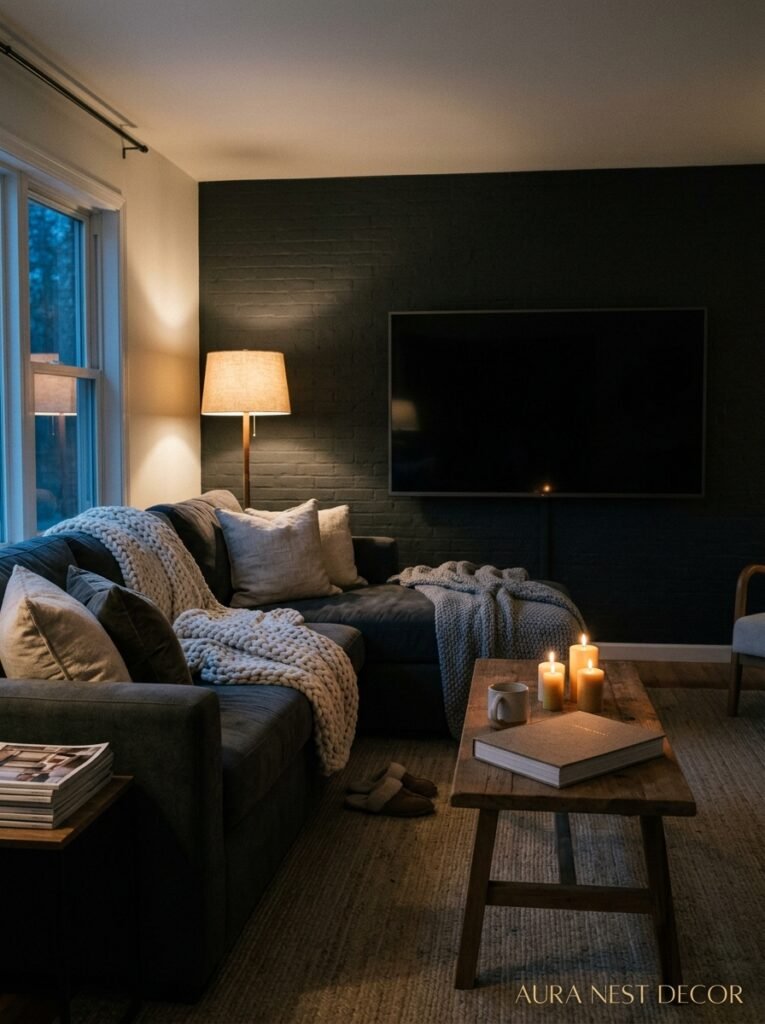
You finally caved. The big one. Eighty-five inches of pure cinematic glory sitting in your living room, and now you’re standing there with a throw blanket in your hand wondering how on earth you make this thing feel warm. Because right now it just feels like a cinema lobby.
—
1. Stop Fighting the TV — Make It the Anchor Everything Else Leans Into
Here’s the mindset shift that changes everything: the TV isn’t the problem. Pretending it isn’t there is the problem.
So many people get an 85-inch screen and then spend months trying to disguise it, distract from it, or balance it out with so much stuff on either side that the whole room looks like it’s in a standoff with itself. That doesn’t work. And honestly, it never will.
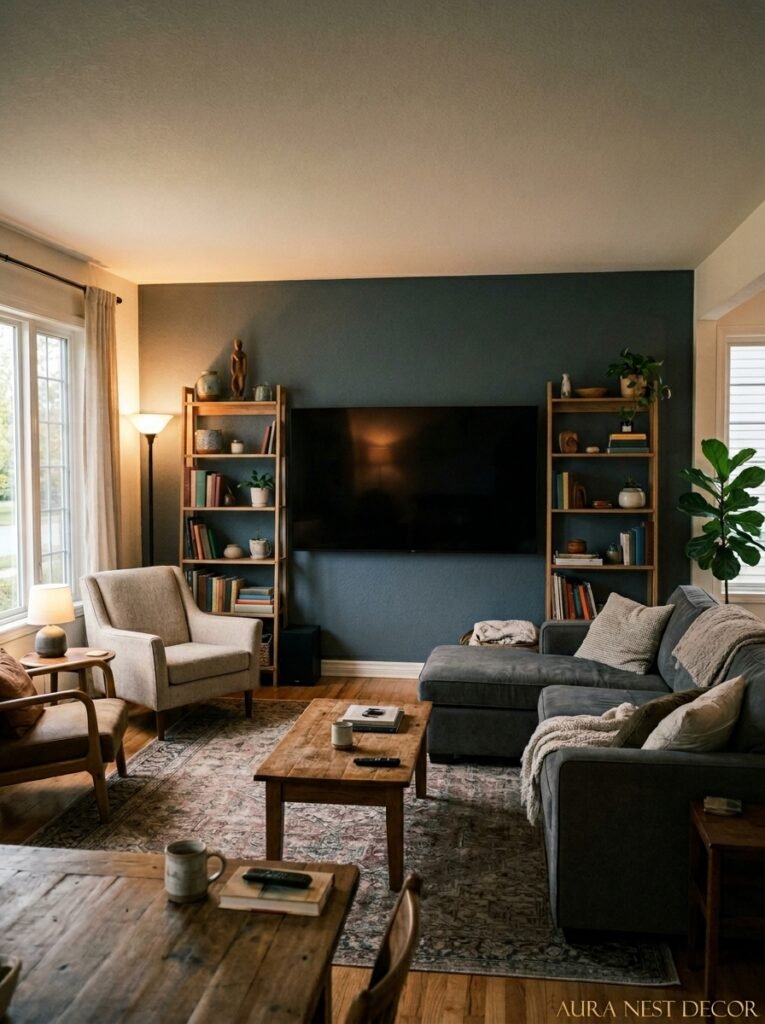
What does work is treating the TV like a fireplace. Because that’s basically what it is now, right? It’s the hearth. People gather around it. Conversations happen facing it. Your couch is pointed at it. So lean INTO that, and build the room with the TV as the anchor point, not despite it.
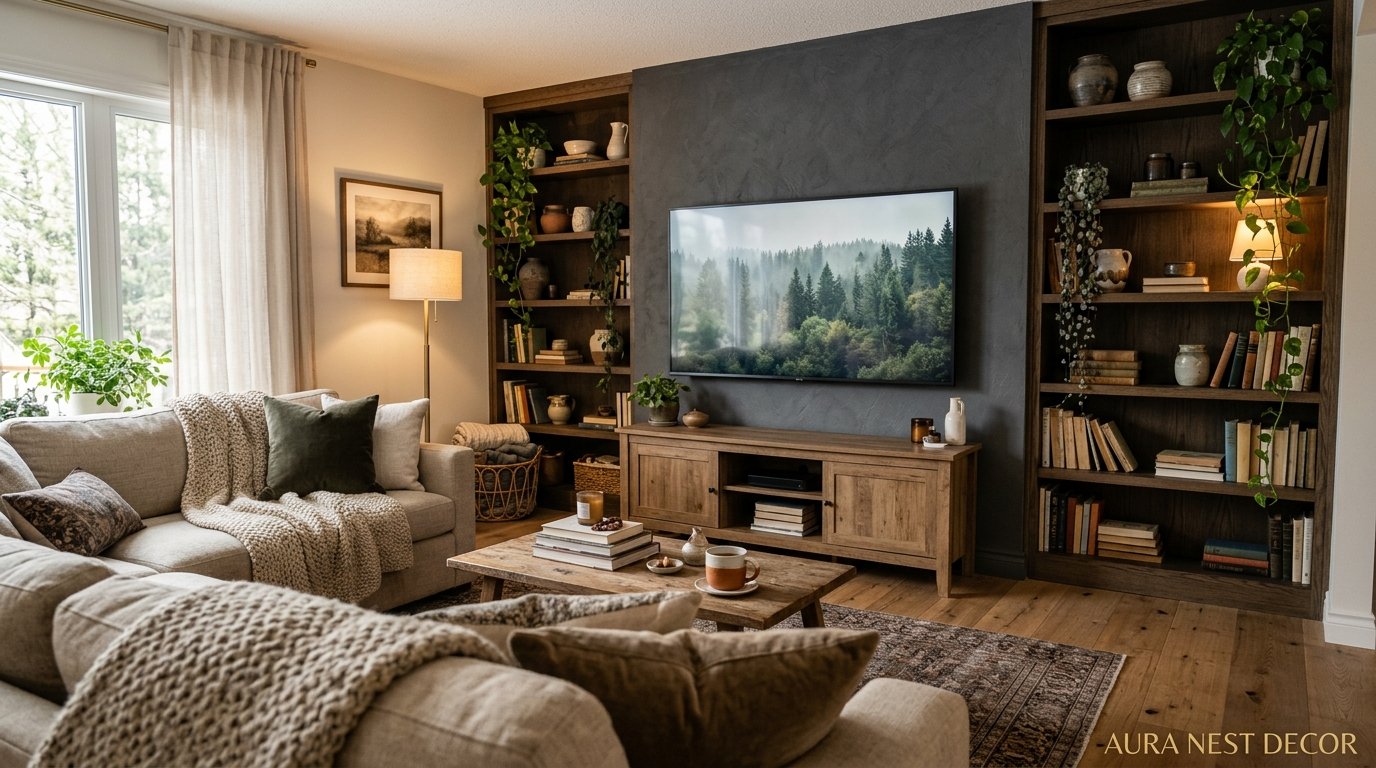
This means the wall it lives on matters enormously. A big, cold, flat white wall behind an 85-inch screen will always feel like a Best Buy showroom. But that same screen mounted on a wall with some depth — a built-in unit, a feature wall in a deep clay or charcoal tone, some texture from paneling or plaster — suddenly it reads as intentional. Considered. Cozy, even.
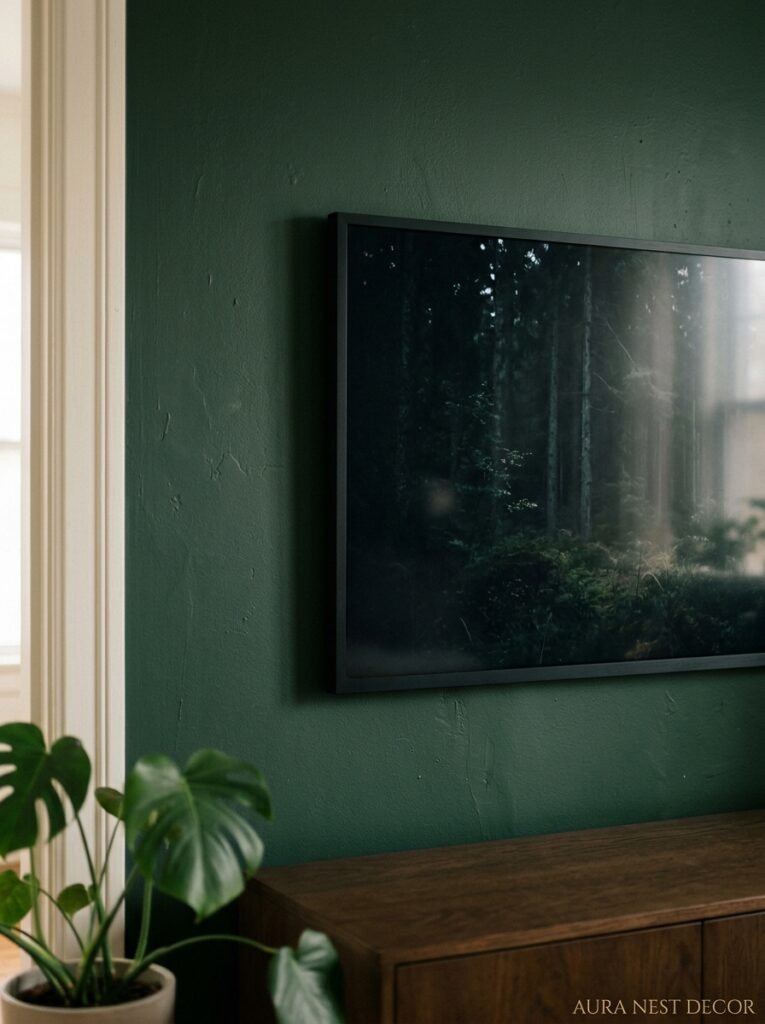
The frame matters here too. If you haven’t already discovered The Frame by Samsung (no, this isn’t sponsored, I just love it), the art mode feature lets the screen display a painting or photograph when it’s not in use. The difference it makes to the “switched off” problem is genuinely kind of extraordinary. A black rectangle becomes a gallery wall moment.
—
2. The Wall Color That Actually Makes an 85-Inch Screen Look Like It Belongs
This is where most people get it wrong. They go light and airy — thinking it’ll make the room feel bigger — and end up making the TV look even MORE dominant against all that pale space.
Dark, warm walls are your friend here. I mean it.
Think about it: when a screen is mounted on a wall that’s already deep in tone — a moody olive, a dusty charcoal, a rich terracotta — the visual contrast between screen and wall drops dramatically. The TV becomes part of the wall rather than a giant black hole punched through it. And when the lights go down for movie night, the whole room wraps around you like a blanket.
In the UK, a lot of designers are reaching for Farrow & Ball’s Railings right now, or Dead Salmon (the name is terrible, the color is gorgeous). In the US, Benjamin Moore’s Kendall Charcoal and Sherwin-Williams’ Urbane Bronze are having a serious moment in living rooms with large screens. These aren’t coincidences. These are deep, warm, saturated tones that do the heavy lifting.
And if you truly can’t go dark — renter, anxious about commitment, whatever — a dark-toned gallery ledge below the TV with some art propped against it creates a similar grounding effect without touching a single wall.
—
3. Why Your Sofa Distance Is Making or Breaking This Room
Okay, quick practical thing that people genuinely don’t think about enough: where your sofa actually sits.
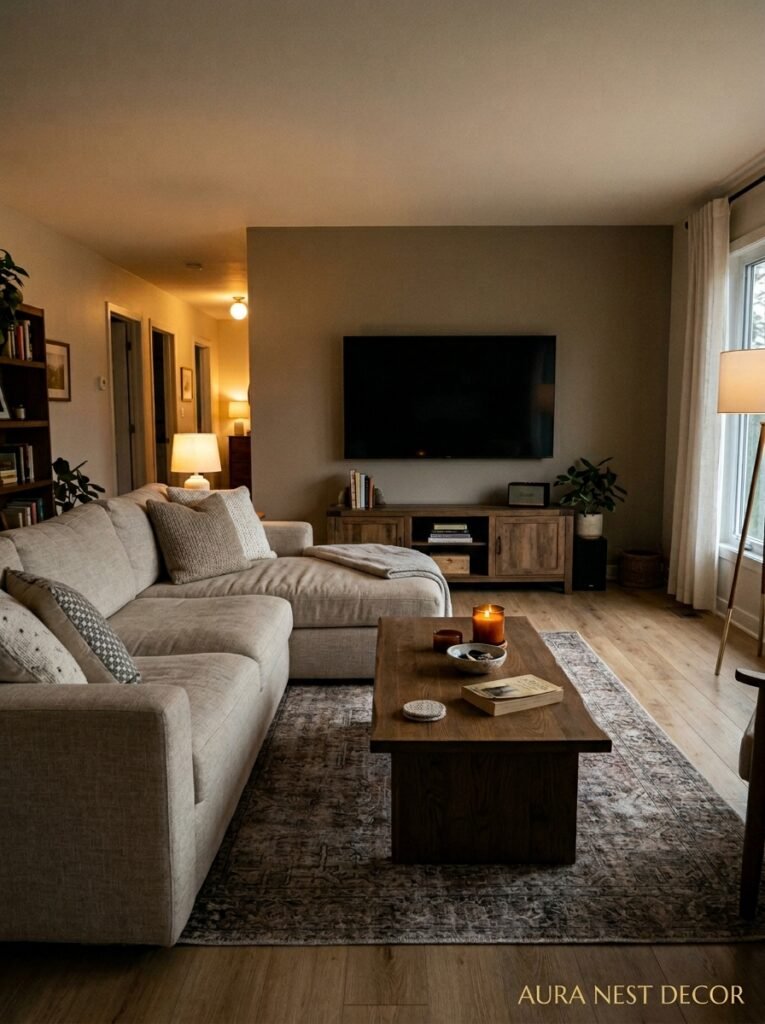
For an 85-inch TV, you want to be sitting roughly 7 to 11 feet away. Too close and you’re craning your neck and it feels overwhelming. Too far and the room starts to feel stretched and cold, like the furniture is trying to escape the screen. That sweet spot — around 8 or 9 feet for most living rooms — is where the magic actually lives.
But here’s what that means for coziness: a lot of people push their sofas against the back wall to “maximize space,” and then they’re sitting 13, 14 feet away from an 85-inch TV in a room that feels like a runway. Pull the sofa forward. Float it in the room. Yes, even if it feels weird at first. Put a beautiful rug underneath it — an area rug anchors floating furniture better than anything — and suddenly that arrangement looks completely intentional.
Floating furniture is actually one of the most underused tricks in creating cozy spaces. When the sofa is pulled away from the wall, there’s room behind it for a skinny console table, a lamp, maybe a trailing plant. The whole room becomes layered and full rather than flat and furniture-lined.
—
4. Lighting Is Doing More Work Than You Realize (and Probably Not Enough of It)
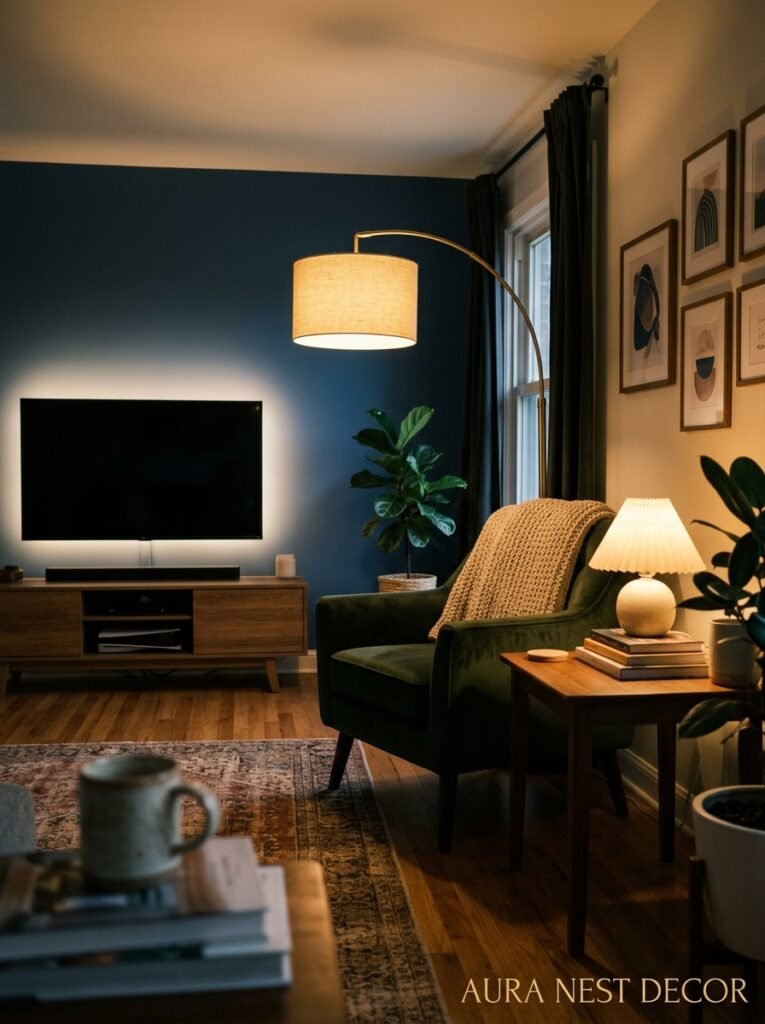
The amber glow of a lamp at 7pm on a winter evening is a completely different experience from overhead ceiling lights at the same hour. I cannot stress this enough.
Big screens in overhead-lit rooms feel like offices. That’s the truth. The harsh, even distribution of ceiling light doesn’t create depth, doesn’t create shadow, doesn’t create any of the warm pockets that make a room feel genuinely cozy. It just illuminates everything equally and makes the TV look like a monitor at a workstation.
So: layer your lighting. Multiple sources, all warm-toned, all on dimmers if you can swing it.
A floor lamp tucked behind the sofa — slightly taller than the sofa back — throws beautiful indirect light across the ceiling and creates that “golden hour” effect even in January. Sconces on either side of the TV wall do something remarkable: they frame the screen and eliminate the harsh contrast between a bright screen and a dark wall, which actually reduces eye strain too, not just a style thing. Table lamps on side tables and consoles. A small LED strip behind the TV set to a warm amber (not blue-toned, please, not ever blue-toned for cozy spaces) — this is called bias lighting and it genuinely changes the viewing experience.
“The right lamp in the right corner can make an 85-inch TV feel like a fireplace. The wrong overhead light can make a fireplace feel like a parking lot.”
—
5. The Furniture Layout That Makes a Giant Screen Feel Intimate
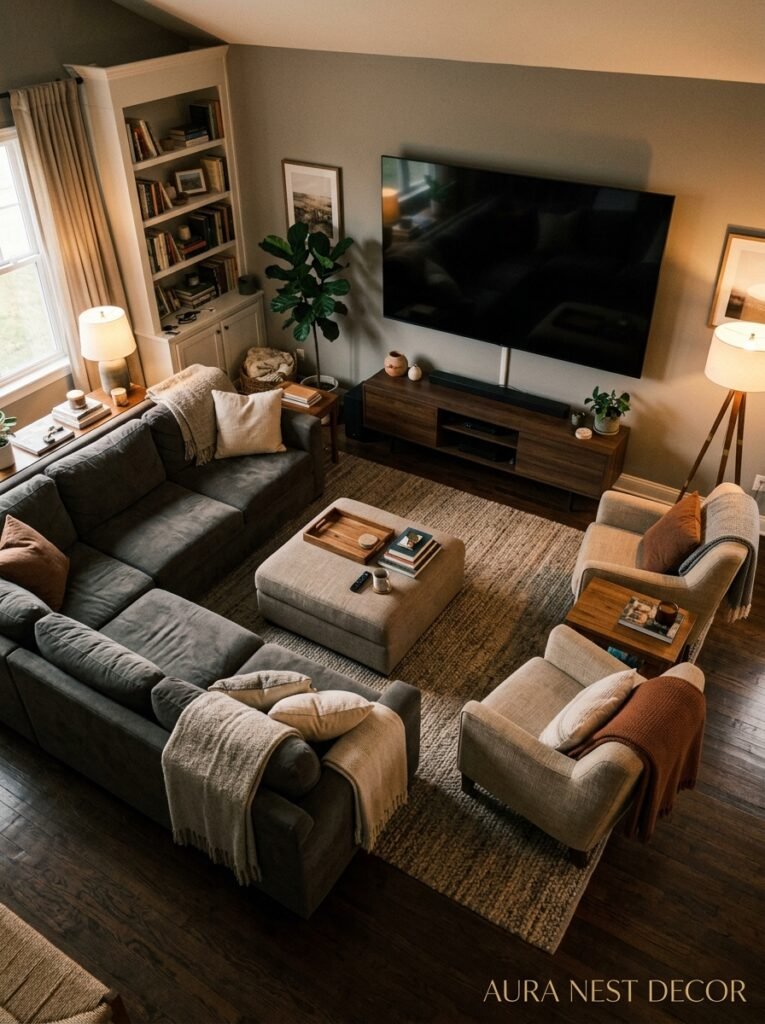
Here’s a layout principle that works almost universally with oversized screens: the horseshoe arrangement.
Sofa centered facing the TV. Two chairs — or one chair and one loveseat — angled inward on either side. A coffee table in the middle. Done. This arrangement creates a conversation zone that also happens to face the screen, so you don’t have to choose between watching together and talking together. It’s both.
The key is that each seat in the horseshoe feels close to the others. You want people to be able to set their drinks down on the same coffee table, reach for the same blanket, lean toward each other. That closeness — the physical proximity — is what makes a living room actually cozy regardless of how big the screen is.
Side note: if you’re working with a narrower room in a British terrace house or an American row home, the full horseshoe might not be achievable. A sofa plus two poufs or ottomans placed diagonally can get you most of the same effect in less footprint. Don’t underestimate poufs, is what I’m saying.
—
6. The Bookcase Trick That Interior Designers Use Around Large TVs
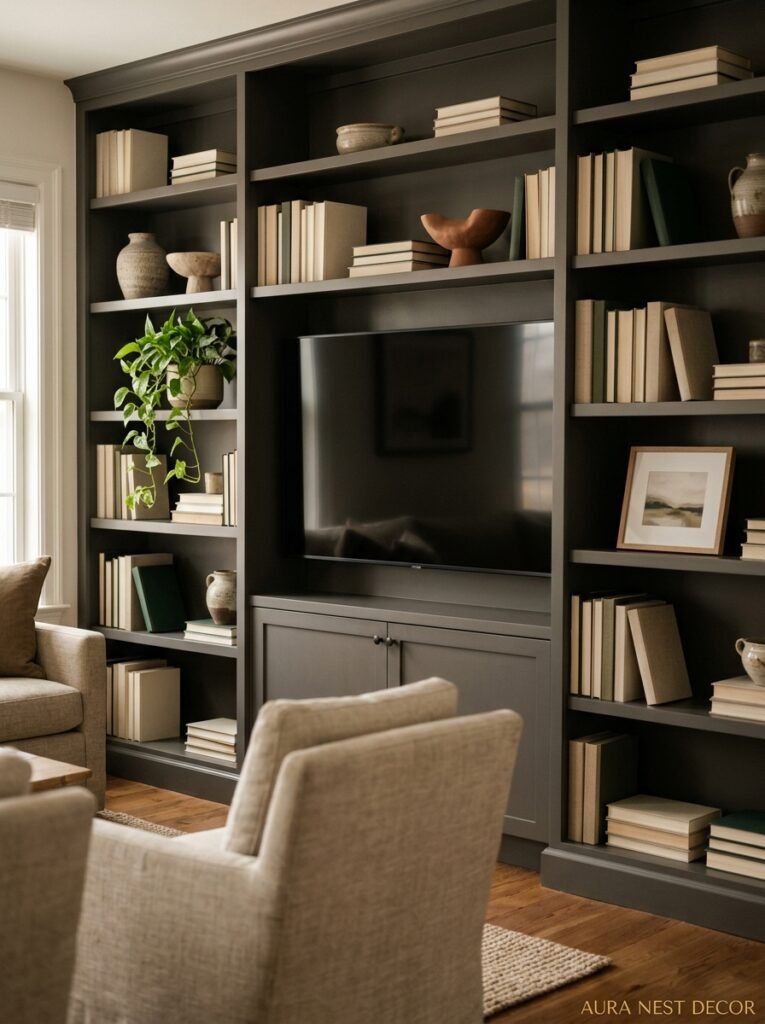
Built-in bookshelves flanking a large TV. It’s everywhere on Pinterest. And there’s a reason it keeps coming back.
It works because it does four things at once. It frames the screen so it doesn’t look like it’s just floating on a blank wall. It adds visual texture through books and objects. It provides storage, which reduces clutter elsewhere in the room. And — this is the one people don’t talk about enough — it makes the TV look proportional to the wall rather than enormous within it.
When an 85-inch TV sits alone on a standard 12-foot wall, it’s roughly 25% of the wall’s width. That’s a lot. But flanked by two 18-inch deep bookcases with open shelving, the whole built-in unit might span 9 or 10 feet of that wall. Now the TV is a centered element within a larger composition. Your eye reads the whole thing, not just the screen.
You don’t need actual built-ins, though they’re obviously gorgeous. IKEA’s Billy bookcases with crown molding added to the top fool the eye completely. So do freestanding shelving units pushed flush against the wall on either side. Style them with a mix of books, plants, ceramics, framed photos — not too neat, not too chaotic — and the effect is basically the same.
“The secret to making a huge TV look intentional? Give it something to belong to.”
—
7. Textiles Are What Actually Make a Room Feel Cozy (The TV Doesn’t Know What It’s Near)
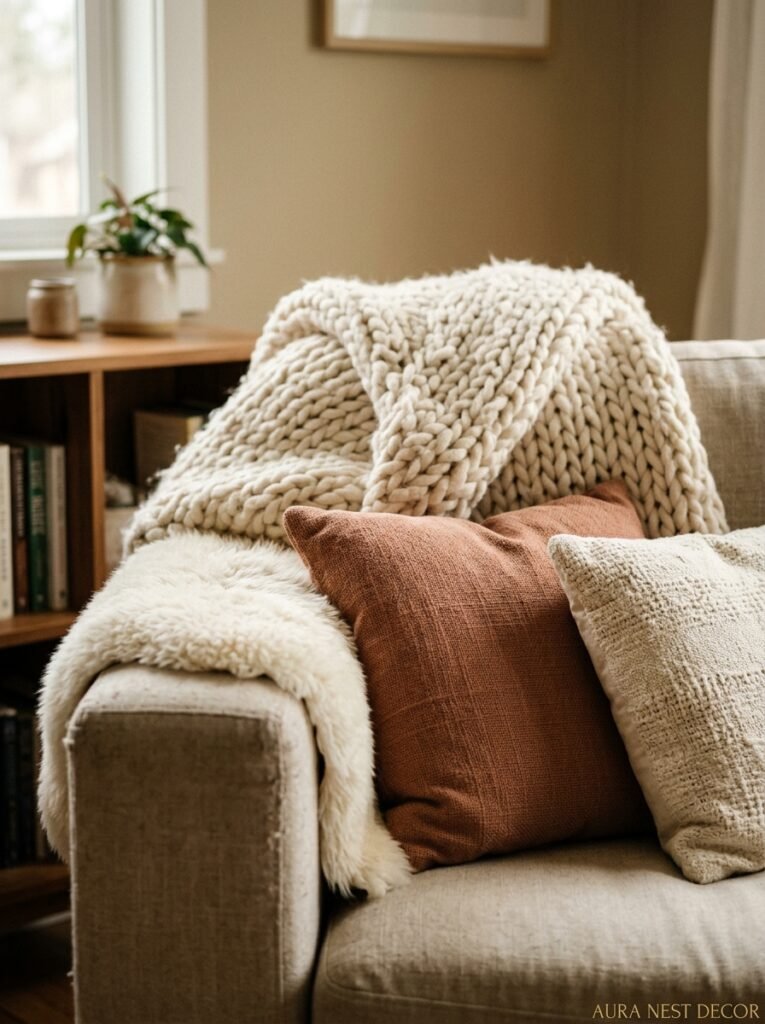
Okay, I want to make a point here: coziness doesn’t come from what’s on your wall. It comes from what you can touch.
Textiles. Layers of them. A chunky knit throw slung over the back of the sofa — the kind that looks like it weighs 11 pounds. Velvet cushion covers in terracotta or mustard. A wool or jute rug with enough pile that you genuinely want to sit on the floor. Linen curtains that puddle very slightly at the bottom.
These things have nothing to do with your TV size and everything to do with how the room feels when you walk in at 6pm in November and drop your bag by the door. That feeling — that physical warmth and softness — is the whole point of a cozy living room, and the good news is that not a single textile item needs to coordinate with an 85-inch screen.
In the US, bouclé is everywhere right now and for good reason — it photographs beautifully and feels incredible. In the UK, there’s a real moment happening with knitted and woven cotton throws in natural, undyed tones. Both are perfect for a screen-anchored living room because they bring softness to what is otherwise a very tech-forward piece of furniture.
—
8. The Rug Size Mistake That Makes Every Large Living Room Feel Wrong
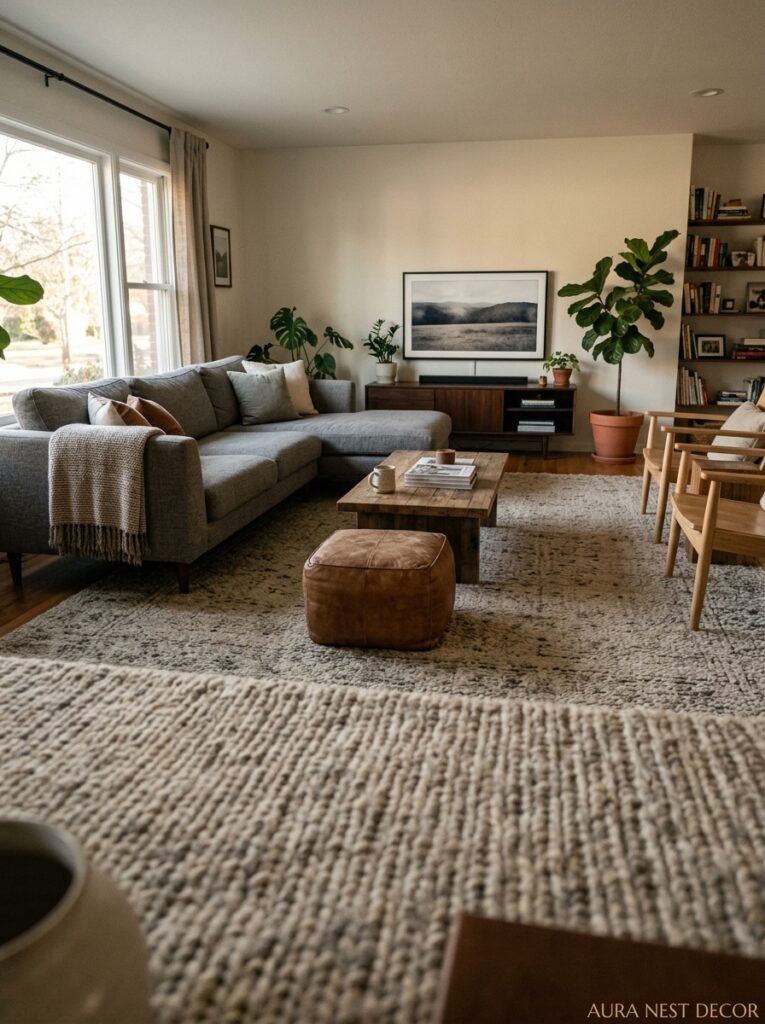
The rug is too small. I know it is. It almost always is.
A small rug under a floating sofa arrangement looks like a bathmat. I’m being blunt because people make this mistake constantly and then wonder why the room feels off. For an 85-inch TV setup — which typically means a larger living room — you’re almost certainly looking at a 9×12 rug minimum. Probably bigger. An 8×10 will work in some rooms but you’ll feel the tightness.
The rule of thumb is simple: all the key furniture legs should sit on the rug, or at least the front legs. The rug defines the seating zone. It pulls the room together. And in a larger living room where the sofa might be floating 8 or 9 feet from the TV wall, a properly sized rug is the thing that makes the whole arrangement feel like one cohesive space rather than a bunch of furniture scattered on a floor.
Warm tones, not too pattern-heavy. Vintage-style Persian rugs are having a permanent moment on Pinterest and they work beautifully in rooms with large screens because the visual busyness of the rug balances the visual simplicity of the TV wall.
—
9. What to Do With the Cords (Because Nothing Kills Cozy Faster)
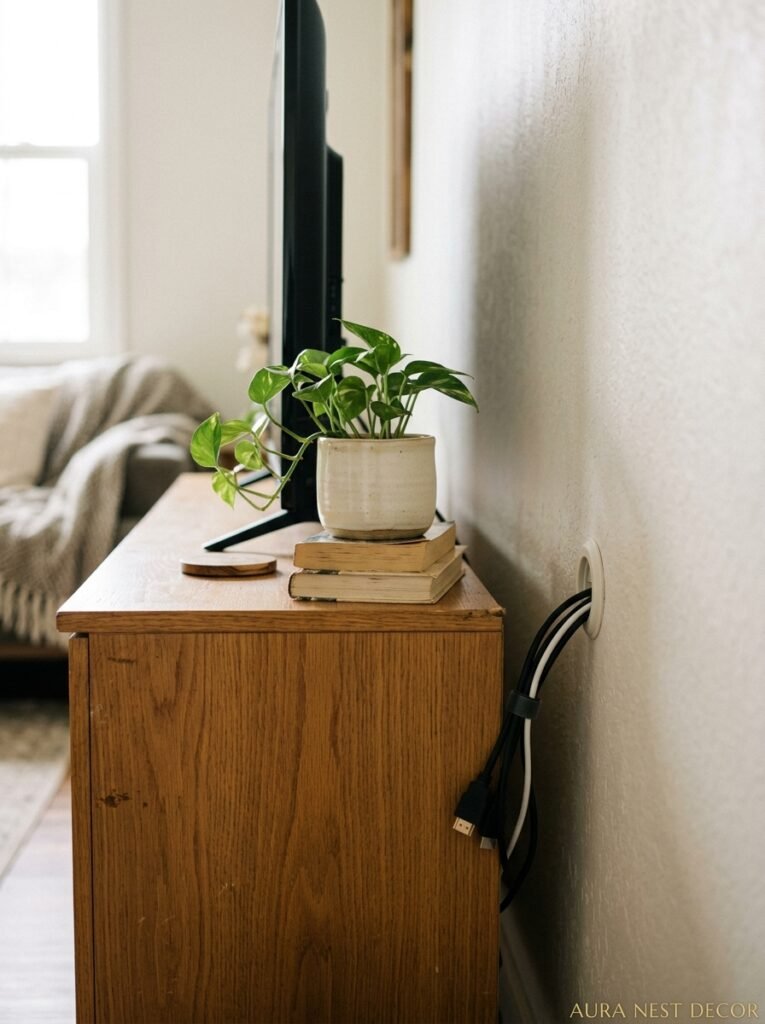
You know what’s not cozy? A cascade of black cables dangling from an $1,800 television.
Sort the cords. Please. I say this with love but also urgency.
In-wall cable management kits are about $30 at any hardware store and they’re a weekend DIY job, even for people who’ve never drilled into drywall before. You run the cables through the wall from the TV down to the TV unit below. Clean. Gone. Done.
If you’re renting or you really can’t do anything with the wall, a cord cover raceway in the same color as your wall becomes nearly invisible. White on white, dark on dark. Alternatively, a floor-to-ceiling standing TV unit that houses the power strip and all peripherals keeps everything in one contained column.
Wireless solutions are getting better too — some people opt for the Sonos system and a streaming stick purely to eliminate the cable situation. Not gonna lie, the no-cord life is worth considering if you’re starting fresh.
—
10. Plants and the 85-Inch TV: A Surprisingly Important Relationship
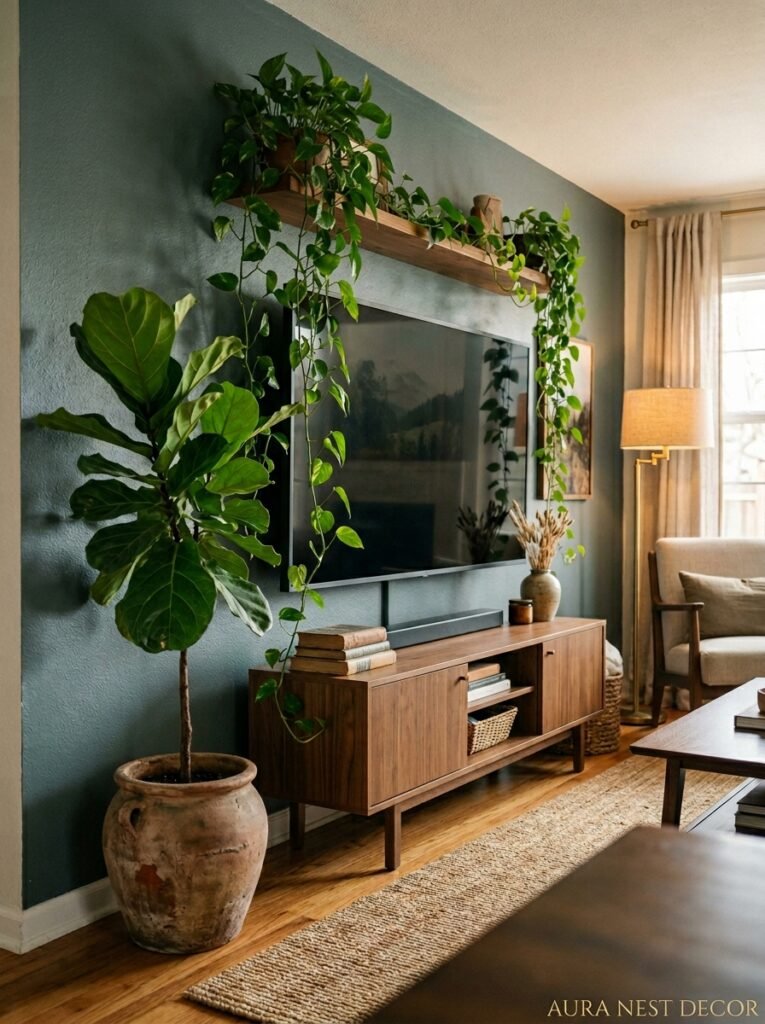
Organic shapes next to hard technology. It sounds small. It’s not.
A large fiddle leaf fig or a monstera in the corner beside the TV wall brings something into the room that no amount of cushions or throws can replicate: a living, irregular, natural form. The eye moves from the flat hard rectangle of the screen to the curving, imperfect shape of leaves, and the room immediately feels more balanced. Less electronic showroom. More someone actually lives here.
Trailing plants on shelves flanking the screen do the same thing on a smaller scale. A pothos or an ivy allowed to trail down from a shelf gets a bit messy and a bit lovely and feels genuinely lived-in. Which is the whole point.
Don’t worry too much about perfect plant placement in relation to light — most low-to-medium light plants will tolerate a TV wall as long as there’s some ambient room light. Snake plants, ZZ plants, and pothos are basically indestructible and they look beautiful in deep-toned living rooms.
—
11. Why the TV Console Choice Matters More Than the TV Itself
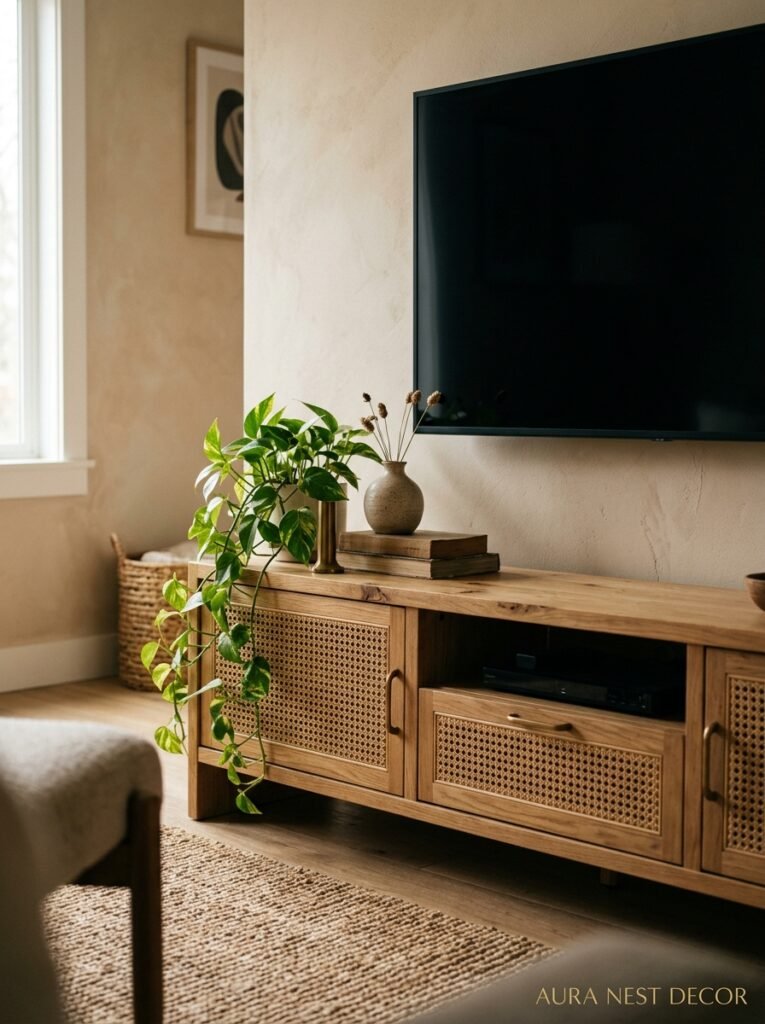
People spend weeks researching the television and fifteen minutes picking the stand.
The TV console is doing enormous visual work in this room. It’s the base. The foundation. And for an 85-inch screen, you want something substantial — not a thin floating shelf that makes the TV look like it’s about to topple, but a proper low console with some weight and presence.
Wide, low sideboards are perfect. They ground the TV, they provide storage, and they create a horizontal visual line that the eye follows across rather than up and down (which is what you want — horizontal emphasis in a room with a big vertical-ish rectangle). Something around 72 to 80 inches wide in a warm wood tone — walnut, oak, mango wood — gives the whole TV wall that grounded, furniture-first feeling.
“Style the console like you’d style a shelf in a home you actually love, not like you’re setting up a display model.”
Candles on the console. A ceramic bowl. A stack of art books. Maybe a trailing plant on one end. These things make a TV wall feel like a decorated room rather than a tech setup.
—
12. The Exact Atmosphere You’re Actually Going for — and How to Know When You’ve Hit It
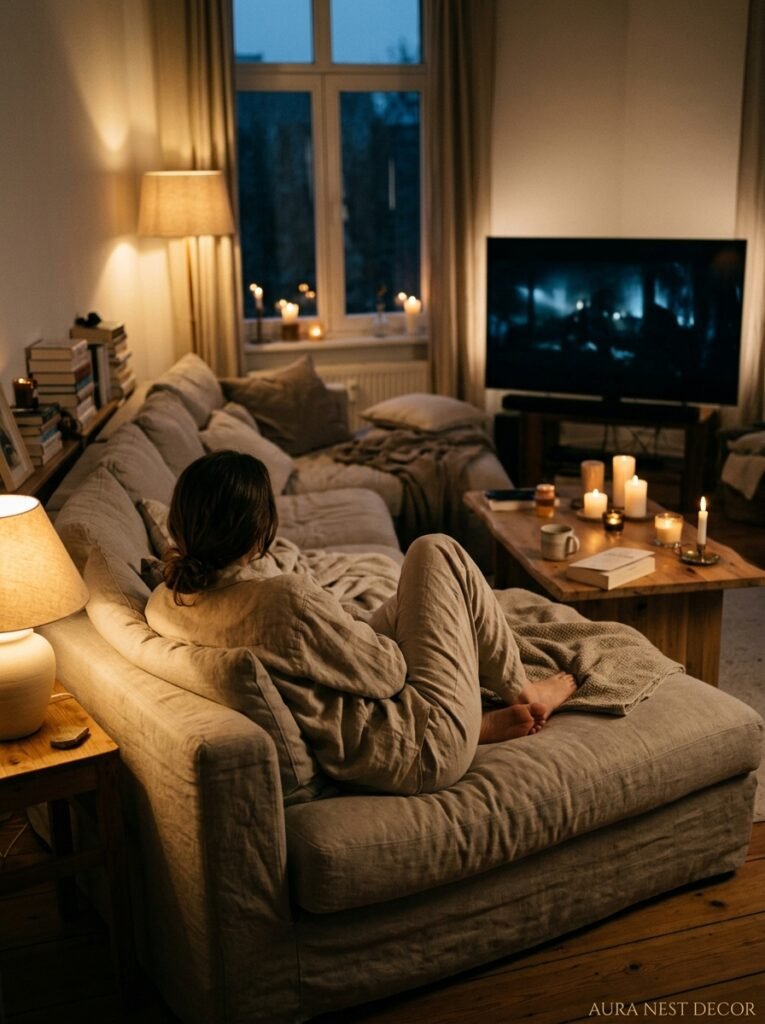
There’s a moment when a room just clicks. You’ve felt it in other people’s houses. That sense of wanting to sink into the sofa and not leave for three hours.
That feeling isn’t about any single thing. It’s not the paint color alone or the throw alone or the lighting alone. It’s all of them working together, and — crucially — it’s the absence of stuff that doesn’t belong. Clutter kills cozy faster than anything. A room with the right pieces, the right scale, the right warmth, and nothing unnecessary? That’s the target.
With an 85-inch TV, you’ve already got your hero piece. Now the job is building a room around it that says: this is a place to be together, to slow down, to actually enjoy. Not a place to scroll in. A place to be IN.
Walk in. Sit down. Can you reach your drink without leaning? Is the light warm? Are there three surfaces you want to touch? Can you see the TV without straining your neck? Do you want to stay?
If yes to all of those: you’re done.
—
❓ FAQ
Q: What height should an 85-inch TV be mounted at for a cozy living room feel? A: The center of the screen should sit roughly at eye level when you’re seated — usually about 42 to 48 inches from the floor to the center of the TV. Mounting it too high is one of the most common mistakes and it’s brutal on the neck over a long evening. If anything, err slightly lower rather than higher.
Q: Can an 85-inch TV work in a smaller living room? A: It can, with the right distance. You want at least 7 feet between the screen and your main seating — ideally 8 to 9. In a genuinely small room, a 75-inch might serve you better both ergonomically and proportionally, but if you’re committed to the 85, dark walls and smart furniture floating will minimize the “it’s eating the room” effect.
Q: What’s the best TV unit for an 85-inch TV to make it look less stark? A: Go wide and low. A sideboard or media console that’s at least 70 inches wide keeps the TV from looking like it’s balanced on a cocktail stick. Warm wood tones — walnut, oak, or mango wood — do the most work in creating that furniture-first, cozy-rather-than-tech-forward feeling.
—
💭 Final Thoughts
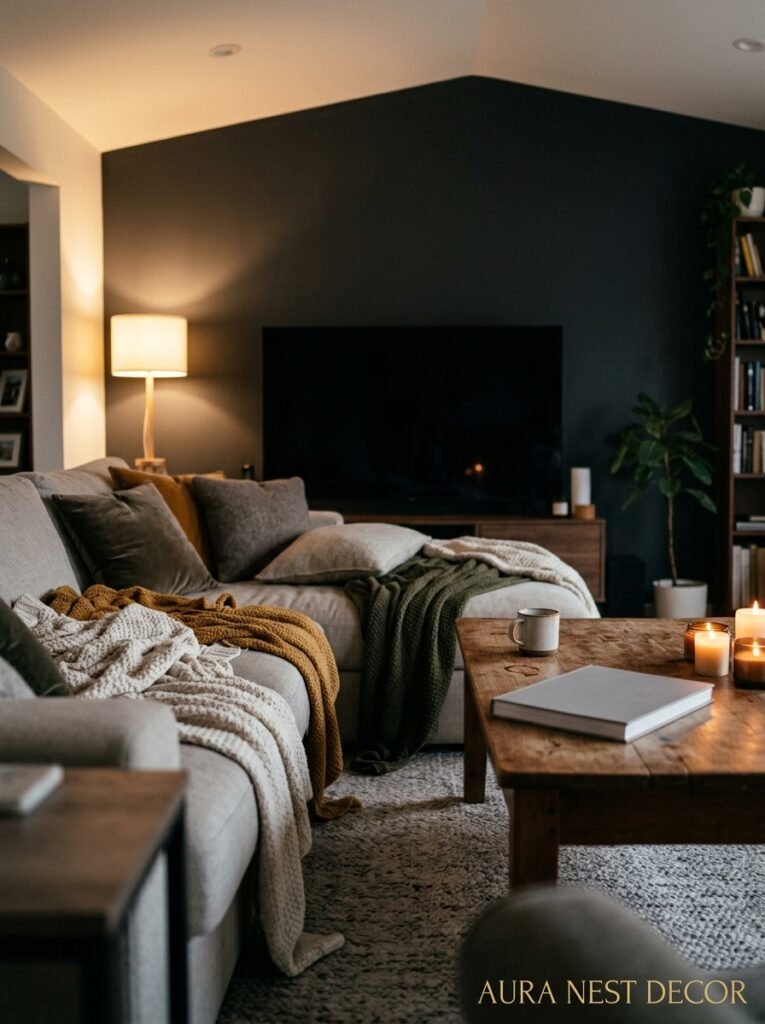
An 85-inch TV in a cozy living room isn’t a contradiction. It just takes a little more intention than a smaller screen does, because the scale is unforgiving — it amplifies everything, the beautiful decisions and the lazy ones equally. Get the wall, the lighting, and the textiles right, and honestly the TV almost disappears into the room. Almost.
What does your current TV setup look like — and what’s the one thing that still feels off about the room?