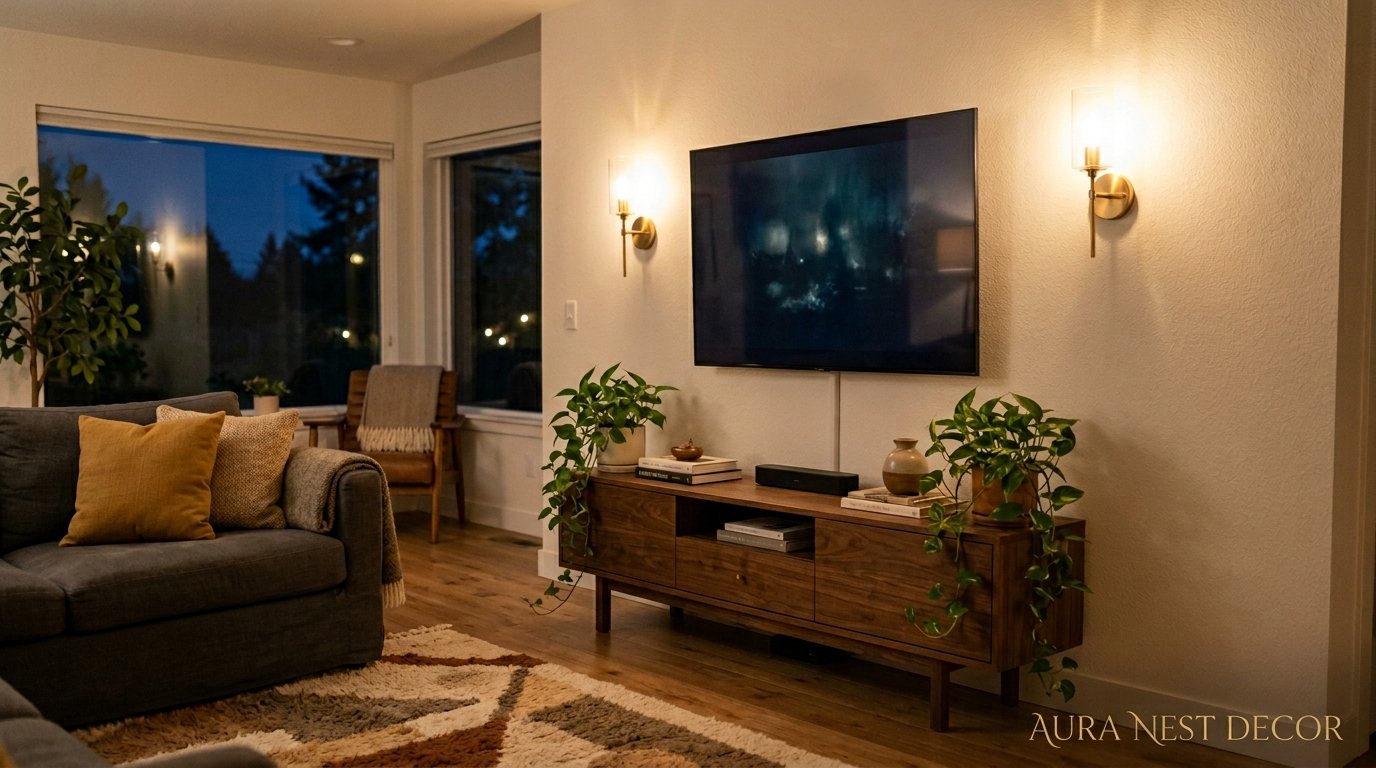
Your TV Doesn’t Have to Ruin Your Living Room (Here’s How to Actually Make It Cozy)
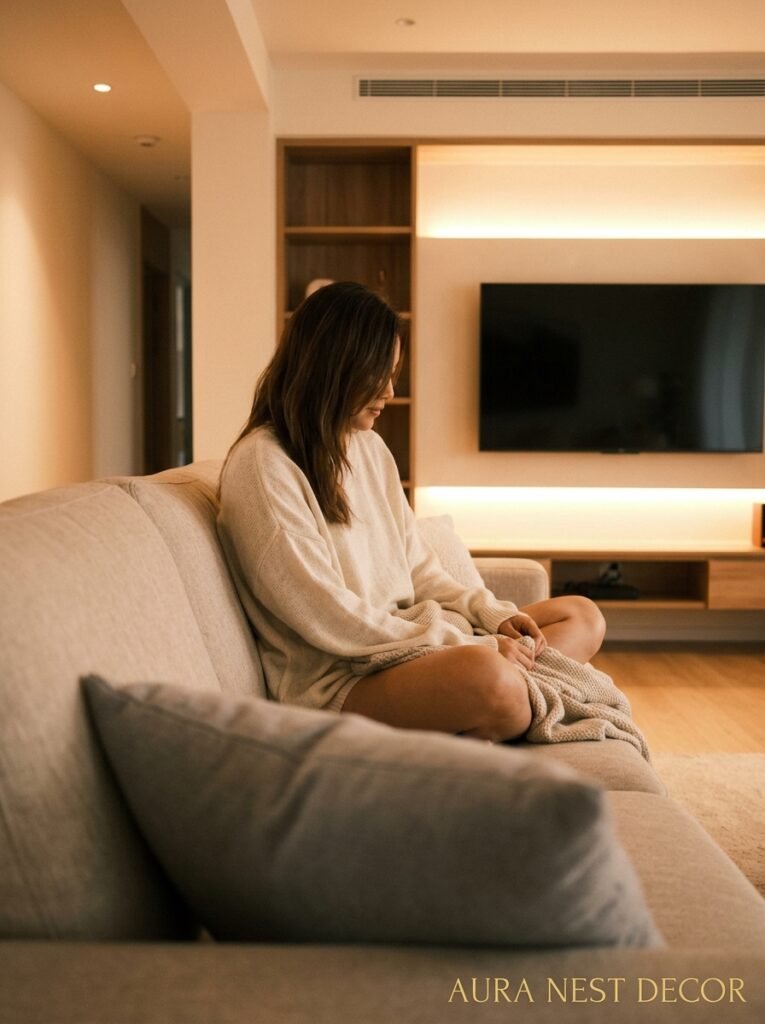
You know that feeling when you walk into someone’s living room and everything just… works? The TV is somehow part of the space, not dominating it. The couch looks lived-in in the best way. There’s a warmth you can’t immediately name. That’s what we’re chasing here, and it’s more achievable than you’d think.
—
1. Why Most TV Walls Feel Cold (And the Dead-Simple Fix Nobody Talks About)
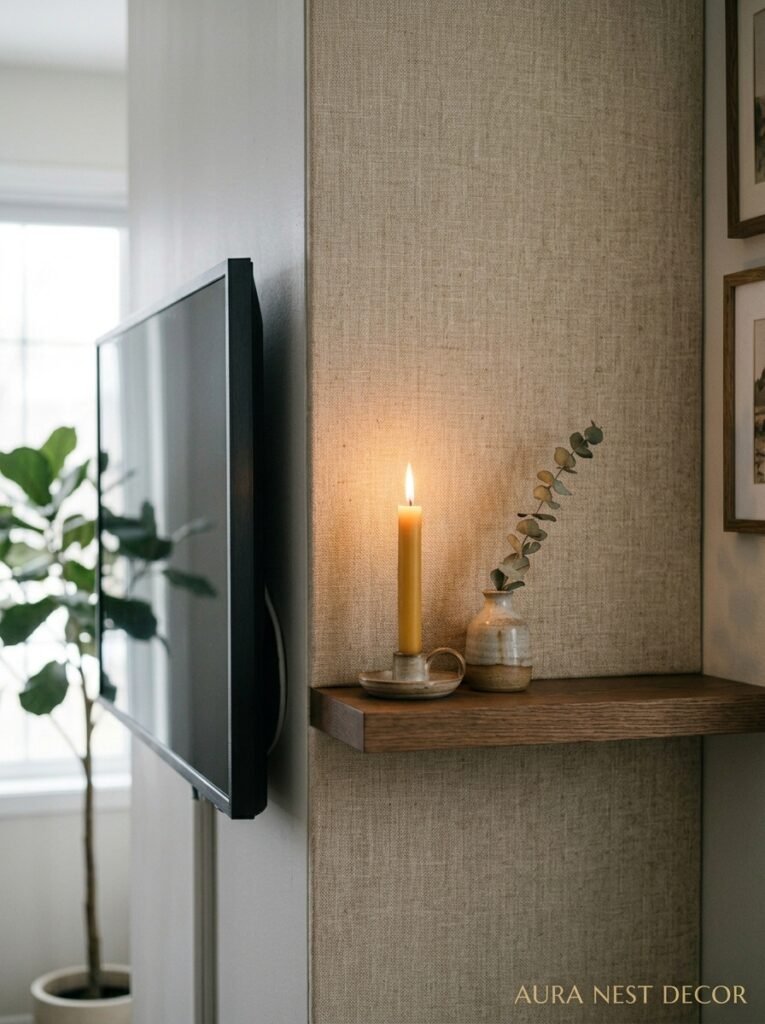
Here’s the thing nobody says out loud: most TV walls feel cold because the TV is the ONLY thing on them. Just a black rectangle, staring at you. It’s like hanging one sad painting in a gallery — the emptiness makes it worse, not better.
The fix isn’t complicated. It’s layers.
When you add things around and near the TV — not just beside it but below it, above it, in front of it — your brain stops reading “screen” and starts reading “room.” A chunky wooden console. A trailing plant on one side. A few candles at different heights. Suddenly the TV is just one part of a moment, not the whole point.
And I know what you’re thinking. Won’t that look cluttered? Not if you give each element some breathing room. The difference between cozy and chaotic is usually just spacing. Pull things back an inch or two. Let them exist without crowding each other. Real homes have a little imperfection in the arrangement, and that’s actually what makes them feel warm.
What you’re going for is this: when someone walks in and the TV is off, they should feel something. A pull toward the corner. A “oh this is nice.” The TV wall should work hard even when nothing is playing.
“If your living room only works when the TV is on, something’s missing.”
2. The Console Table Trick That Changes Everything About Scale
Scale is everything and almost no one gets it right on the first try.
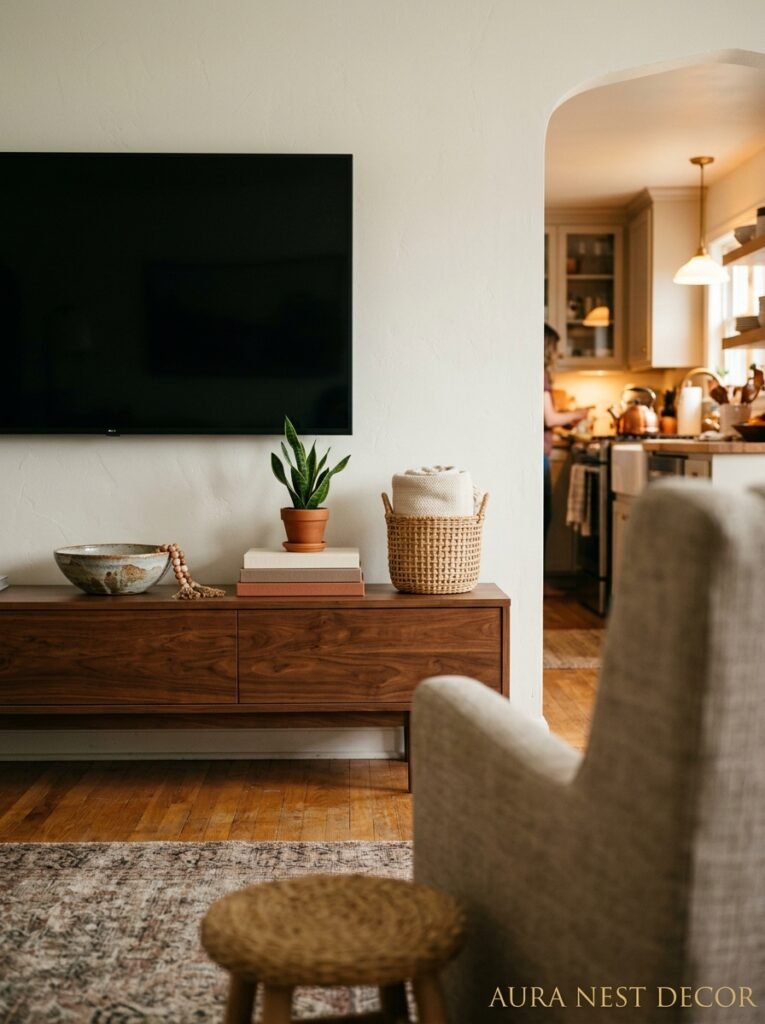
The console under your TV — whether it’s a floating shelf, a sideboard, a proper media unit, whatever — should feel substantial. Not flimsy. Not an afterthought. If your 65-inch TV is sitting on a skinny little stand with spindly legs, that’s your problem. The TV will always look too big and too imposing, because there’s nothing grounding it.
Go wider than you think you need to. Ideally your console or media unit is at least as wide as your TV, if not wider. Some of the most gorgeous living rooms I’ve seen have units that extend well past the screen on both sides, almost like a stage. It gives the TV something to belong to.
What goes on top of and around that console matters too. Keep it real. A stack of actual books you’ve read. A ceramic bowl with the remote in it — functional AND pretty. A low vase with a single stem or a small trailing pothos that spills down the side. Don’t just buy five “decor objects” from a homeware shop and line them up. That’s when it starts looking like a display, not a home.
And honestly? If you’ve got a fireplace or a beautiful architectural feature somewhere else in the room, consider whether the TV even needs to be the focal point at all. Sometimes it doesn’t.
3. The Color Behind the Screen That Makes Your Room Feel Like a Hug
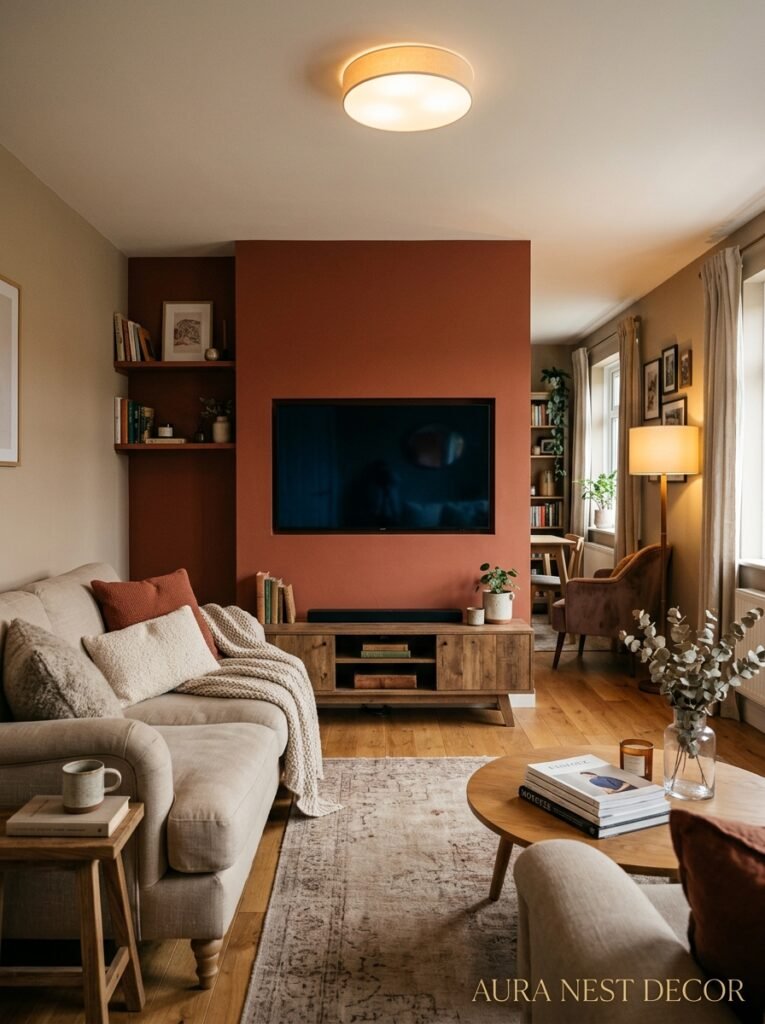
Paint. I cannot say this enough.
The wall behind your TV is one of the highest-impact, lowest-cost changes you can make in any living room. And yet people paint it the same white as every other wall and wonder why the room doesn’t feel finished.
A dark accent wall behind the TV does two things. First, it makes the TV disappear a bit — the black screen blends into a deep charcoal or forest green much better than it does against a stark white. Second, it creates instant depth and drama. Even a small living room in a semi-detached house in Manchester or a compact apartment in Chicago can feel like it has proper bones once there’s a dark wall anchoring the space.
The colors that are working EVERYWHERE right now: deep sage green, warm terracotta, mushroom brown, moody navy, inky charcoal. Not pure black — that can tip into harsh. But anything just one shade warmer or softer than black? Stunning.
Side note — if you rent and can’t paint, temporary wallpaper has gotten genuinely good. There are peel-and-stick options that actually look like real wallcovering now. Not a consolation prize anymore.
4. How Lighting Does More for Your TV Wall Than Any Piece of Decor
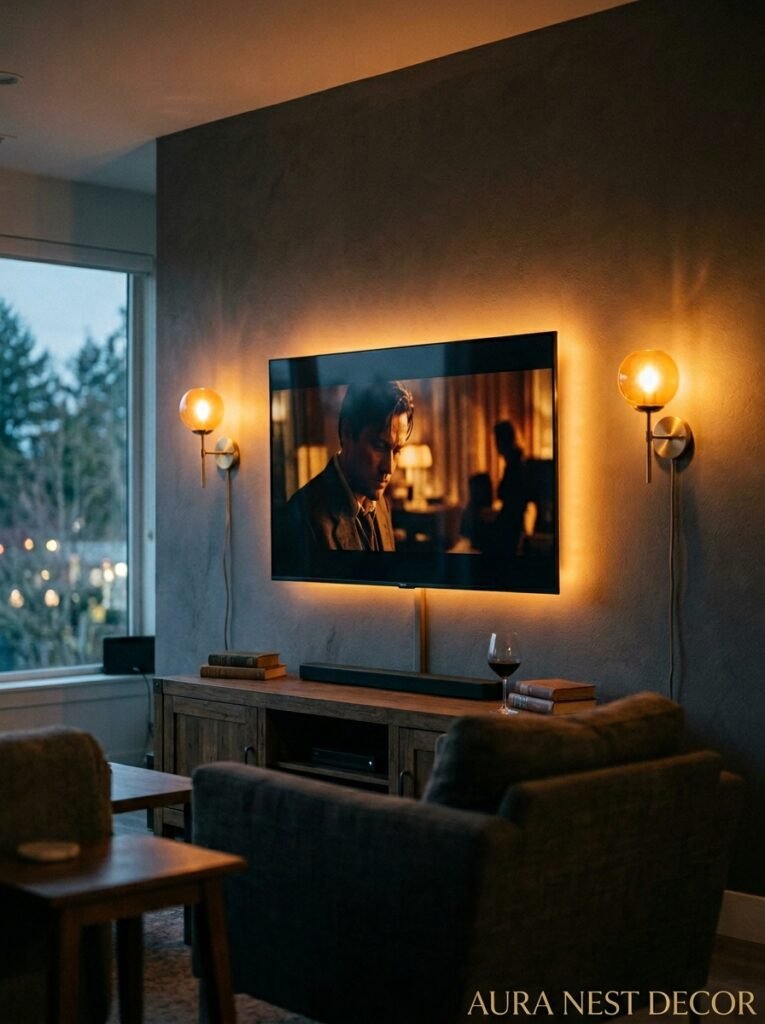
Can we talk about lighting for a second? Because this is where most rooms fall apart completely.
Overhead lighting — especially a bright white ceiling light — kills coziness dead. It doesn’t matter what you’ve done with your furniture or your console or your plants. If the room is lit like a dentist’s waiting room, it’s not going to feel warm.
The goal around your TV wall specifically is ambient glow. Not bright. Not dim to the point of useless. Amber. Layered. Low.
A floor lamp in the corner nearby — the tall, arched kind that curves over toward the seating area — gives you that sweep of warm light without pointing directly at the screen (which causes glare anyway). Table lamps on the console itself on either side of the TV create symmetry and warmth at once. And bias lighting — those LED strips you mount behind the TV on the wall — are genuinely underrated. They reduce eye strain AND they add this soft halo effect that makes the whole wall look intentional.
The amber glow of a warm-toned bulb at 7pm, with a lamp in the corner and a couple of candles on the console. That’s the feeling. Everything else is just logistics to get there.
“Cozy lighting isn’t about how much you have. It’s about where it lands.”
5. Plants That Actually Work Next to a TV (Not Just the Obvious Ones)
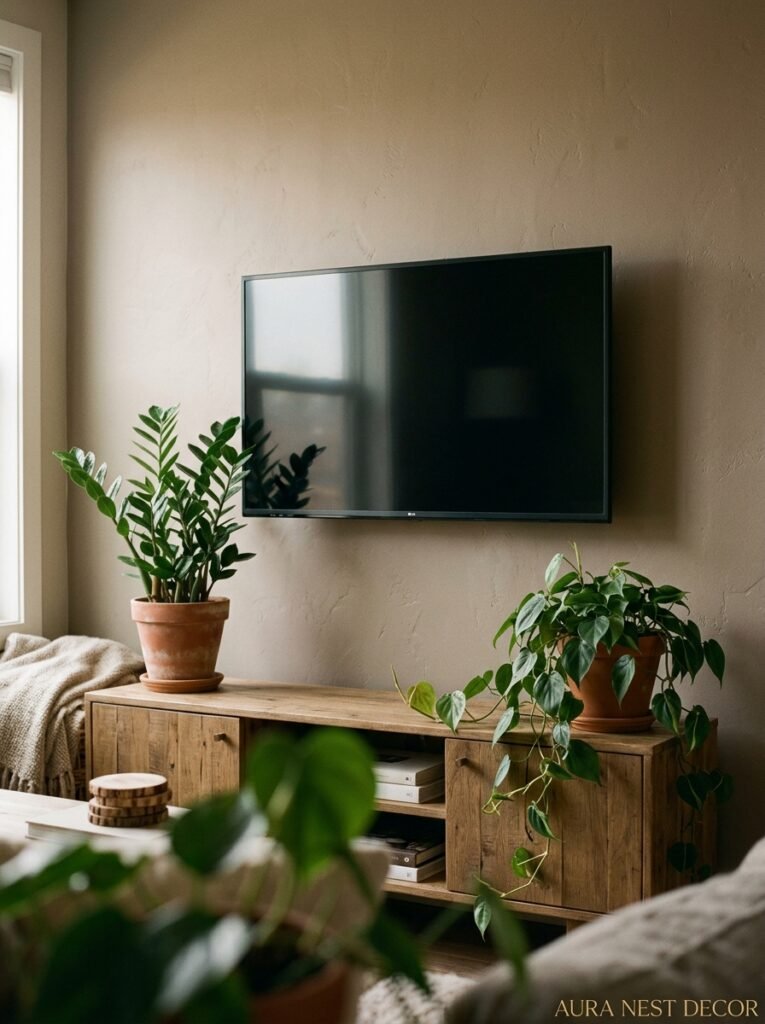
Everyone says “add a plant” and then shows you a perfect fiddle leaf fig that’ll be dead in three weeks. Let me be more useful than that.
Plants next to a TV wall need to deal with a few things: usually lower light, indoor heating or air conditioning drafts if you’re in the US, and the fact that you’ll probably forget to water them when you’re deep in a Netflix binge. So we’re not picking fussy plants. We’re picking tough ones that look gorgeous anyway.
A golden pothos trailing down from a high shelf is probably the best TV wall plant in existence. The variegated leaves catch light beautifully, the trailing vines soften any hard edges, and it genuinely thrives on neglect. Snake plants are another one — sculptural, upright, and they look incredibly good against a dark accent wall.
If you want something a bit more dramatic, a monstera in the corner beside the TV — not directly next to it, but nearby, slightly behind the seating area — can completely change the scale and feel of the room. It creates a sense that the room keeps going even when you’ve hit the wall.
Basically: trailing or sculptural. Those are your two modes. Anything floppy or delicate in between will just stress you out.
6. The Gallery Wall Around a TV That Doesn’t Look Like a Design Blog Cliché
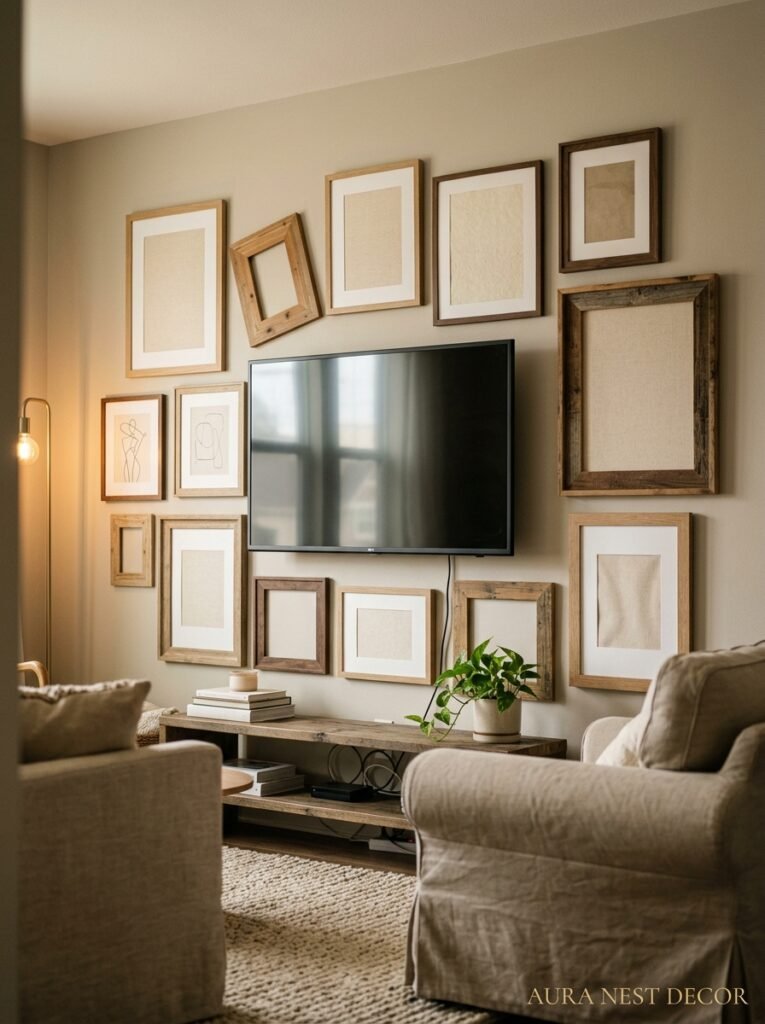
Gallery walls get a bad reputation and I get it. There’s a very specific early 2010s version of this — the herringbone arrangement with matching black frames and inspirational quotes — that deserves to stay in the past.
But an organic arrangement of frames around and beside a TV? Done right, it’s one of the most personal and visually rich things you can do with that wall.
The key is to treat the TV as one element in the arrangement rather than the thing the frames are orbiting. So the frames don’t all point at the TV or form a perfect border around it. They spread out. Some higher, some lower. Some close to the TV, some further away. You’re creating a visual field, not a frame.
And the frames themselves — please don’t match them perfectly. Two or three coordinating finishes is fine: maybe warm wood tones and one or two thin black frames mixed in. But a wall of identical frames feels sterile. Real collections look gathered, not purchased in one shopping cart.
What goes IN the frames is a whole conversation, but the short version: personal photos mixed with art prints mixed with one or two unexpected things (a vintage map, a botanical illustration, an actual piece of fabric behind glass) beats any curated print set you’d find on Etsy.
7. The Rug Decision That Ties the TV Corner Into the Whole Room
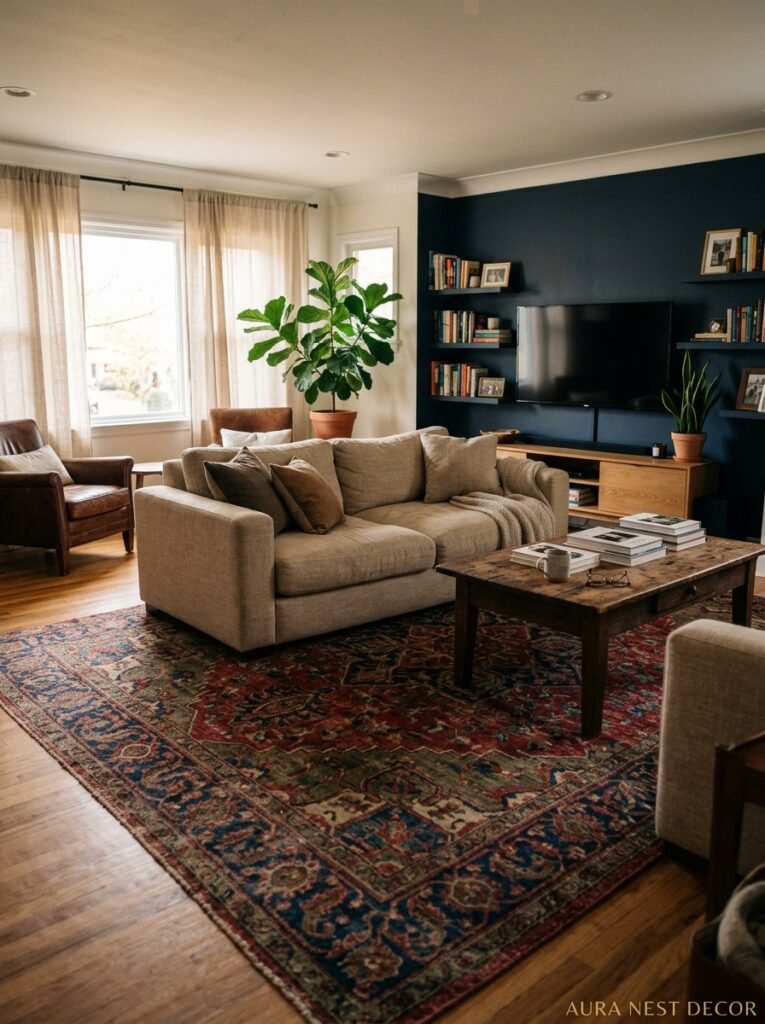
People underestimate what a rug does to the TV area specifically. And I don’t mean just putting a rug in the living room in general — I mean consciously thinking about how the rug relates to the TV wall.
Here’s what happens without a rug or with a rug that’s too small: the sofa floats. The TV wall feels disconnected from everything else. The room looks like furniture that was dropped in a space rather than a space that was designed.
A rug that’s big enough to sit at least the front legs of every seating piece ties the whole conversation area together, and when that happens, the TV wall becomes part of a defined room within a room. That distinction — from “furniture in a space” to “a designed zone” — is the difference between a room that feels finished and one that doesn’t, no matter how nice the individual pieces are.
The texture matters more than the pattern near a cozy TV setup. A high-pile wool rug, something chunky and warm underfoot — that’s going to add to the whole vibe in a way a flat-weave can’t, even if the flat-weave is objectively prettier when photographed.
“The right rug doesn’t decorate the room. It makes the room make sense.”
8. What to Do With TV Cables (Because Visible Wires Ruin Everything)
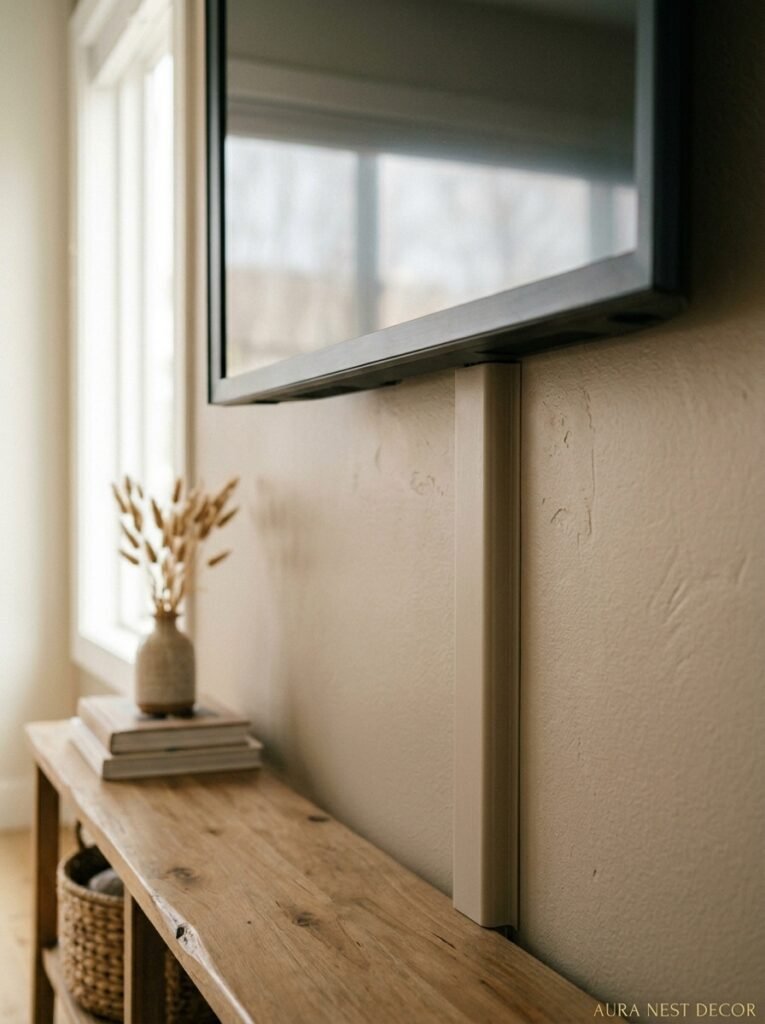
I’m just going to say it. Cords. Dangling. Down the wall. Undone by one detail.
It doesn’t matter how gorgeous your setup is — visible cables snake all the attention. Your eye goes right to them. And the fix is so easy that it’s almost annoying how many people skip it.
The simplest option: cable management channel in a color that matches your wall. It’s literally a plastic conduit that sticks to the wall and hides the cables inside. You paint over it to match. From six feet away, you can’t see it. Done.
The next level: in-wall cable hiding kits. These aren’t as complicated as they sound. You basically cut two small holes — one behind the TV, one down near the baseboard — and route the cables through the wall space. In the UK you’ll want to check your wall type first (stud vs. solid), but it’s genuinely a weekend DIY project that makes a permanent difference.
And if you’re going all the way with a built-in media unit or custom shelving, have an electrician add an outlet inside a cabinet. Everything hides inside. Nothing shows. You don’t think about it again.
This is one of those things where the absence of it is what you notice. Get it right and no one mentions it. Get it wrong and it’s all anyone sees.
9. The Shelf Styling Formula That Looks Effortless (And Isn’t Random at All)
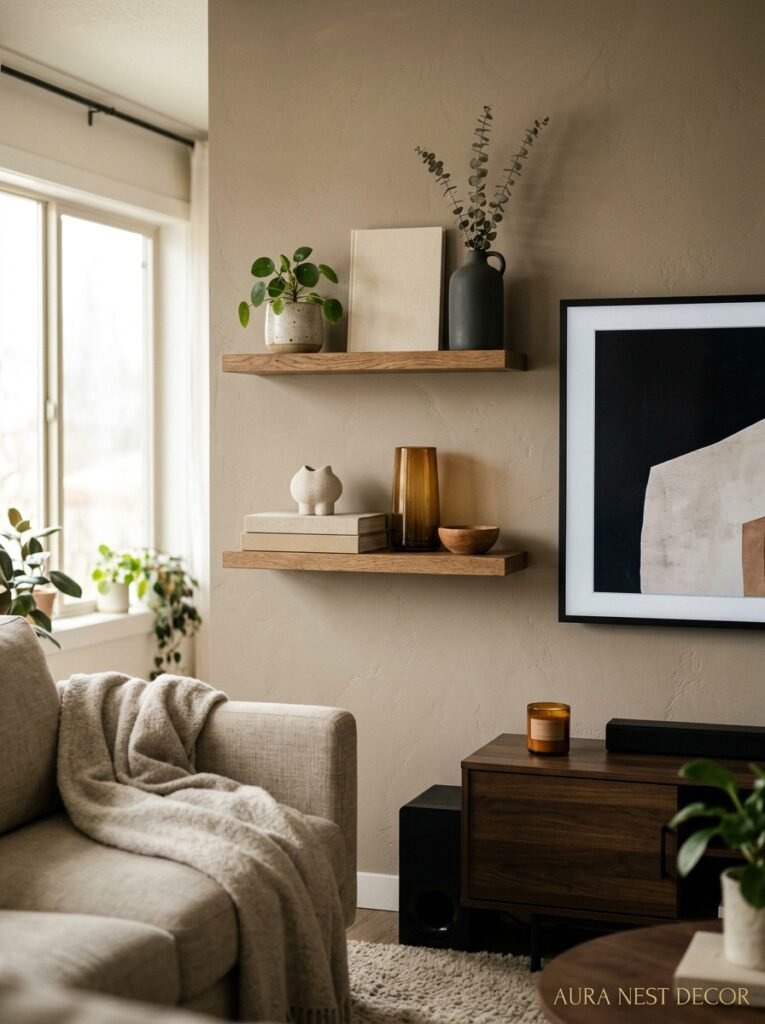
Open shelving around a TV gets chaotic fast. Too much, and it looks like a storage unit. Too little, and it looks sparse and unfinished. There’s a zone in the middle that looks INTENTIONAL, and here’s how you get there.
Work in odd numbers. Three items in a vignette, not two or four. And vary the HEIGHT of things constantly — tall candle next to a low book stack next to a mid-height ceramic. Your eye should travel up and down across the shelf, not sit at one flat horizon.
Leave actual negative space. This sounds obvious but it’s hard to do when you have things you want to display. But a cleared section between two groupings is what lets each grouping breathe and read as intentional. It’s the visual rest your eye needs before it moves on.
One more thing: texture mixing. Something matte next to something with shine. Something rough like a concrete pot next to something smooth like a glass vase. Your hands should want to touch things on the shelf, at least in theory. That tactile quality translates visually even from the couch.
10. Curtains That Make the TV Wall Feel Taller Than It Is
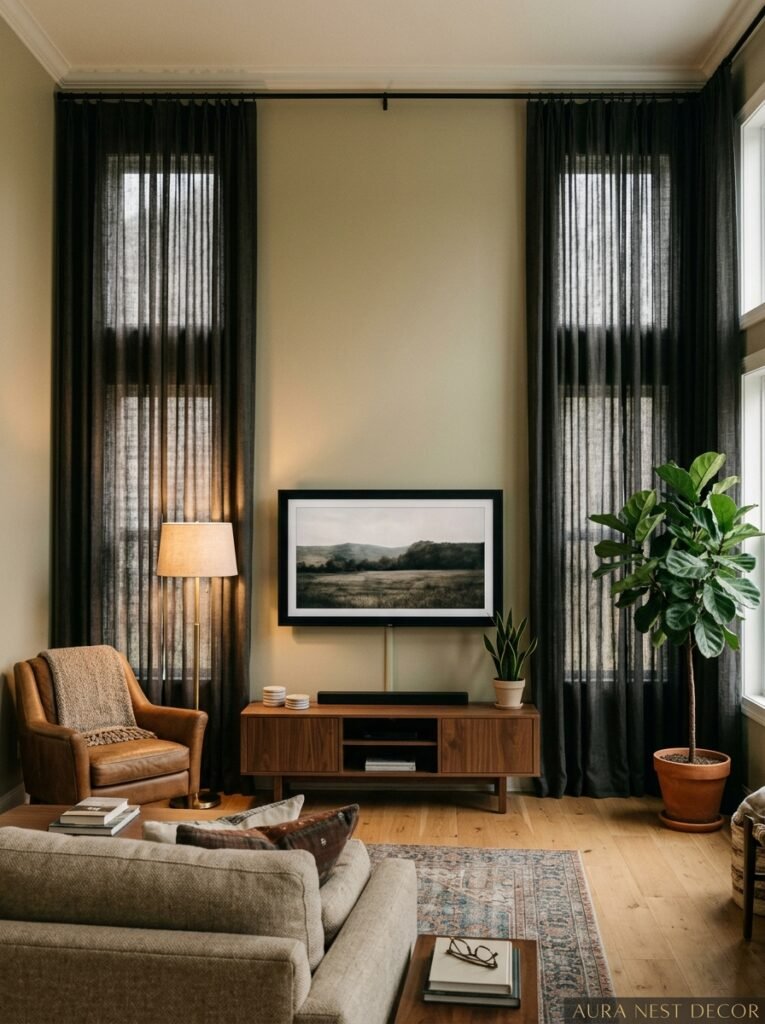
If your TV wall has a window anywhere near it — beside it, above it, in the general zone — curtains are doing more work than you think.
Hang them higher than the window. Like, significantly higher. Ideally right at ceiling height or just below the crown moulding. And hang the rod wide — past the window frame on both sides. When curtains hang from ceiling to floor, the ceiling visually lifts. The wall feels taller. The room feels bigger. It’s the oldest trick in interior design and it still works every single time.
The fabric for a cozy TV zone? Linen. Always linen. Heavy-ish linen in a warm neutral — oatmeal, soft white, warm grey. It filters light beautifully, it drapes beautifully, and it gets better-looking with time as it softens and develops that gentle wrinkle that somehow just looks right in a lived-in room.
Velvet curtains are another option if you want drama — deep forest green or dusty rose velvet floor-to-ceiling is genuinely one of the most striking things you can do in a room and it costs a lot less than people expect.
11. The One Piece of Furniture Most People Forget (That Makes Everything Cozier)
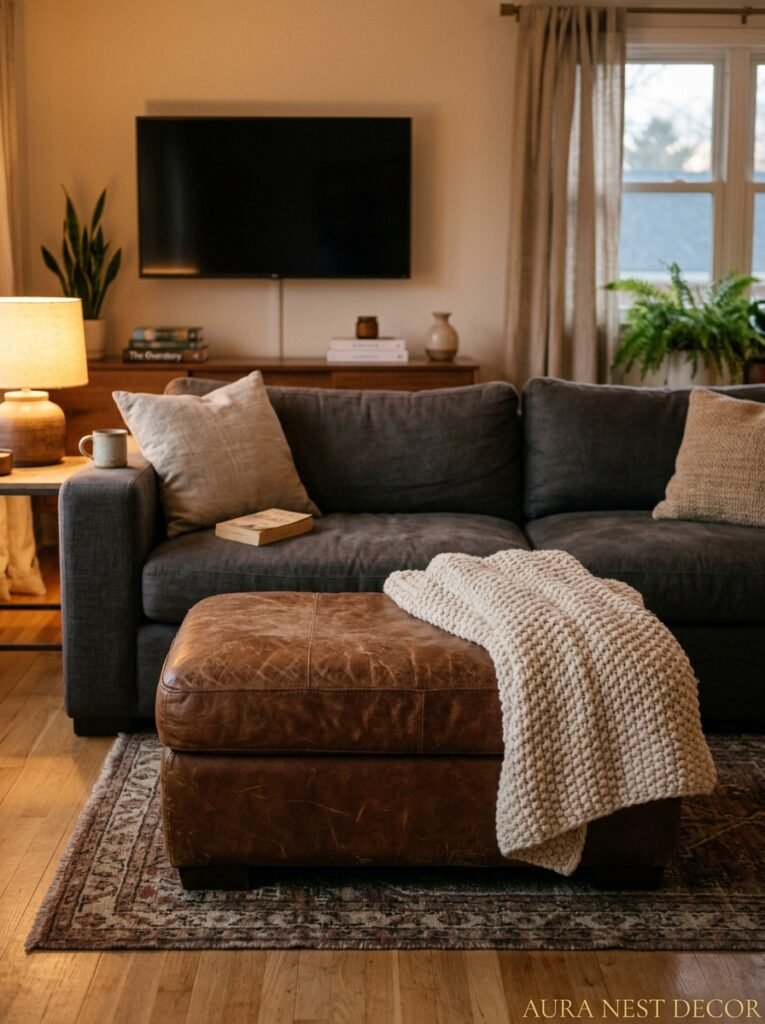
An ottoman. Or a pouffe. Or a low wooden coffee table with a tray and a candle on it.
Actually, you know what? The specific piece matters less than the PRINCIPLE: something close to the seating that gives you a place to put your feet up, your drink down, and your book when you inevitably pick it up and put it down seventeen times during a show.
The absence of this piece — a coffee table that’s too high, too far away, or too small — creates physical discomfort that translates into a vague sense that the room doesn’t feel right. And you can’t always name it, but it’s there.
An oversized, tufted ottoman with a tray on top is probably the most versatile solution. It’s a footrest, a coffee table, a surface for a candle or three, and it can do double duty as extra seating. It also tends to soften a room — the round or cushioned shape balances out the hard rectangle of the TV.
12. Making the Room Work When the TV Is Off (The Real Test of a Cozy Space)
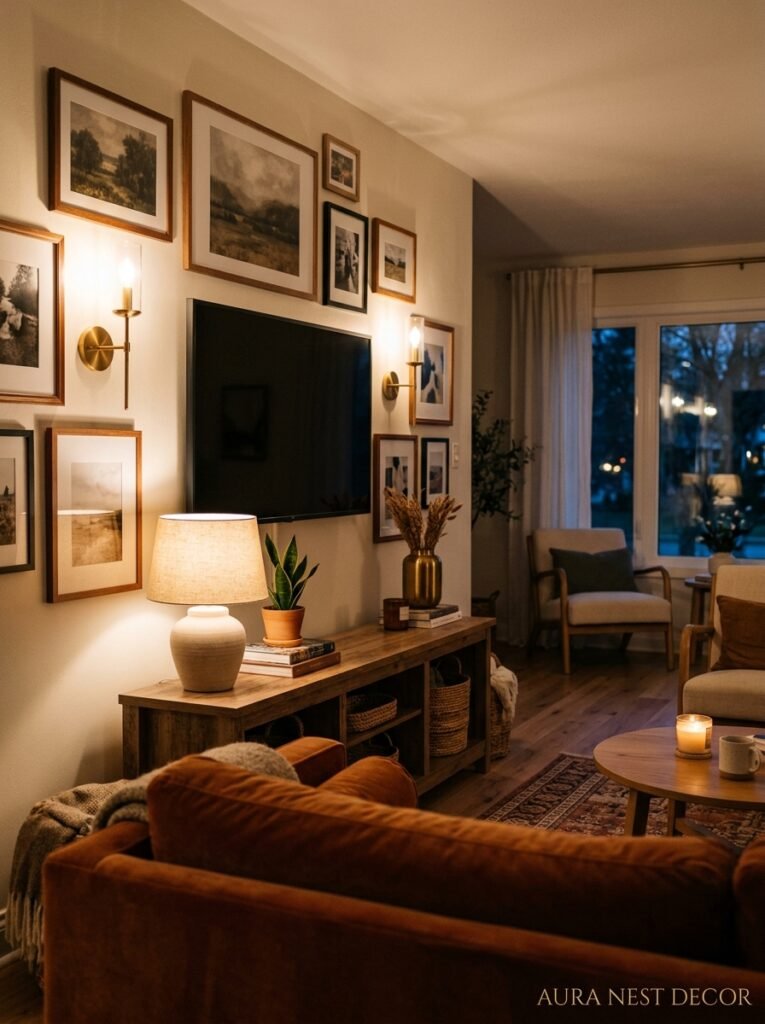
This is honestly the thing I think about most when I’m working on a living room TV area. What does this room feel like when nothing is playing?
Because a room that only works as a TV viewing setup — where everything points at the screen, where there’s nothing to rest your eyes on, where the ambiance collapses when the screen goes dark — isn’t actually cozy. It’s functional. That’s different.
A genuinely cozy living room TV area has things to look at and feel when the screen is off. A beautiful lamp casting that warm amber circle on the wall. Books with spines you actually like. Art that makes you feel something when you catch it from the corner of your eye. A throw over the arm of the sofa that your hand reaches for automatically.
The TV is a tool. A great tool, and we don’t need to be precious about that. But the room is the thing. The room should feel like something before you even reach for the remote. That’s cozy. And honestly? That’s also the room that looks incredible on Pinterest whether the TV is on or not.
—
❓ FAQ
Q: How do I make my TV less of an eyesore in my living room? A: The easiest approach is layering around it — a proper media console that’s at least as wide as the TV, things at varying heights on either side, warm lighting nearby rather than overhead, and a dark accent wall behind it if you can swing it. The goal is for the TV to feel like one element in a designed space, not the only object in the room.
Q: What’s the best color to paint the wall behind a TV? A: Deep, warm shades work best — charcoal, forest green, moody navy, or mushroom brown. These make the black TV screen blend in rather than stick out, and they add a cozy depth that lighter walls just can’t give you. If you rent and can’t paint, good peel-and-stick wallpaper is genuinely worth trying now.
Q: Should my coffee table be centered on the TV or the sofa? A: The sofa, always. The coffee table should be usable — close enough to reach without leaning off the cushion, centered to the seating arrangement. When people center it to the TV instead, the furniture ends up feeling oddly placed and the whole room reads as slightly off without anyone knowing why.
—
💭 Final Thoughts
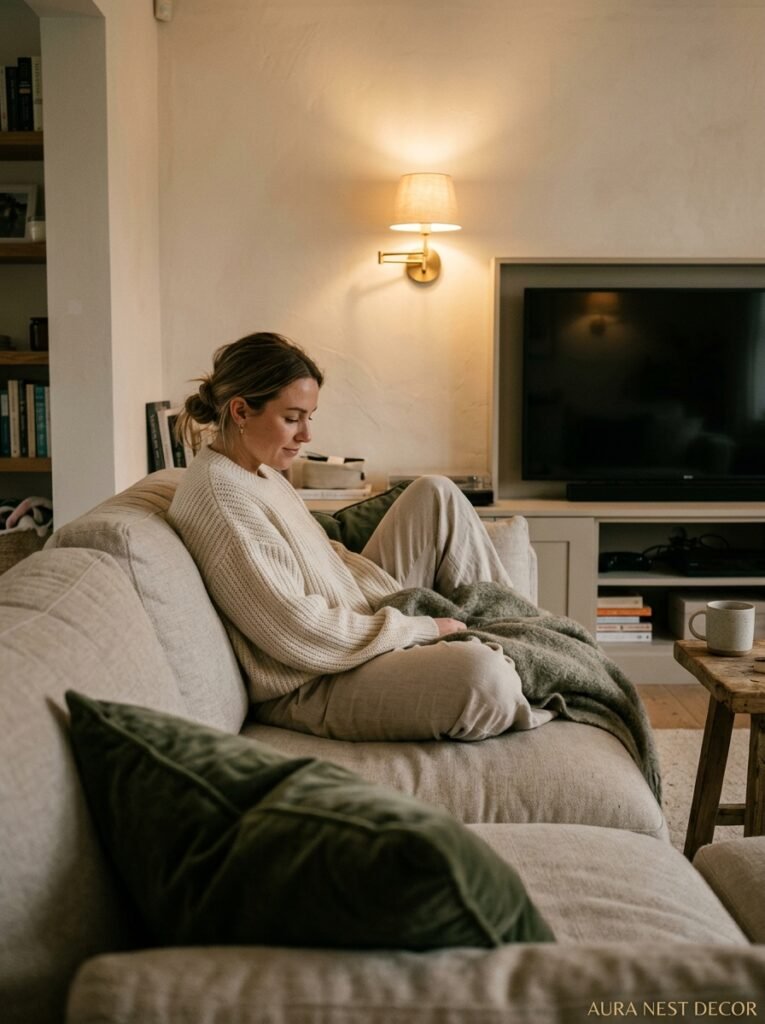
Cozy isn’t a style, really. It’s a feeling. And the TV wall in your living room is one of the places that either creates it or destroys it — there’s not much middle ground. Small changes honestly do compound: the right lamp, a wider console, cables finally hidden, a rug that’s actually big enough. None of it is dramatic on its own. But together? The room shifts.
So — what’s the one thing in your TV corner that’s been quietly bothering you?