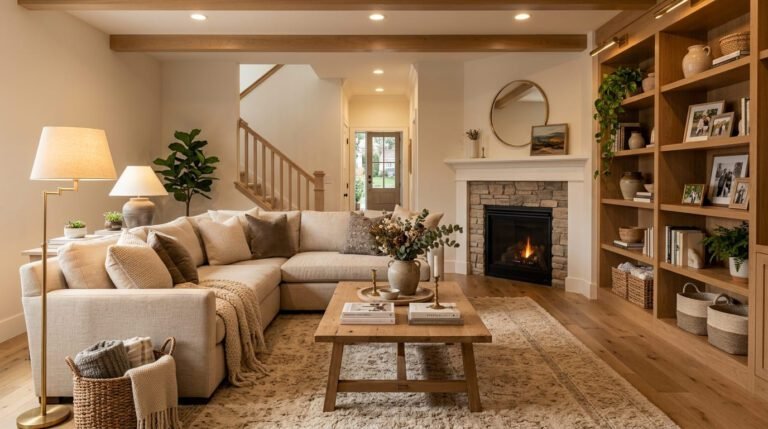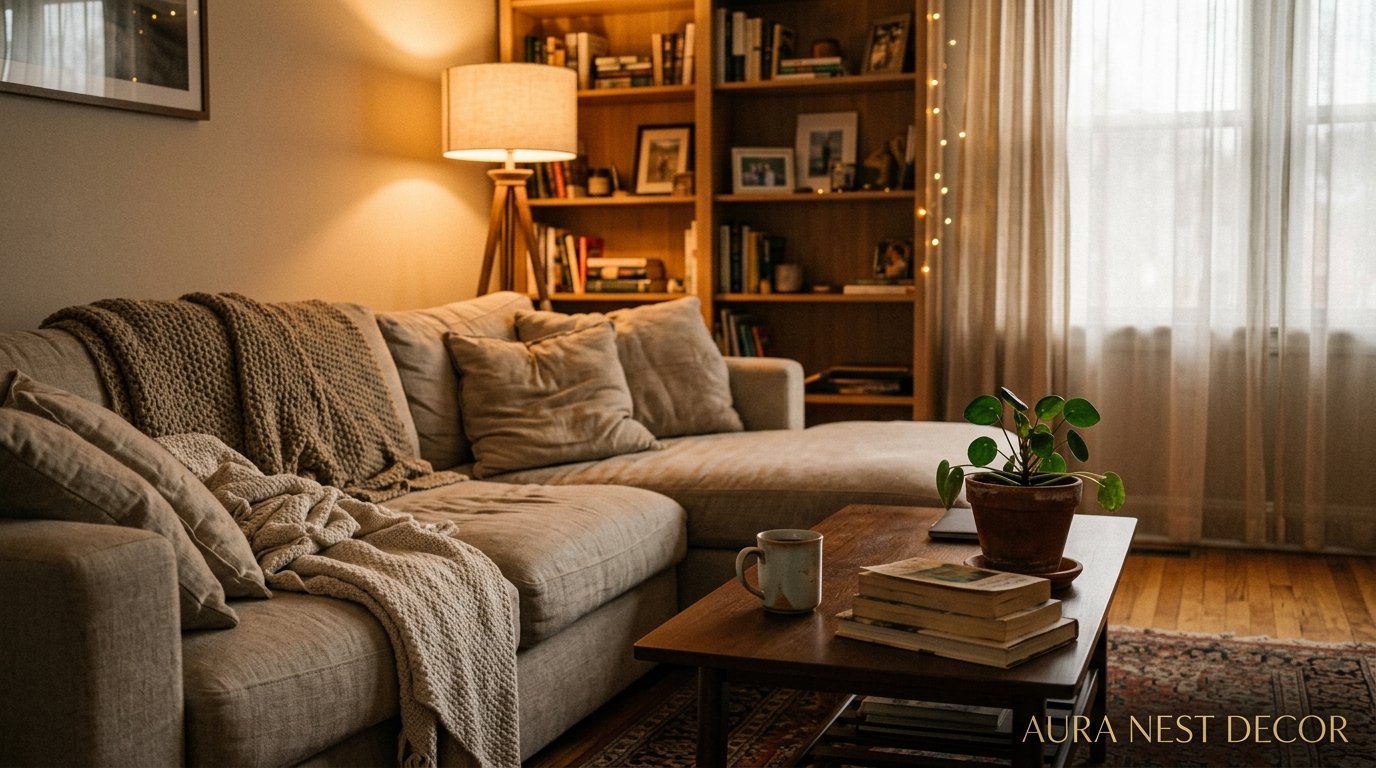
The Living Room That Finally Felt Like Home (And What I Changed to Get There)
You know that feeling when you walk into someone’s house and just… exhale? Like your shoulders drop without you deciding to drop them? That’s what I’ve been chasing for years with my own living room, and I finally figured out what was missing.
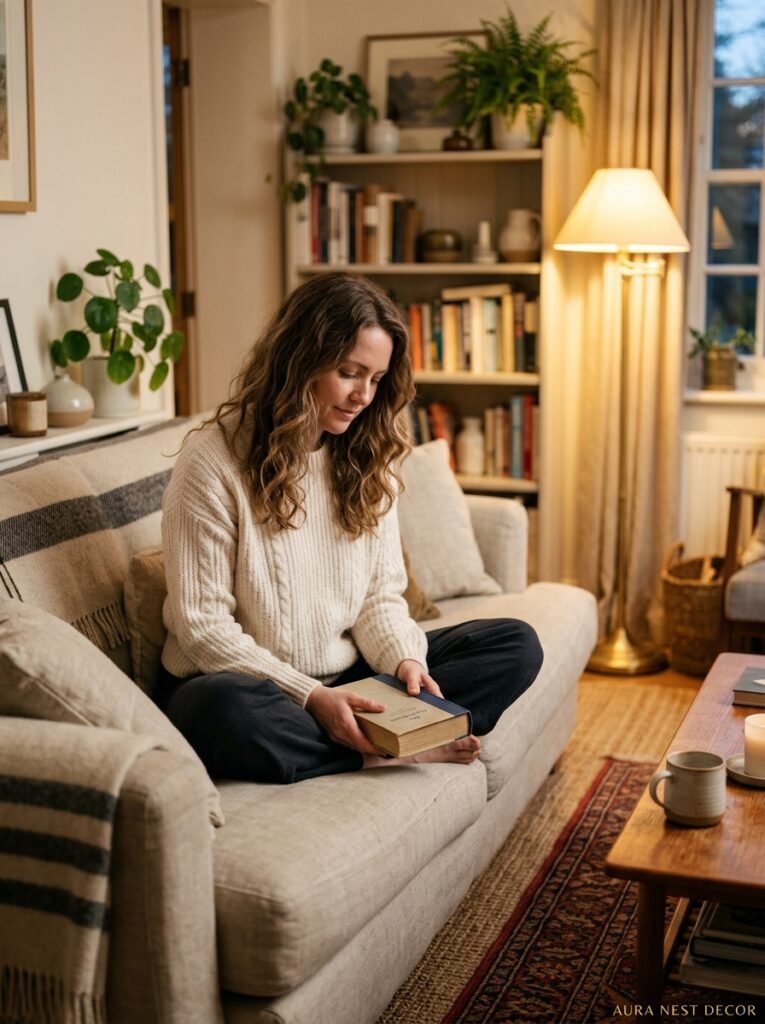
—
1. Why “Cozy” Doesn’t Mean What Most Decor Accounts Tell You It Means
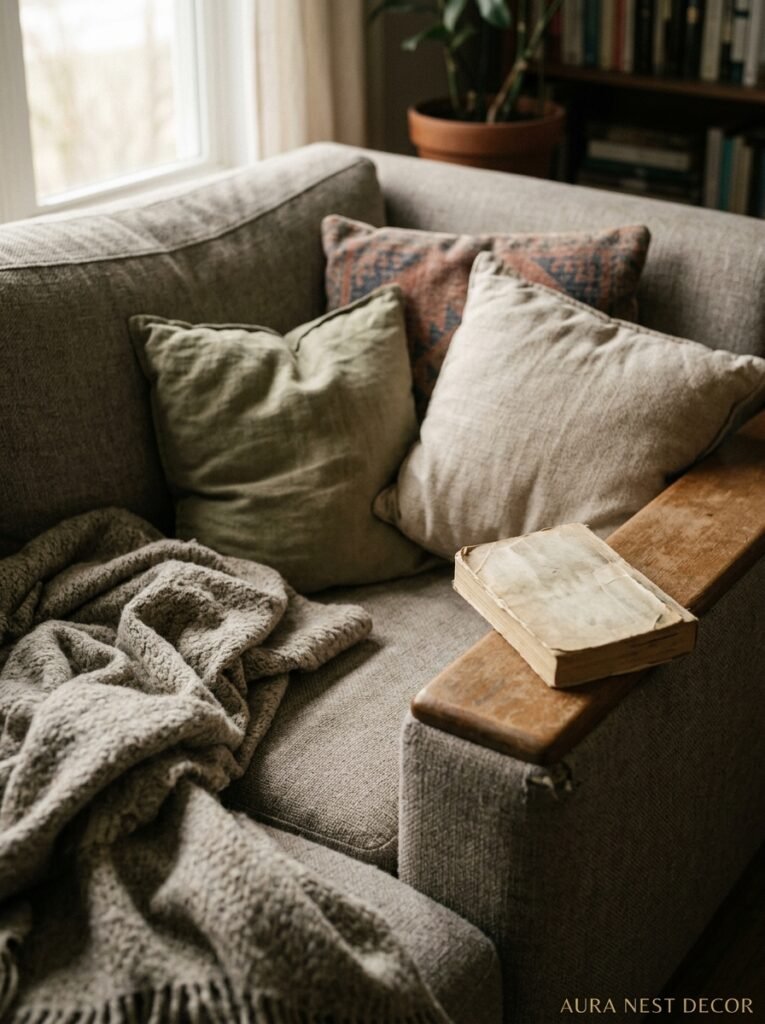
Here’s the thing nobody says out loud: you can buy every throw blanket on the market and still have a cold room. I’ve done it. I had the chunky knit, the rattan tray, the dried pampas grass in the corner that I didn’t even like that much — and my living room still felt like a staging area for a house I didn’t actually live in.
Cozy isn’t a product. It’s a decision about how a room makes you feel when you collapse onto the sofa at 9pm with nowhere else to be.
The rooms that stop me mid-scroll on Pinterest have something I couldn’t name at first. It took me an embarrassingly long time to figure out that what I was seeing was SPECIFICITY. Not “neutral tones and natural materials” — but a very particular shade of terracotta on one wall, or a lamp that was clearly someone’s grandmother’s, or a rug that didn’t quite match anything but somehow made everything work better. Intentional imperfection. That’s the real thing. And you can’t buy it as a kit.
“The rooms that feel the coziest aren’t decorated. They’re accumulated.”
2. The Lighting Rule I Wish Someone Had Told Me Fifteen Years Ago
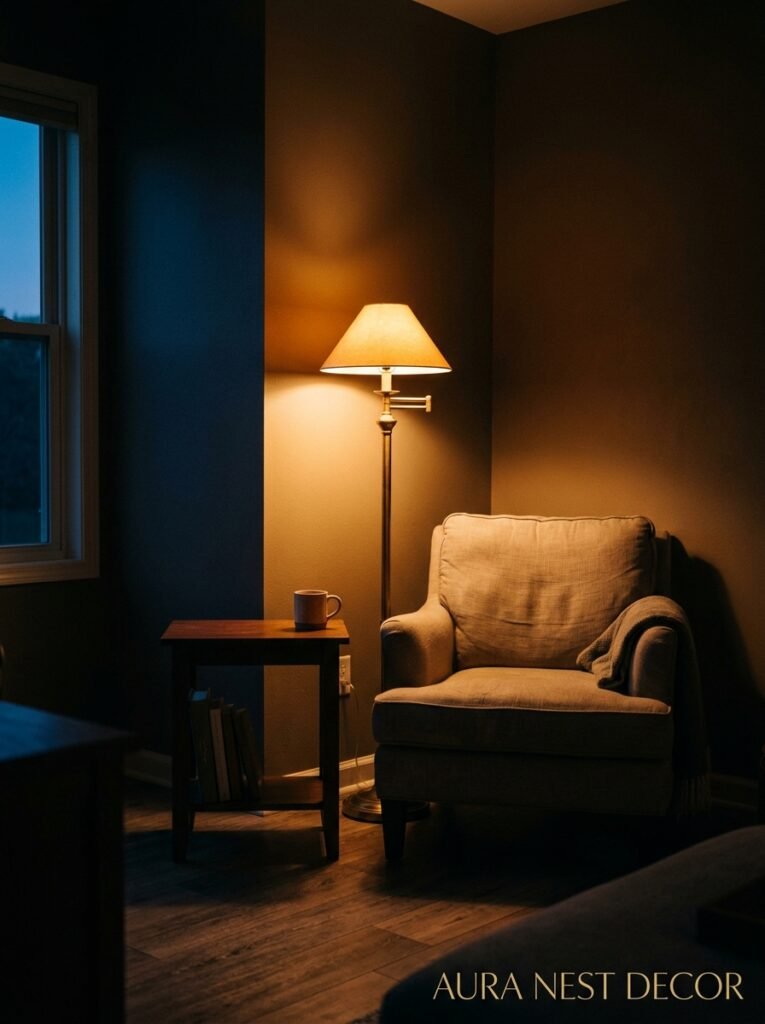
Overhead lighting is the enemy of cozy. I’ll die on this hill.
Most living rooms in both American homes and British terraced houses are built with one ceiling fixture right in the middle, and we just… use it. Like it’s fine. It’s not fine. That flat, top-down light flattens everything — your furniture, your face, the entire mood of the room.
What actually works is light sources at multiple heights, none of them centered. A floor lamp in the corner that throws a warm pool upward. A small table lamp that’s almost too dim on its own. Candles, even just a few, even if you light them for twenty minutes while you drink your tea. The combination of those things creates what I can only describe as the amber quality of a room that’s glad you’re in it. There’s actual science behind why lower, warmer light feels safer — it mimics firelight, which our brains have been reading as “safe and home” for a very long time. So you’re not being precious about candles. You’re being ancestrally correct. Anyway, the point is: install a dimmer switch if you can do one thing this week. It costs almost nothing and changes everything.
3. The Color That Keeps Showing Up in Every Living Room I Can’t Stop Looking At
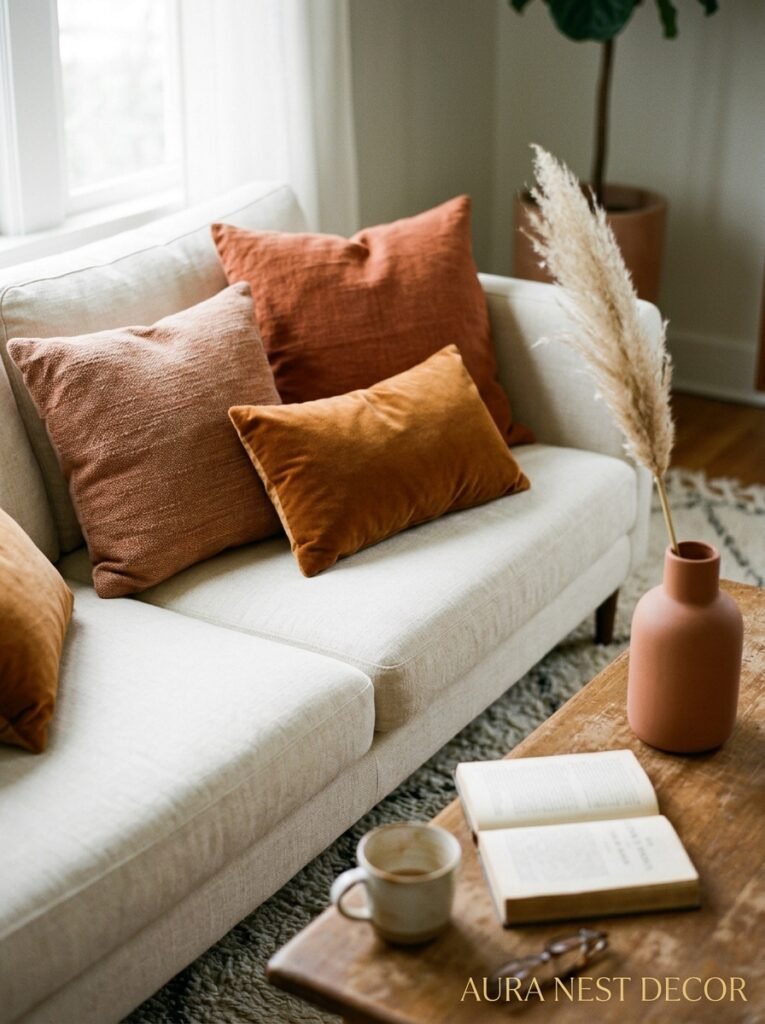
Not beige. Not even the sophisticated version of beige that gets called “greige” or “warm white.” I mean actual color — and specifically, I mean something in the warm rust-to-clay family. Terracotta, brick, dusty cinnamon. It’s everywhere on mood boards right now, and it’s not going away, and honestly? Good.
Here’s why it works in a living room specifically. Those tones do something flattering to everything around them. Warm-toned walls make wooden furniture look richer, make skin tones look warmer, make a slightly chaotic bookshelf look curated instead of messy. They also photograph beautifully in natural light, which I’ll admit is now something I factor into decor decisions because I’m that person.
If you’re not ready to paint, you can get there through textiles. A terracotta or rust-toned cushion cover changes a whole sofa. One amber-glazed ceramic lamp base. A low-pile rug in something brick-ish. You don’t need much. The color family does the heavy lifting once it’s in the room. British homes with older plasterwork and original cornicing look INCREDIBLE against these tones, by the way — if that’s your situation, you’re sitting on something special.
4. What to Do with the Corner That’s Been Bothering You for Two Years
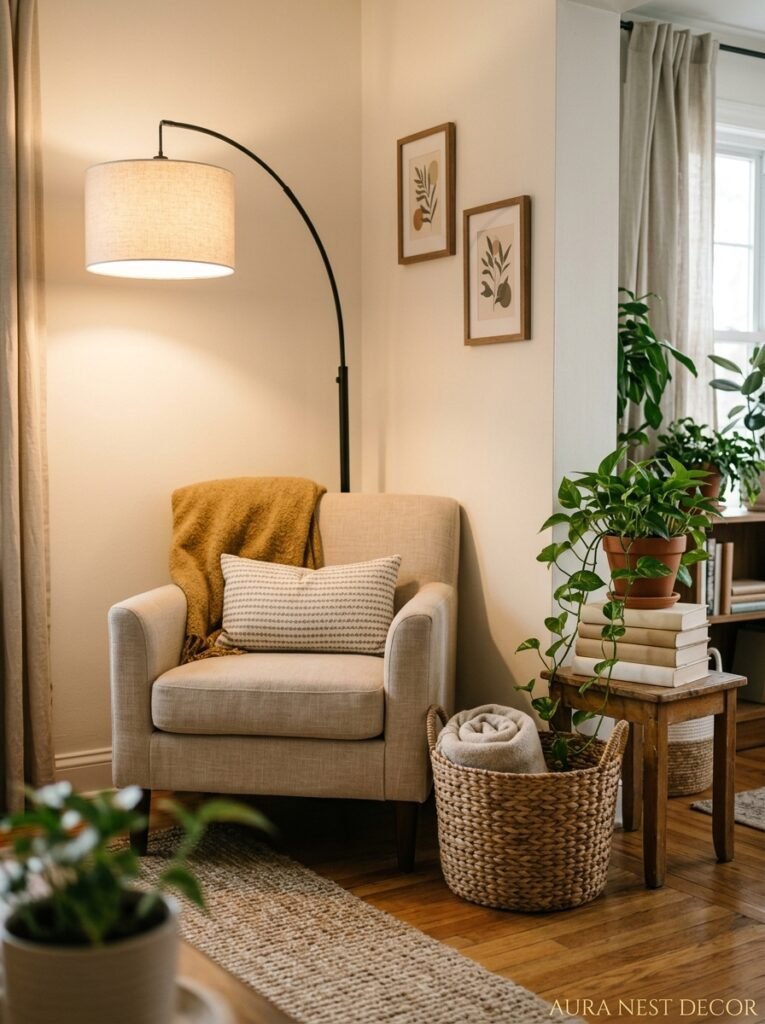
You have one. I know you do because everyone does. The slightly awkward corner where things go to be forgotten — a chair that doesn’t quite work, a plant that’s sort of surviving, a floor lamp you bought in a desperate moment.
Here’s the thing about corners: they become anchors when you commit to them. The mistake is treating a corner like a solution to a problem (where do I put this thing I don’t know what to do with?) instead of treating it like a DESTINATION.
A corner that works has at least two of these: a seat of some kind, light, something living (plant, flowers, something that grows), and something at eye level when you’re sitting. That’s it. An armchair with a small floor lamp directly beside it and a trailing pothos on a high shelf behind it? That’s a corner people will gravitate toward at every single gathering. My mother in law walked into my living room after I redid the corner and immediately asked if she could sit there. She didn’t know why she wanted to. That’s the goal.
“A corner becomes magical the moment you stop using it as a dumping ground and start treating it like the best seat in the house.”
5. The Furniture Arrangement Mistake That’s Making Your Room Feel Wrong
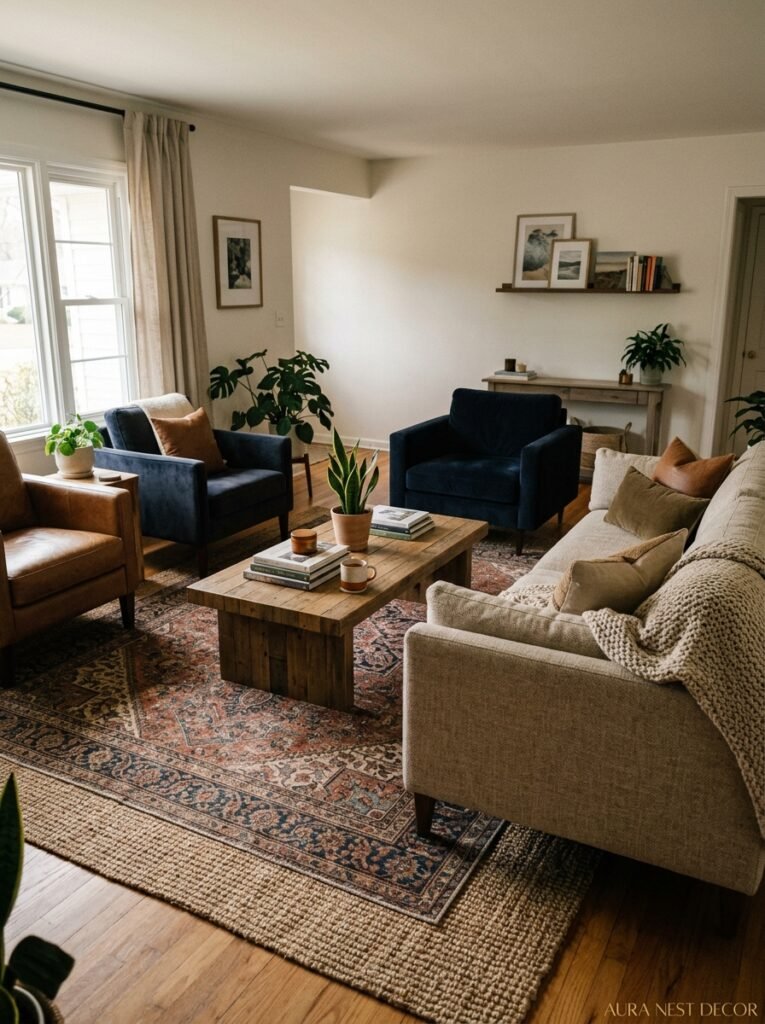
Most people arrange furniture against the walls. It feels logical — push everything back, maximize the open floor space. But unless your room is genuinely tiny, it’s almost always the wrong call.
Pulling furniture away from the walls, even just a few inches, creates definition. The sofa floats instead of leans. The space between the back of a sofa and the wall becomes room for a slim console table with a lamp — which is also brilliant storage — and suddenly that dead zone is working for you. Conversation groupings should face each other with a surface between them that’s reachable from every seat. Nobody should have to lean forward uncomfortably to put down a cup. That sounds obvious, but I’ve been in beautiful rooms where the coffee table is so far away it might as well be in another county.
If you have an open plan space — which is very common in American homes and increasingly in British ones after knockthrough renovations — rugs are how you create rooms within rooms. The rug defines where the living area ends. Without it, everything bleeds together and nothing feels cozy because nothing feels contained.
6. The Bookshelves-Aren’t-Just-for-Books Lesson I Learned the Hard Way
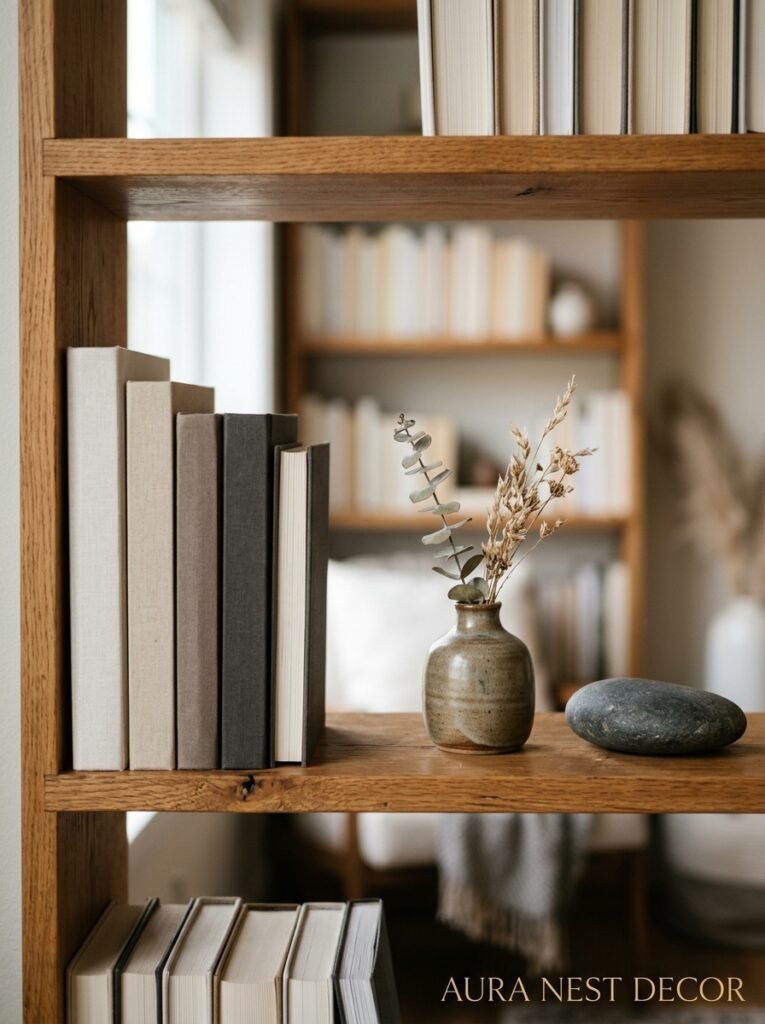
I spent about three years with very tidy, very literary, very boring bookshelves. All books. Arranged by color because I went through that phase. They looked fine in photos and completely dead in real life.
What bookshelves actually want — and I say this as someone who had to be convinced — is mess. Or rather, the impression of a life being lived on them. Books, yes, but also the small ceramic bowl you bought at a market and didn’t know where to put. The photograph that makes you happy every time you see it. A candle you burned halfway down. A small sculptural thing that doesn’t mean anything except that you thought it was interesting. One or two trailing plants that soften the sharp edges.
The stylist trick I think about constantly: treat each shelf as having a front zone and a back zone. Lay a book on its side in front of a row of upright books to create levels. Lean something against the back wall. Let things overlap slightly. Asymmetry is your friend. Equal spacing is the enemy of warmth. And don’t fill every inch — some breathing room makes the things you have look more chosen.
7. Why Sofas Are the Most Loaded Decision in the Room (And How to Get It Right)
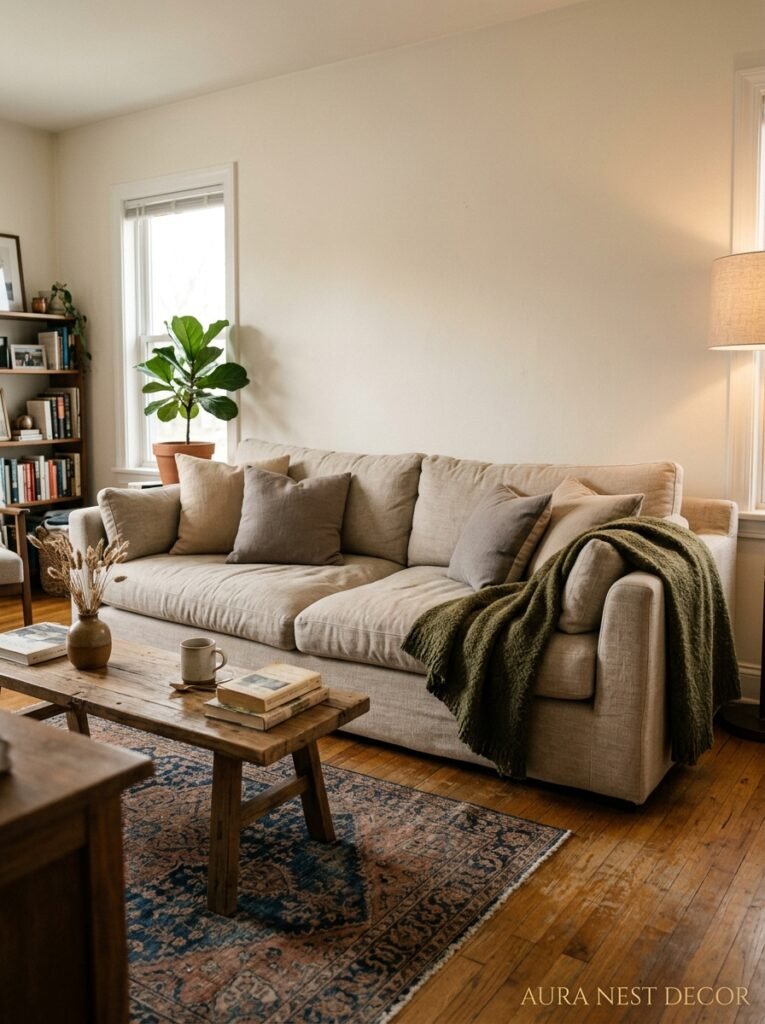
Not gonna lie, I’ve bought two wrong sofas. One was too low-slung and looked amazing but made getting up feel athletic. One was technically perfect and gave me absolutely nothing emotionally, which sounds dramatic but is a real problem.
The sofa you want for a cozy room is probably deeper than you think. Seat depth matters more than almost any other measurement. You want to be able to sit back fully and still have your feet on the floor or your legs tucked up comfortably. Around 22 to 24 inches of seat depth is the sweet spot for most people. British three-seaters often run slightly shallower than American equivalents, so if you’re ordering from a US brand and you’re in the UK, check those measurements obsessively.
Fabric is where people get it wrong in pursuit of practicality. Velvet is softer and more forgiving than it looks. Linen is beautiful but wrinkles the second a human touches it. A mid-tone bouclé or textured weave hides life — pet hair, crumb shadows, the indent from where you always sit — better than anything else I’ve found. And the color matters differently than wall color. A sofa you’re going to sit on for a decade should make you feel something when you look at it, not just match the rug.
“Your sofa isn’t furniture. It’s where your life actually happens.”
8. The Throw Blanket Situation: How Many Is Too Many (Asking for a Friend)
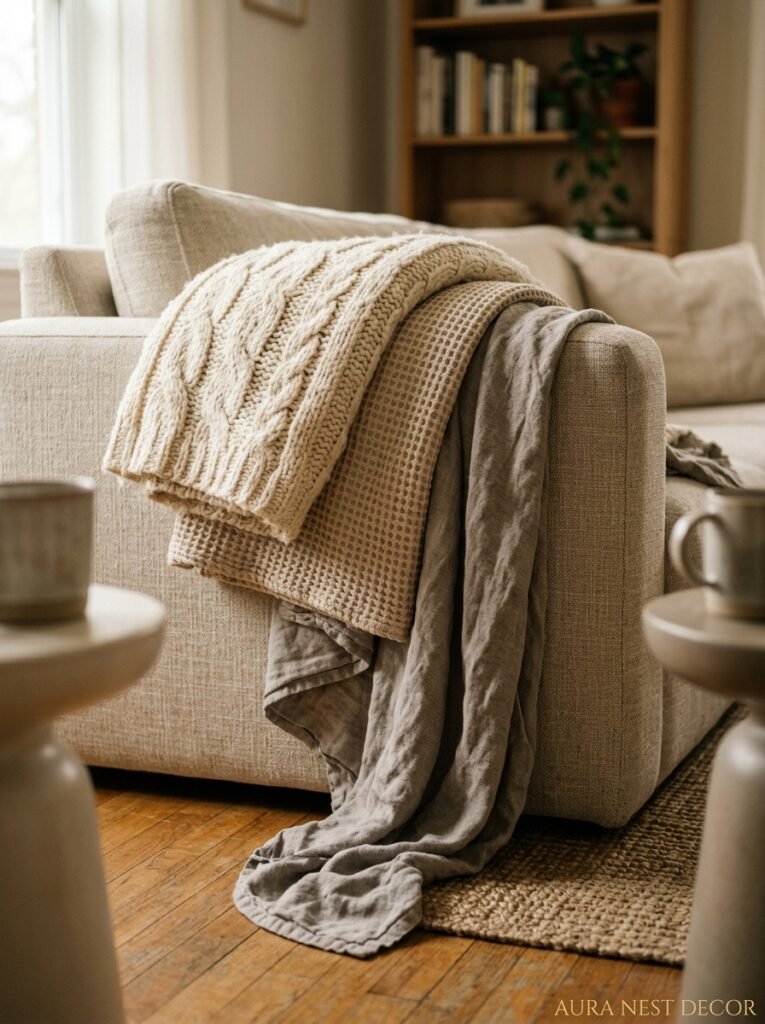
Okay so. The answer is: you probably have too many displayed and not enough actually accessible.
What I mean is: blankets draped artfully over every arm of every chair reads as decor instead of comfort. Which is kind of the opposite of cozy. Real warmth is the one blanket that lives on the sofa in the exact spot you always reach for it, slightly bunched, a bit lived-in. That’s the one that matters.
Have more folded in a basket nearby if you want — a wide, low basket on the floor by the sofa is genuinely useful and looks warm. But the blanket situation that reads as cozy isn’t “styled” — or maybe it’s better to say it’s styled to look UN-styled. There’s a version of this that only works if you actually use the blankets instead of arranging them. So use them. Wash them. Grab them. Let them get loved.
9. What Smell Has to Do With How Cozy a Room Feels (More Than You Think)
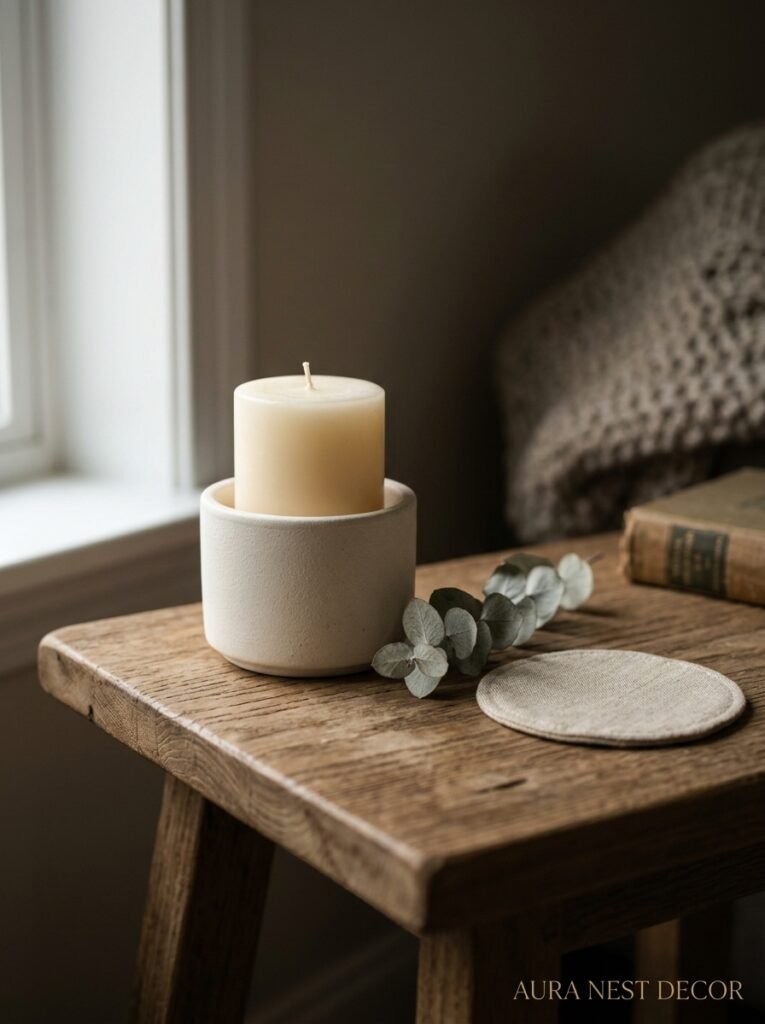
This section exists because I genuinely forgot about it for years and it changed things significantly once I didn’t.
Scent is processed differently in the brain than any other sense — more directly connected to memory and emotion, which is why walking into a room that smells a certain way can make you feel something before you’ve consciously registered why. A living room that smells warm and quiet is processed as safe before you’ve sat down.
I’m not telling you to buy expensive candles, though I also won’t tell you not to. What I’m saying is: beeswax candles smell warmer than paraffin when they burn. Woodwick candles crackle. A linen spray on your sofa cushions right before guests arrive does something subtle but real. Fresh eucalyptus in a tall vase smells clean and faintly medicinal in a good way. If you’ve got a log fire or even a wood-burning stove — which is more common in UK homes and increasingly aspirational in American ones — that’s obviously the pinnacle, but you don’t need it to build a room that smells like you want to stay in it.
10. The One Rule That Makes Any Tiny Living Room Feel Intentional
Scale. It’s always scale.
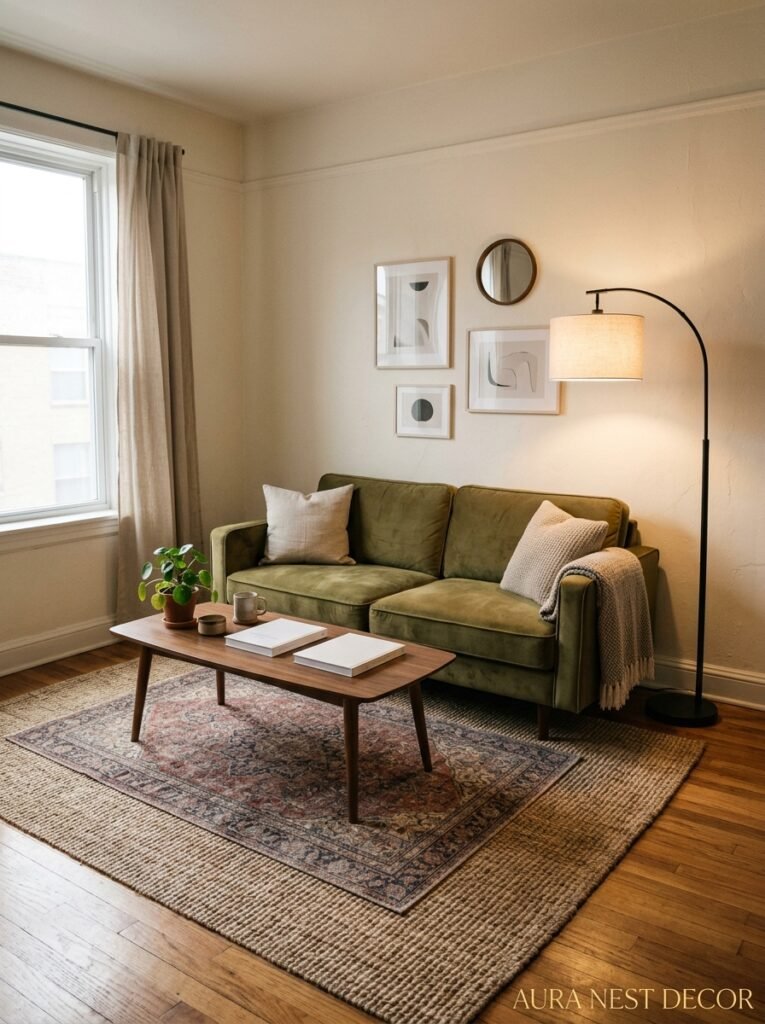
The reflex in a small room is small furniture, and it’s almost always wrong. One large sofa, one large rug, and one significant piece of art create a room that feels deliberately designed for the size it is. Lots of small things in a small room creates clutter, even when everything is tidy, because the eye has nowhere to land.
This is especially relevant in British homes — Victorian terraced houses, garden flats, converted maisonettes — where living rooms can be genuinely compact. A single large piece of furniture that fits the room properly reads as confident. Five small pieces that technically fit reads as temporary.
The rug is the most important scale decision in a small room. It should be bigger than you think. If at least the front legs of all your seating are on the rug, you’ve created a unified zone. If everything floats off the rug or the rug only covers the coffee table area, the room fragments. Buy the bigger rug.
11. Why Personal Things Matter More Than Perfect Things
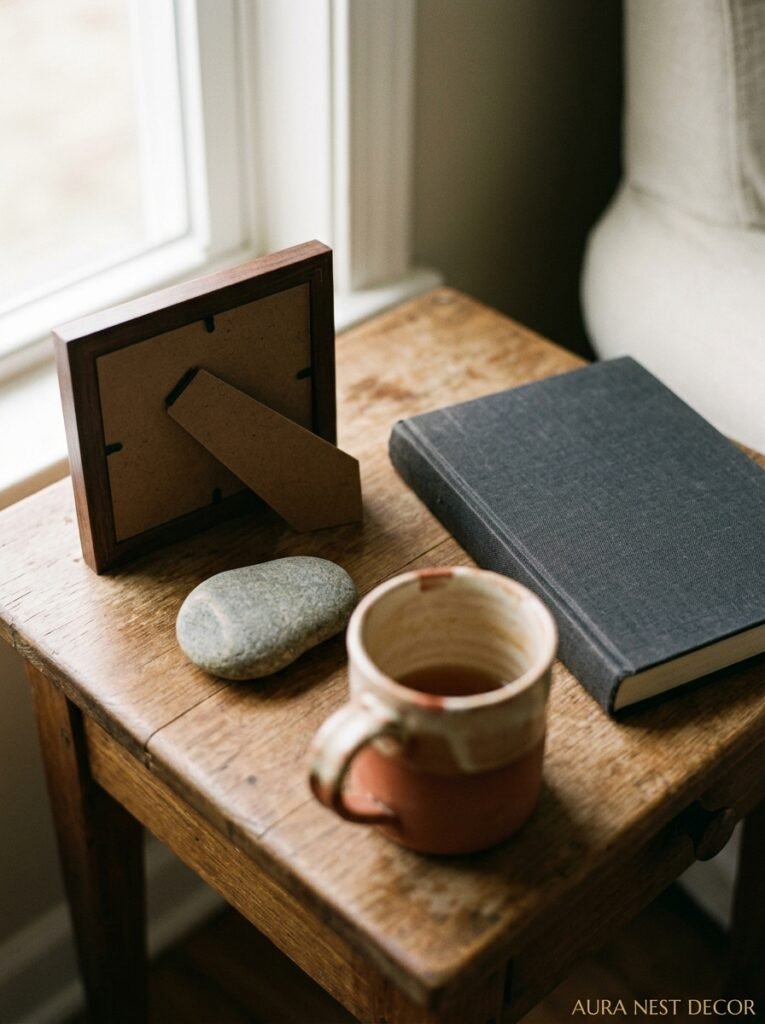
The rooms I’ve photographed for Pinterest that get the most saves — by a lot — are not the perfectly styled ones. They’re the ones where I’ve included something personal and slightly imperfect. The stack of actual books I’m reading. The print that’s not quite level that I keep meaning to fix. My husband’s guitar stand that I’ve made my peace with.
People respond to evidence of real life. Not mess, exactly, but proof that a human lives there. A perfectly staged room is impressive and immediately forgettable. A room with personality is the one people come back to.
So: keep the thing that means something even if it doesn’t “go.” Display the slightly wonky handmade mug. Hang the art that makes you happy even if it’s not in the “right” palette. The rooms that feel the coziest always feel like they couldn’t have been put together by anyone else. That specificity — the fact that it’s unmistakably YOURS — is what creates that thing where people walk in and exhale without knowing why.
12. The Last Five Minutes Before Anyone Comes Over: What Actually Changes a Room
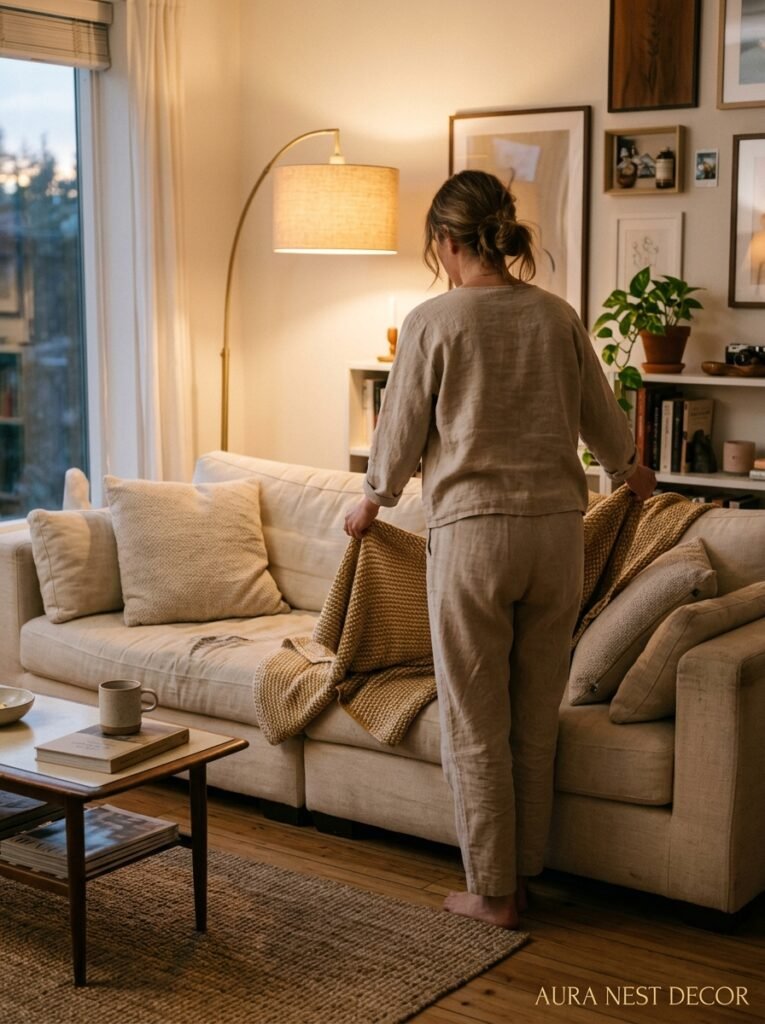
This is practical and I mean it seriously. You don’t need to clean everything or style everything. You need to do about five specific things.
Dim the overhead lights or turn them off entirely and switch on the lamps. Light one or two candles. Fluff the sofa cushions and fold or slightly bunch the main throw. Put anything sitting on the coffee table either away or onto a tray (a tray makes everything look intentional). And open a window for two minutes even in winter, then close it — fresh air resets the smell of a room in a way nothing else does.
That’s it. Five things. Roughly six minutes. Your living room will feel like a different place, and anyone who walks in will feel it without being able to say exactly why. That gap — between what someone feels and what they can name — is the exact gap that cozy lives in.
—
❓ FAQ
Q: What’s the quickest and cheapest change I can make to a living room that feels cold and unwelcoming? A: Lighting, without question. A cheap dimmer switch and one warm-toned floor lamp will do more than almost any furniture change. Kelvin temperature matters — look for bulbs labeled “warm white” around 2700K, not “cool white” or “daylight.” You’ll feel the difference the first evening.
Q: How do I make a rented apartment or house feel cozy when I can’t paint the walls? A: Textiles and lighting carry almost all of the work here. A large rug, layered cushions in warm tones, and lamps at multiple heights can make even magnolia walls feel warm. If you can hang things (and most rentals allow this with care), a large piece of art or a gallery wall at eye level draws the eye away from the walls themselves.
Q: Is there a “right” number of cushions for a sofa? A: Honestly, no — but the rule I keep coming back to is: you should be able to sit down without having to remove three cushions first. Cozy means accessible. If your cushions are purely decorative and slightly annoying, there are too many.
—
💭 Final Thoughts
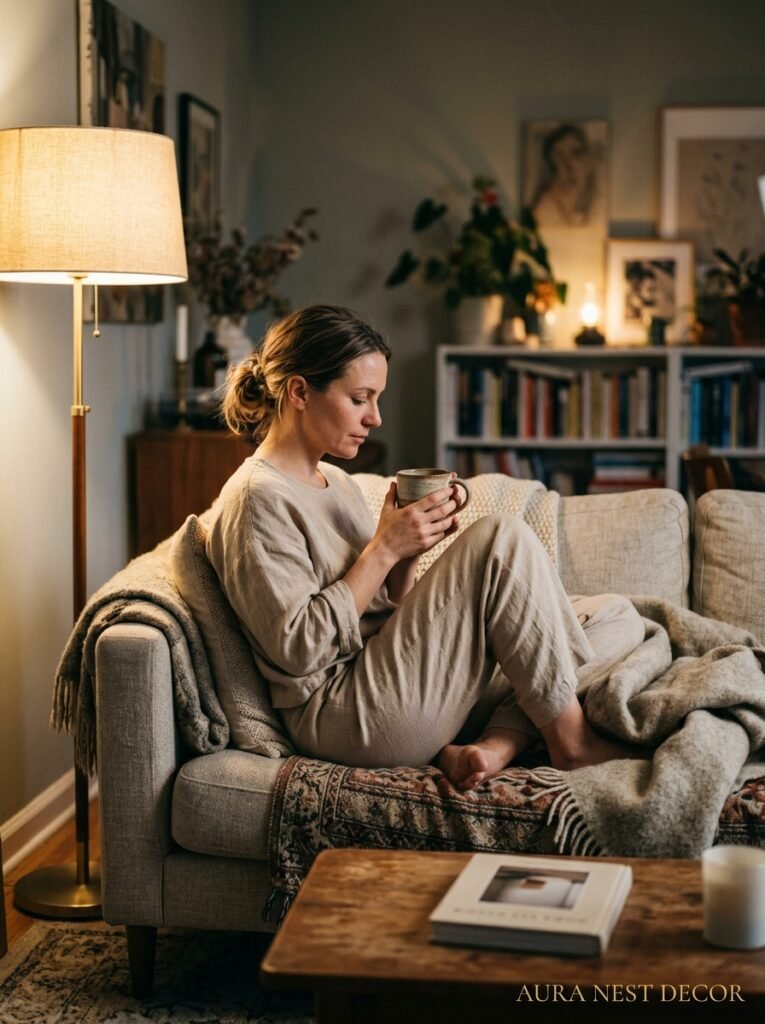
The living room that finally felt like home wasn’t the most expensive version or the most carefully planned. It was the one I stopped trying to perfect and started actually living in. Sometimes I think the cozy-ness crept in quietly, in the gap between deciding the room was done and forgetting to keep decorating it.
I’d love to know — what’s the one thing in your living room that you’ve kept even though it doesn’t quite “fit,” but you could never imagine getting rid of?