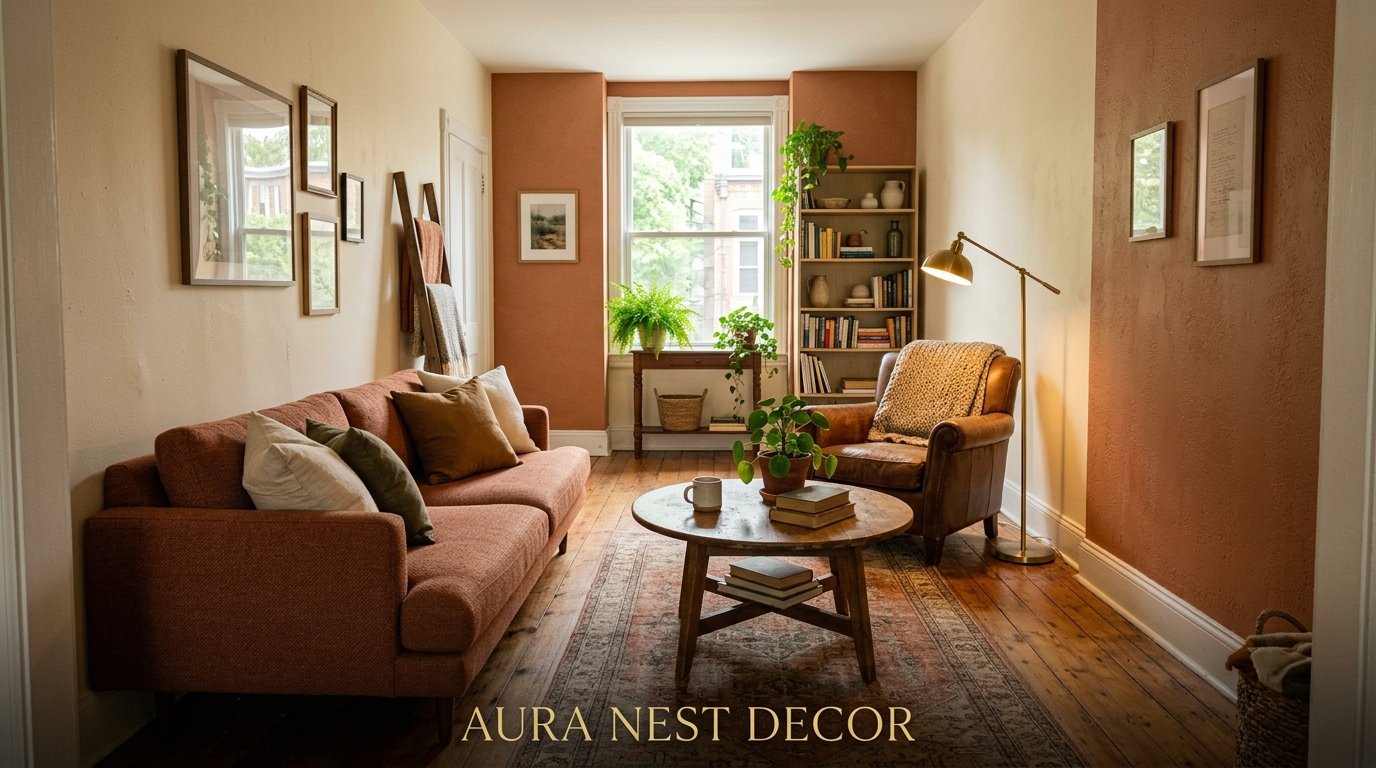
The Long, Thin Room Nobody Talks About Decorating (And Why It’s Actually a Gift)
My neighbor mentioned offhand that she was about to knock down a wall because her living room was “just a hallway with furniture in it.” And honestly? I get it. Narrow rooms feel like a problem someone else forgot to solve. They feel like an afterthought. A corridor that accidentally became the main event.
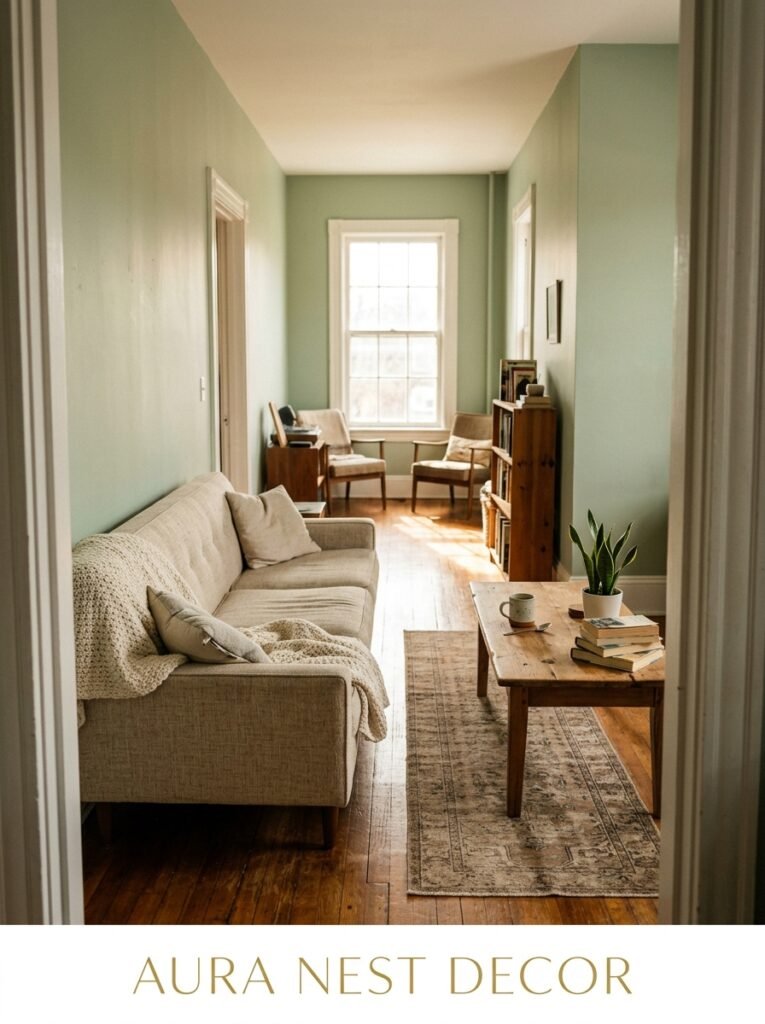
But here’s what I’ve figured out after years of styling awkward spaces: the narrow living room isn’t broken. The furniture arrangement is.
—
1. Why “Push Everything Against the Walls” Is the Worst Advice You’ve Ever Followed
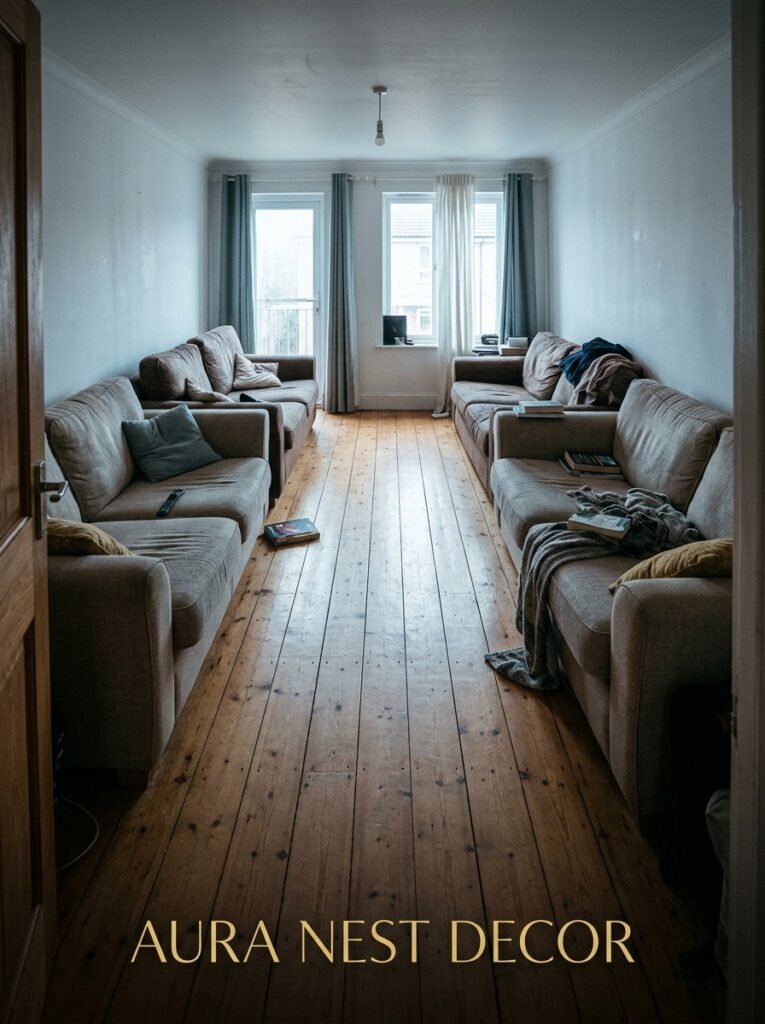
Everyone does it. I did it. You move into a long narrow room, panic slightly, and drag every piece of furniture to the perimeter like you’re expecting a dance floor in the middle. It feels logical. It feels like you’re making MORE space.
You’re not.
What you’ve actually done is created a bowling alley. A room where everyone sits along the edges, staring at each other across an empty stretch of floor that nobody uses and nobody enjoys. The conversation dies because the distance is weird and the room feels cold even when the heating’s on full blast.
The fix — and I mean the single most impactful thing you can do — is to pull your sofa and chairs AWAY from the walls. Even six inches. Even a foot. That gap at the back creates the illusion of depth, and the furniture arrangement suddenly starts to feel intentional rather than desperate.
“A room where everything touches the wall isn’t minimalist. It’s afraid.”
It takes confidence to float furniture in a narrow room. But it’s the move.
—
2. The Furniture Shape That Actually Works in Long Rooms (It’s Probably Not What You Own Right Now)
I’m not going to sugarcoat this: a big L-shaped sectional is not your friend here. I know. I know you love it. But a bulky sectional in a narrow room just cuts the space into two useless halves and makes both of them feel worse.
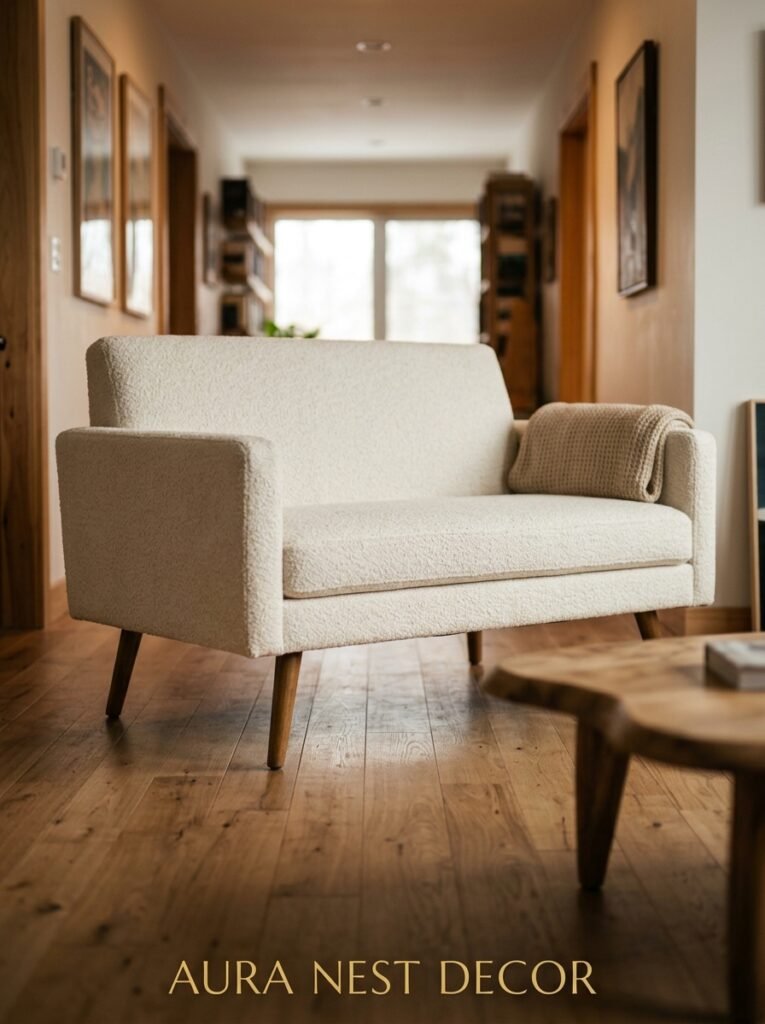
What you want instead is a two-seater or a compact three-seater sofa — something that has a low back, clean lines, and legs you can see underneath. Visible legs are crucial. They let light travel under the furniture so the floor reads as continuous, which tricks the eye into reading the room as wider than it is.
Pair it with one or two armchairs placed at an angle rather than dead-parallel to the sofa. Angled chairs do something almost magical — they create intimacy and break the straight lines that make narrow rooms feel like corridors. Side note: if you’ve got a chair that’s been sitting against the wall at a 90-degree angle to everything else, try rotating it 45 degrees and just… see what happens. Takes thirty seconds. Might change everything.
—
3. The Color That Keeps Showing Up in Every Beautiful Narrow Room Right Now
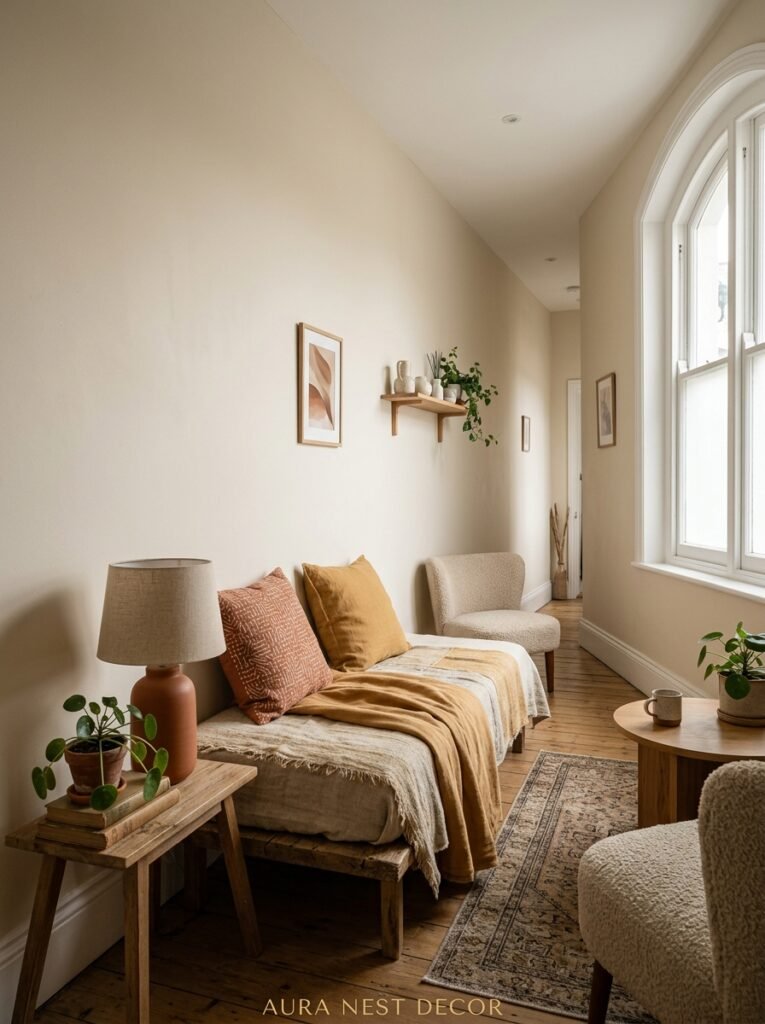
Not white. Everyone says white, and yes, okay, light colors help, but pure white walls in a narrow room often just look… clinical? Like a very clean waiting room.
What’s actually working right now is a warm off-white or a very soft putty — think something with a touch of yellow or pink in it, not a cool grey-white. The warmth makes the room feel embraced rather than squeezed. Benjamin Moore’s “White Dove” does this brilliantly. So does Farrow & Ball’s “Pointing” if you’re decorating on the UK side of things.
But here’s the thing nobody tells you: you should paint the SHORT end walls a slightly deeper shade than the long walls. Not dramatically darker — just a tone or two. What this does is visually push the short ends back, making the room feel proportionally wider. Your brain reads the deeper color as “further away” and adjusts its sense of the room’s shape accordingly.
It’s a small thing. It’s kind of a magic trick.
—
4. How One Long Mirror Changed a Room My Client Had Given Up On
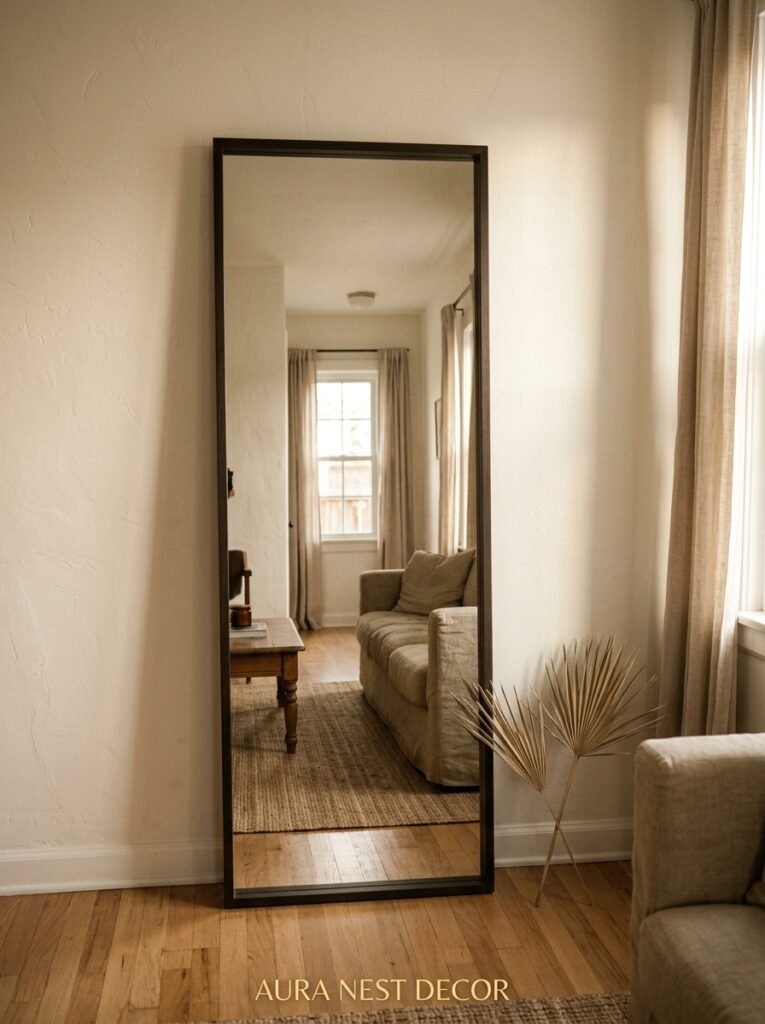
I was visiting a friend’s flat in South London and she’d basically stopped trying with her living room. She’d just accepted the narrowness. There was a sad little console table against the long wall with nothing above it, and the space just felt defeated.
I asked her to hang a large horizontal mirror — not a tiny decorative one, but a proper statement mirror, wide enough that you could comfortably see your whole outfit in it — on that long wall, about eye height.
The change was immediate. The room doubled in apparent width, the natural light from the single window bounced further into the space, and suddenly the room had a focal point that wasn’t just “the sofa pointing at the TV.”
“A mirror on the long wall of a narrow room isn’t a design trick. It’s a structural correction.”
Mirrors work differently in narrow rooms than they do in regular proportioned spaces. In a wide room, a mirror is decorative. In a narrow room, it’s load-bearing. Treat it that way.
—
5. The Rug Rule That Makes the Floor Feel Three Times Bigger
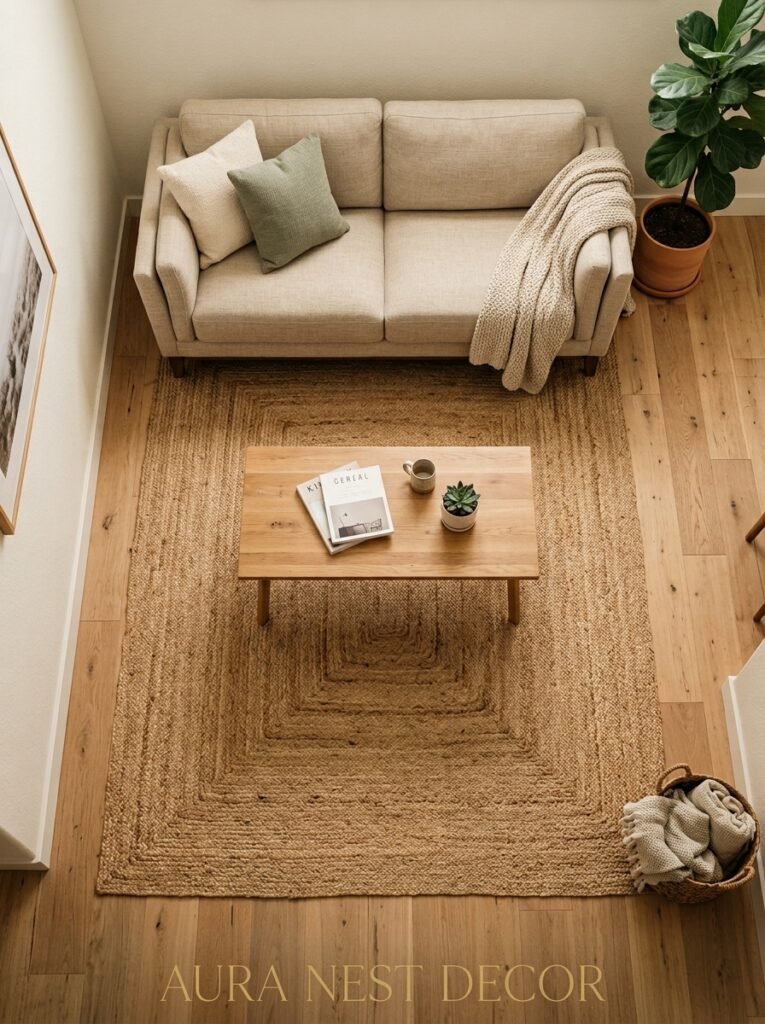
Biggest rug mistake in a narrow room? Going too small, or worse, choosing a rug that runs the same direction as the room — long and skinny, striped lengthwise. That just underlines the narrowness. Emphasizes it. Not helpful.
What you actually want is a rug that runs ACROSS the room rather than along it. So in a room that measures, say, 10 feet wide and 20 feet long, you’d choose a rug that’s 9 feet wide rather than one that’s 12 feet long. Wide rugs visually widen the floor plane and interrupt that corridor feeling.
Size matters more than you think. A rug that’s too small floats in the middle of the room looking lost and scared. You want the front legs of your sofa and chairs to sit ON the rug, anchoring the whole seating arrangement together. That anchoring is what makes a narrow room feel like it has a “center” — a place where the eye stops traveling and finally settles.
Also: patterns. A rug with a horizontal stripe or even a bold geometric that reads wider than it does tall? Absolute game-changer.
—
6. The Lighting Setup That Makes Narrow Walls Recede
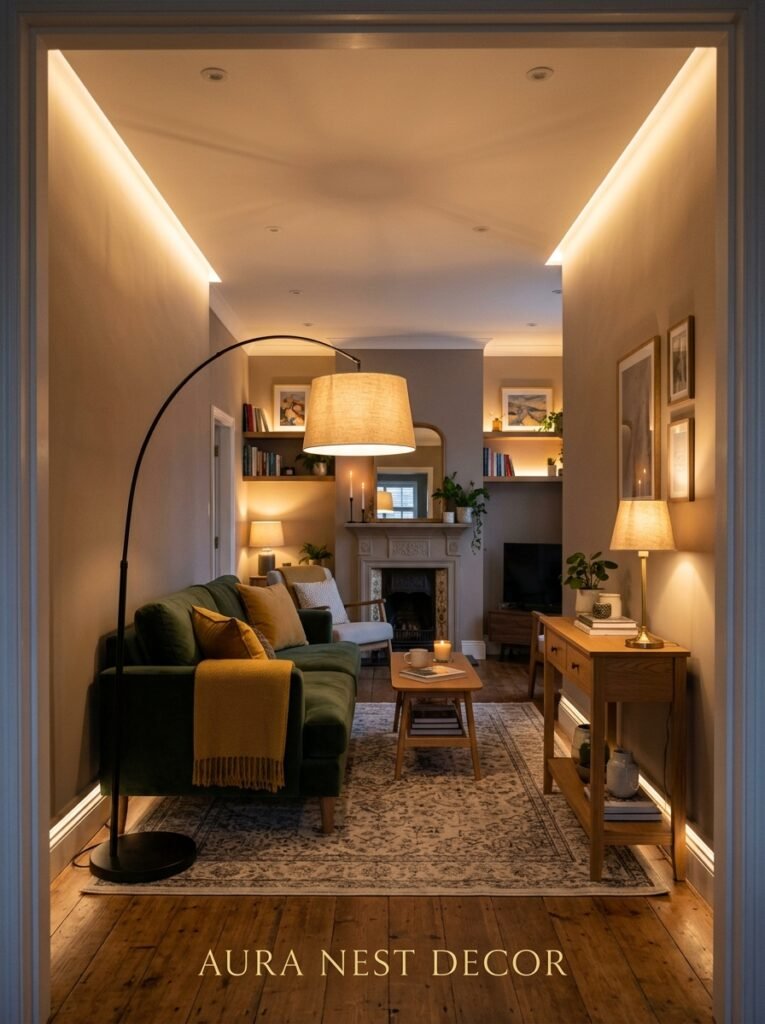
Overhead lighting is, and I say this with all the conviction I have, the enemy of a narrow living room. A single central light fixture draws the eye UP and then straight DOWN, which is exactly the direction you don’t want — it highlights height over width and casts harsh vertical shadows on those long walls.
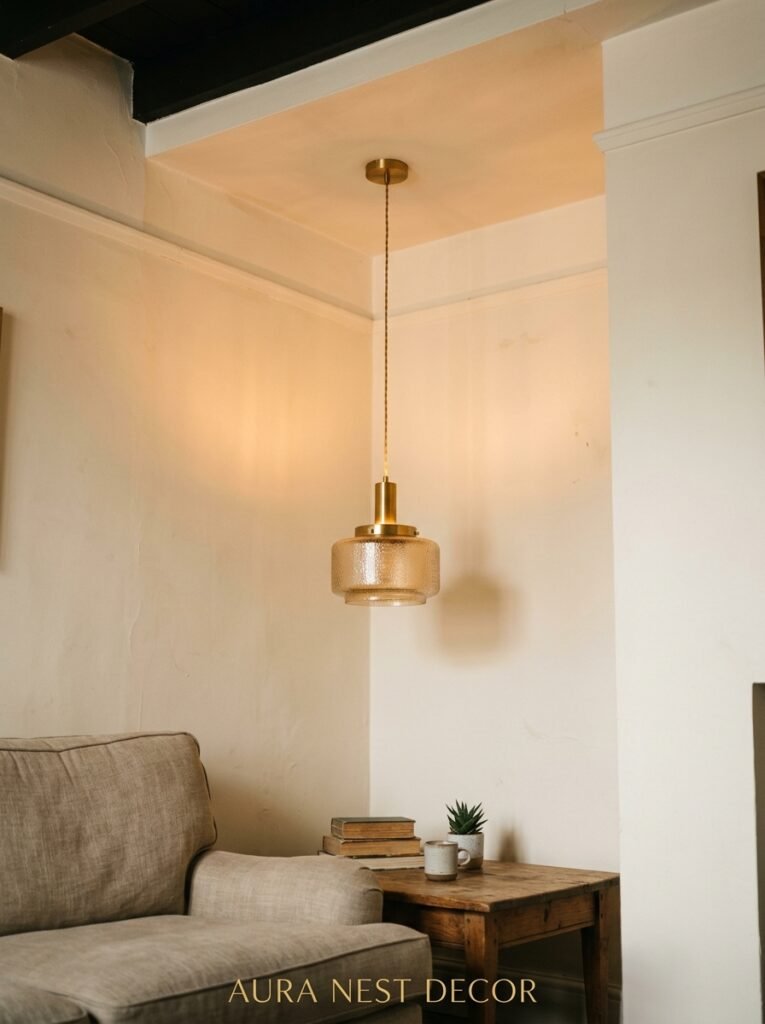
What you want is multiple low light sources. Lamps. Floor lamps in corners. A small table lamp on a side table. The amber glow of an Edison bulb at 7pm is genuinely the most flattering thing that can happen to a narrow room — that warm scattered light pools across the floor and walls horizontally, which is the direction your eye needs to travel.
Wall sconces on the SHORT end walls are particularly good because they draw attention to those smaller walls, which makes the room feel squarer. If you’ve got a wall at the far end of the room that feels like it’s miles away, putting a beautiful lamp or sconce there pulls it toward you visually.
Layer the lighting. Never just overhead. And if you’ve got dimmer switches, use them.
—
7. The One Rule That Makes Any Tiny Narrow Room Feel Intentional
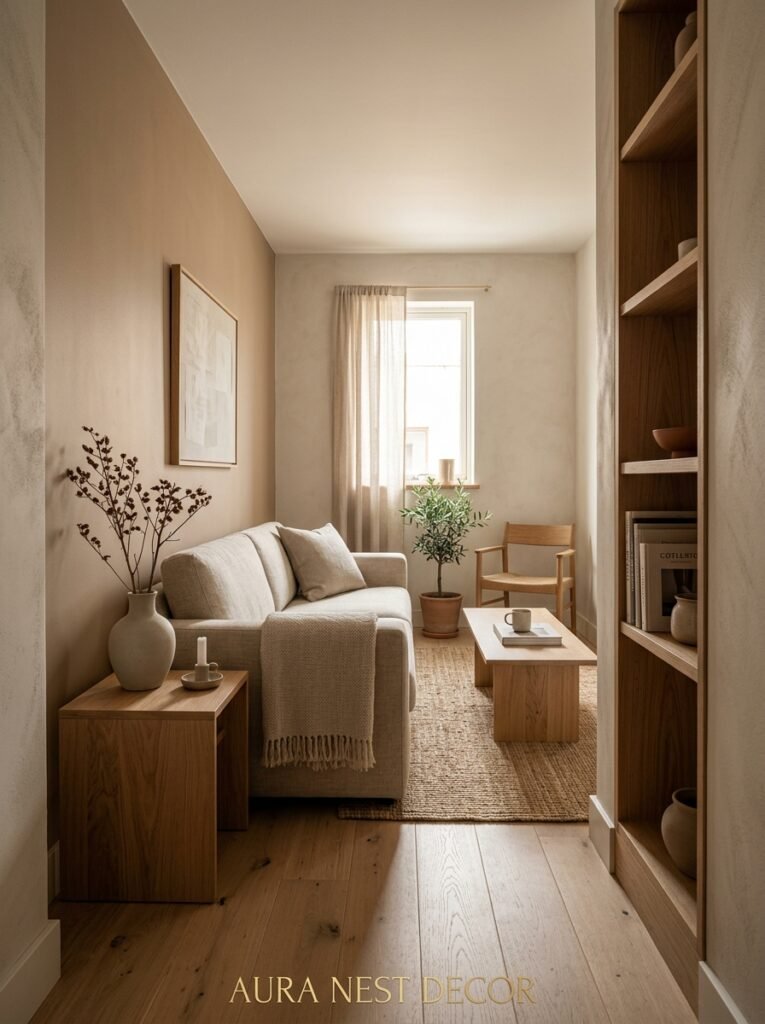
Vertical lines. Say it with me.
Tall bookshelves, tall curtains hung from ceiling height (not from the window frame — from the CEILING), vertical artwork in portrait orientation, a tall narrow plant like a fiddle leaf fig or a potted bamboo. Anything that draws the eye up.
Here’s why this works in narrow rooms specifically: height creates perceived volume. When a room feels tall, the brain recalibrates its sense of scale and the narrowness becomes less dominant. It stops feeling like a corridor and starts feeling like a proper room that just happens to be longer than average.
Curtains are the fastest win here. If your curtains currently hang from the window frame, move the rod up — as close to the ceiling as you can get it — and let the fabric fall in long, unbroken lines to the floor. The window will look taller, the wall will look taller, the room will feel bigger. It costs about forty dollars and a Sunday afternoon. Worth every minute.
—
8. Furniture You Didn’t Know Was Perfect for This Shape of Room
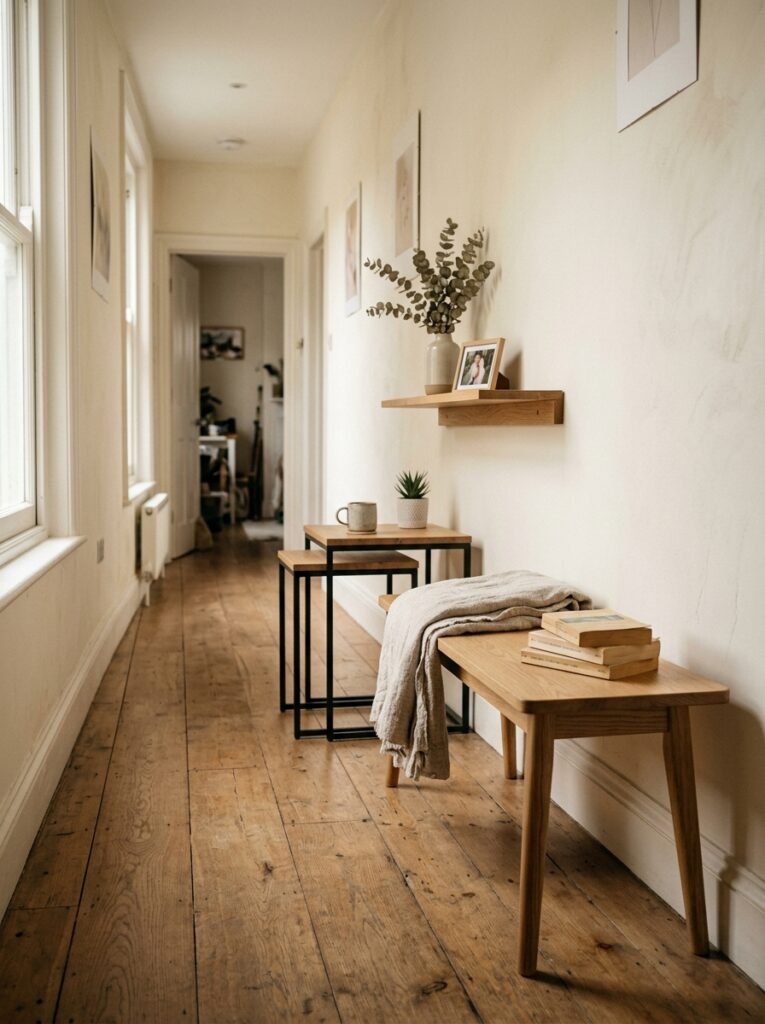
Narrow console tables. Nesting tables instead of a chunky coffee table. Ottomans that can tuck under things or be moved. Basically, anything that’s doing DOUBLE DUTY and not taking up more floor space than it has to.
A bar cart in the corner instead of a drinks cabinet. A floating shelf instead of a big media unit. A bench at the end of the sofa run instead of another armchair.
And honestly? Glass and lucite. I know they’ve had a moment and some people are tired of them, but a lucite coffee table or a glass side table in a narrow room is kind of a cheat code. The eye passes right through them, so the floor reads as uninterrupted, and the room feels less cluttered even when it isn’t. Not everyone’s style, I get it. But if you’re looking for square footage you don’t technically have, transparent furniture is where you find it.
“The best piece of furniture for a narrow living room is usually the one you decide not to buy.”
—
9. The Gallery Wall Mistake That Makes Narrow Rooms Look More Narrow
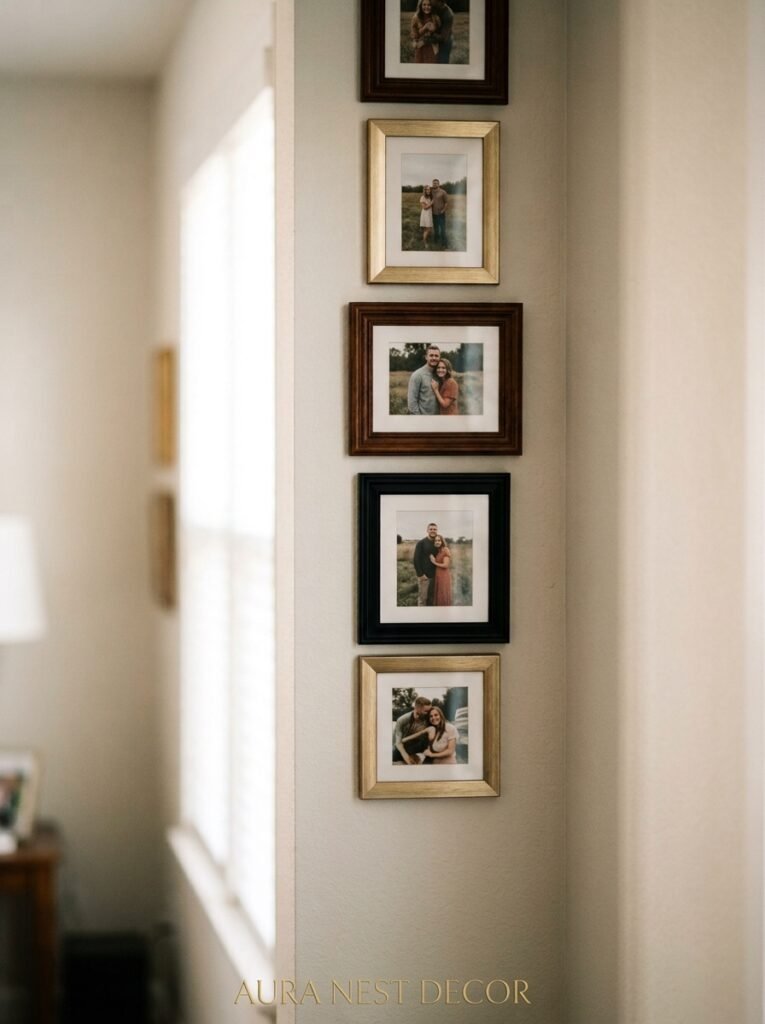
This one gets me every time. People hang a gallery wall on the long wall of the room — usually centered, usually in a vertical cluster — and wonder why the room feels like it’s closing in.
Vertical clusters of art on long walls reinforce the corridor. The eye stacks the images, looks down, and the wall feels taller and closer.
Instead: hang a single long horizontal piece, or arrange a gallery wall in a wide, low, landscape orientation. Think wide and low, like a letterbox shape. Art that spreads horizontally across a wall makes the wall itself feel wider. Simple as that.
And absolutely do hang something meaningful on those short end walls. A lot of people ignore them, treat them as nothing. But a piece of art or a statement mirror on the short end wall of a narrow room does incredible things — it makes the room feel like it has destinations. You look up from the sofa and there’s something interesting all the way at the end. The room suddenly has drama.
—
10. What British and American Narrow Rooms Both Get Wrong (Just in Different Ways)
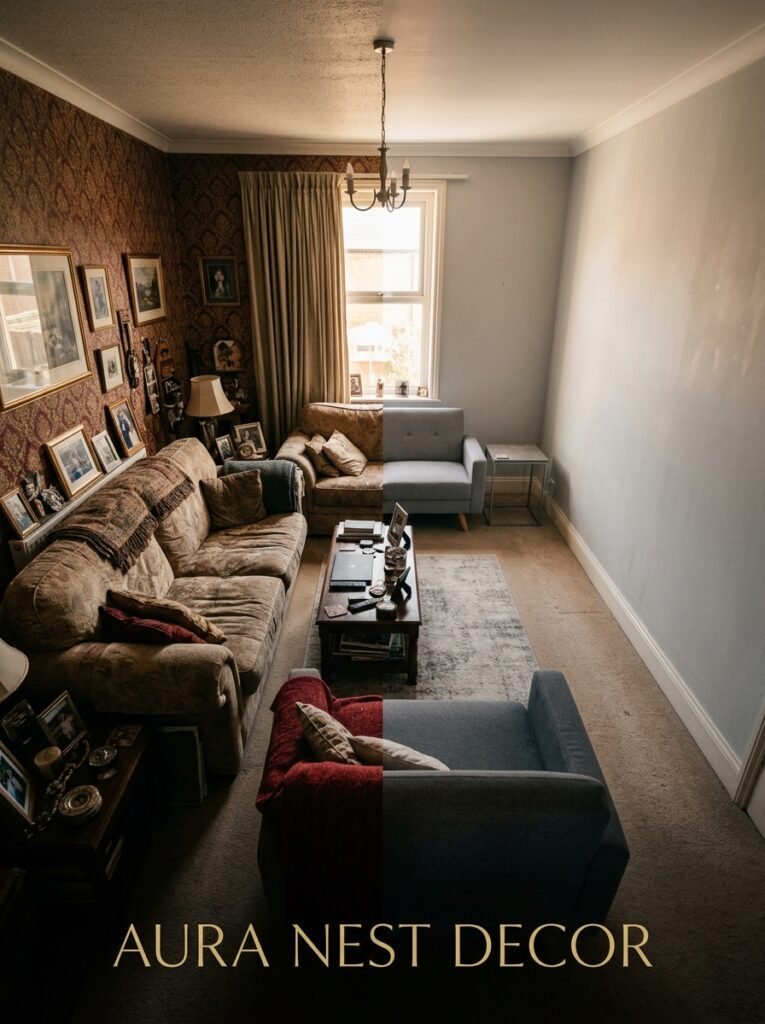
Okay, I’ve spent time in enough narrow Victorian terraces in the UK and enough long thin ranch house living rooms in the US to say this: the mistakes are different but the root cause is the same.
British narrow rooms tend to be over-furnished with small-scale pieces that all fight each other. Too many little things. A room full of small furniture doesn’t feel intimate — it feels chaotic and cramped. One or two larger anchor pieces, scaled correctly, will do more than six small pieces scattered around.
American narrow rooms tend to go the opposite direction — one massive sectional that dominates everything, plus a huge TV console that blocks off the end wall. The scale isn’t wrong, but it’s not varied. A mix of scales — one big thing, some medium things, a few small things — gives the eye somewhere to rest and somewhere to travel.
Both make the mistake of ignoring the ceiling. A painted ceiling, a ceiling-height shelving unit, curtains that start at the ceiling — these are essentially free if you’re already decorating, and they change everything.
—
11. Plants That Actually Work in Narrow Rooms (and the Ones to Leave at the Garden Centre)
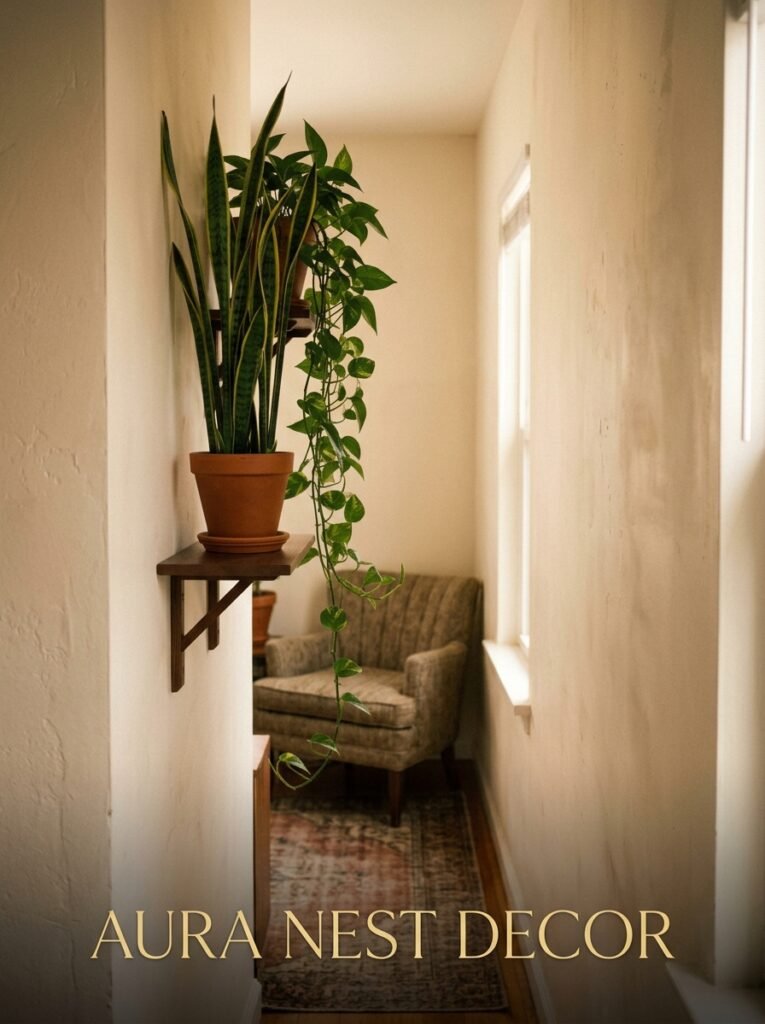
Wide, bushy plants are a problem in narrow rooms. A big round fiddle leaf or a wide-spreading monstera takes up floor width you can’t afford to give. I’ve seen people put a beautiful large monstera in the corner of a narrow room and the thing honestly just makes the room feel like it’s being consumed.
Tall, slim plants are where it’s at. Snake plants. Tall potted bamboo. A single dramatic bird of paradise that grows UP rather than OUT. These add life and oxygen and that soft organic thing that only plants can do — without stealing any of the precious horizontal space.
One big statement plant in a tall, sculptural pot beats four medium plants scattered around. Every time. It’s a focal point, and narrow rooms desperately need focal points that aren’t just the TV.
—
12. The Last Thing I’d Change in a Narrow Room (and Why It’s Usually the First Thing People Notice)
Window treatments. Specifically: how much light you’re actually letting in.
Most narrow rooms are dark. The single window (or the two windows on the short end walls if you’re lucky) has to work incredibly hard, and if it’s got heavy drapes or blinds that are perpetually half-shut, the room just doesn’t stand a chance.
Go sheer on the main window layer. Keep the blackout functionality if you need it — roller blind behind, sheer curtains in front — but let the daylight come in fully during the day. That natural light is doing your walls, your floors, and your furniture more flattering work than any paint color or mirror.
And if you’ve got curtains that are currently hemmed to the window frame and stopping there awkwardly, extend them. Floor to ceiling, ceiling to floor. It’s one of those changes that makes guests walk in and say “wait, did you do something in here?” without being able to say what.
That’s the sweet spot of decorating a narrow room well. Not a dramatic renovation. Just a series of small moves that all push in the same direction — light, width, intention — until the room stops apologizing for its shape and starts owning it.
—
❓ FAQ
Q: How wide does a living room have to be before it’s not considered “narrow”? A: Most designers start using the “narrow room” playbook when a room is under 12 feet wide relative to its length. But really it’s about proportion — a room that’s more than twice as long as it is wide will feel narrow regardless of the specific measurements. These tips apply to any room where the length-to-width ratio feels off.
Q: Should I get rid of my sectional sofa if I have a narrow living room? A: Not necessarily — it depends on the sectional. A small L-shaped sectional in a room that’s at least 12 feet wide can work if one arm runs along the short wall rather than the long one. What kills narrow rooms is a full-sized sectional with a long chaise that runs parallel to the longest wall. That’s the configuration to avoid.
Q: Do dark walls really work in narrow rooms or is that just a design myth? A: They can work, but you have to be strategic. Painting only the short end walls a deep, moody color — leaving the long walls lighter — can actually make a room feel less narrow by making those short walls appear to step forward. Full dark paint on all four walls of a genuinely narrow room tends to make it feel like a cave. Not always the move.
—
💭 Final Thoughts
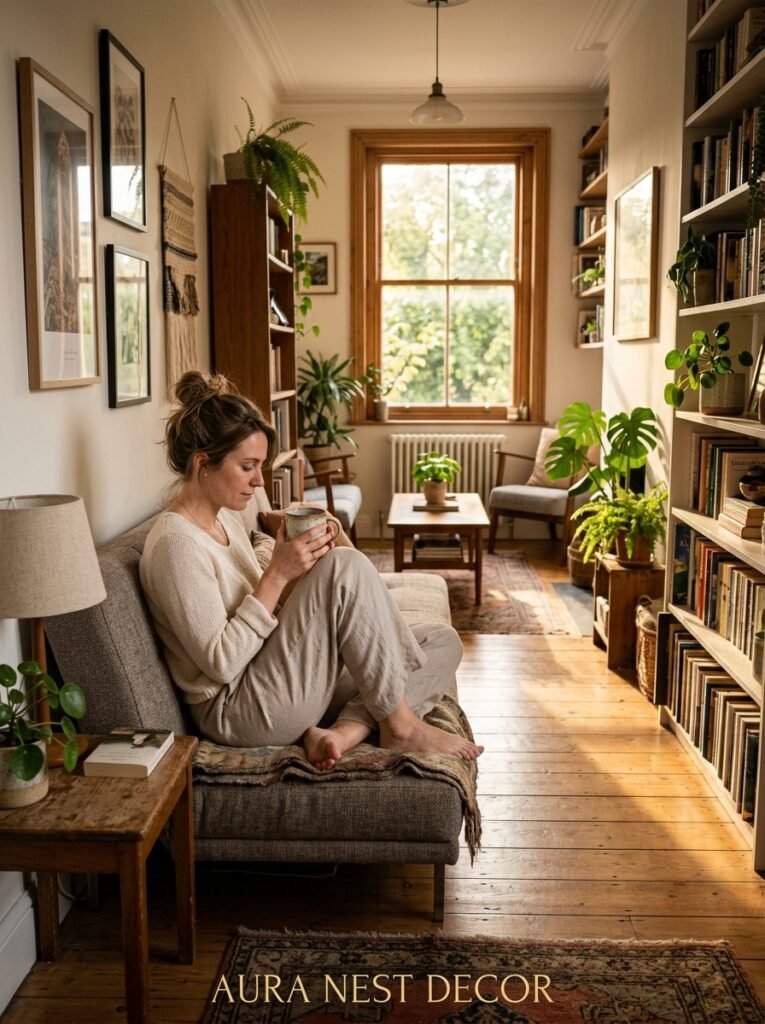
A narrow living room isn’t a flaw in your house. It’s just a room that needs to be understood on its own terms rather than forced into a shape it isn’t. Most of the fixes here are cheap, some are free, and none of them require knocking anything down — which means my South London friend’s walls are staying exactly where they are.
The question I’d leave you with is this: which wall in your narrow room have you been ignoring — and what would happen if you finally paid it some attention?