The Tiny Living Room That Actually Looks More Magical at Christmas Than the Big Ones
My friend walked into her new flat last December, looked at the small sitting room, and said, “I genuinely don’t know how I’m going to do Christmas in here.” She had about twelve feet of usable wall space and a sofa that took up most of it.
By the 23rd, it was the coziest room I’d ever been in.
—
1. Why Less Stuff Actually Hits Harder in a Small Space
Here’s the thing people get backwards. They think a small room needs MORE decoration to feel festive, like somehow you can outrun the square footage with enough ornaments. But it’s the opposite, honestly. When you strip it back — one really good wreath, a cluster of candles, some greenery — every single thing you put in that room lands.
In a big living room, things get lost. Your eye moves around and nothing really registers. But in a small room? You see EVERYTHING. That means bad choices are more obvious, sure. But it also means one genuinely beautiful thing gets its moment. A single garland draped over a doorway becomes a whole feature. A handful of brass candlesticks on a console table looks intentional and considered, not sparse.
So the first mindset shift is this: you’re not decorating a small room. You’re curating a small room. Those aren’t the same thing.
—
2. The One Piece of Greenery That Does All the Heavy Lifting
Start with something real. Or real-looking, if you can’t do real — but real is worth the effort in a small space because the smell alone changes the whole atmosphere of the room. A small amount of real spruce or eucalyptus tucked somewhere does more work than a full artificial garland that smells like nothing.
“One sprig of real evergreen in a small room does more for the mood than a plastic garland twenty feet long.”
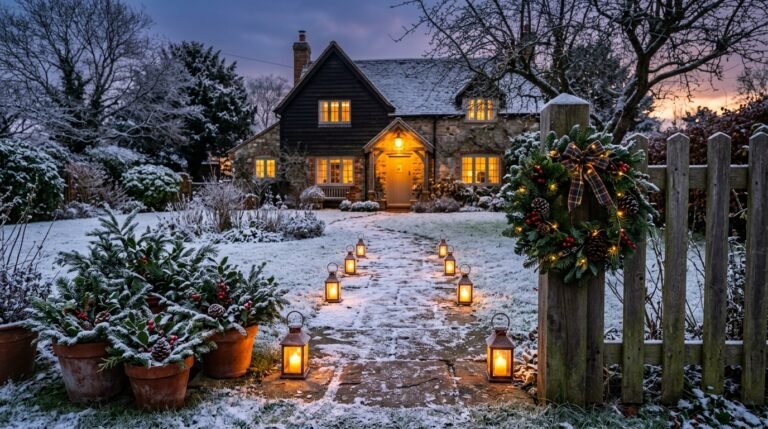
If you’ve got a fireplace, even a tiny one, a slim garland across the mantle is all you need. Don’t go dramatic and full. Keep it tight, lean it slightly forward, and let a few stems drop naturally at the corners. If there’s no fireplace — and plenty of us don’t have one — a simple wreath on the wall above the sofa works beautifully. Not the door. The WALL. It becomes art, and it fills that vertical space without taking up an inch of floor.
Eucalyptus dries well, stays silver-green for weeks, and honestly looks more minimal-chic than traditional pine. Just something to consider.
—
3. The Color Rule That Makes a Minimalist Christmas Feel Rich, Not Cold
Minimalist doesn’t mean beige and sad. That’s the mistake. It means edited, not empty.
For a small living room, pick two colors and commit. Not three. Not “neutral plus three accents.” Two. Deep forest green and warm brass. Or cream and black (yes, black at Christmas — it’s stunning). Or the dusty red-and-natural-wood combination that feels more Scandinavian farmhouse than department store.
The reason two colors works so well in a small space is that your eye reads the room as calm and intentional rather than scattered. Even if you have a lot of decorative objects, if they’re all within the same palette, they read as one cohesive thing rather than clutter. And in a small room, the difference between “curated” and “cluttered” is basically just color discipline.
Side note — warm metallics are basically a neutral at Christmas. Brass, gold, bronze. They pick up candlelight and lamplight and give everything a glow without adding visual chaos. You can mix them, weirdly enough. A brass candlestick next to a bronze bowl? Completely fine. Looks collected, not mismatched.
—
4. What to Do With the Christmas Tree When There’s Nowhere to Put One
Right. The tree. The most stressful part for small room owners.
A few options, and I mean genuinely good options, not consolation prizes. First: a slim or pencil tree. These have gotten so much better looking in the last few years — they used to look sad and institutional, but now you can find ones that are actually beautiful, with good density and shape. In a corner, a 6-foot pencil tree takes up maybe 18 inches of floor space. That’s it.
Second option, and honestly my favorite for very small rooms: go up, not out. A wall-hung flat tree — essentially a tree shape made from branches or a frame mounted on the wall — sounds gimmicky but looks genuinely incredible when done right. Add a few simple ornaments, a string of warm lights, and it becomes a real focal point without touching the floor at all.
“Going vertical is the move nobody in a small room thinks of, and it changes everything.”
Third: skip the full tree entirely and do a large, beautifully decorated branch in a vase. A thick branch from the garden or a florist, painted white or left natural, hung with a few glass ornaments and some lights. It sounds minimal. It IS minimal. And it’s honestly one of the most striking Christmas arrangements you can make.
—
5. The Lighting Trick That Makes a Cramped Room Feel Enormous
This one matters more than almost anything else on this list. The quality and placement of your Christmas lighting will either make your small room feel like a grotto or a cave, and the difference is in the color temperature.
Warm white. Always warm white. The amber glow of a warm bulb at about 7pm, when it’s dark outside and the overhead light is off — that’s the feeling you’re after. Cool white lights make a small room feel clinical and sharp and, weirdly, smaller. Warm lights make the walls soften. They make the ceiling feel lower in the good way, the cozy way.
String lights draped loosely behind a sofa or along a windowsill add depth to a room. They trick your eye into reading the space as larger because the light source is at a distance. A lamp on the floor in a corner does the same thing. You’re creating layers of light at different heights, and those layers are what make a room feel dimensional rather than flat.
Turn off the overhead light. Seriously. Just do it. The room will look three times better.
—
6. Small Surfaces, Big Impact — The Styling Formula That Actually Works
In a small living room, you probably don’t have a huge console table or a massive coffee table to work with. You’ve got what you’ve got — maybe a small side table, a windowsill, a narrow shelf. Here’s how to make those surfaces count.
Odd numbers. Always odd numbers. A cluster of three objects — a candle, a small pot of greenery, a simple ceramic — reads as deliberate. Two feels incomplete, four feels crowded. Three is almost always right.
Vary the heights. This is the one thing that separates a styled surface from one that just has stuff on it. Put a tall candle next to a short, wide object and a medium-height third piece. Your eye moves up and down and the whole arrangement feels dynamic.
And leave space. Actual negative space on the surface. Don’t cover every inch. The empty space is part of the styling, and in a small room, it makes everything breathe.
—
7. The Window Situation That Most People Get Wrong
A window in a small living room is prime real estate and most people either ignore it entirely or go so heavy with decorations that it blocks all the natural light. Neither of those is right.
A simple string of lights along the inside of the window frame — tucked right into the edge so it’s not obvious where they start and end — looks incredible from outside. It also frames the view and, during the day, it’s barely noticeable. At night it becomes a feature.
If you want something more, a single wreath hung in the center of the window pane is classic and beautiful and doesn’t eat any floor space. The light passes around it during the day, and at night the lights on it (if it has them) reflect slightly in the glass. It’s subtle. It’s lovely.
What NOT to do: full curtain-to-curtain garland across a small window. It swamps the room and blocks the light. Small rooms need every scrap of daylight they can get during December, when it’s dark by 4pm and everyone’s already a bit miserable about it.
—
8. The Forgotten Vertical Space That Becomes Your Secret Weapon
Walls. Stairs, if you have them. The space above a doorframe. Everyone decorates horizontally — on surfaces, on the floor — and forgets that they’ve got an entire vertical plane available.
A simple arrangement of foliage above a door costs almost nothing and looks like you hired someone. A few stems of eucalyptus, some dried orange slices, a bit of ribbon in a natural linen color — push it into a small floral foam block and sit it on top of the door frame. Done. The eye is drawn UP, which makes the room feel taller.
On the wall itself: framed prints swapped out for the season are very underrated. A simple print that says something quiet and Christmassy — a botanical illustration of holly, a minimal star, a line drawing of a reindeer that isn’t embarrassing — changes the feel of a room without adding any physical depth or clutter. And you can just swap it back in January.
—
9. How to Make a Sofa Look Intentionally Dressed, Not Just Thrown-Together
The sofa in a small living room is usually the biggest surface in the room. Which means it’s the biggest opportunity, and also the biggest risk for looking messy.
Two or three cushions in coordinating seasonal tones — think deep green velvet, natural linen, a muted tartan — look far more considered than a heap of mismatched cushions. And a throw. One throw, folded loosely but not chaotically over one arm or corner. Not draped everywhere, not crumpled.
“The throw is the finishing touch that either ties the whole room together or looks like someone left their blanket out.”
For a minimalist Christmas feel, go for texture over pattern. A chunky knit in cream or oatmeal. A soft wool throw in charcoal or sage. The Christmas-ness comes from the warmth of the thing rather than from it being explicitly festive. And when December ends, you don’t have to pack it away — it just continues being beautiful all winter.
—
10. Scent as Decoration (The Invisible Layer Everyone Forgets)
This one doesn’t go on any surface and takes up zero visual space. But scent is DECORATION. It’s just decoration your nose registers instead of your eyes.
A candle that smells of cloves, or cedarwood, or beeswax and orange peel — that’s Christmas. That’s atmosphere. In a small room, scent is even more powerful because it fills the space immediately. You walk in and the room tells you what it is before you’ve looked at a single thing.
Real wax candles in simple, neutral holders. Soy wax burns clean. Beeswax smells faintly of honey even unlit. A small simmer pot on the hob with orange peel, cloves, and a cinnamon stick if you want the whole room to smell incredible for free. Anyway, this is the one layer of Christmas decoration that costs almost nothing and makes the single biggest difference to how a room feels.
—
11. What to Actually Cut When the Room Starts Feeling Cramped
You’ll hit a point where you’ve added things gradually and the room suddenly feels busy. It happens. Here’s how to edit.
Stand in the doorway and look at the room. What’s the first thing your eye goes to? That’s your hero piece. Keep it. Everything else is supporting. Now ask: is each supporting element actually supporting that hero piece, or is it competing with it? If it’s competing — out.
Things that most commonly get cut in a small minimalist Christmas room: too many candles at different heights on too many different surfaces (consolidate them), multiple small decorative items scattered around (group them into one place), anything in a different color family from your two chosen colors (even if it’s cute), and the automatic reflex to put something on every available surface just because the surface is there.
Editing is not failure. Editing is the whole point.
—
12. The Detail That Makes It Feel Personal, Not Like a Showroom
Here’s the thing that gets lost in all the minimalism and curation talk. Your small living room should still feel like YOUR living room at Christmas, not a hotel lobby. One personal object — something that belongs to you, that has history — anchors the whole room.
Maybe it’s an ornament you’ve had since childhood, hung somewhere visible. Maybe it’s a photograph in a frame, propped on the mantle. Maybe it’s a mug your kid made in pottery class, used as a small vase for a sprig of holly.
It doesn’t need to match the palette. It doesn’t need to be beautiful in any objective sense. It just needs to be yours. That one imperfect personal detail is what separates a beautifully curated small room from a cold, untouchable one — and it’s what people actually remember when they leave.
—
❓ FAQ
Q: How do I decorate a small living room for Christmas without making it feel cluttered? A: Stick to two accent colors, group objects rather than scattering them, and prioritize quality over quantity. One beautiful statement piece — a slim tree, a wall wreath, a real garland — does more than ten small decorations spread around. The negative space between things is part of the decoration.
Q: Is a small Christmas tree better for a small living room? A: Not always — the right tree is the one that fits without dominating. A pencil tree, a wall-mounted branch arrangement, or even a large decorated bough in a vase can all work brilliantly. What matters is that it’s proportional and doesn’t eat the walking space you need.
Q: Can a minimalist Christmas actually feel warm and cozy, or does it just feel bare? A: It absolutely can, and it relies on a few things: warm-toned lighting (never cool white), texture (velvet, wool, linen), and scent. A room with two candles, some greenery, and the right lighting will feel cozier than a room packed with decorations under harsh overhead light every single time.
—
💭 Final Thoughts
The small living room isn’t the consolation prize. It’s the room that, when it’s done right, people don’t want to leave. There’s something about an intimate space that’s been thoughtfully put together — where every single thing in it was chosen — that a huge room with loads of stuff can never quite replicate.
You don’t need more. You never did.
So what’s the one piece you’re going to lead with this year?