
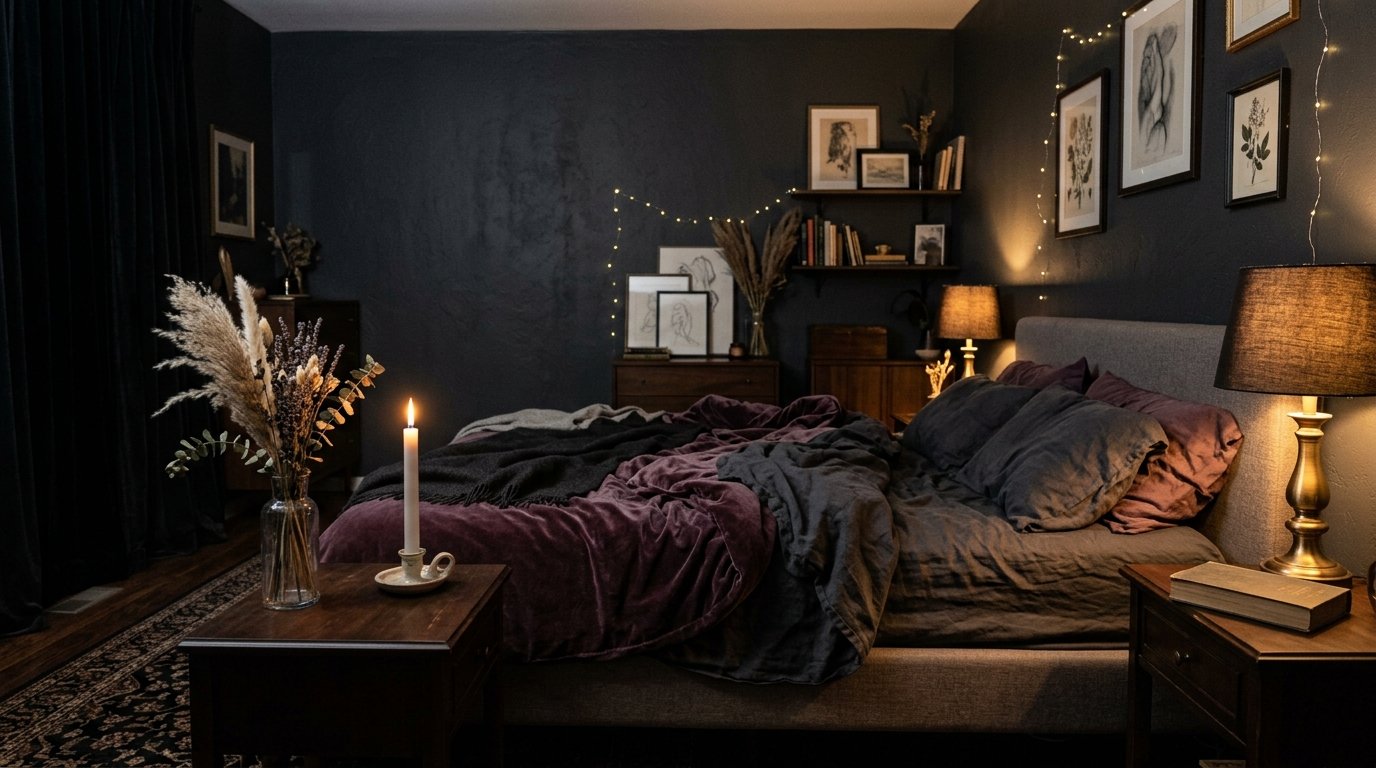
Dark Feminine Bedroom Ideas That Feel Cozy, Not Dramatic
My friend walked into my bedroom last autumn and just stopped. Stood in the doorway. Then she said, “It feels like the inside of a secret in here.” That’s exactly what I was going for.
—
1. Why Dark Bedrooms Feel So Much More Restful Than Light Ones
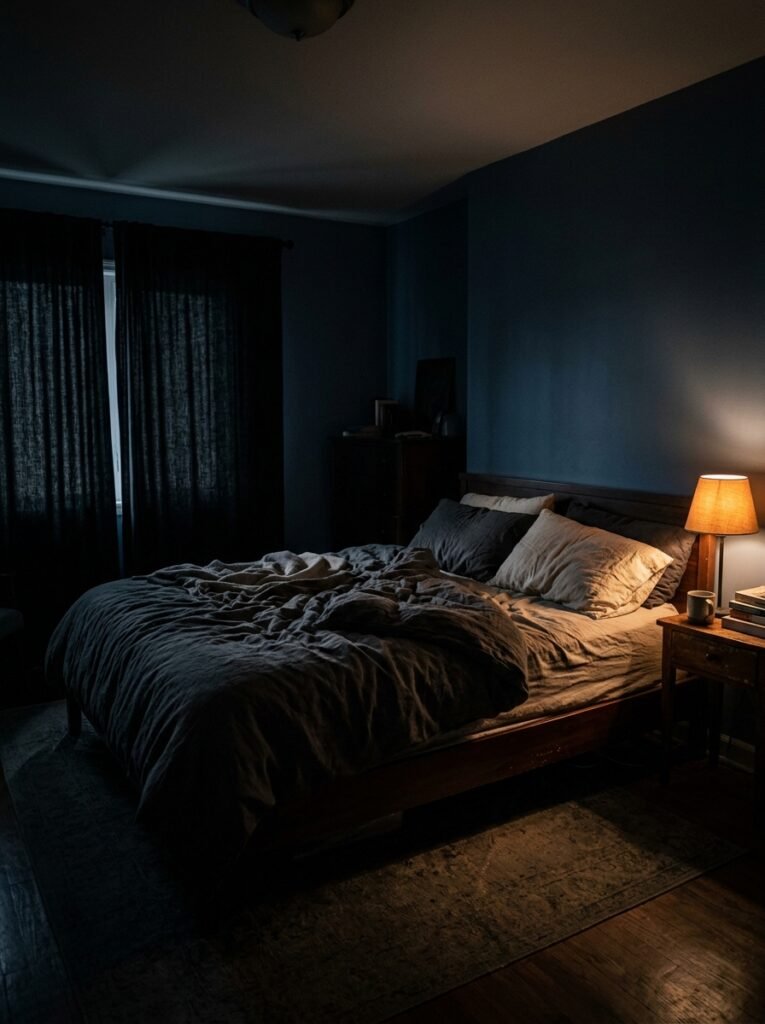
There’s this pressure, especially if you’ve spent any time on home decor accounts, to keep bedrooms bright and airy. White walls, linen everything, a plant on the windowsill catching the morning light. And sure, that’s beautiful. But it’s also kind of… exhausting? There’s something about a dark bedroom that tells your nervous system it’s allowed to slow down.
Deep tones — forest green, dusty plum, near-black navy — absorb light instead of bouncing it around. The room feels contained. Held. You’re not staring at a white ceiling that reflects every bit of ambient glow from outside. You’re cocooned.
The cozy part of dark feminine design isn’t about being moody for the sake of it. It’s about creating a room that exists on its own terms. Private. A little hushed. The kind of space where you close the door and everything outside stops mattering quite so much.
“A dark bedroom doesn’t close a room in — it opens something quieter inside you.”
—
2. The Wall Color That Keeps Appearing in Every Stunning Dark Bedroom Right Now
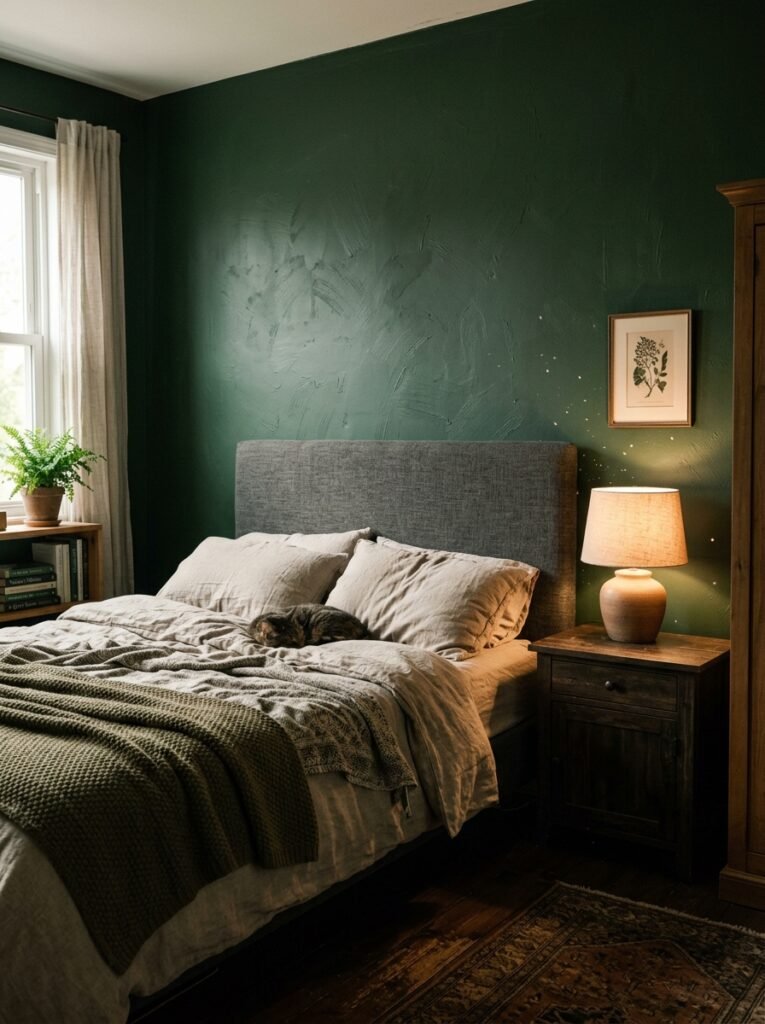
Okay so. It’s not black. And it’s not burgundy (though burgundy is having a moment). The color I keep seeing everywhere — the one that makes a bedroom look expensive and cozy and deeply feminine all at once — is something I’d describe as a smoky plum. Not purple. More like what you’d get if you mixed a little dusty rose into a very dark grey, and then let it dry somewhere with candlelight.
It reads differently at different times of day. In the morning it’s almost soft. By evening it’s dramatically gorgeous. And because it’s got those warm undertones, it doesn’t feel clinical or gothic — it just feels like a room that has taste.
If you can’t commit to walls, try it on a single chimney breast or the wall your bed sits against. That’s often enough to completely shift the energy of a space. Paint behind the headboard first, live with it for a week, then decide.
Also — dark ceilings. I know, I know. But hear me out. Painting your ceiling the same tone as your walls (or slightly deeper) creates this enveloping quality that no amount of soft furnishings can replicate on their own. It sounds terrifying on paper. In person it’s stunning.
—
3. The Bedding Weight That Actually Makes a Dark Bedroom Feel Cozy
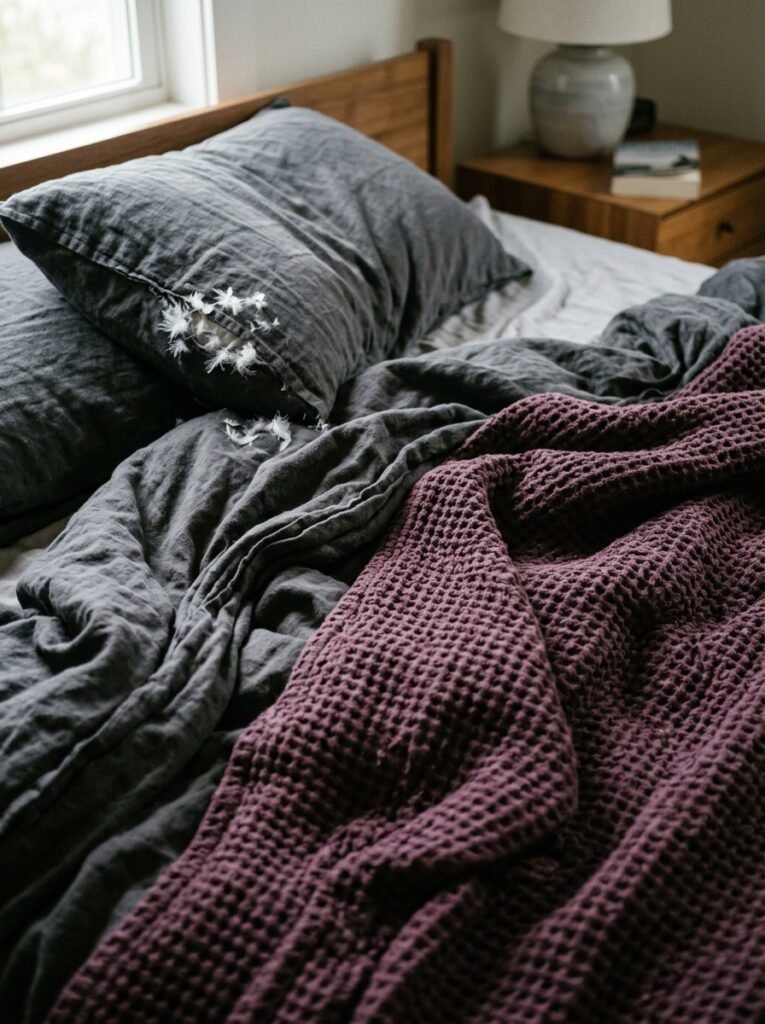
Heavy. It needs to feel heavy.
Not hot-heavy, just substantial. A duvet with real loft to it, layered under a knitted throw or a waffle-weave blanket in something like deep charcoal or faded burgundy. The visual weight of dark bedding matters — thin, flat duvets look sad in a dark room. You need texture. You need layers that look like you could sink into them from across the room.
Cotton velvet pillow covers are probably my single most-used styling trick for this aesthetic. They catch light in this quiet, understated way that looks expensive but genuinely isn’t. A couple of them in dusty rose or soft olive, against charcoal or deep plum bedding, and the whole bed looks deliberately composed.
Side note — linen in dark colours wrinkles beautifully. That slightly undone quality is part of what makes dark feminine bedrooms feel lived-in rather than just designed.
—
4. The One Lighting Rule That Makes or Breaks the Whole Vibe
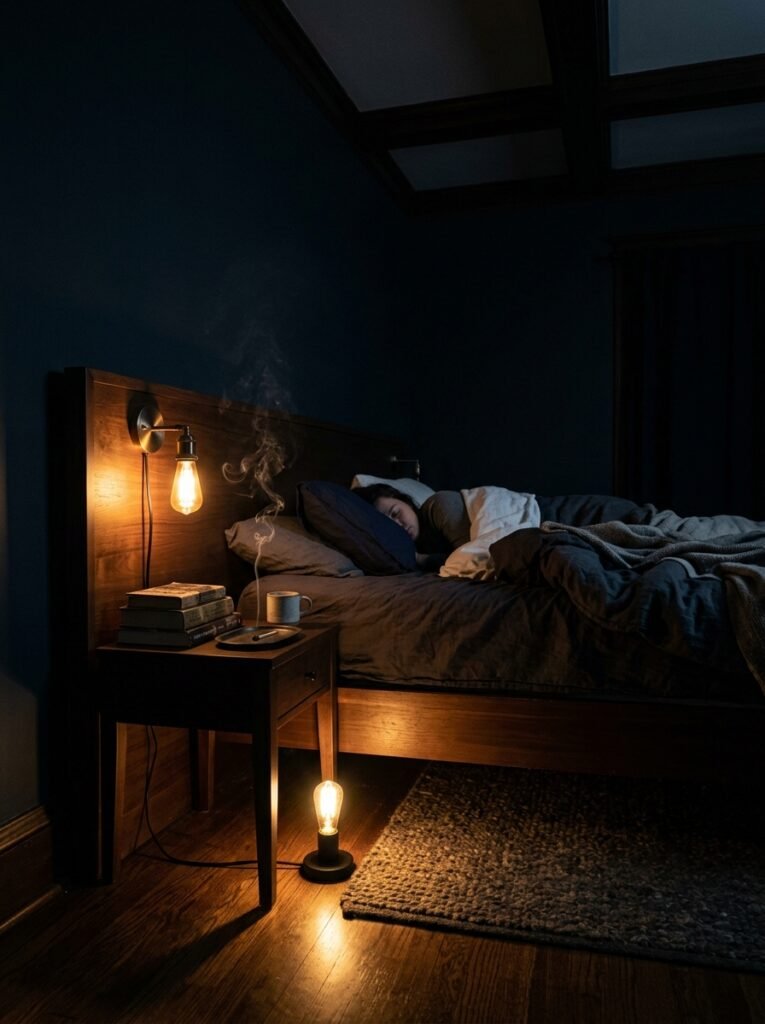
No overhead light. That’s it. That’s the rule.
Or — okay, you can keep the overhead light, but it can’t be the main event. If you’ve got a ceiling fixture and it’s doing all the work in your bedroom, the whole dark aesthetic is going to feel flat and slightly depressing rather than intentional and cozy.
“The moment you replace your overhead light with three smaller sources, the room stops being a room and starts being a place.”
What you want instead: a lamp on each bedside table, ideally something with a warm amber bulb — not the cool daylight ones, please. Then something lower, closer to the floor. A little table lamp in the corner, a cluster of candles on a tray, a plug-in wall sconce if you’re renting and can’t hardwire anything. The amber glow of a low-wattage bulb at 7pm in a room with dark walls is genuinely one of the most beautiful things you can create in a home. I don’t say that lightly.
Fairy lights, done right, also work. Done wrong they look like a university dormitory. The difference is: warm white bulbs on a thin copper wire, draped loosely rather than pinned in a tidy line, near the bed rather than across the whole room.
—
5. Textures That Make Dark Colours Feel Soft Instead of Stark

Dark bedrooms can go wrong when everything is flat. One-dimensional. A dark grey wall next to dark grey bedding next to a dark wooden floor and suddenly you’re living in a cave, not a cosy sanctuary.
The fix is texture contrast. LOTS of it. And that means pulling in things that are rough against things that are smooth, matte against things that catch a little light.
A chunky knit throw. A faux fur cushion (I know some people have opinions about faux fur — I’m keeping mine). A jute or wool rug with visible weave. Linen curtains that pool slightly on the floor. A wooden headboard with visible grain, or a velvet upholstered one in something dark and rich.
The dark feminine aesthetic specifically loves mixing organic materials with a few more refined elements. So: rough linen against a smooth ceramic lamp base. A wooden side table next to a mirrored tray. It’s the contrast that gives the room its depth.
—
6. How Mirrors Change Everything in a Room With Dark Walls
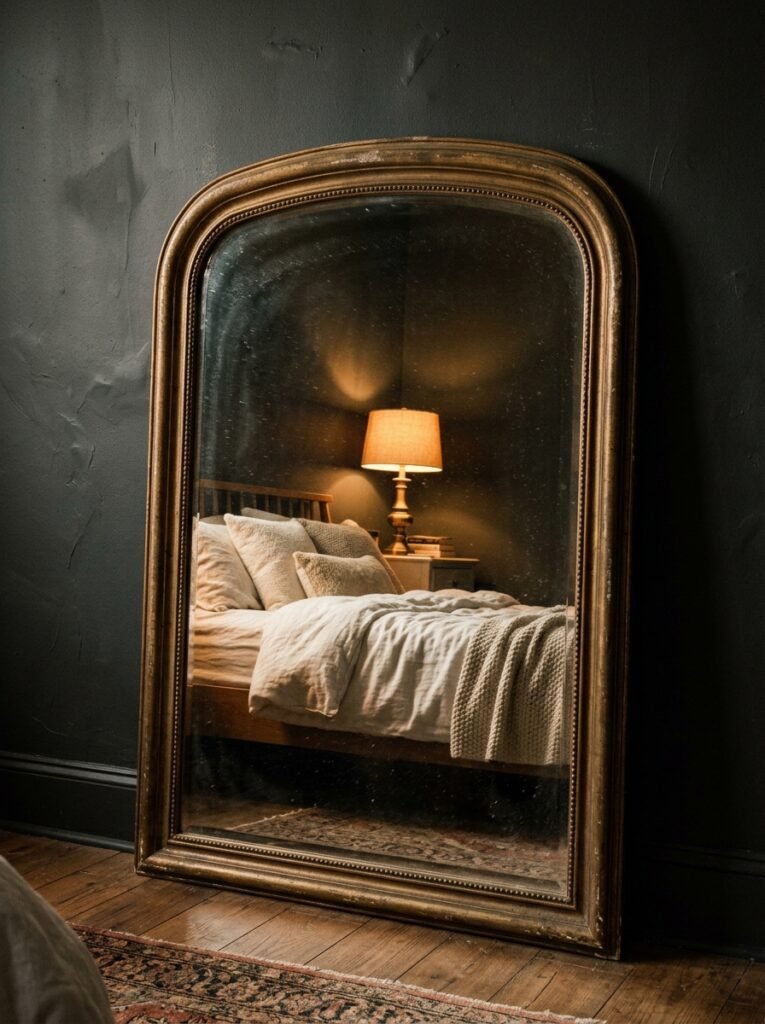
People panic about mirrors in dark rooms because they’ve heard that you need mirrors to “bring in more light.” And yes, that’s technically true. But a dark feminine bedroom isn’t trying to be bright — it’s trying to be atmospheric. So mirrors here serve a slightly different purpose.
A large mirror with an ornate or antique-style frame reflects the warmth of your candles and lamps back into the room, multiplying that golden glow rather than the natural light. It creates depth. A sense of another plane of the room existing just behind the glass.
Leaning a full-length mirror against the wall rather than mounting it flat also adds that slightly undone quality — like the room wasn’t designed to be photographed, it just ended up looking this way. Which is honestly the goal.
—
7. The Plant That Belongs in a Dark Feminine Bedroom
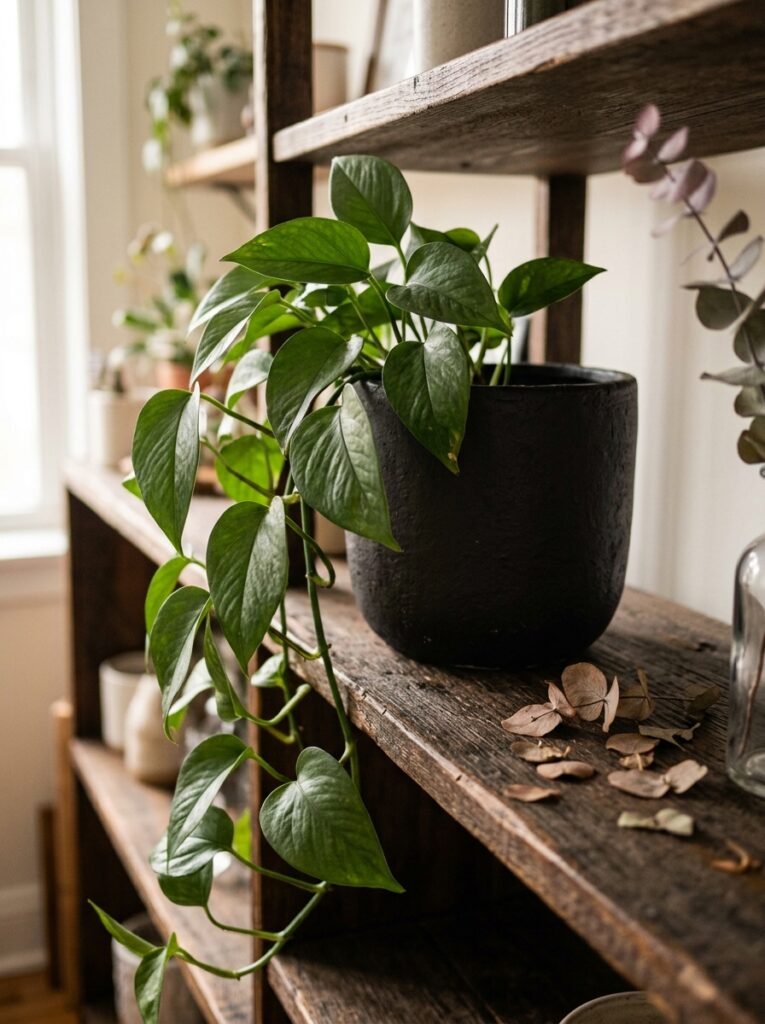
Not a cactus. Not a fiddle leaf fig, gorgeous as they are.
I’m talking about trailing plants — pothos in deep forest green, or the kind with dark, waxy leaves that have a slightly sculptural quality to them. Something that drapes over the edge of a shelf or trails down from a high surface. The movement of a trailing plant in a dark room adds this organic, almost wild quality that softens all the rich, saturated colour around it.
Dark-leafed plants specifically are having a MAJOR moment in interior design right now. A black-leafed variety tucked into a dark ceramic pot, on a wooden surface, in a room with plum walls — it sounds like it should disappear but it doesn’t. It just looks incredibly intentional.
And if you can’t keep plants alive (no judgement, high ceilings and low light will do that), dried pampas or dried botanicals in a dark glass vase do something very similar aesthetically. The texture is there. The organic quality is there. Less demanding.
—
8. The Curtain Length That Makes a Bedroom Look Twice as Expensive
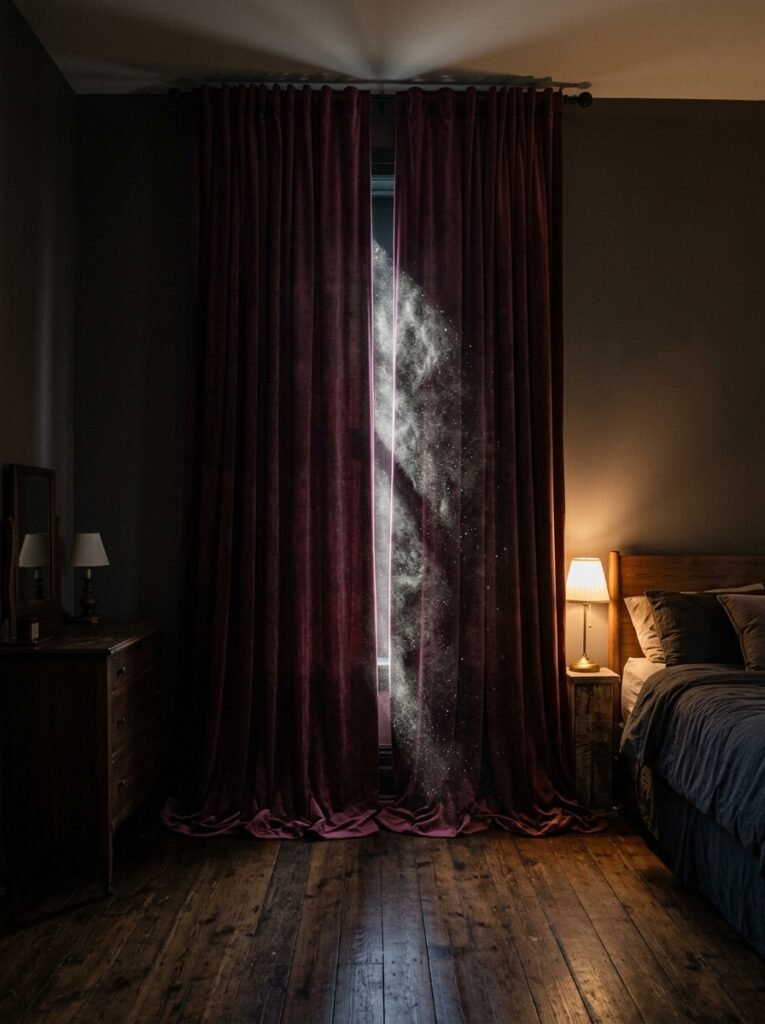
Floor length. Always. And then a little extra.
Curtains that hover nervously above the floor are one of the quickest ways to make even a beautiful room look unfinished. In a dark feminine bedroom specifically, you want curtains that pool — just slightly, two or three inches — onto the floor. It reads as intentional and considered and, honestly, a little romantic.
“Curtains that pool on the floor don’t just frame a window. They make a statement about the kind of room you’re trying to live in.”
For the colour: you don’t have to match your walls exactly. In fact, slightly tonal is often better than a perfect match. So if your walls are deep plum, consider a curtain in deep rust or forest green or near-black. Something that lives in the same family but has its own identity.
Velvet curtains in a dark bedroom are almost unfair — they look so good it barely feels like work. They block out light beautifully, they add that fabric texture the room needs, and they move in this slow, weighty way when there’s any breeze at all. If you can stretch to velvet, stretch to it.
—
9. Small Details That Pull the Whole Dark Feminine Aesthetic Together
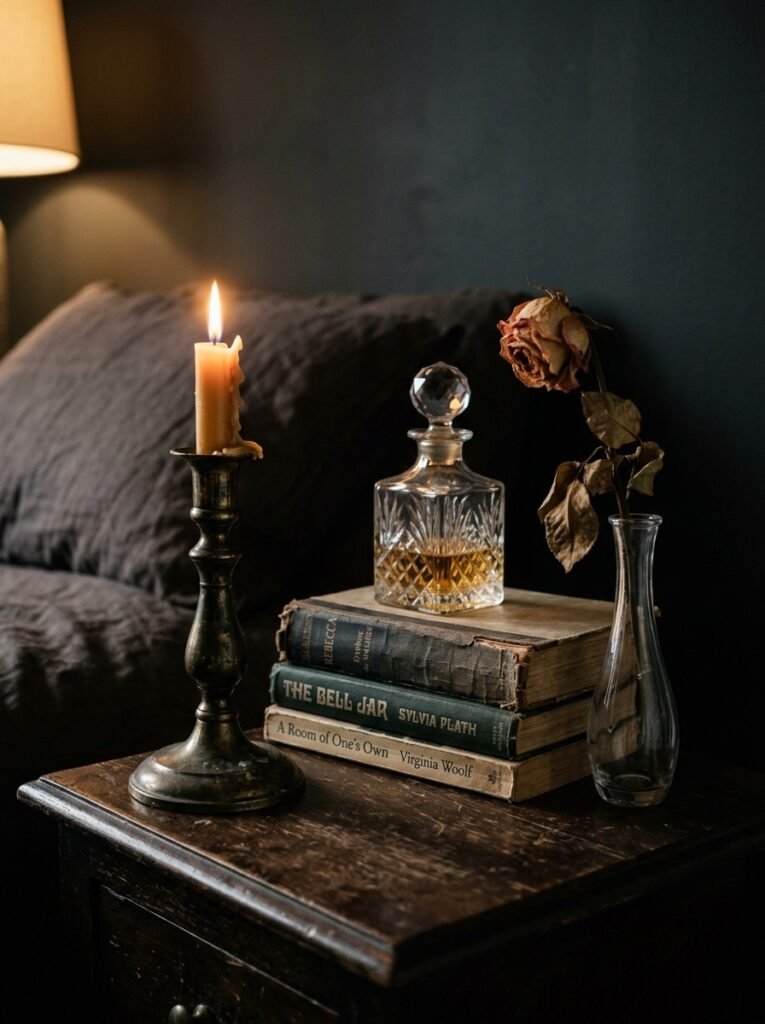
This is where the room goes from “dark” to “dark and curated.”
Candles, obviously. But specifically: tapered candles in dark holders rather than just a jar candle on a nightstand. Tapered candles have a slightly more deliberate quality to them. A pair of them on a tray with a few dried flowers or a small crystal or a worn paperback — suddenly it’s a moment, not just mood lighting.
A ceramic incense holder. A vintage-looking perfume bottle or a small glass dish for jewellery. A stack of books with spines in colours that work with your palette. None of these cost much. All of them matter.
Small metal accents — aged brass is the one — tie everything together without making the room feel shiny or modern. Drawer pulls, a lamp base, a small tray. Aged brass in a dark room looks like it’s been there for decades, like the room has history.
—
10. The Rug That Grounds a Dark Bedroom Without Killing the Vibe
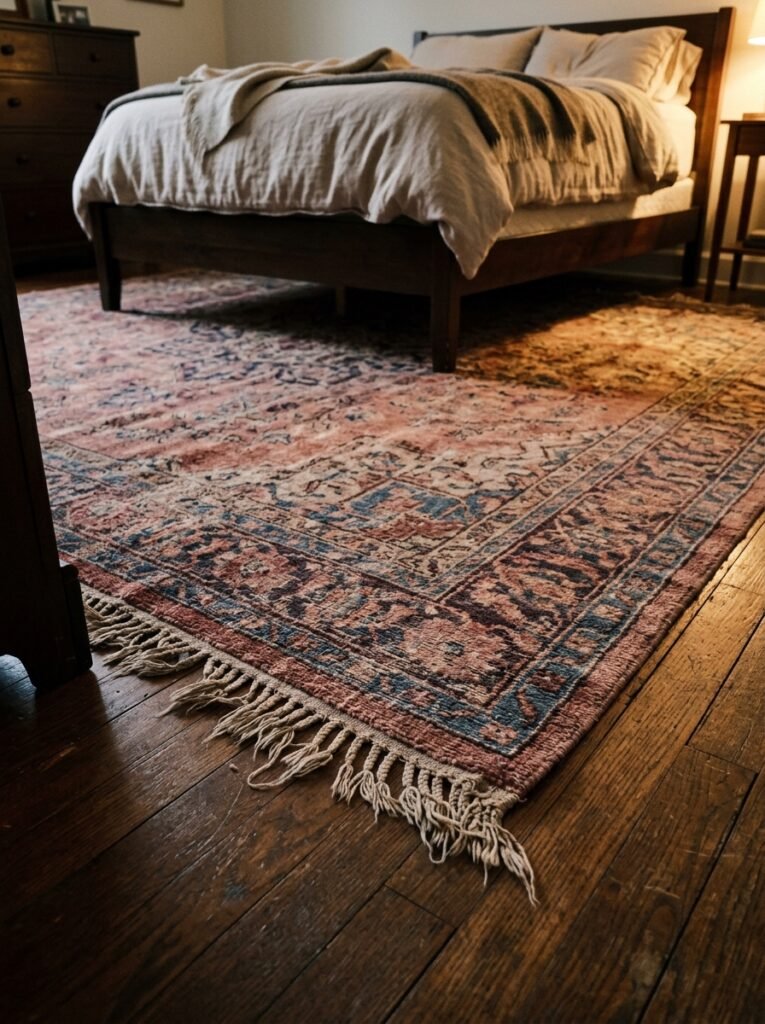
Whatever you do, don’t go lighter on the rug as a way of “balancing” the dark walls. I see this advice everywhere and it almost always makes the room look disconnected, like two different design decisions had an argument and nobody won.
A deep-toned rug — something in wine, forest green, or near-black with texture in it — grounds the room and makes the whole palette feel considered. If you want contrast, get it from texture: a deep plum rug with a visible high-low pile, or something in a faded botanical print where several of your wall tones are already present.
Size matters enormously. The rug needs to be big enough that the front legs of your bed sit on it at minimum. A too-small rug floating in the middle of the room is one of those things that subtly bothers you every time you walk in, even if you can’t immediately identify why.
—
11. How to Do This Aesthetic in a Rented Space Without Painting a Single Wall
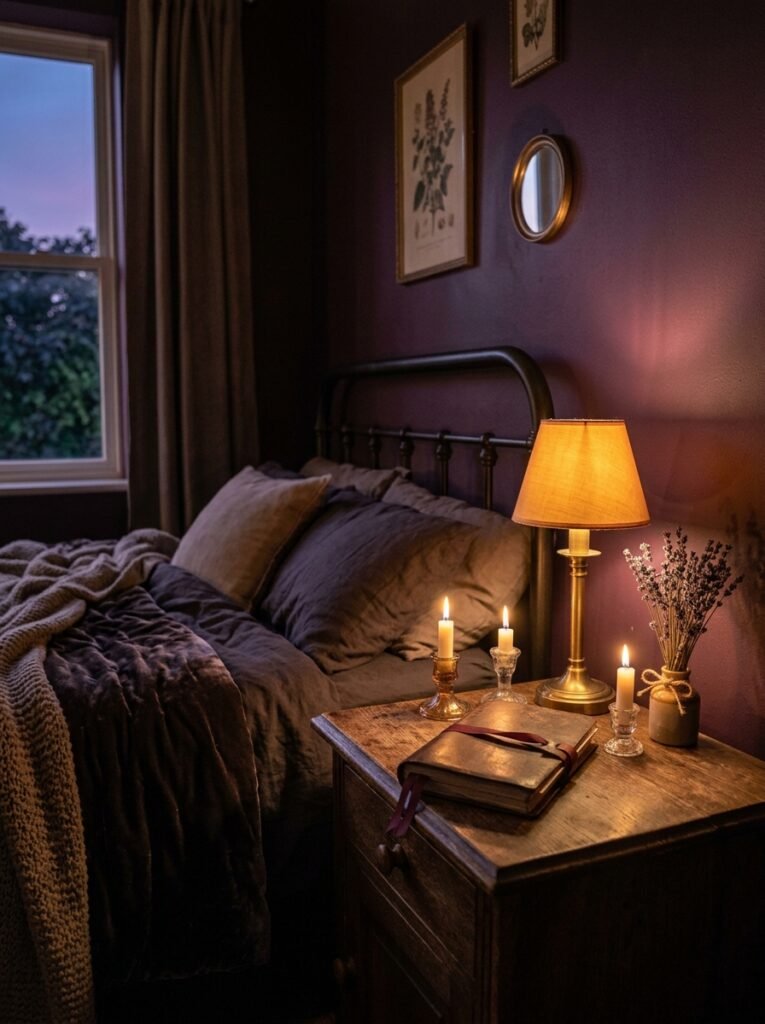
Renters, this one’s for you.
You can’t paint. I know. It’s deeply annoying. But here’s what you actually can do, and how much of a difference it makes.
Dark, heavy curtains hung from ceiling height (use a tension rod or removable hooks) immediately bring the room’s energy down into something more intimate. Dark bedding does the same. A large-format piece of dark art or a tapestry in a deep tone on the wall behind the bed creates the visual anchor that paint would normally provide.
For floors: a large, dark rug over light laminate or pale carpet changes the whole feel underfoot and visually. Add floor lamps rather than relying on overhead lights, keep your surfaces low-key and warm-toned, and you’d be surprised. A room with white rental walls and the right lighting, bedding, curtains, and accessories can feel genuinely atmospheric. It takes a bit more layering, but it works.
—
12. The Mood You’re Actually Creating — and Why It Matters
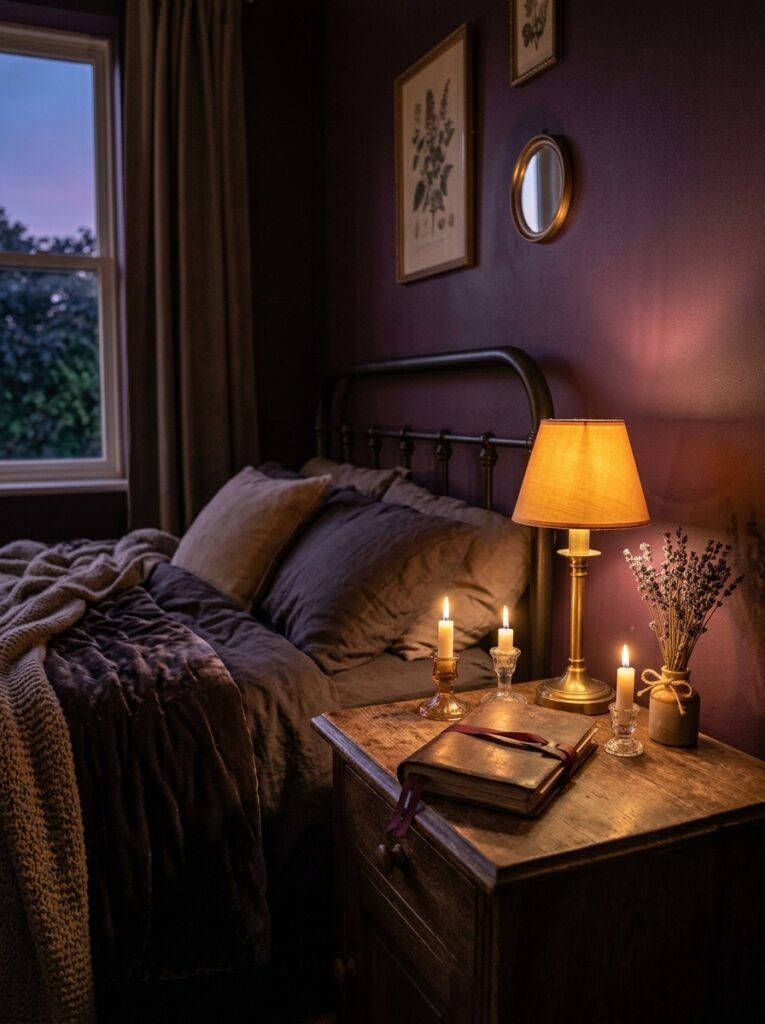
Here’s the thing about dark feminine bedroom design that I don’t think gets said enough. It’s not about aesthetics for aesthetics’ sake. It’s about creating a room that feels like it belongs to you specifically.
A light, bright bedroom is beautiful, but it can also feel a bit generic. Safe. Like a hotel room that could belong to anyone. A dark feminine bedroom — with its specific colour choices and layered textures and gathered candlelight — feels like a decision. Someone made this. Someone lives here and has opinions about how they want to feel when they wake up in the morning and when they close their eyes at night.
That’s the cozy part that never gets mentioned in the mood board captions. It’s not just warm. It’s yours.
—
❓ FAQ
Q: Won’t a dark bedroom make a small room feel even smaller? A: Not necessarily, and actually this is one of the most common misconceptions in interior design. When you use the same dark tone on all four walls and the ceiling, the boundaries of the room visually dissolve rather than closing in. What makes a small room feel cramped is contrast — light walls with dark furniture, for example. A consistently dark palette can make a small room feel enveloping rather than tight.
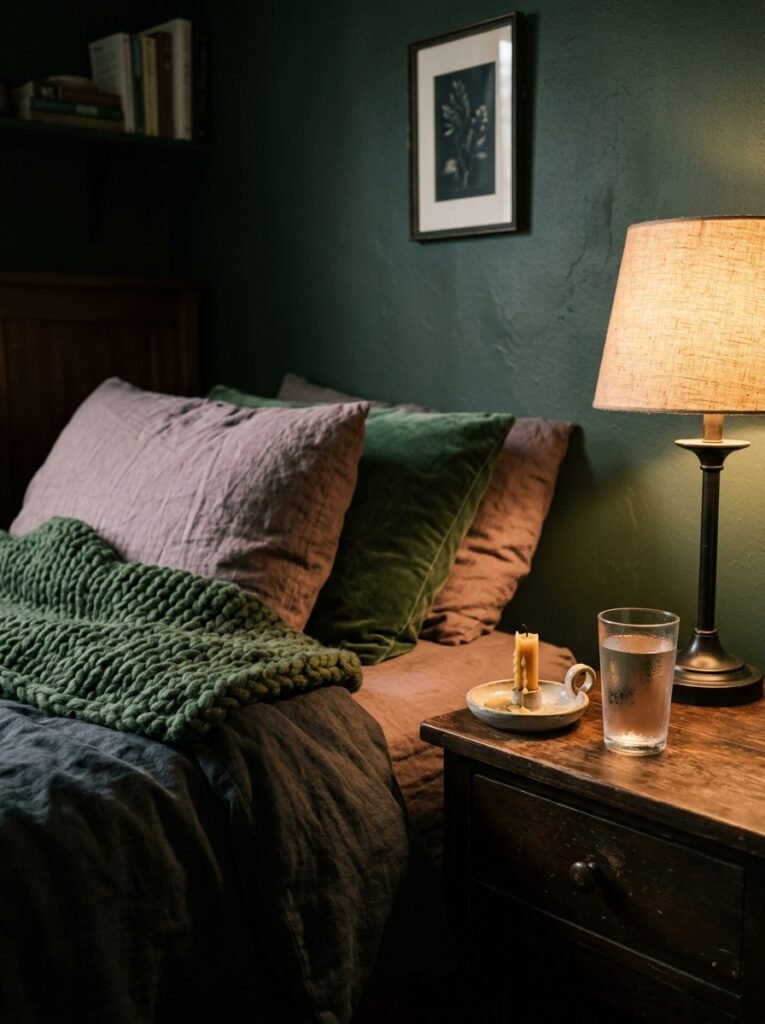
Q: What’s the best dark colour for a bedroom if I’ve never tried anything this bold before? A: Start with something in the green family — a deep sage or a forest tone with grey in it. Greens tend to read as natural and calming even in deep shades, which makes them less daunting than plum or navy as a first foray into dark walls. You can always go deeper from there.
Q: How do I keep a dark bedroom from feeling depressing during the day? A: Natural light during the day is your friend, so keep window treatments easy to push back completely when you want daylight in. A room that’s dark by choice — curtains open in the morning, drawn in the evening — feels intentional. A room that’s always dark because the window treatment blocks everything feels gloomy. The ability to switch between the two is what makes dark bedrooms work.
—
💭 Final Thoughts
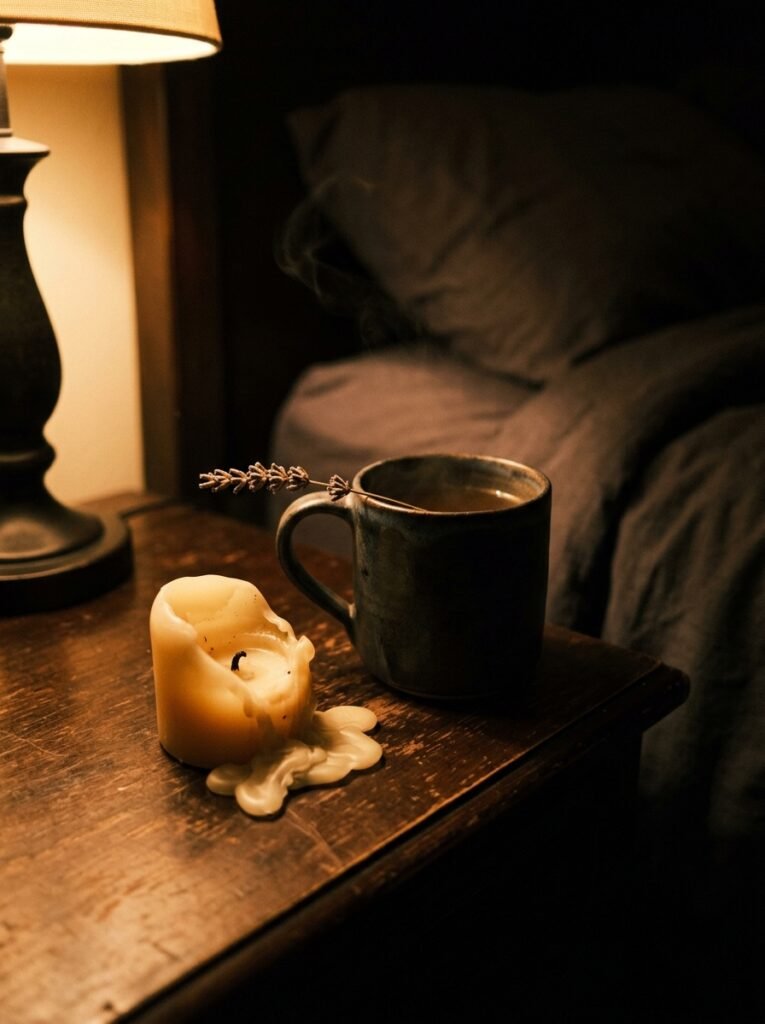
A dark bedroom isn’t a brave choice. Or rather — it doesn’t have to feel like one. It can just be the honest answer to how you’ve always wanted to feel when you walk through the door. Wrapped up, held, a little removed from everything outside.
Start with one thing. The bedding, the curtain, a single painted wall behind your bed. See how it changes the light at 9pm when everything is quiet. I think you’ll know pretty quickly whether this is your kind of room.
And if it is — how deep are you willing to go?