
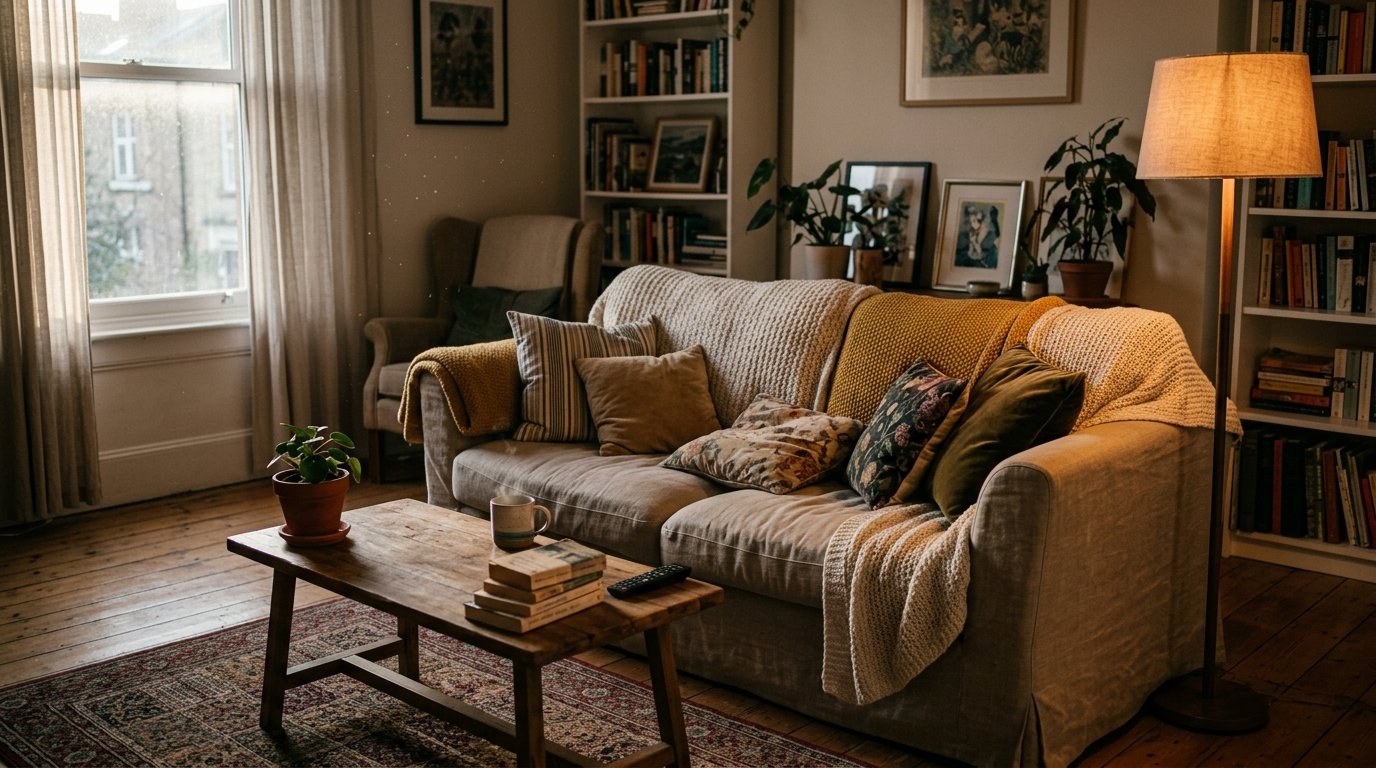
The Cozy Living Room You’ve Been Pinning for Years Is Actually Way More Doable Than You Think
My friend Cara walked into my apartment last winter and immediately said, “wait, did you redecorate?” I hadn’t. I’d just moved a lamp, added a throw, and put books horizontally instead of vertically. That was it. Three things. And somehow the whole room felt different — softer, more intentional, like someone who had their life together actually lived there.
That’s the thing about cozy that no one really talks about.

—
1. Forget “Cozy” as an Aesthetic — Think of It as a Temperature
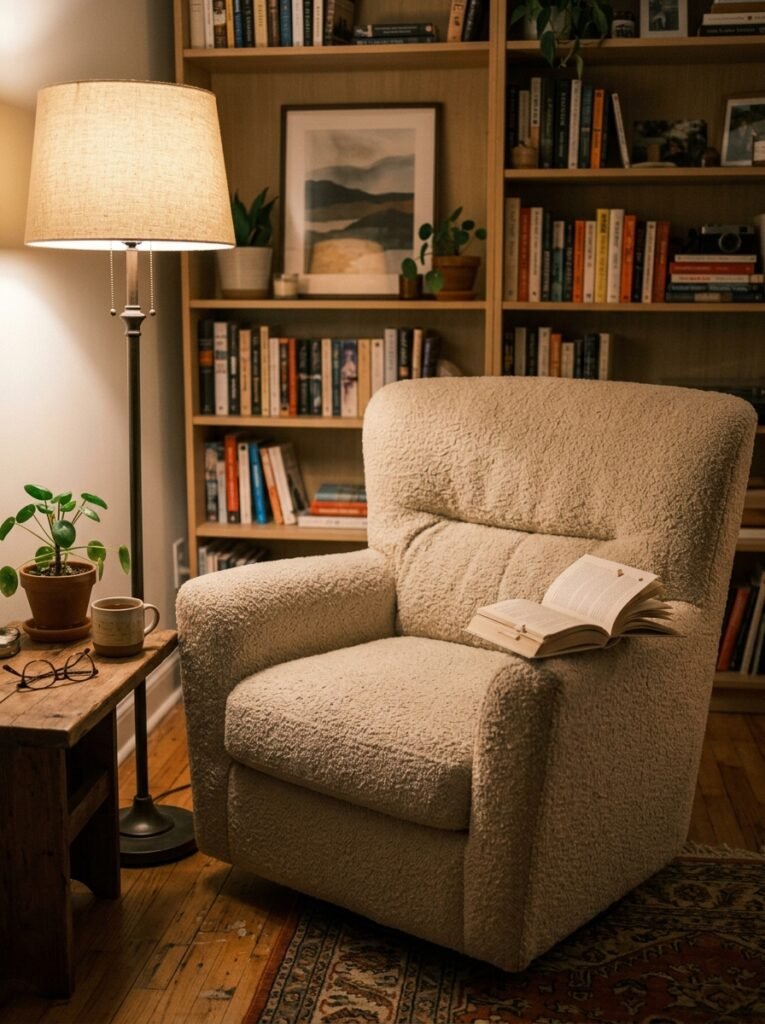
Not actual temperature, though that matters too. I mean emotional temperature. The feeling a room gives off when you walk in at 9pm after a terrible commute, still in your coat, and something about the space just… exhales.
Most people chase cozy by buying things. New cushions, a chunky knit blanket, some candles from the checkout aisle. And sure, those help. But a room full of cozy props isn’t a cozy room, it’s a cozy set. The difference is real and you can feel it the second you walk in.
What actually creates warmth is layering — and I don’t mean that in the vague Pinterest-caption way. I mean literally stacking different heights, different textures, different light sources so your eye keeps moving and never lands on anything cold or blank.
The rooms that make you want to cancel plans and stay in? They’ve usually got three different light sources, none of which are the overhead ceiling fixture.
“A room full of cozy props isn’t a cozy room. It’s a cozy set. The difference is real and you can feel it the second you walk in.”
—
2. The Rug Situation Is More Important Than Your Sofa
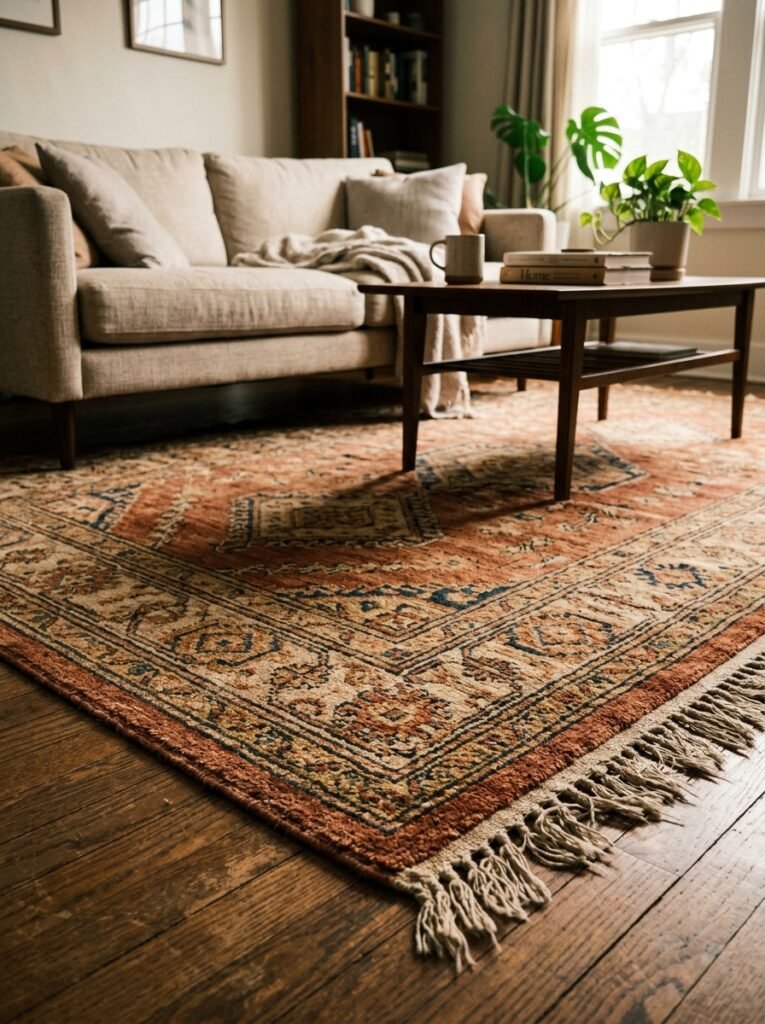
I’ll die on this hill. People agonize over sofas — the fabric, the profile, the leg height — and then put it on a rug that’s two sizes too small and wonder why nothing looks right.
The rug anchors everything. All of it. If it’s too small, your furniture floats around looking apologetic and disconnected. If it’s the right size, the whole seating area becomes a room within a room, which is exactly the cozy effect you’re going for.
General rule: in a living room, you want all four legs of your sofa on the rug, or at the very least the front two. If your rug is only under the coffee table, it’s a bathmat. Sorry. Not sorry.
For apartment living, a woven jute rug or a low-pile wool-blend in something warm-toned (oatmeal, terracotta, deep olive) tends to do more atmospheric work than something cold or stark. And layering a smaller vintage-style rug on top? Peak cozy. Not complicated either.
—
3. The Lamp That’s Changing Every Room It Goes Into Right Now
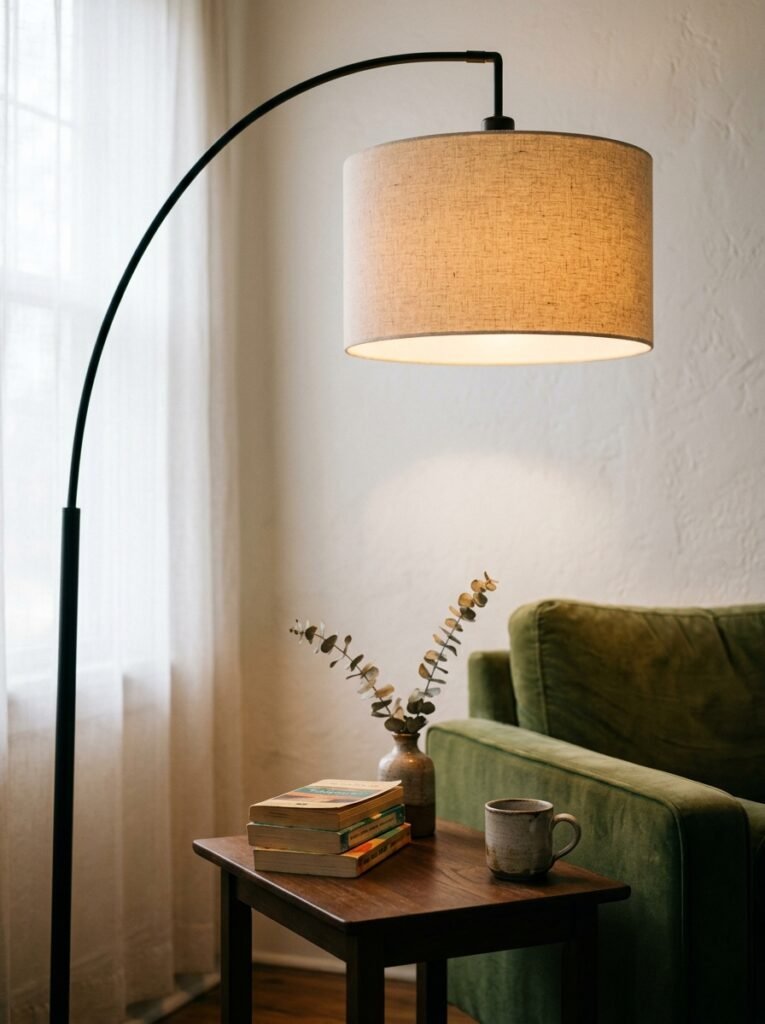
It’s a tall arc floor lamp with a fabric shade, and I’ve seen it in probably forty apartment tours in the last year. There’s a reason. It does something very specific — it creates an intimate pool of light over a seating area that makes the rest of the room feel more settled, more quiet, even if nothing else has changed.
Overhead lights are the enemy of cozy. I know that’s dramatic but I stand by it. The flat, even brightness from a ceiling fixture makes a living room feel like a waiting room. You want light that falls at human height, that pools rather than floods, that makes people look good when they’re sitting in your space.
Warm bulbs only. 2700K or lower. The amber glow of an Edison bulb at 7pm does more for a room than a hundred throw pillows. Pair a floor lamp with a table lamp on a different surface and you’ve already transformed the vibe completely — no furniture moved, no paint required.
—
4. What the Quietest, Most Beautiful Apartments All Have in Common
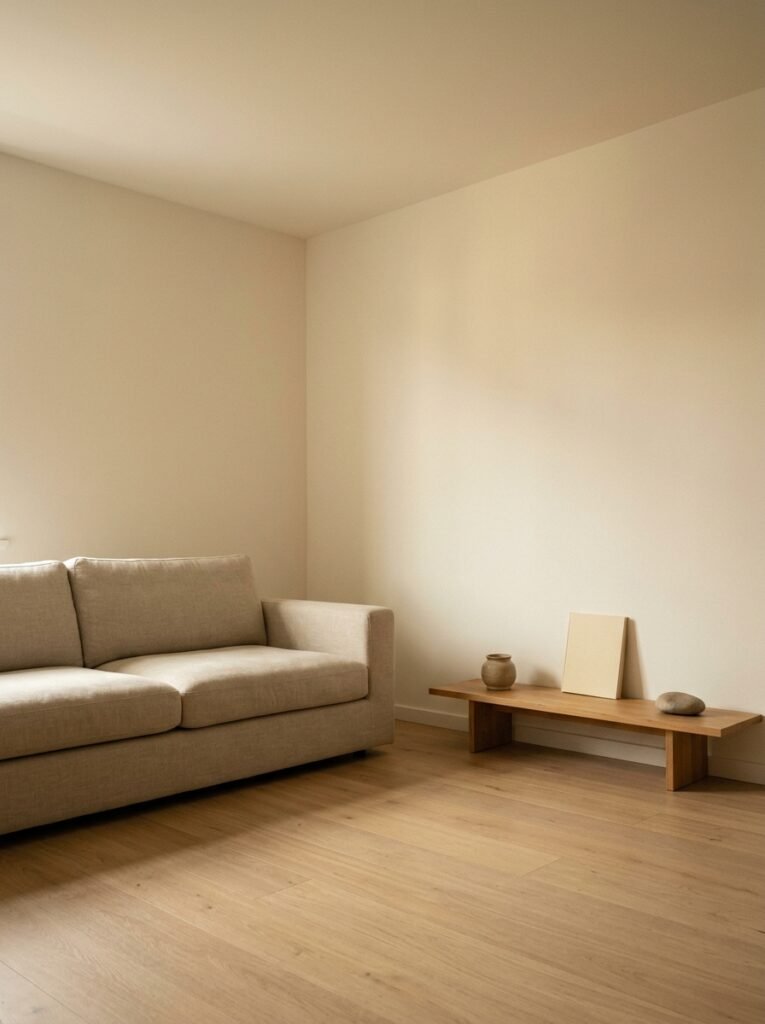
Plants. Books. Something handmade or imperfect.
Okay, I know I said no three-item lists but those three things genuinely ARE what separates “styled” from “lived-in and beautiful.” Let me actually explain why.
Plants bring something alive into the space — literally. There’s movement, there’s growth, there’s a small living thing you’re looking after, and that changes how a room feels in ways that are sort of hard to articulate. Even one big plant (a fiddle-leaf, a monstera, a trailing pothos on a high shelf) does more than a whole gallery wall sometimes.
Books are honest. They signal that a real person lives there, not a showroom. Stack them on the coffee table with the spines up or down, group them by color or not at all, lean one against the wall. Doesn’t matter. They add texture and life.
And handmade or imperfect things? A ceramic pot that’s slightly off-center, a woven wall hanging with a loose thread, a market find that doesn’t match anything but somehow works — these break the synthetic perfection that makes rooms feel unlived-in and a little sad.
—
5. Curtains Hung Wrong Are Costing You the Whole Look
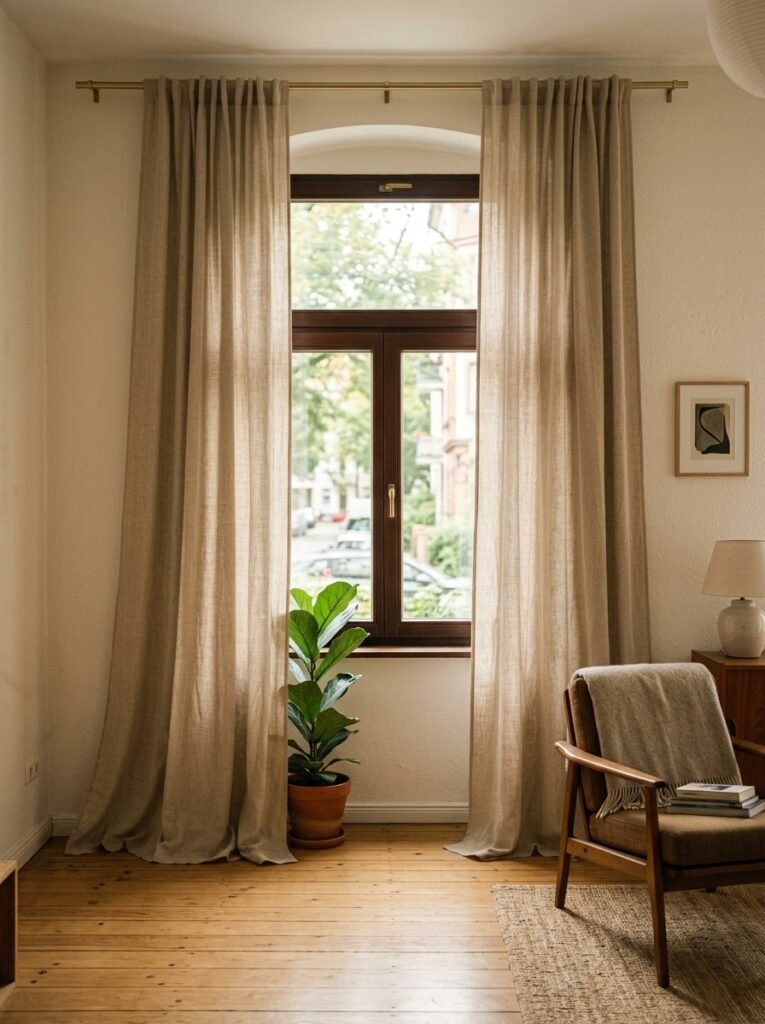
This one makes me a little crazy because it’s such a fixable mistake and it makes such a massive difference.
Curtains should hang from close to the ceiling and fall almost to the floor. Not from the window frame. Not hovering three inches above the sill. Floor to (near) ceiling. Always.
When you mount the rod high and wide — a few inches below the ceiling and extending past the window frame on each side — the window looks taller, the room looks bigger, and the whole thing reads as intentional rather than afterthought. It’s one of those tricks that sounds architectural but costs almost nothing.
And for the love of cozy: linen or cotton in a warm neutral, please. Sheer enough to let light through during the day, substantial enough to feel soft and full when drawn. Heavy curtains that pool slightly on the floor? That’s a choice and I respect it enormously.
“Mount the rod close to the ceiling, let it extend past the window frame on both sides, and suddenly you don’t live in an apartment anymore — you live somewhere with really good bones.”
—
6. The Coffee Table Styling Approach That’s Actually Relaxed
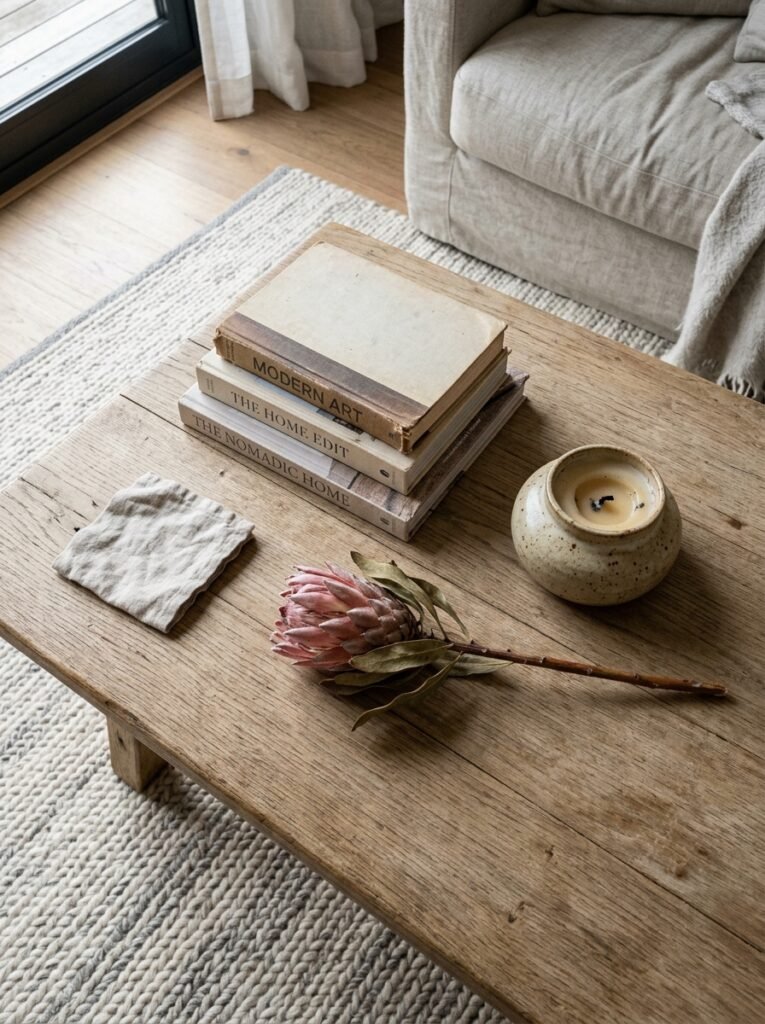
Here’s where I’ll admit I’ve overcomplicated this before. I used to style my coffee table like I was preparing it for a photoshoot — books perfectly stacked, a candle exactly centered, a little tray with three objects arranged just so. It looked fine. Also looked like I was trying too hard and was afraid of touching any of it.
The rooms that read as genuinely cozy have coffee tables that look like someone’s actually been sitting nearby. A book left facedown (or with a bookmark sticking out). A mug that someone might come back for. Maybe a candle that’s actually been burned, not a pristine one still in its box.
Don’t style it. Curate it, then mess it up slightly. That’s the move.
One tray to corral things, a varying-height candle situation, something natural (a small plant, a bowl of pine cones if it’s autumn, honestly just a nice rock you found), and whatever you’re actually reading or watching or doing right now. Done.
—
7. Color Without Commitment (For Everyone Who’s Too Scared to Paint)
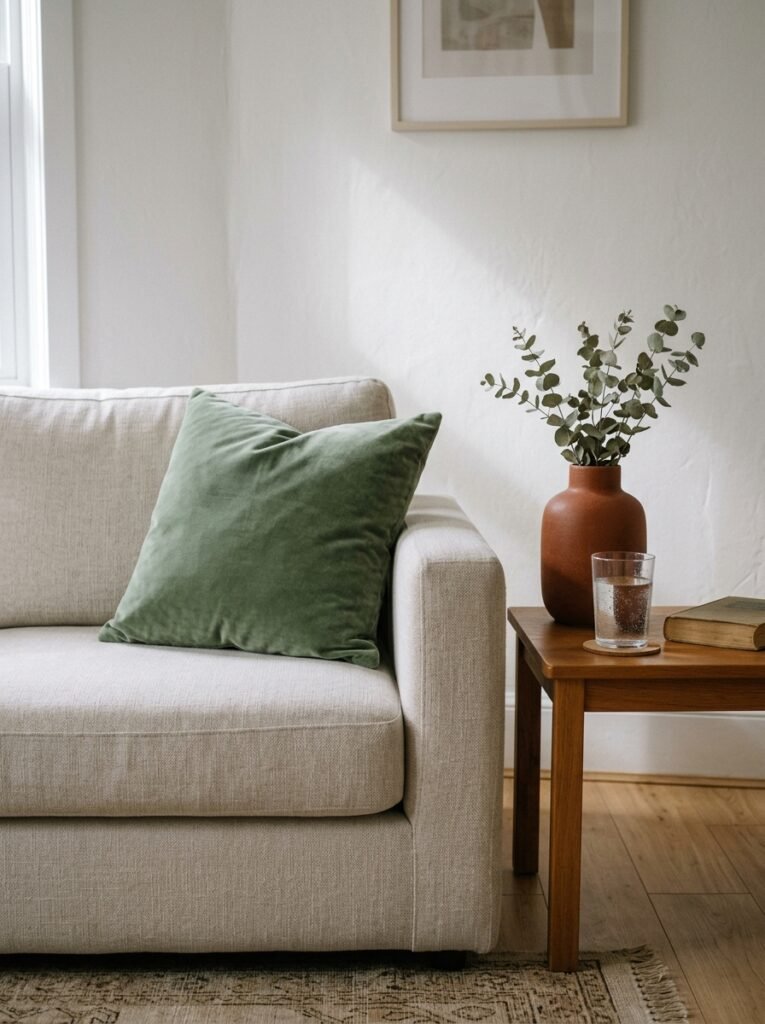
Rented flat, afraid of bold choices, landlord who inspects with a magnifying glass — I get it. But living in a beige box with beige furniture and beige accessories is its own kind of suffering.
You don’t need to paint. You need to introduce a color story through everything that isn’t fixed.
Pick a warm anchor color — dusty rose, deep sage, rust, forest green, warm cognac — and then let it appear in at least four or five places in different amounts. A large throw in that color. A few cushions, not all matching. A vase. A candle. Maybe the lampshade.
What this does is create cohesion without rigidity. The room feels collected, like you made decisions, even if those decisions were just buying a throw and a vase in the same general color family. Side note — the mistake isn’t picking the wrong color, it’s only letting it appear once. One rust cushion on a grey sofa looks like an accident. Four rust-adjacent things in the room look like a palette.
—
8. Why Small Apartments Actually Have an Advantage Here
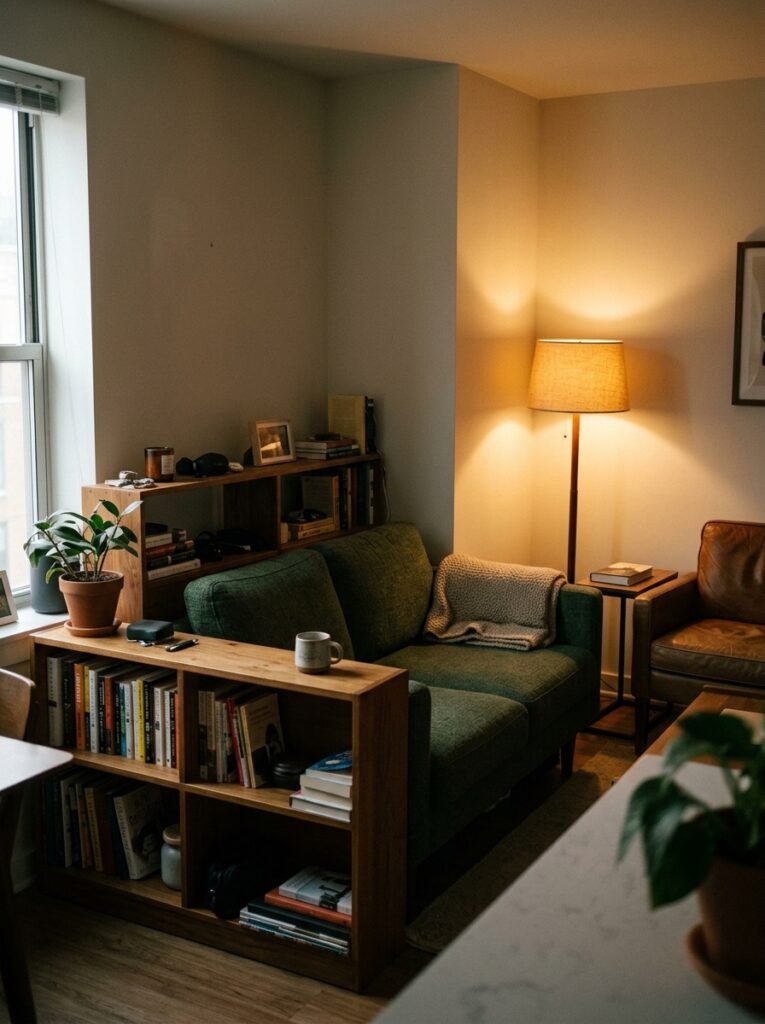
I’ve lived in places where the living room was technically a corner of something else, and I’ve learned to stop thinking of that as a limitation.
Small means intimate. Intimate IS cozy. You’re not fighting the room, you’re working with what’s already there.
The trick is defining the space clearly. A rug. The lamp we talked about. Furniture that doesn’t fight each other or point in seventeen different directions. If everything in the seating area is oriented toward a focal point — a fireplace, a TV, a window, even just the largest wall — the room feels purposeful and contained in the best way.
And please, I’m begging you, resist the temptation to push all the furniture against the walls. It doesn’t make the room feel bigger, it makes it feel like a waiting room. Pull things in slightly. Leave breathing room around the pieces. The center of the room can be empty and that’s fine — it’s negative space, not wasted space.
—
9. The Kind of Clutter That’s Actually Welcome
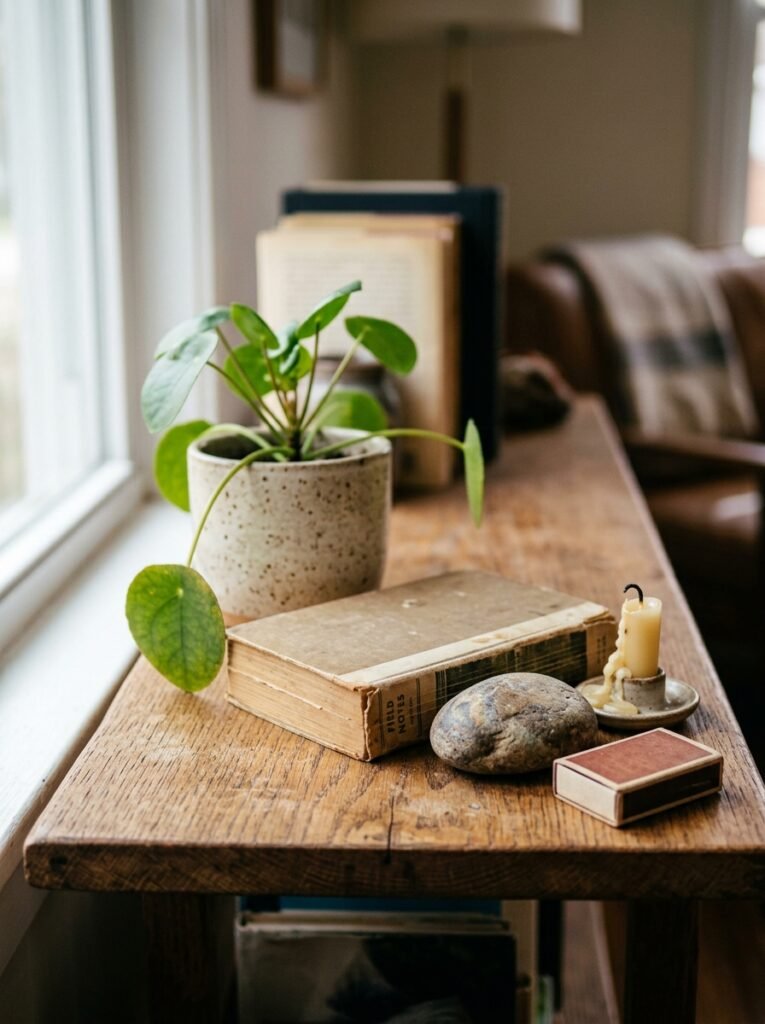
There’s clutter-clutter, which is anxiety-inducing and chaotic. And then there’s the kind of visual richness that makes a space feel inhabited and loved, and I’d argue we need more of the second kind and less fear about it.
Books I’ve mentioned. But also: a bowl on the entryway table that collects keys and a forgotten earring. A candle on the windowsill that’s dripped slightly. A blanket that’s been used recently and not folded with military precision. A little stack of things on the end table that are actually useful to the person sitting there.
This is the stuff that signals a real person lives here and real people are warm and interesting and have ongoing lives. Your living room should look like yours. Not like a hotel lobby that’s trying very hard.
“Your living room should look like yours — not a hotel lobby that’s trying very hard.”
—
10. Walls Don’t Have to Be Empty to Be Calm
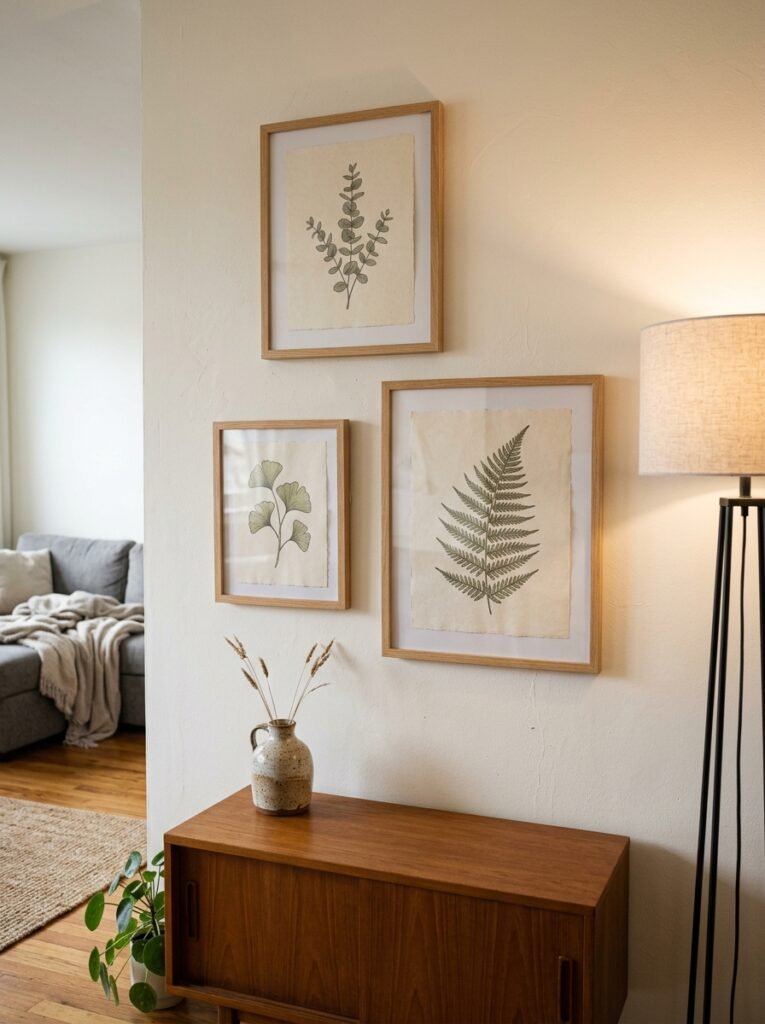
Gallery walls get a reputation for being fussy, and okay, some of them are. But a bare wall in a living room can feel just as unfinished, just as cold — maybe more so.
You don’t need seventeen frames. You might just need one large piece hung at eye level (actual eye level, which is lower than most people hang things) that has enough presence to hold the wall without needing company.
Or three frames in a simple horizontal line. Or a textile — a woven wall hanging, a vintage kilim-style piece, even a piece of fabric stretched over a frame — which adds texture in a way that prints can’t.
The thing I’d say is don’t rush this part. An empty wall while you wait for the right piece is better than a hastily filled one you grow to resent. I had a blank wall for seven months before I found a print I actually loved, and every time I looked at it, I was already happy. Now I look at the print and I’m happy. Same result, eventually.
—
11. The One-Piece Swap That Feels Like an Entire Redecorate
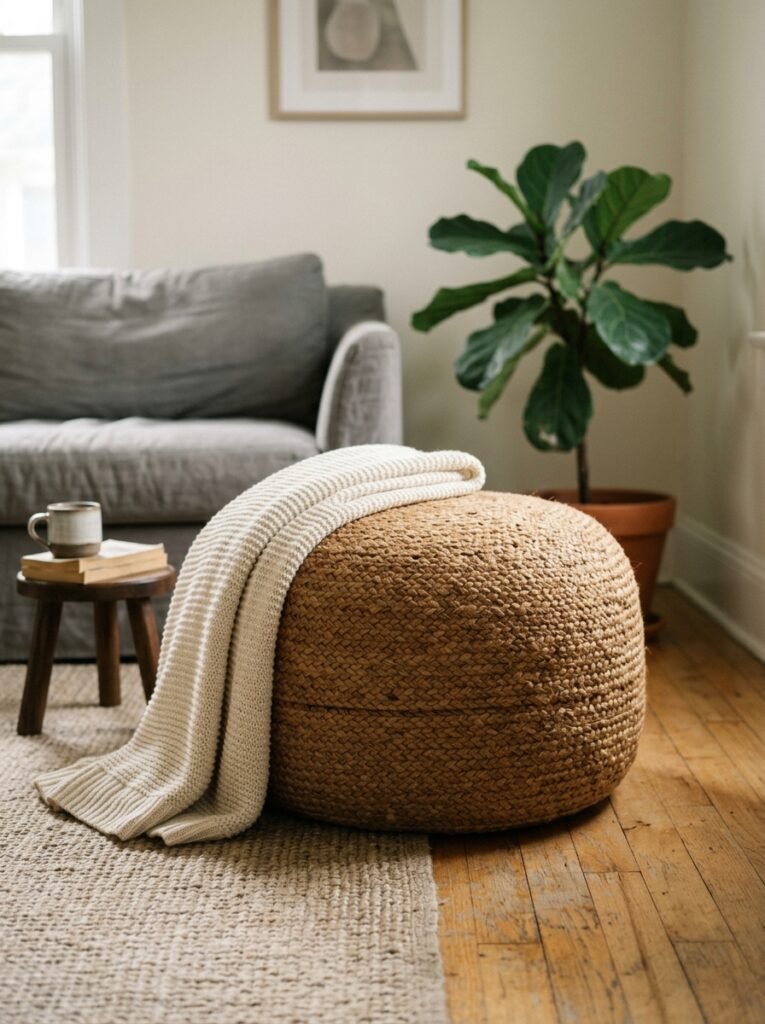
Swap your coffee table for an oversized upholstered ottoman.
I know. Hear me out.
An ottoman at the center of a seating area changes the whole energy of a room. It’s softer. More casual. It invites you to put your feet up, which is — again — the entire point of cozy. You can put a tray on it for drinks. You can use it as extra seating when people come over. It’s practical AND it shifts the room from formal to settled in about four seconds.
Round or rectangular, in a warm fabric (boucle, velvet, a chunky weave), in a color that either ties into your palette or introduces something new. It doesn’t even have to be expensive, it just has to be the right size and not wildly out of place.
This is genuinely one of the highest-impact single changes I’d make in a living room that feels too stiff.
—
12. The Thing That Ties a Cozy Room Together Isn’t a Thing
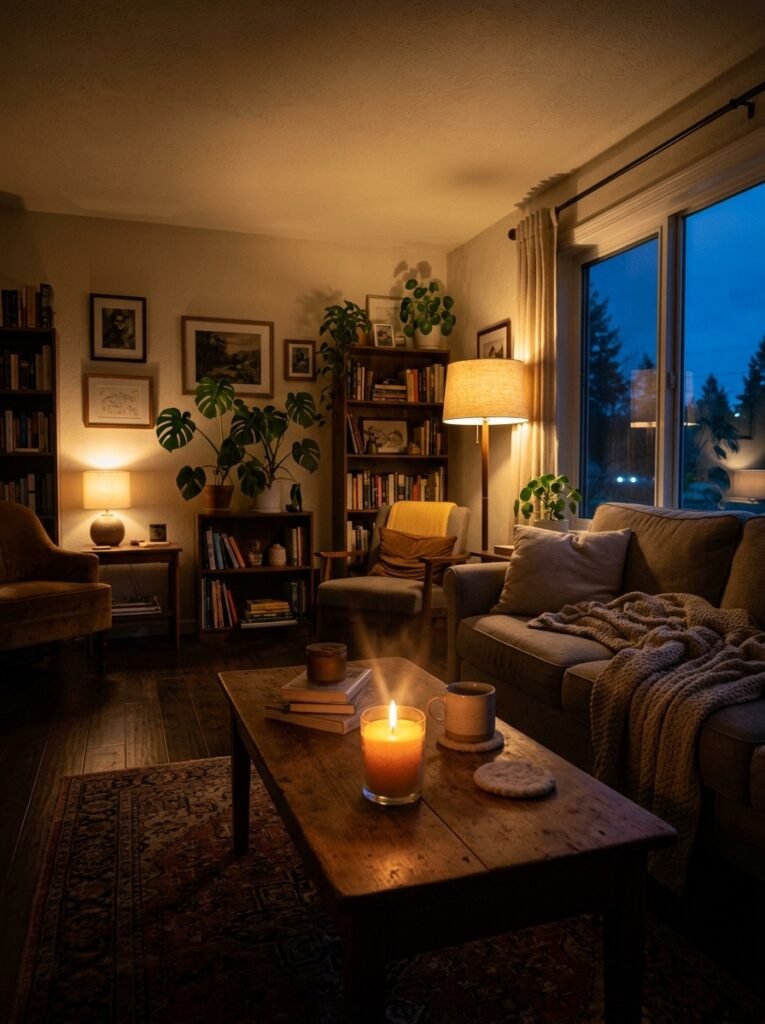
It’s repetition. Not of objects, but of tone.
When a room feels cohesive and warm, it’s usually because the same feeling shows up in multiple places — curved shapes instead of sharp ones throughout, warm tones in both the textiles and the wood tones, soft materials appearing in corners that might otherwise go forgotten.
You don’t need a decorator and you don’t need to spend a lot. You just need to look at your room and ask: what’s the coldest thing in here? The most angular? The most synthetic? And then soften it. Add something with a bit of give, a bit of warmth, a bit of imperfection.
Do that a few times and your room starts to have a temperature of its own. The kind where people walk in and want to stay.
—
❓ FAQ
Q: How do I make a small apartment living room feel cozy without making it feel crowded? A: The key is to define the space clearly with a properly sized rug, use warm low-level lighting instead of overhead lights, and pull furniture slightly away from walls to create natural breathing room. Less is more, but what you have should feel deliberate and warm rather than sparse.
Q: What are the most affordable ways to make a living room look more expensive and cozy? A: Honestly? Hang your curtains close to the ceiling (not from the window frame), swap one lightbulb for a warm-toned Edison style, and layer one good-quality throw over your sofa. Those three things do more atmospheric work than almost anything you can buy, and none of them need to be expensive to look considered.
Q: What colors work best for a cozy apartment living room? A: Warm, grounded tones — terracotta, deep sage, warm oatmeal, forest green, dusty mauve — tend to create that contained, snug feeling more than cool greys or stark whites. But more important than the specific color is consistency: let your chosen tone show up multiple times throughout the room rather than just once or twice.
—
💭 Final Thoughts
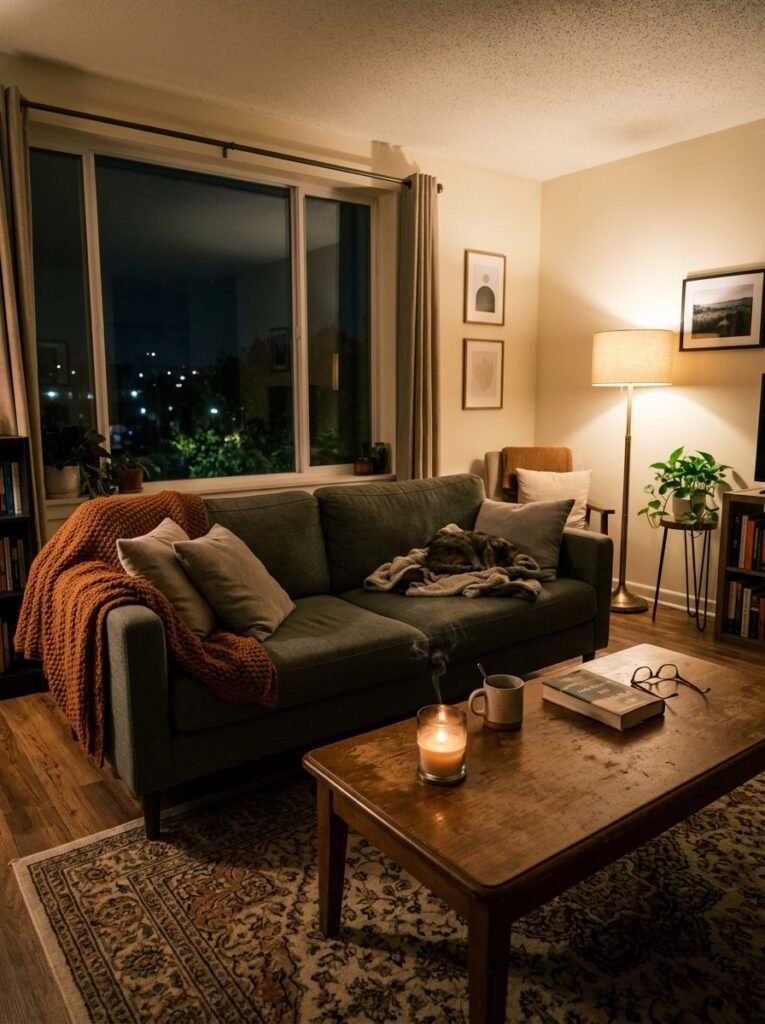
Cozy isn’t a style, really. It’s a feeling. And feelings come from a hundred small decisions that compound over time — the lamp you moved slightly to the left, the rug that finally fits, the throw you actually use on a Tuesday night in February.
Your living room doesn’t need a renovation. It might just need a few quiet edits and some patience with the process.
So, what’s the one thing in your living room right now that feels just slightly off to you?