
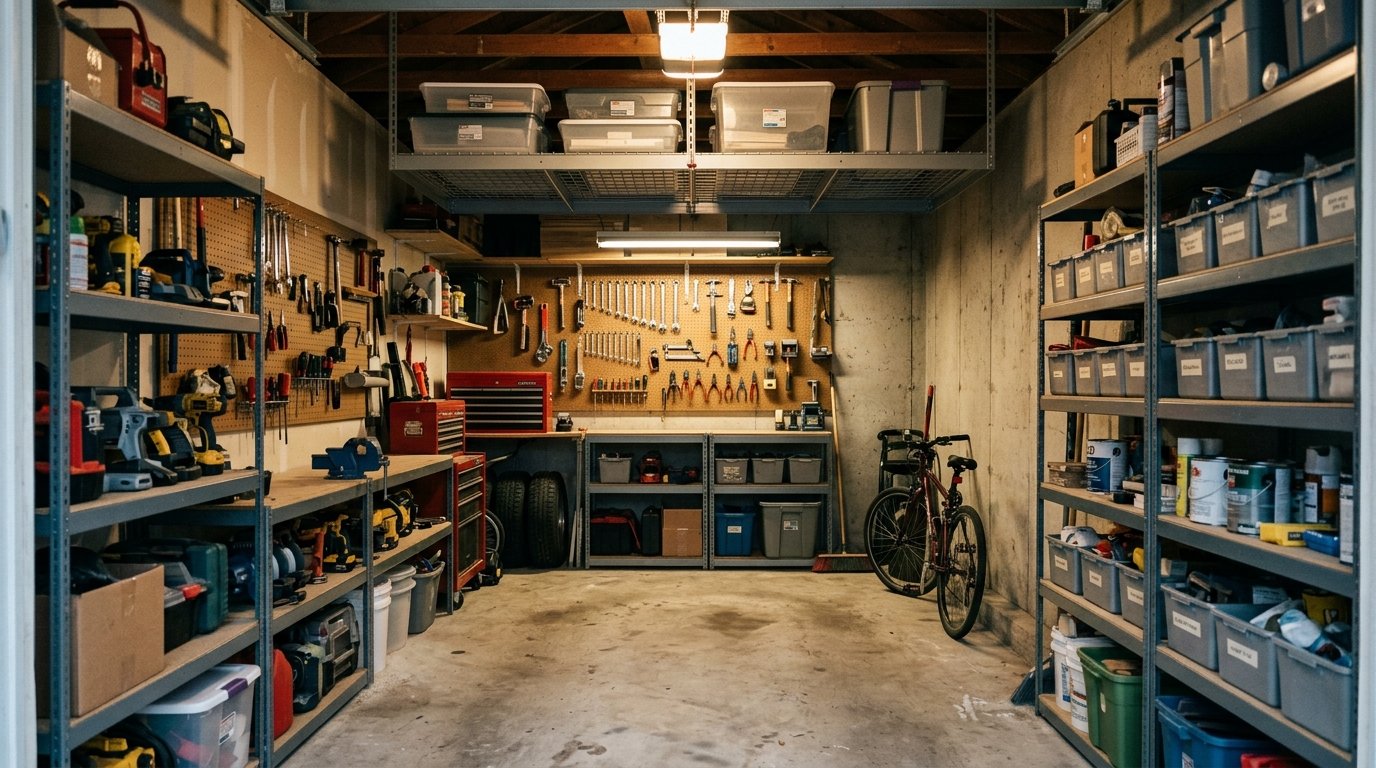
The Small Garage That Finally Got Its Act Together (And Looks Good Doing It)
My neighbor knocked on my door last spring and asked if she could see my garage. Not my kitchen, not the living room I’d been obsessing over for months — my garage. I didn’t know whether to be flattered or suspicious.
—
1. Why Most Garage Storage Advice Makes Things Worse, Not Better
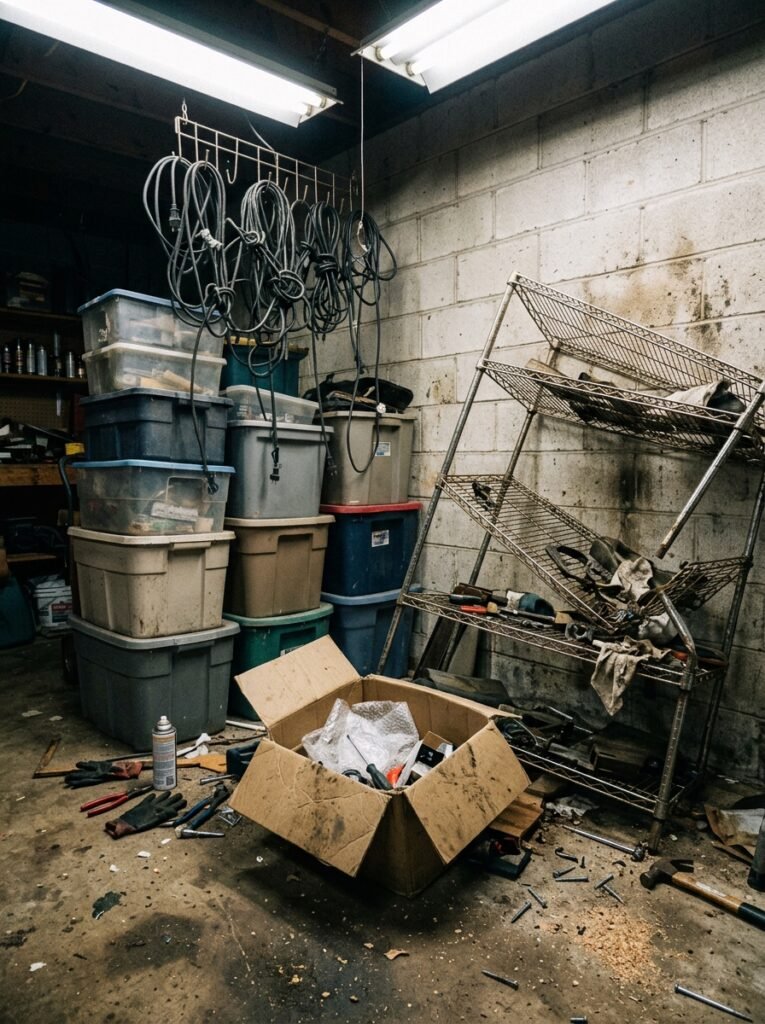
Here’s the problem with most small garage storage advice. It assumes you have the wrong stuff. Too much stuff. And if you’d just get rid of half of it, everything would fall into place.
That’s not always true.
Some of us have exactly the right amount of stuff for our lives — we just don’t have a system for it. There’s a difference. And treating a storage problem like a decluttering problem means you spend three weekends feeling guilty about your garden tools instead of actually fixing anything.
What actually works is designing around your real life, not some imagined minimalist version of it. So before you buy a single hook or bin, walk into your garage and ask yourself: what does this space need to DO every single day? Not occasionally. Every day. That’s your foundation.
“The garage isn’t the place to store things you’ve decided to keep. It’s the place where your daily life quietly runs from the background.”
—
2. The Wall Space You’re Almost Certainly Wasting Right Now
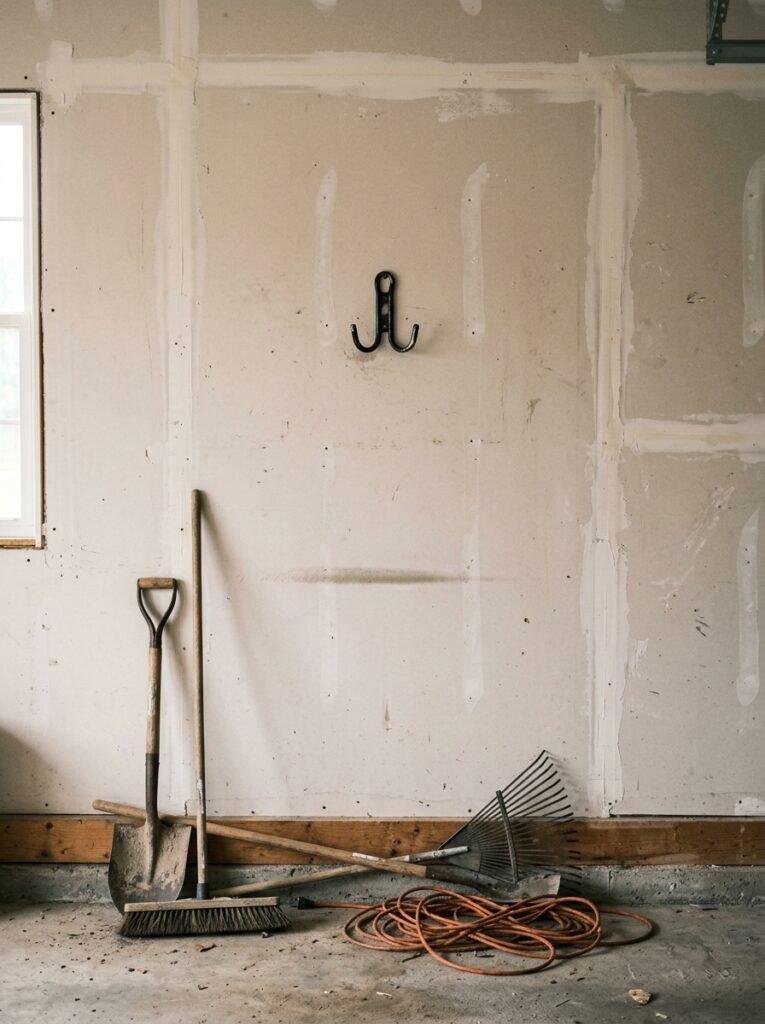
Vertical space is the answer everyone knows about and almost nobody actually uses well.
Here’s why. Most people hang a few tools, maybe some bikes, and then call it done. But the walls in even the smallest garage can genuinely hold an enormous amount — if you plan them properly rather than just putting things up where there’s a gap.
Think about installing a proper slatwall panel system or a floor-to-ceiling pegboard arrangement along the longest wall you’ve got. Not just the back. The side walls count too. Every inch of vertical surface is real estate that doesn’t cost you any floor space at all, and in a small garage, floor space is the stuff you’re actually desperate for.
Hooks that fold flat when not in use are brilliant. Adjustable shelving brackets mean you can change the layout as your seasons change. And don’t ignore the wall behind the door — a shallow row of hooks or a slim rail system there is basically invisible and incredibly useful.
—
3. The Overhead Storage Trick That Feels Almost Like Cheating
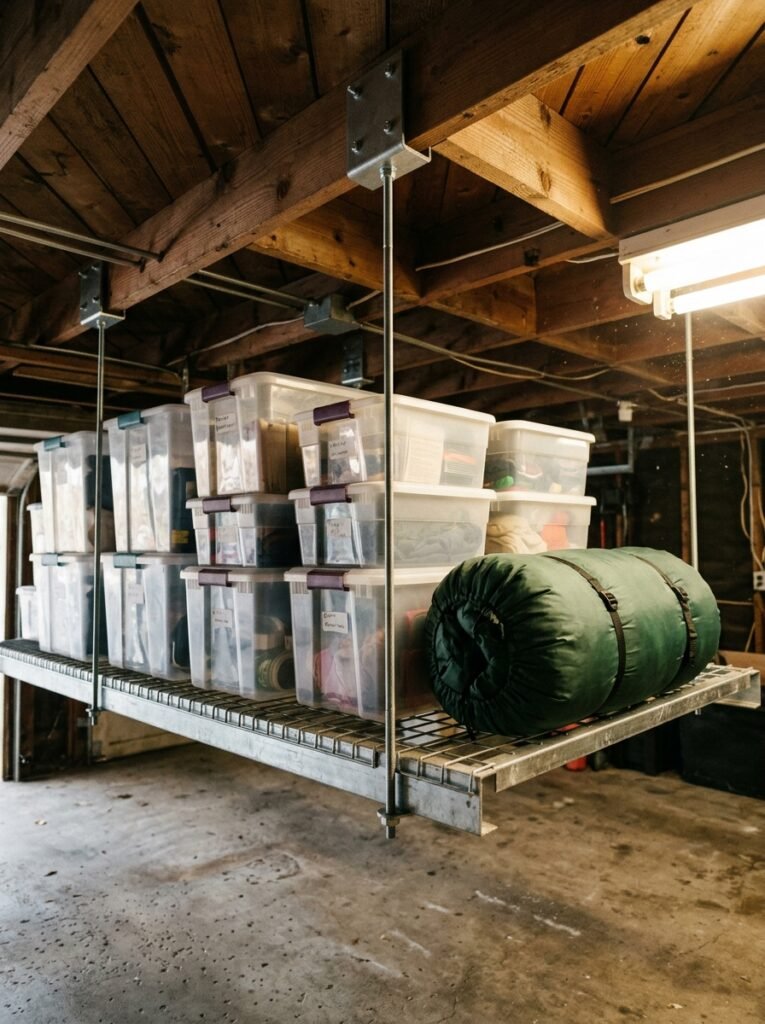
Look up.
Seriously, look at the ceiling of your garage right now. If it’s bare, you’ve got untapped storage above you that most people completely ignore. Overhead ceiling racks — the kind that bolt directly to the ceiling joists — can hold bins of seasonal stuff, camping gear, holiday decorations, all the things you need twice a year but definitely need to keep.
The key is labeling those bins clearly and putting a written inventory on the door or somewhere obvious. Because “I know it’s up there somewhere” isn’t a system, it’s a source of quiet stress every single time you need something.
If your ceiling height is on the lower side, even a simple set of ceiling hooks can handle bikes, ladders, or kayaks — things that take up a disproportionate amount of floor space when they’re just leaning against the wall like they’re tired.
—
4. The Color That Makes a Small Garage Feel Bigger Than It Is
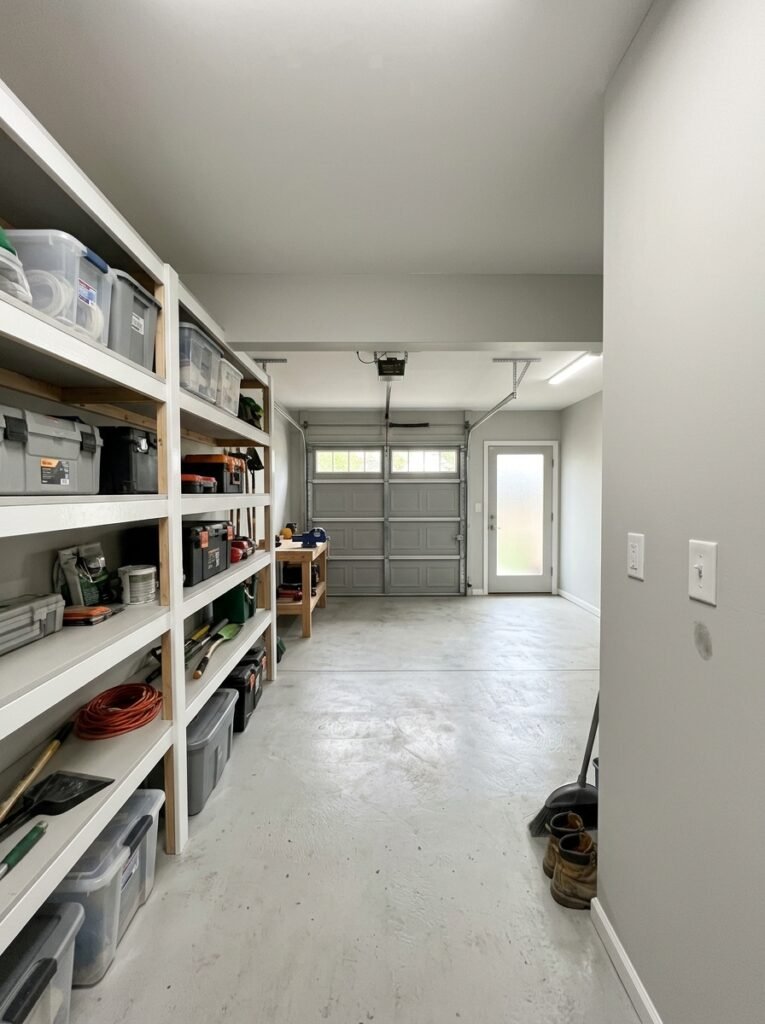
White walls in a garage sounds boring. It’s not.
Bright white, or even a very pale grey, bounces light around in a way that makes the whole space feel more open — and more importantly, it makes it easier to FIND things. A dark garage hides everything. You end up buying duplicates of things you already own, which is a very specific kind of expensive frustration.
But here’s the part people skip. Paint the floor too. Or at least use interlocking rubber tiles in a clean, light tone. The floor in most garages looks like the aftermath of something unpleasant, and it makes the whole space feel chaotic no matter how organized the walls are.
A pale floor and white walls, some decent lighting, and suddenly your small garage doesn’t feel like a cave anymore. It feels like a room that’s doing a job.
—
5. One Zone for Every Function, and Why That’s Not as Hard as It Sounds
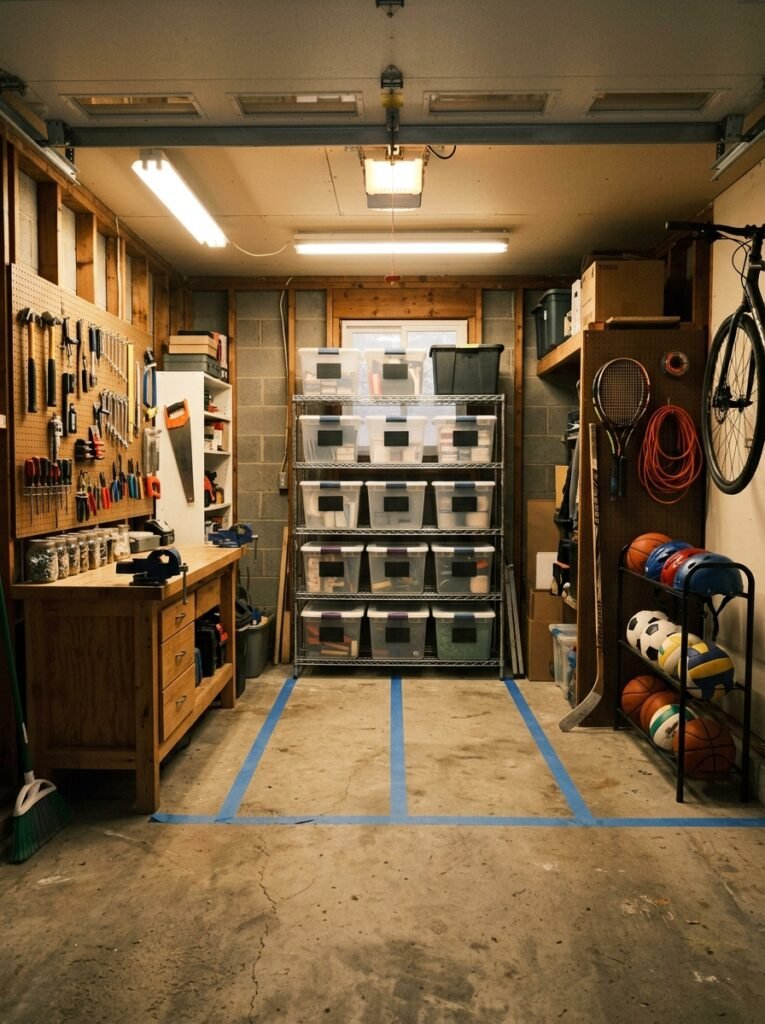
The garages that stay organized are the ones with zones.
Not complicated ones. Just — garden stuff here, sports stuff there, car stuff in this corner, tools on that wall. It doesn’t have to be labeled or color-coded. It just has to be CONSISTENT. Because when everything has a general area, putting things away becomes automatic rather than a decision.
Decision fatigue is a real thing. When you finish in the garden and you’re tired and muddy and you have to think about where the trowel goes, you put it wherever is nearest. And that’s how the chaos starts.
Zones remove the decision. The trowel goes over there. That’s all.
“You don’t need a perfect system. You need a consistent one. Consistent beats perfect every single time.”
—
6. The Right Bins (and the Ones That Just Look Like More Clutter)
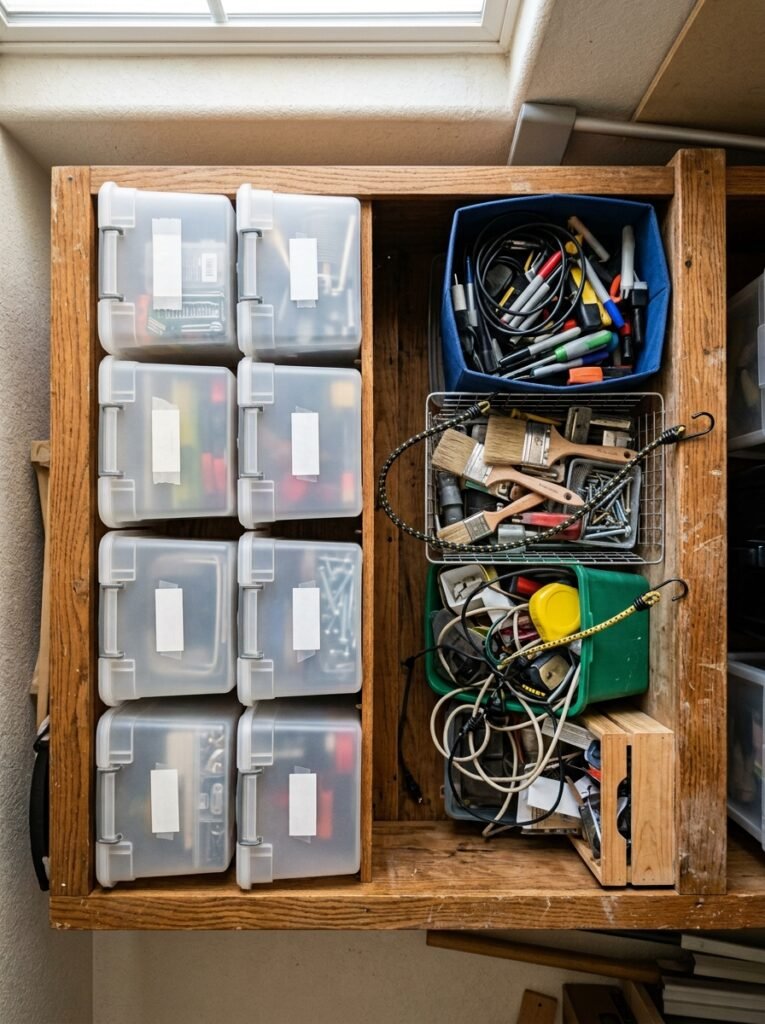
Clear bins or labeled bins. Pick one. Don’t do mystery bins, those dark-coloured lidded containers you can’t see into and never label because you’re going to “remember what’s in them.”
You won’t.
Clear bins are genuinely better in almost every scenario because you can grab the right one on the first try. But if you prefer a tidier, more uniform look — totally understandable — then just commit to labeling. Properly. Not a scrap of masking tape with something half-legible on it.
The other thing about bins: size matters more than you’d think. Lots of small, same-sized bins on shelves look organized and stay organized. One giant bin becomes a catch-all where nothing is ever truly accessible. Small bins force categorization. That’s the whole trick, kind of.
And stackable matters. Bins that can’t stack are bins that will eventually end up in a pile on the floor, which defeats the entire point.
—
7. What to Do With the Awkward Corner You’ve Been Ignoring for Two Years
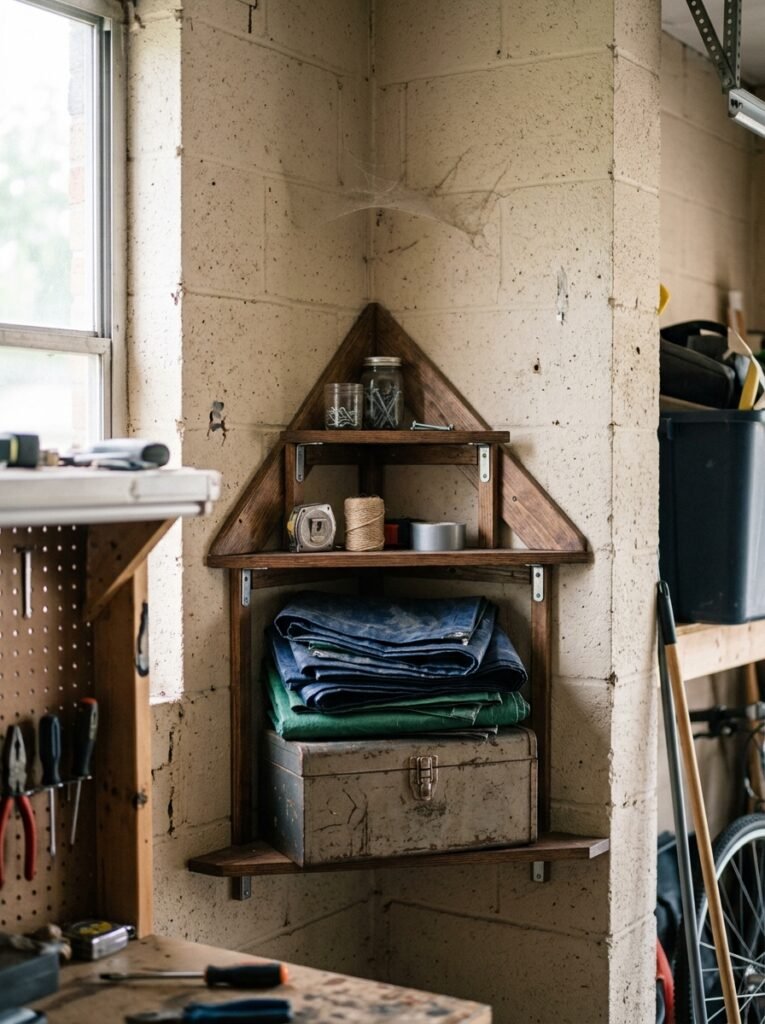
Every small garage has one. The corner that’s somehow both too small for a unit and too big to just ignore. Usually there’s something leaning in it that shouldn’t be there.
Corner shelving units — the triangle or quarter-circle shaped ones — can make those spaces properly usable. But honestly, even a simple set of regular shelves pushed INTO the corner at a 45-degree angle works. It looks a little unexpected, it fills the space efficiently, and it forces you to think about that corner as real storage rather than a visual dead zone.
If the corner gets awkward overhead space too, that’s where a ceiling hook or a single high shelf can catch the overflow — the extension leads, the extra hose, the spare garage light bulbs.
Don’t write off the corners. They’re usually more generous than they look.
—
8. The Lighting Situation Nobody Talks About Until It’s Too Late
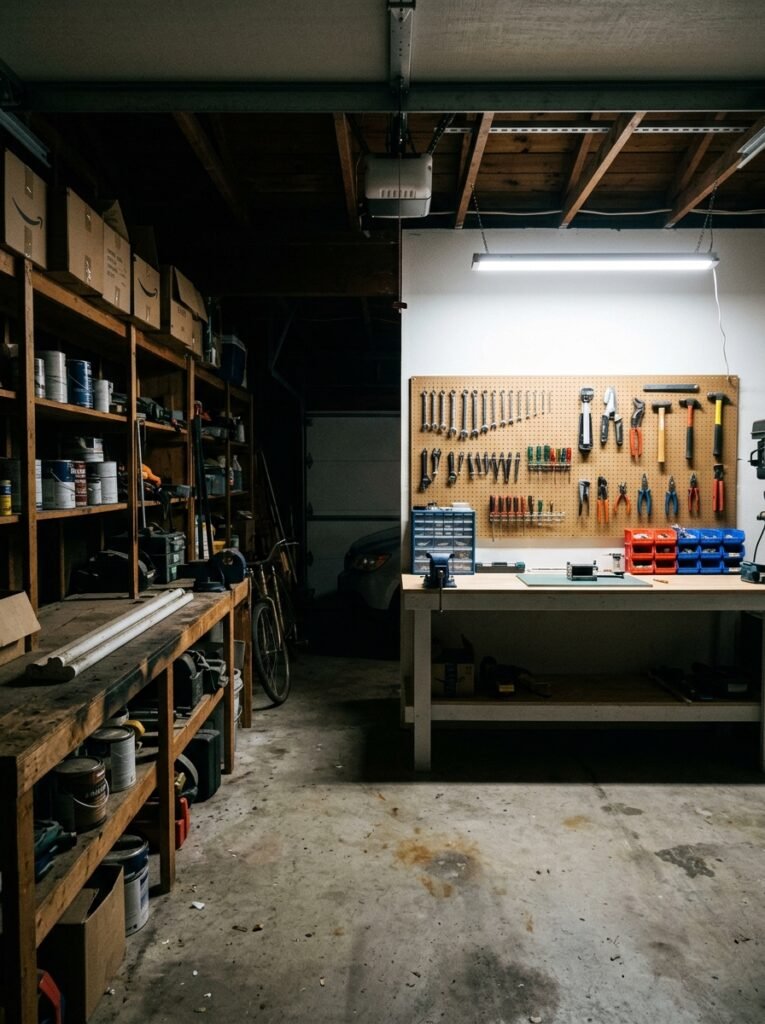
You can have the most organized garage in the world and still not be able to USE it properly if the lighting is bad.
One central light bulb does almost nothing. The shadows it creates are worse than working in semi-darkness because they’re inconsistent — bright in one spot, completely dark two feet away.
Strip lights along the ceiling, or LED panels in a grid, make an extraordinary difference. I cannot stress this enough. Under-shelf lighting for work surfaces is a nice extra. Motion-activated lights near the door mean you’re never fumbling around.
And if your garage has a window — USE it. Don’t cover it with shelves. Let the natural light in. Position your primary work area near it if you can. Natural light makes everything feel less oppressive and helps you actually see the colour of the paint tin you’re reaching for.
—
9. Why Bikes Are the Single Biggest Small-Garage Problem (And How to Solve It)
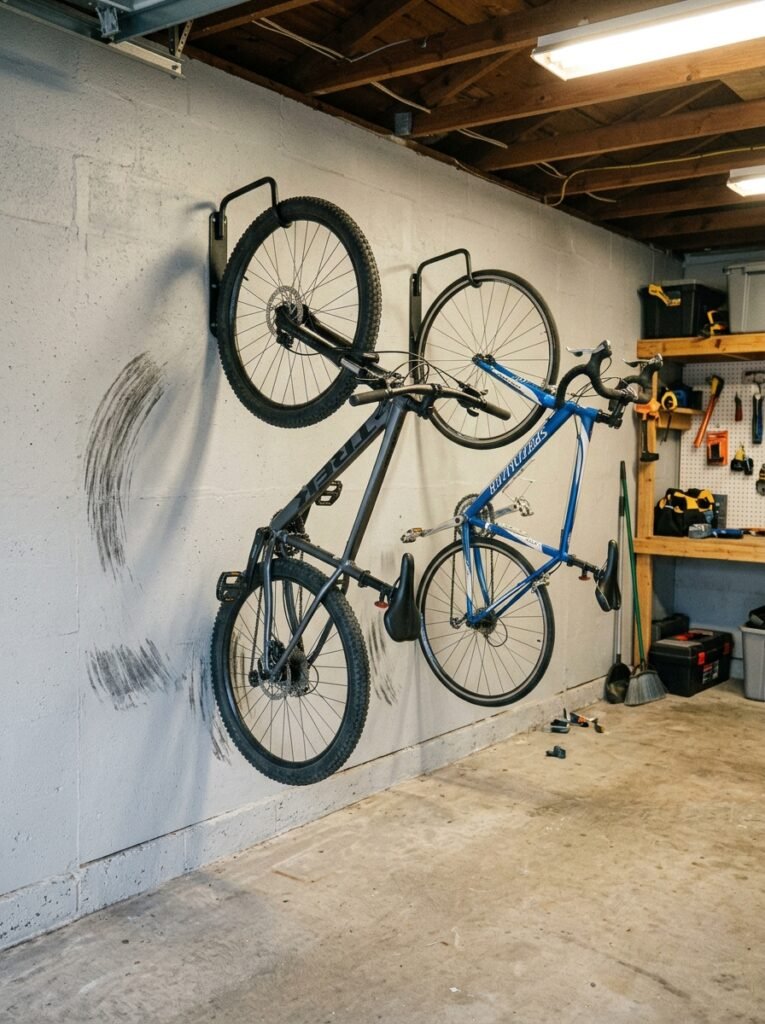
Bikes are enormous. People don’t think of them as enormous until they’re taking up a quarter of a small garage.
The simplest solution is a wall-mounted bike hook — the kind where the front wheel hangs up against the wall, or where both wheels slot into channels. This gets a bike completely off the floor and genuinely only takes about 18 inches of wall depth.
If you’ve got more than two bikes and limited wall space, a freestanding vertical rack that holds multiple bikes side-by-side is worth every penny. They take up about the same floor space as one bike laid sideways but can hold four. The maths on that are pretty satisfying.
The mistake people make is thinking they’ll just move the bikes when they need to. They don’t. They work around them, and the bikes become immovable objects at the centre of an increasingly irritating orbit.
Mount them. Free the floor.
“Once the bikes go on the wall, you get your garage back. It’s not dramatic — it just quietly changes everything.”
—
10. The Small Detail That Actually Keeps a Garage Organized Long-Term
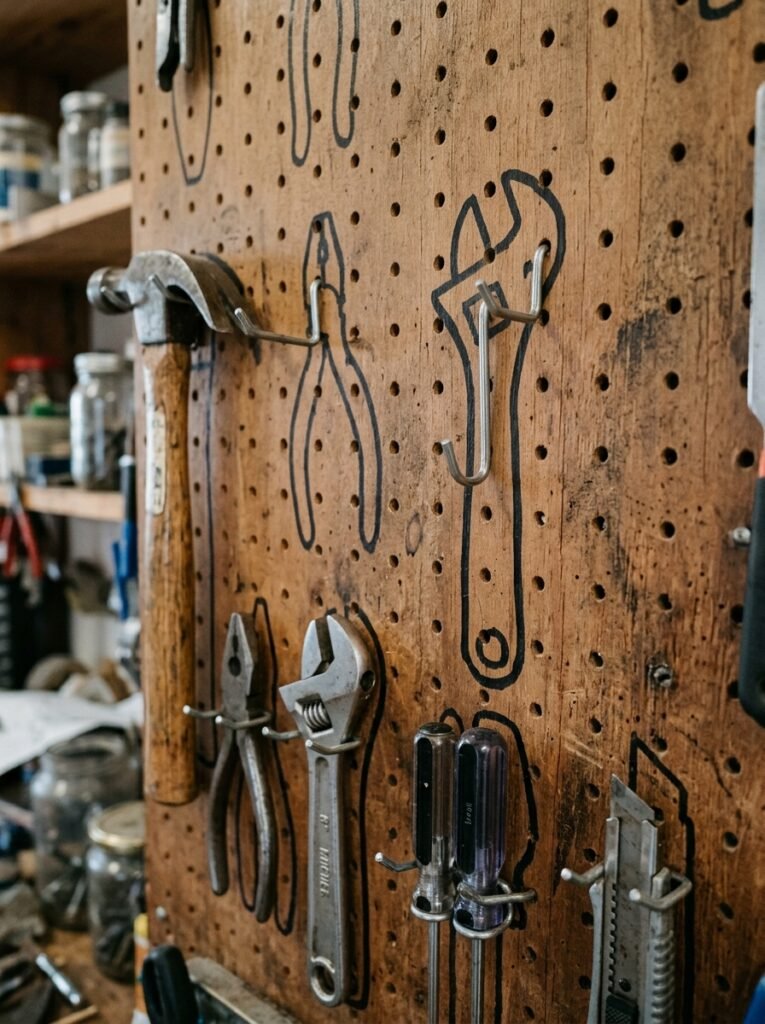
This is the unglamorous one. But it might be the most important.
A designated “to do” area. Or a “to take out” shelf.
One specific spot — a shelf, a bin, a section of floor near the door — where things go when they’re broken, need to be returned somewhere, or need to go to the charity shop. Not just “somewhere near the door.” A specific, actual designated spot.
Without this, those things migrate. They get lost in the general organization and suddenly your carefully arranged garage has a slow leak of random stuff spreading back across every surface.
The “to deal with” zone is not failure. It’s how organized spaces stay organized. It acknowledges that life creates in-progress items, and it keeps them contained.
—
11. How to Store Garden Tools Without Them Becoming a Hazard
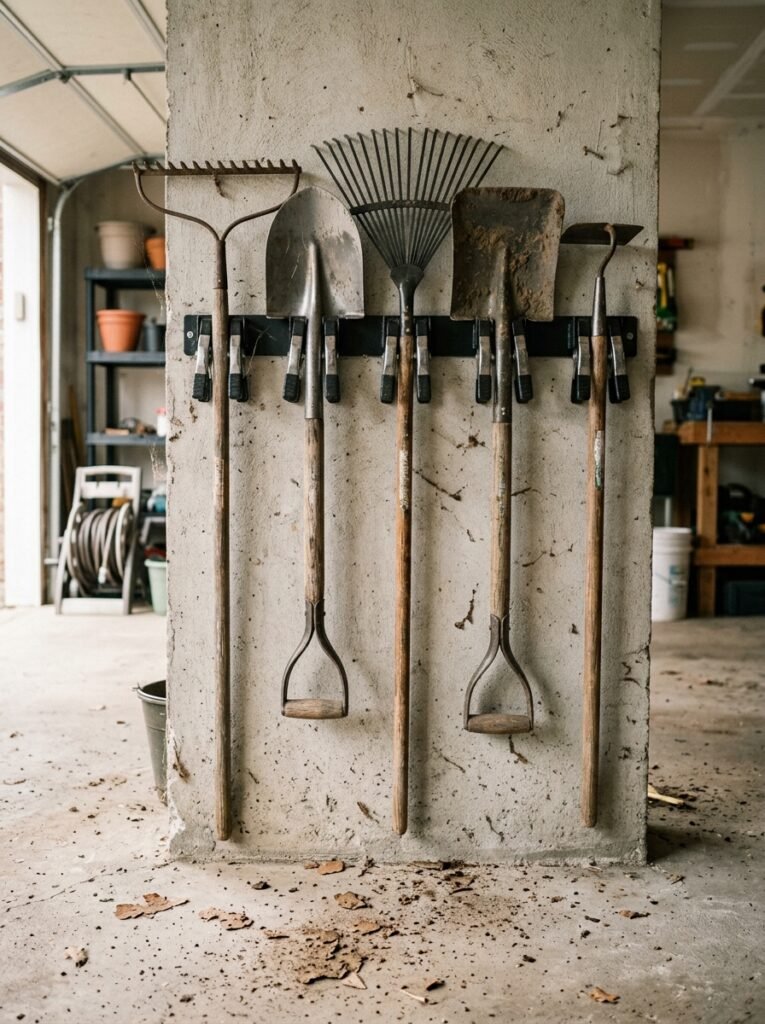
Garden tools are a specific category of problem. They’re long, weirdly shaped, heavy at one end, and genuinely dangerous if they fall on you. Which they will, if they’re just in a bucket or leaning against a wall.
A wall-mounted tool organizer — the kind with individual slots or rubber grips for each handle — keeps long-handled tools vertical, visible, and completely stable. These are cheap, they work, and they take up about eight inches of wall depth.
For smaller hand tools, a horizontal row of small hooks at eye level beats digging through a box every single time. You can see everything. You grab what you need. You put it back in the right spot because the spot is obvious.
The bucket approach isn’t all bad for trowels and small gear — but get a WIDE, low bucket rather than a tall narrow one. Things don’t disappear into the bottom that way.
—
12. The Smallest Garages That Genuinely Look Like They Have It Together
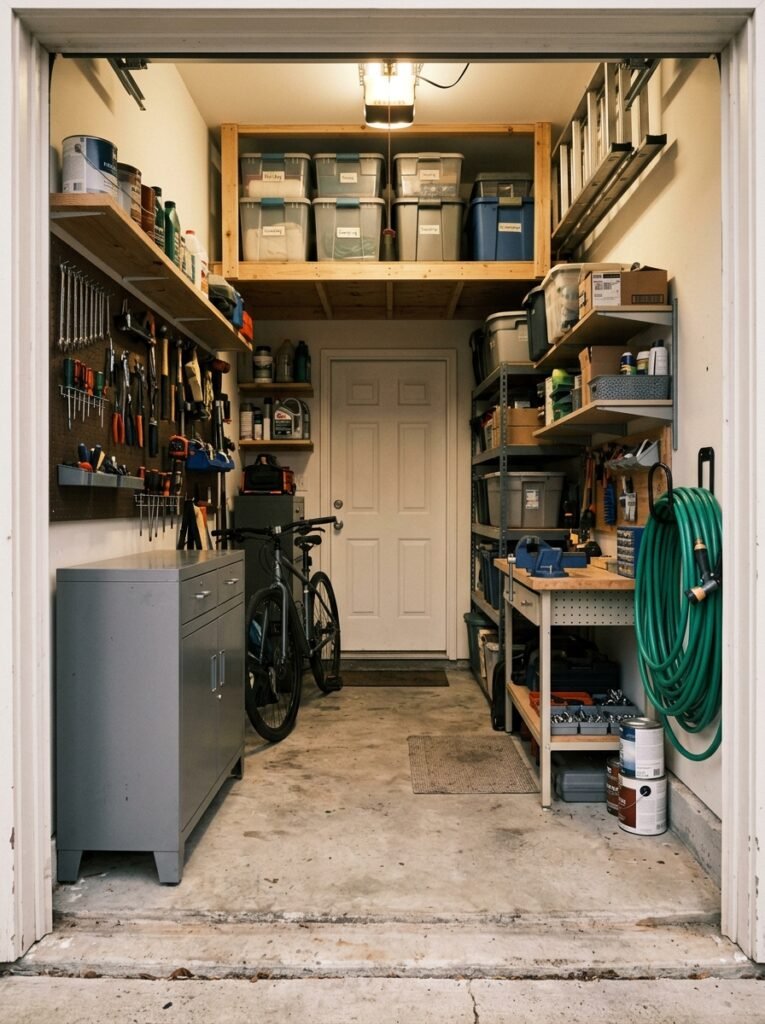
Honestly? The small garages that look intentional are almost never the ones with the fanciest storage systems. They’re the ones where someone made a few deliberate decisions and then stayed consistent.
Clean floor. Light walls. Everything off the ground that can be off the ground. One zone per function. Labels that someone actually made time to write.
That’s it. That’s the whole secret. It’s not a reveal. It’s just consistency applied in a small space, and it makes people knock on your door to ask about your garage in a way that feels inexplicably like a compliment.
The things that don’t work: buying more storage than you’ve actually planned for, mixing fifteen different organizing systems that don’t speak to each other, or saving the “real organization” for some future weekend that never quite arrives.
Start with one wall. Do it properly. Then do the next one.
—
❓ FAQ
Q: What’s the best way to store seasonal items in a small garage without it feeling overwhelming? A: Clear, same-sized bins on overhead racks or high shelves work brilliantly for seasonal stuff — holiday decorations, camping gear, that sort of thing. Label them on the END of the bin, not the top, so you can read them while they’re stacked. A simple inventory list on your phone or stuck to the inside of the garage door means you don’t have to pull everything down to find one thing.
Q: How do I keep a small garage organized if multiple people in the household use it? A: Zones are your best friend here. Give each person or each activity its own clearly defined area, even if it’s just a shelf or a wall section. When everyone knows where their stuff lives, there’s less “I just put it down somewhere” behaviour. A small whiteboard near the door for notes (“used last of the WD-40, need more”) also helps more than you’d think.
Q: Is it worth insulating or finishing a small garage before organizing it? A: If damp is a problem, yes — sort that first, because no storage system survives a moisture issue. But most homeowners don’t need a full garage conversion before they can get organized. A good clean, a coat of paint, and decent lighting will take you 80% of the way there for a fraction of the cost. Save the insulation and drywall project for when you know how you’re actually using the space.
—
💭 Final Thoughts
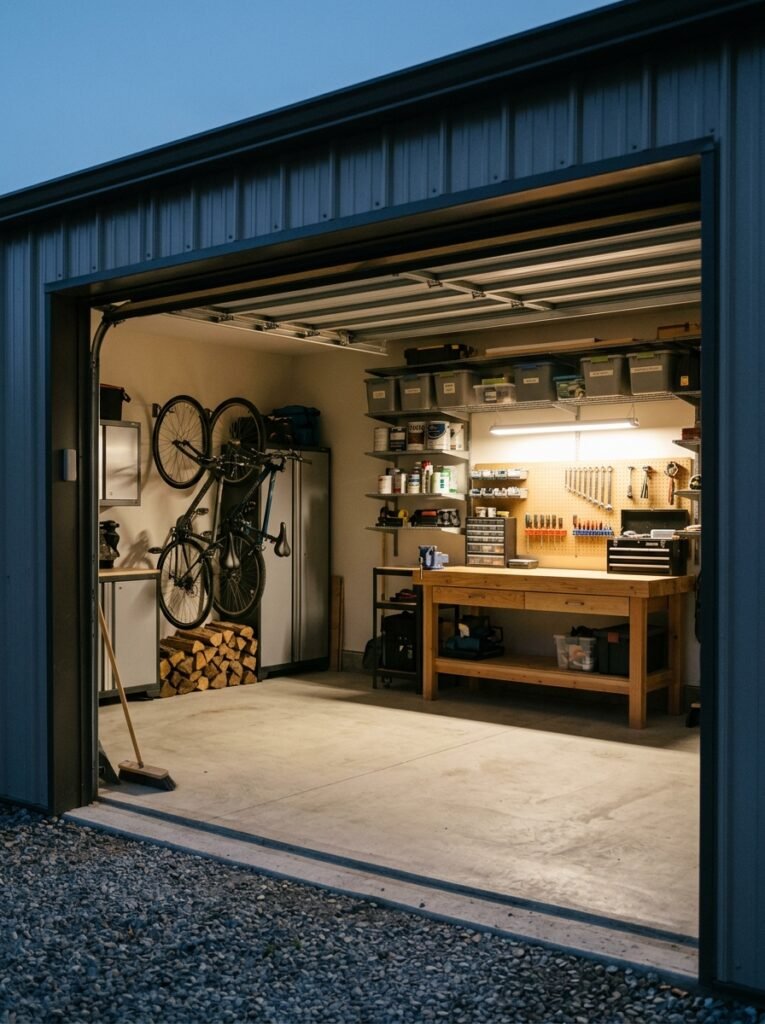
A small garage doesn’t need to be a compromise. It needs to be a decision — a series of small, deliberate ones that add up to a space you actually want to walk into.
The neighbor who knocked on my door? She said it looked “calm.” That’s maybe the best word for it. Not impressive, not over-designed. Just calm. Everything where it belongs, nothing fighting for attention.
Is that the kind of space you want yours to be?