
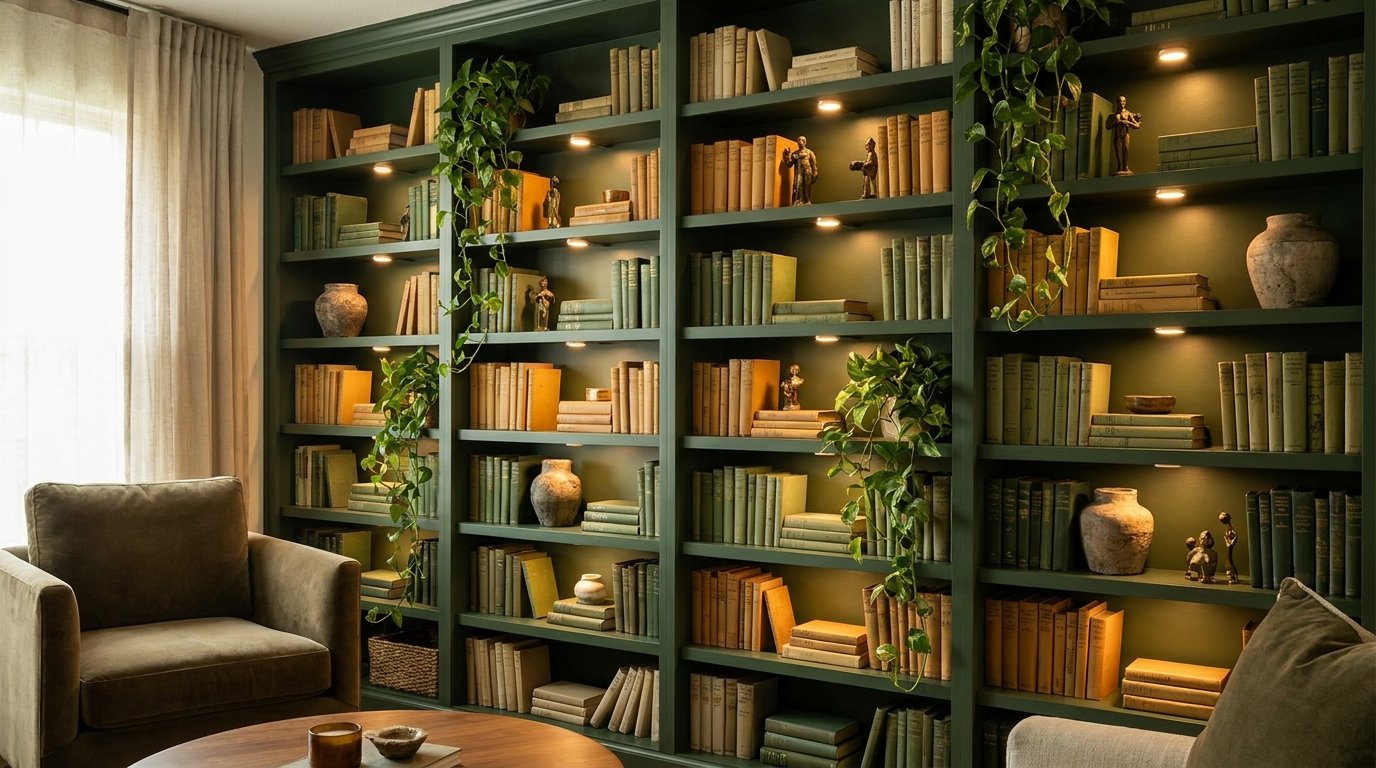
The Living Room Bookshelf That Makes Every Guest Stop and Stare (And How to Build Yours)
There’s something quietly powerful about a well-styled bookshelf in a living room — it doesn’t just hold books, it holds stories, memories, and an unspoken invitation to know you better. Walk into a home where the shelves feel curated and intentional, and something shifts in the air. You feel it before you can explain it. That feeling is exactly what we’re chasing today.
—
1. Why Your Living Room Bookshelf Is Actually the Soul of Your Home
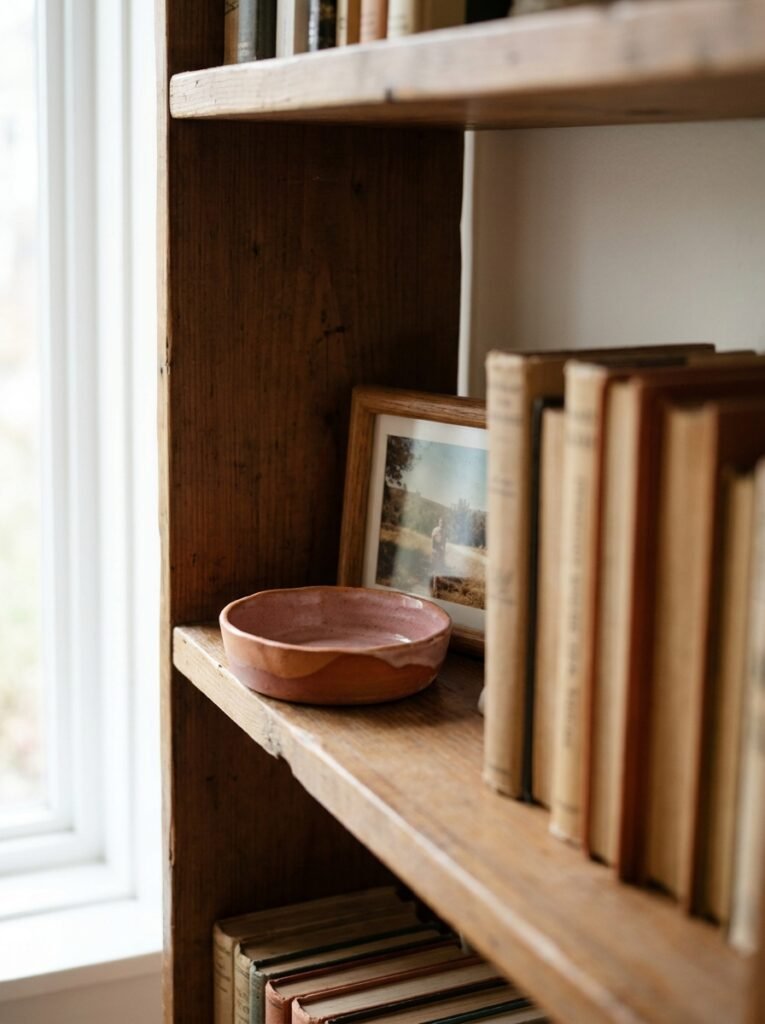
Most people think of bookshelves as storage. A place to put things you don’t want on the floor. But interior designers will tell you something different — your bookshelf is the single most personal piece of furniture in your entire home. Unlike a sofa you picked because it was on sale, or a coffee table that matched everything else, your bookshelf is a living record of who you are.
The spines of your books, the little ceramic dish your daughter made in second grade, the travel photo from that trip you almost didn’t take — these things together tell a story no Pinterest board can fully replicate. And when you place them with intention, that story becomes art.
“Your bookshelf isn’t décor — it’s autobiography.”
The first shift to make, before you touch a single object, is mental. Stop thinking of your shelves as a place to put things and start thinking of them as a curated gallery wall — one that happens to live in three dimensions.
2. The One Rule That Changes Everything: The Rule of Odd Numbers
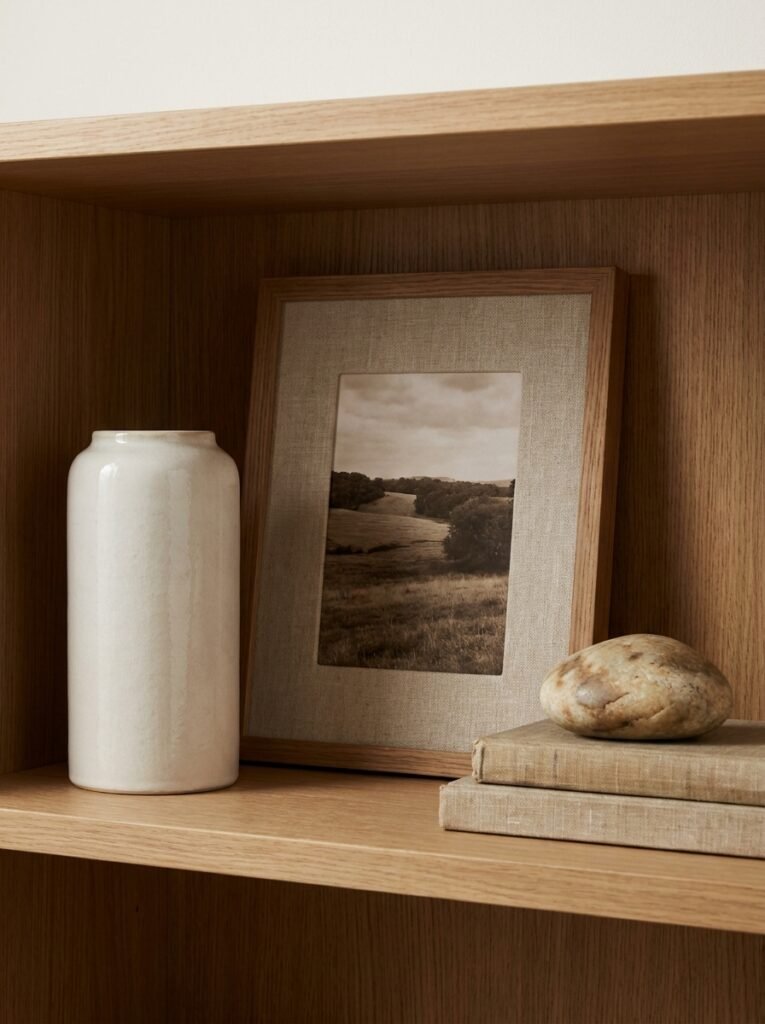
Here’s the kind of thing interior designers know that most of us never get told — odd numbers are more visually satisfying than even ones. Three books, five objects, a cluster of seven small items — these feel alive. Four identical candles in a row feel like a hotel lobby.
The human eye is drawn to imbalance because it creates tension, and tension creates interest. A pair of objects feels resolved, finished, a little flat. Three objects feel like the beginning of a story. That’s the energy you want on your shelves.
When you’re grouping items on a shelf, aim for clusters of three or five. One tall item (a lamp, a vase, a stack of oversized books), one medium item (a framed photo, a small plant, a bowl), and one small item (a figurine, a candle, a single decorative stone). The varying heights create a natural rhythm that draws the eye through the shelf without effort.
3. What Color Theory Actually Tells Us About Bookshelf Styling
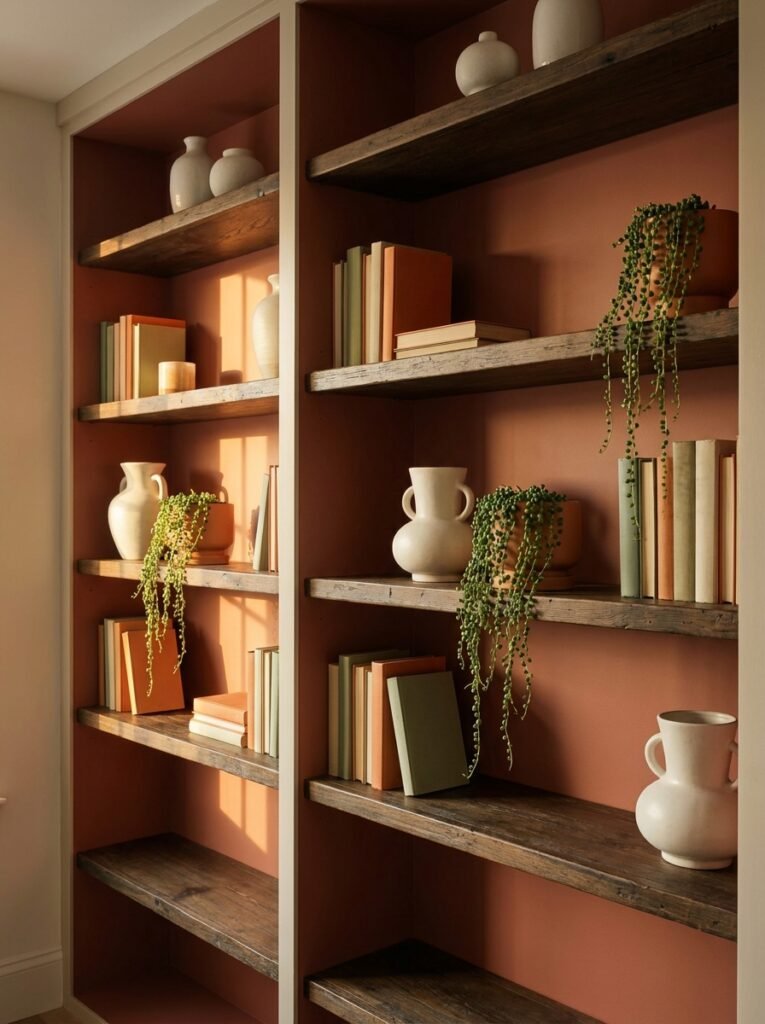
You don’t need a design degree to use color effectively — you just need a few principles that work every time. On a bookshelf, color is your most powerful tool, and it’s completely free.
The first approach is the rainbow method — organizing books by spine color to create a gradient from warm to cool tones. It’s visually stunning in photographs and wildly popular on Pinterest for good reason. But it has a practical downside: you can never find anything. If you’re someone who actually reads your books, this method might drive you quietly mad.
The second approach is more livable — the neutral base with accent pops. Paint or use the back panel of your shelf in a deep, rich color (dusty terracotta, forest green, navy, warm charcoal). Then let your objects bring the personality. The dark background makes every item pop forward dramatically, especially ceramics, plants, and lighter book spines.
The third approach is the tonal edit — removing every book that doesn’t fit your color palette and storing the outliers elsewhere. It sounds extreme, but the visual calm it creates is genuinely remarkable.
4. The Books vs. Objects Ratio That Actually Works
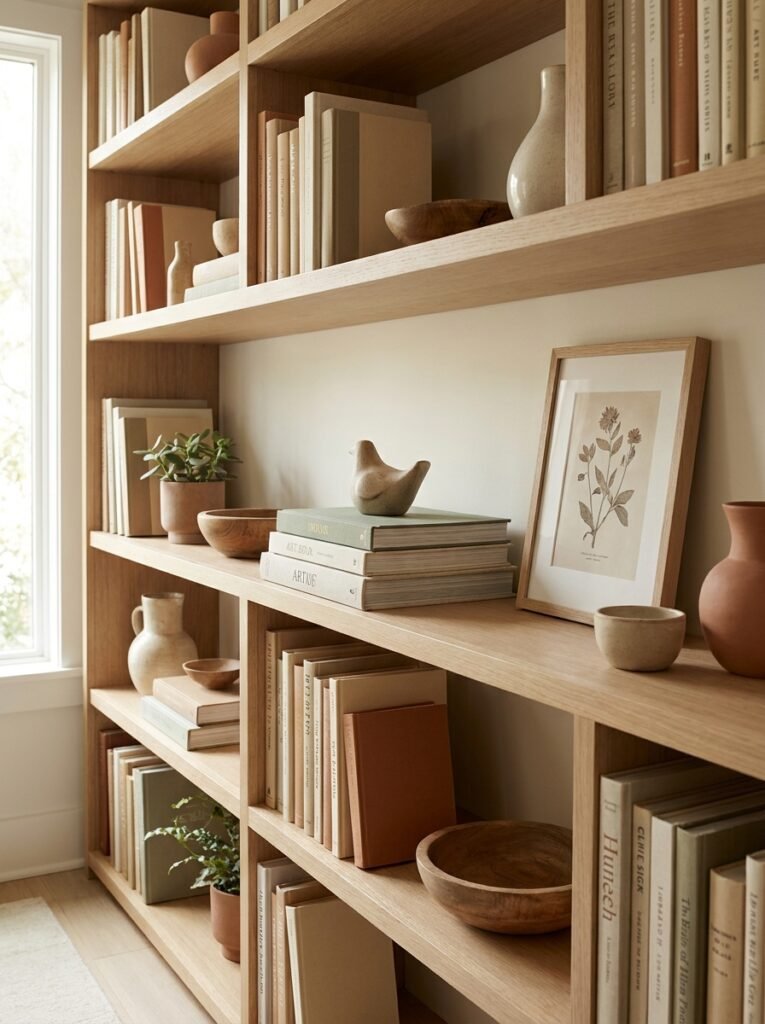
One of the most common mistakes people make when styling bookshelves is filling every inch with books. It feels logical — it’s a bookshelf, after all. But visually, an unbroken wall of spines reads as flat and overwhelming, no matter how beautiful the books themselves are.
The sweet spot that most designers use is roughly 60/40 — sixty percent books, forty percent objects and breathing room. That breathing room is crucial. Empty space on a shelf isn’t wasted space; it’s visual rest. It gives your eye somewhere to pause before moving on, and it makes the objects you do display feel intentional rather than crammed.
Lay some books horizontally to create platforms — stacking three or four horizontally lets you place a small object on top, instantly adding depth and dimension. Lean a framed print or artwork loosely against the back of a shelf at a slight angle rather than hanging it flat. These tiny moments of imperfection are exactly what makes a shelf feel human rather than staged.
5. Small Living Room? Here’s How Bookshelves Actually Make It Feel Bigger
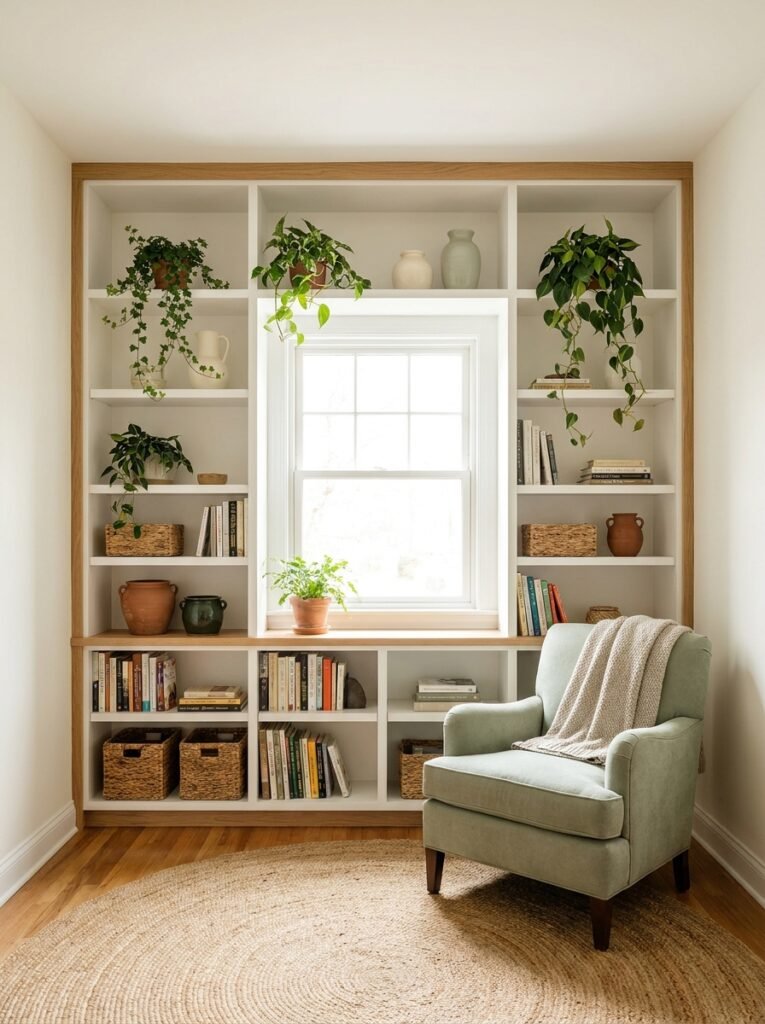
Counter-intuitive design truth: adding a large, floor-to-ceiling bookshelf to a small living room can actually make the space feel significantly larger. Here’s why — when the eye has something beautiful and detailed to explore across an entire wall, it perceives depth rather than limitation.
The trick is in the styling. Keep the upper shelves lighter and airier — more white space, fewer objects, some trailing greenery. Keep the lower shelves slightly denser and darker. This mimics the natural visual weight we expect from the world (sky above, earth below) and makes the room feel properly proportioned and calm.
“In a small space, a well-styled shelf doesn’t crowd the room — it gives it a reason to breathe.”
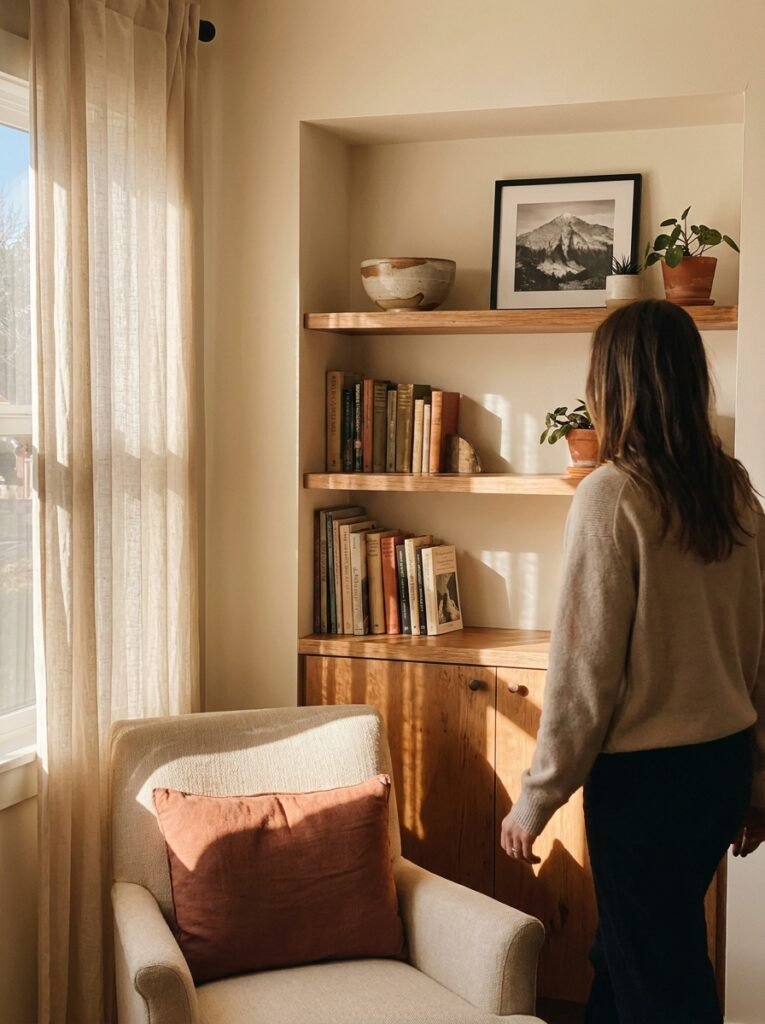
Built-in shelves flanking a fireplace or window are the gold standard for small living rooms. They’re architectural, they eliminate the need for other furniture, and they make a room feel designed rather than decorated. If built-ins aren’t in your budget right now, IKEA’s BILLY bookcase system is legitimately one of the most designer-mimicking budget pieces available — especially when you add trim, paint, and replace the hardware.
6. The Plants That Belong on a Bookshelf (and Why)
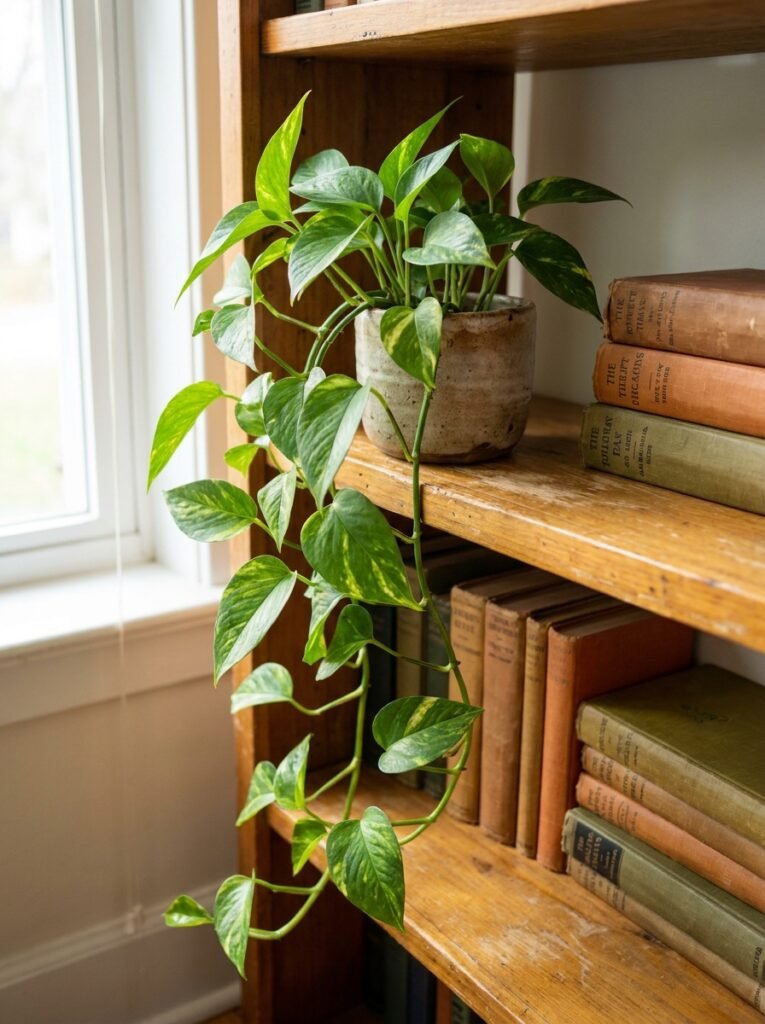
Plants on bookshelves are having a long-overdue renaissance, and for good reason — they introduce the one element that no amount of beautiful objects can replicate: life. Something growing on your shelf changes the energy of the entire wall.
The best plants for shelves are those that trail or drape gracefully — pothos, string of pearls, heartleaf philodendron, and tradescantia all work beautifully because they follow gravity softly, adding movement to what would otherwise be a static display. A single trailing plant at the end of a shelf, draped just enough to soften the corner, does more for the overall look than almost any decorative object you could place there.
For shelves with less light, ZZ plants and snake plants tolerate low-light conditions remarkably well. If natural light is very limited, high-quality faux plants (particularly from brands that focus on botanical realism) are a completely valid choice — the visual effect is what matters.
7. Lighting Your Bookshelf Like an Interior Designer
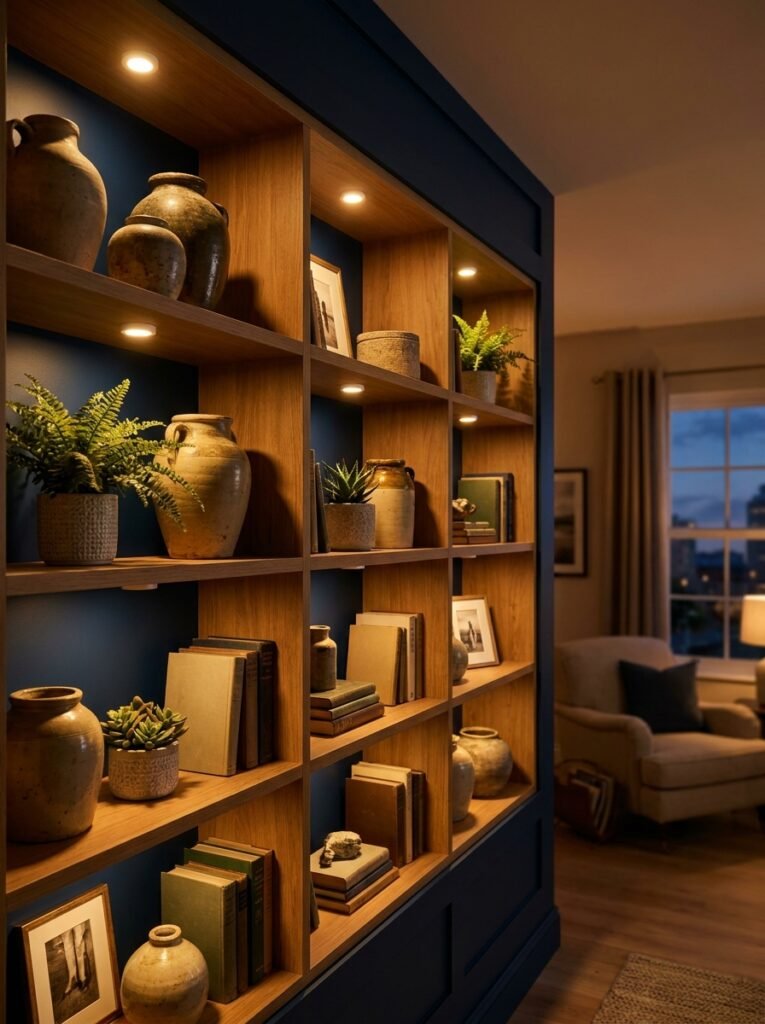
Most living room bookshelves are lit only by the general overhead light in the room — which means they’re lit flatly, without drama, and without the warm glow that makes them feel inviting in photographs and in real life.
Adding dedicated lighting to your bookshelves is one of the highest-impact, lowest-cost changes you can make. Small LED puck lights mounted at the top of each shelf, pointing downward, create a layered glow that makes the entire wall feel warm and intentional. Battery-operated options are available for shelves where running wires is impractical, and many are now rechargeable via USB.
Warm white (2700K–3000K) is almost always the right choice for living room shelves — it reads as intimate and cozy, makes colors look richer, and feels like candlelight without the fire hazard. Cool white lighting (above 4000K) tends to make shelves look clinical, which is lovely in a home office but rarely what you want in your living room.
8. The Art of Mixing Old and New on a Single Shelf
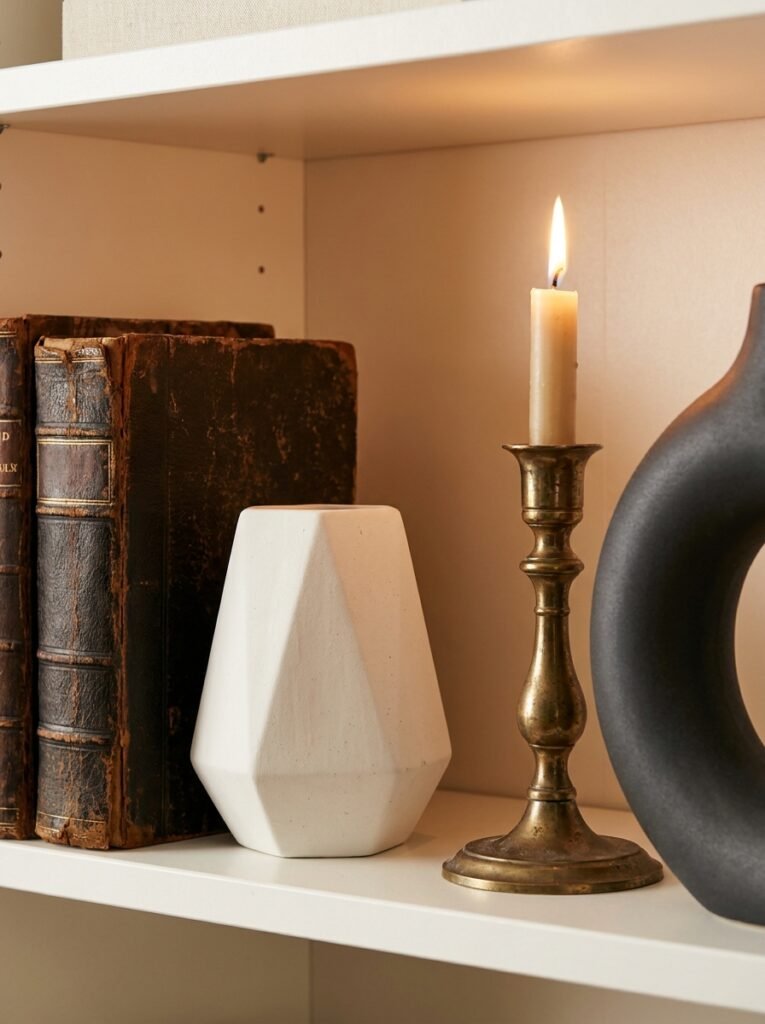
There’s a particular kind of beauty that happens when something very old sits next to something very new on a shelf — a worn leather-bound book beside a modern geometric vase, a vintage brass candleholder next to a contemporary ceramic sculpture. The contrast creates narrative. It suggests a life lived across time, not just assembled in a single shopping trip.
This is the principle interior designers call “collected over time” — deliberately mixing eras, materials, and origins to create the feeling that these objects arrived from different chapters of a life well-lived. Antique markets, estate sales, and secondhand shops are rich sources for the “old” side of this equation. You don’t need to spend much — a single beautiful old object placed among newer things is enough to shift the entire mood of a shelf.
9. How to Use Bookshelf Styling to Anchor Your Living Room’s Design Story
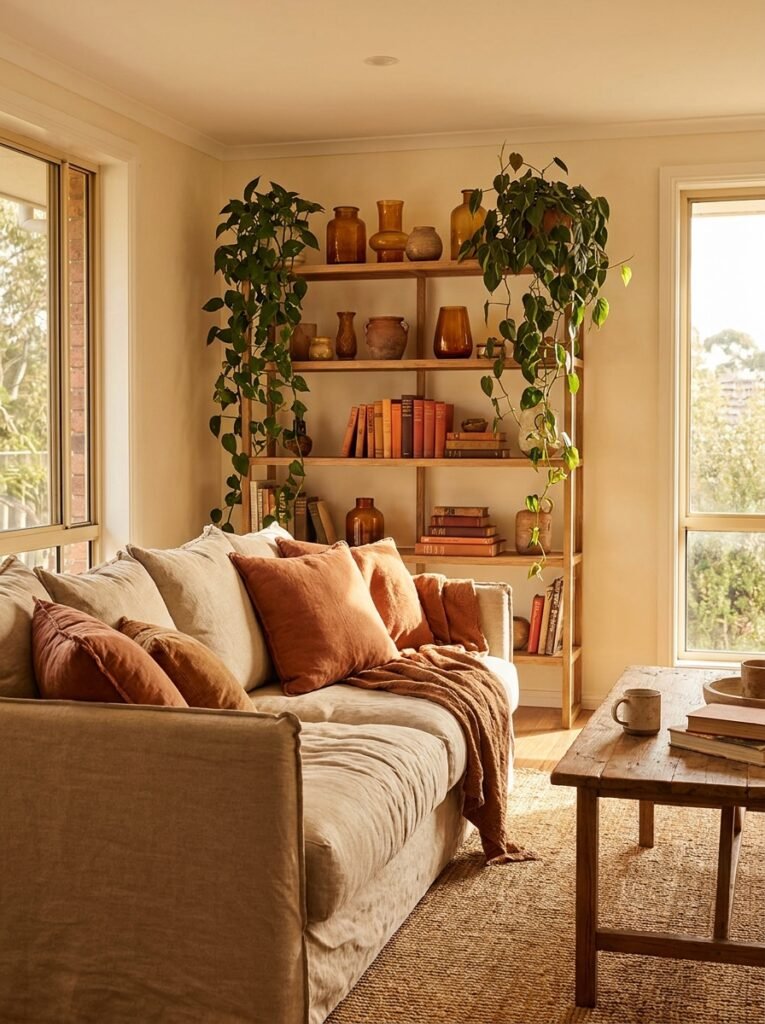
Your bookshelf shouldn’t exist in isolation — it should speak the same visual language as the rest of your living room, but with its own voice. Think of it as the most detailed sentence in your room’s design paragraph.
If your living room leans toward warm, earthy tones — terracotta cushions, wooden furniture, linen drapes — let your shelf carry that same warmth through amber glass, raw ceramics, vintage books in warm tones, and deep green plants. If your living room is more modern and minimal, let your shelf breathe more, with fewer objects, more deliberate negative space, and cleaner lines in your decorative pieces.
The mistake to avoid is treating the shelf as a separate project from the rest of the room — as if you can style it in a completely different aesthetic and somehow make it work. The most beautiful living rooms feel coherent because every element is in quiet conversation with everything else.
“The most beautiful rooms don’t match — they resonate.”
10. Seasonal Shelf Refreshes That Keep Your Living Room Feeling Alive
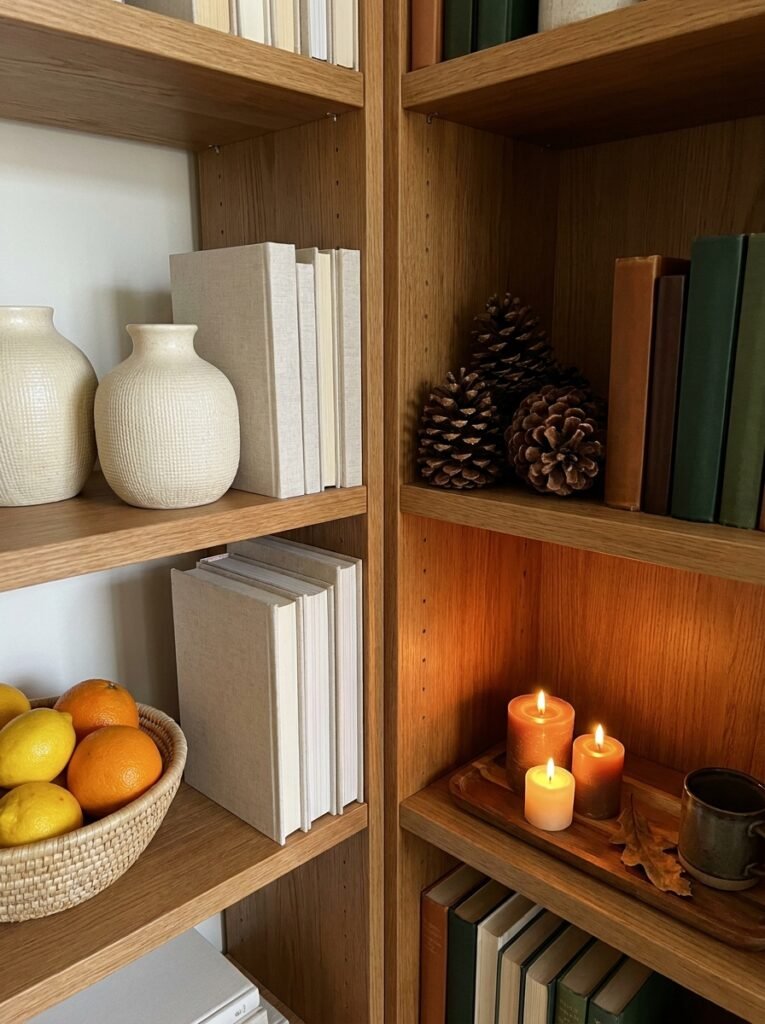
One of the underused benefits of a well-styled bookshelf is how easy it is to update seasonally without redecorating an entire room. Swapping out a few objects — a summer citrus bowl for autumn pinecones, linen-colored ceramics for something richer and darker as winter arrives — takes thirty minutes and completely transforms the mood of your living room.
Keep a small box of “off-season” shelf items so the rotation stays intentional rather than accumulated. Spring might bring fresh botanical prints leaned against the back panel; winter might bring candles at varying heights and a few small dark-spined books layered in. These micro-updates keep your living space feeling current and personally curated year-round, and they give you something lovely to do on a slow Sunday afternoon.
11. What to Avoid: The Most Common Bookshelf Mistakes
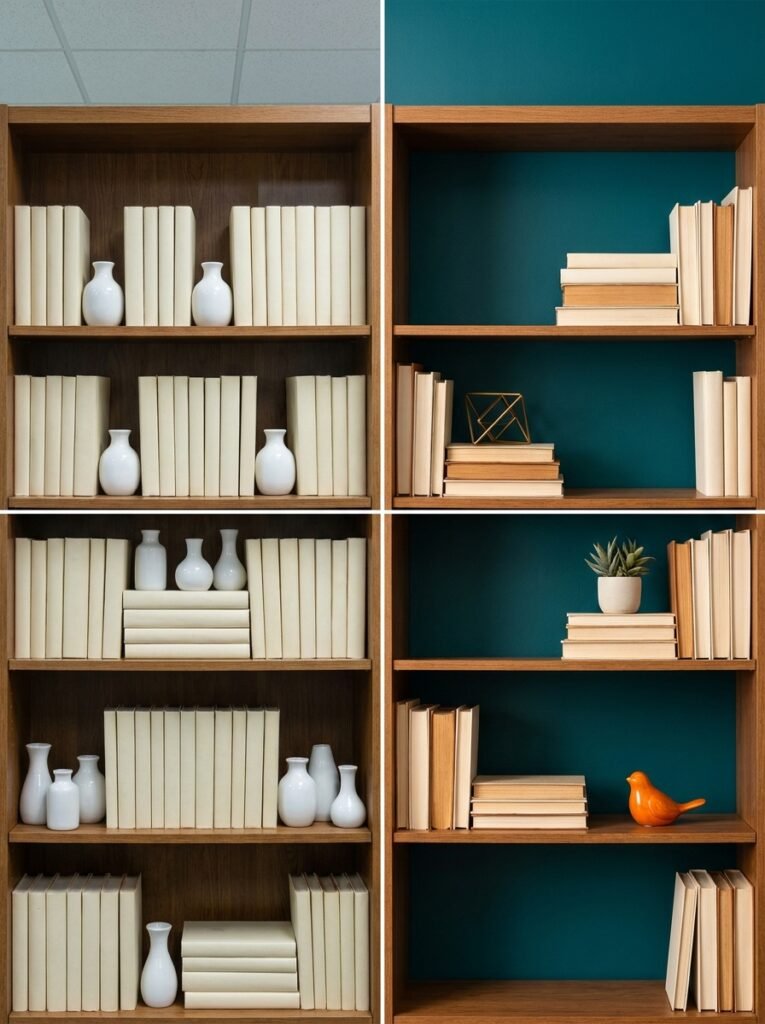
Some things, once you see them, you can’t unsee — and certain bookshelf styling habits quietly undermine even a beautiful room. Overcrowding is the most common: when every square inch is filled, the eye has nowhere to rest and the shelf reads as overwhelming storage rather than curated display. Resist the urge to use every inch.
Matching everything too perfectly is the second mistake — a shelf where every object is the same material, the same height, and the same color looks purchased rather than collected. Introduce at least one surprise element: something unexpected in color, material, or scale.
Ignoring the back panel is the third — the back of your shelf is essentially a fifth wall in your living room. Painting it a contrasting or complementary color, applying removable wallpaper, or even covering it in fabric creates an instant backdrop that elevates every item placed in front of it with almost no effort.
12. The Emotional Return on Investment of a Well-Styled Bookshelf
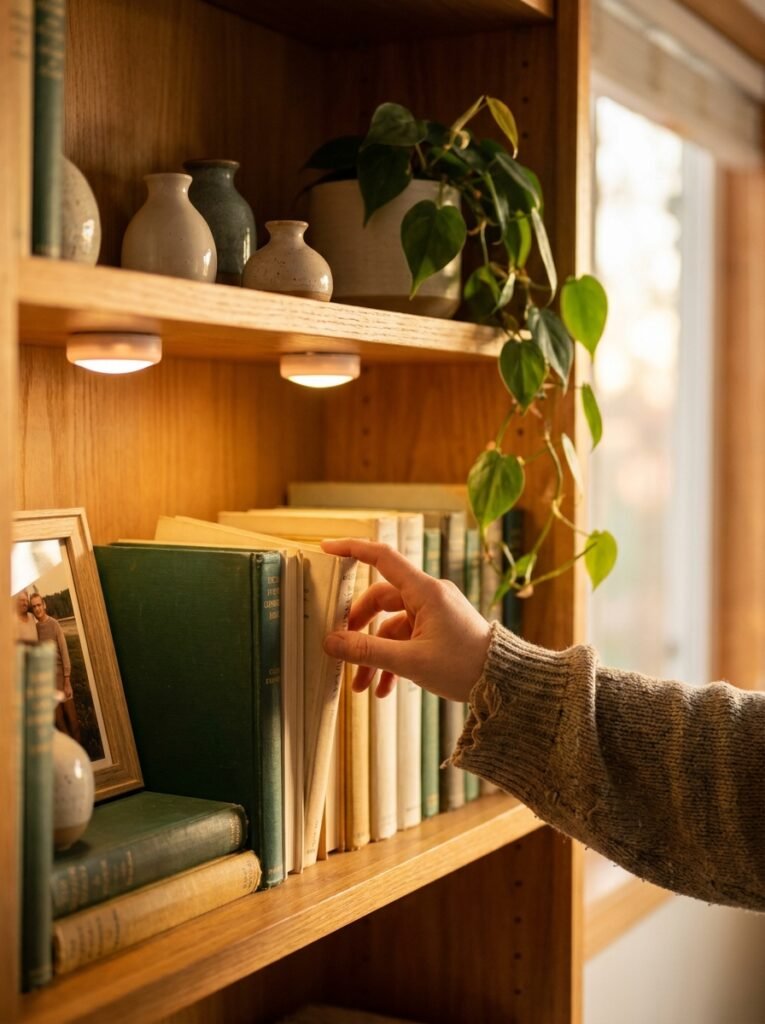
There’s something worth saying plainly here: the effort you put into styling your living room bookshelf pays you back every single day. Not in a grand, dramatic way — but in the quiet pleasure of walking past something beautiful that belongs to you. In the way a guest stops mid-conversation to look more closely at the shelf, picks up a book, asks you about it. In the way your living room becomes a space you actually want to spend time in, rather than just pass through.
Beautiful spaces don’t require big budgets or professional designers. They require attention — the kind of slow, considered attention you give to things you love. Your bookshelf is one of the most personal canvases in your home, and the good news is that you already have most of what you need to make it extraordinary.
—
🌿 How to Take Care of Your Living Room Bookshelf
Maintaining a beautiful bookshelf isn’t about perfection — it’s about regular, gentle attention. Once every month or so, do a quick walk-past edit: remove anything that feels out of place, has accumulated dust, or simply no longer sparks that small feeling of joy when you look at it. Living rooms change as we change, and your shelf should too.
Dust your objects and book spines with a soft microfiber cloth — book spines in particular trap dust along their tops, which dull their color over time. If you have open-backed shelves, a quick wipe of the back panel keeps the whole display looking fresh.
Check in on your shelf plants weekly — feel the soil, rotate them slightly toward the light source so they grow evenly, and remove any yellow leaves promptly. A struggling plant does more visual damage than no plant at all.
Every season, pull everything off one shelf and rethink it before putting things back. You’ll be amazed how often this edit produces a combination you never would have arrived at by simply moving things around in place. Fresh eyes — even your own — see differently.
Finally, give yourself permission to evolve. A bookshelf that looked right in January might want to feel different by October. That evolution isn’t inconsistency — it’s a home that grows with you.
—
❓ FAQ
Q: How many items should I put on each shelf to avoid it looking cluttered? A: A good starting point is leaving roughly 20–30% of each shelf as empty, negative space. For a standard bookshelf shelf that’s about 36 inches wide, aim for two to three groupings with clear breathing room between them. When in doubt, remove one more item — you can always add back, but editing down is where the magic usually happens.
Q: What’s the best background color to paint the inside of a bookshelf? A: Deep, saturated colors tend to work best because they create contrast that makes your objects pop forward dramatically. Dusty terracotta, forest green, navy, warm black, and deep teal are all consistently beautiful choices. If you’re hesitant, start with a warm charcoal — it’s forgiving, sophisticated, and works with virtually every color palette.
Q: How do I make a cheap IKEA bookshelf look high-end? A: Three changes make the biggest difference. First, paint the back panel a rich accent color. Second, replace the standard hardware with something more elevated — unlacquered brass, matte black, or ceramic knobs. Third, add LED shelf lighting. These three updates cost relatively little but shift the entire perceived quality of the piece dramatically.
—
💭 Final Thought
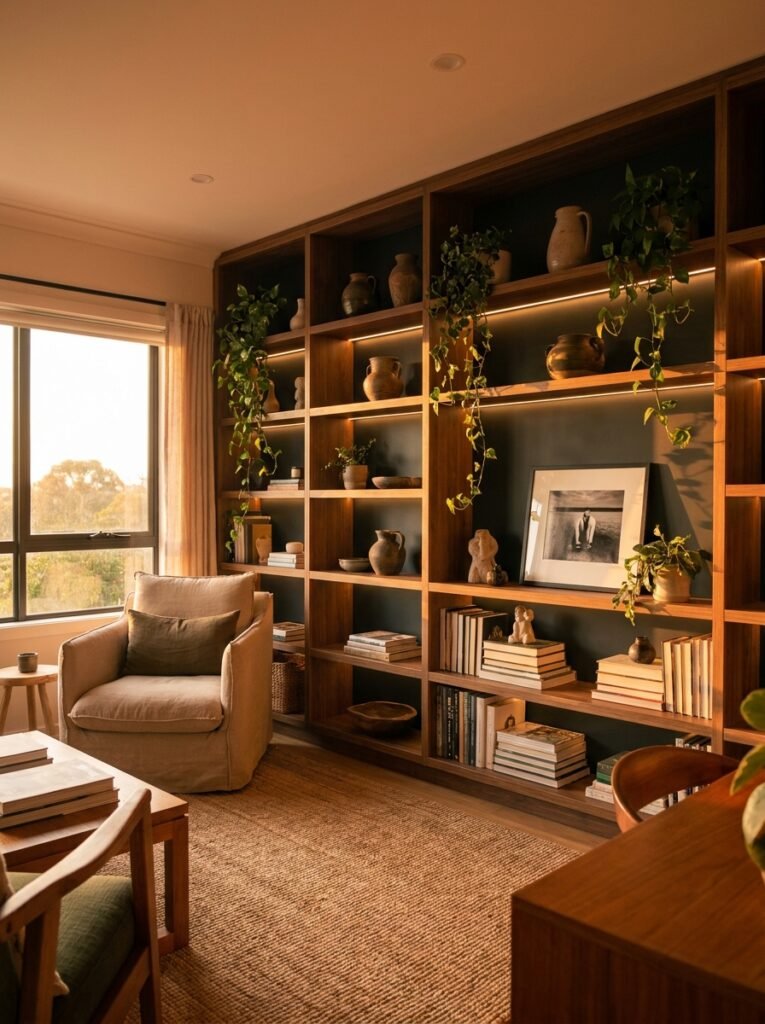
A living room bookshelf, at its very best, is a self-portrait made from objects — proof that a real person with a real history lives in this space, loves certain things fiercely, and has taken the time to share that with anyone who walks through the door. You don’t need to spend a fortune, and you don’t need to follow every trend. You just need to be intentional with the things that matter to you.
So here’s what I’d love to leave you thinking about: if a stranger walked into your living room right now and spent five minutes looking at your bookshelves, what story would they tell about the person who lives there — and is it the story you actually want to tell?