The Built-In That Made My Living Room Look Like It Was Designed by Someone Who Knows What They’re Doing
There’s a moment — you’ve probably had it — where you walk into someone’s living room and something just works, and it takes you a full minute to figure out what it is. Nine times out of ten? It’s a built-in with the TV tucked right in the middle of it.
That combination of function and intention changes everything. Here’s how to get it right.
—
1. Why a Floating TV on a Blank Wall Feels Unfinished (Even When Everything Else Is Perfect)
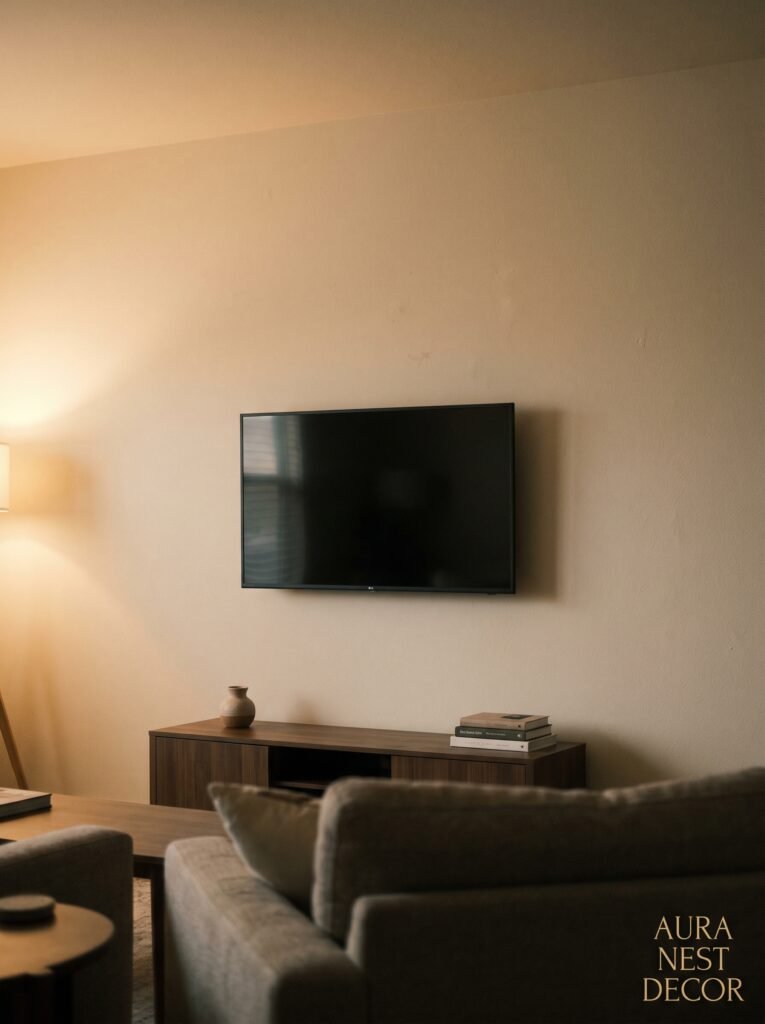
Here’s the thing nobody really says out loud: a TV mounted on a bare wall is basically a void. It’s a black rectangle competing with nothing and winning nothing. Your eye doesn’t know where to land. The room feels staged rather than lived in, which is the design equivalent of making your bed but leaving dirty dishes in the sink.
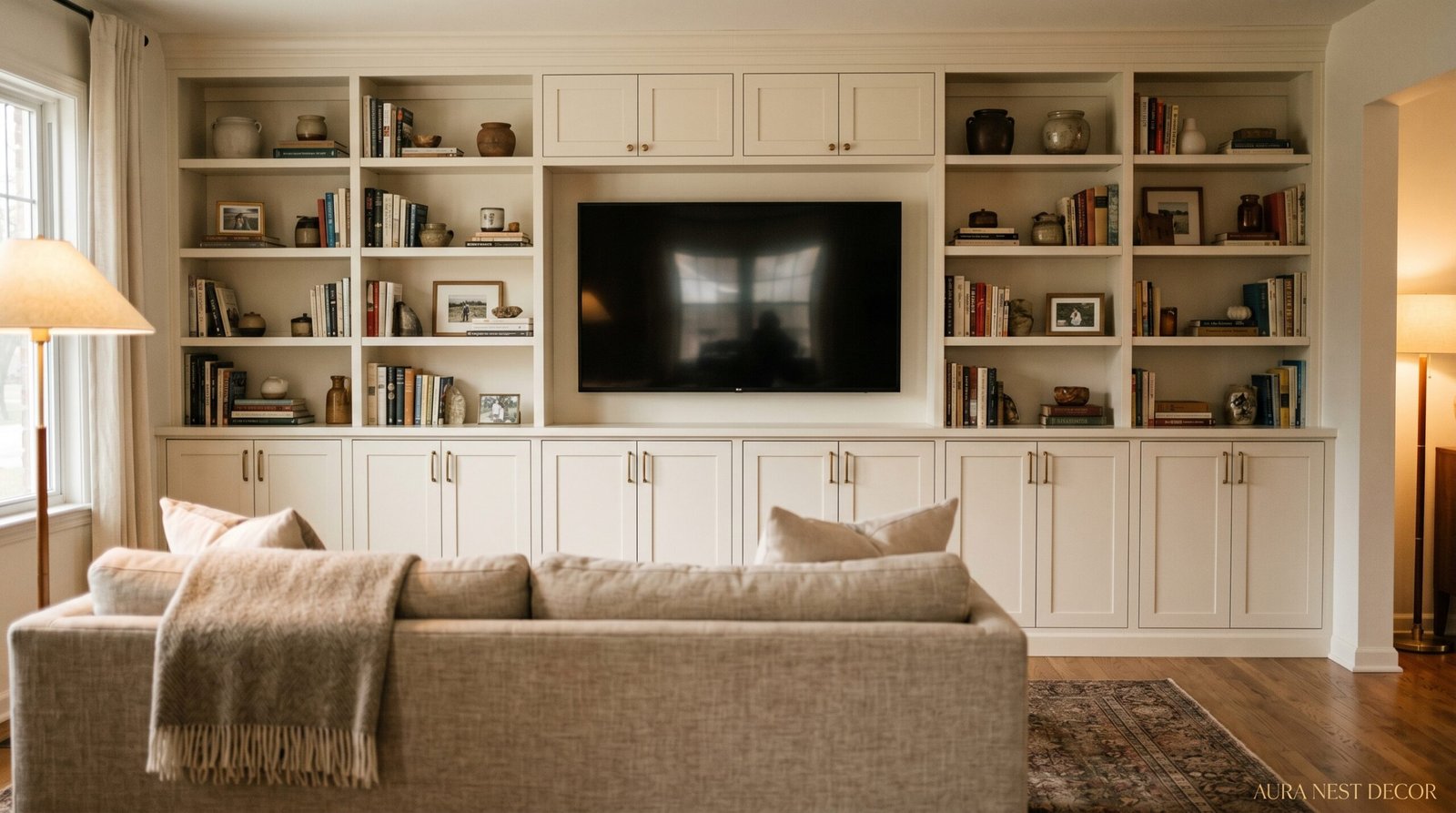
Built-ins solve this without you even realizing it. They give the TV a reason to be there. It becomes part of an intentional composition — shelving on either side, maybe a cabinet below, a little breathing room at the top — and suddenly the TV isn’t the awkward focal point anymore. It’s just one element in a wall that’s actually doing something.
I didn’t fully understand this until I saw a friend’s Victorian terraced house in Bristol with a full-wall built-in, the kind with glass-fronted upper cabinets and chunky timber shelves. The TV was in the center at eye level and you barely noticed it. What you noticed was the whole wall. That’s the difference.
It also reads SO much better in photos. Which, not gonna lie, matters when you spend time putting a room together.
“Give the TV a reason to be there, and it stops being the problem it always was.”
2. The First Decision That Determines Everything Else: Recessed vs. Flush
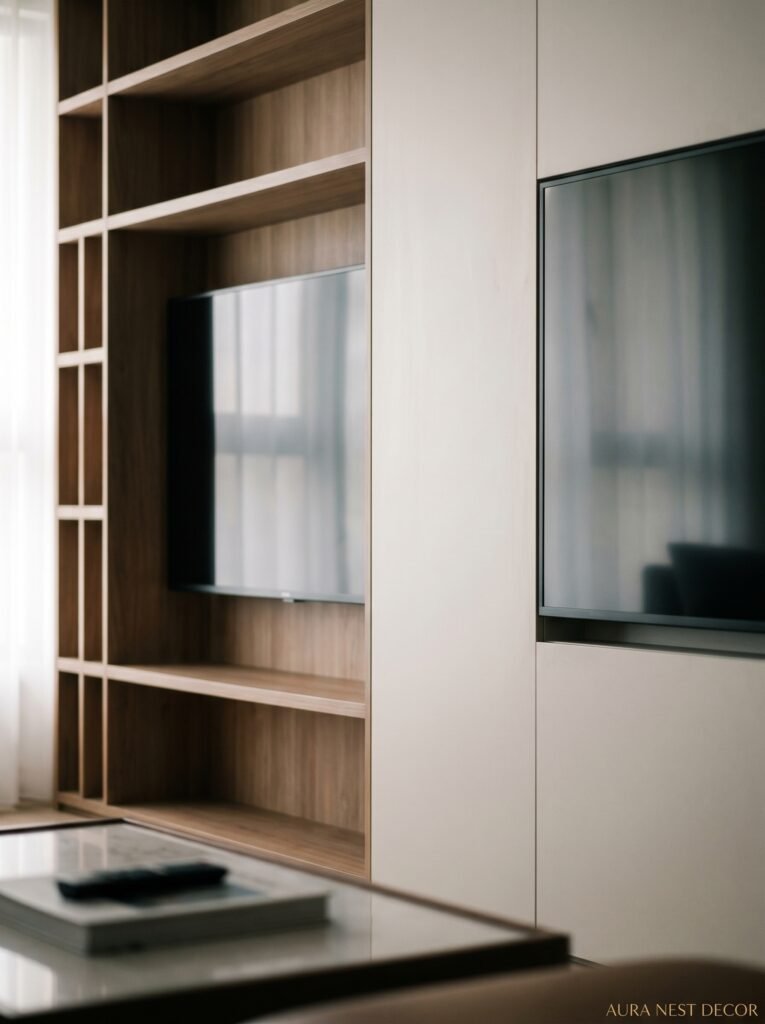
Before you pick a finish or a hardware style or argue about whether open shelves are too dusty (they are, but let’s not get into that yet) — you need to decide if your TV is going in into the wall or just sitting within the built-in frame.
Recessed means cutting into the wall cavity so the TV sits flush with or behind the face of the cabinetry. It looks incredibly clean. Especially in modern or transitional spaces where you don’t want anything protruding. The catch is that it’s a bigger project, potentially involves an electrician and a carpenter working together, and if you’re renting — obviously, no.
Flush means the TV sits on the face of the built-in structure, wall-mounted onto a back panel. Still looks intentional and designed. Still miles better than floating on a white wall. And it’s the more accessible version for most of us, including anyone in an older home where the walls are basically held together by wallpaper and prayers.
For most American and British homes I’ve seen done well, the flush approach wins on practicality. The trick is making sure the depth of your built-in accommodates the cords cleanly. That’s where a lot of DIY versions fall apart — the TV looks great and then there’s a full cable situation happening in plain view. Sort the cord management FIRST. It’s not glamorous but it matters enormously.
3. The Color That Keeps Showing Up in Every Stunning Built-In Right Now
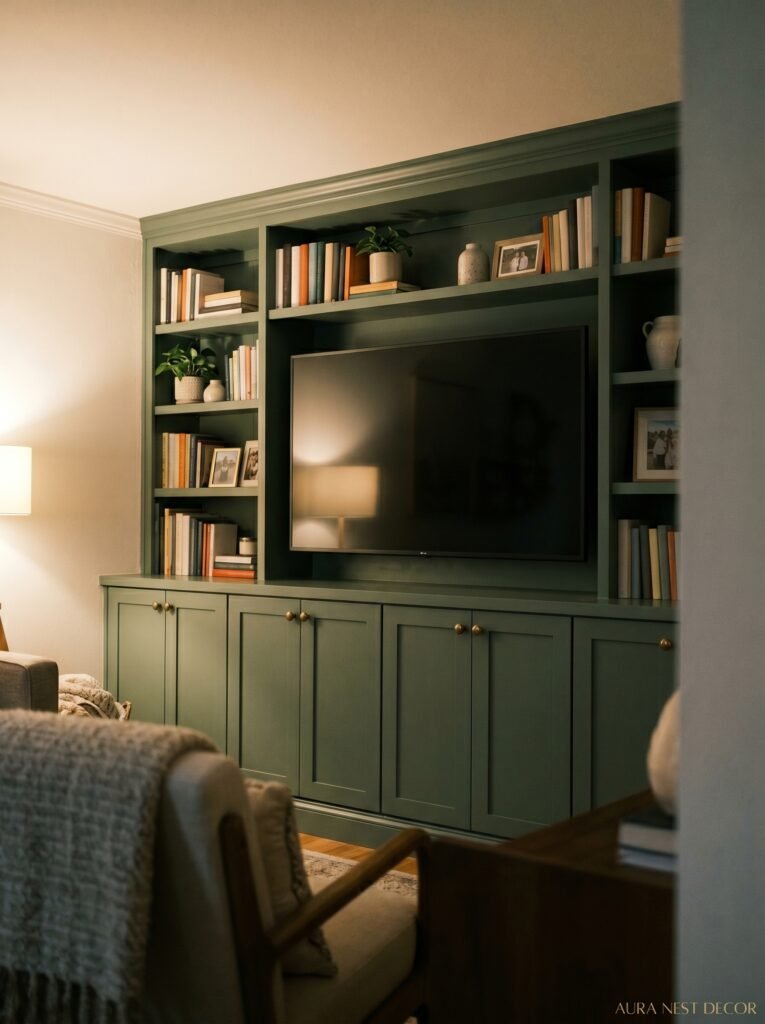
It’s not white. I mean, white is fine and timeless and I’ll never argue against it, but the built-ins I can’t stop saving on Pinterest and flagging in magazines are painted in colors that weren’t really on anyone’s radar five years ago.
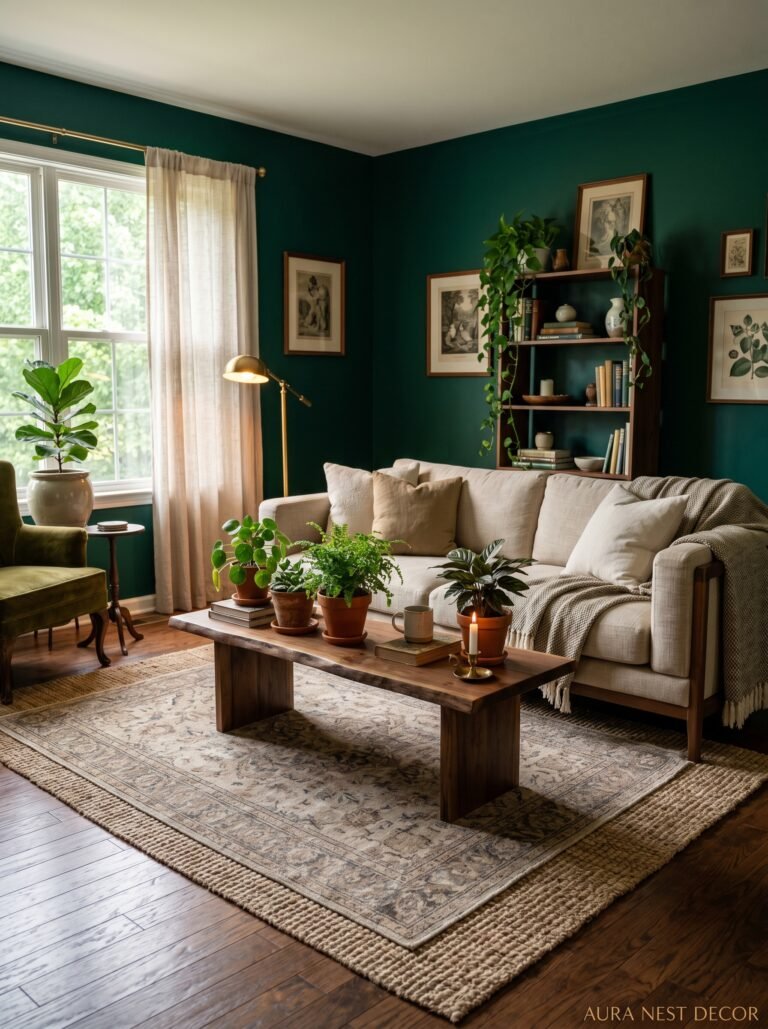
Deep navy. Like, really dark navy — almost black in low light, but then you get it in daylight and it’s clearly blue. Farrow & Ball’s Hague Blue and Benjamin Moore’s Van Deusen Blue keep coming up. There’s also a resurgence of warm dark greens — Calke Green, Studio Green, anything in that forest-floor family — which works incredibly well in rooms with natural wood floors and linen sofas.
The logic is that painting the built-in dark (and ideally the wall behind the TV too, if not the whole wall) makes the TV disappear. A black screen against a dark background? You genuinely stop seeing it when it’s off. The room reads as designed rather than decorated around a TV.
On the lighter end, soft putty tones are having a moment. Not beige — beige is sort of done — but that warm greige that reads almost like aged linen. Railings by Farrow & Ball. Accessible Beige by Sherwin-Williams. These work if your room already has a lot of contrast coming from furniture and rugs and you want the built-in to recede gently rather than make a statement.
Go bold or go neutral. The middle ground tends to look like an accident.
4. Open Shelves vs. Closed Cabinets: The Fight That Every Couple Has
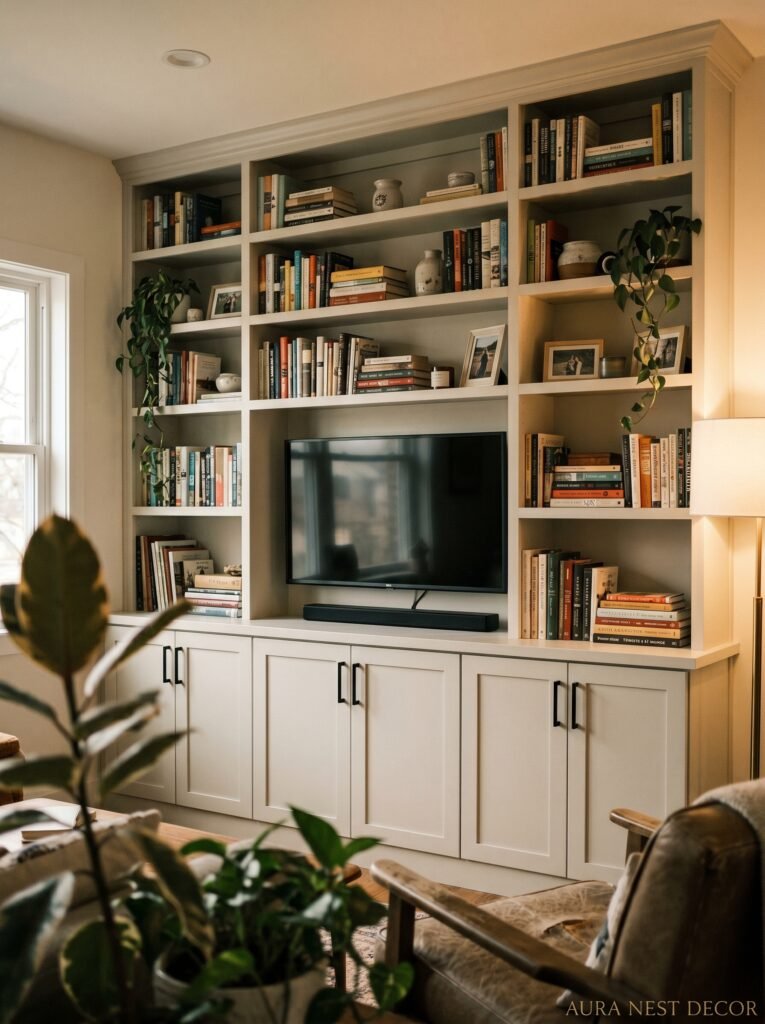
Here’s where I’ll give you an honest answer instead of a diplomatic one.
Open shelves look better in photos. Closed cabinets look better in reality. That’s basically it.
Open shelving on a built-in requires you to either have very curated objects or embrace the visual chaos, and most of us live somewhere between “I have a lot of stuff” and “I have A LOT of stuff.” Books, plants, candles, that vase you bought on holiday, the speaker that doesn’t fit anywhere else, the kids’ thing that somehow migrated in there — it piles up. And then your beautiful built-in looks like a bookshelf at a car boot sale.
The smarter approach, honestly? Closed lower cabinets for actual storage — games, chargers, extra throws, whatever — and open upper shelves for the styled, intentional stuff. You get the pretty photo AND you have somewhere to hide the router.
If you’re committed to open all the way, then commit to the curation. Fewer things, more breathing room, objects in an odd number groupings, and please — I’m begging — don’t use the built-in shelves as a dumping ground for things that have nowhere else to go. That’s what the cupboard under the stairs is for.
“Closed cabinets at the bottom. Open shelves at the top. This isn’t compromise — it’s just correct.”
5. The Shelf Heights That Most People Get Wrong the First Time

This is the boring-sounding section that I promise isn’t boring once you’ve made the mistake.
Most built-in designs default to evenly spaced shelves. Equal height all the way up. And that’s fine! But it’s also a bit rigid and kind of obvious, and it limits what you can display because you’re constantly working around the fixed heights.
The thing that makes a built-in feel truly custom — even when it’s a flat-pack frame from IKEA or a mid-range carpenter job — is varied shelf height. One tall shelf for oversized books or big plants. Shorter shelves for stacked books and smaller objects. Ideally one shelf deep enough to actually hold something substantial.
The TV bay itself should be sized EXACTLY for your TV. Not just “fits a 65-inch TV” but literally measured: width of the TV plus four to six inches each side, height with a few inches above for breathing room. When the TV bay is the right size, the whole built-in looks like it was always meant to be there. When the bay is too wide or too tall, the TV looks like it was dropped in as an afterthought.
Side note — if you’re going adjustable shelving, spend a bit more on better shelf pins. The cheap ones bow over time and nothing is more depressing than a warped shelf.
6. The One Hardware Detail That Makes a Built-In Feel Expensive
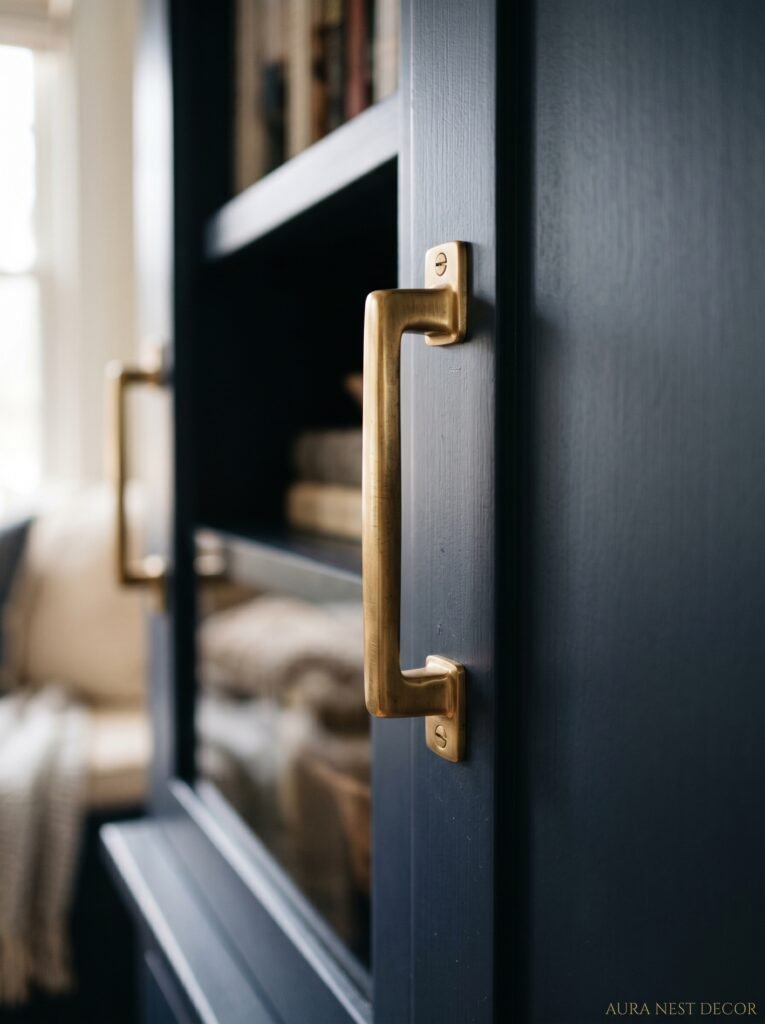
I’ve seen built-ins that cost a fortune and still looked sort of generic, and I’ve seen flat-pack builds that looked genuinely upscale. The hardware is almost always the difference.
Specifically: the handles or knobs on any lower cabinets.
Cheap bar handles in satin silver? Instantly looks like a kitchen from 2009. But swap those for aged brass cup pulls, or matte black arched handles, or even unlacquered brass bar handles — and the whole built-in shifts register. It sounds minor. It isn’t.
In the US, Rejuvenation and House of Antique Hardware carry handles that photograph beautifully and genuinely feel substantial in your hand. In the UK, Anthropologie Home (weirdly) and Dowsing & Reynolds consistently nail the balance between distinctive and timeless.
The other hardware detail that matters more than people think: hinges. If you have any glass-fronted upper cabinets, visible hinges in the wrong finish will sit badly. Match the hinges to the handles. Keep them in the same metal family. That’s it. That’s the whole trick.
7. Where to Actually Put the TV Height — Because Almost Everyone Gets This Wrong
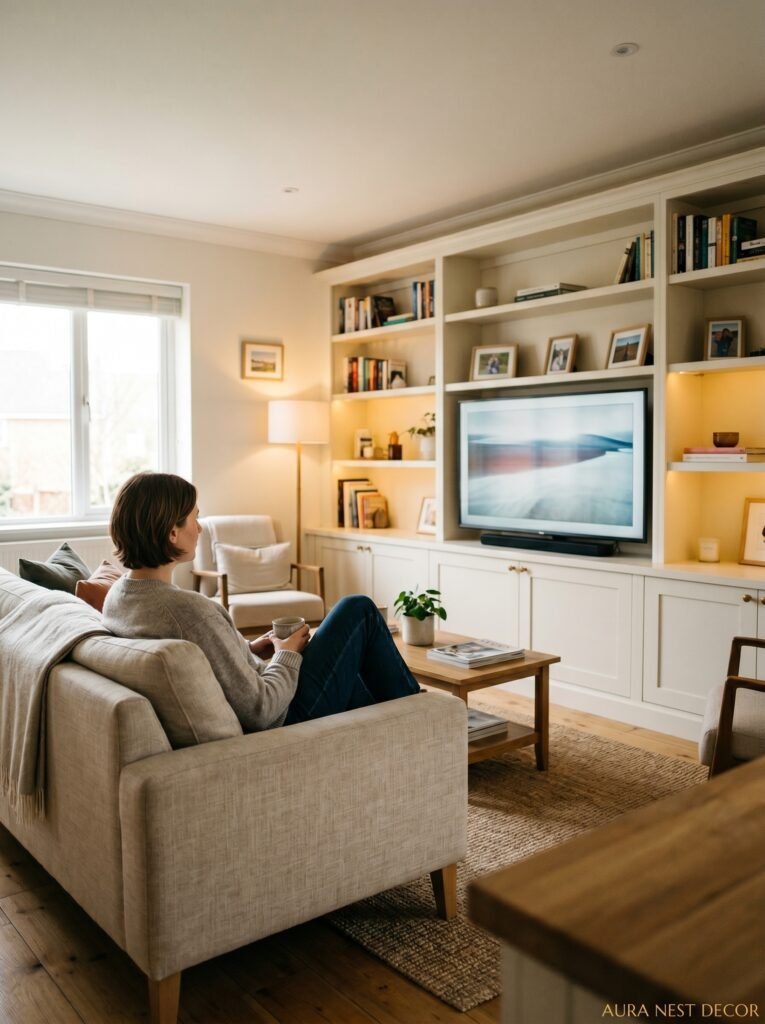
Eye level when you’re seated. That’s the rule. It sounds obvious until you see how many built-ins have the TV positioned too high because it “looked right” standing in the room during the build.
Sit on your sofa. Measure the height of your eye from the floor. That’s where the CENTER of your TV screen should be. Usually somewhere between 40 and 50 inches from the floor, depending on your sofa height and how you sit in it.
People push the TV up too high because they’re worried the lower cabinets take up too much visual space, or because the proportions look more balanced in a standing view. But you don’t WATCH television standing up. You watch it sitting down, slightly reclined, often with your feet up. If your neck is tilted upward at all while you’re watching, the TV is too high. Full stop.
“The TV height should be decided sitting down. Not standing in an empty room holding a tape measure.”
8. Lighting Inside a Built-In — The Detail That Separates a Good Build from a Showstopping One
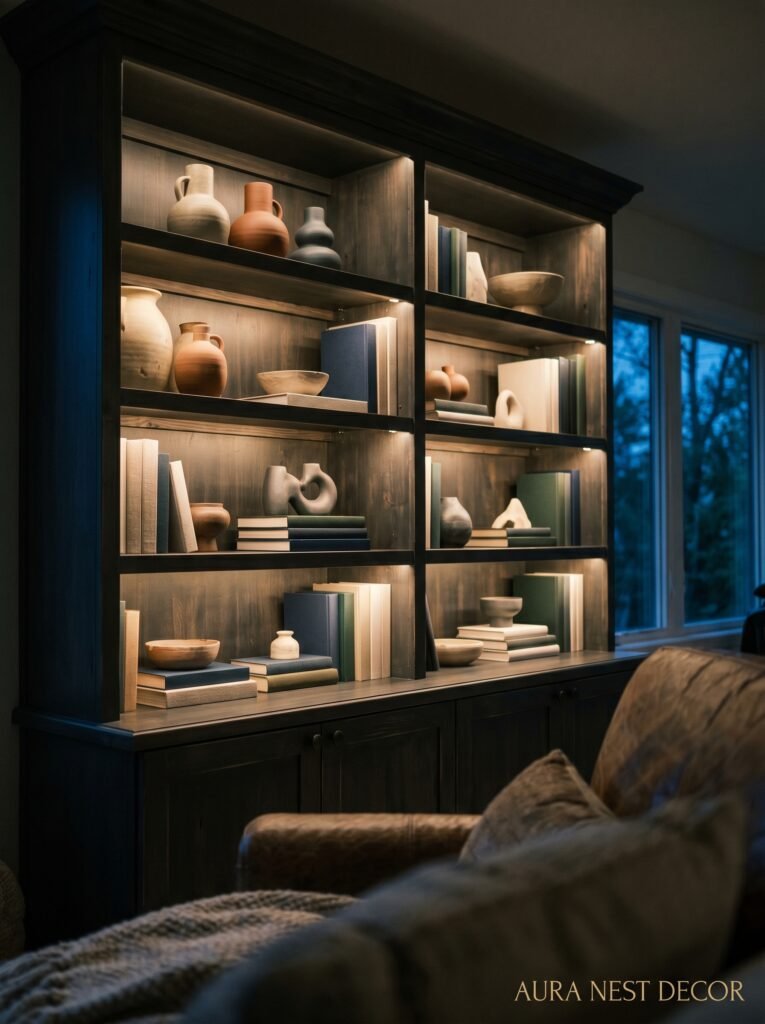
This is the part where I get kind of evangelical about something most people treat as optional.
LED strip lighting inside built-in shelves. That’s all. Just that one addition.
Run a warm white LED strip along the top inner edge of each shelf bay and suddenly the built-in glows. At night, when the room lights are dimmed, the objects on the shelves are lit from above and the whole wall becomes atmospheric. The TV becomes less dominant because there’s actually something competing with it now — in the best possible way.
The color temperature matters a lot here. Don’t go cool white (anything above 3000K reads clinical and a bit sad in a living room). Stick to 2700K or even 2400K if you want that really amber, candlelit warmth.
Battery-operated or hardwired — hardwired is cleaner, battery is more flexible if you’re renting or don’t want the faff of an electrician. Either works. What doesn’t work is skipping it entirely and wondering why your built-in looks flat in every photo you take of it.
9. The Way British and American Built-Ins Actually Differ (And Why It Matters)
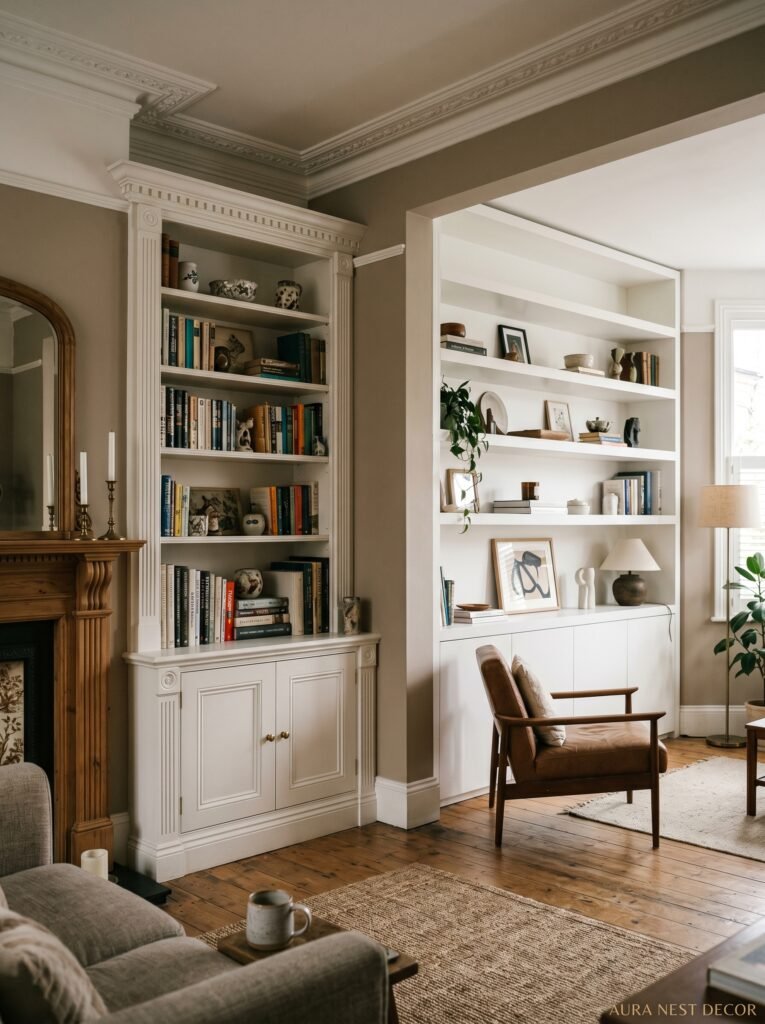
This isn’t just aesthetics — the architecture shapes the built-in completely.
American homes, particularly suburban builds from the last few decades, tend to have more square footage to work with but shallower wall cavities and often drywall construction throughout. This makes fully recessed built-ins trickier without significant structural work. What works brilliantly in American rooms is the full-width, floor-to-ceiling built-in that spans the entire fireplace wall — anchored by a gas or electric fire below, TV center, flanking towers of shelves.
British homes, especially Victorian and Edwardian terraces (which are everywhere in London, Manchester, Bristol), have those gorgeous original alcoves on either side of the chimney breast. Built-ins that fit into those alcoves are some of the most satisfying projects I’ve ever seen. The architecture gives you the framework; you’re just filling it in beautifully.
For Georgian and Edwardian homes, traditional paneling details — a little beading, a simple cornice, shallow raised panels on cabinet doors — echo the house’s original character in a way that modern frameless styles don’t. Know your house. Build something that could have always been there.
10. Styling the Shelves Without It Looking Like a Prop Shop
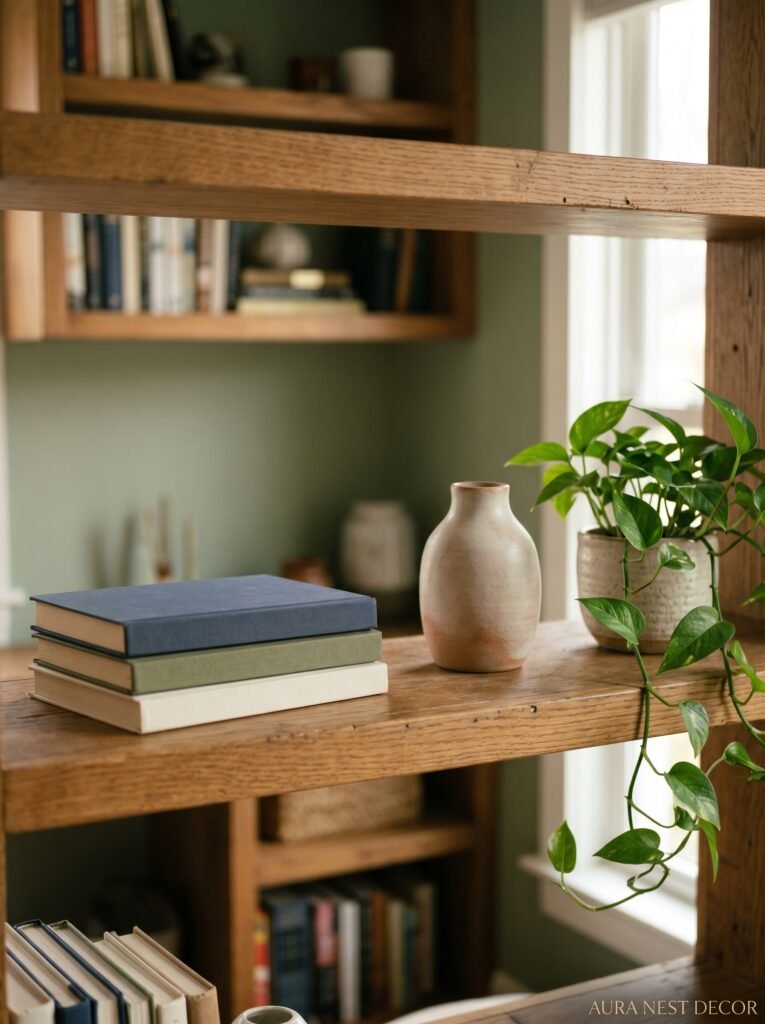
Right, so you’ve got the built-in. The TV’s in. The lighting’s on. Now you have to put things on the shelves and NOT have it look like you staged it for a listing.
The trap most people fall into is trying to style every inch of every shelf. Give the shelves room to breathe. Empty space is a styling choice. A shelf that’s 70% full and 30% air looks more intentional than one stuffed to the edge with carefully curated objects.
Books are your best friend here — not because they look good (they do) but because they add depth and color variation naturally, without trying. Stack some horizontally for height variation. Stand some vertically. Don’t organize by color unless you genuinely love the rainbow-spine look; it tends to date a room quickly.
Plants work on built-ins if they’re the right kind. Trailing plants like pothos or string of pearls that drape over a shelf edge look effortless. Big upright plants — a small fiddle leaf, a rubber plant — belong at the BASE of the unit, not on a shelf. Get the scale right.
And one thing I’d say quite firmly: resist the urge to buy “shelf decor” as a category. The objects that look best on shelves are almost always things that mean something — a piece from a trip, a book you’ve actually read, a candle in a scent you love. Stuff bought specifically to sit on a shelf tends to look exactly like that.
11. The Budget Question: Where to Spend and Where to Save
This is a real-world section for real-world people who don’t have a renovation budget that stretches to a bespoke joinery quote.
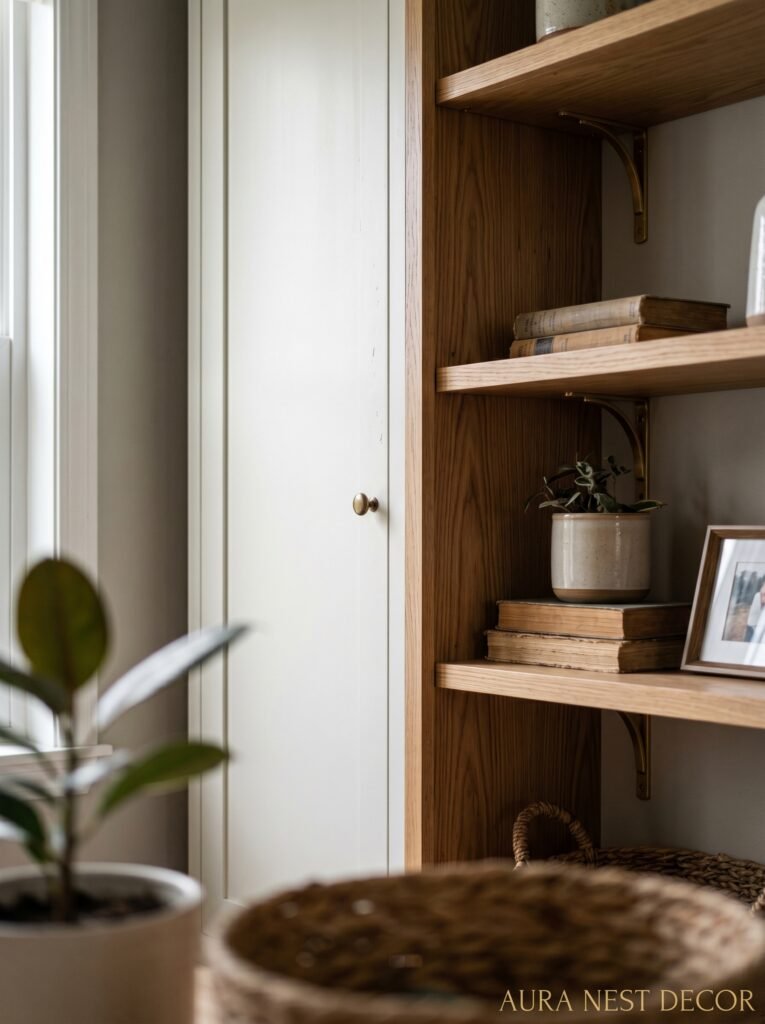
Spend on: paint (good paint, the right color, properly prepped — this is non-negotiable), hardware (handles and knobs transform a basic frame), and lighting (the LED strip situation from section 8 — do not skip it).
Save on: the carcass itself. IKEA BILLY and PAX wardrobes have been used as the structural bones of incredible built-ins for years. The trick is in the crown molding, the trim at the base, the in-fill panels, and the paint finish — all things that cost relatively little but make a flat-pack frame look completely custom. Search “IKEA hack built-in” and prepare to be genuinely stunned.
Bespoke joinery is worth it if you have an unusual space — an alcove that’s an odd size, walls that aren’t straight, a fireplace breast with a specific profile that needs to be accommodated. Or if you want it to genuinely outlast you. But if your walls are square and your floor is level? An IKEA-based build with good finishing work will look extraordinary at a fraction of the price.
12. The One Thing to Decide Before You Start Anything
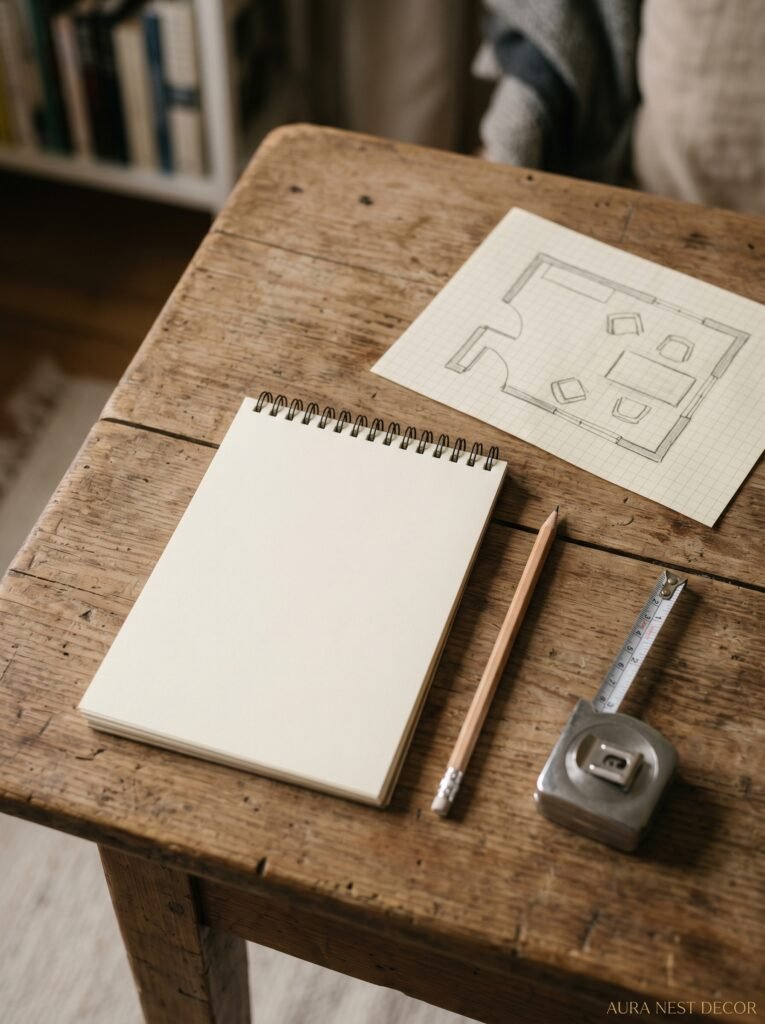
Before you pick a color, a style, a carpenter, or scroll a single pin — decide exactly what this built-in needs to DO.
If it’s primarily storage (and it often is, because living rooms never have enough of it), design from the storage need outward. Figure out what you’re hiding, how much of it there is, and build closed cabinet space accordingly before worrying about the pretty open shelves.
If it’s primarily a media feature — you want the TV to be the star, everything organized around the viewing experience — then the proportions need to lead with the TV bay. The shelving is secondary.
If it’s primarily a design statement — you’ve got the TV situation fine already and you just want the wall to be a jaw-dropping moment — then you have the most freedom, and you should probably push the color and material choices further than feels comfortable.
Knowing what you want the built-in to SOLVE means you won’t get six months in and realize the thing that looked stunning in a Pinterest save doesn’t actually work for your life. That’s the most expensive mistake of all — not financially, but emotionally. Build for the room you actually live in.
—
❓ FAQ
Q: How deep should a built-in be for a TV? A: The TV bay itself only needs to be about 6–8 inches deep if the TV is wall-mounted — you’re just creating a visual frame, not a shelf. The lower cabinets typically go 12–16 inches deep to be actually useful for storage. Don’t go shallower than 12 inches on cabinets or you’ll constantly be annoyed by what doesn’t fit.
Q: Can you do a built-in with a TV in a rented home? A: Honestly, more than people think. Freestanding built-in-lookalike units exist from IKEA, West Elm, and others that give the effect without permanent installation. You can also do a partial built-in using L-brackets and trim that attaches to the wall minimally — worth checking your lease and asking the landlord, because sometimes they say yes.
Q: Do you have to hire a carpenter or can you DIY this? A: If your space is straightforward — square walls, flat floor, standard ceiling height — and you’re comfortable with a circular saw and a miter saw, an IKEA-based DIY built-in is genuinely achievable over a long weekend. The finishing work (trim, caulk, paint) takes longer than the building. If anything is structural or involves moving electrics, bring in a professional for those elements even if you’re doing the rest yourself.
—
💭 Final Thoughts
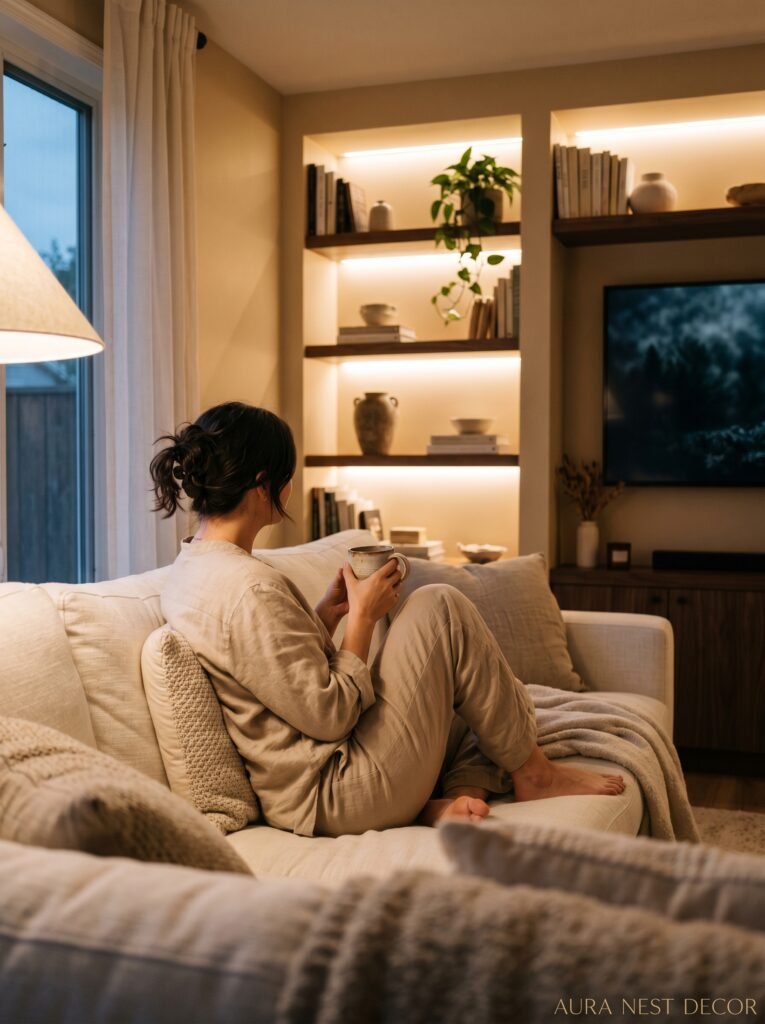
A built-in with a TV isn’t a project you undertake lightly, but it IS one of those rare home improvements where the after looks so dramatically different from the before that it genuinely changes how you feel about a room. Not the whole house. Just that one wall. Which turns out to be enough.
It’s the kind of thing you stop noticing after six months — in the best possible way, because it just fits, the way things do when they belong somewhere.
What would you build it around — a fireplace, a blank wall, or one of those gorgeous alcoves?