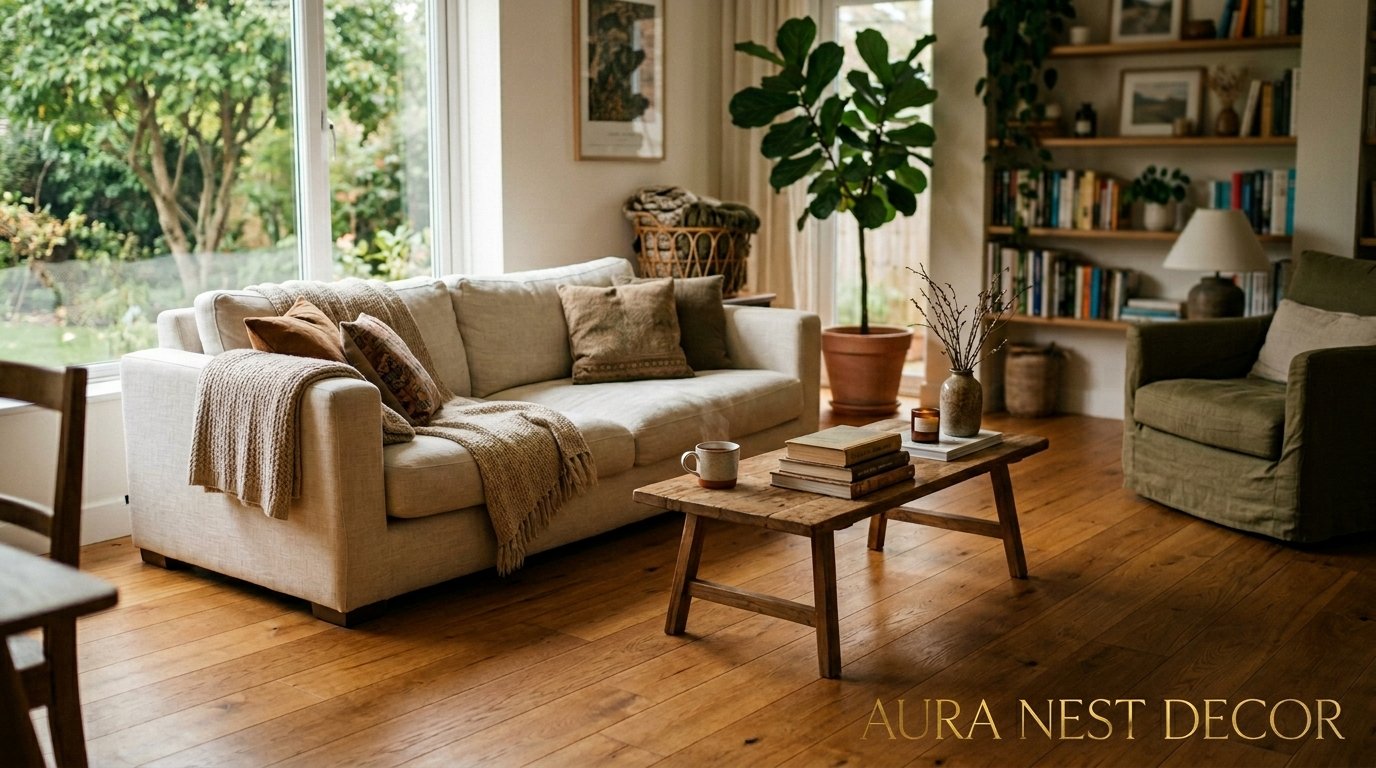
The Living Room Floor Decision That’s Going to Haunt You (In the Best Way)
You didn’t think it would matter this much. You were focused on the sofa, the paint color, the perfect throw pillows — and then someone mentioned the floor and now you can’t stop looking at it. Every photo you pin, every living room you admire, the floor is doing half the work. Quietly. Constantly.
—
1. Why Your Floor Is Actually Running the Room (and You Probably Know It)
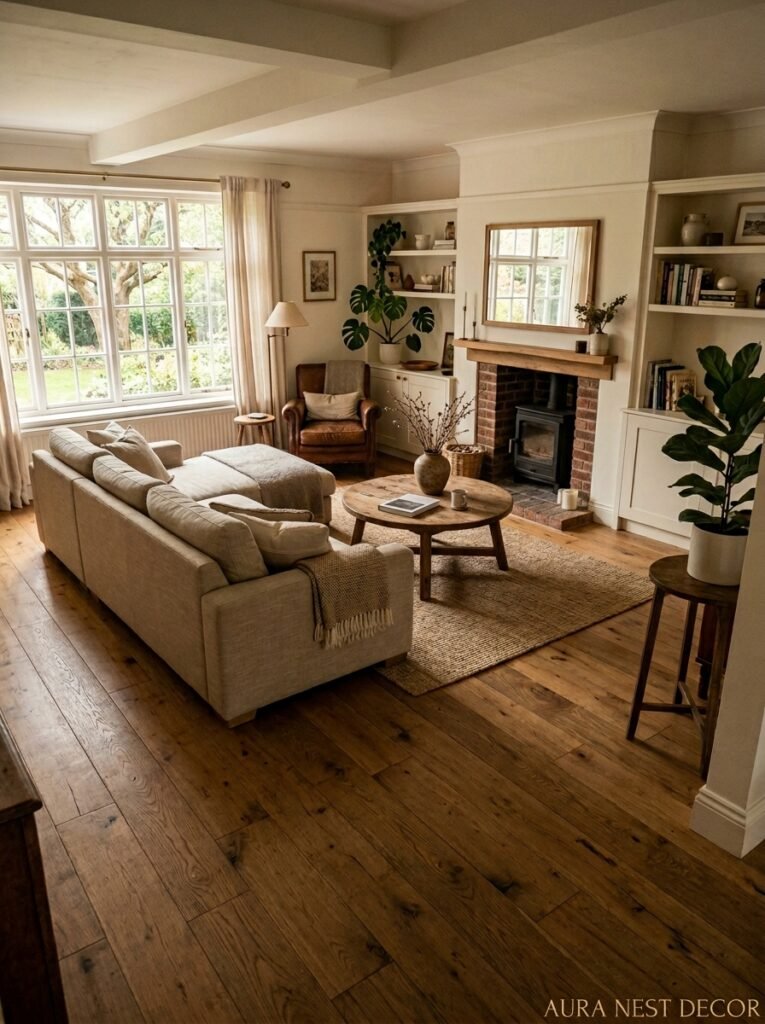
Here’s the thing nobody tells you when you’re obsessing over furniture: the floor is the largest single surface in your living room. Larger than any wall. Larger than your sofa, your rug, your gallery wall combined. And because it’s horizontal and you’re vertical, your eye travels across it constantly without you even realizing. It sets the tone before anything else in the room gets a chance.
I used to think flooring was a “practical” decision. Something you sorted out and forgot about. And then I spent three years in a house with cold, pale laminate that looked fine in photos and felt wrong every single day. Not wrong like ugly. Wrong like — the room never settled. Never felt finished. We kept buying things trying to fix a problem we couldn’t name, and the whole time it was the floor.
The floor dictates warmth or coolness. It dictates whether a room feels grounded or floaty. It affects how your furniture looks, how your walls read, how light behaves in the space at different times of day. Get it right and everything you put on top of it looks better. Get it wrong and you’ll be chasing that “something’s off” feeling for years.
So yeah. The floor is kind of everything.
“The floor is the one decision in your living room you literally cannot ignore.”
2. The Hardwood Question and Why the Answer Is Almost Always Yes
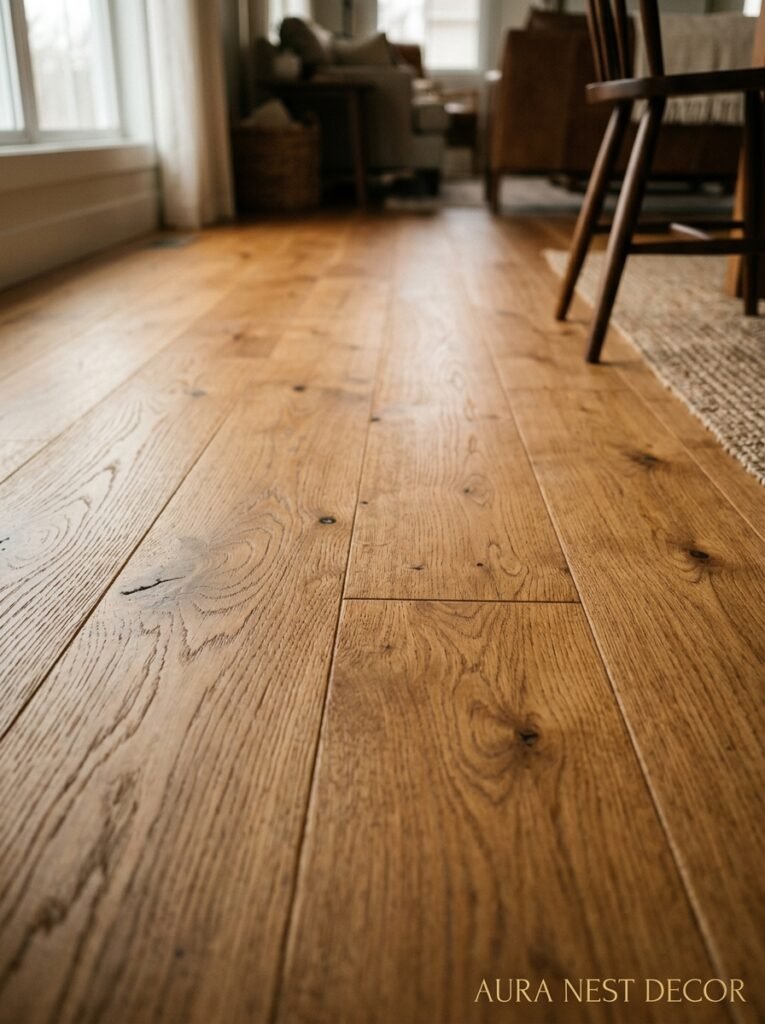
Hardwood floors in a living room are — not gonna lie — just correct. Not trendy. Not a phase. They’ve been the go-to in British period homes and American craftsman houses alike for over a century, and there’s a reason they keep surviving every design era that comes and goes.
What real hardwood gives you that nothing else quite replicates is depth. The way light hits solid oak at 4pm on a winter afternoon, that honeyed, slightly amber glow — you can’t manufacture that. You can approximate it, sure. But it’s not the same.
Now, solid hardwood isn’t cheap and it’s not practical for every situation — damp basements, ground-floor flats with concrete subfloors, homes with underfloor heating that runs very hot. Those are real limitations. But if you can do it, if the budget and the structure allow? Do it. Wide plank, medium tone, lightly oiled finish rather than high gloss. You’ll never regret it.
The one thing I’d push back on: going too light. Very pale washed hardwood was everywhere for a while and it shows EVERYTHING. Every footprint, every crumb, every shadow. Beautiful in photos. Maddening in real life.
3. The Engineered Wood Argument (This One’s Actually More Interesting Than It Sounds)
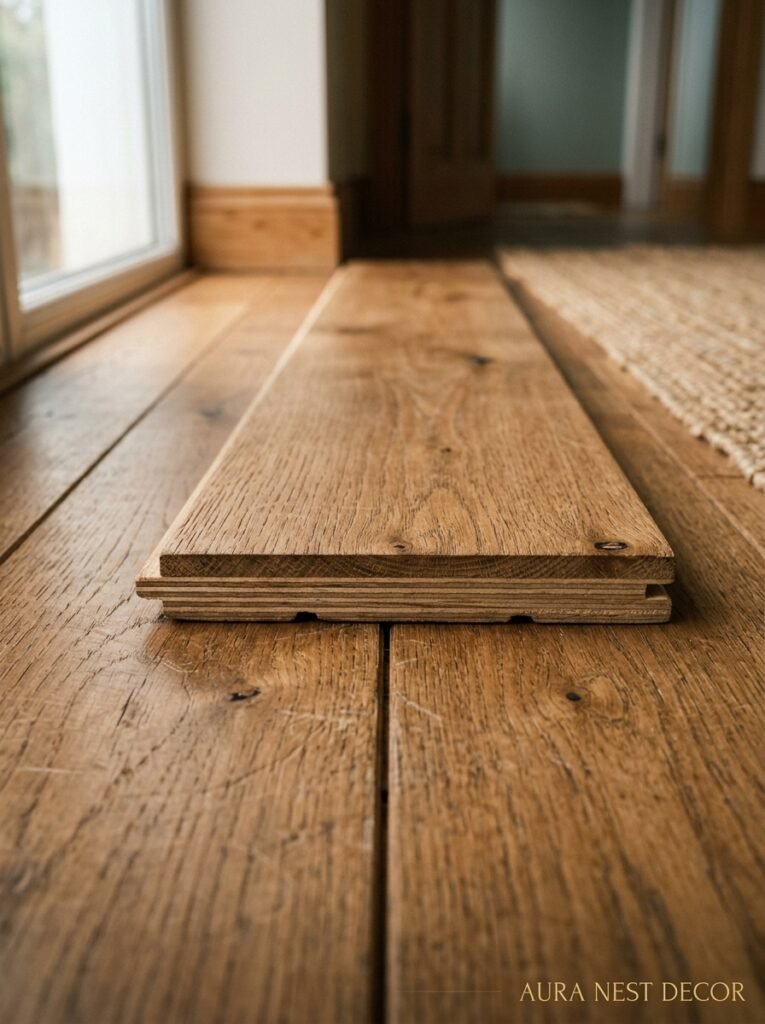
Engineered hardwood gets undersold because people think it’s a lesser version of the real thing. And in some ways, technically, it is — it’s a real wood veneer over a plywood core rather than solid timber all the way through. But here’s where it gets interesting: in a lot of living rooms, engineered wood is actually the better choice.
It’s more dimensionally stable. That means it handles humidity changes without the expanding and contracting that solid hardwood does, which matters enormously in the UK where heating systems cycle dramatically, or in American homes that go from AC in summer to central heat in winter. Less movement means fewer gaps, fewer creaks, fewer of those slightly raised edges that catch the light wrong after a few years.
You can also use engineered wood over underfloor heating, which solid hardwood generally can’t handle as well. And the thickness of the veneer on a quality engineered plank — we’re talking 4-6mm of real oak or walnut — means it looks and feels genuinely real underfoot. Not like laminate. Not like vinyl. Like wood.
Go for a brushed or matt lacquered finish rather than gloss. Wider boards if your room can handle it — anything under 120mm feels a bit dated now, honestly. The whole look is moving toward these big, generous planks with visible grain and a natural, unfussy finish.
4. The Color That Keeps Showing Up in Every Beautiful Living Room Floor Right Now
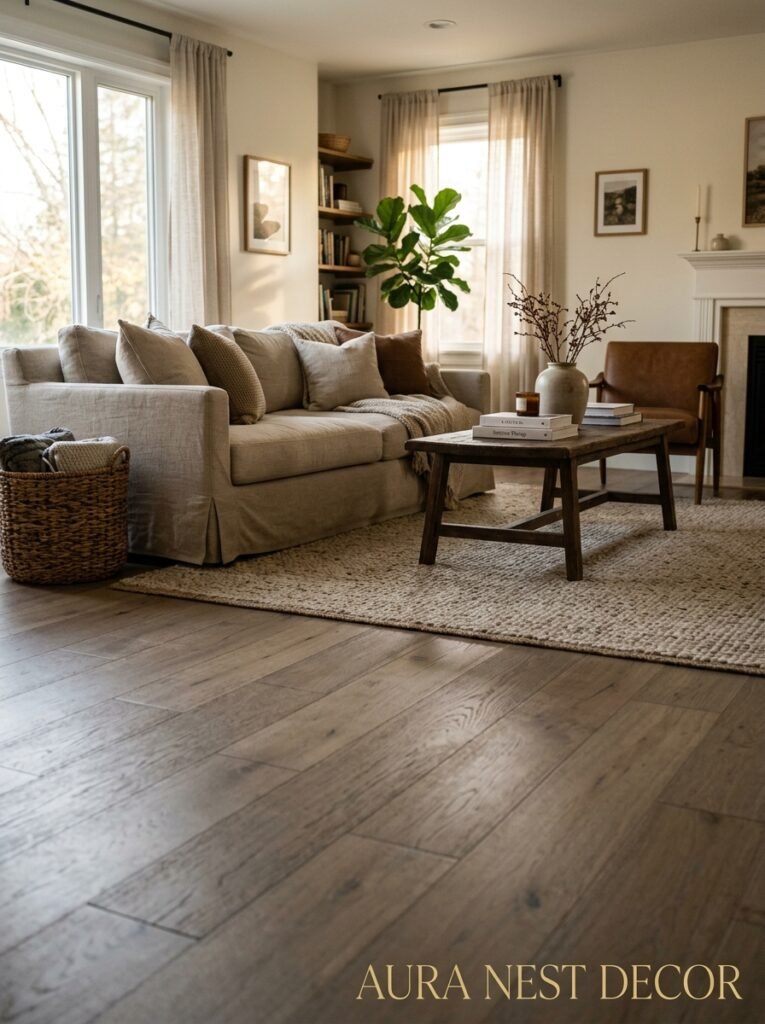
Mid-tone brown. Not golden oak from 2005. Not the grey-washed Scandi floors of 2015. Something in between — a warm, earthy, natural brown that reads almost like the color of good coffee with a dash of milk. It’s everywhere right now and for good reason: it works with nearly everything.
It doesn’t fight with dark walls (which are hugely popular and not going anywhere). It doesn’t disappear under neutral furniture. It adds warmth without going all the way into that honey-pine territory that can feel dated. And it photographs beautifully in natural light, which, if you’re on Pinterest, matters.
The grey floors — look, I had them. Lots of people had them. And they’re fine, they’re not hideous, but there’s something slightly cold about a grey floor that even the warmest room struggles to fully overcome. Grey floors tend to make spaces feel more clinical than cozy, and in a living room, cozy usually wins.
Side note — the grey floor trend was VERY driven by staged show homes and Rightmove listing photos. It photographs wide and bright. Living with it is a different thing.
“A floor that photographs well is one thing. A floor you want to come home to is another.”
5. The Honest Case for a Really Good Luxury Vinyl Tile (LVT)
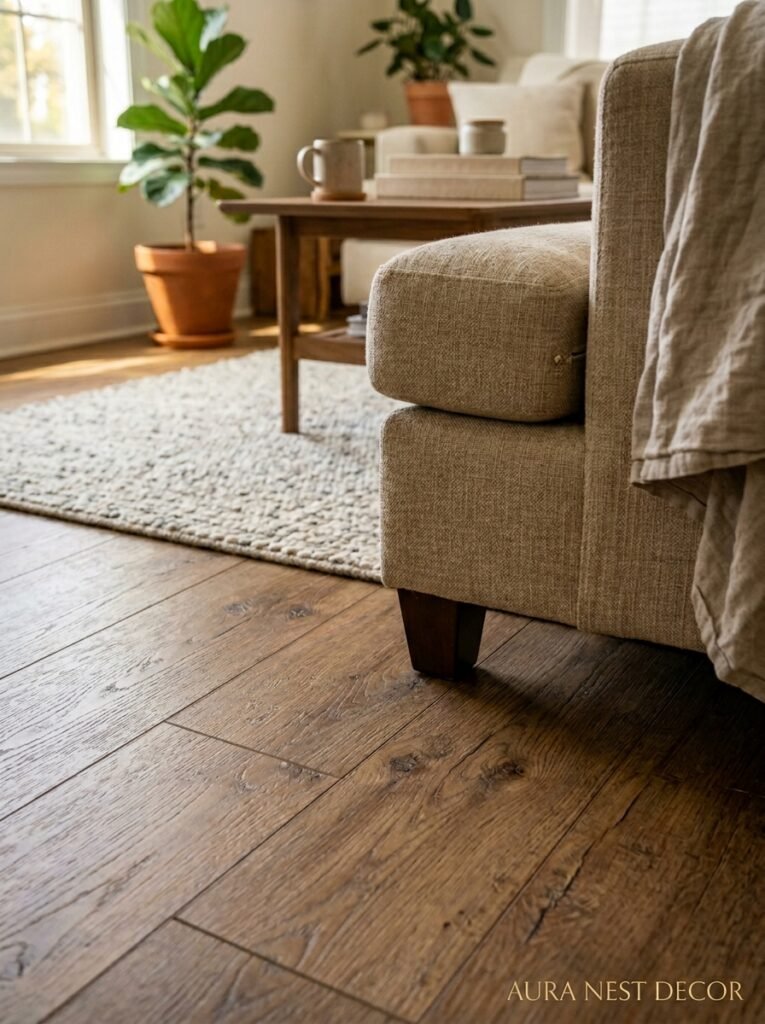
Before you roll your eyes — hear me out. Because LVT has gotten so good that I’ve genuinely been fooled in person, standing in someone’s living room, and I didn’t realize it wasn’t real wood until I knocked on it. That’s how far it’s come.
The practical advantages are real. It’s waterproof, or very close to it. It handles heavy furniture without denting. It’s warm underfoot in a way that laminate never quite is. And for families with dogs, kids, or just a genuinely busy life where a living room sees actual living — LVT is a completely honest choice that doesn’t require you to apologize for it.
The key is buying quality. There is a massive difference between cheap LVT and good LVT. Look for a wear layer of at least 0.55mm for a living room. Avoid the ones with extremely repetitive patterns — real wood and stone never repeat perfectly, and when vinyl does, your eye clocks it even if your brain doesn’t know why. The best LVT has variation built in across multiple plank designs that don’t tile in any obvious way.
Brands like Amtico, Karndean, and Luxury Vinyl Co. (popular in the UK) or Shaw and COREtec in the US are making stuff that’s genuinely impressive. It’s not a compromise. It’s a considered choice.
6. The One Rule That Makes Any Living Room Floor Feel Intentional
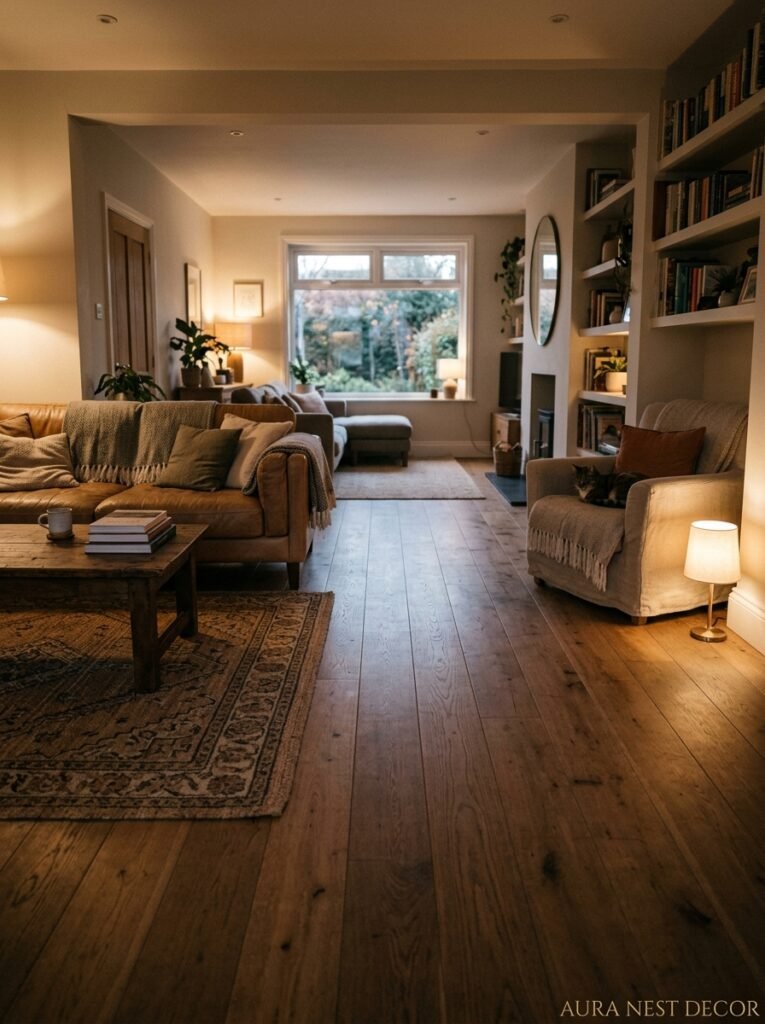
Whatever flooring you choose, the direction you run it MATTERS enormously and almost nobody talks about this enough.
Run planks lengthwise along your longest wall and the room stretches. Runs them widthwise and the room widens. This isn’t a subtle effect — it can literally change the perceived dimensions of a space by several feet. A narrow living room run the right way suddenly feels balanced. A squat, wide room suddenly has length.
Diagonal installation is having a bit of a moment and honestly, done right, it’s stunning. Particularly in older homes with interesting architectural features — bay windows, alcoves, period fireplaces. The diagonal creates energy and draws the eye in a way that straight planks don’t. It also makes smaller rooms feel significantly larger, because your eye follows the diagonal to the corners rather than stopping at the walls.
The other thing: where you start laying from. Most people start from the door or the most obvious wall. But starting from the fireplace wall or a focal window changes everything about how the room reads.
7. Stone and Tile in a Living Room — Brave, Beautiful, and Not for Everyone
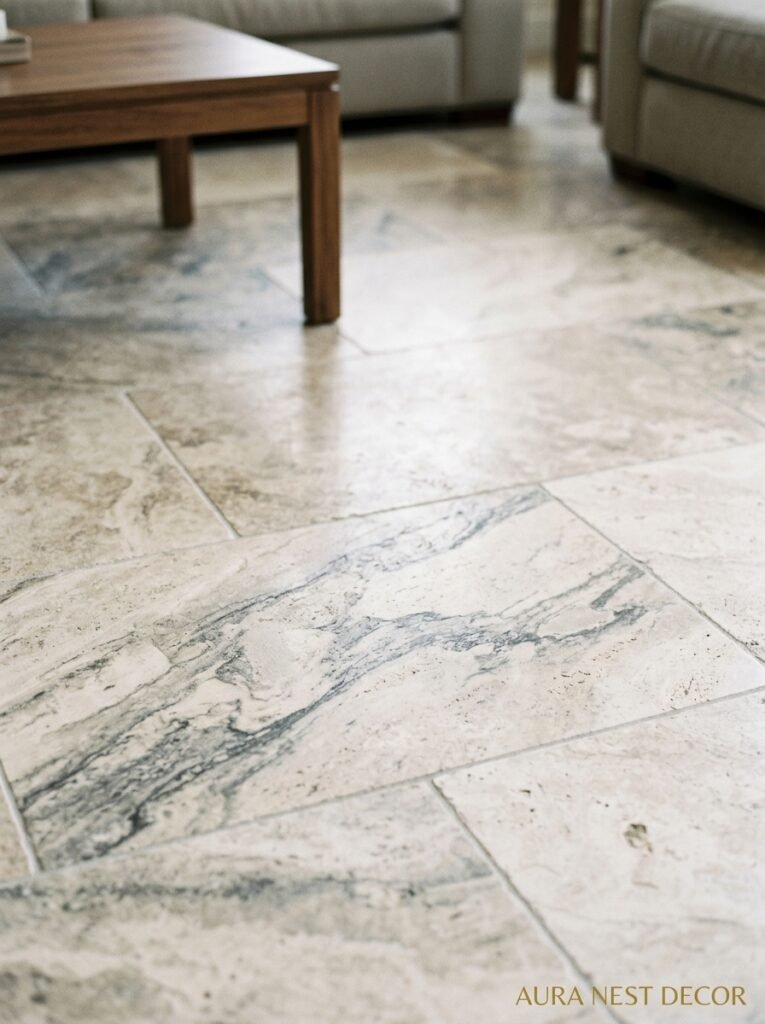
Stone floors in a living room feel very specific. Very European, very certain kind of house. Old farmhouse in the Cotswolds, or a 1920s Spanish Revival in Southern California — that kind of thing. And in those homes? Genuinely breathtaking. Limestone flags, tumbled slate, reclaimed terracotta tiles worn smooth — these floors carry history in a way nothing else does.
The catch is obvious: stone is COLD. Unless you’ve got underfloor heating running properly beneath it, a stone-floored living room in a British winter requires serious commitment. You’re not padding around in socks at 7am. You’re finding your slippers. Every single morning.
That said, the look is so specific and so impossible to fake convincingly that if you’ve got the heating situation sorted, it’s worth taking seriously. Reclaimed flagstones in particular have this patina that takes decades to develop naturally, and salvage yards in both the UK and US still have access to beautiful original material.
Large format porcelain tile that mimics stone is a genuinely good alternative — the manufacturing has gotten extremely good, and properly heated, it’s almost indistinguishable from the real thing in daily life.
“Stone floors don’t say ‘interior design.’ They say ‘this house has been here a while.'”
8. What a Rug Actually Does to Your Floor (and Why You Need to Think About Them Together)
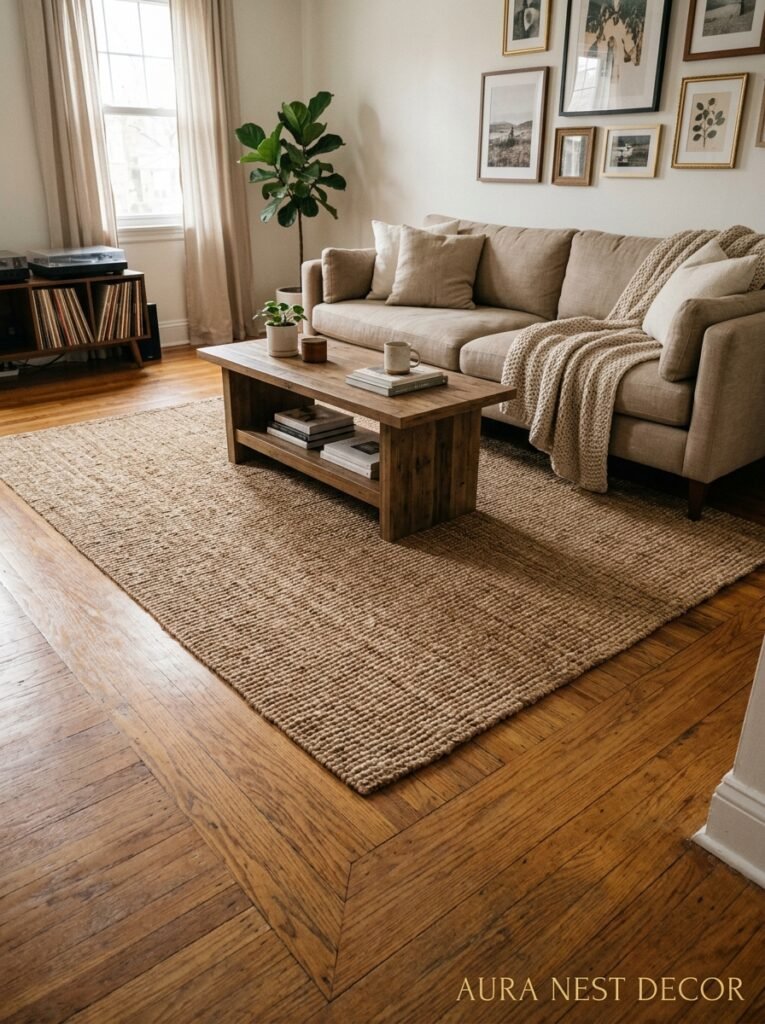
Here’s where people go wrong. They choose a floor, then choose a rug as a separate afterthought. But the rug and the floor are in a relationship — they need to work together from the start.
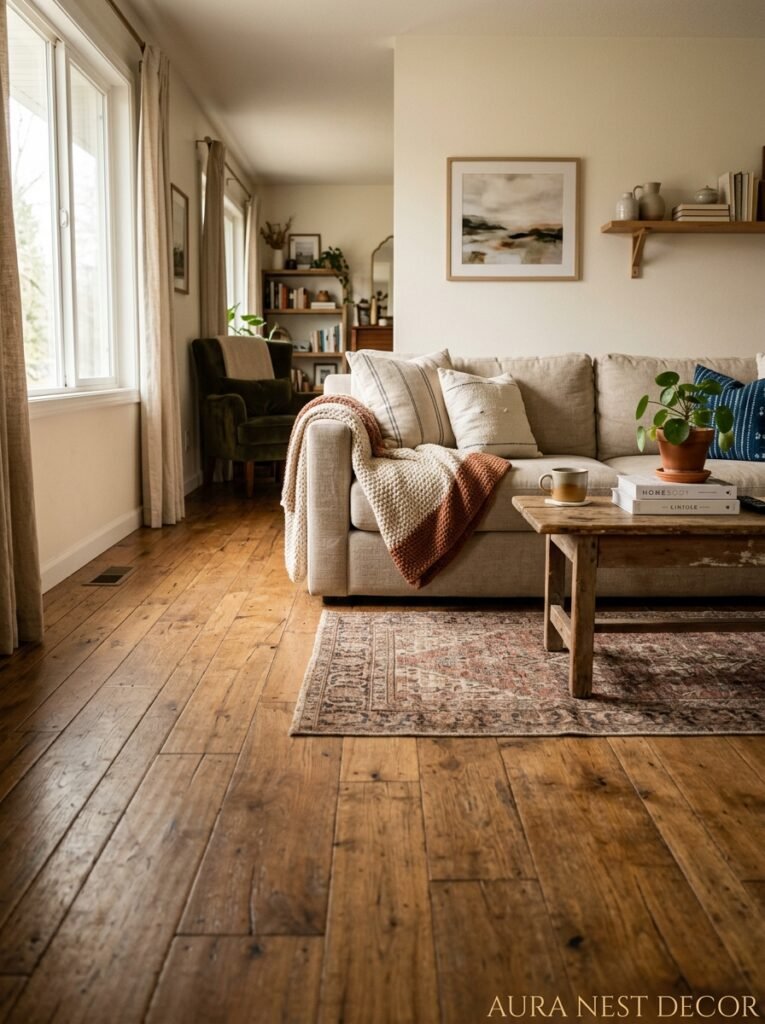
A very dark floor with a dark rug loses both of them. A pale floor with a pale natural jute rug is beautiful in summer and disappears in winter when you need warmth. A medium-tone wood floor with a richly patterned rug is almost always correct. There’s a reason that combination appears in approximately 80% of “perfect living room” photos on Pinterest. It works.
Rug size is where people consistently go wrong, and it makes me a little crazy. Too small. Almost always too small. In a living room, your rug should be large enough that at minimum the front legs of every piece of seating furniture are on it. Ideally all four legs. A rug that floats in the middle of the room surrounded by bare floor on all sides looks like it arrived by accident.
The texture of your rug matters against your floor, too. Very smooth floors — polished concrete, high-gloss tiles — benefit from a rug with real texture. Pile, boucle, something with physical depth. The contrast makes both surfaces more interesting.
9. The Concrete Floor Conversation (Because Someone’s Going to Bring It Up)
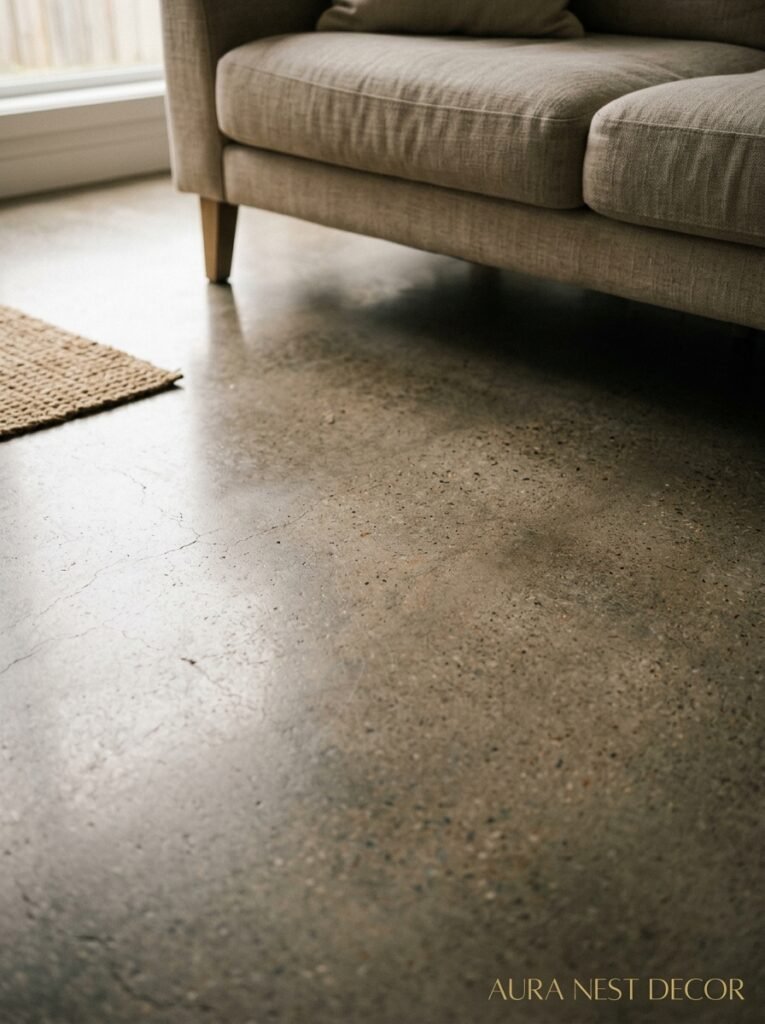
Polished concrete is divisive and I’m not going to pretend otherwise. People either love it fiercely or they look at it and feel faintly sad. I’m somewhere in the middle.
In the right living room — a modern converted warehouse space, a sleek new build with double height ceilings and enormous windows — polished concrete is extraordinary. It’s honest. It’s architectural. The way it reflects light is completely different from any other floor, almost liquid, and when it’s colored slightly or has aggregate visible in the finish, it’s genuinely beautiful.
But it’s cold. It’s hard. It transmits sound. It needs proper sealing and ongoing maintenance. And in a traditional or period home it looks genuinely out of place, like wearing a very avant-garde outfit to a village fete.
Microcement — a thin overlay applied to existing floors — has made concrete-look finishes more accessible and more flexible, and some of the finishes being achieved now are quite warm and matte, less that cold industrial aesthetic. Worth knowing about if you love the look but live in a more conventional house.
10. The Skirting Board Problem Nobody Warns You About
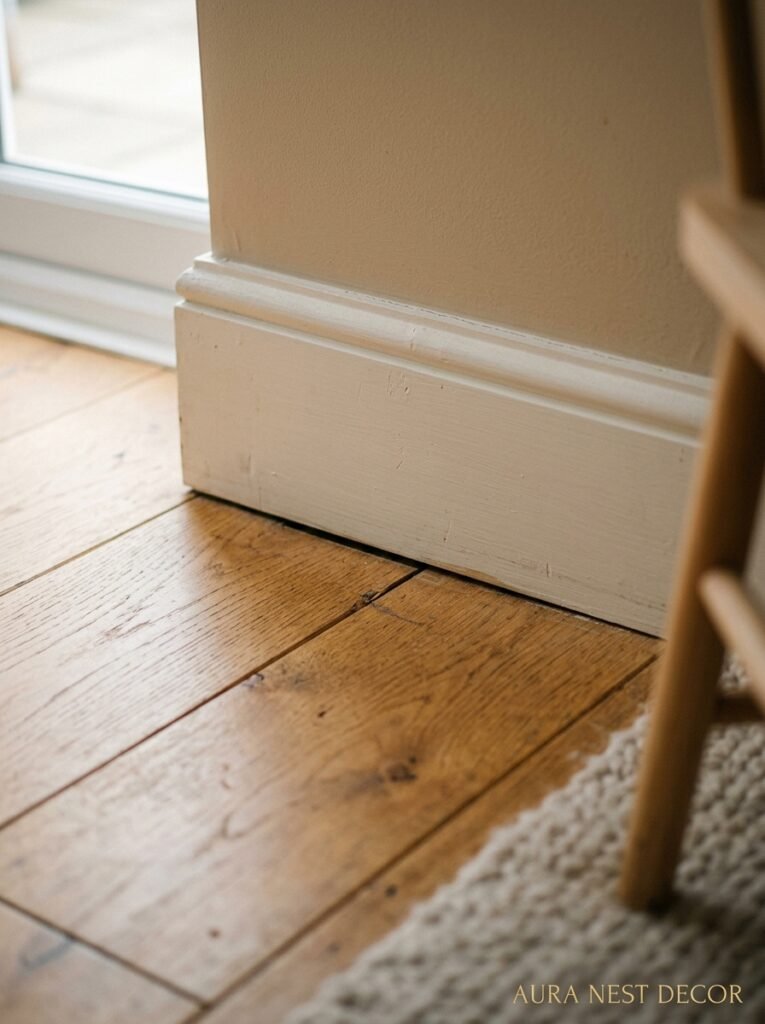
You’ve chosen your perfect floor. You’ve ordered the samples, made the decision, the installer is booked. And then you look at your skirting boards and your heart sinks.
Skirting boards and floors talk to each other constantly. Old dark stained skirting boards with a pale modern floor looks fractured and unresolved. Bright white gloss skirting with a rich dark wood floor can be very sharp and clean, or it can feel like the room has a border around it. Matching your skirting tone to your floor isn’t always right, but thinking about the relationship is always right.
In the UK particularly, houses often have original Victorian or Edwardian skirting boards that are beautiful and worth preserving. A painted floor — not as wild as it sounds, painted floorboards are a real and genuinely gorgeous option — can actually bring those original boards into the scheme rather than fighting them.
In American homes with wall-to-wall carpet being pulled up, the skirting situation can be brutal. Often there’s a tack strip edge that needs addressing before any new floor goes down. Factor that into your budget and your planning.
11. The Mistake That’s Very Easy to Make and Very Expensive to Fix
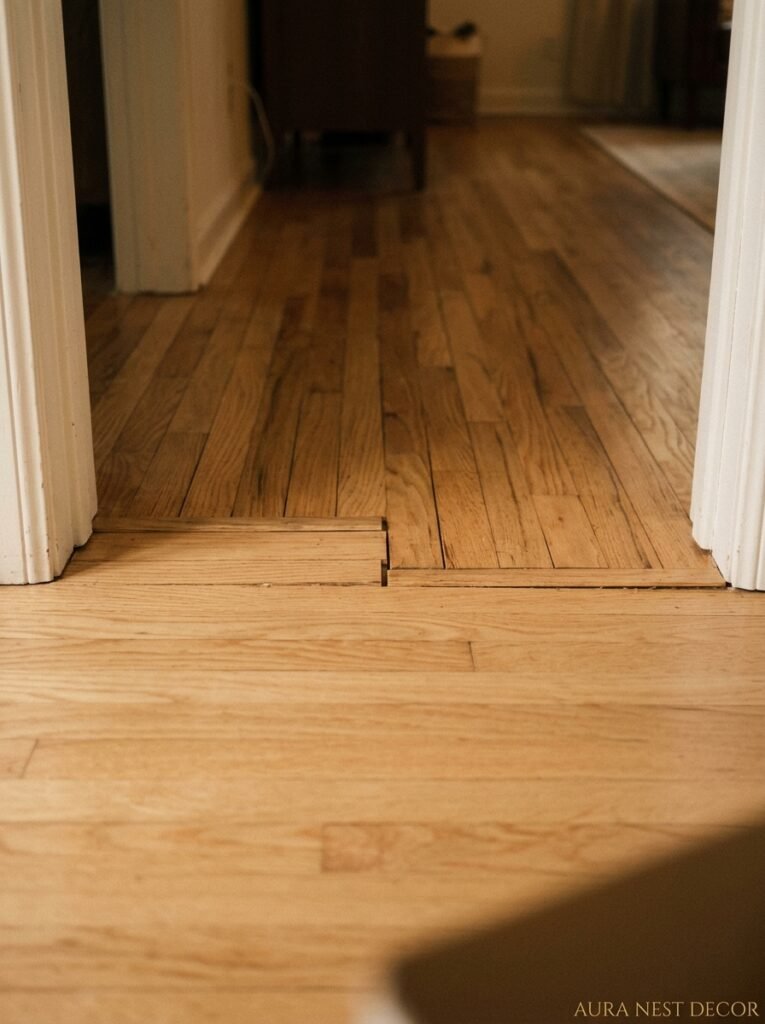
Buying on looks alone without testing samples in YOUR light. This is the mistake. THE one.
Flooring looks completely different depending on the direction your windows face, the paint colors you have, the kind of light fittings you use, and honestly even the time of year you’re viewing it. A floor sample that looks perfect in a showroom under halogen lighting and then comes home and looks green or orange or strangely grey in your north-facing living room — that’s real. That happens constantly.
Order samples. Large ones, not the tiny two-inch square things that tell you nothing. Put them on the floor in the actual room. Look at them at 8am. Look at them at 1pm. Look at them at 9pm with your lamps on. Live with them for a week. Because once that floor is down, it’s down. Correcting a flooring mistake costs a lot of money and requires a complete room teardown.
Also: order more than you think you need. Ten percent extra minimum. Twenty if you’re doing a herringbone or diagonal pattern because the cutting waste is significant. Having extra material means you can replace damaged boards years later from the same batch without any color mismatch.
12. The Floor That Stays Beautiful for Twenty Years vs. the One That Looks Tired in Five
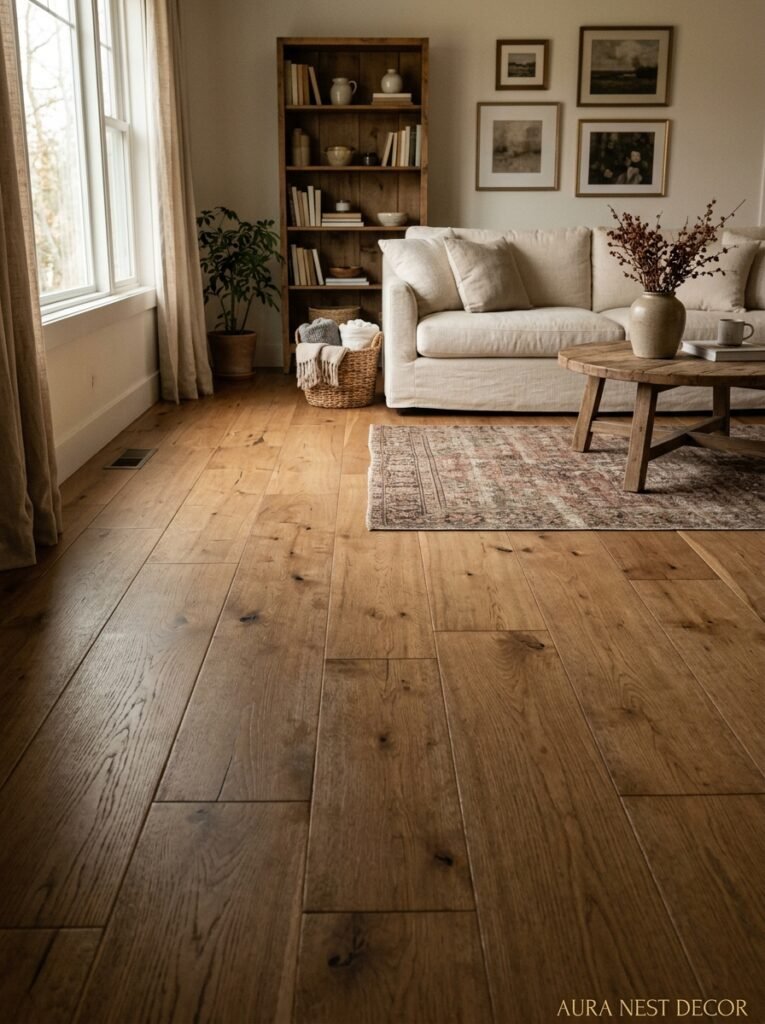
It comes down to finish, maintenance, and honesty about your life.
High-gloss anything shows scratches, shows footprints, shows everything. It looks incredible in a staged photo and it looks a bit worn and sad eighteen months into real family life. Matt and satin finishes are more forgiving, age more gracefully, and tend to look better over time as a floor develops a natural patina.
Oiled hardwood floors are maintenance-heavy — they need re-oiling periodically — but they repair beautifully. Scratches and scuffs can be sanded locally and re-oiled without refinishing the whole floor. Lacquered floors look pristine longer but when they go, they go, and you’re refinishing the whole thing.
If you have dogs, go for wire-brushed or hand-scraped textures. The surface texture disguises scratches naturally. Smooth, machine-finished floors show every claw mark. Not gonna lie, my current floor has visible evidence of a Labrador living her best life, and I’ve made peace with it because the texture of the wood hides more than I expected.
Floors that last beautifully are floors chosen for real life, not for the Instagram of it.
—
❓ FAQ
Q: What’s the best living room flooring for a home with dogs and kids? A: Engineered hardwood with a brushed finish, or quality LVT with a wear layer of at least 0.55mm. Both handle heavy traffic well — the brushed wood texture disguises scratches and the LVT is genuinely waterproof. Either is a far better choice than solid hardwood with a smooth lacquered finish in a genuinely busy home.
Q: Can you mix flooring types between the living room and hallway? A: You can, but transitions need to be handled carefully or they look choppy. The cleanest approach is to use the same flooring throughout open-plan spaces, or to use a threshold strip that creates a deliberate, neat break. If the rooms are visible from each other, matching tones (even if not identical materials) keeps the whole thing feeling cohesive.
Q: How much should I budget for living room flooring including fitting? A: In the UK, budget roughly £40–£80 per square meter for good engineered hardwood or LVT including fitting. In the US, $6–$15 per square foot installed is a reasonable range for quality materials. Stone and solid hardwood go higher. Always get at least three quotes and ask what’s included — subfloor prep, removal of existing flooring, and underlayment can add significantly to the total.
—
💭 Final Thoughts

The living room floor is one of those decisions that sounds practical and turns out to be deeply personal. It affects how the room feels to wake up to, how it looks in firelight in December, whether it’s a room you rush through or one you actually want to stay in. Take your time with it. Get the big samples. Live with them.
What does your living room floor feel like to walk into right now — and is it the feeling you actually wanted?