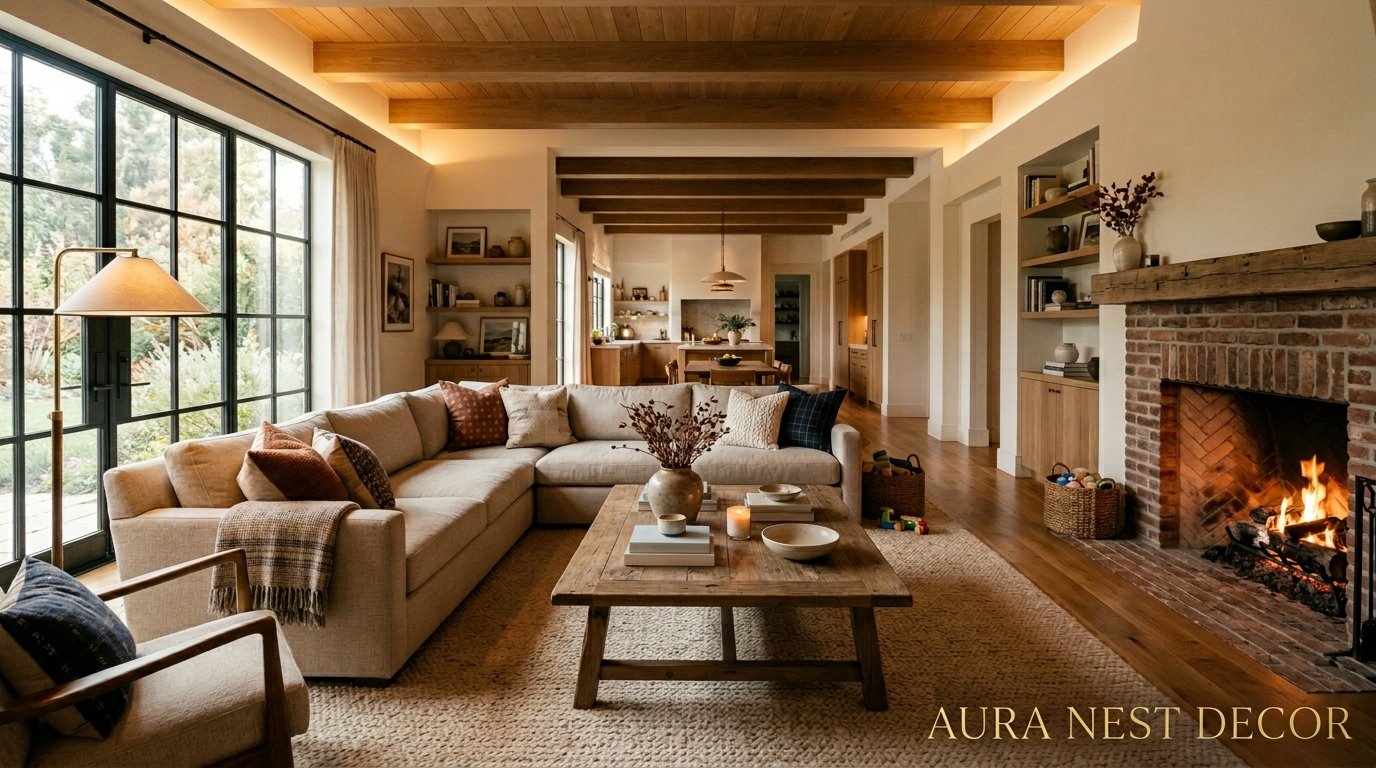
Your Big Living Room Is a Gift — Stop Wasting It on Furniture That Doesn’t Know What It’s Doing
You have more square footage than most people dream about. So why does it still feel kind of… off? Like the furniture is just floating there, uncertain of itself, and the whole room has this weird empty energy even when it’s full of stuff.
That’s not a size problem. That’s a design problem. And it’s fixable.
—
1. The Furniture-Against-the-Walls Trap That’s Making Your Room Feel Like a Waiting Room
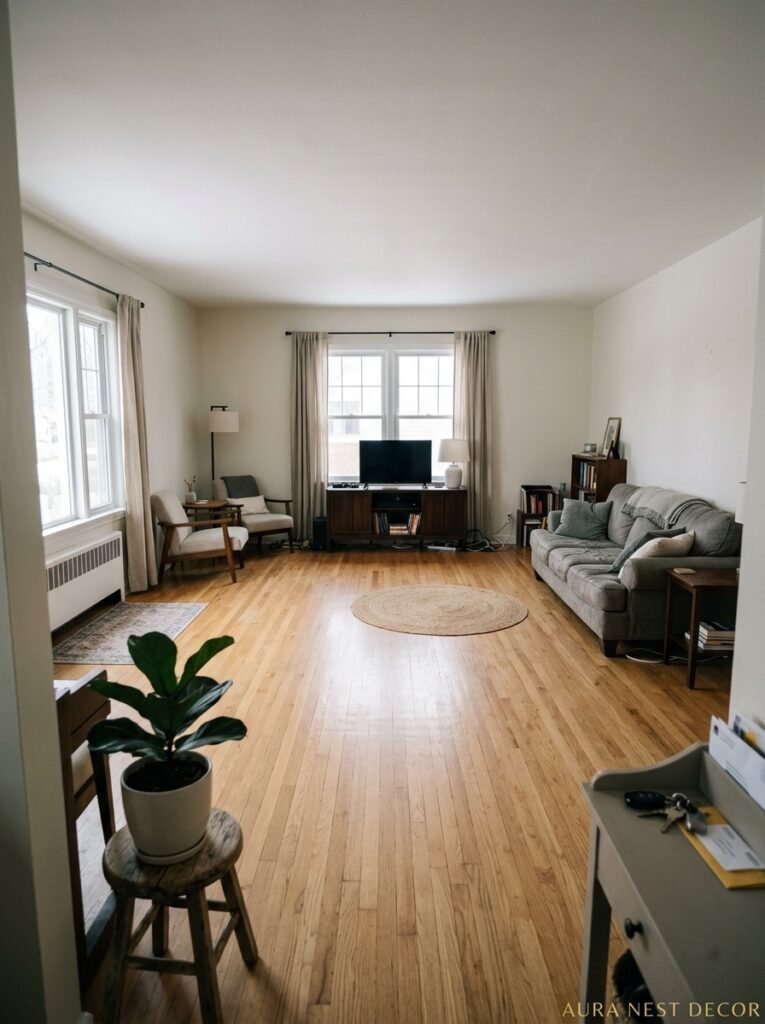
Every single time. Someone moves into a big living room, pushes all the furniture against the walls, and stands back expecting it to look spacious. But what actually happens? The center of the room becomes a dead zone. A void. And the whole space ends up feeling more like an airport gate lounge than someone’s home.
Pull your sofa away from the wall. I know it feels wrong, especially the first time you do it. But floating furniture — when done with intention — is what actually makes a large room feel ALIVE. It creates zones. It gives the space purpose. The room stops being “a big empty rectangle” and starts being a place where things happen.
In practice, this means your sofa might sit three or four feet off the wall, anchored by a large area rug underneath. That rug is doing serious heavy lifting here, don’t underestimate it. It’s not decorative — it’s structural. It tells the room where the conversation is happening. Everything else organizes around it.
British design has been doing this for centuries, actually. Think of a proper Georgian drawing room — the furniture was always arranged for people, grouped in the center, pulled toward the fire. The walls were for portraits and plasterwork, not sofas.
Don’t let your beautiful room look like it’s waiting for a flight.
“The center of a big room isn’t empty space — it’s the whole point of the room.”
2. The One Rug Mistake Designers Spot Immediately (And It’s Not the Pattern)
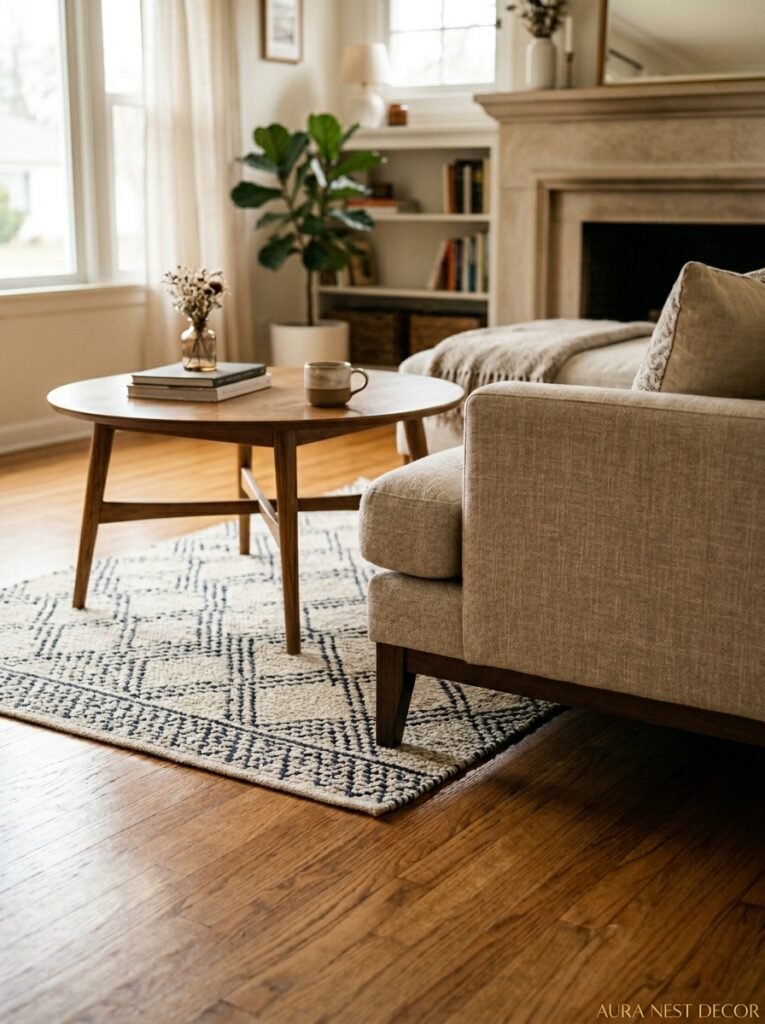
Size. Always size. People consistently buy rugs that are too small and then can’t figure out why the room still doesn’t feel right, even after they’ve spent real money on furniture, curtains, the whole lot.
A rug in a large living room should be big enough that at least the front legs of every sofa and chair sit ON it. Ideally all four legs. If your rug is floating in the middle of the seating area like a little island with furniture orbiting around it from a distance, it’s too small and the room knows it.
What size are we actually talking? In a generous living room, don’t go below 9×12 feet. Honestly, 10×14 or even larger isn’t excessive — it’s appropriate. I’ve seen people drop a 6×9 rug in a room that needed a 10×14 and wonder why everything looks wrong. The math just doesn’t work.
Pattern is a whole other conversation. But the non-negotiable is: get the right size first, then worry about whether it’s geometric or floral or that gorgeous faded Persian look that’s everywhere right now.
And one more thing — layer rugs if you want texture without commitment. A natural jute underneath, something softer and more interesting on top. It works, it’s comfortable, and it adds that editorial quality you see in the rooms that make you stop scrolling.
3. Why Two Seating Areas Are Better Than One Enormous Sofa You Can’t Actually Use
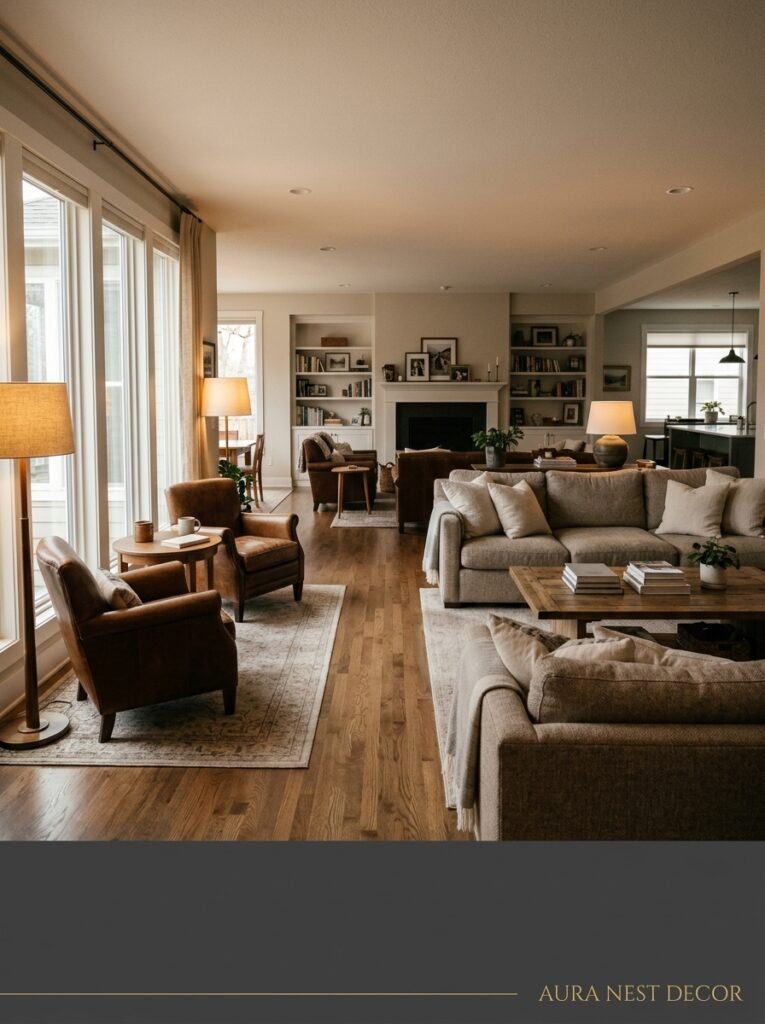
Big rooms can handle — and honestly, they kind of need — more than one seating moment. Not two living rooms sitting awkwardly side by side. But two defined areas with a relationship to each other.
The main seating zone is obvious: big sofa, maybe a sectional, a couple of chairs, the central rug, coffee table. Done. But over by the window, or tucked beside the fireplace if you’ve got one? That’s where you put a small armchair and a side table. Maybe two chairs and a little bistro-style table between them. A reading lamp overhead.
That secondary spot is where the REAL life happens. Morning coffee. A quiet book. The place someone perches during a dinner party when they want a slightly separate conversation. It gives the room personality. It says someone actually thought about how people use this space, not just how it photographs.
In the UK, this is sometimes called a “snug corner” even when it’s technically in a bigger room. I love that. It’s the idea that coziness can exist inside grandeur. The room doesn’t have to choose between being impressive and being comfortable — it can be both.
Don’t buy a sofa so enormous it eats the whole room. Buy furniture that invites multiple ways of being in the room.
4. The Color Decision That’s Either Going to Save Your Big Room or Swallow It
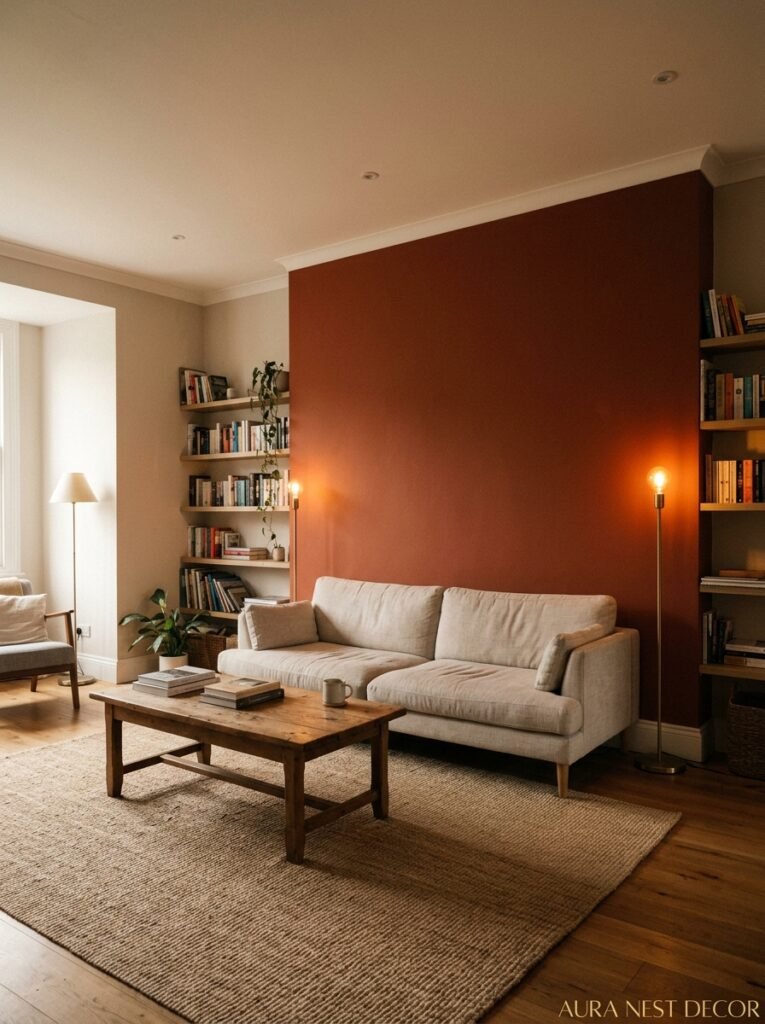
Here’s where people get scared. A big room feels risky to paint. What if it’s too dark? What if it feels cave-like? So they default to white or greige and then spend three years feeling vaguely uninspired.
Dark walls in a big room are not just fine — they’re often BETTER. A deep forest green, an inky navy, a warm charcoal with a hint of brown in it. These colors do something white can’t: they make the room feel contained. Intentional. They draw the walls in just enough that the space stops feeling untethered.
Think about it this way. Benjamin Moore’s Black Forest Green, Farrow & Ball’s Hague Blue, Sherwin-Williams’ Urbane Bronze. These are not scary colors. They’re anchoring colors. They make furniture look more expensive, they make art pop, and they absolutely transform the room from “big neutral box” to “somewhere I actually want to be.”
The rule isn’t about room size. It’s about ceiling height. If you’ve got high ceilings — which a lot of big living rooms do — go as dark as you want. The height keeps it from feeling oppressive. Low ceilings with dark walls, that’s where you need to be more careful.
“A dark room isn’t a small room. It’s just a room with a point of view.”
5. What No One Tells You About Lighting in a Large Living Room (Until You’ve Already Got It Wrong)
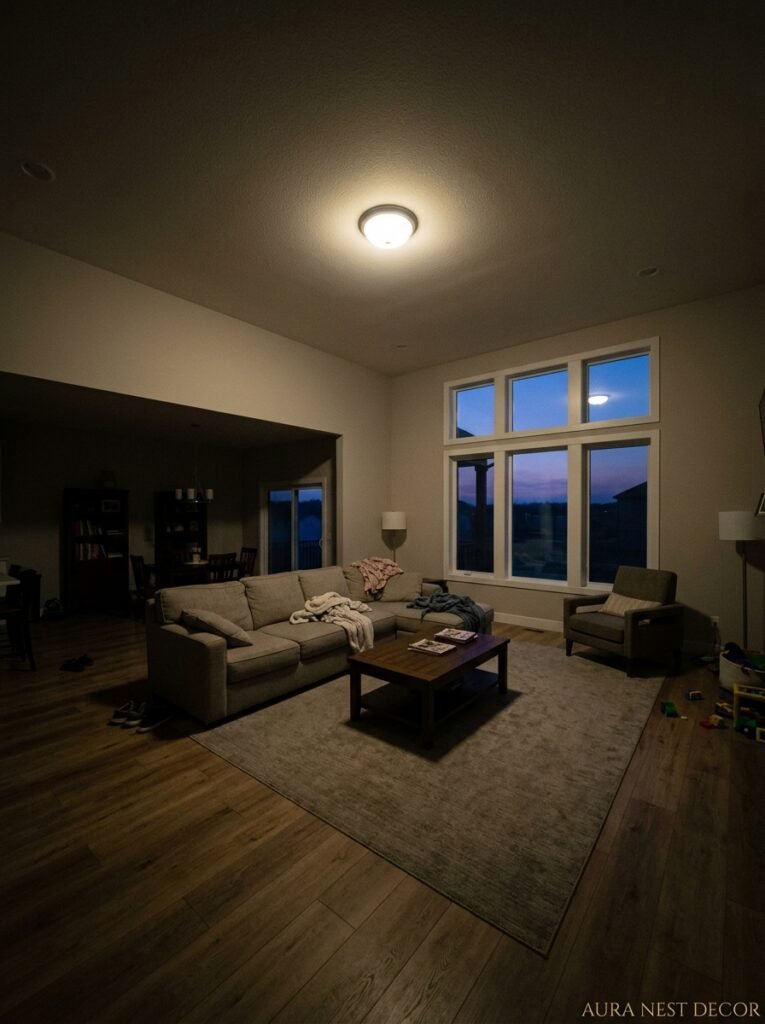
One overhead light in a big room is a disaster. Not an inconvenience — a DISASTER. You get one flat circle of harsh light in the middle of the room and then everything else falls into shadow, and it looks like a room that someone forgot to finish.
You want multiple light sources at different heights. Always. A floor lamp beside the sofa. Table lamps on the side tables. Maybe a couple of wall sconces if you can manage it. And yes, a central fixture, but one that adds warmth rather than fluorescent bleakness — a statement chandelier, a cluster of pendants, something with presence.
The rule of thumb designers use: every seating area should have its own light source within arm’s reach. That secondary reading chair? It needs a lamp. The console table by the wall? A table lamp or a couple of candles, something warm.
In the evening especially, overhead lights should be dimmed way down or off entirely. The floor lamps and table lamps take over and suddenly the room feels completely different — intimate, warm, like the amber glow of an Edison bulb at 7pm in a room that’s figured itself out. That’s the goal.
Smart bulbs help enormously here, by the way. Being able to adjust warmth and brightness without replacing fixtures changed things for a lot of people.
6. The Reason Your Big Living Room Feels Cold (And It Has Nothing to Do With the Heating)
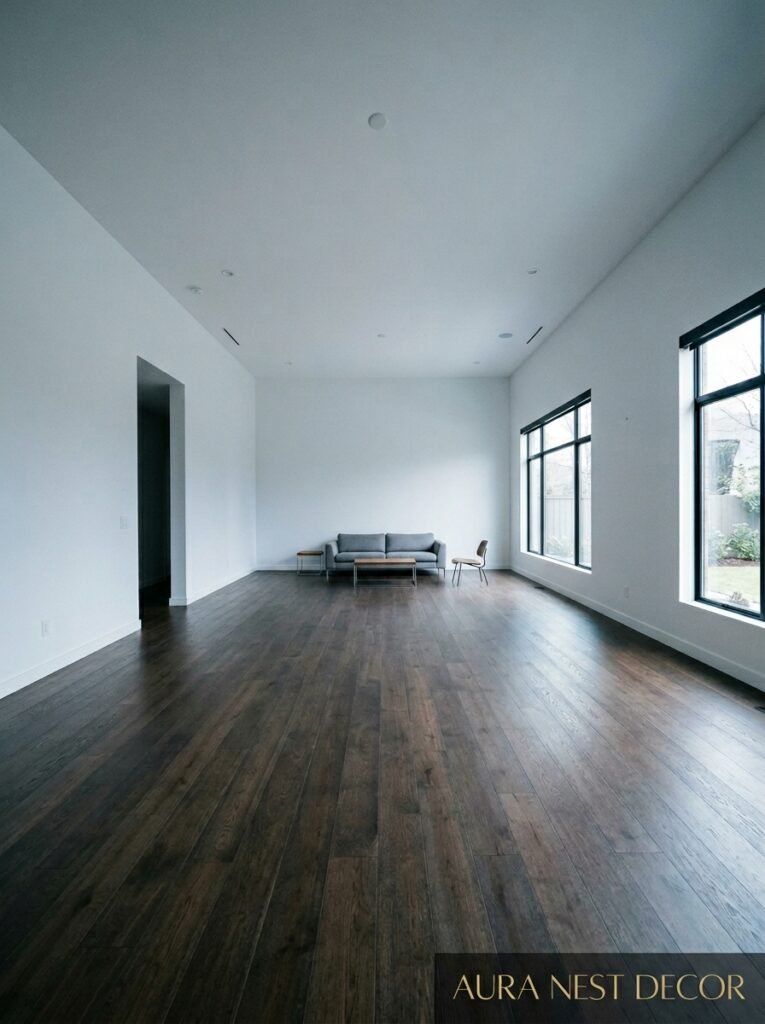
Hard floors. Minimal textiles. Too much furniture with legs. Sometimes it’s all three at once.
Large rooms lose warmth faster than small ones, and not just temperature — visual warmth. The feeling of coziness. So you have to actively add it back in. This means textiles, and a lot more of them than you’d think you need.
Throw blankets draped over the arm of the sofa. Cushions in different textures — linen, velvet, something with a bit of knit or boucle. Curtains that go floor to ceiling even if the windows don’t quite reach the ceiling, because extending them upward makes the room feel taller AND warmer somehow. Heavy drapes in a warm color will change how the whole room reads, I’m not exaggerating.
Wood helps too. A chunky coffee table in oak or walnut, open wooden shelving, anything that brings a natural material into a room that might otherwise feel a bit modern and cold. Even a large wooden bowl on the coffee table. Small detail, real impact.
British homes often get this instinctively — layers of textiles, books everywhere, a sense of lived-in warmth that American interiors sometimes trade away for cleanliness and minimalism. There’s a middle ground. Find it.
7. The Gallery Wall Approach That Actually Works in a Space This Big
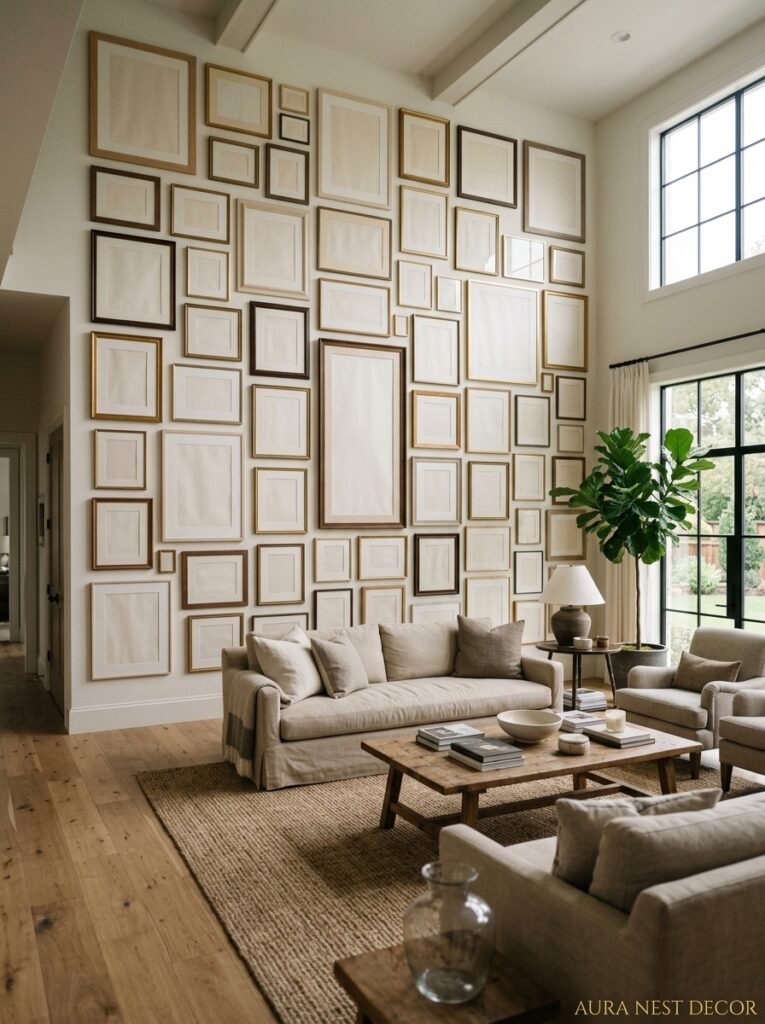
Small gallery walls look lost in large rooms. A cluster of tiny frames arranged carefully in the center of a huge wall is not the move. It looks like a postage stamp on a billboard.
Go big or go home is a cliché but it’s genuinely true here. One oversized piece of art on a big wall — really oversized, we’re talking 48 inches wide at minimum, often more — makes more impact than twenty small pieces carefully arranged. Big art reads as confident. It owns the wall rather than apologizing for taking up space.
If you love a gallery arrangement (and I do, genuinely), scale it to the wall. Not six frames. Fourteen frames. Mix sizes dramatically, go from floor level up to nearly ceiling height, include a mirror or two in the mix. Make it feel like it grew there over time rather than being installed on a Sunday afternoon.
“Art in a big room should make you stop walking, not squint from across the room.”
And for the love of everything, hang it at the right height. Eye level means the CENTER of the piece at roughly 57-60 inches from the floor. Not the top of the frame at eye level, not just wherever it happened to land when you held it up. This one thing, done right, makes everything look more professional.
8. Why Bookshelves Are the Secret Weapon of Every Large Living Room That Photographs Well
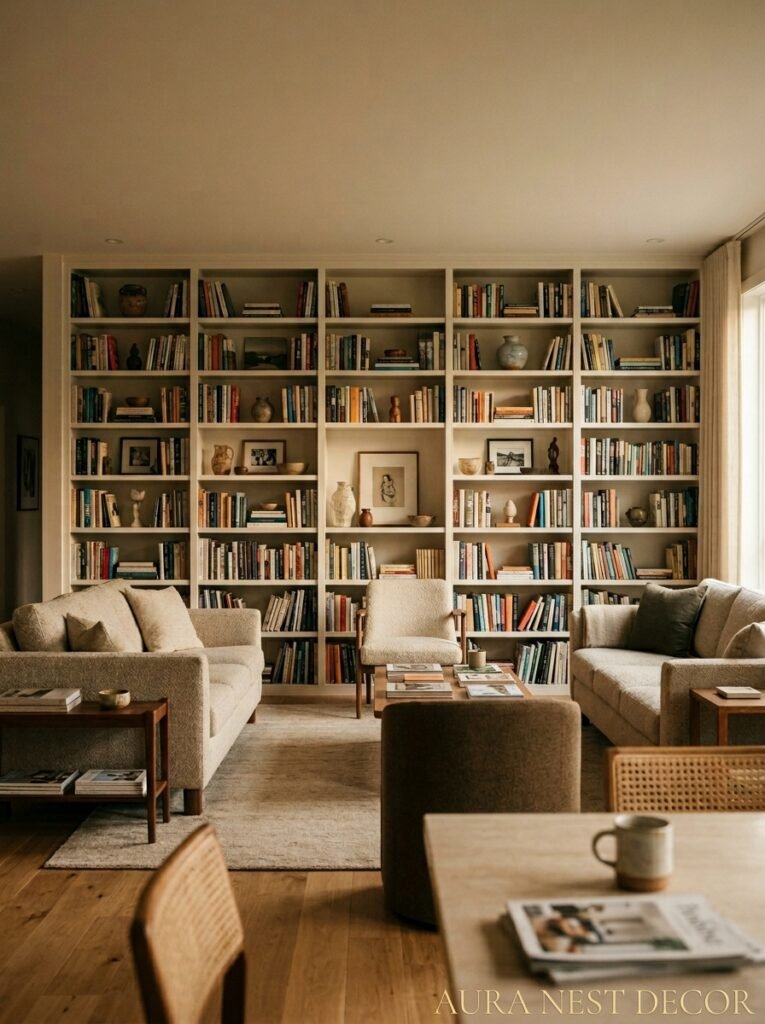
A big room with no storage looks like a showroom. Beautiful maybe, but impersonal. Bookshelves fix this — and not just practically. Styled shelves add depth, color, personality, and that crucial sense that someone LIVES here.
Built-ins are the dream. If you can do it, floor-to-ceiling built-in bookshelves flanking a fireplace or window are one of the most impactful things you can do to a large living room. They add architectural interest where there might have been none, they make the room feel more substantial, and they create display space that organizes the room rather than cluttering it.
Can’t do built-ins? Large freestanding bookcases work. Two tall Billy bookcases from IKEA, styled well, with some trim added to look built-in — this is a real hack and it works. Don’t sniff at it. Half the beautiful “built-in” shelving you see on Pinterest started as flatpack with a coat of paint and some molding around the edges.
Style them with books AND objects. A plant. A lamp on a lower shelf. Something sculptural. Books spine-in occasionally for texture if you don’t love the look of mixed covers. The point is that the shelf itself becomes a design element, not just storage.
9. The Floor Plan Problem That Even Beautiful Furniture Can’t Fix
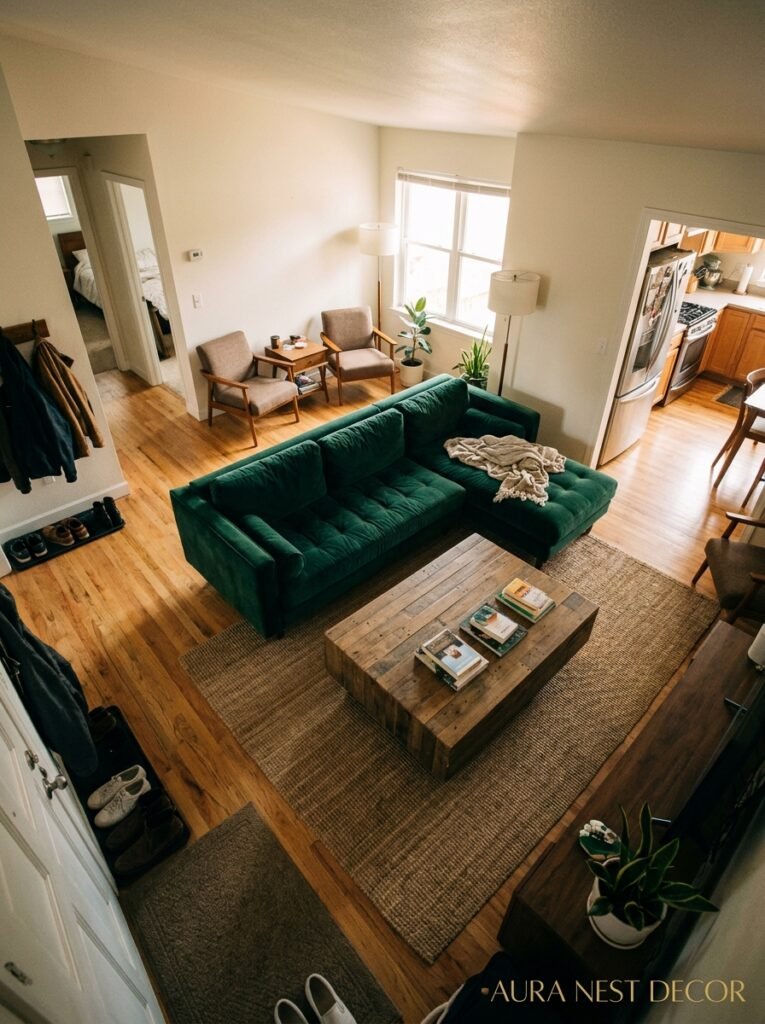
Traffic flow. So boring. So completely critical.
In a big room, it’s tempting to fill all the space because the emptiness feels wasteful. But if you’ve blocked the natural path through the room — or worse, created multiple confusing paths that go around and through the furniture — the room will always feel awkward and slightly hostile without anyone knowing why.
There should be at least 18 inches between furniture pieces for comfortable movement. 24-30 inches feels generous and right. A main clear walkway through the room of at least three feet, ideally more. If someone has to turn sideways to get past the coffee table, the coffee table is in the wrong place.
This is one of those design rules where getting it wrong is invisible but felt. The room feels off, people unconsciously avoid sitting in certain spots, the space never quite settles. Get it right and nobody notices — but the room just WORKS. People move through it easily, it feels welcoming, conversations naturally happen in the seating area because it’s comfortable to get there.
Draw it on paper if you need to. I know that sounds old fashioned, but sketching out the furniture arrangement before moving anything heavy is never a bad idea.
10. The Fireplace Styling Mistake That’s Breaking the Whole Room’s Composition
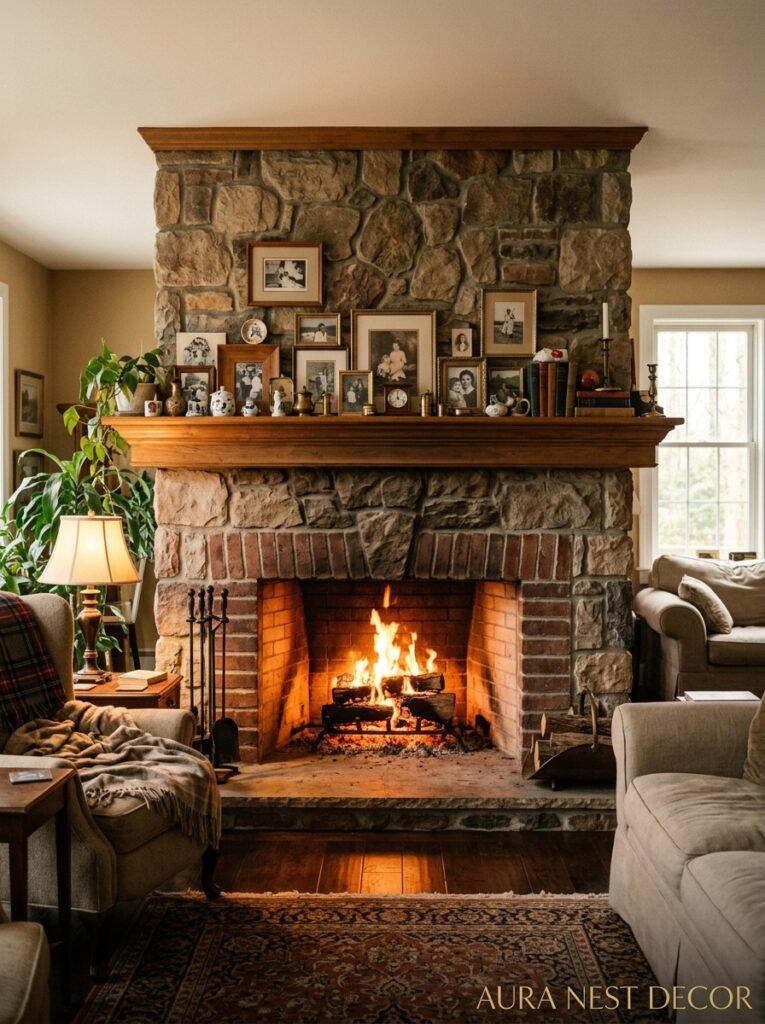
If you’ve got a fireplace in a large living room, it’s the natural focal point. Congratulations — you’ve got a center of gravity that a lot of rooms would kill for. But leaving the mantel bare or filling it with random objects you haven’t thought about? That’s a wasted opportunity.
A fireplace mantel should be styled like a shelf in a museum. Considered. A few objects that mean something, arranged with intention. A large mirror above — ideally as wide as the mantel — makes the room feel bigger and reflects light back into the space. A couple of candles. Maybe a single piece of art leaned against the mirror rather than hung. Something living, a plant or some stems.
The fireplace surround matters too. Original Victorian or Georgian tiles in a British home? Don’t paint them, please. They’re perfect. A dated 1980s brick surround in an American home? Paint it white, add a new mantel shelf if you can, transform the whole focal point for a few hundred dollars.
And make sure the furniture faces the fireplace. I know that sounds obvious, but I’ve seen beautifully styled rooms where the main sofa faces AWAY from the fireplace and toward the TV instead. The TV won. The fireplace lost. And somehow the room never felt quite right as a result.
11. The Plant Situation: Why One Little Succulent on the Coffee Table Isn’t Doing Enough Work
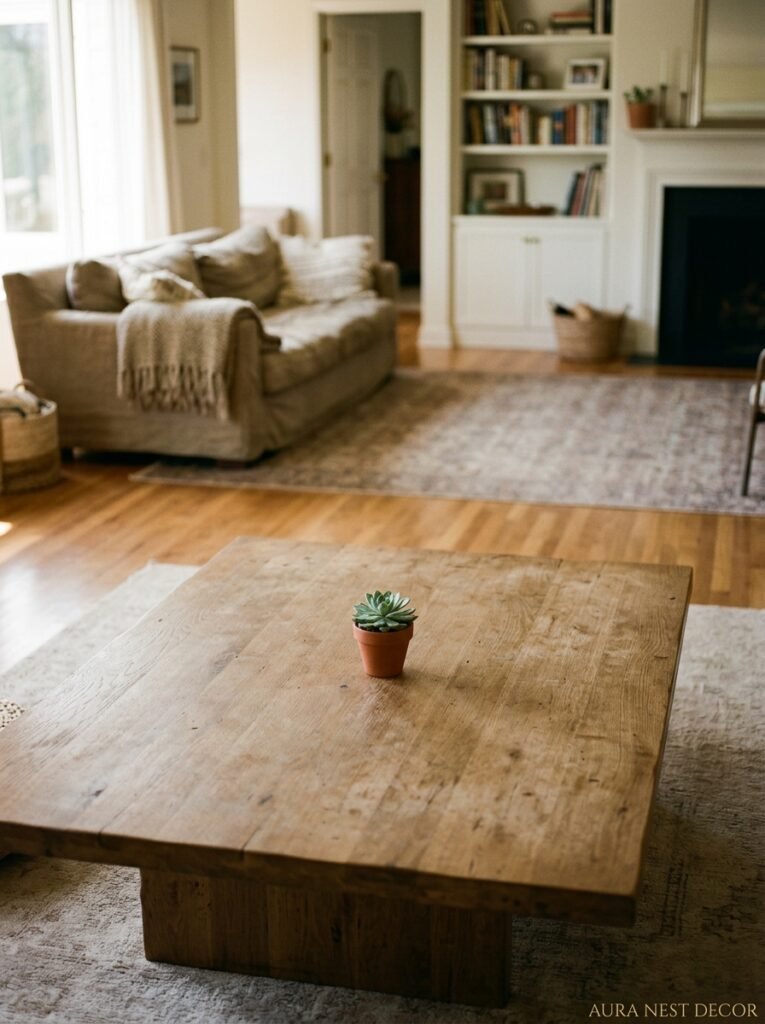
Scale, again. Always scale in a large room.
A small plant in a large room looks like a houseplant trying its best and failing. You need something that commands space. A fiddle leaf fig that actually reaches the ceiling. A large olive tree in a terracotta pot. A monstera that’s been growing for three years and has leaves the size of dinner plates. Something that fills vertical space and brings genuine life into the room.
Put it in a corner. Put it beside the fireplace. Flank the window with two matching large plants. The point is that it reads from across the room rather than disappearing into the furniture.
Dried botanicals work too, especially for rooms that don’t get much natural light. Pampas grass in a large floor vase, dried eucalyptus, bleached palm leaves. They look incredible, they last ages, and they add that organic sculptural quality that makes a room feel styled rather than just decorated.
Side note — a large woven basket as a planter rather than a plastic nursery pot changes everything. The texture, the warmth of it. Don’t skip that detail.
12. The One Thing That Ties Every Corner of a Big Room Together Without You Having to Think Too Hard
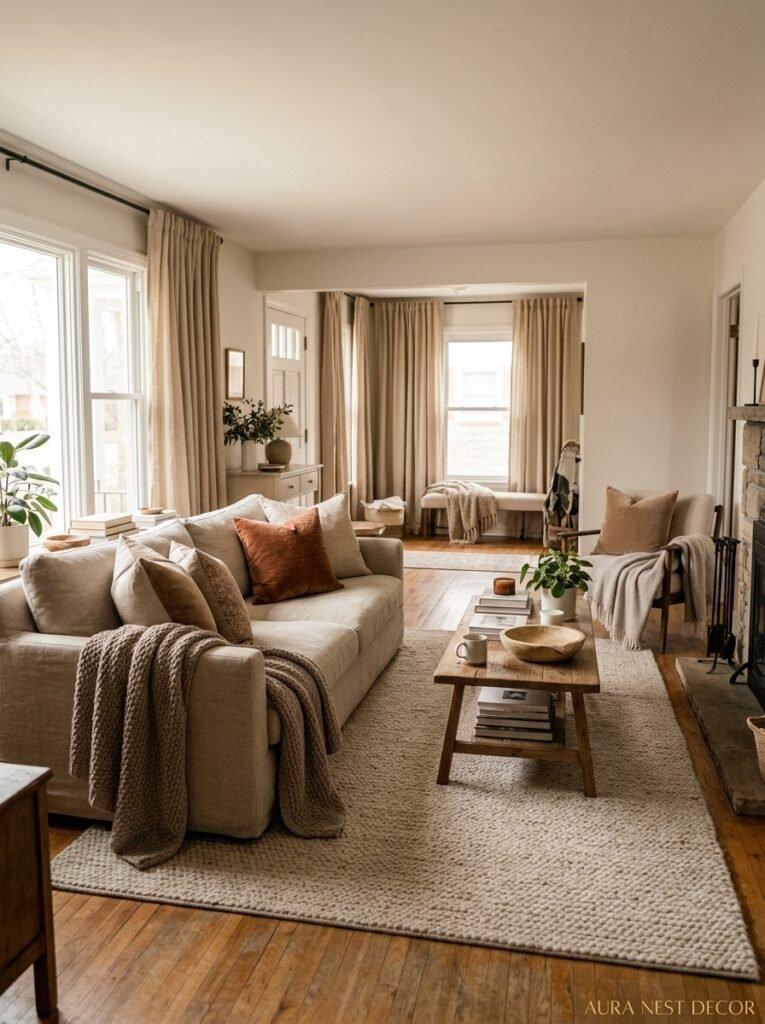
Repetition. Specifically, repeating one color or material throughout the room so that the eye travels around the space and everything feels connected.
This doesn’t mean everything matches. That’s the opposite of what I mean. It means picking one element — say, a warm brass — and using it consistently. The lamp base. The picture frame. The curtain rod. The small tray on the coffee table. None of these things are the same, but they speak the same language and so the room holds together even if it has ten different styles of furniture in it.
Same trick with a color. If you’ve got a deep terracotta throw on the sofa, a terracotta pot for the plant, and a small piece of art with that tone in it, your eye connects those three points around the room and the whole space feels intentional. Like someone thought about it. Because you did.
British interior designers call this “threading” — pulling one element through the room like a thread. It’s one of those techniques that sounds simple and IS simple, but it’s also what separates a room that looks curated from a room that looks collected.
—
❓ FAQ
Q: How do I make a big open-plan living room feel cozier without splitting it up with walls? A: Rugs are your best tool — use them to define separate zones (living area, reading nook, dining space) so each area feels contained and intentional. Layer in warmer lighting and heavier textiles to bring the scale down. The trick is making each zone feel complete on its own, so the open plan reads as several cozy spaces rather than one overwhelming room.
Q: What’s the best sofa size for a large living room? A: Don’t be afraid to go big. A sectional or a large three-seater plus two accent chairs will fill the space better than one sofa that’s slightly too small and surrounded by emptiness. The front legs of all seating should sit on a shared rug to anchor the group. If the sofa feels “too big” in the furniture store, it’s probably about right for a generous living room.
Q: Should I hang curtains on every window in a big living room, or can I leave some bare? A: Floor-to-ceiling curtains on every window will make the room feel more finished, warmer, and more intentional — but bare windows with beautiful architrave or trim can look very intentional in the right style of home. In a traditional British townhouse or an American craftsman, bare windows with good woodwork can look stunning. In a modern new-build with standard window frames, curtains do a lot of heavy lifting.
—
💭 Final Thoughts
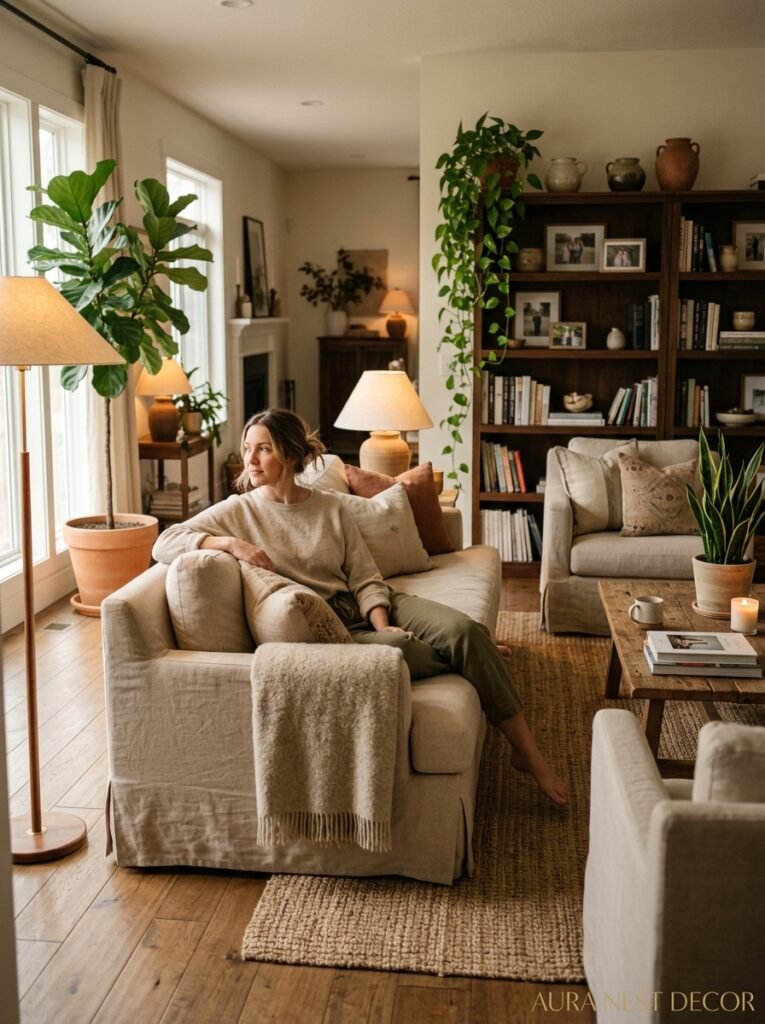
A big living room is one of those things that sounds like a dream until you’re standing in the middle of it wondering what to do with all that space. But once it clicks — once the furniture is pulled together, the rugs are the right size, the light is warm and layered and the room has genuine places to BE — it becomes the most satisfying space in the house. Generous, intentional, completely yours.
Don’t rush it. These rooms take time to figure out, and the best ones always look like they happened slowly, on purpose.
What’s the one corner of your living room that still doesn’t feel right?