The Cottage Living Room Makeover That Doesn’t Look Fake or Forced
You know the ones. The “cottage style” rooms that feel like a staging job for a holiday rental. Too many mason jars. A chalkboard sign that says gather. Everything matching in a way that nature never actually intended. Real cottage style looks nothing like that — and once you see the difference, you can’t unsee it.
—
1. Why Every Beautiful Cottage Room Starts With an Ugly Wall Decision

Not the pretty decision. The uncomfortable one.
The number one thing that separates a genuinely cozy cottage living room from a theme-park version of one is what’s happening on the walls — and specifically, whether someone had the nerve to leave them imperfect. Limewash paint. Original cracked plaster left intentionally. Tongue-and-groove paneling that wasn’t sanded quite smooth. These are the walls that make a room breathe.
I’m not saying go distress your drywall with a hammer (please don’t). But I am saying that if your walls look like they were finished last Tuesday, the rest of the room will never feel grounded. The wall needs a past, even if it’s a manufactured one.
Limewash has become genuinely popular in the last couple of years — both in the US and in older UK homes where it’s making a comeback — because it catches light differently depending on the time of day. At noon it looks almost pale and chalky. By evening, with a lamp throwing amber across it, the tonal variation in the wash creates this subtle depth that’s almost impossible to explain and very easy to fall in love with.
Start here. The furniture can come later.
“If your walls look like they were finished last Tuesday, the room will never feel old enough to be cozy.”
2. The Sofa Color That Keeps Showing Up in Every Genuinely Good Cottage Room

It’s not white. It’s not grey. And honestly it’s not even that “oatmeal linen” you keep seeing everywhere, though I get why people love it.
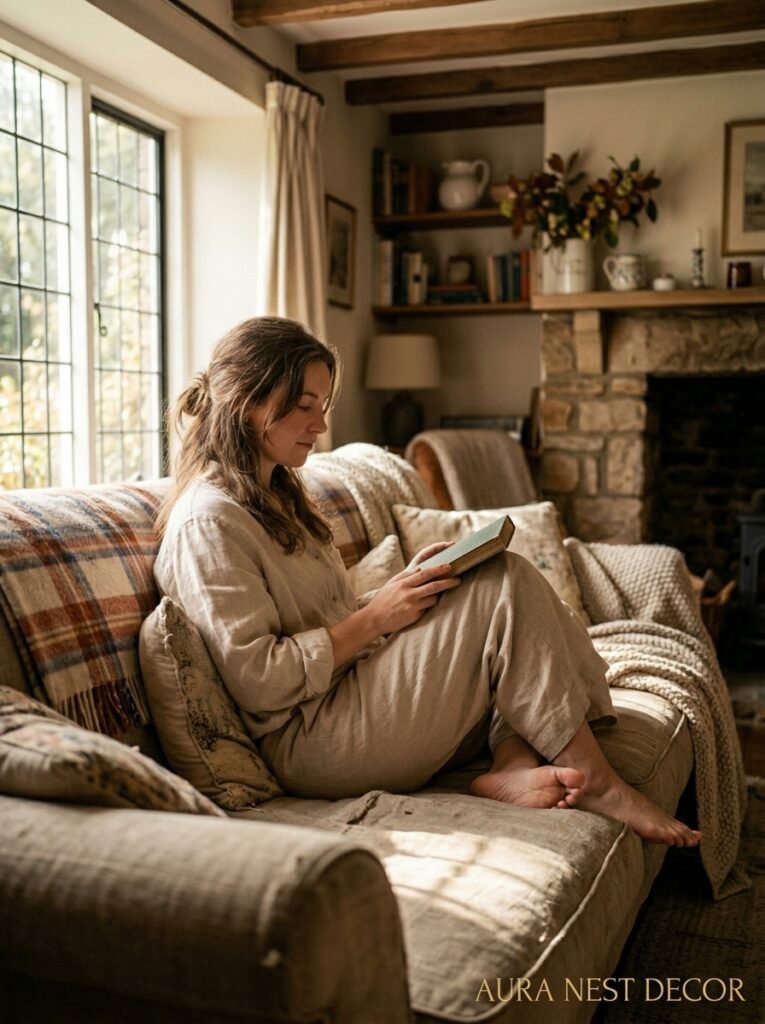
It’s a faded, slightly worn kind of green. Not sage — sage has peaked, bless it. More like the color of a field after a week of rain. A little muted, a little grey in it, maybe a hint of olive if you’re in better light. Worn velvet in this shade looks almost edible. And here’s the thing — it works in bright American rooms with big windows AND in dark British front rooms that don’t see the sun from October to March.
The reason this color works isn’t magic. It’s that green already exists in the natural materials that surround it — the wood, the dried flowers, the linen, whatever you’ve got growing on the windowsill. So the sofa doesn’t stick out, it settles in.
But if green genuinely isn’t your thing, I’d say go warm and faded. A dusty terracotta in worn cotton. A deep plum that’s been washed a hundred times and lost its edge. Avoid anything that looks new. Newness is the enemy of cottage style.
3. The One Textile Rule That Changes Everything About How a Room Feels
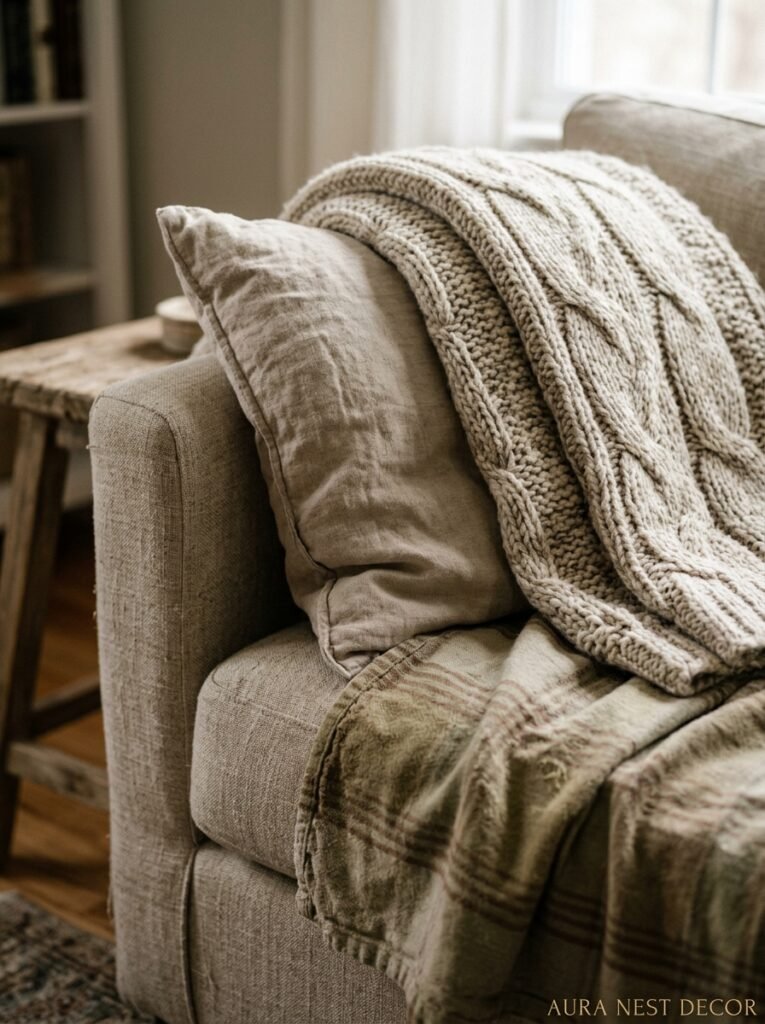
Layer things that don’t technically match. And I mean that seriously.
Most people get this wrong because they’re still trying to “coordinate” their textiles. They find a cushion they like, then they look for throws and curtains in the same palette. Which gives you a room that’s coherent but not warm. Not cottagecore. Not actually lived-in.
Real cottage style is when you put a hand-crocheted blanket your nan made in 1987 next to a printed linen cushion from a small Etsy seller, and they somehow both just work. The secret is sticking to naturals — cotton, linen, wool, jute — because natural fibers have this built-in visual harmony. They’re all a little muted. A little organic. So even when the patterns are very different, the materials themselves keep things from screaming.
Chunky knit throw? Yes. Old grain-sack pillow cover with faded stripes? Absolutely. A small floral cushion that’s slightly sun-bleached? Yes, please. And then one that’s just a deep plain velvet to anchor all of it.
That’s the mix. Nothing too precious.
4. Every Cottage Living Room Needs At Least One Thing That Doesn’t Belong
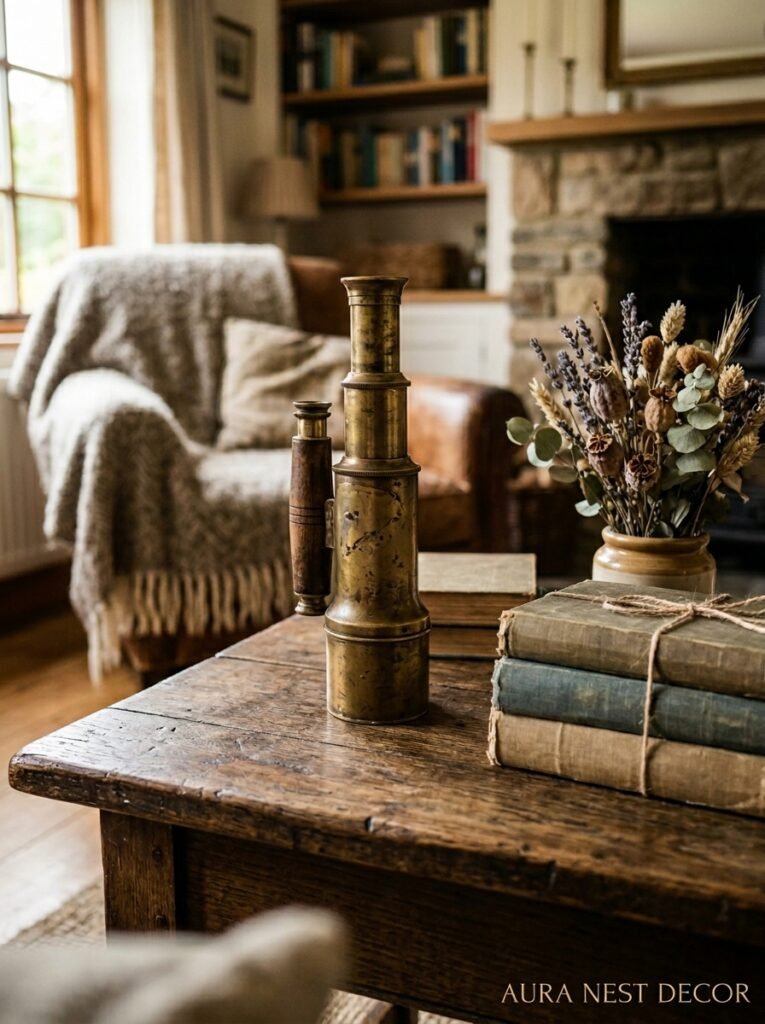
Hear me out.
The rooms that feel genuinely collected — like someone actually lived a life and then decorated their home — always have one wildcard. Something that has no business being in a cottage-style living room and yet somehow makes the whole thing more interesting because of its presence.
An industrial pendant light. A dark, dramatic oil painting that’s almost too formal for the space. A single modernist side table in black iron sitting next to a floral armchair. Something that shouldn’t work.
In British interiors especially, you see this all the time in homes that have been handed down through families. There’s a very deliberate sense that the room accumulated its contents over decades rather than arriving from one shopping cart. That weird painting from a car boot sale. The mirror that’s slightly too big. The lamp that doesn’t match anything else but has been in the family since forever.
If you’re decorating from scratch, you can fake this — but you have to commit to the piece. Don’t hedge by choosing something vaguely vintage-ish. Pick something with a genuine personality clash and put it somewhere confident. Center it. Light it properly.
“The room that accumulated its contents over decades will always look more interesting than the one that arrived from one shopping cart.”
5. The Truth About Cottage-Style Lighting (It’s Not What Pinterest Shows You)

Those images with fairy lights strung everywhere and candles covering every surface? That’s a vibe, not a lighting plan.
Real cottage room lighting is about layers. And not in the “three types of light” way designers say it in a polished magazine — I mean the specific, physical layering of different warm light sources at different heights so the room doesn’t have one single mood, it has about five.
You want a lamp on the floor near the bookshelf. One on the side table, not too tall. A pendant over any seating area that feels like a gathering point. And then candles — real ones, not the electric fakes, sorry — somewhere you’ll actually light them and not just put there for photos.
The temperature of the bulbs matters enormously. I’d say 2200K is where you want to be for primary lamps. That’s the amber-gold that makes everything look better, everyone look healthier, and the room feel like 7pm in October even at 2pm in March. It’s not warm-white. It’s almost yellow. If you’re not sure you’ve gone far enough, go further.
Overhead lighting is basically off in a cottage living room. If you have a ceiling light, it’s the last resort. Or it’s controlled by a dimmer and kept so low it’s basically decorative.
6. The Plants That Actually Belong in This Kind of Room (and the Ones That Don’t)
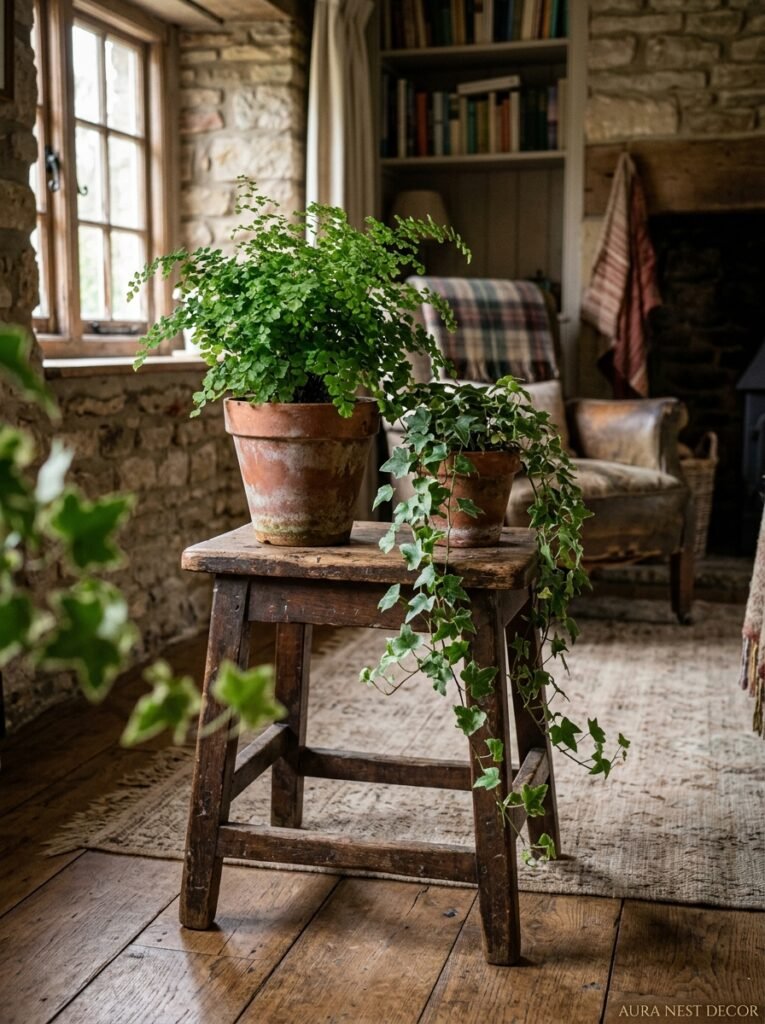
No succulents. That’s just a rule I’m making now.
Succulents are fine plants in the right room, but a cottage living room isn’t that room. Too clean. Too graphic. Too contemporary in their structure.
What belongs here is anything that drapes or trails or looks slightly wild. An overgrown pothos with vines crawling along a shelf. A big-leafed philodendron that’s clearly outgrowing its pot and you keep meaning to repot it. A rosemary plant in a terracotta pot on the windowsill that’s simultaneously decorative and actually used for cooking. Dried botanicals — lavender, eucalyptus, something with seed heads — in a stoneware vase or an old ceramic jug.
Side note — if you can find a jug from a car boot sale or thrift store with a small chip in it, that’s better than a perfect new one from a homeware shop. The chip is the point.
Fresh flowers work too, obviously. Nothing formal. A handful of whatever is seasonal — foxgloves and peonies in June, dahlias in September, bare twigs in January that you’ve stuck in a bottle because that’s what’s real right now. Cottage style is always tethered to the season, and that’s what keeps it from feeling fake.
7. How to Build a Cottage Bookshelf That Looks Like Someone Actually Reads

Not a styled bookshelf. Not a symmetrical bookshelf. A LIVED one.
This is the thing that gets me about a lot of cottage room inspo — the bookshelves are exquisite and clearly touched only for photo purposes. Books facing backwards to show just the white pages? Books organized by color? Beautiful, but not cottage.
A real cottage bookshelf has books turned face-out because you forgot to turn them around after reading them. It has a candle stub that’s been sitting there for six months. A postcard from someone. A small piece of pottery that someone gave you. A stone from the beach that you picked up three summers ago for reasons you can’t fully explain.
What you want to avoid is the total chaos of, say, a student house — that’s not cottage style, that’s just messy. The organizing principle you’re working with is emotional rather than visual. Things live on this shelf because they mean something or because they belong near books, not because they photograph well.
Between the books, don’t over-gap and don’t overstuff. Let a few lie horizontally on top of others, which is what actually happens when you run out of space and you’re a real reader and you just deal with it.
“A real cottage bookshelf has a candle stub that’s been sitting there for six months. And that’s exactly right.”
8. The Floor Rug Decision That Makes or Breaks the Whole Look
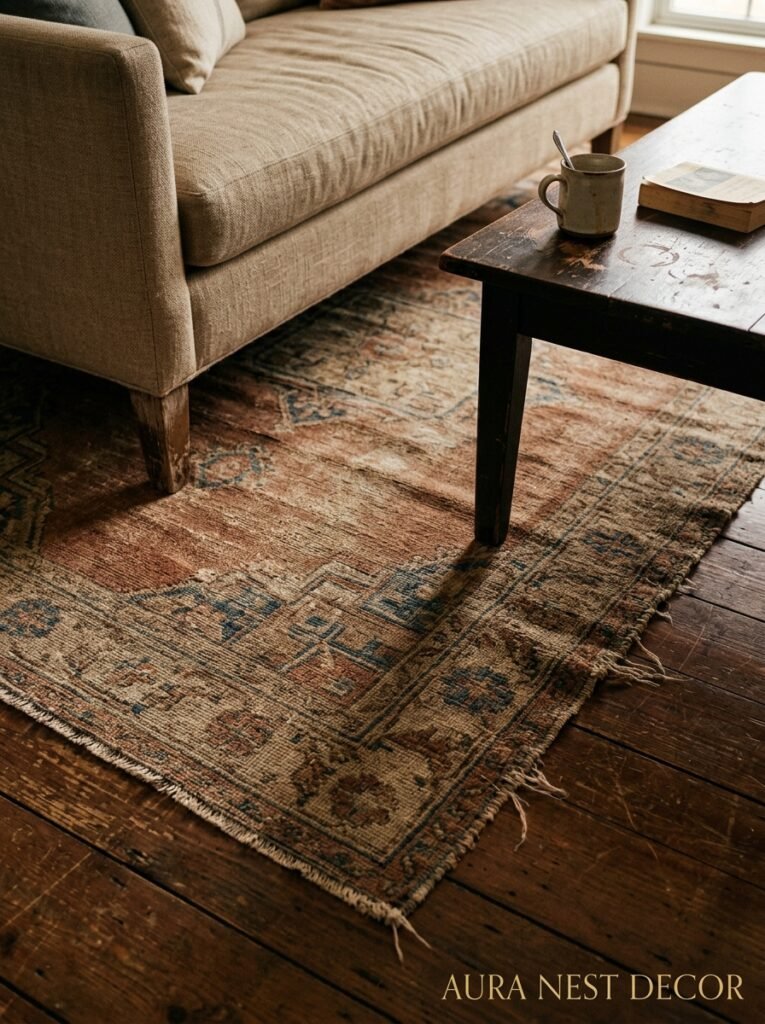
A bad rug in a cottage room is worse than no rug at all. And I say this from experience.
Too thick, too new, too obviously patterned — and suddenly your beautiful lived-in room looks like a Wayfair showroom. The wrong rug is the most obvious tell that a space was decorated rather than developed.
What you want is flatweave or low pile. Something with a worn quality — maybe an actual vintage kilim if your budget stretches, or one of the many good flatweave options that are made to look aged. Persian-style patterns in faded reds and blues. Plain natural jute that’s slightly rough underfoot. Striped cotton in muted navy or cream. Something that looks like it’s been there for years, not something that still has fold marks from the packaging.
And please, size it correctly. In cottage living rooms especially, people go too small. The rug should go under the front legs of the sofa at minimum — ideally the whole seating area sits on it. When the rug is too small the whole room floats. It doesn’t land.
9. Windowsills Are Doing More Work Than You Think
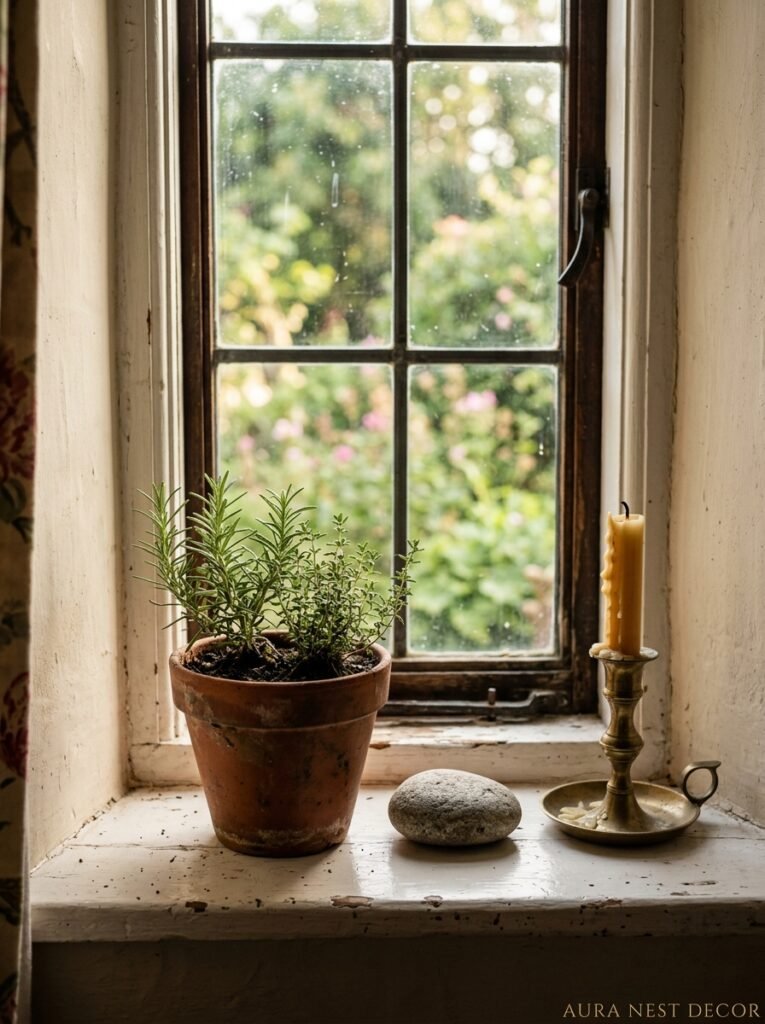
This might be the most underused real estate in the whole room, especially in British homes where the sills are often deep and beautiful and completely bare.
A windowsill in a cottage living room should have things on it. Not clutter — things. The distinction matters. A terracotta pot with herbs. A row of different-height bottles in old glass. A single candle. A plant trailing down toward the radiator. Something seasonal — a couple of holly sprigs in December, a stem of blossom in April.
The reason the windowsill matters more than people think is that it sits in front of the outside light, which means whatever you put on it gets backlit naturally. Glass catches it. Plants glow. Even a simple ceramic looks more interesting in that kind of light than it would on a table in the center of the room.
In American homes with large picture windows, the sill might be narrower — in which case even one good thing matters. One plant. One candle. One beautiful thing in the window changes the whole character of the room from the outside AND the inside simultaneously.
10. The Smell of a Cottage Living Room Is Part of the Design
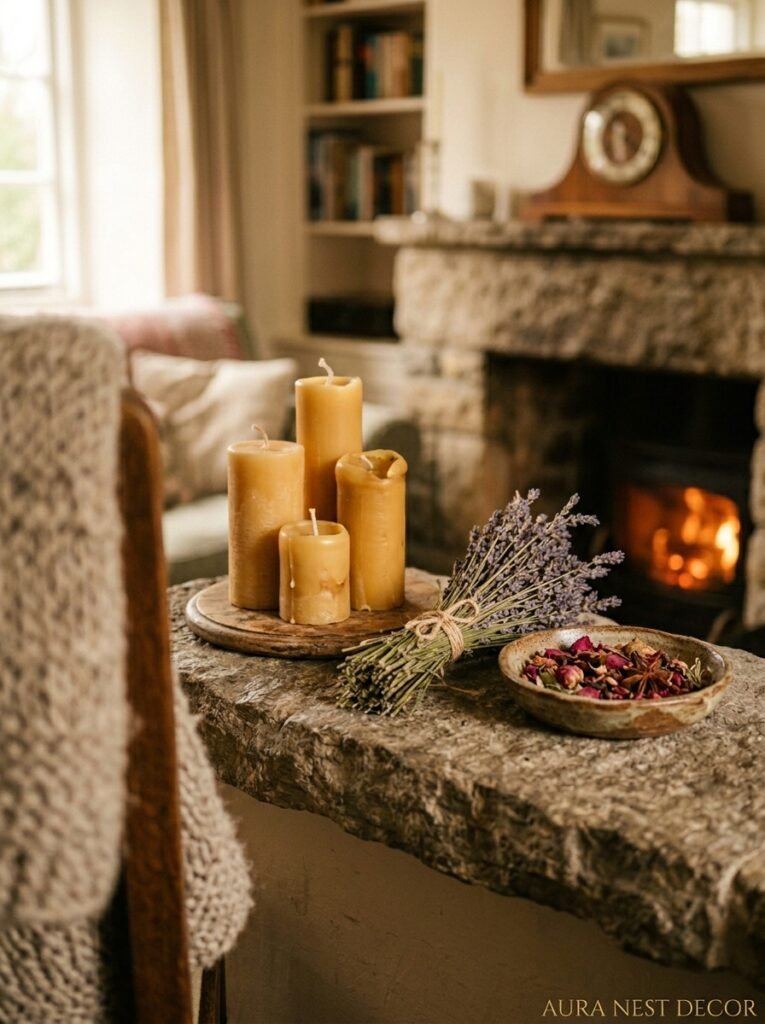
You won’t find this in any interior magazine but it should be there.
A well-designed cottage living room smells like something. Real wood. Beeswax candles. A vase of flowers that’s gone slightly past its peak. Old books. Whatever you cooked last night still faintly hanging around. These aren’t bad smells — they’re the smell of a room that’s inhabited, and it completes the whole atmosphere in a way no cushion can.
If your room smells of synthetic air freshener or nothing at all, that’s a problem that goes deeper than aesthetics. Light actual candles. Get real flowers that have a scent. Open the window even in winter, just briefly. Burn incense occasionally if you like it — cedar or sandalwood rather than anything floral.
And if you have a fireplace — a real one, a log-burning one, even a small cast iron stove — use it. Regularly. Because nothing, and I mean NOTHING, does more for a cottage living room than the smell of woodsmoke.
11. Why the Accent Chair Is Actually the Most Important Seat in the Room

More than the sofa. Way more than the sofa, honestly.
The sofa is where comfort lives. But the accent chair is where character lives. And in a cottage living room, character is the whole point.
This chair should be a little surprising. A Victorian button-back in dusty pink velvet next to a linen sofa. A worn leather reading chair that’s too masculine for the florals and works exactly because of it. A nursing-style rocker that someone recovered in a wool plaid. Something with legs that show wood — dark oak, or turned legs that have a history to them.
And it should have a lamp next to it. Always. Because the mark of a genuinely great cottage room is that there are multiple places to sit with good reading light, and the accent chair with its own lamp creates a little world within the room. A corner. A moment. The kind of place someone will immediately migrate toward without knowing why.
12. The Decorating Mistake Every Cottage Room Makes in January

Too many people redo their rooms for January — all the Christmas things come down and suddenly the room feels stripped and wrong and a bit sad, so they go shopping and buy things to fill it back up.
Don’t.
January and February in a cottage living room should feel austere. Spare. The room should breathe. This is when you actually need fewer things, not more. A single branch in a vase. The candles but no other ornamentation. Heavy curtains kept half-closed. The wool throw used, not just folded decoratively.
Cottage style follows the rhythm of the year. If it looks the same in January as it did in October, something’s wrong — and that’s the moment most people reach for the online shopping cart when they should be reaching for nothing at all. The room needs to rest. And honestly? So do you.
—
❓ FAQ
Q: How do I get a cottage living room look on a tight budget? A: Start with paint and textiles — they’re cheap and high-impact. Limewash-effect paints exist in every price range now, and secondhand/thrift stores are genuinely your best friend for the kind of worn, imperfect pieces that make this style work. You don’t need to buy everything at once.
Q: Can cottage style work in a modern flat or apartment with no period features? A: Yes, but you have to compensate through texture and warmth rather than architecture. More rugs. More soft layering. More candlelight. The bones of the room matter less than what you put in it, and honestly a completely modern flat with the right textiles and lighting can feel cozier than a period home with contemporary furniture.
Q: What’s the difference between cottage style and cottagecore? A: Cottagecore is an aesthetic — it’s visual, slightly fantasy-driven, very Pinterest. Cottage style is a philosophy of decorating. One is a mood board, the other is actually how you live. The real-life version is less precious, more practical, and significantly more interesting.
—
💭 Final Thoughts
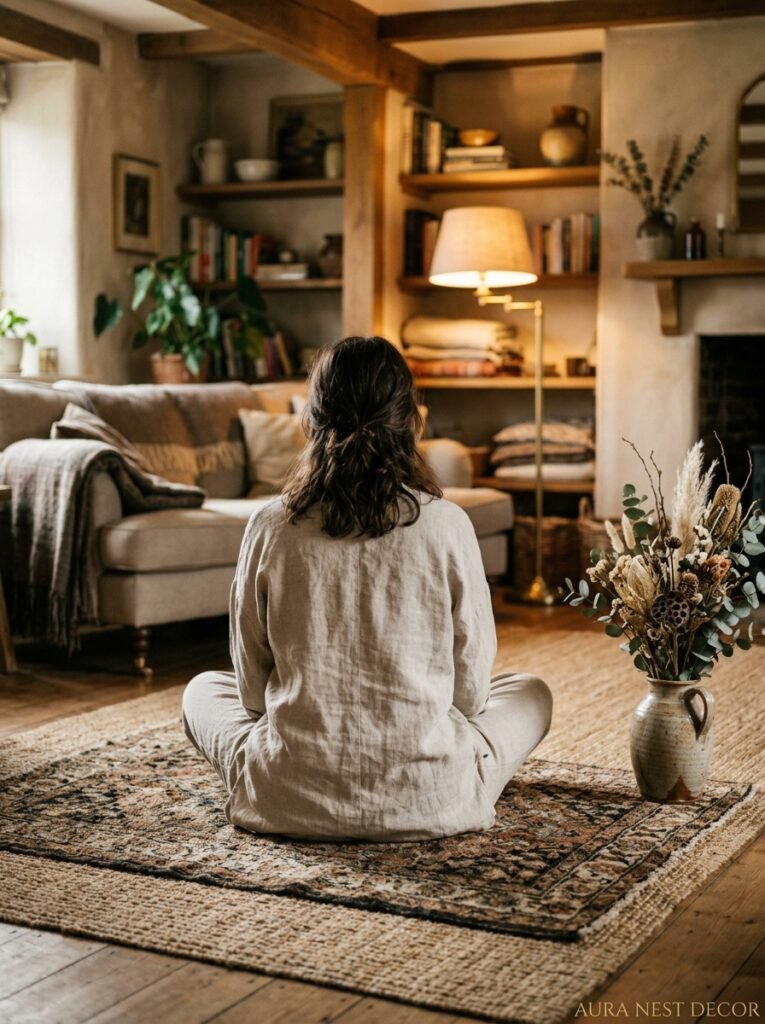
A cottage living room isn’t a look you achieve. It’s a feeling you build slowly, over time, with things that actually mean something to you. The rooms that stop people mid-scroll are never the ones that were designed in a weekend — they’re the ones that look like they’ve been collecting their contents for years. So maybe start with one wall. One lamp. One chair that surprises you. And give it time to settle. What’s the one thing in your living room right now that has an actual story behind it?