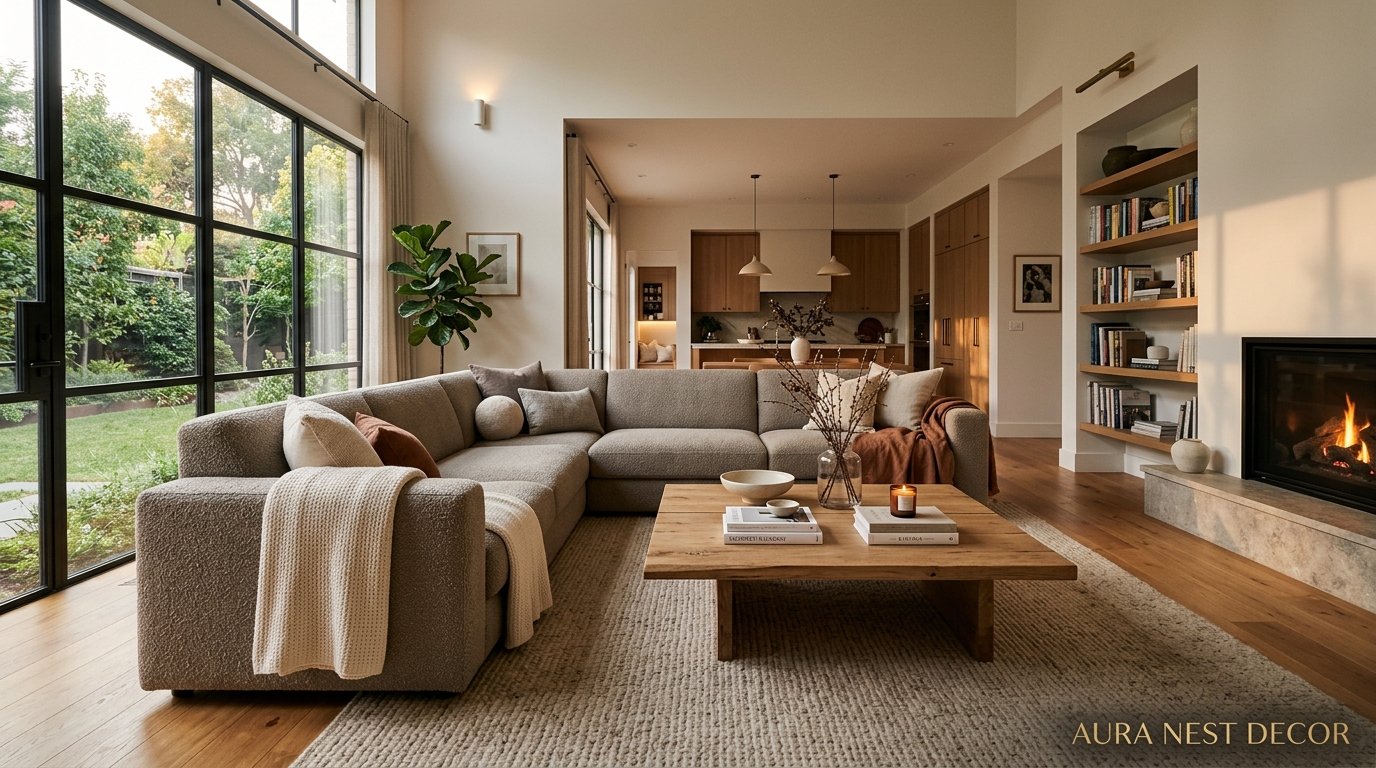
The L-Shape Sofa Is Taking Over Living Rooms — And Honestly, It Should
You walk into a room and it just works. The sofa anchors everything. The whole space feels considered, generous, like someone actually thought about how people sit and talk and live. Nine times out of ten, there’s an L-shape involved.
—
1. Why Every Designer’s Floor Plan Starts With an L Right Now
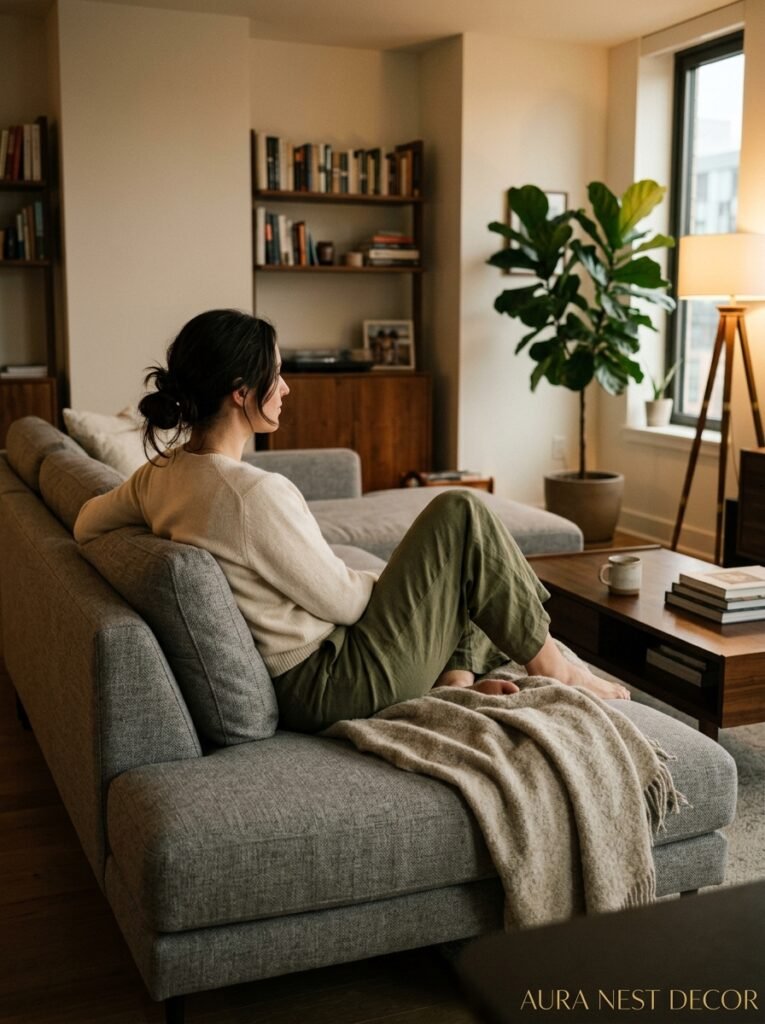
Not gonna lie — I resisted the L-shape sofa for years. It felt too big, too committal, too “suburban showroom.” And then I sat in one. Properly sat in one, curled up in the corner section with a coffee, and I understood immediately why everyone’s obsessed.
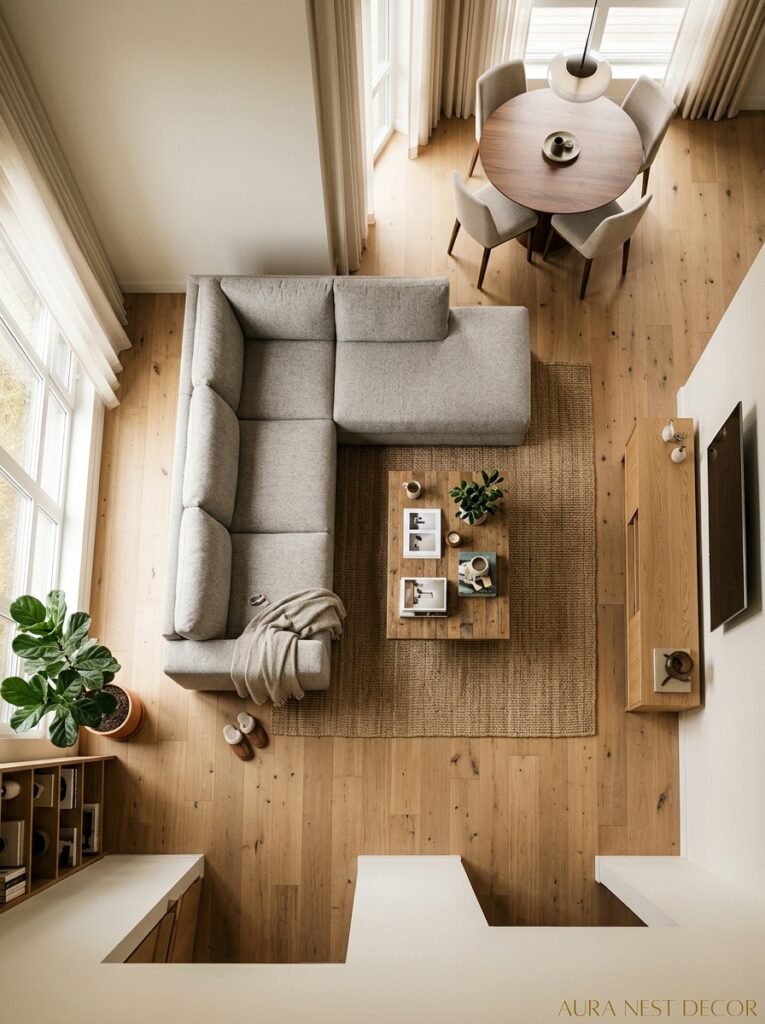
The L-shape does something a regular sofa just can’t. It creates an actual zone. A destination. You walk into a room with an L-shape and your brain immediately understands what that corner of the room is for. There’s no ambiguity, no “where do I put myself?” awkwardness. The sofa decides. And in a modern luxury context, that sense of intention is everything.
Designers keep coming back to the L-shape because it solves the hardest problem in living room planning: scale without emptiness. A big sectional can make a room feel furniture-heavy and stuck. But an L, placed right, creates this beautiful negative space — the coffee table floats, the room breathes, there’s a clear visual anchor without the whole thing feeling like a mattress store.
Right now the configurations that are showing up everywhere are chaise-end L-shapes (cleaner, more contemporary) and modular sectionals in an L arrangement that you can actually move. That second one is becoming massive. People want luxury AND flexibility, and the modular route gives you both.
“A sofa that creates a zone doesn’t just furnish a room — it tells people how to exist inside it.”
2. The Velvet Moment We’re All Living Through (And It’s Not Slowing Down)
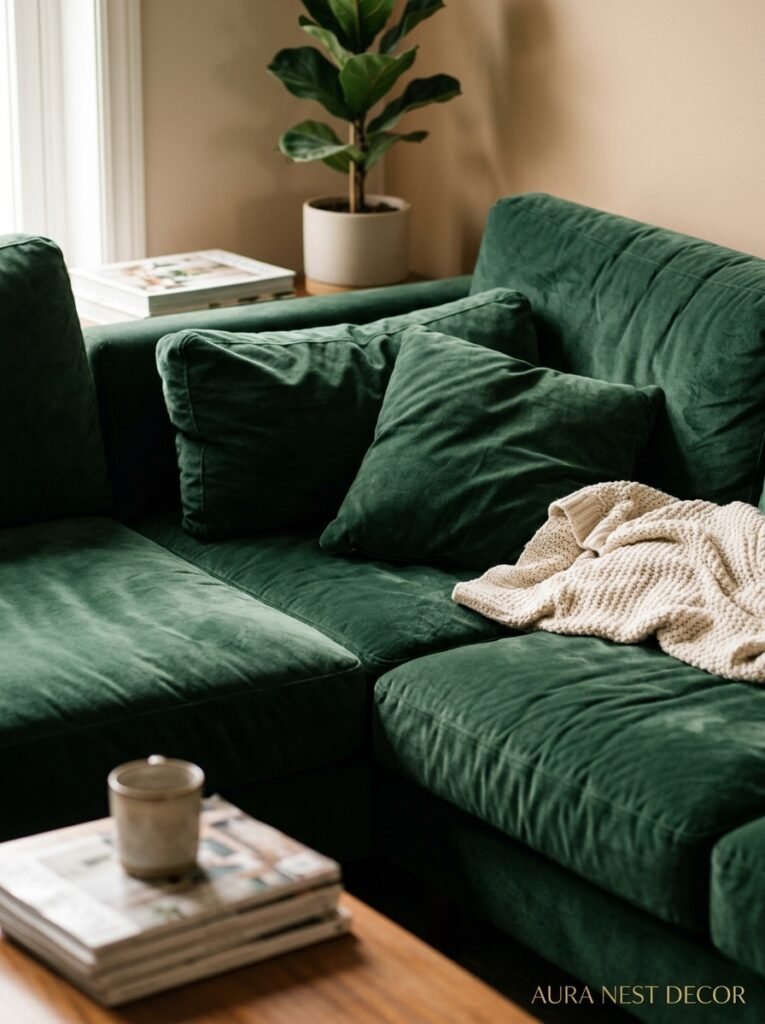
Velvet on an L-shape is having a full cultural moment and I don’t think it’s peaking yet. Forest green velvet. Deep ocean blue. A dusty blush that photographs like a dream. If you’ve been scrolling Pinterest for more than ten minutes in the past year you’ve seen it, saved it, and probably sent it to someone with no caption because it doesn’t need one.
Here’s why velvet works SO well on a large-format sofa specifically: the texture catches light differently across a big surface. On a regular three-seater, velvet is nice. On an L-shape, velvet is architectural. The way it shifts from muted to almost luminous as you move around the room — that’s not something you get from linen or cotton or, God forbid, polyester microfiber.
The colors that are genuinely moving right now are emerald, cognac, and a deep charcoal that reads almost black in certain lights. Cognac velvet on an L-shape with brass accents nearby is honestly one of the best things happening in interiors right now. It feels warm and expensive without trying too hard, which is sort of the whole goal.
For UK buyers, Sofology and John Lewis both carry decent velvet L-shapes, though honestly some of the best quality-per-pound options I’ve seen lately are coming from smaller independent makers. Worth the look.
3. The Color That Keeps Showing Up in Every Stunning Modern Living Room
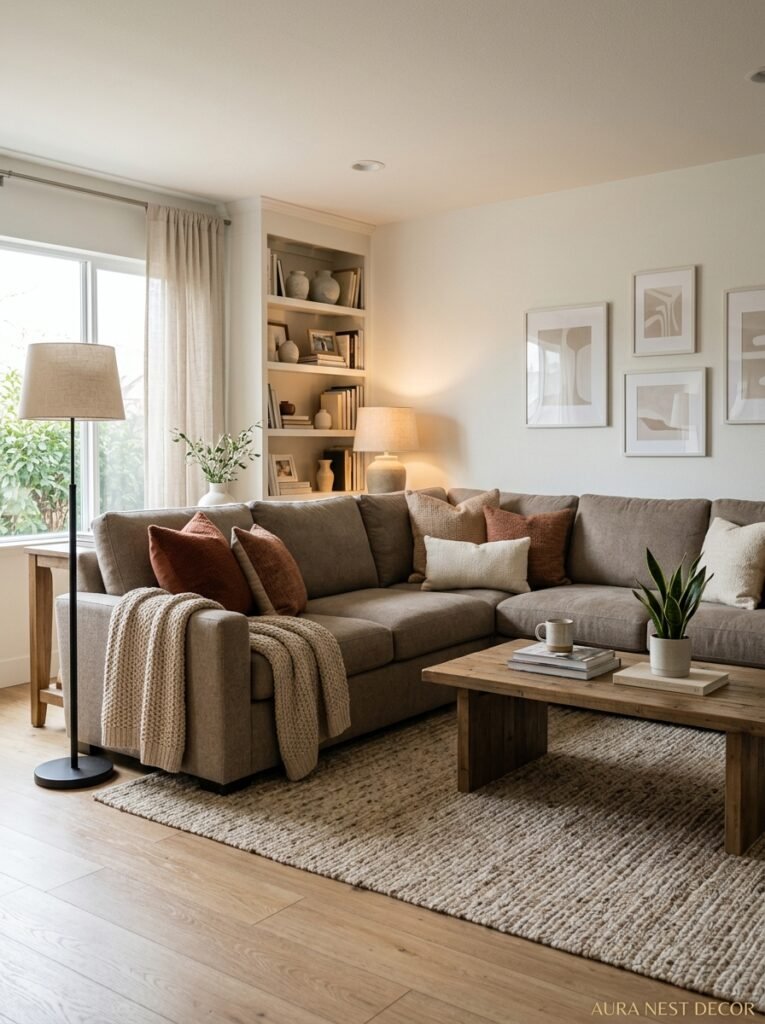
It’s boucle white. Or greige. Or that specific warm off-white that isn’t cream and isn’t beige and doesn’t have a consistent name across paint brands, which is maddening. But that’s the one.
For L-shapes specifically, neutral doesn’t mean boring right now — it means intentional. The sofa becomes the foundation and everything else gets to be interesting. A boucle or textured fabric L-shape in a warm neutral lets you go dark on the walls (and people ARE going dark on walls — more on that in a second), add patterned cushions, bring in natural materials, hang something bold. The sofa holds it all together without competing.
The other color that keeps catching me off guard in a good way is rust. Terracotta-adjacent rust, specifically. Not orange. Not red. That in-between. On a low-profile modern L-shape it looks seriously expensive and it photographs incredibly on Pinterest because it pops against both light and dark backgrounds. If you want something that feels a little more committed than neutral but you’re not ready for jewel tones, rust is your answer.
4. Placement: The One Decision That Makes or Breaks the Whole Room
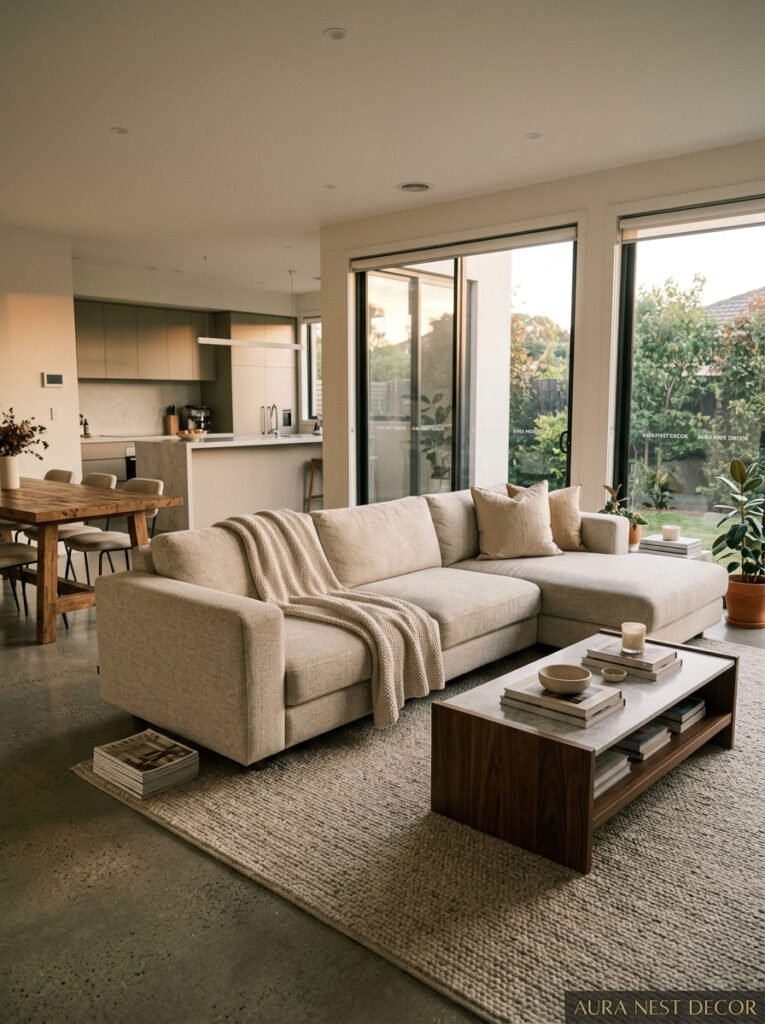
Most people float their L-shape wrong. They push it toward a wall, leaving one arm in the middle of the room feeling purposeless, or they angle it in a way that fights the architecture instead of working with it.
The rule — and this one actually holds — is to let the chaise or the long end face INTO the room, not into a wall. The chaise is the luxury part. The part that says “you can actually lie here, this isn’t just for sitting up straight.” Pointing it at a wall wastes that entirely.
In a square room, diagonal placement can work beautifully. The L cuts across a corner, the coffee table sits at an angle, and suddenly you’ve got a room that feels designed. Not decoratively diagonal — like, “ooh look at my funky sofa” — but genuinely better proportioned.
For open plan spaces, which is most of what’s being built and renovated right now on both sides of the Atlantic, the L-shape acts as a natural room divider. The back of the sofa defines where “living room” ends and “kitchen/dining” begins, without a wall. It’s elegant. It’s functional. And it means you don’t have to stare at the back of a sofa — if you choose a low-profile design with a clean back, it actually looks good from every angle.
“The chaise points toward the room, not the wall. That’s it. That’s the whole rule.”
5. Why Dark Walls Behind a Light L-Shape Is the Combination I Keep Saving
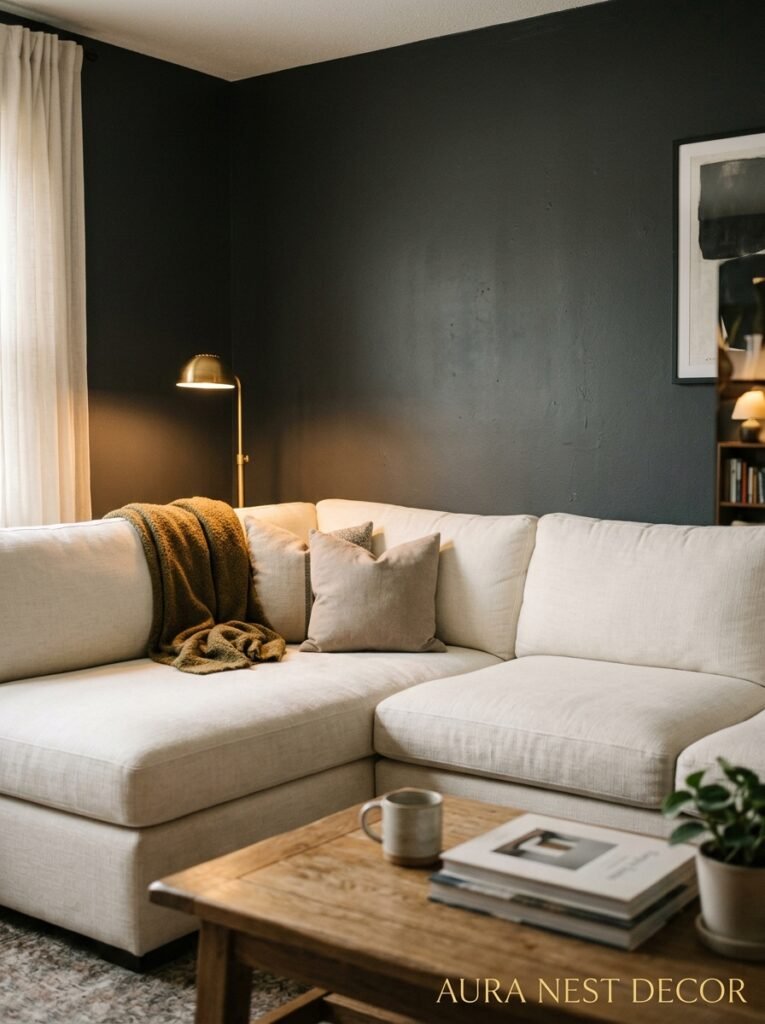
Someone painted their living room in Farrow & Ball’s Pitch Black behind a cream boucle L-shape and my jaw dropped. Then someone did it in Down Pipe. Then in Railings. Then in a deep moody green I don’t even have the name for and I’ve been trying to find it for three months.
Dark walls behind a light or mid-tone L-shape create this contrast that makes the sofa look like it’s glowing. The furniture pops. The room feels intimate and intentional, like you’ve walked into somewhere that has a POINT OF VIEW. I’ve become a genuine evangelist for this combination and I apologize in advance to anyone who’s heard me talk about it in person.
What I’ll say is this: it’s not as scary as it sounds. You don’t have to paint all four walls. One dark feature wall behind the sofa — especially if there’s art or a mirror or wall lights on it — is enough. The L-shape becomes the centrepiece, the wall becomes the backdrop, and the whole corner feels like it was designed by someone who charges a lot of money for this.
US equivalent paint brands — Benjamin Moore’s Onyx, or their Wrought Iron, both do this well. Sherwin-Williams Tricorn Black if you want to go full drama.
6. The Coffee Table Question Nobody Talks About Enough
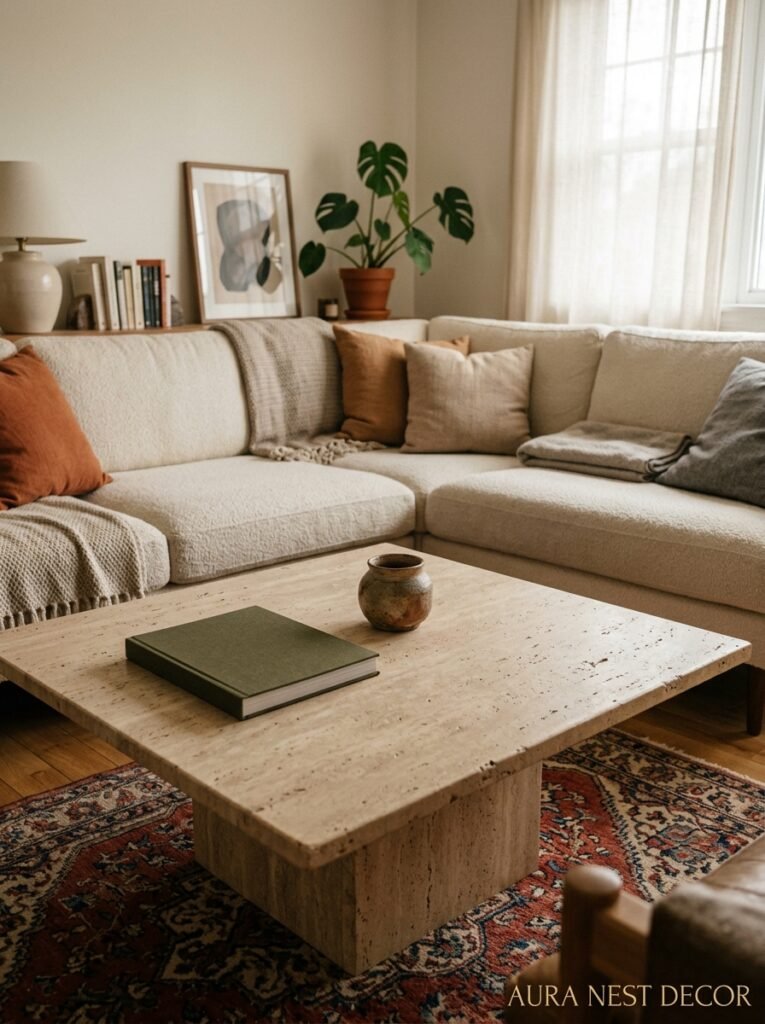
Round or rectangular. That’s the debate. And with an L-shape, people almost always default to rectangular because it “matches” the shape. Which is fine. Totally fine. Slightly boring, but fine.
Round or oval coffee tables with an L-shape are genuinely one of my current obsessions. The contrast in shapes creates movement. A round travertine coffee table in front of an L-shape sofa photographs like an editorial shoot. There’s something about the curve against the right angle — or both right angles, technically — that feels considered in a way rectangular-on-rectangular just doesn’t.
The size question matters too. Too small and the coffee table looks like it got lost. Too big and you can’t actually get around it, which is annoying because you’ll have to do that constantly. The general guideline is two-thirds the length of the main sofa face, but I’d honestly go by eye. Get the tape measure out, put painter’s tape on the floor, and live with the outline for a day before you buy anything. Genuinely changed how I shop for furniture.
7. Cushions Are Doing Heavy Lifting Right Now (Here’s Exactly How)
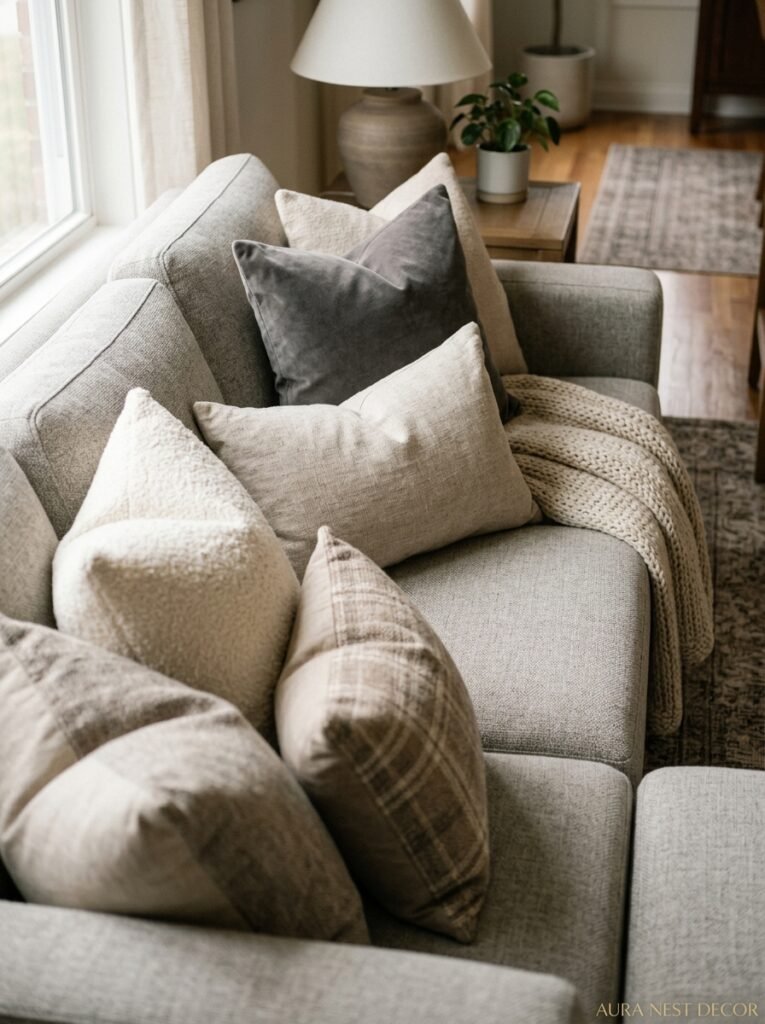
The L-shape creates more cushion real estate than almost any other sofa configuration. Which is either exciting or terrifying depending on your relationship with soft furnishings. For me, exciting. Always exciting.
The current approach that looks most intentional — not “my nan gave me these” and not “I bought a matching set” — is mixing one large-scale pattern with two or three solid textures in pulled-from-that-pattern colors. So if you have, say, a botanical print cushion in sage and rust and cream, you then pull sage velvet, rust linen, cream boucle. They all relate. Nothing matches. Everything belongs.
On an L-shape specifically, cluster your cushions toward the corner section — that’s where people naturally gravitate, so it makes sense for it to feel most dressed. The chaise end can be a bit more minimal. One or two cushions max, maybe a throw pooled at the end. The contrast between the styled corner and the looser chaise end actually looks MORE expensive than spreading cushions uniformly across the whole thing.
“Nothing matches. Everything belongs. That’s the rule for cushions in 2024 and I’m keeping it.”
8. The Low-Profile Modern L-Shape and Why It’s Changing Room Proportions
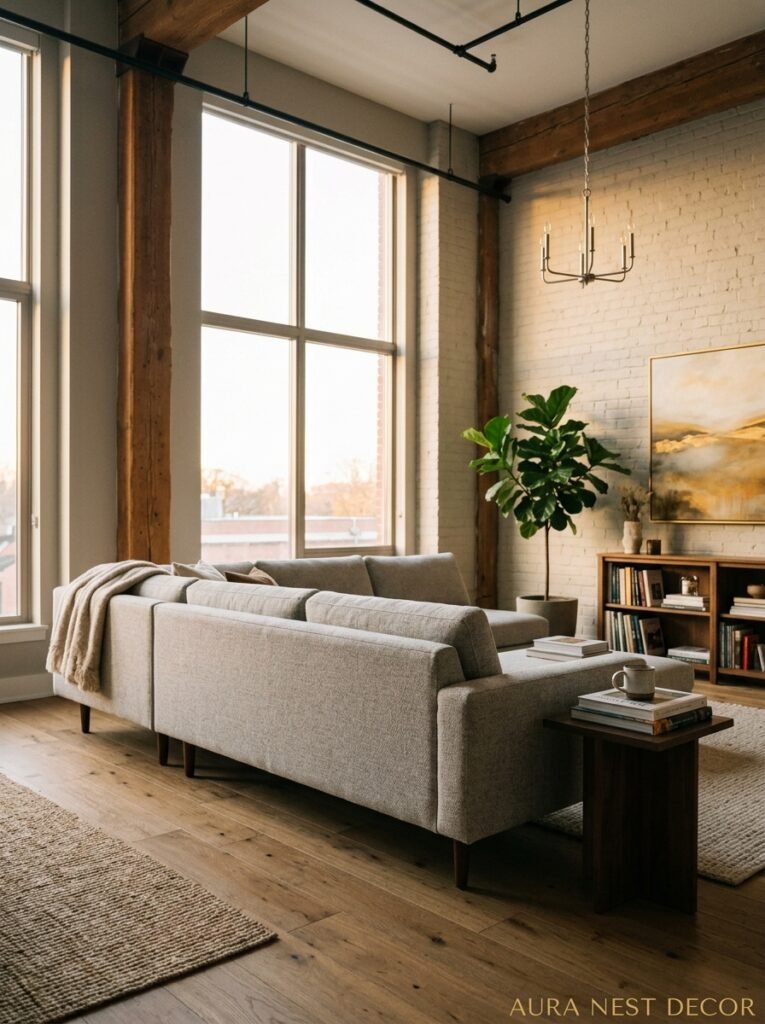
High-back sofas had their moment. They’re cozy, they’re dramatic, and in the right room they look incredible. But the silhouette that’s dominating luxury living room design right now is low. Low arms, low back, clean horizontal lines that make the room feel taller without doing anything to the ceiling.
A low-profile L-shape in a room with 9-foot or higher ceilings is almost unfairly good-looking. The sofa sits quietly, the space above it feels generous and airy, and any artwork or lighting above the sofa gets to breathe. It’s the furniture equivalent of speaking quietly and still being the most interesting person in the room.
This profile also photographs BEAUTIFULLY which — yes, we’re all aware this is a factor in furniture decisions now, sorry not sorry. The clean horizontal line reads clearly in a photo, the room’s volume shows, and the sofa looks expensive at any price point because the silhouette is doing the work.
The only thing to watch with low-profile sofas: seat depth. Some of them go so sleek that they’re actually not that comfortable to sit in for long periods. Look for at least 22 inches of seat depth, ideally 24. Anything less and you’ll feel like you’re perching, which defeats the purpose of having a huge comfortable L-shape entirely.
9. What to Put on the Wall Across From an L-Shape (The View From the Sofa Matters)
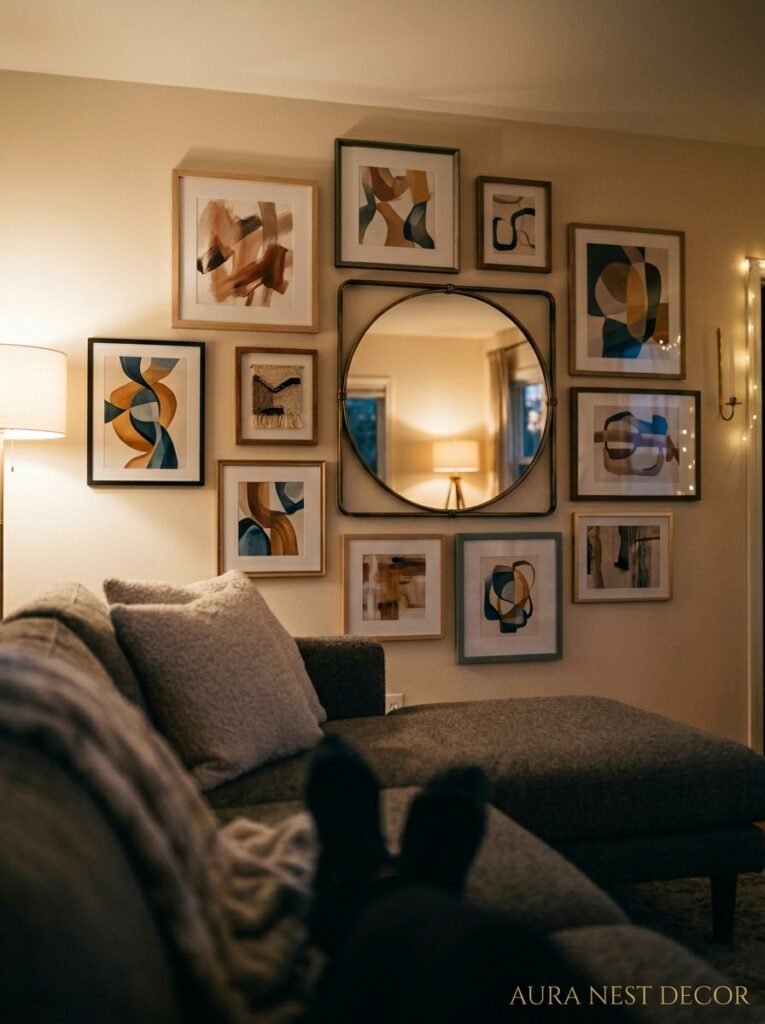
Here’s something that doesn’t get discussed enough: when you have an L-shape sofa, you’ve committed to where people will be sitting and looking from. That’s actually a gift. You know exactly what the view is. So design the view.
Large-scale art works brilliantly across from a sectional because the sofa’s mass needs something substantial to balance against. One big piece tends to look more confident than a gallery wall in this situation — though a gallery wall can work if it’s disciplined (consistent frames, consistent spacing, please). The gallery wall chaos look doesn’t sit well with the clean lines of a modern L-shape. They fight each other.
A large mirror across from the sofa doubles the light, makes the room feel enormous, and gives you a great view of the whole setup which — honestly — is its own pleasure. Not ashamed to say I’ve caught myself looking at the room in a mirror and feeling briefly smug about a furniture arrangement. It’s one of life’s small joys.
If you’re in the UK, check out Desenio and Poster Store for large format prints that punch well above their price point. In the US, Society6 and Minted both have genuinely good options that look way more expensive than they are.
10. The Rug Situation: Bigger Than You Think and Anchored, Always
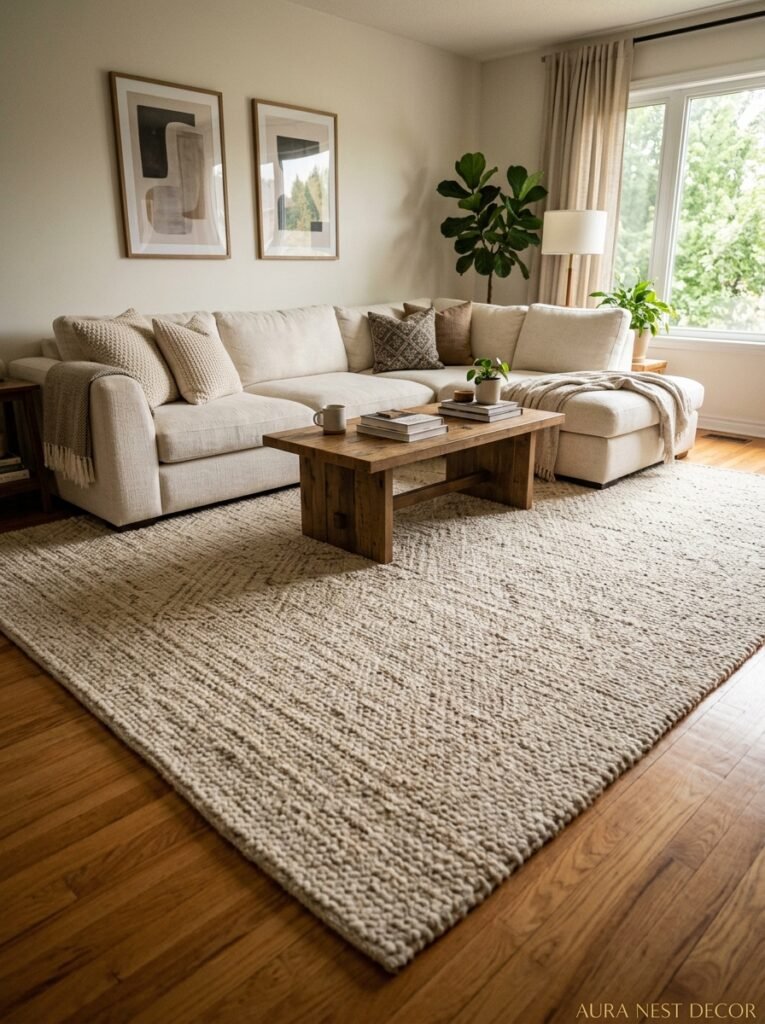
The number of times I’ve seen a beautiful L-shape sitting on a rug that’s too small. It haunts me. The sofa looks like it’s floating on a postage stamp. The whole room feels un-anchored even if everything else is perfect.
For an L-shape, you want ALL the sofa legs on the rug. Not just the front legs. Not “most” of the legs. All of them. This usually means going up to a 9×12 or even bigger, which feels enormous until it’s down and then it feels exactly right. Size up, always. You can make a rug feel smaller with furniture placement but you cannot make it feel bigger.
Natural fiber rugs — jute, sisal, seagrass — work beautifully under a plush or velvet L-shape because the texture contrast is satisfying. If the sofa is textured (boucle, bouclé-adjacent, any kind of chunky weave), go smoother on the rug. A low-pile wool or a flatweave. Same principle in reverse: let the contrast do the work.
11. Lighting an L-Shape Living Room Like You Actually Know What You’re Doing
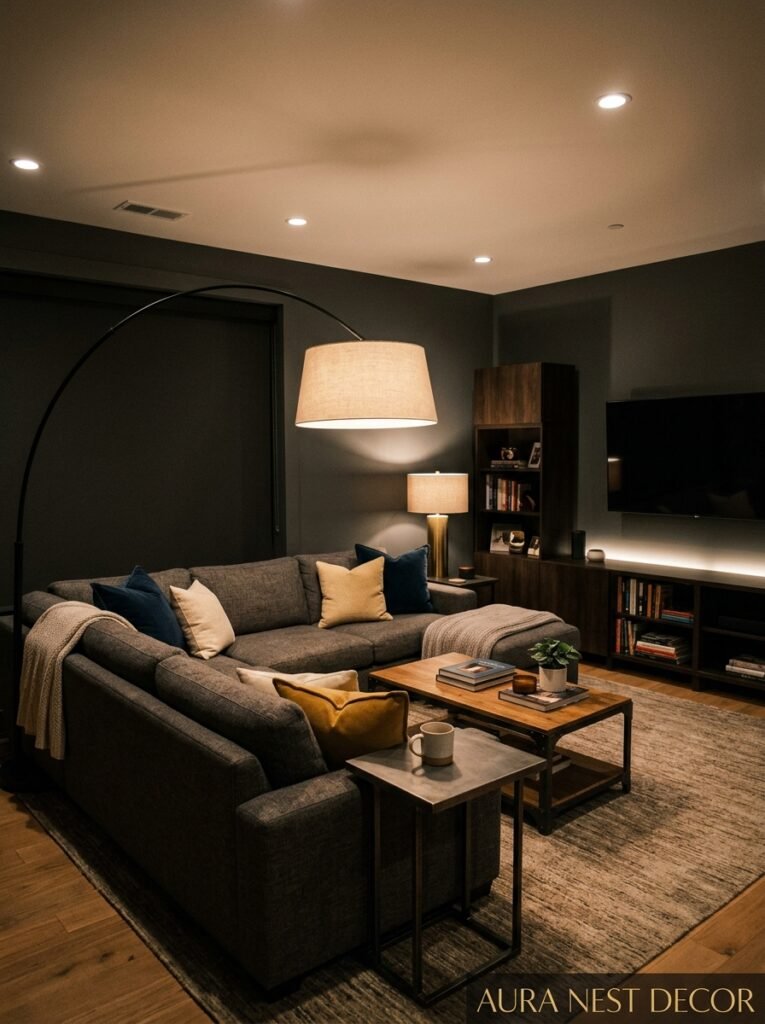
The L-shape creates a specific spatial problem: the corner section tends to be further from windows and further from overhead lighting. Which means it can feel dim in a way that makes the whole room feel a bit dreary if you’re not careful.
Floor lamps in the corner behind or beside the L are non-negotiable. Not a big overhead-arc floor lamp that looks like it wandered in from a dentist’s waiting room — a warm, sculptural floor lamp with a shade that throws soft light downward and slightly outward. Something with a linen shade or a pleated shade. Something that looks good even when it’s off.
Sconces on the wall flanking any art or mirror across from the sofa create this gorgeous ambient layer that makes the whole room feel like it has more dimensions to it. The amber glow of a warm-white bulb at around 2700K does things that overhead lighting just CANNOT do. It makes velvet glow. It makes wood look richer. It makes the room feel like somewhere you’d want to spend an entire Sunday.
Table lamps on a console or side table at one end of the L also help define the space. The L-shape gives you more surface real estate around it than a standard sofa, use it.
12. The Budget Honest Reality of Getting This Look (US and UK)
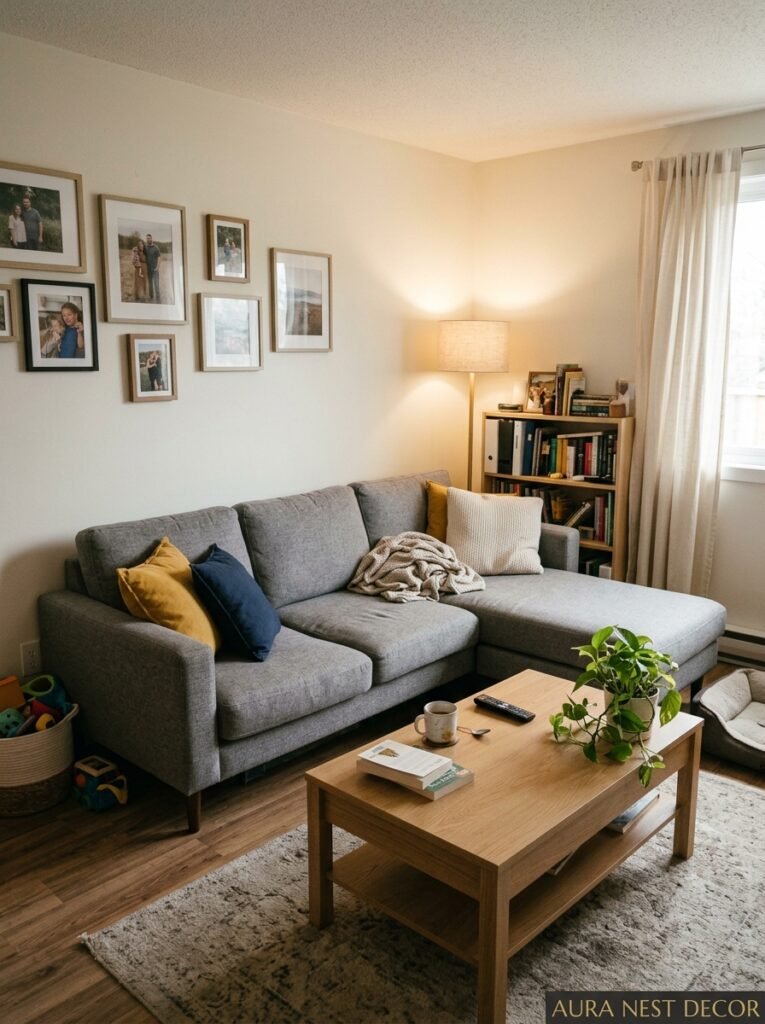
Here’s the thing nobody in interior design content wants to say clearly: a genuinely beautiful, well-made L-shape sofa is an investment. A real one. We’re talking $2,000-$8,000+ in the US and £1,500-£6,000+ in the UK for something that’ll actually hold its shape and look good in five years.
The budget options exist and some of them are not bad — IKEA’s KIVIK sectional configured as an L gets genuinely good reviews for the price, and you can dress it up significantly with quality cushion covers and a throw. West Elm in the US runs sales that make their mid-range sectionals more accessible. In the UK, Made.com’s former customer base has moved largely to Loaf and Arlo & Jacob, both of which hit a nice quality-to-price balance.
Where I’d genuinely tell you NOT to skimp: the frame and the cushion cores. Cheap cushion filling collapses within a year and then you’ve got a sagging, sad L-shape that no amount of styling saves. High-resilience foam or a foam-and-feather blend is worth paying for. The frame should feel solid when you sit in the corner — no flexing, no creaking. Everything else can be managed.
—
❓ FAQ
Q: How do I know if my living room is big enough for an L-shape sofa? A: A rough minimum is around 12×12 feet for a smaller L-shape configuration, but honestly the proportions matter more than the raw square footage. The key is leaving at least 18 inches of walkway around the sofa and enough space for a coffee table with clearance. Painter’s tape on the floor before you buy is genuinely the best trick — outline the sofa dimensions and live with it for 48 hours.
Q: Which direction should the chaise end face in an L-shape sofa? A: Into the room, not toward a wall, and ideally toward your TV or main focal point if you have one. The chaise is the lounging end — you want it oriented so someone can actually stretch out and face into the space, not the skirting board.
Q: Is velvet practical for an L-shape sofa if you have kids or pets? A: More practical than you’d think, actually. Velvet doesn’t trap hair the way you’d expect — a lint roller gets most of it. The bigger concern is scratching from pets (it pulls and snags) and spills, which need immediate attention. If you love velvet and have chaotic domestic circumstances, look for performance velvet fabrics, specifically anything marketed as stain-resistant or performance-grade. They’re not as buttery as true velvet but they’re close and they survive real life.
—
💭 Final Thoughts
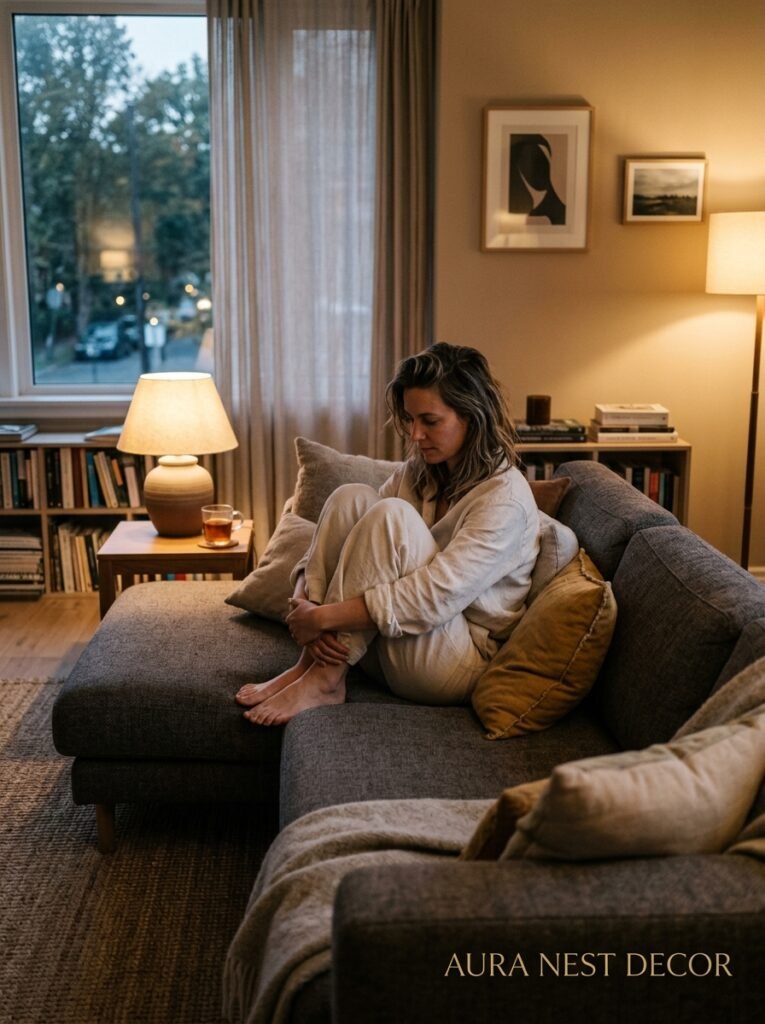
The L-shape sofa isn’t a trend that’s going anywhere soon — it’s becoming the default starting point for how we think about living rooms, the way the three-seater was for decades before it. Get the placement right, don’t underestimate the rug size, and let the sofa be the anchor instead of fighting it. Your room will tell you what it needs once the big piece is in the right spot.
What’s the one thing holding you back from committing to an L-shape?