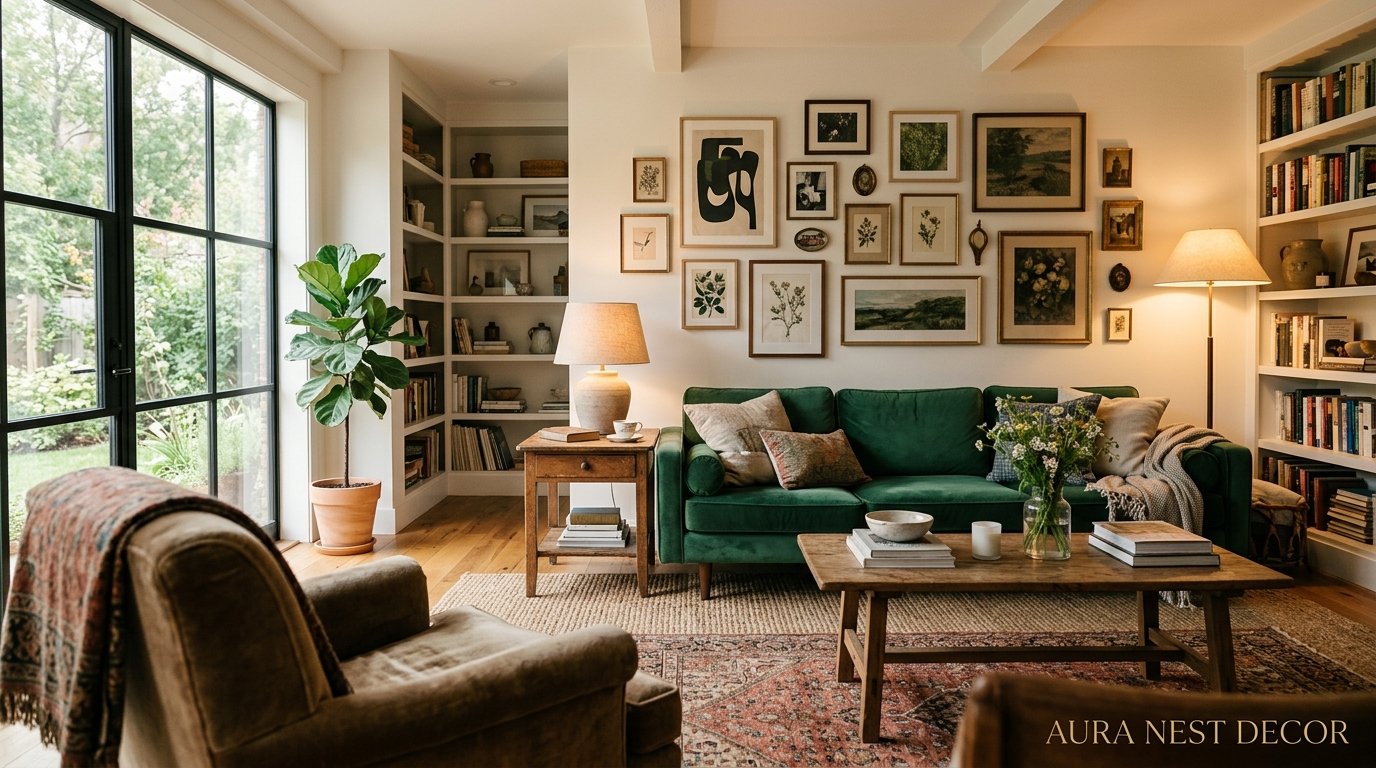
The Living Room That Broke Every “Rule” — And Looked Better for It
You walk in and something just works. You can’t explain it. There’s a velvet sofa next to a rattan chair, a framed vintage map hanging over a very modern shelf, and somehow the whole thing feels completely intentional. That’s modern eclectic done right. And it’s not as mysterious as it looks.
—
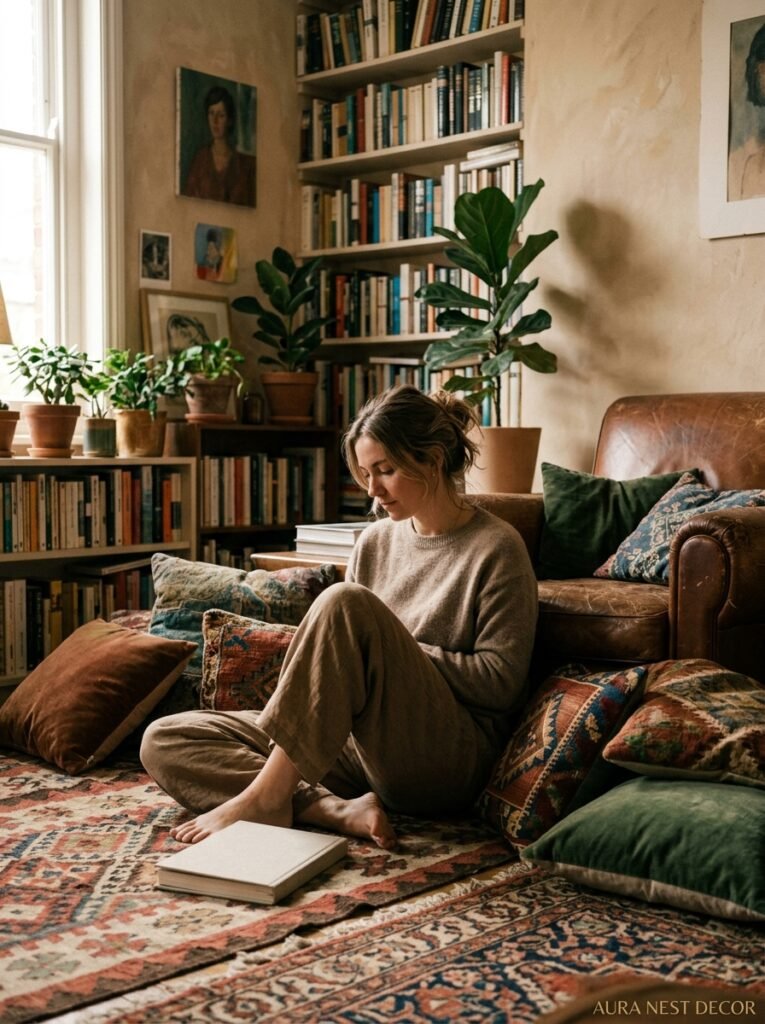
1. Why “Eclectic” Doesn’t Mean “I Couldn’t Decide”
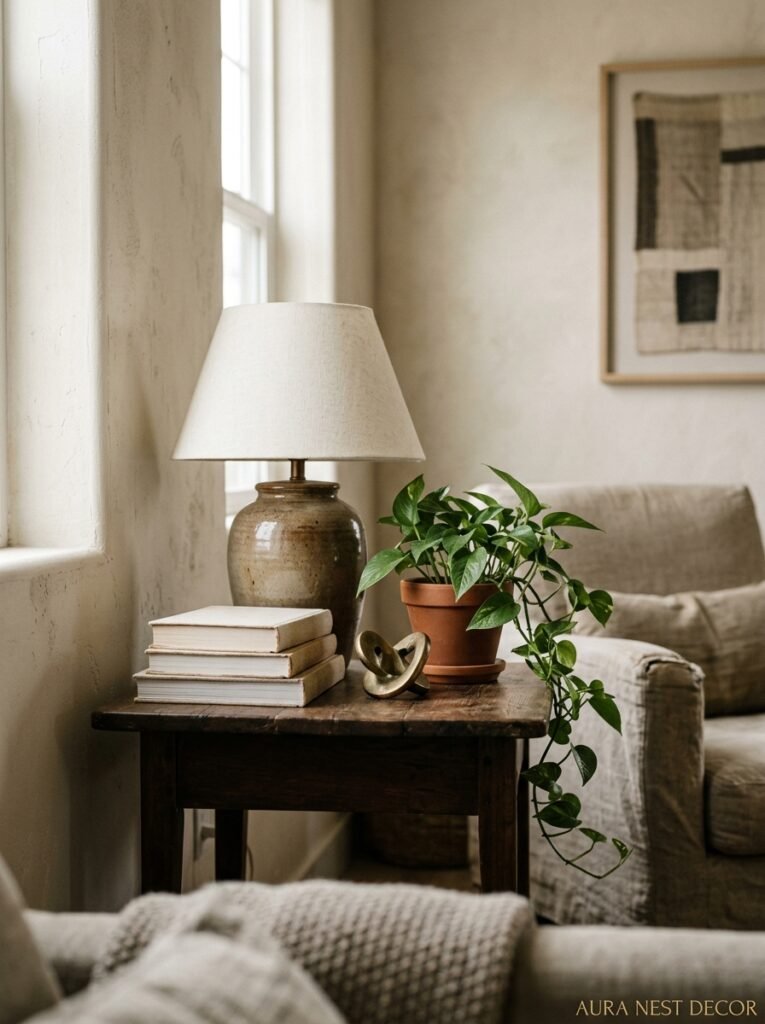
Here’s the thing people get wrong. They think eclectic means throwing everything you love at a wall and hoping. It doesn’t. Modern eclectic is actually one of the most disciplined design styles there is — it just hides that discipline really well.
The difference between a room that looks “collected” and one that looks chaotic usually comes down to one thing: a throughline. Not a matching set. Not a color scheme straight out of a paint store brochure. A feeling. Every piece in a truly great eclectic room asks the same question of itself — does this belong here? Not “does this match,” but does it belong.
Think about the rooms you see on Pinterest that make you stop scrolling. Nine times out of ten, they’ve got something unexpected in them. A brutalist concrete lamp next to a worn leather armchair. A Moroccan rug under a very clean-lined Scandinavian coffee table. The contrast is doing the work. The unexpected pairing is what makes it memorable.
So if someone’s ever told you your space looks “too busy” — honestly? They might just be looking at it wrong. Busy is bad. Layered is brilliant. The goal is layered.
“The goal was never to match everything. The goal was to make everything feel like it was always meant to be there.”
2. The One Color Move That Ties a Chaotic Room Together Instantly
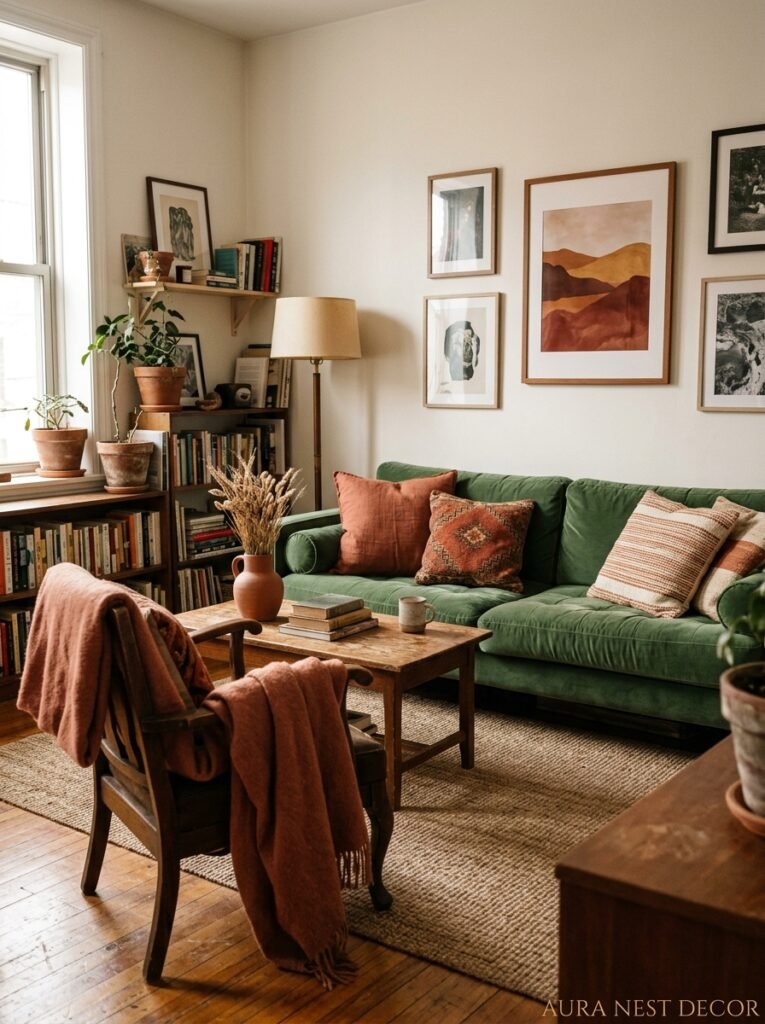
Color is the invisible thread. It’s the thing that makes your brain say yes before it even processes what it’s looking at.
In a modern eclectic space, you don’t pick one color and repeat it robotically across every cushion and curtain. That’s matchy-matchy, not eclectic. Instead, pick two or three colors — one deep anchor, one warm mid-tone, one surprising accent — and let them weave through the room naturally. Maybe the deep color shows up in the sofa fabric AND a small piece of pottery on the shelf AND the binding of a stack of books. None of those things are “matching.” But your eye picks up the echo and feels satisfied.
The accent color is where people chicken out, and I get it. But honestly, committing to something unexpected — a dusty terracotta, a deep teal, a faded olive — is exactly what gives eclectic rooms their personality. Neutrals alone make a room feel like it’s waiting to get dressed.
Not gonna lie, I’ve seen so many “eclectic” mood boards online that are just beige in different finishes. That’s not eclectic. That’s beige. Don’t be afraid of the accent. It doesn’t have to be everywhere — even three or four appearances is enough to make it read as intentional.
Side note — if you’re working with an existing sofa in a color you can’t change, start your palette there. Work outward. It’s actually easier to build around a constraint than to start from scratch.
3. The Furniture Mix That Actually Works (and the One That Doesn’t)
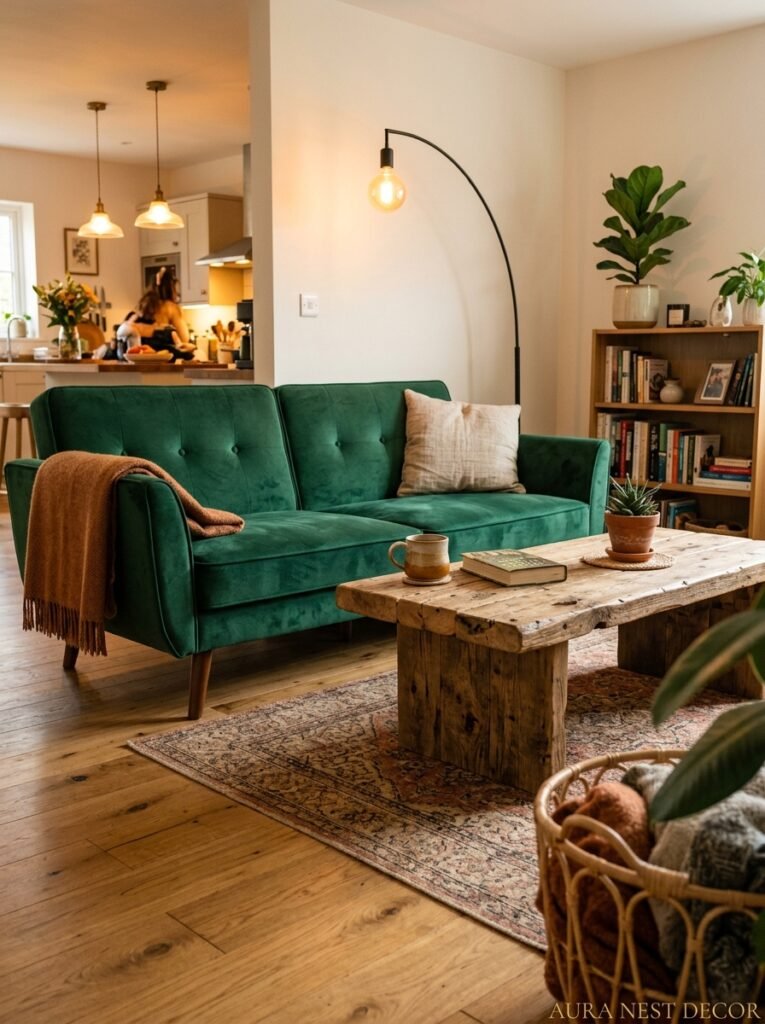
Let’s be specific here because “mix old and new” is advice so vague it’s basically useless.
What actually works: pairing pieces with different textures but similar visual weight. A chunky wooden coffee table and a slim-legged velvet sofa look strange together because one is heavy and the other is light. But a solid wooden coffee table with a deep, low-profile curved sofa? Both carry visual weight. They feel like they’re in the same room.
Periods can be mixed freely — Victorian side table next to a contemporary floor lamp, totally fine. What you’re managing is proportion and weight, not era.
The mix that doesn’t work is what I call “showroom random.” That’s when someone buys five pieces they each loved in isolation and puts them together without thinking about how they talk to each other. A spindly antique chair next to a massive oversized sectional next to a glass console table that’s basically invisible. Each piece is individually nice. Together they’re just loud.
Here’s a rough test I use: squint at the room. Really squint. Are the shapes and masses roughly balanced across the space? Not symmetrical — balanced. There’s a big difference. Symmetry is formal. Balance is eclectic.
4. Vintage Finds vs. High Street — How to Shop for an Eclectic Room Without Losing Your Mind
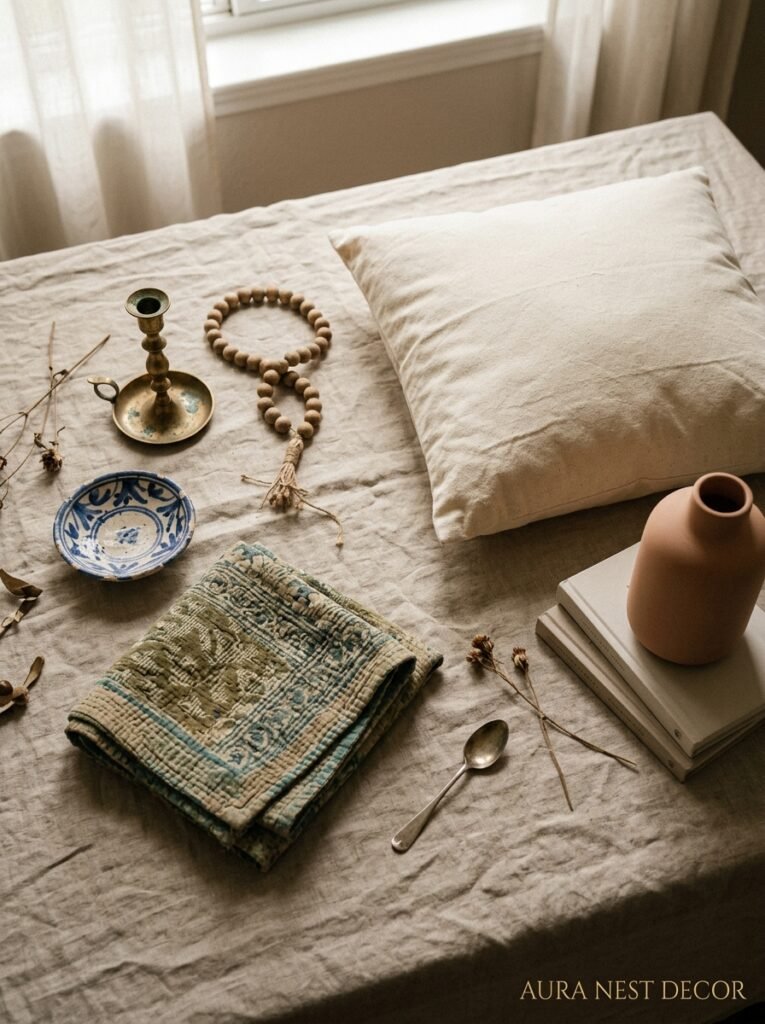
The honest answer is: you need both. All vintage and the room starts to feel like a museum. All high street and it looks like a showroom floor. The tension between the two is actually what creates that “lived in but considered” quality.
A decent starting point — anchor pieces like sofas and large rugs can come from anywhere. They’re going to be in the room a long time, so invest accordingly. But the smaller moments? Lamps, cushions, side tables, decorative objects — that’s where vintage absolutely sings. A £4 ceramic vase from a car boot sale can do more for a room than a £40 version from a chain store. I’d argue it does MORE, because it has a story on it.
“The most interesting rooms aren’t the most expensive ones. They’re the ones where something clearly has a history.”
In the US, estate sales and Facebook Marketplace are criminally underrated. In the UK, charity shops and car boot sales are genuinely extraordinary if you’re patient. I’ve found things I’d never find in any shop — things that don’t look like anything else, which is exactly what eclectic needs.
Don’t overlook your own house, either. That old wooden crate in the garage. Your grandmother’s side table that’s been in storage. Things that already have a relationship with you carry a different energy. And honestly, they’re usually really beautiful.
5. The Rug Rule That Nobody Talks About Enough
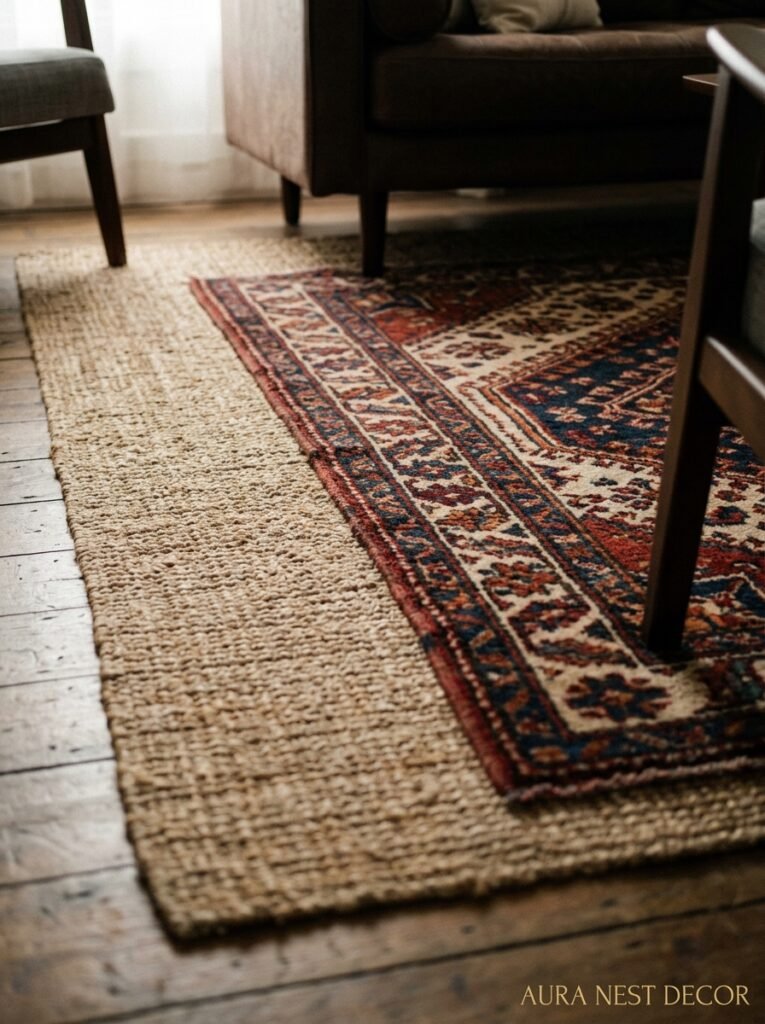
Your rug is either the foundation of the room or the afterthought. There’s no in between.
Most people buy a rug that’s too small. Way too small. A rug that only fits under the coffee table with a little strip on either side looks like a place mat in the middle of your living room. The front legs of your sofa should be ON the rug. Ideally all four legs of everything are on it, but at minimum, the front legs. This is non-negotiable in my opinion.
In a modern eclectic room, the rug is often doing the heaviest lifting in terms of pulling the aesthetic together. A good eclectic rug has some visual complexity — a pattern, some texture, a mix of colors — but it shouldn’t compete with everything else. Think of it as a quiet foundation with personality, not the loudest thing in the room.
Geometric patterns work brilliantly with organic, curved furniture. Faded Persian or Turkish-style rugs work beautifully under clean-lined contemporary pieces. That contrast thing again. You’re not supposed to match the rug to the sofa. You’re supposed to let them have a conversation.
And if you’re in a smaller space, a lighter rug reads as more floor, which reads as more space. Dark rugs anchor and ground — great for a larger room that needs to feel cozier.
6. Lighting: The Reason Your Room Looks Flat and You Don’t Know Why
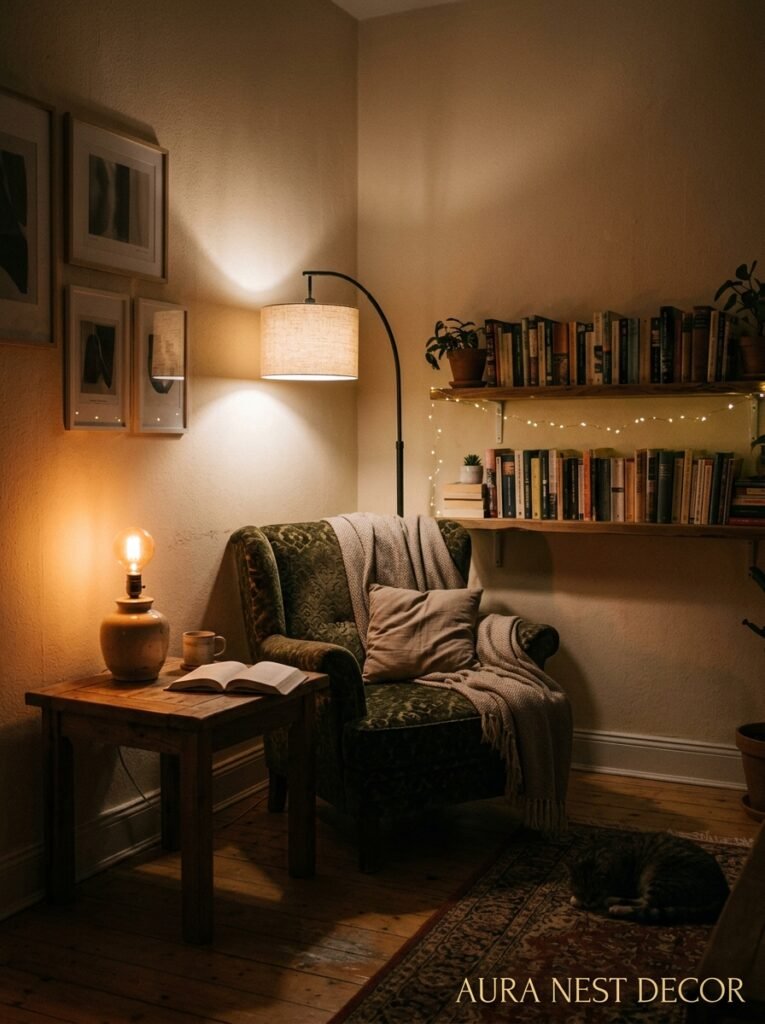
Nobody talks enough about how much lighting is making or breaking eclectic spaces on a daily basis. A beautiful room lit by a single overhead fixture looks like a dental waiting room. That’s just the reality.
Modern eclectic rooms thrive on layered light — and I mean that quite literally in terms of height. Something low (table lamps, floor lamps angled down), something mid (wall sconces, picture lights), and something ambient for when you actually need to see. The overhead can stay, but it should almost never be the main source. It’s background.
Edison bulbs have had their moment and they’re still good — that amber glow at around 7pm when everything feels warm and soft and you don’t want the night to end. But color temperature matters across all bulbs. Warm white (around 2700K) is almost always the right call for a living room. Cool light is clinical. It fights the cozy layered aesthetic you’re trying to build.
Lamps in an eclectic room should not match. At all. A ceramic table lamp on one side, a tall arching floor lamp on the other, a clip-on reading light tucked in somewhere — that variation is intentional. It adds to the “collected over time” story that eclectic rooms tell.
7. Art Walls Without the Anxiety
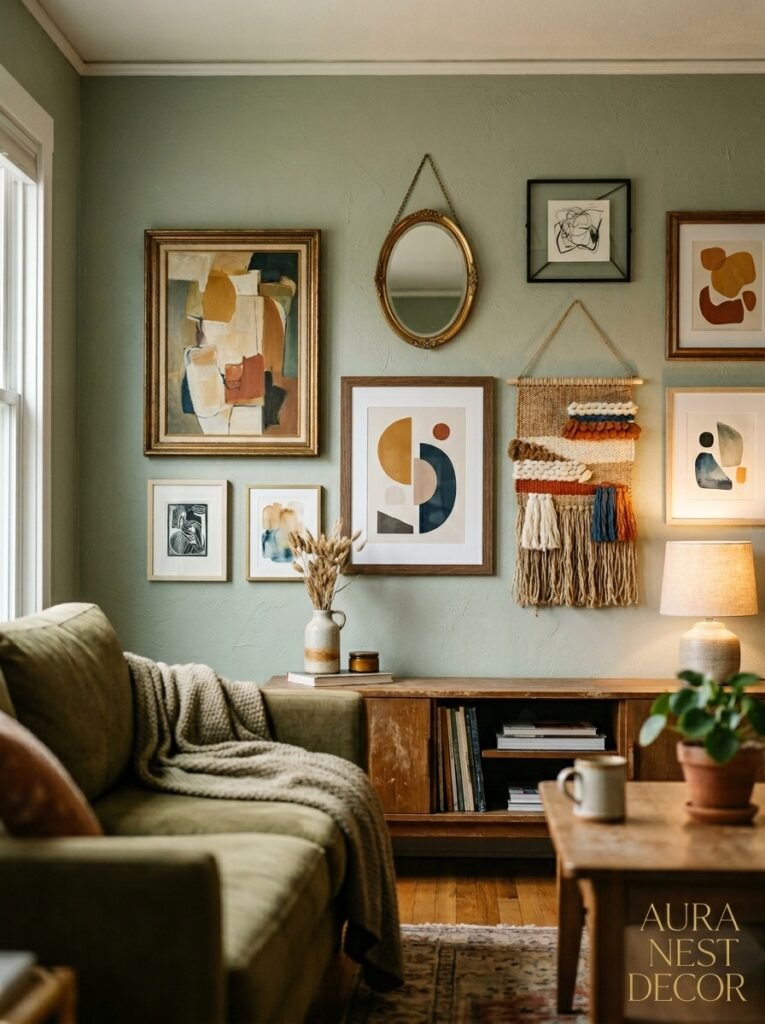
Gallery walls have a reputation for being stressful to execute and I think that’s because people try to plan them perfectly on paper first. Don’t do that. Or at least — don’t only do that.
Lay everything on the floor first. Move things around until the grouping feels right — not perfectly balanced, but interesting. Wider spacing between some pieces, tighter elsewhere. Mix frame sizes dramatically. Don’t use the same frame finish for everything. The variation is the point.
“A gallery wall should look like it grew over time. Because the best ones did.”
In a modern eclectic living room, art doesn’t have to be fine art. A vintage botanical print in a modern black frame. A child’s drawing matted and framed properly. A piece of fabric stretched over a canvas. A decorative mirror. Text in a language you love. Mix it up completely. The unifying element shouldn’t be what the art IS — it should be what it means to you, or how it makes you feel, or that the colors it carries somewhere echo colors that appear elsewhere in the room.
One thing that always works: anchor the wall with one large piece or a pair, then build outward. Starting with small pieces and working up is harder and often looks scattered.
8. Plants: the Cheat Code Everyone’s Already Using, But Not Like This
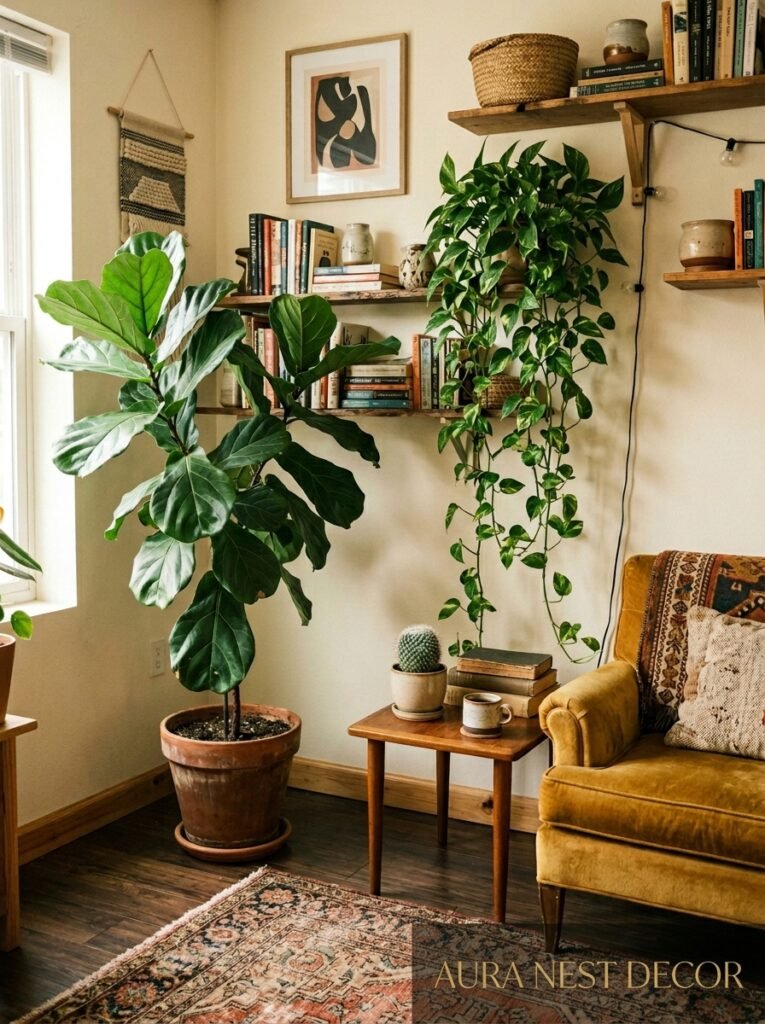
Yes, plants. You’ve heard it. But I want to be specific because there’s a way to use plants in an eclectic room that feels considered, and a way that just feels like you have a lot of plants.
It’s about scale contrast. A massive fiddle-leaf fig or a sprawling monstera in the corner of a room creates an anchor — something that gives the eye a natural resting place. Then smaller plants can appear at different heights elsewhere, on shelves, on window sills, maybe a trailing pothos coming over the edge of a high shelf. It’s not about number of plants. It’s about where they land and how big they are relative to their spot.
Pots matter more than people think. Terracotta is having such a moment right now and genuinely it looks good in nearly any eclectic palette. Aged ceramic, woven baskets as pot covers, even a nice vintage tin. The pot is a design decision. Don’t buy the plastic nursery pot and forget about it.
9. The Small Details That Make a Room Feel Curated, Not Cluttered
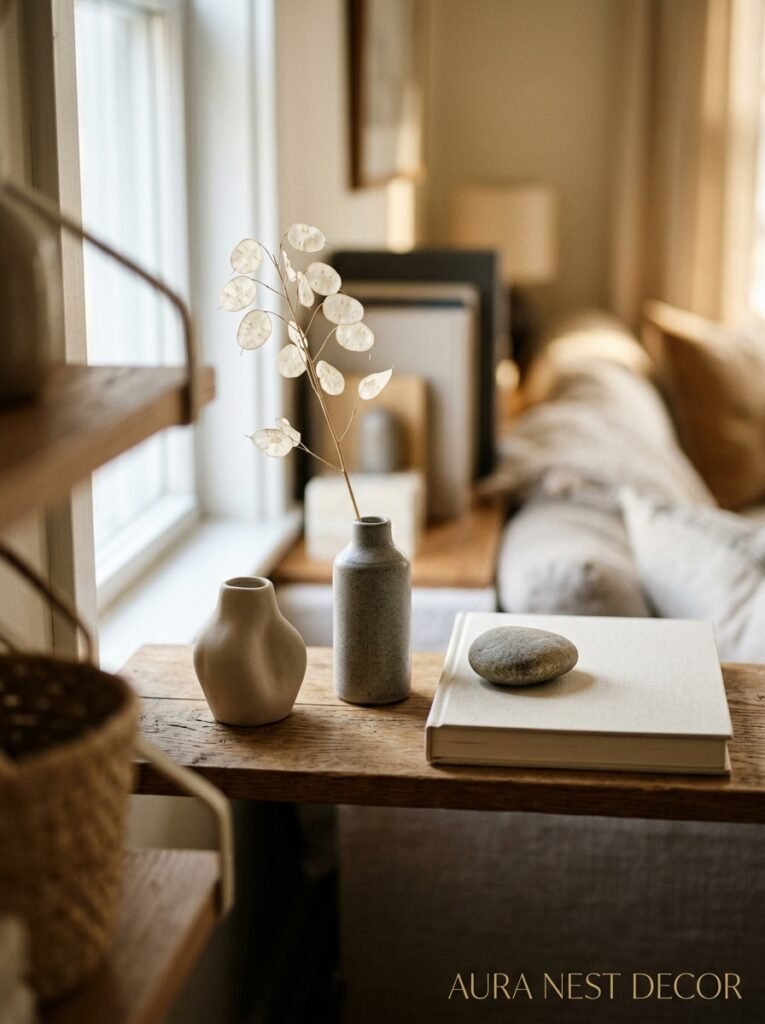
Books. Stacked horizontally, not just upright in a row. Spine color grouped loosely, or deliberately mixed — either works, but randomly shoved in doesn’t. A stack of three or four books with a small object on top is one of those little styling moments that makes a bookshelf feel alive.
Candles — lit, not just displayed. A room that smells good is doing something for you that no amount of styling can replicate. But also wax-dripped candles, used ones, candles with character. Not a row of pristine untouched pillars.
Objects grouped in odd numbers. Three, five, seven. Even numbers feel commercial. Odd numbers feel human and collected. I don’t know why this works but it does, every single time.
Tactile variety at table level — something smooth next to something rough next to something soft. Your hand wants to touch things in a good room. That’s actually a sign you’ve done it right.
10. The Common Mistakes That Make Eclectic Look “Messy” Instead of “Intentional”
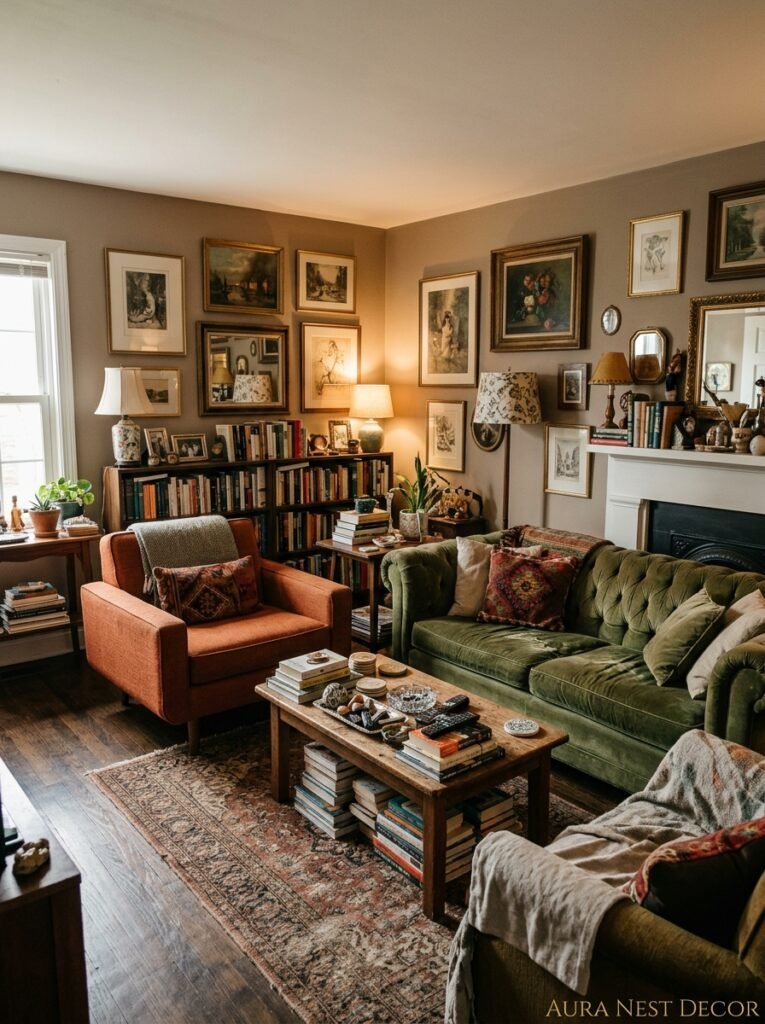
Too many focal points. If everything is trying to be the most interesting thing in the room, nothing is. Give one or two things space to breathe and be the statement. Let the rest support.
Ignoring scale. A room full of small things reads as fussy. A room with some genuinely large elements — a big piece of art, a substantial rug, a tall lamp — feels confident. Scale up more than you think you need to.
Buying things because they’re “eclectic-looking” rather than because you actually love them. You can always tell. There’s a quality to things bought for aesthetic performance versus things that actually mean something to the person who owns them. Rooms feel real when the objects are real.
And the wall color. If you’ve got a genuinely eclectic room and you’re still painting the walls the palest possible gray — I’d challenge you on that. Not every room needs to go dark. But a warmer white, a soft clay, a muted sage — something with a tiny bit of personality in the paint goes a long way.
11. How British and American Eclectic Tastes Are Different (and Where They Overlap)
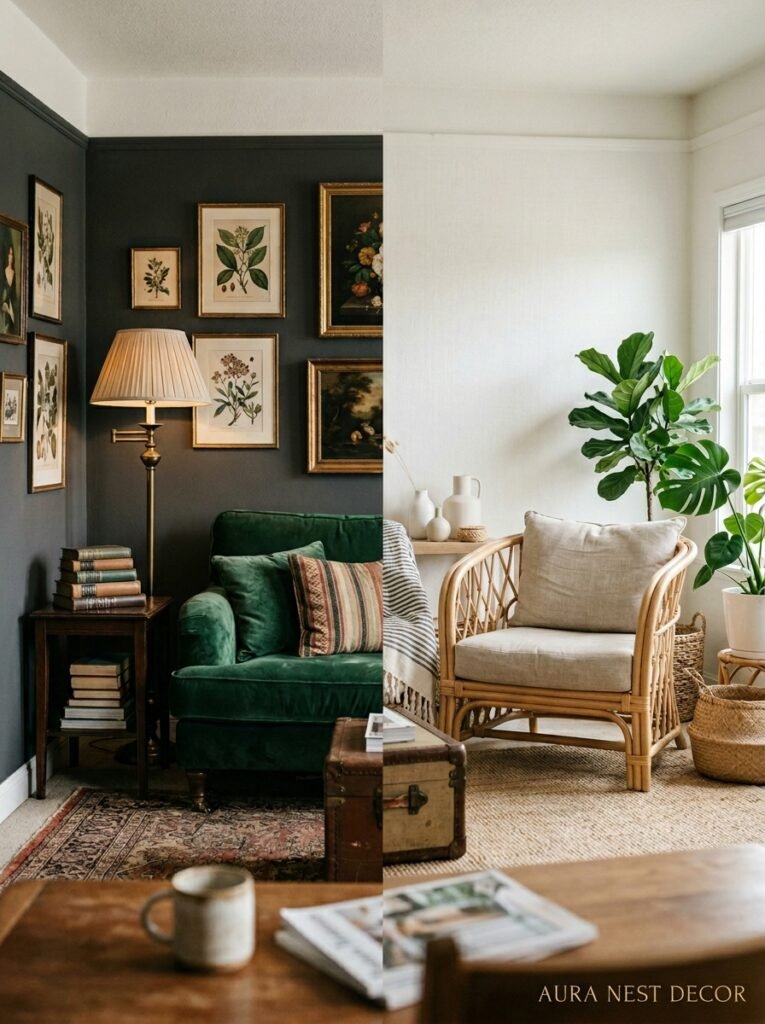
Not gonna lie, there’s a real difference. American eclectic tends to lean a little larger — bigger gestures, bigger furniture, bolder color accents, more maximalist leanings in the best cases. There’s less fear of going big.
British eclectic has a sort of… worn quality that’s actually its superpower. Layered textiles, slightly faded colors, things that look like they’ve been in the family for a while. The British are better at mixing genuinely old pieces with modern ones and making it feel natural. That patina thing — Americans are starting to appreciate it, but in the UK it’s kind of just assumed.
Where they absolutely overlap: the love of meaningful objects, the importance of comfort alongside aesthetics, and an increasing appetite for colors that aren’t just white and gray. Both have moved away from the sterile minimalism of the 2010s and toward something warmer and more personal. That’s the cultural moment we’re in right now, on both sides of the Atlantic.
12. The Mood Your Living Room Should Have at Night vs. During the Day
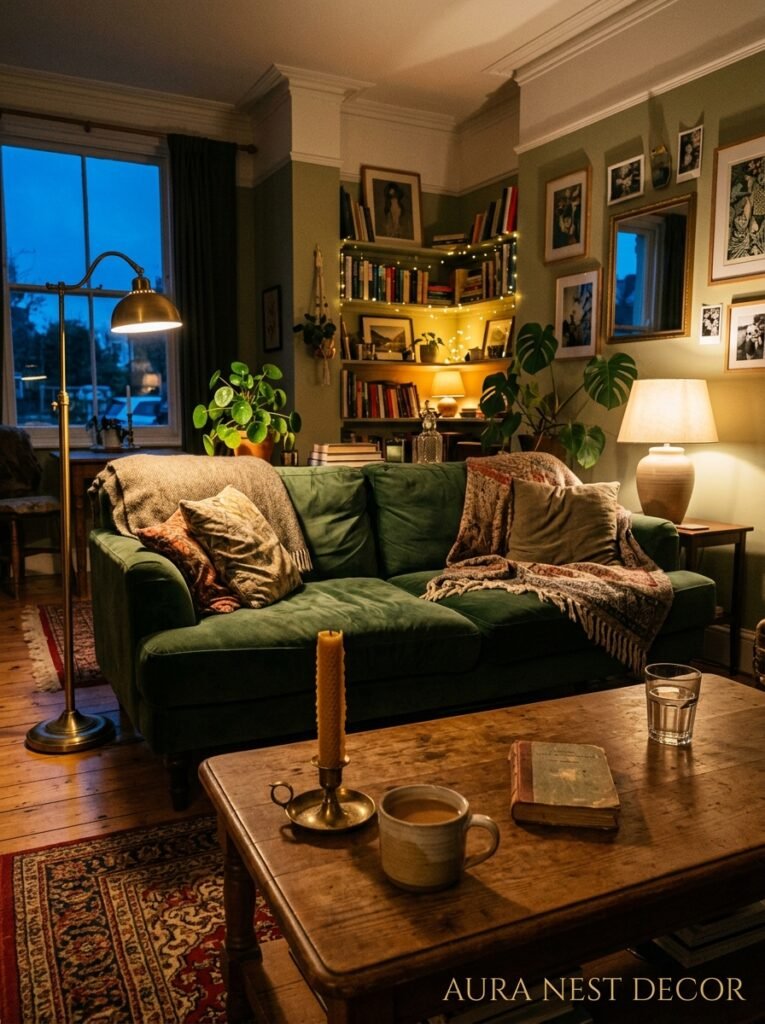
This one gets ignored and it really shouldn’t. A room that’s designed only for how it looks in daylight is missing half its life.
Daytime in an eclectic living room is about texture and natural light. How do things look when sunlight catches the weave of a linen cushion, or moves across the surface of a wooden shelf? Natural light is honest. Textures show up clearly. Colors read true.
Nighttime is completely different energy. This is when you want pools of warm light rather than full overhead. When the candles come on and the Edison bulbs do their thing and the room gets smaller and closer. Certain colors — deep blues, warm terracottas, rich greens — look completely different by lamplight. Some rooms are actually MORE beautiful at night.
If you’ve never stood in your living room at 9pm with just the lamps on and assessed it properly — do that tonight. It will tell you things about what’s working and what isn’t that a thousand daytime photos can’t.
—
❓ FAQ
Q: How many styles can I actually mix before it looks like a mess? A: There’s no firm number, but the more styles you’re mixing, the more tightly you need to control color and visual weight. Two or three distinct style influences with a consistent palette is usually the sweet spot. Beyond that you need a really clear anchor — like a dominant rug or a strong wall color — to pull it together.
Q: I’m renting and can’t paint the walls — can I still do modern eclectic? A: Absolutely yes, and actually textiles do a huge amount of the work here. Rich curtains that go ceiling to floor, a great rug, layered cushions, and enough art on the walls will change the feeling of a room dramatically even if the walls themselves are stuck at rental-magnolia. The color lives in everything else.
Q: Is modern eclectic a style that dates quickly? A: It tends to age really well because it’s personal rather than trend-led. What dates quickly is trend-chasing disguised as eclectic — buying whatever’s on Pinterest right now and calling it collected. Real eclectic rooms are slow-built and they keep getting better as you add things over time.
—
💭 Final Thoughts
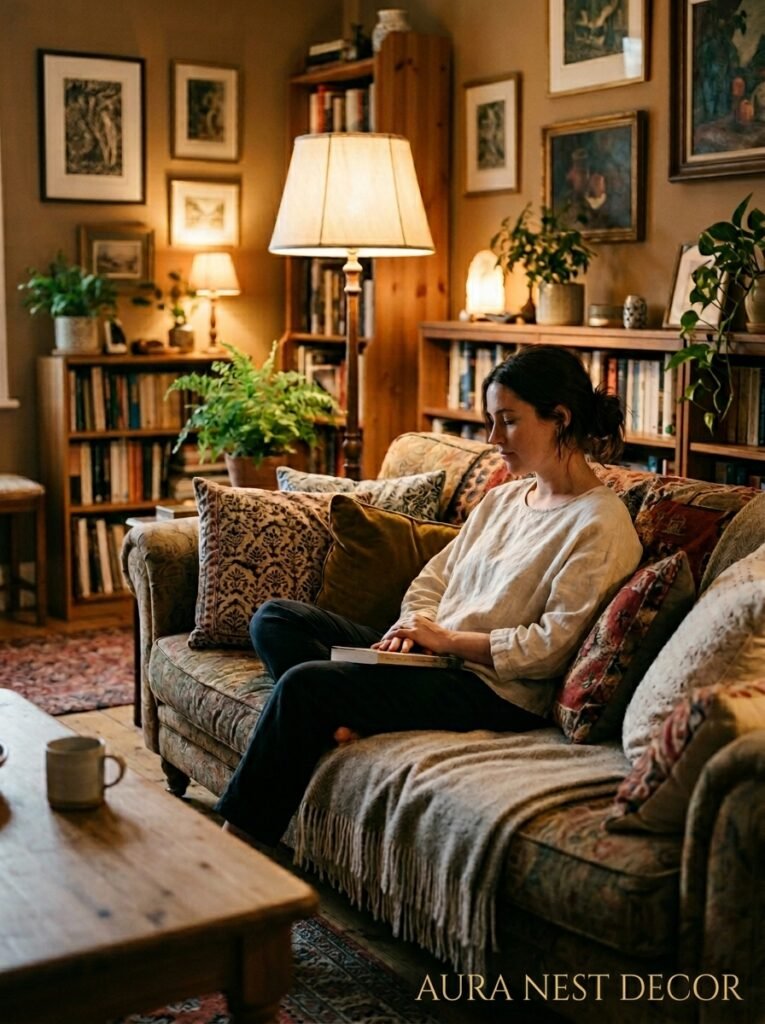
Modern eclectic isn’t a look you buy all at once. It’s something that accumulates — slowly, stubbornly, wonderfully — until you walk into your own living room one day and realize it genuinely looks like nowhere else on earth. That’s the goal. Not a showroom, not a Pinterest board made physical, but something that couldn’t have been made by anyone but you. So what’s the one thing already in your home that you’ve been afraid to put on display?