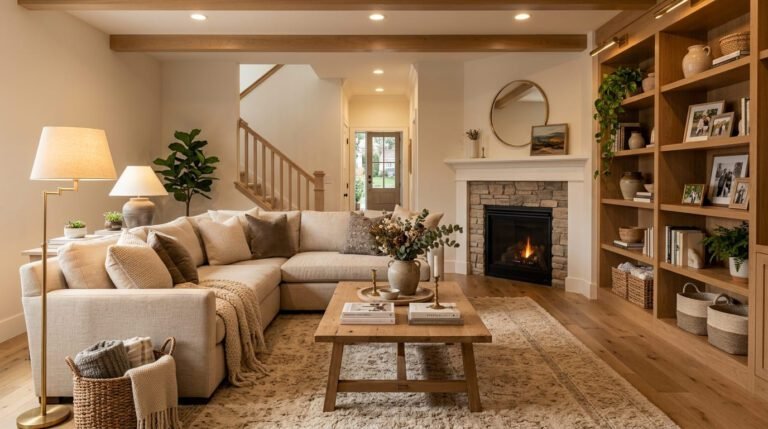
The Living Room Mirror Trick That Makes Designers’ Homes Look Twice as Good (and Twice as Big)
You walk into a room and something just works. The light feels softer, the space feels bigger, there’s a kind of effortless depth that you can’t quite put your finger on. Nine times out of ten? There’s a mirror doing something clever on that wall.
Mirrors are one of those things that sounds simple until you really start thinking about them — and then suddenly you’re an hour deep into Pinterest at midnight trying to figure out why yours looks wrong and everyone else’s looks right.
—
1. Why Most Living Room Mirrors Look Like an Afterthought (And How to Fix That)
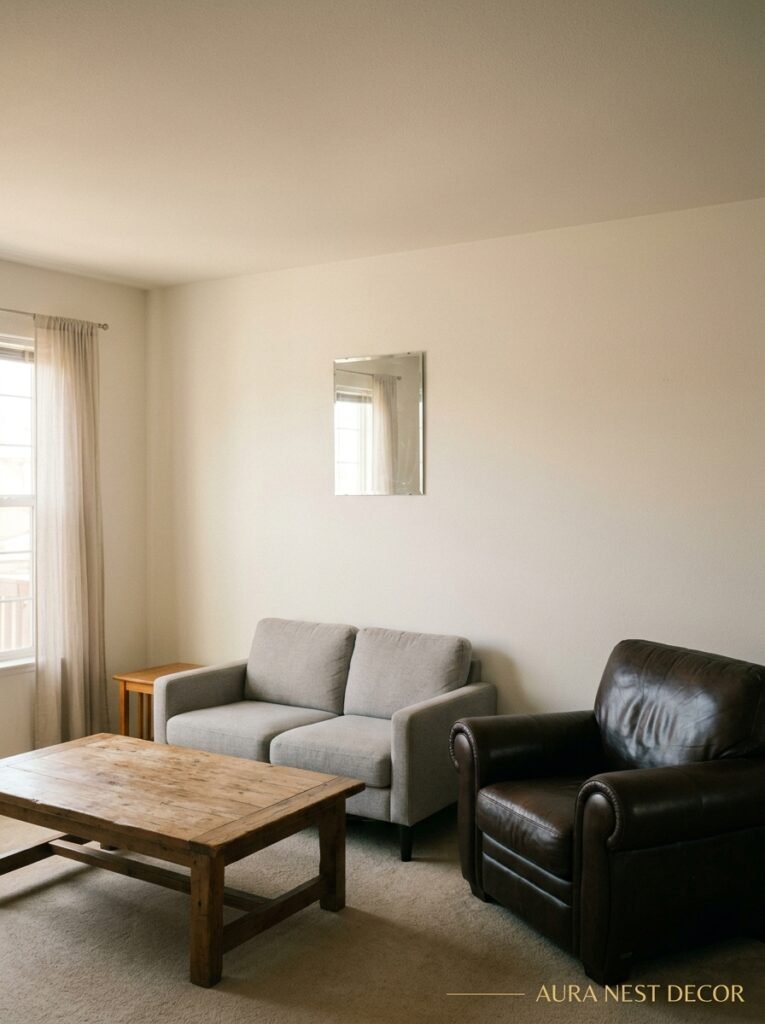
Here’s the thing nobody tells you when you buy a mirror: placement matters more than the mirror itself. You could have the most gorgeous, ornate, vintage-gold-framed piece and it will still look completely wrong if it’s hung at the wrong height, facing the wrong wall, or sitting in visual isolation like it doesn’t know anyone else in the room.
Most people hang their mirror too high. That’s honestly the number one mistake. There’s this instinct to push things up toward the ceiling — maybe to make the room feel taller, maybe because it looked good in the store — but what actually happens is the mirror loses its connection to the furniture below it. It floats. And floating mirrors look like they’re waiting to be moved.
The general rule — and this is one I actually follow — is to hang the center of the mirror at roughly eye level, which for most people is somewhere between 57 and 60 inches from the floor. But honestly, it’s less about the measurement and more about whether it feels anchored. Hang it so it has a conversation with whatever’s beneath it. A console table. A fireplace mantle. A low-slung sofa. Something.
If your mirror currently looks like it wandered in from another room, try dropping it down about three or four inches. I know that sounds small. It’s not.
“A mirror that doesn’t know what it’s reflecting isn’t decorating — it’s just hanging there.”
—
2. The Wall Your Mirror Should Actually Be Facing (It’s Probably Not Where You Think)
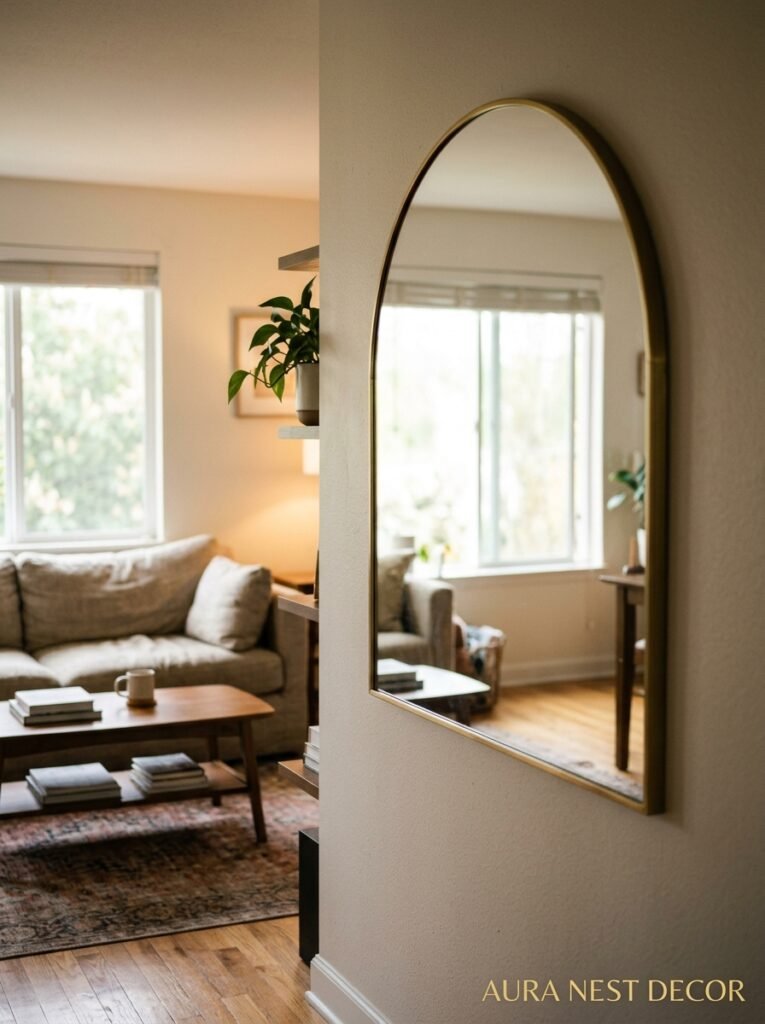
Everyone wants to put the mirror ON the feature wall. And I understand the impulse — you’ve got this beautiful statement piece and you want it front and center. But here’s the thing. A mirror facing a feature wall doesn’t reflect the feature wall. It reflects whatever’s OPPOSITE.
So before you decide where the mirror goes, stand across the room and look at what it would actually show.
Does that wall have gorgeous natural light coming in? Great. Does it have an ugly cable box and a pile of shoes by the door? Less great. A mirror is essentially a window into the rest of your room, and you want that window to show something worth seeing.
The best placement in most living rooms is facing a window or a source of natural light. Not directly opposite — slightly angled, or just enough to catch that light and throw it back into the room. On grey winter days in the UK especially, this is EVERYTHING. You get this diffused, bounced light that makes the whole space feel warmer without a single extra lamp. American homes with south-facing rooms? Same principle applies, it just looks less dramatic because you’re already drowning in sunshine most of the year, lucky you.
—
3. Leaning vs. Hanging — There’s Actually a Right Answer for Your Room
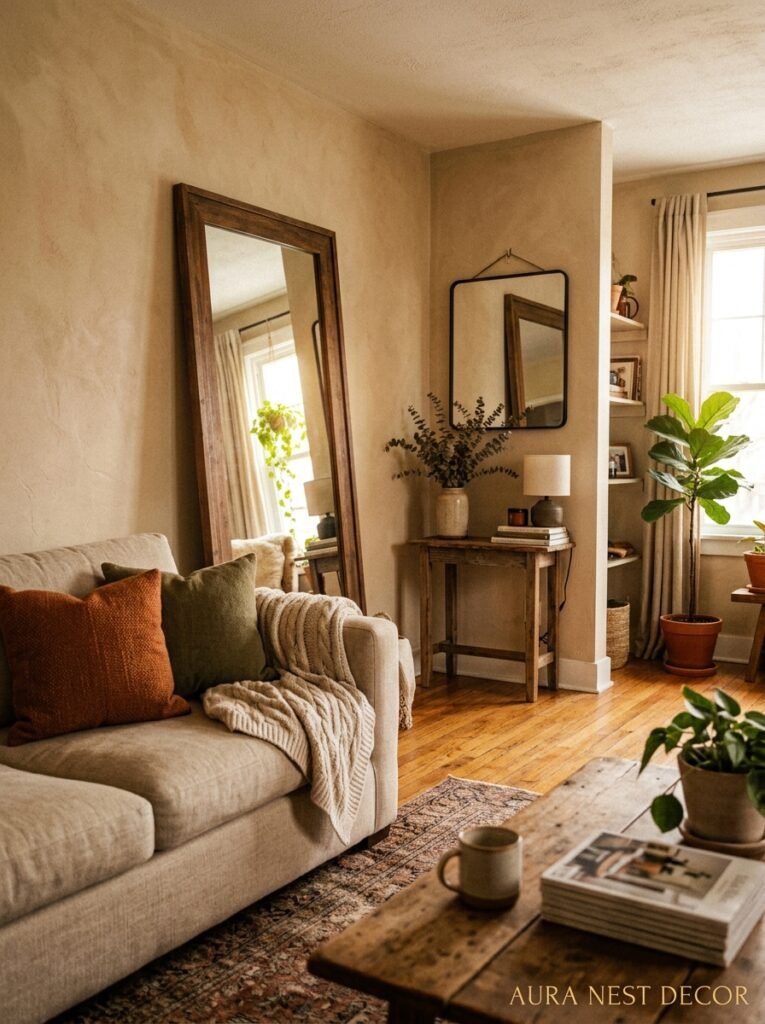
The lean-against-the-wall thing became incredibly popular about five years ago and honestly it’s still everywhere on Pinterest, which is either a sign it’s timeless or a sign we’re all stuck in 2019. I can’t decide.
But lean-vs-hang isn’t just an aesthetic choice. It changes how the mirror functions in the space.
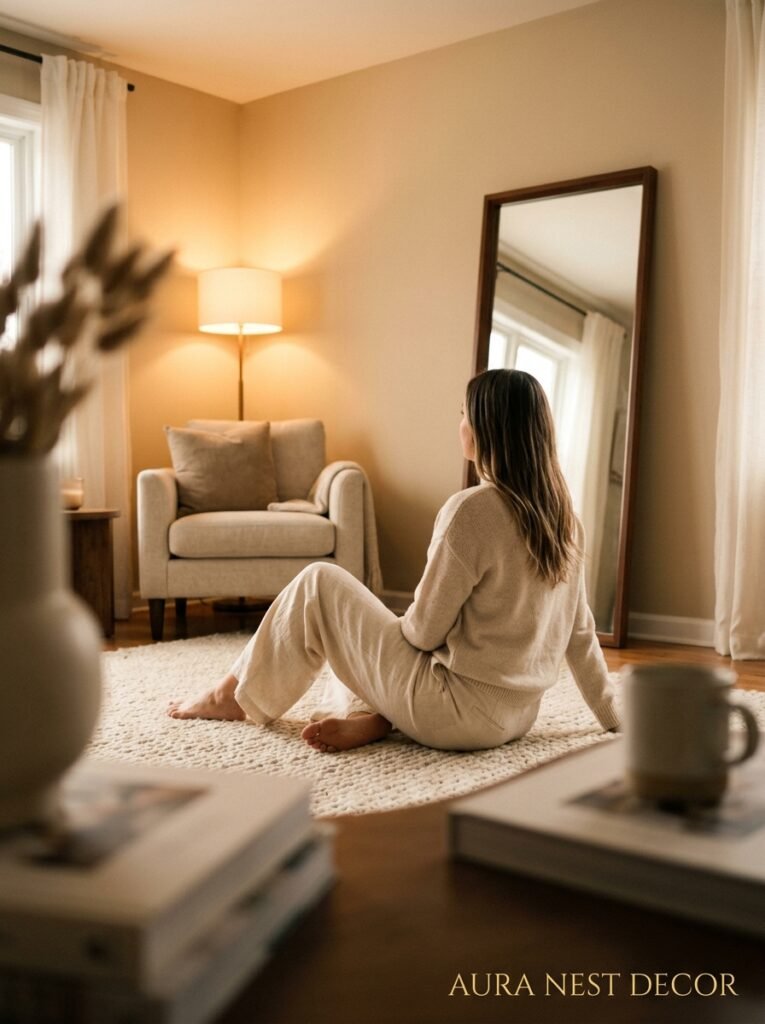
A leaned mirror — propped against a wall, usually on the floor — creates a more casual, lived-in feeling. It’s great for bigger rooms where you want that easy, undone quality. It also tends to reflect more of the room at a wider angle, which can actually be more flattering for showing off a space. If your living room has genuinely beautiful floors (hardwood, a gorgeous rug), a floor-length leaner will show them off in a way a hung mirror never could.
A hung mirror creates formality. Structure. It says this is where I live in a way a leaned mirror can’t quite commit to. And for smaller rooms, that’s usually better — because you want the mirror to feel like a decision, not an accident.
Side note — if you’re going for the lean, make sure the mirror is heavy enough that it isn’t going anywhere. Lightweight frames tip. I learned this the hard way.
—
4. The Size Question Nobody Asks Correctly
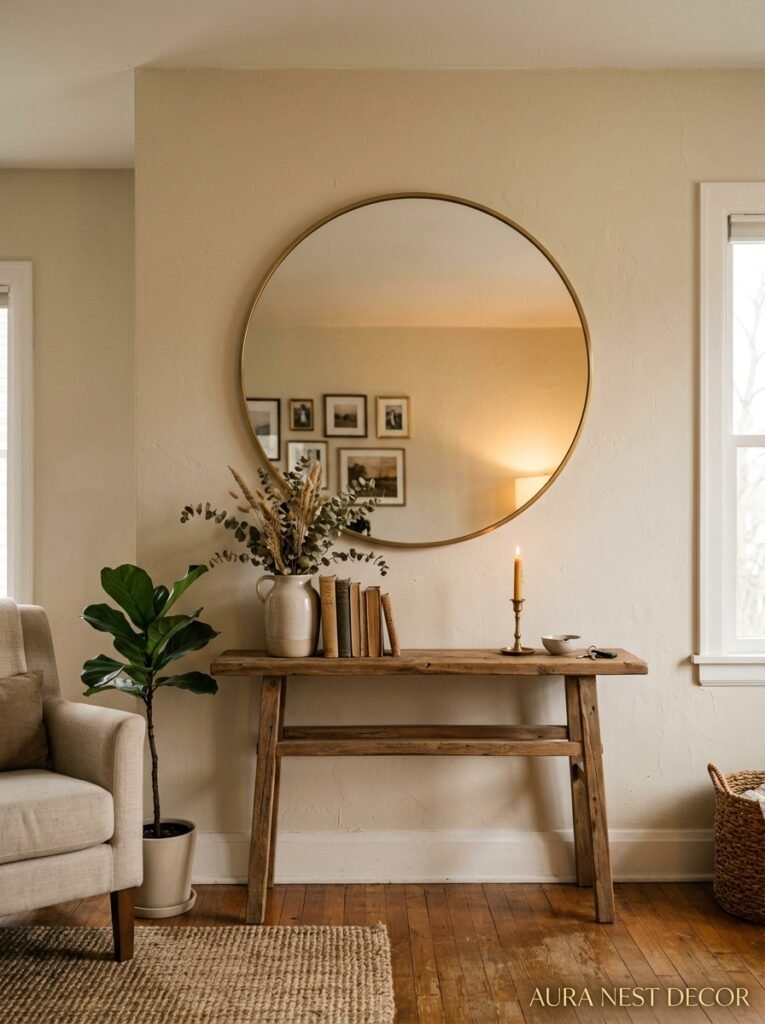
People always ask “what size mirror should I get?” But that’s the wrong question. The right question is: what size relative to what it’s sitting above?
Here’s a rough guide that actually works. If your mirror is going above a piece of furniture — a sofa, a sideboard, a console — it should be roughly two-thirds the width of that piece. Not the full width. Not half. About two-thirds. This creates visual balance without looking like you bought matching furniture.
But there are exceptions. A single, ENORMOUS mirror — oversized, almost floor-to-ceiling — can stand completely alone and doesn’t need the two-thirds rule at all. Those pieces work differently. They don’t need a visual partner. They ARE the room.
For smaller spaces — UK apartments, American city condos, any room where square footage is precious — bigger mirrors almost always work better than smaller ones. This sounds counterintuitive. A giant mirror in a tiny room? Won’t that overwhelm it? No. Here’s why: a small mirror in a small room just makes the small room look like it has a small mirror in it. A large mirror makes the small room feel like it might go on a bit further than it actually does.
“In a small room, a tiny mirror is a decorating mistake. A huge one might be the whole solution.”
—
5. What Your Mirror Frame Is Actually Saying About Your Living Room
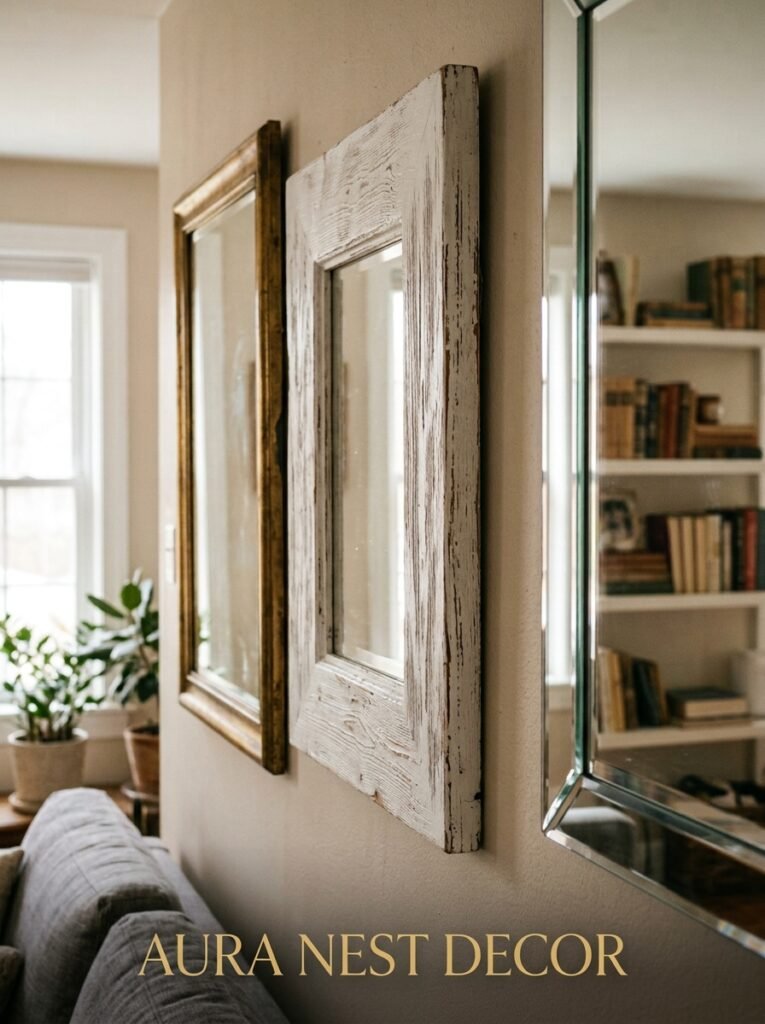
Frames are where people’s personalities come through, and also where people make choices they’ll regret in three years. Not judging — I’ve been there.
Thin black metal frames are everywhere right now and they look clean, graphic, industrial-lite. They work beautifully in modern spaces and contrast well against warm-toned walls.
But chunky vintage gold or brass frames? Those are having a genuinely sustained moment that I don’t see ending anytime soon. Warm metals feel inherently more personal, more collected-over-time, less like you ordered everything from the same store in one afternoon. If your room skews neutral or earthy — lots of warm whites, terracotta, natural linen — a gold or brass frame will feel like it grew there.
Ornate carved wood frames, especially white or off-white, lean more traditional. They’re perfect for British period properties — Victorian terraces, Edwardian semis, anything with original cornicing. In those spaces they feel correct. In a contemporary open-plan apartment, they can feel like a costume.
And then there’s frameless. Clean-edged, beveled mirrors with no frame at all. These are kind of brilliant in the right space because they don’t ask for attention. The reflection is the whole point.
What you probably shouldn’t do: match your mirror frame exactly to your curtain rod, your coffee table legs, and your lamp bases. Coordination is great. Perfect matching is a little soulless.
—
6. The One Mirror Placement That Stylists Use Constantly and Homeowners Almost Never Try
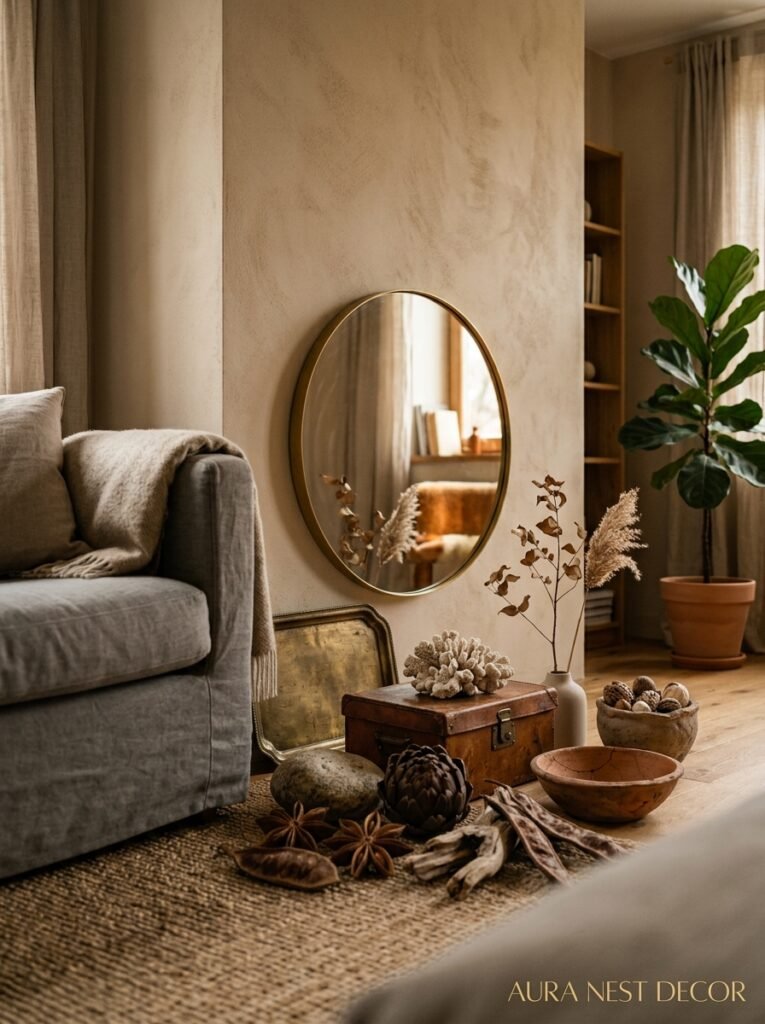
Put it next to a window. Not across from one. Next to one.
I don’t see this nearly enough and I have no idea why because it’s gorgeous. When a mirror sits adjacent to a window — on the same wall, beside the opening — it catches the changing light throughout the day in a way that no other placement does. Morning light will hit it one way, afternoon light another way entirely. The room shifts. It feels alive.
It also avoids the slightly harsh effect you can get when a mirror is DIRECTLY across from a window and essentially just doubles the glare on bright days.
In UK homes especially — where windows are often smaller and light is at more of a premium — this lateral placement can make a room feel sunnier without adding any actual light source. It’s a bit of a magic trick.
—
7. Gallery Walls With Mirrors: The Difference Between Intentional and Chaotic
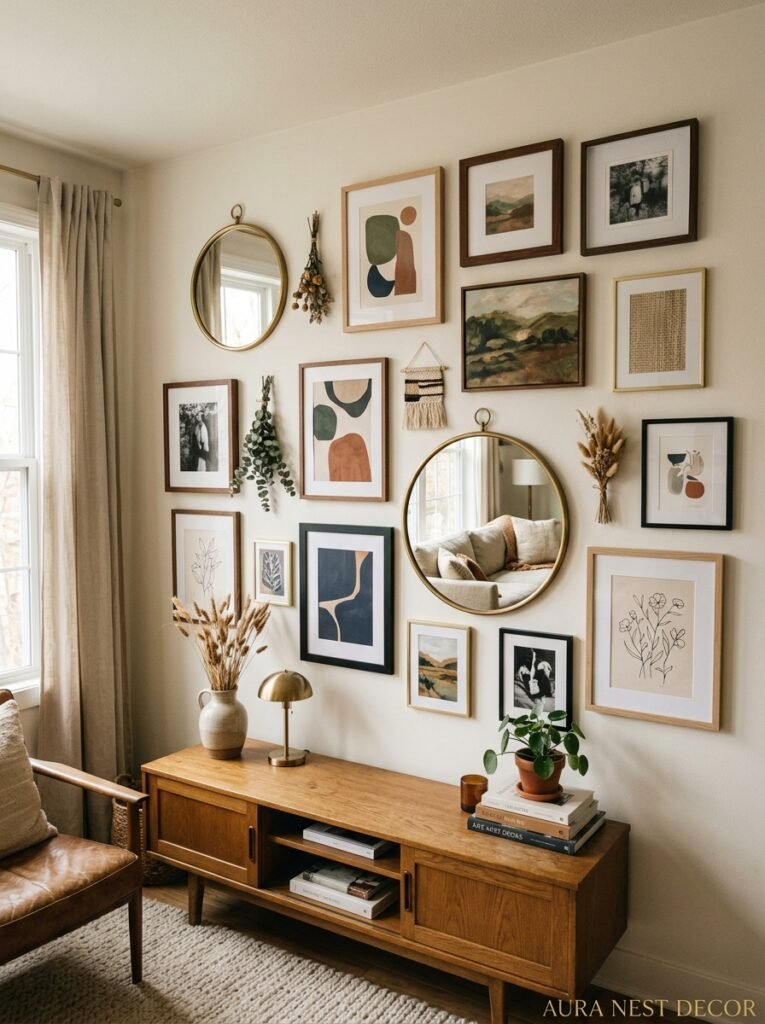
Gallery walls that mix framed art with mirrors are one of my favorite things in a living room. Done well, they look layered and collected and like the room has a history. Done badly, they look like the wall couldn’t make up its mind.
The difference usually comes down to one thing: scale variation.
If all your frames are roughly the same size, the gallery will look flat, even if the content varies. You need at least one anchor piece — something significantly larger than the rest — and the mirror works beautifully in that role because it adds depth as well as visual weight. Put a medium-to-large round or arched mirror as your anchor, then build art around it in smaller frames.
What you DON’T want is multiple mirrors on the same gallery wall. One mirror in a gallery arrangement: intentional. Two mirrors: slightly confused. Three: the wall is having an identity crisis.
Also — odd shapes mixed with rectangular frames always look more interesting. A round mirror with rectangular prints. An arch with squares. The contrast makes it feel curated.
“One mirror in a gallery wall tells a story. Three mirrors just create confusion.”
—
8. Round, Arched, Rectangular — Which Shape Is Actually Right for Which Room
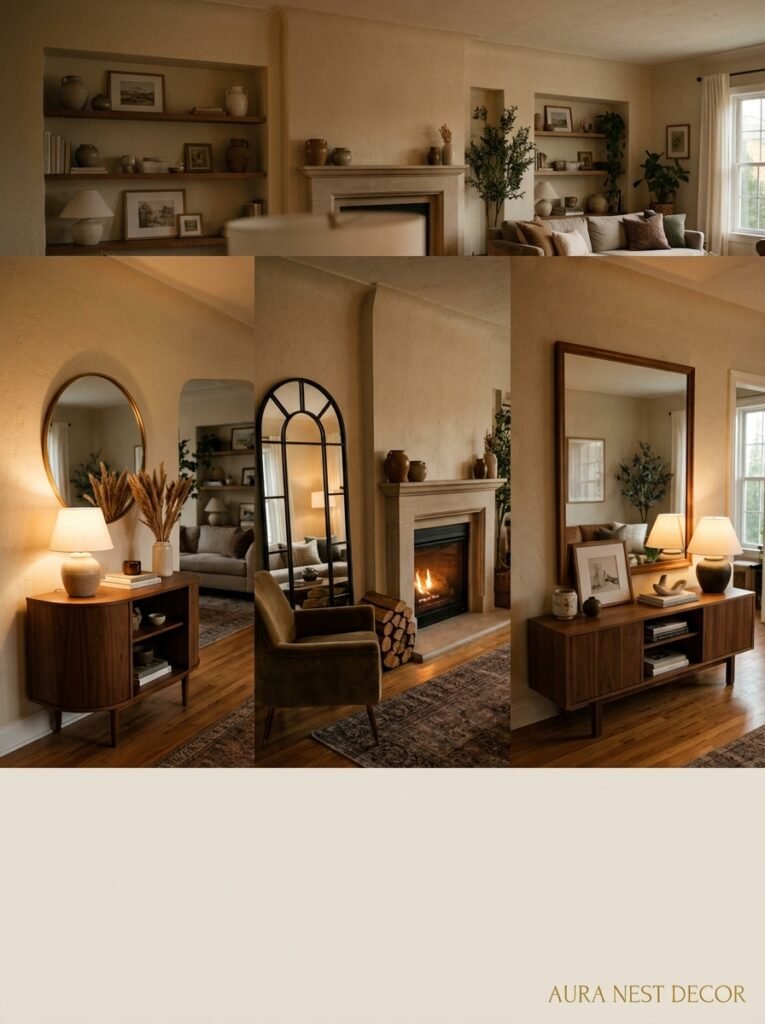
Round mirrors soften a room. Full stop. If your space is very angular — lots of straight lines, sharp corners, geometric furniture — a round mirror breaks that up and adds a little warmth. They’re also forgiving in awkward spaces because they don’t have to align with anything perfectly.
Arched mirrors are having an absolute moment and honestly I’m into it. They’ve got this kind of Georgian-window-meets-modern-minimalism thing going on that works in surprisingly many spaces. They’re particularly good in rooms with lower ceilings because the arc draws the eye upward without being as imposing as a full rectangular mirror.
Rectangular mirrors are the classics. They’re more versatile than any other shape and they’ll outlast every trend. Horizontal rectangles feel grounded and work well above furniture. Vertical rectangles feel taller and are great for making a ceiling feel higher.
What I’d avoid: overly ornate shapes with lots of cutouts or unusual angles. They’re striking in person and then somehow exhausting to live with.
—
9. The Colors and Walls Where Mirrors Completely Transform
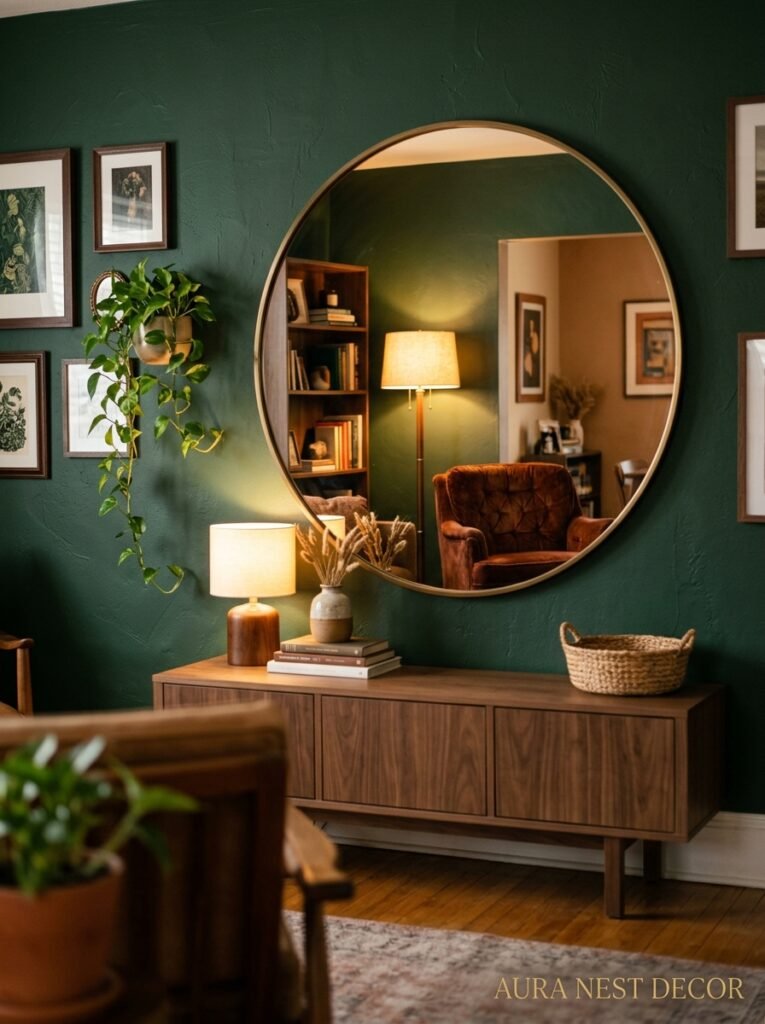
Dark walls and mirrors are a combination that’s genuinely underused. There’s this assumption that dark walls make a room feel smaller, so a mirror would be a fix — but the truth is dark walls with the RIGHT mirror placement make a room feel deeply atmospheric and rich. The reflection in a mirror against a dark wall looks almost jewel-like. Deep green, navy, charcoal — any of them.
Light walls obviously work too, but in a different way. Against a pale wall, a mirror becomes more about the frame than the reflection. The frame is the art. So choose accordingly.
One thing I’d push back on: the idea that you need to match your mirror to your “decor style.” Mixing periods is one of the best things you can do in a living room. A very traditional ornate gold mirror in a clean, contemporary room? Intentional tension. It looks collected, personal, like someone with taste made a considered choice.
—
10. Styling What Goes in Front of the Mirror (Because the Reflection Matters Too)
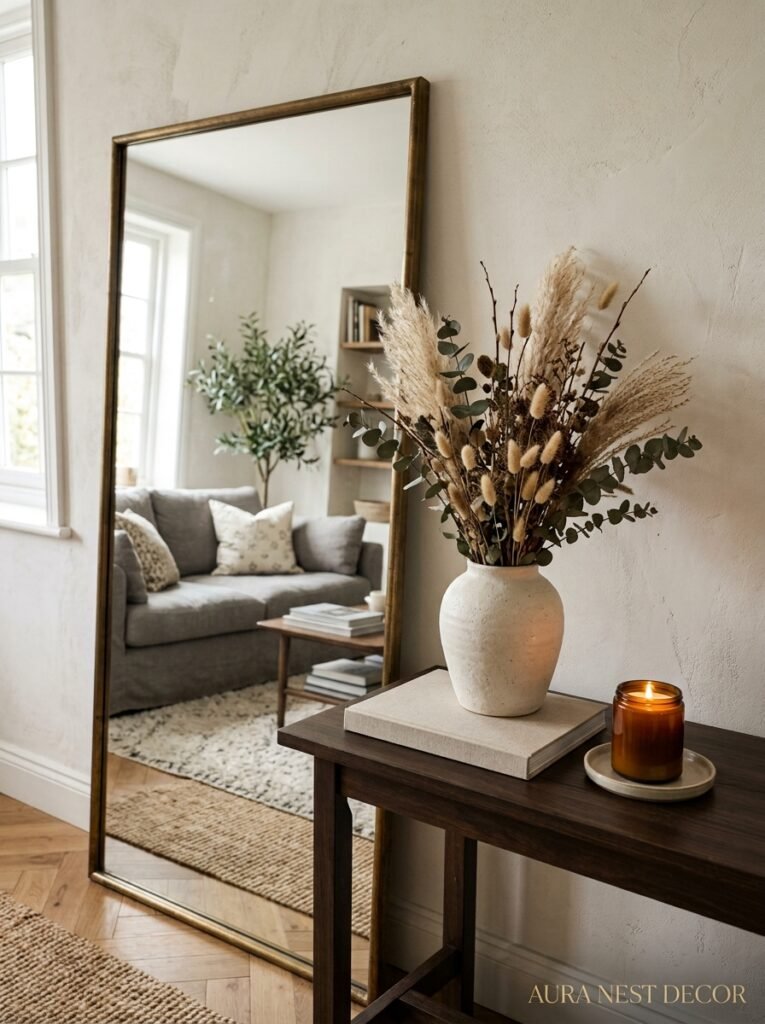
Your mirror reflects whatever is in the room. Which means you should style the space the mirror will SHOW, not just the mirror itself.
A console table in front of or below a mirror is the classic setup. And what goes on that console table is essentially set dressing for your mirror. Keep it considered — a lamp, a vase, maybe a small stack of books — so the reflection feels styled rather than cluttered.
Candles on a mantle in front of a mirror are one of the great atmospheric tricks of home design. When the candles are lit, the mirror doubles them, doubles the light, creates this layered glow that no amount of overhead lighting can replicate. If your living room has a fireplace with a mantle mirror and you’re not doing candles, you’re leaving the best version of that room on the table.
—
11. The Mirror Mistake That Even Experienced Decorators Make
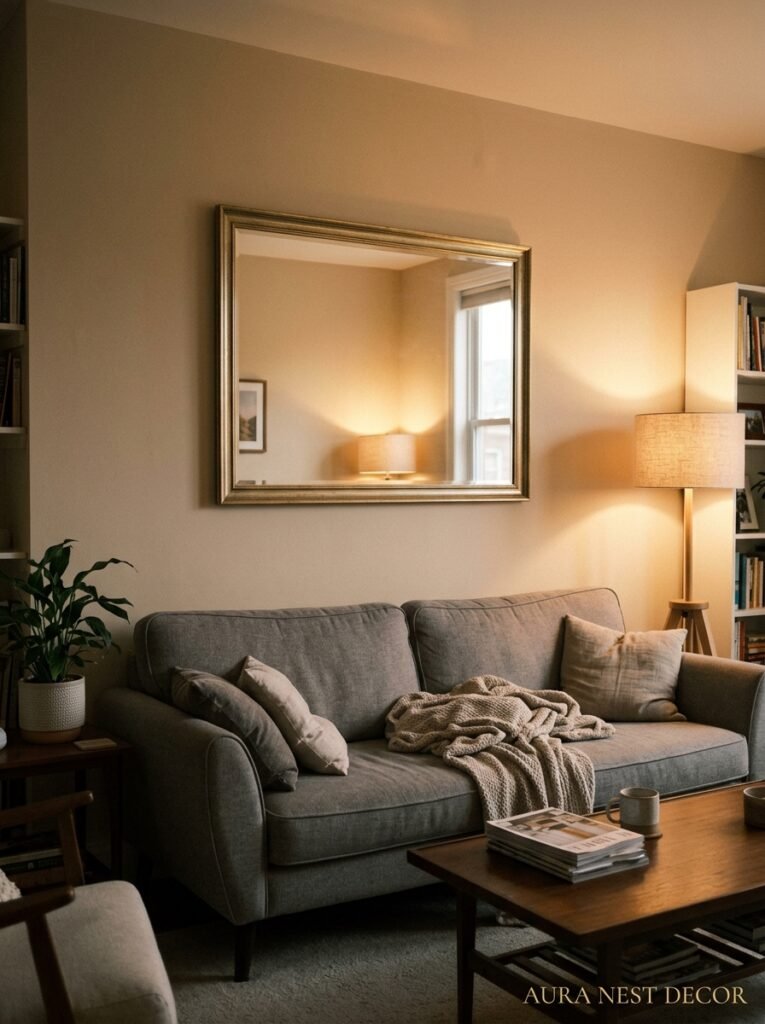
Hanging a mirror where it reflects something unflattering, then doing nothing about it.
This sounds obvious. But it’s incredibly common. The mirror goes up, it reflects the ugly ceiling fan, or the messy entryway glimpsed through a doorway, or a window looking directly into a neighbor’s fence.
Before you commit to a placement, hold the mirror up — get someone to help you hold it at the right height — and look at what it actually shows. Walk around, look from different angles. The reflection that matters most is the one you’ll see most often: probably from your main seating position on the sofa.
From your sofa, your mirror should show something good. Light. Architecture. A pretty corner of the room. If it doesn’t, move it until it does.
—
12. The Mirror That Always Gets Saved to Pinterest (and Why It Works Every Time)
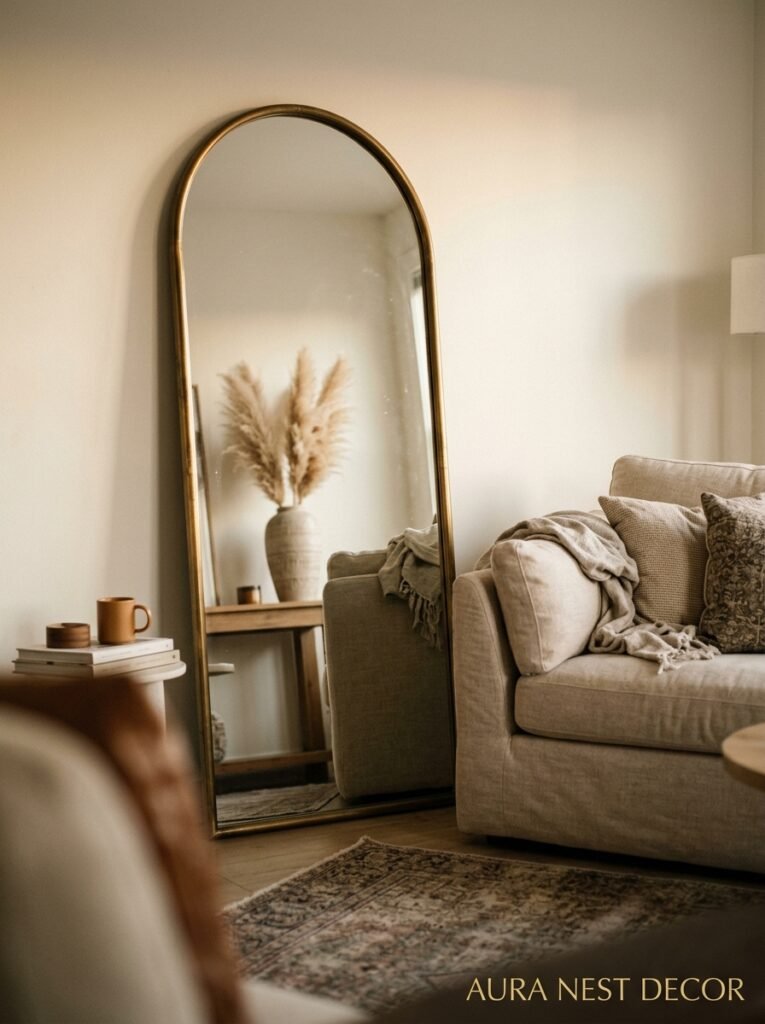
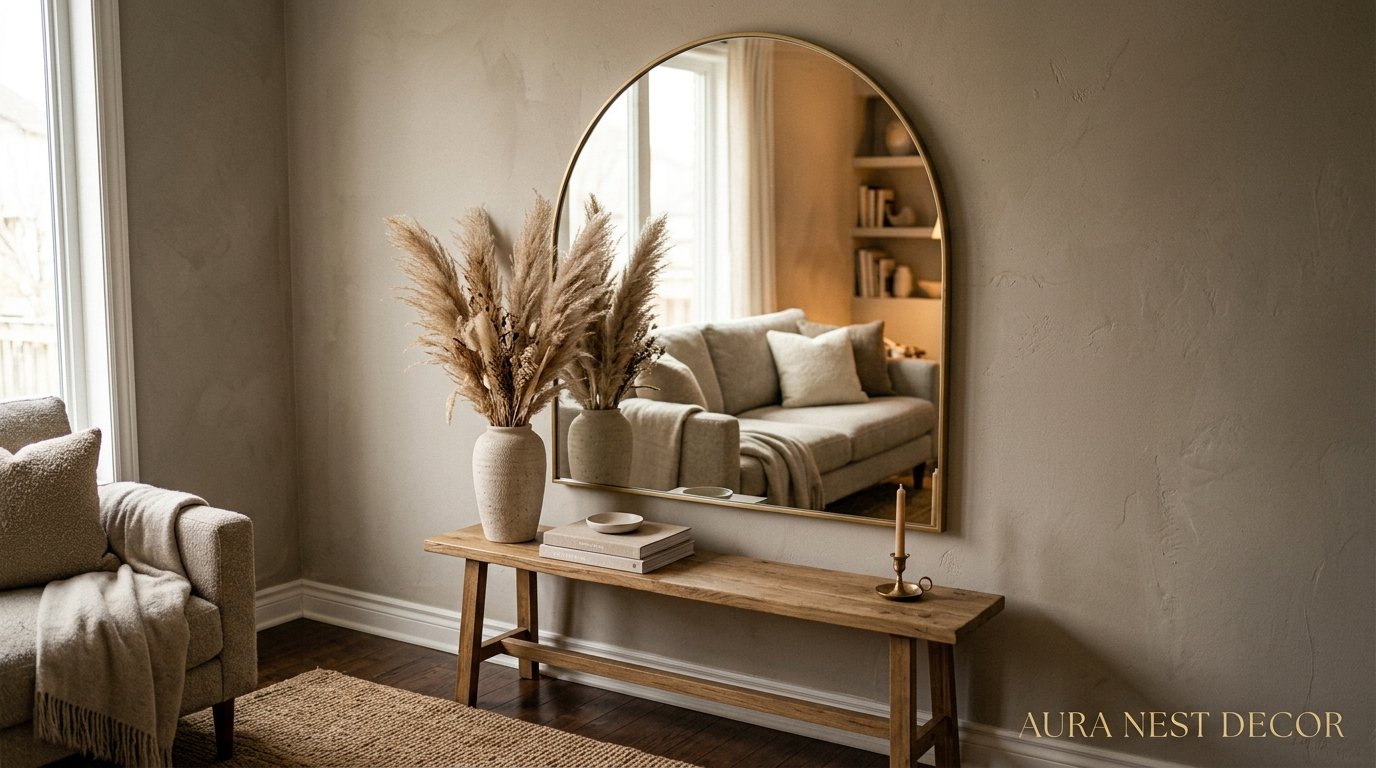
You know the image. Large oval or arched mirror, warm brass or aged gold frame, leaning against or hung above a marble fireplace or a simple white wall. Maybe some dried pampas grass on one side, a sculptural lamp on the other. Warm evening light. The reflection shows a beautifully decorated corner of the room.
This image gets saved millions of times because it captures something specific: a mirror that’s doing a job AND looking gorgeous while doing it. It’s reflecting light. It’s grounding the furniture beneath it. It’s adding depth and warmth and a little bit of drama. The frame adds personality without overwhelming the space.
But here’s the thing — that image isn’t a formula. It’s a set of principles executed really well. Big enough to make an impact. Warm metal that suits the other tones in the room. Placed to reflect something worth seeing. Styled so the reflection itself is beautiful.
You can recreate that feeling in any living room. You don’t need a marble fireplace. You need the underlying logic.
—
❓ FAQ
Q: What’s the ideal height to hang a mirror in a living room? A: The center of the mirror should sit at roughly eye level — around 57 to 60 inches from the floor for most people. The more important thing is that it looks connected to the furniture below it. If it feels like it’s floating above the room, drop it down a few inches.
Q: Can a mirror make a small living room look bigger? A: Yes, genuinely — but placement matters. A large mirror facing or angled toward a window will bounce light and create a sense of depth. A small mirror in a small room doesn’t really do anything useful; you need to go bigger than feels instinctively comfortable for the effect to work.
Q: Should my mirror match my other decor? A: It doesn’t have to, and honestly some of the best-looking rooms mix periods and styles deliberately. A traditional ornate frame in a contemporary room creates interesting tension. Just make sure the metal tones work with what else is in the room — warm metals together, cool metals together — and you’ll be fine.
—
💭 Final Thoughts
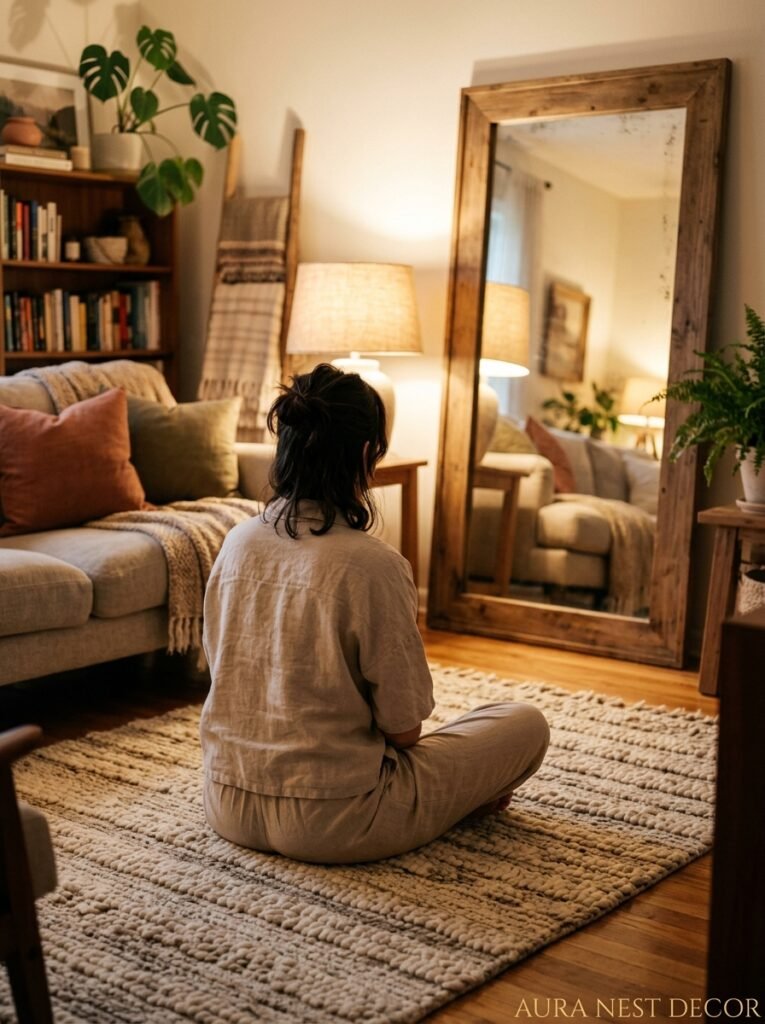
A good mirror doesn’t just hang there. It changes the way light moves through a room, makes the space feel considered and alive, and sometimes it reflects back a version of your living room that looks better than the original — and that’s not a small thing.
Get the placement right first. Then worry about the frame.
What does your mirror currently reflect — and is that actually the best your room has to offer?