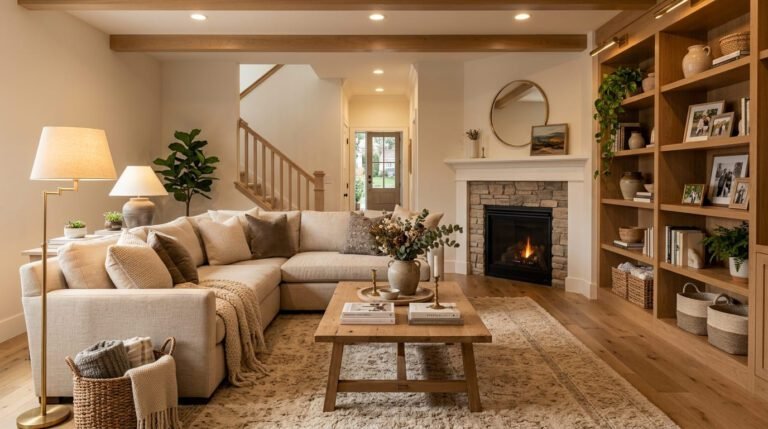
The Living Room Ceiling Everyone’s Suddenly Obsessing Over (And It’s Not What You’d Expect)
You scroll past a living room photo and something stops you. The furniture’s nice but it’s not that. The rug is fine. Then you look up — and suddenly you get it. The ceiling is doing something.
False ceilings have been quietly having a moment, and honestly, I think they’re one of the most underrated design moves in any home right now.
—
1. Why Your Ceiling Is the Most Wasted Surface in Your Entire Living Room
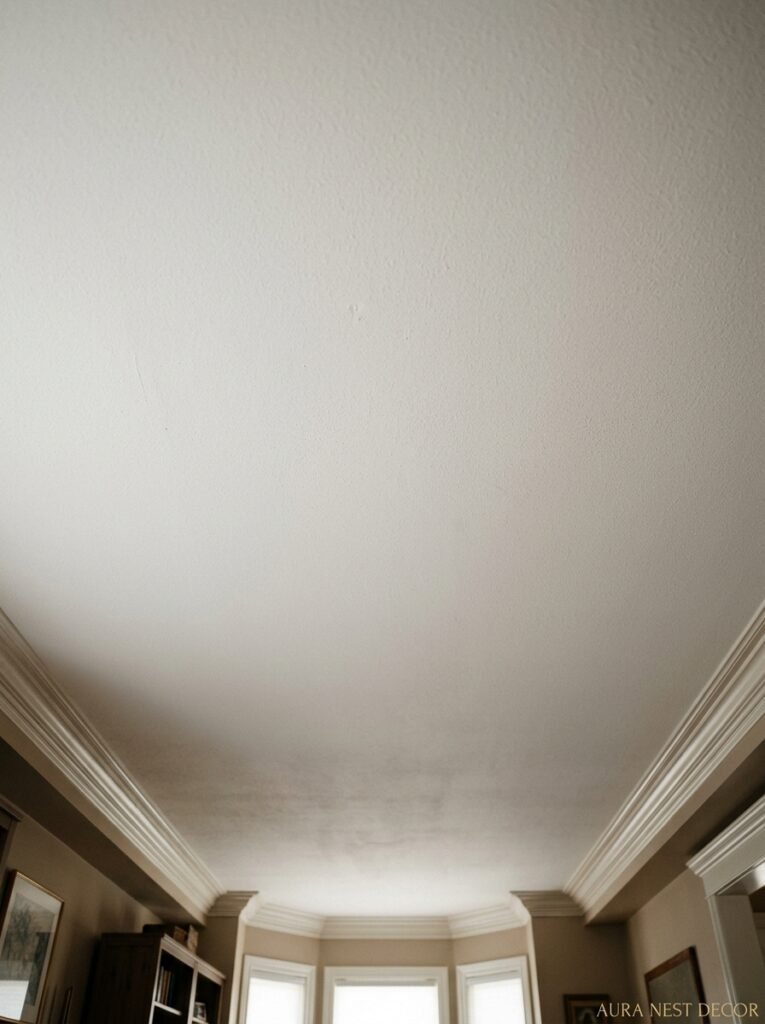
Nobody thinks about the ceiling. That’s the whole problem. You spend weeks choosing the right sofa, you agonize over paint swatches, you rearrange furniture at 11pm because something felt off — and then you paint the ceiling white and call it a day.
But here’s the thing. The ceiling is the one surface your eye lands on when you’re lying on the couch, when you’re relaxing, when you’re actually in the room. And most of us have been ignoring it completely.
A false ceiling — sometimes called a drop ceiling, a tray ceiling, a coffered ceiling, a cloud ceiling, depending on what it’s doing — changes the entire spatial feel of a room. Not in a subtle “oh that’s nice” way. In a “wait, why does this room feel so different and so much better” way. It defines zones without walls. It brings light down without harsh fixtures. It makes a tall, echoey room feel intentional instead of unfinished.
I genuinely think it’s the single highest-impact change you can make to a living room that nobody talks about enough.
“The ceiling is the only surface in your home that you stare at when you’re truly at rest — and most of us have been leaving it blank for years.”
—
2. The Tray Ceiling Glow That’s All Over Pinterest Right Now
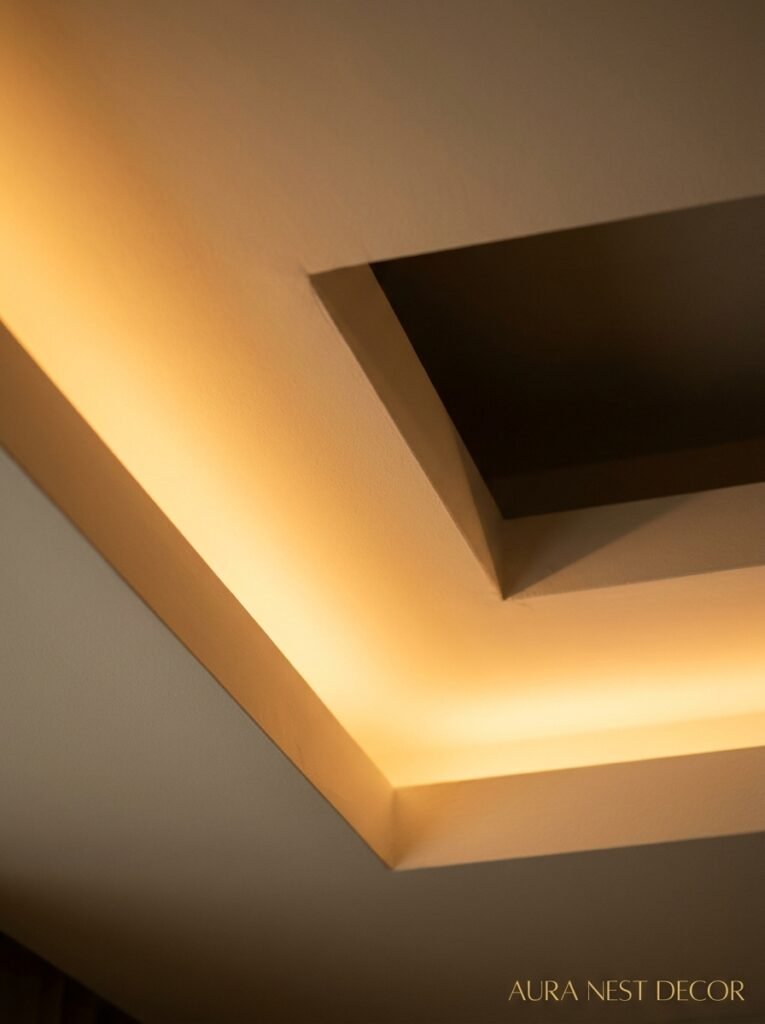
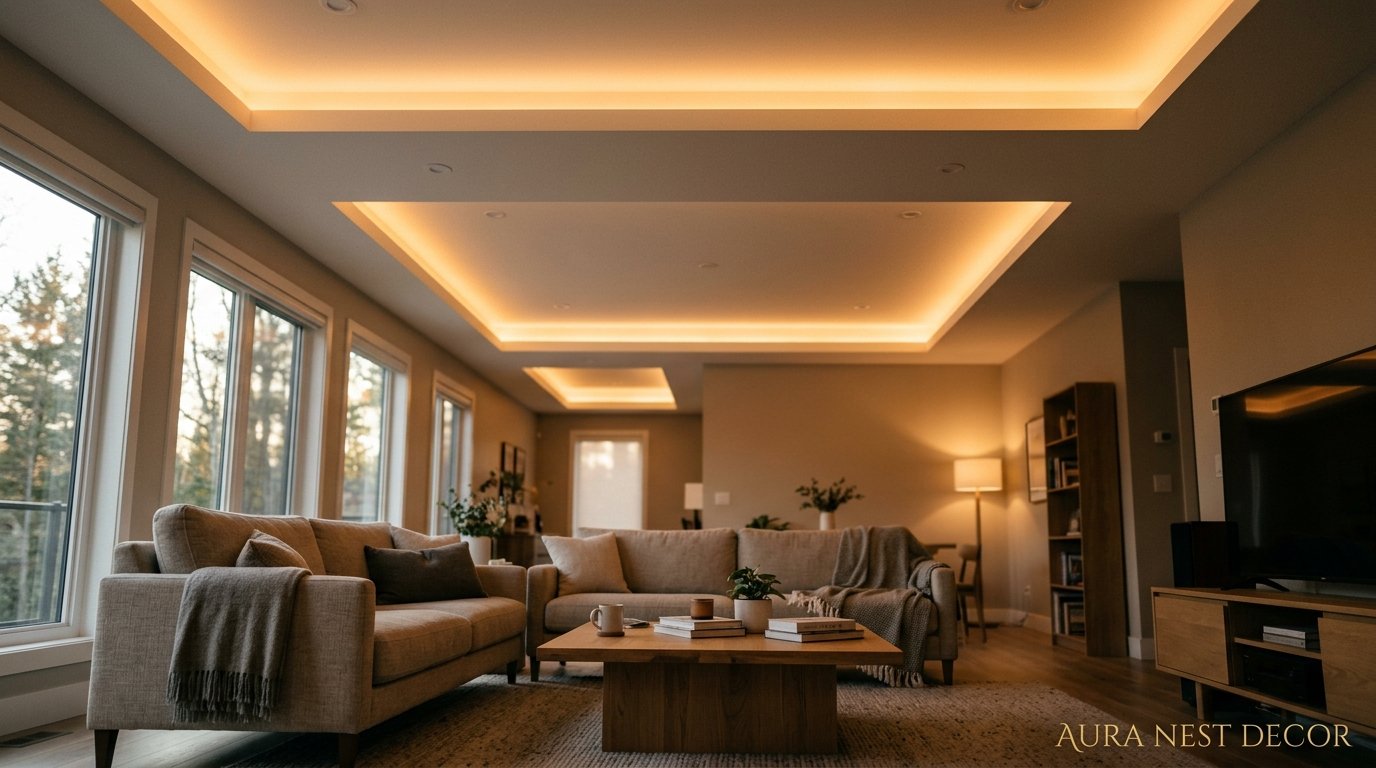
You’ve seen it. The recessed center with a rim that glows amber at night. It’s everywhere — American craftsman homes, British new builds that want some warmth, converted flats with low ceilings trying to create the illusion of height they don’t actually have.
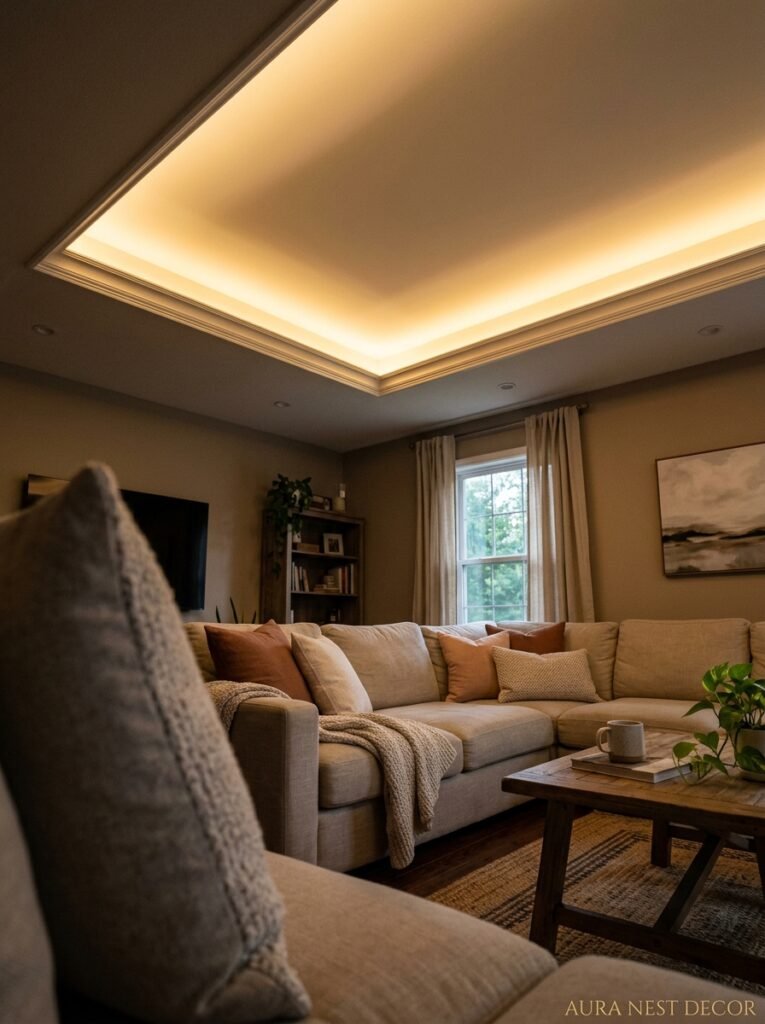
The tray ceiling works because it does two things at once. During the day, it adds architectural depth — a shadow line, a visual frame, a reason for your eye to move upward. At night, with LED strip lighting tucked into that recessed edge? It becomes something else entirely. That warm, indirect amber wash at 7pm when the overhead lights are off is genuinely one of the coziest things a living room can produce. Not warm lighting. That specific glow.
What makes it work in a smaller British terrace as much as a larger American open-plan is that you’re not adding volume, you’re suggesting it. The tray pulls the center up visually while the lit border keeps everything feeling grounded. It’s a visual trick that works almost embarrassingly well.
Paint the tray a shade or two darker than your walls if you’re nervous about contrast. Or go full navy, deep olive, or moody charcoal if you want it to be A Statement. Both work. Different moods.
—
3. The Coffered Ceiling Rule That Makes or Breaks the Whole Look
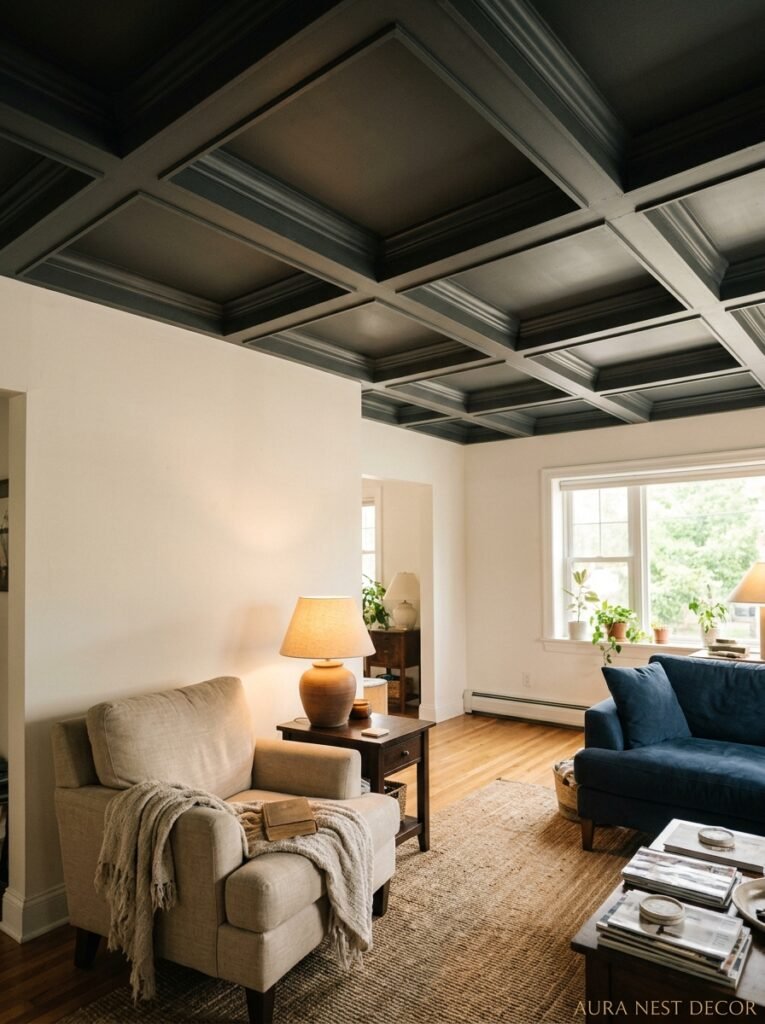
Coffered ceilings — the grid of beams creating recessed panels — can look incredible or absolutely terrible and the difference is almost always one thing. Proportion.
Too shallow and the coffers look like someone glued picture frames to the ceiling. Too deep and the room feels like a basement. The sweet spot? The beams should read as genuine structure, even if they’re lightweight MDF profiles painted to match. The panels inside should be roughly square rather than long thin rectangles, which always look a little awkward.
In American homes with 9-foot ceilings or higher, coffered ceilings feel genuinely architectural and earned. In British homes with lower ceilings — and plenty of us have them — you have to be more selective. A coffered look with very thin beam profiles in a matte white or off-white keeps the drama without eating the room. Or you skip the depth entirely and do a surface-applied grid in the same color as the ceiling, which gives the visual pattern without losing any actual height.
The grids don’t have to be uniform either. A wider center panel with narrower edge panels reads more traditionally elegant. Uniform squares feel more modern, a bit Scandinavian. Both are worth considering depending on whether your living room is already pulling in one direction or the other.
—
4. What a “Cloud Ceiling” Actually Is and Why It Feels So Different
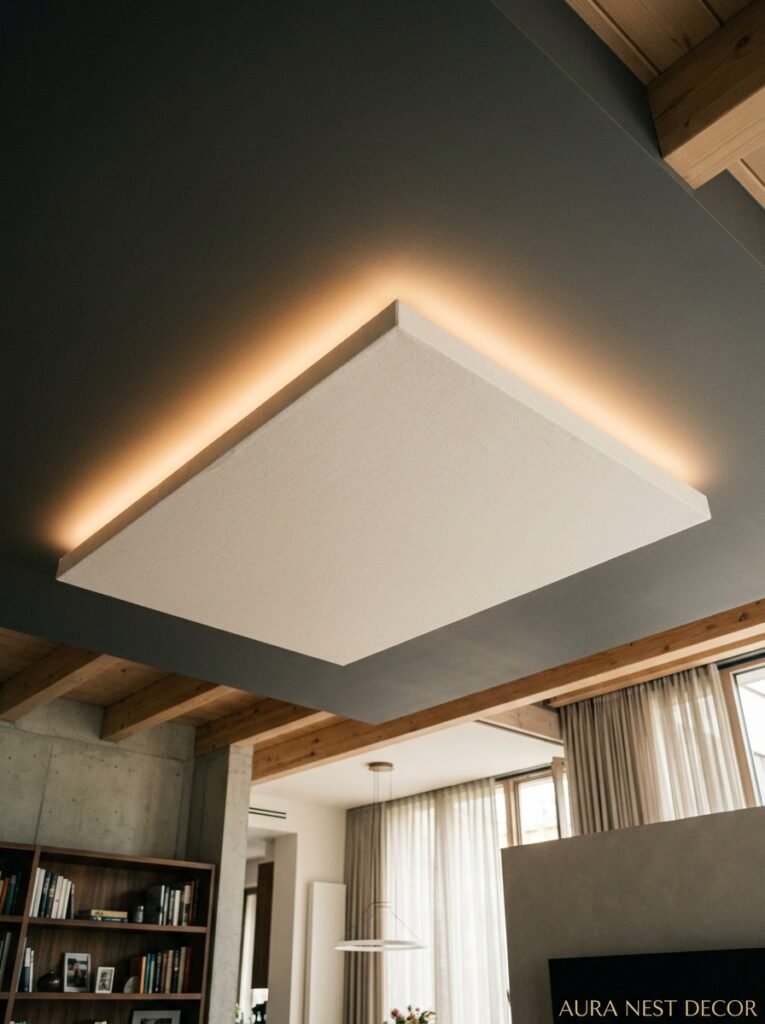
A cloud ceiling sounds like a trend name someone made up, and maybe it is, but the effect is real and I keep seeing it in rooms that stop me mid-scroll. Instead of a full false ceiling across the whole room, you install a partial suspended panel — usually over the sofa or seating area — that floats between you and the actual ceiling above it.
It defines the seating zone without any walls or partitions. It brings acoustics down, which sounds technical but basically means the room feels quieter and more intimate in that corner. And it’s genuinely striking from every angle.
The panels can be plaster, stretched fabric, MDF, even perforated acoustic material if you care about sound. Recessed lighting set INTO the cloud panel means light falls only on the seating area, which creates this moody, intentional pool of warmth that the rest of the room doesn’t have.
“A cloud ceiling doesn’t cover the room — it claims one part of it, and that selectiveness is exactly what makes it feel expensive.”
It’s also a more manageable project. You’re not tackling the whole ceiling. You’re doing one purposeful section. That’s a big deal if you’re renting, if you’re nervous about commitment, or if your budget has limits — which, same.
—
5. The Beam Finish That’s Replacing Painted White in Every Style Forum I Follow
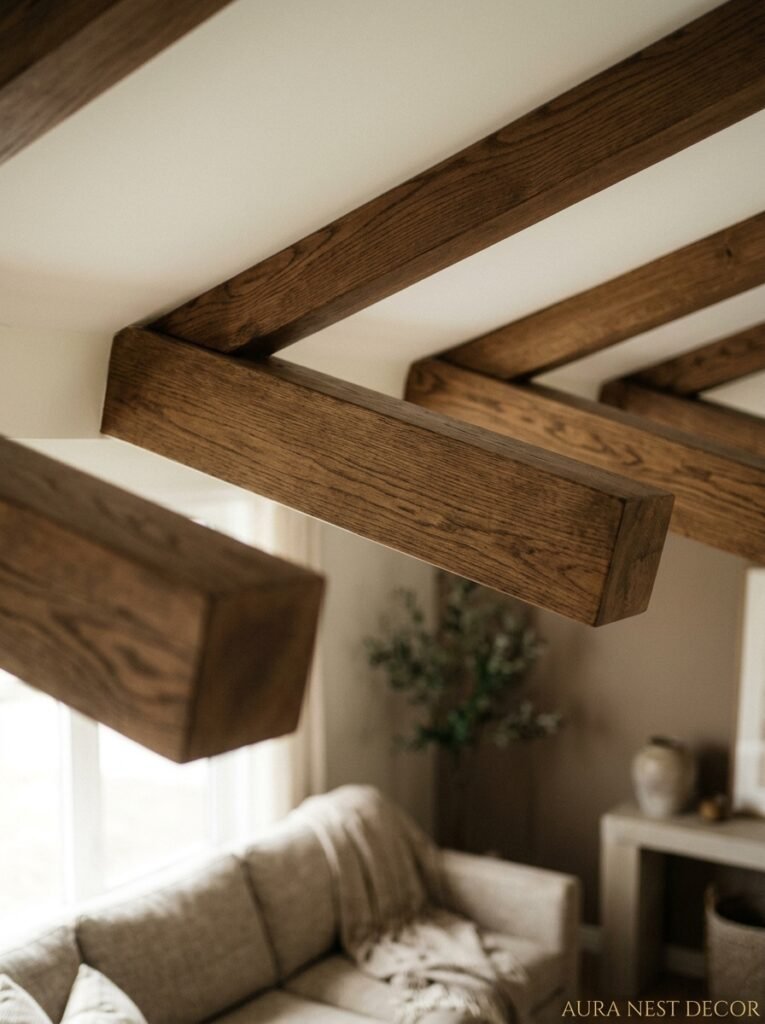
Exposed beams used to mean one thing: rustic farmhouse, reclaimed wood, shiplap. And I get it, that look was everywhere for a while. But something’s shifting.
The beams showing up in living rooms I’m obsessing over lately are not rustic. They’re smooth-finished, painted in deep colors — charcoal, off-black, warm dark brown — or wrapped in a wood veneer that’s more Japandi than barn conversion. Thin, architectural, confident. They’re not trying to look old. They’re just structure made beautiful.
In a British Georgian or Victorian terrace this works incredibly well because you’re referencing the bones of the house without faking history. In an American craftsman or mid-century home, the dark beam grid against a lighter ceiling feels correct in a way that’s hard to articulate but immediately obvious when you see it.
White-painted beams aren’t going anywhere and they’re still a valid choice — especially in rooms that are already quite dark or have low ceilings. But if your room can handle some visual weight, the dark beam moment is one I’d pay attention to.
—
6. The Quiet Power of a Recessed Perimeter — Even Without Lighting
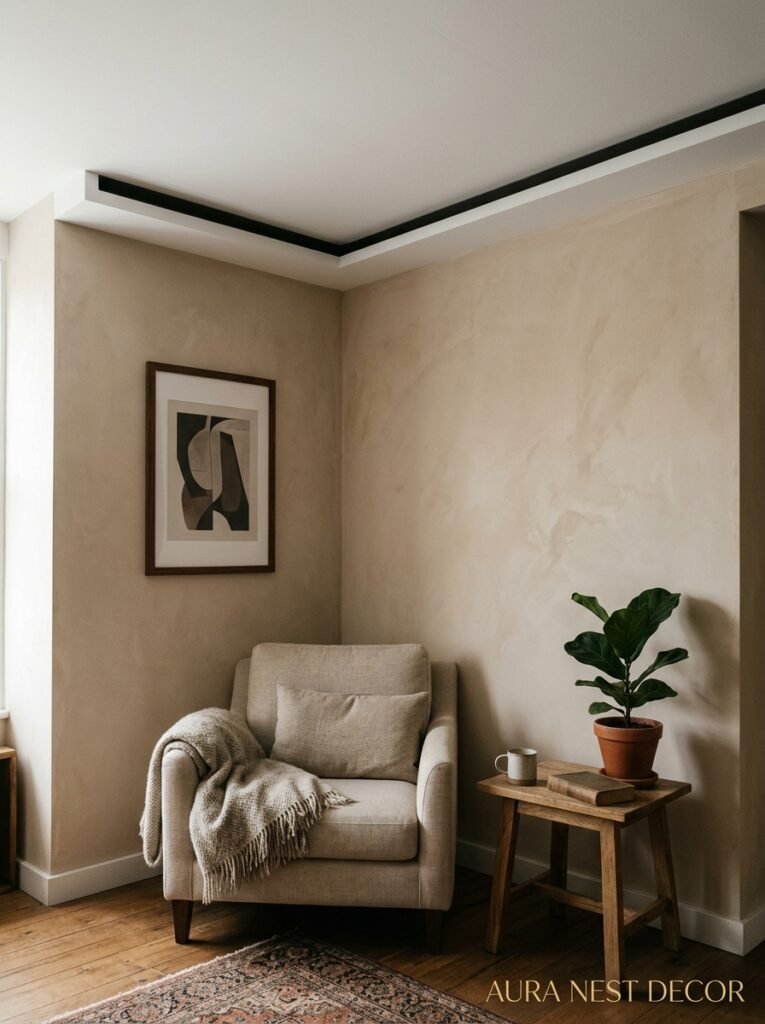
Most people see recessed perimeter ceilings and immediately think: LED strips. And yes, fine, the lighting is great. But I want to make a case for the recessed perimeter WITHOUT any light source, because I don’t think this version gets nearly enough attention.
A shadow gap — that narrow recessed line where your ceiling meets the walls — creates a visual separation that makes the ceiling plane look like it’s floating. No glow, no warm amber, just a clean architectural shadow that runs the whole room. It’s more subtle. More confident in a different way. The kind of thing that interior designers do in projects and most homeowners walk past without knowing why the room feels so polished.
You can do this in a newer build with standard plasterboard, or you can fake it with a shadow gap molding profile. The width matters — too narrow and it disappears, too wide and it starts looking like a gap you forgot to fill. Around 8-15mm is usually the range that reads as intentional rather than accidental.
This is genuinely one of the lower-cost false ceiling approaches and one of the most elegant. Doesn’t require extra lighting costs. Doesn’t require huge structural changes. Just a clean line that does more work than you’d think.
—
7. How to Make a False Ceiling Work in a Room With Low Ceilings (Without Making It Worse)
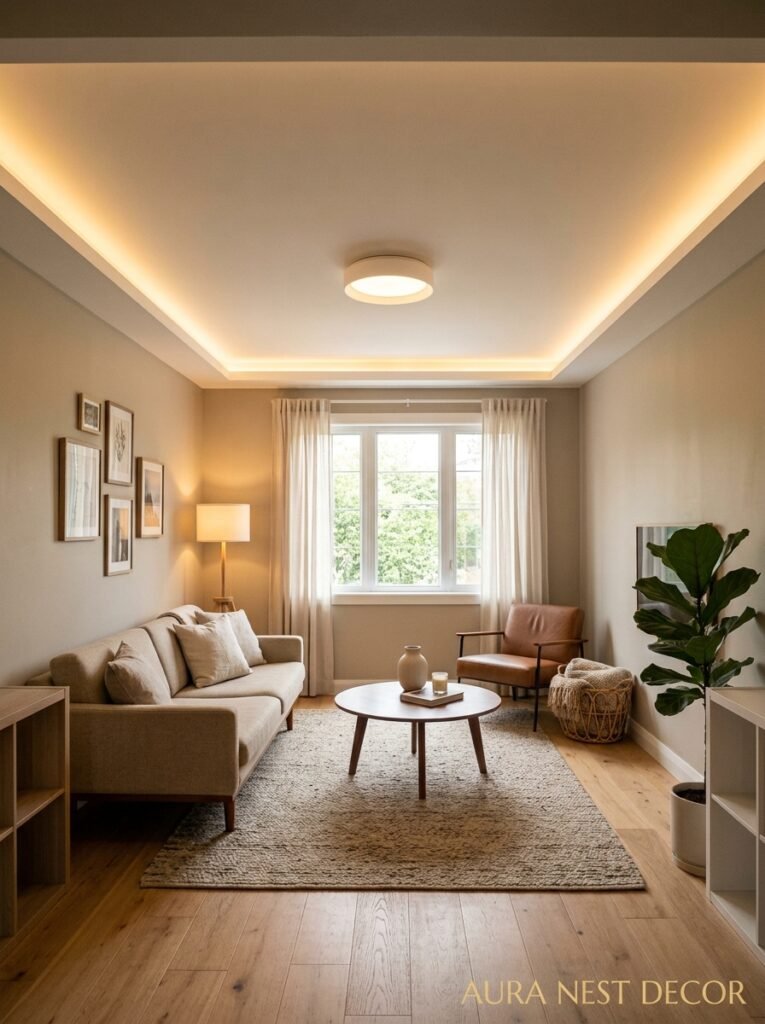
This is the question I get asked the most. And the honest answer is: it depends on what kind of false ceiling and how you execute it.
Here’s what doesn’t work in a low-ceilinged room. Heavy coffered beams. Anything that drops the actual ceiling height by more than about 4 inches. Anything with a strong horizontal banding effect at eye level.
Here’s what does work. The shadow gap profile — barely any height loss, huge visual payoff. A very shallow tray with lighting in the recess, because the glow draws the eye upward even if the tray itself is only a couple of inches deep. A cloud panel over ONE section rather than the whole ceiling — and I mean strategically placed, not randomly floating in the middle of nothing. Lightweight surface-applied molding in the same color as the ceiling that creates pattern without depth.
“A false ceiling in a low room isn’t about adding height — it’s about making the height you already have feel considered.”
Color also matters more in a low-ceilinged room than anywhere else. A false ceiling element in the same color as the actual ceiling reads as extension, not addition. The moment you introduce a contrasting color, the eye measures the gap more acutely. So if you’re nervous, stay tonal. You can always go bolder later.
—
8. The Material Nobody Talks About But Should
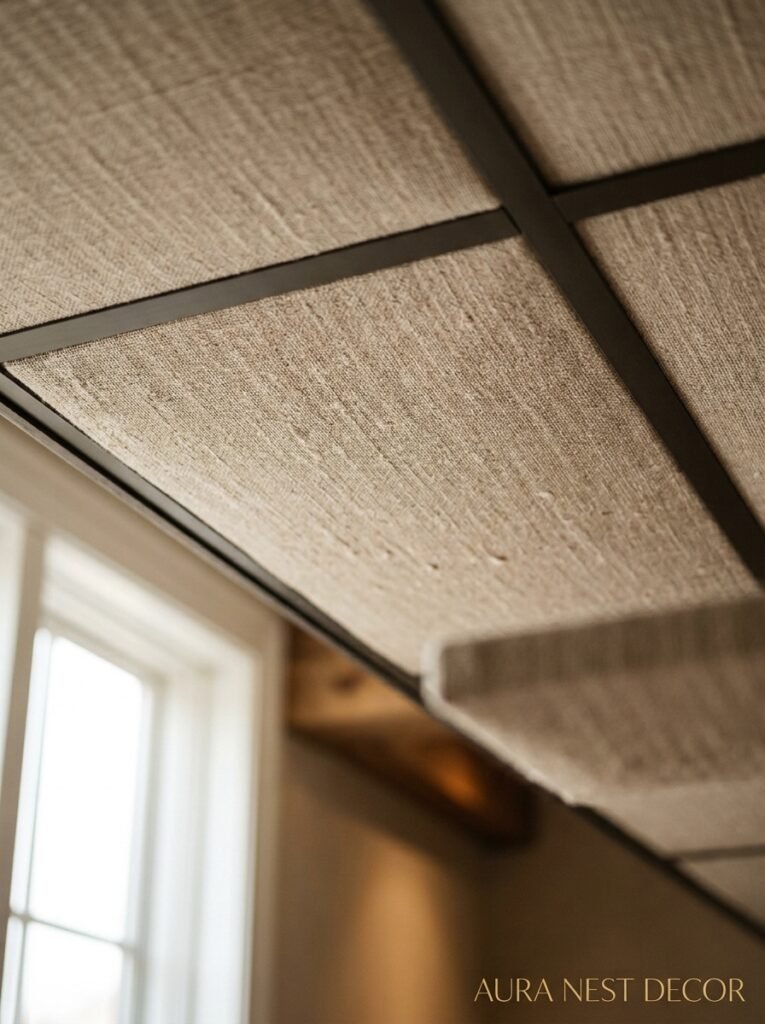
Stretched fabric ceiling systems. I know, I know, it sounds like something from a commercial gym. Bear with me.
Stretch ceiling systems — where a thin tensioned fabric or PVC membrane gets clipped into a perimeter track — have been common in European interior design for years, and they’re starting to show up in high-end American and British residential projects in a way that feels genuinely exciting. You can get them in matte, satin, or gloss finishes. Solid colors. Abstract prints. Backlit panels where the light source is completely hidden behind the membrane, giving you a soft, glowing, almost cloud-like ceiling with zero visible fittings.
The acoustic fabric versions are particularly interesting for living rooms, because they actually absorb sound — which changes the feel of the space in a way that goes beyond visual. A room with good acoustics feels calmer. More like a place you want to be.
The cost point used to be prohibitive. It’s still not cheap but it’s come down significantly. And unlike plasterwork, it’s completely reversible. That matters if you’re in a rental property or just someone who changes their mind every three years (no judgment — I’m the same).
—
9. What to Do With Lighting Inside Your False Ceiling Design
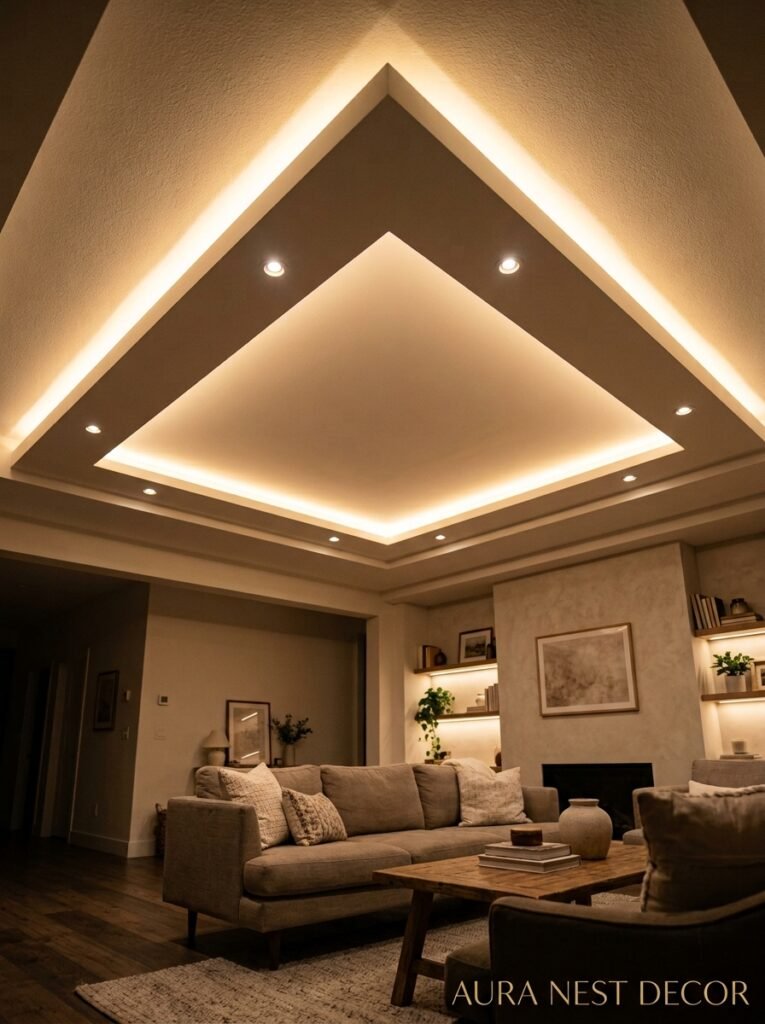
Let’s be direct about this because there’s a lot of bad advice out there. Recessed downlights in a regular grid are FINE but they’re not interesting. Six identical downlights in two parallel rows is the visual equivalent of office lighting, and living rooms deserve better than that.
What actually looks good:
Asymmetric placement — cluster the lights over where people actually sit, not evenly across the whole surface. The eye doesn’t need the ceiling to be uniformly lit. Your activities do.
Mixed sources — a recessed downlight over a reading chair, LED strip inside the tray perimeter for ambient, a single statement pendant dropping through the false ceiling at the dining end of an open plan. Different heights, different warmth levels, different moments.
Warm white only. 2700K maximum, honestly 2400K if you can find it. This sounds boring until you sit in a room with 2700K ambient and then visit someone with cool white recessed lights. The difference is immediate and physical.
And if you can swing it — dimmers on everything. Every single circuit. The difference between a well-lit room and a room that does what you want it to do at any moment of the day is almost entirely in the dimmers.
—
10. The Colors That Are Doing Something Interesting on False Ceilings Right Now
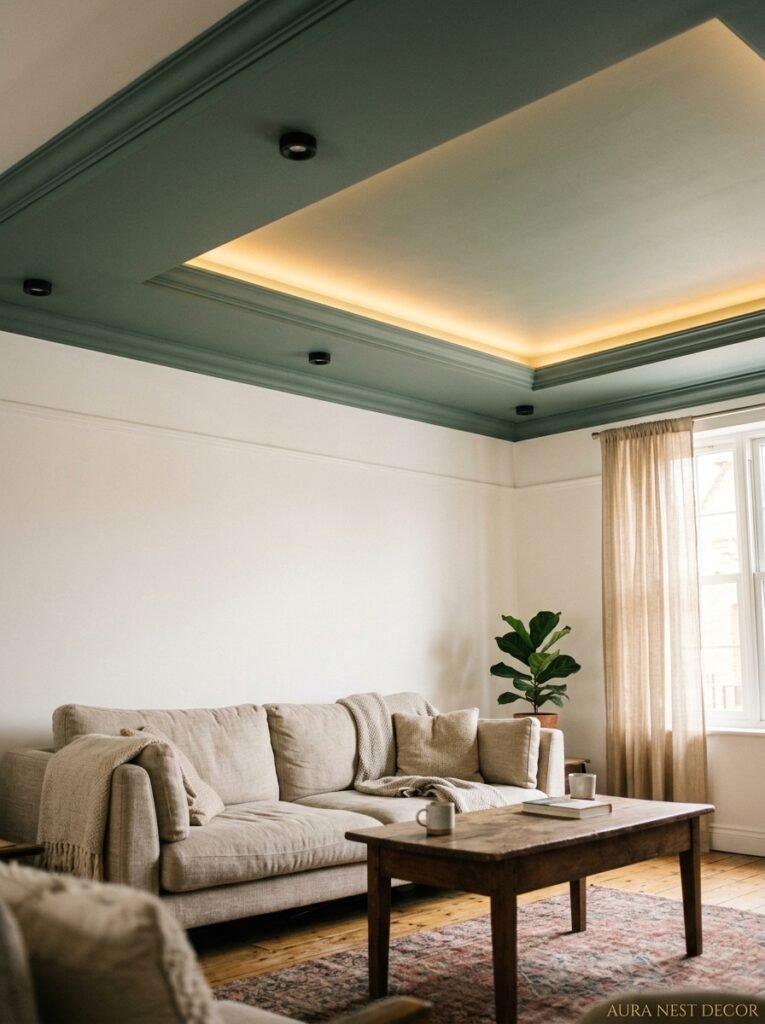
White. Fine. The ceiling’s fine. But if you’re going to the effort of adding architectural interest, I’d at least make the color work harder for you.
Deep teal on a tray insert with warm white walls. Matte black beam profiles on a bright white field. The softest barely-there pink — not blush, more like a slightly warm white — on a stretch panel that makes the whole room feel somehow softer without anyone being able to say why.
In British interiors specifically, I keep seeing off-black used in the recessed portions of tray and coffered ceilings. It reads almost like depth — like you could reach up into it — and against white moldings it’s incredibly graphic and clean. More London gallery than Cotswolds cottage, but still.
American interiors are going warmer. Greige, putty, warm sand on the false ceiling insert. Especially in newer builds that want to feel curated rather than shiny.
The color of your false ceiling element is basically the quietest part of your room that carries the most atmosphere. Take it seriously.
—
11. The DIY Version That Actually Looks Like It Wasn’t DIY
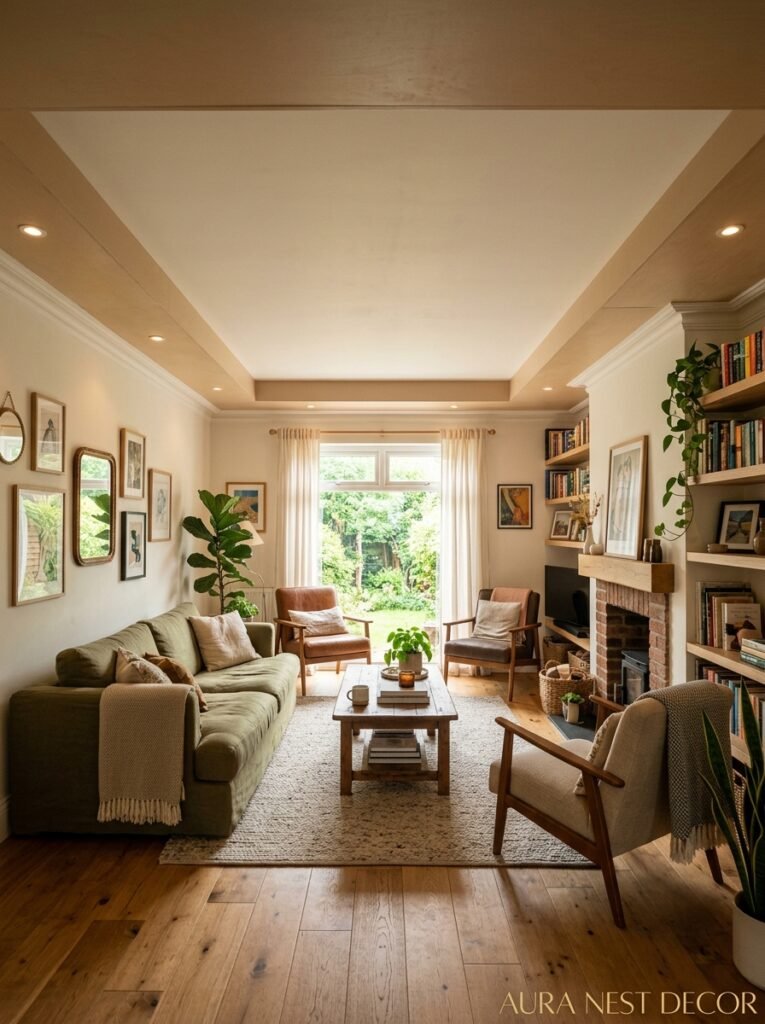
Not everything here requires a full contractor project. There are false ceiling approaches that a reasonably capable homeowner can tackle over a weekend — and that look intentional rather than budget-improvised.
Surface-applied ceiling medallion grids using MDF moulding — you’re gluing and nailing lightweight profiles directly to the existing ceiling in a grid pattern, painting everything the same color. Zero depth, big visual impact. This is genuinely doable.
Peel-and-stick ceiling panels in geometric patterns have also gotten much better in the last few years. The key is buying from a supplier that offers realistic shadow lines in the profile — flat peel-and-stick looks flat, but a panel with actual dimensional depth photographs beautifully and reads as architectural.
Canopy-style fabric suspended from ceiling hooks with a simple timber frame. Not a traditional false ceiling design but creates the same zone-defining effect as a cloud ceiling at a fraction of the cost and effort.
Side note — always check the actual ceiling height before you commit to any of these, because the math changes fast in older British properties where ceiling heights vary room to room and sometimes within the same room.
—
12. The Thing That Makes a False Ceiling Look Expensive vs. Just Different
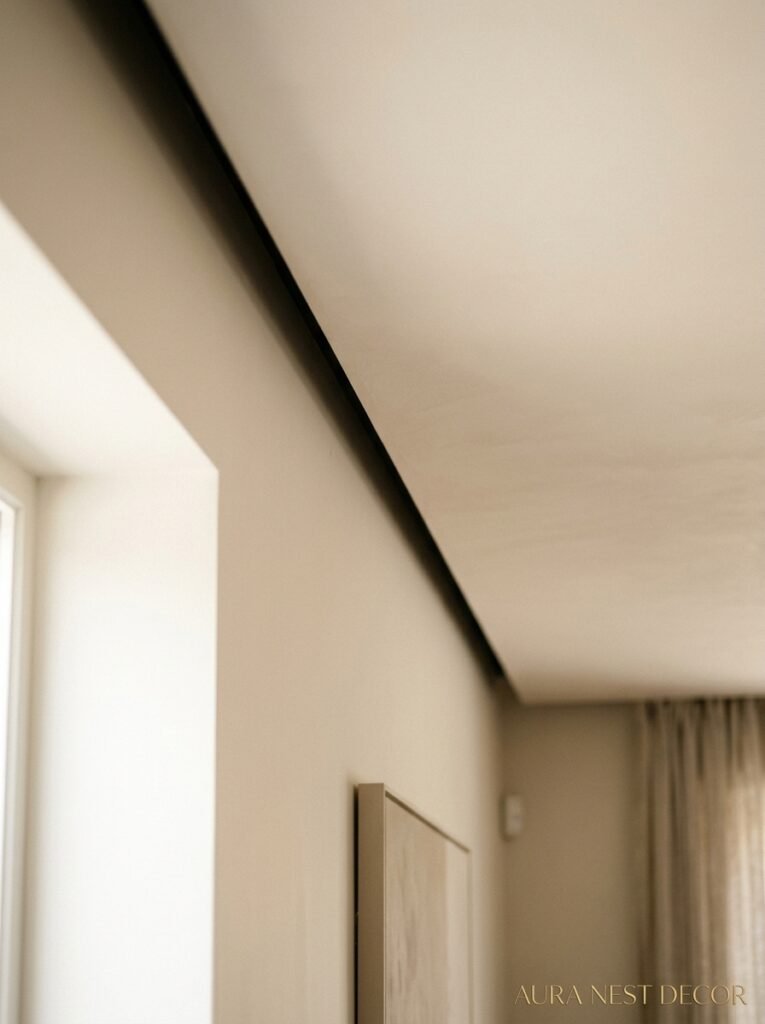
Every option I’ve listed can look either brilliant or wrong and the difference is almost always finishing. Not the concept, not the material, not the color. The edges, the transitions, the shadow lines, the way the new element meets the old surface.
A tray ceiling with a perfectly crisp shadow line looks architectural. The same tray with a slightly uneven edge looks like a home renovation job. Coffered beams that are all exactly level look like a design decision. Beams that sag 3mm on one side make the whole thing look DIY in a bad way.
This is the part where I’d say — if you’re spending money on a false ceiling project, spend it on a plasterer or joiner who has done exactly this kind of finish work before. Not just someone who can build things, but someone who has built this specific thing and has photos to prove it. The concept is free. The execution is where the budget goes and where it absolutely should go.
Because a beautifully finished false ceiling at modest material cost will always look better than an expensively specified false ceiling finished poorly. Always.
—
❓ FAQ
Q: How much does a false ceiling typically cost to install in a living room in the US or UK? A: It varies a lot depending on the type and size. A basic tray ceiling or surface-applied molding project in a standard living room can range from a few hundred dollars/pounds for DIY approaches up to $3,000–$8,000+ for full plastered coffered or cloud ceilings with integrated lighting in the US. UK costs are broadly similar in GBP. Get three quotes and ask specifically about finishing work — that’s where costs vary most.
Q: Will a false ceiling make my living room feel smaller or lower? A: It can, if you choose the wrong type for your ceiling height. In rooms under about 8 feet, stick to shadow gap profiles, surface-applied molding, or shallow tray designs that don’t actually drop the ceiling height significantly. Anything that adds architectural interest without reducing height is your friend in a lower-ceilinged space.
Q: Can I add a false ceiling in a rented flat or apartment? A: Depends entirely on your tenancy agreement, but structural work almost certainly needs landlord permission. However, some options — stretched fabric canopy panels, freestanding room divider canopies, and even peel-and-stick ceiling panels with removable adhesive — give you some of the visual effect without permanent alteration. Always double check your lease first.
—
💭 Final Thoughts
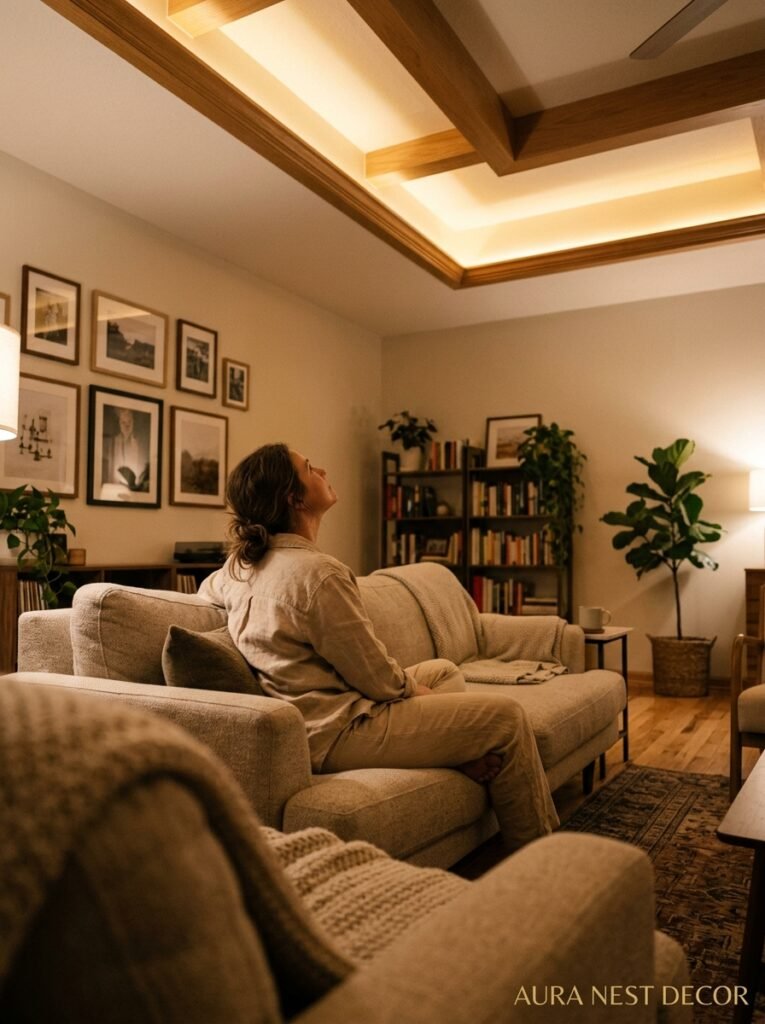
The ceiling’s been the forgotten surface for too long, honestly. Every bit of attention and budget goes down — to the floors, the furniture, the walls — and up there it’s just… white. Blank. Nothing.
False ceiling design isn’t a luxury addition or an overdone renovation trend. It’s just acknowledging that the room has a sixth surface, and deciding whether you want it to do something or not. Most rooms get better when someone finally looks up.
So — when you look up at your living room ceiling right now, what do you wish it was doing instead?