Your Living Room Doesn’t Need Another Throw Pillow — It Needs a Bar
You know that moment when someone walks into a room and immediately says oh, I love this? Nine times out of ten, there’s a bar cart somewhere in that room. Not because alcohol is the point. Because intention is.
—
1. Why a Living Room Bar Hits Different Than a Kitchen Liquor Cabinet
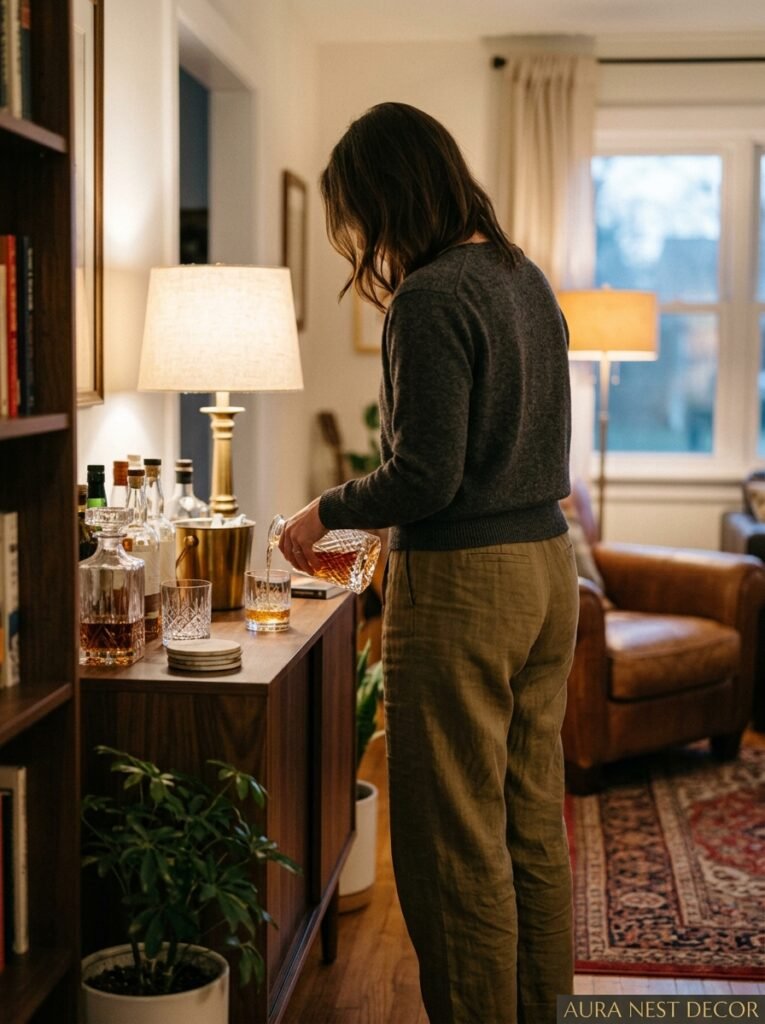
There’s something about having a bar in your living room that changes the whole feeling of a space. Not just the look of it — the feeling. The way a room shifts from “somewhere we sit” to “somewhere we actually gather.”
I’ve been styling homes and saving pins for years now, and I can tell you: nothing gets reshared faster on Pinterest than a well-styled living room bar. And it’s not because people want to get drunk in their lounges. It’s because a bar — a real one, set up with care — signals that someone LIVES there. That they have guests, have rituals, have opinions about glassware.
In the US, we tend to think about it as a statement piece. Something bold near the TV wall or anchored in the corner of an open-plan room. In the UK, it’s often a bit more tucked away — a vintage drinks trolley near the bay window, or an alcove conversion that looks like it’s been there since the 1930s. Neither approach is wrong. Both are completely right in different ways, and honestly the best inspo pulls from both.
But here’s what gets overlooked constantly: a living room bar isn’t just styling. It’s function. It’s what happens on a Friday night when you don’t have to disappear into the kitchen to fix everyone’s drinks and miss half the conversation. Small thing. HUGE difference in how a night actually feels.
“A bar in your living room isn’t about drinking. It’s about not leaving the room.”
—
2. The Bar Cart vs. the Built-In: Which One’s Actually Right for You
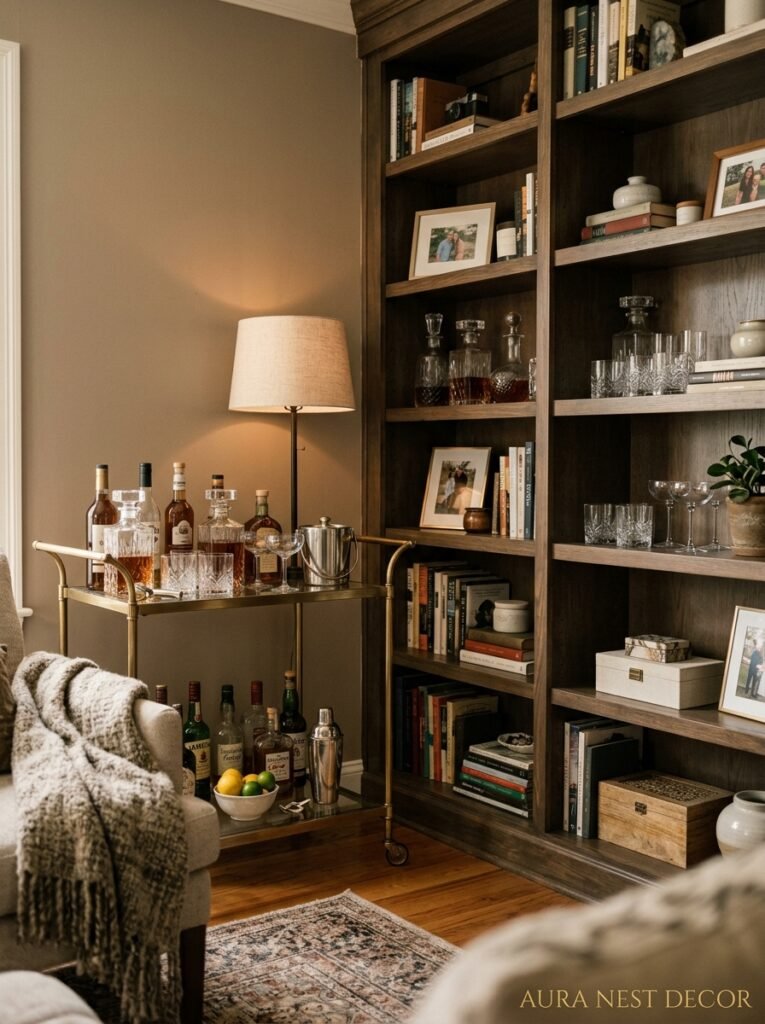
Okay, let’s get into this because it’s a real decision and there’s no universal answer.
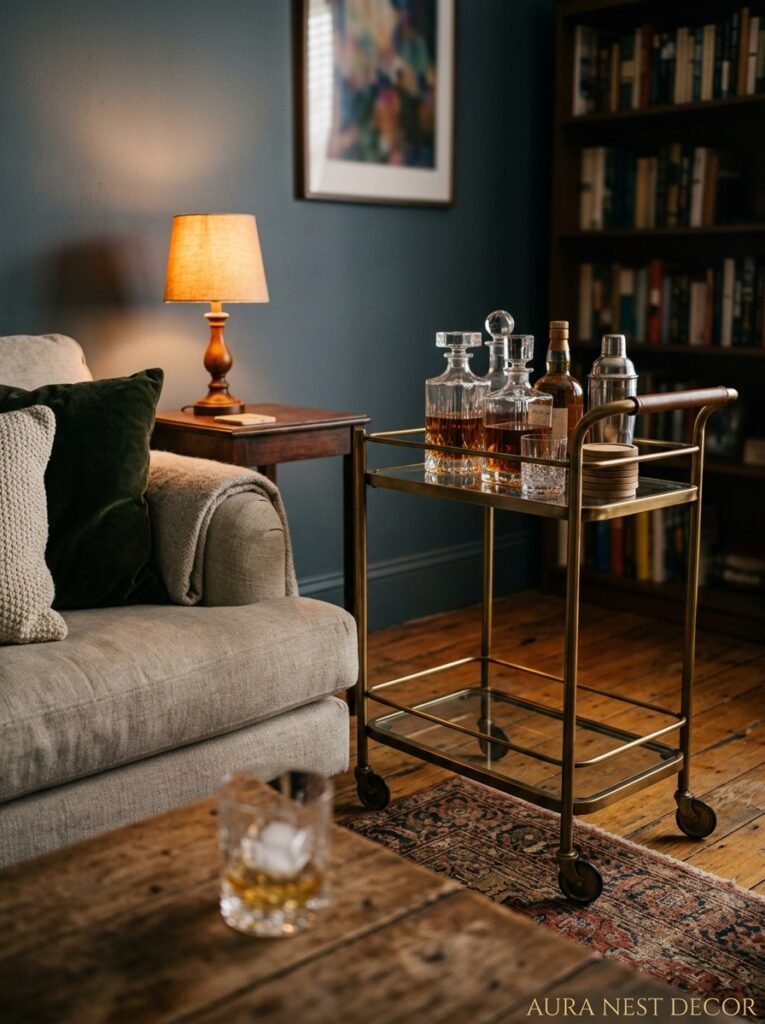
Bar carts are the obvious starting point for most people, and for good reason. They’re flexible. You can move them, restyle them, roll them out of the way when your in-laws come and they’ll wonder why there are suddenly four types of vermouth in your house. They’re also a relatively low commitment — you can find a gorgeous brass bar cart for under $150, style it beautifully, and be done in an afternoon.
But bar carts have limits. They tip. Things fall. And if you’ve got kids or cats or just general household chaos, a cart on wheels is kind of an accident waiting to happen. Not gonna lie.
Built-ins are a different story. If you’ve got an alcove — and in the UK especially, Victorian and Edwardian homes are basically swimming in them — converting one side into a proper bar situation is one of those decisions you’ll never regret. Add some floating shelves, a low-watt light strip underneath, and a small vintage fridge tucked in below if you can manage it. Done. It looks like it cost ten times what it did.
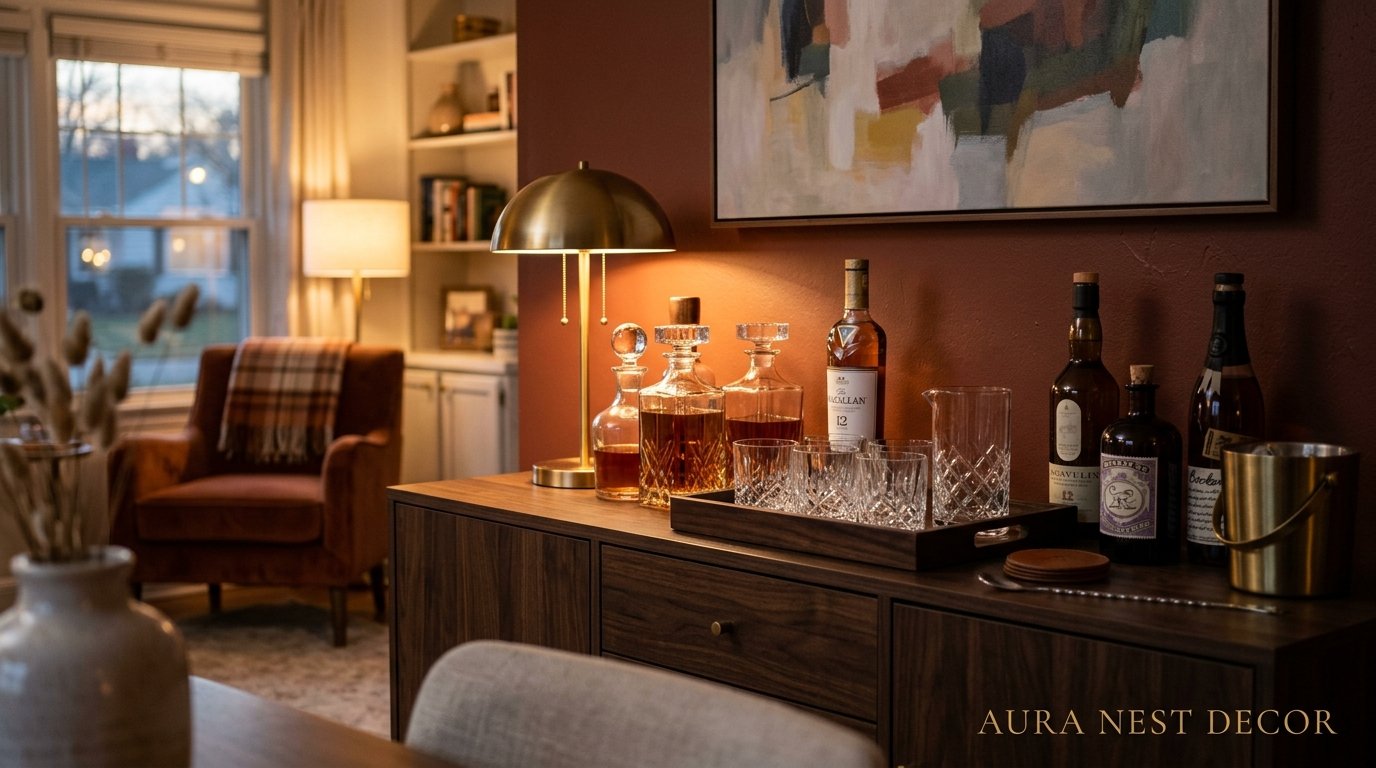
For US homes without natural alcoves, a credenza or sideboard situation works beautifully as a bar. Low profile, hides the less-pretty bottles, and gives you surface space to actually work with. I’d argue the bar sideboard is actually the most underrated option in the whole conversation.
—
3. The Shelf Arrangement Nobody Talks About Enough
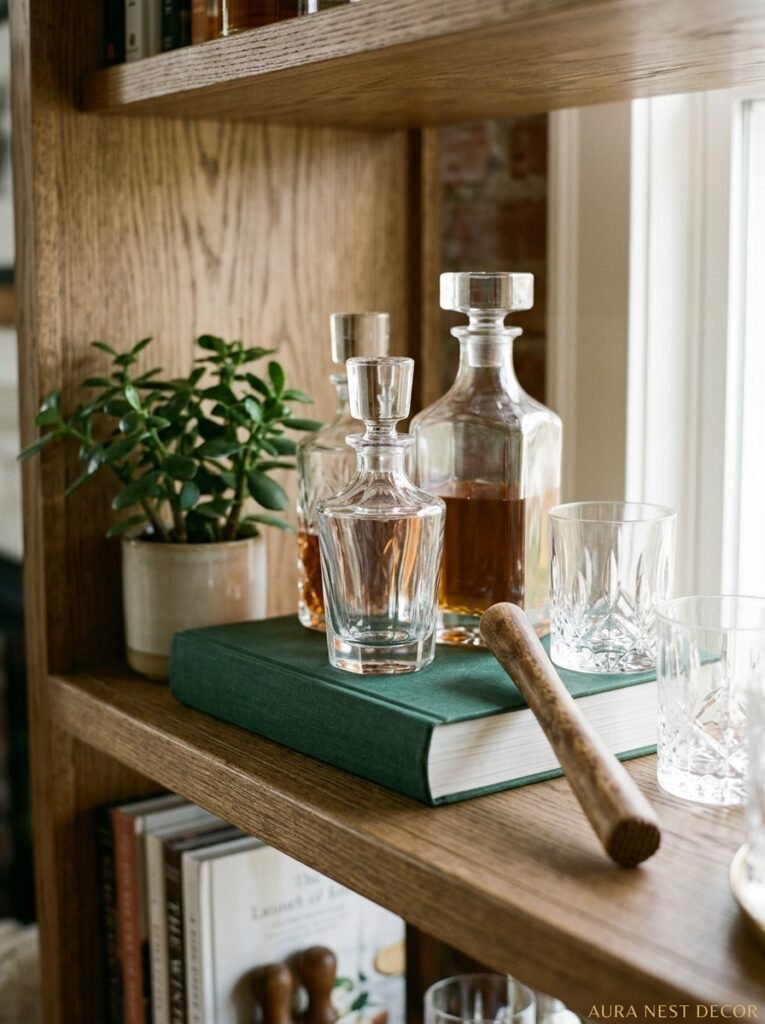
Here’s a truth about living room bar styling that took me an embarrassingly long time to figure out: it’s not about the bottles. It’s about the negative space around the bottles.
When everything is crammed together, it reads as clutter, not as a bar. Even if you have a beautiful collection. The eye needs somewhere to rest.
So here’s how I think about it. Front row gets the glasses — and not all of them, just two or three types max on display. Coupes or nick-and-nora glasses if you want something elegant and a little unexpected. Tumblers if you’re going for something warmer and more lived-in. What you display is what you’re saying about yourself, a bit.
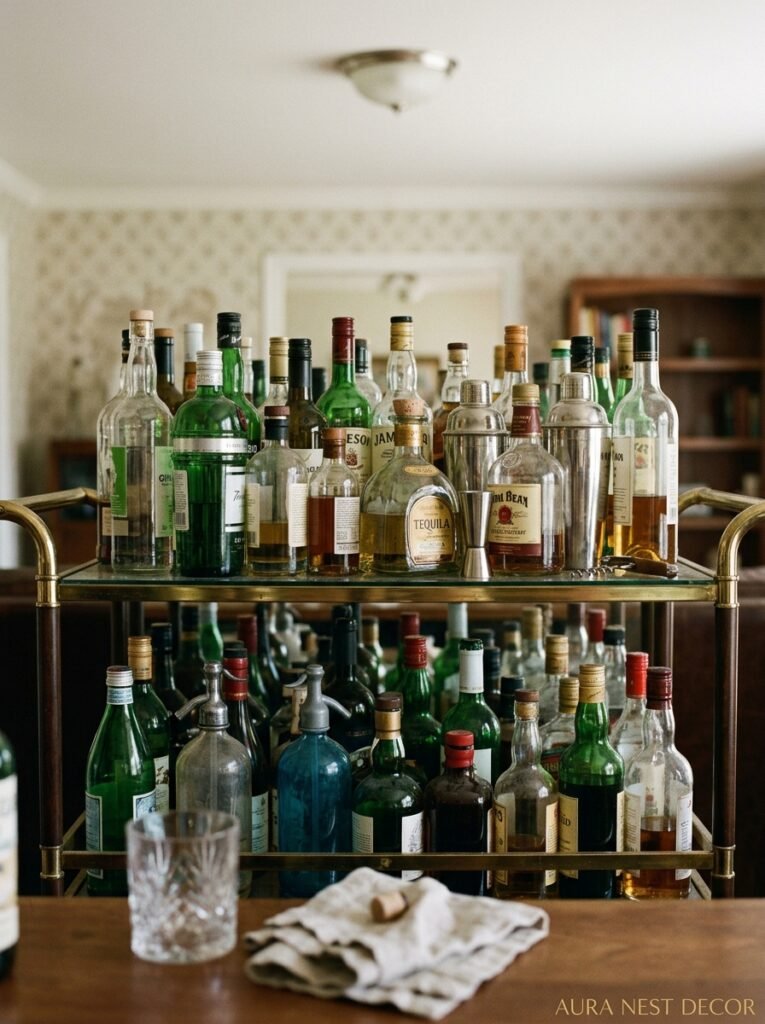
Middle depth gets the bottles you actually reach for. Three to five, honestly. Not fifteen. People always over-bottle their bar setups and then wonder why it looks chaotic. Edit brutally.
And then — this is the move — one interesting object that has nothing to do with drinking. A small plant. A candle in a vessel you love. A weird little brass object you found at an antique market and couldn’t leave behind. That one off-note thing is what makes it look styled rather than just… stacked.
—
4. The Lighting Situation That Makes Everything Look Better at Night
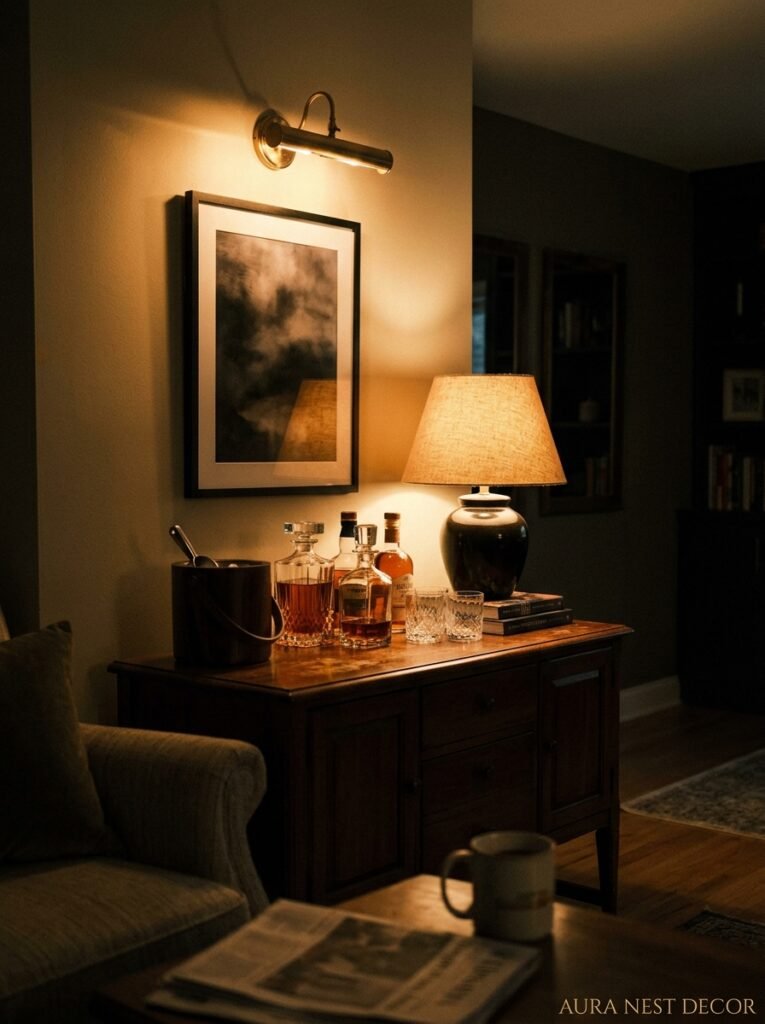
I’d argue lighting is doing more work in a living room bar setup than any single bottle or glass or gorgeous accessory. And most people set up the whole bar and then just… use whatever overhead light they already have. Which is almost always wrong.
The amber glow of an Edison bulb at 7pm when you’ve got friends coming over — that’s a specific thing. That’s an atmosphere. And you can create it pretty cheaply.
A small table lamp near or behind the bar is the simplest move. Low wattage, warm tone, maybe a linen or amber shade. It pools light in a way that feels intentional rather than illuminated. If you’ve got floating shelves, an LED strip along the underside of each shelf with a warm (not cool, NEVER cool) white tone is genuinely transformative in how the whole arrangement reads. It’s almost unfair how good it looks for the cost.
Candles, obviously. But grouped rather than scattered — two or three on a small tray, different heights. Not every single shelf.
What you’re going for is: this corner of the room glows while the rest fades back a little. That’s the feeling.
“The right lighting doesn’t just show off your bar. It makes the whole room lean in.”
—
5. The Color Decision That’s Harder Than It Looks
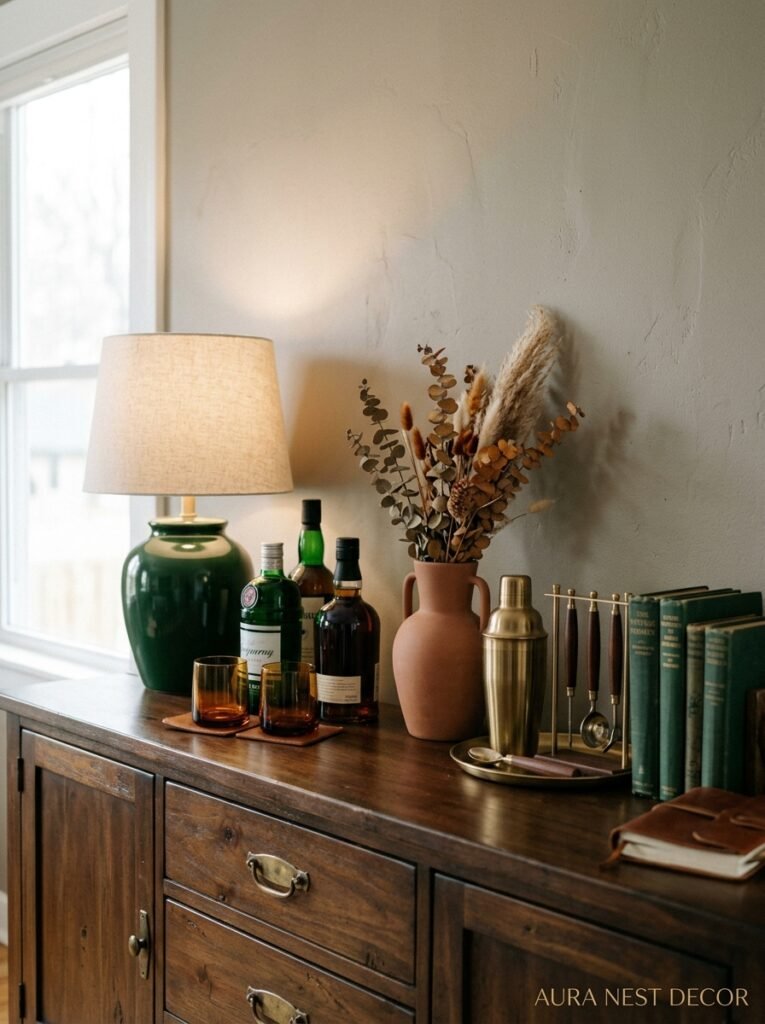
I see so many people styling their bar around their existing room and it’s fine, it’s perfectly fine — but the bars that stop your scroll are usually the ones where someone made a slightly brave color decision.
Dark green on the back wall of an alcove bar. Like a proper deep bottle green, not sage. It makes the bottles pop in a way nothing else does, and it photographs beautifully.
Deep navy or inky blue does the same thing. There’s something about a dark, almost moody backdrop that makes a bar feel like a real bar rather than just some shelves with bottles on them.
In the UK especially I keep seeing this burgundy-adjacent color — sort of a dark oxblood or wine red — used in alcove bar conversions and it is STUNNING. Feels both current and like it’s always been there.
For those of you in lighter, more neutral spaces who don’t want to commit to a dark feature wall: a mirrored back panel does similar work. Reflects the bottles, doubles the depth visually, bounces the light around. It’s a bit more glam but genuinely so effective.
—
6. What to Actually Stock (Without Going Overboard)
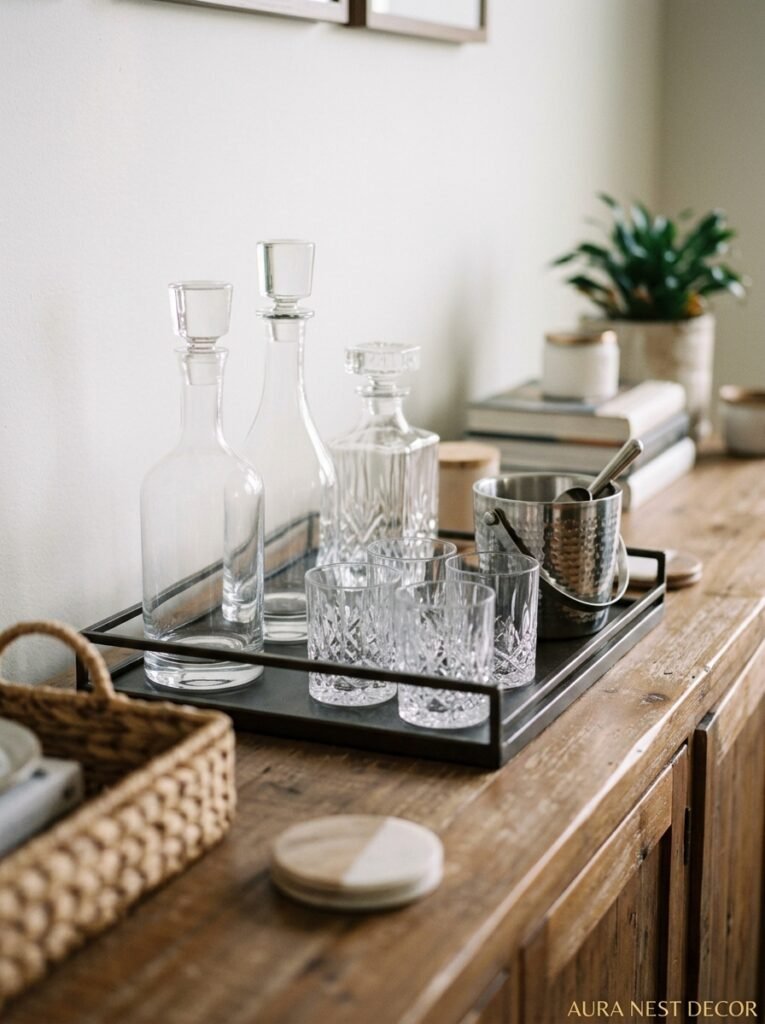
Can we talk about this? Because bar setups often become a game of “how many bottles can I fit on here” and then the whole thing looks like an off-license rather than a considered, beautiful space.
If you’re stocking for display AND use, here’s my honest take: six bottles is the sweet spot for most living room setups. One whisky (a good one, doesn’t have to be expensive, just one you’d actually serve someone). One gin that looks good because the bottle matters when it’s on display, sorry but it does. A vermouth or amaro for that slightly sophisticated visual and because it’s actually useful for cocktails. Sparkling water in a nice glass bottle if you keep it chilled nearby. And then two wild cards that are genuinely yours — whatever you actually drink, whatever reflects you.
That’s it. Resist the urge to add more. You can store the rest elsewhere.
Glassware: two types max on display, I said it before and I’ll say it again. Everything else goes in a cabinet.
—
7. The Small-Space Bar That Doesn’t Look Like an Afterthought
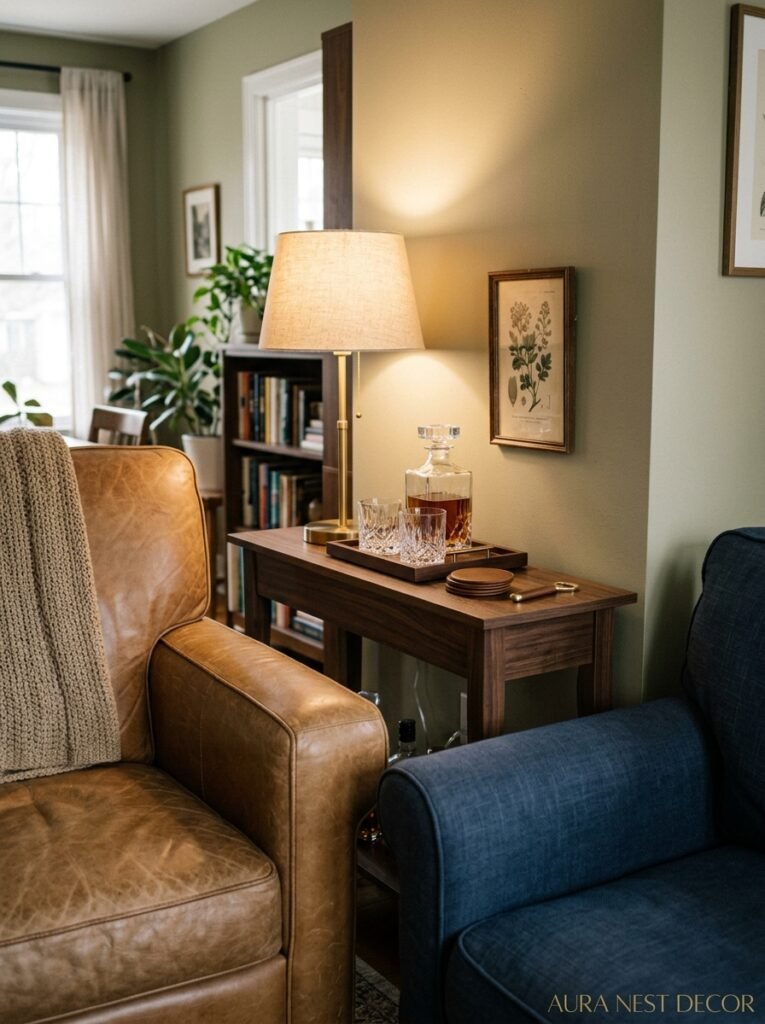
Small living rooms are not a reason to skip the bar situation. I’d actually argue a small, perfectly styled bar corner hits harder in a smaller room because it has more focus. There’s less competing with it.
A single floating shelf at around eye level, a second one below it, and a small stool or side table underneath — that’s a full bar setup in about two square feet of wall space. Genuinely. The shelf spacing matters (leave more room than you think you need between them), the backing matters (paint the wall behind dark or add a small mirror panel), and the edit matters most of all.
Apartment dwellers in the US and flat owners in the UK — you’ve got this. A slim bar cart against a hallway wall works. A repurposed bookshelf with the bottom two shelves cleared for bottles and glassware works. A corner table with good styling works.
The only thing that doesn’t work is trying to scale it too big for the space. Smaller and intentional beats big and crowded every single time.
“Two shelves and the right lighting is all it takes. The rest is just editing.”
—
8. The Vintage Piece That Changes the Whole Vibe
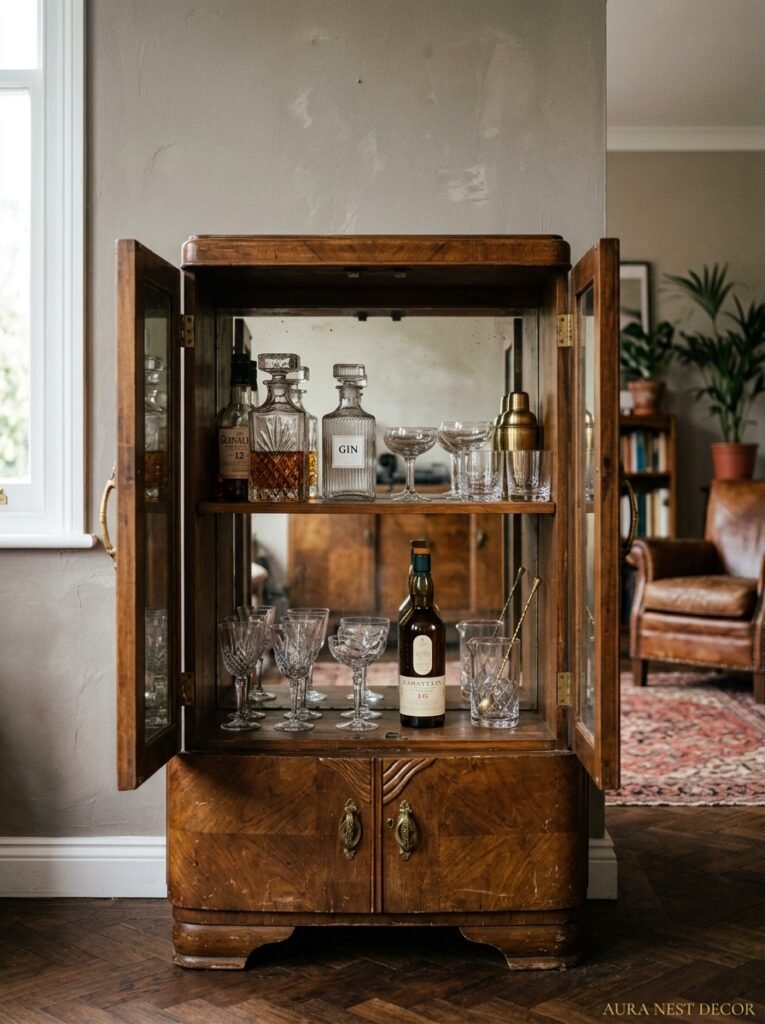
There’s one thing that separates a bar setup that looks styled from a bar setup that looks COLLECTED, and it’s almost always one vintage or antique piece in the mix.
A 1970s ice bucket. A set of crystal tumblers from a charity shop that turned out to be genuinely beautiful. A vintage cocktail shaker that’s slightly dented but made of proper silver plate. A drinks trolley from an estate sale that needed nothing except a clean.
In the UK, this is almost embarrassingly easy — car boot sales, charity shops, estate agents’ clearance situations, eBay searches for “vintage drinks trolley.” In the US: estate sales, antique markets, Facebook Marketplace is genuinely incredible for this. I’ve seen people find $15 bar carts on Marketplace that cleaned up to look like $400 pieces.
The key is: one vintage piece. Not everything vintage or it starts feeling like a prop set. But that one piece carries a history and a warmth that new things simply can’t fake, no matter how well they’re designed.
—
9. The Art and Wall Situation Around Your Bar
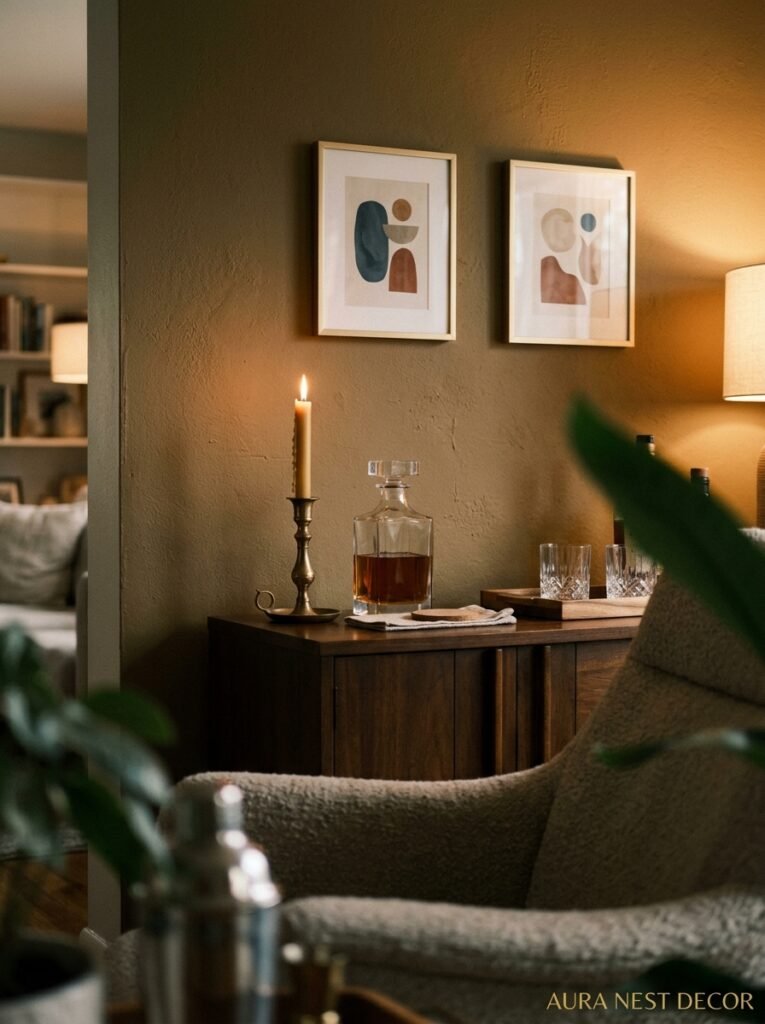
This gets overlooked but it matters. What’s on the wall above and beside your bar is part of the bar.
A large single print or painting above a bar sideboard can completely anchor the setup — pulls the eye up, makes the whole thing feel like an intentional vignette rather than just furniture against a wall. Something botanical, something abstract with moody tones, a vintage drink menu print if you want to lean into the theme without being too obvious about it.
Don’t just leave the wall blank above your bar. Or do — if the wall itself is doing something interesting like a dark paint color or a textured wallpaper. But if it’s plain white or neutral, something needs to go up there.
Gallery walls around bars can be beautiful but they can also compete too much. One thing I’ve seen work really well: a single large mirror, especially in an arched shape, positioned above a bar sideboard. Looks expensive. Feels considered. Bounces light back from those candles we talked about.
—
10. The Bar Accessories That Are Worth Buying vs. The Ones You Can Skip
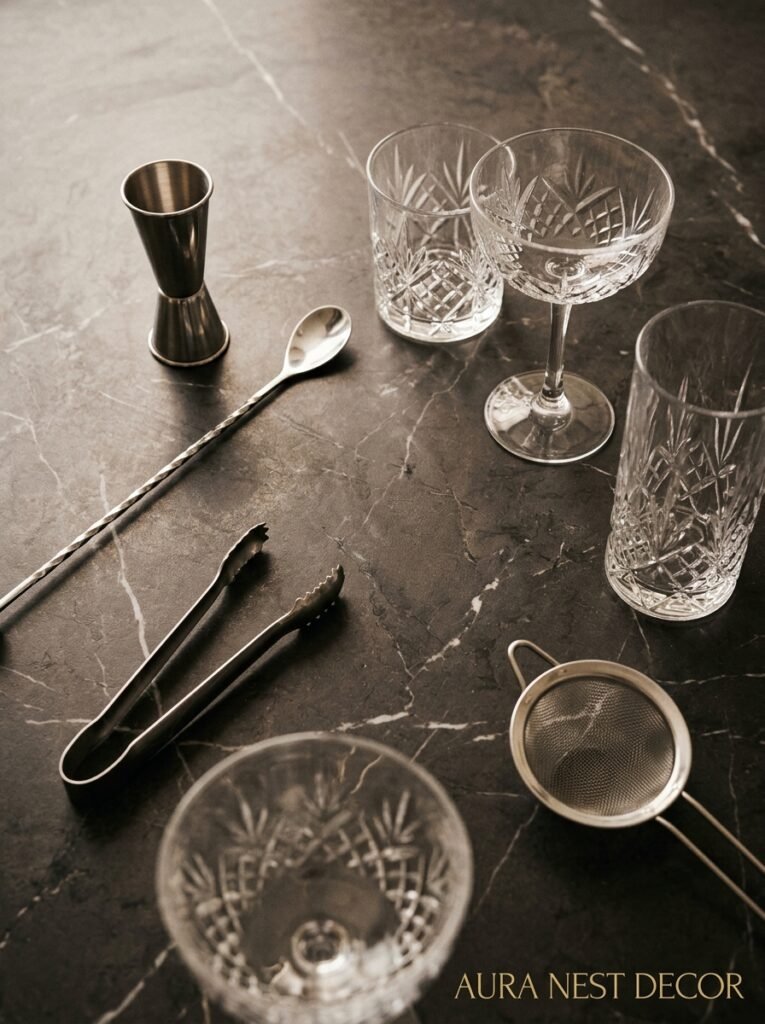
Worth every penny: a good cocktail strainer, one proper muddler, a jigger if you actually make drinks (and I think you should, it’s fun), a handsome tray to corral the tools on, and one really nice set of glasses even if everything else is mixed.
Could skip entirely: the electric cocktail mixer that charges via USB, the matching “home bar” sign, the coaster sets sold specifically as “bar accessories” which are usually ugly and overpriced, and most things that come in “bar starter kit” packaging.
Side note — the tray is doing SO much work in a bar setup. A good tray contains, it organizes, it makes a cluster of things look curated rather than cluttered. Marble, stone, lacquered wood, beaten brass — any of these work. Just make sure it’s large enough that things aren’t hanging off the edges.
—
11. The Finishing Touches That People Always Notice
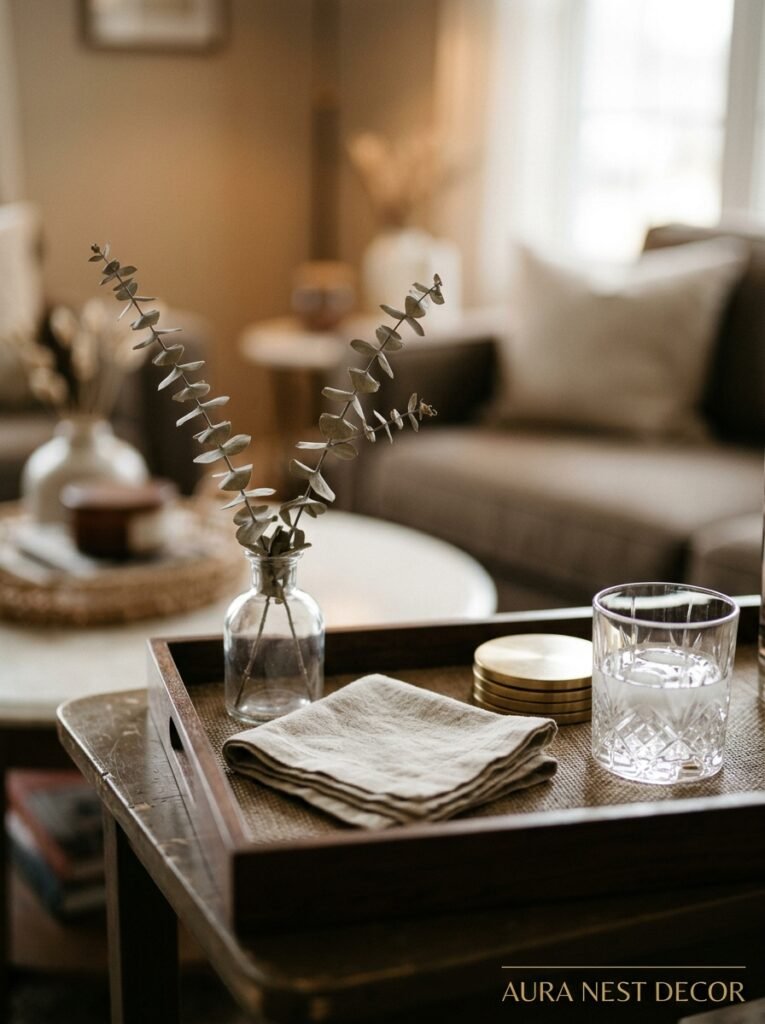
Fresh flowers or a small plant near the bar. Always. Even just a single stem in a bud vase. It signals that someone tends to this space, that it’s alive, that it changes. It’s such a small thing and it does so much.
Scent. Okay, not everyone does this, but a candle near the bar in the right scent — something smoky or woody or faintly citrusy — ties the whole sensory experience of that corner together in a way that’s hard to articulate but you absolutely feel when you walk past it.
And: a small bowl of something. Salted almonds, fancy crisps, a mix of things. It’s the detail that makes the setup feel genuinely hospitable rather than just decorative. A bar in a living room that’s only for looking at isn’t really a bar. It’s a still life.
—
12. The One Styling Mistake That’s So Common It’s Almost Become a Rule
Symmetry. People LOVE to put one bottle on each side, one glass on each side, one candle on each side. And it looks so correct. So balanced. And so completely boring.
Real, interesting bar setups are asymmetric. More weight on one side. An odd number of things. Things at different heights. Something unexpected right where you’d expect nothing.
Symmetry reads as designed. Asymmetry reads as lived in. And lived in is what we’re going for here — a space that feels like yours, that couldn’t quite exist in anyone else’s home, that people walk past and look twice at because something about it is specific in a way they can’t immediately name.
That’s the goal. Always has been.
—
❓ FAQ
Q: How do I set up a bar in my living room without it looking tacky? A: Edit ruthlessly — fewer bottles, fewer glasses on display, one statement piece. Tacky usually comes from overcrowding and mismatched scales, not from the idea itself. A dark paint color on the wall behind it immediately lifts everything too.
Q: What’s the best bar cart for a small UK flat? A: A slim, two-tier brass or matte black cart works best for tight spaces — they don’t need much clearance and tend to feel more elegant than bulky three-tier options. Check eBay and Facebook Marketplace before buying new; vintage ones are often sturdier and more interesting.
Q: Do I need special lighting for a home bar setup? A: You don’t need anything expensive, but you do need to address it. A single warm-toned table lamp nearby or an LED strip under a shelf makes an enormous difference. Avoid cool white light — it kills the atmosphere you’re trying to build.
—
💭 Final Thoughts
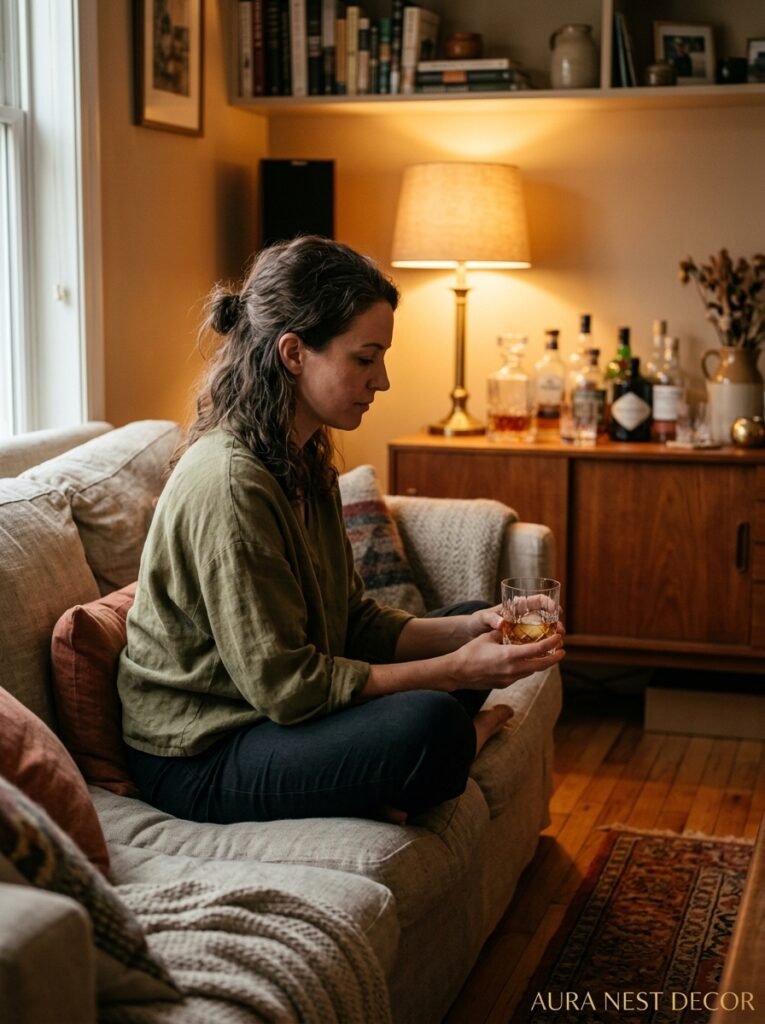
A living room bar is one of those things that sounds like a luxury but actually just takes an afternoon, a few good decisions, and a willingness to edit. It doesn’t need to be big. It doesn’t need to be expensive. It just needs to feel like you thought about it.
And once you have it — once you’ve got that warm little corner glowing on a Friday evening with the right glasses out and something cold already poured — you’ll wonder what the room was even doing before.
What would your bar corner say about you?