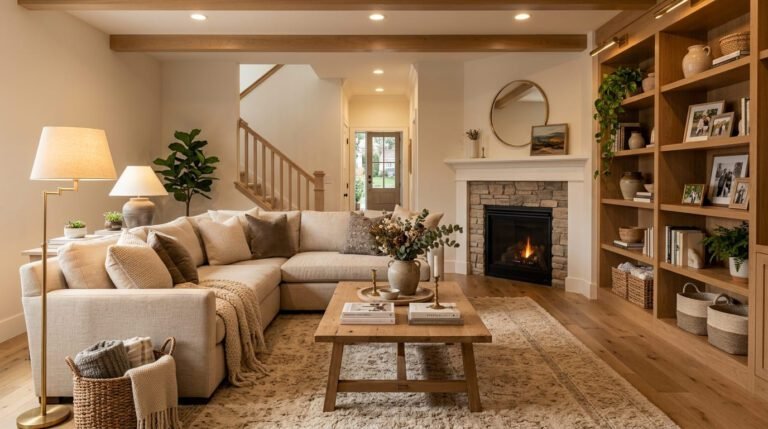
You Don’t Need a Bigger Budget. You Need Better Taste.
You’ve been scrolling. You’ve seen the kitchens with the marble countertops and the living rooms that look like they were styled by someone with a trust fund. And honestly? Half of those looks are way more achievable than Instagram wants you to believe. Let me show you how.
—
1. The Thing Nobody Tells You About “Budget Decorating”
Budget decorating has a reputation problem. People hear it and immediately picture flatpack furniture that wobbles, printed canvas art from a discount bin, and rooms that look FINE but never feel finished. That’s not what this is.
The real secret — and I mean this — is that expensive-looking rooms aren’t expensive because of price tags. They’re expensive because of proportion, restraint, and texture. You can get all three for almost nothing if you understand what’s actually creating the effect. A room with two well-chosen pieces and a lot of intentional empty space will always look more expensive than a room stuffed with cheap finds. Always. This is the mindset shift that changes everything, and nobody in the discount home decor world wants to say it out loud because it means you should buy LESS stuff, not more.
So before you buy anything — anything — look at what you already own. I’m serious. The answer is probably already in your house, just in the wrong room.
“The most expensive-looking rooms aren’t full of expensive things. They’re full of confident choices.”
—
2. The Color That Keeps Showing Up in Every Beautiful Budget Kitchen Right Now
It’s not grey. Grey is done, honestly, and I’ll stand by that. The color that’s everywhere in beautiful, inexpensive kitchens right now is a warm off-white — not stark white, not cream exactly, but something in between. Think the color of a page in an old paperback novel. Warm. A little aged. Not trying too hard.
The reason it works so well on a budget is that it makes everything else look intentional. Wooden cutting boards, a brass tap, mismatched mugs — all of it looks CURATED against that warm white. It also photographs beautifully in natural light, which is probably why it’s taken over Pinterest so completely in the last year or so.
In the UK, this shade is showing up in a lot of Victorian terrace renovations where people are working with original features and not a lot of money for new cabinetry. In the US, I’m seeing it in smaller apartment kitchens where the cabinets get repainted rather than replaced. And painting your cabinets, by the way, is genuinely one of the highest-ROI things you can do for a kitchen on a tight budget. A £40 or $50 pot of good cabinet paint can make a room feel completely different. Not kind of different. COMPLETELY.
—
3. Why Your Living Room Furniture Is Probably in the Wrong Place
This one is going to sting a little. Most people push all their furniture against the walls. It feels logical — more floor space, right? But it actually makes a room feel smaller, more awkward, and somehow both too empty and too crowded at the same time.
Floating your furniture, even slightly, changes everything. Pull the sofa a foot or two away from the wall. Bring an armchair in closer to create a conversational cluster. Leave some distance between the edge of your rug and the walls. It feels counterintuitive and I know the first time you try it you’ll stand in the doorway thinking “this looks wrong.” Give it 24 hours. Come back. I promise you it’ll look right.
The reason this works psychologically is that it creates a sense of intention. When furniture floats, it says “someone made a decision here.” Against the walls, it says “we didn’t know what else to do with this.” And that difference — that tiny shift in perceived intention — is what separates a room that feels designed from one that feels just… assembled.
The best part? Moving furniture is free. Completely free. Do this before you buy anything else.
—
4. How to Fake a £2,000 Kitchen Shelf Styling for Under £30
Right, so kitchen shelving. Open shelves in particular. You’ve seen the ones — ceramics lined up, a wooden cutting board casually leaning, little pops of green from a trailing pothos, everything cohesive and warm and somehow not looking cluttered even though there’s stuff everywhere.
Here’s the actual formula they’re using: odd numbers, varying heights, and one natural material to anchor it. That’s it. Three items is better than four. A tall thing next to a medium thing next to something low and flat. And always — ALWAYS — something made of wood or something living.
For under £30 or $35, you can pull this off. A second-hand ceramic pitcher from a charity shop or thrift store. A bundle of dried cotton stems (cheaper than fresh, last forever). A wooden board you already have. Maybe one thing in a color that ties back to something across the room. You don’t need matching sets — you need a palette. There’s a massive difference between the two.
“A shelf styled in odd numbers and varying heights will always look like it cost more than it did.”
—
5. The Lighting Rule That Makes Any Room Feel Like a Magazine Spread
Overhead lighting is ruining your home. Not forever, you can fix it, but RIGHT NOW the overhead light in your living room is probably making everything look flat, harsh, and kind of like a doctor’s office waiting room.
Layer your light. That’s the whole rule. You want multiple light sources at different heights — a table lamp in one corner, a floor lamp somewhere else, maybe some candles or a small lamp on a shelf. None of it has to be expensive. A good floor lamp from a budget retailer (we’re talking £25-$40 range) plus an amber-toned bulb — not daylight white, never daylight white — will change the entire feel of your evenings in that room.
The amber glow of an Edison-style bulb at 7pm on a dark autumn evening is one of those things that makes a home feel like a HOME. I can’t explain why it works neurologically but it just does. Turn the overhead off. Turn everything else on. See what happens.
Side note — dimmers are genuinely worth the investment if you can manage it. Even a smart plug with a dimmer capability costs almost nothing these days and the difference is real.
—
6. The One Rule That Makes Any Tiny Room Feel Intentional (Not Just Small)
Small spaces have one core problem and it isn’t square footage. It’s confusion. Too many different materials, too many scales, too many things asking for attention at once.
The solution is what designers call a “limited palette” but honestly you can just think of it as having a theme you actually stick to. In a small living room, pick TWO main textures — let’s say linen and wood — and then make everything in the room relate to those somehow. Linen curtains, a wooden side table, a linen-tone cushion, a light wood picture frame. Now you’ve got a room that feels EDITED, and edited rooms feel bigger. Not because of any optical illusion, but because your brain isn’t working overtime trying to process competing visual information.
In the UK especially, where so many homes have small sitting rooms and galley kitchens, this rule is basically essential. And in smaller US apartments — particularly in cities where you’re working with genuinely compact square footage — it’s the difference between a room that feels oppressive and one that feels intentional.
Also: mirrors. Everyone says it and it’s still true. One large mirror, strategically placed to catch either natural light or a lamp, will do more for a small room than almost any piece of furniture.
—
7. Curtains Are the Most Underrated Budget Upgrade in Any Home
I’m going to say something controversial: most people’s curtains are too short and too narrow. And it’s making their rooms look shorter, cheaper, and somehow sadder than they need to.
Hang your curtains HIGH — up near the ceiling, or as close as you can get. Hang them WIDE — extending past the window frame on both sides so that when they’re open, they don’t block any light. This creates the impression of a taller, wider window, which creates the impression of a bigger, grander room. And you don’t need expensive curtains for this to work.
Plain linen-look curtains from budget retailers work brilliantly for this. In the US, IKEA’s LENDA curtains are a classic for this reason. In the UK, they’re everywhere from Dunelm to Primark Home and they photograph incredibly well. The KEY is the hanging height. Get that right and even cheap curtains will look expensive.
“Hang your curtains near the ceiling, not at the window. The room will thank you.”
—
8. The Charity Shop and Thrift Store Finds That Actually Look Expensive
Not everything from a charity shop or thrift store reads as “budget.” Some things look cheap when you get them home. But there are specific categories that almost always punch way above their price point.
Ceramics, almost always. Old ceramic vases, pitchers, bowls — especially in earthy or neutral tones — look genuinely beautiful and the charity shop circuit in the UK is FULL of them. In the US, Goodwill and Facebook Marketplace are your best bets and honestly the finds there are sometimes jaw-dropping.
Wooden items — old frames, small stools, side tables, trays — tend to look better with a little age on them. New wood often looks too new. Aged wood has character and character is free.
Heavy glassware. Old crystal decanters and chunky glasses look expensive because they ARE expensive — just not for you, because you’re buying them secondhand.
What doesn’t work: most fabric-based items unless you’re handy, and anything with an obvious brand aesthetic that dates it. You want pieces that feel timeless, not pieces that feel like someone’s 2012 living room.
—
9. The Kitchen Counter Styling Trick That’s Actually About What You Remove
Here’s the thing about beautiful kitchen counters: the secret is subtraction.
Most of us have too much on our counters. The toaster, the kettle, the coffee maker, the knife block, the fruit bowl, the stack of mail, the random vitamins — it accumulates and it makes even a beautiful kitchen look cluttered and small. And cluttered and small is the opposite of what we’re going for.
Clear everything off. Genuinely, just clear it all. Then put back ONLY what you use every single day without exception. The kettle probably stays (especially in a British kitchen, let’s be honest, the kettle is non-negotiable). But the toaster? Can it live in a cupboard between uses? The blender you use twice a week? Put it away.
What you leave out should be things that also LOOK good — a beautiful coffee machine, a wooden bread bin, a simple kettle in a color you actually love. Everything else: away. The counter space that opens up will make your kitchen feel twice as big. Not metaphorically. It physically will.
—
10. Why the “Luxury Look” in Living Rooms Is Really Just About Layering Textiles
You want to know what actually makes a living room look expensive? Not the sofa. Not the coffee table. It’s the layers.
A throw blanket, folded loosely over one arm of the sofa. Cushions in different textures — maybe a velvet one, a linen one, something with a bit of tactile interest — not a matching set, never a matching set. A rug that’s big enough to actually anchor the seating area. When you layer textiles, you create depth and warmth, and depth and warmth read as LUXURY.
None of this needs to cost much. A good chunky knit throw can be found for £20-$25. Cushion covers (just covers, not cushions — stuff the ones you already have into better covers) can be found cheaply everywhere. Rugs are worth spending slightly more on because they define the room, but even then, there are great options at every price point. The layering is the thing. One perfect throw on a sofa does more than three awkward cushions from a matching set.
—
11. The Plant Situation: What to Buy, What to Skip, and Where to Put It
Plants are having a moment that has now lasted approximately six years, which means it’s not a moment anymore, it’s just how rooms look now. And the good news is that plants are cheap, they’re alive (until they’re not), and they add something to a room that no object can replicate.
But — and this is important — plant placement matters as much as which plants you choose. A large plant in a corner does something architectural. A small plant on a shelf does something intimate. A trailing plant on a high shelf does something unexpected and kind of magical.
For budget decorating, pothos and devils ivy are genuinely your best friends. Nearly impossible to kill, fast-growing, trail beautifully, and cost almost nothing. A single pothos bought for £5 or $8 will fill a shelf within a few months. A snake plant in a corner gives you that tall, architectural feel for usually under £15 or $20. And dried flowers — cotton stems, pampas, eucalyptus — give you the visual warmth of plants without the maintenance, last for months, and photograph beautifully.
—
12. The Final Layer: What Your Room Is Missing That You Haven’t Named Yet
There’s a quality in certain rooms that’s genuinely hard to put into words. You walk in and it just FEELS right. Like it’s lived in but beautiful. Comfortable but intentional. And when you try to figure out what exactly is creating that feeling, it’s hard to isolate.
What it usually comes down to is personal objects. Not clutter — personal, meaningful objects that say something about the person who lives there. A stack of books you’ve actually read. A small print from an artist you genuinely love. A candle in a scent that makes the room smell the way you want your home to smell. A piece of pottery someone gave you.
This is the layer that no amount of budget decorating advice can tell you how to buy, because it’s specific to you. But it’s also the layer that’s completely free, because you probably already own some of these things and they’re in a box somewhere, or on a shelf in another room, not doing the work they could be doing.
Bring out the things that mean something. Put away the things that are just filling space. That’s the last step and in a lot of ways, it’s the most important one.
—
❓ FAQ
Q: What’s the single highest-impact budget change for a small living room? A: Honestly? The curtain height trick — hanging curtains as close to the ceiling as possible and wider than the window frame. It costs nothing extra if you’re already buying curtains and it makes the room feel significantly taller and bigger. Second to that would be removing the overhead light from your evening routine and switching to layered lamps.
Q: How do I make a budget kitchen look more expensive without replacing the cabinets? A: Paint them if you can — it’s genuinely the biggest visual change for the least money. If painting isn’t an option, change the hardware. New handles and knobs are surprisingly affordable and make an enormous difference to how dated or fresh a kitchen reads. Then focus on the countertop styling and the shelves — what’s on display matters as much as the cabinetry itself.
Q: Are expensive rugs actually worth it on a budget? A: For most items, no — go cheap and clever. But rugs I’d say are worth stretching the budget slightly because a bad rug can undermine an otherwise beautiful room. That said, “worth it” doesn’t mean expensive — it means finding something that looks right in terms of size, texture, and color, even if you have to save up for a few weeks. A rug that’s too small is almost worse than no rug at all.
—
💭 Final Thoughts
Beautiful rooms aren’t built in a weekend and they’re not built with a big budget either, most of the time. They’re built with attention — to proportion, to light, to what you actually keep versus what you’re just used to seeing there. The best home is the one that feels like yours, not a showroom and not a mood board. So take what’s useful here, ignore what isn’t, and trust your instincts more than you probably do. What’s the one room in your home that you walk past and think “I could do something with that”?