The $200 Living Room Glow-Up That Actually Works (No, Really)
You’ve scrolled past a hundred of those “budget decor” posts and every single one ends with a $400 rug “that’s totally worth it.” I’m not doing that. This is about the changes that cost almost nothing and make people walk into your living room and ask what you did differently — and you get to say “oh, just a few small things” with a mysterious smile.
—
1. The Lighting Trick Designers Charge $500 to Tell You
Overhead lighting is the enemy. I’m sorry but it just is.
That harsh, flat, light-every-corner-equally approach is why so many living rooms feel like a waiting room at the dentist. The fix isn’t expensive. It’s just about where the light comes FROM.
Get a lamp. Put it in a corner, low to the ground, pointing upward. Then get another one — a different height, maybe a clip-on for a shelf. The goal isn’t to light the whole room. The goal is to create pools of warm light that make some areas glow and let others fall into shadow, the way the room feels at 9pm on a Friday when everything’s just right.
Edison bulbs with a 2200K warmth rating cost about $8 at any hardware store. That amber glow they throw at dusk is genuinely the difference between a room that feels like a home and one that just… doesn’t. Ditch the main ceiling light as your primary source. Use it never, or almost never. Seriously.
“The right lamp in the wrong room still beats the wrong light in every corner.”
2. Why Your Sofa Arrangement Is Fighting Against You
Most people push everything against the walls. It feels logical — more floor space, right? But it’s actually doing the opposite of what you want.
When furniture hugs the perimeter, the center of the room becomes this big empty void and the seating feels weirdly far apart, like you’d have to shout across a canyon to have a conversation. Pull things IN. Even 12 inches off the wall makes a room feel bigger, not smaller, because now it feels designed rather than just stored.
For small living rooms specifically, a floating sofa arrangement with a small rug anchoring it underneath creates what designers call a “room within a room.” It sounds fancy but it’s honestly just about defining the space intentionally. Your sofa doesn’t need to lean on the wall for support. It’s fine on its own.
Side note — if you’re renting and terrified to mess with things, just try it for a weekend. Worst case, you shove it back.
3. The One Color That’s Showing Up in Every Beautiful Low-Budget Room Right Now
Warm white. Not cool white, not gray-white, not “greige.” WARM white.
It’s having a moment and honestly I think it’s because people spent a few years in gray rooms and finally snapped. Warm white on walls — think Benjamin Moore White Dove or Dulux Jasmine White in the UK — does something wild: it makes every other color in the room look more intentional. Your thrifted cushions suddenly look curated. Your hand-me-down bookcase looks vintage and deliberate.
The thing is, warm white reflects light softly rather than bouncing it hard and cold around the room. Rooms painted in it feel almost like the walls are slightly glowing at golden hour. And if you’re renting and can’t paint? A warm white throw draped over a sofa, warm white candles, and a cream-colored rug creates enough of the same energy that it genuinely shifts the whole room’s temperature.
I’ve repainted rooms three colors before landing on a warm white and every single time the warm white won.
4. Thrift Store Shopping Rules That Actually Get You Good Stuff
The secret isn’t patience. It’s knowing what to LOOK for.
Go for bones, not surface. A lamp with a bad shade but a great base? Buy it. Recover or replace the shade for $15. An ugly ceramic vase with a great silhouette? Buy it. Paint it. A wooden side table with a scratched top but solid legs? Buy it. Sand it, oil it, done.
What you’re looking for are shapes that feel intentional. Rounded ceramics. Tapered legs on furniture. Anything with an interesting silhouette that’s just been painted an unfortunate color or left to get dusty. The form is what costs money new — you’re basically raiding the stock early.
Also: don’t go to one thrift store once. The stock turns over constantly. Go every few weeks, go to multiple shops, and develop a weird emotional instinct for which sections to check first. Mine is always the lamp section, then ceramics, then furniture. Other people swear by the picture frames section for the glass alone, which you can repurpose in about forty different ways.
“Don’t buy what it is. Buy what it could be with twenty minutes and some paint.”
5. The Small Space Kitchen Rule That Interior Designers Don’t Actually Keep Secret
They just don’t make it clickable enough, I guess. The rule is: vertical space is free real estate you’re ignoring.
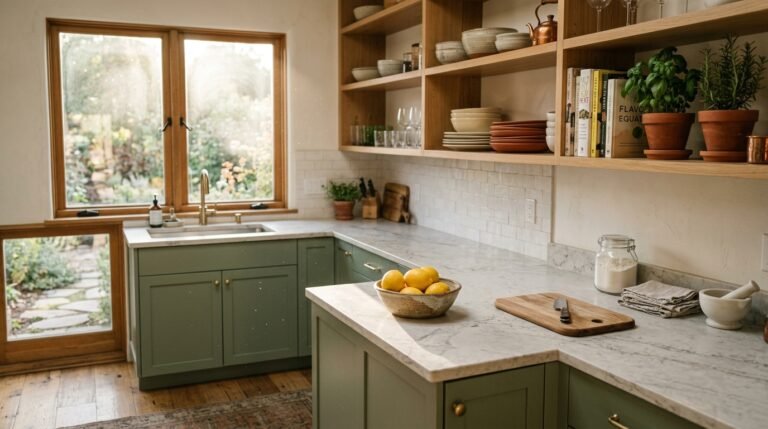
Most people in small kitchens think about counter space and cabinet space and forget entirely that there’s a whole wall between the counters and the ceiling that’s just… sitting there. Floating shelves, a single rail with S-hooks for hanging things, a magnetic knife strip, pegboard painted to match the wall — these aren’t just storage. They’re decor.
When you put your nice olive oil bottle and your wooden cutting board and your little terracotta pot of herbs on a shelf at eye level, that kitchen suddenly has a STORY. It looks like someone lives there who actually cooks and actually cares. Which you do. But the room wasn’t showing it before.
In the UK especially, kitchen units often stop about a foot below the ceiling and that gap is prime territory. A row of wicker baskets up there, or some stacked vintage cookbooks, takes a budget kitchen from “functional” to something you’d actually want to photograph.
6. How Rugs Do the Decorating FOR You When You’ve Got Nothing Left to Spend
A rug is load-bearing decor. It’s not an accessory. It defines the entire emotional register of a room before you’ve touched anything else.
The mistake most people make is going too small. A rug that sits under the coffee table and doesn’t reach the sofa legs reads as an afterthought — it’s just floating in the middle of the room looking confused. For a living room, you want the rug to sit under the front legs of ALL the seating, minimum. Ideally, everything is on it.
Budget option that actually looks expensive: layering rugs. A plain jute rug (incredibly cheap, lasts forever) as the base layer, then a smaller patterned rug or sheepskin on top. The texture contrast is interesting, the scale difference reads as intentional, and you can swap the top layer seasonally without spending much. Also, jute goes with literally everything, which is annoying because it means I’ve recommended it to basically everyone I know.
The warmth a good rug adds isn’t just visual. When you walk in from a cold day and your feet hit that softness, the whole room just changes. That’s not pretentious — that’s just true.
7. Why Decluttering Is Overrated (and What to Do Instead)
Every minimalism account on Pinterest tells you to clear every surface and live with one perfect object. And those rooms DO look beautiful in photographs.
But you’re not in a photograph. You’re a person who lives there and drinks tea and has books and that candle you bought in 2019 that you’re still using. Real rooms with a bit of STUFF in them feel lived-in in a way that’s actually comforting. The goal isn’t emptiness, it’s intentional arrangement.
Here’s the actual trick: cluster things. Instead of one candle, two books, and a plant all spaced equally across a shelf, push them together. Make a little scene. Three candles of different heights, a small stack of books, a trailing plant. That cluster reads as deliberate. The same objects spread out reads as random. Your eye doesn’t know what to settle on when things are scattered, and the room feels messy even if there isn’t that much in it.
“Three things grouped together is styling. The same three things spread apart is clutter.”
8. The Kitchen Detail That’s Cheap and Immediately Changes the Vibe
Hardware. Cabinet hardware is genuinely the quickest win in a kitchen.
Those flat brass pulls, or the aged bronze ones with a bit of weight to them — they’re usually about $2-$6 each. And the before/after difference when you swap out stock white or silver hardware for something with actual character is almost unfair. It’s the equivalent of swapping plastic buttons for fabric-covered ones on a coat. Suddenly the whole thing feels more considered.
In the UK, B&Q and Dunelm both have options that look much more expensive than they are. In the US, places like Home Depot and even Etsy sellers have pulls in every finish imaginable. Aged brass reads as vintage and warm. Matte black reads as modern and slightly minimal. Unlacquered brass looks incredibly specific — like someone chose it on PURPOSE.
You don’t need new cabinets. You need new hardware and maybe an afternoon. That’s it.
9. The Plant Theory That Actually Makes Sense for People Who Kill Plants
Not every plant is created equal for low-light, low-effort, budget interiors.
Big sculptural leaves — think monstera, fiddle leaf fig (I know, I know, but a small one is still worth it), or a rubber plant — do SO much more decorative work per plant than a bunch of small fiddly things scattered around. One oversized plant in the corner of a living room reads as intentional, almost architectural. Twenty tiny succulents on a windowsill reads as a collection that got out of hand.
For people who’ve murdered every plant they’ve ever owned: pothos. Non-negotiable. Literally trails everywhere, thrives on neglect, looks beautiful cascading off a shelf, and costs about $5. They’re drought tolerant, low light tolerant, basically indestructible — or maybe it’s the opposite, maybe they just really WANT to live, honestly. My pothos has been knocked over, forgotten for three weeks, and repotted badly at least twice. It’s thriving.
Buy one big plant and one trailing plant. That’s your starting lineup. Then decide from there.
10. Modern on a Budget Means Knowing Which Details to Get RIGHT
Modern decor has this reputation for being expensive because of the minimalism — every single object is in view, so every object has to be good. But budget-modern is completely possible if you know which things are non-negotiable.
Consistent metals. Pick ONE metal finish and stick to it. Gold lamp, gold hardware, gold picture frame? Beautiful. Gold lamp, silver frame, bronze hardware? Chaos. Consistency in metal finishes is what makes a budget room look like you knew what you were doing all along.
Clean lines on furniture. You don’t need expensive furniture — you need furniture without a lot of visual noise. Simple shapes, no ornate detailing, no carved wood accents that collect dust. IKEA is genuinely very good at this, especially their EKET and KALLAX units which are cheap and have clean profiles.
And white space. Not everything has to be filled. Leave some walls bare. Not all of them, but some. A bare white wall next to one good piece of art reads as intentional restraint. Which honestly costs nothing.
11. The Budget Wall Decor Idea That Looks Like a Design Decision (Not a Compromise)
Gallery walls get a bad name because badly done gallery walls are genuinely painful to look at. But a GOOD gallery wall is one of the cheapest ways to add serious visual impact.
The trick is committing to one decision and then being consistent. All black frames. Or all wood frames. Or all white mats regardless of frame. Pick one variable to unify them and then let everything else vary — different sizes, different types of art, a mirror mixed in. The frame consistency is what makes it look curated rather than chaotic.
For art itself: free options genuinely exist. The Met Museum and Unsplash both have high-resolution downloadable images. Old botanical prints are in the public domain and look beautiful printed at home. Vintage maps. Old magazine pages from secondhand shops, framed simply. Even your own photos, printed at drugstore prices. Art doesn’t have to mean expensive art, it means something intentional on the wall.
One more thing — level your frames properly. Get a level app on your phone. Crooked frames undermine EVERYTHING else you’ve done, they’re the one detail that people will notice even if they can’t say why the room feels off.
12. The Finishing Touch That Costs Nothing and Most People Forget
Scent.
Not a candle necessarily, though candles are great. But the overall olfactory experience of a room. Because people feel a room before they consciously evaluate it. When someone walks in and there’s a faint cedar scent, or vanilla, or that particular clean-but-warm smell of a home that’s well-loved — their brain registers it immediately and decides it feels good in there.
A reed diffuser in a consistent scent throughout your main space costs about $10-$15 and lasts months. Opening windows regularly. Fresh flowers, even a £1 bunch from the supermarket, add a lightness. Washing cushion covers every few weeks. These aren’t decorating in the traditional sense, but they’re absolutely part of what makes a room feel like somewhere you want to BE.
A room that smells good makes every design decision you’ve made read as better than it actually is. I cannot explain the psychology of this. I just know it’s true.
—
❓ FAQ
Q: What’s the single best thing to do in a small living room to make it look bigger? A: Pull your furniture away from the walls and put a large rug under all the front legs of your seating. A floating arrangement on a properly-sized rug makes small rooms feel defined and intentional rather than cramped — and that’s what reads as “bigger” to the brain.
Q: How do I make a rented kitchen look nicer without losing my deposit? A: Swap cabinet hardware (keep the originals in a bag to reinstall), add open shelving if the landlord allows it, and use peel-and-stick tiles for a temporary backsplash — they’re fully removable and have gotten genuinely good-looking in the last few years.
Q: What’s the cheapest way to make a living room look more modern? A: Pick one metal finish and use it consistently across every detail — lamp, frames, hardware, anything decorative. Consistency in metals signals intention. That single decision makes a budget room look like it was designed rather than assembled.
—
💭 Final Thoughts
You don’t need a renovation. You need about three weekends, a lamp you love, a rug that’s bigger than you think, and the willingness to move something three inches to the left and see what happens. Most of the rooms I’ve loved most weren’t expensive — they were just paid attention to. Which is the thing money can’t actually buy anyway.
What’s the one corner of your living room that’s been bothering you for months that you just haven’t touched yet?