How to Make Your Living Room and Kitchen Look Like You Spent Thousands (When You Really, Really Didn’t)
You know that feeling when you walk into someone’s home and it just feels right? Like everything is considered and cozy and somehow effortless? Yeah. That’s not money. That’s knowing a few things most people don’t.
—
1. The Farmhouse Look Is Free If You Know Where to Squint
Okay so here’s the thing nobody tells you about farmhouse style — it was never meant to be expensive. Like, the whole POINT was using what you had. Worn wood. Mismatched crockery. A jug of something from the garden. Somewhere between shiplap becoming a TikTok trend and Joanna Gaines getting her own network, we all forgot that farmhouse style was literally just… old stuff that worked together.
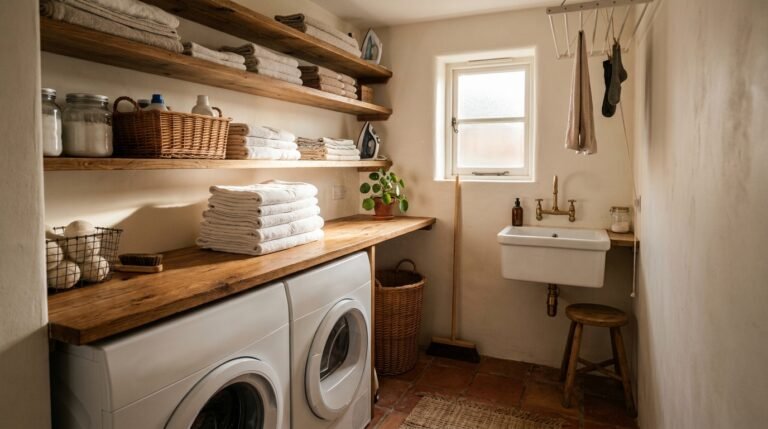
So before you spend a single pound or dollar on anything new, walk through your home and look at what’s already there. That beat-up wooden tray on your counter? That’s farmhouse. The slightly chipped enamel mug on your shelf? That’s farmhouse. The linen throw your mum gave you that you shoved in the closet because it “didn’t match”? Oh, it matches. Trust me.
The trick is intentionality. You’re not piling things up randomly — you’re editing. Take three things off every surface and replace them with one thing you actually love. Instantly more considered, instantly more “I designed this.” And you didn’t buy a single thing.
—
2. The Thrift Store Section Nobody Else Is Looking In
Everyone hits the furniture at the thrift store. The sofas, the bookshelves, the sad little side tables. But the REAL finds are in the random section — the one with the mismatched stuff nobody knows what to do with. Old wooden crates. Glass bottles with that beautiful blue-green tint. Ceramic pitchers with chips on them that make them look antique.
I found a set of three varying-height wooden candlesticks at a Goodwill for $2 total. They’re currently on my mantelpiece and I have had four people ask me where I got them. I said “antique market” because honestly it felt more true than “the bin at Goodwill next to a broken lamp and someone’s old wedding photos.”
In the UK — charity shops. Specifically the ones in slightly posher areas, because people donate differently. An Oxfam near me in a village just outside town had a set of linen napkins with embroidery on them that I use as kitchen shelving décor. They’re folded. They look intentional. They cost 50p each.
“The best-looking homes aren’t styled with money — they’re styled with patience and the willingness to look at something ordinary and see it differently.”
—
3. The Color That Keeps Showing Up in Every Beautiful Budget Kitchen Right Now
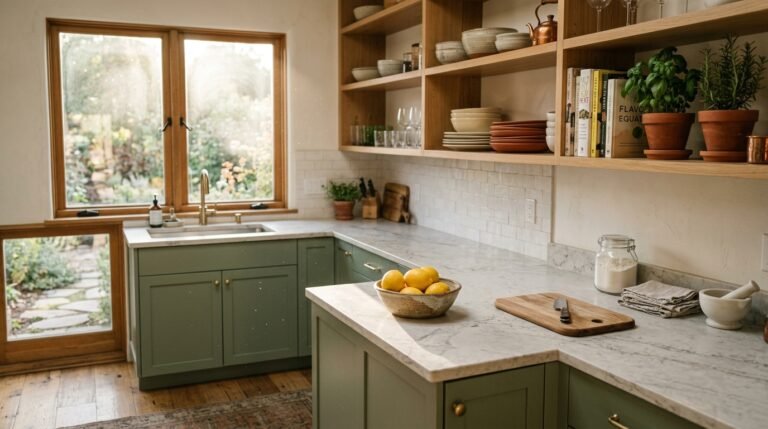
It’s not white. It was white for ten years and white is tired, honestly. It’s also brutally unforgiving if you have small kids, a dog, or a functioning life. What’s showing up everywhere — and I mean everywhere, from Pinterest boards to British interiors magazines to every American home renovation account I follow — is a kind of warm greeny-grey. Not quite sage, not quite olive. Something in between.
The reason it’s everywhere right now is because it does something genius: it makes a cheap kitchen LOOK expensive. That builder-grade laminate cabinetry you’ve been embarrassed by for three years? Paint it in something like Farrow & Ball Mizzle or Behr’s Dusty Miller. Take photos. Watch people assume you renovated.
You don’t have to paint everything. A lot of people paint just the lower cabinets and leave the uppers white or cream, which actually opens up the space and is WAY less commitment. If you’re renting — don’t do the cabinets, but a single painted wall in this color behind open shelving? Completely different room. Really.
—
4. Tiny Living Room? Here’s the One Rule That Actually Works
Stop putting everything against the walls. I know. I KNOW it feels counterintuitive. But pulling your sofa even eight inches away from the wall — just slightly, not dramatically — makes the room read as bigger, not smaller. It creates a sense that the furniture is placed, rather than shoved.
This is something interior designers charge actual money to tell people and here I am just saying it for free. You’re welcome.
The other thing: scale. People with small living rooms tend to buy small furniture thinking it’ll take up less visual space. But a room full of tiny things looks cluttered and cramped. One properly sized sofa in a small living room looks like a choice. Three small chairs and a tiny loveseat and a little side table and a small rug all crammed in looks like a storage unit. Pick one big thing. Let it anchor everything else. This applies whether you’ve got a cozy UK terrace house living room or a small American apartment with an “open plan” situation that’s basically just the kitchen and a couch.
“A small room doesn’t need small furniture — it needs fewer things that actually matter.”
—
5. The $20 Amazon Buy That Changed My Kitchen Shelves Forever
Okay so I don’t usually do product recommendations because everyone does product recommendations and most of them are just affiliate links dressed up as advice, but this one is different and I’m going to tell you about it anyway. Rattan shelf liners. Or wicker basket dividers. Or literally any kind of woven texture in a neutral tone.
I have open shelves in my kitchen — which looks gorgeous but is basically a way to put all your chaos on display — and the second I put a flat woven tray on each shelf and grouped things ON the tray, everything looked curated. The tray becomes a visual boundary. Your eye reads “section” instead of “mess.” It’s basically psychological trickery on yourself.
You can get similar things at HomeGoods, T.J. Maxx, or IKEA. In the UK, try Flying Tiger or even Dunelm — they do surprisingly good versions. The price point is laughably low for what it does to a space. Side note: this same trick works on coffee tables and bathroom counters and really anywhere you have stuff that needs to look like it was arranged instead of just dumped.
—
6. What Farmhouse Style Gets Wrong (And How to Fix It Without Spending More)
The shiplap thing. Can we talk about the shiplap thing? Real farmhouse homes didn’t have perfectly even, freshly painted shiplap as a “feature wall.” That’s a renovation show invention. Real old farmhouses had character that came from imperfection — from the marks of a life being lived in a space.
So if you’re chasing that aesthetic without a renovation budget, stop trying to recreate the show-version and start noticing the imperfections that are already in your home. A rough-plastered wall that you’ve always hated? That’s texture. A slightly uneven ceiling? That’s age. Lean into the things that make your space look lived-in because that IS farmhouse style.
What actually makes a room look farmhouse on a budget: vintage-ish textiles (linen, cotton, anything slightly rough to the touch), natural materials (wood, clay, wicker — not plastic trying to look like wood), and a restrained color palette that pulls from nature. Cream. Warm whites. Muted greens. The occasional black accent so nothing looks too sugary.
You can do ALL of this for the price of a few market finds and maybe one good throw pillow. Or honestly no money, if you shop your own house and actually look at it with fresh eyes.
—
7. The Lamp Situation (This One’s Serious)
Overhead lighting is the enemy of a beautiful room. I will die on this hill. The big light — you know the one, the flat ceiling fixture that floods everything with harsh brightness — is making your budget-friendly home look cheaper than it is. It’s making your space look like a waiting room.
Turn it off. Put it on a switch and forget it exists. And then:
Get a lamp. Or two. Or four, depending on the room. Second-hand lamp bases are everywhere and they’re cheap because nobody wants them in their original state. A dated brass lamp base from a charity shop or a garage sale? That’s a twenty-minute spray paint job away from looking incredible. I did mine in matte black and I tell people it’s from a boutique home shop. And then I change the subject quickly.
The shade matters more than the base. A good linen or cotton drum shade in cream or off-white is everything. It throws that amber glow that makes everyone in the room look good and makes your home feel like the kind of place people don’t want to leave. You know the one. The glow at 7pm when the light outside is changing and everything inside feels golden. You want that. It costs like $15 at IKEA.
“Turn off the big light. This is not a suggestion. This is home design at its most essential.”
—
8. Kitchen Counter Styling for People Who Actually Cook in Their Kitchen
Here’s the thing about those perfectly styled kitchen counters you see on Pinterest — they’re not real kitchens. Nobody actually cooks in them. They’re staging. They’re sets. And if you try to replicate them in a kitchen where you actually make dinner every night, you will fail and feel bad about yourself and that’s just not a fair outcome.
Real counter styling for real people means: decide what earns its place. Your coffee maker? Yes. Your stand mixer if you use it weekly? Yes. The seventeen different hot sauces lined up in a row? Maybe pick three favorites and put the rest in a cabinet. The knife block that’s kind of ugly but completely functional? Swap it for a magnetic strip on the wall if you want, but honestly if the block works, it works.
The stuff that ALWAYS looks good on a counter, no matter the kitchen: a wooden cutting board leaned against the backsplash, a small potted herb (basil if it’s warm, rosemary if it’s not), and a vessel holding utensils that’s actually beautiful — a crock, a jug, a ceramic pot. That’s it. That’s the formula. Everything else is clutter with good PR.
—
9. The Rug Thing That Nobody Agrees On But Everybody Notices
Too small. That’s the problem. Almost every living room rug I see — in real homes, not styled shoots — is too small for the space. It sits in the middle of the room like an afterthought, like someone wasn’t quite committed to the decision.
A rug should be big enough that at least the front legs of every piece of furniture can sit on it. Ideally all legs. This grounds the seating area and makes it feel like a room rather than just furniture floating in space.
Now, big rugs aren’t cheap. But here’s the budget workaround: layering. A large, inexpensive flat-weave or natural jute rug underneath, and then a smaller, prettier (possibly more expensive) rug layered on top. The bottom one can be from IKEA. The top one can be from a vintage market, a Moroccan-style find from a discount shop, or an online source like Rugs Direct where you can actually find decent deals. This is honestly one of those tricks that looks more expensive than the alternative of just buying one medium rug you’re not fully in love with.
—
10. Small Kitchen Hacks That Aren’t About “Decluttering Your Soul”
You’ve read the decluttering articles. We all have. They tell you to get rid of everything and only keep things that “spark joy” and your kitchen will be a serene space of beautiful minimalism. And then you realize you need four different pot sizes and a colander and that thing that gets the seeds out of pomegranates and suddenly minimalism feels like a lie.
The actual goal isn’t minimalism — it’s intentional organization. Everything has a place and that place makes sense. Use the inside of cabinet doors for extra storage (command hooks, small racks). Stack vertically where you can. Put a tension rod under the sink for cleaning spray storage. These aren’t life-changing revelations but they actually WORK in a real kitchen.
And then the visual stuff: matching storage containers make a chaotic pantry shelf look like a layout from a home magazine. Doesn’t matter if they’re from a fancy shop or the dollar section at Target — the visual consistency is what does the work. This is probably the highest-ROI thing you can do in a small kitchen and it costs very little.
—
11. The Free Styling Move That Makes Any Bookshelf Look Intentional
Books facing backwards. I know you’ve seen it and maybe you thought it was pretentious or impractical and you know what, on both counts you’re kind of right. But hear me out.
You don’t have to do it to ALL the books. Pick one section — maybe the middle shelf, maybe one side — and face those books spine-in so you just see the pages. The creamy white of old paperback pages is beautiful. It immediately breaks up the visual busyness of all those different colored spines and titles. And it makes your bookshelf look like it was styled.
Pair it with a few objects — something with height, something with weight, something with texture. A candle. A small piece of pottery. A framed photo with the frame leaned rather than standing. Again: three different heights, not three of the same thing. The eye likes variety. It reads variety as intentional, and intentional reads as expensive, and none of this cost you anything.
—
12. The $0 Reset That Makes Your Space Feel Like Someone Else’s House (In the Best Way)
Move things. That’s it. Move things around.
We stop seeing our own homes. It happens to everyone. You walk past the same arrangement every day and your brain just… files it as background. Nothing feels fresh or interesting because your eye stopped registering it months ago. So swap things between rooms. Take the plant from the bedroom and put it in the kitchen. Move the stack of books from the coffee table to a side table. Hang something on a wall you’ve never used for anything.
This is the thing interior designers do that nobody talks about — they’re constantly editing and moving and reconsidering. Not buying. Moving. Your home has more to offer than the arrangement you settled on in the first week you moved in.
Rearranging takes an afternoon and costs nothing and makes your home feel genuinely different. Put a podcast on. Move everything. Live with it for a week. Adjust. This is actually how good rooms happen — through iteration, not through one big purchase.
—
❓ FAQ
Q: How do I get the farmhouse look without it looking like a knockoff Magnolia Home catalog? A: Lean on texture and imperfection rather than signs and shiplap. Real farmhouse style is about worn, natural materials — linen, aged wood, clay, cotton — not a sign that says “GATHER.” Mix old and new, keep the palette warm and muted, and don’t try to match everything perfectly.
Q: What’s the single best thing I can do to improve a small living room on a budget? A: Honestly? Replace your lighting. Ditch the overhead light, add two lamps with warm bulbs, and the room will look completely different — warmer, bigger, and more like a space someone actually designed. A second-hand lamp base and a cheap shade from IKEA can do this for under $25.
Q: Are these tips appropriate for UK homes or are they very American? A: Both! I’ve tried to include UK-specific references throughout — Farrow & Ball, Dunelm, Flying Tiger, charity shops. The core styling principles work in a London terrace just as well as a US suburban home. The only real difference is that UK homes tend to have smaller kitchens, so the counter-styling and cabinet organization sections are especially relevant.
—
💭 Final Thoughts
None of this requires a renovation. None of it requires a big budget or a whole weekend or a trip to a fancy shop. It requires looking at your home like a stranger might — with fresh eyes and actual curiosity. The most beautiful homes I’ve ever been in weren’t expensive. They were considered.
So which room are you starting with?