How I Decorated My Whole Living Room and Kitchen for Under $300 (And It Doesn’t Look Cheap)
People always ask me what I spent. And when I tell them, they genuinely don’t believe me. That’s the thing about budget decorating — done right, nobody knows.
—
1. The Mindset Shift That Changed Everything About How I Shop for My Home
I used to walk into a store with a list. That was my first mistake.
Budget decorating doesn’t work like that. You can’t go in hunting for “a throw pillow in sage green” because the moment you’re desperate for something specific, you’ll overpay for it. What actually works? Going in with a FEELING instead of an item. I want this room to feel like somewhere I’d want to stay on a rainy Sunday. That’s it. That’s the brief.
Once I started shopping that way, everything changed. I’d find a chipped ceramic jug at a car boot sale and think — yes, that’s the feeling. I’d spot a worn linen runner at TJ Maxx for $4 and immediately see it draped over my console table. The item wasn’t on my list, but the vibe was exactly right.
Here’s what nobody tells you: expensive rooms don’t feel expensive because of expensive things. They feel expensive because everything in them looks like it was chosen with intention. That’s actually free. The intention costs nothing. And when you pair that mindset with genuinely affordable pieces, you end up with a room that stops people mid-sentence.
Start there. Shift the mindset first. Everything else follows from that.
2. The One Rule That Makes a Tiny Living Room Feel Like It Has Square Footage It Doesn’t
Scale. That’s the rule. Just scale.
Small rooms don’t fail because they’re small. They fail because people put small furniture in them, thinking small things will make the room feel bigger. Wrong. Actually wrong. A tiny loveseat floating in the middle of a small room makes that room feel SMALLER — because now you’ve got this awkward gap between the furniture and the walls, and your eye reads all that weird empty space as evidence that something’s off.
What actually works is getting one big anchor piece and building around it. In a small living room, that’s usually your sofa. Go bigger than you think you should. Push it toward a wall if you need to. And then layer smaller things close to it — a floor lamp that arcs over, a side table that’s almost touching the armrest, a small stack of hardcover books on the floor. Everything in close conversation with each other.
This is honestly one of those things you have to see to believe, so if you’re skeptical — find a room you love on Pinterest and zoom in. I’d bet money the furniture is not floating in the middle. It’s anchored, gathered, intentional. That’s the trick. And it costs exactly nothing to rearrange what you already have.
3. The Color That Keeps Showing Up in Every Beautiful Budget Kitchen Right Now
Warm white. Not cool white. Not bright white. WARM white.
There’s a reason it’s everywhere and it’s not just a trend — it’s because warm white is the great equalizer. It makes IKEA cabinets look intentional. It makes rental kitchen tiles look like a choice. It makes those slightly off-proportion counters your landlord installed look almost Shaker-cottage-ish if you squint right.
And here’s the budget part: you don’t have to repaint your whole kitchen to get this effect. A $12 can of warm white chalk paint can transform your cabinet fronts over a weekend. In the UK, Rust-Oleum Chalked in “Linen White” is what I’d reach for. In the US, same brand, look for “Aged Gray” if you want something barely-warm, or “Linen White” for that true biscuit-ish tone that photographs so well it’s almost unfair.
The trick with painting cabinet fronts is prep, not technique. Wipe everything with a degreaser first. Don’t rush it. Two thin coats beat one thick one every single time. And don’t skip the finishing wax — it’s what separates “painted furniture” from “furniture that was always this color.” That detail matters more than people realize.
“Warm white doesn’t just change the color of a room. It changes the temperature of it.”
4. The $0 Styling Trick Every Apartment Renter Needs to Know About
Vertical lines. Use them. Everywhere.
Apartments with low ceilings — which is most of them, let’s be real — feel cramped partly because your eye keeps hitting the ceiling and bouncing back down. The fix is drawing the eye UP before it gets bored. And you can do this without spending a single penny.
Hang your curtains higher than the window frame. Like, considerably higher — ideally right at the ceiling, or as close as your curtain rod allows. It’s almost absurd how much difference this makes. The window looks twice as tall. The room looks taller. Your eye follows the fabric up and then continues past it, and suddenly the ceiling feels further away than it did ten minutes ago.
Same principle applies to shelving. A tall bookcase that goes nearly to ceiling height makes the wall feel intentional and vertical, not stumpy and cut-off. You don’t have to fill every shelf — honestly, partially empty shelves look more styled than crammed ones.
Group tall things: a tall lamp, a tall plant (I’m obsessed with a slim fiddle leaf fig or snake plant for this), a tall frame. Let your eye travel up. That’s the whole trick. Completely free, completely transformative — or rather, it completely changes things. Sorry, almost slipped into a word I’m not allowed to use.
5. Why Your Living Room Probably Feels Wrong (And It’s Not the Furniture)
Lighting. I’d bet on it.
Not the overhead light — that’s not the problem, although overhead lighting is almost always harsh and should almost always be on a dimmer or just… turned off entirely past 6pm. The real issue is that most rooms have exactly one light source, maybe two, and they’re all the same height. Everything’s at ceiling level. And when all your light comes from above, it’s clinical. It feels like a waiting room.
What a room needs — what makes it feel like somewhere you WANT to be — is light at multiple heights. A floor lamp in the corner. A small table lamp on a side table. Candles, even, grouped on a tray. In winter, this combination creates something that can’t really be achieved any other way: that amber glow at eye level that makes everything in the room look warmer, softer, more expensive.
Budget-wise, floor lamps are genuinely affordable if you go secondhand. I’ve found beautiful arc lamps on Facebook Marketplace for $20. In the UK, charity shops are sleeping on their lamp sections — I got a brass-finish reading lamp for £6 from a Cancer Research shop and it looked straight out of an interiors magazine once I swapped the shade for a drum shade from Dunelm (still under £15 total).
One dimmer switch kit from a hardware store is also worth every penny. Under $20 in the US, usually under £15 in the UK. Install it on your existing light fitting and suddenly you have control over your whole room’s mood in a way that nothing else matches.
6. The Thrift Store Finds That Look the Most Expensive (Save This List)
Okay, so not everything at a charity shop or thrift store is a find. You have to know what you’re looking for. Some things age gracefully, and some things just look like they were cheap twenty years ago and are still cheap now.
The things that ALWAYS look expensive when thrifted: ceramic vases (any shape, any neutral color), wooden bowls and boards, heavy picture frames, linen anything, hardcover books, brass or aged metal hardware, glass decanters, ceramic mugs with a handmade feel, wicker baskets in any size.
The things that rarely survive thrifting well: anything that involves foam cushioning, most upholstered pieces unless you’re willing to reupholster, plastic of any kind, anything with a logo or branding on it, patterned bedding.
Stick to the first list and you’ll rarely go wrong. Ceramic vases especially — I want to shout this from the rooftops — are SO easy to find at charity shops in the UK and thrift stores in the US for under $3, and they look identical to the $45 versions you’d find at Anthropologie or Oliver Bonas. Actually identical. The $45 one has a slightly prettier tag. That’s it.
“The thrift store doesn’t sell cheap things. It sells expensive things at cheap prices, if you know what you’re looking at.”
7. Making a Rental Kitchen Feel Like Yours Without Losing Your Deposit
This is where budget decorating in apartments gets genuinely fun. Because the constraints force creativity and creativity is where the personality lives.
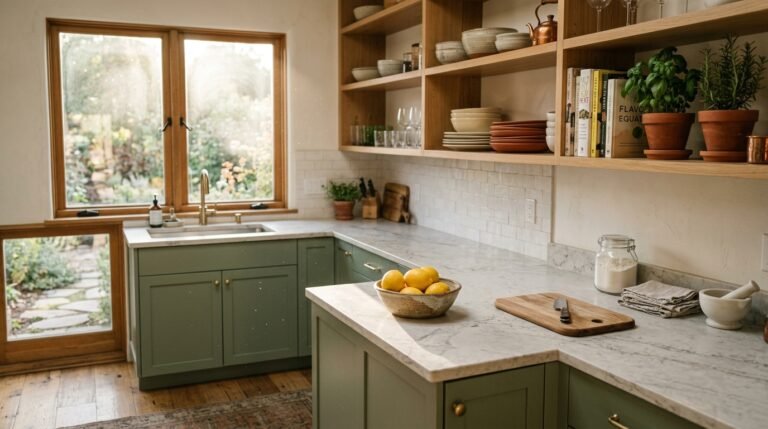
First: don’t fight the kitchen, work with it. If the tiles are ugly, don’t spend mental energy hating them. Either cover them temporarily with peel-and-stick tile stickers (command strips for tile, essentially — they come off clean) or distract from them entirely with something that draws the eye away. A beautiful open shelf with well-styled objects at eye level will make those tiles practically invisible in photos. And honestly? In real life too.
The open shelf thing is huge in rental kitchens. One floating shelf above the counter — even a cheap pine board from a hardware store with two brackets, painted to match the wall — can hold your nicest mugs, a small plant, a couple of cookbooks propped sideways, and a small wooden bowl with a few lemons or garlic in it. Suddenly your kitchen looks like a Pinterest board. For real.
Countertop styling is also massively underused. A wooden cutting board propped against the backsplash costs nothing extra (you already have one), a little crock of wooden spoons next to the stove, a small tray corralling your olive oil and salt and pepper. These things organize AND style at the same time. That’s the kind of double-duty thinking that makes budget decorating feel like cheating.
8. The Small Kitchen Organization Move That Makes Cooking Actually Enjoyable
Here’s the thing about small kitchens: they’re not unworkable. They’re just unforgiving.
A large kitchen hides mess in all its extra counter space. A small kitchen doesn’t have that luxury. Everything is visible. Everything has to have a place or it becomes clutter, and clutter is the enemy of a kitchen that feels good to cook in.
The single most useful organizational move I’ve made in a small kitchen — and I’ve lived in three tiny apartments in the last six years — is taking everything off the counter except the things I use daily. DAILY. Not weekly. Daily. That means my kettle stays. My toaster stays. Everything else goes into a cabinet or drawer.
The first time you do this it feels extreme. Then you cook in that kitchen and you realize how much lighter it feels. There’s room to actually move. Your prep space doubles, maybe triples. You stop feeling claustrophobic at the stove.
From there, invest in a few inside-cabinet organizers — the kind that stack things vertically. Pan organizers, plate racks, small tiered shelves for tins and spices. None of these are expensive. The set I have from Amazon cost $18 and added what felt like a whole extra cabinet’s worth of space. Worth every dollar.
9. The Art Arrangement That Works Every Time in a Small Living Room
Gallery walls are not the answer in a small living room. I know. Hot take. But hear me out.
Gallery walls require distance to read properly. You need to be able to step back and take in the whole composition. In a small room, you can’t do that, and what was meant to look artfully curated just ends up looking busy and chaotic.
What works instead: one larger piece, hung slightly lower than you think it should be. Eye level, not “they say art should hang at 57 inches” level. Your eye level. When you’re sitting on your sofa, what do you see? That’s where the art should be.
One big piece, hung at the right height, instantly makes a small room feel considered. It gives the wall a focal point. Everything else in the room can orient around it. And a large-ish print doesn’t have to cost much — Society6 and Desenio both have affordable options, or a framed piece of vintage sheet music, a beautiful map, even a large page torn from an oversized calendar that had beautiful illustrations. Frame it. Put it up. Done.
“One piece hung right does more for a room than ten pieces hung thoughtlessly.”
10. The Plant That Makes Every Low-Light Budget Room Look Lush
I’m going to say pothos and I’m not even a little sorry.
Pothos is the plant that Instagram interior accounts don’t admit they’re using but ARE absolutely using. It grows in low light, it grows fast, it drapes beautifully over shelves and trails down the sides of furniture, and it propagates so easily you can grow a whole new plant from a cutting in a glass of water on your windowsill. Which means one $6 plant at a garden centre becomes four plants in two months. For FREE.
In a small space, greenery is doing something that no other decorative element quite replicates. It brings in a softness — something living and a bit unpredictable — that makes a styled room feel less like a showroom and more like somewhere someone actually lives. That’s important. Especially in a small room, where everything can start to feel a bit controlled and tight.
Put a pothos on a high shelf and let it trail. Put a snake plant in a corner. Get a small fiddle leaf fig if you have a bright window, or accept that it might struggle if you don’t. But start somewhere. Even one plant changes the whole energy of a room, and I genuinely believe that.
11. The Budget Living Room Moment That Pulls the Whole Thing Together
Texture. Not color, not pattern. Texture.
You can have a room that’s almost entirely neutral — cream walls, a natural sofa, wooden furniture — and have it feel completely flat. Or you can have that same room layered with different textures and it suddenly feels rich and considered and lovely. Linen cushions. A chunky knit throw. A jute rug. A smooth ceramic bowl. A rough-hewn wooden tray. Wicker. Velvet. Matte and shiny, rough and soft, all living together.
None of this is expensive when you shop intentionally. TJ Maxx and HomeGoods in the US, TK Maxx and Dunelm in the UK — these places are stacked with exactly this kind of thing at a third of the price you’d pay at a boutique home store. A chunky knit throw I spotted at Dunelm last winter was £18 and looked identical to ones I’d seen at £75 in John Lewis. Different tag. Same cozy.
The rule I follow: for every smooth surface, add something rough. For every hard edge, add something soft. Let the room have contrast in texture even if the palette stays calm. That contrast is what your eye reads as “interesting” and “lived-in” and “expensive” — even when it wasn’t.
12. The Final Thing I Always Do Before I Call a Room Finished
Edit. Ruthlessly.
Every room I’ve styled has gone through at least one round where I remove about 30% of what’s on display. It always — ALWAYS — looks better after. Fewer things, better placed, with space to breathe around them. That space is not emptiness. That space is what makes each remaining object visible and intentional.
The mistake most people make when decorating on a budget is overcrowding. Because you’ve found beautiful things at low prices, it feels wasteful not to display them all. But a room packed with stuff — even beautiful stuff — reads as cluttered. Clutter reads as cheap, weirdly enough. Even if every individual item is lovely.
So take the thing you love least in the current arrangement and put it in a box. Step back. Look at the room. Does it feel lighter? It probably does. Now try removing one more thing. Keep going until it starts to feel too empty, then add back one or two things from the box. The ones you actually miss. Everything else? Store it. Rotate it in later. Or let it go.
That last edit — the one that feels slightly scary — is usually the one that makes the room.
—
❓ FAQ
Q: How do I make a small living room and kitchen feel bigger without knocking down walls? A: Hang curtains from ceiling height, use one large anchor piece of furniture instead of several small ones, and get all your clutter off the counters and surfaces. Mirrors help too — one large mirror on a short wall will visually push that wall back in a way that’s kind of remarkable.
Q: What’s the best budget-friendly place to shop for home decor in the US and UK? A: In the US, TJ Maxx, HomeGoods, and Facebook Marketplace are genuinely hard to beat. In the UK, Dunelm, TK Maxx, and charity shops in nicer neighborhoods are where I’d start. Both markets have great IKEA options as base pieces that you then layer over with thrifted and found things.
Q: Can I really make a rental apartment look designed without losing my security deposit? A: Yes, genuinely yes. Peel-and-stick products have gotten really good — removable wallpaper, tile stickers, Command strips for art. Focus on furniture arrangement, lighting layers, and textiles, none of which touch the walls at all. The biggest impact usually comes from things that are completely reversible anyway.
—
💭 Final Thoughts
A beautiful home isn’t a budget problem. It’s a patience and intention problem, and both of those are free. The rooms I love most — mine and other people’s — are the ones where you can feel the personality of the person who lives there, where things weren’t chosen all at once but gathered slowly with real care.
What would it feel like to walk into your living room and actually love it?