The Warm Rustic Living Room Look That Feels Expensive But Costs Almost Nothing to Pull Off
My friend Jess walked into my living room last autumn and stopped dead in the doorway. “How does it feel this cozy?” she asked. And I didn’t have a great answer, because honestly — I hadn’t followed a plan. I’d just kept adding things that felt right and removing things that didn’t.
—
1. The Texture Trick That Every Warm Rustic Room Is Actually Built On
Nobody talks about this enough. People obsess over paint colors and furniture pieces, but the rooms that STOP you when you walk in — the ones that photograph like a dream and feel like a hug — they’re built almost entirely on texture.
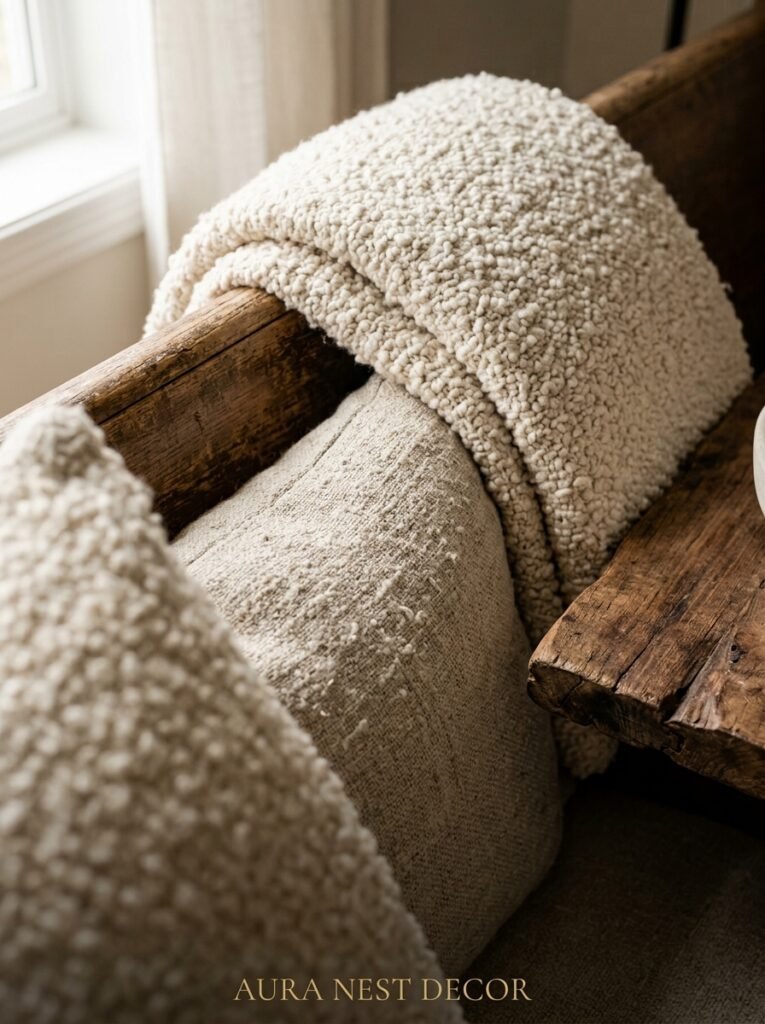
Think rough linen next to a smooth ceramic vase. A nubby chunky knit throw draped over the arm of a worn leather sofa. Raw wood that still has its grain and its imperfections sitting right next to something matte and soft.
The secret isn’t one expensive item. It’s contrast. Layering materials that feel different from each other so your eye — and your hand — wants to move around the room. A jute rug under a velvet cushion on a pine coffee table. That’s the formula. It doesn’t matter if the rug’s from Walmart or World Market or IKEA, it genuinely doesn’t. What matters is that nothing in the room is the same surface twice in a row.
I made the mistake for years of thinking rustic meant wooden and worn. That’s part of it. But the warmth comes from layering, not from any single material.
“The rooms that feel expensive aren’t full of expensive things. They’re full of things that feel different from each other.”
—
2. Why Dark Walls Might Be the Best Decision You Haven’t Made Yet
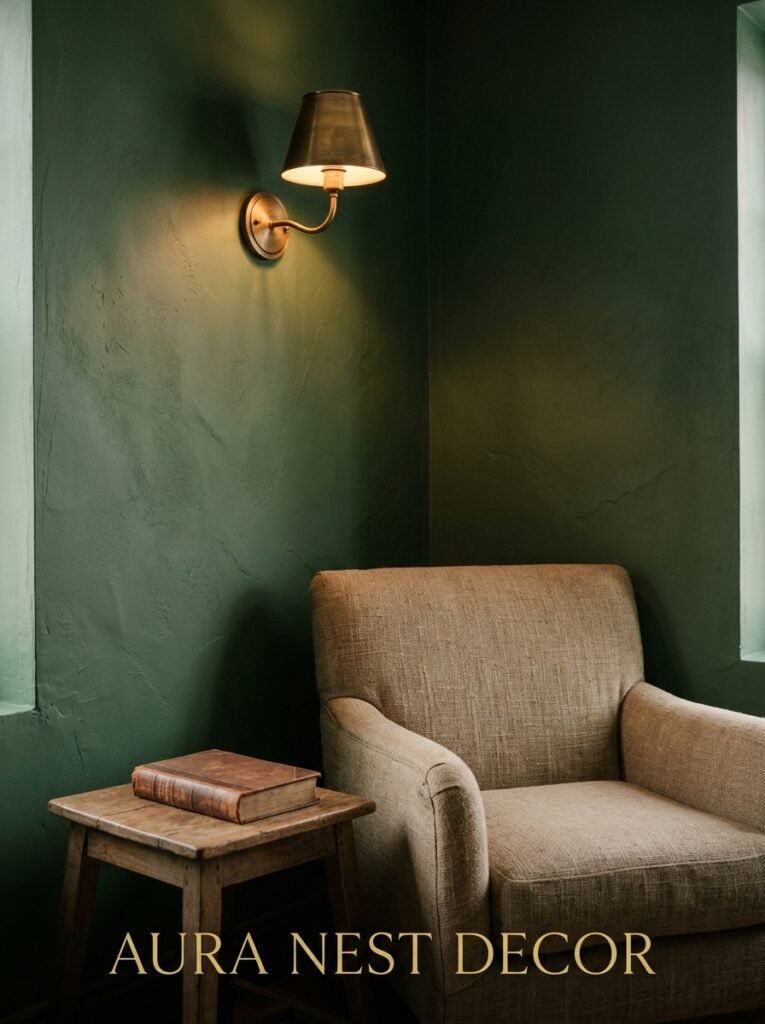
I know. I know. “Dark walls make a room feel smaller.” That’s what everyone says. And honestly? I used to believe it.
But there’s a reason every beautiful moody living room on Pinterest has a deep terracotta or a warm charcoal or an aged forest green on the walls. It pulls the room inward. In the best way. It makes the space feel intentional and cozy rather than just… there.
The key word is WARM. Not cold gray-blue. Not stark navy. You want hues that have some ochre or red or green-brown in them. Benjamin Moore’s Witch Hazel. Farrow & Ball’s Preference Red. A deep warm taupe that reads almost cognac in low lamplight.
And speaking of lamplight — dark walls need layered lighting to work. Not a single overhead fixture. Lamps. Candles. The soft glow of something amber. You want at least three light sources in a room at any given time, none of them the main ceiling light.
Side note — the British are significantly better at this than Americans. Go look up any British interiors account and notice how rarely anyone has their main ceiling light on. There’s something to that.
—
3. The Coffee Table Situation Nobody Gets Quite Right
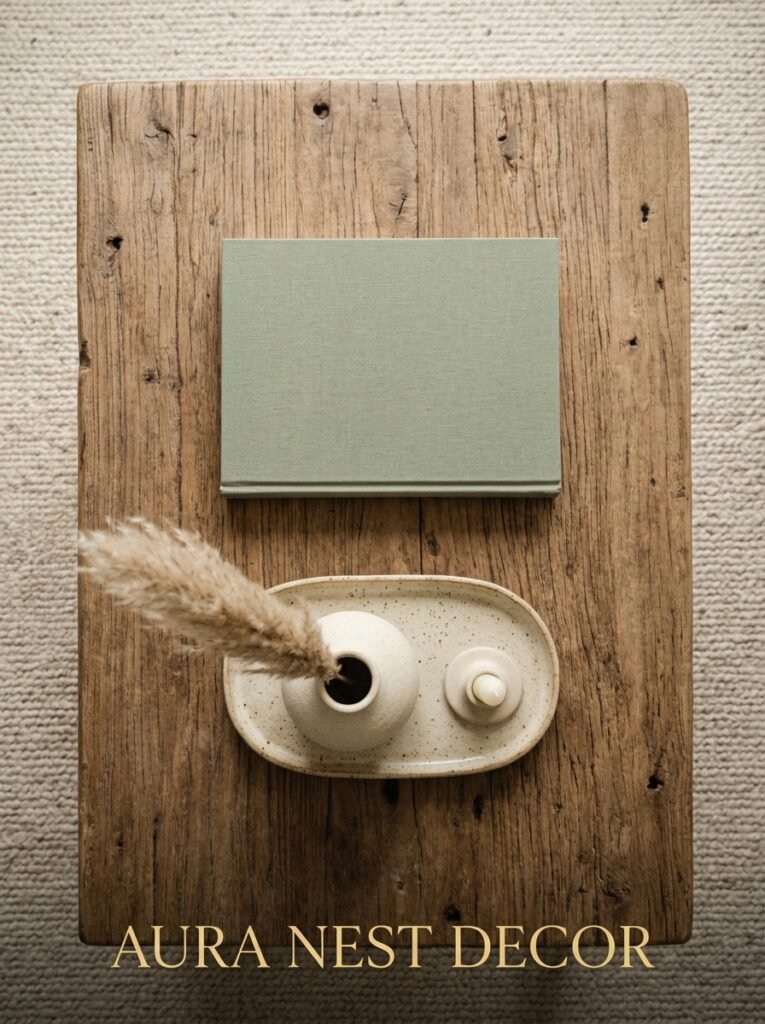
Here’s the thing about rustic coffee tables. People see a gorgeous reclaimed wood table in a store and buy it, bring it home, place it perfectly centered in front of the sofa — and then the whole vibe goes flat. Because a beautiful table means nothing if you haven’t figured out what goes on top of it.
A rustic coffee table wants to look LIVED IN. Not styled within an inch of its life.
A stack of actual books you’ve actually read. One imperfect ceramic bowl — maybe with a couple walnuts in it, or a candle. A small plant, slightly wild-looking. That’s it. Three things, loosely arranged. No symmetry. No matching trays with matching candles. That’s catalogue territory, and you can feel it.
The table itself doesn’t have to be expensive either. I’ve seen people transform a flat-pack table with a stain and some steel wool and it’s genuinely unrecognizable. The imperfection is the point.
—
4. The Color That Keeps Showing Up in Every Gorgeous Rustic Living Room Right Now
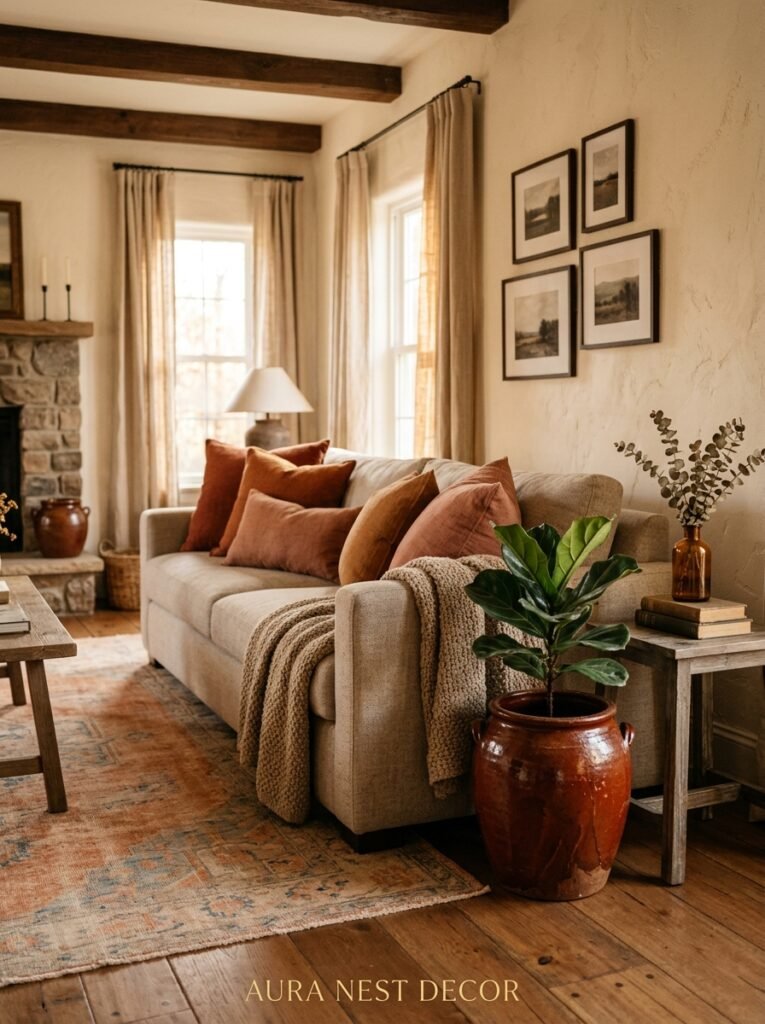
Terracotta. And not the burnt orange, clay-pot terracotta of the nineties. Something more muted. More dusty. Almost like if terracotta had been left in the sun for a season and softened.
It works in cushions. It works in throws. It works as a wall color. It works as a ceramic vase. And — this surprised me — it works incredibly well in smaller doses as an accent against deep sage green or warm cream.
The reason it keeps appearing is that it’s essentially the color of warmth itself. It reads like candlelight. Like autumn. Like a slow afternoon with nowhere to be. Interior designers have been quietly using it for the better part of a decade now and the rest of us are finally catching on.
If you’re not ready to commit to it on walls or furniture, start with a terracotta candle or a single terracotta cushion cover. See how it sits. You might find yourself going back for more.
—
5. Vintage Pieces That Make a Rustic Room — and the Ones That Accidentally Ruin It
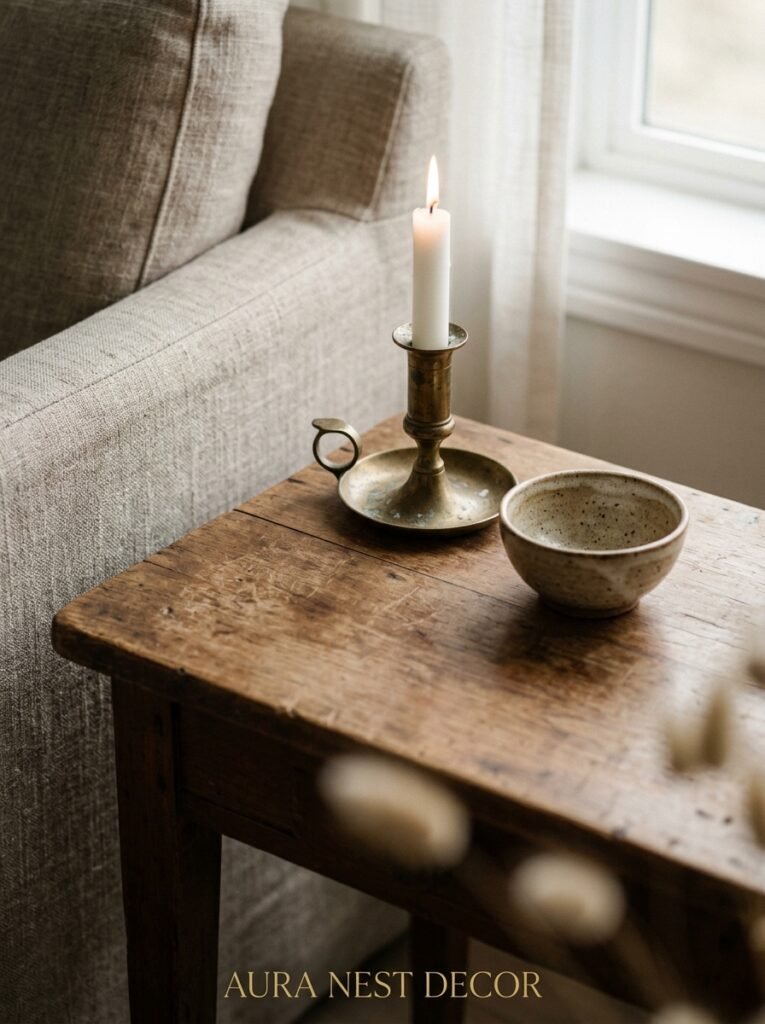
Not all vintage is good vintage. That’s worth saying.
Some antique pieces carry warmth — old wooden picture frames, a battered leather armchair with a sagging seat that just needs a new cushion, a tarnished brass table lamp that still works. These things have PRESENCE. They make a room feel like it has a history.
But some vintage just reads as unwanted. And the difference is usually condition and scale. A massive dark mahogany sideboard in a medium-sized living room doesn’t say rustic — it says heavy. A collection of 12 mismatched frames crammed into a corner doesn’t say curated gallery wall — it says “I don’t know what to do with these.”
Edit. That’s the whole job sometimes. Buy less than you think you need, see how it sits, then add slowly.
Charity shops in the UK and thrift stores in the US are genuinely extraordinary for this. I’ve found beautiful solid wood side tables and brass candleholders for almost nothing. The secret is going often, not going once and expecting perfection.
“Vintage makes a room feel lived in. Too much vintage makes it feel like nobody lives there anymore.”
—
6. The One Rule That Makes Any Small Rustic Living Room Feel Intentional
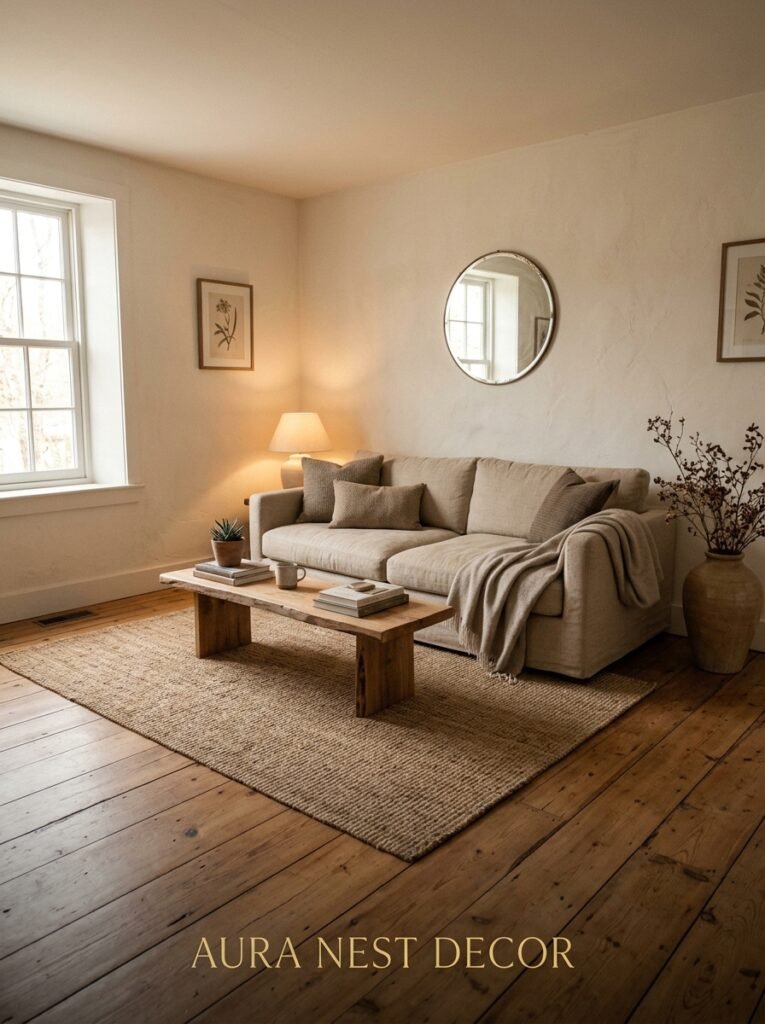
Scale. Everything comes back to scale.
A small room with small furniture doesn’t feel cozy — it feels apologetic. I know that sounds backwards but it’s true. One big, CONFIDENT sofa anchors a small room in a way that four small mismatched pieces never will.
Go bigger than you think. One large piece. Then let everything else breathe around it. Don’t fill every corner with something. Let there be a corner that’s just wall and light. Negative space is part of the design — not a problem to solve.
This applies to art too. One large-ish piece of art reads dramatically better than several small ones arranged nervously across a wall. Even in a smaller room. Especially in a smaller room.
—
7. Firelight, Lamplight, Candlelight — Getting the Lighting Actually Right
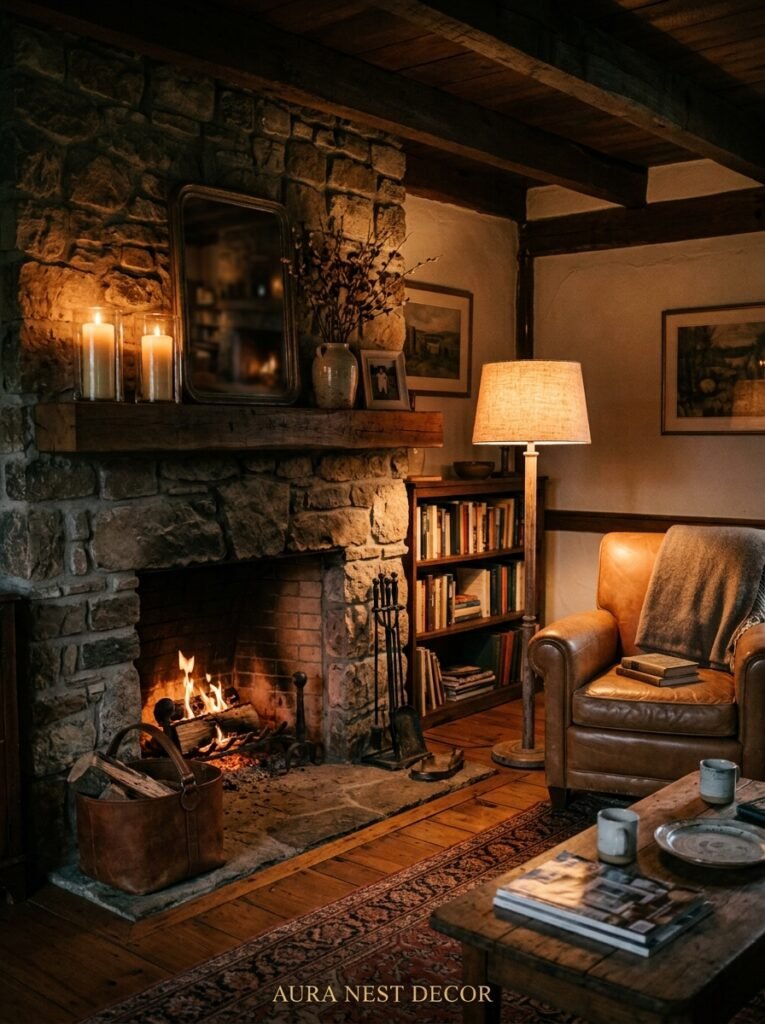
Real talk: lighting is responsible for about 60% of how warm a room feels. Maybe more.
You can have the most beautiful furniture and the most perfectly layered textures and the most gorgeous terracotta walls — and if your lighting is wrong, the room’s going to feel cold and a bit sad. And “wrong” in a rustic living room almost always means too bright and too white.
Warm bulbs only. That means 2700K or lower. The amber-toned ones. Edison bulbs if you want them, though honestly a regular warm LED does the job fine and costs about 30 cents more to run. The look you’re going for after 6pm is something approximating candlelight, which is warm, low, directional, and slightly uneven.
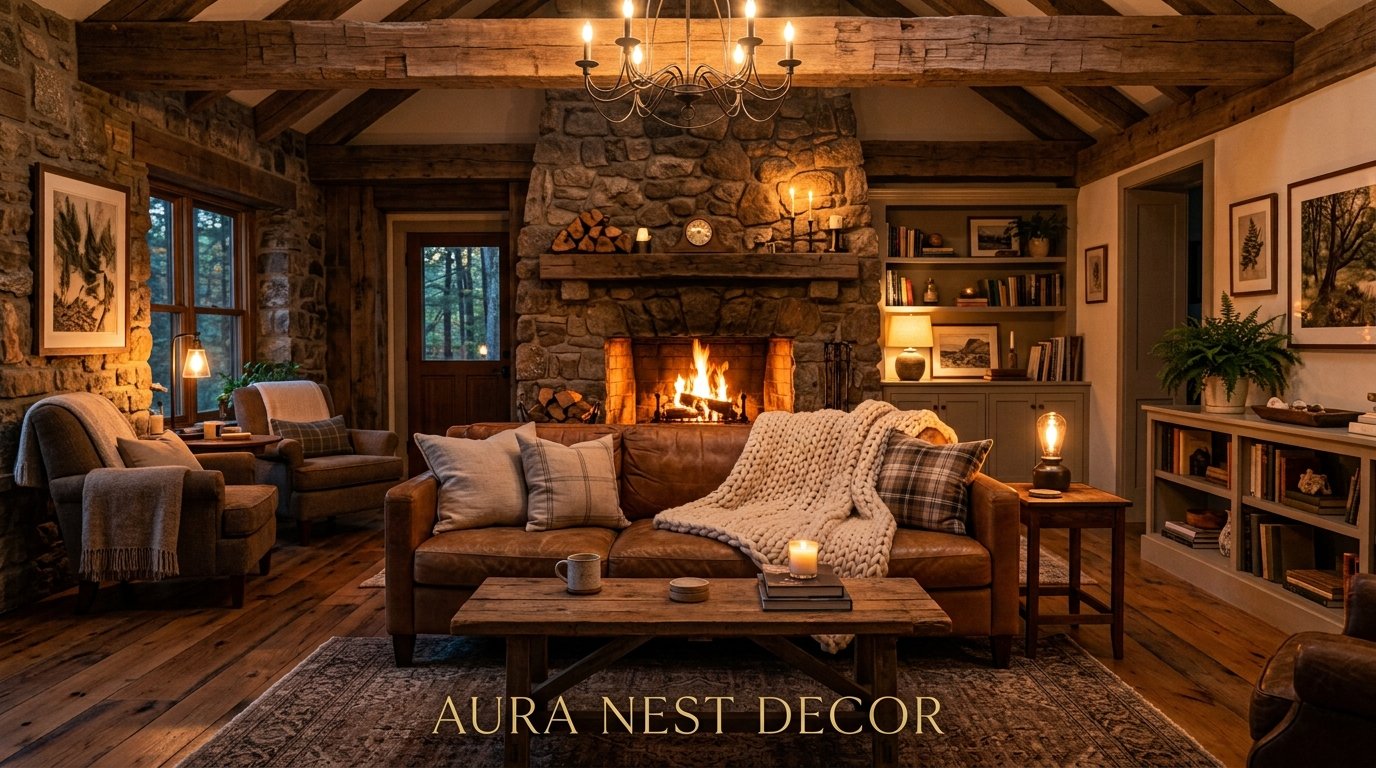
Multiple light sources. A lamp in the corner, a lamp on the side table, candles on the coffee table (and on the mantle, if you have one). Turn the overhead light OFF. I can’t overstate this. The overhead light is the enemy of a cozy evening in.
If you have a fireplace — real or gas — that’s your anchor light. Everything else should just gently support it.
—
8. What to Do With Your Walls When You Don’t Want Art Everywhere
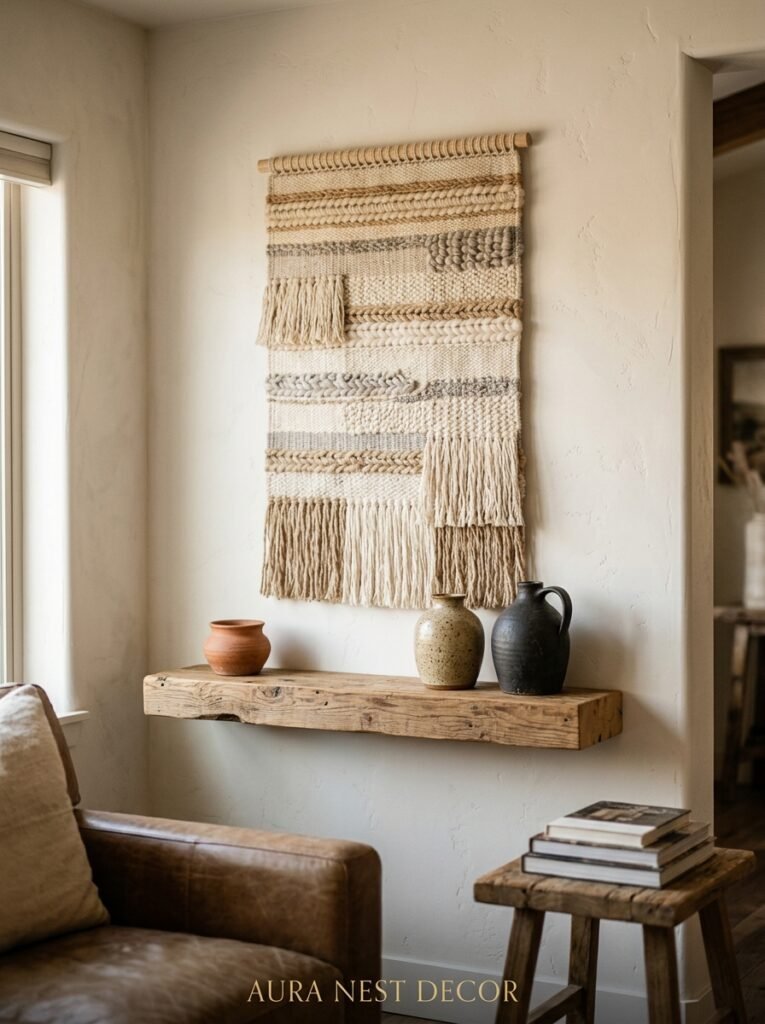
Not every wall needs something on it. But the walls in a rustic living room DO want to feel like someone thought about them.
Some options that work beautifully without defaulting to a gallery wall:
- A single large mirror with a simple wooden or aged metal frame. Bounces light, adds depth, looks completely effortless.
- Wooden shelves — not floating white IKEA shelves, but solid, slightly chunky ones in a natural or dark-stained wood — with a sparse mix of books and objects.
- A woven wall hanging or textile piece. Not a macramé nightmare from 2017, but something a bit more subdued — natural fibers, simple pattern, muted tones.
- Nothing. Just the wall color, doing its job.
I’ve had people come over and comment on how “done” my living room looks, and sometimes I genuinely haven’t added anything new in months. The restraint IS the decision.
—
9. Plants That Actually Work in a Rustic Living Room (and the Ones That Don’t)
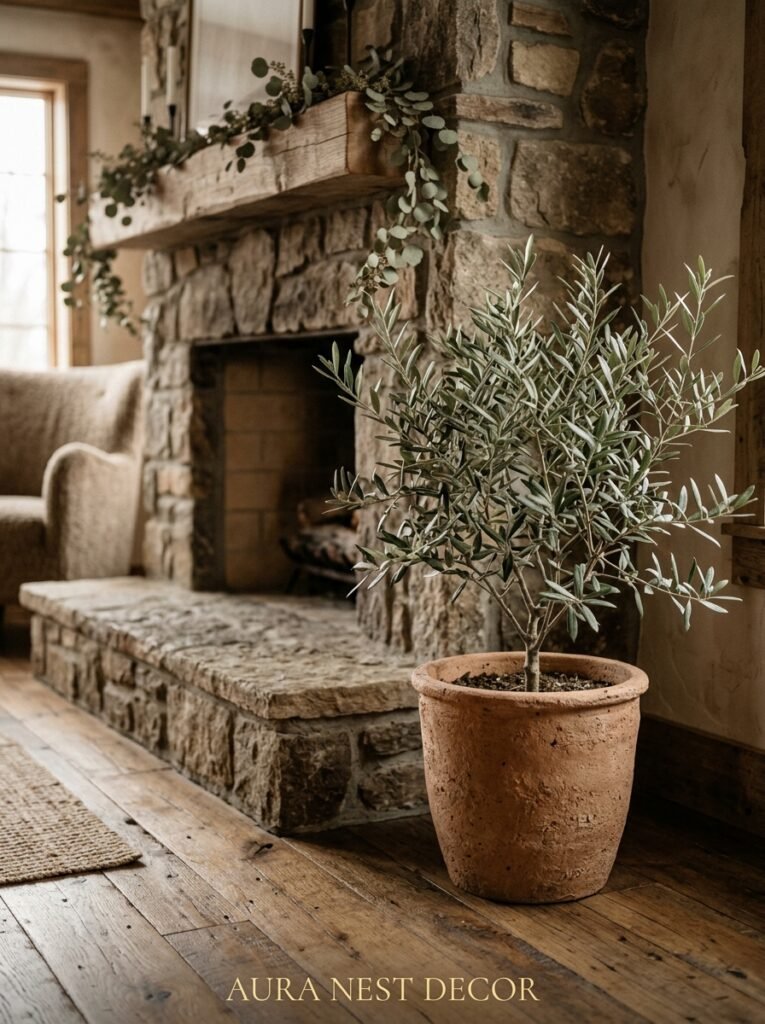
This is a mild rant but I’m going to say it: not all houseplants belong in a rustic room.
A spiky, architectural cactus in a clean white pot — stunning in a minimalist space, wrong here. Same with a highly polished fiddle leaf fig in a sleek planter. Wrong energy. Too perfect. Too geometric.
What works: trailing plants that look slightly wild. A pothos that’s starting to drape over the edge of a bookshelf. Dried eucalyptus in an old bottle. A compact olive tree in a terracotta pot (obviously). Wild-looking grasses in a ceramic vase. Anything with a slightly imperfect, growing-on-its-own feeling.
The plant should look like it BELONGS, not like it was placed there for a photo. Big distinction.
—
10. The Sofa Decision That Defines the Whole Room
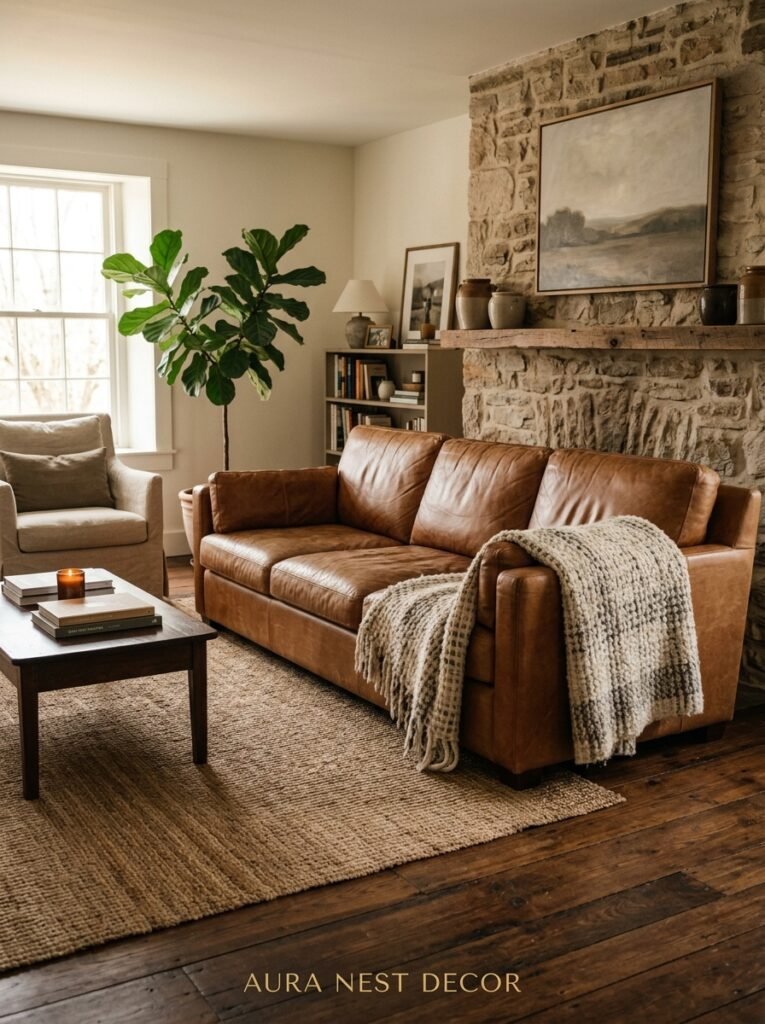
Your sofa is doing most of the heavy lifting here. And for a warm rustic living room, certain fabrics and colors just work — and certain ones fight the whole vibe no matter what you put around them.
Linen works. Aged or distressed leather works (really works, honestly — brown leather is having a full comeback and I’m here for it). Bouclé works if it’s in a warm neutral. Velvet works if the color is right — deep rust, warm olive, cognac.
What doesn’t work as well: anything too crisp. Too structured. Clean white slipcovers are beautiful but they require a totally different room around them. Bright color sofas in jewel tones — again, different vibe entirely.
Color-wise you’re mostly in the world of warm cream, caramel, cognac, deep olive, or weathered tan. These all read as rustic and warm without trying. They also hide the crumbs, which, not gonna lie, is a factor.
“Brown leather sofas went away for about a decade. Now they’re back and I am SO relieved.”
—
11. The Scent of a Warm Rustic Room (and Why You’re Probably Skipping This Entirely)
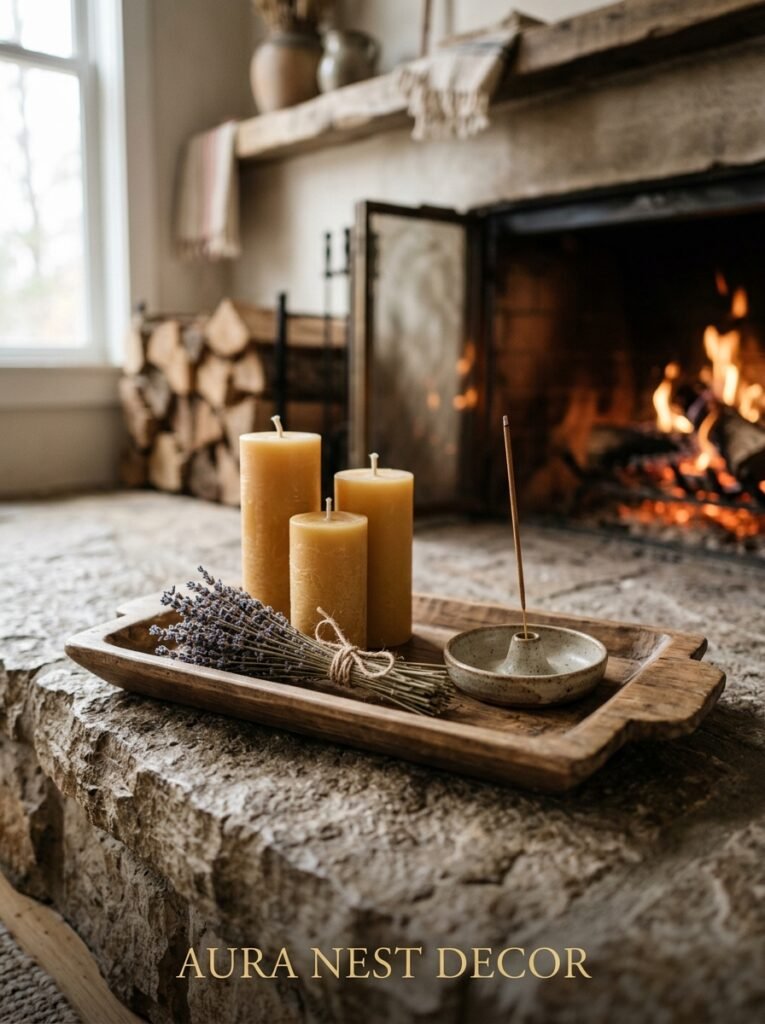
Okay this is the thing most home decor articles completely ignore and I think it’s genuinely one of the most important details.
A room that looks beautiful but smells like nothing — or worse, like cleaning products or that vague synthetic fragrance — doesn’t FEEL beautiful when you’re in it. And a warm rustic living room has a scent. It should.
Wood smoke, if you have a real fireplace. Cedar. Sandalwood. A candle that smells like amber or tobacco or vetiver or clove. Not fruity. Not clean-linen-laundry. Not ocean breeze. Those scents belong somewhere else.
The fragrance should feel grounded. Earthy, almost. Like the outside world brought inside. Diptyque’s Feu de Bois candle is the obvious answer and yes it’s expensive and yes it’s worth the smell even just once. But there are cheaper options that get you surprisingly close — Paddywax has a cedarwood and amber candle that’s excellent, and in the UK, Aldi occasionally does a candle that’s just chef’s kiss.
Light a candle before guests arrive. Not right when they walk in — fifteen minutes before. Let the scent settle into the room.
—
12. The Final Layer That Makes It Feel YOURS (and Not Like a Pinterest Board)
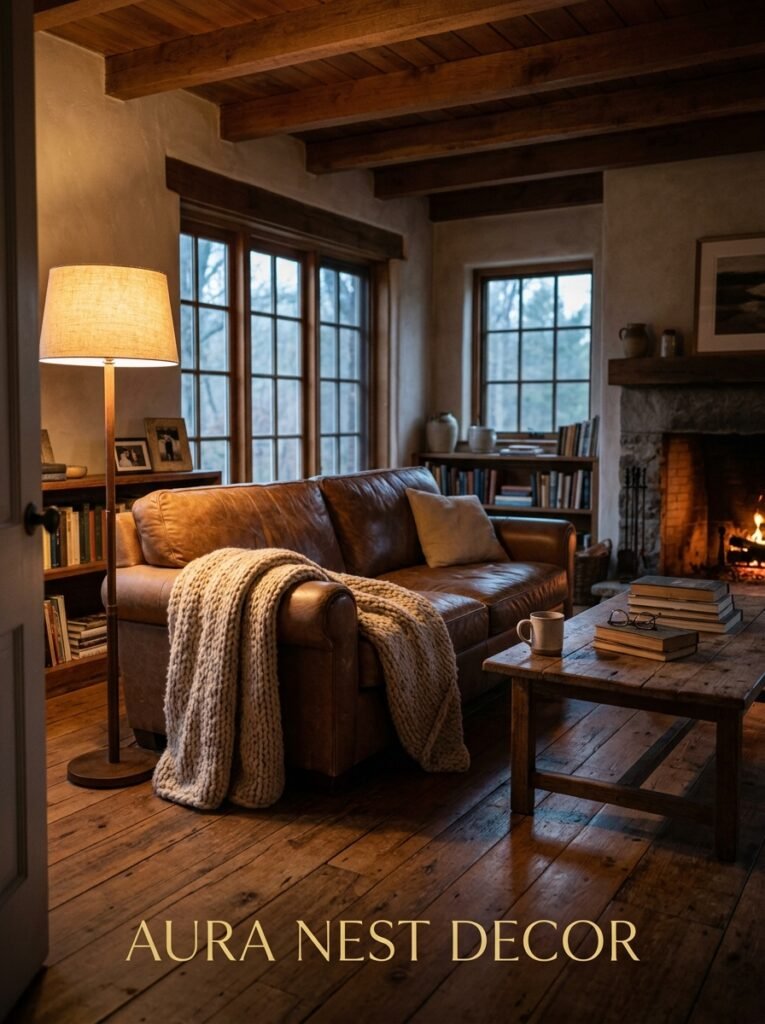
This is the part that can’t be bought in one shopping trip and it can’t be styled into existence. It’s the personal layer.
The book you’re actually reading, left face-down on the armrest. The mug from that trip you took three years ago. A framed photo that’s slightly crooked because you never got around to fixing it. The specific, imperfect ceramic piece you made at that pottery class you did on a whim.
These are the things that make a room feel inhabited. Loved. Real.
Pinterest is gorgeous for inspiration but a room that looks EXACTLY like a Pinterest board feels uncanny. Something’s off and you can’t place it. What’s missing is the evidence of an actual person living there — their specific tastes, their small imperfections, the things they kept because they mattered, not because they matched.
Put the personal things back in. Let the room be slightly messy in the right places. That’s not a failure of styling. That’s what warm actually means.
—
❓ FAQ
Q: What’s the easiest first step to making a living room feel warmer and more rustic? A: Change your lightbulbs and turn off your overhead light. Seriously — this single change can shift a room’s entire mood in about ten minutes and it costs almost nothing. Then add one warm-toned throw and a candle. You’ll see the difference immediately.
Q: Can you do a warm rustic look in a modern flat or new-build house? A: Absolutely, and it actually works really well as a contrast. New builds often have clean white walls and open layouts, which means you can introduce texture and warmth through soft furnishings and lighting without fighting the architecture. Dark-stained wood, chunky textiles, and warm Edison-style lamps do most of the work. You don’t need exposed brick or original features — the warmth comes from the objects, not the bones of the building.
Q: Is rustic style different in the US vs. the UK, and does that matter? A: A bit, yes. American rustic tends to lean into the farmhouse direction — shiplap, galvanized metal, mason jars. British rustic is often a little more muted and antiquated — think flagstone floors, William Morris prints, faded velvet. But the overlap is huge, and most of the principles here work in both contexts. Follow what feels right for your space and your instincts, not a nationality.
—
💭 Final Thoughts
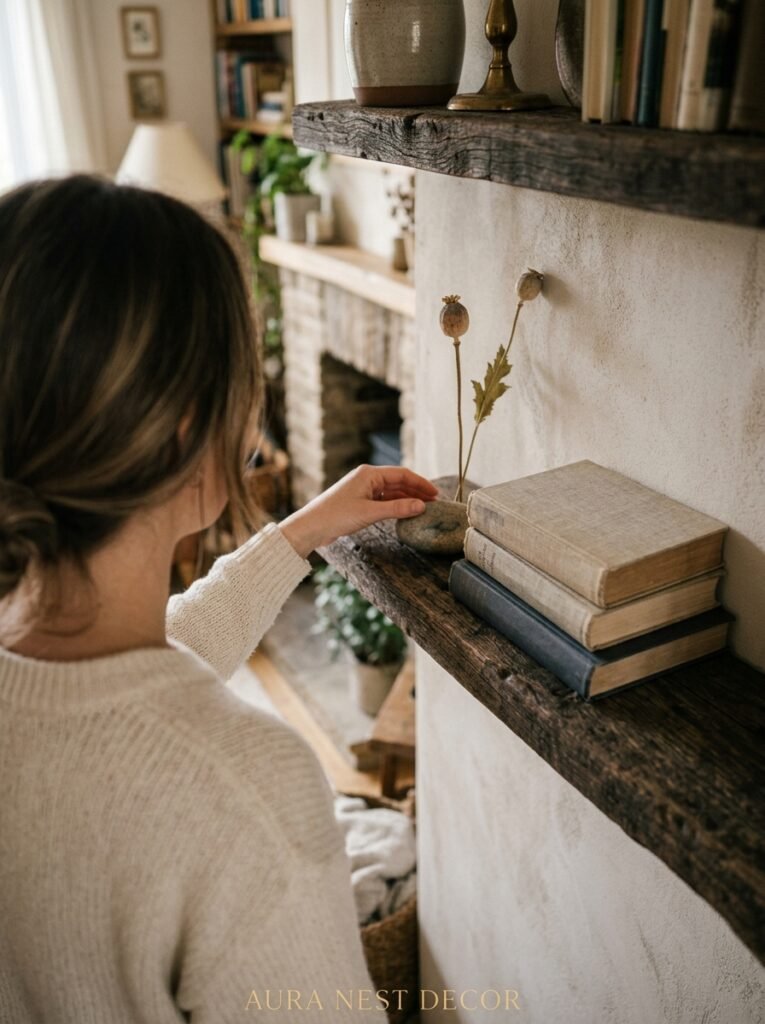
A warm rustic living room isn’t really a style. It’s more of a feeling you’re working toward — something that says “you can relax here.” The layers build slowly, and the best rooms often look like they weren’t designed at all, just… accumulated with care over time.
Start with one thing that feels right. Then another. Let it grow a little messily.
What’s the one corner of your living room that’s never quite felt like yours yet?