The Dark Brown Couch Every Designer Told You Not to Buy (And Why They Were Wrong)
My friend called me in a mild panic last spring. She’d bought a dark brown leather sofa — floor model, amazing deal — and now it was sitting in her living room looking like a waiting room at a dentist’s office. “It’s so heavy,” she said. “Everything looks dark and dated.” I told her to give me twenty minutes.
Two phone calls and one Pinterest rabbit hole later, she had a game plan. That couch is now the best thing in her home. I’m not exaggerating.

—
1. Why Dark Brown Furniture Stopped Being “Safe” and Started Being Actually Good
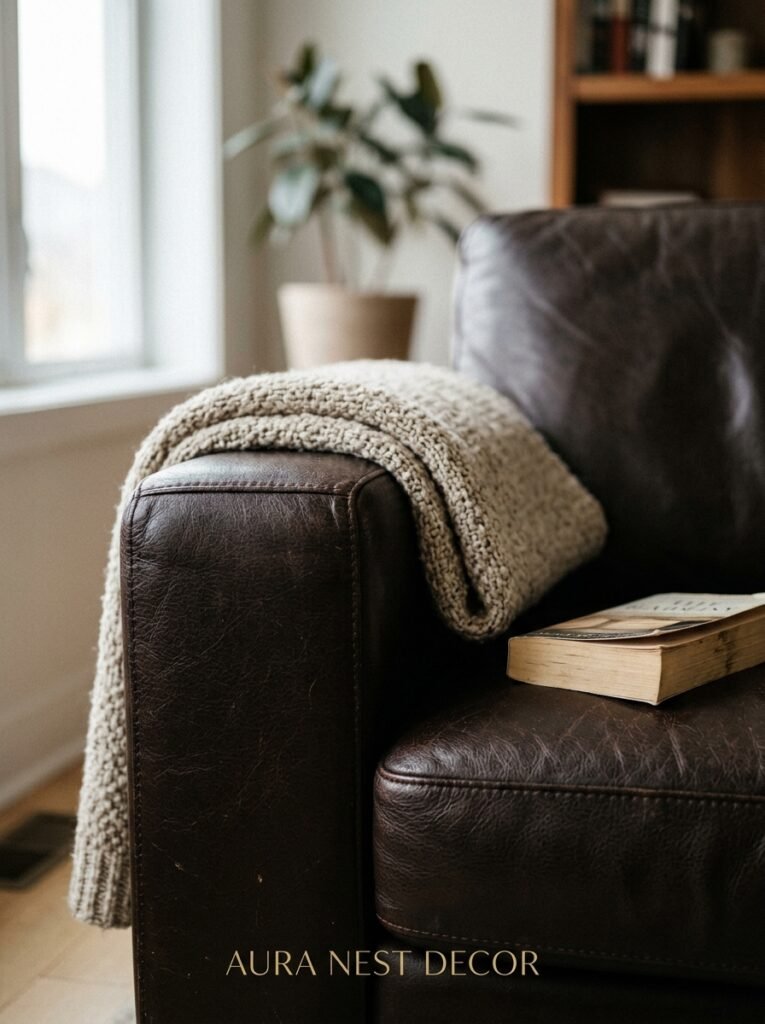
Here’s the thing nobody tells you: dark brown couches went out of style around 2010, and then they quietly came back around 2022 — but completely different. The old version was beige walls, dark wood, and a brown sofa all fighting each other for dominance in the same muddy middle ground. That version was exhausting.
The new version is contrast. It’s the brown couch against something that shouldn’t work but does. Dusty sage. Warm terracotta. Deep inky navy on an accent wall. The couch isn’t the problem — it never was. The problem was the context it was put in.
Dark brown grounds a room. It gives everything else something to push against. Think of it less like furniture and more like an anchor, or the bass note in a song. You don’t always notice it, but pull it out and everything feels slightly off.
And look — rich brown tones are everywhere right now. In kitchens, in wardrobes, in coffee shop interiors on both sides of the Atlantic. Brown is warm in a way that grey never quite managed to be.
—
2. The Wall Color That Makes a Dark Brown Couch Look Intentional, Not Gloomy
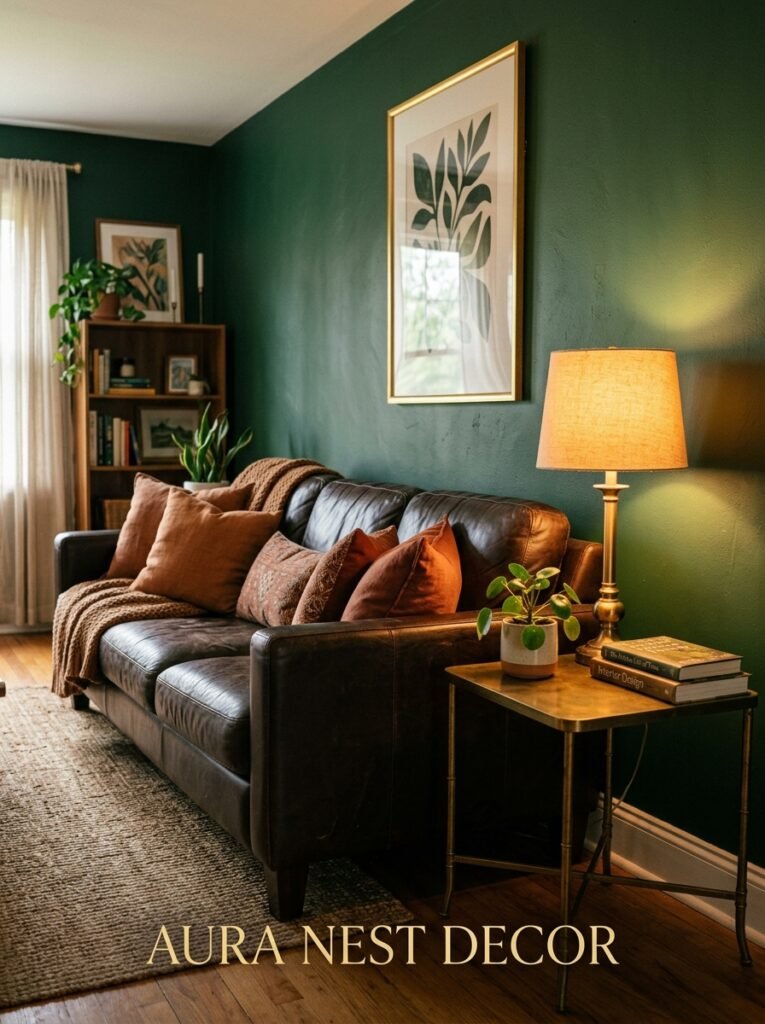
Paint is everything here. EVERYTHING.
If you keep white or off-white walls, the dark brown couch will look heavy. Not dramatic. Just heavy. The contrast is too stark, too sharp — it draws your eye straight to the couch like a stain on a tablecloth.
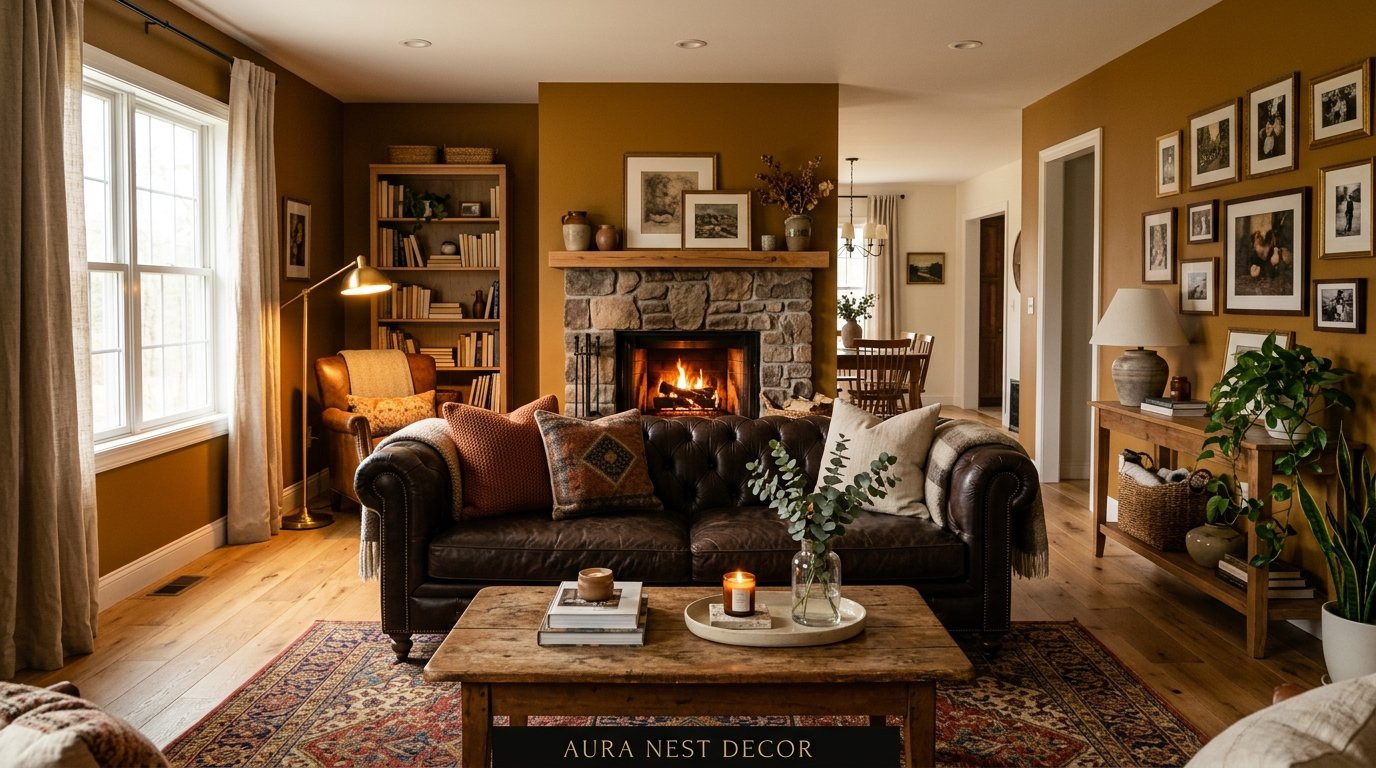
What works? Warm walls. Not beige — warmer than that. Think terracotta at about 30% saturation. Clay tones. A soft caramel or a muted amber that’s almost not there, almost like the light itself is warm. In the UK, Little Greene’s “Aged Oak” and Farrow & Ball’s “Joa’s White” do something magical with a chocolate sofa — they blur the line between furniture and wall in the best way, so the room feels cohesive instead of cluttered.
For Americans, Benjamin Moore’s “Pale Oak” or Sherwin-Williams “Antique White” hit that same territory. You want the wall to feel warm, not to call attention to itself.
But here’s the other option — and this one surprises people. Go dark. A deep forest green, a moody slate blue, a charcoal that’s almost black. Dark walls with a dark brown couch creates atmosphere. Depth. The kind of room that looks like it belongs in an editorial spread. It shouldn’t work mathematically, but your eye reads it as rich and intentional rather than oppressive.
“Paint the walls warm or paint them dark — the one thing you can’t do is leave them cold and expect the couch to carry the room.”
—
3. The Rug That’s Not Beige (Please, Not Beige)
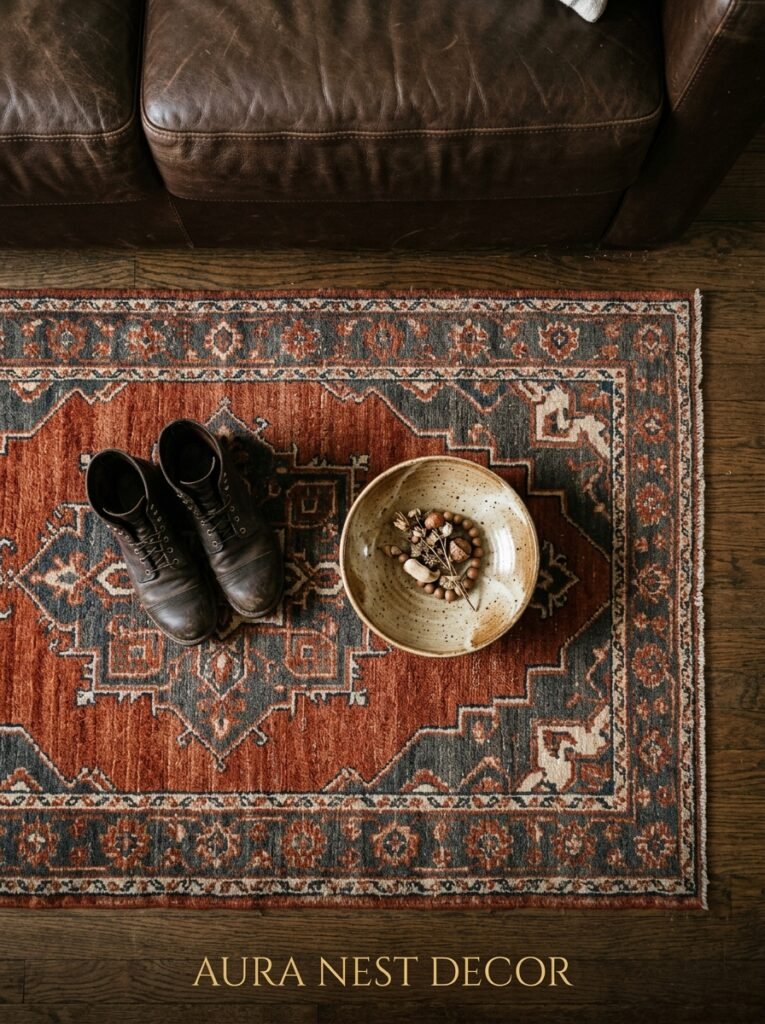
Real talk: so many people put a beige rug under a brown couch and wonder why the room looks flat. It’s because you’ve stacked warmth on top of warmth with no contrast and nothing for the eye to catch on. The whole thing just… dissolves.
A patterned rug with some dark thread running through it can actually pull the couch into the room rather than away from it. Geometric patterns, Moroccan-style trellis, abstract with terracotta or rust — any of these give the floor layer some structure and let the couch feel like it belongs there.
If you love a solid rug, go for something unexpected. A deep olive green. A dusty rose, which sounds wrong and looks RIGHT. Even a pale cream — but cream, not beige — creates light contrast without washing everything out.
Round rugs are underrated in this situation, by the way. Something about a circular shape softens all that linear darkness in a brown sofa setup. It’s a weird trick but it works.
Size matters too. Too small a rug makes the couch look like it’s floating in the middle of the room. Get the front legs of the sofa ON the rug. That’s the rule. Front legs on, anchored, done.
—
4. What Nobody Told You About Throw Pillows and a Dark Couch

You’d think dark cushions would get lost. They don’t — as long as there’s texture.
Velvet in burnt orange against dark brown leather is one of those combinations that looks expensive in a way that’s almost irritating. Linen in a natural cream tone has enough texture that it stands out even against a deep chocolate background. Boucle — that fluffy, loopy fabric that’s been everywhere for two years and isn’t going away yet — looks incredible against dark upholstery because of the way light catches all those tiny loops.
The pattern to avoid? Flat, smooth fabric in a mid-tone brown or tan. It just disappears. You want contrast in either color, texture, or both.
A quick note on quantity: three or four pillows on a standard three-seater is enough. More than that and it starts to look like you’re hiding the couch, which sends a weird message about whether you actually like the couch. Which you do. You bought it. Own it.
—
5. The Lighting Trick That Changes the Entire Feeling of the Room at Night
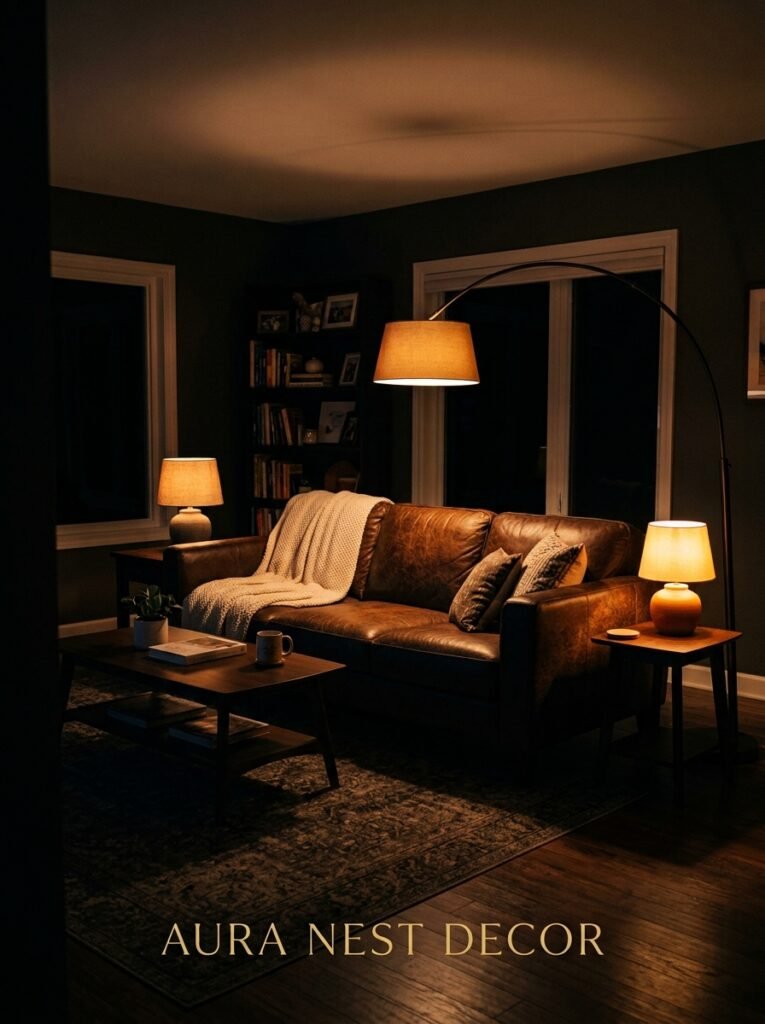
Overhead lighting is the enemy of a dark brown couch. One ceiling light, directly above, makes the room look like an interrogation room with nicer furniture.
What you want is layer lighting — but specifically, warm and LOW. A floor lamp in the corner with an amber bulb. A table lamp on the side table that throws light sideways across the wall, not up at the ceiling. Candles if you’re the type, though no judgment if you’re not.
The magic moment is around early evening — in winter especially — when the overhead light is off and just the lamps are on. The brown of the couch picks up all that warm amber glow and starts to look genuinely beautiful. It’s almost ridiculous how different a room looks when the lighting is right.
“Turn off the overhead light, switch on two lamps, and then tell me the brown couch doesn’t work.”
Edison bulbs are fine but they’re maybe a bit overdone at this point. I’d go for a smart bulb set to about 2700K warm white. Same amber quality, less vintage-café aesthetic if that’s not your thing.
In the UK, where natural light is scarce roughly nine months of the year, this tip is less optional and more survival. Layer your lighting. Live in a warm glow. Your brown couch will thank you.
—
6. Plants That Actually Look Good With Dark Brown Furniture (Not Just Any Plant)
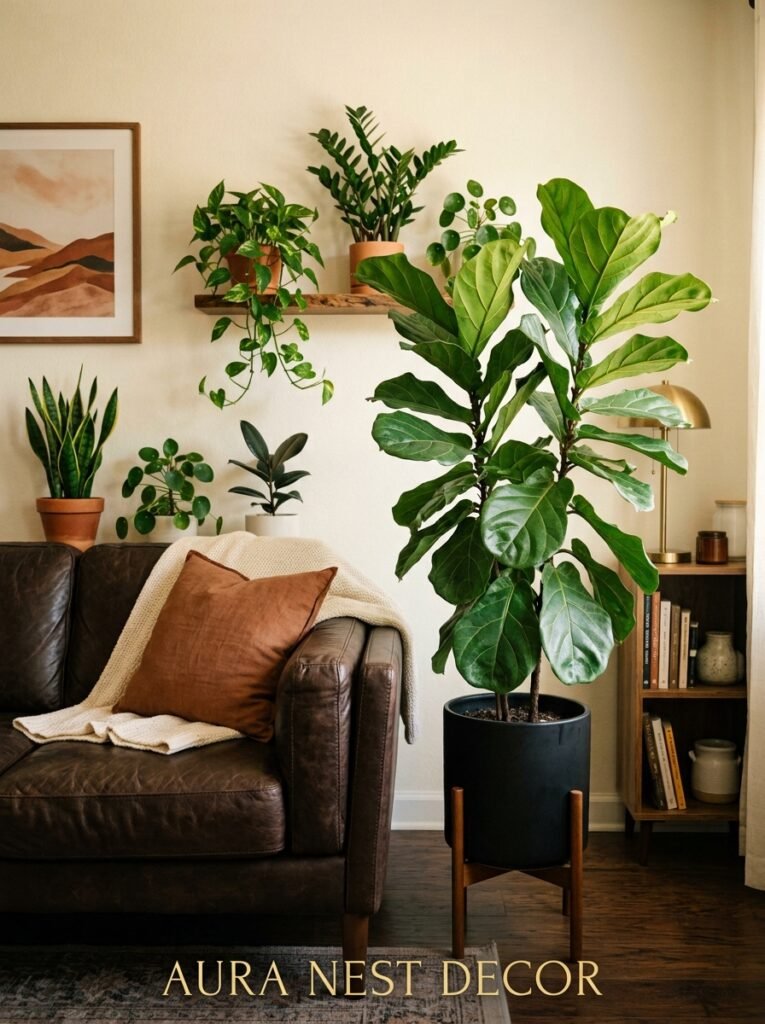
You’ve seen the photos — a single fiddle-leaf fig in a terracotta pot, flooded with light, next to a leather sofa. Genuinely stunning. But the reason it works isn’t “plant near couch.” It’s specifically about light and contrast.
Dark green glossy leaves — like a rubber plant or fiddle-leaf — pop against dark brown because they’re a different dark. The brown reads warm, the plant reads cool, and your eye distinguishes them immediately. It’s contrast without being harsh.
What doesn’t work so well: pale or silver-toned plants (like eucalyptus or some succulents) can look a bit washed out against a dark couch if the lighting isn’t perfect. They’re not off-limits — they just need to earn their place with good light.
For the UK, where light is genuinely a concern, pothos and heartleaf philodendron handle low light and still have that deep green quality that reads well against dark furniture. Both are basically indestructible, which is a secondary but not insignificant benefit.
The pot matters too. Terracotta and dark brown is a warm-on-warm combo that works because the orange of terracotta is a completely different family from the brown — they’re adjacent on the color wheel without competing. Matte black pots work brilliantly too, and they’re everywhere right now.
—
7. The Coffee Table Question That Divides Everyone

Light or dark coffee table?
This is where people get into arguments on interior design forums and, honestly, I’ve been in those arguments. My take: lighter, but not white.
A bleached wood coffee table — blonde oak, light ash — gives the eye somewhere to land that isn’t more darkness. It balances the weight of the couch without fighting it. And there’s something about the contrast between very dark upholstery and pale wood that feels effortlessly Scandinavian in a way that Instagram loves and for good reason.
Glass coffee tables work too, if that’s your style. They don’t add any visual weight, which with a dark brown couch can be genuinely helpful. The room breathes.
What I’d avoid: a dark walnut or mahogany coffee table in front of a dark brown sofa. You end up with a puddle of darkness on the floor and nothing for your eye to rest on. It’s not cozy — it’s just dim.
Rattan and cane tables are having a serious moment and they’re genuinely great with dark brown. The woven texture adds visual interest, the natural tone contrasts without clashing, and it brings a little relaxed energy that keeps the room from feeling too serious.
—
8. Small Rooms: The One Approach That Doesn’t Make It Worse
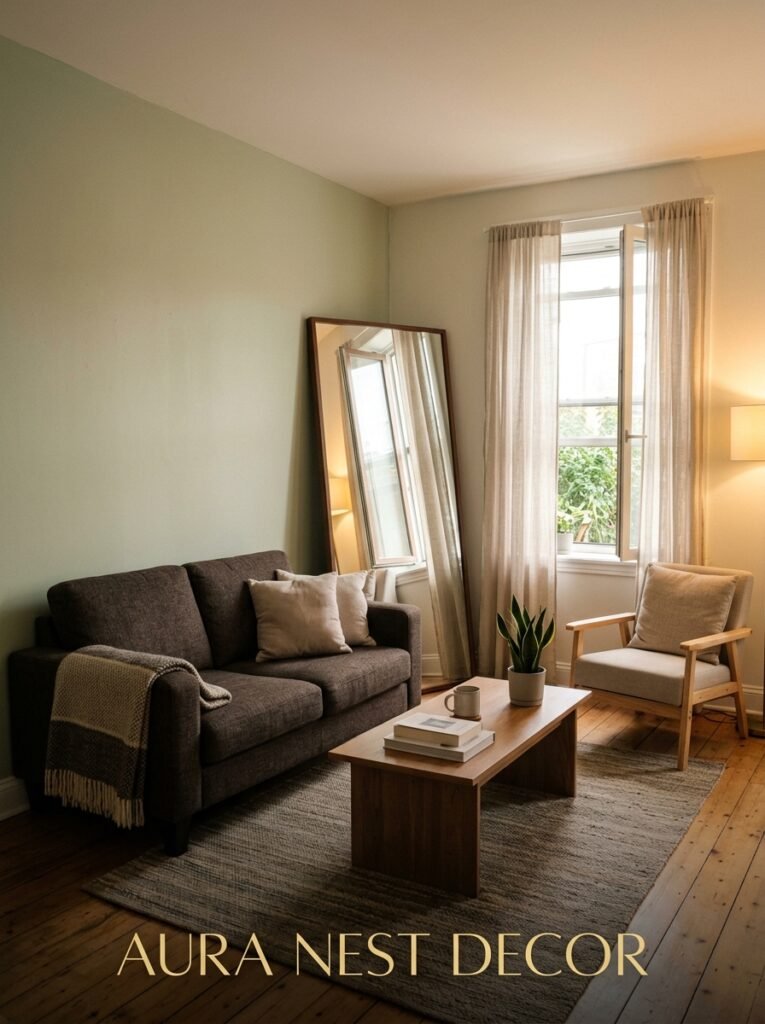
A dark brown couch in a small room sounds like a terrible idea. It doesn’t have to be.
The mistake is putting the couch against a neutral wall with nothing else doing any work. Suddenly it’s just a big dark mass in a small pale room and yes, that feels oppressive.
The fix is to think about the room as a whole, not the couch in isolation. If the walls are warm (back to section two), if there’s a light rug, if there are a few bright or light accessories — a ceramic lamp, a light-toned throw, a pale picture frame — then the couch becomes one layer of a balanced room rather than the only visual statement.
Mirrors help. Not just “mirrors make a room bigger” — a specific mirror with a warm or light-toned frame placed to reflect a lit lamp or a window will bounce light around the room and soften how heavy the sofa reads.
Also: keep the floor clear around the couch as much as you can. Clutter in a small room with a dark sofa makes everything claustrophobic. The couch needs breathing room.
“In a small room, the couch isn’t the problem. The space around it is.”
—
9. The Accent Color That’s Trending Alongside Dark Brown Right Now
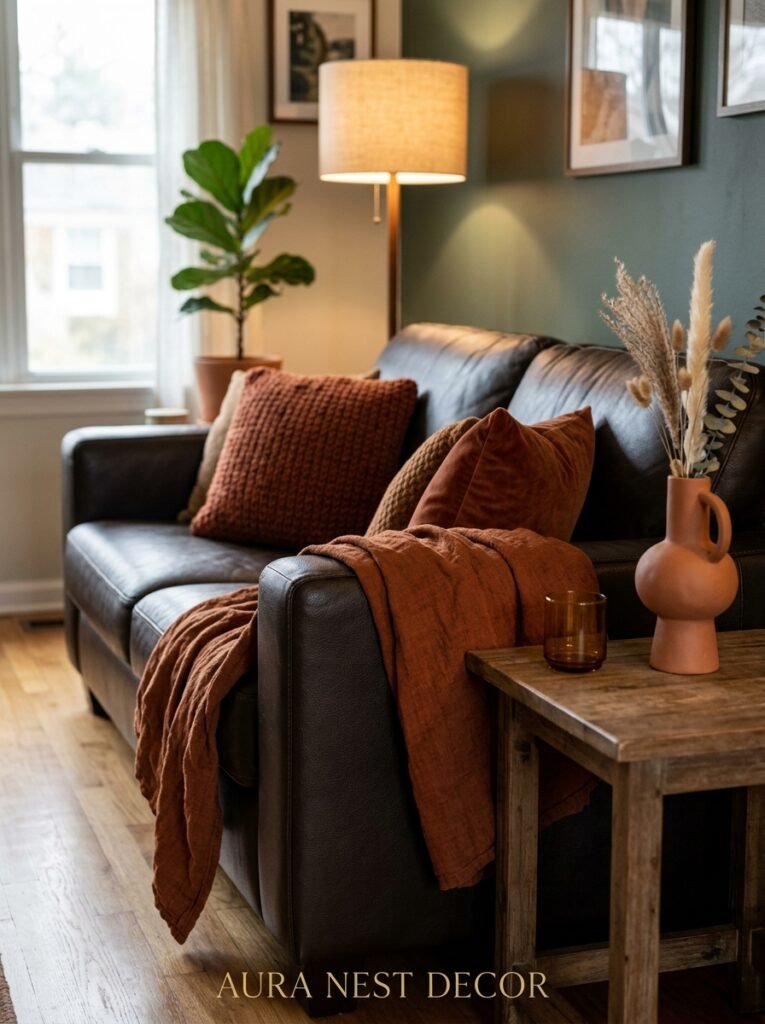
The combination I keep seeing everywhere — in US interior design accounts, in UK homes featured in Living Etc and Homes & Gardens — is dark brown with warm rust or terracotta as an accent. Not orange. Rust. There’s a difference.
Orange is loud and a bit difficult. Rust is warm, aged, sophisticated — it looks like something that’s been there forever and earned its place. Against a dark brown sofa, rust-toned pillows or a terracotta vase or a copper lamp base creates a palette that looks intentional and grounded without trying too hard.
The other one is a deep, dusty green — not the bright emerald green that had a moment a few years ago, but something more muted. Olive. Sage. The kind of green you’d find in old velvet curtains in a Scottish country house or in a Brooklyn brownstone that’s been half-renovated. That green and dark brown is a combination with a lot of history — think hunting lodges, old libraries, rooms that have been lived in — and it reads as genuinely sophisticated.
Blush pink is having a quiet comeback too, and unexpectedly? It works. A dusty rose cushion against dark brown leather is the definition of “shouldn’t work, does.” But go dusty, not bright. Bright pink against dark brown looks accidental.
—
10. Curtains: The Detail That Either Pulls It All Together or Blows It
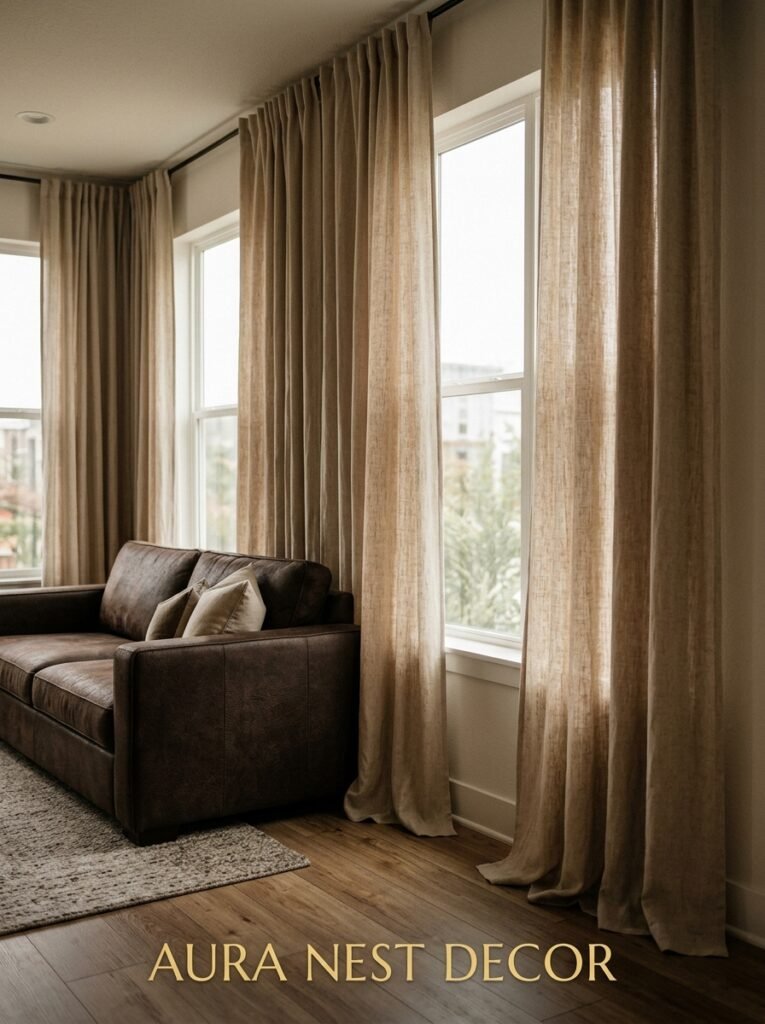
Curtains are probably the most underestimated element in a living room and they work especially hard when you’ve got a dark brown couch.
Long curtains — floor to ceiling, ideally hung from as high as possible — add height and drama and give the room a sense of scale that makes the heavy couch feel proportionate rather than dominant. This is especially relevant in UK homes where ceilings can be lower and windows smaller.
For color: linen curtains in a natural undyed tone are incredibly versatile with dark brown. They’re not quite white, not quite beige — they’re warm without competing. They let light through in a way that softens the room. And linen curtains photograph beautifully which, let’s be honest, matters if you’re pinning this stuff.
Velvet curtains in deep green or dark blue next to a dark brown couch is bold. I’ve seen it done badly and I’ve seen it done magnificently. Done well, it’s probably the most “this person has genuine design confidence” statement a living room can make. Done badly, it’s a cave.
The key for velvet curtains is to keep everything else lighter — the rug, the coffee table, the walls if possible. Let the dark elements be the sofa and the curtains, and build upward from there with lighter pieces.
—
11. Art on the Walls: What to Hang and Where It Goes
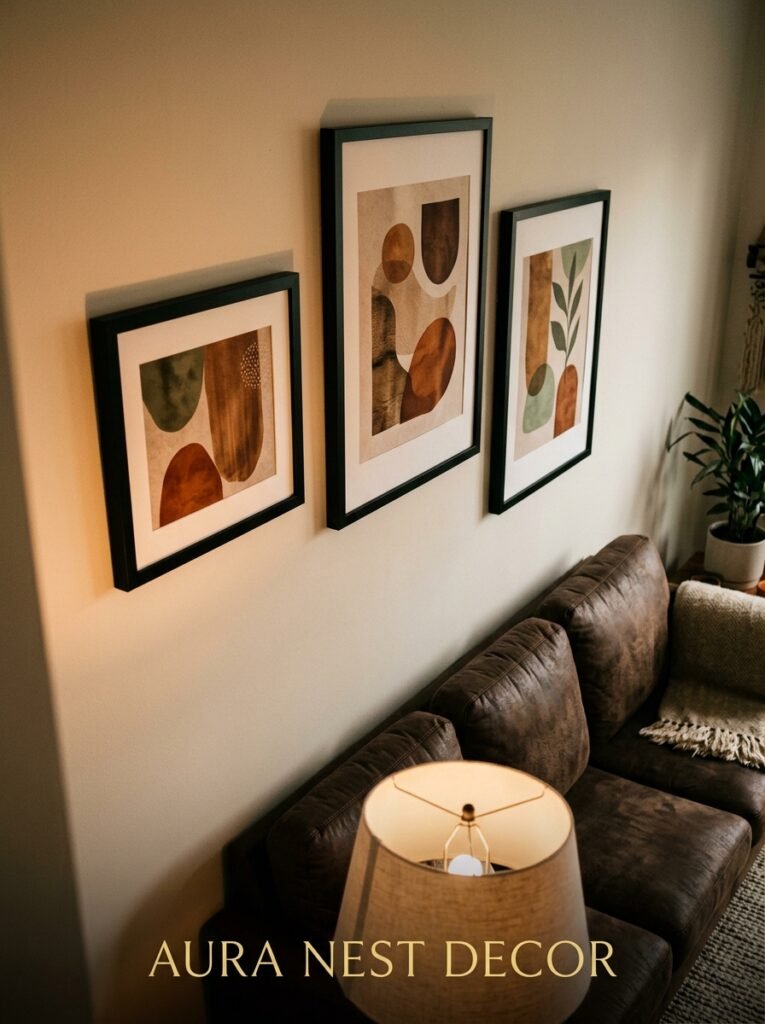
Big art, placed confidently. That’s most of the advice here.
A large, single piece of art on the wall above or behind a dark brown sofa gives the eye somewhere to go that isn’t just “more couch.” It lifts the visual weight of the furniture and creates a focal point that’s vertical rather than horizontal.
Color in the art matters. Abstract art with warm tones — ochre, rust, burnt sienna, cream — picks up the warmth of the brown and creates a visual conversation between the wall and the furniture. It looks collected rather than coordinated, which is what you want.
Gallery walls can work, but they need editing. Don’t put fifteen frames up and expect it to feel intentional. Five or seven, varied sizes, with some breathing room between them — that’s a gallery wall that works next to a dark sofa. Too dense and the whole wall just looks heavy.
One thing I’d avoid: very cold, very blue-toned art against a brown sofa. Silver-grey abstract prints, icy blue photography, anything with a lot of cool grey — these fight the warmth of the brown rather than supporting it. They can look intentionally designed, but it takes real skill to pull off. If you’re asking the question, stay warm.
—
12. The Styling Layer That Most People Skip (And Why It Matters)
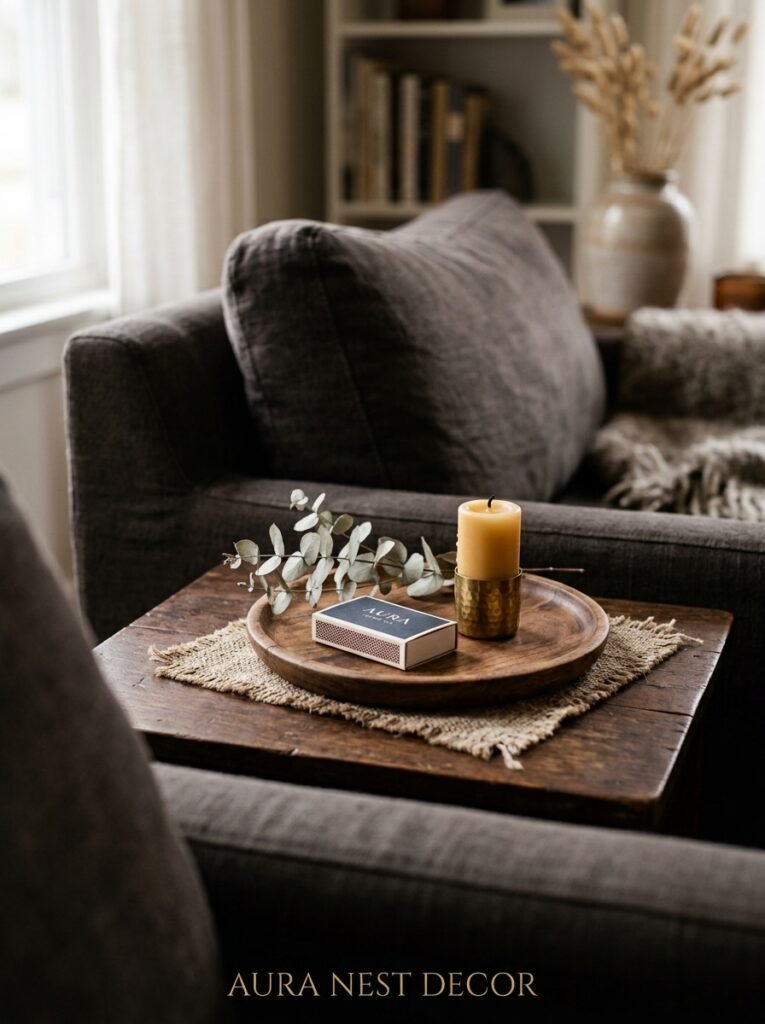
Books, objects, trays, small lamps. The stuff that goes on the coffee table, on the side tables, on the shelves near the sofa. This is the layer that separates a “nice room with a brown couch” from a “room that looks like a photo.”
What it needs: variation in height, variation in texture, and a few things that catch light. A ceramic bowl. A candle in a glass holder. A stack of books with a small object on top. A plant, small, in a contrasting pot.
What it doesn’t need: a bunch of matching accessories all from the same shop. That looks like a showroom, not a home. Mix a thrifted ceramic with something new. A brass candlestick with a matte stone coaster. The mix is the point.
Side note — this is the part of styling that’s completely reversible and costs almost nothing. If something’s not working, you move it. It’s the lowest-stakes design decision you can make, so experiment more than you think you should.
The brown couch, ultimately, is a canvas. A dark, warm, deeply good-looking canvas that a lot of people gave up on too quickly. Don’t be one of those people.
—
❓ FAQ
Q: Can I have a dark brown couch in a small living room without it feeling cramped? A: Yes, but it needs support. Warm walls, a light-toned rug, and good layered lighting will keep the couch from feeling oppressive. Mirrors help a lot too — position them to bounce natural or lamp light around the room and the space will breathe.
Q: What colour throws and cushions work best on a dark brown sofa? A: Warm contrast is your best friend here — burnt orange, dusty rose, rust, and terracotta all work brilliantly. For neutrals, cream linen or boucle adds texture that reads well against the dark upholstery. Avoid mid-tone beige, which tends to disappear against brown.
Q: Does a dark brown sofa work in a modern or contemporary living room, or is it too traditional? A: It works in both, but the styling signals are different. For a contemporary feel, pair it with a glass coffee table, clean-lined furniture, and muted wall art. For a more traditional or cozy feel, lean into velvet, rattan, warm lighting, and layered textiles. The couch itself is neutral enough to go either direction.
—
💭 Final Thoughts

Brown furniture had a reputation it didn’t deserve for a long time. Maybe because it got associated with a particular era of design — dark, heavy, a little airless — that nobody wanted to go back to. But that association isn’t the couch’s fault. It’s the context it was sitting in.
Get the context right — warm walls, layered light, contrast where it counts — and a dark brown sofa is one of the most grounded, livable, genuinely inviting pieces of furniture you can build a room around. It’s warm in winter and rich in summer and it hides a truly impressive amount of everyday mess.
So, what’s stopping you from finally making it work?