
The Fireplace Was Already There. I Just Had to Stop Fighting It.
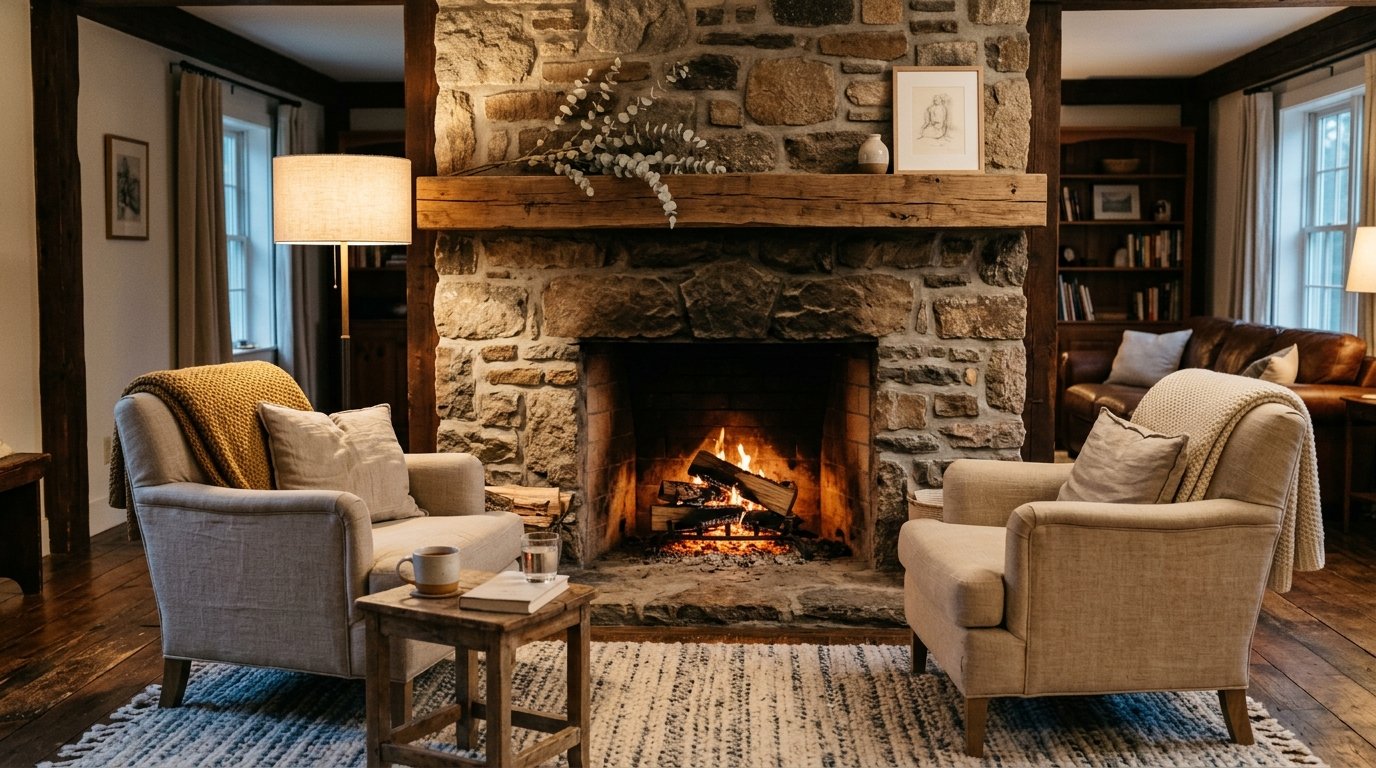
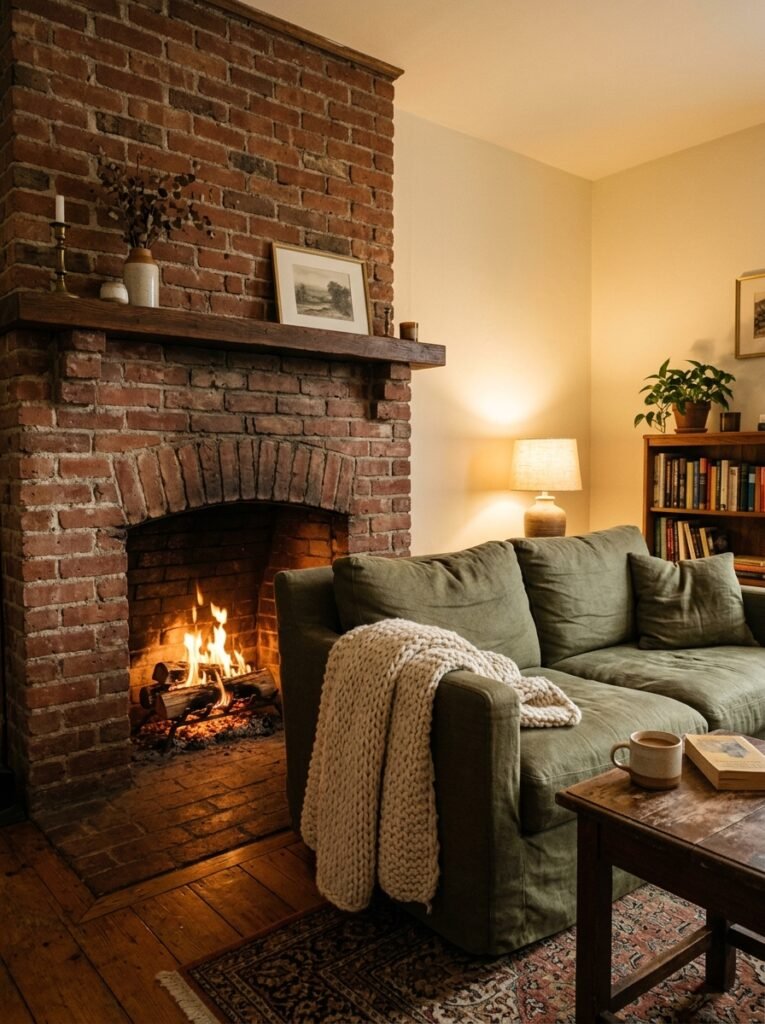
My friend called her fireplace “an awkward focal point” for three years. She’d pushed the sofa away from it, hung art on the adjacent wall to draw the eye elsewhere, and generally treated this beautiful original Victorian mantel like it was something to work around. Then one afternoon, kind of by accident, she moved everything to face it directly — and the whole room clicked.
I think about that story every time someone tells me they’re struggling with their living room layout.
—
1. Why “Facing the Fireplace” Feels So Obvious Once You’ve Done It
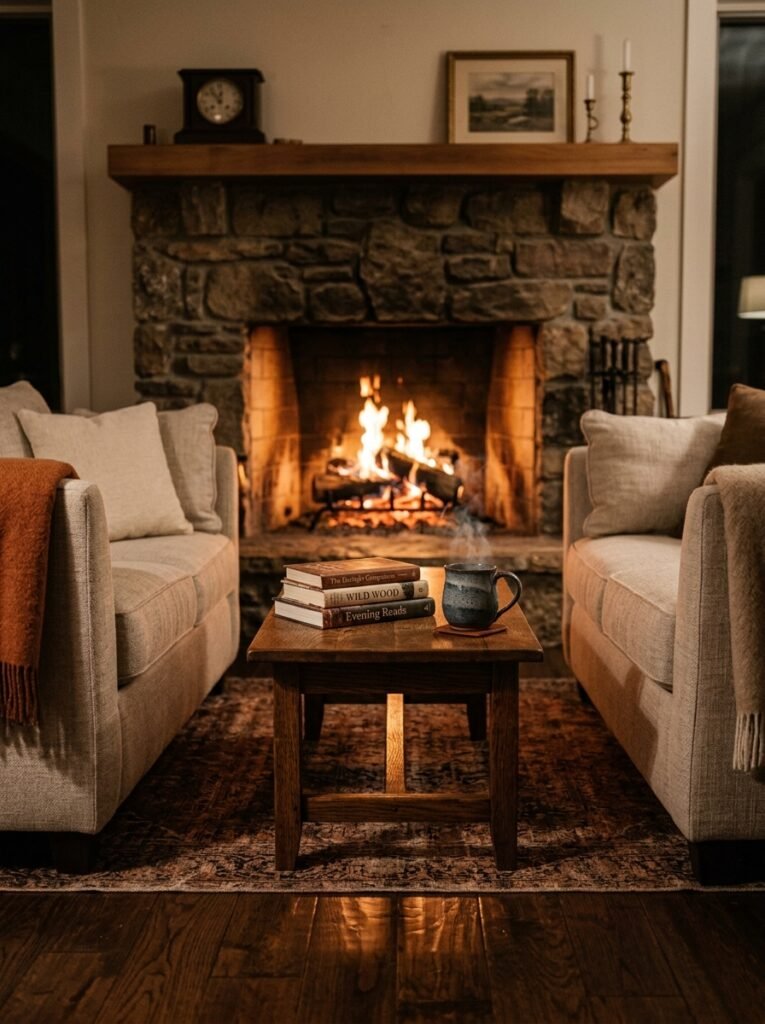
Here’s the thing nobody tells you: a fireplace isn’t furniture. It doesn’t compete with your sofa or your coffee table. It’s architecture. And when you finally start treating it that way — as the fixed point everything else revolves around — decisions that used to feel impossible just sort of… make themselves.
The sofa goes opposite. Or angled toward it. The chairs pull in. The rug anchors the whole arrangement. Suddenly you’ve got a room with a reason for existing, which sounds dramatic but honestly, that’s what a properly arranged fireplace room gives you.
Don’t overthink the distance. You want to be close enough that the warmth actually reaches you, not so close you’re sweating every November evening.
“A fireplace isn’t a feature you decorate around. It’s the thing that tells you where every other piece belongs.”
—
2. The Mantel Rule That Changed How I Style Everything
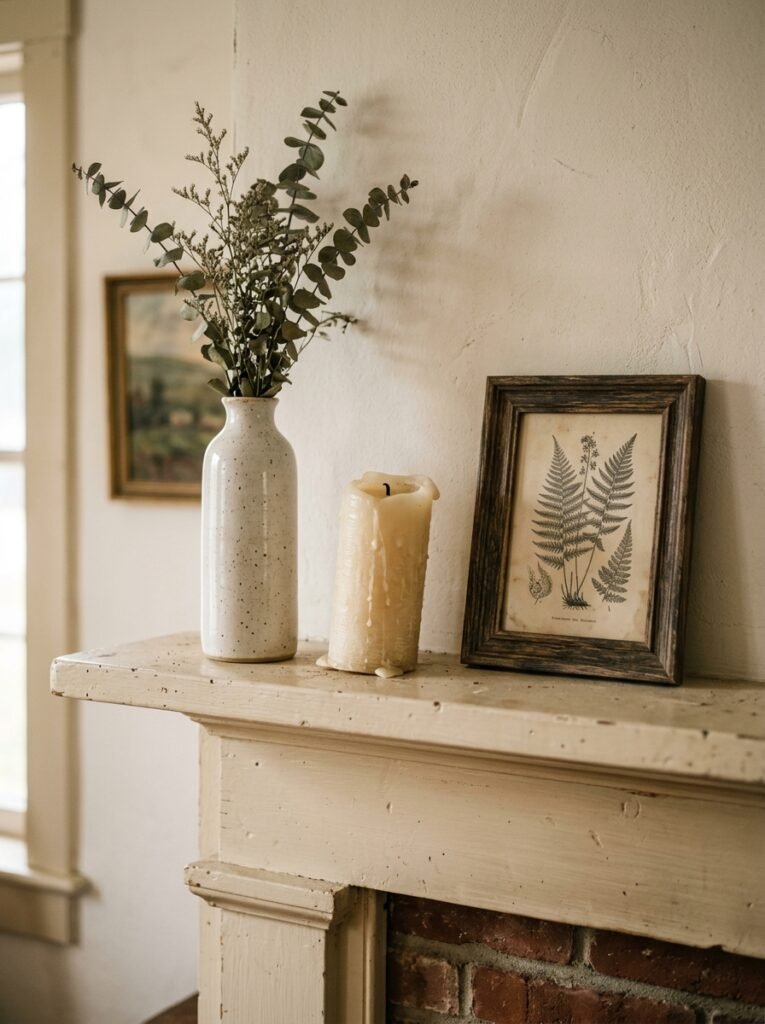
Leave some empty space on it.
That’s it. That’s the rule.
I know that sounds almost too simple, but I’ve been in so many homes where the mantel is loaded — candles, photos, a clock, a vase, a small sculpture, dried flowers, a mirror propped behind all of that — and the whole thing reads as visual noise instead of intentional display. Your eye doesn’t know where to land so it kind of bounces around uselessly and gives up.
Try this instead: pick one taller object (a single candlestick, a narrow vase with dried stems, one piece of art leaned casually against the wall) and let everything else breathe around it. Odd numbers tend to work. Three objects, max, with negative space between them. Or honestly? One object. One beautiful, considered object and a lot of air. That air is doing more work than you think.
—
3. The Color That Keeps Showing Up in Every Beautiful Fireplace Room Right Now
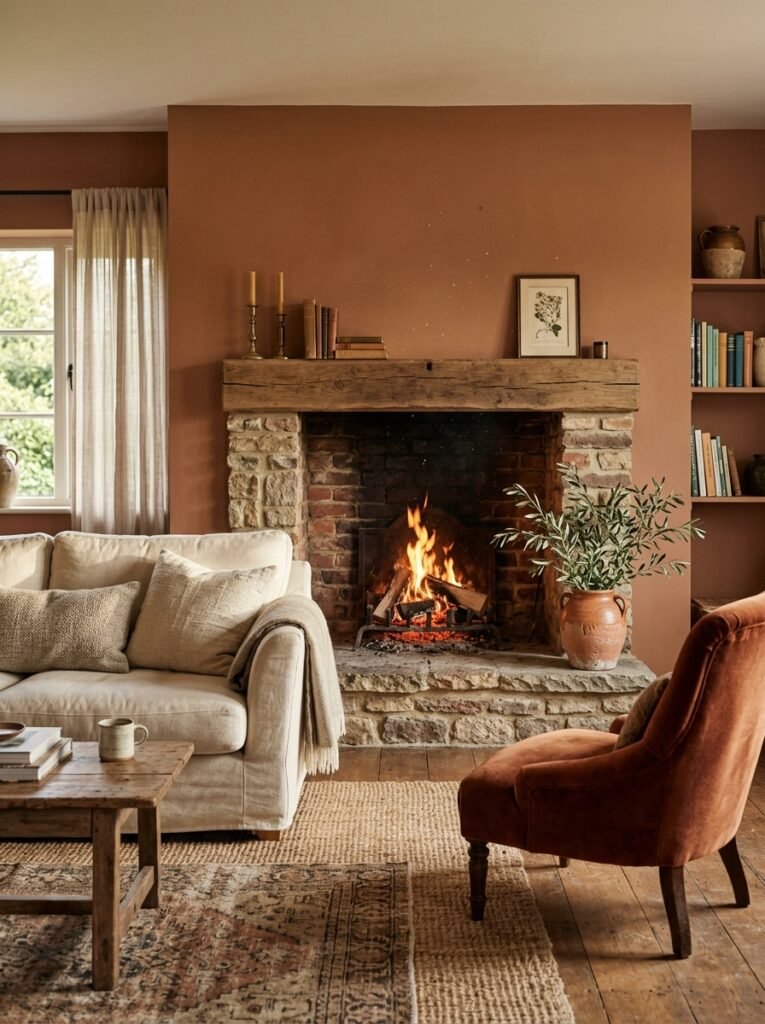
Warm clay. Not terracotta exactly — something a shade or two subtler. Like a terracotta tile that spent a few years in the sun.
It’s everywhere right now and I don’t think it’s going anywhere, because it does something genuinely smart: it plays off the inherent warmth of a fireplace without trying to match it. You’re not decorating to compete with the fire, you’re decorating to respond to it.
You see it in throw pillows, in painted walls, in wool blankets draped over linen sofas. Paired with warm cream or an aged off-white, it feels ancient in a good way. Paired with deep forest green it feels a bit more current. And it works in a Victorian terraced house in Leeds AND a craftsman bungalow in Portland, which honestly not many colors can claim.
—
4. What to Actually Do With the Wall Above the Mantel
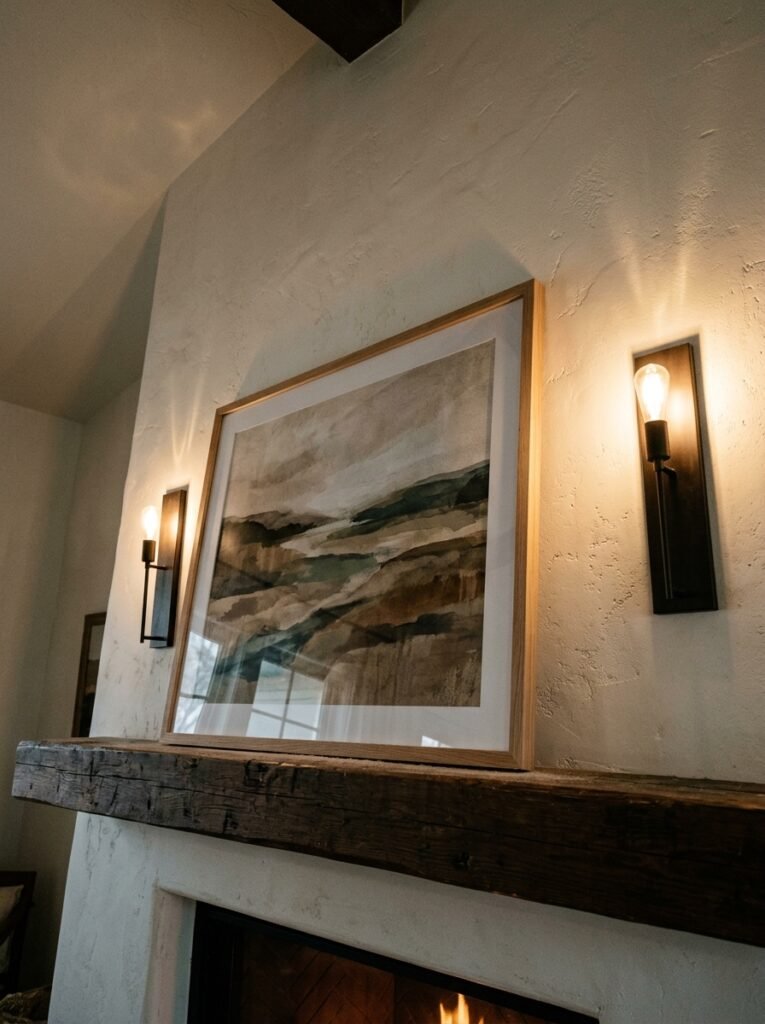
People agonize over this and I get it. It’s prime real estate.
A mirror is the safe choice, and honestly there’s nothing wrong with safe when safe is good. A large, slightly aged mirror (think foxed glass, a thin metal frame, or something that looks like it was found rather than purchased) will make the room feel bigger and reflect the fire’s light in a way that’s genuinely beautiful at night. Don’t hang it too high. The center of the mirror should sit roughly at eye level when you’re standing, which means lower than you think.
A single large piece of art is the bolder choice. The key word is large. A small painting centered above a wide mantel looks nervous and apologetic. Go bigger than feels comfortable. And lean it if you can — a large canvas leaned against the wall looks considered, not lazy.
What NOT to do: gallery walls. Directly above a fireplace, they almost always look too busy. The mantel’s already got stuff on it; the wall above doesn’t need to compete.
—
5. The One Rule That Makes Any Fireplace Hearth Look Intentional
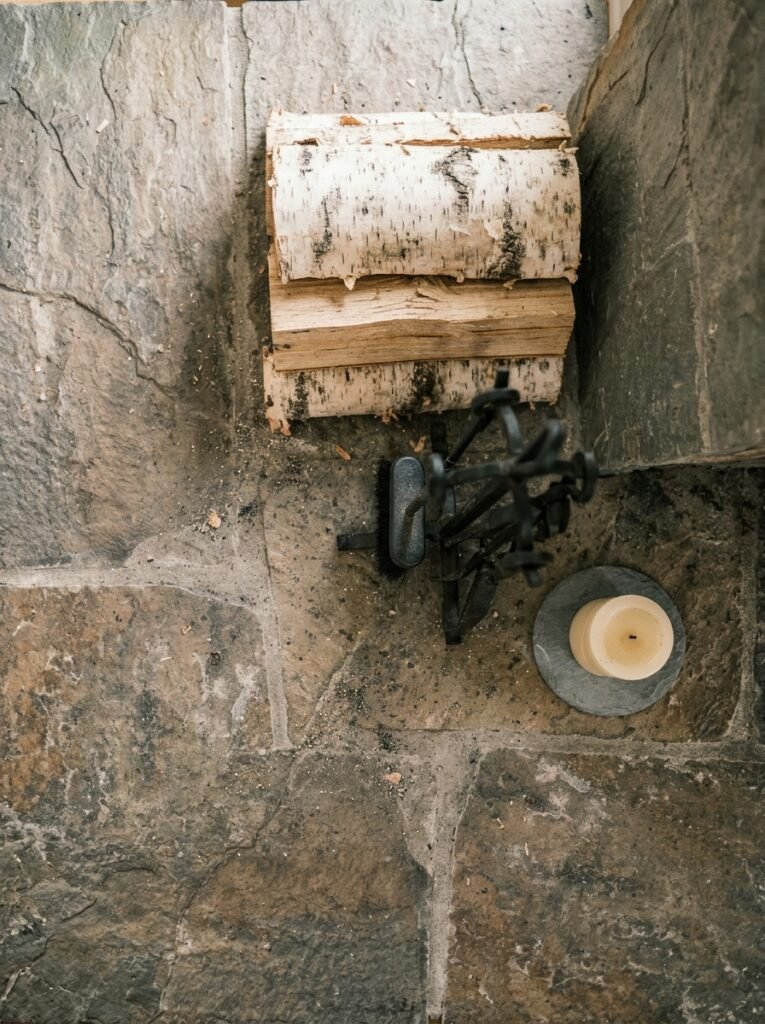
Define it.
The hearth extends out from the fireplace, and most people just… ignore it. Leave it as a patch of tile or stone in the middle of the room with no relationship to anything around it. But if you put something there — a stack of real logs if you’re burning them, a woven basket with kindling, a few pillar candles in varying heights on a small tray — suddenly it becomes part of the whole composition.
It’s a small thing. Takes five minutes. But it makes the fireplace look inhabited rather than decorative, which is the difference between a room that feels lived-in and one that feels staged.
“There’s a difference between a room that looks like a showroom and a room that looks like someone actually lives there beautifully. The hearth is where that difference shows up first.”
Side note — if you’ve got an unused fireplace (sealed, decorative only), candles on the hearth are exceptional. Cluster them. Different heights. Let the wax drip a little if you can stomach it. The effect is genuinely good.
—
6. Lighting the Room So the Fireplace Actually Glows
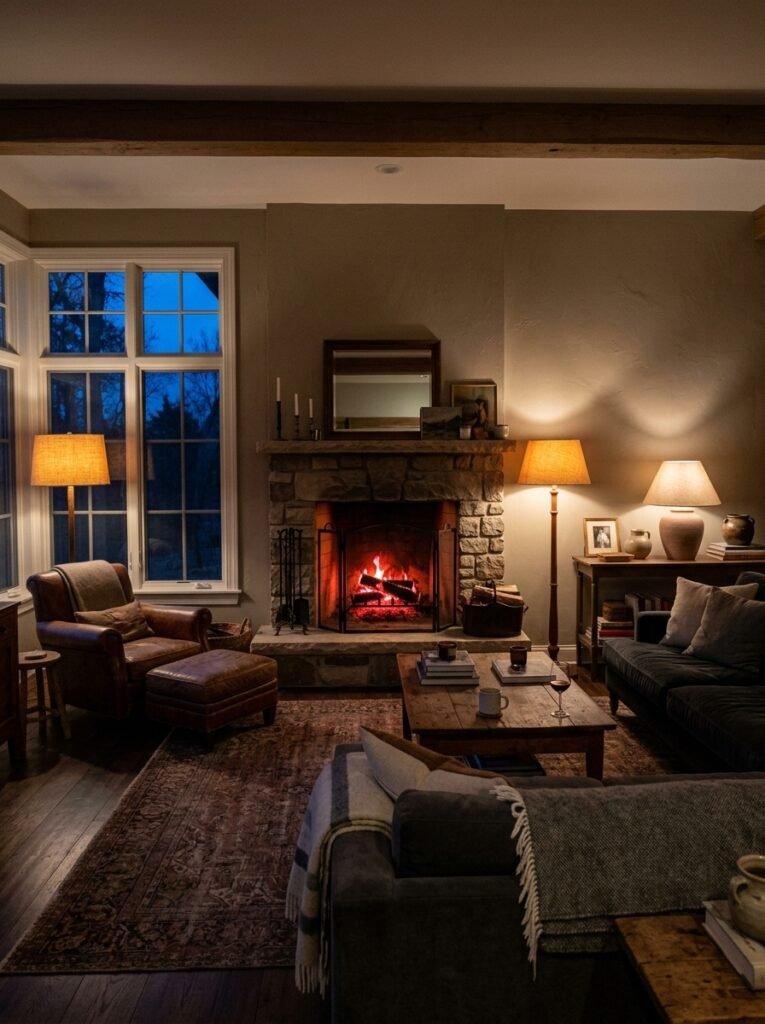
This one’s a bit counterintuitive. If you want your fireplace to look dramatic, you don’t actually want bright overhead lighting. You want dim, warm, lower-level light that lets the fire (or even a candle arrangement) be the brightest thing in the room.
Floor lamps positioned at the sides of the sofa. Table lamps on lower surfaces. The amber glow of a low-watt bulb, not a cool-toned bright white one. Think 2700K or below if you’re buying bulbs and actually pay attention to that stuff, which — fair if you don’t.
Overhead recessed lighting on its own is a fireplace room’s worst enemy. It flattens everything and makes the fire look weak. If you’ve got a ceiling fixture, put it on a dimmer and use it at maybe 20% after dark. Let the lamps and the fire do the work.
—
7. The Rug Size That Trips Everyone Up in Fireplace Rooms
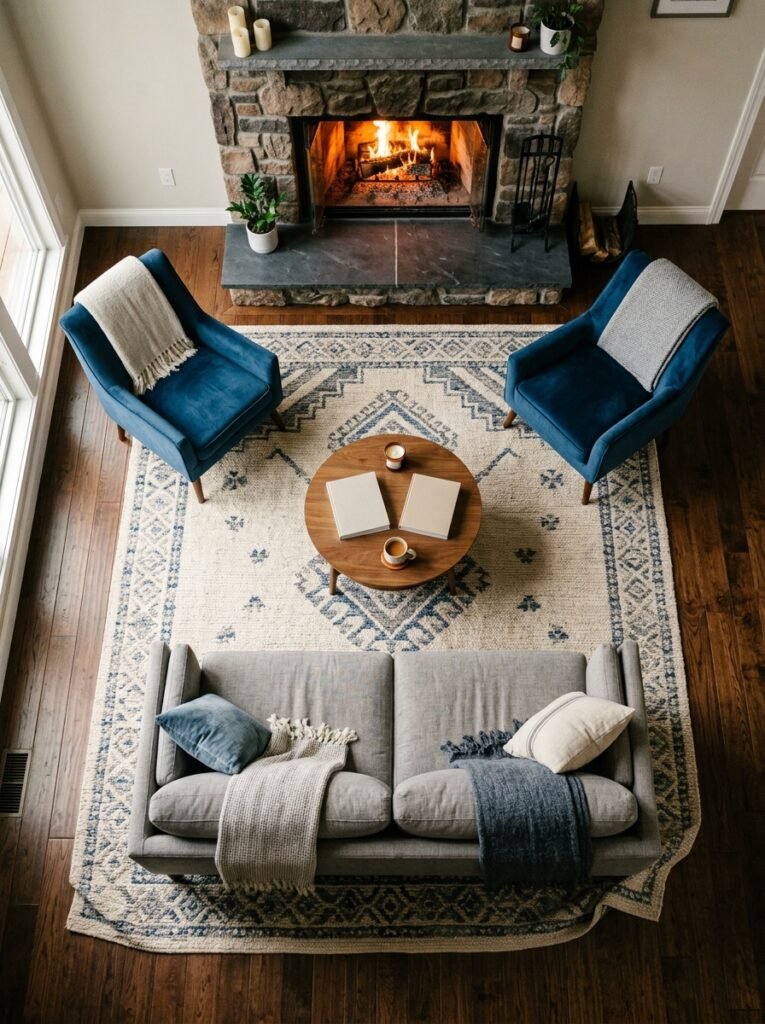
Too small. That’s almost always the problem.
A rug that doesn’t reach under the front legs of your sofa just sort of sits there looking lost. In a fireplace room, where the rug is literally bridging the gap between seating and hearth, this matters even more than usual. You want the rug to tie everything together — to visually say “this is all one seating area, one intentional space.”
Go bigger than your instinct says. If you think you need a 5×7, you probably need an 8×10. If you think you need an 8×10, you might need a 9×12.
And texture. Not just pattern — actual physical texture. A chunky woven rug, something with a bit of pile, a flatweave with visible ridges. Next to a fireplace, texture reads differently than it does anywhere else in the house. The warmth of the fire makes tactile things feel even more tactile, if that makes sense.
—
8. Choosing Furniture Fabrics That Actually Make Sense Next to a Fire
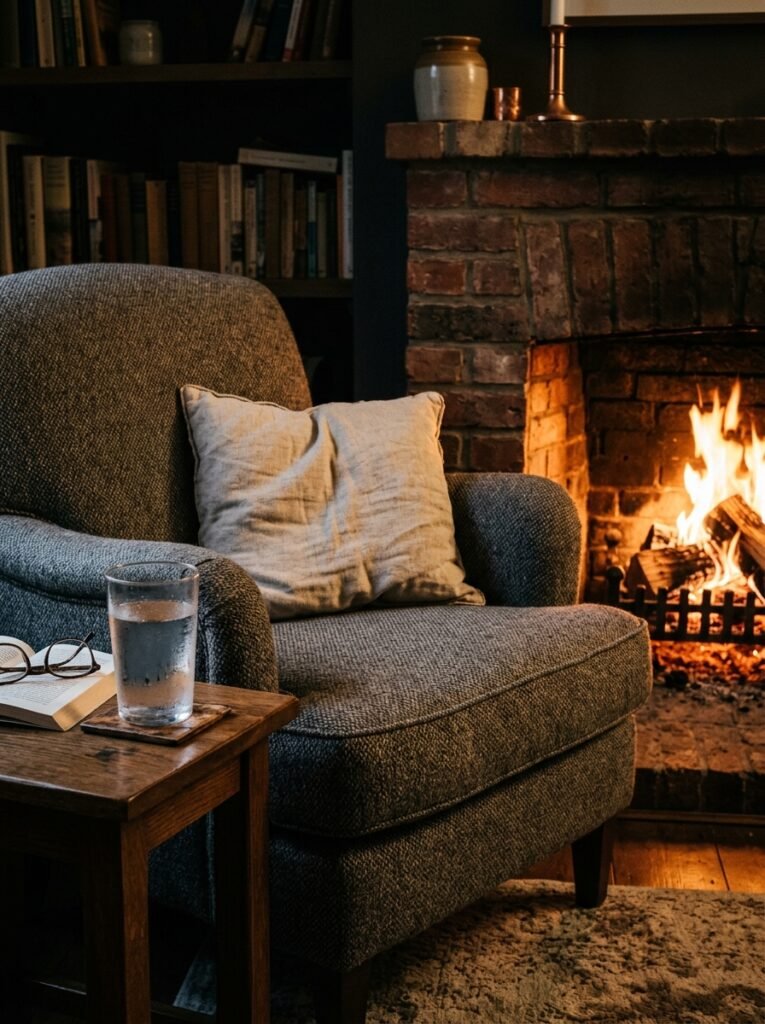
Linen is the answer for most people. It’s got that natural slightly-rumpled quality that reads as relaxed and intentional at the same time, it doesn’t look fussy, and in cream or warm oat tones it’s perfect against a stone or brick fireplace surround.
Velvet has a moment too — deep teal, warm rust, dusty rose. Velvet next to a fire at night is extraordinarily cozy. Just know that it’s a commitment. It’s not subtle.
What I’d avoid: anything very shiny or very sleek. Leather in a bright cherry or a cool charcoal tends to fight the warmth of a fireplace rather than work with it. A worn, broken-in leather in cognac or caramel? Different story entirely, actually beautiful.
—
9. When the Fireplace Is Original and the Room Has Nothing Else to Show For It
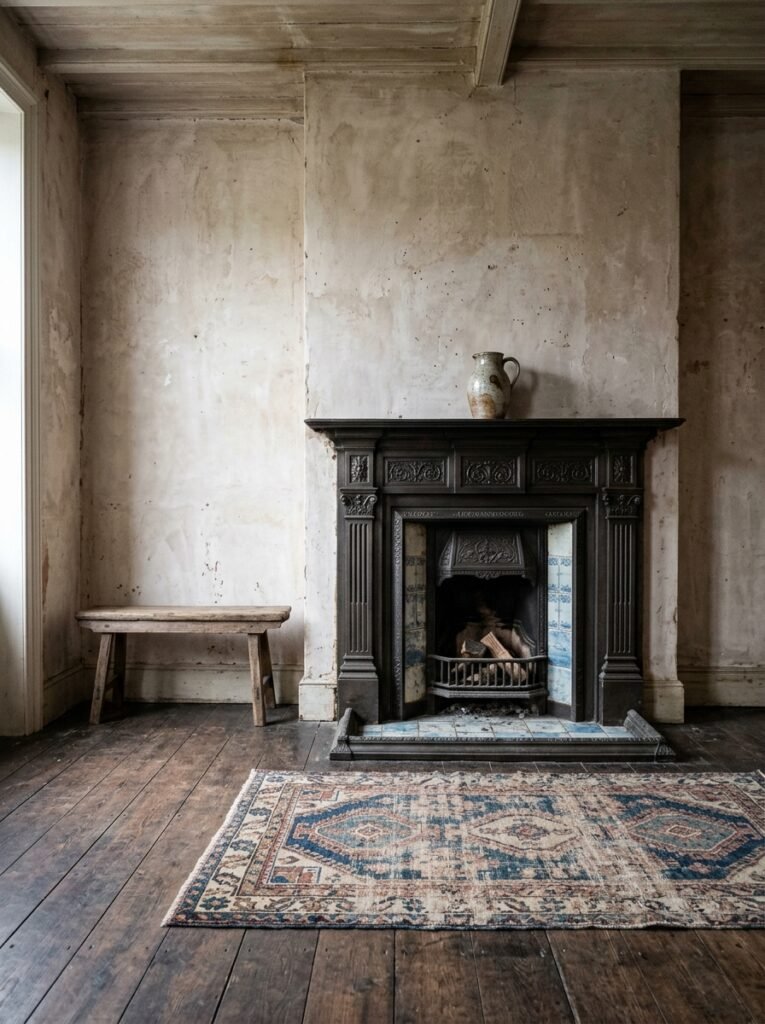
This is a situation I see a LOT, especially in older UK homes — gorgeous original Victorian or Edwardian fireplace, ornate cast iron, beautiful tiles. And then the rest of the room is just… fine. Modern furniture with no particular character, neutral walls, nothing that responds to the age or detail of the fireplace at all.
The fireplace ends up looking marooned.
You don’t have to go full period-correct to fix this. But adding one or two pieces with some age — a wooden coffee table with visible grain and history, an antique-looking lamp, a piece of art with a worn frame — creates a dialogue. The fireplace stops being a relic and starts being a conversation.
Even just a vase that’s clearly old, or a wooden bowl, or a stack of books with weathered spines. Small things. But they tell the fireplace that it belongs here.
—
10. How to Decorate a Fireplace Room for Winter Without It Feeling Temporary
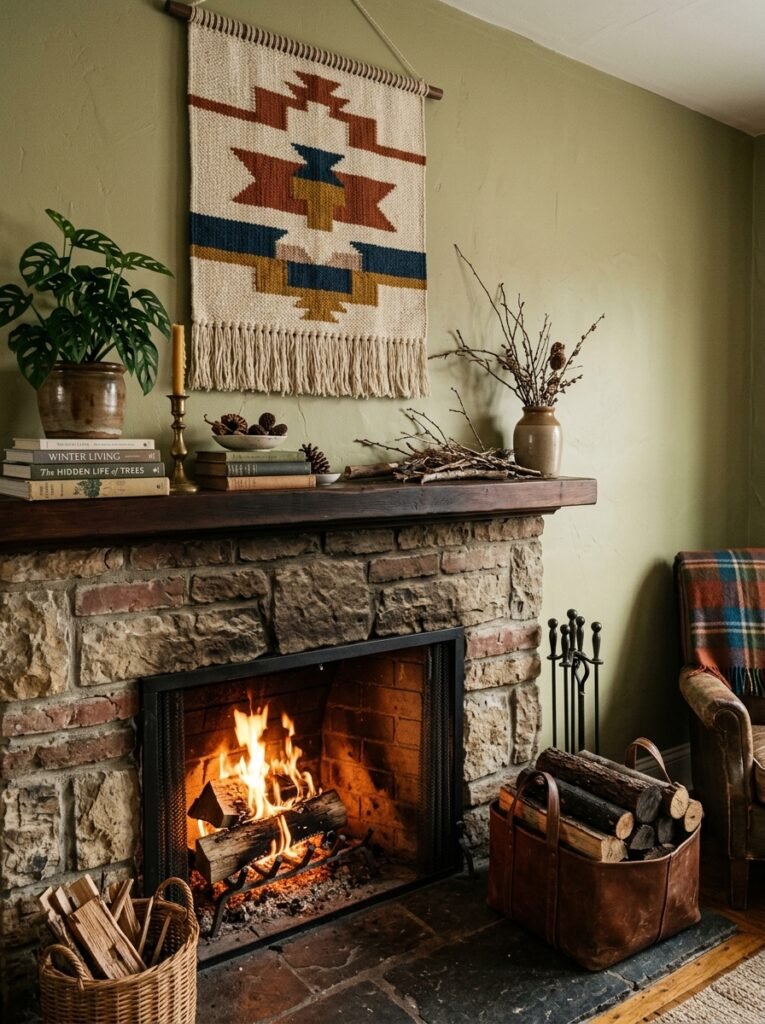
Don’t do it seasonally. That’s my actual take.
I understand the impulse — swap in the woolly throws, add the pine cones, do the whole hygge setup for November through February and then what, take it all away in March? But a fireplace room that really works is one that’s permanently warm in feeling, not just when the weather demands it.
Layered textiles that stay year-round. A permanent throw (not a seasonal one) that lives on the arm of the sofa. Warm lighting that doesn’t come down in April. Candles all the time, not just when it’s cold.
“A room built around a fireplace should feel like winter every time you walk into it — in the best possible way.”
The seasonal swap shouldn’t be “adding warmth” — it should be a subtle shift. Maybe a heavier throw comes out in November. Maybe the flowers on the mantel go dried in winter instead of fresh. But the bones stay warm.
—
11. Small Touches That Punch Above Their Weight in a Fireplace Room
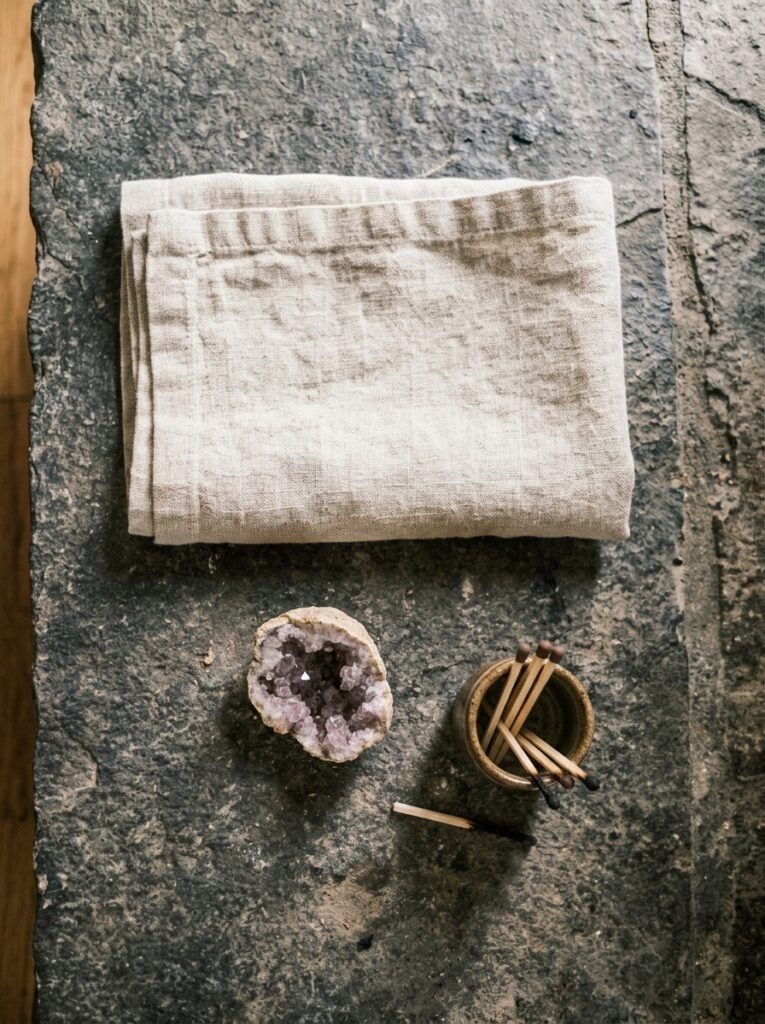
A few things that genuinely make a difference, in no particular order:
- Books on or near the mantel. Not decorative fake books — real ones, ideally ones you’ve actually read. They add personality in a way almost nothing else does.
- One plant that can handle low light. A tall fig or a trailing pothos near (not directly next to) the fireplace. Something living.
- Candle holders in different materials. Brass, ceramic, stone. Mix them. Don’t match them.
- A throw that’s folded properly. Not stuffed behind a cushion, not bunched up. Folded once or twice, draped deliberately. It sounds fussy but takes two seconds and makes the room look a hundred times more intentional.
These aren’t the big moves. They’re the finishing moves, and they’re the ones people notice first without knowing why.
—
12. The Version of This Room That’ll Still Feel Right in Ten Years
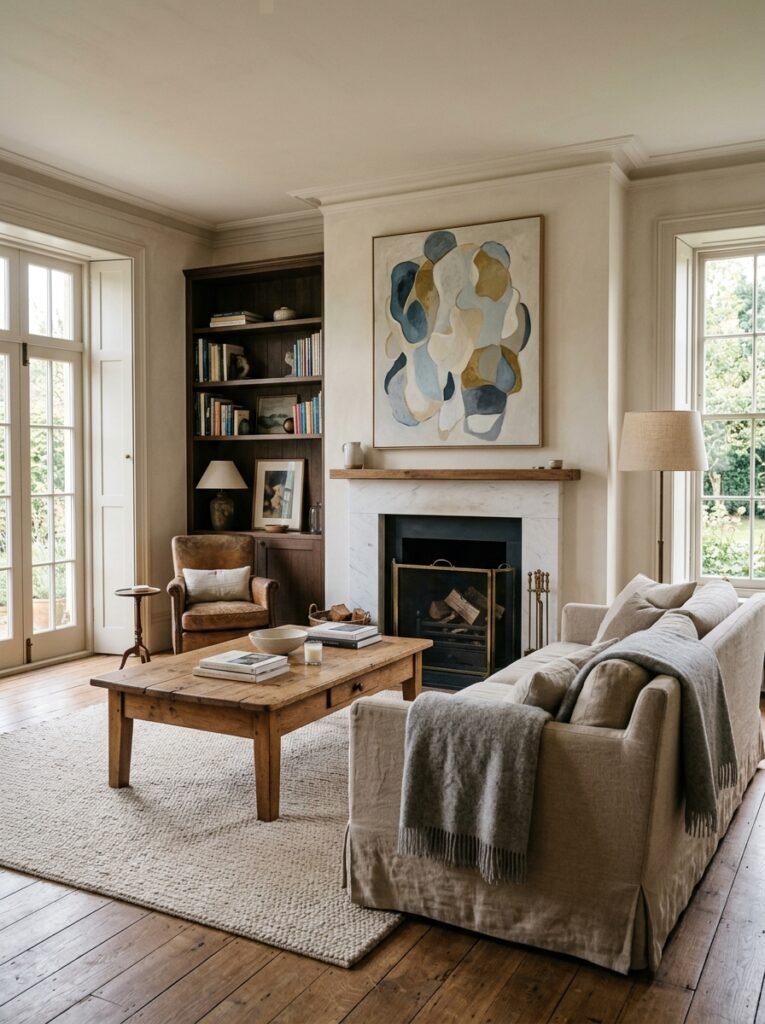
Here’s what I think ages well: natural materials, warm neutrals, a fireplace that’s allowed to be the star, and furniture that’s comfortable enough that people actually sit in those chairs instead of just looking at them.
Here’s what I think doesn’t: overly themed rooms (the “hygge corner” that’s twelve products placed deliberately), gallery walls packed wall to floor, furniture that’s too precious to actually use.
A fireplace living room should be the most usable room in the house. The one you actually sit in when it’s dark at 4pm in November and you need a cup of tea and you want to just exist for a while. It shouldn’t be a museum. It shouldn’t require upkeep every time a guest comes over. It should be the room where people collapse into the sofa and let out a long breath and feel like they’re somewhere good.
That’s the goal. Not a Pinterest board brought to life — although honestly, if your room ends up on someone’s board because they sat in it and thought I want my home to feel like this, that’s pretty much the best possible compliment there is.
—
❓ FAQ
Q: How do I arrange furniture in a living room with a corner fireplace? A: Corner fireplaces are genuinely tricky, because the natural focal point is at an angle rather than on a wall. The key is to angle your main sofa toward it — not parallel to a wall, but on a diagonal that points toward the corner. A round or oval rug can help unify the arrangement since it doesn’t have a directional “orientation” the way a rectangular one does.
Q: What’s the best way to decorate a fireplace that doesn’t work anymore? A: Fill it with intention rather than trying to make it look like it still functions. Stacked pillar candles at varying heights are the classic choice and genuinely look beautiful. A large bunch of dried pampas grass or eucalyptus branches in the firebox can also work surprisingly well. What tends to look a bit sad is leaving it completely empty — the void reads as neglect rather than minimalism.
Q: Can I have a cozy fireplace room in a modern or contemporary house? A: Completely, yes. The key is not to force period detail that doesn’t belong there. In a contemporary space, a fireplace works beautifully with clean lines, warm concrete or plaster textures, and furniture in simple shapes with natural fabrics. You’re going for warmth of feeling, not warmth of style — and those are two different things.
—
💭 Final Thoughts
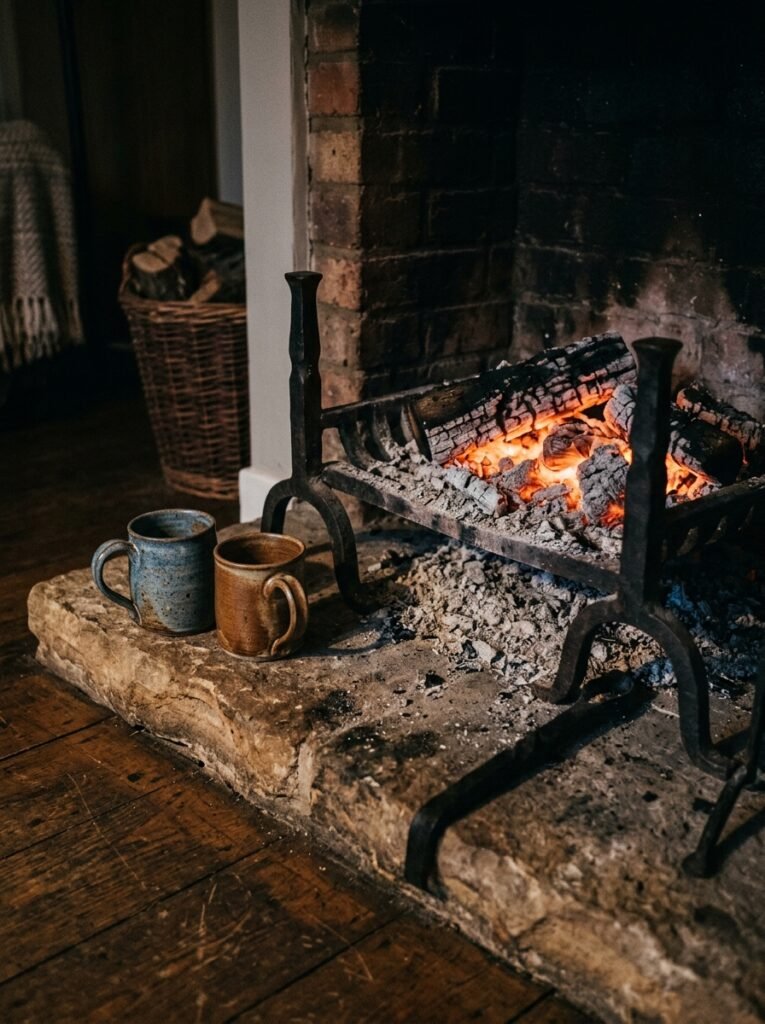
A good fireplace room isn’t decorated. It accumulates. Objects come in over time, get rearranged, get replaced, and slowly the room develops a personality that’s hard to trace back to any single decision. That’s actually the goal — to build something that feels like it grew there rather than appeared.
So maybe stop trying to get it right all at once. Move one thing. See how it feels. Do you actually want to spend your evenings in this room?