The Newborn Nursery Mistakes I Wish Someone Had Warned Me About (And What Actually Makes a Beautiful Baby Room)
My friend Sarah called me at 11pm, two weeks before her due date, in a full panic about her nursery. “I bought everything in grey,” she said. “Is that wrong? Did I ruin it?” She hadn’t ruined anything. But we stayed on the phone for an hour anyway, because nobody tells you the REAL stuff about designing a baby’s room until you’re already knee-deep in it.
—
1. Grey Is Fine. Here’s What’s Actually Going to Date Your Nursery Fast
Not gonna lie — grey nurseries had a good run. They’re still pretty. But the ones that feel timeless aren’t the ones that leaned hardest into the trend. They’re the ones that used grey as a neutral backdrop and then did something interesting on top of it.
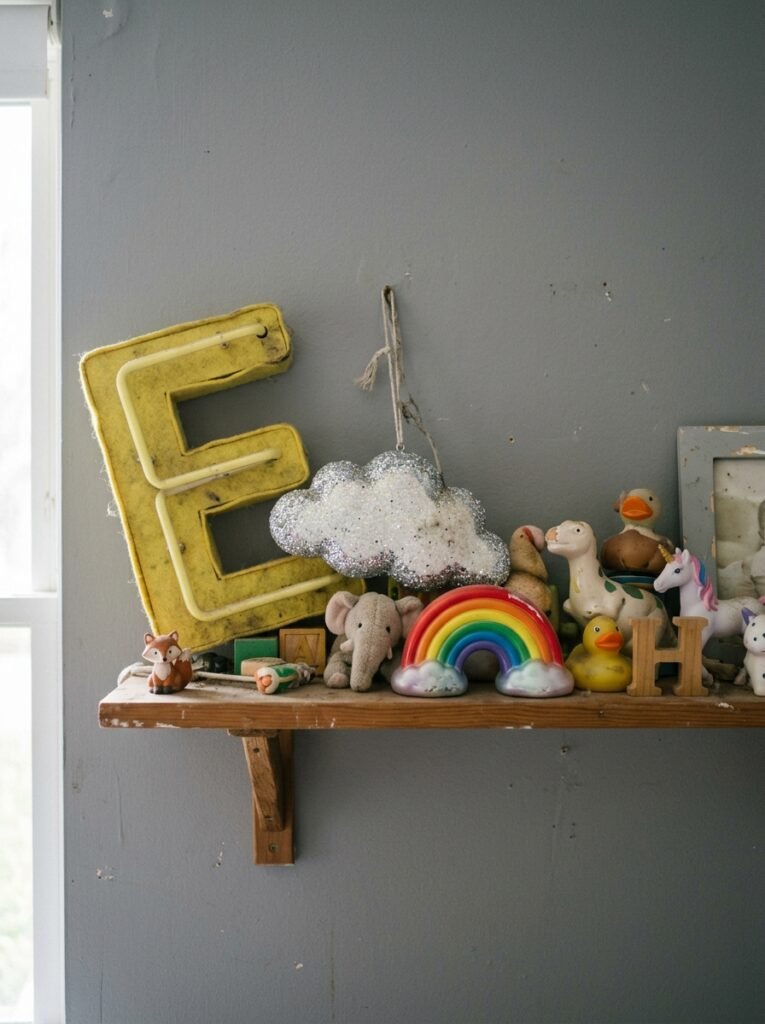
What dates a nursery faster than any color is the accessories. The mass-produced wall letters spelling out the baby’s name in a font that was everywhere two years ago. The matching-set curtain-rug-mobile combo that makes it look like a showroom display. The room that clearly came from one shopping cart on one website in one afternoon.
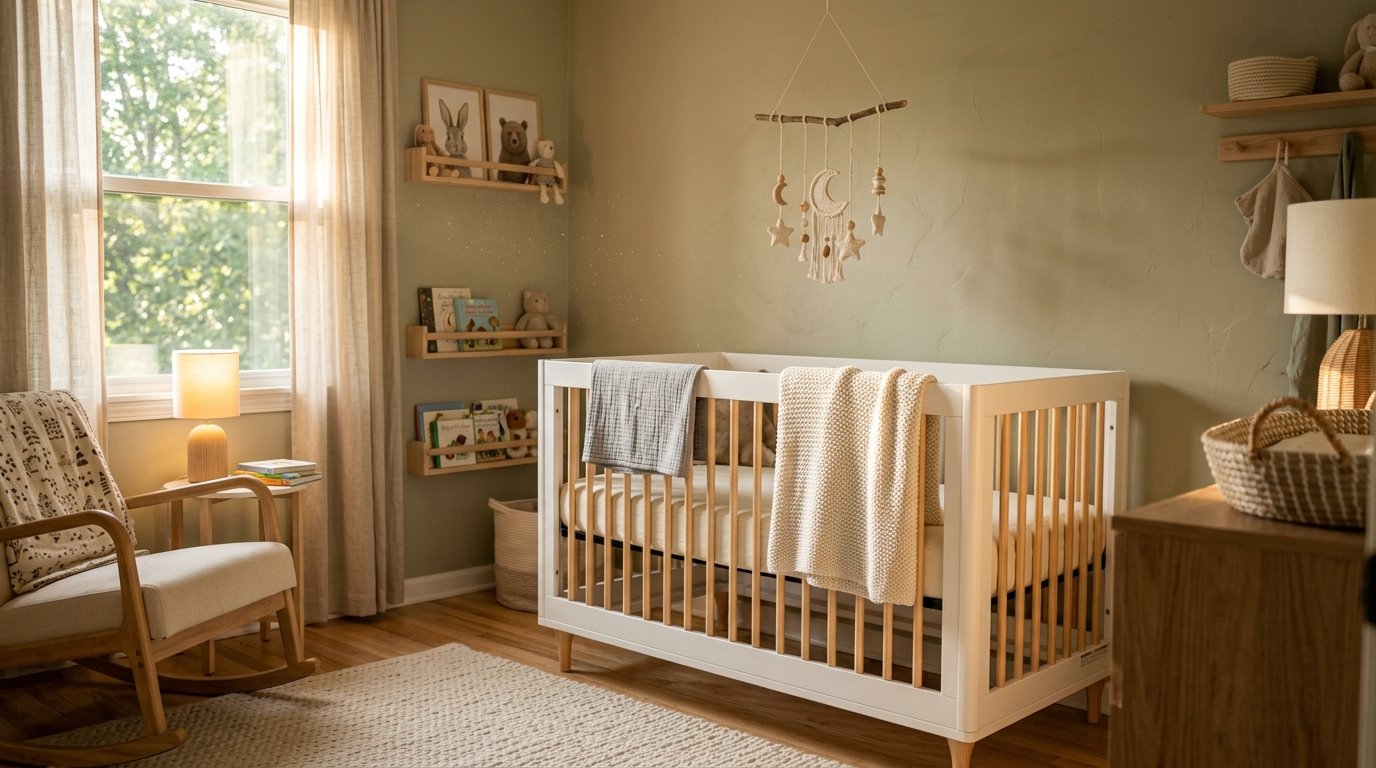
What doesn’t date? Texture. A chunky hand-knitted blanket draped over the arm of the nursing chair. A simple linen roman blind in a soft warm white. Something handmade — even just one thing — that can’t be replicated.
If you do go grey (or greige, or sage, or whatever the current soft neutral is), put something unexpected in there. A small framed vintage botanical print. A lamp with a warm amber bulb. A rattan storage basket that looks like it belongs in a grown-up living room, because honestly? It does.
“The rooms that feel magical aren’t the ones with the most stuff — they’re the ones where someone clearly made a decision instead of just buying a set.”
—
2. The Light You Pick Now Will Matter at 3am More Than You Think
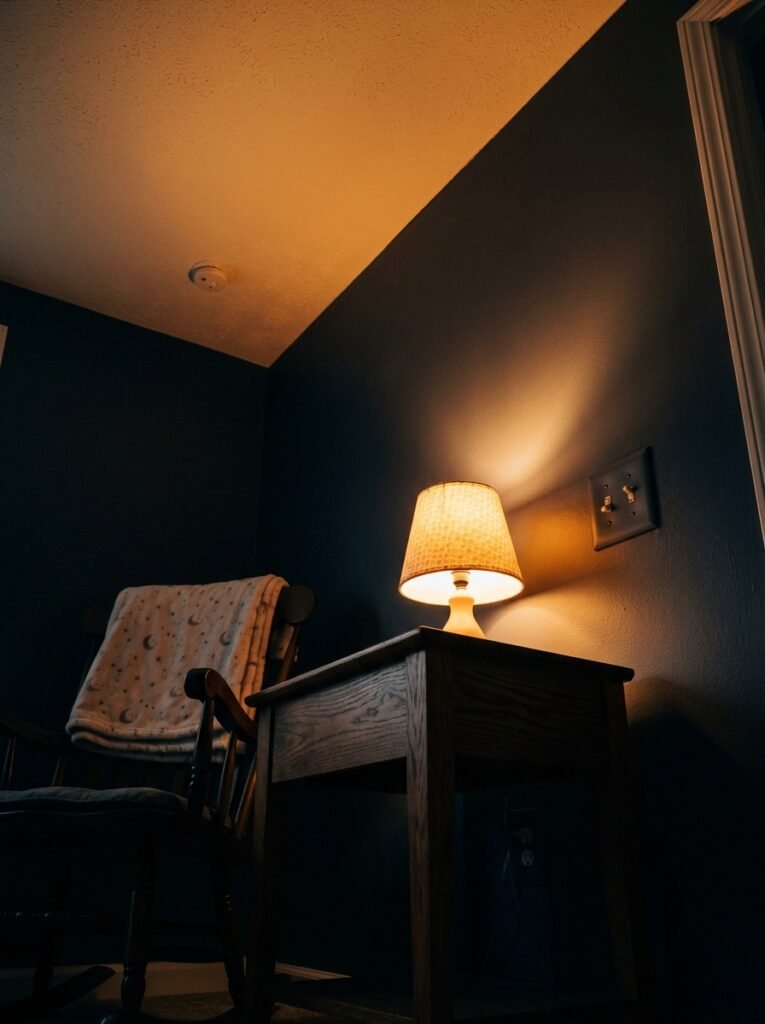
Here’s something nobody puts on a nursery checklist: lighting layers. You need at least three levels, and you need to figure them out before the baby arrives, not after.
The overhead light is basically useless for nighttime feeds. You turn that on and suddenly it’s an interrogation room and both you and the baby are confused and unhappy. What you actually need is a warm, very dim lamp on a side table or a plug-in night light with a soft amber glow — not blue-toned, not white, specifically warm. Your melatonin will thank you.
Then there’s daytime light. Big windows are wonderful but uncontrolled sunlight during nap time is your enemy. Blackout blinds — real ones, not the slightly-see-through kind — are one of the best investments you’ll make. Put them behind something pretty if the look bothers you. A soft sheer panel in front of a blackout blind gives you the aesthetic without sacrificing the darkness.
The third layer is just general ambient light for during the day when you’re in there doing normal things. That’s where a good floor lamp or wall sconce earns its place.
Side note — if you’re in a rental and can’t do hardwiring, rechargeable wall sconces exist now and they’re genuinely brilliant. No electrician, no deposit drama.
—
3. The Color That Keeps Showing Up in Every Beautiful Nursery Right Now
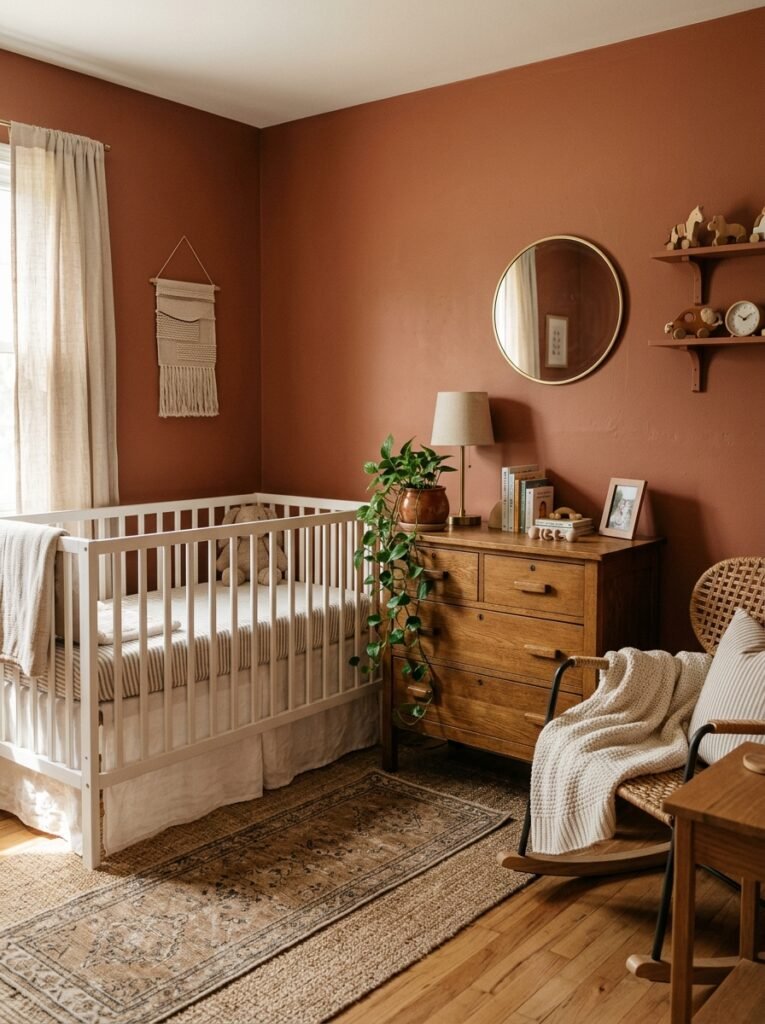
Warm white. Not cool white, not bright white. Warm white — the kind with just the faintest whisper of cream or blush or yellow in it.
And I know, warm white sounds boring. But paired with natural wood tones? A soft terracotta accent? One small deep-toned piece of art? It turns into something really lovely. The room breathes. It feels calm without feeling clinical.
The thing that’s interesting about warm white as a nursery wall color is that it actually makes the baby’s other things — the textiles, the toys, the mobile — pop in a way that a busier wall color doesn’t. The room becomes a backdrop instead of a statement, which means you can change the accessories as the child grows without a full repaint.
In the UK especially, where a lot of older homes already have beautiful architectural details — picture rails, dado rails, original skirting — a warm white wall lets all of that do the work. You don’t need to add visual interest because it’s already built in.
—
4. Why the Nursing Chair Is Secretly the Most Important Design Decision in the Room
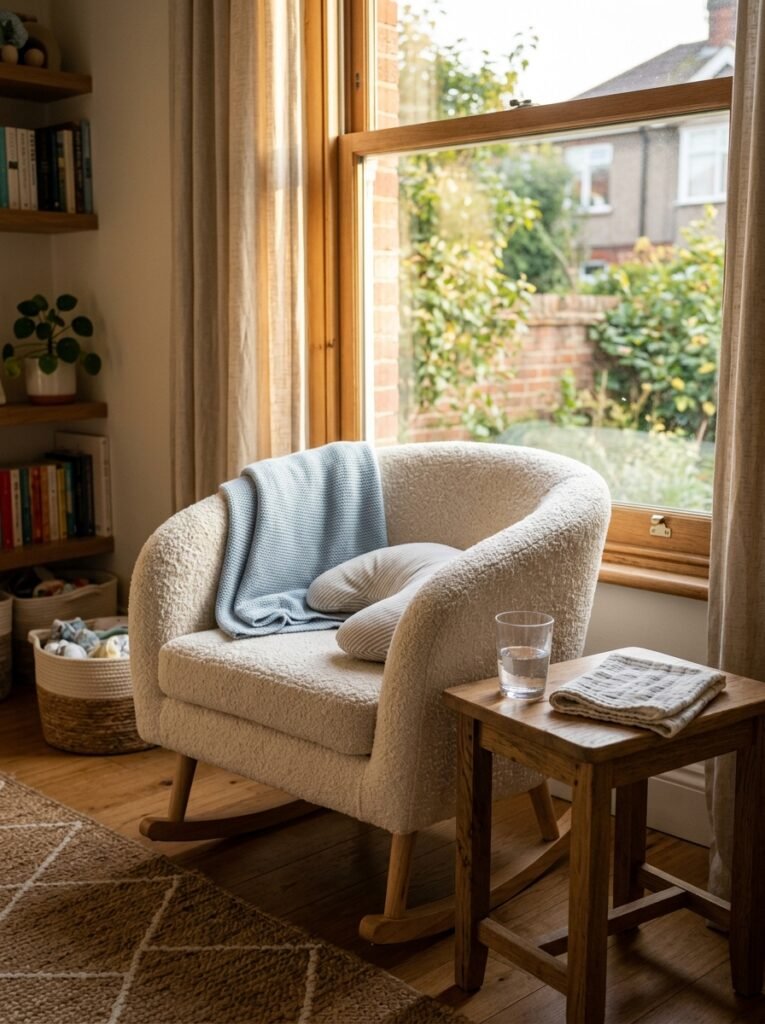
Not the crib. The chair.
You’re going to spend a WILD amount of time in that chair. Middle of the night, 4am, feeding or rocking or just sitting there with a warm baby on your chest. The chair has to be comfortable in a real, sustained way — not “looks lovely in a showroom” comfortable, but “my back doesn’t hate me after an hour” comfortable.
It also has to be cleanable. Fabric that wipes down, or a slipcover that comes off and goes in the wash. Just trust me on this.
From a design standpoint, the nursing chair is often the biggest visual piece in the room apart from the crib. So it’s worth treating it like a grown-up furniture decision. A soft boucle occasional chair can work beautifully. So can a simple upholstered rocker in a muted sage. Or honestly, an old armchair reupholstered in something soft and durable.
“Your nursing chair is going to see more of you in those early weeks than your own bedroom will. Treat it accordingly.”
What I’d avoid: anything with wooden arms (you’ll knock the baby’s head, everyone does), anything too low to the ground (you need to be able to stand up easily while holding a sleepy baby), and anything that wobbles. It sounds obvious. It’s not obvious at 3am.
—
5. The One Rule That Makes a Tiny Nursery Feel Like a Real Room
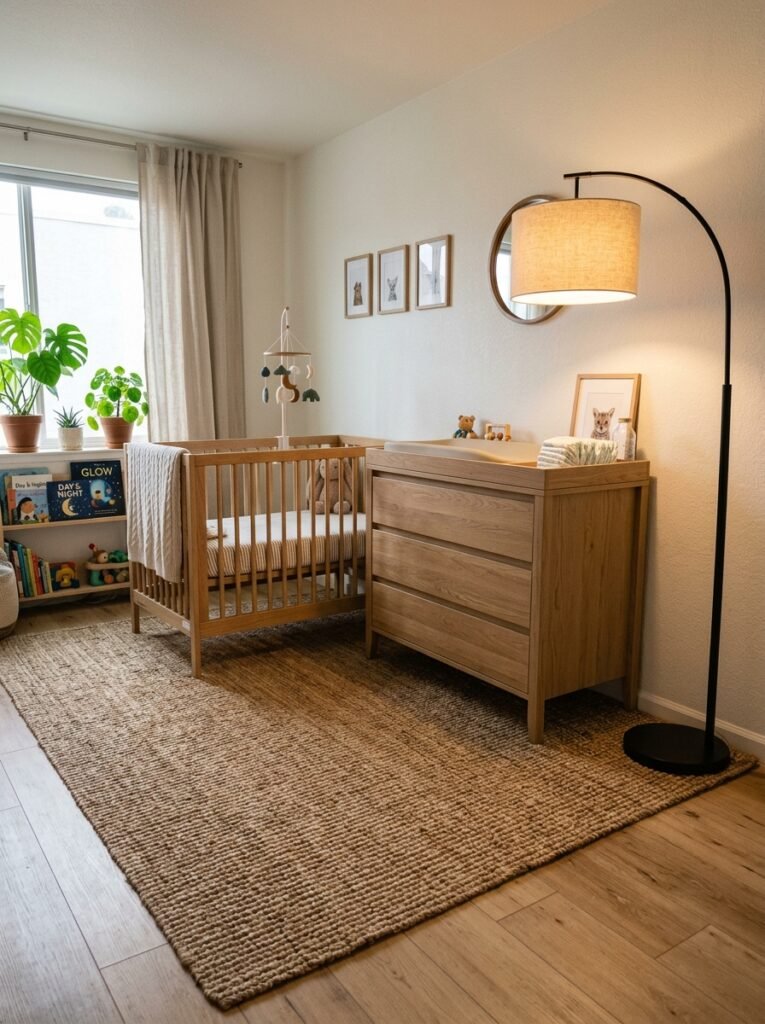
Give it one proper statement piece.
Not five medium things. ONE big, deliberate, grown-up thing. Because small rooms get ruined by everything being the same scale. When everything is small-to-medium — small dresser, medium crib, small lamp, medium rug — the room reads as fussy and cluttered even when it’s perfectly tidy.
But one thing at the right scale — a large simple crib, or a genuinely oversized piece of art above the changing table, or a dramatic curtain that goes all the way from ceiling to floor — anchors the whole space. Everything else can be smaller and it’ll still feel intentional.
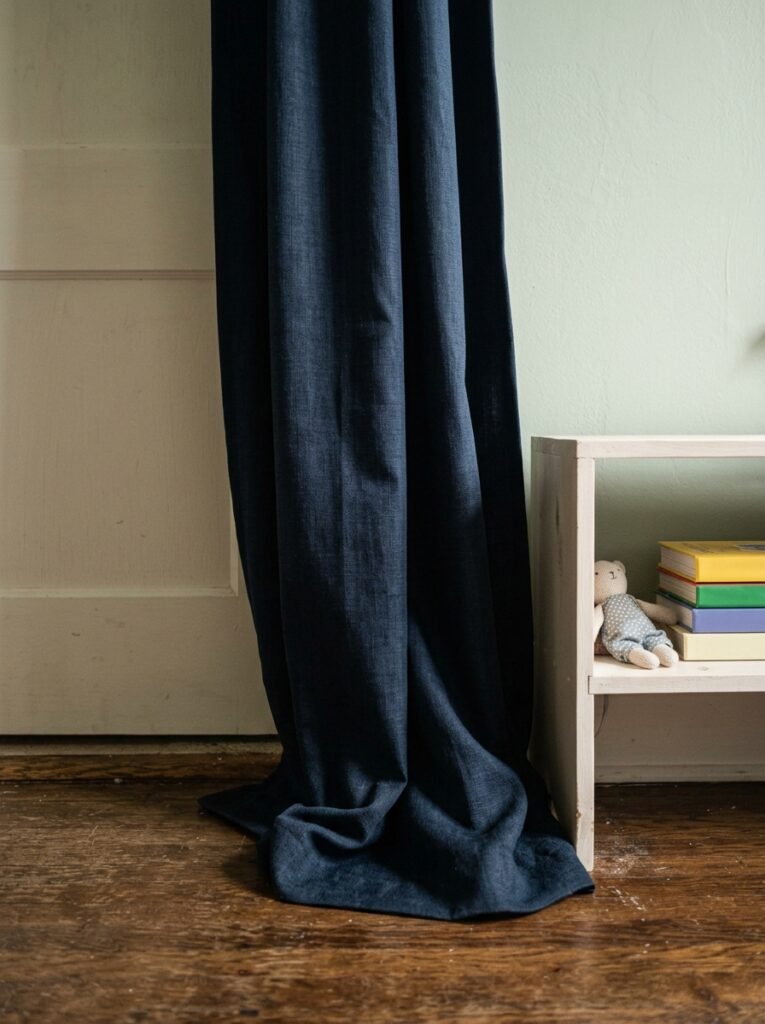
In practice: if the room is small, splurge on the curtains. Hang them HIGH (from the ceiling if you can) and let them pool slightly on the floor. Even in a 9-by-10-foot box of a room, floor-to-ceiling curtains in a beautiful soft linen make the whole thing feel designed.
—
6. What Real Parents Actually Put on the Walls vs. What Looks Good on Pinterest
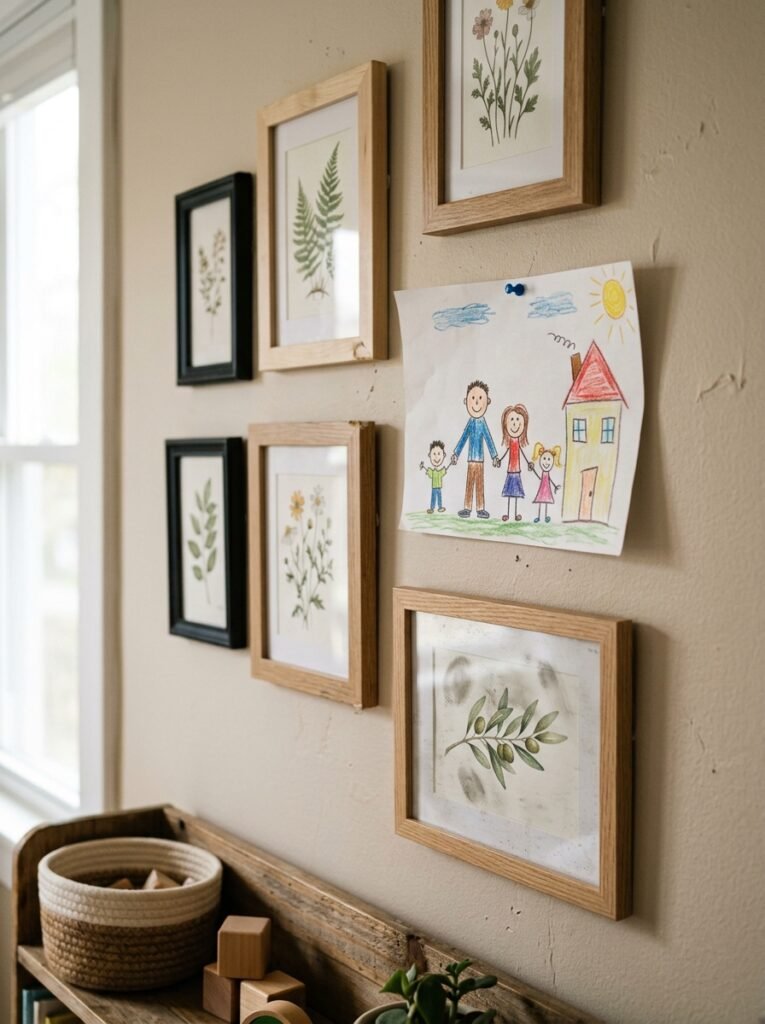
Real talk: most nursery wall art that photographs beautifully is either impossible to find or expensive or both. The gorgeous minimal prints in that one viral nursery photo? Half of them were custom made or found at a local market.
But here’s what actually works and isn’t a nightmare to source:
Framed fabric swatches. I’m serious. A small square of a beautiful printed fabric — floral, geometric, abstract — in a simple frame looks deliberate and unusual. You can often find interesting fabric remnants for almost nothing.
A single large-scale print. Not a gallery wall of tiny things. One 20-by-24 or bigger, something soft and interesting. A watercolor landscape. A graphic botanical. Abstract shapes in warm tones. Simple.
And actual shelves — not just for books but as a display surface. A floating shelf at adult eye-level with three or four carefully chosen objects (a small plant, a beautiful object, one framed photo) does more for the room than a whole gallery wall of prints.
What I’d skip: the matching wall decal set, the mass-market alphabet prints, and anything that spells out “DREAM” or “SLEEP” in wooden letters. Just my opinion. But also I’m right.
—
7. The Floor Situation (And Why It Matters More Than the Wall Color)
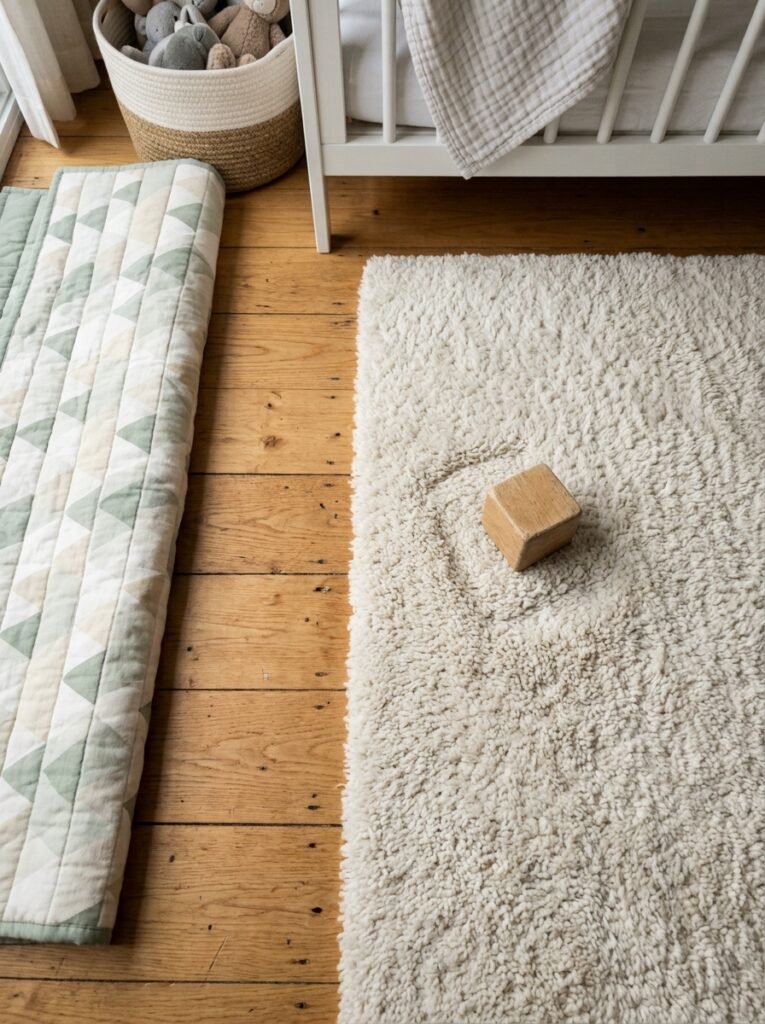
Floors in nurseries are genuinely underrated. People obsess over walls and forget that you’re going to be sitting on that floor. A lot. Playing, stretching out, doing nappy changes if the changing table isn’t available — the floor is a whole thing.
If you’ve got hard floors (wood, LVT, whatever), a good rug is non-negotiable. And not a thin little decorative thing — a proper, padded-enough rug that feels soft when you sit on it. Round rugs work really well in smaller nurseries because they soften the boxy geometry of the room.
Texture matters here too. A woven jute rug can look beautiful but it’s honestly a bit rough for bare baby knees. A soft wool or cotton flatweave, or something with a little pile, is much better in practice.
Color-wise, the rug is a great place to bring in that one slightly bolder tone if your walls and furniture are all neutral. A dusty terracotta rug in a white and wood room. A warm sage green. A faded blush with a subtle pattern. It doesn’t have to shout — just something with a little life in it.
“The rug is the thing people step around on the photo but sink into in real life. Get a good one.”
—
8. Storage That Doesn’t Look Like a Container Store Exploded
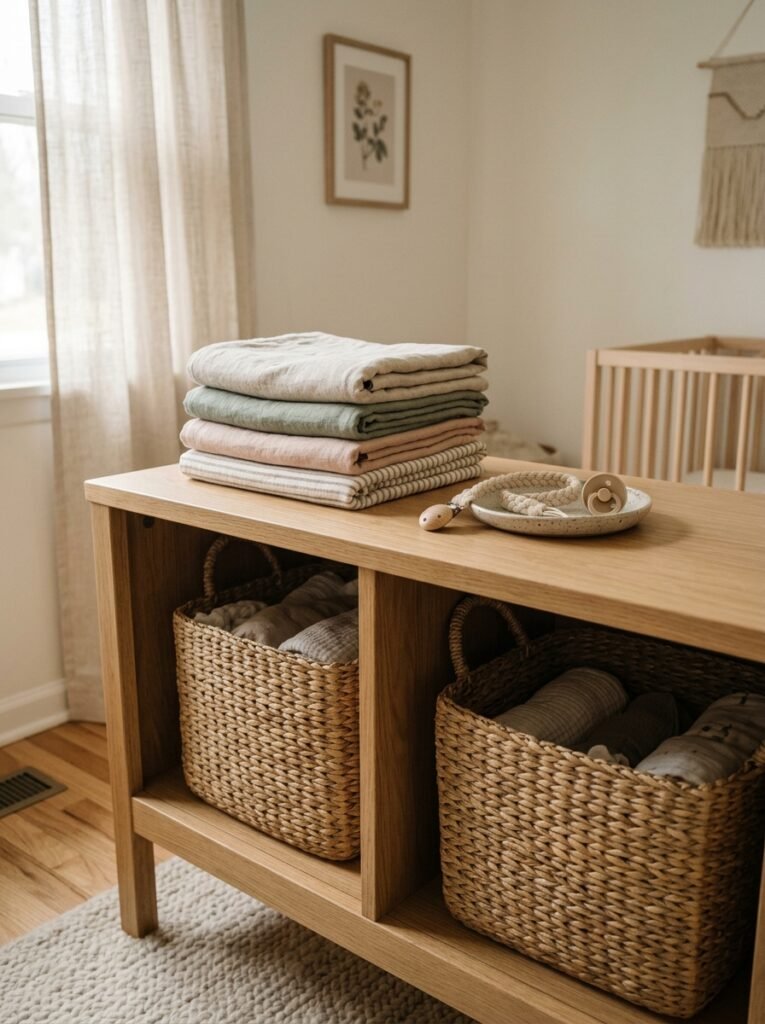
The number of storage solutions marketed at new parents is genuinely overwhelming. Baskets, boxes, drawer dividers, hanging organizers, stackable bins — it goes on forever.
Here’s my actual advice: buy less storage than you think you need, but make what you do buy beautiful. Three matching baskets in a natural woven material look a thousand times better than eight mismatched plastic bins, even if the eight bins technically hold more. Visual clutter is real even when everything is technically “organized.”
A simple dresser with deep drawers will do the work of most specialized baby storage furniture. You don’t need a special unit for nappy supplies if a regular small cabinet works just as well. The simpler the better, honestly.
For the UK specifically — lots of older houses don’t have much built-in storage, so a single freestanding wardrobe (a simple one, not a themed one) gives you more flexibility than most nursery-specific furniture will, and it’ll be useful in the room long after the nursery phase is done.
—
9. The Textile Layer That Pulls the Whole Room Together
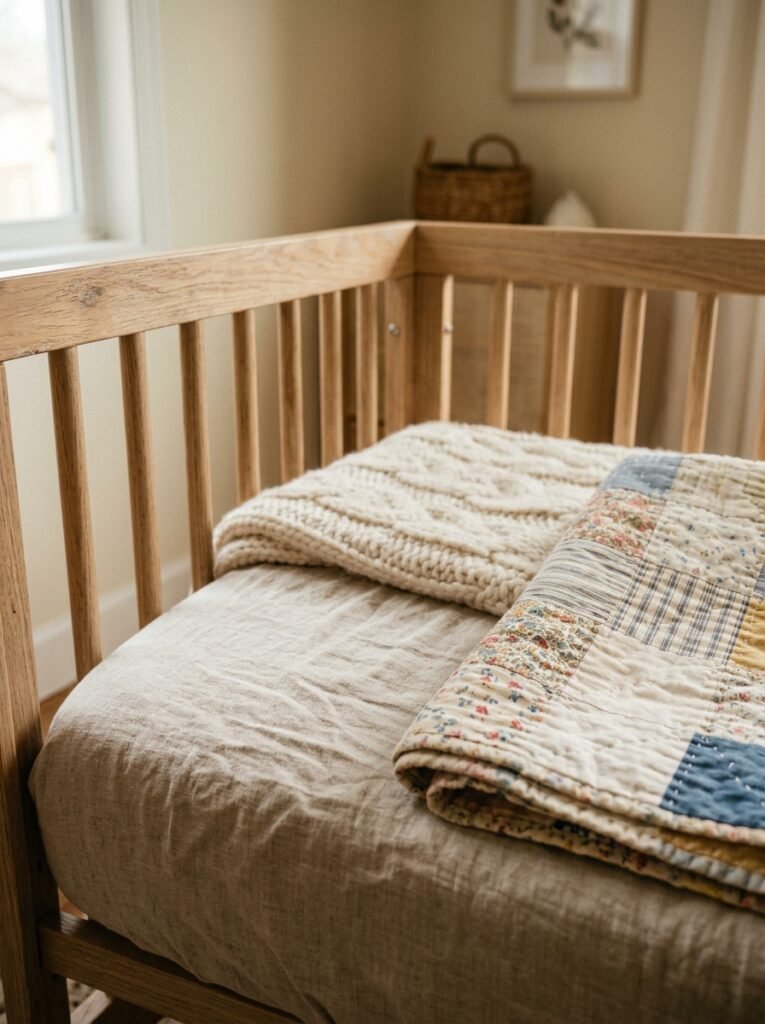
Cushions, blankets, curtains, the crib bumper (or deliberate lack thereof), the changing mat cover — textiles are where a nursery either comes together or falls apart. They’re also, conveniently, one of the cheaper ways to style a room.
The thing to watch: scale and restraint. Two or three textiles that share a color family and a general vibe (say, soft naturals with a botanical motif) will look infinitely better than six textiles that each independently match the wall color but have nothing to do with each other.
A linen duvet cover folded over the side of the crib even before the baby is old enough to use it. A hand-knit throw on the chair. Curtains that have a little weight to them rather than looking flimsy. These are the things that make a room feel finished.
—
10. Natural Materials vs. the Pretty-But-Synthetic Trap
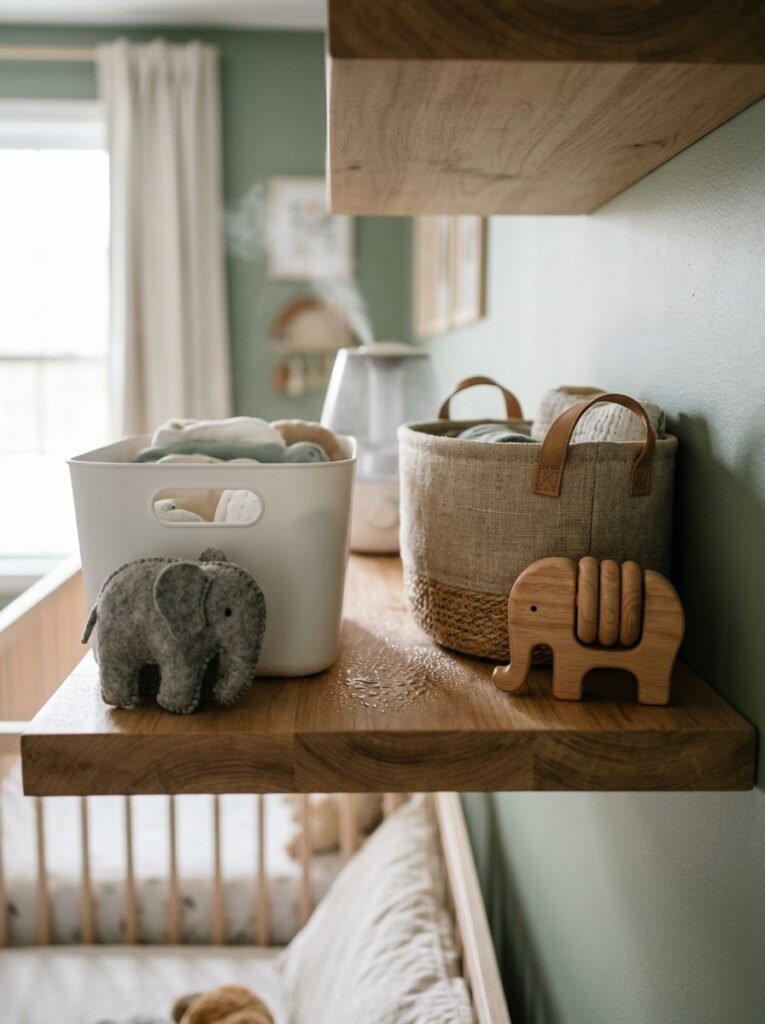
This one matters more than most people realize, because a newborn’s room is a space they’re going to breathe in around the clock. Synthetic materials off-gas more than natural ones — not usually at dangerous levels, but still worth considering when you’re choosing paint, furniture, rugs, and textiles.
Practically speaking: water-based paints are the obvious call. Solid wood furniture ventilated before the baby arrives. Cotton and wool and linen over polyester fleece where possible. It doesn’t have to be expensive or precious — plenty of perfectly ordinary, affordable natural-material options exist.
And honestly, beyond the practical? Natural materials just look better in nurseries. The warmth of real wood. The softness of a real cotton muslin. The organic imperfection of a woven basket. Synthetic versions of these things always look slightly off and they’re usually not as durable either.
—
11. How to Make the Room Feel Like It Belongs to THIS House
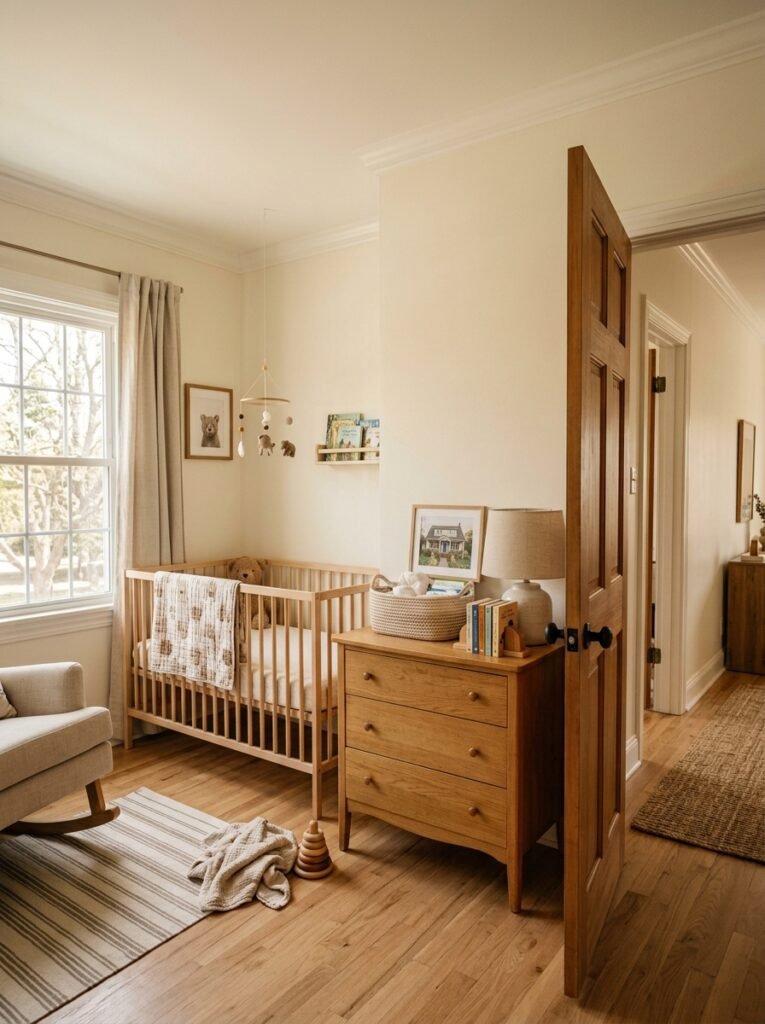
The nurseries I find most beautiful on Pinterest are always the ones that feel like they belong somewhere specific. A London terrace nursery has sash windows and original floorboards and feels different to a light-filled California farmhouse nursery, and both are beautiful in different ways.
Whatever your home’s bones are, lean into them. Period features, exposed brick, an unusual window shape, low ceilings that create coziness — these are assets. The instinct to strip everything back and make it neutral-nursery-generic usually produces a room that looks like every other nursery photo but doesn’t feel special in person.
One thing that consistently makes a room feel personal: something handmade or locally found. A piece of pottery from a local maker on the shelf. A print by an independent artist. Even a simple macramé piece made by someone you know. Mass-produced things have their place but they can’t do what a single handmade object does.
—
12. The Part Everyone Forgets Until It’s Too Late
Temperature. Ventilation. Practicality.
I know, I know. Not exactly romantic. But here’s the thing — you can have the most beautiful nursery in the world and if the room runs too hot in summer or the window doesn’t open far enough to ventilate properly, none of it matters. In the UK especially, older houses can have rooms that trap heat in summer in a way that can be genuinely uncomfortable for a newborn.
A basic room thermometer is a really sensible addition. The recommended sleeping temperature for a newborn is between 16–20°C (61–68°F), and it’s worth knowing what your room actually runs at before the baby arrives.
The other practical thing: lay the room out thinking about the 3am version of you. Where does the nappy bin go so you don’t trip over it? Is there somewhere to set down a bottle that’s close to the chair? Does the crib door open without banging into the dresser? Walk through it tired and slightly frantic before you finalize where things go. You’ll thank yourself.
—
❓ FAQ
Q: What wall color is best for a newborn nursery? A: Warm whites, soft sage greens, and pale dusty blues are consistently popular for good reason — they’re calm, they photograph well, and they’re easy to work with over time. That said, the BEST color is whatever makes the room feel peaceful to you, because you’ll be spending a lot of time in there.
Q: Do I really need blackout curtains in a nursery? A: For most babies, yes — especially for daytime naps. Newborns don’t distinguish between night and day initially, and a dark room during sleep windows helps start building those associations earlier. A proper blackout blind (not just a “room darkening” curtain, which is very different) is genuinely worth the cost.
Q: How do I make a small nursery feel less cramped? A: Focus on ceiling height — floor-to-ceiling curtains create the illusion of height in a way almost nothing else does. Keep furniture to the perimeter rather than floating pieces in the center, and choose one larger statement piece rather than lots of small items. A large mirror can also do a lot for perceived space without being a decorating cliché in a nursery the way it might elsewhere.
—
💭 Final Thoughts
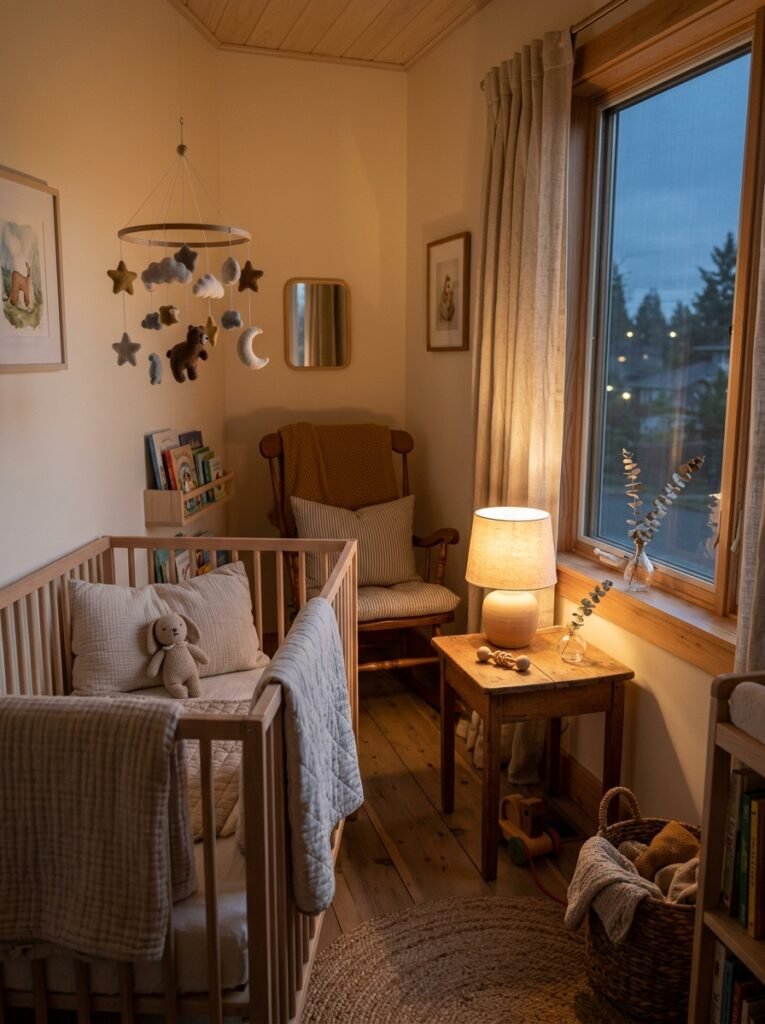
A nursery doesn’t need to be perfect before the baby arrives. Some of the best details get added over the first few months, when you actually know what the room needs. It’s a living space, not a set. Give it warmth, make it practical for the tired version of you, and let it be a little imperfect.
What’s the one thing in your nursery that you’re most proud of — or most wish you’d done differently?