
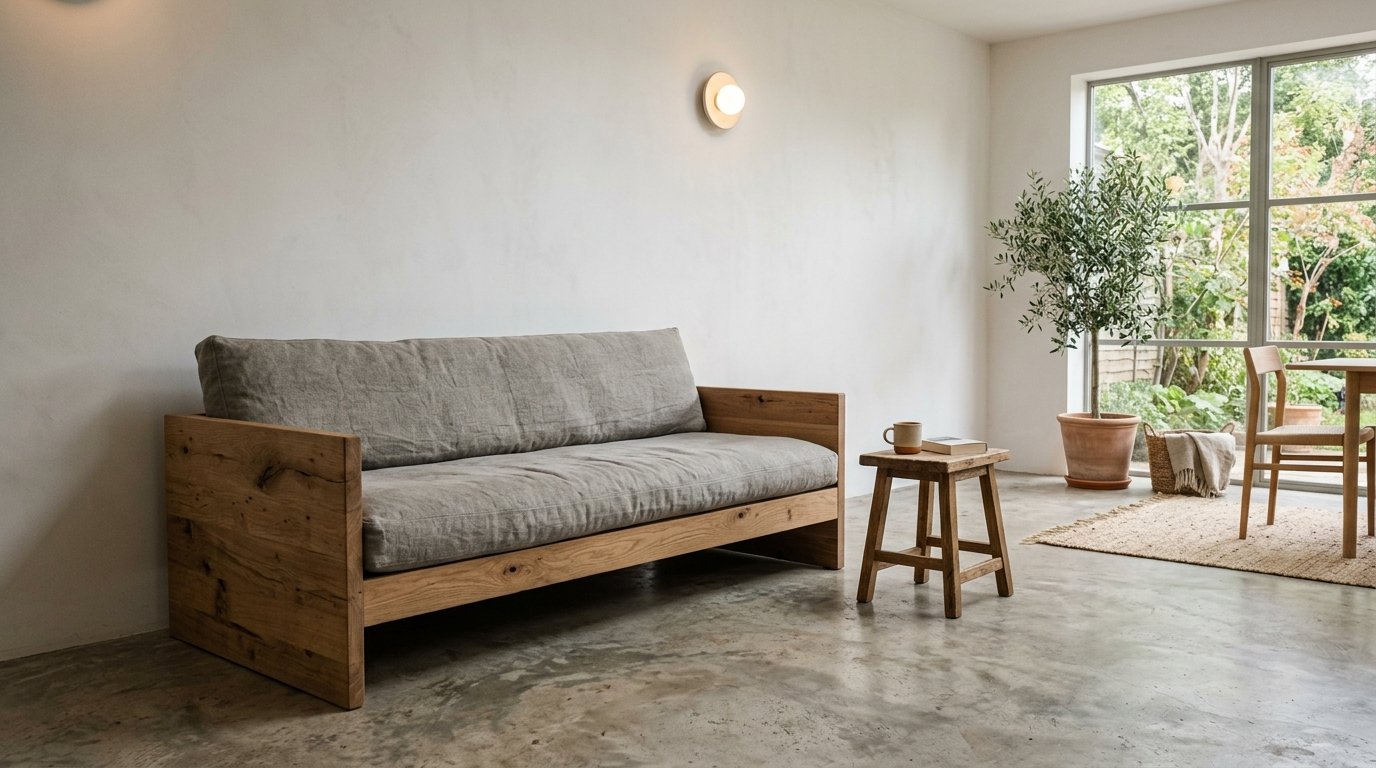
The Minimalist Living Room That Actually Feels Like a Home (Not a Hotel Lobby)
My friend walked into my living room last spring and said, “Did you just move in?” I’d lived there for three years.
That was the moment I realized I’d gotten minimalism completely wrong.
—
1. The Difference Between “Minimal” and Just… Empty
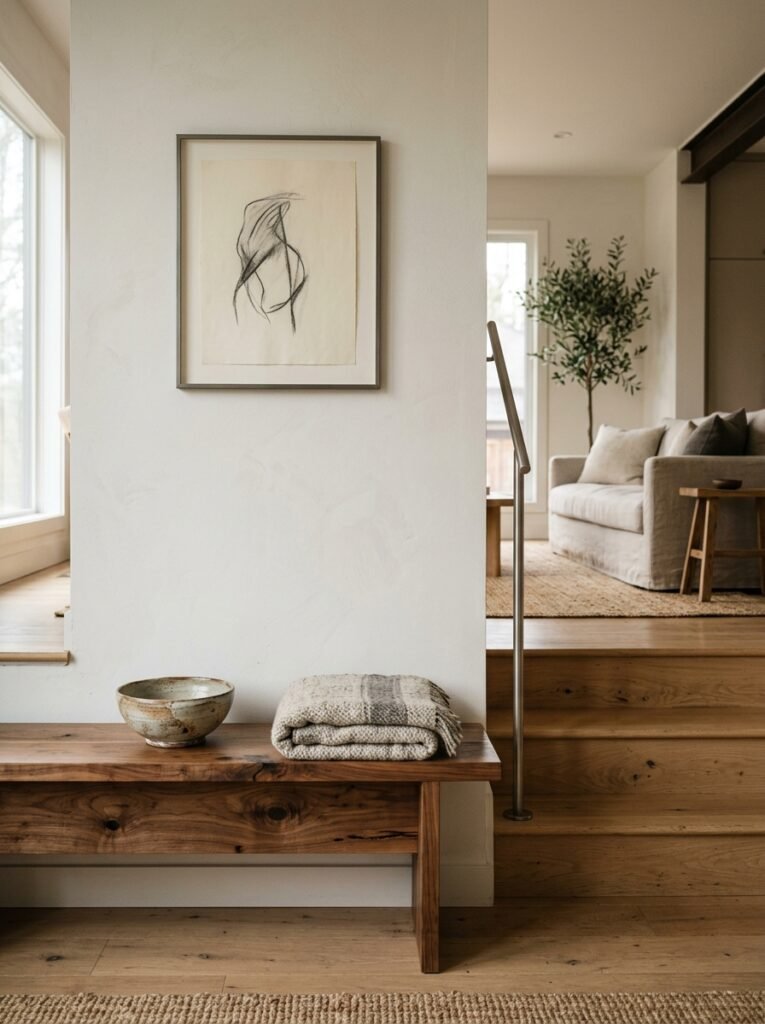
There’s this version of minimalism that lives on Pinterest boards and nowhere else. You know the one. White walls, a single orchid, one throw pillow centered on a sofa so stiff it looks like it’s never been sat on. Everything’s in its place because nothing has a place at all.
That’s not minimalism. That’s a showroom with worse lighting.
Real minimalist living rooms have warmth. They have a dog-eared book left on the coffee table. A mug that someone forgot to take to the kitchen. The trick isn’t removing everything — it’s removing everything that doesn’t earn its spot. Those are not the same thing, and honestly, that distinction took me an embarrassingly long time to figure out.
The goal is a room that feels considered, not a room that feels evacuated.
“Minimalism isn’t about owning less. It’s about stopping the things you DO own from competing for attention.”
So before you start rearranging furniture or panic-decluttering, ask yourself: does this room feel calm, or does it just feel empty? Because calm is the goal. Empty is just… sad.
—
2. The Color Rule That Every Minimalist Living Room Gets Right (Without Looking Boring)
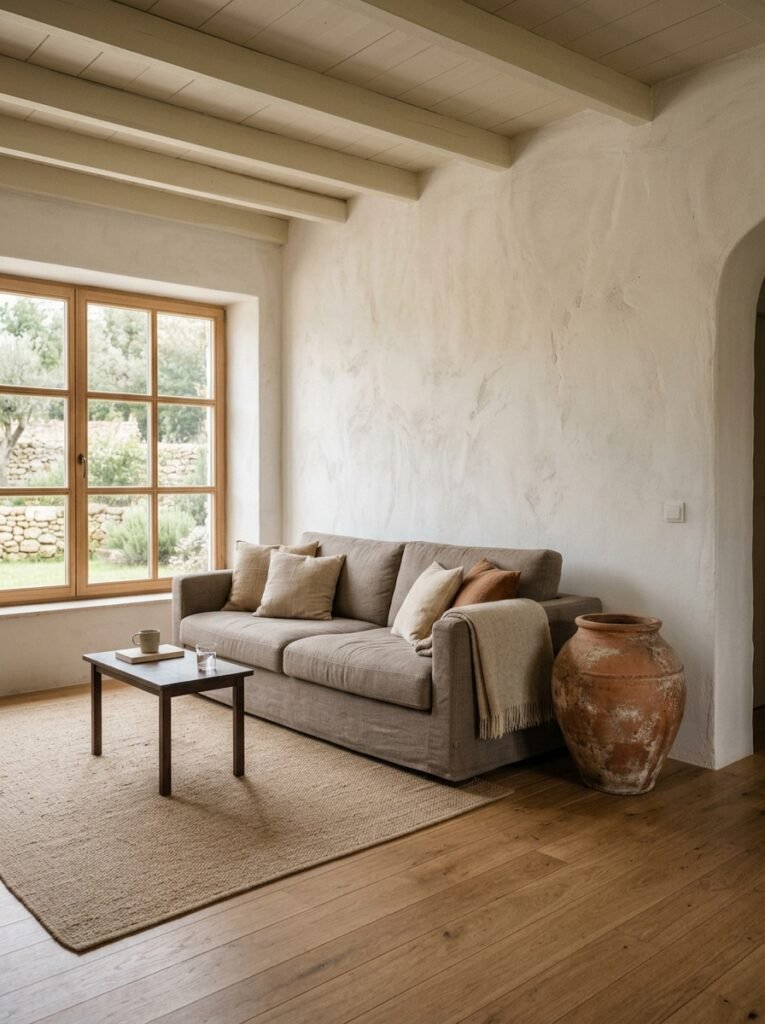
Okay here’s something that keeps showing up in every beautiful minimalist living room I’ve saved, photographed, or obsessively analyzed: they don’t go fully neutral. They ALMOST go fully neutral.
There’s one anchor color. Just one.
It might be a deep, dusty terracotta on a single wall. Or a worn olive green linen sofa against plaster-white walls. Or a charcoal-grey reading chair tucked in the corner that makes the whole room make sense. The rest of the room is quiet — creams, warm whites, natural wood tones — and that one color is where your eye lands, relaxes, and stays.
What doesn’t work is loading a “neutral” room with five different shades of greige that all feel like the right choice separately and a confusing mess together. Or, and I’m speaking from personal experience here, painting four walls in a beautiful warm linen color and then wondering why the room feels like a cardboard box.
Pick your anchor. Let the rest of the room serve it.
And side note — warm whites almost always beat cool whites in a living room. The amber glow of a lamp at 7pm against a warm white wall is a different universe from that same lamp against a blue-white wall. Different universe.
—
3. Why Your Sofa Is Probably Doing Too Much
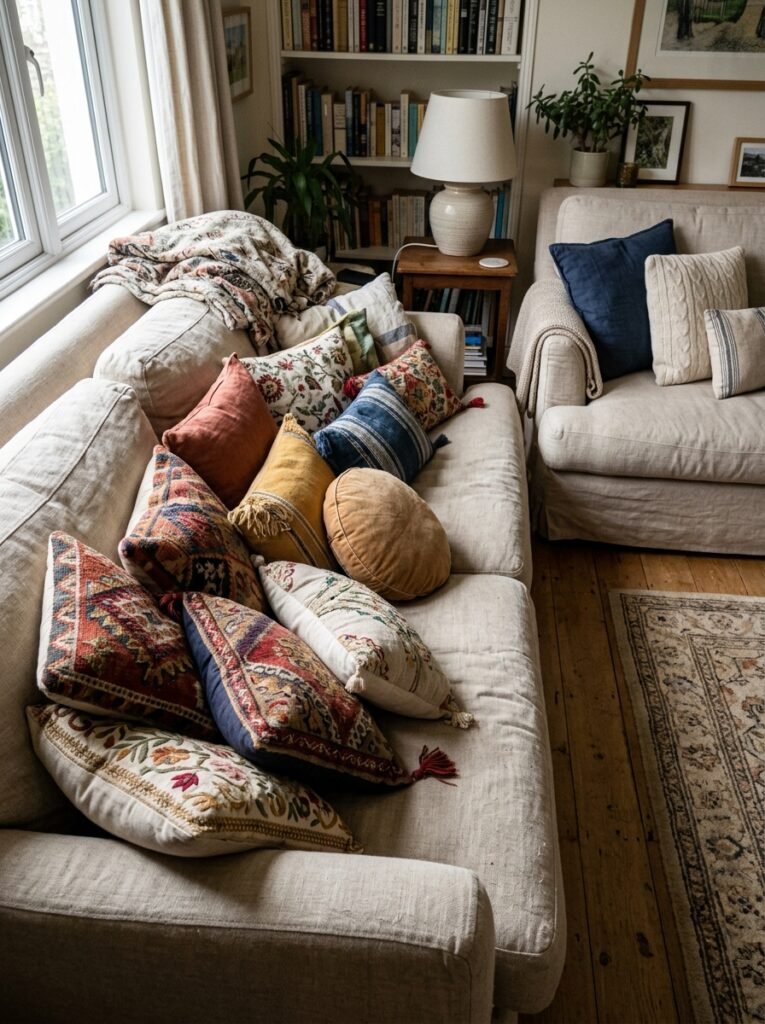
Not literally. But the sofa is often where minimalist living rooms go wrong first.
A big, overstuffed sectional in a small room isn’t cozy — it’s claustrophobic. A sofa with rolled arms, carved legs, button tufting, AND nail-head trim is trying to be five things at once. In a minimalist space, you want a sofa that has one strong quality and commits to it. Clean lines. Or incredible depth. Or a fabric so good you could talk about it for five minutes.
Pick the one thing your sofa does brilliantly, then let it do that.
For smaller British sitting rooms especially, a two-seater or apartment sofa in a solid, slightly textured fabric will almost always feel more intentional than a three-seater that grazes the walls on both sides. Americans working with longer living rooms have more flexibility, but the same principle applies: fit the furniture to the ROOM, not to the square footage fantasy you had when you moved in.
Cushions: two to three on a sofa. That’s it. They should feel placed, not installed.
—
4. The Floor That Changes Everything
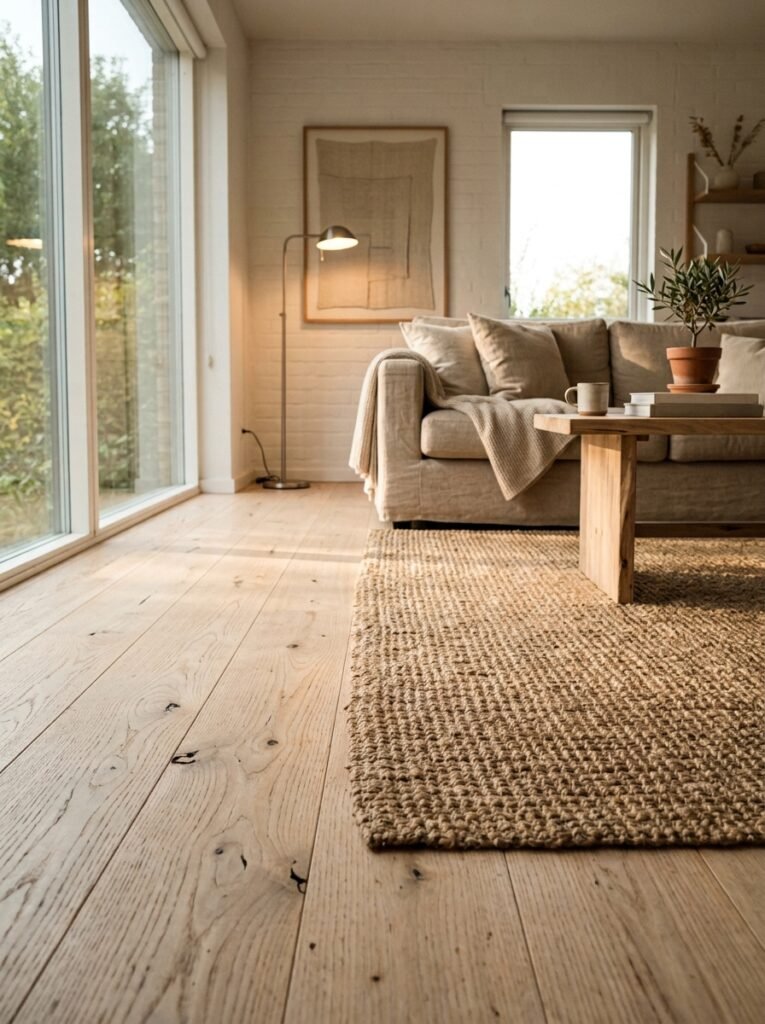
Floors are where most people spend zero budget and then wonder why the room feels unfinished. I’m not gonna pretend a brand-new hardwood floor is accessible for everyone — it’s not. But here’s what IS accessible: a rug.
A good rug in a minimalist living room isn’t decorative. It’s structural. It literally defines the space, pulls the furniture together, and creates a sense of intention that a floating sofa arrangement never achieves on its own.
“A rug that’s too small makes your furniture look like it’s trying to escape the room.”
The rule is bigger than you think. In most living rooms, all four legs of the sofa should be ON the rug, or at least the front two. The tiny 5×7 rug under just the coffee table is one of the most common minimalist styling mistakes out there, and it makes otherwise beautiful rooms feel like the furniture is a little lost.
Woven jute, flat-weave wool, or a simple low-pile rug in an off-white or natural tone works beautifully in minimalist spaces. You want texture underfoot, not pattern. The texture gives warmth without visual noise.
—
5. Light: The Part Everyone Treats Like an Afterthought
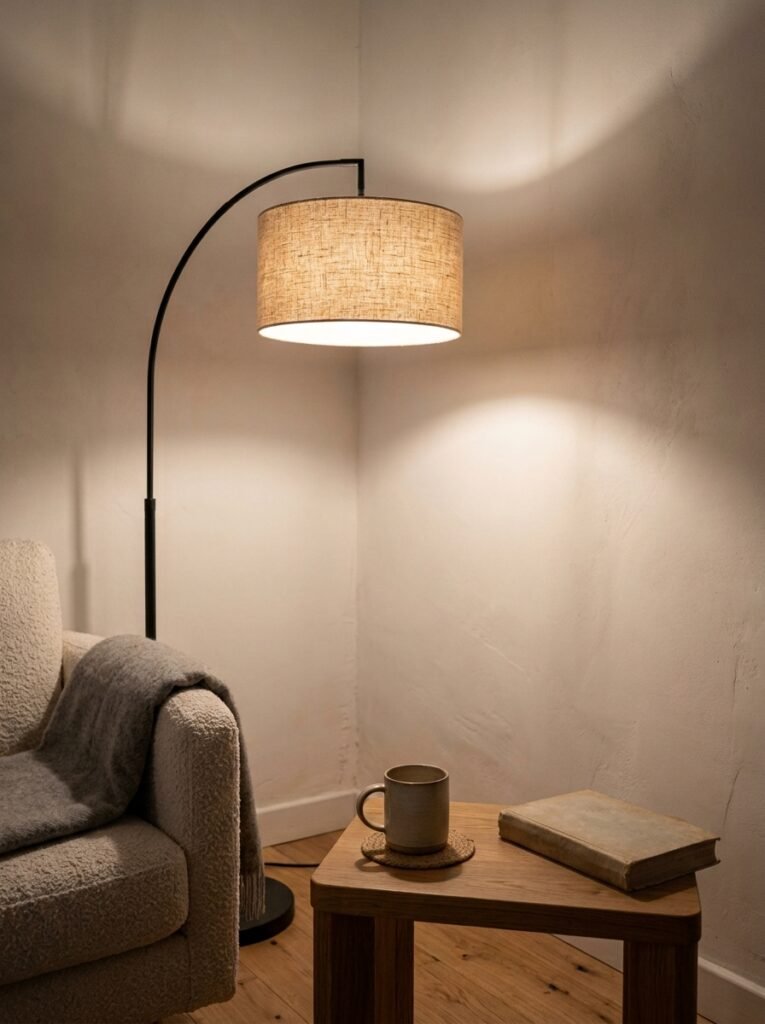
Here’s the honest truth about lighting in a minimalist living room: overhead lighting is ALMOST always the problem.
One blaring overhead fixture illuminates a room the way a fluorescent light illuminates a supermarket. Everything’s visible. Nothing looks beautiful. The room looks functional and flat, which is the opposite of what you’re after.
What actually works:
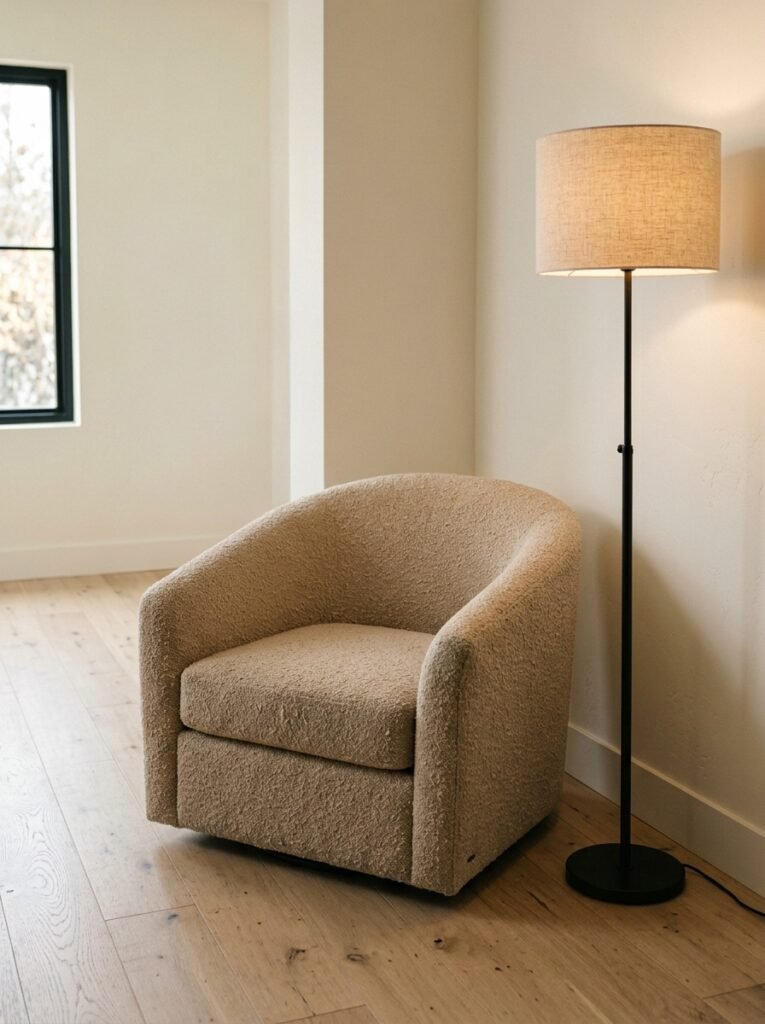
- A floor lamp in the corner (tall, with a warm-toned bulb)
- A table lamp at sofa-arm height on a side table
- Maybe a single pendant light used as an architectural moment over a reading chair
You’re layering light sources, keeping them low, and keeping the temperature warm. 2700K bulbs. Not 4000K, which is “cold white” and will make your beautiful warm palette look sickly.
Do this one thing and the room feels 30% more expensive. I mean that.
—
6. The Wall Art Trap Most Minimalist Rooms Fall Into
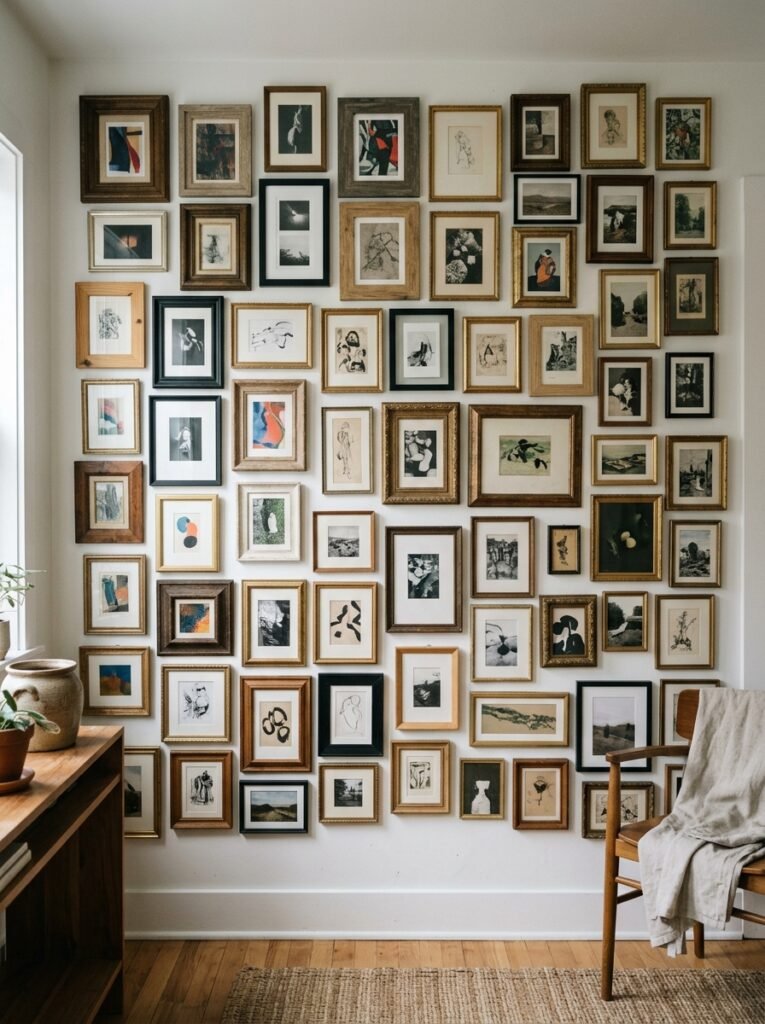
Gallery walls are everywhere. And in the right room — maybe a maximalist botanical print situation or an eclectic collected-over-years arrangement — they’re beautiful. In a minimalist living room they often just… read as clutter that’s been hung up.
One piece of art, placed well, does more than seven pieces placed nervously.
And the placement matters a LOT. The center of a piece of art should be at eye level — roughly 57 to 60 inches from the floor, which is the gallery standard that most people ignore entirely. Too high (which is almost every living room I’ve ever been in) and the art floats away from the furniture and disconnects from the room.
One more thing: framing. A simple thin frame in natural wood or matte black makes almost any print look three times better than whatever the artwork came with. This is one of the most underrated things you can do.
—
7. What to Put on Your Coffee Table (and What to Finally Throw Away)
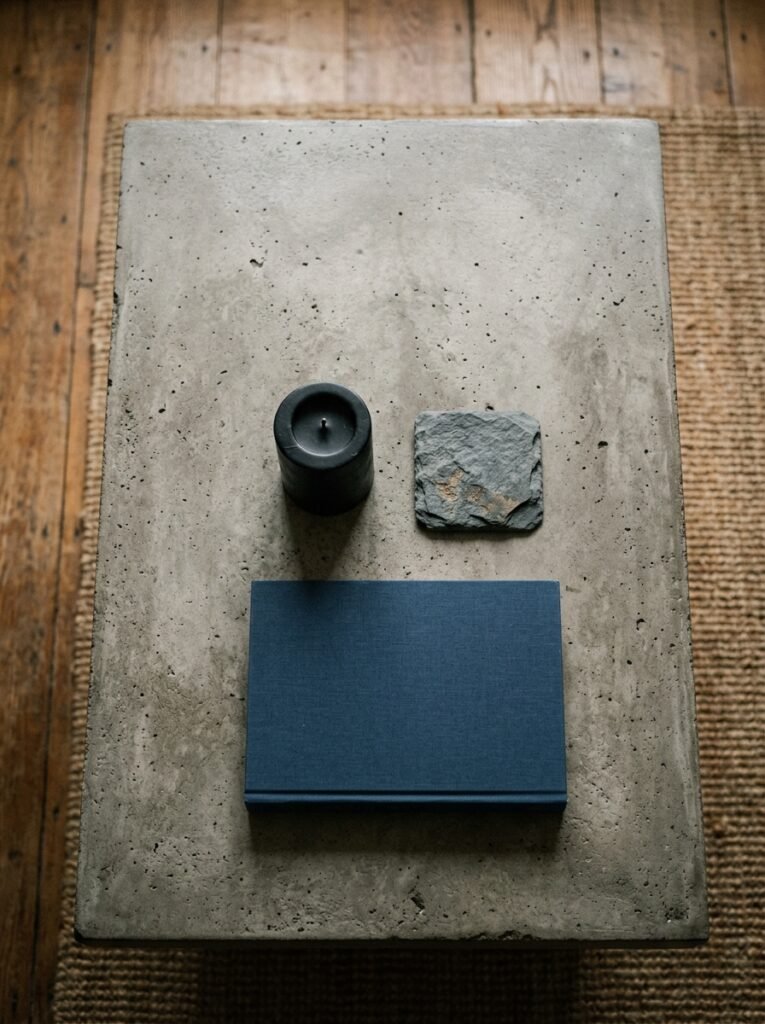
I’ve had this debate with myself approximately forty times. The coffee table is where minimalism either works or completely falls apart.
The urge is to style it. A candle, a stack of books, a small sculptural object, a tray, a little bowl of something, maybe a plant cutting in a small vase — and suddenly you’ve got eight things on a coffee table and the whole room feels busy.
Here’s what actually works: three things maximum. One larger thing (a stack of two or three thick books, a low bowl, a candle lantern). One medium thing (a single tray, a low vase). One small thing or none at all.
The negative space on the coffee table is PART of the styling. That’s not a mistake, it’s not laziness. It’s the point.
And practically — leave enough room for an actual coffee cup. Because if your beautifully styled coffee table has no room for the thing it’s named after, it’s not working.
—
8. The One Thing in the Room That’s Allowed to Be Interesting
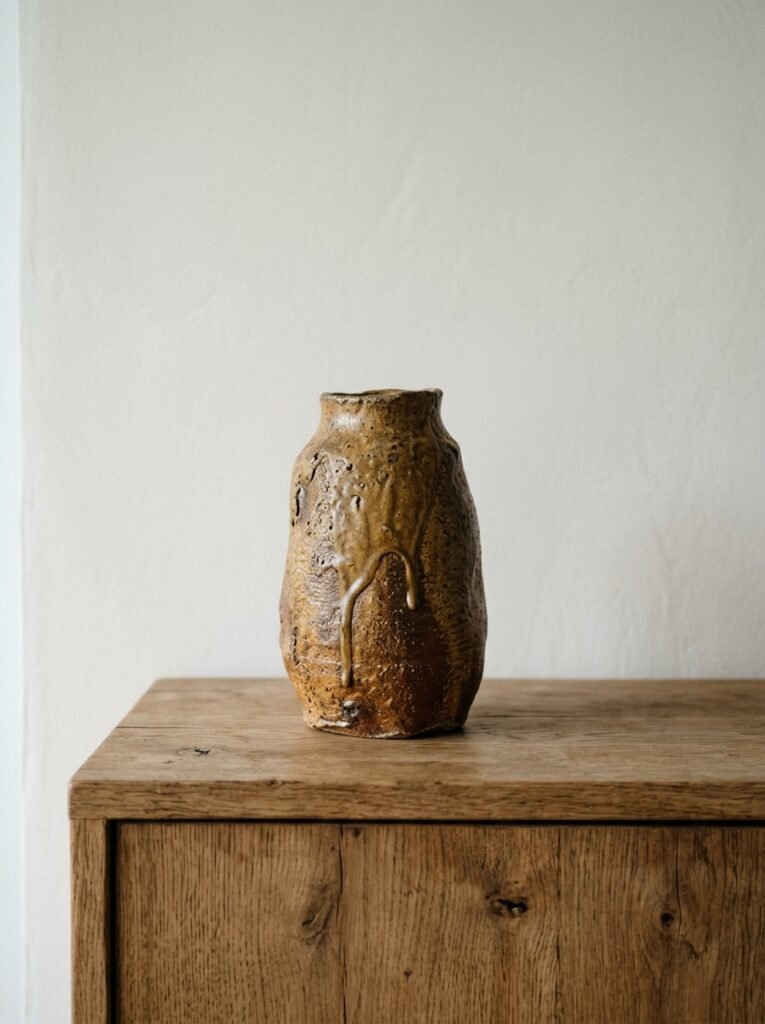
Minimalism gets a reputation for being boring, and honestly, it deserves that reputation when it’s done badly.
Because here’s the thing: the whole point of stripping everything back is to give one or two things ROOM to be extraordinary. You can’t appreciate a beautiful hand-thrown ceramic lamp when it’s competing with seventeen other decorative objects. You CAN when it’s sitting alone on a side table against a quiet wall.
So choose your interesting thing deliberately. A genuinely remarkable piece: a textural plaster wall finish on one surface. A vintage wooden stool used as a side table. A painting that makes you stop. A floor lamp with an unusual silhouette.
“Give your most beautiful thing room to breathe, and it’ll do more work than a room full of stuff ever could.”
One thing. Let it be extraordinary. Let the room serve it.
—
9. Why Plants Don’t Ruin Minimalism (But Too Many Do)
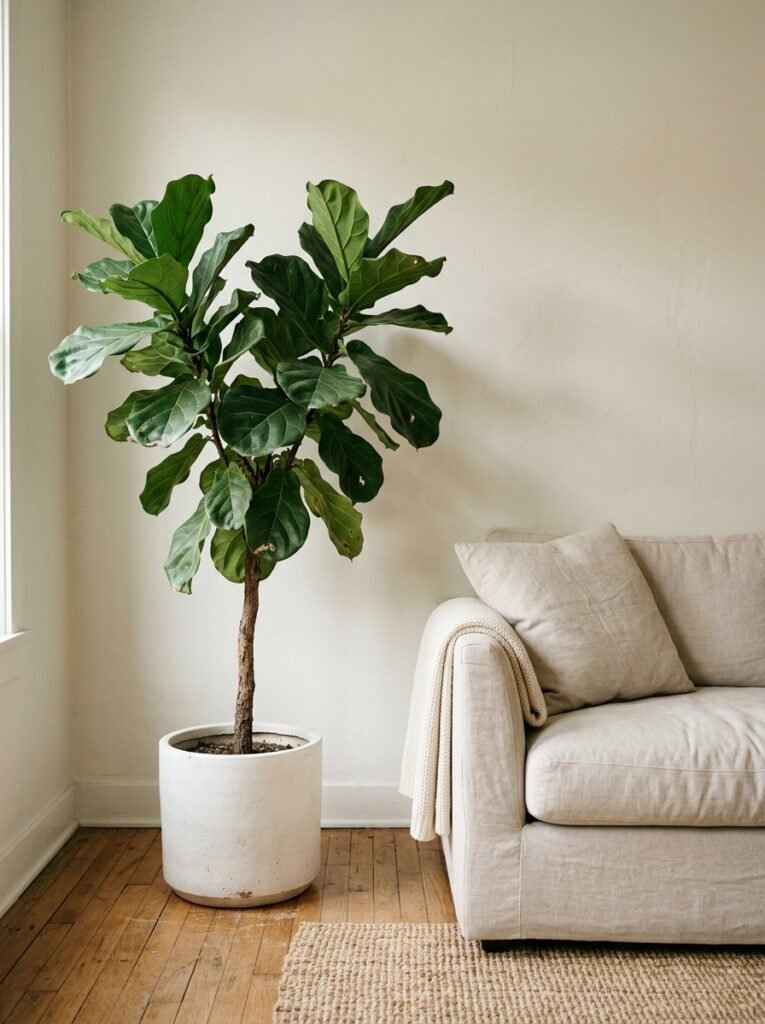
There’s a version of “minimal” that’s plant-free and has the warmth of a dentist’s waiting room. That’s not the vibe.
One or two plants, well-placed, add the kind of organic life that no decorative object can replicate. A large, structural plant — something sculptural, like a fiddle-leaf fig or a snake plant in a simple terracotta or white pot — reads as a design element, not decor. It’s alive, it moves slightly in a breeze, it does something no ceramic vase does.
But the key word is STRUCTURAL. One big plant in the right corner. Or a small, trailing plant on a shelf. Not a windowsill stuffed with six pots in mismatched containers, which starts to feel less “urban jungle” and more “couldn’t decide.”
Pot choice matters too — the container is as important as the plant itself. Simple, unadorned, in a material that connects to the room (terracotta, matte white, natural wood).
—
10. The Shelf Styling Approach That Doesn’t Look Like a Shop Display
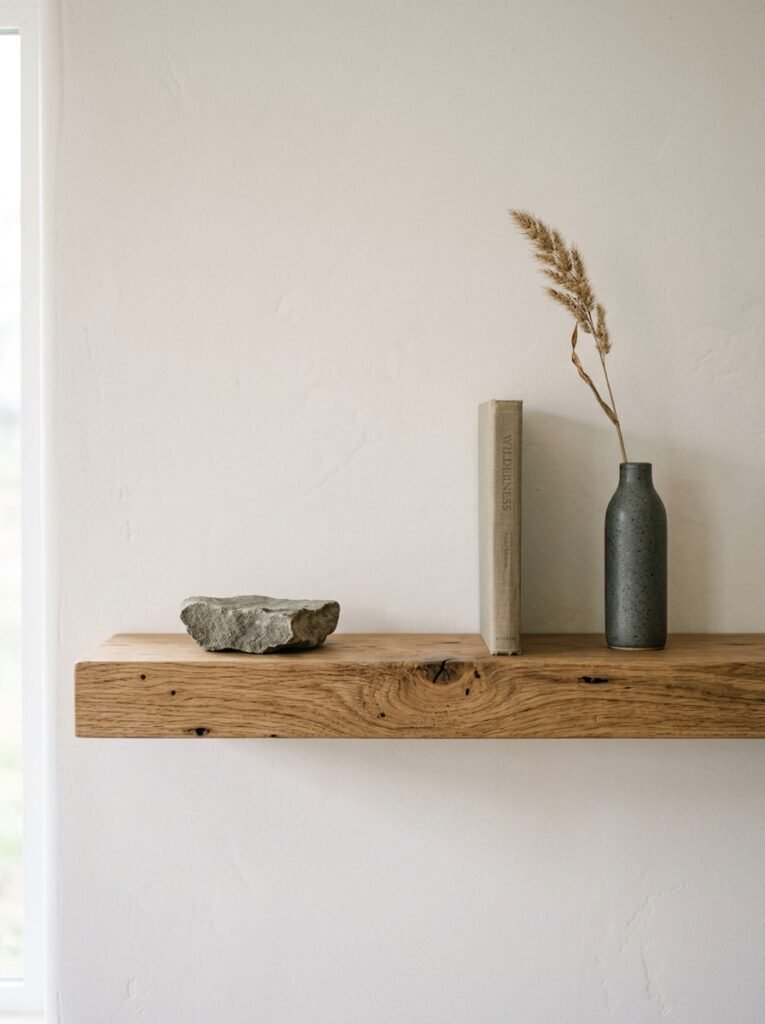
Bookshelves in minimalist living rooms are where things go to be confused about whether they belong. Every knick-knack you couldn’t quite throw away, every half-read book, every random candle — it all ends up on the shelves and suddenly the whole room has a problem.
The answer isn’t empty shelves. Empty shelves just look unfinished in most rooms (floating shelves with nothing on them do the same). The answer is editing down to maybe 30 to 40% of what you currently have on there, and grouping by height and weight.
Tall things together. Books laid horizontally in small stacks rather than all vertical makes them look more intentional. One small object that has a reason for being there. Space between groups.
And if something’s on the shelf because you feel guilty throwing it out — just throw it out.
—
11. The Texture Detail That Prevents a Minimalist Room from Feeling Cold
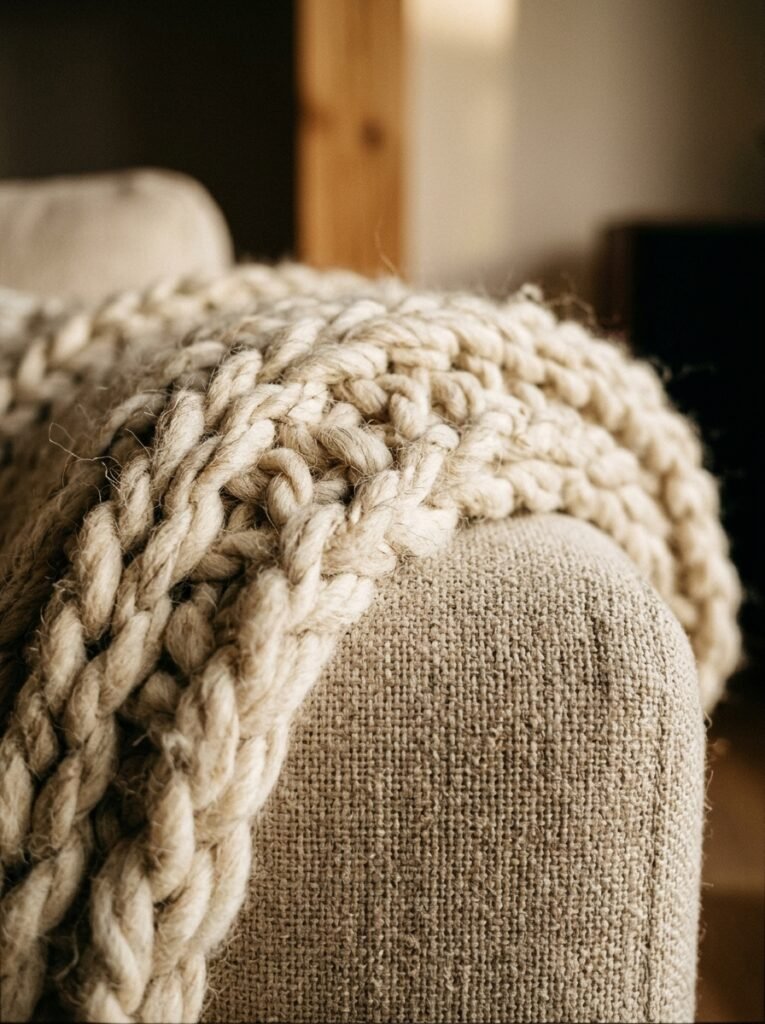
This is the quiet secret of every cozy minimal living room you’ve ever loved. The ones that feel warm and liveable, not like a showroom. They have texture.
Not printed pattern. Texture. The difference matters a lot here.
A nubby boucle throw folded over one arm of the sofa. A linen cushion cover that looks slightly wrinkled in a way that’s somehow perfect. A rough-hewn wooden side table next to a smooth plaster wall. A woven rattan pendant light shade above a clean-lined sofa.
The contrast of smooth and rough, soft and structured — that’s what gives the room dimension without adding visual noise. You can have a completely restrained color palette and still make a room feel deeply, physically comfortable, just through material choice.
This is also where UK readers have a slight natural advantage, honestly — British interiors tend to lean harder into natural textiles and that rumpled-linen aesthetic, which is exactly right for this look.
—
12. The Final Edit That Most People Skip
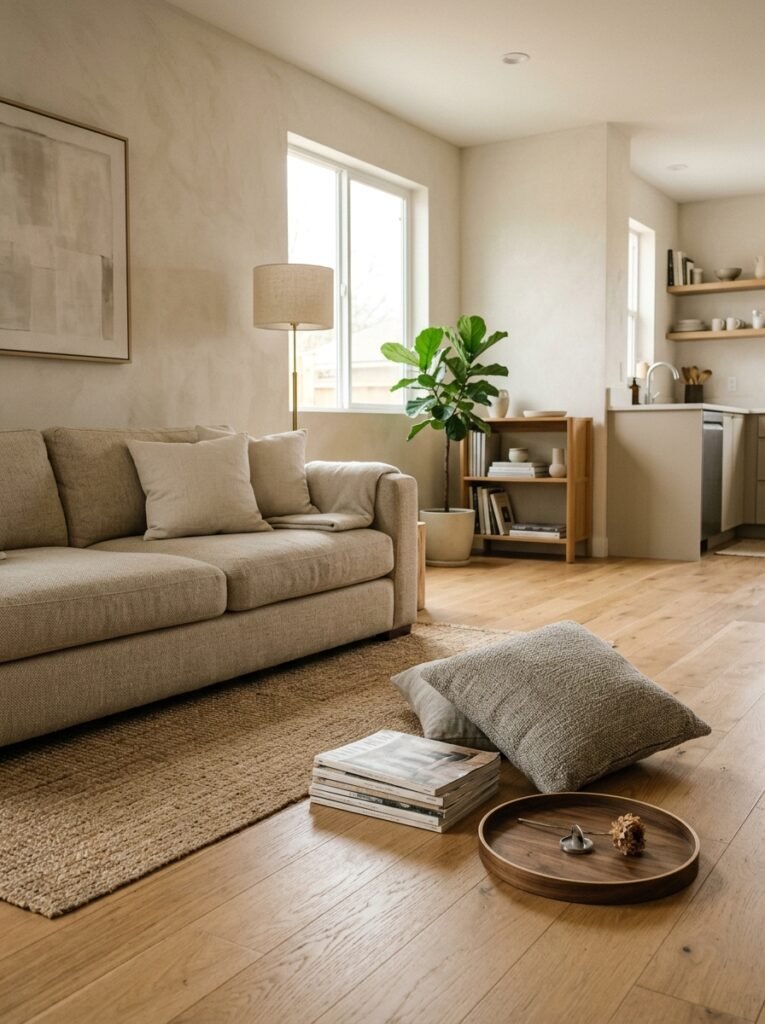
You’ve done it. The room is styled, the plants are in their pots, the coffee table has three things on it, the lighting is warm. And then you stand in the doorway and… something still feels slightly off.
This is the moment most people give up and assume they got something wrong. They didn’t. They just haven’t done the final edit.
Walk out of the room. Come back in like you’ve never seen it before. What’s the FIRST thing your eye goes to? If it’s something beautiful — a piece of art, a great lamp, the curve of your sofa — the room’s working. If it’s a cable snaking across the floor, or a pile of mail on the side table, or a bin bag you forgot to take out, the room’s not working yet.
The final edit is about removing the things that answer the door before the beautiful things can. It’s not about the room being perfect. It’s about making sure nothing distracts from what you actually love.
Once you’ve done this a few times you start seeing rooms differently. Not as spaces to fill, but as things to protect.
—
❓ FAQ
Q: How do I make a minimalist living room feel warm and not cold? A: It’s mostly about material choice and light. Warm-toned bulbs (2700K), textured natural fabrics like linen and boucle, and at least one organic element like a plant or wooden piece go a long way. A room can have almost no color and still feel incredibly cozy if the textures and lighting are right.
Q: How do I start decluttering toward a minimalist living room without it feeling overwhelming? A: Don’t try to do the whole room at once. Pick one surface — the coffee table, or a single shelf — and edit it down to only what genuinely earns its place there. Live with it for a week. The momentum usually follows naturally, and it’s much easier to make decisions when you can SEE the result of making them.
Q: Can minimalism work in a small living room, or does it only work in bigger spaces? A: It actually works BETTER in small rooms. Fewer pieces means each one has to be great, which forces good decisions, and the open space reads as bigger rather than cramped. The one thing to watch in a small room is scale — a sofa that’s even slightly too large kills the whole effect, so measure carefully and size down when in doubt.
—
💭 Final Thoughts
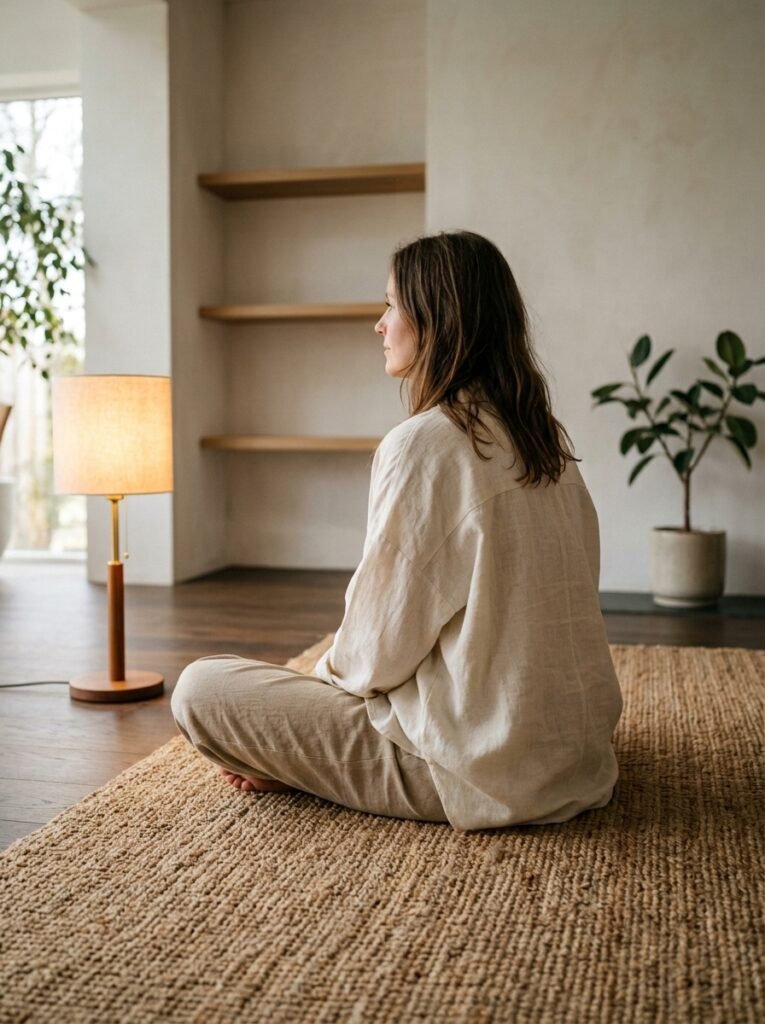
Minimalism isn’t a design trend, not really. It’s more like a decision to stop letting your space be louder than your life. And once a room starts to feel genuinely calm — not empty, not precious, just calm — it’s kind of hard to go back.
What’s the one thing in your living room that’s been fighting for attention when it should probably just go?