The TV Cabinet You Actually Want to Look At (Not Just Hide Behind Your Sofa Cushions)
My friend Sam said something to me last year that I haven’t stopped thinking about: “Why does every living room I walk into feel like the TV is winning?” And honestly? She was right. The TV cabinet — or the lack of a good one — is quietly running the aesthetic of most living rooms, and not in a fun way.
But it doesn’t have to be that way.
—
1. Why Most TV Cabinets Look Cheap Even When They Cost a Fortune
Here’s the thing nobody tells you when you’re standing in IKEA or scrolling through Wayfair at midnight: price doesn’t save bad proportions. A £900 floating unit that’s too narrow for the wall it’s on will always look cheap. Always.
The rule is embarrassingly simple. Your TV cabinet should be roughly as wide as your sofa, give or take. Not exactly the same, but in the same neighborhood. When the cabinet is dramatically narrower than the seating in front of it, the whole room feels lopsided — like the furniture is arguing with each other.
And yet almost nobody does this. Most people pick the cabinet first, then arrange the seating around it, which is backwards. Start with your sofa width. Then find the cabinet. It changes everything.
“The TV cabinet should feel like it belongs to the room — not like something the room is tolerating.”
The other thing? Leg height. Cabinets that sit flat on the floor, especially in smaller rooms, feel heavy and stuck. Even two inches of leg clearance creates a visual breath underneath the piece, and suddenly the room feels less crowded. Little detail. Huge difference.
—
2. The Color That Keeps Showing Up in Every Beautiful Living Room Right Now
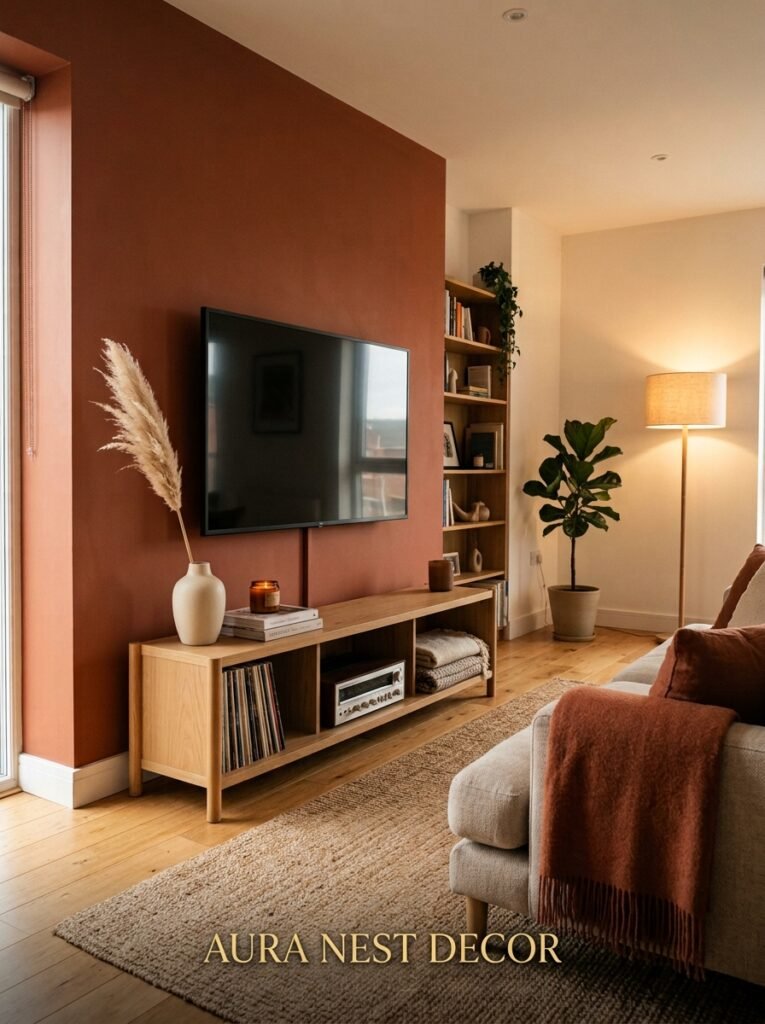
It’s not white. And it’s not the gray everyone did for a decade.
It’s warm clay. Sometimes called terracotta-adjacent. A kind of muted, earthy red-brown that sits somewhere between rust and blush without committing to either. You’re seeing it on cabinets with cane inserts, on fluted sideboards, on chunky media units in walnut and warm-toned lacquer.
Why is it everywhere? Because after years of cool-toned minimalism, people are craving something that feels warm when you walk into the room. Not cozy in a cliché way — just… inhabited. Like someone actually lives there and makes dinner and has a life.
Don’t stress if warm clay isn’t your thing. The point is the WARMTH of it. If you’re building around a dark sofa, look for a cabinet with honey oak or amber-toned wood. If your room skews lighter, aged brass handles on a dusty sage cabinet give you that same warmth without the depth.
Cool-toned media units exist, they’re fine, and some people love them. But right now, in this moment, the rooms that stop you mid-scroll are warm. So.
—
3. Floating Vs. Standing: The Debate Nobody Finishes

Both are good. Neither is universally better. I’m going to give you a real answer instead of a non-answer, though, because there actually IS a winner depending on your situation.
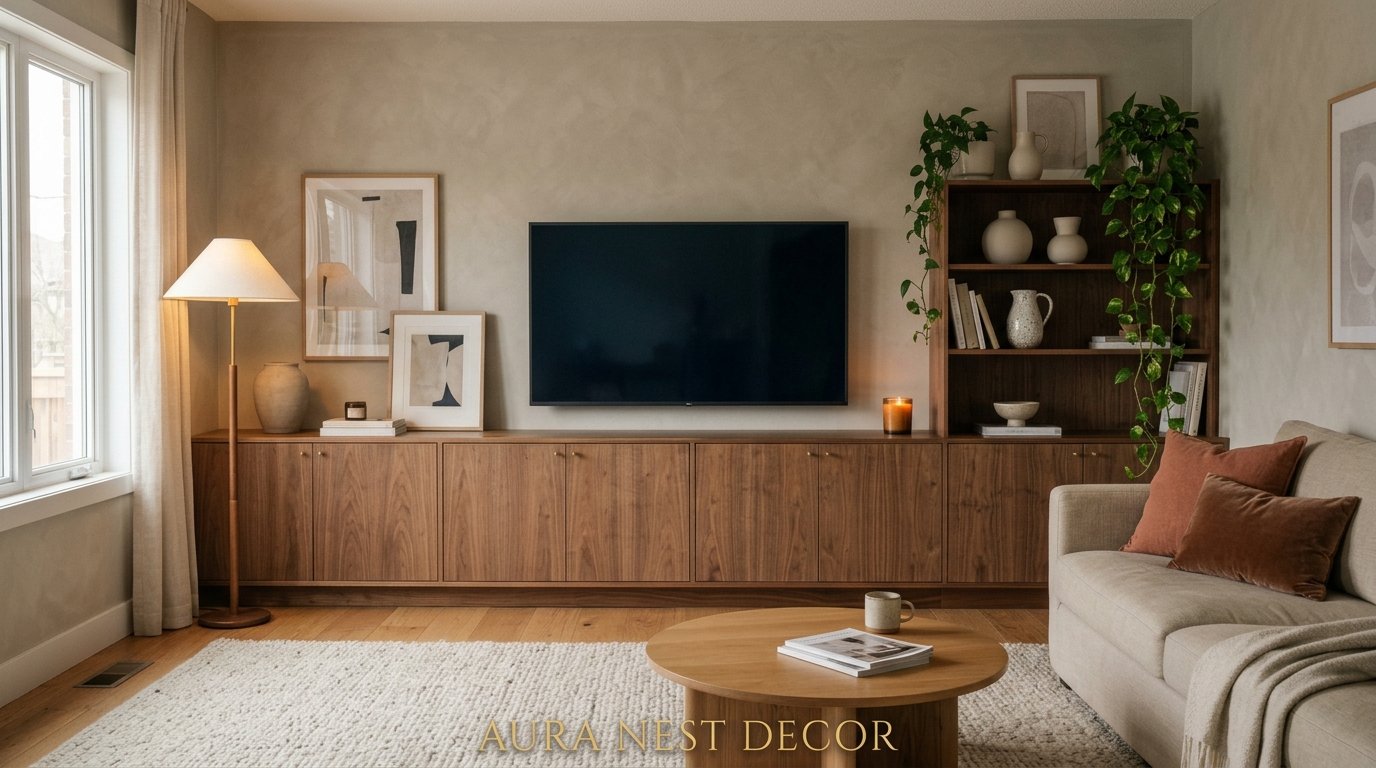
Floating shelves and wall-mounted cabinets work beautifully in: apartments and smaller rooms where floor space matters, rooms with beautiful hardwood or tile you want to show off, spaces with a really strong design intention (mid-century, Japandi, that sort of thing).
But standing cabinets — the kind that sit on the floor, sometimes with legs, sometimes not — work better in: rental properties where you can’t drill, rooms that need storage at floor level (hello, toddler households), and spaces where you want the TV wall to feel warm and grounded rather than sleek.
The floating option creates this great sense of space underneath. Very clean. Very editorial. But if you’ve got pets and children and real life happening, those floating shelves collect dust bunnies in a very visible way and it’s genuinely annoying. Just being honest.
—
4. The One Feature That Instantly Makes Your TV Unit Look Styled, Not Staged
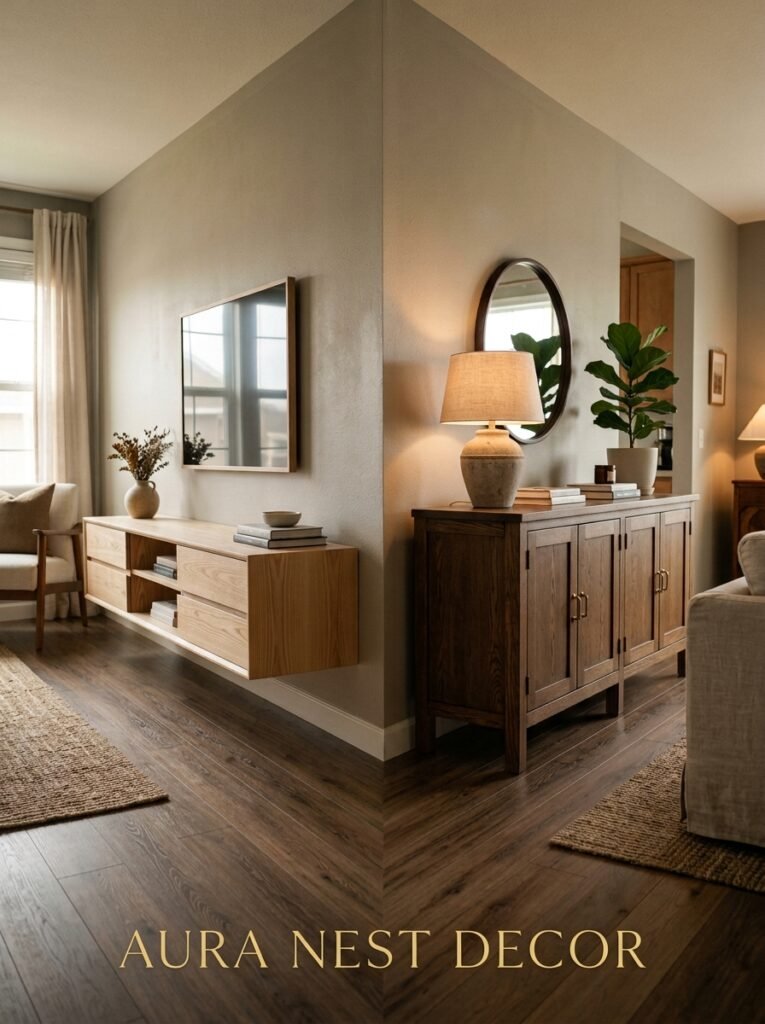
Cane. Or rattan. Or any woven texture on the cabinet doors.
I know, I know — you’ve seen it everywhere. But there’s a reason it keeps coming back and it’s not because of trend cycles, it’s because it WORKS. The natural texture of cane webbing on cabinet doors breaks up flat surfaces, adds shadow and depth, and makes even an inexpensive IKEA hack look like something you found at a vintage shop in Notting Hill.
“Cane doors do something paint can’t — they add texture that moves with the light.”
It’s the difference between a flat surface and one that has some life in it. In the morning when the sun is low, cane catches light differently than it does in the evening. The cabinet actually looks different at different times of day, which sounds like a weird thing to care about but makes a room feel genuinely dynamic.
If you can’t find a cabinet with cane doors, you can actually replace flat panel doors on most IKEA units with cane ones. There are a bunch of companies in the UK and US that sell these specifically. Superfront, Reform, Bemz. Not sponsored. Just genuinely good options.
—
5. Stop Centering the TV. Seriously. Stop.
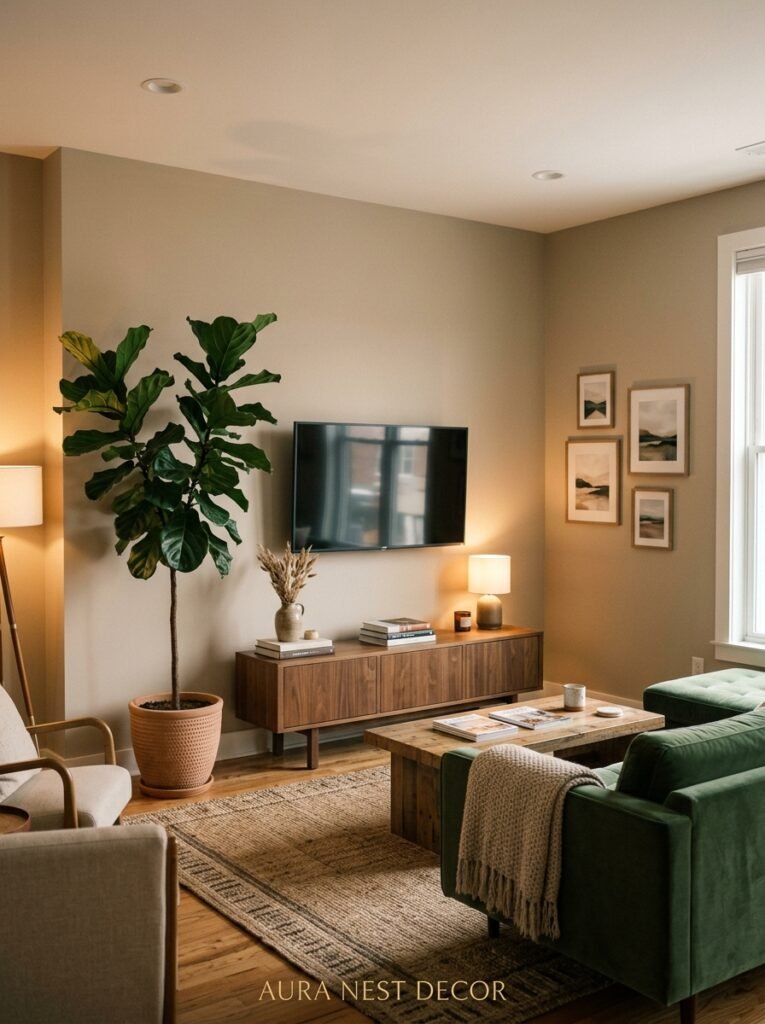
Not every TV needs to be perfectly centered on the wall. This one might be the most controversial thing I’ll say in this whole article, and I’m saying it anyway.
Off-center TV walls — where the cabinet sits slightly left or right of center, with artwork or a plant or a tall lamp anchoring the other side — feel more like real design decisions and less like a showroom display. They feel human. Like a room that evolved over time rather than one that was installed in an afternoon.
It takes some nerve to do it. You’ll second-guess yourself every time you sit down for a while. But once your eye adjusts? You won’t want it centered again.
The trick is to balance the OTHER side with something that has visual weight. A large-scale piece of art. A really good floor lamp (not a cheap one, it needs presence). A tall plant in a substantial pot, not a wispy little fiddle leaf in a thin nursery pot. The off-center composition only works when the counterweight is strong enough to hold its end of the room.
—
6. Cable Management: The Least Glamorous Section That Matters More Than You Think
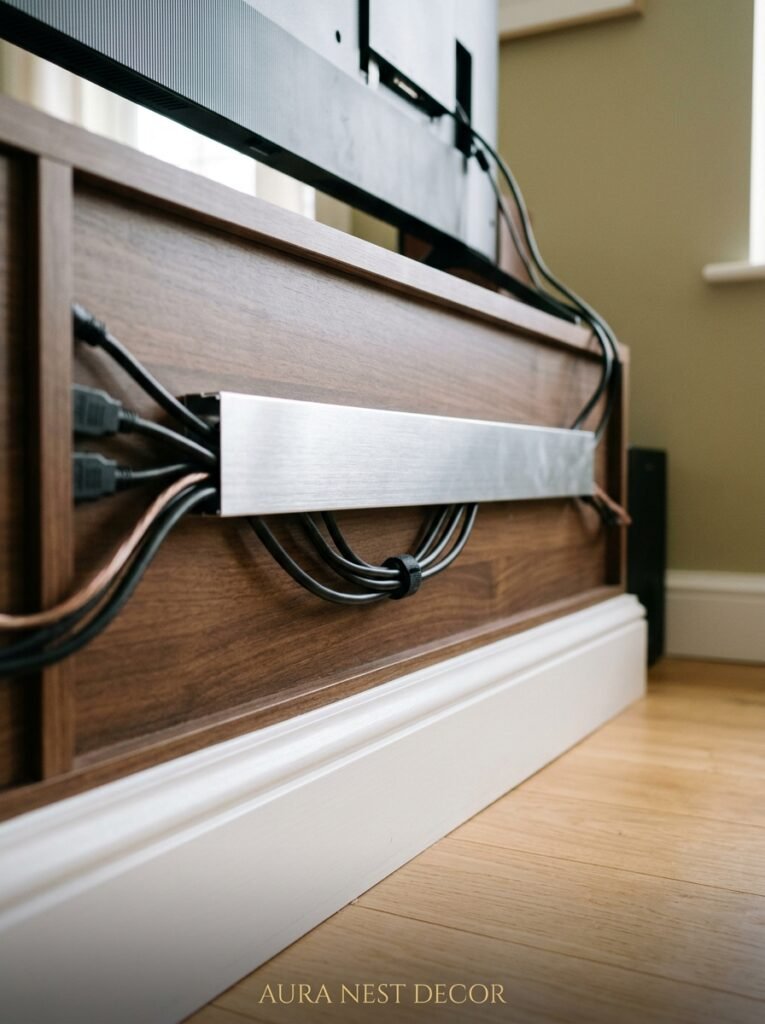
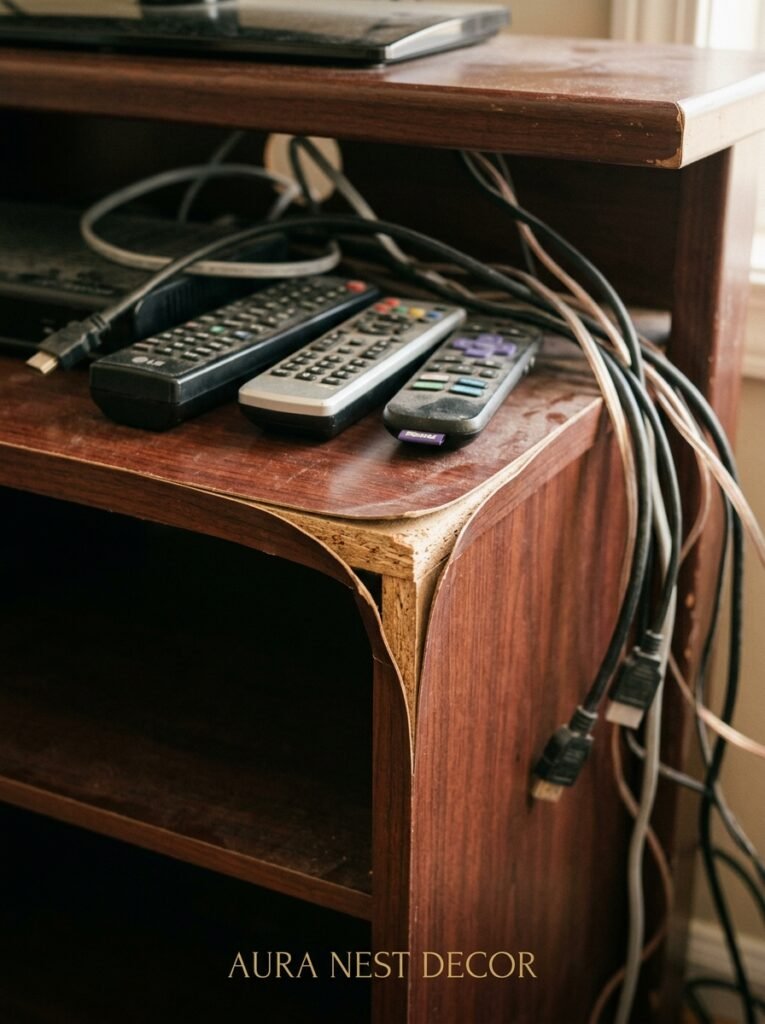
I wasn’t going to write about cables. But I’ve seen too many otherwise gorgeous living rooms ruined by a curtain of black wires hanging off the back of a floating cabinet, so here we are.
The solution nobody uses but everyone should: cable raceways. These are little plastic channels — you can paint them to match your wall — that route cables neatly along the skirting board or up the wall to the cabinet. They cost almost nothing. Like, $12 on Amazon.
The slightly more committed version is having an electrician move the wall socket behind or inside your TV unit. If you’re in a house you own and you’re doing any kind of renovation, do this. Add it to the electrician’s list. You won’t miss the cables once they’re gone.
Alternatively — and this is underrated — embrace the sideboard style of cabinet that has a solid back with pre-drilled cable holes. You feed the cables through, close the doors, and they disappear. Simple. Boring. Effective.
—
7. The Styling Layer That Most People Skip Entirely
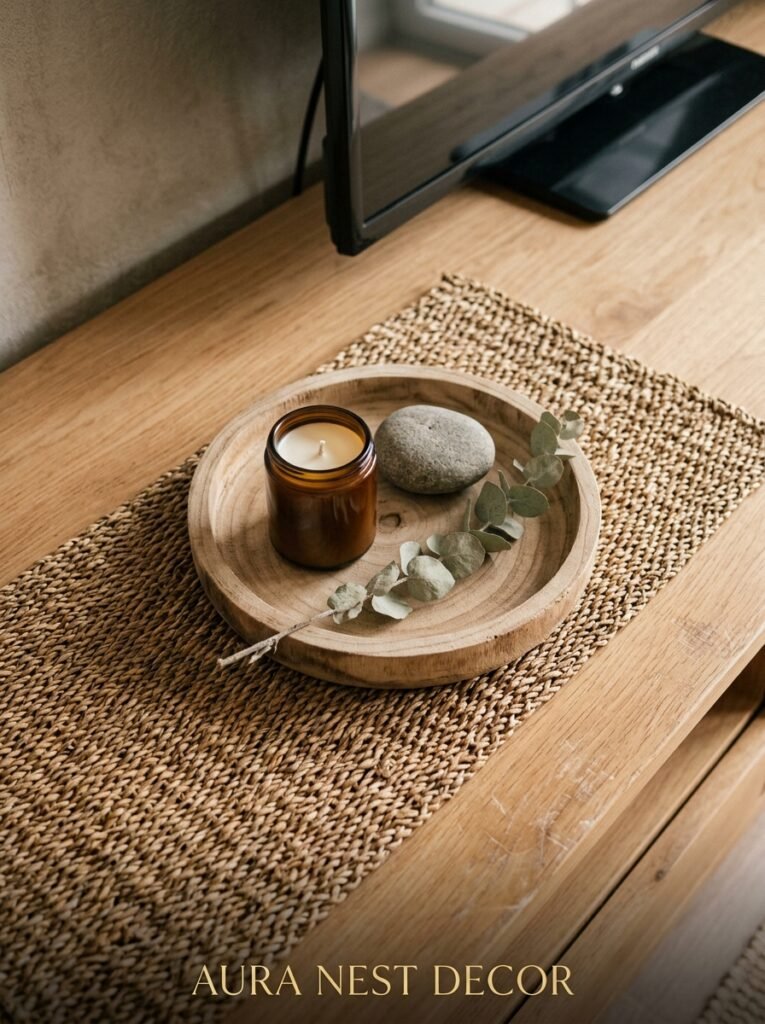
So you’ve got a beautiful cabinet. Now you’ve lined up some books and a plant and called it styled. But the room still looks… not quite right? Here’s probably why.
Height variation. You need things at different heights on and around the cabinet, and most people subconsciously place everything at the same level because it feels tidy. It does feel tidy. It also feels like a hotel lobby.
Put something TALL next to the unit. Not on it — next to it. A floor lamp. A sculptural plant. A stack of coffee table books literally stacked on the floor. Then put something LOW on the cabinet itself — a small tray, a single candle, a little ceramic bowl. Then mid-height: a vase, a framed photo, something with a bit of personality.
The layering creates a sense of a room that’s been lived in and arranged over time, rather than styled in an afternoon. Even if you styled it in an afternoon. Which is allowed.
—
8. What British and American Living Rooms Get Very Right (And Where They Each Go Wrong)
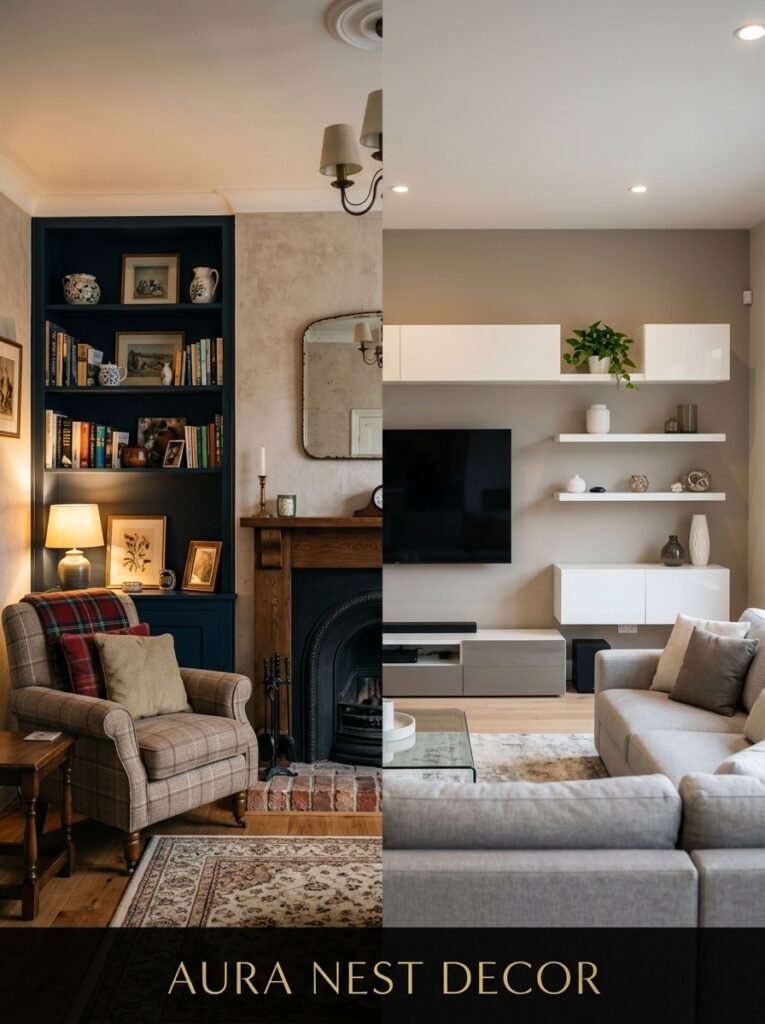
This is a generalization, obviously, but an interesting one.
British homes tend to nail the cozy layer — throws over the sofa arm, reading lamps with warm bulbs, the general sense that you could sit down and feel immediately comfortable. But the TV cabinet is often a bit afterthought-ish. Functional, perfectly adequate, slightly boring. Like the cabinet was chosen entirely on practicality and nothing else.
American living rooms often go bigger and bolder — a whole TV wall, built-ins, dramatic lighting. The scale is usually right. But sometimes it gets so maximalist that there’s no breathing room. Every surface covered, every nook filled. It tips from “styled” into “busy” and the eye doesn’t know where to land.
“The best living rooms aren’t the fullest ones. They’re the ones where every single thing you can see was chosen on purpose.”
The sweet spot is somewhere in the middle. British restraint + American confidence in scale. It sounds like a recipe but it’s actually just about editing — keeping the things that work, removing the things you only kept because you already own them.
—
9. Built-Ins Are Worth It. Here’s When They’re Not.
Built-in TV cabinetry — the kind that goes floor to ceiling with shelving on either side and a dedicated media section in the middle — looks incredible. It also costs a lot. In the UK you’re typically looking at £2,000–£5,000 depending on your joiner. In the US, similar range in dollars, more in major cities.
Worth it if: you’re staying in the house for at least five years, you have a genuinely awkward wall that freestanding furniture can’t deal with, or you’ve got a period property with alcoves that are basically BEGGING for fitted shelving.
Not worth it if: you’re renting, you’re planning to sell in the next couple of years, or you change your mind about things constantly (not a criticism — I’m one of these people, everything rearranges twice a year at minimum).
The middle-ground option that doesn’t get talked about enough: modular systems. IKEA’s BESTA system, String shelving in the UK, Vitsœ if you’ve got a bigger budget. These can look almost as intentional as built-ins when they’re styled well, and they move with you.
—
10. The Color Combinations That Work on a TV Wall (And the One That Never Does)
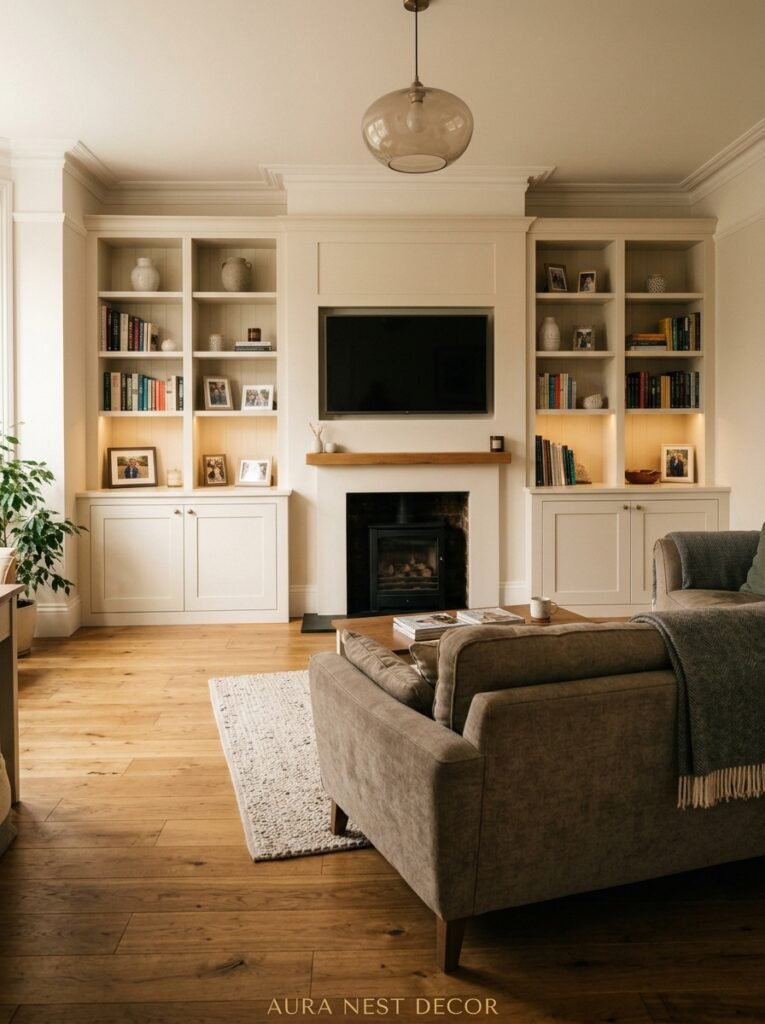
Warm wood cabinet on a warm white or cream wall. Timeless. Can’t go wrong.
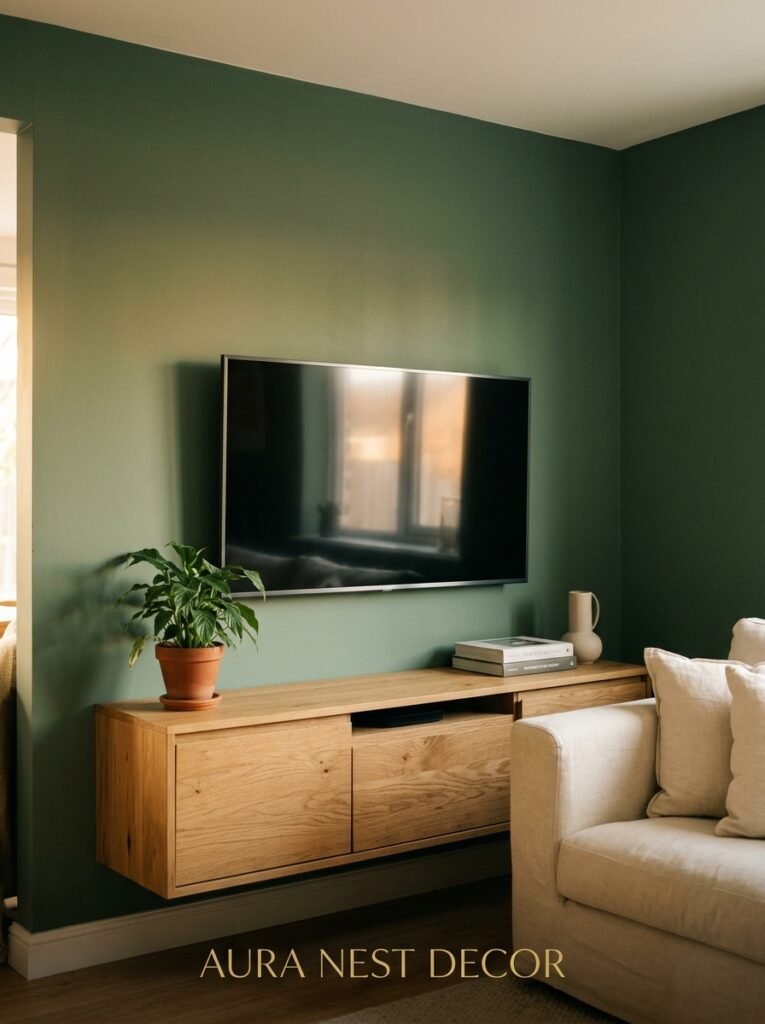
Dark olive or forest green cabinet against a lighter warm wall — this one’s having a serious moment and honestly deserves it.
White or off-white cabinet on a dark moody wall (navy, forest green, charcoal). Dramatic. Good in rooms that can handle drama.
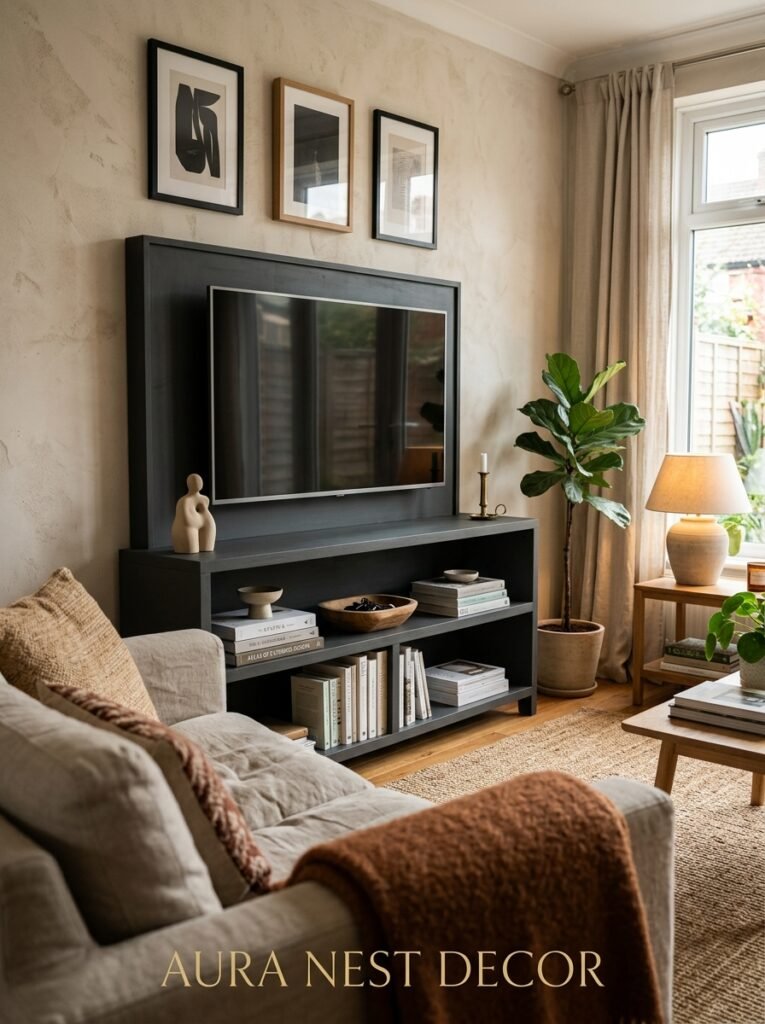
Black cabinet on any wall. Grounding, strong, ages well. Works almost everywhere. Underrated.
The one that never quite works, even though it should on paper: matching the cabinet exactly to the wall color. Tone on tone sounds like a great idea — magazine-approved, Instagram-worthy — but in real life it tends to flatten the whole wall and make the unit disappear in a way that just looks blank rather than intentional. A slight contrast, even a subtle one, gives the cabinet an edge. Literally.
—
11. Small Living Room? The Rules Change.
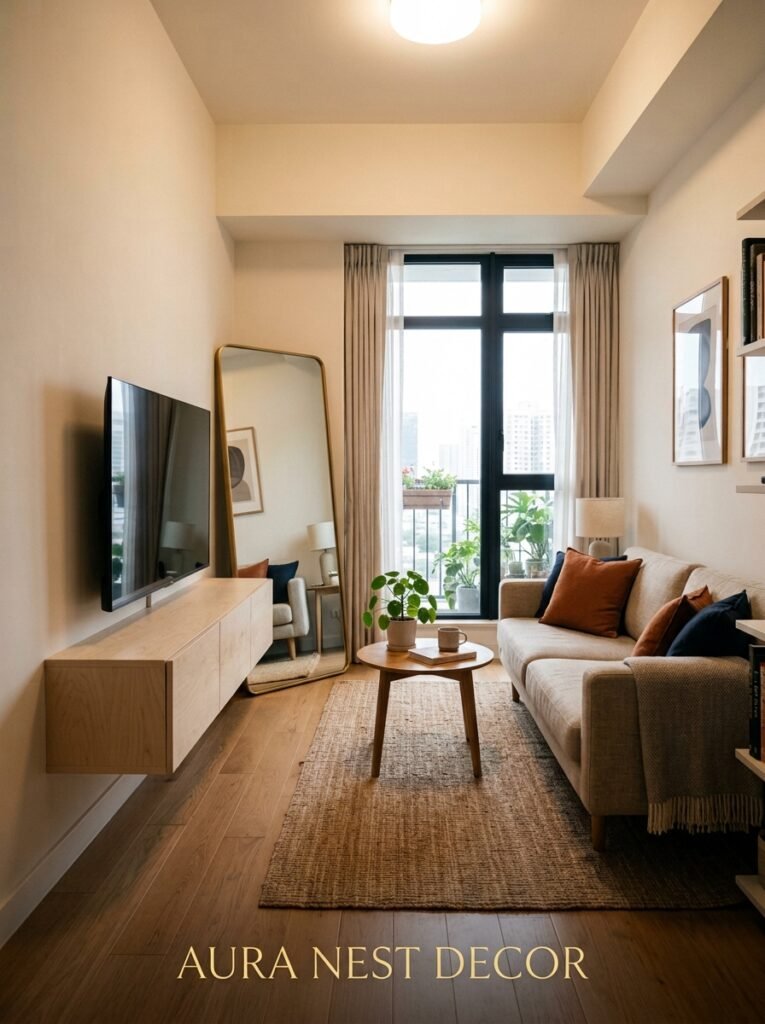
Not completely, but significantly.
In a small room, floating wins. Always. The visual floor space that a wall-mounted unit opens up makes the room feel physically larger, not just aesthetically lighter. It’s one of those things where you genuinely can’t argue with the result — you see it in person and immediately understand.
Scale down but don’t go too small. A cabinet that’s too petite in a small room just looks lost. You’re better off with something that almost fills the wall than something that rattles around in the middle of it.
Mirrors help. Not a mirror ON the cabinet — a mirror somewhere near the TV wall, especially if it catches natural light from a window. The reflection opens the room in a way that’s sort of quietly magical.
And don’t crowd the floor around a floating cabinet with too many things. A small basket for remotes. Maybe one plant. That’s it. The restraint is the whole point.
—
12. The Last Thing Most People Do But Should Actually Do First

Plan your lighting BEFORE you finalize the cabinet.
I learned this the hard way when I moved into my last flat and placed the whole TV unit and then realized there was no wall socket anywhere near where I wanted a lamp, and the overhead light created the worst possible glare on the screen, and I spent six months watching Netflix with the lights off like some kind of cave person.
Ambient lighting behind or beneath the TV unit (bias lighting, it’s called, and it’s genuinely worth looking up) dramatically reduces eye strain and makes the whole wall look more considered. A simple LED strip behind the TV costs almost nothing.
Sconces on either side of the TV wall — where possible — create a balanced frame for the whole setup. And a floor lamp beside the unit, throwing warm light upward and sideways, ties the seating area to the TV wall in a way that overhead lighting simply can’t do.
The light is what makes you feel like the room is beautiful. Not just the cabinet.
—
❓ FAQ
Q: How high should a TV be mounted above a TV cabinet? A: The center of your screen should sit roughly at seated eye level, which for most people is around 42–48 inches from the floor. If your cabinet sits at 18–20 inches, your TV’s center should be somewhere around 42–45 inches from the floor. Don’t mount it too high — it strains your neck over time and it’s one of the most common mistakes in TV room setups.
Q: Can a TV cabinet work in a small living room without making it feel cramped? A: Yes, but you’ve got to be disciplined about scale. Go for a floating or wall-mounted unit to open up floor space, and don’t over-style it — a few curated objects rather than a full display. The less stuff you have competing for attention around the TV, the bigger the room tends to feel.
Q: What’s the best TV cabinet style for a rented home? A: Go freestanding — something with legs that can move easily, that doesn’t require drilling into walls. A sideboard-style cabinet in a warm wood or a painted finish gives you the most flexibility. Modular units like IKEA BESTA or KALLAX with a TV panel on top can also look genuinely good without any permanent commitment.
—
💭 Final Thoughts
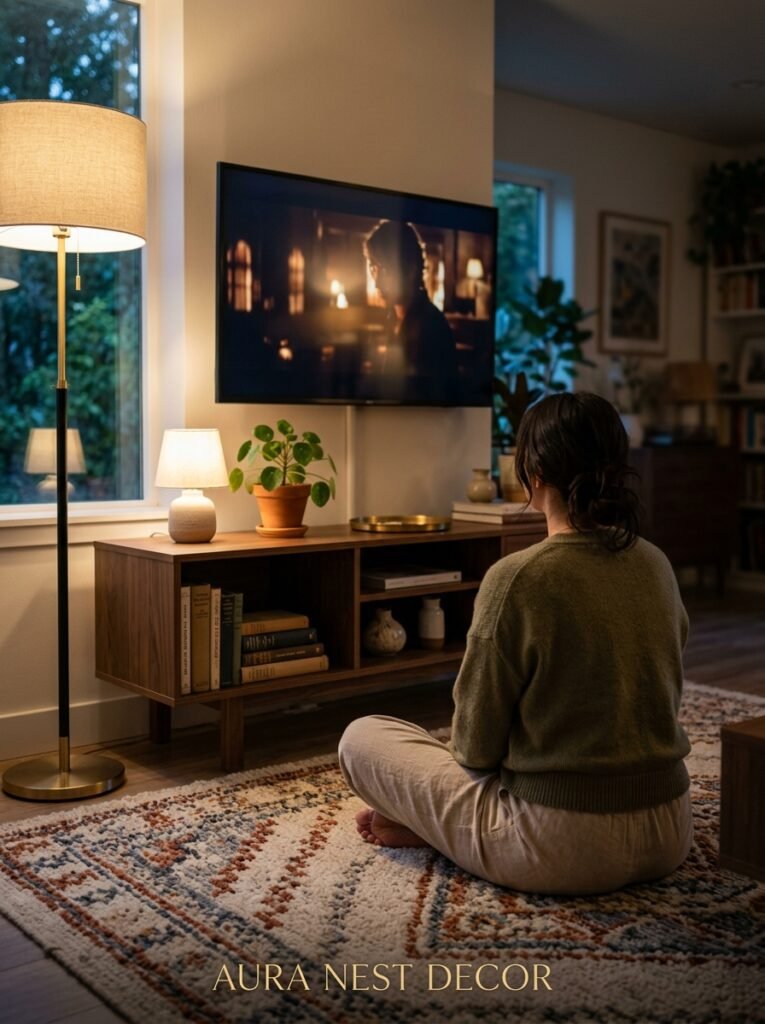
A TV cabinet is one of those things you make a decision about once and then live with for years, and yet most people spend less time choosing it than they do picking a throw pillow. Which is a bit mad, when you think about it.
Get the proportions right. Think about the light. And don’t let the TV win.
What’s the one thing in your living room right now that’s quietly driving you crazy every time you walk in?