
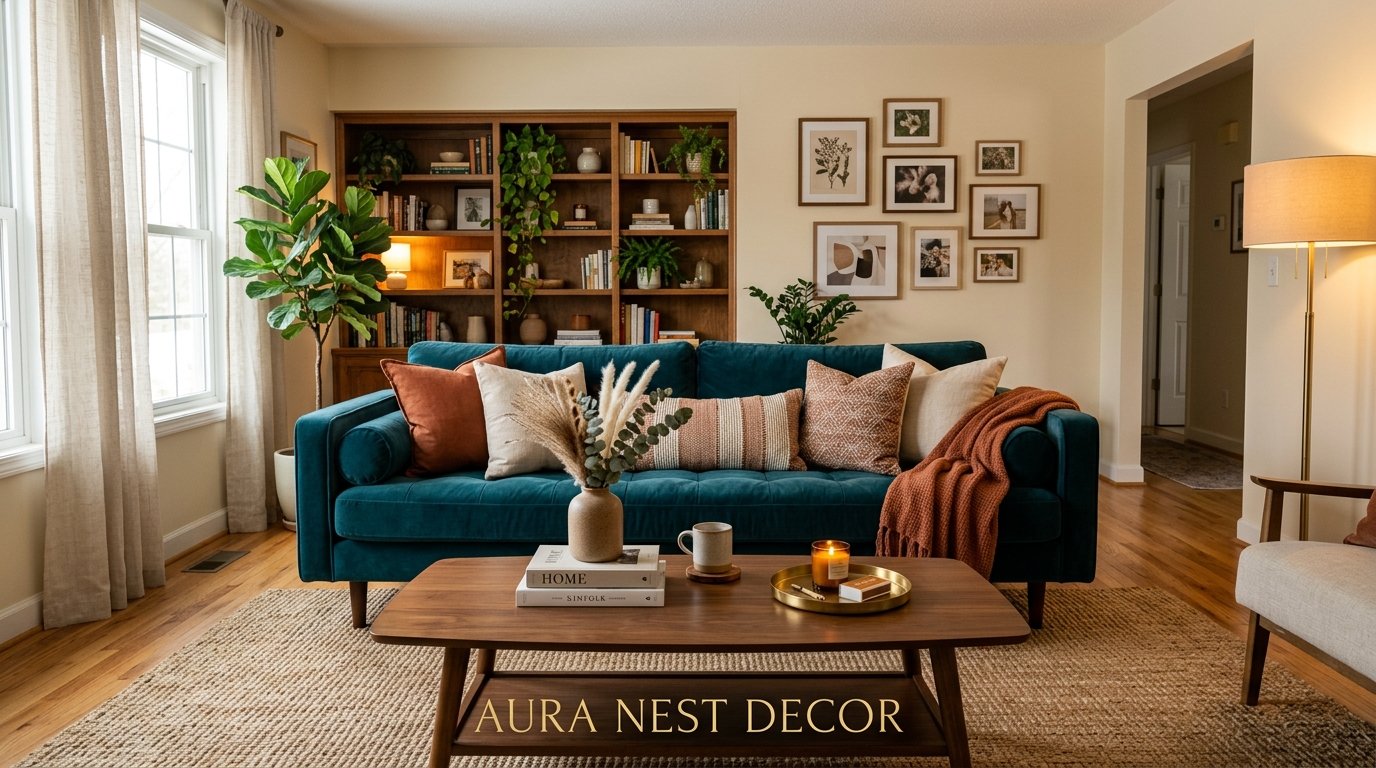
Why a Teal Sofa Might Be the Bravest (and Smartest) Thing You Put in Your Living Room
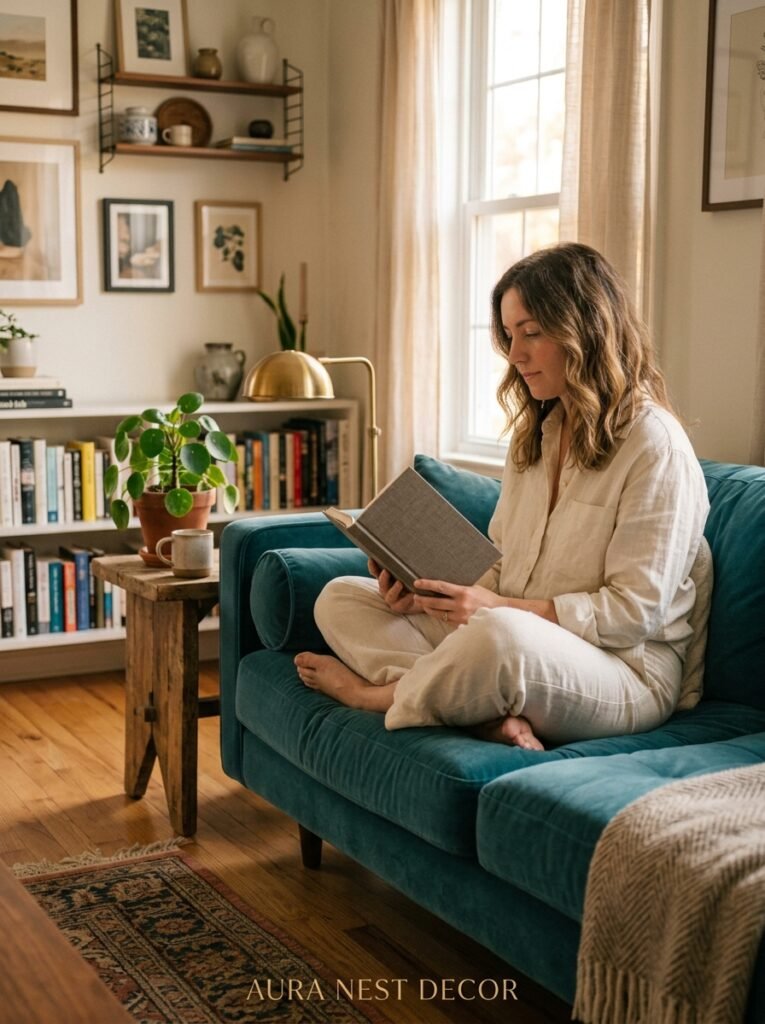
My neighbor pulled up in a moving van last spring with a sofa the color of the ocean just before a storm. I thought, okay, bold choice. Six months later I’m standing in my own living room wondering why everything I own is beige.
—
1. The Moment Everyone Gets Cold Feet — and What to Do Instead
You’ve seen it on Pinterest. You’ve saved it seventeen times. You’ve maybe even gone to the store and sat on one. And then you walked out with a grey sofa because it felt “safer.”
I get it, I really do. A teal sofa FEELS like a commitment. Like getting a tattoo, but for your living room. But here’s the thing nobody tells you: a neutral sofa doesn’t actually make a room easier to decorate. It just makes it easier to ignore. You end up with a perfectly fine room that doesn’t make you feel anything when you walk into it.
Teal, on the other hand, gives you a starting point. It’s the anchor. Everything else gets to respond to it, play off it, push against it a little. And that tension? That’s where a room starts to feel alive.
The cold feet are normal. Push through them.
2. What “Teal” Actually Means (Because There Are About Forty Versions of It)
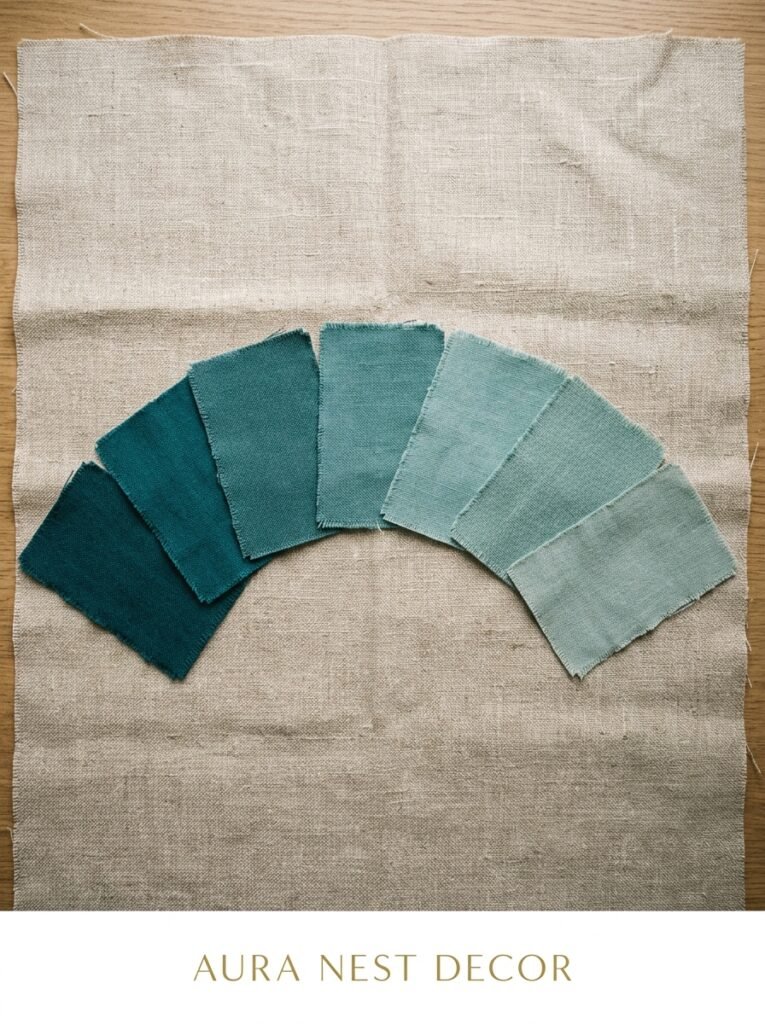
Not all teals are created equal, and this matters more than you’d think before you buy.
There’s the bright, almost-turquoise kind that reads very tropical and energetic — fun, but it can tip into “resort lobby” if you’re not careful. Then there’s the deep, almost-teal-blue that leans moody and masculine, somewhere between peacock and navy. And right in the middle there’s that warm, slightly green-leaning teal — the one that shows up in every gorgeous living room photo and somehow works with EVERYTHING.
That middle teal is the sweet spot. It’s not screaming at you. It’s not trying to be the ocean. It just sits there looking impossibly good next to warm wood, against white walls, under brass light fittings, surrounded by rust or terracotta or dusty pink.
When you’re shopping, look at the sofa in natural light if at all possible. Showroom lighting lies. A sofa that reads blue under fluorescents can read deeply green by a window on a cloudy afternoon. Both are beautiful, but they’re different rooms.
“Teal isn’t just one color. It’s a whole spectrum of confident choices, and the one you pick will shape every other decision in the room.”
3. The Wall Color Question That Keeps Everyone Up at Night
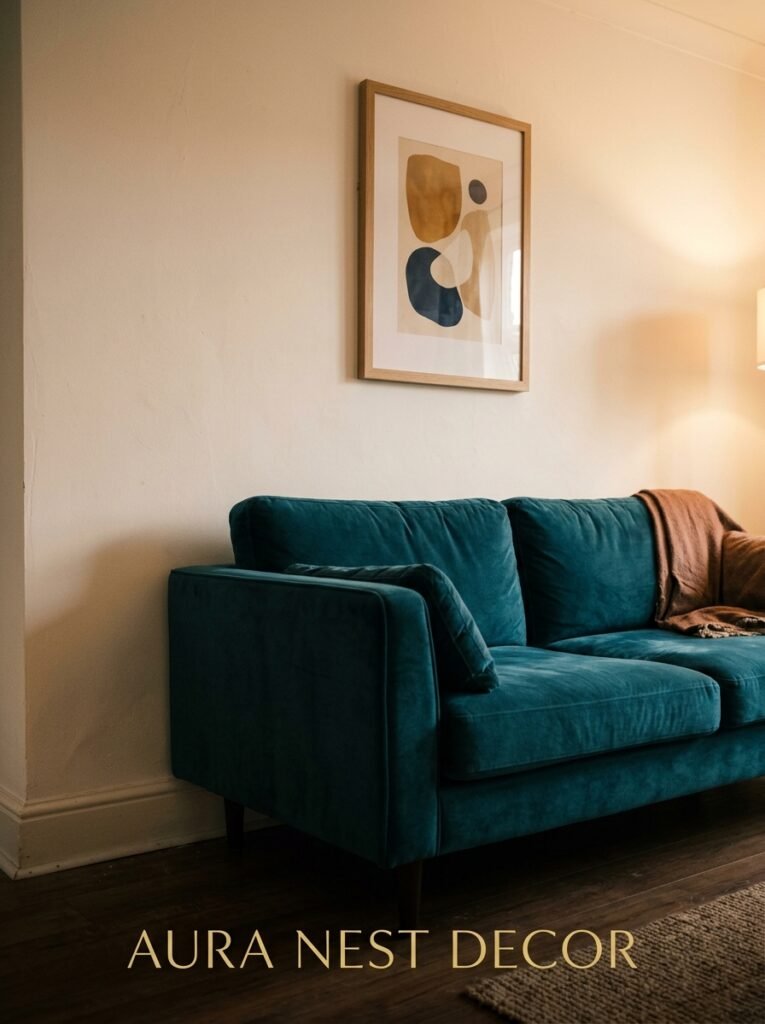
Okay, so you’ve got (or you’re getting) the teal sofa. Now what do the walls do?
White is the obvious answer and honestly? It’s the right one about seventy percent of the time. Specifically a warm white, not a cold, stark white. Think more “linen” than “hospital.” The teal pops, the room breathes, and you’ve got total freedom with everything else.
But. If you want to do something a little more interesting — warm terracotta walls with a teal sofa is absolutely stunning. Sounds chaotic, works incredibly well. The warmth of the terracotta pulls out the green notes in the teal and the whole room just glows.
Soft sage green walls with teal is another one I keep seeing and can’t stop thinking about. It sounds like it’d be too much green, but because the tones are so different in depth and saturation, they don’t compete — they actually make each other look more intentional.
What doesn’t work: cool grey walls. The teal goes cold and flat. The room feels like a waiting room. Avoid.
4. The Rug That Actually Holds the Whole Room Together
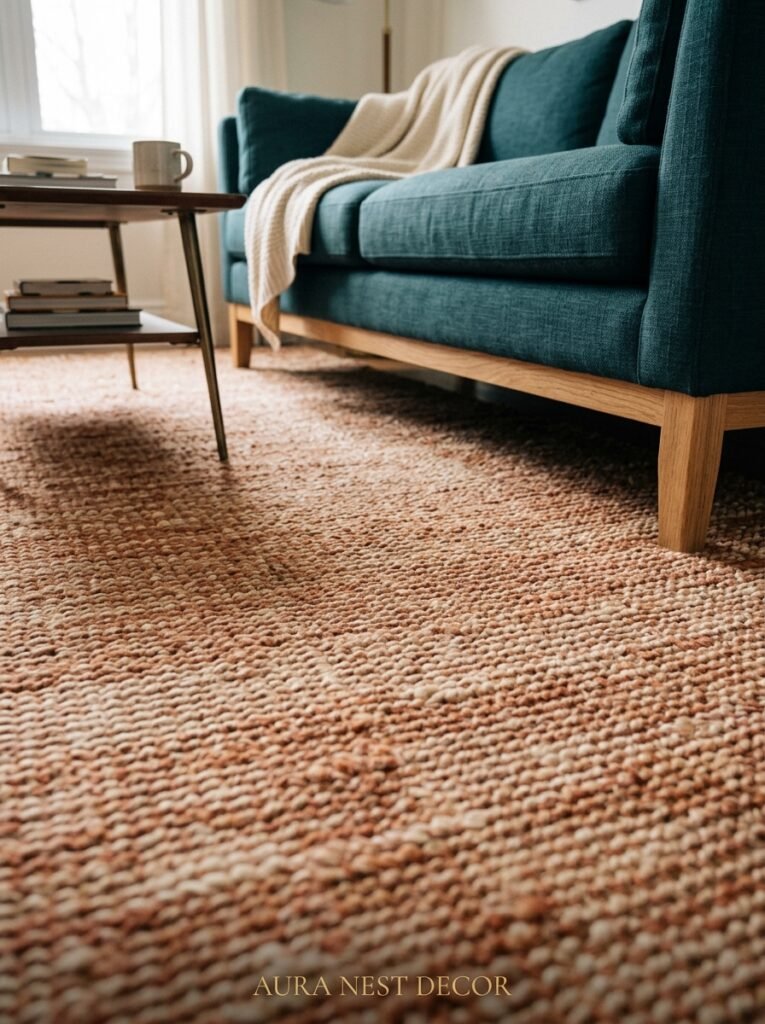
This is the decision that makes or breaks a teal sofa room, and I say that with full confidence.
A lot of people go straight for a neutral rug — cream, grey, natural jute — thinking it’ll balance the sofa. And jute actually can work beautifully, especially in a boho or coastal-leaning space. That natural texture against the teal is genuinely nice.
But the rugs that make teal sofas sing? Patterned ones. Specifically anything with terracotta, rust, mustard, or dusty rose woven through it. Moroccan-style rugs, Persian-inspired patterns, even a simple geometric with warm earth tones. Suddenly the teal sofa isn’t just “the colorful sofa” — it’s part of a considered color story.
Side note — if you’re in the UK and you’ve got original floorboards you don’t want to cover much, a smaller statement rug under the coffee table still works. You don’t need wall-to-wall.
Size matters too. When in doubt, go bigger. A too-small rug makes the whole seating area feel like it’s floating.
5. Cushions: The One Place Most People Accidentally Ruin It
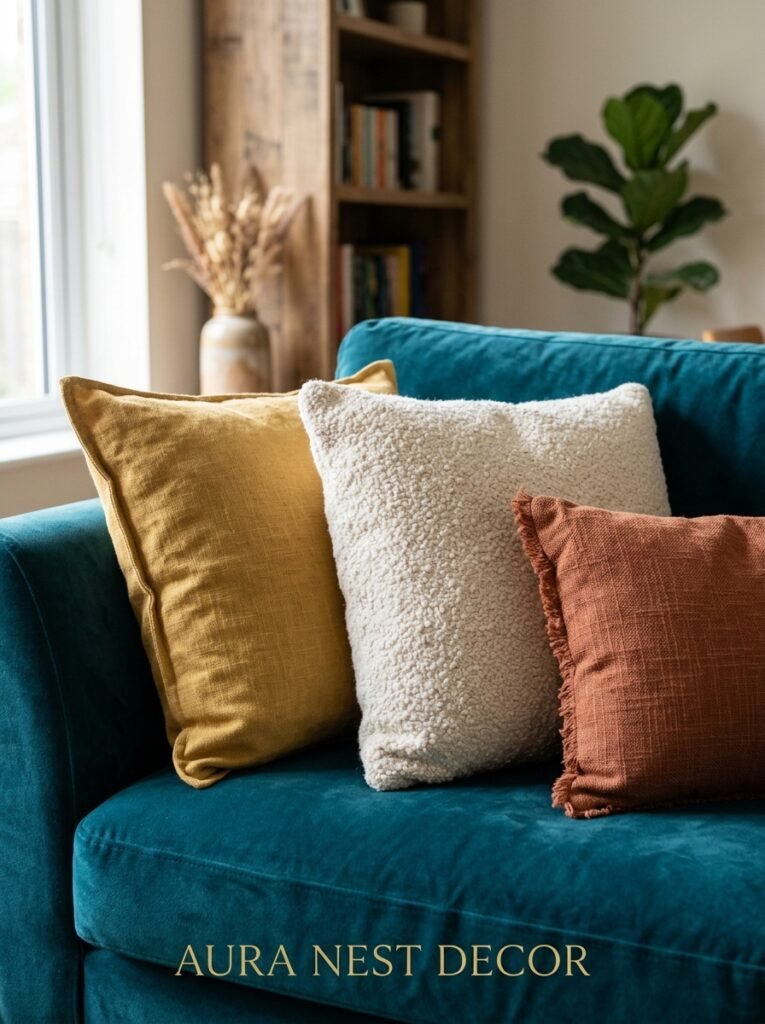
I’m going to be direct. The matching cushion set is almost always a mistake.
You know the one — the little pack of three cushions that came styled with the sofa on the website, in complementary shades of teal and grey. They’re perfectly coordinated and they look completely lifeless in an actual home.
What works instead is a mix that feels slightly collected. A deep mustard velvet cushion. Something in a warm burnt orange. A pattern that picks up the teal but isn’t teal itself. Maybe one in off-white with a woven texture. The goal is a sofa that looks like you’ve had those cushions for years, from different places, and they just happen to work together.
Odd numbers. Textures mixing. Not everything the same size.
And one thing I’d genuinely avoid: cool-toned purple or cobalt blue cushions. They read beautifully in photos and then in person the sofa looks like it’s at a fantasy convention.
“The cushions are where most people play it too safe or go too matchy-matchy — and either way the sofa ends up looking less expensive than it actually is.”
6. The Wood Tone Conversation (This One Actually Matters a Lot)
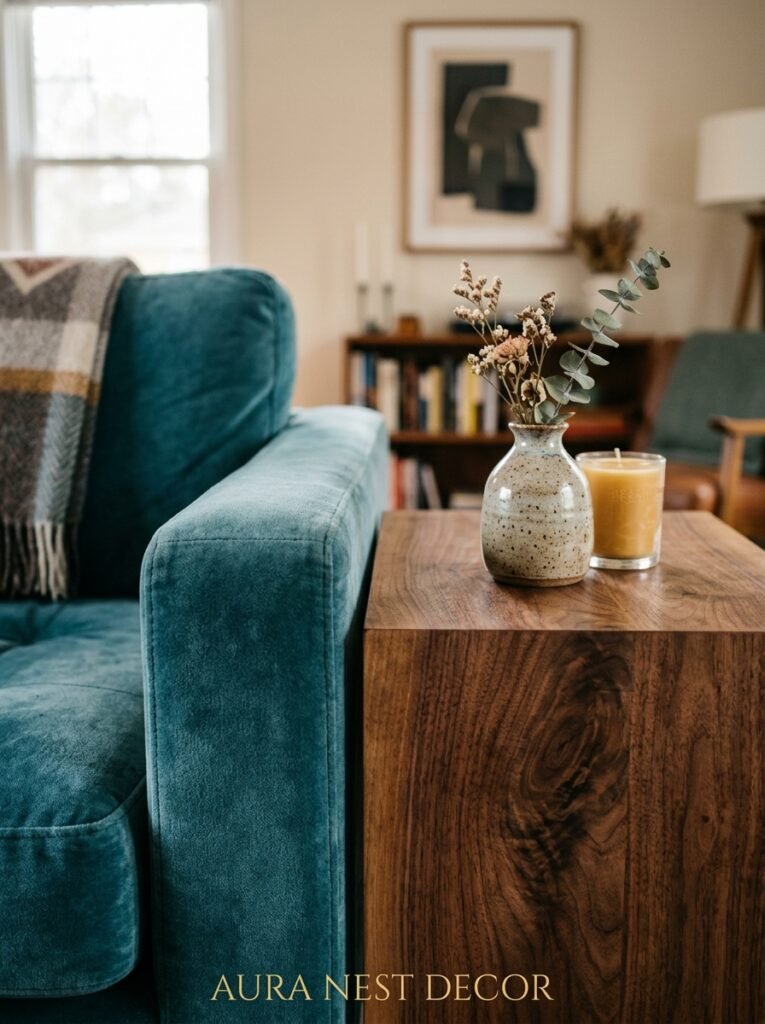
Furniture legs, coffee tables, bookshelves, floors — the wood tones in your living room are going to have a real conversation with your teal sofa, whether you plan that conversation or not.
Warm, medium-toned woods are the natural partner. Think walnut, oak, teak. They bring out the warmth in teal without competing. A walnut coffee table in front of a teal sofa is genuinely one of the most visually satisfying combinations in home decor and I will die on that hill.
Light wood — like very pale Scandi-style birch or ash — also works, especially if you’re going for that clean, airy Scandinavian feel. The teal becomes a bolder pop in that context. It’s a slightly cooler, more contemporary look.
Dark espresso wood is trickier. It can look gorgeous and moody, but it can also make the room feel heavy and closed-in if the lighting isn’t right. If that’s what you’ve got already, make sure there’s enough light in the space.
What doesn’t work: bright, orange-toned pine. It’s not that it’s “wrong” exactly, it just makes the whole room feel like a holiday cabin rental and the teal starts looking like a mistake.
7. The Lighting Setup That Makes Teal Look Rich Instead of Garish
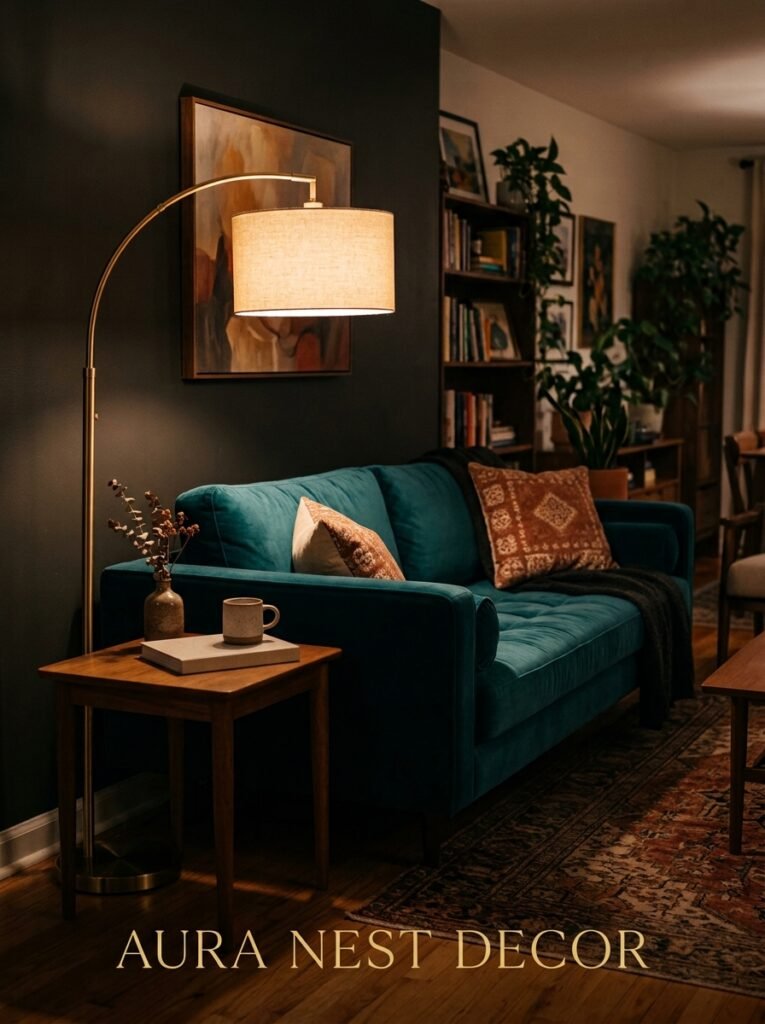
Lighting changes EVERYTHING and teal is one of those colors that’s almost embarrassingly responsive to it.
In cool, flat overhead lighting, teal can look harsh. A bit plastic-y. Like a color that’s trying too hard.
In warm, low lighting — the amber glow of a floor lamp at dusk, a couple of table lamps with warm-toned bulbs — that same teal suddenly looks luxurious. It deepens. It gets complex. You start seeing the green and the blue dancing in it separately.
This is the real reason those moody, gorgeous living room photos look so good. It’s not just the sofa — it’s that they’re all lit like a film set.
For a teal sofa room, I’d really suggest layering your lighting. An overhead source for function, a floor lamp over near the sofa, and at least one table lamp somewhere in the space. And keep the bulb color warm — 2700K to 3000K is the range you want. Not daylight bulbs. Not cool white.
Brass or antique brass lampshades and fittings are also genuinely magic here. The warm metal amplifies the warmth of the light and it plays beautifully against teal.
8. The Wall Art Approach That Doesn’t Look Like You Tried Too Hard
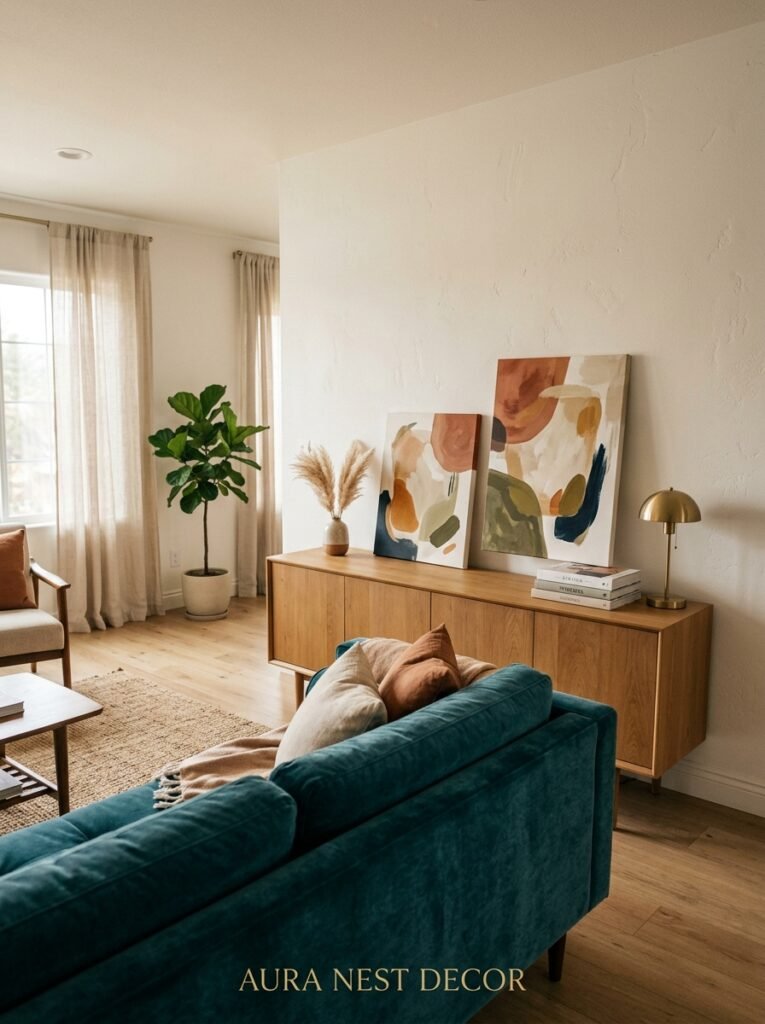
Here’s a thing I’ve noticed. In rooms where the teal sofa works perfectly, the wall art usually has one of these qualities: it’s either very abstract with warm undertones, or it’s very botanical/nature-inspired, or it’s completely monochrome.
What tends to fight with a teal sofa: art that has a lot of very saturated, competing colors. An enormous pop-art print in red and yellow and green is going to argue with your teal sofa constantly. That’s too many strong personalities in one room.
Big, simple abstract prints with warm ochres, creams, and dusty pinks? Perfect. A gallery wall of black-and-white photography? Surprisingly good — the contrast lets the teal breathe. Framed botanicals, especially tropical leaves? So, so good. There’s an obvious logic to it but also it just works every time.
Frames matter too. Gold or brass frames. Warm natural wood frames. Avoid cold grey metal frames if you can — they push the teal toward cold and that’s the opposite of what you want.
9. When the Rest of the Room Is Already Decided (And You’re Shoehorning in the Teal)
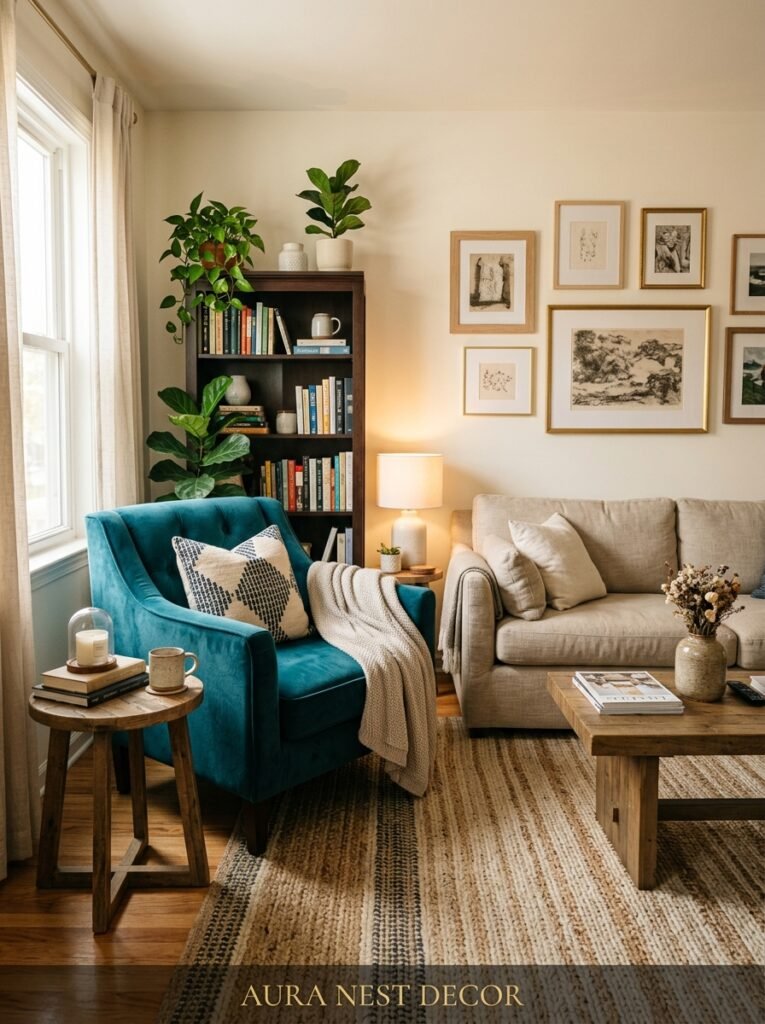
Maybe you’re not starting from scratch. Maybe you’ve got existing furniture, existing floors, existing curtains, and you just really want that teal sofa. That’s okay. It’s actually a more interesting design problem.
The key question is: does your existing room lean warm or cool? If it leans warm — honey-toned floors, wooden furniture, warm-white walls — you’ve got a fantastic foundation and you can go for a rich, slightly green-leaning teal with total confidence.
If your room leans cool — grey walls, silver accents, cool-toned floors — you’ll want a slightly blue-leaning teal rather than a green one, and you’ll want to consciously add some warm accents (a few rust cushions, a warm-toned throw, a plant in a terracotta pot) to stop the room from reading cold.
The plant thing, by the way — a big leafy plant in the room with a teal sofa is one of the cheapest and most effective things you can do. A large fiddle-leaf fig or a monstera in a corner just makes the whole teal-and-greenery palette feel completely intentional.
“You don’t have to redesign the whole room. You just have to speak to the sofa.”
10. Velvet Versus Fabric — and Why the Material Changes Everything
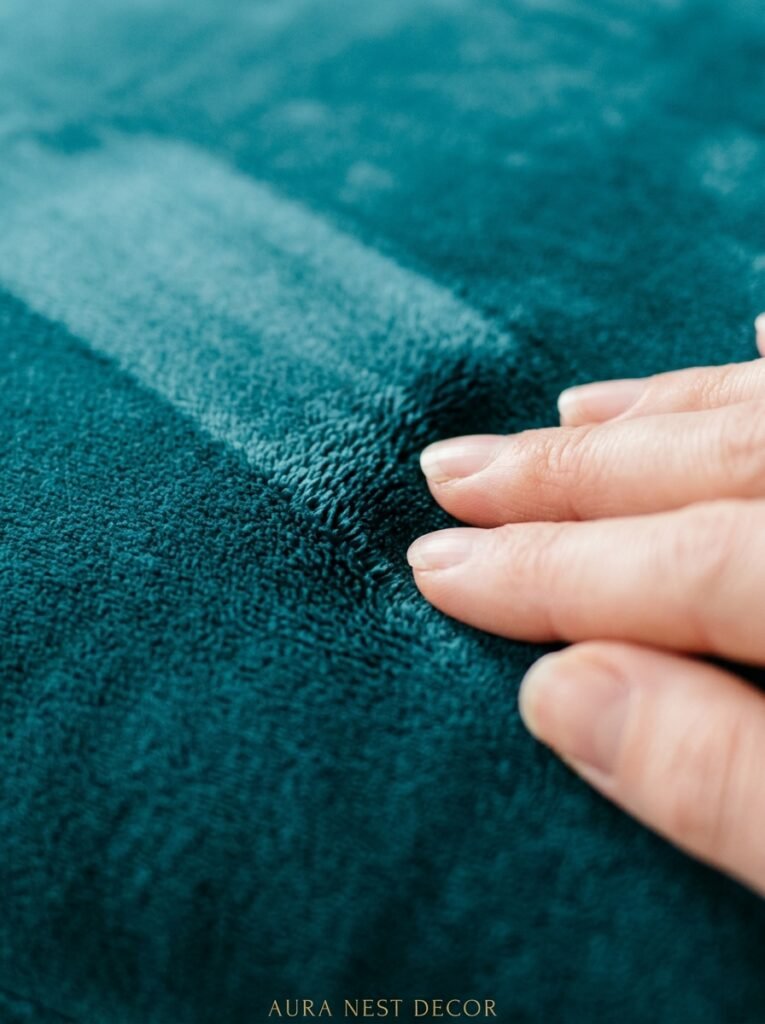
If you’re still choosing, this matters.
Velvet teal sofas are the ones you see in every glossy interior photo, and there’s a reason for that. Velvet catches light differently across its pile, which means the teal constantly shifts — lighter on the top cushions, darker in the shadows. It looks MORE expensive than it probably is. It looks intentional and considered.
The downside: velvet needs attention. Pets can be unkind to it. If you’ve got kids who’ll be launching themselves at this sofa every day, velvet might be an ongoing source of mild despair.
Performance fabric — and there are genuinely beautiful teal options in performance fabrics now — is a more practical choice for busy households. Modern performance fabrics don’t look synthetic the way they used to. Some of them look very close to linen, which is lovely.
Teal linen is a real option too, especially for UK homes that skew more laid-back or country-house in vibe. It’s softer, a little more casual, and it ages in a really beautiful, lived-in way.
Choose based on your life, not the Instagram version of your life.
11. Small Living Rooms: The One Rule About Scale That Nobody Talks About
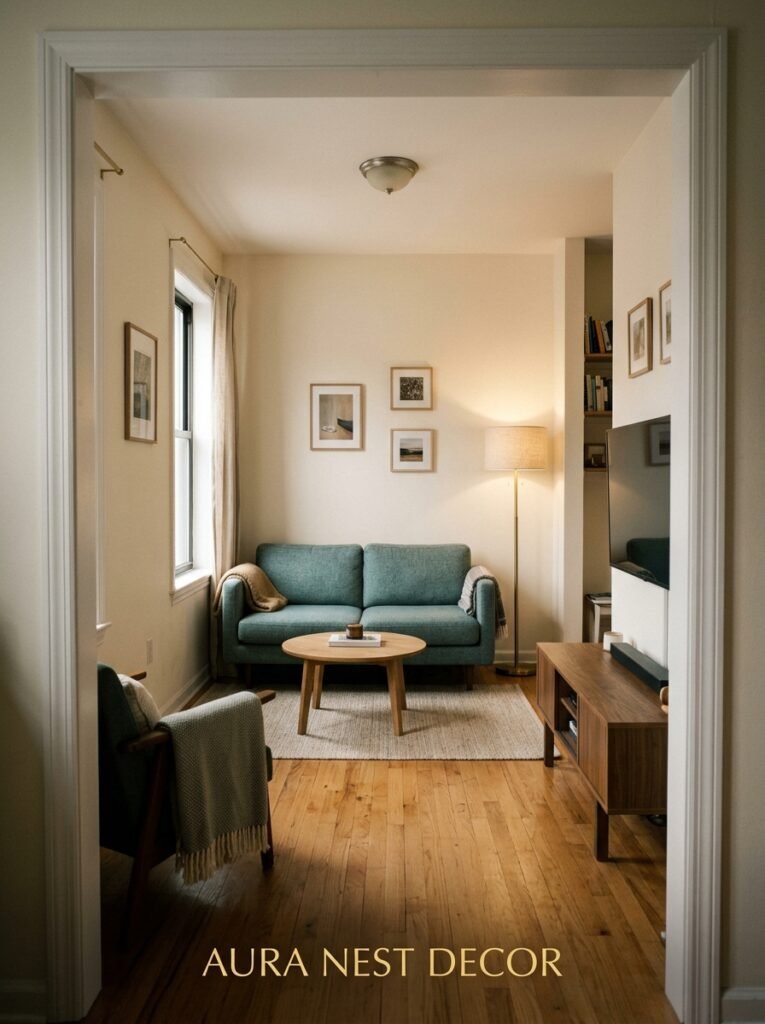
Here’s the thing nobody really says out loud. In a small living room, the SCALE of the sofa matters more than the color.
A huge, overstuffed teal sofa in a small room will feel overwhelming — not because it’s teal, but because it’s huge and overstuffed. A teal sofa with clean lines, low arms, and a slim profile in that same room? Perfectly fine. Sometimes even better than a neutral would be, because the color creates a focal point that makes the room feel designed rather than just cramped.
So if you’ve got a smaller space and you’re nervous: don’t let the room size stop you. Let the sofa size guide you. Go for something streamlined. Something that sits closer to the ground. A two-seater or a compact three-seater rather than a sectional.
And keep the rest of the room relatively light — pale walls, lighter rug, not too many heavy furniture pieces — so the sofa gets to be the statement without the room feeling stuffed.
12. The Styling Moment That Makes the Whole Room Click
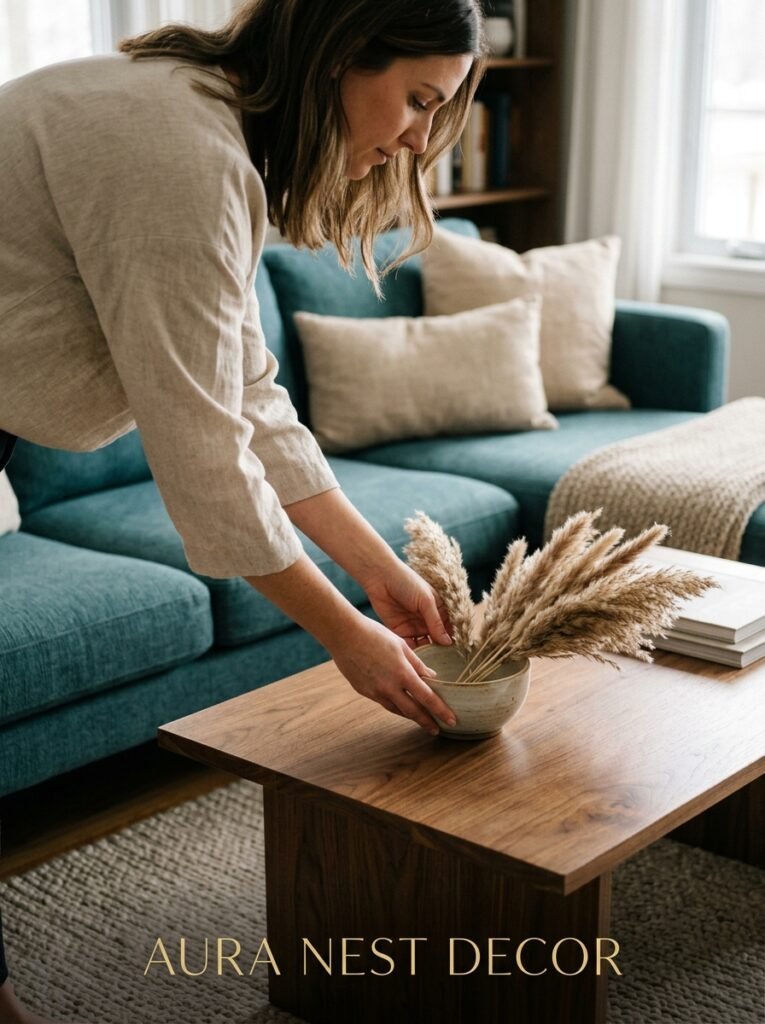
There’s always one thing. One small addition that makes a room with a teal sofa stop looking like “a room with a teal sofa” and start looking like YOURS.
Sometimes it’s a throw. Not a perfectly folded one draped exactly over the arm — a slightly lived-in one, tossed across a corner, maybe in a warm camel or burnt sienna. Something that says someone actually sits there.
Sometimes it’s the coffee table styling. A stack of books with interesting spines, a candle that’s been burned, one small object that means something to you. Not a styled tray of matching objects from a shop, but real things.
Sometimes it’s just a single plant, big and slightly unruly, in a corner of the room, catching the light.
What I’ve noticed is that the rooms that look best with a teal sofa aren’t the perfectly styled ones. They’re the ones that look like someone lives there, has opinions, bought things they loved, and the sofa happens to be this gorgeous, confident piece of teal in the middle of all of it.
That’s all it needs to be.
—
❓ FAQ
Q: Does a teal sofa go with grey walls? A: Honestly, not great — cool grey walls make teal go flat and cold. If you want a neutral-ish wall, go for a warm white or a soft off-white instead. If you’re set on grey, lean toward a very warm grey with clear beige undertones rather than anything blue or cool.
Q: What color throw looks good on a teal sofa? A: Warm tones do the heavy lifting here. Camel, mustard, terracotta, and dusty blush all look genuinely beautiful against teal. A chunky knit in rust or a linen throw in warm cream are both easy wins. Avoid navy or cobalt — they compete rather than complement.
Q: Can you have a teal sofa and colored walls at the same time? A: Yes, and it can look incredible — but keep the wall color warm and on the softer side. Terracotta, sage green, and warm putty all work well. What you want to avoid is two very saturated colors fighting for attention at the same time. One of them should be the star, the other the supporting character.
—
💭 Final Thoughts
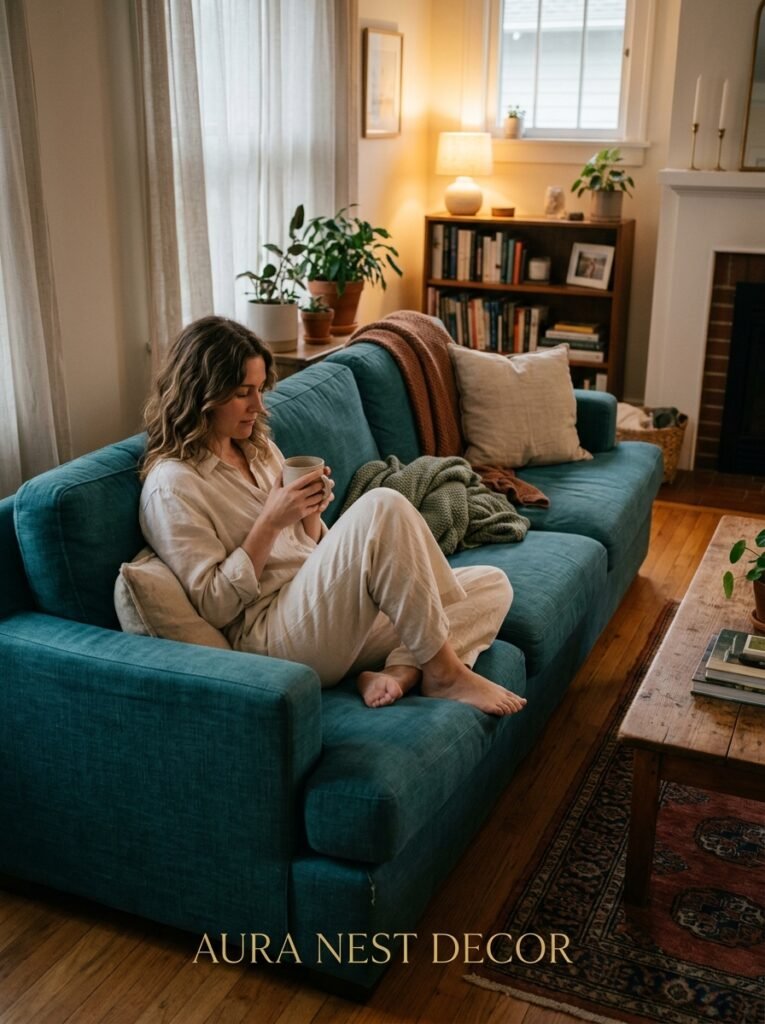
A teal sofa doesn’t ask you to be bold forever. It just asks you to be brave once — on the day you choose it. After that it does the work. It makes your room feel chosen, not assembled. It pulls every other decision into focus. It turns out that one committed choice can do more for a living room than a hundred cautious ones.
So here’s what I keep wondering: what’s the worst that actually happens if you get the sofa and love it?