Why Every Living Room I Fall in Love With Right Now Has a Spanish Accent
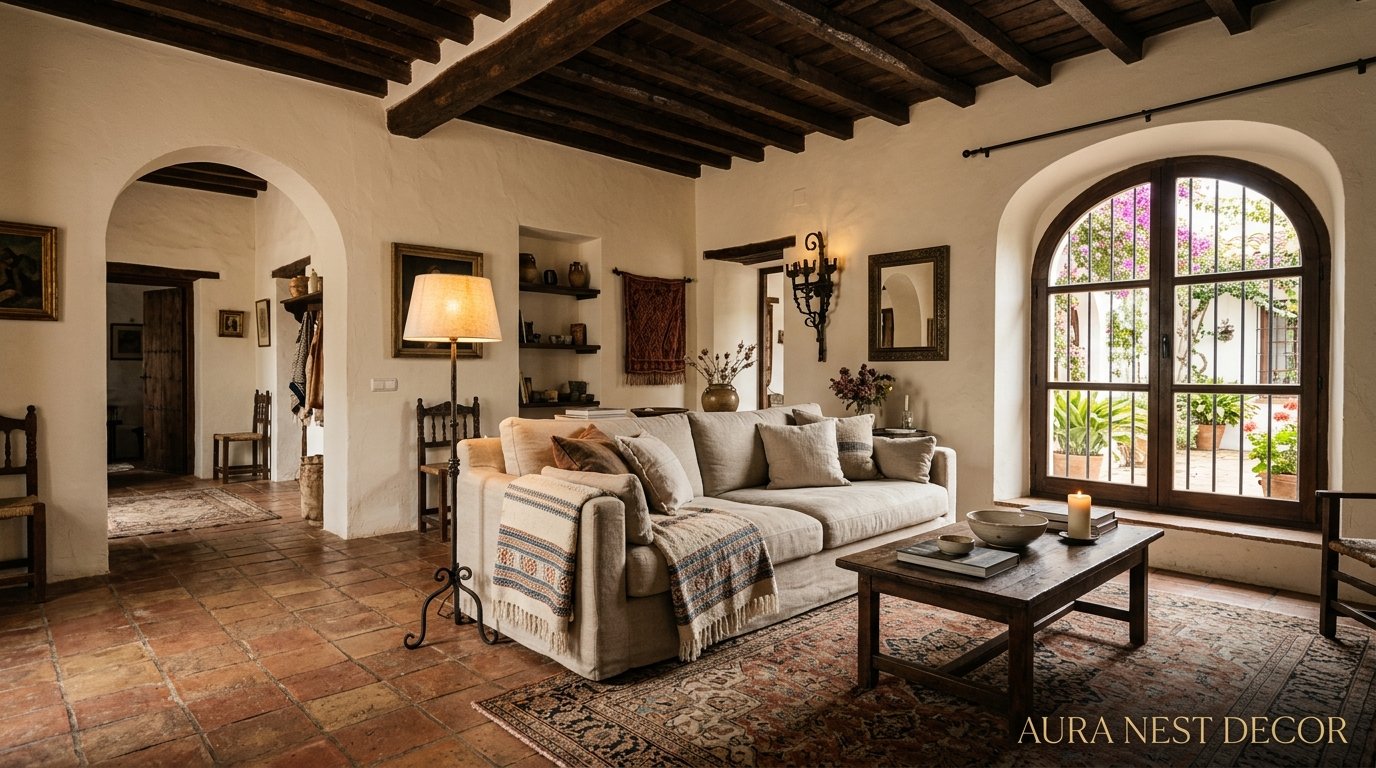
There’s something about walking into a Spanish-style living room that makes you want to slow down. Not in a tired way — in a remembered way. Like your body recalls a version of home it’s never actually lived in but somehow misses.
—
1. The Thing Nobody Tells You About Spanish Style (It’s Not What You Think It Is)
People hear “Spanish style” and immediately picture terracotta pots and flamenco posters. Which, no. That’s not it.
Real Spanish-influenced interiors — the kind that stop you mid-scroll on Pinterest — are built on something much harder to fake: age. The sense that a room has been lived in, loved in, slightly argued in, and then forgiven. There’s plaster that’s been painted over more than once. There’s wood that’s darkened with time. There’s iron that nobody polished because it looks better unpolished. That’s the actual aesthetic. Not a style so much as a feeling.
And here’s the thing: you can create that feeling in a semi-detached in Birmingham or a condo in Phoenix. You really can. It doesn’t require a Spanish grandmother’s actual house (though that would obviously be ideal). What it requires is understanding what’s doing the emotional heavy lifting in those spaces and then making intentional choices around those specific things. The architecture helps if you have it — arched doorways, thick plaster walls, terracotta tile floors. But the soul of the style lives in the details, not the bones.
So let’s start there. With the details.
“Spanish style isn’t a design trend. It’s a design memory.”
2. The Color That Keeps Showing Up in Every Beautiful Spanish-Inspired Room Right Now
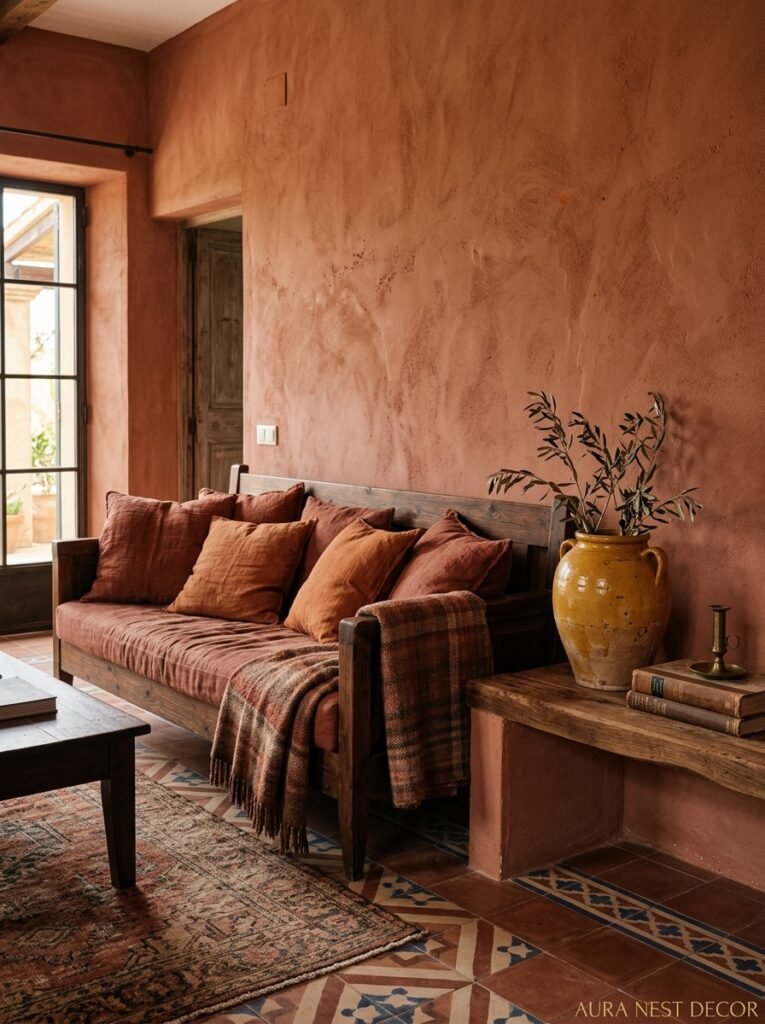
I’ve been looking at Spanish-style living rooms obsessively for about three years, and there’s a color that appears in almost every single one I’ve saved.
It’s not terracotta, actually. Or rather — it’s not only terracotta. The color that’s doing the most work right now is this deep, slightly dusty, muted rust. Not orange-rust. Not red-rust. The kind of rust that looks like it’s been sitting in the sun for decades and has forgotten what it used to look like. Think old brickwork in a coastal town in Andalusia. Think clay roof tiles after a summer of heat. It’s a warm color but it doesn’t shout — it settles.
Pair that with ochre, off-white plaster tones (not bright white — NEVER bright white in a Spanish room, please), and then one hit of something deep and unexpected. Navy. Forest green. Aged burgundy. The depth is what makes it feel real instead of themed. I’ve seen people do beautiful rooms with this palette in 1930s Craftsman homes in California and in Victorian terraces in South London, so don’t let your architecture talk you out of it. You might need to adjust the intensity — slightly lighter in a north-facing UK room, slightly deeper in a sun-drenched American one — but the core logic holds everywhere.
3. Why Spanish Rooms Feel so Grounded (It’s the Furniture Weight)
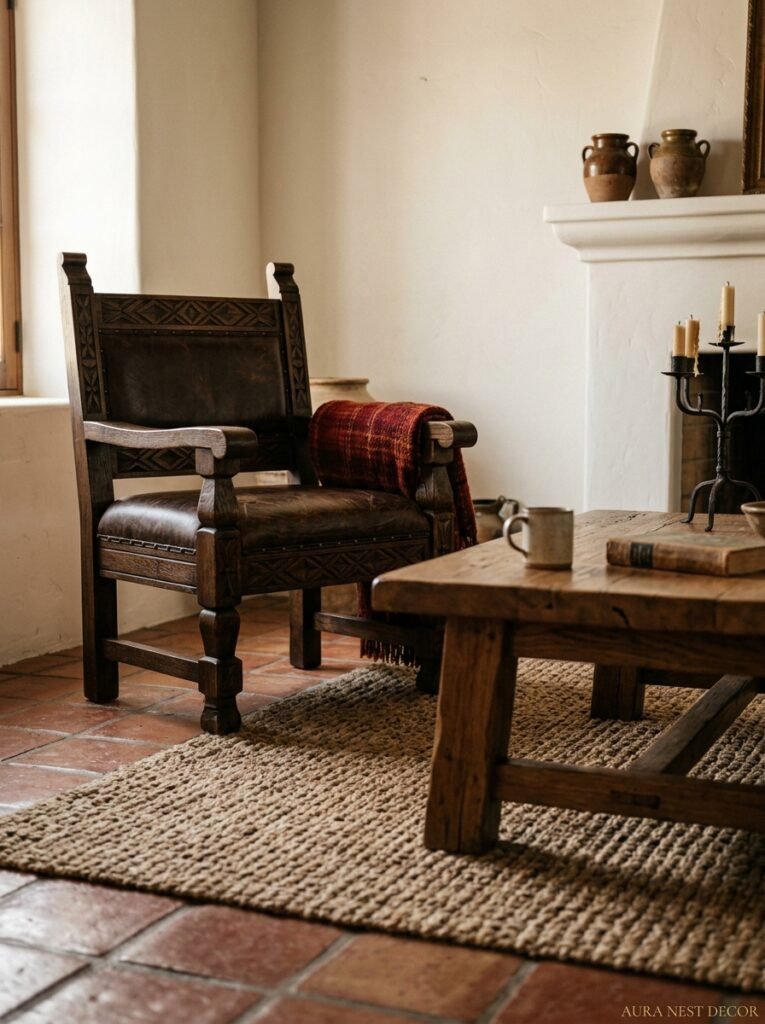
This is the detail that interior designers know and almost nobody else talks about.
Spanish-style living rooms use HEAVY furniture. Not clunky — heavy. There’s a difference. A deep, low sofa with visible wood detail on the legs or base. A coffee table that looks like it was carved from one piece of wood and couldn’t be moved by fewer than two people. Solid, substantial armchairs with aged leather or woven fabric that has actual texture you can see from across the room.
When furniture is too light — too leggy, too spare, too Scandinavian (which is beautiful, but a completely different energy) — a Spanish room loses its anchor. It floats. And these rooms are not supposed to float. They’re supposed to sit on the earth like they grew there.
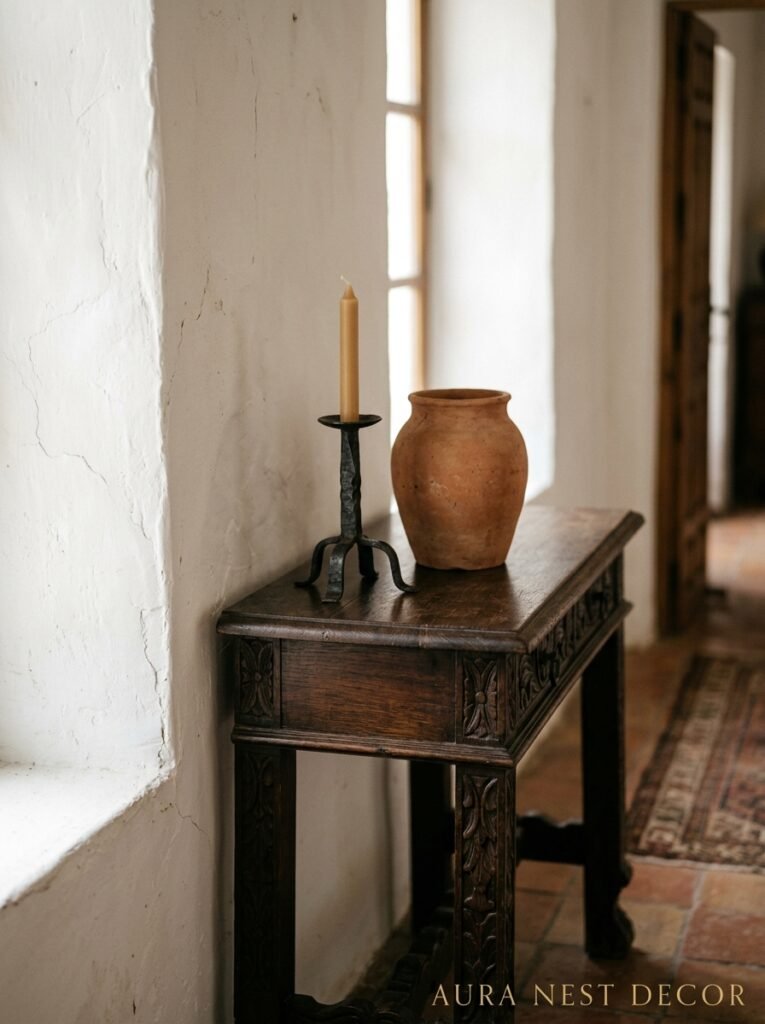
This is surprisingly achievable without spending a fortune, by the way. IKEA’s heavier wood-frame pieces can actually work here with the right styling. Antique shops and estate sales are genuinely your best friend for Spanish-style furniture — you’re looking for things with visual weight, warm wood tones (think walnut, dark oak, anything that’s been stained over time), and ideally some kind of hand-carved or hand-forged detail. Even one statement piece — a Spanish-style console table, a heavy bench at the base of a sofa — shifts the whole room’s energy.
4. The Textile Trick That Makes Spanish Interiors Look Expensive Without Being Expensive
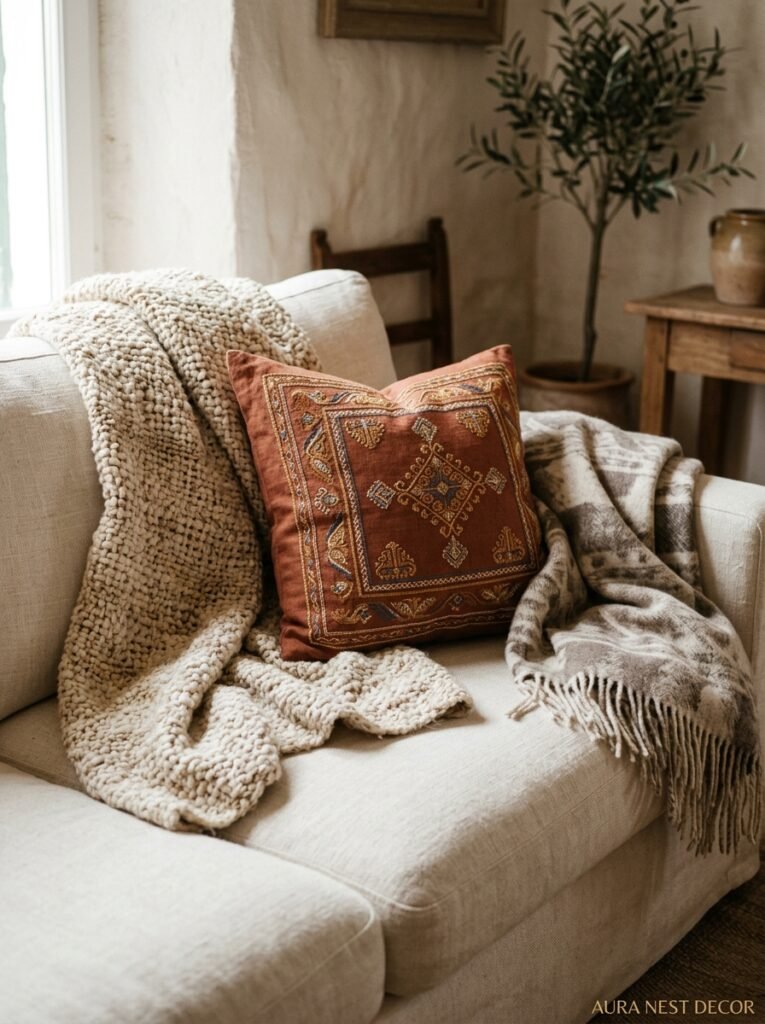
Throw pillows are not enough.
I say this with love, because I used to think throw pillows were enough. They’re not. Not in this style.
Spanish living rooms layer textiles in a way that’s almost aggressive compared to minimalist aesthetics. And the key is that NOTHING matches perfectly. You’ve got a woven wool blanket in rust and cream draped over the arm of a leather sofa. You’ve got a kilim-style rug that pulls three different colors from the room but doesn’t “coordinate” with anything in a deliberate way. You’ve got cushions in different sizes and different fabrics — maybe one in a heavier embroidered fabric, one in a faded linen, one in a dark velvet that’s slightly worn at the edges.
The effect is accumulated. That’s the word. Not arranged — accumulated. Like these textiles arrived in the room from different decades, different markets, different trips. And none of them were bought specifically for the sofa they’re currently on.
“A Spanish living room looks like it was styled by someone who traveled a lot and shopped at markets and kept everything.”
In practice: start with a good rug. A proper one, not a machine-made synthetic — a wool or cotton flatweave with actual character. The rug does 40% of the work in one of these rooms. I’m not exaggerating.
5. The Lighting Setup That Makes Everything Feel Like It’s Golden Hour All the Time
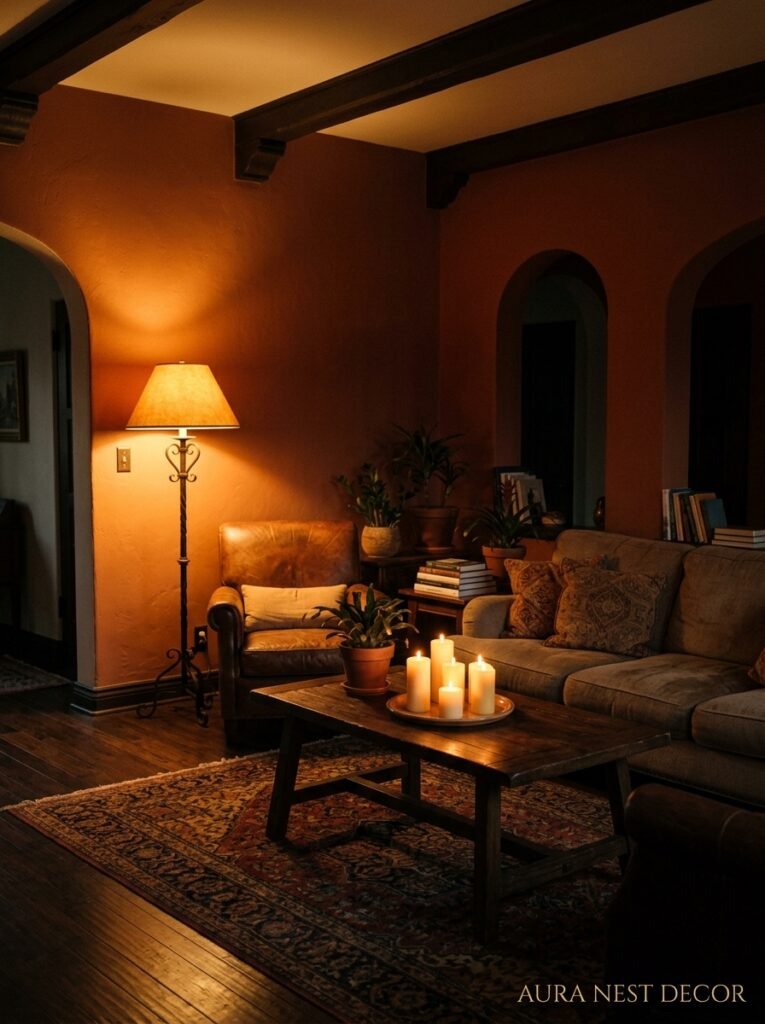
Here’s something I genuinely think about more than is probably normal: the way light moves through a Spanish-style room.
In southern Spain, you get this particular quality of afternoon light — warm, sideways, slightly amber — that casts everything in this glow that makes ordinary spaces look extraordinary. You can’t recreate that in Manchester in November. You just can’t. But you can get surprisingly close to the feeling of it with the right lighting choices.
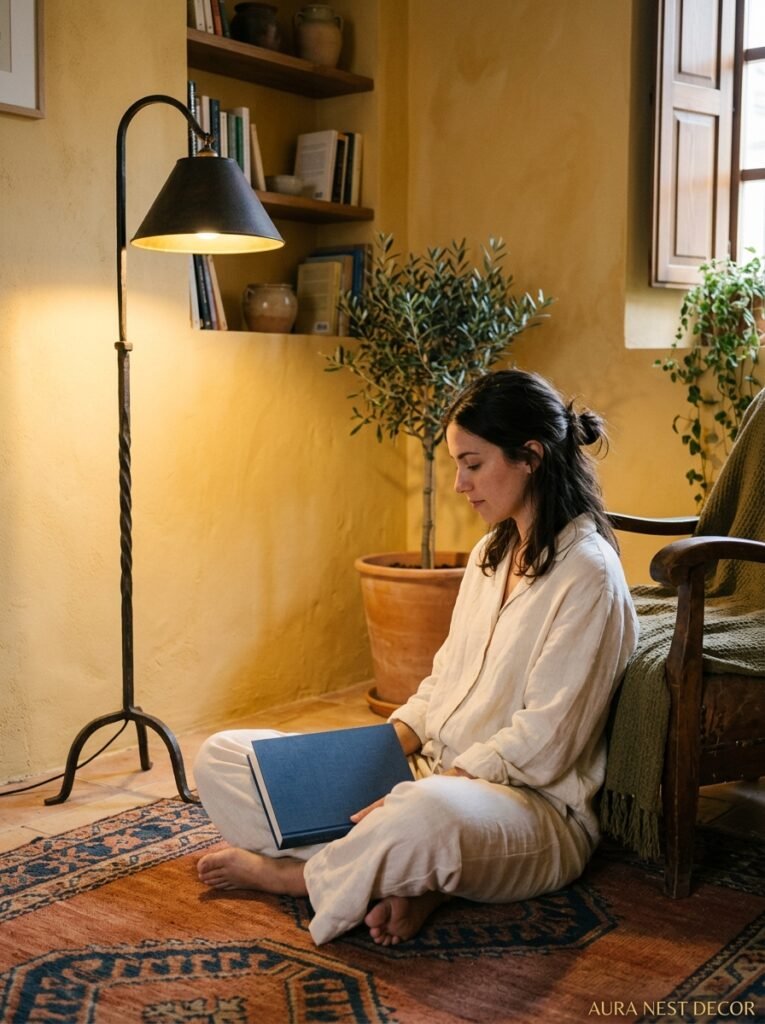
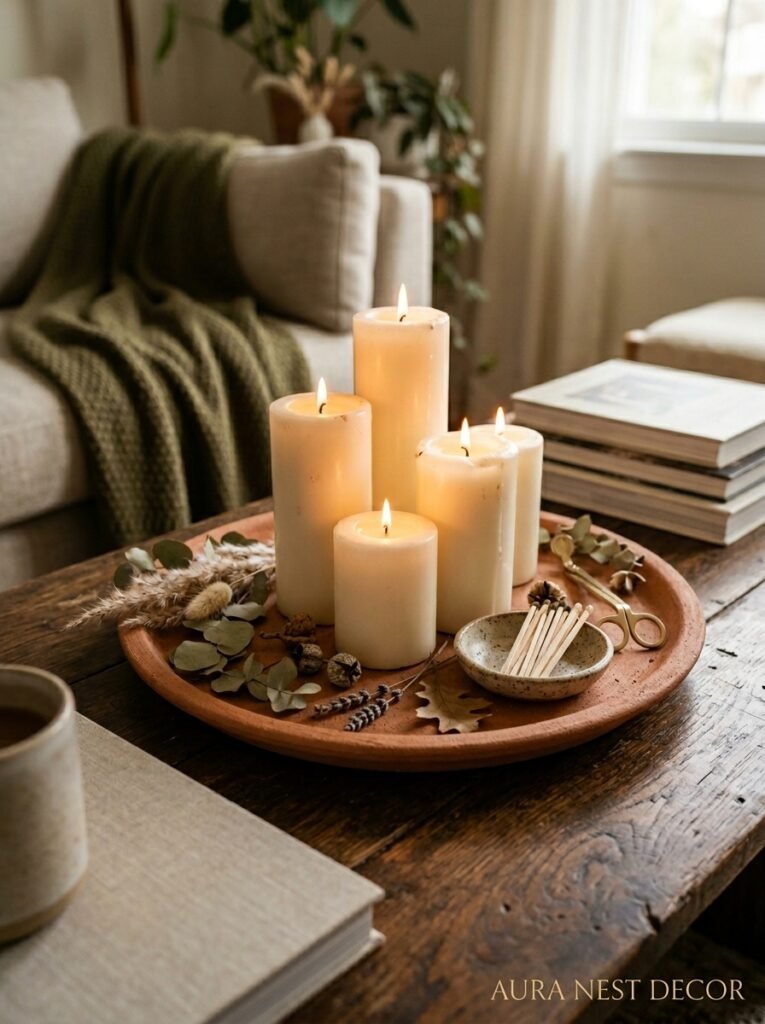
First: get your bulbs right. Warm white, 2700K or lower. I can’t stress this enough. Cool white light kills a Spanish room instantly. It turns everything flat and institutional. You want the amber glow of an Edison-style bulb in a ceramic pendant, or the low flicker of a chunky pillar candle on an iron holder. Actually — candles. Use more candles than you think is reasonable. Spanish interiors love candlelight in a way that feels almost devotional.
Second: floor lamps and table lamps, not just ceiling lighting. Multiple light sources at different heights. The ceiling fixture in a Spanish room is often a wrought iron chandelier or pendant — something with character — but it’s not the only source. You want pools of warm light rather than one even wash of it.
6. Wrought Iron: The Detail That Makes People Ask “Wait, What Is That Room Doing?”
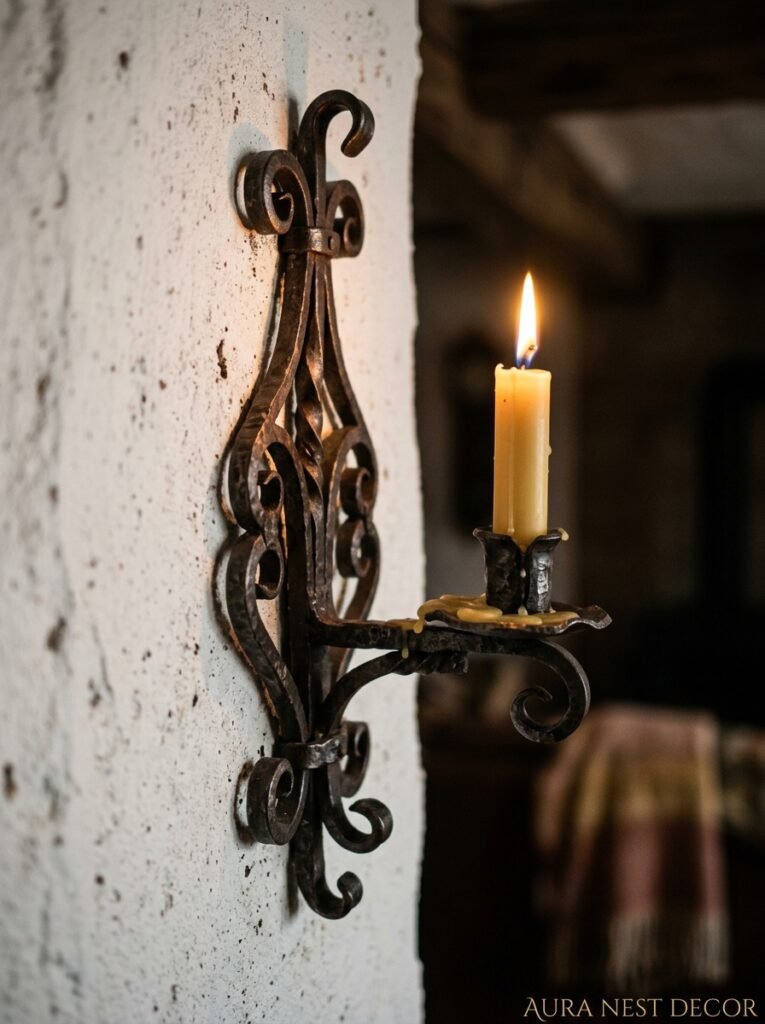
I know wrought iron sounds heavy. It is heavy. That’s kind of the point.
Wrought iron details in a Spanish living room can be subtle or they can be a statement — either works, as long as there’s some. A wrought iron candle holder on the fireplace. A pair of iron-framed mirrors. Iron drawer pulls on a wooden sideboard. A side table with an iron base. A lamp with an iron stand. These little hits of dark, handcrafted-looking metal do something specific to a room: they make it feel like it has HISTORY.
In American homes, especially newer builds, this is often the element that does the most transformation for the least money. A room that’s feeling generic or too new can often be pulled into something more interesting with one or two wrought iron pieces. In UK homes, especially in older properties that already have character in the architecture, iron details lean into what’s already there.
What you want to avoid is anything that looks too polished or too perfect. Spray-painted-to-look-like-iron is immediately obvious and it kills the aesthetic. You want actual iron, or at minimum cast iron or iron-effect metal that has genuine texture. Charity shops in the UK and thrift stores in the US actually turn up good stuff here if you’re patient.
7. The Plant You Keep Seeing in Spanish Living Rooms (and Why It Works)
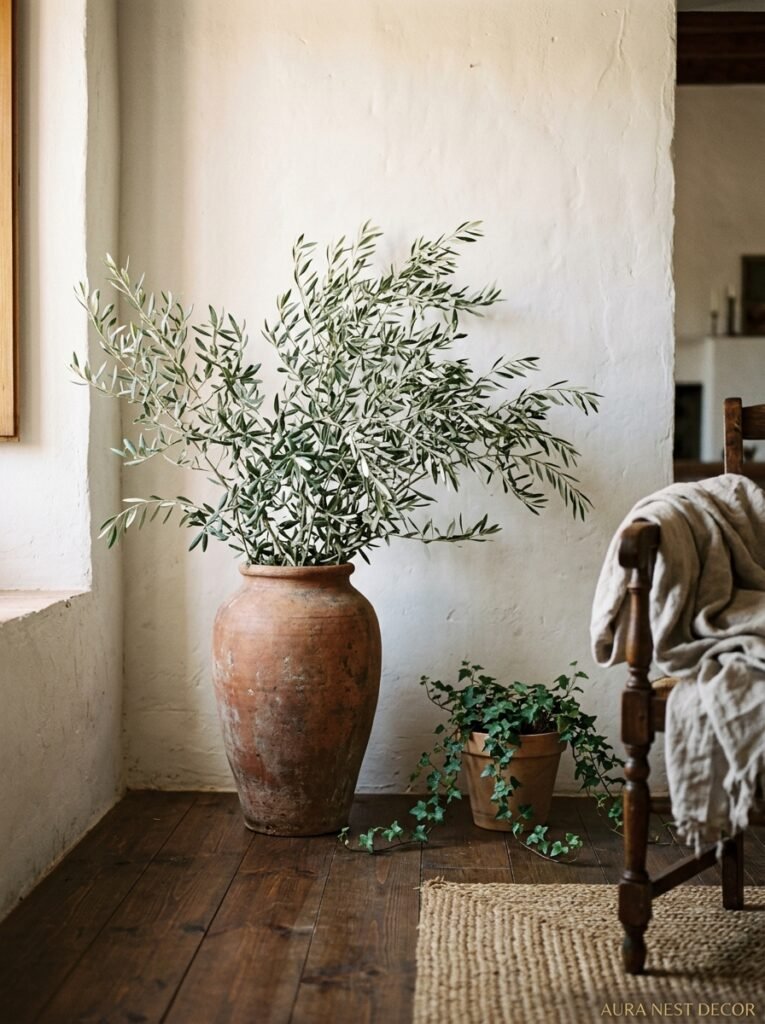
Not a fiddle-leaf fig. Not a trailing pothos.
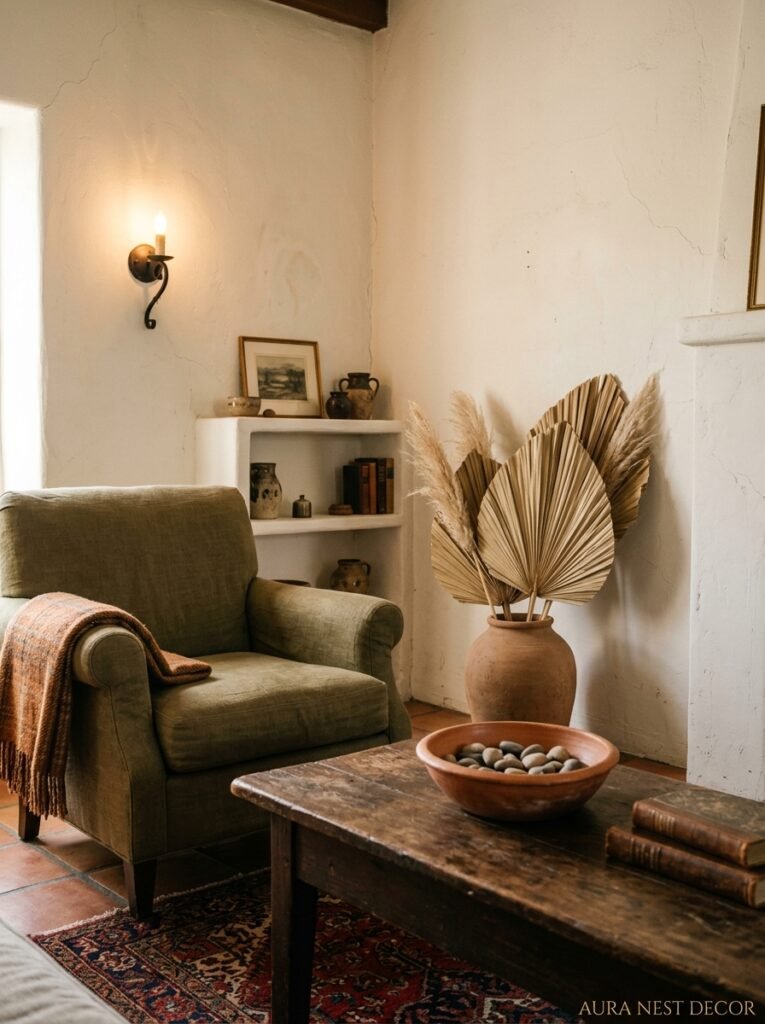
The plant that appears in Spanish-style interiors constantly, the one that actually fits — it’s something architectural. Something that looks like it could survive in a clay pot in hot sun. Think: olive tree (small, indoor variety), a succulent in a terracotta pot that’s actually cracked a little at the base, a tall cactus column in the corner, or a rosemary plant that’s outgrown its kitchen windowsill and ended up somewhere unexpected.
“The plants in a Spanish room look like they belong there, not like they were placed there.”
There’s also a strong tradition of hanging dried botanicals — dried herbs, dried citrus slices on a string, lavender bundles — which add scent as well as visual texture. These are incredibly cheap and they work surprisingly well against white plaster walls or exposed brick. A bunch of dried lavender costs almost nothing in either country and it smells like a farmhouse in southern France, which is adjacent to where we’re trying to go, vibe-wise.
Anyway. The point is: no trendy plants that are currently having a moment on social media. The plants in this style have been “in style” for centuries, which means they’re kind of above the concept of being in style.
8. Arches and What to Do When Your House Doesn’t Have Any
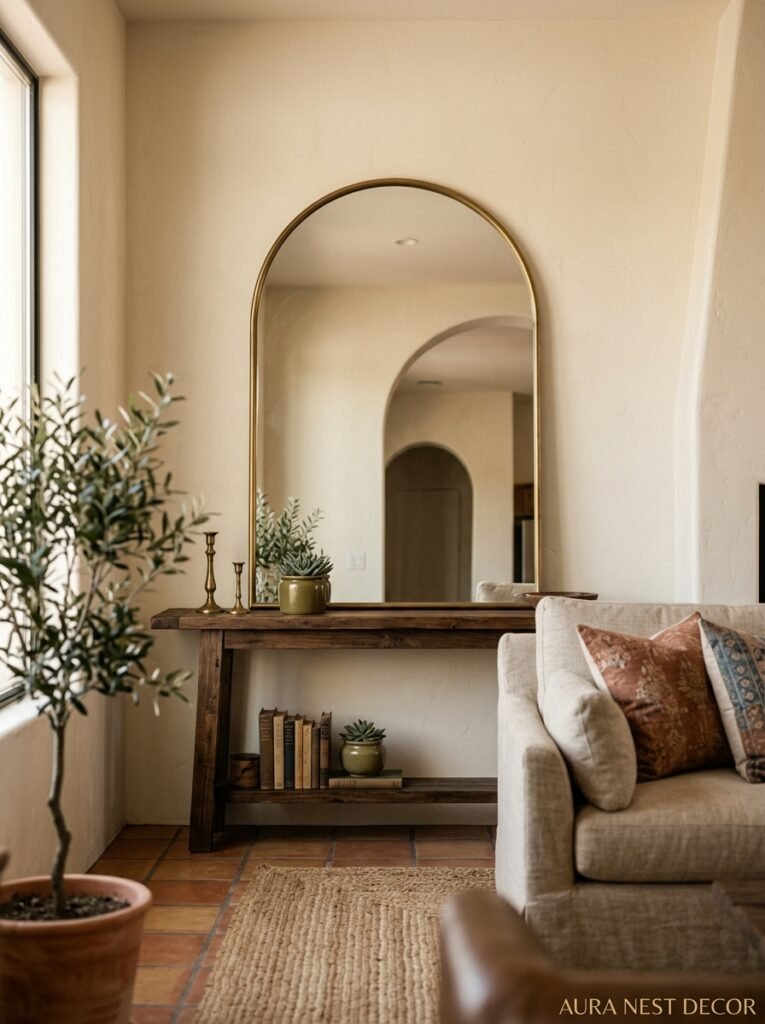
This is the question I get asked most by people trying to recreate a Spanish interior in a non-Spanish house.
You don’t have arches. Your house is a rectangle of right angles, and arched doorways aren’t in the budget. What do you do?
A few things actually work here. One: arch-shaped mirrors. They’re everywhere right now and for good reason — a large arched mirror on a flat wall does a remarkable job of implying a different kind of architecture. Two: look for rounded shapes elsewhere. A curved sofa edge. A round coffee table. Arch-shaped picture frames. The principle of the arch can live in the room without structural changes. Three — and this is the cheat code — get a curved plaster or Roman arch-shaped nook headboard-style piece of furniture or art installation and put it against a feature wall. Some people DIY these with plaster or foam. They look genuinely stunning.
What you’re trying to avoid is a room full of nothing but sharp corners and straight lines. Spanish architecture has roundness to it — in arches, in clay vessels, in the curves of ironwork. The more you can pull that softness into a room with right-angle architecture, the more convincingly the style reads.
9. The Role of Ceramics and Why You Should Have More Than You Think
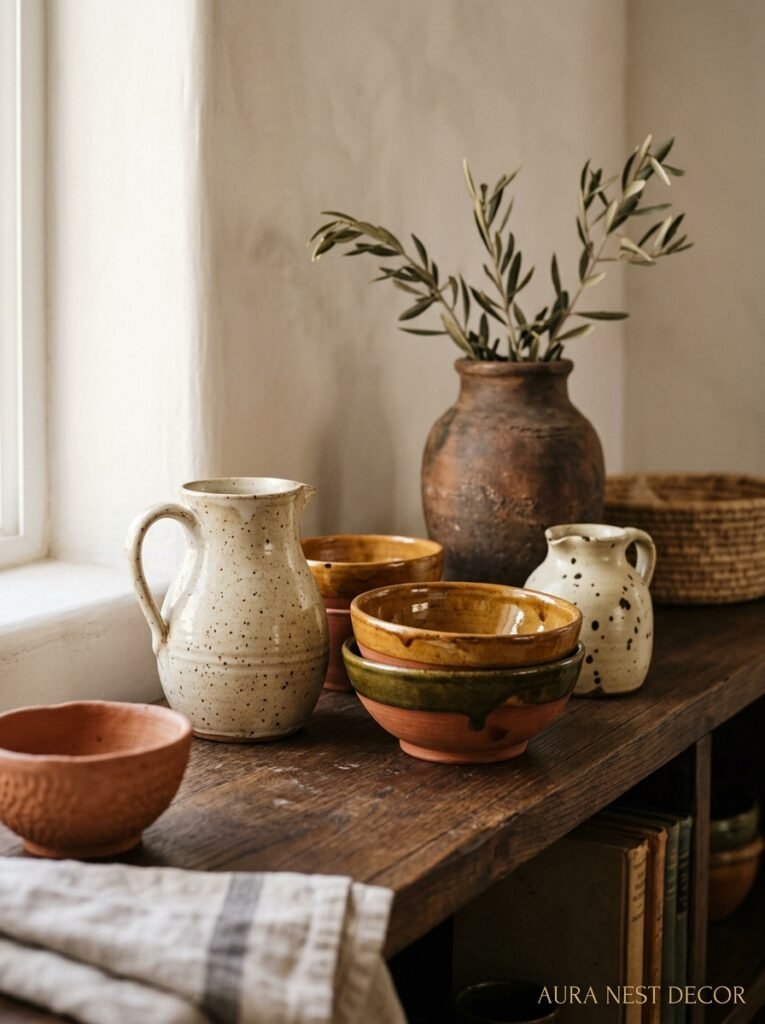
There’s a Spanish ceramics tradition that’s been going for hundreds of years, and it shows up in these interiors in the best way.
We’re talking hand-painted tiles used as coasters or framed as wall art. Terracotta bowls stacked on a shelf not because they’re being used for anything but because they’re beautiful. A ceramic lamp base in a faded glaze. A row of mismatched vintage plates on a plate rack — not matching, never matching — each one from a different market or a different decade.
The general rule: every surface in a Spanish living room has something on it. Not clutter — objects. There’s a difference in intention even when the visual result looks full. Each thing was chosen for some reason, even if that reason was just “I found it and it was beautiful and I kept it.”
British readers: you’re probably already closer to this instinct than American readers, honestly. The British interior tradition involves accumulation in a way that translates surprisingly well. Lean into your antique shops. Your car boot sales. Your inherited bits and pieces. All of that is very, very right for this aesthetic.
10. The One Piece of Art That Changes Everything in a Spanish Room
Not a print. Not a gallery wall of family photos.
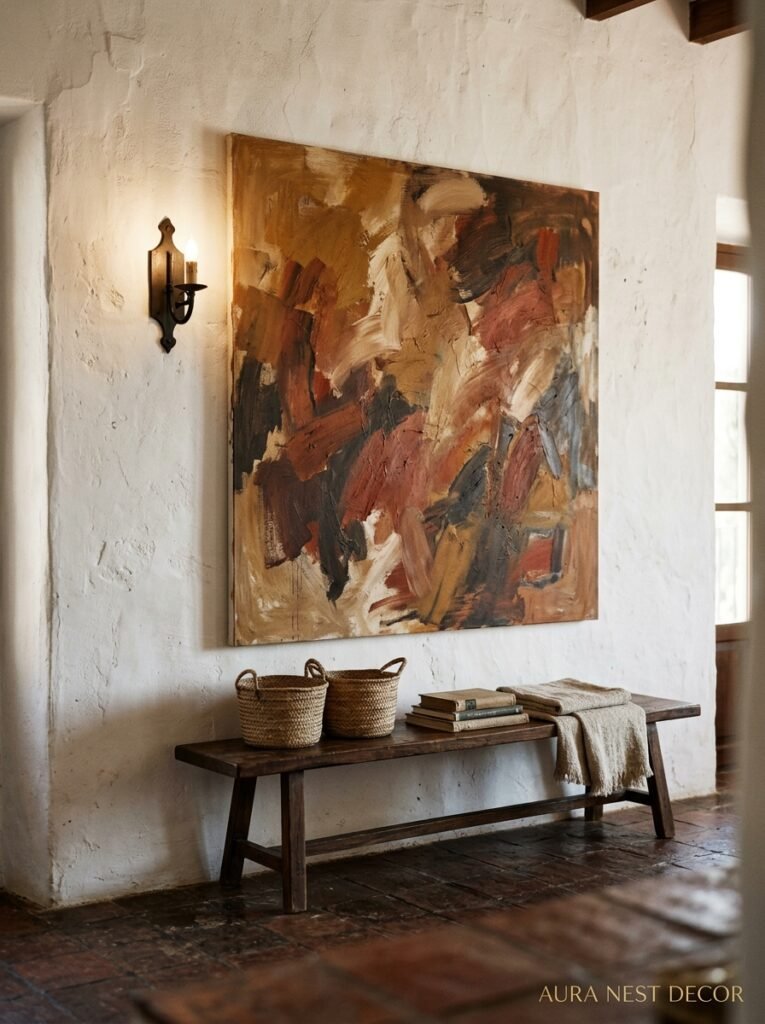
What works: one piece of actual art. Something with texture — an oil painting, a heavy watercolor, something on canvas rather than paper. The subject can be almost anything but it tends to lean toward landscapes, botanical subjects, or figurative work. The frame should be substantial — wood, ideally, with some detail to it, possibly a bit gilded or a bit dark, definitely not IKEA-thin-metal.
And it should be big. Bigger than you think it needs to be. In Spanish rooms, artwork isn’t decorative wallpaper — it’s presence. One large canvas over a fireplace or above a sofa, in a frame that has weight, reads COMPLETELY differently than a collection of small framed prints. It anchors the room. It gives it a focal point that isn’t the television.
Side note — if your television is the dominant visual element in your Spanish living room, something has gone wrong. Hide it in a cabinet, flank it with heavy bookshelves until it stops dominating, or at minimum get it off a cheap flat TV stand and put it on something with actual legs and soul.
11. What Spanish Style Sounds Like (This One’s Weirder but Trust Me)
Okay this is going to sound strange but — sound matters in this aesthetic.
Spanish living rooms tend to have a particular acoustic quality. It’s related to all those textiles and heavy furniture and layered rugs. They absorb sound differently. Hard floors plus rugs plus heavy curtains plus upholstered furniture means sound moves through the room in a specific way — there’s stillness to it. A quietness that isn’t silence.
If you’re listening to music in a Spanish-style living room (and you should be, periodically), it tends to be either completely silent or something with guitar — classical, flamenco-adjacent, or even just singer-songwriter acoustic. Not because the style demands it, but because somehow that music just… fits. The room calls for a certain kind of attention that noise-canceling headphones and true crime podcasts don’t quite honor.
Also, if you have a fireplace: USE IT. The sound of a fire is part of this aesthetic. Even a candle cluster on a fireplace does something similar — a focal point with warmth and a tiny bit of ambient sound.
12. The Small Change That Ties the Whole Room Together (And You Can Do It This Weekend)
Replace your curtains.
I’m serious. If you’re doing anything else in a Spanish living room and your curtains are polyester panels in a neutral from five years ago, they’re working against everything else.
Spanish interiors use curtains in heavy fabrics — linen, cotton canvas, velvet — in deep or earthy tones. Floor to ceiling, pooling slightly on the floor, hung ABOVE the window frame (high and wide, to make the window feel larger and the ceiling feel taller). They don’t have to cost a fortune. Linen curtains from H&M Home or IKEA’s heavier ranges, in terracotta, ochre, forest green, or deep off-white, are genuinely good and genuinely appropriate for this style.
But the RIGHT curtains — hung properly, puddling on a wood or tile floor, in a fabric with actual weight — can make a room feel like you’ve been working on it for years. Even if you just changed the curtains and did nothing else.
That’s maybe the best thing about Spanish style overall: it rewards commitment to individual choices. You don’t have to do everything at once. You pick one element — the rug, the curtains, the iron candleholders, the ceramics on a shelf — and you do it well. And then the room starts to pull toward itself. Slowly, the way all good things do.
—
❓ FAQ
Q: Can I do Spanish-style decor in a modern or new-build home without it looking costume-y? A: Yes, but you have to go lighter on the architectural references and heavier on the objects and textiles. New builds don’t have the bones for it, so you compensate with accumulated character — good rugs, heavy ceramics, real wood furniture, iron details. The style lives in the stuff, not the walls.
Q: What’s the difference between Spanish style and Mediterranean style in home decor? A: Spanish style is a subset of Mediterranean, but it’s specific — it leans darker, heavier, and more earthy than, say, Greek or Italian influences. You’ll see more wrought iron, deeper colors, and less blue-and-white than you would in a Greek island aesthetic. It’s also less resort-hotel, more old farmhouse.
Q: What kind of rug actually works in a Spanish-style living room? A: A wool flatweave or a kilim-style rug with warm earth tones is your best bet — think rust, ochre, cream, dark brown, maybe a hit of navy. Size up from what you think you need. A too-small rug in this style looks accidentally wrong, whereas a large rug that fills the seating area properly looks completely intentional.
—
💭 Final Thoughts
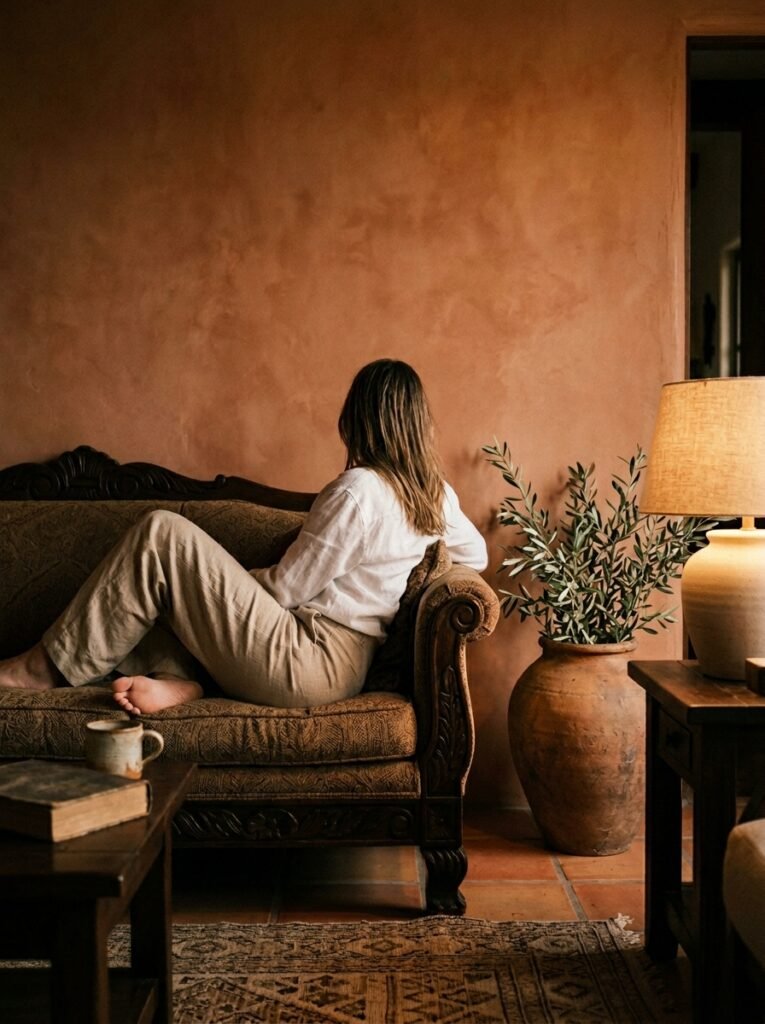
Spanish-style living rooms feel timeless because they’re built on things that don’t go out of style: warmth, weight, craft, and the beauty of objects that have been genuinely loved. You don’t have to recreate a room in Seville. You just have to let the room breathe a little, accumulate a little, settle into itself.
What’s the one thing in your living room right now that feels most out of step with that kind of warmth?