The Cozy Vintage Living Room You’ve Been Saving to Every Board (But Haven’t Tried Yet)
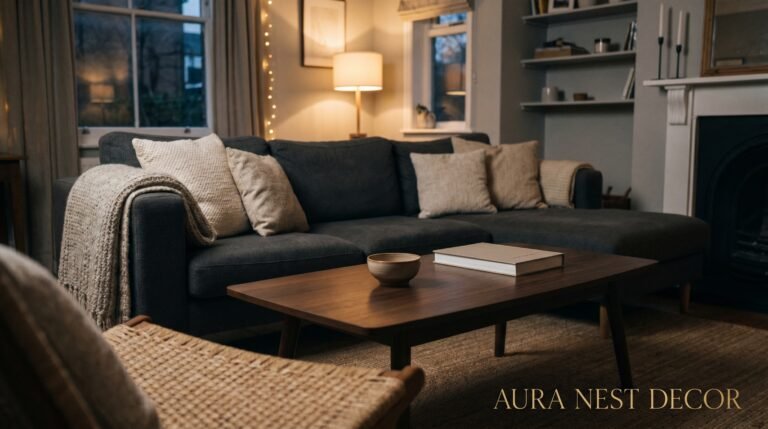
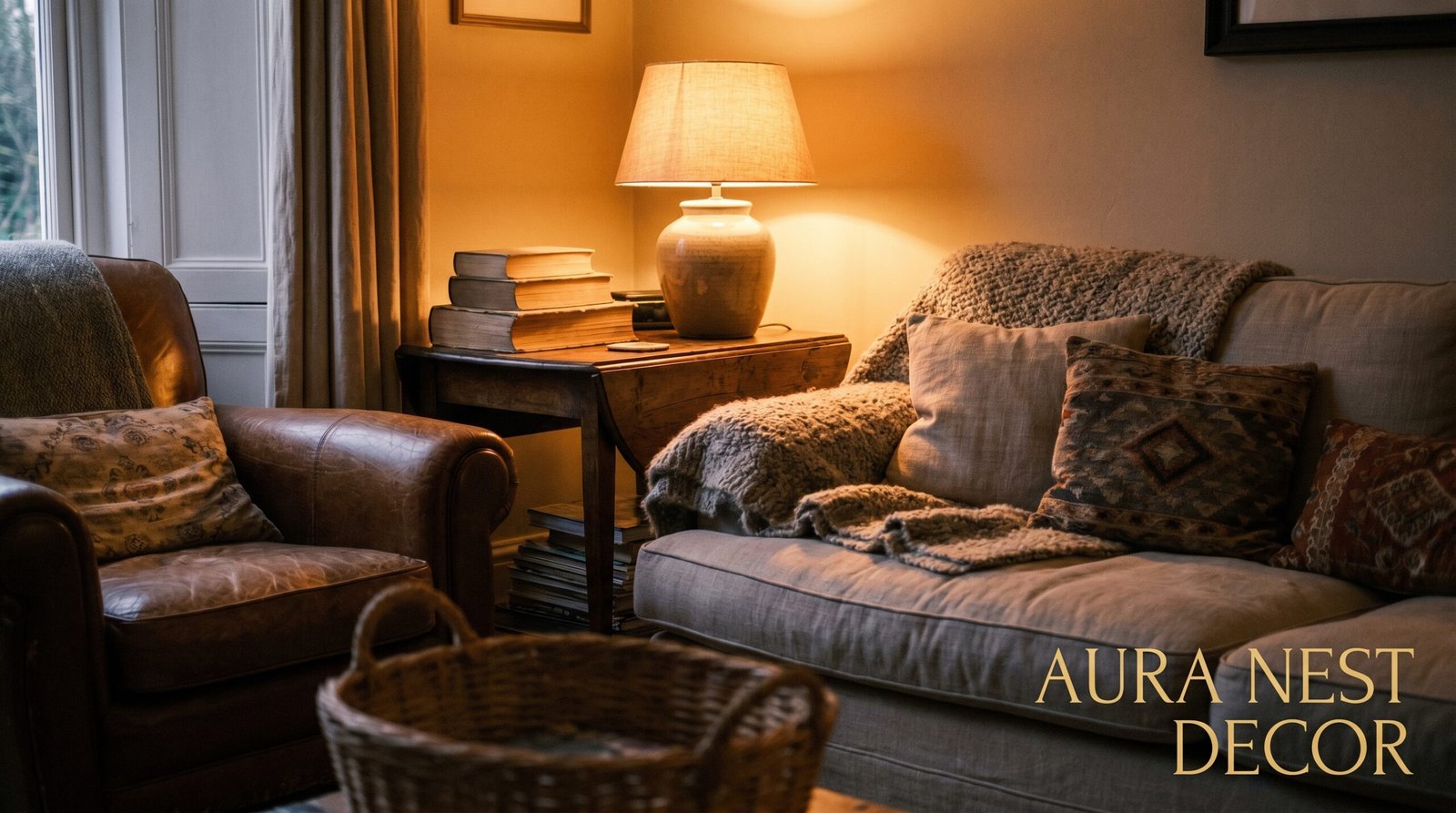
You know that feeling when you walk into someone’s living room and you just… stop? Everything’s worn in the right ways. There’s a lamp in the corner that looks like it survived three different decades and somehow won. That’s what we’re building here.
—
1. Why “Vintage Cozy” Hits Different Than Any Other Aesthetic Right Now
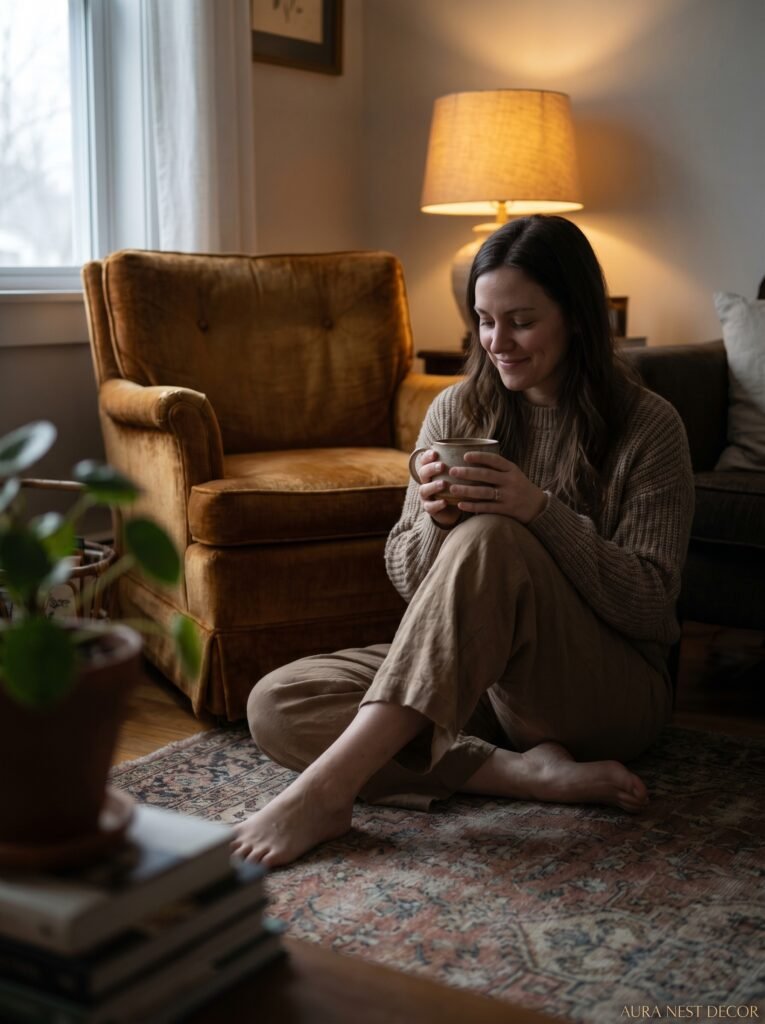
There’s something happening in living rooms across the US and UK that’s hard to pin down but instantly recognizable when you see it. It’s not maximalism exactly, and it’s definitely not the cold-white-walls minimalism that dominated the last decade. It’s something older, warmer, more personal. Rooms that look like they’ve been lived in by interesting people.
The vintage cozy aesthetic works because it doesn’t try too hard. A worn leather armchair pulled close to a stack of actual books someone actually read. A lampshade that’s maybe slightly crooked. Curtains in a faded floral that shouldn’t work with the rug but somehow absolutely does. These rooms feel earned rather than purchased.
And honestly? Pinterest searches for “cozy vintage living room” have been climbing steadily for a while now because people are exhausted by interiors that feel performative. They want rooms that look like real life got lived there. Which is both the easiest and the most difficult thing to create, because it requires you to stop overthinking and start trusting.
The good news is that vintage cozy has almost no rules. The bad news — for perfectionists, anyway — is that it requires you to let things be a little imperfect. That amber glow at 7pm. That slightly dented side table. That’s the whole point.
“Vintage cozy isn’t a mood board. It’s a permission slip to stop making your home look like it’s for sale.”
—
2. The Furniture Pairing That Makes Secondhand Look Intentional
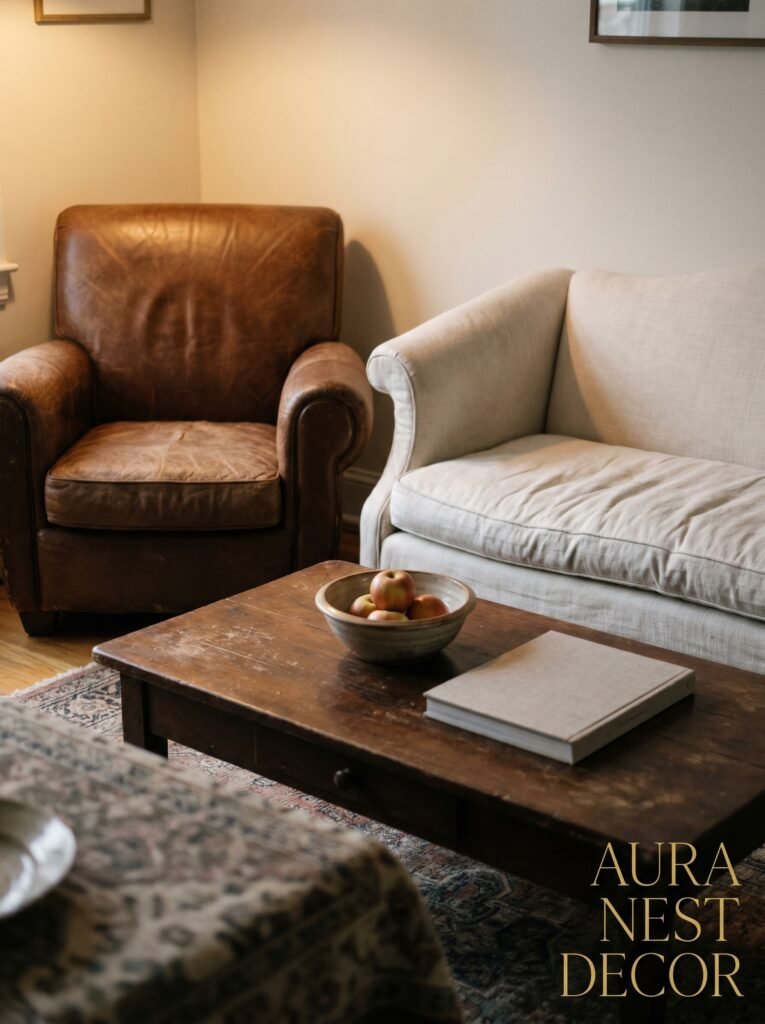
Here’s what nobody tells you about vintage furniture: it’s not supposed to match. Matching is actually the thing that kills the vibe. A Victorian-era carved wood side table next to a 70s-style low-slung velvet sofa? Correct. A chippy painted dresser serving as a TV stand beside a mid-century armchair? Absolutely.
The trick — and this is the ONE thing worth memorizing — is that you need at least one consistent thread running through the mismatched pieces. Could be color. A soft gold tone that shows up in the wood stain, the lamp base, the picture frame. Could be texture, like every upholstered piece having some kind of nap to it. Or it could just be age. Pieces that are all clearly old, even if they’re from different eras, tend to coexist peacefully.
Charity shops and estate sales are obvious answers in the UK, and thrift stores and Facebook Marketplace in the US — but don’t sleep on antique markets and flea markets for the slightly bigger statement pieces. A brass floor lamp. A velvet wingback. The kind of thing that makes people immediately go “where did you find THAT.” You don’t need much of it. One great vintage anchor piece and the room starts building itself around it.
Side note — don’t be afraid of things that need a bit of work. A sofa with good bones and a slightly worn cushion is your best friend here, not your enemy.
—
3. The Color That Keeps Showing Up in Every Beautiful Vintage Living Room Right Now
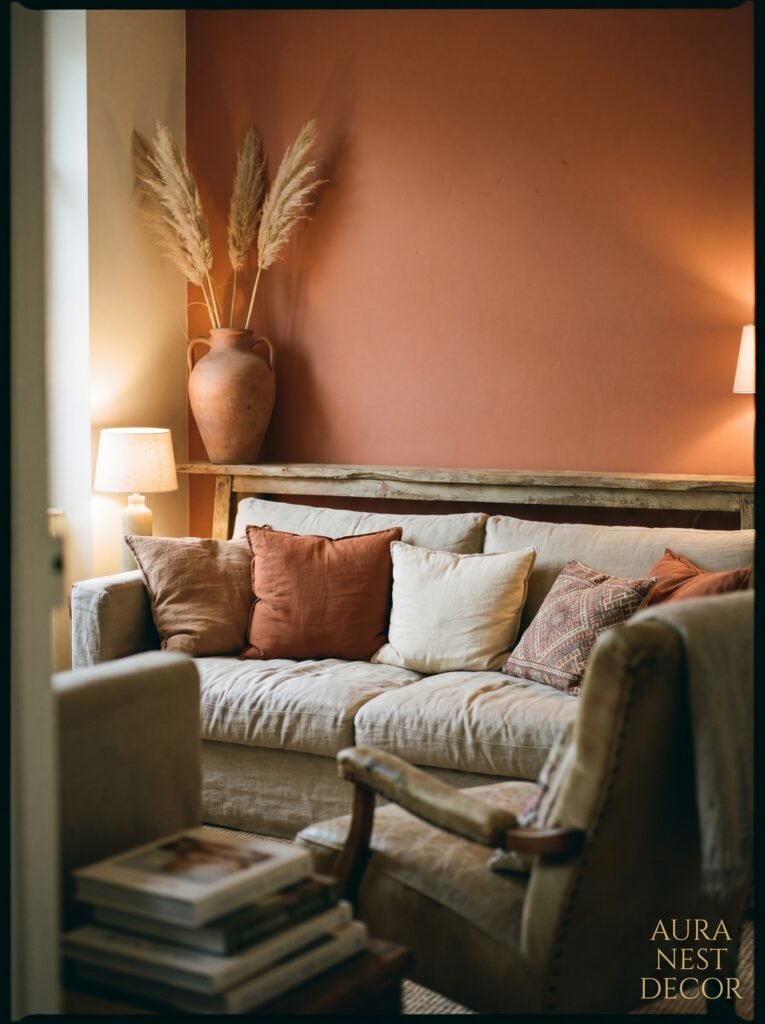
It’s not beige. Well. Sometimes it is, but not the flat builder’s beige you’re imagining. It’s more like the color of milky coffee or old parchment or really good honey. Warm, slightly yellow-toned neutrals that make everything sitting in front of them look more expensive and more intentional.
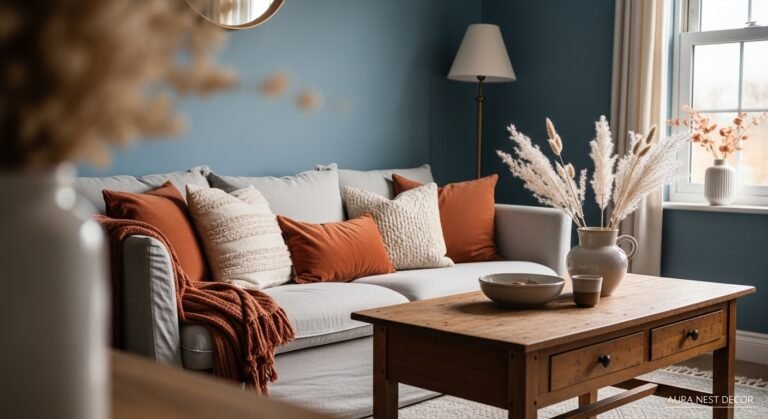
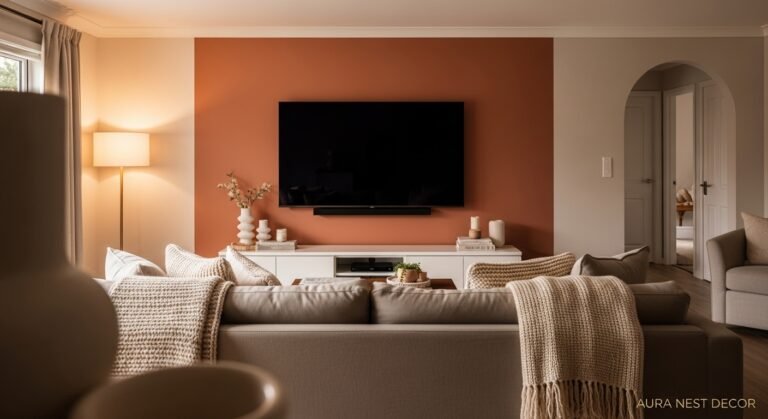
But the color I keep seeing EVERYWHERE, the one that’s all over the Pinterest boards and the interior accounts I can’t stop scrolling — is this particular dusty terracotta. Not the bright Southwestern version. The faded, almost slightly-pink terracotta that looks like an old terracotta pot left in a sunny window for five years. That color.
Pair it with sage green — actual sage, not the yellow-green that crept in around 2020 — and deep off-white and you’ve got something that looks like it belongs in a Georgian terraced house in Edinburgh and a craftsman bungalow in Vermont equally. It’s weirdly versatile that way.
You don’t have to paint everything. An accent wall, or honestly just a couple of large throw pillows and a vase in that dusty terracotta, can shift the whole temperature of a room. Colors are more powerful than furniture at setting tone. Which is either great news (cheap fix!) or mildly terrifying depending on how you think about it.
—
4. Layering Textiles Until the Room Feels Like a Hug
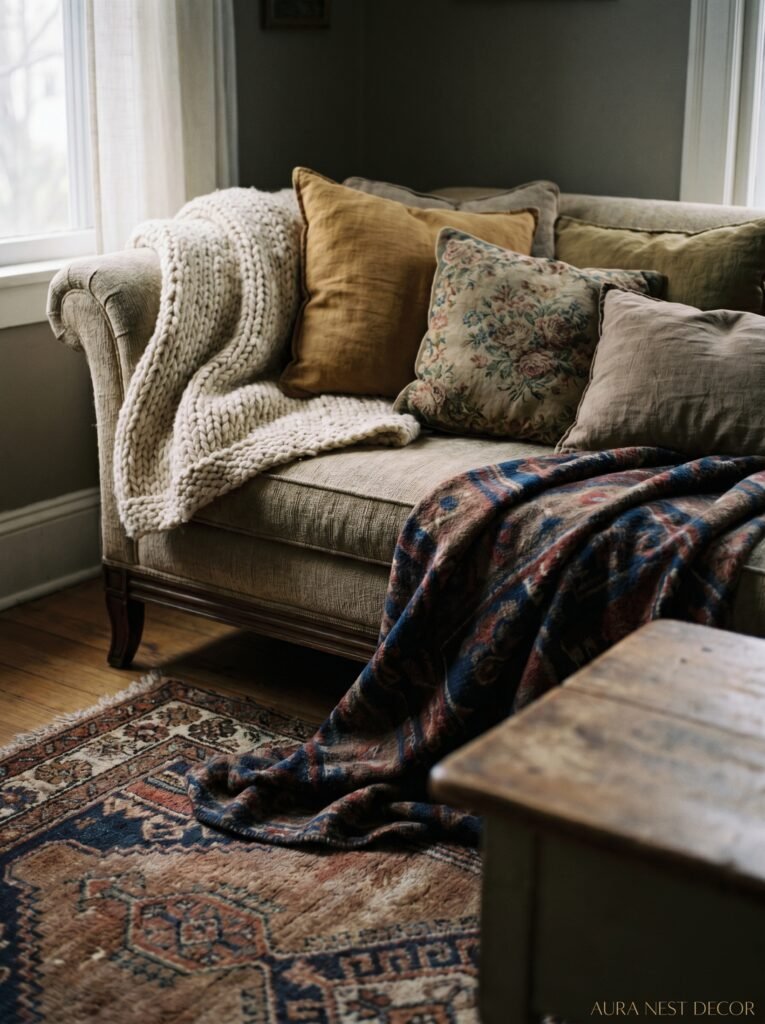
This section is where the real magic happens. You can have the most beautiful vintage furniture and the most considered color palette and the room will still feel flat if the textiles aren’t right. Textiles are what make a room feel SOFT. Which is the whole goal.
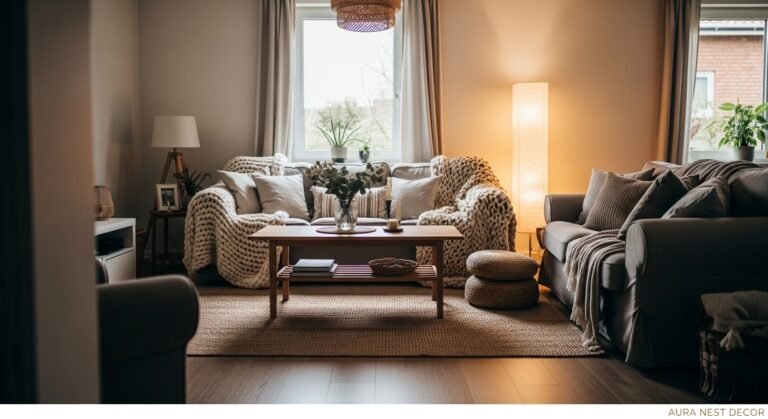
For a cozy vintage living room, you want layers. Not coordinated layers where everything matches the same color family. Real layers, the kind that look like they accumulated over time. A chunky knit throw over the arm of the sofa. A different, finer woven blanket draped over the back. A couple of cushions in varying sizes — and don’t be precious about the sizes, a mix of small and large looks more natural than a perfectly symmetrical arrangement.
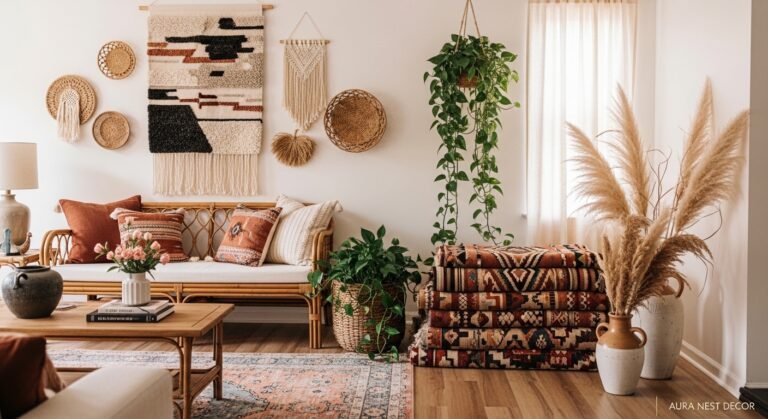
Rugs. Oh, the rugs. A large Persian or Turkish-style rug underneath everything anchors a vintage room like nothing else. Doesn’t have to be an actual antique, loads of decent options exist at reasonable price points, but it should have pattern and depth and a slight faded quality, or maybe it’s the opposite, honestly — a rich deep-color rug that hasn’t faded yet can work just as well if everything else is lighter.
In the UK, wool throws with a bit of tartan or check read as heirloom without trying. In the US, a linen or cotton quilt folded on the sofa does the same work. Either way: layers. Always more than you think you need.
“The room isn’t finished until it looks like someone might actually fall asleep in there.”
—
5. The One Rule That Makes Any Collected Vintage Space Feel Intentional
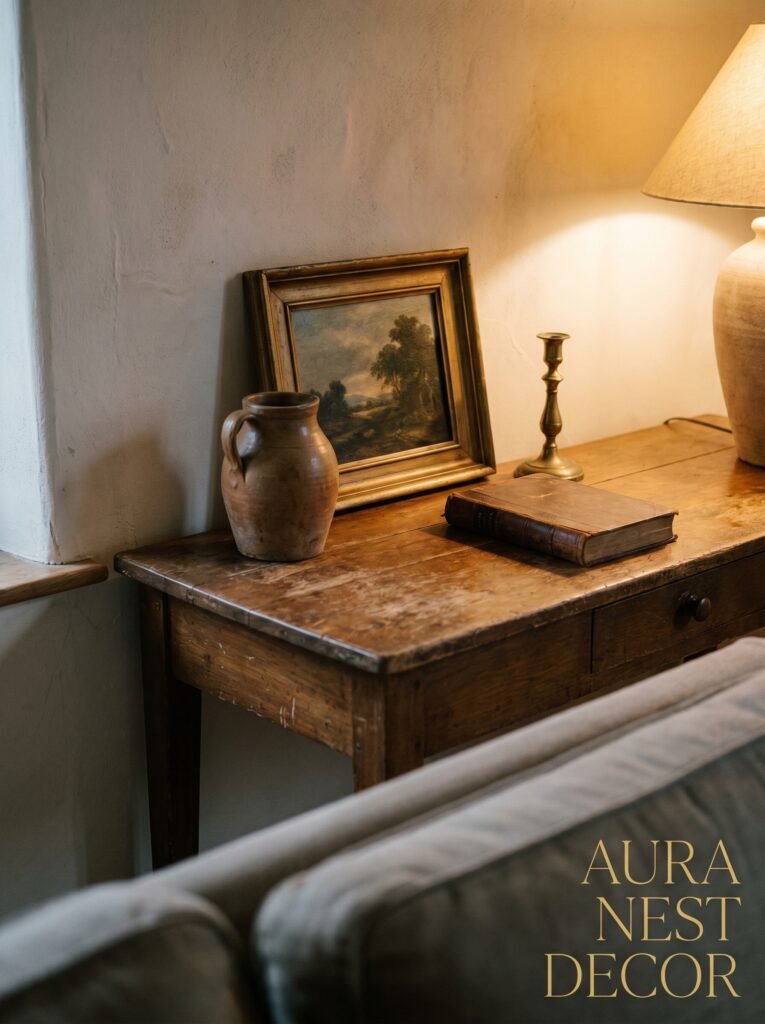
Don’t do categories. Seriously — don’t dedicate a shelf to “vintage cameras” or “old perfume bottles” or whatever. That’s how vintage tipping into clutter happens, and it’s also how it starts looking like a set design rather than a home.
Instead, mix objects by scale and height. A tall candlestick next to a small stack of books next to a medium ceramic vase. The eye moves, the arrangement feels dynamic, and because you’re not organizing by theme, the pieces get to just be beautiful objects rather than a “collection.”
One thing that works brilliantly is placing something unexpected — a small framed portrait or miniature, a single dried flower in a bud vase, a little dish with a couple of interesting stones or old buttons — among the books on a shelf. It breaks up the monotony. It also tricks the eye into thinking the books were just… already there, not arranged. Which is the feeling you want.
Don’t overcrowd. The objects need breathing room or they start shouting over each other. Less is almost always more with vintage displays, which feels counterintuitive because vintage spaces often feel full. But there’s a difference between full and crowded, and the difference is mostly negative space.
—
6. What Vintage Lighting Does to a Room (That No Other Change Can Replicate)
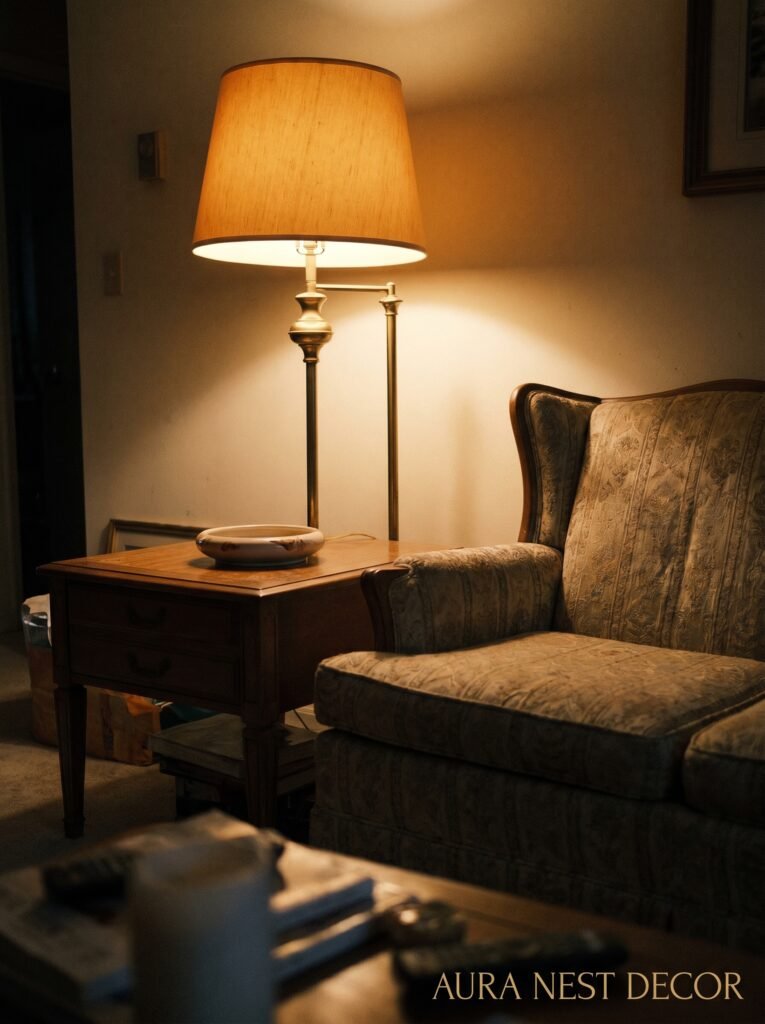
Lighting is doing more work in a cozy vintage living room than any other single element. More than the sofa. More than the rug. And yet it’s the last thing most people address.
Overhead lighting is essentially the enemy here. Harsh overhead light flattens everything, makes the room look like an office, and just feels wrong in a space you’re trying to make feel warm and intimate. What you want instead is pools of warm light at different heights. A floor lamp in the corner. A table lamp on the side table. Maybe a small lamp on the bookshelf if you’ve got the outlets for it.
Edison bulbs are maybe a bit of a cliché at this point but honestly — they’re a cliché because they WORK. The amber-orange glow they give off at 7pm on a dark autumn evening? There’s no substitute. Vintage-style brass or antique bronze fixtures make a huge difference too. Even a modern lamp can start reading as vintage if the shade is the right warm parchment color.
Candles. Lots of them, but in holders that feel old. A cluster of mismatched candlesticks on the mantlepiece at different heights is one of the most classic moves in the vintage cozy playbook, and it never gets old. No shame in using battery-operated tea lights if you’ve got small kids or pets — the glow is what matters.
—
7. Gallery Walls That Look Lived-In, Not Like You Bought the Set
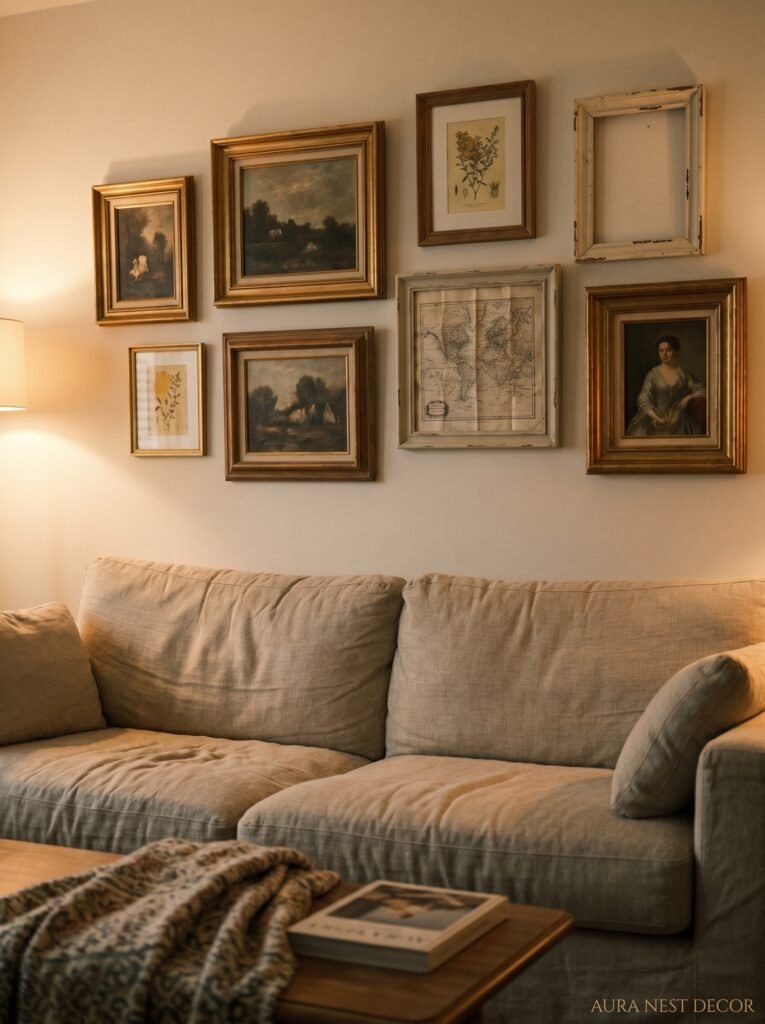
The worst gallery walls are the ones where everything is the same frame size, evenly spaced, with matching black frames. Beautiful in a modern minimal room, absolutely wrong here. Vintage cozy gallery walls should look like they grew organically, like you’ve been adding to them over years.
Mix frame finishes. Gilt, dark wood, thin black, white, even unframed canvas or prints with just clips. Mix sizes aggressively. A large oil painting (doesn’t have to be an actual antique, prints are fine) surrounded by much smaller pieces looks rich and layered. Add a non-frame element — a small decorative plate, a woven basket, a vintage mirror — to break up the flatness.
For content: old botanical prints are eternally good. Family photographs (even vintage-looking ones you printed yourself from digital files) add warmth and personality. A vintage map. A faded watercolor landscape. The kind of art that looks like it has a story, whether or not it actually does.
In the UK, car boot sales are a gold mine for old frames. In the US, thrift stores usually have a bin of them for almost nothing. Buy the frame and replace whatever’s inside if needed — or don’t, because sometimes the original content is charming.
“A gallery wall that looks like it happened accidentally is the hardest kind to get right. And the most worth it.”
—
8. The Bookshelf Strategy That Every Cozy Vintage Room Gets Right
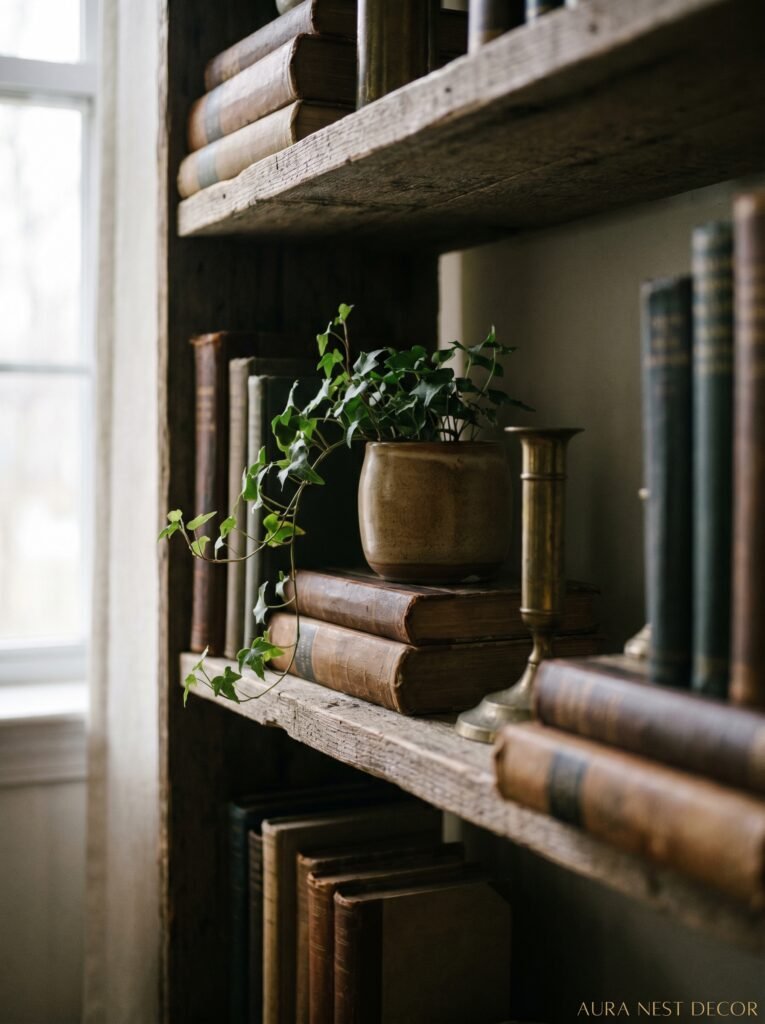
Books are doing double duty in a vintage living room. They’re functional, obviously. But they’re also texture, color, a kind of visual warmth that no purchased decor object can really replicate. Full bookshelves read as intellectual, lived-in, and cozy simultaneously, which is a difficult combination to achieve otherwise.
Don’t arrange them by color. I know, I know — the rainbow bookshelf was everywhere for a while and it looks incredible in photos. But it’s aesthetically neutral in person. Arrange by whatever system makes sense for you as a reader, and then style the shelf on top of that logic, not instead of it.
Face a few books outward so you can see the cover. Lay a few on their sides to create height variation. Tuck in some of those small objects I mentioned earlier. Leave a small section slightly underfilled — it reads as natural rather than aggressively styled.
The key is mixing heights throughout rather than having all the tall books in one place. It sounds counterintuitive for organization but it makes a huge visual difference. The shelf looks more like a real person’s shelf and less like a photo shoot.
—
9. How Old Mirrors Make a Room Feel Like It Has a Secret
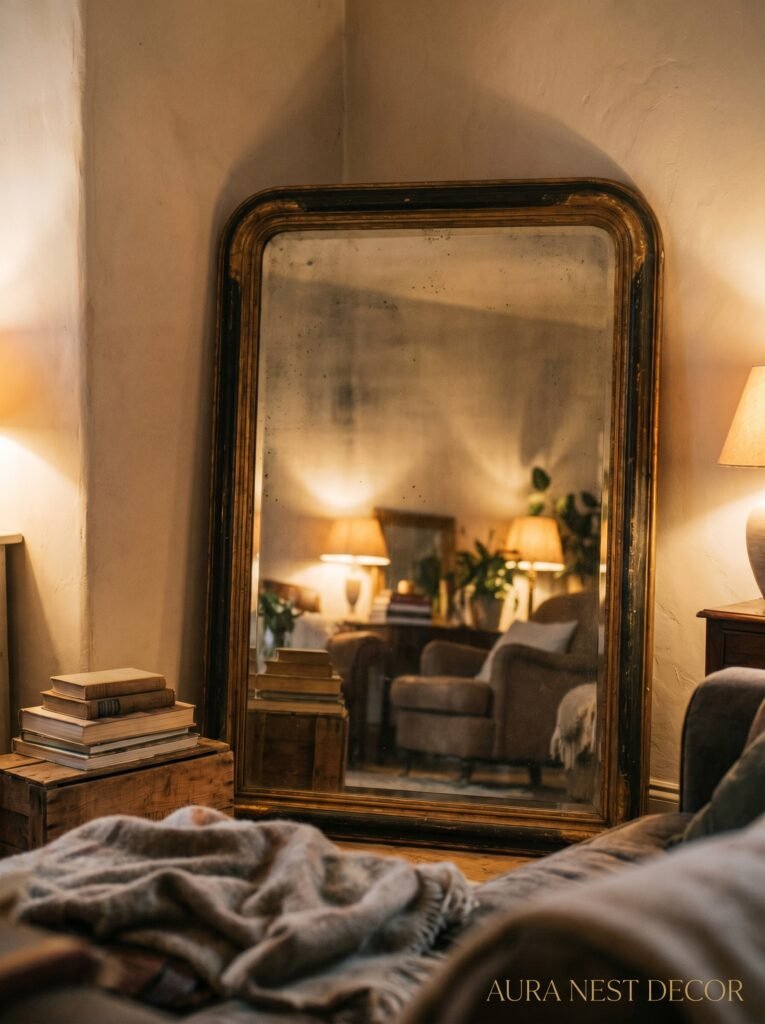
A vintage mirror is one of the highest-ROI things you can add to a cozy living room. Not because of the light-bouncing practical stuff (though that’s real too) — because a foxed, slightly worn, ornate mirror with a great frame makes a room look like it has history. Like the house has been somewhere.
Lean a large one against the wall rather than hanging it if it’s tall enough. This is one of the simplest things you can do to make a room feel immediately more relaxed and editorial. Hung mirrors say “I decorated this room.” Leaning mirrors say “this is just how it is.” Different energy entirely.
Don’t be afraid of slightly imperfect mirrors — slight foxing (that speckled effect on really old mirrors), slightly off-kilter silvering — these all add to the vintage feel rather than detracting from it. You can find beautiful arched or ornate frames at most antique markets and flea sales on both sides of the Atlantic, and they tend to be more affordable than you’d expect.
—
10. Plants That Belong in a Vintage Interior (And the Ones That Don’t)
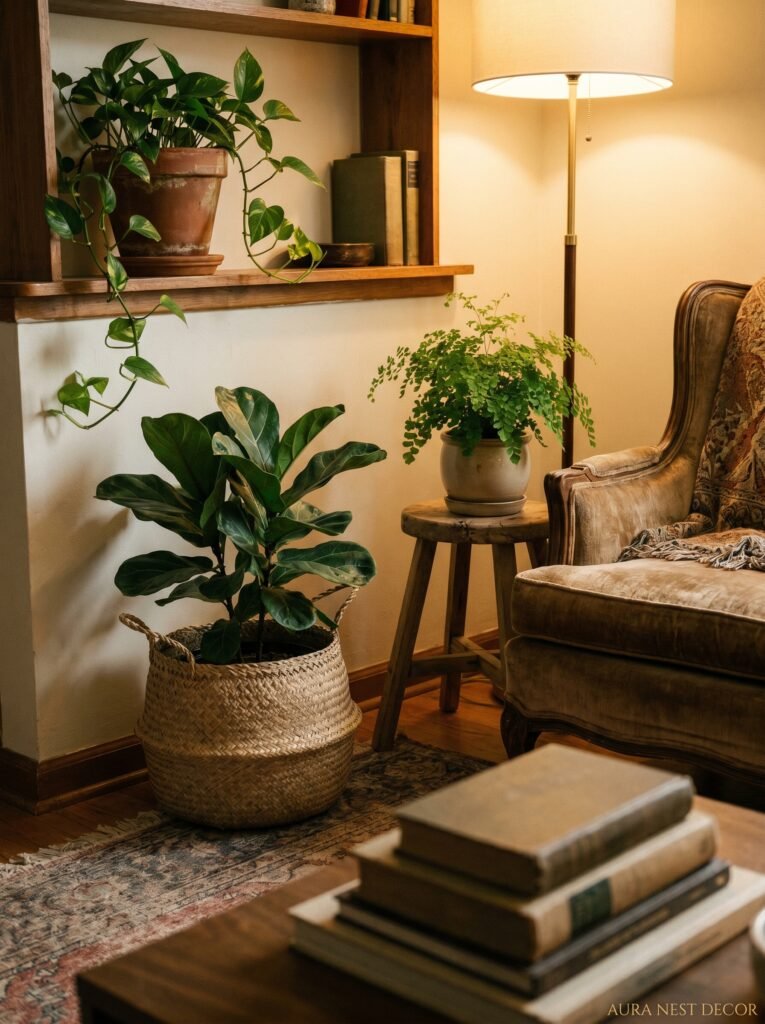
Not every plant works in a vintage living room. Succulents in terracotta pots, oddly, can go either way — very terracotta-colored succulents in a window can feel vintage cottagecore, but the modern minimalist succulent arrangement? Wrong room. Monstera plants are too contemporary. A big dramatic one can feel jarring.
The plants that belong: trailing pothos in hanging vintage macramé or draped over a bookshelf. English ivy in a small pot on a windowsill. Ferns in wicker baskets — the droopy, messy kind, not the perfectly trimmed kind. A big fiddle leaf fig in a beautiful aged ceramic pot, if you can keep one alive (I personally cannot, but more power to you). And dried flowers, honestly. Dried pampas grass or eucalyptus or lavender in a ceramic jug makes a stunning vintage statement and requires absolutely zero maintenance.
The plant vessels matter almost more than the plants themselves in this context. Heavy ceramic crocks, old terracotta, wicker baskets as pot covers, maybe a vintage enamel bucket for something trailing and wild.
—
11. The Small Details That Read as “Collected Over a Lifetime” vs. “Bought Last Tuesday”
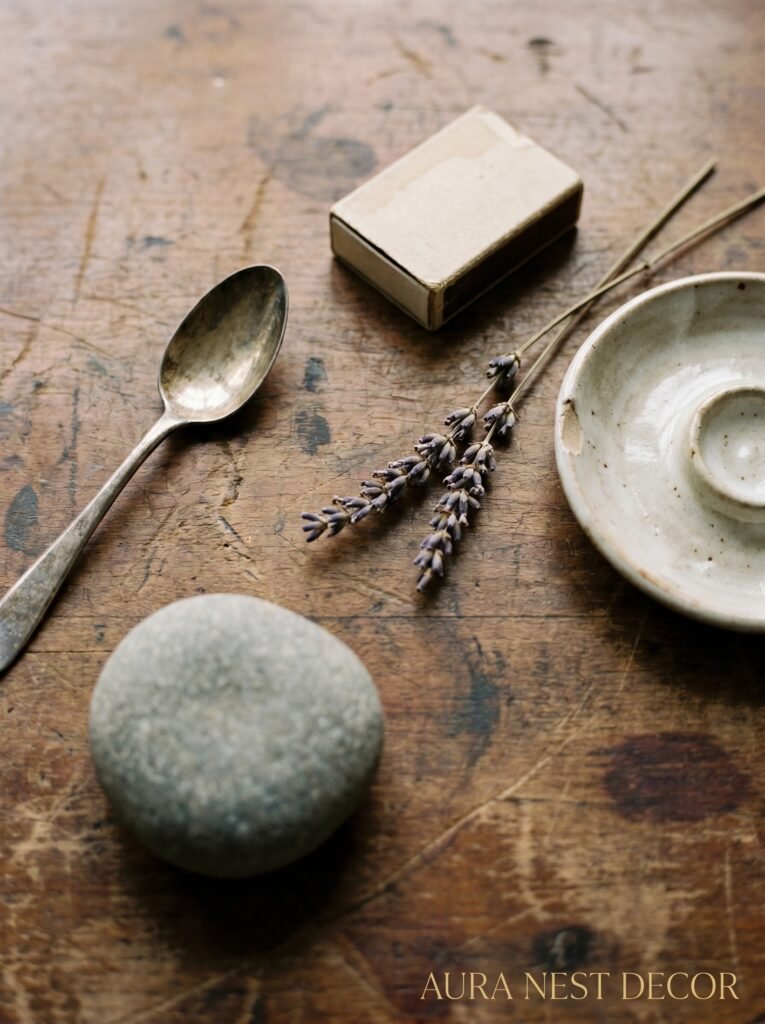
This one’s about the stuff you don’t notice consciously but absolutely feel. The small details that make a room feel like a real person lives there.
Old books (actual old books, not just ones with pretty spines) stacked on a coffee table with a candle on top. A worn leather notebook on the side table. A little dish of something real — a couple of old buttons, a smooth stone from a beach trip, a vintage coin. These aren’t decor. They’re evidence of a life.
Trays are very useful here. A worn wooden tray or an old lacquered one can corral a few small objects and make them look curated rather than scattered. A tray on a coffee table with a small plant, a candle, and one interesting object is a classic for a reason.
And honestly — don’t be afraid to leave some things that are just yours. A book you’re currently reading. A slightly chipped mug from a place you love. Your actual blanket that your actual dog has sat on. The imperfection is the story.
—
12. The Edit: What To Remove Before You Add Anything New
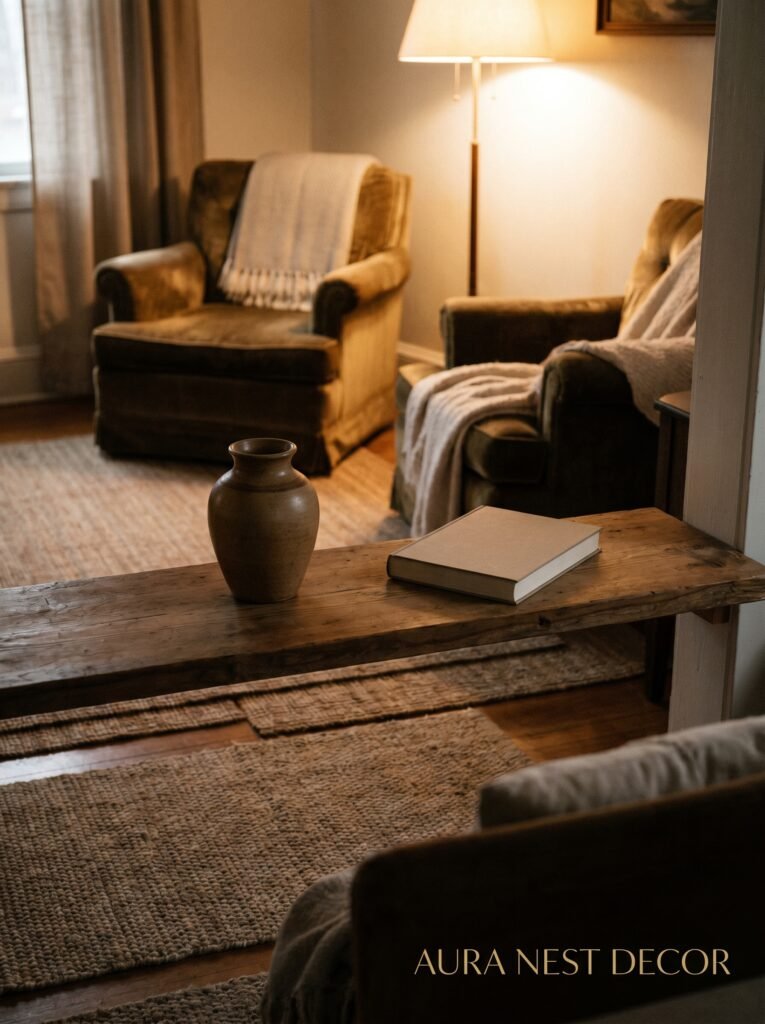
This is the section people skip and then wonder why their room still doesn’t feel right. Because it’s not about what you add — sometimes it’s entirely about what you take away.
Anything plastic that doesn’t have a specific job to do. Anything that’s trying too hard to be vintage but isn’t (fast furniture with distressed paint that clearly wasn’t distressed by time). Matching furniture sets. Anything that’s in the room because it fits, not because you actually like it.
Clear out enough that you can see what you actually have. Nine times out of ten, people already own most of what they need for a cozy vintage living room — they just can’t see it through all the stuff surrounding it.
Then add back slowly. One piece at a time, if you can manage it. The goal is a room where every object has been chosen, even if it looks completely unchosen.
—
❓ FAQ
Q: How do I make a modern apartment feel cozy and vintage without it looking like a grandma’s house? A: The key is restraint. You’re not recreating a Victorian parlor — you’re borrowing specific elements (one great vintage lamp, a layered rug, some weathered frames) and letting them coexist with your existing space. Keep it sparse and let a few carefully chosen vintage pieces carry the mood.
Q: Where’s the best place to find affordable vintage furniture in the US and UK? A: Facebook Marketplace and Craigslist are genuinely excellent in the US — people give away incredible pieces for next to nothing. In the UK, check eBay local collection listings, Freecycle, and any charity shops in wealthier postcodes. Estate sales on both sides of the Atlantic are where the best stuff hides.
Q: Can you do a cozy vintage living room if you’re renting and can’t paint the walls? A: Yes, completely. Textiles and lighting do almost all the work, and neither requires a drill. A large vintage-style rug, layered throws, warm-toned lamps, and some gallery clips for art will shift even the blandest rental room significantly.
—
💭 Final Thoughts
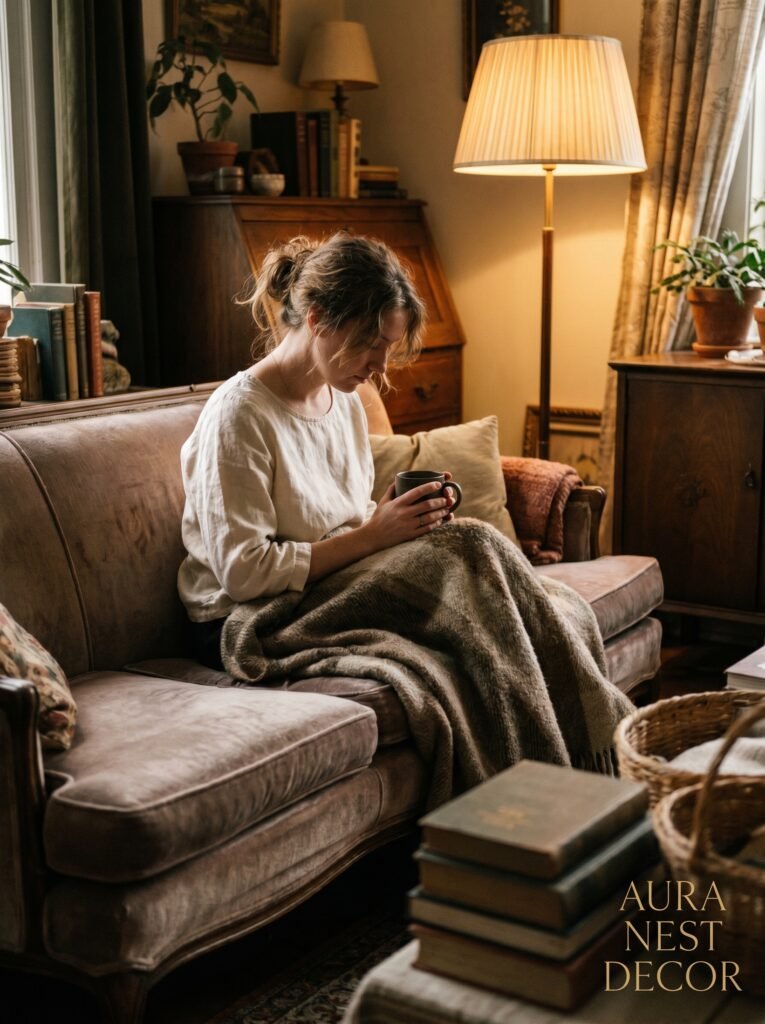
The rooms that stay with you — the ones you remember years later — were never perfect. They were loved. That’s the whole secret of the vintage cozy aesthetic, really: it’s not about the right pieces, it’s about giving yourself permission to stop staging and start living.
So maybe start with one lamp. Or one throw. Or finally hang that thing that’s been leaning against the wall for eight months.
What’s the one piece in your home right now that already has that vintage, worn-in magic — and are you actually letting it work?