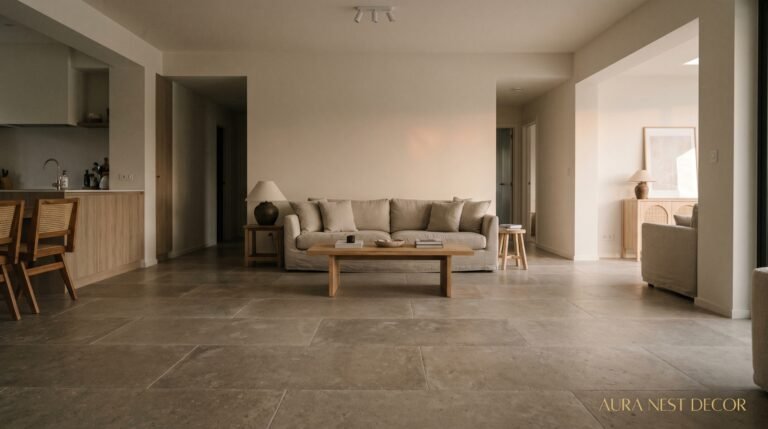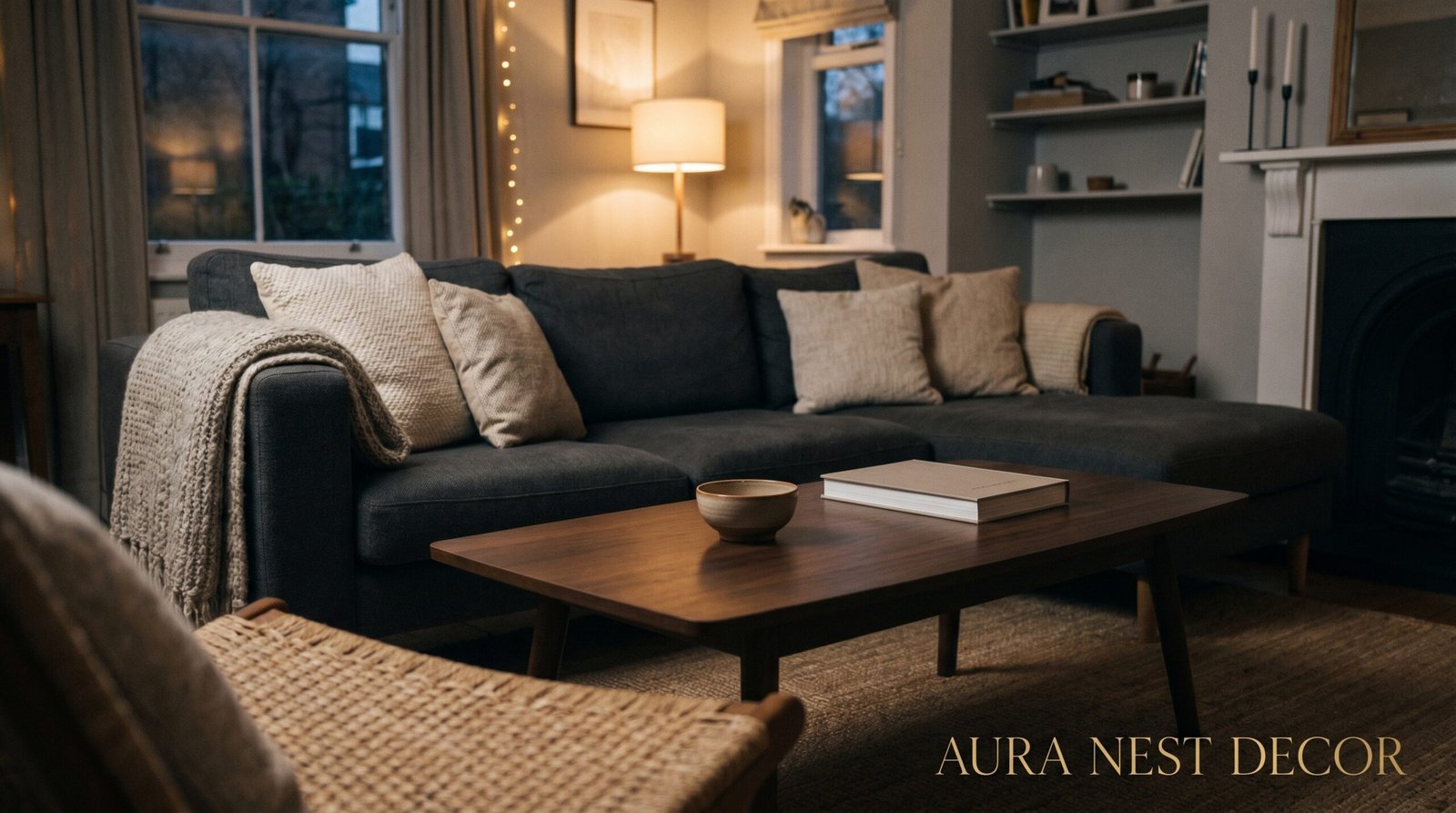
The Grey Living Room Glow-Up That Actually Feels Like Home (Not a Showroom)
You know that feeling when you walk into someone’s living room and just… exhale? Everything’s grey, but it’s somehow the warmest room you’ve ever been in. That’s not an accident. And it’s absolutely something you can recreate.
—
1. Why Grey Keeps Winning (Even When People Keep Saying It’s Over)
Every few years, someone declares grey dead. “It’s out!” they say, usually on Instagram, usually with a beige living room behind them. And then you walk into a beautifully styled grey space and immediately forget everything they said.
Grey doesn’t go away because it works. It’s one of the only neutral colors that can go completely warm or completely cool depending on what you pair it with, which makes it weirdly flexible for a color that looks so simple on a paint swatch. Pair it with warm wood tones and chunky wool blankets and it feels like a Scottish cottage in November. Add sharp white trim and black hardware and suddenly it’s a New York loft. The color itself is kind of a shapeshifter, honestly.
The key thing most people don’t realize is that grey isn’t one color. It’s about sixty. There’s the warm putty grey that leans almost beige in certain light. There’s the blue-grey that shifts depending on whether the sun is coming in. There’s deep charcoal, which is basically a neutral black. And then there’s that sad, flat, 2014 grey that everyone painted their walls and regretted. The one that looks cold at noon and kind of greenish by 4pm. Don’t do that one.
What we’re talking about here is intentional grey. Grey that breathes. Grey with texture layered on top of it so it never looks sterile or like a waiting room.
“Grey doesn’t feel cold because of the colour — it feels cold because of what people put with it.”
2. The Sofa Decision That Changes Everything Else in the Room
Okay, if you’re starting from scratch or thinking about a new sofa, here’s my actual honest opinion: a grey sofa is not the move if you want a cozy grey living room. I know, counterintuitive, right? But hear me out.
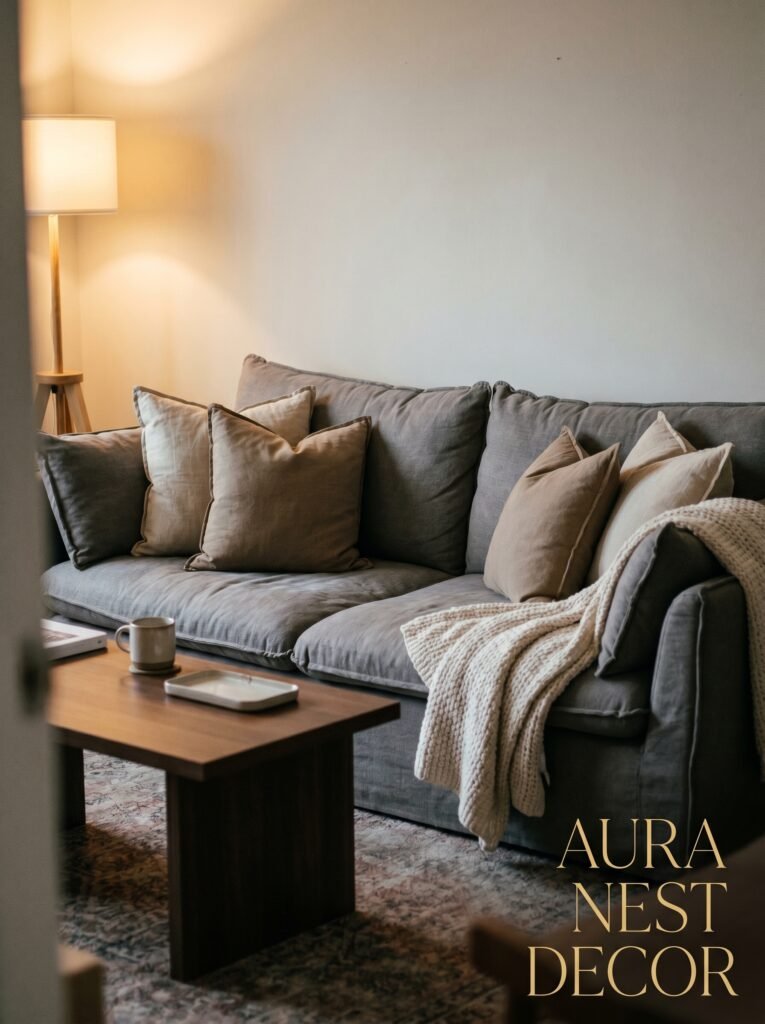
When your sofa and your walls are the same family of grey, everything flattens. The room loses depth. You end up adding more and more stuff to compensate and it still doesn’t feel right. Instead — go warm. A deep caramel leather, a dusty terracotta velvet, a warm mushroom boucle. Something that creates contrast. Your grey walls become a backdrop then, not just… a surface.
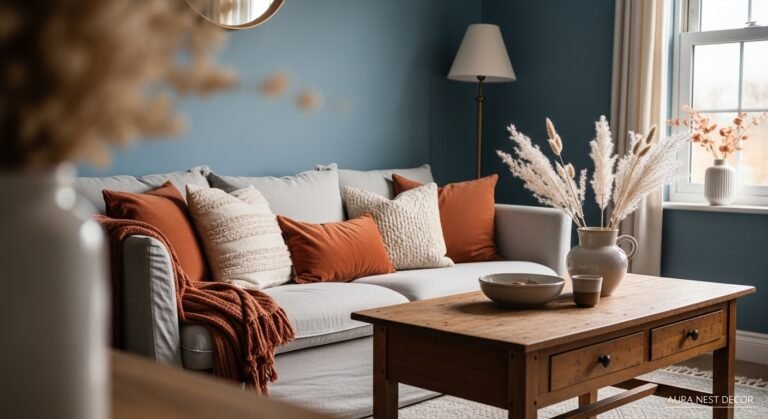
That said, if you already HAVE a grey sofa, you’re not stuck. This is where throws, cushions, and the right rug do the heavy lifting. A chunky knit throw in off-white or rust. Cushions that mix mustard, burnt sienna, and maybe a deep forest green. These colors all sit beautifully against grey because they’re warm without being garish. They don’t fight the grey — they argue with it gently, and that’s a good thing.
British homeowners tend to lean into the grey sofa because it photographs beautifully in those classic Victorian terrace rooms, and honestly, with the right styling it can work. American homes with more natural light can pull off both. But if you’re starting fresh, go warm on the sofa. Let the grey be the room.
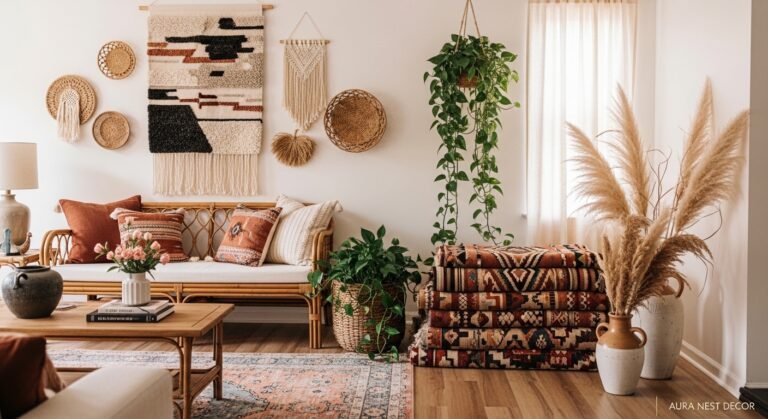
The rug matters here just as much. A faded Persian in dusty pinks and reds on a grey floor does something magical. Don’t ask me to explain it scientifically, but it works every single time.
3. The Lighting Truth Nobody Puts in the Magazine Spreads
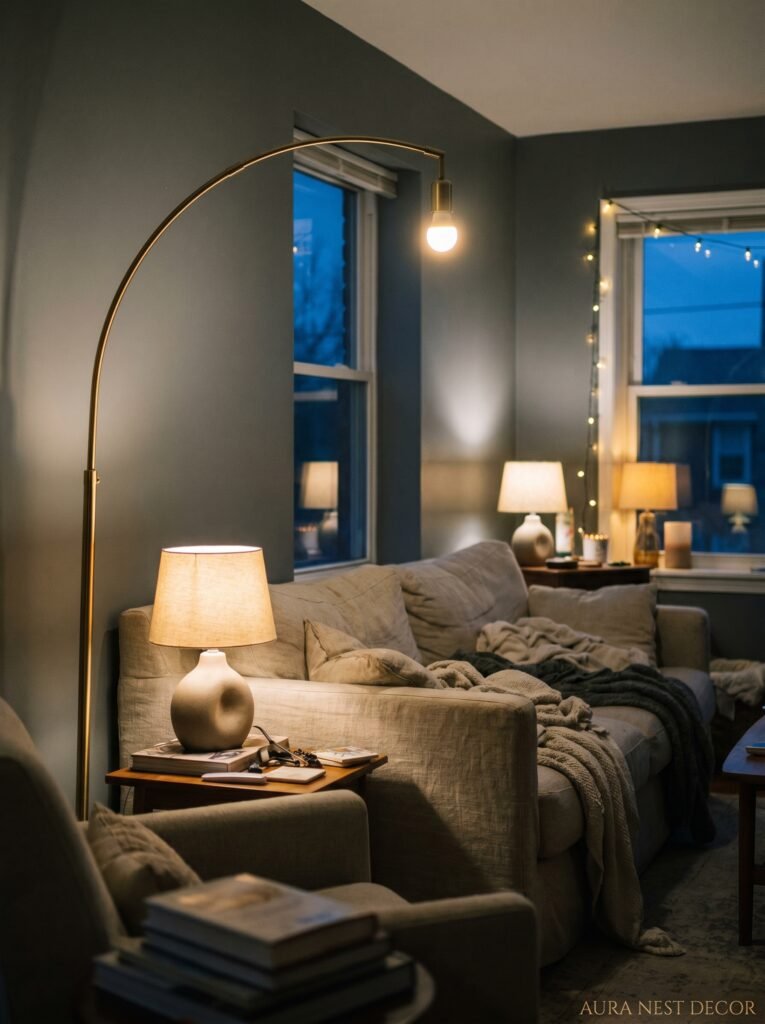
Grey is at the mercy of your lighting in a way that white and beige are not. White just brightens. Beige just warms. Grey? Grey completely transforms. And if you get the lighting wrong, you will hate the room and blame the color.
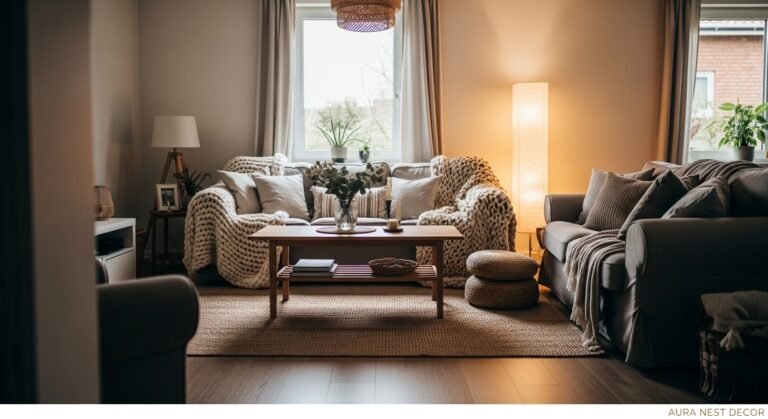
Overhead lighting is usually the culprit. That flat, even, bright ceiling light is grey’s worst enemy. It strips all the warmth out and makes everything look clinical. If you can’t ditch the overhead fixture entirely, at least put it on a dimmer. A grey room at 60% overhead with two or three lamps going at once is a completely different emotional experience than the same room at full blast.
What you want instead: table lamps with warm bulbs (2700K is your number — write that down), a floor lamp tucked into a corner, maybe a little LED strip behind a bookshelf if you’re feeling adventurous. The amber glow of an Edison bulb at 7pm in a grey room is genuinely one of the nicest things in interior design. It pulls all the warm undertones out of the grey and makes the space feel like an embrace.
Side note — candles. Obviously. But specifically pillar candles on a wooden tray, not just a scented candle jar by itself. The warmth of actual flame in a grey room is unbeatable, and the visual of multiple candles at different heights adds something that no lamp can replicate.
4. Texture Is the Secret Ingredient (And You’re Probably Not Using Enough of It)
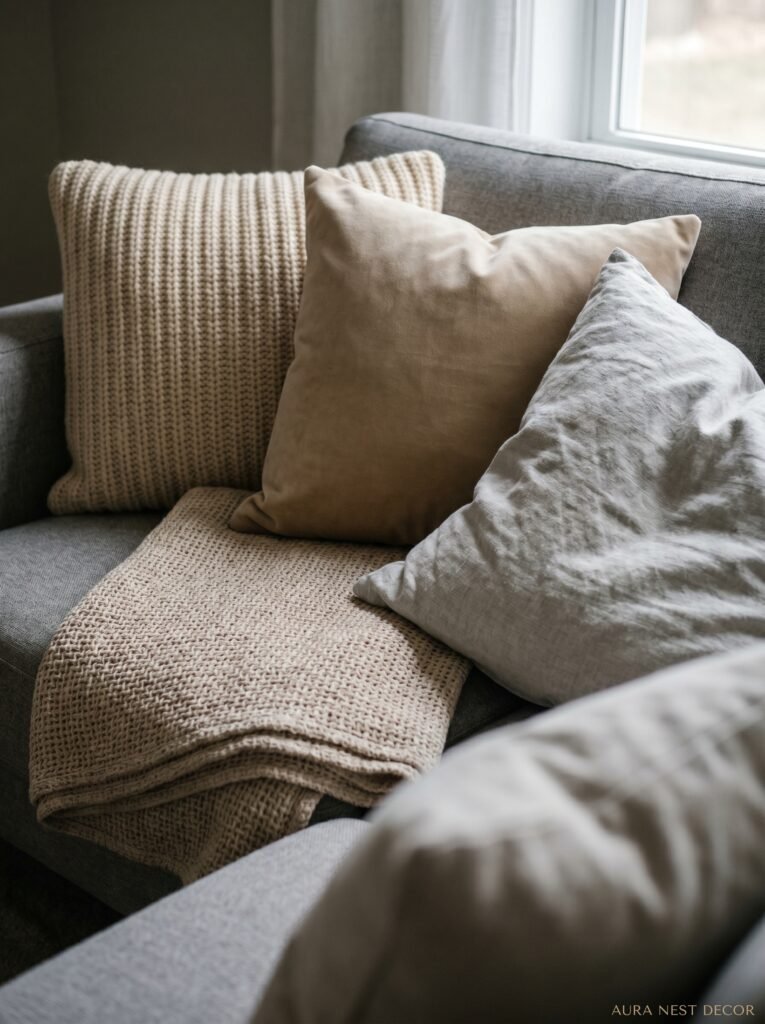
Here’s the thing about cozy grey rooms that get saved a million times on Pinterest: it’s never really about the grey. The grey is just the canvas. What makes those rooms feel extraordinary is the texture stacked on top.
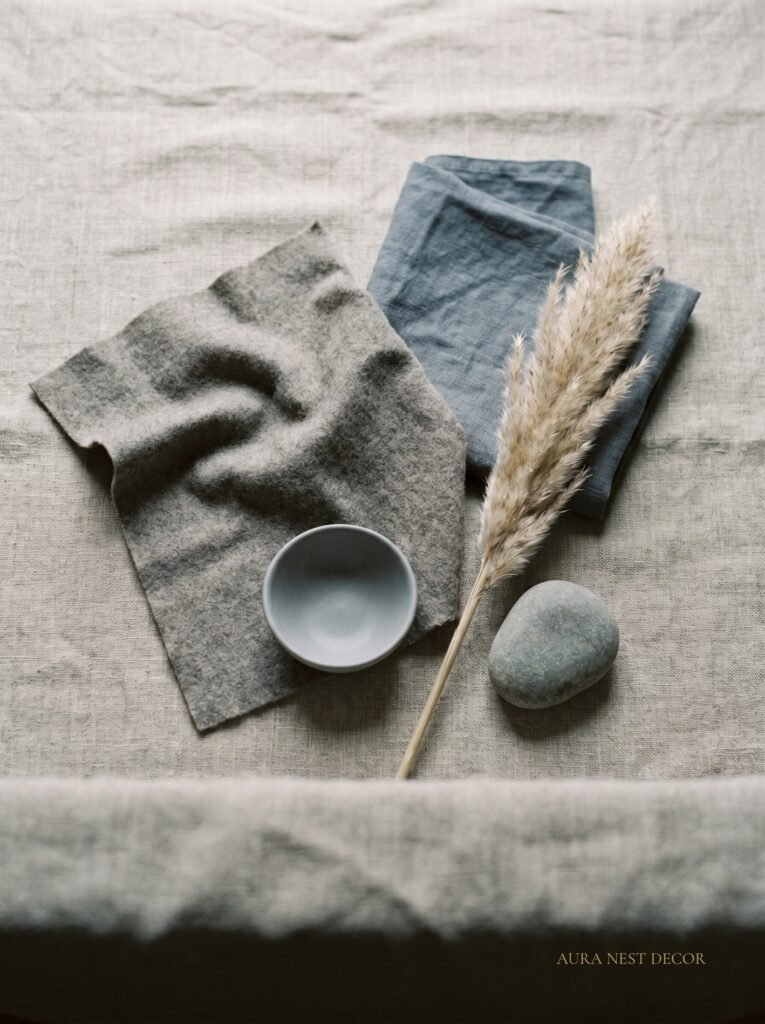
Think about it. A flat grey wall, a smooth grey sofa, a flat grey rug — that’s a dentist’s office. But a grey wall with a chunky cable-knit throw draped over a velvet cushion next to a woven rattan lamp — that’s a home. Same color, completely different feeling. The difference is entirely tactile, even when you’re just looking at it.
“The rooms people can’t stop saving on Pinterest aren’t the prettiest ones — they’re the ones that look like they feel good to be inside.”
Linen curtains are one of the best investments in a grey room. Even cheap linen curtains hung high and pooled slightly at the floor add this soft, textured, editorial quality that changes the whole atmosphere of the room. Natural linen in an off-white or warm oat colour against grey walls is a combination that’s been popular for years and genuinely hasn’t gotten old.
Don’t sleep on the ceiling, either. A wooden beam — real or faux — or even just a warm wood floating shelf picks up the grey and anchors it in something natural. That contrast of cool grey and warm wood is kind of the foundation of the whole aesthetic we’re going for.
5. The Specific Grey Paint Shades Worth Actually Talking About
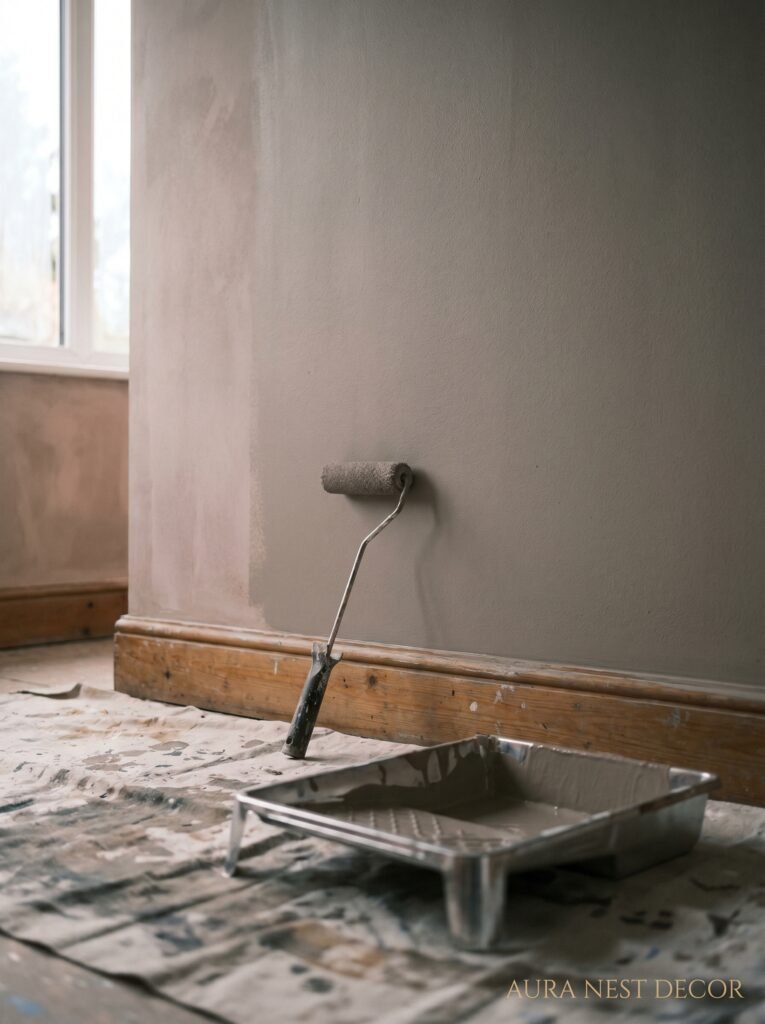
Let’s be practical for a second. You’re going to need a name, not just “warm grey.”
Farrow & Ball’s Purbeck Stone is having a constant, eternal moment. It’s this warm, dusty grey that leans towards clay without ever fully committing, and it looks different in every light — slightly purple in morning light, almost taupe at dusk. It’s brilliant and not cheap, but if you’re only doing one room, it’s worth it.
For something more accessible, Benjamin Moore’s Pale Smoke is genuinely lovely — softer than it sounds, with a blue-grey quality that still reads as warm when you layer textures against it. In American homes with south-facing light, it’s especially good.
Dulux Warm Pewter (more of a UK staple) is the one I keep seeing in British homes done really, really well. It’s deeper than you think it’ll be on the sample card, and it photographs beautifully. Pair it with warm white trim and it’s a classic for a reason.
The thing I’d say to anyone choosing a grey paint is this: get the sample. No, actually get it. Don’t pick from a strip under fluorescent shop lights and expect it to look the same on your living room wall at dusk in November. It won’t. Paint the sample card, tape it to the wall, and live with it for two days before you commit. This is the single best piece of advice for grey in particular.
6. What to Put on a Grey Feature Wall That Doesn’t Look Like a Rental Flat
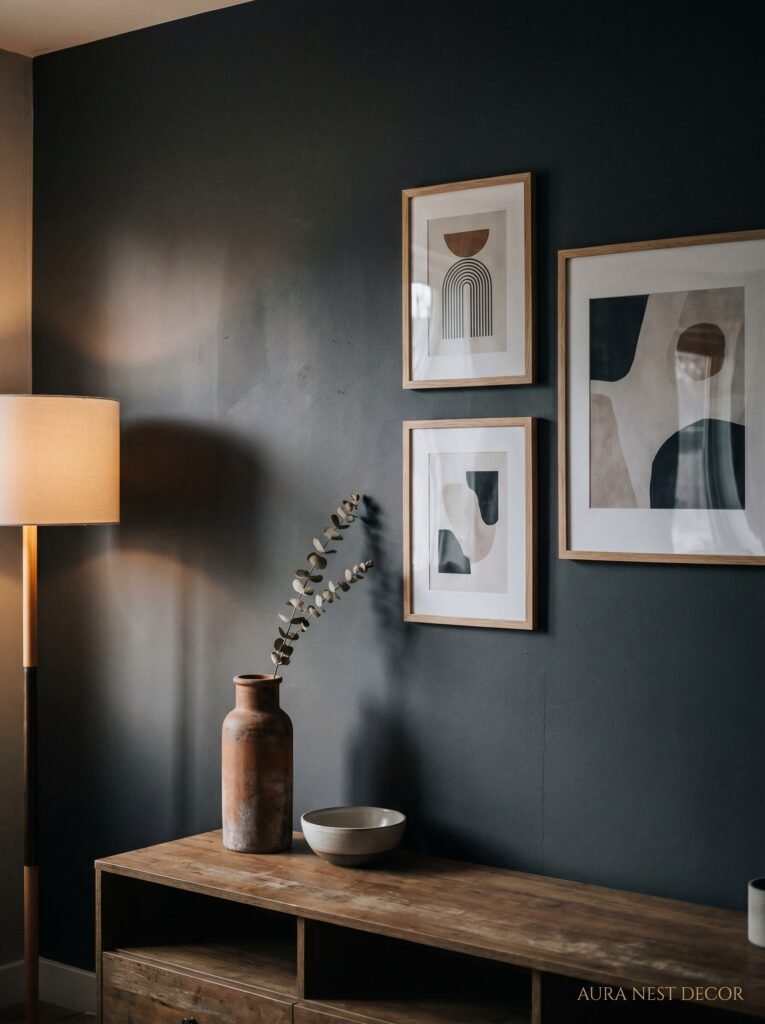
A grey feature wall can be stunning or it can look like you just painted one wall because you ran out of paint. The difference is commitment.
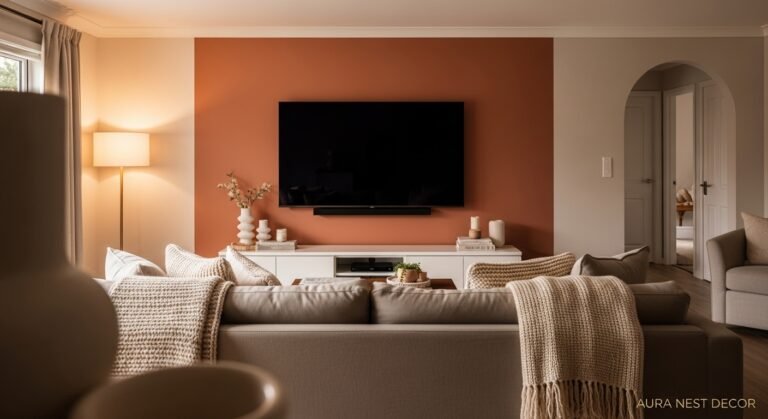
If you’re going for a feature wall, go dark. Deep charcoal, dark slate, almost-black grey. Something like Hague Blue mixed with grey, or Graphite from Farrow & Ball. A timid mid-grey feature wall doesn’t do anything — it just exists. But a deep, dramatic wall behind your sofa or fireplace? That creates an anchor for the room and everything you put against it pops.
Gallery walls work brilliantly on a dark grey feature wall, by the way. Mix black and white photography with warm wood frames, maybe a small oil painting, and suddenly the whole wall is a mood. It doesn’t have to be perfectly curated, either — honestly, a slightly imperfect gallery wall looks more real and more interesting than a precisely measured one.
Alternatively, do the feature wall in texture, not paint. Limewash. Plaster effect. Even a subtle grasscloth wallpaper in grey-taupe. These have a depth that paint can’t replicate and they change with the light in a way that adds real life to the room.
7. Plants That Actually Look Good in a Grey Living Room (Not Just The Obvious Ones)
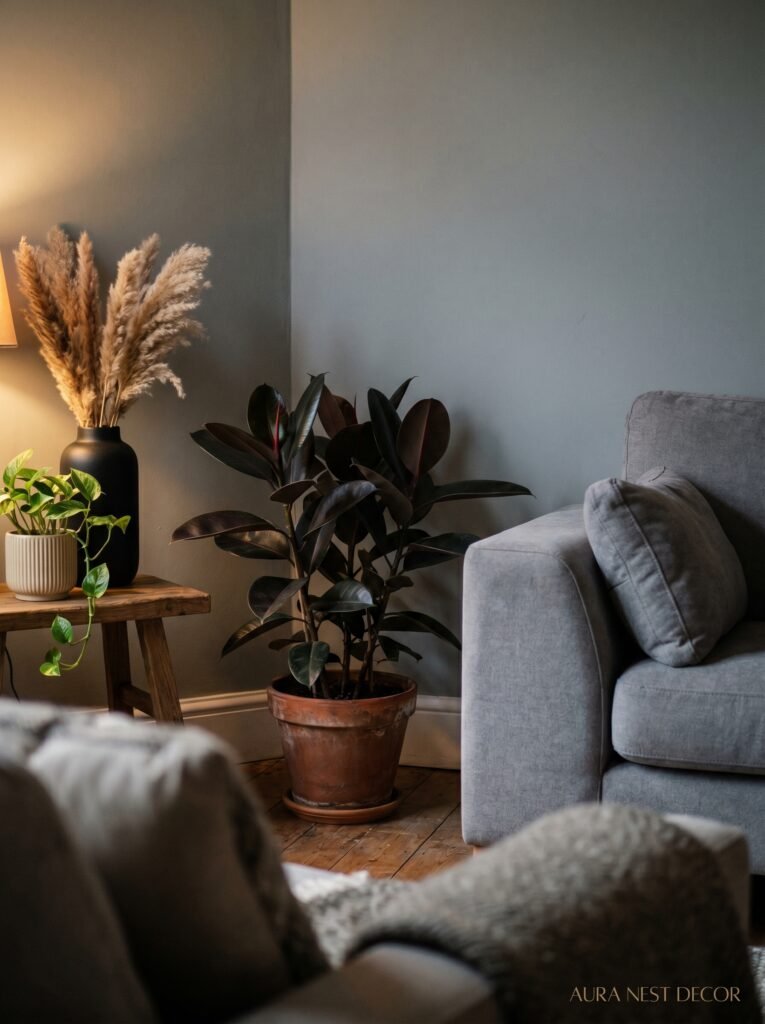
Every grey living room on Pinterest has a fiddle-leaf fig in the corner, and look, they’re beautiful, but they’re also kind of everywhere now. Can we talk about some others?
Olive trees are spectacular in a grey room. The silver-green of the leaves does something incredible with grey walls — they almost vibrate against each other. A small potted olive in a terracotta pot against a grey wall is one of the best low-effort style moves in interior design, I genuinely believe that.
Eucalyptus, even dried, in a tall vase adds something airy and botanical. The grey-blue of dried eucalyptus leaves against a warm grey wall is almost perfectly matched in a way that feels more effortful than it is.
Darker plants — deep burgundy rubber plants, black-green ZZ plants — give grey rooms a richness that pale plants don’t. The contrast of very dark foliage against a lighter grey wall is dramatic without being exhausting to look at.
“A single olive tree in a terracotta pot does more for a grey living room than a hundred throw cushions. Okay, maybe not a hundred.”
Pots matter too, obviously. Terracotta always. Warm wood planters. Matte stone or concrete. Avoid the shiny white ceramic pots — they go cold in a grey room and fight with everything else you’re trying to do.
8. The Bookshelf Styling Trick That Makes Grey Rooms Feel Intellectual and Warm at the Same Time
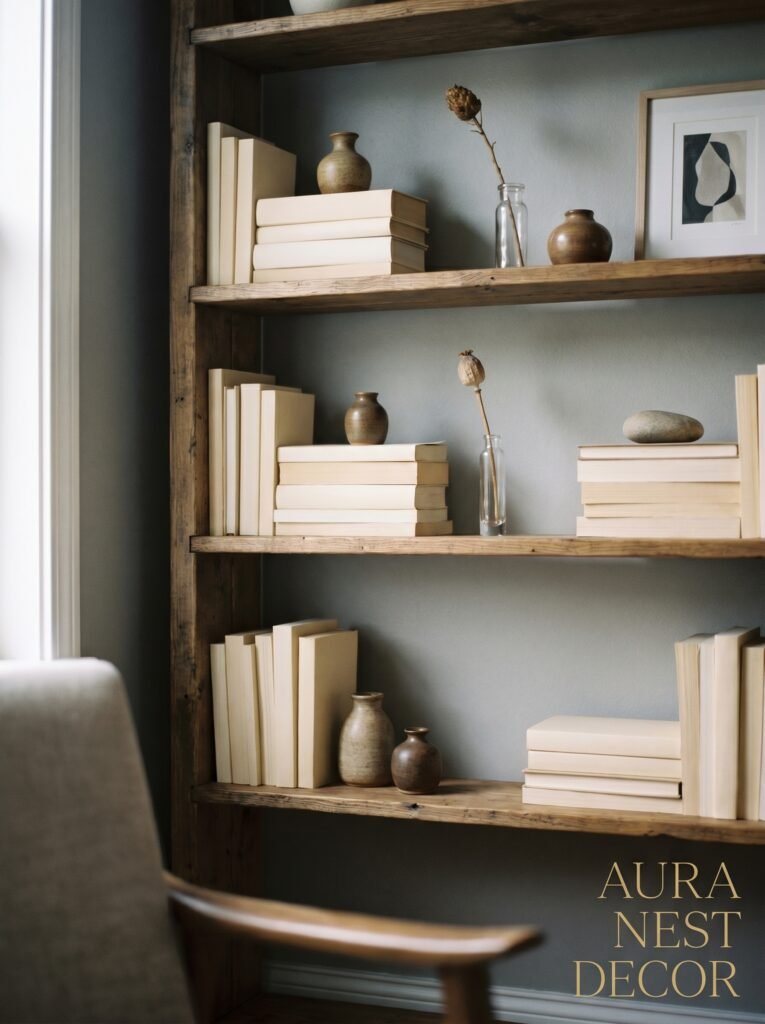
Grey rooms love a bookshelf. There’s something about the combination of cool grey walls and the warm tones of book spines and wooden shelving that’s almost automatically cozy. But there’s a way to do this that elevates the whole room and a way that just looks like you own a lot of books.
Group books by color loosely — not rigidly, not obsessively, just approximately. Warm tones together, cool tones together. This creates a visual calm on the shelf that lets other objects breathe. And then mix in objects between the books: a small ceramic bowl, a candle, a framed photo face-down for texture, a little dried floral stem in a tiny vase.
The negative space on a shelf matters as much as what you put on it. Leave some shelves sparse. A single beautiful object on a grey shelf in a grey room is almost a meditation.
American homes often have built-in shelving already, which is a genuine gift for this. UK Victorian terrace homes sometimes have original alcove shelving that, when painted the same grey as the walls, creates this wonderful integrated look like the whole room was designed as one piece.
9. Fireplace Styling That Doesn’t Look Like It Was Taken Directly From a Hotel Lobby
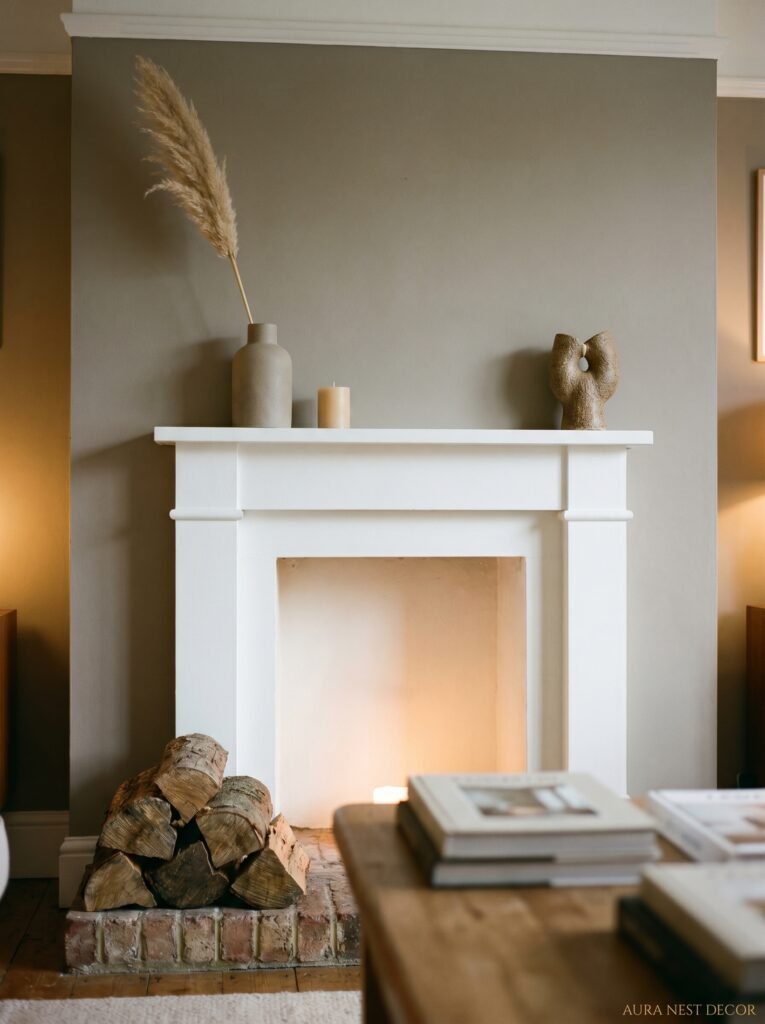
If you’ve got a fireplace in your grey living room — which a lot of UK homes do, and increasingly American ones too with the push toward original features — the way you style it makes or breaks the cozy factor.
The mantelpiece should be spare. One or two things, not seven. A single large mirror leaning against the chimney breast (not hung, leaning) immediately makes the whole thing more casual and real-looking. Add one or two thick pillar candles in varying heights, maybe a small object that means something to you — a piece of pottery, a found stone, a tiny vase with a single dried stem — and leave it there. Done.
Inside the fireplace, if it’s not in use: stacked logs are gorgeous. Even if you never light them. A bundle of birch wood in particular adds warmth and texture to a grey surround.
The surround itself, if you’re renovating: a white Carrara marble surround against dark grey walls is quite honestly one of the best combinations in any style of home. It’s classic, it’s slightly dramatic, and it photographs spectacularly. An original Victorian cast iron fireplace left in its natural state against grey walls in a period British home is similarly brilliant.
10. Curtains and Windows: The Part of the Room People Get Wrong Most Often
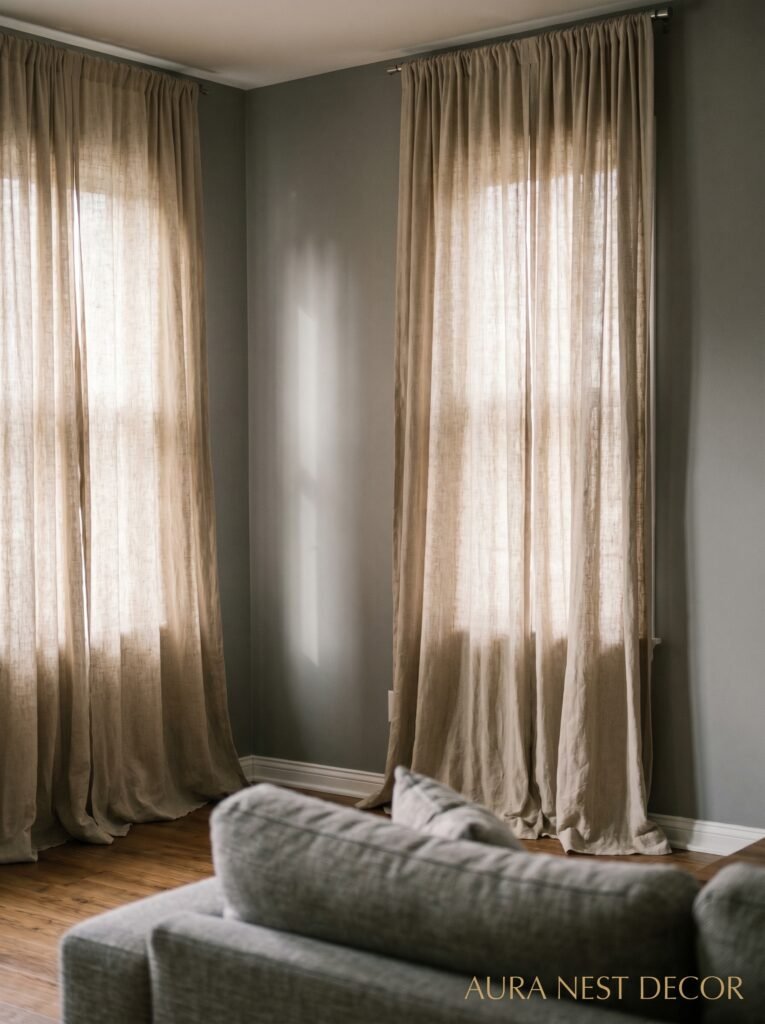
Curtains in a grey room are often an afterthought and it’s a mistake. The curtains in a cozy grey living room should almost certainly be floor-to-ceiling, hung high (a few inches below the ceiling if you can manage it), and pooled or just grazing the floor. This is not about fashion — it’s about proportion. It makes the ceilings feel taller and the room feel bigger and more considered.
Linen in warm white or soft oat is the classic choice and it’s classic for a reason. It lets light filter through in the most flattering way and it adds that soft, slightly undone texture that stops the room looking like a catalog.
But don’t overlook curtains in deeper tones either. Dusty blush, deep rust, forest green — all of these can work as curtains against grey walls and add a more layered, maximalist-leaning coziness. The trick is keeping everything else in the room relatively simple if you go bold on the curtains.
Shutters, for UK homes especially with period windows, are another brilliant option — painted in warm white or off-white, they add architectural interest and that classic Georgian or Victorian look that works brilliantly with grey walls.
11. The Small Moments That Make a Grey Living Room Actually Personal
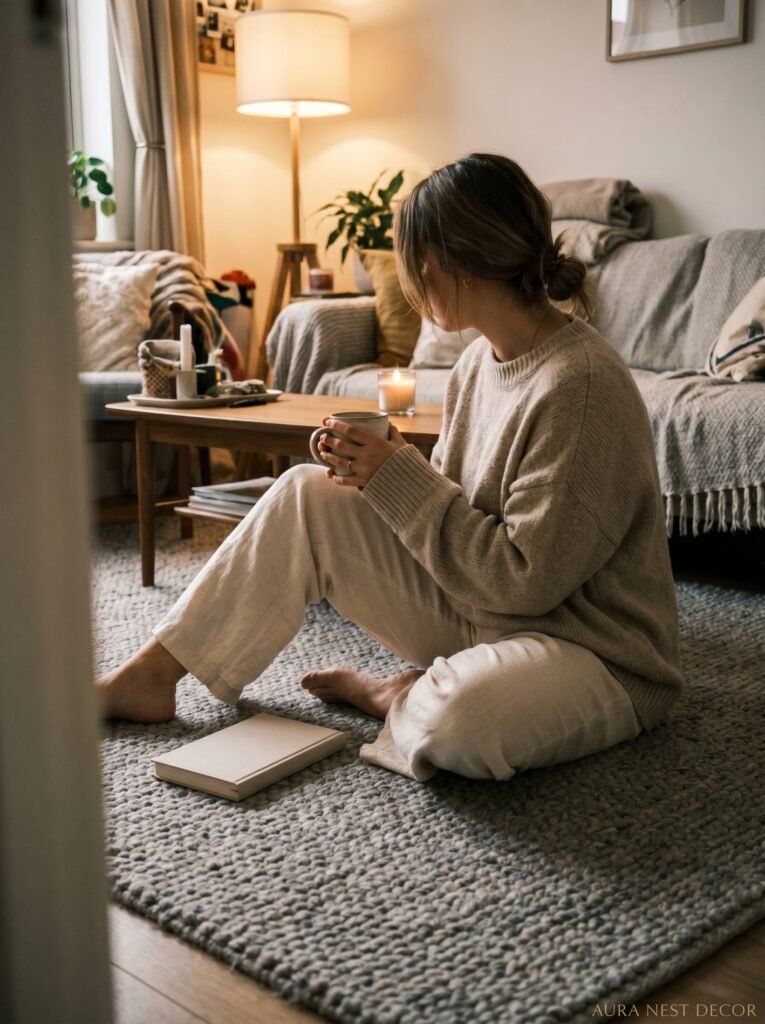
This is the section where I say: stop decorating and start living in the room. Because the grey rooms that feel the warmest are the ones where someone actually lives. They have a slightly worn throw that gets pulled over legs on cold evenings. They have a stack of actual books being read, not just styled. They have a mug ring somewhere on a side table that probably shouldn’t be there.
A collection of objects on a coffee table that means something. The small ceramic your kid made. The shell you found on a beach in Cornwall. The vintage lighter that doesn’t work but looks brilliant. These things don’t style themselves but they’re what separates a grey living room that feels human from one that feels like a staged property for sale.
Scent matters too, more than people admit in home decor content. A room that smells of cedarwood and amber feels warm in a way that purely visual styling can’t achieve. Burning a candle regularly in your living room — the same candle, one you love — becomes part of the atmosphere in a way that’s completely distinct from how the room looks. It’s the full experience.
12. The Colour That Keeps Showing Up in Every Beautiful Grey Living Room Right Now
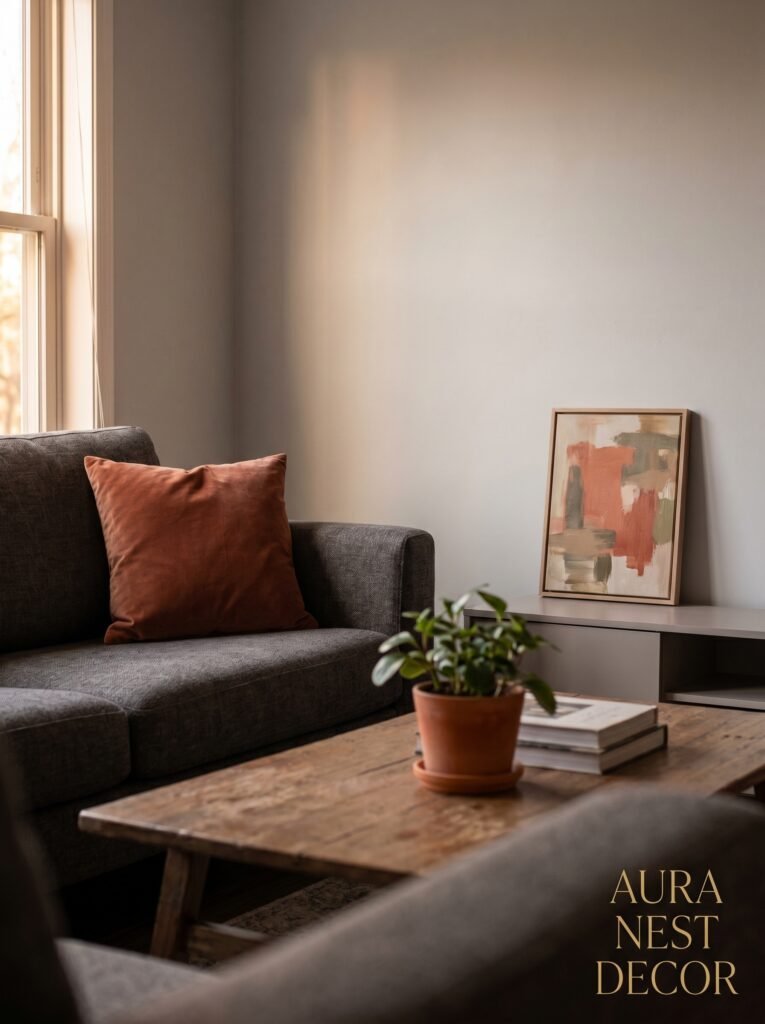
Rust. Specifically that warm, earthy, slightly muted rust that sits somewhere between terracotta and burnt orange. Not bright orange, not bright terracotta — rust.
It’s showing up in cushions, in throws, in the glazing on ceramics on coffee tables, in the painted legs of furniture. And it works with grey in a way that feels genuinely right — the warmth of the rust pulls out all the warmth latent in grey, and suddenly the room feels less like a design exercise and more like something real.
Not gonna lie, I was late to rust. I thought it was going to feel very 1970s in the wrong way. But in small doses — a cushion, a throw, a ceramic vase — it’s surprisingly modern and it works especially well in rooms that also have a lot of natural wood and linen. It’s the accent color for a grey living room that feels like 2024, not 2014. And honestly, I think it’s going to keep being relevant because it’s grounded in nature rather than trend. It’s the color of dried leaves and autumn evenings and it makes grey feel like it belongs.
—
❓ FAQ
Q: What’s the best grey paint color for a north-facing living room? A: North-facing rooms get cool, blue-toned light all day, so you want a grey with warm undertones — something that leans toward taupe or putty. Try Farrow & Ball’s Purbeck Stone or Dulux’s Warm Pewter. Avoid anything with blue or green undertones because in north-facing light, those will go genuinely cold.
Q: How do I make a grey living room feel cozy without spending a lot? A: Lighting first — always. Swap out overhead bulbs for warm 2700K ones, buy one or two inexpensive table lamps, and the room will change immediately. Then add texture through throws and cushions from TK Maxx, H&M Home, or Target. A secondhand Persian-style rug from eBay or Facebook Marketplace does more for a grey room than almost anything else.
Q: Can grey work in a small living room, or will it make it feel smaller? A: It can absolutely work, but go lighter rather than darker in a small space. A warm light grey on the walls with bright white trim actually makes a room feel bigger and airier. Keep furniture legs visible (sofas and chairs on legs rather than flush to the floor), use mirrors, and don’t overdress the windows.
—
💭 Final Thoughts
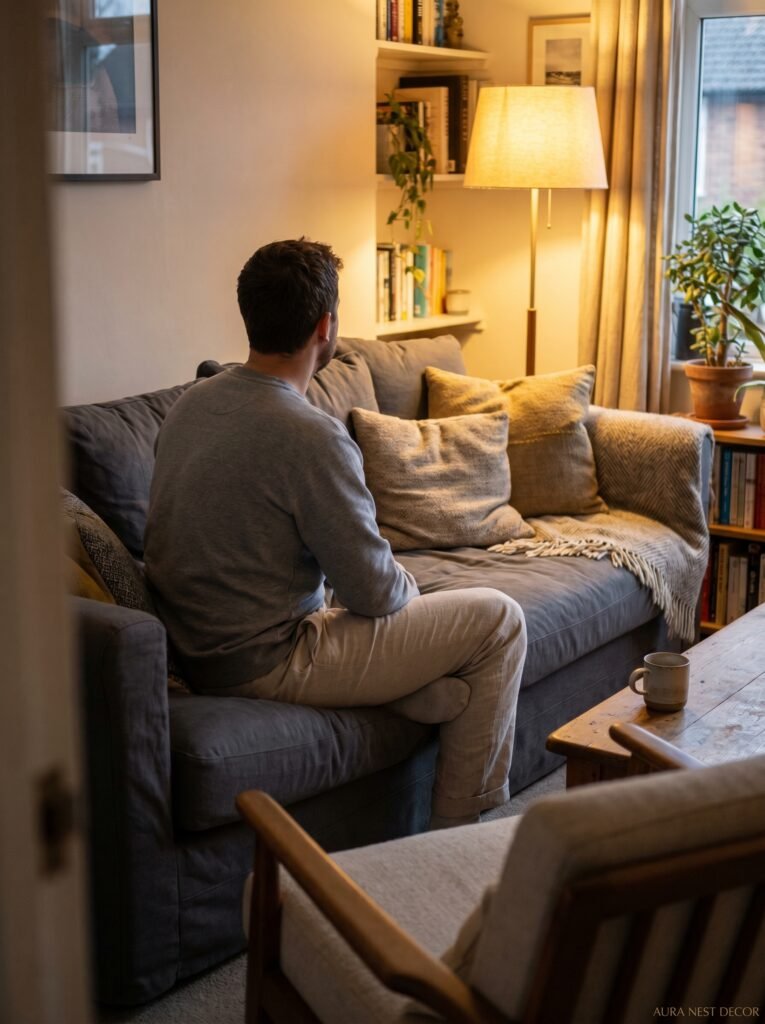
A great grey living room isn’t really about grey at all — it’s about understanding that grey is the most receptive neutral you can work with, and then filling that space with warmth, texture, and the kind of objects that make a room feel genuinely lived in. Get the lighting right, layer the textures, and stop overthinking the shade.
The most beautiful rooms I’ve ever seen didn’t start with a perfect plan. They started with one good decision and built from there.
What’s the one thing that’s been stopping you from committing to grey in your own living room?