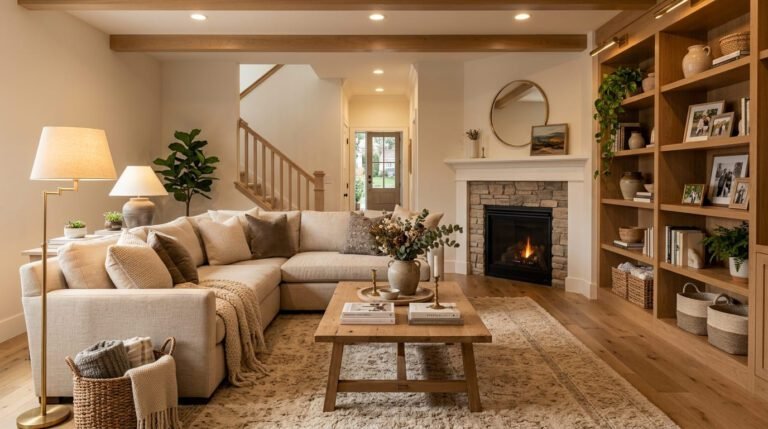
The Cozy Living Room TV Setup Nobody Talks About (But Everyone Wants)
You’ve got the sofa. You’ve got the throw pillows. And then there’s the TV — that big, glowing rectangle you’ve been quietly trying to work around for three years. Here’s the thing: it doesn’t have to be an eyesore you apologize for. Done right, it can anchor the whole room.
—
1. Stop Fighting the TV — Build the Room Around It Instead
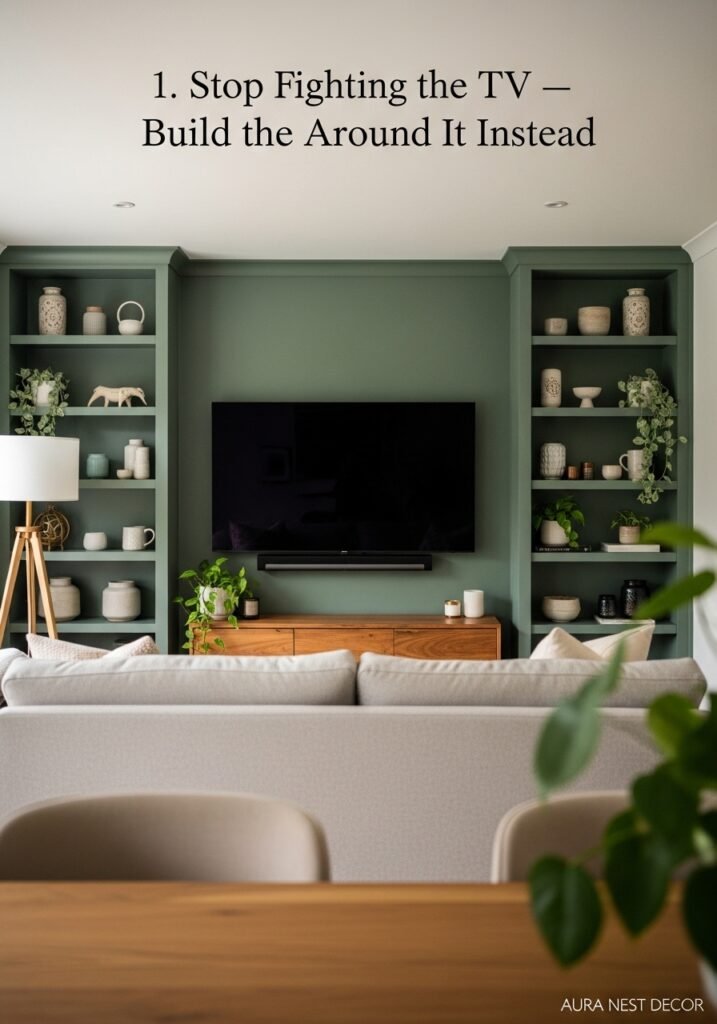
This is the mindset shift that changes everything. So many people treat the TV like a necessary evil, something to hide behind a cabinet door or disguise with a gallery wall, and I get it — I really do. But fighting it usually just makes the room feel confused. Like the furniture’s facing one direction and the “aesthetic” is facing another.
The rooms that actually work? They lean in. The TV becomes the anchor, and everything else — the sofa placement, the lighting, the shelving — radiates out from it with intention. Think of it less like a screen mounted on a wall and more like a fireplace. A focal point. One that happens to stream Netflix.
What makes this easier than people think is that most modern TVs have pretty sleek profiles. A 55-inch on a well-styled media unit, flanked by some trailing pothos and a couple of textured candles, looks considered. It doesn’t look like you gave up.
The trick is treating the TV wall the way a hotel stylist would. The screen is there. Work WITH it.
“The TV doesn’t ruin a cozy room. Ignoring it in your styling does.”
—
2. The Media Unit That’s Doing the Heavy Lifting You Haven’t Noticed
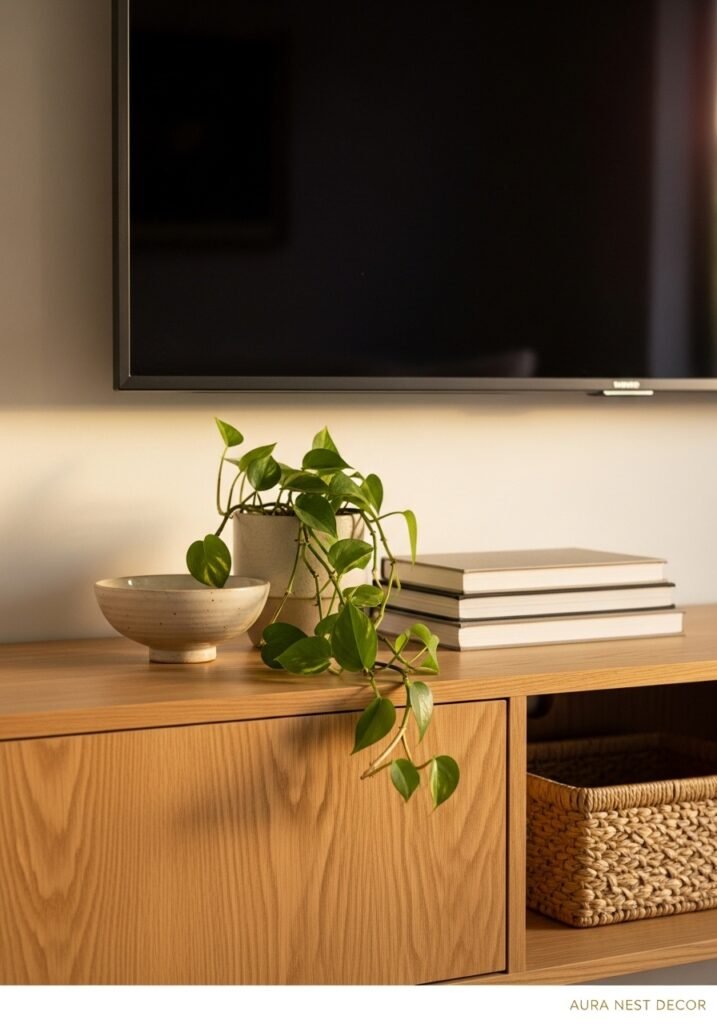
Can we talk about media units for a second? Because the right one genuinely does more for a living room than people give it credit for.
A too-small unit makes a big TV float awkwardly. A too-big unit turns the whole wall into a black hole. What you want is something that visually grounds the screen without competing with it — and that also gives you shelf space to actually style, not just store.
Rattan-fronted cabinets are having a serious moment right now, especially in UK homes where you’ve got that natural material obsession working in your favor. In the US, I’m seeing a lot of low-profile walnut consoles with hairpin legs — very mid-century, incredibly warm-feeling, and they don’t take up visual weight the way chunky dark wood does.
Here’s what I’d say about height: lower is almost always better. A console that sits at about 18-22 inches keeps your TV at a comfortable viewing angle, keeps the room feeling open, and gives you a whole surface to work with. Stack some art books. A sculptural object. One small trailing plant.
And please — hide the cables. I don’t care how you do it, cable clips, a little channel, an in-wall kit — just deal with them. Nothing breaks a cozy vibe faster than a tangle of black wires hanging down a freshly painted wall.
—
3. The Color That Keeps Showing Up in Every Cozy TV Wall Right Now
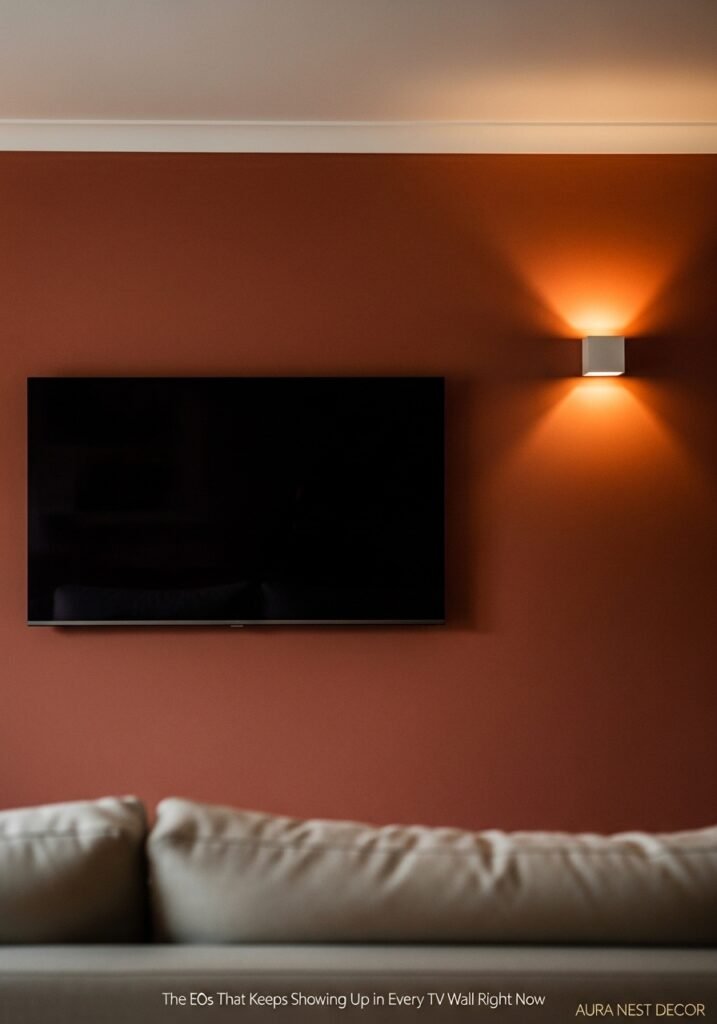
It’s not white. It’s not gray. It’s not even the dark green everyone was obsessed with last year (though I still love that, honestly).
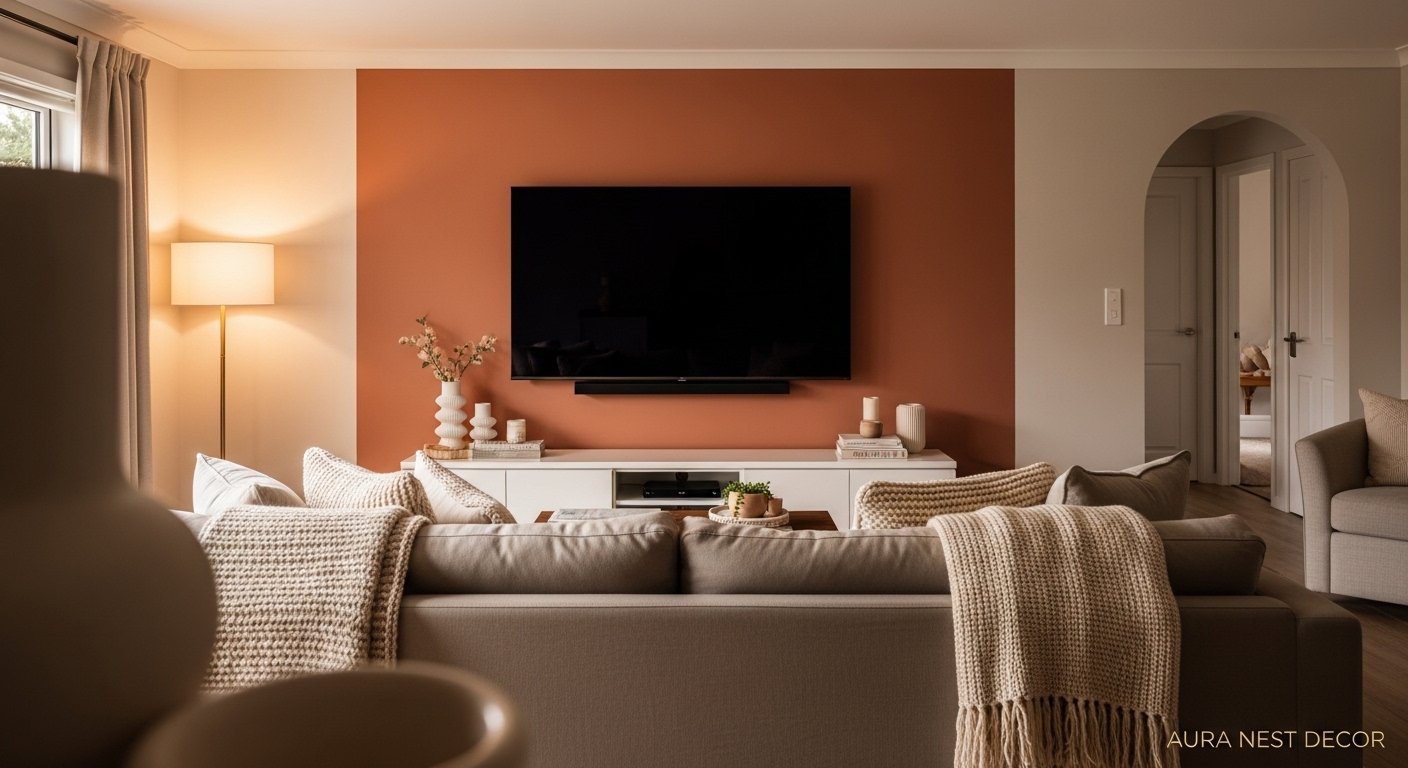
The color I keep seeing everywhere — in saved pins, in magazine spreads, in that one friend’s flat that you remember thinking “this feels so good in here” — is warm clay. Terracotta-adjacent but softer. Like if terracotta got washed once too many times and became something quieter.
In the US you’d find it as something like Benjamin Moore’s “Pale Cognac” or Behr’s “Antique Earth.” In the UK, Farrow & Ball’s “Dead Salmon” (yes that’s really the name, yes it’s stunning) or Little Greene’s “Pale Tan” gets you in that same neighborhood. Paint just that one wall — the TV wall — and the rest can be white or cream. The effect is of a room that has a heartbeat.
Why does this work so well with a TV? Because the warm undertone in the wall pulls the room forward when the screen is off, and when it’s on, the light from the screen actually flatters the wall color instead of washing it out. It’s kind of accidental perfect science.
Side note — if you’re renting and can’t paint, a large textured wall hanging in those tones does something similar. Not identical, but close enough.
—
4. Lighting Is the Actual Difference Between Cozy and Depressing
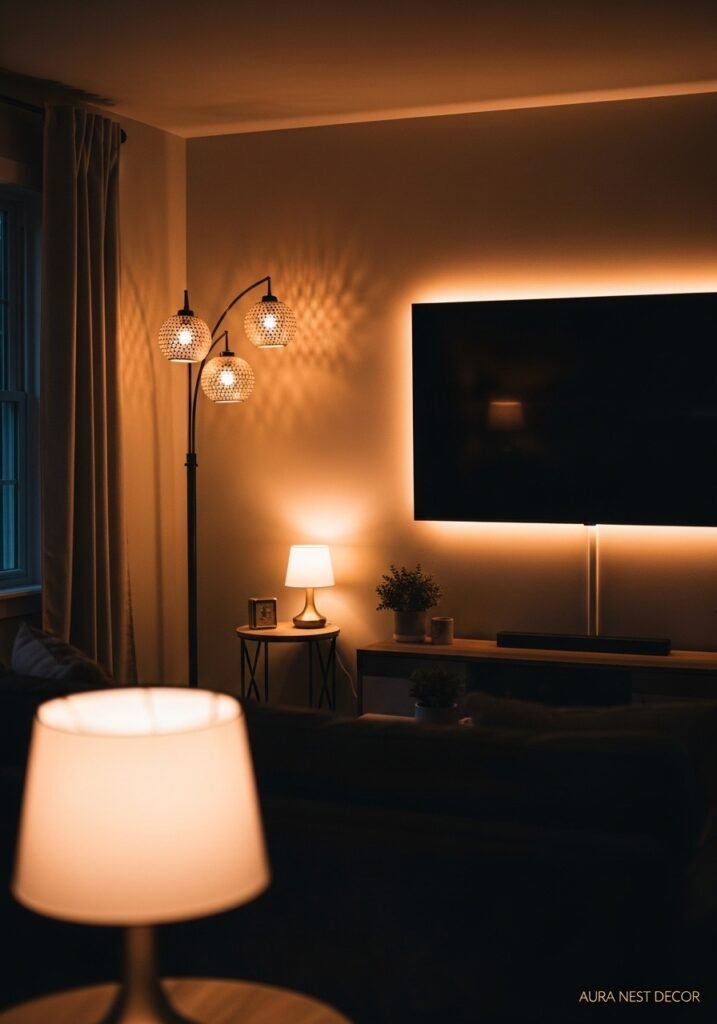
I cannot stress this enough. I’ve been in rooms that had everything — the right sofa, great rug, lovely TV setup — and they still felt sort of flat. Almost always, it was the lighting.
Overhead lighting is the enemy of cozy. That one ceiling fixture blasting light down from directly above you? It makes everything look like a waiting room. You need layers.
Behind the TV is a great place to start. A bias lighting strip — those LED strips that mount to the back of the screen — are cheap, they reduce eye strain, and they spill a soft glow onto the wall that makes the whole setup feel intentional and almost cinematic. You can get them in warm amber tones, which I’d strongly recommend over the RGB color-changing ones unless you want your living room to look like a gaming setup. No judgment if you do, that’s just a different vibe.
Then: floor lamps. At least one, ideally two, flanking the sofa or placed in the corners. The kind with fabric shades in cream or linen. At 7pm when everything clicks on, that amber glow makes the room feel wrapped around you.
“Overhead lighting is doing your cozy room a disservice. Turn it off.”
And table lamps on the media unit itself, if there’s room. Small ones. Even just one on either side of the TV, sitting on the shelves, create this low warm horizon of light that feels genuinely luxurious.
—
5. The One Rule That Makes Any TV Corner Feel Intentional
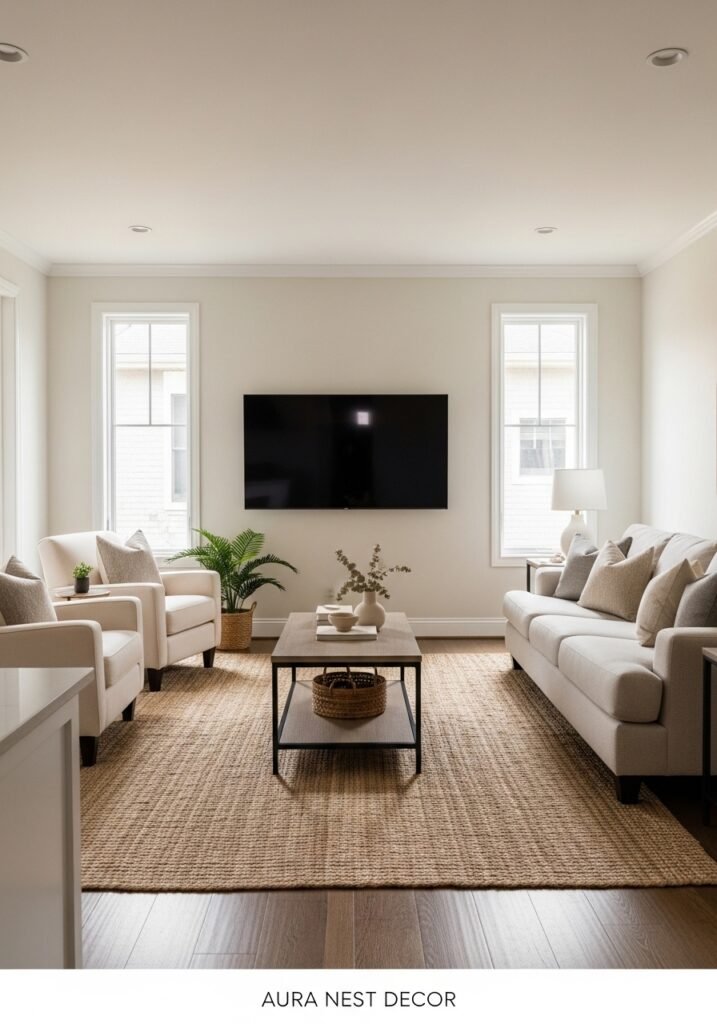
Here it is: the TV should never be the ONLY thing on that wall.
That’s it. That’s the rule. If your TV is hanging on a completely bare wall with nothing around it, nothing under it, nothing to either side — it looks like an afterthought. Like you finished decorating the room and then went, “oh right, the TV.”
What goes around it matters. This doesn’t mean a full gallery wall (though that works beautifully if done right). It could be as simple as two tall, thin pieces of art flanking the screen at the same height. Or a single large piece of art hung ABOVE a media console, with the TV mounted in front of it. That layered look — art behind, screen in front — is one of the most sophisticated things you can do in a living room, and almost nobody thinks of it.
Floating shelves on either side of the TV are another option that’s genuinely underused. You can style them like a bookshelf — varied heights, some books spine-out, some spine-in, a small plant, a ceramic thing you bought on holiday — and suddenly the TV is just one element in a whole composed wall.
The goal is that someone walking into your room looks at the TV wall and sees a wall, not just a screen.
—
6. Textiles That Work Hardest When the Lights Go Down

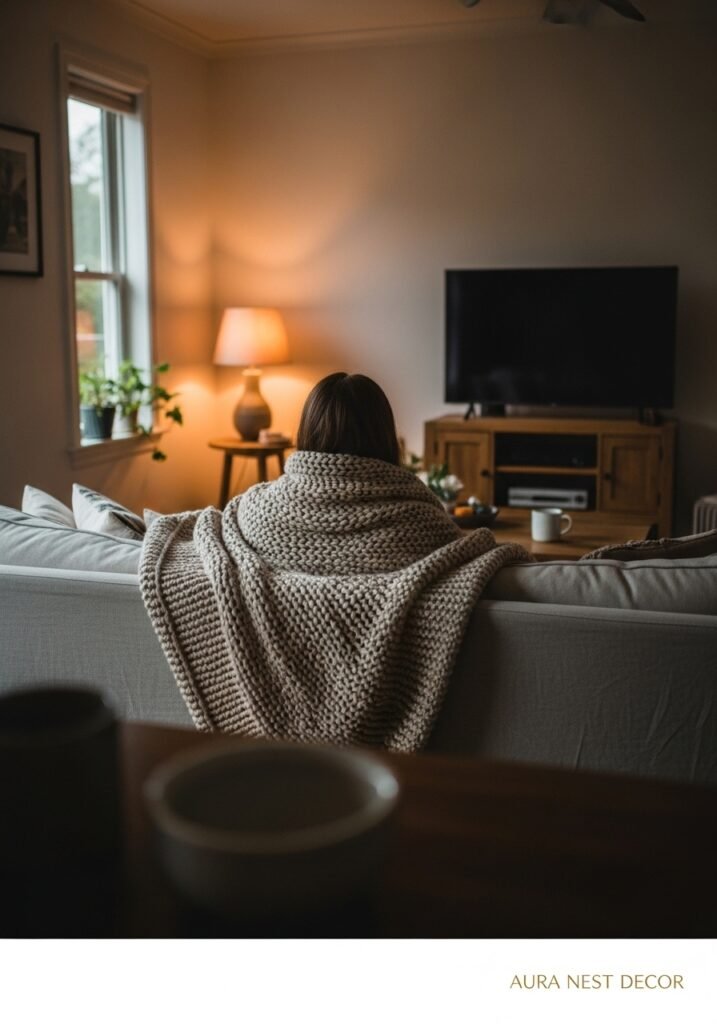
When you’re watching something in the evening, the room shifts. The lighting changes, you’re probably horizontal, and the softness of the space suddenly matters in a very physical way. This is where textiles earn their keep.
The sofa throw you fold over the arm — it needs to actually be soft. Not “decorative soft,” ACTUALLY soft. A waffle-knit cotton, a chunky ribbed knit in oatmeal, a sherpa-lined blanket you actually want to be inside. If you’ve got one of those scratchy Instagrammable throws that looks great in photos but you’d never actually use, swap it for something real.
Cushions are where most people over-invest in number and under-invest in quality. Three great cushions beat seven mediocre ones every time. Mix a solid linen with a subtle texture — boucle, if you can find it, is having its moment for a reason — and maybe one with a very simple pattern. And vary the sizes. A big 60cm cushion and a couple of 45cm ones look much better than a row of identical squares.
The rug. Oh, the rug. If your rug is too small, everything floats and looks disconnected, and no amount of styling tricks will fix it. In a typical living room, you want at minimum the front legs of all your seating on the rug. Ideally, ALL the legs. A bigger rug grounds the whole thing, makes the room feel larger somehow (I know that sounds backwards, but it’s true), and in the evening, when everything’s warm and low-lit, a good thick rug ties all the coziness together into one cohesive, soft thing.
—
7. The Gallery Wall + TV Combo That Looks Curated, Not Chaotic
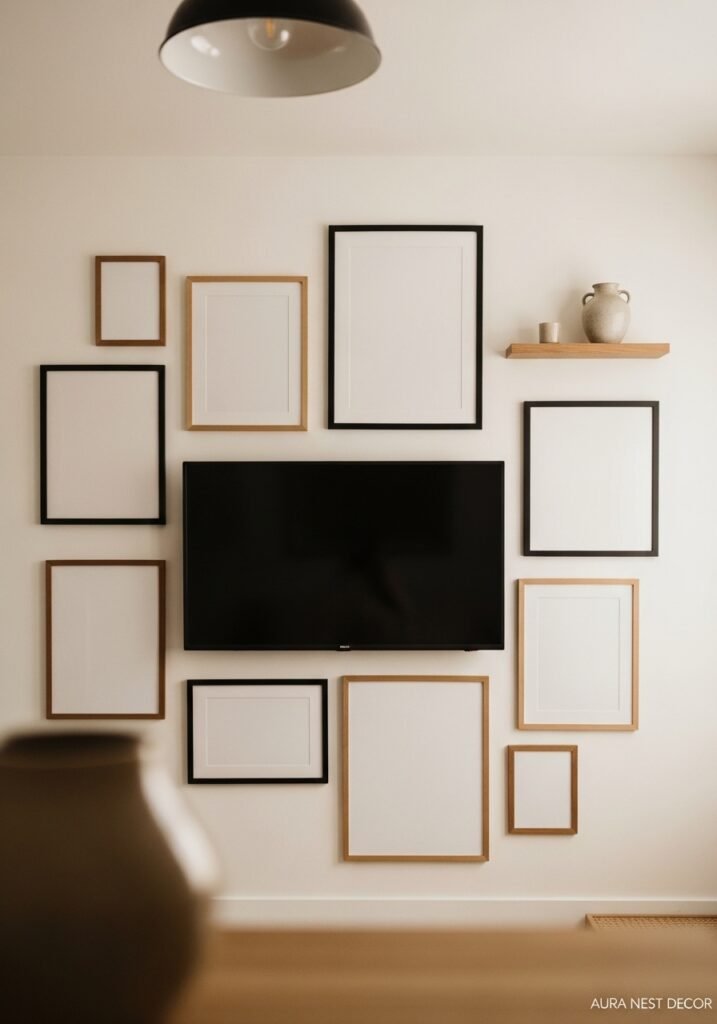
Okay so I know I said the TV shouldn’t be on a bare wall, but I also know that gallery walls around TVs can go very wrong. There’s a version that looks editorial and intentional, and there’s a version that looks like you framed every Etsy print you’ve ever bought and arranged them in a panic.
The difference is restraint.
If you’re going gallery wall around the TV, keep the frames in one metal finish. Brass or black. Don’t mix them. Give the TV some breathing room — don’t hang frames so close to the screen that the whole thing competes with itself. And vary the sizes more dramatically than you think you need to. A really large piece, a really small piece, then medium — that tension is what makes it look like someone thought about it.
“The best gallery walls look collected, not completed.”
In UK homes especially, I love seeing this done with botanical prints, vintage maps, and one or two abstract pieces. There’s something about that mix of old and new that feels very Pinterest-editorial and also genuinely warm. American living rooms seem to lean more into photography and typography prints, which also works — but watch the quantity. More than eight to ten pieces and it starts to feel like wallpaper.
—
8. How to Style the Space NEXT to the TV (Most People Ignore This Completely)
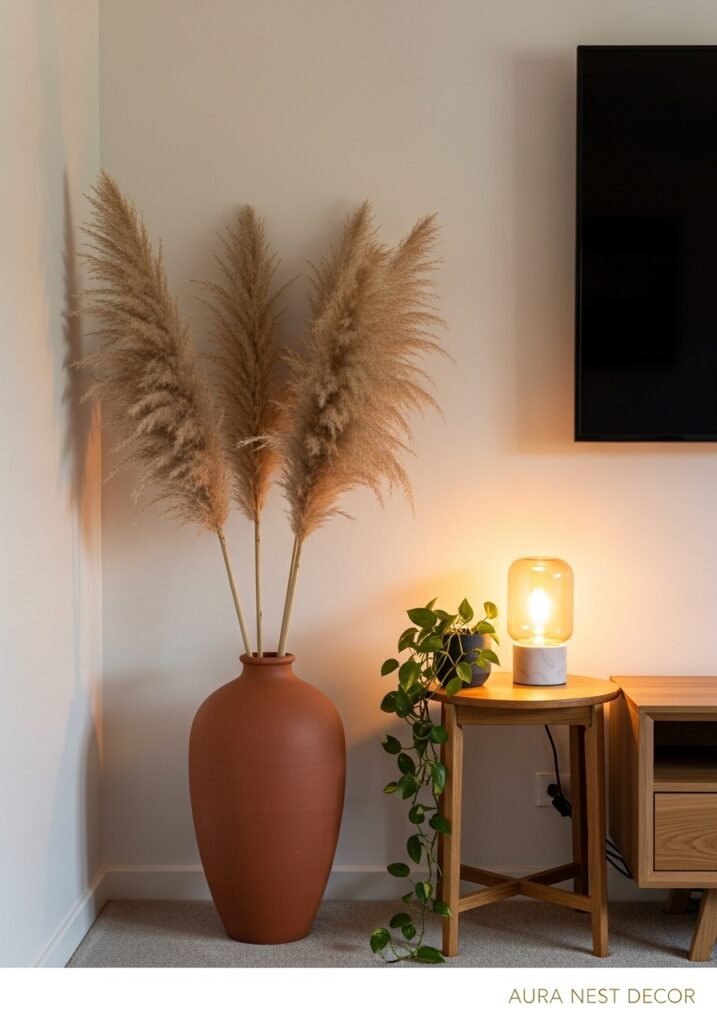
The area to the sides of your TV setup is chronically understyled. People focus so hard on the screen itself and forget that your eye travels to what’s adjacent when the TV’s off.
A tall houseplant in that corner? Instant life. A fiddle leaf fig, a monstera, a snake plant if you’re a serial plant-killer (no shame, I’ve murdered many). Something tall enough to reach about two-thirds up the wall, in a pot that matches your overall palette. Plants do something for a room that no decor object can replicate — they move, they grow, they make the space feel alive in a literal sense.
Or try stacking books on the floor next to your media unit. A small architectural pile with a candle or a small sculpture on top. It sounds simple but it creates a layered, dimensional look at floor level that most rooms completely ignore.
One thing I wouldn’t do: add another screen, another device, another thing that glows or makes noise. That corner beside your TV should be calm. Soft. The visual equivalent of an exhale.
—
9. Arranging Seating So the Room Feels Like It Actually Wants You There
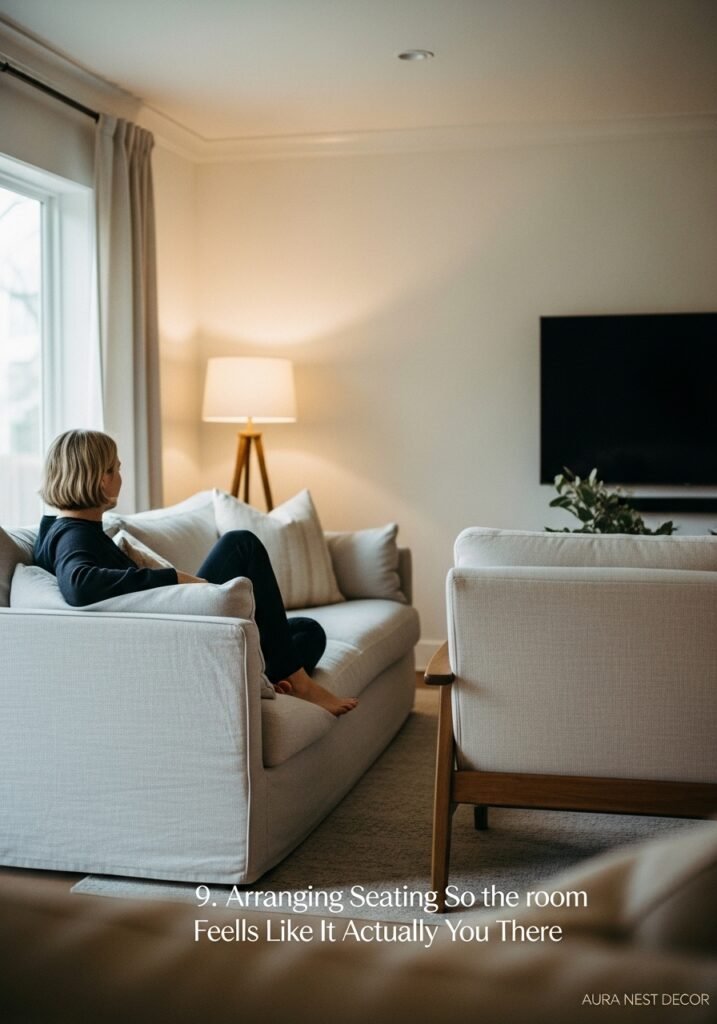
Sofa pointing straight at the TV with nothing else going on — that’s a hotel room setup, not a home. Cozy living rooms have seating that suggests conversation as much as viewing. An armchair at a slight angle. A loveseat or settee perpendicular to the sofa. Something that says “we sit here together” even when the TV is off.
The distance between your seating and the screen matters more than people think, both practically and aesthetically. For a 55-inch TV, you want to be roughly seven to nine feet away for comfortable viewing. Any closer and the room starts to feel like the furniture is leaning toward the screen hungrily. Any further and it starts to look formal and standoffish.
And leave space. Don’t cram every piece of furniture into the room. Empty floor space reads as intentional in a well-decorated room. It’s one of those things that feels counterintuitive — like you should fill the room — but restraint is always more sophisticated.
—
10. Shelving That Looks Good on Camera AND in Real Life
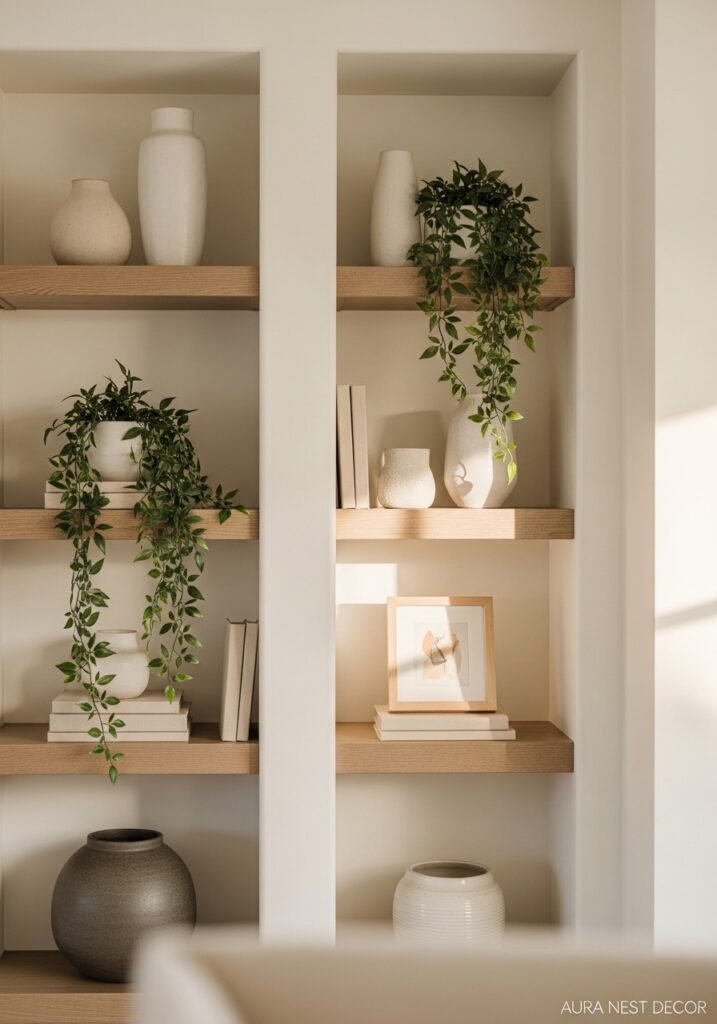
Not just for storage. For storytelling. The shelves flanking your TV — whether they’re floating or built-in — should feel like a little curated world when you walk in.
The formula I use: books (always some books), at least one living thing (plant, dried grass, something), at least one object with texture (ceramic, woven basket, rough stone), and one thing that’s purely decorative and probably shouldn’t be there but you love it anyway. Maybe it’s a vintage find. Maybe it’s something your kid made that you actually want to display. Whatever it is, it’s the thing that makes the shelf YOURS.
Vary the height of objects constantly. Low, tall, medium, then low again. Never line everything up at the same height — it looks like a shop shelf. The goal is a slightly improvised, slightly layered look that took you ten minutes but looks like it evolved over years.
—
11. The Cozy TV Room That Works in a Small Space (Really Does Work)
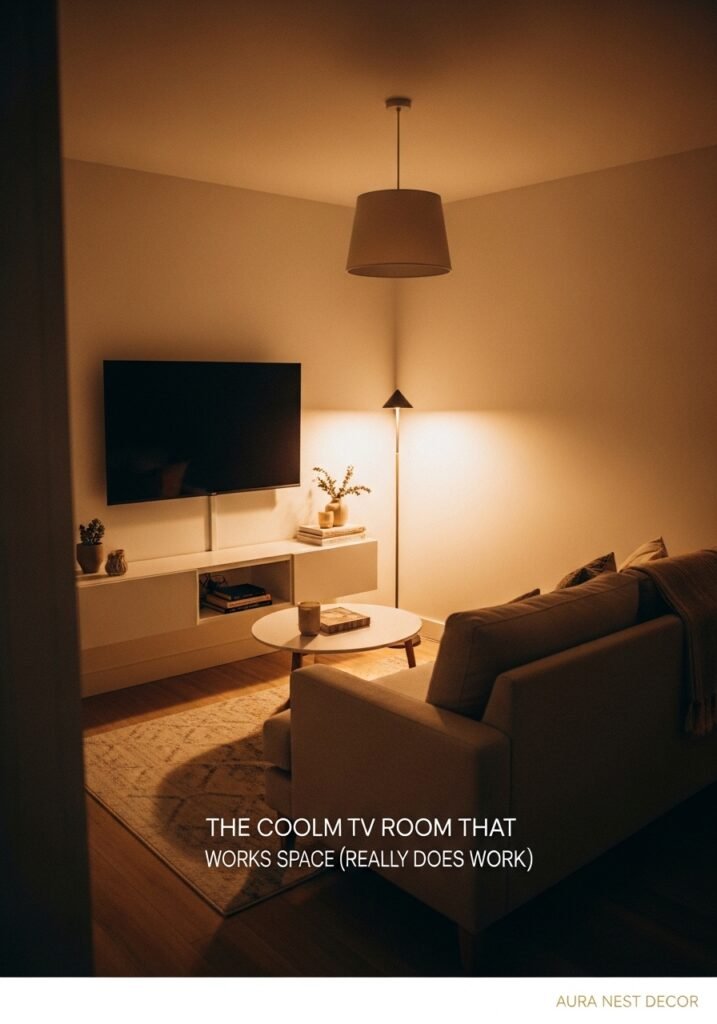
Small doesn’t mean you can’t have everything. It means you have to be more intentional.
In a smaller living room, the TV can go on a wall-mounted bracket instead of a console — but here’s the key thing, add a floating shelf just below it to recreate that grounded feeling. Style that shelf the same way you would a console. It does the same job in half the floor space.
Mirrors are your friend. Not in a generic way — not just “hang a mirror and things look bigger.” Specifically, a large round mirror on the wall adjacent to the TV reflects light from your lamps and makes the room feel like it has another dimension behind it. It works especially well in the evenings.
And don’t overcrowd it. In a small space, every piece of furniture has to earn its presence. One sofa, one armchair if it fits, a small side table. That’s probably enough. The temptation is to fill every inch, and it’s almost always a mistake.
—
12. The Details So Small You’d Walk Past Them (But They’re Doing Everything)
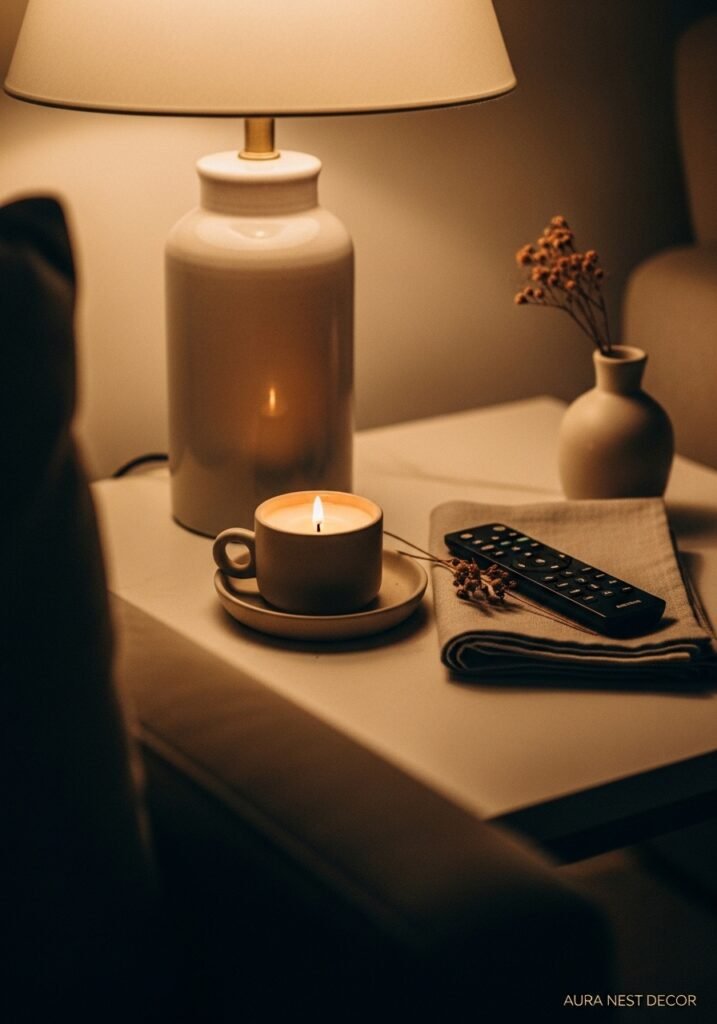
The coaster you always use. The small tray on the coffee table that holds the remote, a candle, and a little succulent. The throw you hang JUST SO over the arm of the sofa. These tiny things are what make a room feel like someone lives there and loves it.
Candles near the TV area specifically — not on the unit itself unless it’s very far from the screen, fire hazard and all that — but on the coffee table or a side table close by. When the TV’s on and you’ve got three or four candles going and the floor lamp’s lit and the bias light is glowing behind the screen, the room does this thing where it HOLDS you. Like the space itself is warm.
That feeling isn’t magic. It’s intentional small choices. A lot of them, layered up over time.
—
❓ FAQ
Q: Should the TV be mounted on the wall or sit on a TV unit? A: Both can look great — it really depends on your room. Wall-mounting gives a cleaner, more minimal look and saves floor space, but you lose the grounding effect of a media unit underneath. If you go wall-mounted, add a floating shelf below to anchor it visually. If you have the floor space, a good media unit is almost always warmer and more versatile for styling.
Q: What’s the best color to paint a TV wall to make the room feel cozy? A: Warm, muted tones work best — think dusty clay, warm greige, or a soft terracotta. In the UK, look at Farrow & Ball’s “Dead Salmon” or Little Greene’s “Pale Tan.” In the US, Benjamin Moore’s “Pale Cognac” is gorgeous. Dark colors like charcoal or deep forest green can also look incredible if you’ve got decent natural light. Avoid cool grays — they fight the warm, cozy feeling you’re going for.
Q: How do I make a TV wall look cozy without hiding the TV? A: Style around it, not away from it. Add shelving or art on either side, layer your lighting with lamps and bias lighting behind the screen, put a media unit or floating shelf underneath, and bring in some plants and textured objects nearby. The TV becomes part of a composed wall rather than a lone rectangle, and somehow it stops feeling like it’s in the way.
—
💭 Final Thoughts

A cozy TV room isn’t really about the TV at all. It’s about a room that wraps around you — one that feels considered, layered, and lived-in enough to settle into without thinking. The screen is just one element in that, honestly a pretty small one once everything else is working.
What small change would make the biggest difference in your living room right now?