The Chandelier Your Living Room Has Been Waiting For (And Why You Keep Getting It Wrong)
You walked past one in a restaurant. Or saw it on someone’s Instagram. That moment where the light hit just right, and the whole room felt like it belonged in a film — you’ve been chasing that feeling ever since. Here’s the thing: it’s not luck. It’s the chandelier.
—
1. Why Most People Pick the Wrong Size (And What the Ceiling Is Actually Telling You)
This is where almost everyone goes wrong. Not the style, not the finish — the SIZE. And it’s not really their fault because the standard advice out there is genuinely confusing.
Here’s a rule that actually works: add your room’s length and width together in feet, and that number in inches is roughly the diameter your chandelier should be. So a 12 x 14 foot living room? You’re looking at a 26-inch fixture. Not a tiny 16-inch thing lost in a sea of ceiling. Not a 40-inch statement piece that makes guests duck when they walk in.
But honestly, ceilings complicate everything. Standard 8-foot ceilings need the bottom of the chandelier to hang no lower than 7 feet from the floor — that’s your absolute minimum for walking clearance. Got a soaring 10 or 12-foot ceiling? Lucky you. Drop it lower. Let it breathe. A chandelier that hangs too high in a tall room looks like it’s trying to escape, and that energy is not the vibe.
One more thing people skip: don’t center your chandelier on the ceiling if the furniture isn’t centered under it. Center it on the SEATING AREA. Where people actually sit. That’s where the magic happens.
—
2. The Chandelier Style That’s Quietly Taken Over Every Beautiful Living Room This Year
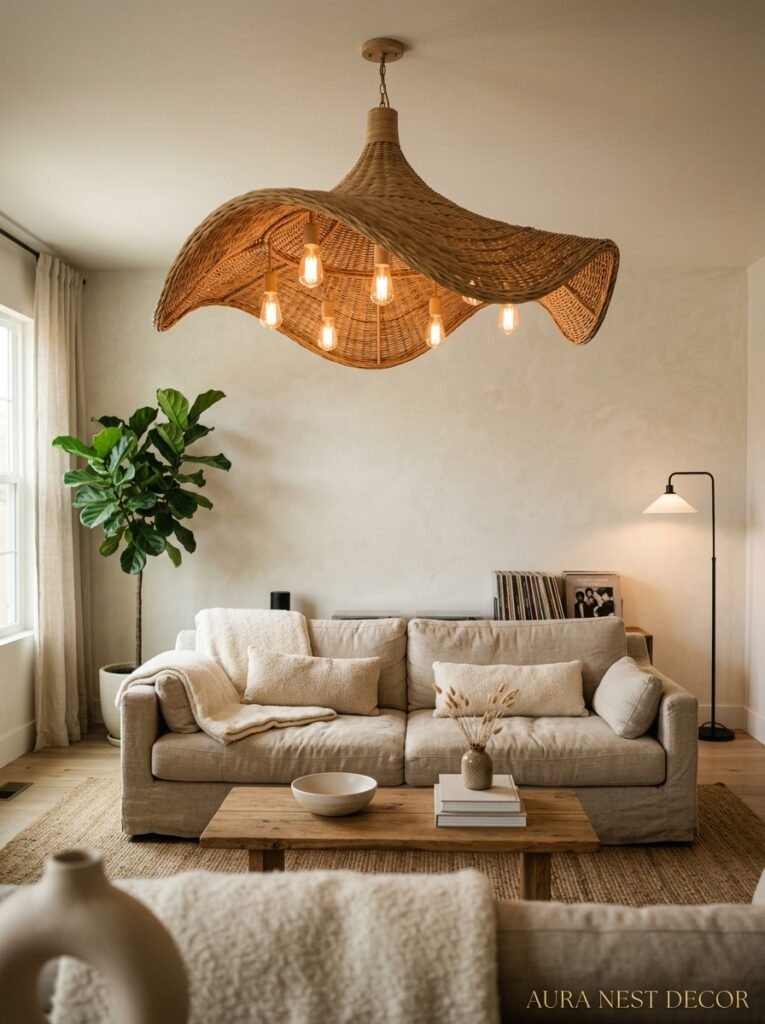
It’s not crystal. It’s not mid-century minimal. And it’s not the farmhouse wagon wheel (thank goodness, honestly).
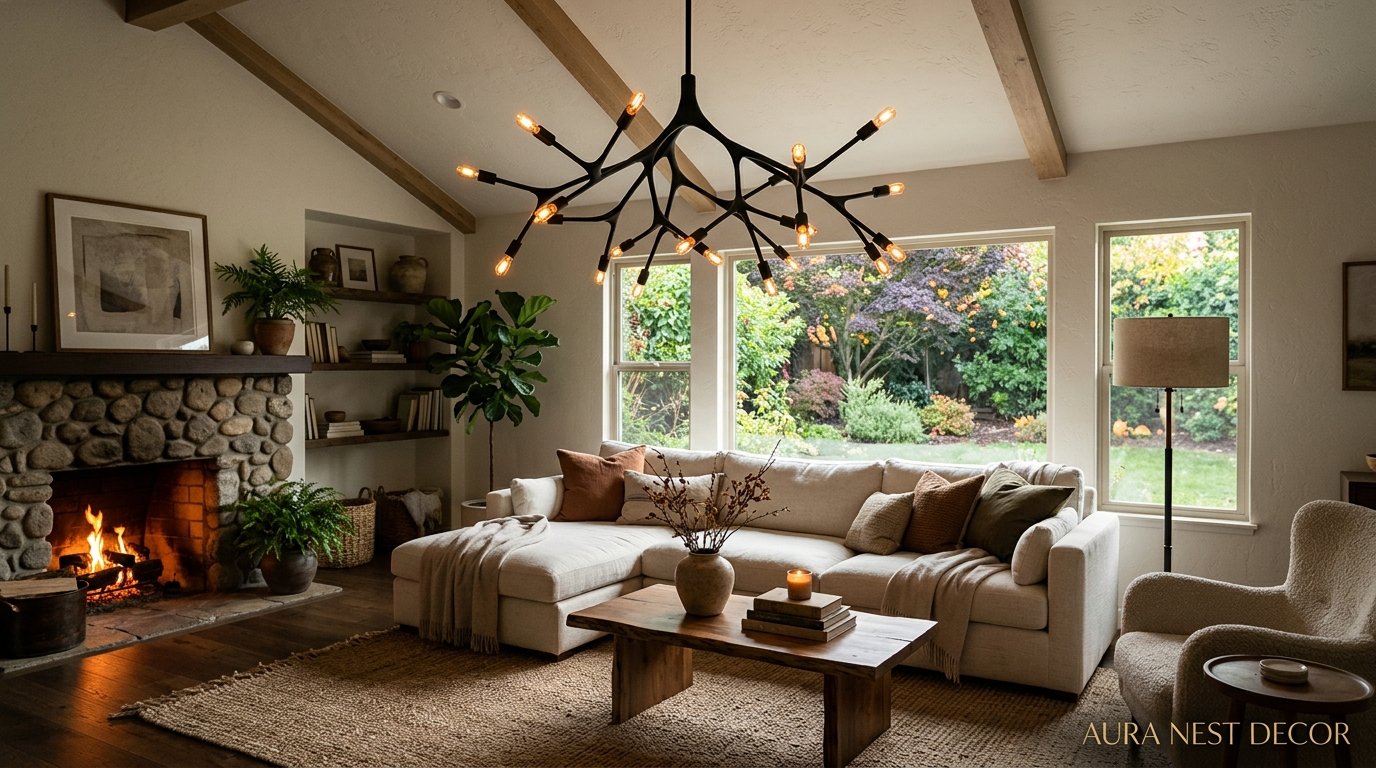
What’s everywhere right now is what I’d call “organic modern” — sculptural shapes, matte finishes, and materials that feel like they were found rather than manufactured. Rattan. Linen shades. Hammered brass. Black iron twisted into something that looks almost botanical. These chandeliers don’t scream “look at me.” They just… belong. They look like they’ve always been there, like the room evolved around them.
The British interiors market has gone absolutely mad for unlacquered brass right now — it patinas over time, goes a bit dark and moody in the corners, and it looks incredible in Victorian terraces and Georgian townhouses. Americans seem to be gravitating toward matte black and aged bronze, which reads really well in both modern farmhouses and older Craftsman homes.
Side note — I’ve seen some truly spectacular woven seagrass chandeliers lately that I did NOT expect to love as much as I do. They look like something you’d find in a coastal cottage but they somehow work in a downtown apartment too. Go figure.
“The right chandelier doesn’t complete a room. It unlocks it.”
—
3. Crystal Chandeliers Aren’t Dead — You’re Just Hanging Them Wrong
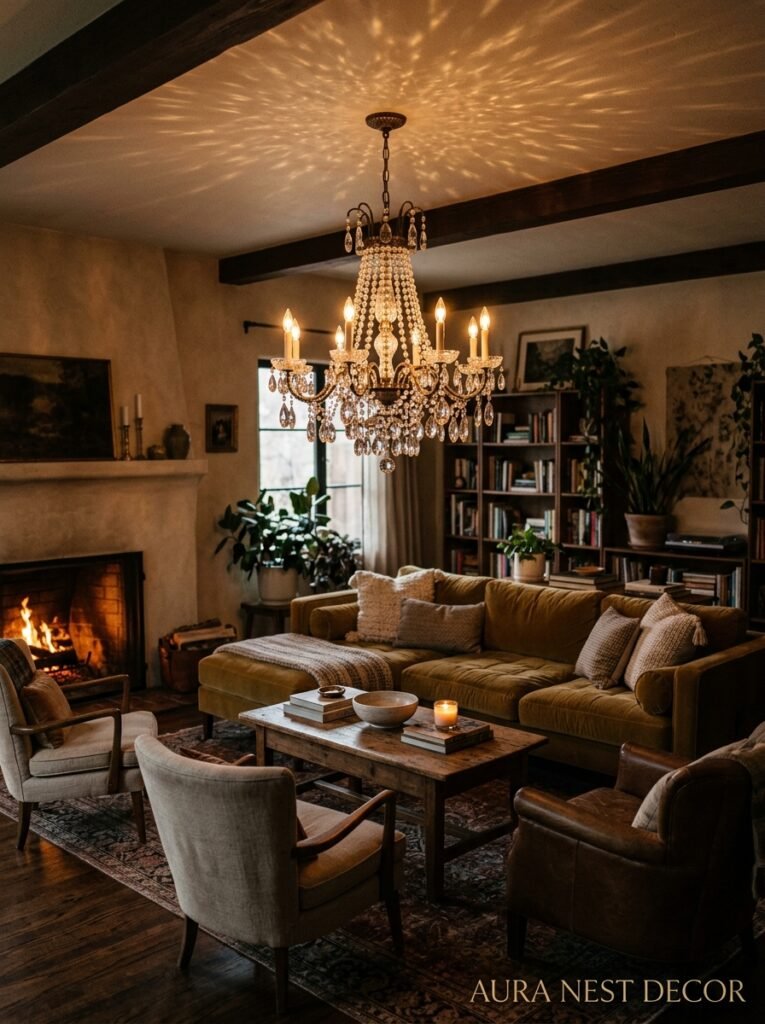
Here’s an opinion that might ruffle some feathers: crystal chandeliers are not outdated. They’re just being used wrong.
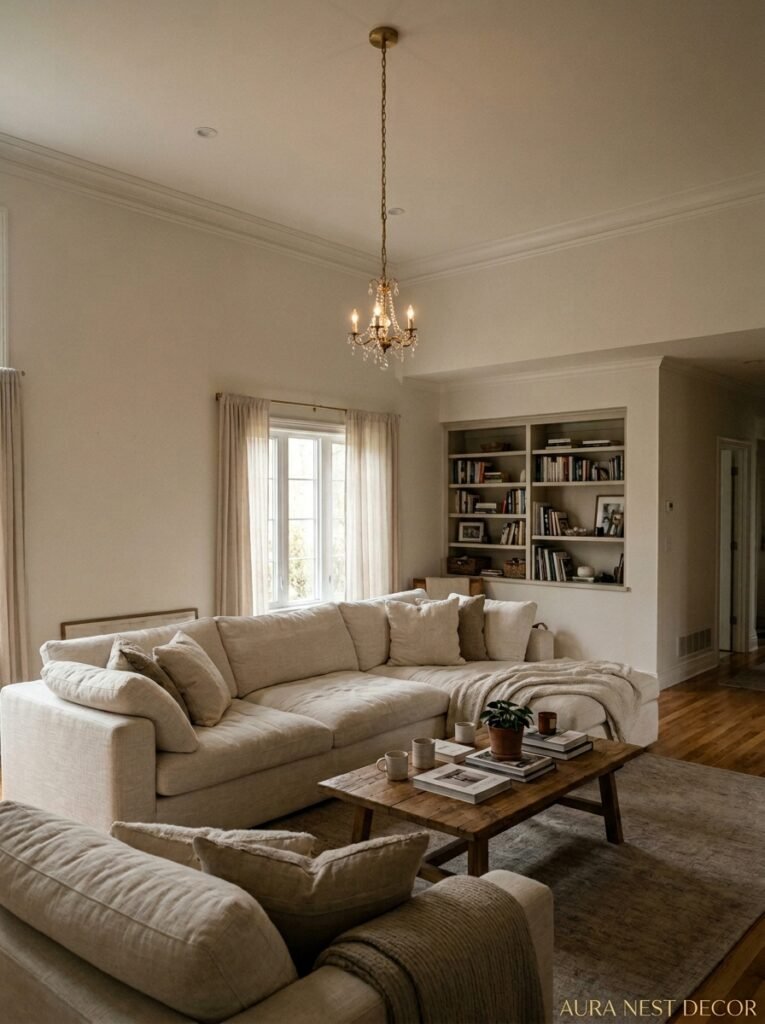
The problem is context. A traditional waterfall crystal chandelier in a minimalist white box of a room looks confused. But that SAME chandelier in a room with velvet sofas, painted dark walls, a vintage rug, and some antique picture frames? Suddenly it’s the most sophisticated thing you’ve ever seen.
Crystal works when it has texture to play with. It’s light-reactive — it needs contrast, shadow, richness. Put it in a room that’s already got depth and character, and it amplifies everything. Drop it into a blank, modern space with no personality and it just floats there, looking a bit sorry for itself.
If you want crystal but you’re working with a more contemporary space, go for something with a cleaner silhouette — a single-tier drum with crystal drops, or a geometric frame with minimal crystal accents. It gives you the sparkle without the grandeur. Some people need grandeur. Some don’t. Both are valid.
—
4. The Lighting Temperature Conversation Nobody Is Having (But Should Be)
I feel like I’m on a mission about this. Truly.
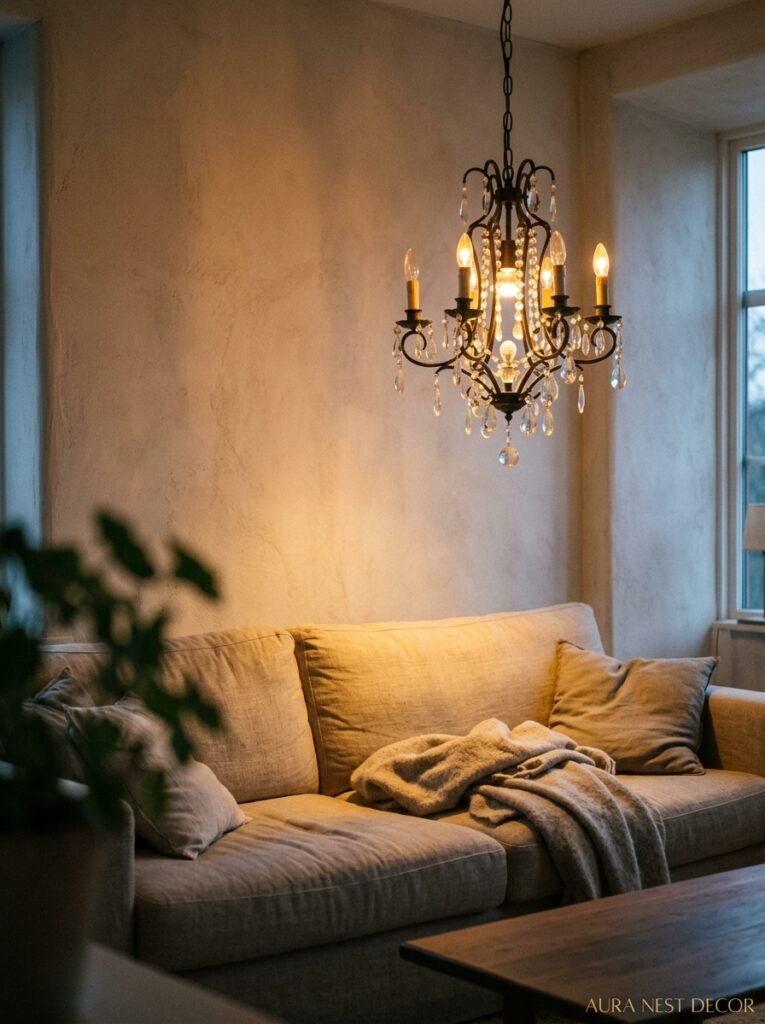
Your chandelier is only as good as the bulb you put in it. And most people are destroying their own living room atmosphere with bulbs that are too COLD. That blue-white light that makes everything feel like a dentist’s office? That’s a 5000K bulb. Get it out of your home.
For living rooms, you want 2700K to 3000K. Warm white. The kind of light that makes skin look good and makes food look delicious and makes everyone in the room seem like they’re having a slightly better time than they actually are. The amber glow at 7pm, curtains half-drawn, something good on the record player — that’s 2700K. That’s the goal.
And please, if your chandelier is dimmable (and it should be, always, install a dimmer switch immediately if you haven’t), learn the different settings. Full brightness at 8am on a Sunday is fine. Full brightness at 8pm on a dinner party night is genuinely kind of aggressive. Dim it down. Create atmosphere. Let the chandelier do what it was born to do.
“A chandelier at full brightness every night is like playing every song at maximum volume. The quiet settings are where the good stuff lives.”
—
5. What Happens When You Put a Chandelier in a Low-Ceilinged Room (Spoiler: It Can Work)
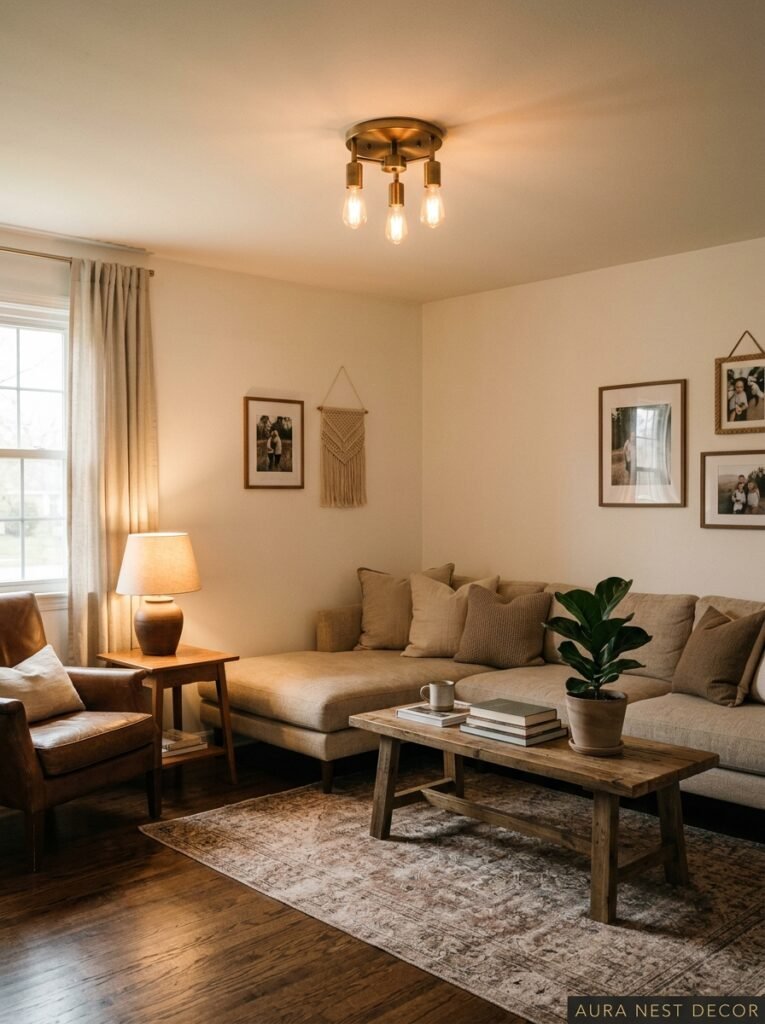
Not everyone’s got a Victorian double-height sitting room. Some of us are working with 8-foot ceilings in a 1970s semi-detached or a small ranch-style house, and we still want something beautiful overhead. Good news: there are real options.
Semi-flush chandeliers are the move here. They mount close to the ceiling but still have presence — decorative elements, multiple bulbs, interesting silhouettes. Don’t get a basic flush mount, that’s not what I’m suggesting. Get something that has actual DESIGN to it, just without the long drop.
Linear chandeliers can also work brilliantly in low rooms over a long sofa — they run horizontally rather than hanging down deep, so they feel less imposing vertically. And candelabra-style chandeliers with upward-facing bulbs push light up toward the ceiling, which tricks the eye into thinking the ceiling is higher than it is.
The one thing you genuinely shouldn’t do in a low-ceilinged room is hang a chandelier with a very long chain and then just coil up the excess. It looks improvised. Either get a properly sized fixture or get the chain cut and adjusted properly. It’s worth the small cost.
—
6. The Color Trick That Makes Any Chandelier Look More Expensive
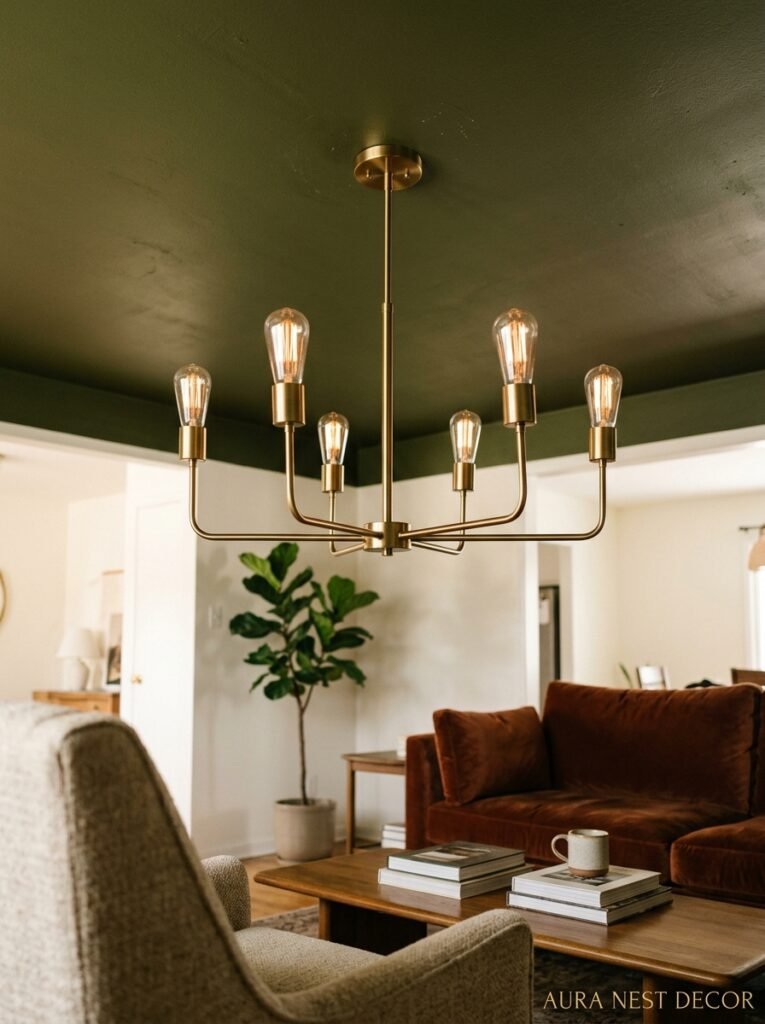
Paint your ceiling.
Specifically: if your chandelier is gold or brass, paint your ceiling a very soft warm white — something with a yellow or pink undertone, like a barely-there cream. It bounces the warm light back down and the whole setup just glows.
If your chandelier is black or wrought iron, a ceiling in a deep, moody color — navy, forest green, charcoal — creates this incredible contrast where the fixture seems to emerge from the darkness. It’s dramatic and it costs about £30 or $35 worth of ceiling paint. Genuinely one of the best cheap upgrades in home decor.
For crystal or silver-toned fixtures, a soft pale blue or grey ceiling does something almost architectural — it feels a bit like sky, and the crystal picks up that cool light and scatters it differently. It’s subtle but once you know to look for it, you see it everywhere in really well-styled rooms.
I know painting the ceiling feels like a commitment. But ceilings are actually one of the lowest-stakes places to be bold — you’re not touching the walls or the floor. It’s almost like a little secret in the room.
—
7. How to Mix a Chandelier With Other Light Sources (Because Overhead Isn’t Enough)
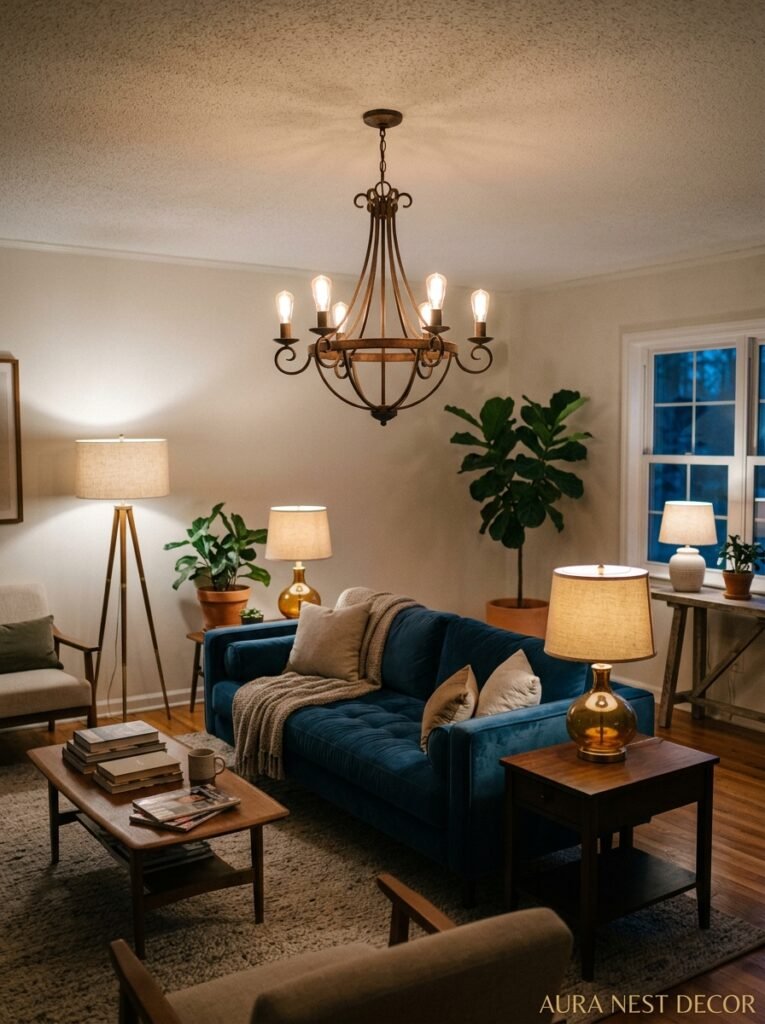
A chandelier alone cannot light a living room properly. I need to be really clear about that. It’s ambient light — it sets the tone, it creates mood, it gives the room its personality. But you ALSO need floor lamps, table lamps, maybe some wall sconces.
The rule I live by: three sources of light at different heights, minimum. The chandelier is the high source. A floor lamp behind a chair or sofa is the mid-to-low source. Table lamps on side tables are the low, focused source. Get all three going and you never need overhead alone — the room layers, it feels warm rather than lit.
And here’s the thing about mixing metals across your light sources: don’t stress about it. A brass chandelier with black floor lamps and aged bronze table lamps can absolutely coexist. The mistake people make is trying to MATCH everything exactly, and it ends up feeling like a hotel lobby rather than a home. A little tension between finishes reads as intentional. It reads as collected over time, which is exactly what you want.
“Light a room from three heights and it doesn’t matter what’s on your walls. The room will always feel good.”
—
8. Maximalist Chandeliers and the Rooms That Can (Actually) Handle Them
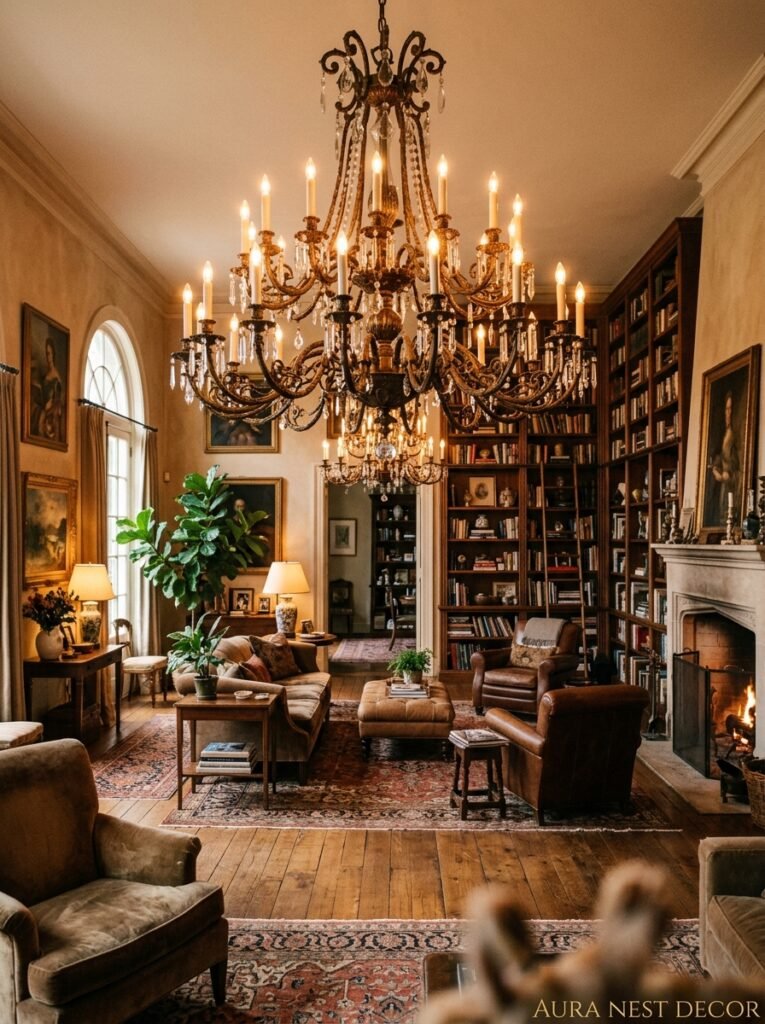
Some chandeliers are not subtle. They’re not trying to be. Massive sputnik fixtures in antique gold. Cascading crystal drops six feet long. Sculptural black iron things that look like a modernist nightmare in the best possible way. I love all of them.
But they need the right room or they’ll eat everything alive.
Maximalist chandeliers work when the rest of the room is relatively restrained — the furniture is simple, the color palette is controlled, the surfaces aren’t fighting for attention. The chandelier IS the statement. Let it be. This is not the room for the gallery wall and the patterned rug and the eclectic bookshelf all happening at once. Pick your fight.
Alternatively, they work in very large rooms where the scale demands that kind of presence. A huge living room with a tiny chandelier looks sad, actually. Sad and oddly corporate. Big rooms want big light. They can take it.
The UK has some incredible Victorian and Edwardian living rooms where a genuinely enormous chandelier just makes sense — the ceiling height, the ornate cornicing, the bay windows. Sometimes the architectural bones of a room tell you exactly what it needs.
—
9. The Chandelier Finish Pairing Guide Nobody Told You About

Gold and cream. Always.
Black and anything warm — terracotta, rust, warm white, burnt orange.
Brushed nickel and cool tones — greys, soft blues, greens.
Unlacquered brass and rich jewel tones — deep teal, forest green, burgundy, navy.
Natural materials (rattan, seagrass, linen) and earthy neutrals, obviously, but also surprisingly gorgeous against a really bold wall color. A natural rattan chandelier against a deep terra cotta wall is one of the most unexpectedly beautiful combinations going right now.
Chrome is tricky. Chrome goes well with very clean, minimal, monochromatic spaces. It fights with everything that’s warm or layered. If your room is cozy and collected, chrome might be the one finish to avoid.
Honestly the pairing that keeps showing up in every room I’m saving on Pinterest lately is unlacquered brass with green — any shade of green. Sage. Olive. Emerald. The warmth of the brass against the coolness of the green creates this really grounded, natural feeling that I genuinely can’t get enough of.
—
10. The Rental Apartment Problem (Yes, You Can Still Have a Chandelier)
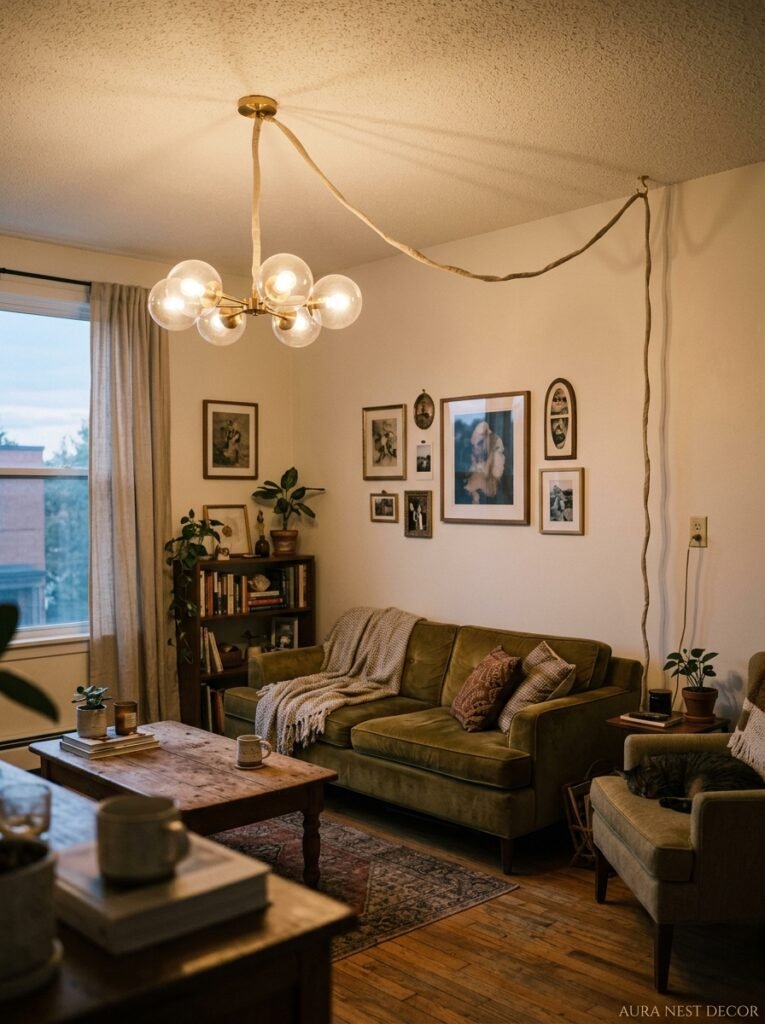
Renters. I see you. You can’t rewire anything, you can’t mess with the ceiling junction box, and the landlord has put up the saddest possible pendant light in a plastic housing that makes you want to weep.
Here’s what you can do: swag a chandelier. A swag chandelier has a cord that runs across the ceiling on hooks (command hooks work fine on most ceilings, by the way) and plugs into a regular wall outlet. You get the visual drama of a hanging chandelier without touching the electrical at all.
Battery-operated candle chandeliers have also gotten MUCH better in the last couple of years. The ones with flickering LED candles — some of them genuinely look real from across the room. Good for rooms where you need mood more than actual reading light.
And if you’re in a UK rental with a pendant light that won’t budge, you can sometimes swap just the shade or the cage around the existing fitting for something more interesting — as long as you keep the original to restore when you leave. A rattan cage or a fabric empire shade can dramatically change a basic pendant without touching the wiring.
—
11. The Thing Happening in Transitional Homes That Interior Designers Are Obsessed With
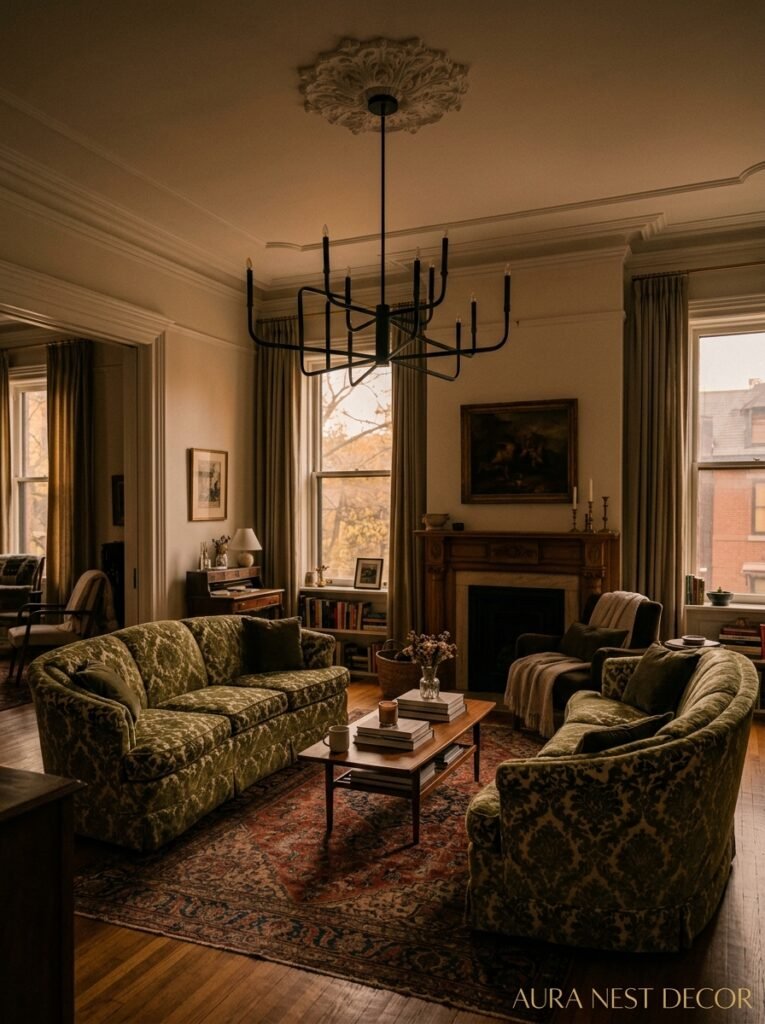
Transitional style — that sweet spot between traditional and contemporary — is probably where most real people’s living rooms actually live. Not fully modern, not fully traditional. Some vintage pieces, some clean lines, a bit of both.
And the chandelier that works in transitional spaces is usually something with a traditional silhouette in an unexpected finish. A classic candelabra form in matte black. A tiered chandelier with clean, simple arms in antique bronze. A drum shade chandelier in a textured fabric with minimal hardware.
The shape can be familiar — recognizable, even — but the finish and the materials should do something a little surprising. That’s what reads as current without feeling trendy. Trends fade. The right chandelier for a transitional space can last fifteen years and look intentional the whole time.
This is also the style where mixing a chandelier with ceiling beams really shines. Beamed ceilings with a simple iron or bronze chandelier is one of those combinations that’s been working for about 200 years and shows absolutely no sign of stopping.
—
12. The Mistake You Make After You Buy the Perfect Chandelier
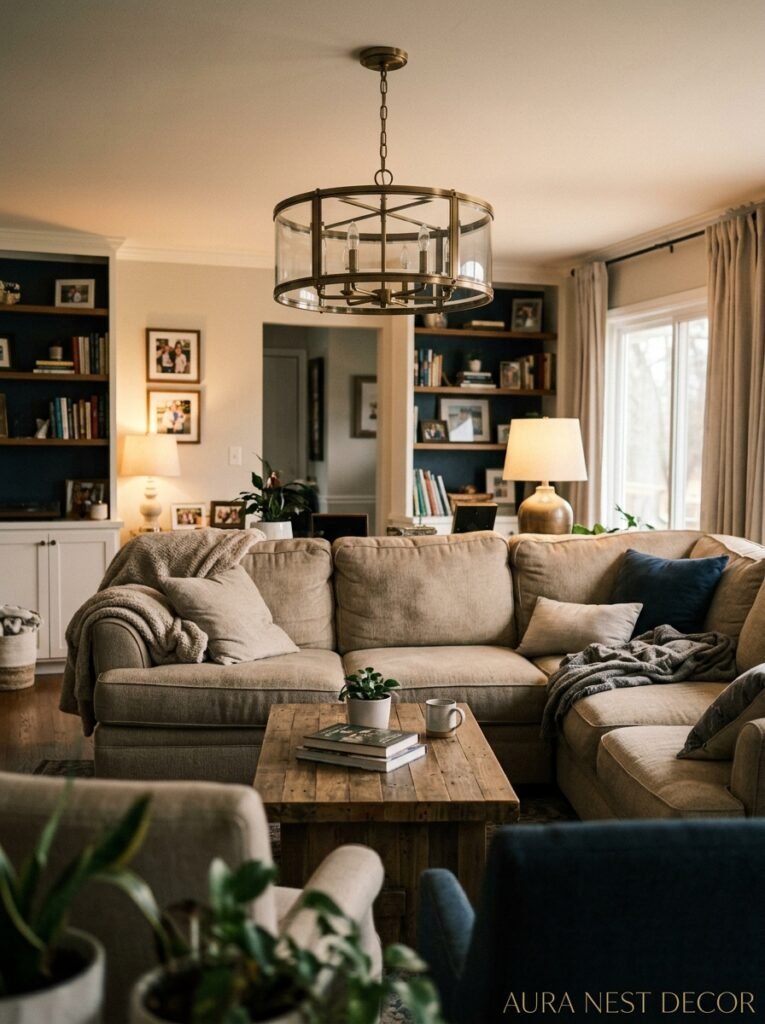
You install it and then you leave the room.
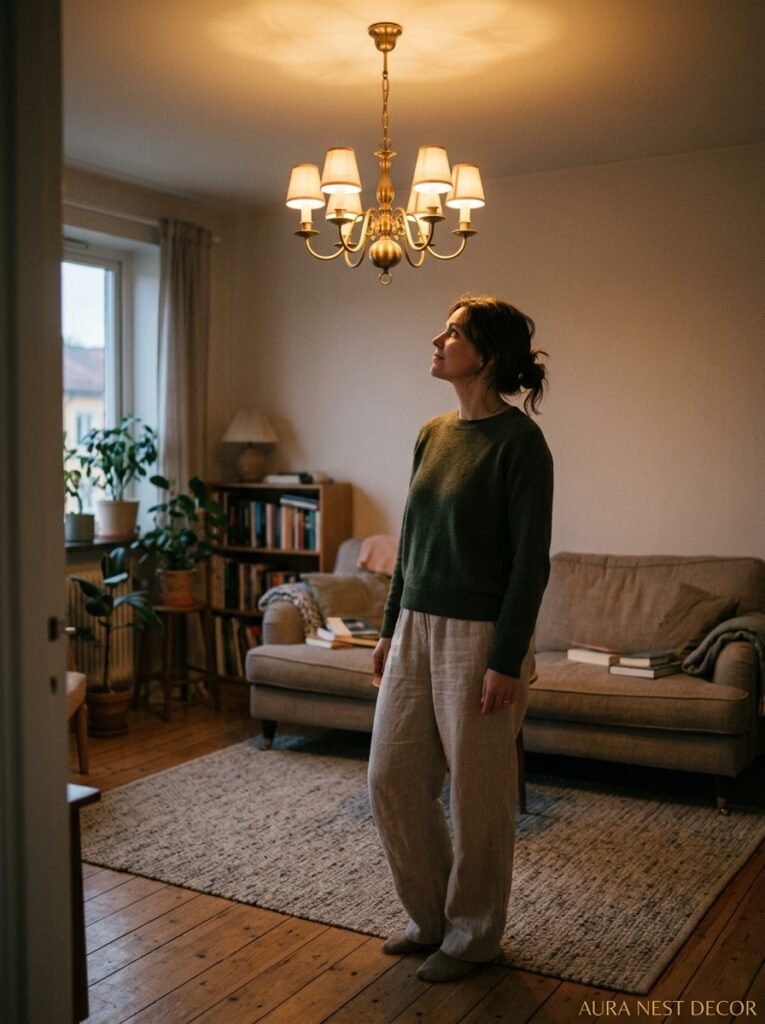
Here’s what actually needs to happen: you need to sit in your main seating spot, at night, with the chandelier on at different dimmer levels, and just… look at the room. Because the angle you’ll see the chandelier most often is from below, at about a 30-degree tilt while you’re sitting on the sofa. Not from the doorway. Not from straight underneath.
Sometimes you’ll notice the chandelier is slightly off-center from where you’re actually sitting. Sometimes the height isn’t quite right now that the furniture’s in place. Sometimes there’s a bare bulb that’s too visible at that angle and needs a shade or a different bulb shape.
This last step matters as much as any of the choosing and installing. Give the room a night. Sit with it. Let it settle. You’ll either fall in love or you’ll see exactly what needs tweaking — and either way, that’s the most important information you can have.
—
❓ FAQ
Q: How high should a chandelier hang in a living room with a standard 8-foot ceiling? A: The bottom of the chandelier should be at least 7 feet from the floor — so you’re really only working with about 12 inches of drop, which means a semi-flush or close-to-ceiling design is usually your best bet. Don’t try to force a chandelier with a long chain into a low room; it’ll look wrong and it can be a safety issue.
Q: Can I put a chandelier in a living room that doesn’t have a ceiling junction box? A: Yes, if you’re willing to have an electrician install one (not a huge job), or if you go the swag route with a plug-in chandelier. Swag chandeliers run on a cord to a wall outlet and can look completely intentional when done right — the cord along the ceiling becomes part of the design.
Q: What’s the best chandelier style for a living room that’s trying to be cozy rather than grand? A: Go for soft materials over hard ones — linen shades, rattan, wood, or fabric-wrapped arms rather than crystal or polished metal. A small-to-medium chandelier with warm Edison bulbs on a dimmer creates that cozy, intimate feeling without any grandeur at all. It’s about warmth and scale, not drama.
—
💭 Final Thoughts

The best chandelier you’ll ever pick isn’t the most expensive one or the most dramatic one. It’s the one that looks like it was always supposed to be there — the one guests don’t notice consciously but somehow always end up standing underneath. That’s the goal. That’s what you’re chasing.
Take your time, get the size right first, and trust the weird material or unexpected finish that keeps pulling your eye when you’re scrolling. Your instincts are usually right about these things.
What’s the one thing that’s been holding you back from committing to a chandelier?