
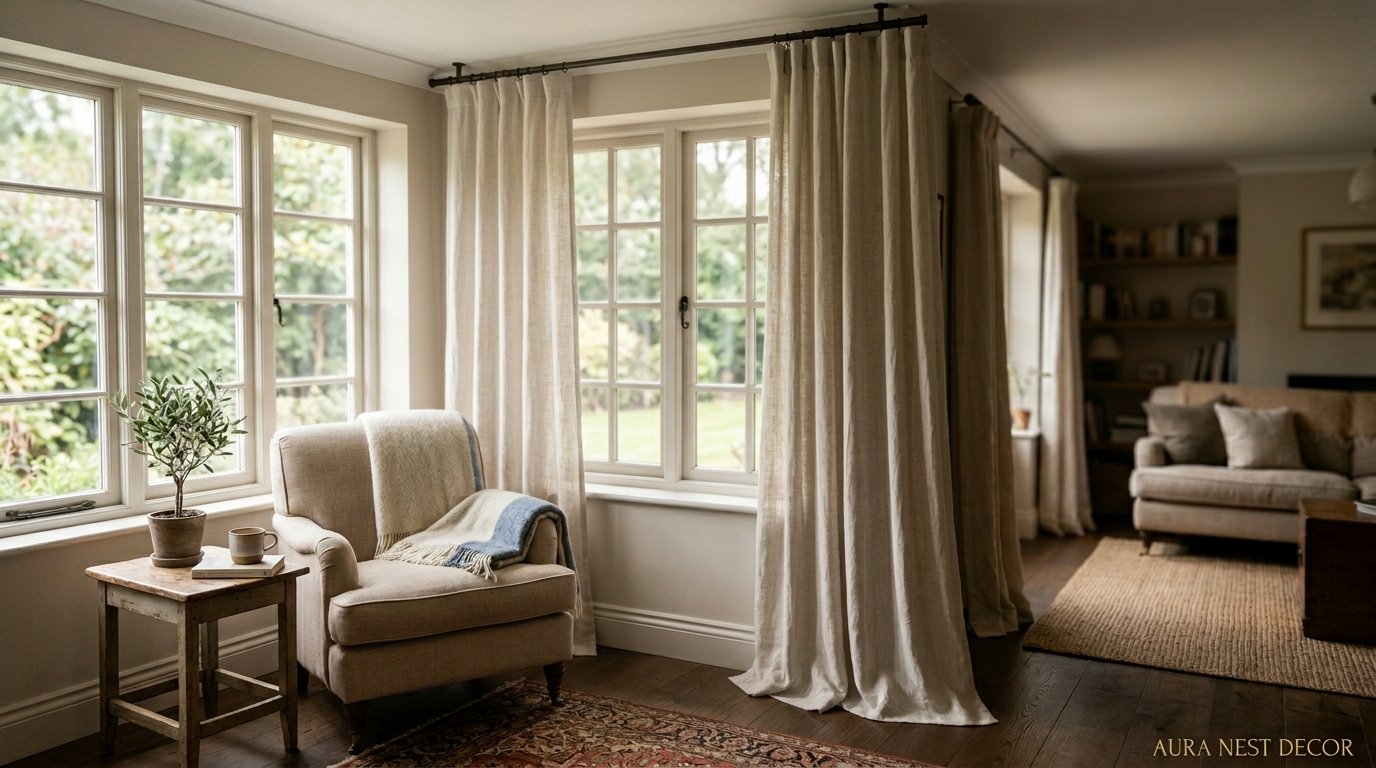
The Curtain You’ve Been Getting Wrong Is the Reason Your Living Room Feels Off
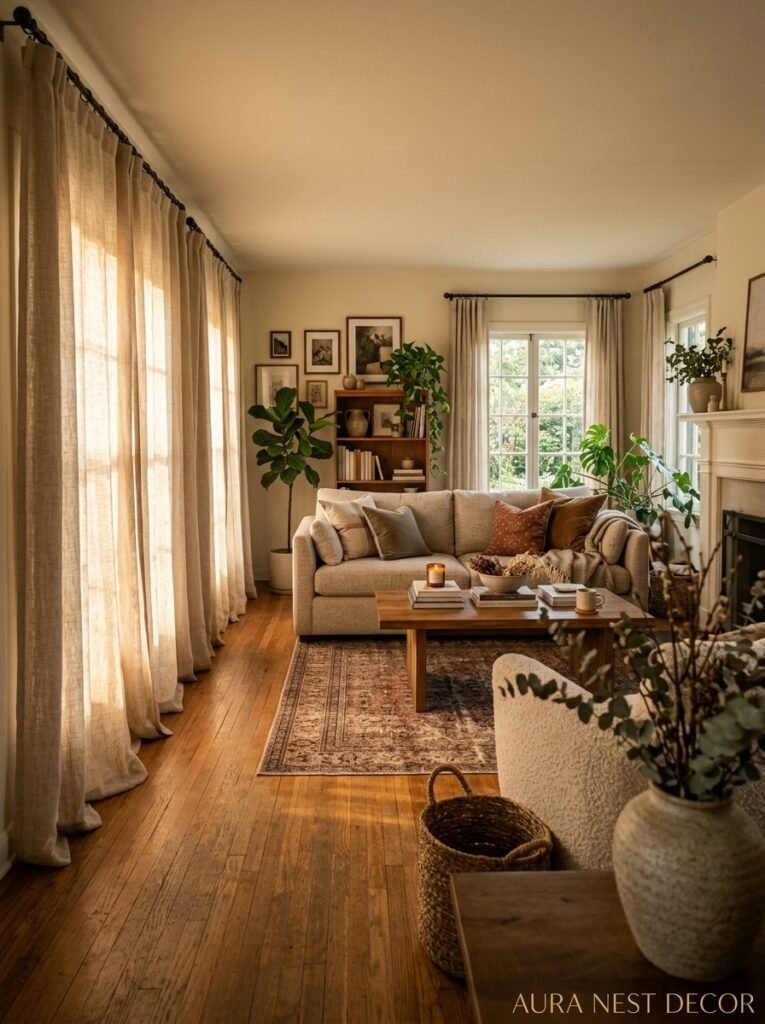
You know that feeling when a room looks almost right but you can’t figure out why it doesn’t? Nine times out of ten, I’d bet money it’s the curtains. Not the sofa, not the paint — the curtains.
—
1. The Height Mistake That’s Secretly Shrinking Your Ceilings
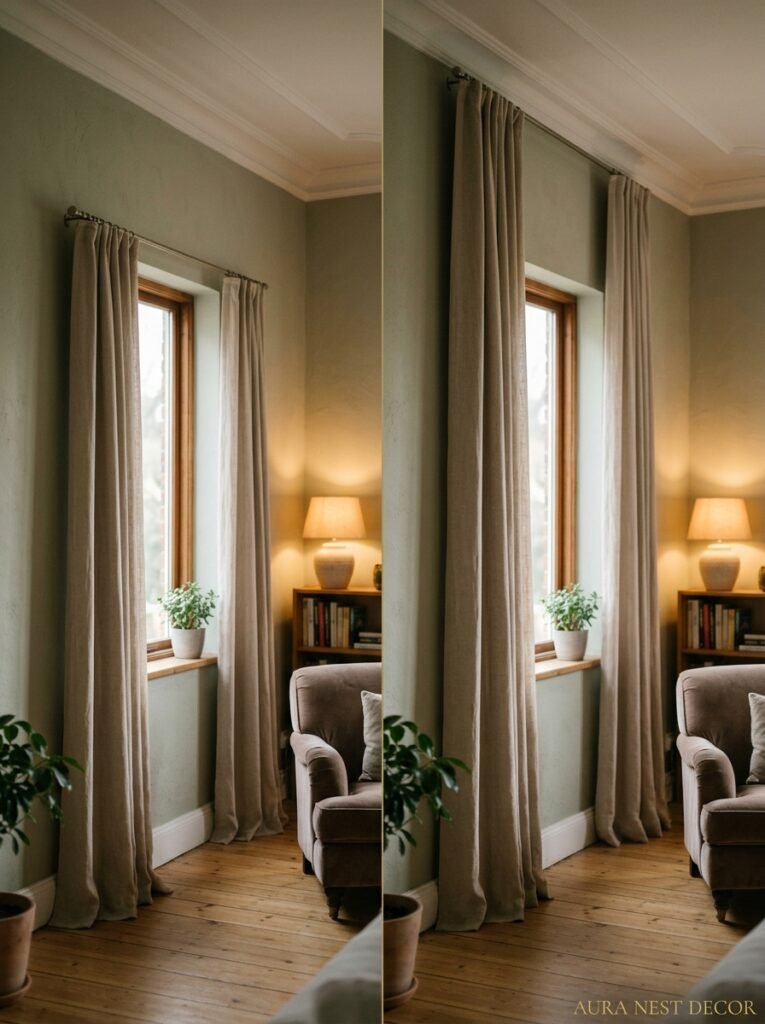
Okay, so this is the one I wish someone had grabbed me by the shoulders and explained years ago. Most people hang curtains at window height. Like, right above the frame. And it seems logical — the window is there, you cover the window, done. But it’s genuinely one of the most common mistakes I see in living rooms, from studio flats in London to open-plan homes in the suburbs of Chicago.
Here’s what actually happens when you hang them that way: your ceiling drops. Visually. The room compresses. It doesn’t matter if you’ve got nine-foot ceilings or twelve-foot ones, low-hung curtains make any room feel like it’s wearing a hat two sizes too small.
The fix is almost embarrassingly simple. Hang the rod 4 to 6 inches below the ceiling — or even right at the ceiling if you’re feeling bold. Then let the fabric fall all the way to the floor. Suddenly the room breathes. The eye travels upward. You didn’t add square footage but somehow the room FEELS bigger, more considered, like someone who knew what they were doing made choices in there.
I’ve done this in two different living rooms now and the difference both times was honestly ridiculous. My mother-in-law walked in and asked if we’d had work done. We hadn’t. It was just curtains, hung higher.
“Hang curtains at window height and you’ll shrink a room. Hang them at ceiling height and you’ll transform one.”
2. The Width Rule That Interior Designers Don’t Talk About Enough
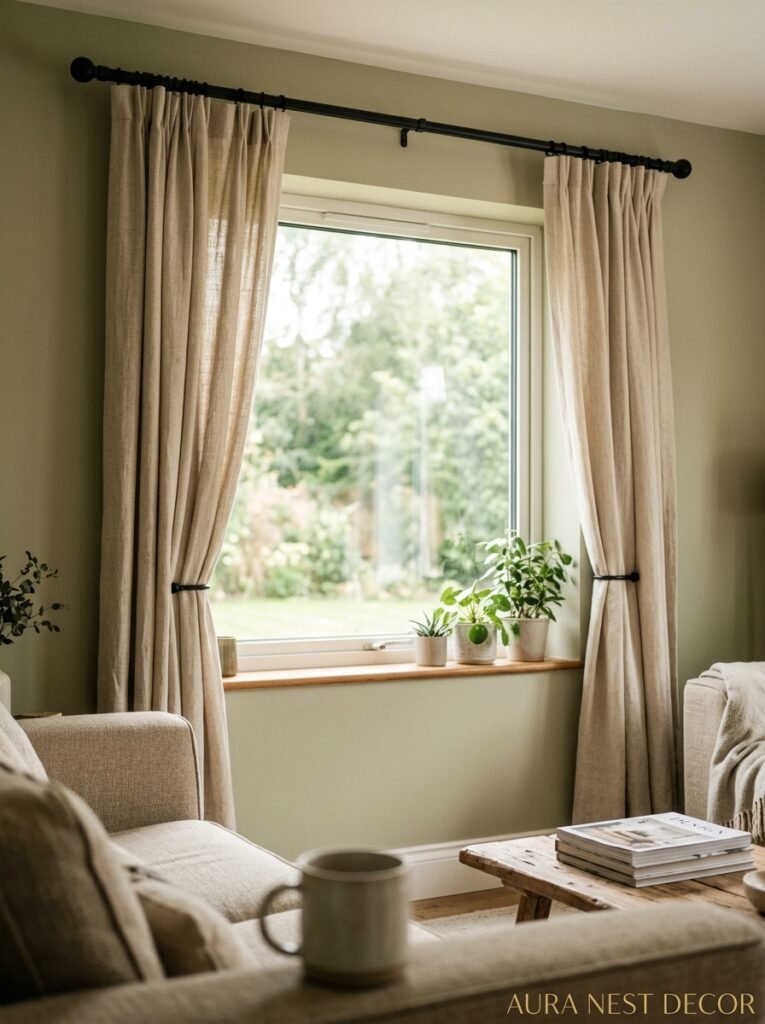
Here’s another one. Your curtains shouldn’t just cover the window. They should EXTEND past it — several inches on either side, sometimes more. The standard advice is 6 to 12 inches beyond each window frame, but honestly, I’d lean toward the wider end most of the time. Maybe even further if your wall space allows it.
Why? Because when curtains are pulled open, you want them to stack on either side of the glass, not eat into the window itself. If they’re too narrow, you end up with fabric blocking half your natural light even when the curtains are “open.” That’s annoying and kind of defeats the whole point. You’re losing daylight — which in a British winter, you cannot afford to do. Or a Chicago winter for that matter. Any winter, really.
Wide curtains also make a window look more architectural, more intentional. A small window suddenly looks like it meant to be there. There’s something about a generous expanse of fabric that signals confidence in a room. Like the room knows what it wants to be.
So before you order anything — measure your wall width, not just your window width. This matters more than almost any fabric choice you’ll make.
3. Linen, Velvet, or Whatever That Third Option Is You Keep Overlooking
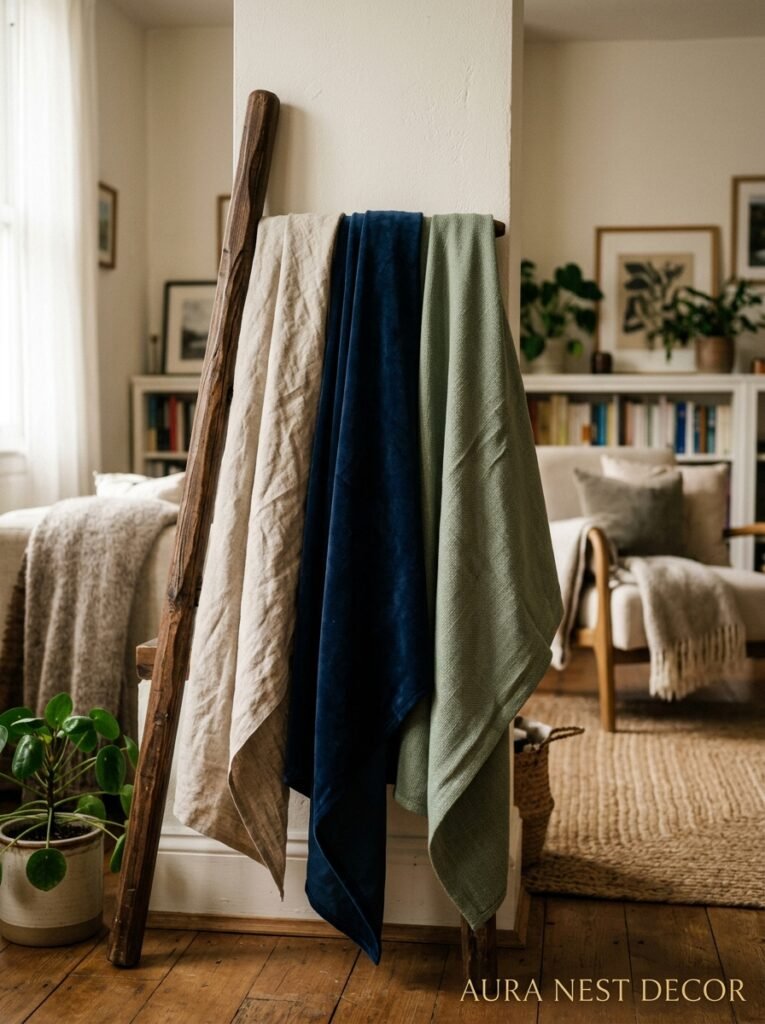
Fabric is where people really get lost. There are genuinely too many options and most curtain listings online describe their fabric with the same three vague adjectives — “luxurious,” “flowing,” “elegant” — which tells you absolutely nothing.
Let me just be honest about what I’ve actually lived with.
Linen is beautiful and it’s everywhere on Pinterest right now for good reason. It’s got that relaxed, slightly rumpled texture that makes a room feel like it has a personality. It doesn’t try too hard. But linen is not a blackout fabric, not by a long shot, and it does wrinkle, which some people love and some people find maddening. Know which type you are before you commit.
Velvet is the opposite mood entirely. It’s heavy, rich, absorbs sound in a way you can almost feel, and it makes a room feel instantly more formal — or more dramatic, depending on your color choice. A deep forest green velvet curtain in a room with cream walls and a wooden floor is one of the most satisfying things you can do to a living room. But it’s a commitment. And vacuuming velvet is its own experience.
Then there’s the category I feel like people sleep on, which is cotton-linen blends or cotton canvas — sort of the middle path. Less fussy than linen, less intense than velvet, and weirdly versatile. Works in modern rooms and in cottagecore rooms and everywhere in between.
4. The Color Theory Everyone Ignores (And Why That’s Actually Fine)
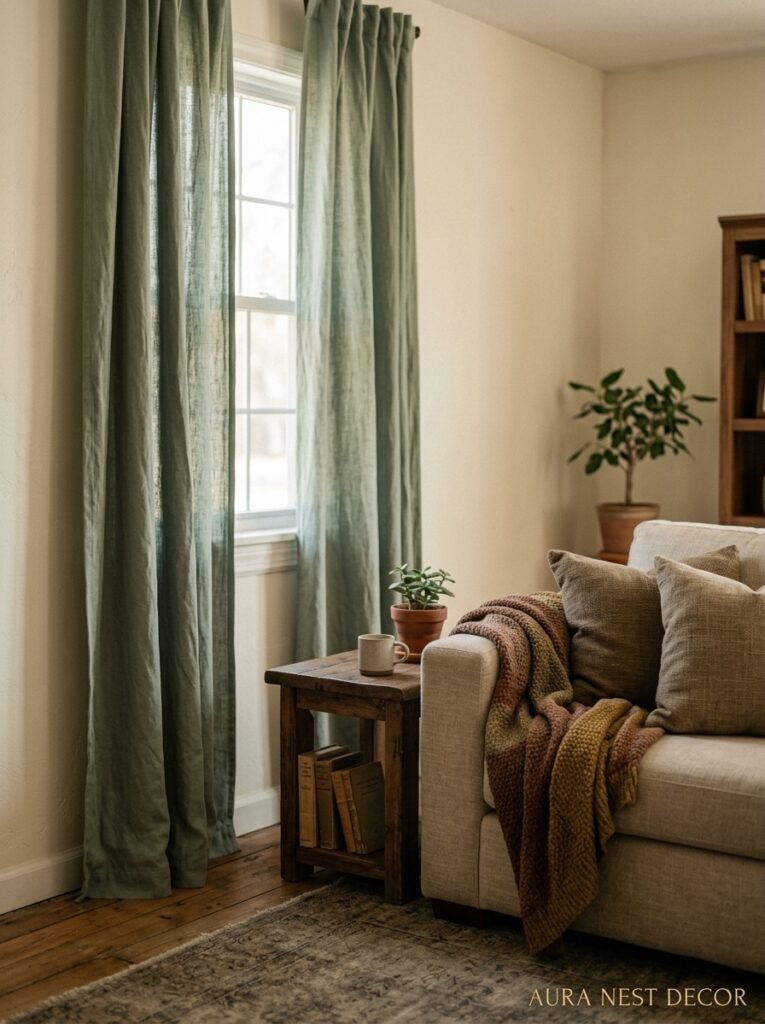
There’s a rule that says curtain color should match the walls or match a secondary tone in the room. And sure, that works. But I think the more interesting question is: what do you want the curtains to DO in the room?
If you want them to disappear — to frame the window without drawing attention — go close to your wall color. A warm white room with warm white linen curtains is absolutely lovely and very calm.
But if you want them to be a feature? That’s where things get interesting. And maybe a little nerve-wracking.
I’ve seen a completely neutral beige room absolutely rescued by a pair of burnt terracotta curtains. Not “matching” anything in the room particularly, just existing as a bold, warm anchor that made everything else feel intentional by contrast. The sofa looked better. The rug looked better. The whole room got a personality transplant and the curtains did all the work.
“The right curtains don’t just dress a window — they decide what mood the entire room is allowed to have.”
This doesn’t mean you should go crazy. But “matching everything perfectly” is kind of a trap that leads to rooms that feel safe but forgettable. A little tension in the color palette — not clashing, just a bit of contrast — is often exactly what a living room needs.
5. What “Puddling” Is and Whether You Should Actually Do It
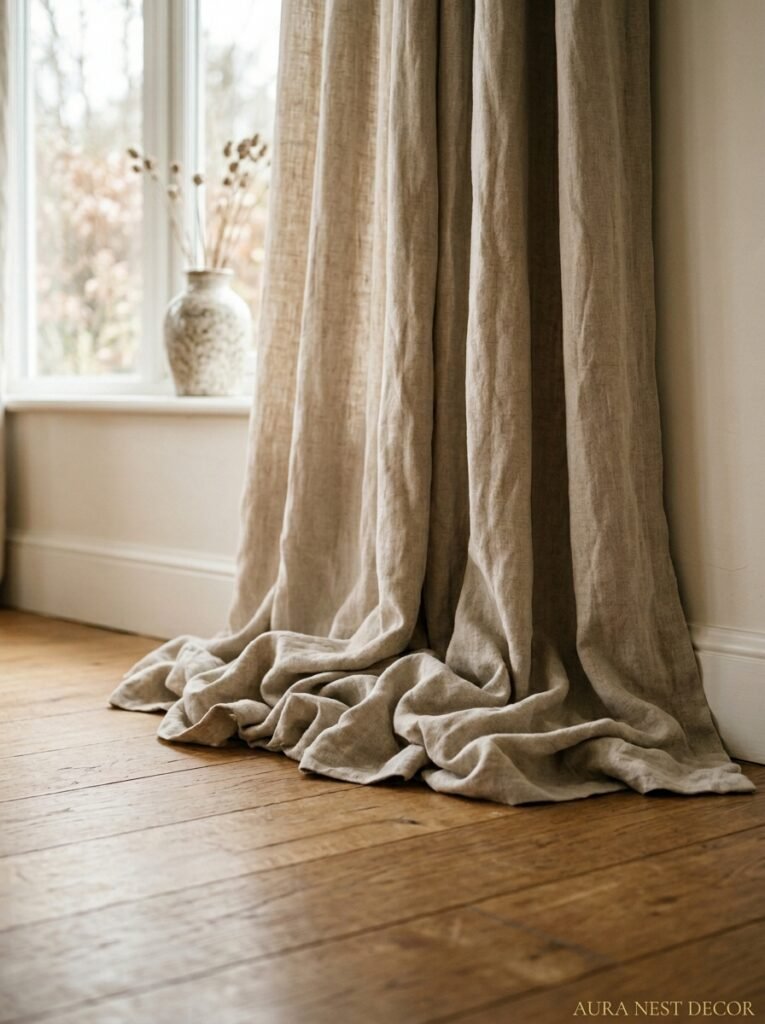
Puddling is when your curtains are intentionally too long and pool on the floor. A few inches of extra fabric, sometimes up to a foot, just resting there in a soft little cascade. It’s a very old, very formal decorating tradition and it’s also having a very serious moment on Pinterest right now — mostly in the context of moody, romantic, “old house in Tuscany” kind of living rooms.
Do I love it? Yes, kind of, in the right context. Does it make zero practical sense in most real homes? Also yes.
Puddled curtains collect dust like it’s their job. If you have pets, they will absolutely sit on them. They’re harder to clean, harder to open and close without eventually messing up the drape, and in a home with kids or dogs or both, they become a project within about six weeks.
But. If you have a formal living room that isn’t a daily thoroughfare, or a bedroom-adjacent sitting room, or a space that’s mostly for adults and aesthetics? Go for it. The look is genuinely stunning and there’s something about that excess of fabric that feels almost decadent. Just go in with your eyes open.
A 1-inch floor kiss is the more practical version — fabric just barely grazing the floor, enough to look intentional without being high-maintenance. That’s my personal sweet spot, not gonna lie.
6. Why Cheap Curtain Rods Are Ruining Perfectly Good Curtains
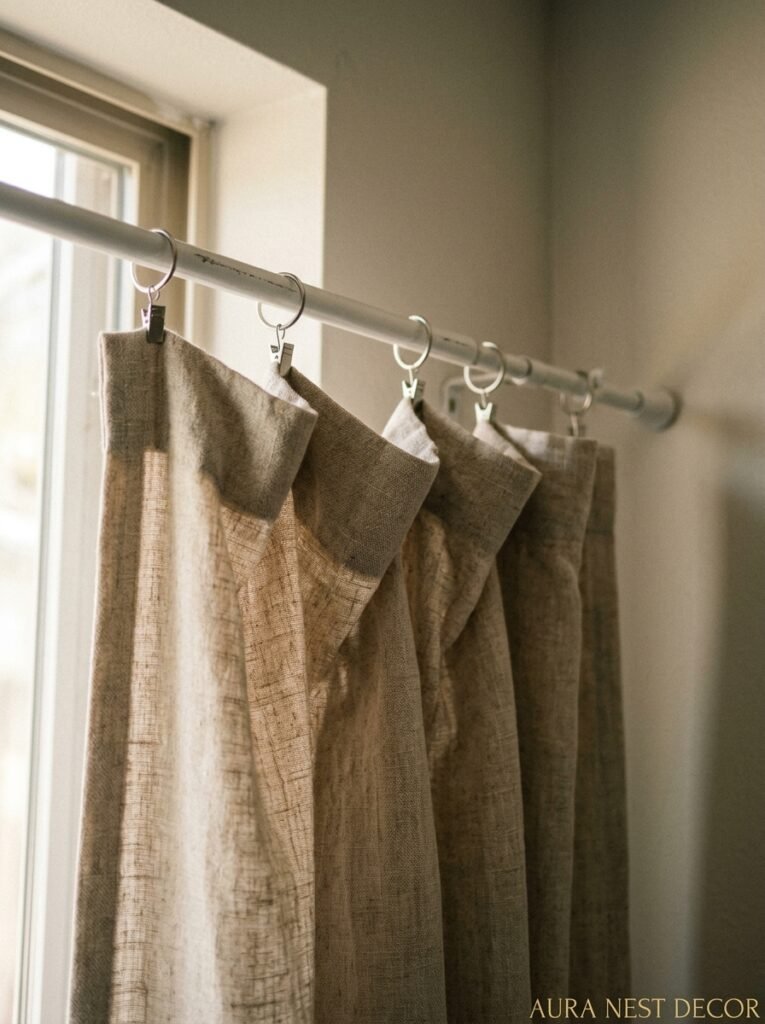
This one drives me slightly mad. Someone spends real money on beautiful linen panels and then puts them on a flimsy £15 rod from a discount store that bows in the middle within three months. The curtains look wrong and they can’t figure out why.
The rod matters. A lot.
A substantial metal rod with a matte black or aged brass finish does something to a room that a thin chrome rod simply cannot do. It has visual weight. It reads as furniture, not as hardware. And when your curtains hang from something that looks intentional, they look intentional too.
Good rods are not as expensive as you might think — you’re not looking at hundreds of dollars or pounds here. Mid-range options that look genuinely high-end exist at most home stores, and honestly IKEA has some decent options if you’re not asking them to span a very wide window. Look for something with a solid center bracket if you’re going wide.
Also — finials. Those little end caps on the rod. Don’t overlook them. A simple ball finial reads as classic, a flat disc reads as modern, and a spear or arrow tip reads as somewhere between dramatic and slightly vintage. They’re a small detail that lands differently than you’d expect.
7. The Heading Style Nobody Explains but Everyone Can See
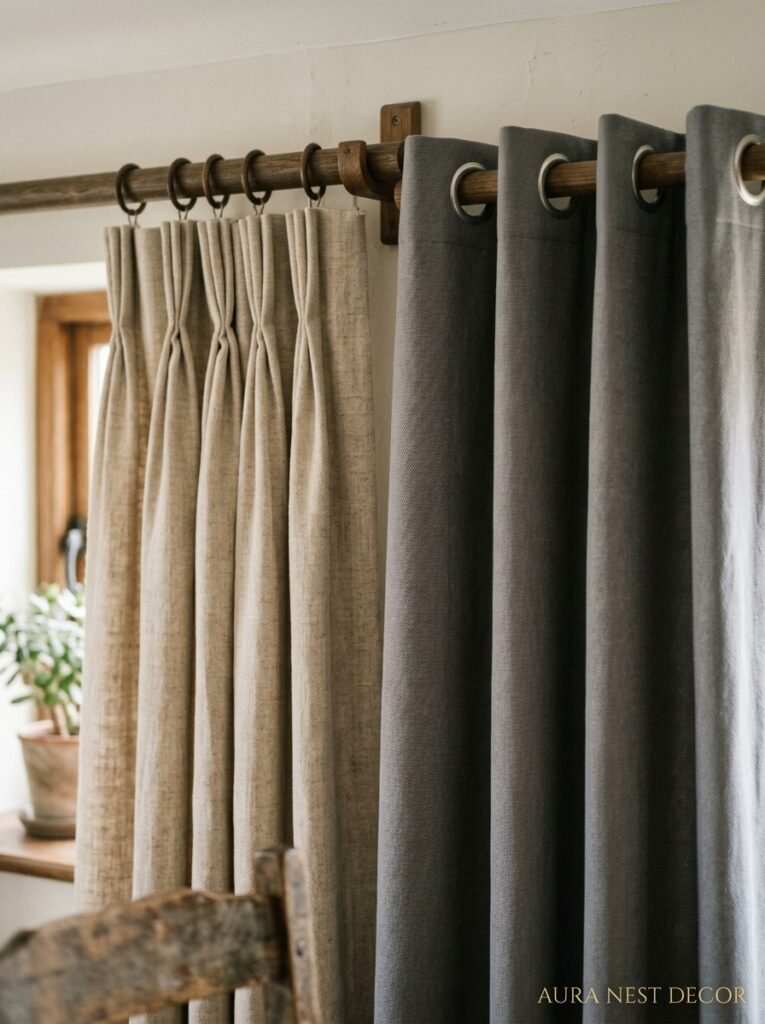
The “heading” is how the fabric attaches to the rod at the top. And different heading styles create completely different looks, even with the exact same fabric.
Eyelet (or grommet) headings have metal rings punched through the fabric. They hang in even, parallel folds and look very contemporary and a little casual. Easy to slide open and close.
Pinch pleat has those intentional pleats gathered at even intervals, which creates a more formal, tailored look. It’s the classic heading you’d see in older, more traditional homes, and it’s made a real comeback in the “quiet luxury” design conversation. Looks expensive. Is sometimes expensive to have made.
Wave tape is what a lot of hotel rooms use — a very soft, uniform ripple along the entire width. It’s modern without being harsh, and it works really well in minimalist rooms where you want texture but not too much structure.
Tab top — the loops of fabric at the top — is the most casual of all. Great for a relaxed beach house or a cottage kitchen. In a more formal living room it can look a bit underdressed, so just match the formality of the heading to the formality of the room.
“The same fabric, the same color — but a different heading style will make the curtains feel like they belong to a completely different house.”
8. The Part of Curtain Shopping Nobody Warns You About (The Fullness Problem)
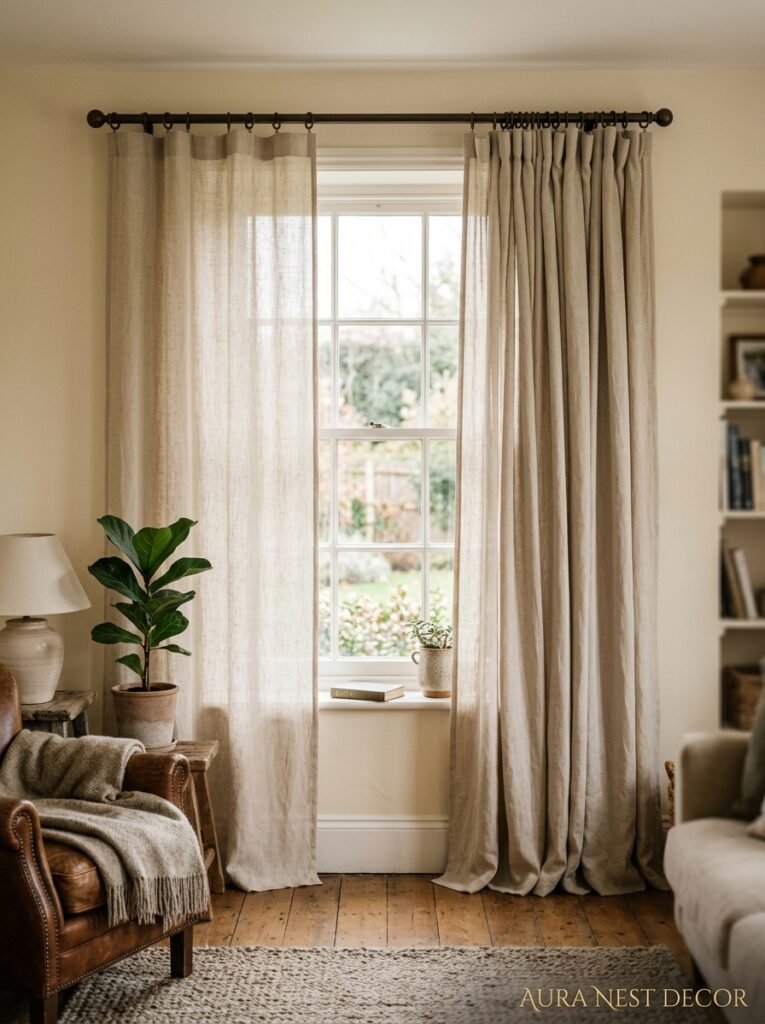
Right, so this one’s specific but it matters enormously. When you buy curtains, the panel width listed is NOT the width you cover. You need at least double your window width in total fabric — ideally 2.5 times — to get that lush, full look you’re seeing in magazine rooms and on Pinterest.
So if your window plus your rod extension is 60 inches wide, you don’t buy two 30-inch panels. You buy two panels that together give you 120 to 150 inches of fabric. Otherwise your curtains look flat, skinny, and like they’re not quite reaching for each other across the window.
Flat curtains read as an afterthought. Full curtains read as a decision.
This is genuinely the most common reason why someone’s curtains look “off” even when the color and the length are both right. There just isn’t enough fabric. More fullness almost always looks more expensive and more intentional, even if the fabric itself is budget.
9. The Quiet Magic of Lining (Even If You Didn’t Think You Needed It)
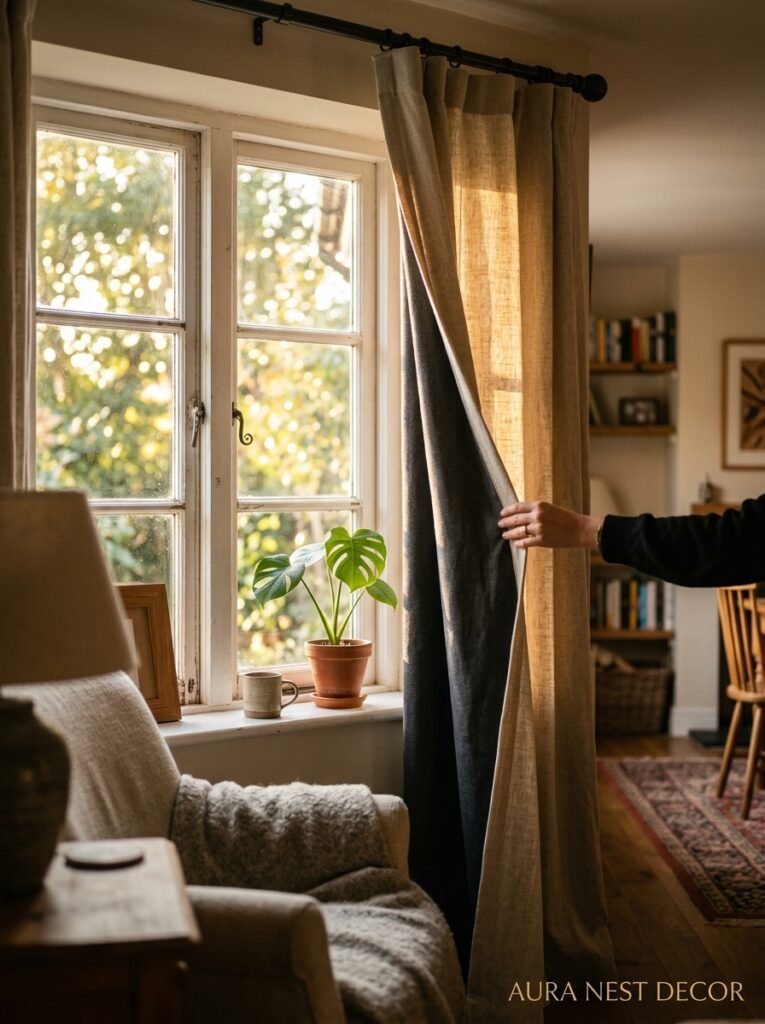
Unlined curtains have their place. Sheers, light linen, anything meant to filter light rather than block it — totally fine unlined. Beautiful, actually.
But for your main curtains? Lining is worth considering even if you’re not worried about light or privacy. Here’s why. Lining adds WEIGHT to the fabric. Heavier curtains hang better — they drape in those satisfying vertical folds rather than going kind of wavy and limp. They move more slowly when there’s a breeze. They look more expensive without being more expensive.
And yes, there’s practical stuff too. Thermal lining keeps rooms warmer in winter which, if you’re in the UK especially, is not a small consideration. A lined curtain can make a real difference on a cold November night when you pull them shut against the dark.
Also lining protects the outer fabric from UV fading, which matters more than people think. A pair of velvet curtains that fades in streaks from sunlight is a genuinely sad sight.
10. Patterns: When They Work and When They Absolutely Don’t
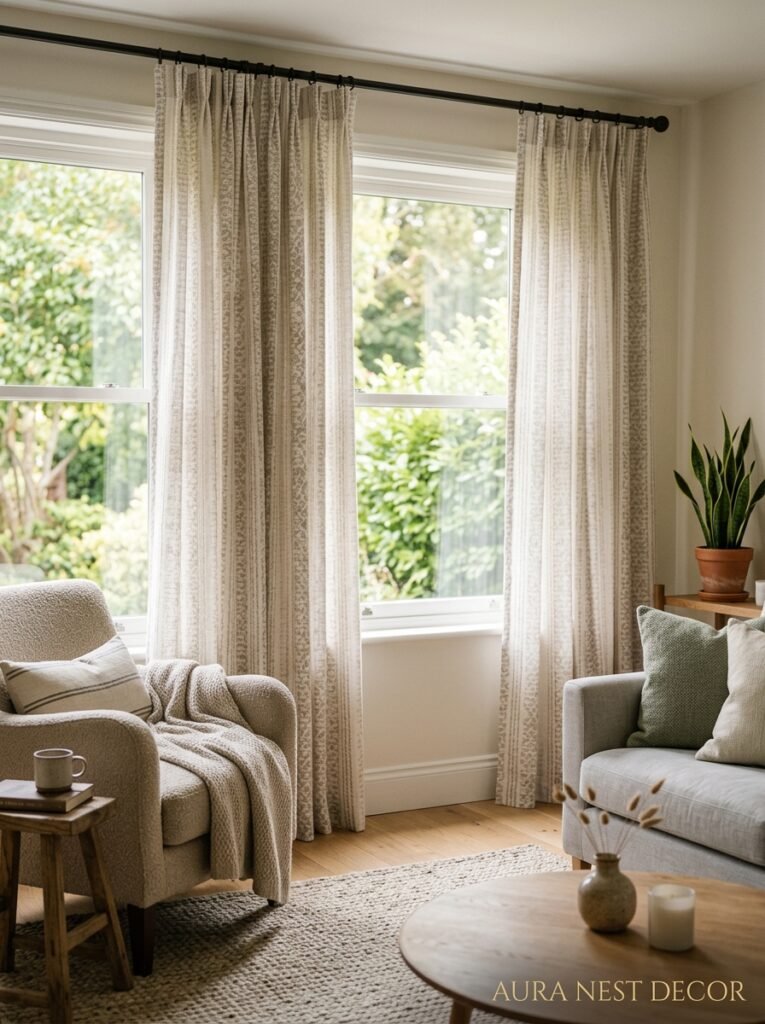
Pattern curtains are a commitment. Let’s just be clear about that upfront.
When they work, they WORK — a living room with a bold botanical print or an oversized geometric on the curtains can feel like the entire room was designed from that one piece outward. It becomes the starting point, the anchor, the thing the room is organized around.
But when they don’t work, it’s usually because of scale. Small-scale patterns on large curtain panels look busy and slightly chaotic — like fabric that couldn’t decide what it wanted to be. You need a bold, relatively large-scale pattern to hold a window, especially a wide one.
Also — mixing patterns in a room with patterned curtains requires some confidence. If you’ve got a heavily patterned sofa and you want patterned curtains too, they need to either coordinate in color or vary wildly in scale. Patterns that compete at the same visual weight just argue with each other.
For rooms with a lot going on already, solid curtains are almost always the better call. There’s a reason so much beautiful interior design uses plain, textured fabric at the window — it lets everything else breathe.
11. How to Make Budget Curtains Look Like They Weren’t
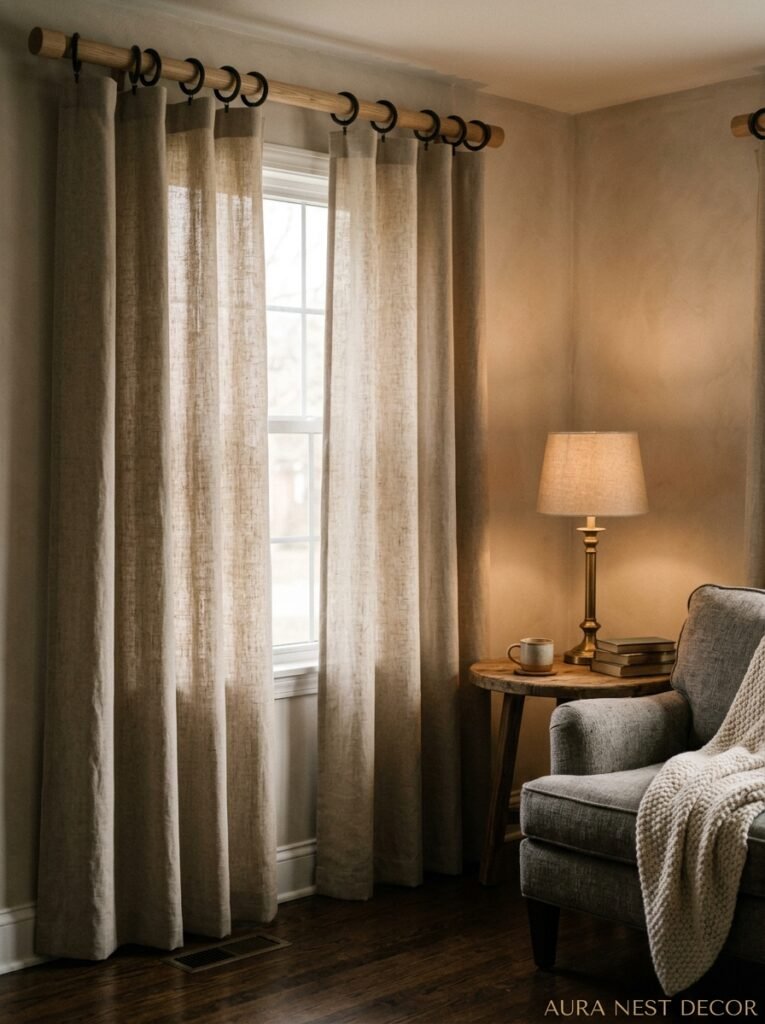
Not everyone’s working with a big curtain budget. That’s just real life and there’s zero shame in it. But the way you hang and style curtains makes far more difference than the price tag.
First: buy more panels than you think you need. Two panels on a standard window looks okay. Three panels, or even four on a wider window, looks genuinely abundant and luxurious.
Second: steam them the day they go up. Straight from the packaging, curtains often look wrinkled and flat. A good steam — or even hanging them in a steamy bathroom for a while — makes them drop into proper folds and suddenly they look intentional.
Third: clip or tie them back during the day. Even a simple piece of rope or a leather curtain tie can make budget curtains look styled. It introduces an element of deliberateness that reads as “someone made a design choice here” rather than “these came from a bin.”
12. The Thing I Wish Someone Had Told Me Before I Started
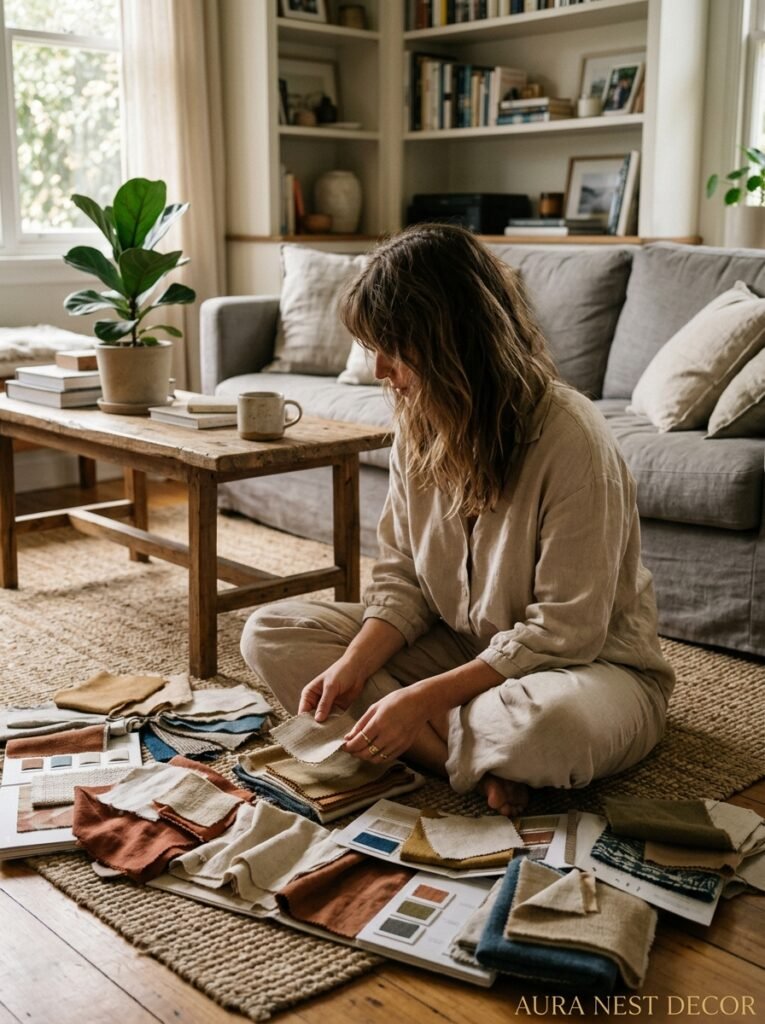
Curtains are slow. That’s kind of their whole point.
They’re not the immediate gratification of new cushions or a new throw. You hang them, you live with them, and over a few weeks the fabric settles, the room settles around them, and then one evening you sit down with a cup of tea and the light is hitting the window in that particular way and you think — oh. Yes. That’s it.
Good curtains don’t announce themselves. They just make the room feel more like itself.
That’s the thing I’ve learned after years of obsessing over them on Pinterest and in my own homes and in every beautiful room I’ve ever bookmarked. The best curtains are the ones that make you feel like you’ve always had them. The ones that make the room feel finished — quietly, privately, without any fuss.
—
❓ FAQ
Q: How high should curtains be hung in a living room? A: As high as you can manage — ideally 4 to 6 inches below the ceiling, or right at the ceiling line. This makes the room feel taller and more polished. Hanging them right above the window frame is the most common curtain mistake in living rooms.
Q: How do I stop curtains from looking cheap? A: Three things make the biggest difference: hang them higher, make sure you have enough fabric fullness (at least double your window width), and use a rod that has visual weight and substance. Steam out the wrinkles when you first hang them. The fabric price matters less than how they’re hung.
Q: Should living room curtains touch the floor? A: Yes, in almost every case. Curtains that hover above the floor look unfinished and dated. Aim for them to just graze the floor — around a half-inch of contact — or pool slightly if you want a more dramatic, formal look. The only exception might be in a very casual or family-heavy room where floor-length fabric isn’t practical.
—
💭 Final Thoughts
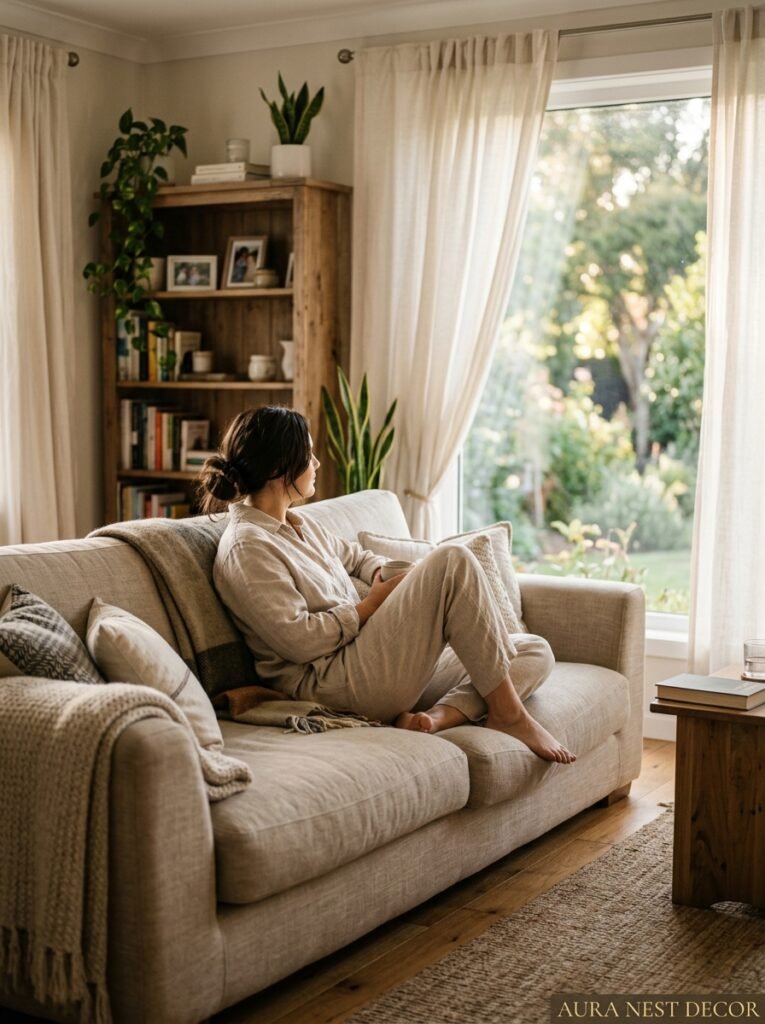
There’s something deeply satisfying about getting curtains right — more satisfying than almost any other change you can make to a living room, and I’m not entirely sure I can explain why. Maybe because they’re so tied to the feeling of a room at different times of day — morning light filtering through linen, or heavy velvet pulled shut against a dark winter evening. They change with the light and the season in a way that walls and furniture just don’t.
If you take nothing else from this: hang them high, give them width, and don’t skimp on fullness. Everything else is just details.
What’s the one thing about your living room that’s been quietly bothering you — and do you think curtains might actually be the answer?