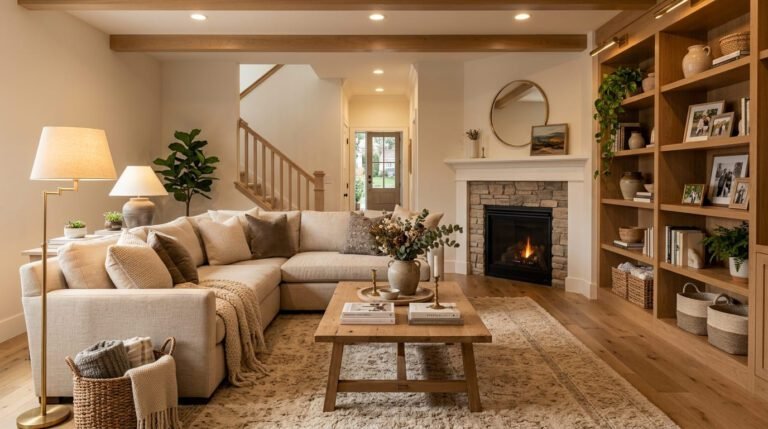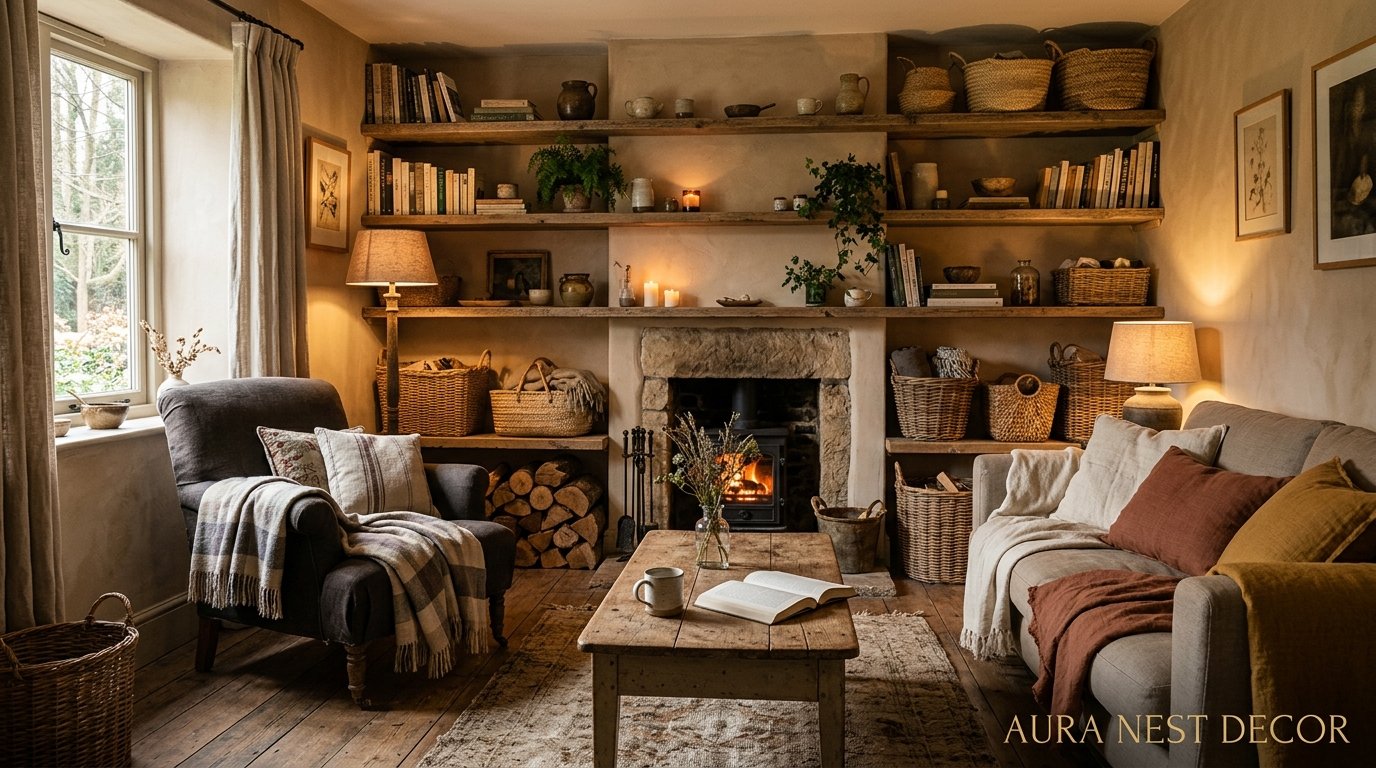
The Small Living Room Glow-Up That Doesn’t Require Knocking Down Walls
You know that feeling when you walk into a small living room and it just works? Not cramped. Not cluttered. Just cozy and intentional and full of personality. That’s not an accident — and it’s not expensive either.
—
1. Why Rustic Storage Hits Different in a Small Space
Okay so here’s the thing nobody tells you when you’re obsessing over storage solutions at midnight on Pinterest. Most storage advice is written for people with ROOM. Like, spare room. Garage space. Walk-in closets.
But rustic storage? It’s almost tailor-made for small spaces, and I’ve been slowly figuring out why.
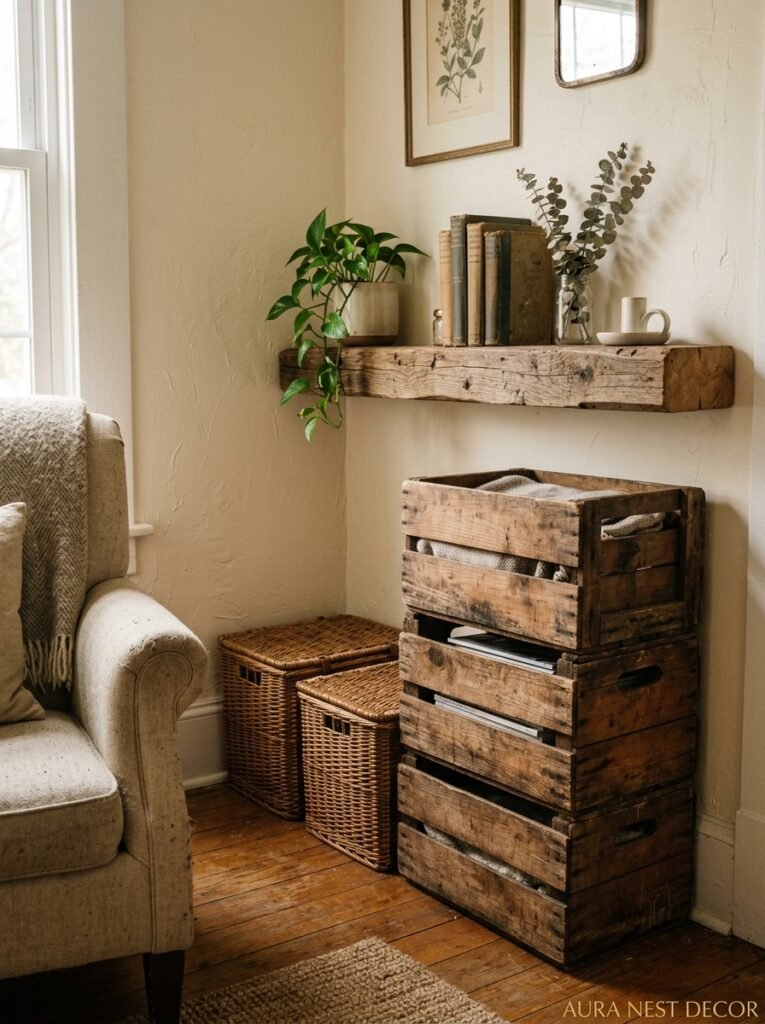
The aesthetic does a lot of heavy lifting. A wicker basket sitting on a shelf doesn’t scream “I’m hiding a tangle of phone chargers and last year’s Christmas cards.” It looks like a design choice. A crate mounted on the wall isn’t just storage — it’s character. Rough wood textures, vintage crates, aged metal hooks, linen baskets — all of it has this wonderful quality of looking curated even when it’s functional, even when it’s a little rough around the edges. Which is exactly what you need in a small living room where everything is visible all the time.
Small spaces can’t hide their mess the way big ones can. So your storage has to be its own decoration. Rustic style gives you that, almost by default. And I think that’s why it keeps showing up in every “small living room inspo” post I save. It earns its place twice.
“In a small room, your storage doesn’t get to hide. It has to be beautiful.”
—
2. The Floating Shelf Trick That Actually Makes Rooms Look Bigger
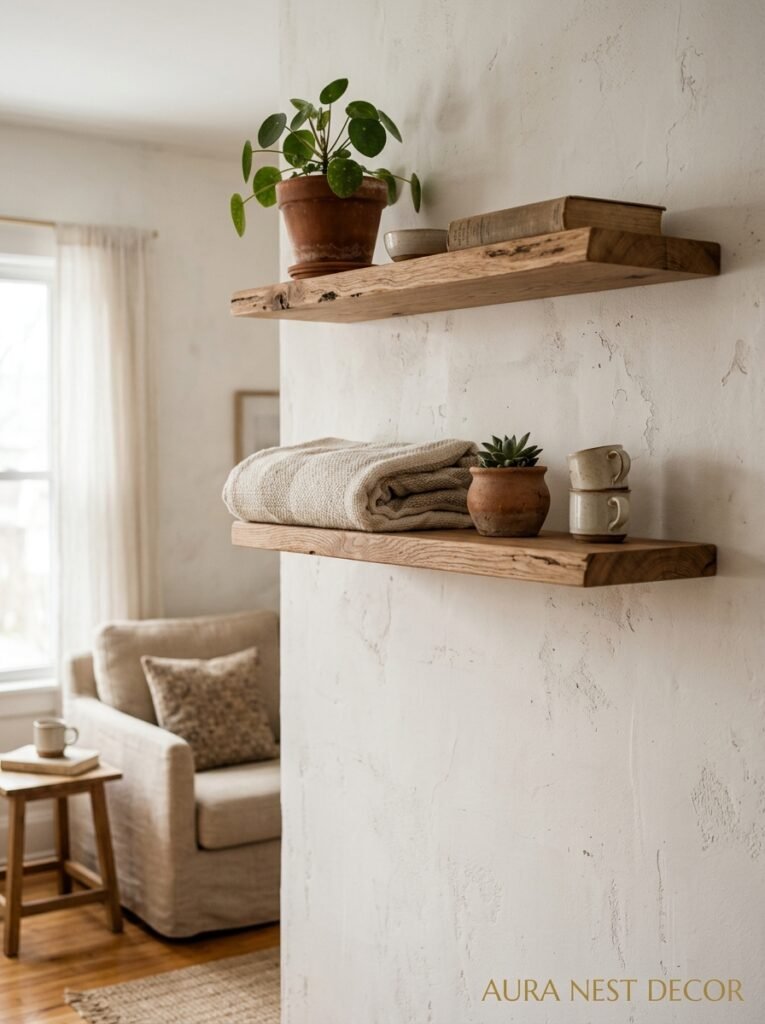
I know, I know. Everyone talks about floating shelves. But bear with me because there’s a specific WAY to do this in a rustic small living room that most people get completely wrong.
Don’t center them symmetrically above the sofa like picture frames. That’s the thing that looks stiff and predictable and somehow makes rooms feel smaller, not bigger.
Instead, go asymmetric and go HIGH. Mount one long raw-edge wooden shelf close to the ceiling on the longest wall and use it like a ledge — a place where things rest rather than get organized to death. A few trailing plants, a vintage clock, some books face-out, a ceramic jug you found at a car boot sale. Nothing matchy. That high horizontal line draws the eye UP, which tricks the brain into registering more vertical space.
The rough wood matters too, by the way. Smooth white MDF shelves reflect the eye back. Reclaimed wood with grain and knots and color variation gives the eye somewhere to go. It’s subtle but it’s real. I’ve tested this in my own living room and the difference was almost embarrassing — like, why didn’t I do this sooner embarrassing.
Stack two or three shorter shelves on a different wall at varying heights. Irregular. A little scattered. Not three evenly-spaced rows — that’s the AI version of shelving. Real homes don’t look like that.
—
3. The One Piece of Furniture That Does the Work of Four
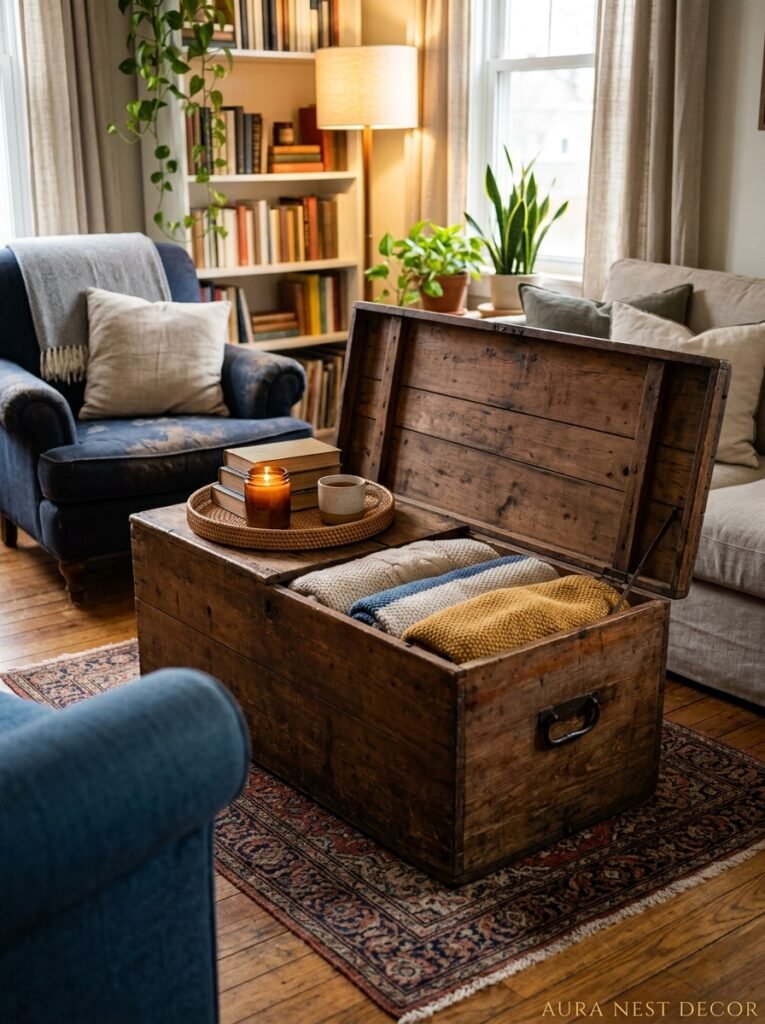
A storage ottoman. But not just any one — a big, oversized, tufted, slightly worn leather or faux-leather one that you can put your feet on, eat dinner off of, use as extra seating when people come over, AND stuff full of blankets.
This is the piece I recommend to literally everyone with a small living room, and it remains the single best return on investment I’ve ever seen in home décor. You give up your coffee table (which was probably taking up 4 square feet of walkable floor anyway) and you gain all of that function in roughly the same footprint.
Go for a warm tone — cognac brown, a sort of dusty caramel, even a dark tan that’ll look more beautiful as it ages. That soft distressed leather look is very rustic farmhouse without being too on-the-nose, and it works in UK terraced houses just as well as American craftsman bungalows. Throw a reclaimed wood tray on top so you’ve got a stable surface for your tea. Done. That’s the whole coffee table situation sorted.
Now your sofa side tables can disappear too, or get replaced with a single drum-style wooden stool that you can kick to wherever you need it. Fewer legs on the floor. More breathing room.
—
4. The Basket-to-Surface Ratio Nobody Talks About
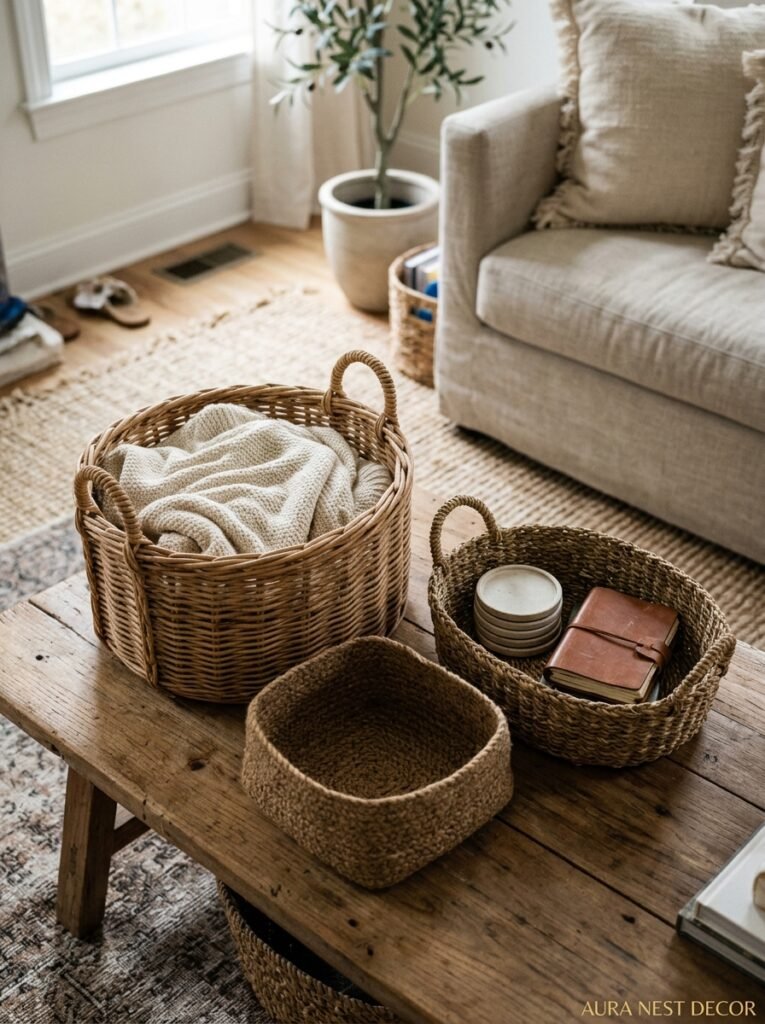
Here’s a number I made up but actually believe in. You want roughly one basket or woven container for every hard surface in your living room.
Why? Because hard surfaces — wood shelves, metal side tables, glass-topped anything — they register as “visual weight” in a way that reads as busy and cluttered in small rooms. Soft textures absorb that visual noise. A wicker basket on a shelf softens the whole shelf. A jute storage box under a side table grounds the space. A large seagrass basket in a corner becomes a feature.
Rustic décor is obsessed with baskets and honestly good. Stack them in different sizes near the hearth or fireplace — and if you don’t have a fireplace, a cluster of baskets in a corner with a plant and a tall candle creates this little vignette that reads almost like one. People who visit will ask you about it. I promise.
The baskets can do ANYTHING. Magazines, kids’ toys that migrate to the lounge, dog leads and balls, spare cushion covers for when you change up your color scheme seasonally. Everything in a basket looks like it belongs there.
“A basket on a shelf isn’t just storage. It’s a whole vibe.”
—
5. Paint the Walls a Color That Makes Your Stuff Glow
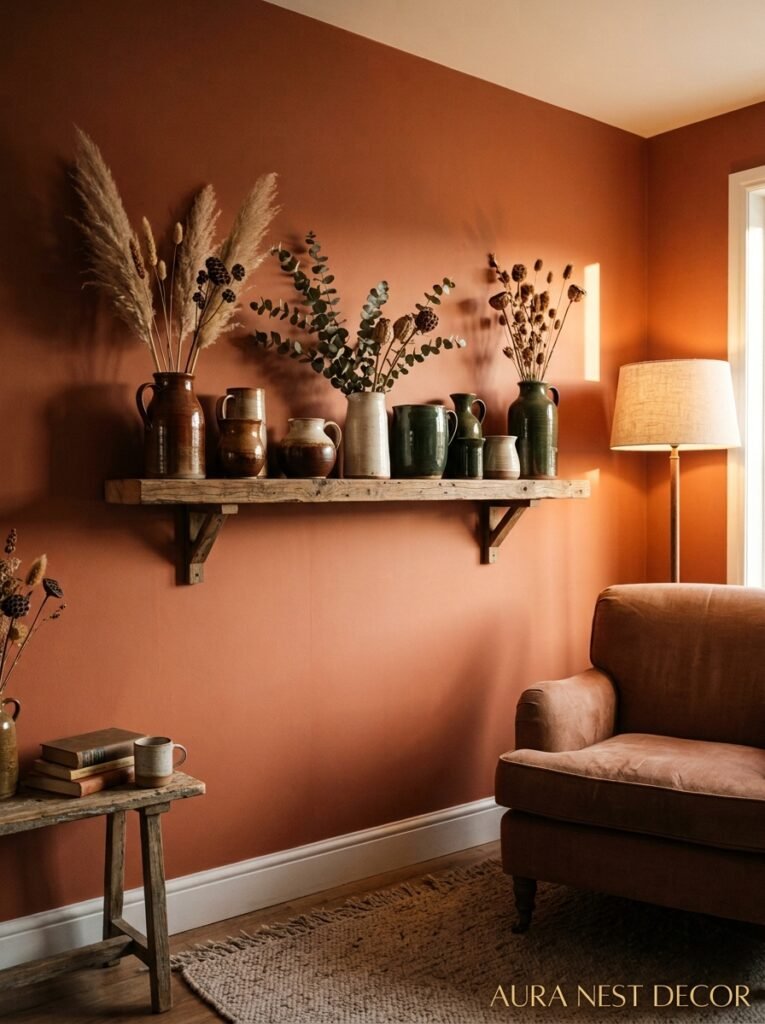
This section is specifically for people who are playing it safe with white or greige right now.
Rustic décor — the warm wood, the rattan, the vintage metals, the earthy ceramics — looks so much MORE beautiful against a deeper wall color. I’m talking about forest green. Or a dusty terracotta. Or that deep warm navy that’s been doing the rounds on UK interior Instagram accounts for about two years now and still hasn’t gone anywhere because it’s THAT good.
White walls in a small room don’t actually make it feel bigger, not always. Sometimes they just make it feel blank and a bit cold. A dark wall shrinks the perceived boundaries of the room and that can actually make it feel more intentional, more cozy, more like a room that knows what it is.
Paint one wall. Just one. The chimney breast if you have one, the wall your sofa sits against, whatever makes sense. Then watch your wooden shelves and your rustic baskets and your amber candles all suddenly look like they’re in a magazine. It costs almost nothing and it changes everything.
—
6. Why a Ladder Shelf Is Still the Most Useful Thing You Can Own
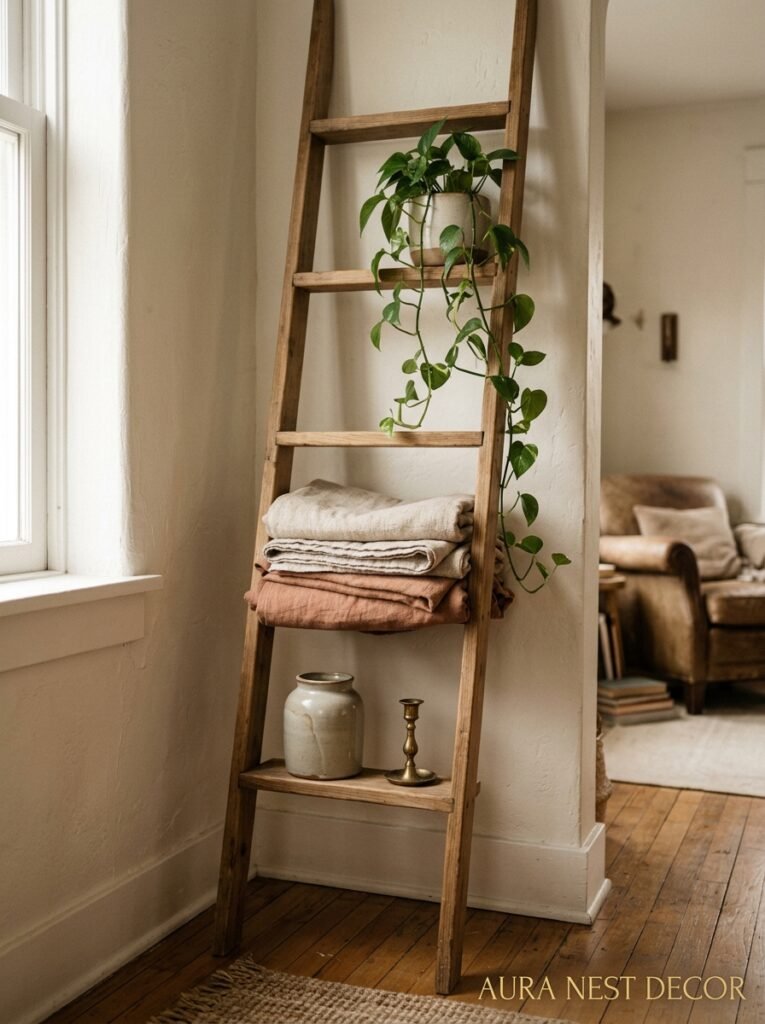
I went through a phase of thinking ladder shelves were tired. Over. Too trendy, too much. And then I actually needed one and now I’m a convert again.
In a small living room, a lean-to ladder shelf does something no other furniture quite manages. It gives you VERTICAL storage that doesn’t feel heavy or built-in. You can pick it up and move it. It looks casual, unstudied, slightly improvised — which is extremely on-brand for rustic décor. It leans. It has attitude.
Put it in a corner. Fill the rungs with a mix of books, plants at different heights, a few decorative objects, maybe one basket shoved onto the widest bottom rung. Let it feel a bit full. Sparse ladder shelves look lost; packed ones look lived-in.
Go for weathered or reclaimed wood if you can find it — or buy an inexpensive one and distress it yourself with a little sandpaper at the corners and some watered-down wood stain rubbed on and immediately wiped off. Honestly takes about 20 minutes and the result looks like something you paid triple for.
—
7. The Fireplace Hearth as Storage That Nobody’s Using Properly
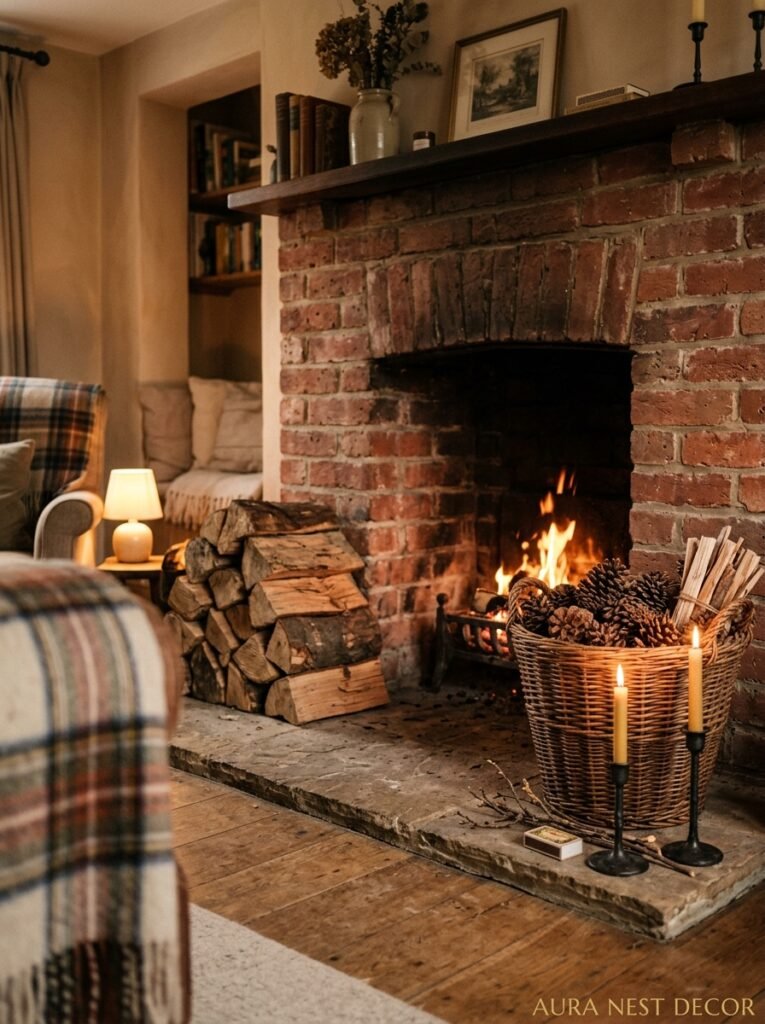
If you’ve got a hearth — working fireplace or not, doesn’t matter — you’ve got bonus storage that most people completely ignore.
The hearth area has this wonderful natural permission to hold things. Logs, yes, but also: oversized church candles, tall dried grasses in a stoneware vase, a stack of vintage hardbacks, a lantern or two. It becomes this layered little moment that looks incredibly deliberate and adds so much rustic warmth to the room.
For a non-working fireplace specifically, consider actually putting furniture IN the opening. I’ve seen footstools, baskets overflowing with blankets, even a small stack of logs just for aesthetic — all sitting inside the firebox. It fills a dead space, it looks fascinating, and suddenly that unused opening becomes the most interesting part of the room.
A log store beside a working hearth pulls double duty beautifully — especially those black iron-framed log holders with hairpin legs that look like they belong in a countryside cottage but weirdly also work in a London flat.
“A hearth that doesn’t work as a fireplace can absolutely work as a focal point.”
—
8. The Power of Grouping Three Odd Things Together on One Surface
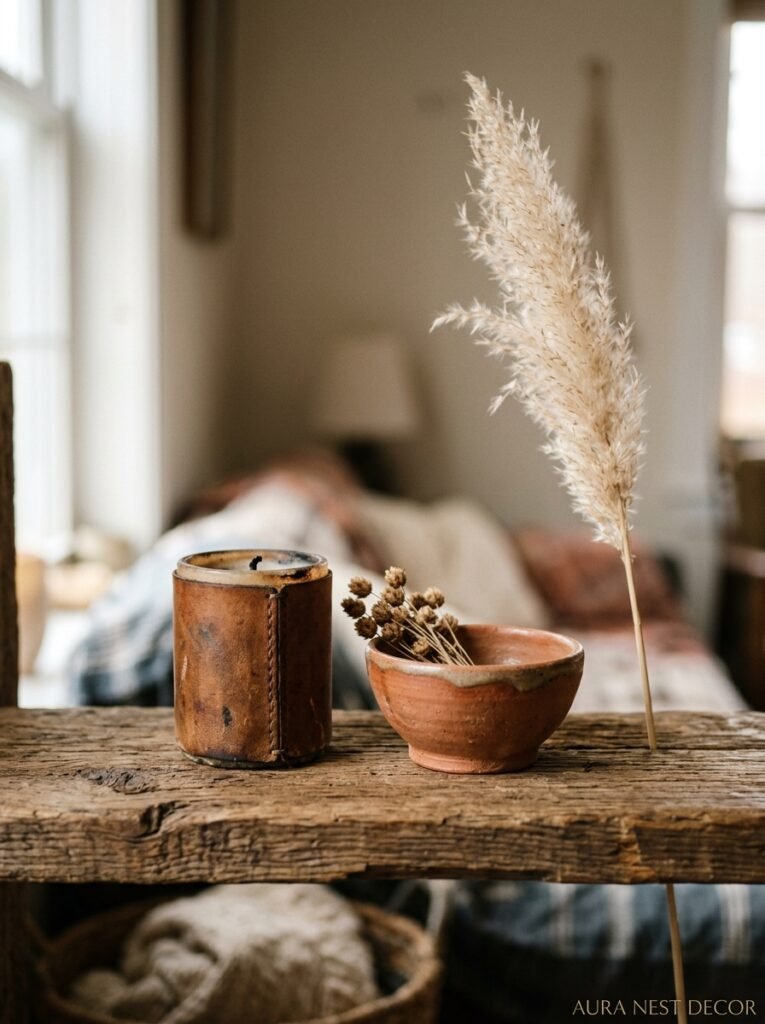
This is basically the foundational rule of rustic vignette-making, and once you see it you can’t unsee it.
Three things, ideally at three different heights, ideally with a mix of textures. A tall candlestick. A low ceramic bowl. Something trailing or green in the middle height range — a small plant, a sprig of dried lavender, whatever you’ve got.
That’s it. That’s the whole formula. But here’s the part that elevates it past generic: make them odd together. Don’t buy a matching set. The tall candlestick should look like it came from a charity shop. The ceramic bowl should have a slightly uneven glaze. The plant should be in a slightly-too-big terracotta pot that shows water marks.
Imperfect groupings read as collected and personal. Perfect matching groupings read as… a showroom. And small rooms need personality more than they need perfection.
—
9. The Crate Wall: Ugly on Pinterest, Brilliant in Person
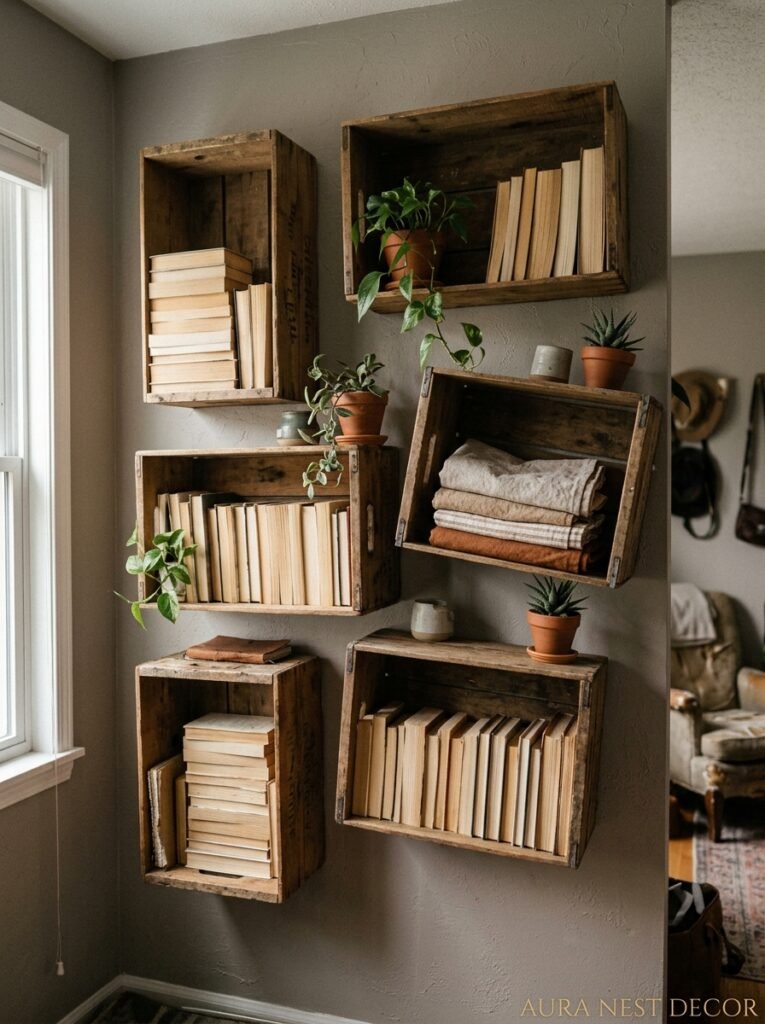
I was not on board with wall-mounted wooden crates for an embarrassingly long time. They always looked a bit craft-fair-from-2013 in photos.
Then I saw them done right and I completely changed my mind. The key is the wood quality and the mounting. Cheap pine crates mounted haphazardly? That’s how you get the craft-fair feeling. But dark-stained, rough-hewn crates mounted at staggered heights in a thoughtful arrangement on an accent wall? Different thing entirely.
Use them in a small living room as modular shelving you can actually move and rearrange. They’re genuinely deep enough to store things in — folded blankets, a collection of vintage paperbacks, your vinyl if you’re into that. And they add this incredible texture to the wall that no shelving unit can replicate.
Stain them all the same deep walnut or ebony tone. Space them a little unevenly. Don’t try to make them into a perfect grid — let them breathe and scatter a bit. And then fill them like the rest of your shelves: mix of practical and decorative, never too neat.
—
10. Curtains That Touch the Floor (Even in Tiny Rooms)
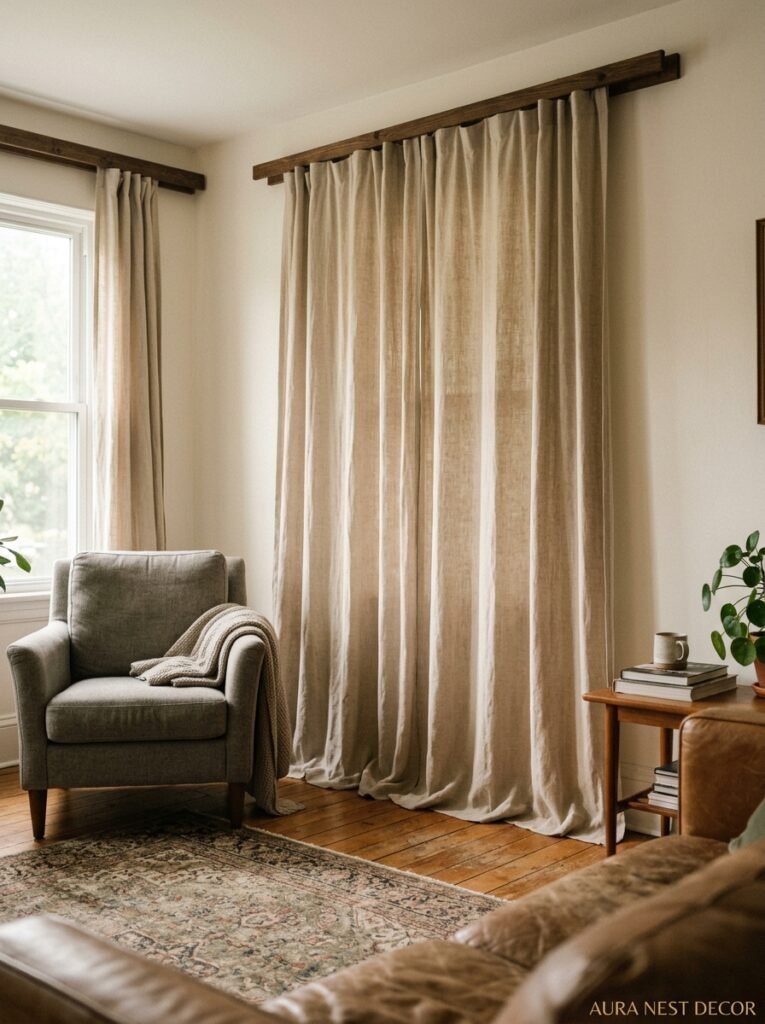
This isn’t technically storage but it changes how the whole room feels around your storage, so I’m including it.
Curtains that pool slightly on the floor — or at very minimum brush it — make ANY room feel more expensive, more deliberate, more designed. This is especially true in small rooms because the long vertical line of fabric draws the eye up and out in the same way the high shelf does.
In a rustic living room, go for linen. Natural, undyed, or in a warm tone — oatmeal, soft sage, dusty blush. Linen hangs with this beautiful relaxed weight that feels completely at home with wooden shelves and wicker baskets. It also creases, and that’s FINE — the creases are part of why it looks so good.
Hang the rod as close to the ceiling as possible. Even if your windows aren’t tall, this tricks the eye into thinking they are. It’s one of those things that costs about £30 or $40 to do and looks like you hired an interior designer.
—
11. The Side Table That Secretly Stores Everything
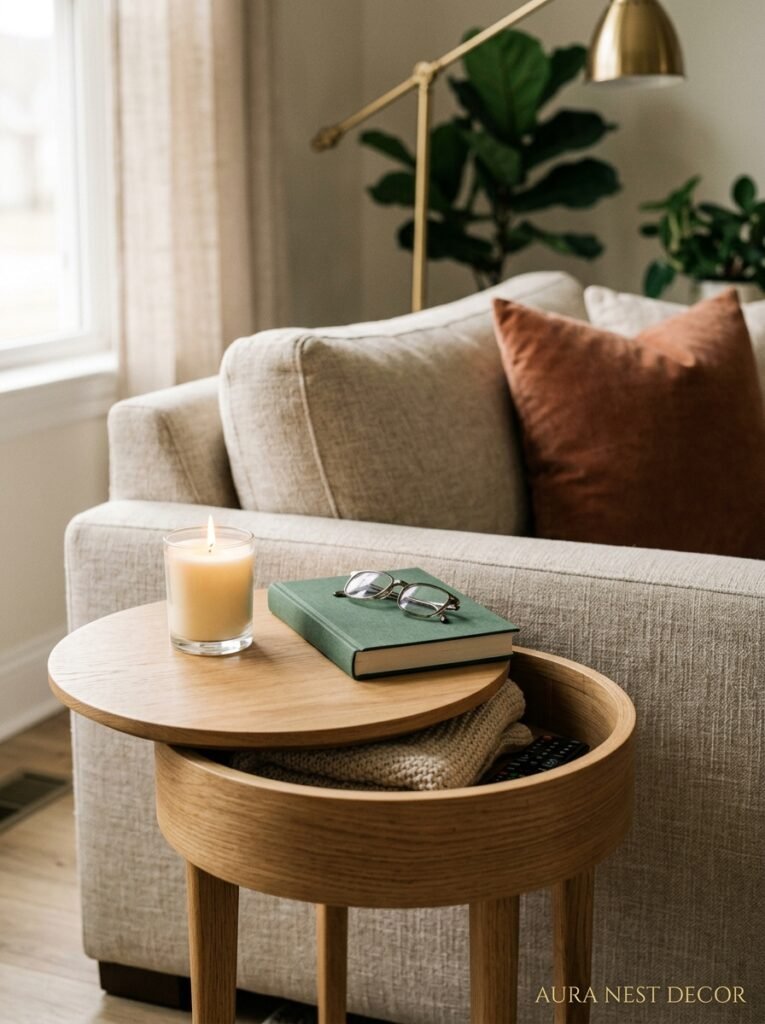
Swap out a regular side table for a small vintage trunk. A wooden chest. An old metal toolbox on legs. Something with a LID.
You’d be amazed how much stuff disappears into a trunk-style side table. Remote controls, coasters, the book you’re halfway through, hand cream, a spare phone cable, the good matches for the candles. All of it gone, contained, invisible.
In a rustic space, a battered leather trunk or a painted wooden chest looks like an intentional vintage find rather than a practical solution — even though it’s both. You can drape a small throw over one corner of it and suddenly it’s a whole moment.
This works especially well in UK homes where side tables are often right next to the sofa arm and get used constantly — having that lid means things get put away instead of left on top, which is honestly the difference between a room that feels tidy and one that doesn’t.
—
12. The Golden Rule of Rustic Small Spaces: Edit Brutally, Then Add Back Slowly
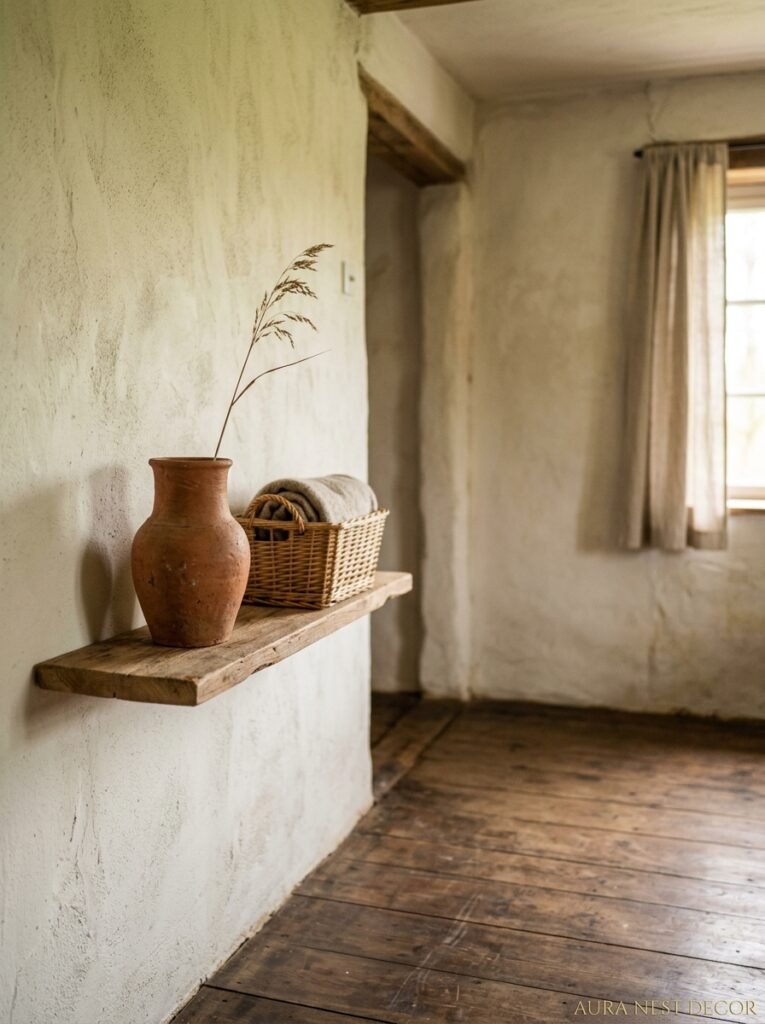
Here’s the thing I keep coming back to, the one that ties all of this together.
Rustic décor can tip into cluttered very fast. The whole warmth of it comes from layering — multiple textures, different heights, collected-over-time vibes — and that layering can easily become overwhelming in a small room.
So the rule I’ve landed on is: edit to the point where the room feels slightly TOO sparse. Like, uncomfortably spare. And then add back one thing at a time, living with it for a day before adding the next.
Because you’ll find that the room needs less than you thought. A corner that you were planning to fill with three things might only need one. A shelf you were going to style with six objects might only want four. When you add slowly, you can actually feel the room get heavier with each piece — and you stop when it feels right instead of when it looks full.
That’s the whole secret, honestly. Rustic small spaces work when they feel intentional. Collected. Not accumulated.
—
❓ FAQ
Q: What’s the best storage furniture for a small rustic living room? A: A large storage ottoman is probably your highest-impact purchase — it replaces a coffee table and gives you hidden storage in one footprint. After that, a ladder shelf and a few wall-mounted crates give you vertical storage without eating into floor space. These three things together can basically transform a small room’s functionality.
Q: How do I stop a rustic living room looking too cluttered? A: The texture of rustic décor can accumulate fast, so editing is everything. A good rule of thumb is to leave at least a third of every shelf surface empty, and to make sure every item you can see is doing double duty — either beautiful or functional, ideally both. When in doubt, put it in a basket and hide it.
Q: Do dark wall colors actually work in small rooms? A: They really do — especially behind rustic décor, which practically glows against deep green, navy, or terracotta walls. The key is warm lighting alongside it: floor lamps with warm-toned bulbs, candles, fairy lights wound through your shelves. Dark walls with cold white light feel like a cave. Dark walls with warm light feel like a destination.
—
💭 Final Thoughts
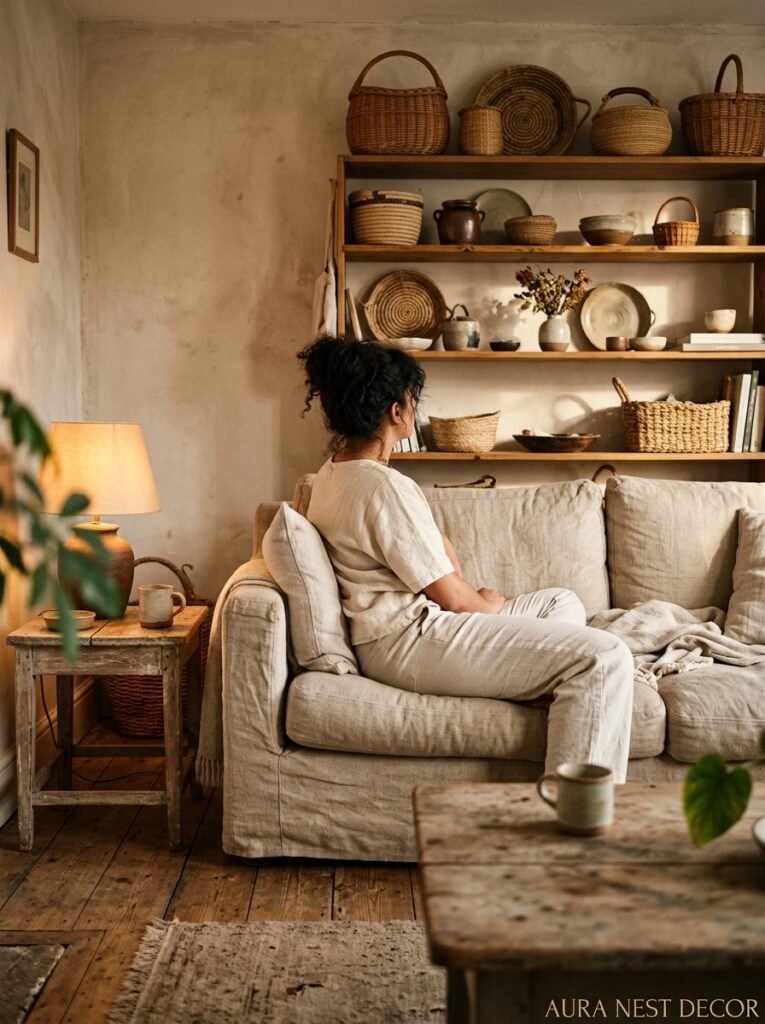
Small living rooms done right are genuinely some of the coziest, most compelling spaces I’ve ever seen. There’s something about constraint that forces intention — you can’t be sloppy when you don’t have room to be. And rustic décor, with all its warmth and texture and that wonderful don’t-take-me-too-seriously quality, fits beautifully into that kind of space.
You don’t need to do all twelve of these things at once. Pick one corner. One wall. One piece. And see what happens.
What’s the one small change you keep putting off that you know would make a real difference to your living room?