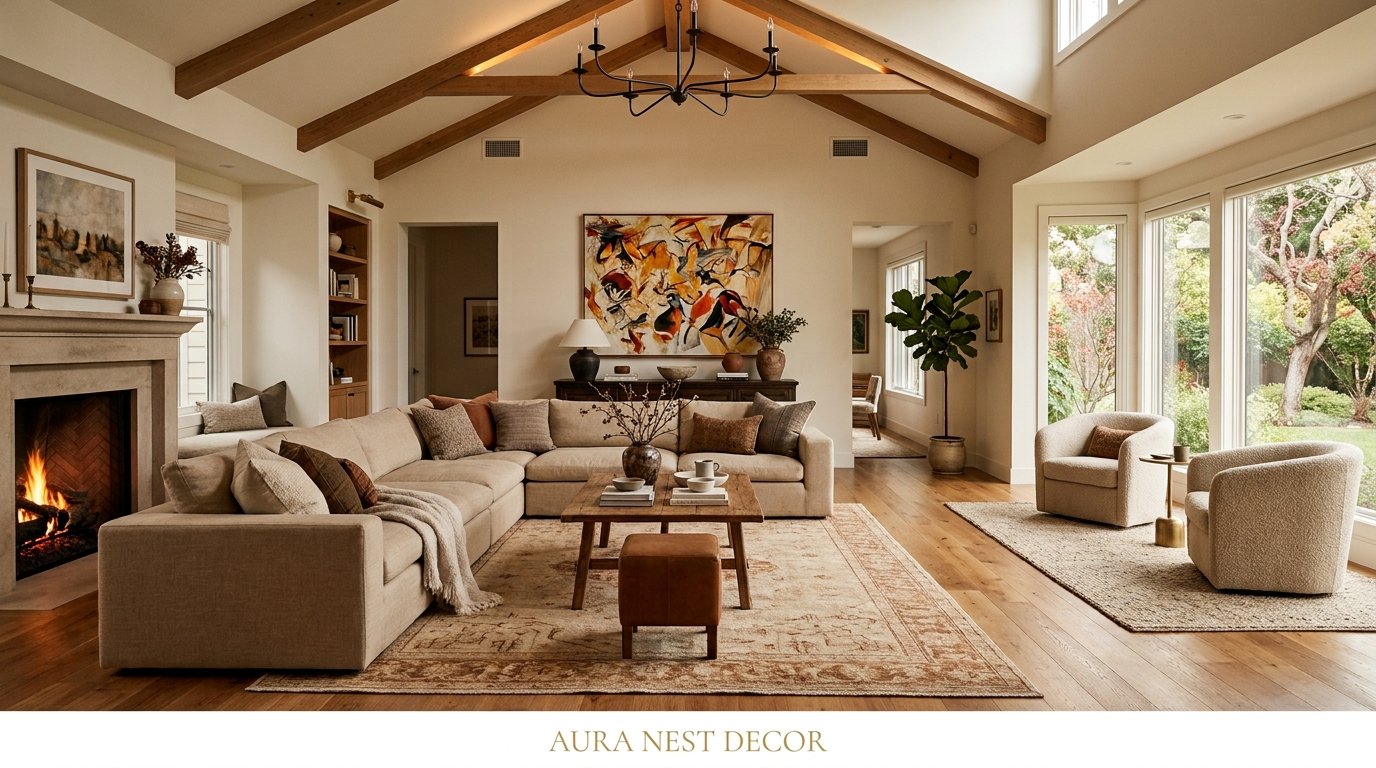
The Large Living Room Problem Nobody Talks About (And How to Actually Fix It)
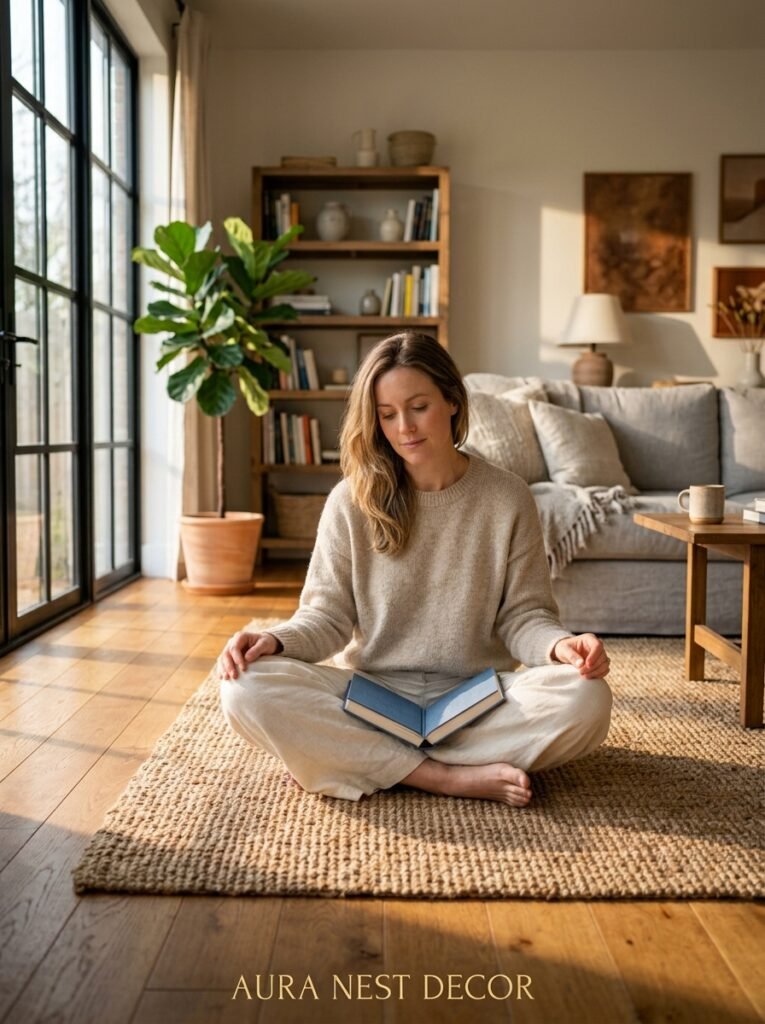
My friend Jess moved into her dream house last spring — high ceilings, original Victorian cornicing, a living room that could comfortably host a dinner party for twelve. She called me two weeks later, voice flat. “It just feels like a waiting room,” she said. “Like the lobby of a mid-range hotel.”
She wasn’t wrong. I saw it for myself.
—
1. Why Big Rooms Feel Empty Even When They’re Full of Furniture
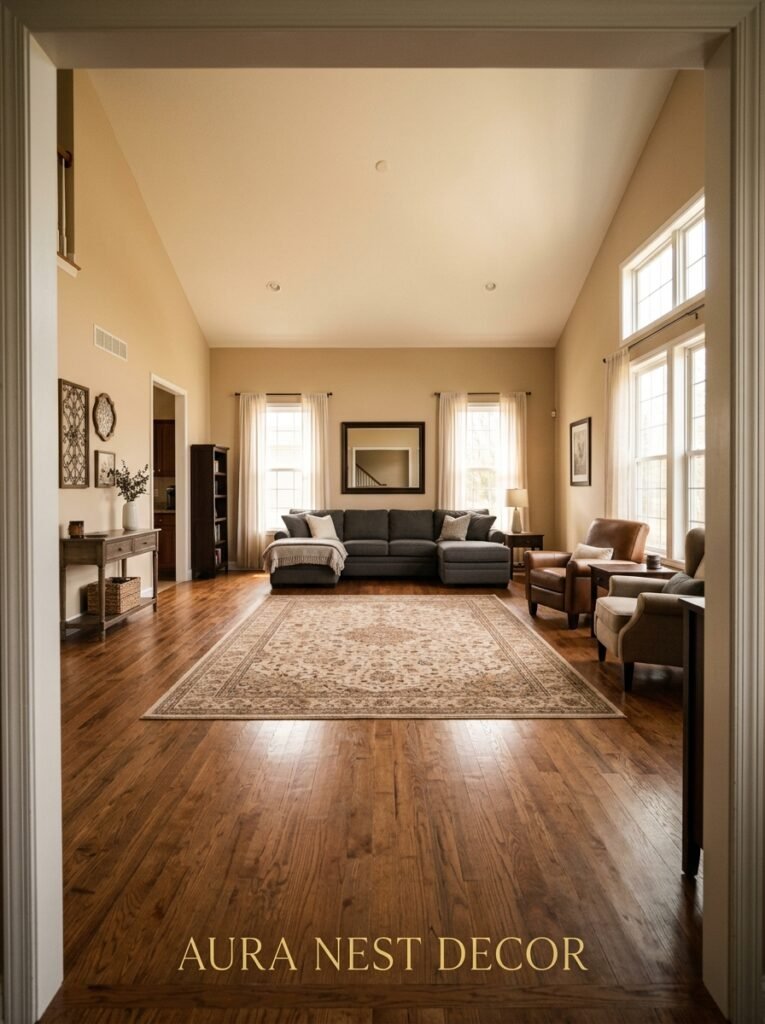
This is the thing nobody tells you when you’re fantasizing about a spacious living room. Square footage doesn’t automatically equal comfort. You can fill a large room with a sofa, a coffee table, a rug, a TV unit — all the right pieces — and still feel like you’re sitting in the middle of an airport terminal at 6am.
The problem isn’t the furniture. It’s that large rooms need a REASON to exist at every corner. They need layering, not just filling.
Small rooms have an automatic coziness built in. Walls are close, light bounces around, everything feels contained. Large rooms don’t offer you any of that for free. You have to build it. Intentionally, zone by zone, layer by layer, which sounds like a lot of work but actually once you understand what’s happening — it becomes sort of fun? Like solving a puzzle that you actually want to look at.
—
2. The Floating Furniture Trap That’s Making Your Room Feel Worse
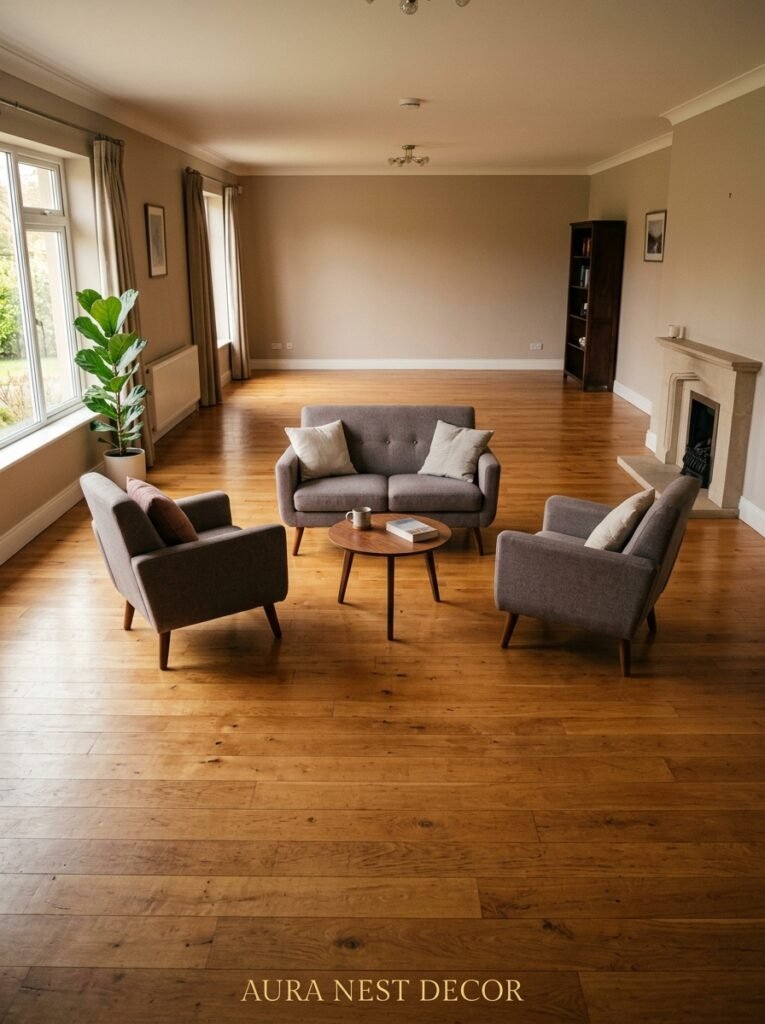
You know the look. Everything pushed against the walls, a rug in the center barely big enough to slide a book under, a sofa that’s technically “facing” a TV but feels like it’s across a football pitch from it.
This is the single most common large living room mistake.
And it’s completely understandable — instinctively, pushing furniture to the edges feels like it should make a room feel bigger. More floor space visible! More breathing room! But what it actually creates is a perimeter of furniture with a dead, purposeless center, and the brain reads that as cold, not spacious.
“Pull your sofa away from the wall. Even just twelve inches. You’ll feel the difference before you can explain it.”
In a large room, furniture has to float. Has to. A sofa sitting 18 inches off the wall, with a generous rug anchoring it (and we’re talking 9×12 minimum — probably bigger), instantly makes the room feel intentional. The seating arrangement becomes its own destination rather than a thing you cross the room to reach.
Side note — the rug size question trips people up constantly. If your rug doesn’t fit under the front legs of every piece of furniture in the grouping, it’s too small.
—
3. Zone Before You Decorate: The Step Most People Skip
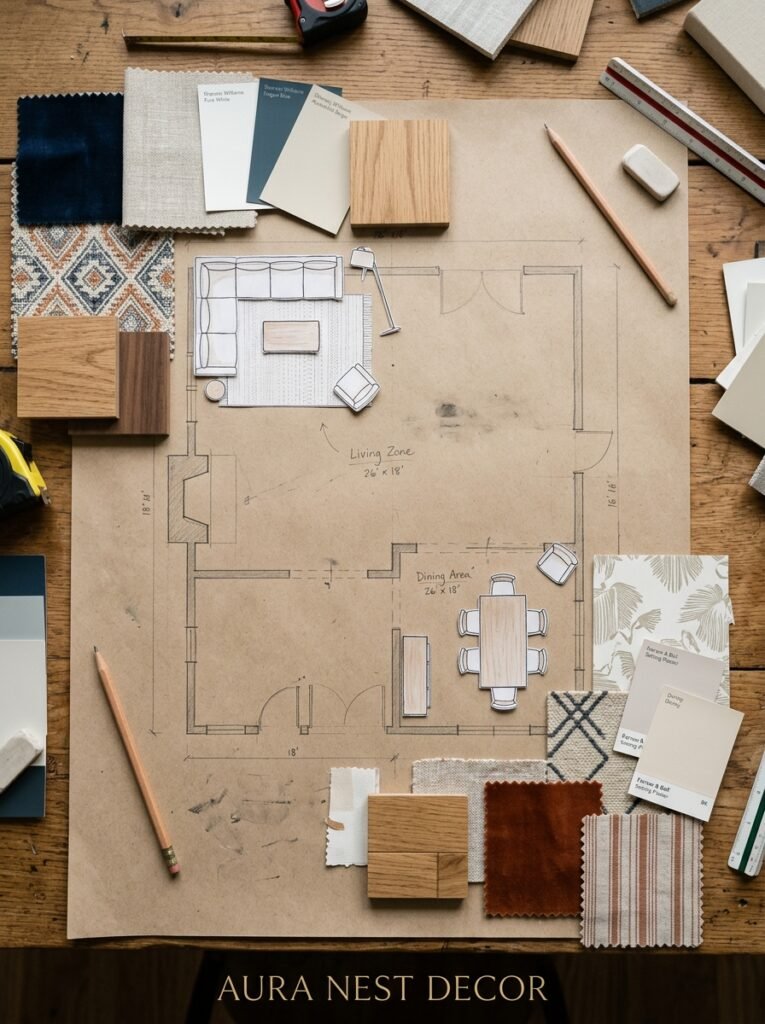
Before buying a single new thing, zone the room.
A large living room almost never works as one big space meant for one big purpose. It needs two zones, sometimes three, depending on layout. The main seating area. Maybe a reading corner. A drinks trolley moment in the far end. A writing desk tucked near a window. Whatever makes sense for how you actually live — not how you imagine a living room is supposed to function.
Because here’s the thing: humans don’t want to inhabit large expanses. We want to feel settled somewhere within them. Think about why corner tables at restaurants fill up first. Why people choose the armchair beside the bookshelf over the open sofa in the middle of the lounge. We’re drawn to places that feel bounded.
So — create those places deliberately. A reading chair with its own floor lamp and a small side table isn’t just a chair. It’s a room within a room. And that’s what a large living room desperately needs more of.
—
4. The Color Rule That Sounds Counterintuitive But Actually Works
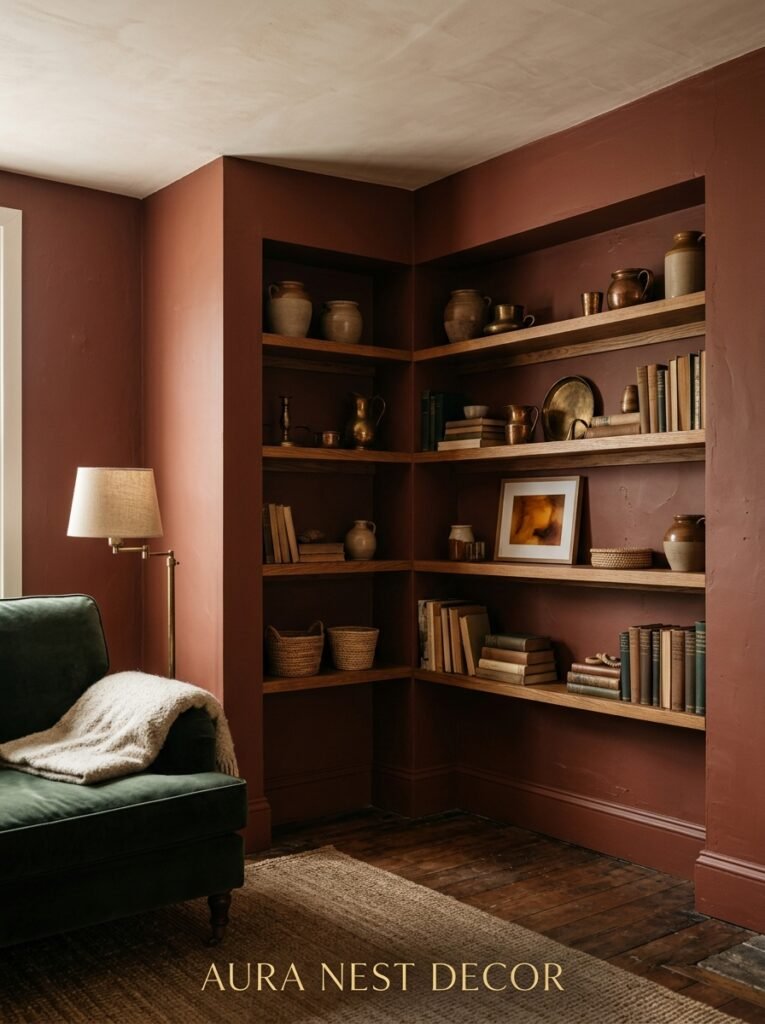
Everyone assumes that large rooms should be painted white or very pale. To “keep them light.” And yes, pale walls won’t actively make things worse. But they won’t help either.
A large living room painted a really confident, deep color — think a British racing green, an inky navy, a warm terracotta — doesn’t shrink. What it does is give the room walls. Psychological walls. Suddenly the space has a presence, a texture, a sense that it wraps around you rather than just extending indefinitely in every direction.
Not gonna lie, this one took me ages to believe until I saw it in person. A friend’s house, enormous Victorian living room, painted in Farrow & Ball’s Hague Blue from floor to ceiling including the woodwork. It should’ve felt oppressive. Instead it felt like the most enveloping, peaceful room I’d ever been in.
The walls came toward you. In the best possible way.
Lighter colors work beautifully too — but if you’re going pale, go warm. Cream, stone, antique white. Cold whites in a large room feel clinical, especially on grey British days when natural light is doing absolutely nothing for you.
—
5. Why Your Sofa Is Probably Too Small (And Your Coffee Table Definitely Is)
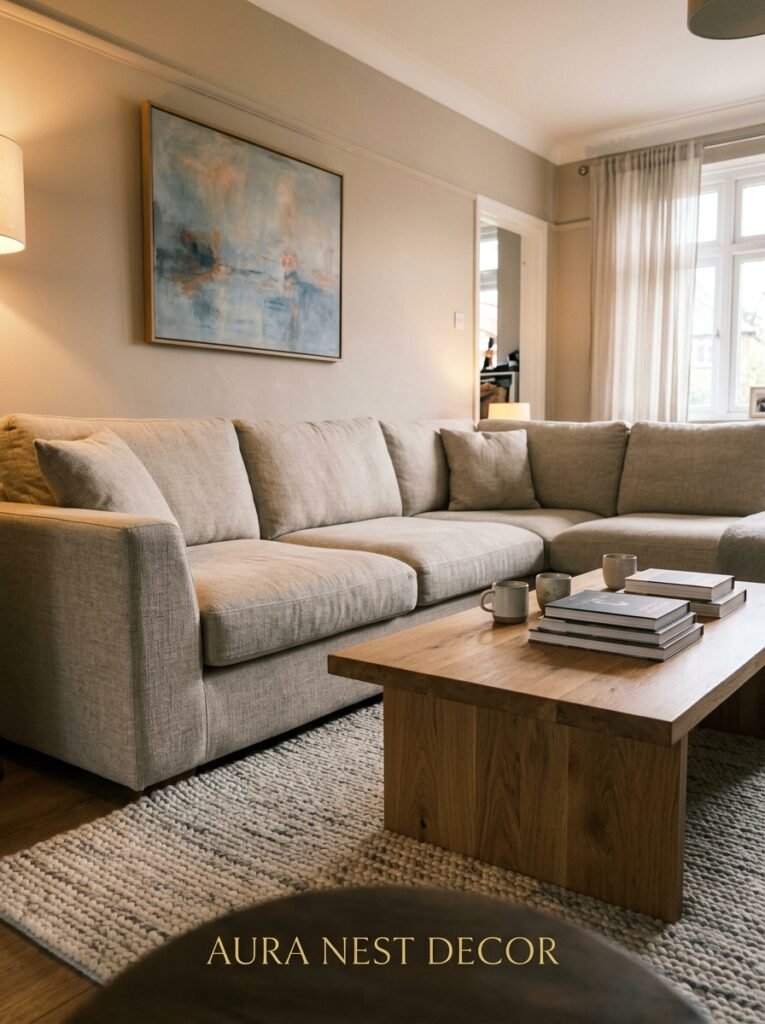
Scale is where most large living room decorating goes sideways.
A two-seater sofa in a 500-square-foot room isn’t cozy. It’s just small. And small furniture in a large room doesn’t read as delicate or understated — it reads as wrong, in a way your brain notices before your eyes catch up.
“In a large room, you don’t need more furniture. You need BIGGER furniture.”
A proper large living room can handle a three-seater and a separate two-seater — or a three-seater with a chaise. It can handle an oversized ottoman doubling as a coffee table. It can handle an armchair that’s genuinely, luxuriously large rather than the compact version you’d pick for a flat.
Go big on the coffee table too. A double-tier, a large round, a pair of ottomans serving as a surface — all better options than the standard 4×2 rectangle that’ll look like a drinks coaster in a large space.
And curtains. Floor to ceiling. Always floor to ceiling, pooling slightly if you’re feeling dramatic. Short curtains in a large room are like cropped trousers on a very tall person. They just draw attention to what’s not there.
—
6. The Layer That Nobody Budgets For (But That Changes Everything)
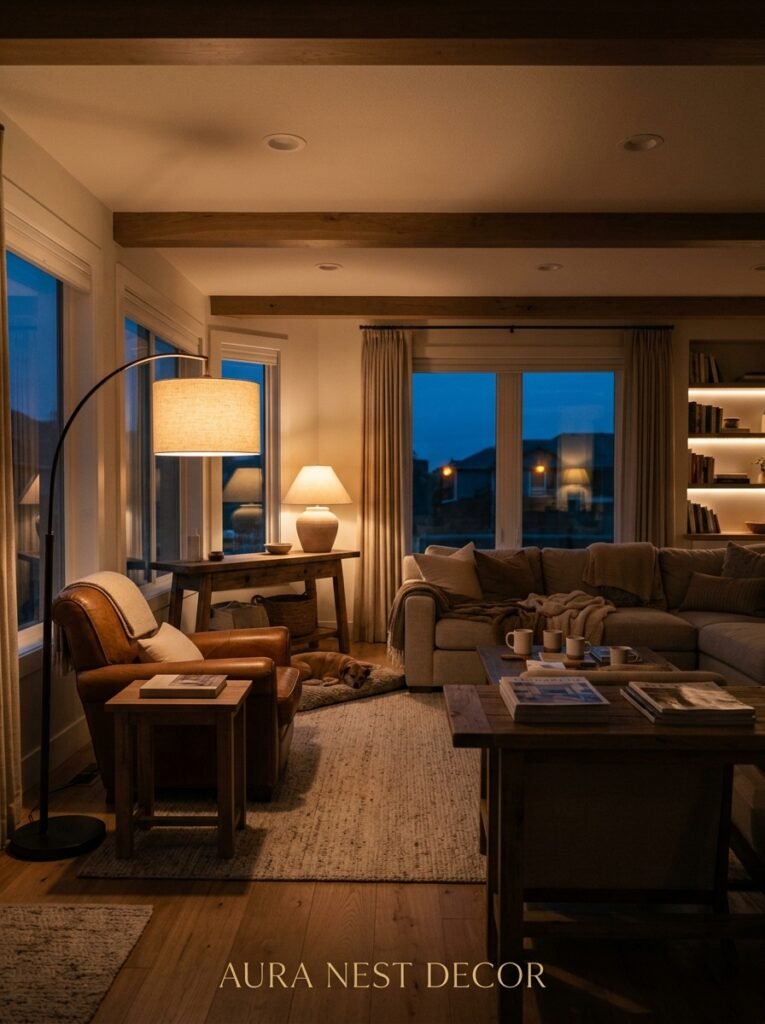
Lighting. Not one big central ceiling light. Multiple sources, at multiple heights, all on separate circuits or dimmers if you can manage it.
A large living room lit only by an overhead fixture looks like a staff meeting. You need the ambient layer, yes, but you also need the amber glow of table lamps at 7pm, a floor lamp throwing a warm pool of light into the reading corner, maybe a couple of picture lights drawing the eye up to the walls.
Three different light sources switched on at different levels do something almost architectural to a large room. They carve it up. They make it feel like several warm pockets of space rather than one big evenly-lit box.
This is also the area where smart investment pays off more than anywhere else in the room. You can have beautiful furniture and a perfectly zoned layout, but bad lighting will undo most of it. Whereas solid, layered lighting will make even the most work-in-progress room feel intentional.
Lamp shades matter too — fabric shades in warm tones diffuse light in a way that plastic or metal can’t. Small detail. Huge difference.
—
7. The Bookshelf Move That Interior Designers Use to Ground a Room
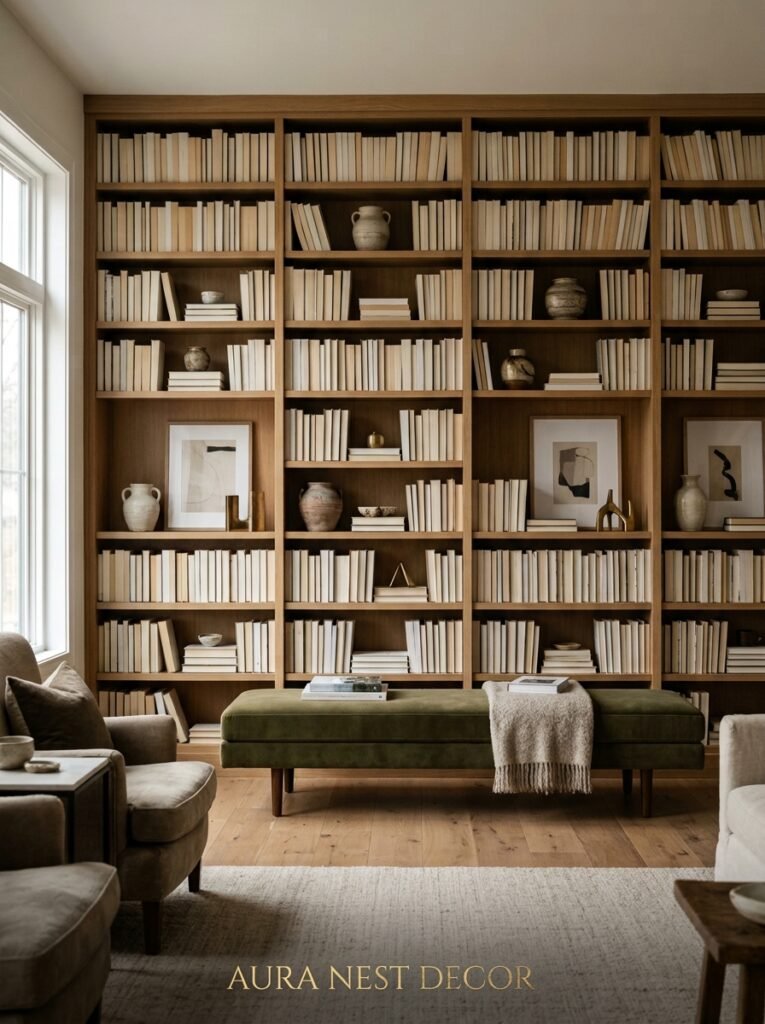
Built-ins are obviously ideal but not everyone has them or wants to commit to them. What you can do — and what genuinely works — is go tall with freestanding shelves.
Not one low bookcase. A pair of bookcases that reach close to or all the way to the ceiling, framing something. A fireplace, a TV, a window. Tall shelving does two things in a large room: it creates vertical interest, which draws the eye up and makes high ceilings feel intentional rather than just far away, and it anchors the furniture around it.
A sofa floating in the middle of a large room looks uncertain. A sofa floating in front of two flanking bookshelves looks deliberate.
Style them with a mix of books, objects, plants. Don’t obsess over perfectly matching everything — a bit of visual variety on shelves reads as lived-in and collected, which is a very different feeling from arranged.
—
8. The One Rug Trick That Makes Zoning Feel Natural
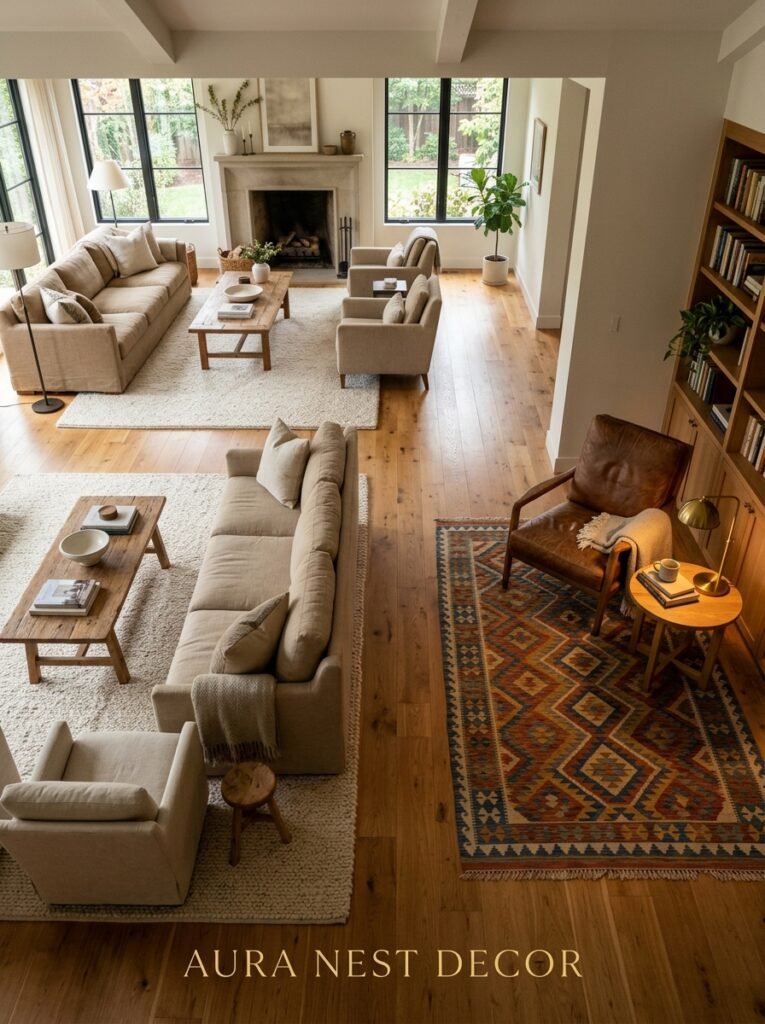
Two rugs. That’s it.
If you’ve got a large living room with two zones — a main seating area and a secondary space, a reading chair and a small desk — give each zone its own rug. Different but complementary. Maybe one is patterned and one is solid. Or one is a jute and one is a wool.
Separate rugs are like punctuation in a room. They tell you where one sentence ends and another begins. And they make zones feel real rather than suggested.
The rugs can share a color — warm terracotta in a pattern on the main rug and a rust-adjacent solid under the reading chair. That visual link ties them together without making the room feel like it’s wearing a matching set.
—
9. How Mirrors Actually Work in a Large Room (Not the Way You’d Think)
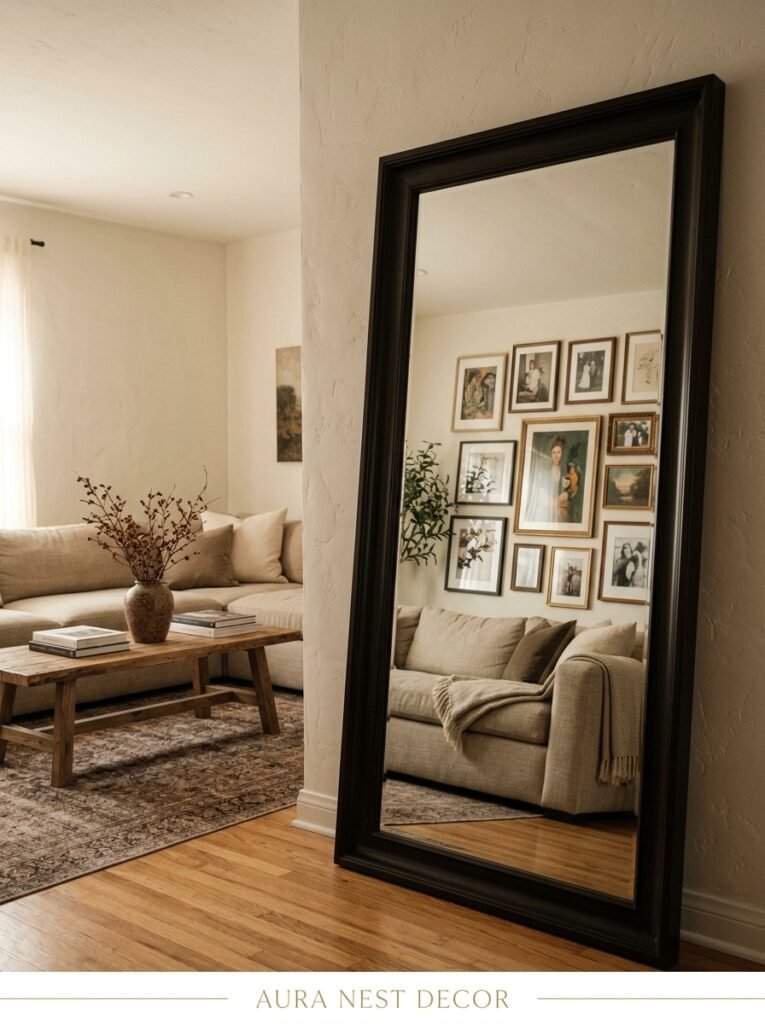
In a small room, mirrors create the illusion of space. In a large room, mirrors serve a completely different function — they bounce light and make the room feel more alive, more animated.
But here’s where people go wrong: one large mirror on one wall. Just standing there.
What works better is a mirror that’s positioned to reflect something beautiful — a lamp, a window, a shelf of books, a plant. A mirror facing another mirror creates a tunnel, which is odd. A mirror reflecting a warm light source doubles that warmth back into the room.
Also — don’t feel like mirrors have to be leaned against walls or hung perfectly level. A large mirror leaned casually in a corner, slightly angled, has a relaxed energy that an overly perfectly-hung mirror doesn’t. The nonchalance of it reads as confident.
—
10. Plants That Actually Work at Scale (Don’t Bother With Small Ones)
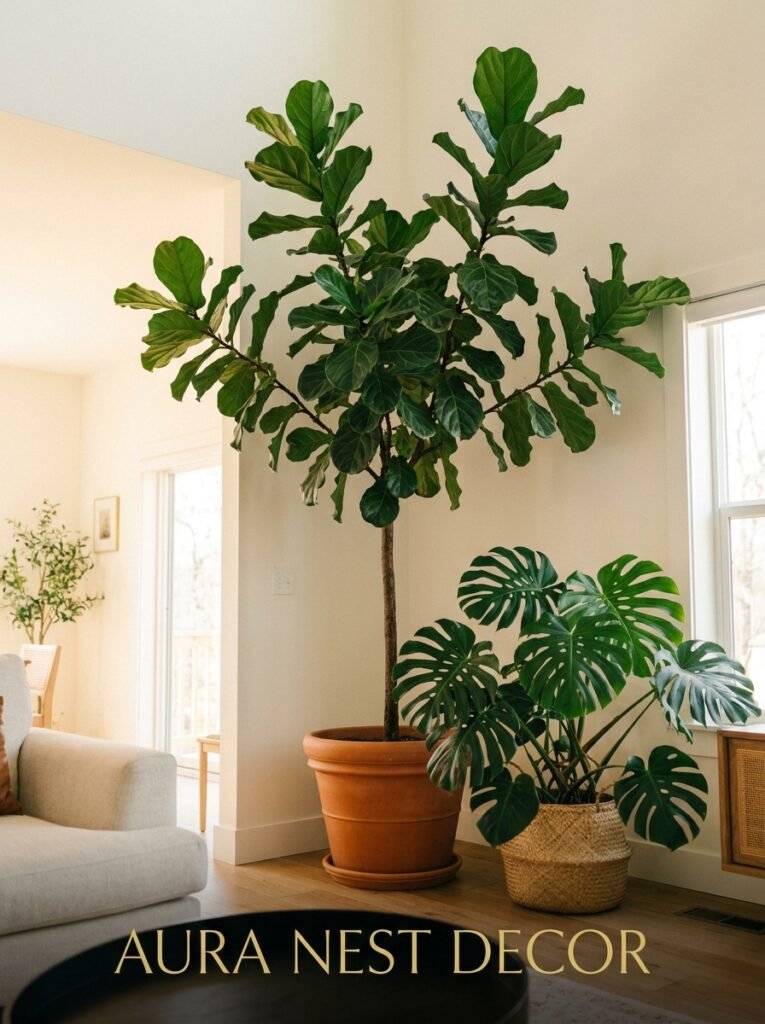
A single fiddle-leaf fig in the corner of a large living room can be a beautiful thing. But a small pothos on the coffee table in a 400-square-foot room? Barely visible. Almost irrelevant.
Scale up. Go for one or two dramatic plants that make a genuine visual statement — a monstera that’s been allowed to actually get large, a tall olive tree in a terracotta pot, a bird of paradise that reaches the level of the windowsill.
And group them if you can. Three plants clustered together create impact where one on its own would disappear. Put them where they do double duty: a tall plant in a corner fills a visual gap that no piece of furniture could fill as naturally. An olive tree near a window pulls the eye toward light. A large trailing plant on a high shelf adds the organic, slightly-wild element that keeps a large, well-decorated room from feeling like a showroom.
“A large room needs large plants. Not because the small ones wouldn’t be pretty — but because they won’t register.”
—
11. The Fireplace (Real or Faux) as the Room’s Whole Reason for Being
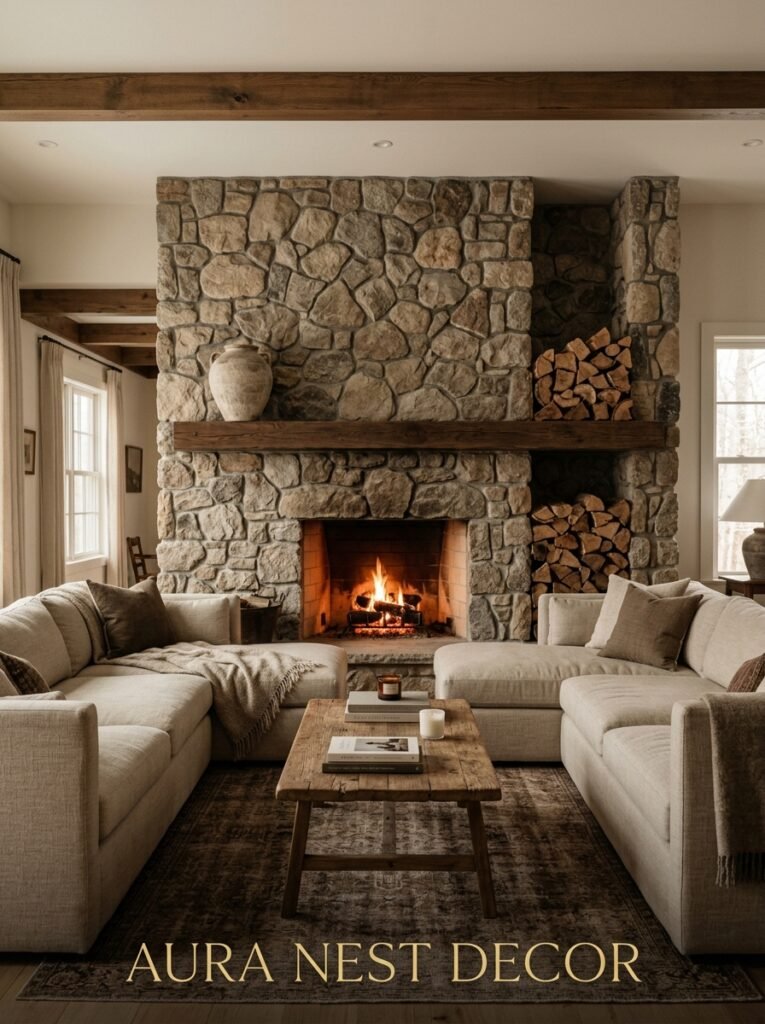
If you have a fireplace, everything should face it or relate to it. It shouldn’t be an afterthought on a side wall while the furniture arrangement points toward the television.
The TV is not the hearth. It functions like one, I know. But a fireplace — working, gas, or even a beautifully styled electric one — does something for a large room that no other object can do. It gives the space a center of gravity.
In the UK especially, so many Victorian and Edwardian homes have original fireplaces that have been boarded up at some point, lost under layers of MDF and magnolia paint. If yours is one of them, it might be worth investigating. Even a non-functional fireplace, opened up and filled with candles or a collection of logs, gives the room an anchor that makes everything else fall into place around it.
Style the mantle carefully. Not cluttered — but not bare either. A large mirror above it, a few objects with varying heights, maybe a plant. Give it weight, because it needs to hold the room’s attention from across a large distance.
—
12. The Detail That Signals the Room Is Done (Even When It’s Not)
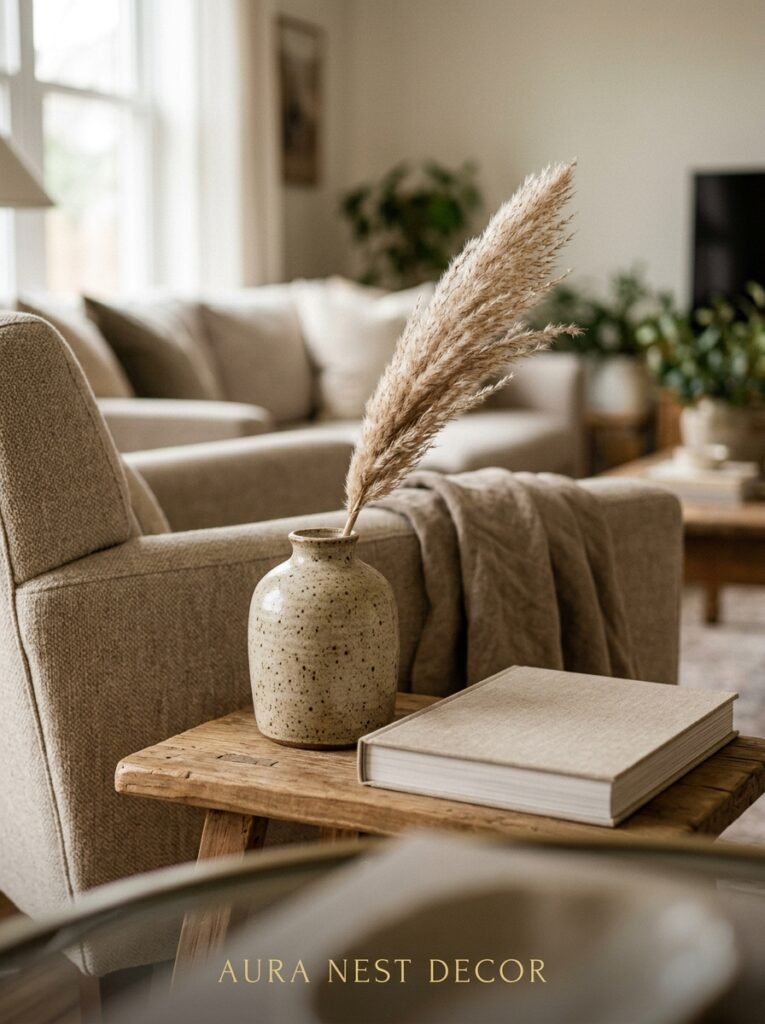
There’s always one small thing that makes a room click. And in a large living room, that thing is almost always something textile.
A pile of throw blankets that looks casually abandoned on the sofa arm rather than neatly folded. A kilim or vintage-style cushion that introduces a bit of pattern and texture that the rest of the room doesn’t have. A linen curtain that pools very slightly on the floor.
These details signal inhabited, not just decorated. And that’s the whole goal with a large room — to make it feel like people actually want to be in it, that they linger there, that they pull the blanket off the sofa arm and wrap it around themselves while they watch TV at 9pm in February.
That’s the feeling. Everything else is in service of that.
—
❓ FAQ
Q: How do I make a large living room feel cozy without making it look cluttered? A: Focus on creating distinct zones rather than filling the whole room with furniture. One beautifully styled seating area with layered lighting and textiles will feel far cozier than a room stuffed with pieces that have no relationship to each other. Cozy comes from intentionality, not quantity.
Q: What size rug do I need for a large living room? A: Bigger than you think. For a main seating area, a 9×12 is often the minimum, and in a genuinely large room a 10×14 or even larger is better. The key test is that all the front legs of your main furniture pieces should sit ON the rug, not beside it. If you’re zoning the room with two rugs, make sure each one is still substantial enough to anchor its respective area.
Q: Should I use the same color palette throughout a large open-plan living room? A: A shared palette is a good idea — but shared doesn’t mean identical. Pull a color from one zone and let it appear in a secondary way in the other. One chair in the reading corner picks up the accent color that appears as a larger presence in the main seating area. That kind of thread running through the room makes it feel cohesive without feeling uniform, which in a large space reads as deliberate and interesting rather than just matched.
—
💭 Final Thoughts
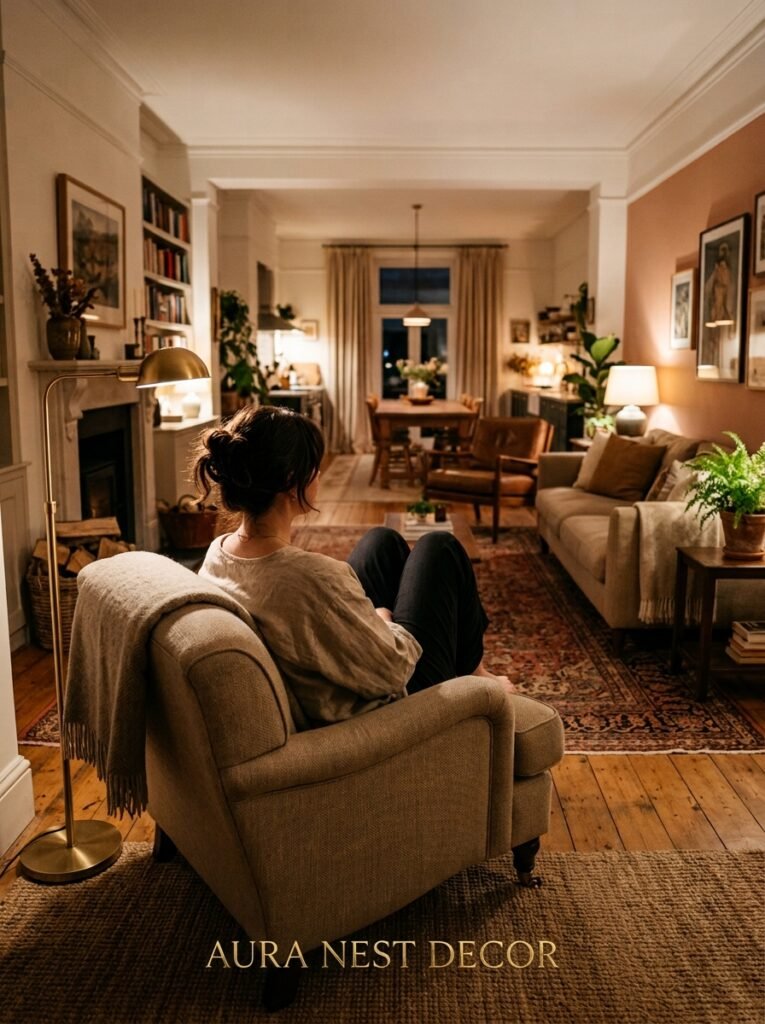
A large living room isn’t a gift you just get to enjoy. It’s more like a project that rewards patience and a willingness to rethink your assumptions — about scale, about color, about what “cozy” actually means when the room is 25 feet long.
But when it clicks, there’s nothing quite like it. A large, well-considered room has a generosity to it that smaller spaces just can’t offer. Room to breathe. Room for people. Room for the evening to stretch out without anyone feeling pressed against anyone else.
My friend Jess, by the way, painted her walls a deep forest green and pulled her sofa three feet off the wall. She says it still doesn’t feel completely done — but it no longer feels like a waiting room.
Does it ever really feel completely done, though?