
Dark Feminine Green: The Bedroom Aesthetic That’s Quietly Taking Over Every Beautiful Home Right Now
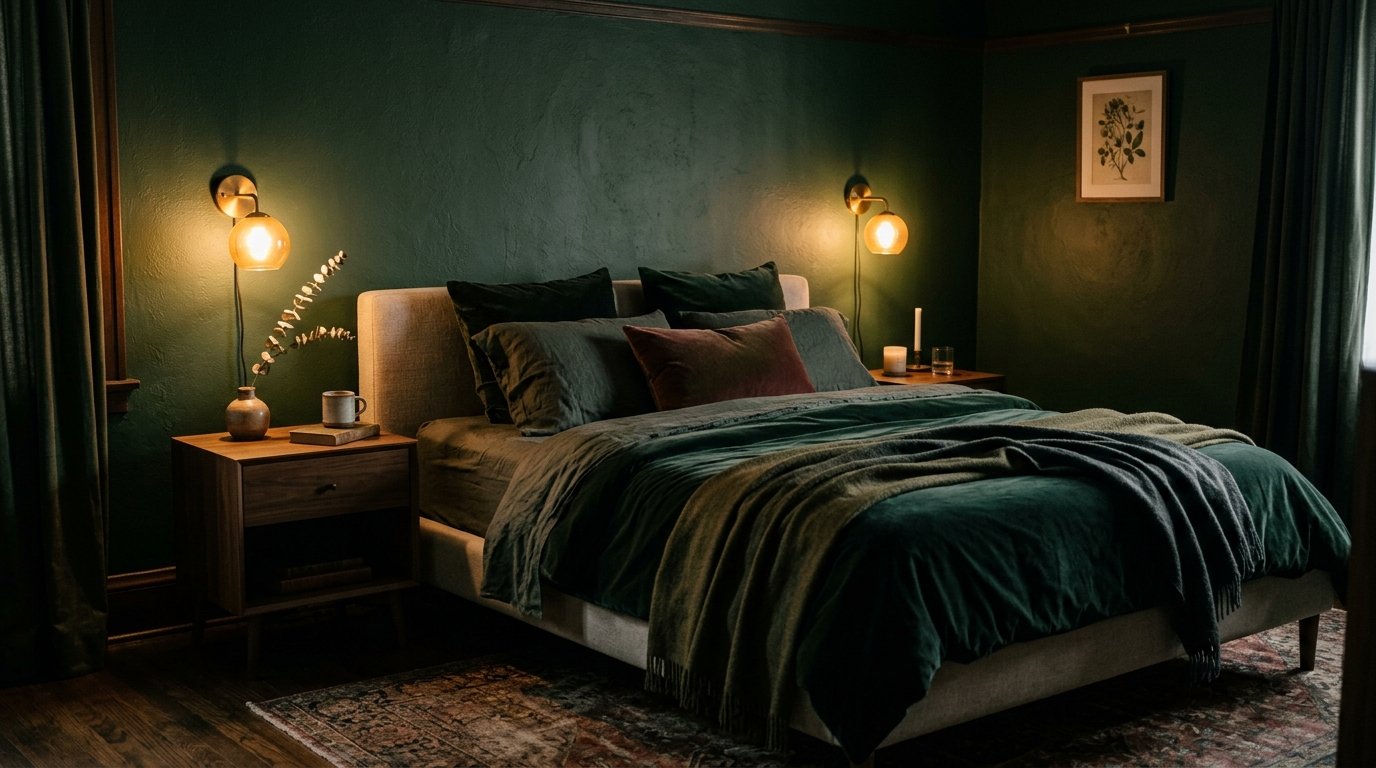
My friend sent me a photo at 11pm last Tuesday. No caption. Just a bedroom — deep forest walls, a velvet duvet the color of dried moss, soft gold pooling from a single lamp. I stared at it for longer than I want to admit.
That’s what dark feminine green does. It doesn’t ask for your attention. It just takes it.
—
1. Why This Shade of Green Feels Different From Every Other Trend Right Now
Most color trends feel like a decision. This one feels like a mood.
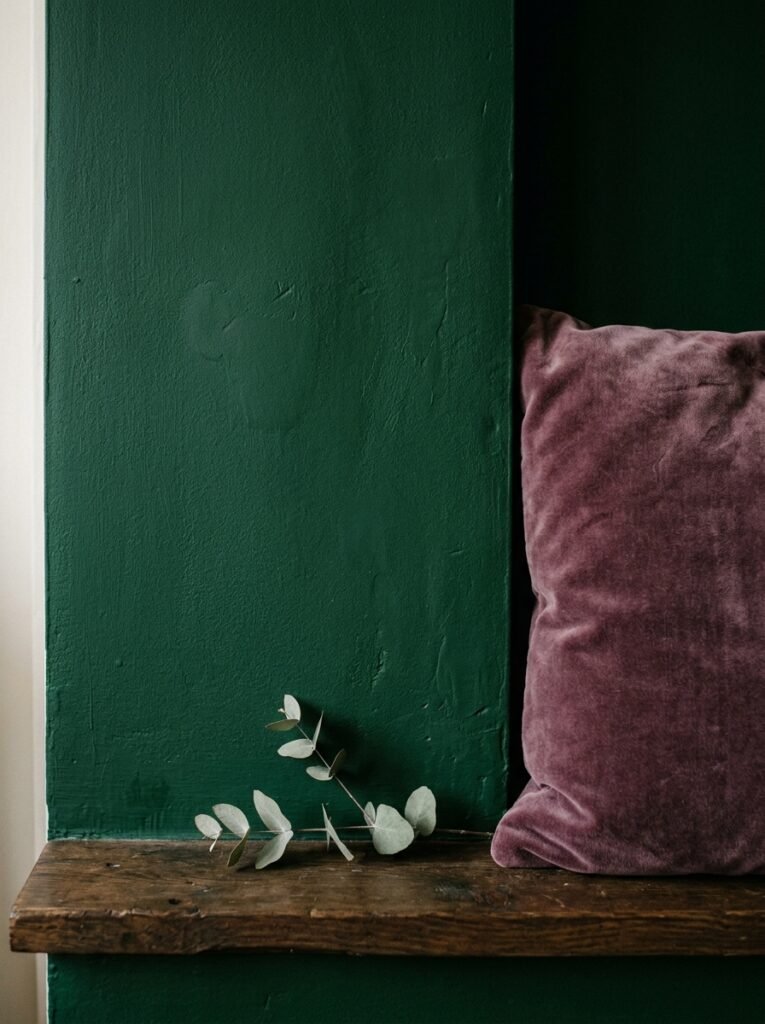
Dark feminine green — and I’m talking deep hunter, aged sage, almost-black bottle green, that bruised eucalyptus tone that sits somewhere between blue and green depending on the light — it doesn’t perform. It doesn’t announce itself the way blush pink did, or the way those aggressively bright terracotta rooms felt for a while. It just sits there being absolutely gorgeous and letting you come to it.
And there’s something distinctly feminine about that energy. Not frilly. Not soft-pastels-and-flowers feminine. Something older. More deliberate. The kind of room that feels like it belongs to someone who knows exactly what she wants and genuinely doesn’t need your opinion about it.
That’s the vibe we’re building here.
“It doesn’t perform. It doesn’t announce itself. It just sits there being absolutely gorgeous and letting you come to it.”
What’s interesting is that green in a bedroom used to feel risky to a lot of people. Too cold, they said. Too nature-y. But the specific shades driving this aesthetic aren’t fresh or bright — they’re dense, complex, a little mysterious. They read WARM in the right light, even though that sounds like it shouldn’t be true.
It completely is, though.
—
2. The Wall Color Decision That Changes Everything Else in the Room
Here’s the thing about committing to a dark green bedroom: once you pick the shade, the room sort of… designs itself. Not entirely, obviously. But there’s a logic that clicks into place.
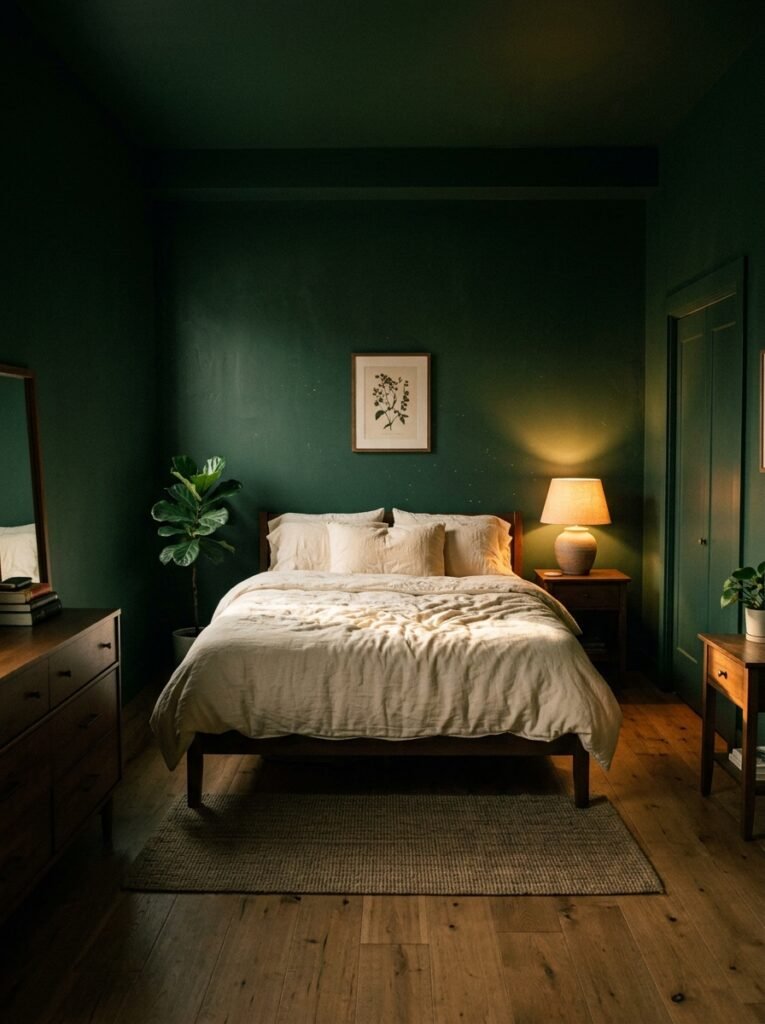
Deep green walls push certain things forward — warm metals, aged wood, cream and ivory linen, anything with a patina or a texture. And they absorb things that don’t belong. Anything too cool, too stark, too modern-minimal will look awkward fast.
So the wall color isn’t just a backdrop. It’s basically your art director.
For dark feminine bedrooms specifically, I’d be looking at shades with some blue in them (more mysterious, more dramatic at night) or some grey (earthier, more intimate, incredibly good with candlelight). Pure bright greens — the leafy, garden-centre kind — are a different aesthetic entirely. Beautiful, but not this.
If you’re in the UK, older plaster walls actually do something really lovely with deep green paint — the slight texture catches the colour differently at different times of day. Worth knowing if you’re in an older property and assuming that’s a disadvantage.
—
3. The Exact Lighting Setup That Makes Dark Green Walls Look Magical Instead of Depressing
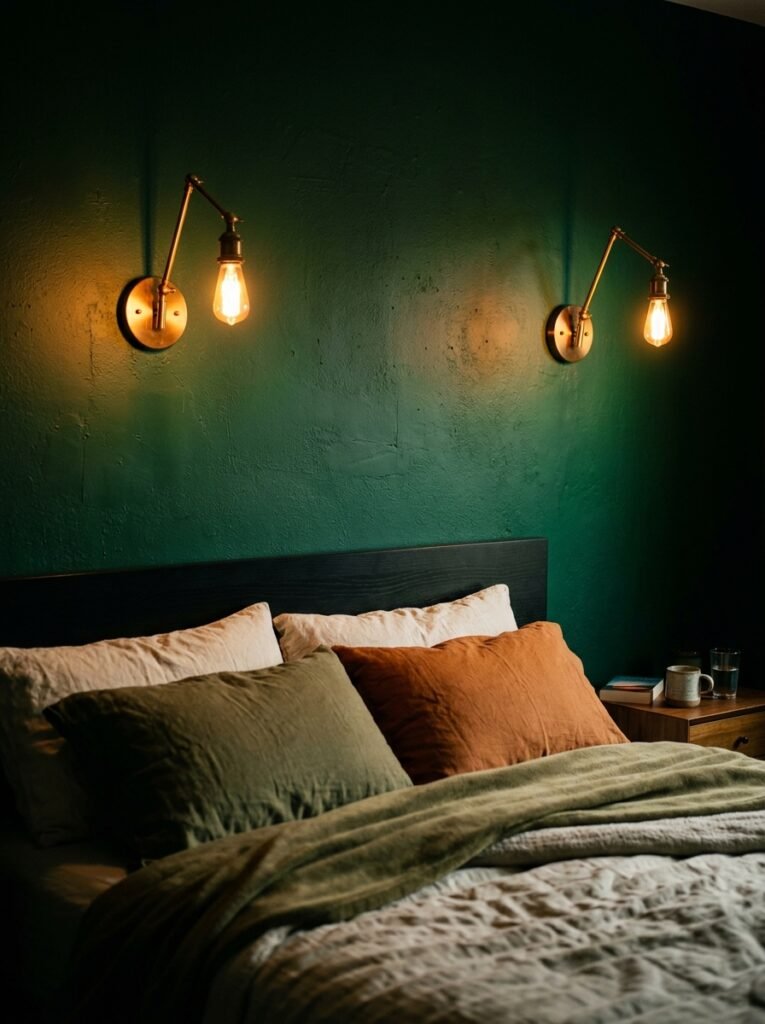
Bad lighting will absolutely ruin this. I can’t stress that enough.
Overhead lighting is the enemy of a dark green bedroom. Actually, overhead lighting is the enemy of most bedrooms, but with dark walls it’s particularly brutal — it flattens everything, kills the depth, makes the room feel like a cave in the worst possible way rather than the best.
What you want instead is layered, low, warm light. Think: the amber glow of an Edison bulb at 7pm. Bedside lamps at eye level when you’re lying down. A dimmer switch, honestly, is non-negotiable in this room.
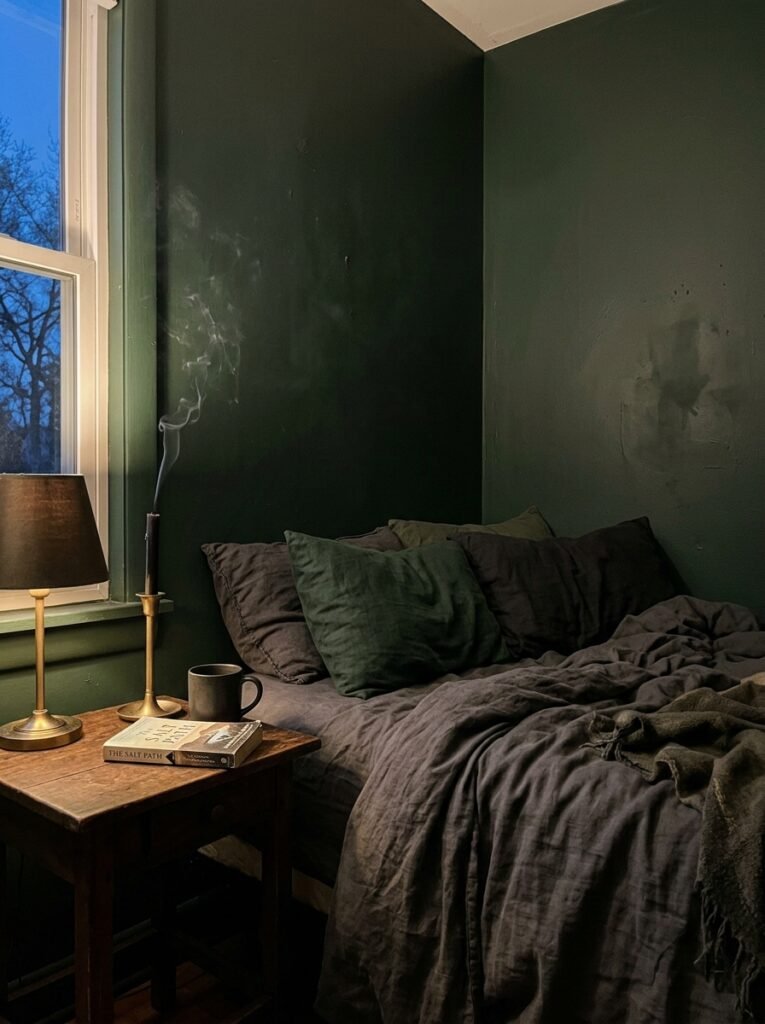
Side note — if you can add any candlelight, even LED candles you pick up cheap somewhere, do it. Dark green walls with flickering warm light feel almost medieval in the best way possible. Like sleeping in a very luxurious old manor house.
The other thing nobody talks about: mirrors. A well-placed mirror in a dark green bedroom doesn’t just make it feel bigger, it bounces light around in this warm, layered way that makes the whole room glow. One large mirror or two smaller ones, preferably with a warm gold or aged brass frame. Game-changing.
—
4. Textiles That Work Harder Than Any Piece of Furniture Ever Could
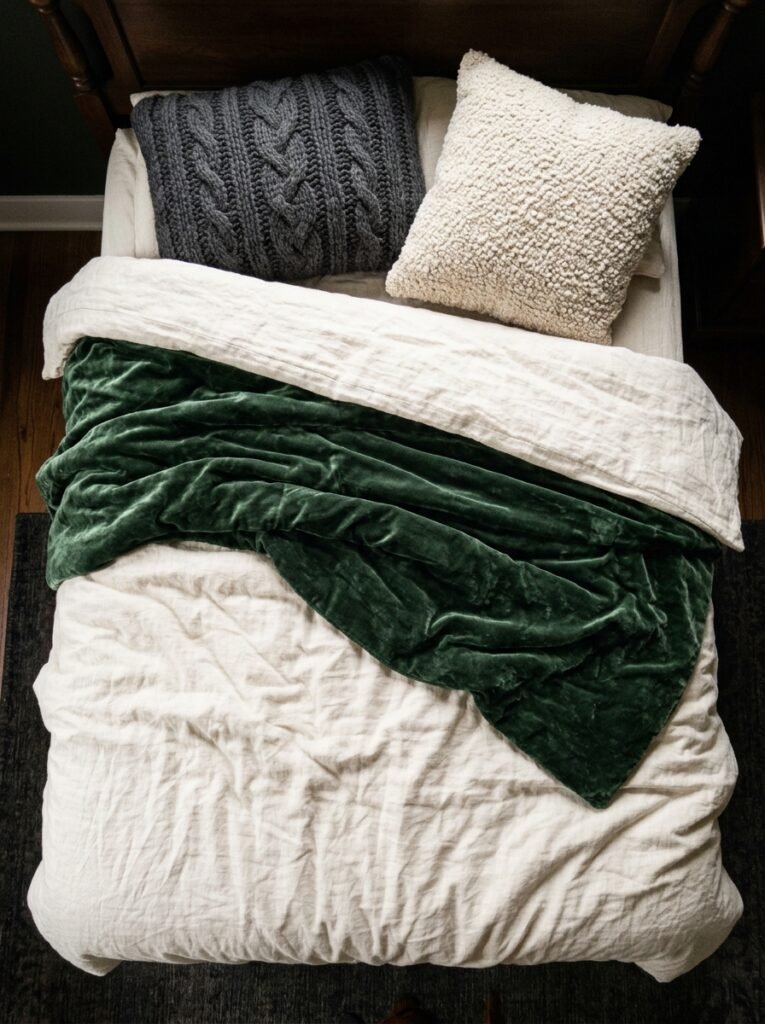
This is where the “feminine” part of dark feminine green actually lives, in my opinion. Not in the color itself — in the layers.
Velvet. Always velvet somewhere. A velvet duvet cover in deep green or that slightly dusty mauve-plum tone that shows up with green like they were designed for each other. Velvet throw pillows. Even a velvet lampshade if you want to commit.
Then linen. Unwashed, slightly rumpled natural linen in ivory or warm cream. The contrast between velvet’s richness and linen’s casualness is the whole visual trick — it keeps the room from feeling like a stage set.
Then something woven. A chunky throw blanket draped half-off the bed. A woven cushion cover with an interesting texture. Jute somewhere — maybe a rug, maybe a basket you didn’t even intend as decor.
“The contrast between velvet’s richness and linen’s casualness is the whole visual trick — it keeps the room from feeling like a stage set.”
You don’t need all of these at once. You just need MORE than one texture. A bed that’s all one fabric, even beautiful fabric, reads flat in a dark room. Texture is what makes it feel alive.
—
5. The Metal Finish That Belongs in This Room (and the One That Absolutely Doesn’t)
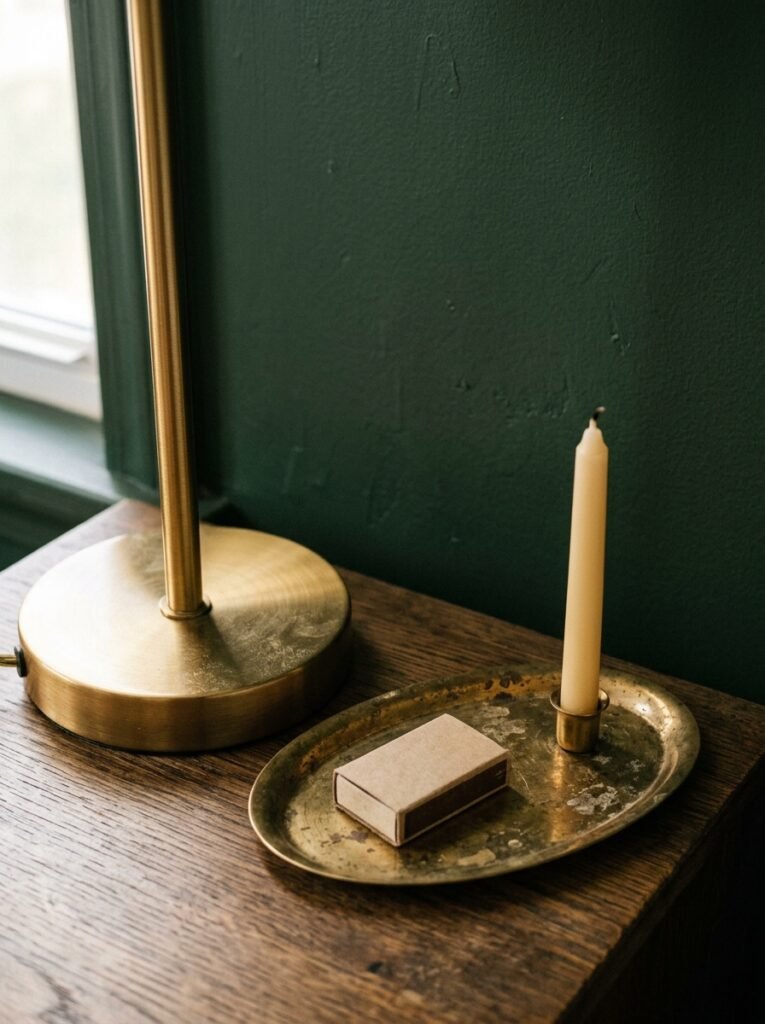
Aged brass. That’s the answer. Warm, slightly dark, not the shiny-bright kind — the kind that looks like it’s been handled for fifty years. Aged brass with dark green is genuinely one of the most beautiful combinations in interior design. I’ll die on this hill.
Antique gold works too. Warm bronze. Even dark iron if you want to go slightly more Gothic with it.
What doesn’t work: cold silver. Polished chrome. Anything too sleek or modern. Those finishes fight the warmth that makes this palette work, and the room starts feeling confused rather than layered.
This applies to: lamp bases, drawer handles, mirror frames, curtain rods, small decorative objects. All of them. Pick a lane with your metals and stay in it — this aesthetic is particularly unforgiving of mixing cool and warm finishes.
—
6. The Furniture Pieces That Look Like They Belong Here vs. the Ones That Look Lost
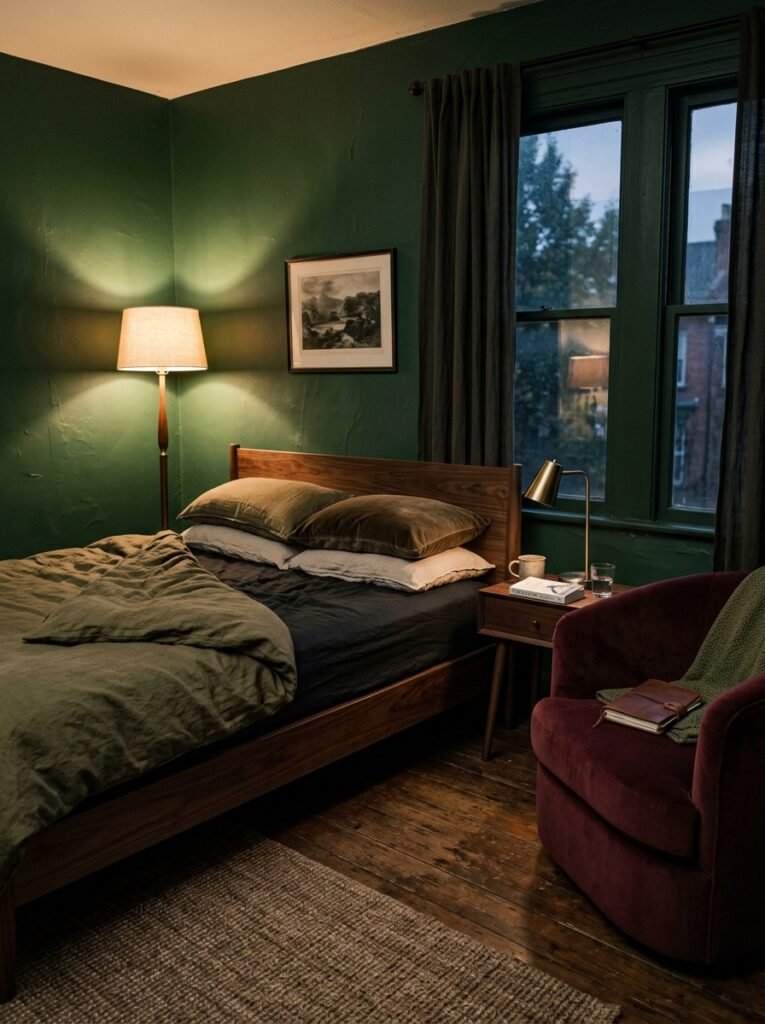
Dark wood. That’s the starting point.
Walnut, mahogany tones, anything with a rich brown base rather than the pale ash or blonde wood that was everywhere for a while. Dark green and dark wood have this deeply satisfying relationship — they share a kind of heaviness, a seriousness, that makes a room feel intentional rather than assembled.
That said — you don’t want ALL dark furniture in a dark green room, or it tips into oppressive. One or two anchor pieces in dark wood, then balance with lighter or more textural pieces. A bedside table with slim legs. An upholstered ottoman at the foot of the bed.
Curved furniture is having a real moment in this aesthetic too and honestly it earns it. A curved headboard, a round bedside table, even a mirror with an arched top — softening the geometry of the room keeps it feeling feminine rather than just dramatic.
And honestly? An old piece with some history works better here than anything brand new and obviously new. A vintage dresser. A slightly worn chair in the corner. The room benefits from things that look like they’ve lived somewhere before.
—
7. What to Put on the Walls When the Walls Are Already Doing the Most
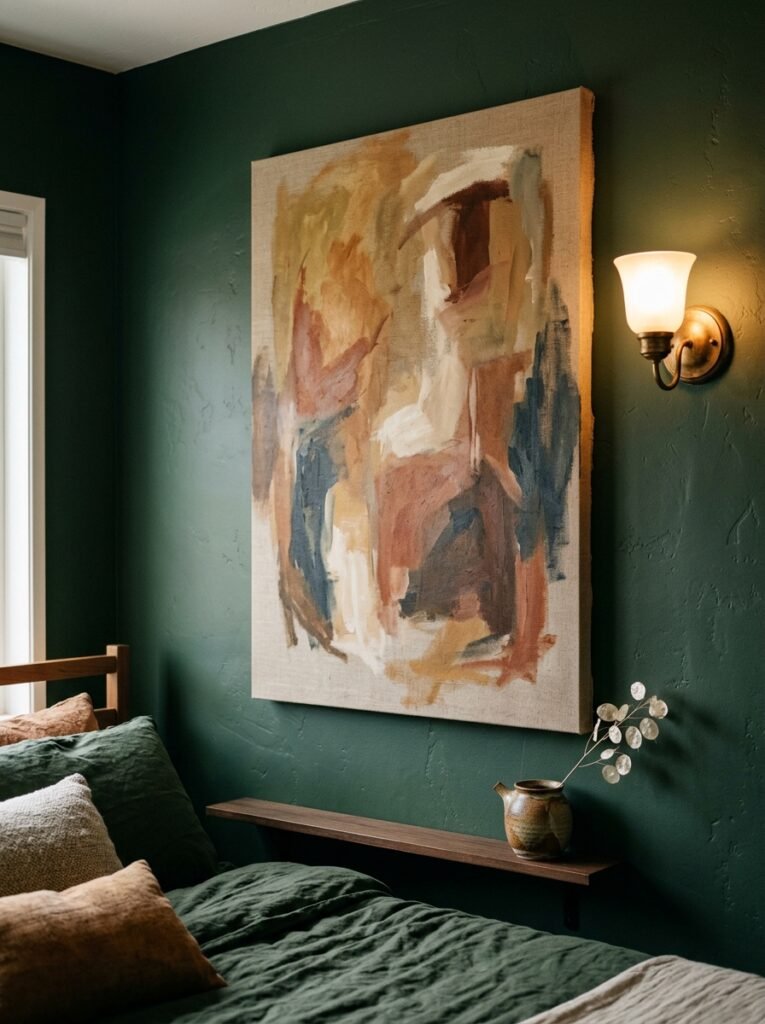
This is the question I see people get stuck on, and I get it. Dark green walls feel complete somehow — like, does anything even go on them?
Yes. But less than you think.
One large piece of art is almost always better than a gallery wall in this aesthetic. Something with some weight to it — a botanical illustration, an abstract with dark and organic tones, a vintage portrait print. Not minimalist line art. Not anything too cool or graphic. The art needs to feel like it belongs to the same world as the walls.
Alternatively: a dramatic mirror counts as wall decor and does more work than art in a dark room because of the light thing I mentioned earlier.
One thing I’d genuinely avoid: floating shelves crammed with stuff. That particular style — the maximalist shelf with plants and candles and books and little objects — feels incredibly curated in a white room and just looks busy against dark walls. If you want shelving, keep it more curated. Five things, not fifteen.
—
8. Plants That Actually Make Sense in a Dark Bedroom (Not Just the Pretty Ones)
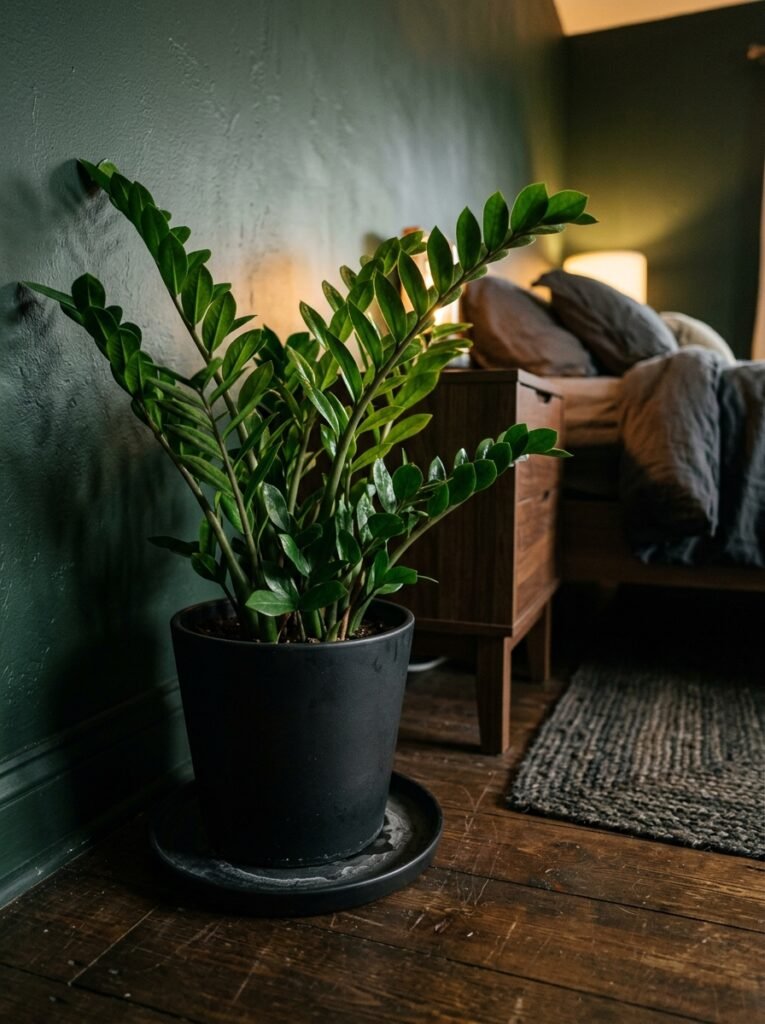
You’d think dark green walls and lots of plants would be a natural pairing. And it CAN be — but you need to be selective.
The mistake people make is going full jungle. But that pulls the room toward a different aesthetic entirely (botanical maximalism, which is its own wonderful thing) rather than the darker, more refined feeling we’re going for.
One large statement plant. Or two, max. Something with drama — a tall fiddle leaf, a deep-leafed monstera, a snake plant if you’re in a lower-light situation. The scale matters here. One large plant in an aged ceramic pot reads as intentional. Eight small plants on a shelf reads as hobby.
And honestly? A single stem of dark dried botanicals in a dark vase can do MORE for this aesthetic than a lush living plant. Dried pampas grass in a deep terracotta or black vessel. Dried eucalyptus with its silvery-green tones. The dryness and darkness of them fits the mood in a way that bright green living plants sometimes don’t.
—
9. The Scent of This Room (Because That’s a Thing We Should Talk About)
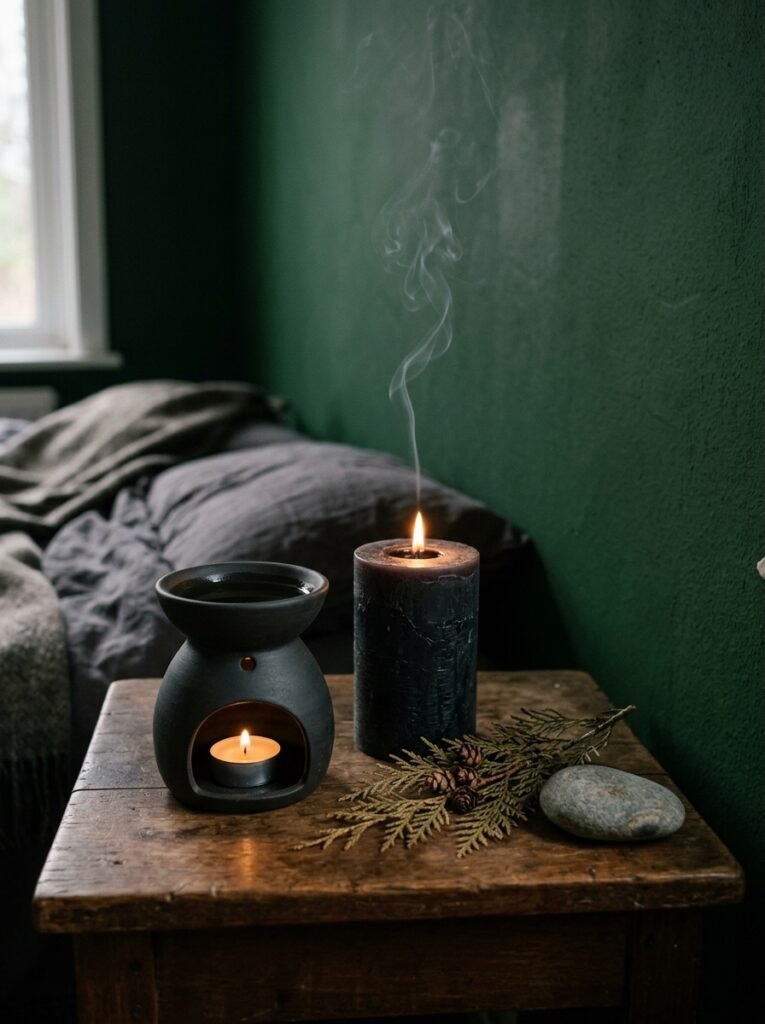
Ok, hear me out.
A bedroom is a full sensory environment and dark feminine green has a scent. Or it should. You’d want something green-adjacent but complex — not a fresh, clean soap smell, and definitely not something sweet or floral in an obvious way.
Vetiver. Sandalwood. Cedarwood. Anything with a green, slightly smoky or earthy base note. Fig. Oakmoss if you can find it.
A diffuser with something like that running on low, or even just a candle you light for an hour before bed, and the room has a whole additional layer that photographs can’t capture but you absolutely feel when you walk in.
It’s a small thing that makes the space feel completely finished. Which is maybe the most feminine thing on this entire list, now that I think about it.
—
10. The Case for Painting ONLY One Wall (and Making It the Right One)
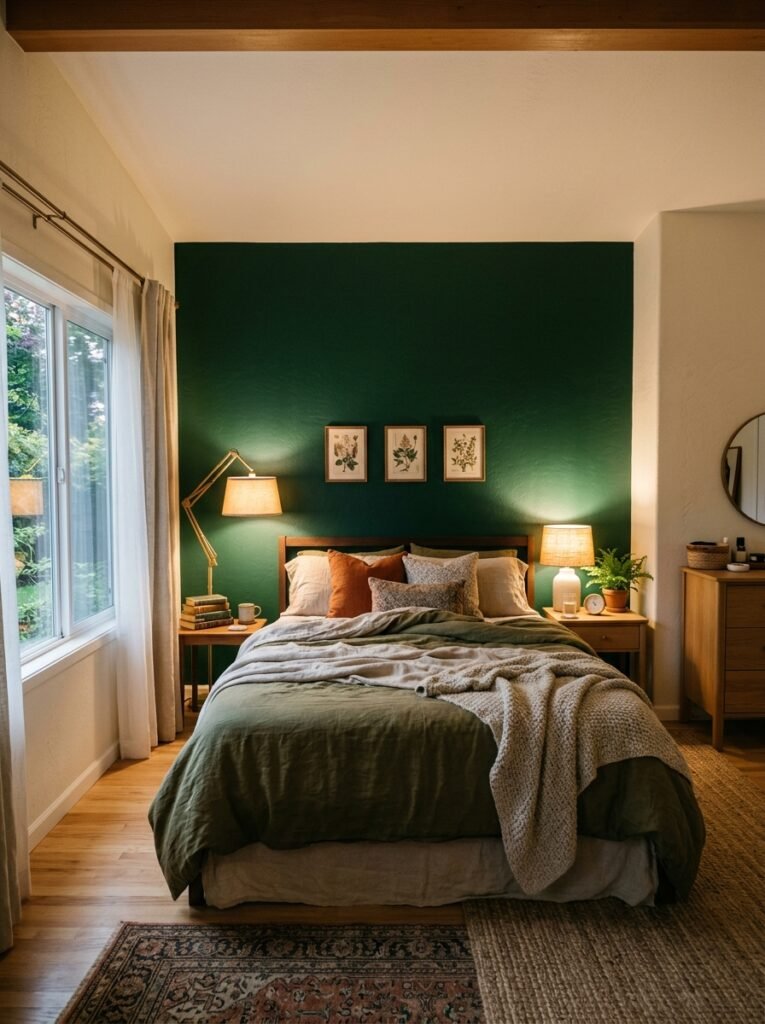
Not everyone’s going to paint all four walls dark green. And that’s completely fine — actually, done well, a single dark green wall can be even more dramatic than the full room treatment.
The key word there is DONE WELL.
The mistake is treating it like a traditional feature wall — a sort of half-commitment behind the bed, and then everything else stays white, and the room looks like it couldn’t make up its mind.
What actually works: if you’re doing one wall, fully commit to the styling choices in the rest of the room. Pull the green through in textiles, in plants, in objects. Let the one wall feel like it’s on purpose rather than a test run.
“Let the one wall feel like it’s on purpose rather than a test run.”
The wall behind the bed is almost always the right choice, because it becomes the backdrop for the whole room — especially in photos. But if your bed sits against a window wall, consider the wall opposite instead. It’s what you see when you walk in, and that first impression is everything.
—
11. Small Bedrooms, Big Ambitions — Does Dark Green Even Work?
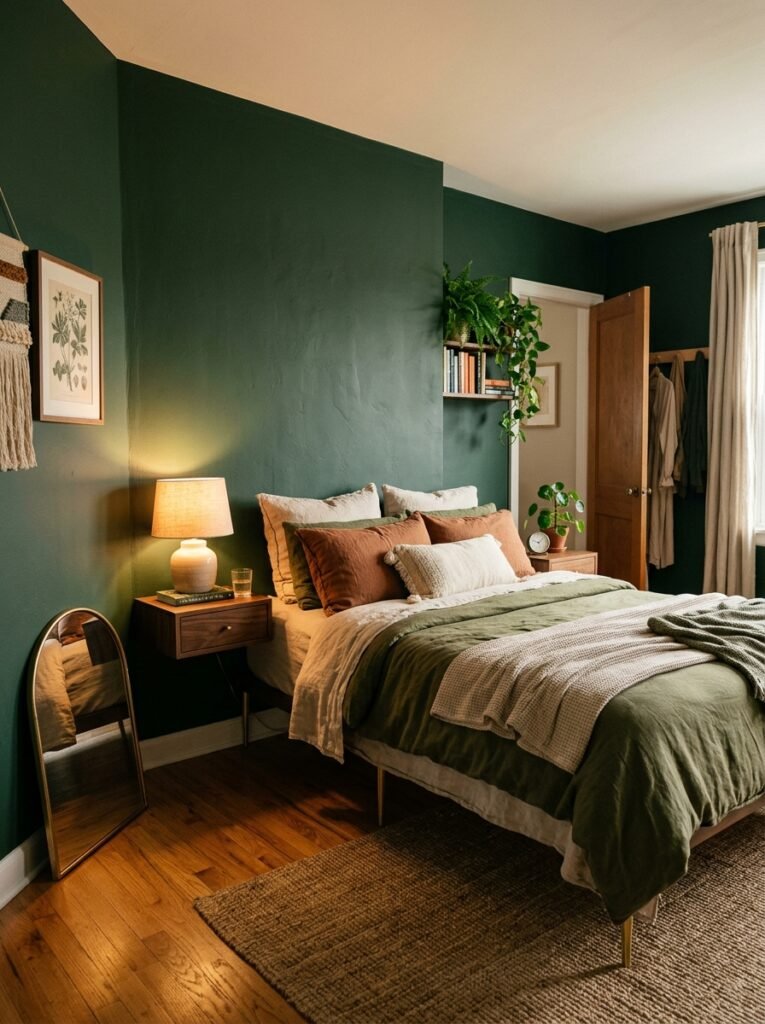
Yes. And I will not be taking questions at this time.
Ok, I’ll take the question. Because I know it feels counterintuitive — shouldn’t you keep small rooms light? And the conventional wisdom says yes. But conventional wisdom doesn’t account for the fact that a small room painted deep green, with the right lighting and textiles, doesn’t feel small. It feels cocooned.
There’s actually a psychological thing happening here. When the walls recede visually (which dark colours do), they don’t necessarily make a room feel smaller — they make the boundaries feel less fixed. The room just… exists. You stop seeing its dimensions.
A few things that genuinely help in a small dark green bedroom: a large mirror, obviously. Furniture with legs (rather than pieces that sit directly on the floor, which can make a room feel heavy). Keeping the ceiling lighter than the walls. And not overcrowding — in a small room with dark walls, each object needs to earn its place more than ever.
—
12. The Mood You’re Actually Creating — and Why It Feels So Different to Sleep In
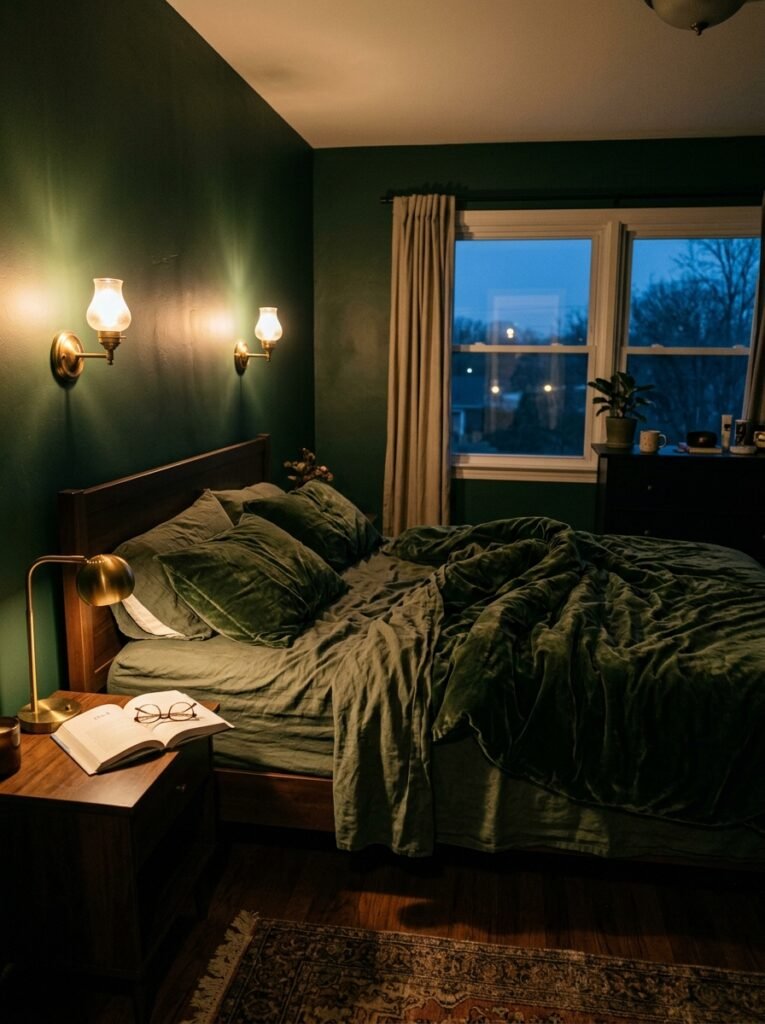
I want to end here because I think it’s the most important thing.
A dark feminine green bedroom doesn’t just look different. It FEELS different to be in. Especially at night.
There’s something about dark walls that tells your nervous system to relax. Genuinely — a lot of sleep researchers and interior psychologists talk about how lighter, brighter rooms keep us in a more alert state, and how darker, more enclosed spaces trigger something closer to rest. The colour green, specifically, has associations with calm that run pretty deep in how we process the visual world.
But it’s more than that. A room like this feels like yours. Completely, specifically yours. Not a staging exercise. Not a neutral space. A room that has a perspective and a mood and asks something of you when you walk into it — specifically, it asks you to slow down.
Which is, honestly, everything I want a bedroom to do.
—
❓ FAQ
Q: Will dark green paint make my bedroom feel smaller? A: Not necessarily, and often the opposite is true when done right. Dark walls can make boundaries feel less fixed rather than more closed-in, especially with layered warm lighting and a well-placed mirror. The key is keeping the ceiling lighter and not overcrowding the space.
Q: What colours go well with dark green in a bedroom? A: Aged brass and warm gold metals are the standout pairing. For soft furnishings, cream, ivory, dusty mauve-plum, and warm terracotta tones all work beautifully. Deep brown wood furniture anchors the space. What to avoid: anything cool-toned or silver, which fights the warmth this palette depends on.
Q: Do I have to paint all four walls or can I just do one? A: One wall works, but only if you commit to it — pulling the green through in textiles, plants, and accessories so it looks intentional rather than unfinished. The wall behind the bed is usually the strongest choice. If you go all four walls, the effect is more immersive, but one done well can be just as dramatic.
—
💭 Final Thoughts
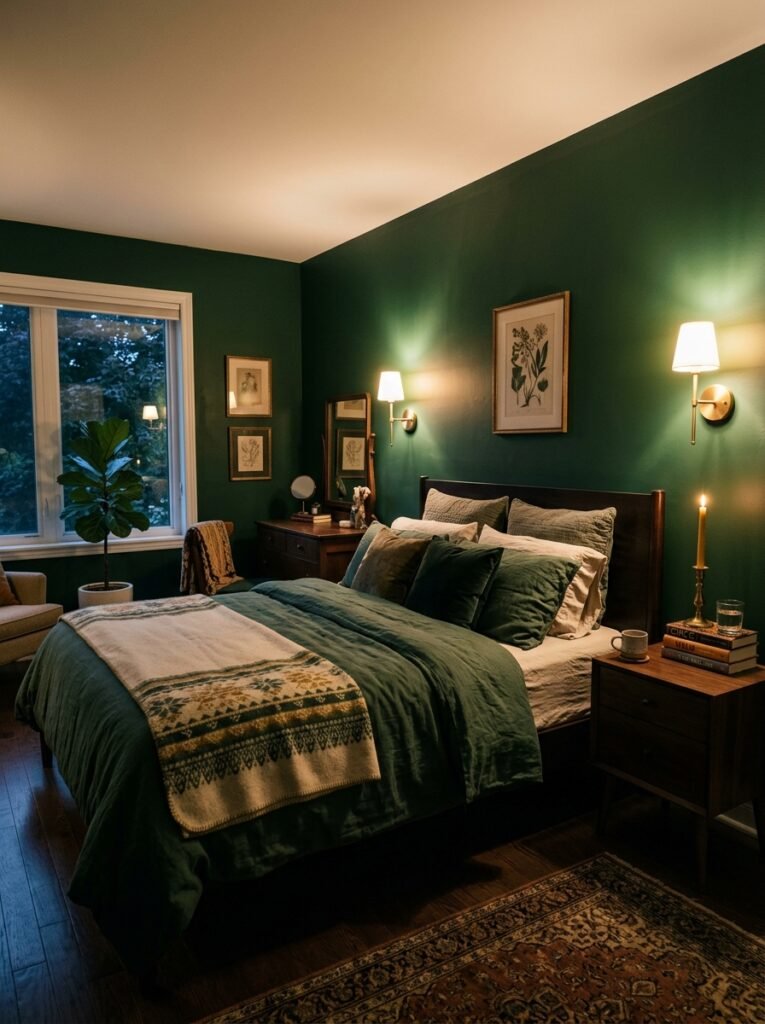
There’s a reason this particular aesthetic keeps showing up on every mood board, every saved Pinterest folder, every “bedroom goals” collection I’ve seen this year. It’s not a trend that’s trying to be provocative. It’s just a very specific kind of beautiful — the quiet, confident, slightly mysterious kind.
I think the rooms that actually affect us are the ones that feel like they were made by someone with a clear point of view. Dark feminine green might be yours.
What would you put on the walls?