

Empty Wall Ideas for Your Living Room That Will Make You Fall in Love With Your Space All Over Again
There’s something quietly unsettling about a large, blank wall staring back at you — like an unfinished sentence, waiting for the right words. You’ve rearranged the furniture twice, found the perfect throw pillows, and still, that wall just sits there, empty and expectant. The good news? That blank canvas isn’t a problem. It’s an invitation.

—
1. Why Your Empty Wall Is Actually a Hidden Opportunity You’ve Been Overlooking

Most people see an empty wall and feel a low-grade anxiety — like there’s homework they forgot to do. But interior designers see something entirely different: possibility. That stretch of bare paint is arguably the most flexible design element in your entire living room. Unlike furniture, which requires effort and budget to move, a wall can be transformed with relatively little commitment and enormous visual impact.
The key mindset shift is this: stop thinking about what the wall lacks and start thinking about what it could say. Every wall in your home tells a story — about your taste, your values, your sense of beauty. An empty wall just hasn’t found its story yet.
“Your empty wall isn’t a problem waiting to be fixed — it’s a story waiting to be told.”
Consider the light that hits that wall throughout the day. Is it bathed in morning sun, or does it catch the warm amber glow of afternoon? The way light moves across a wall will influence everything you hang, lean, or place against it. Spend a day simply observing that wall before you do anything else. You might be surprised by what you notice.
—
2. Gallery Walls: The Timeless Classic That Never Actually Gets Old

If there’s one living room wall idea that has genuinely stood the test of time, it’s the gallery wall — and for very good reason. Done thoughtfully, a gallery wall transforms a blank surface into something that feels deeply personal, layered, and lived-in. It tells your story in a way that no single framed print ever could.
The secret to a gallery wall that looks intentional rather than chaotic comes down to three things: a cohesive color palette, a mix of frame sizes, and consistent spacing. You don’t need matching frames — in fact, mixing metals, woods, and painted finishes adds warmth and character. What you do need is a unifying thread: similar tones in the artwork, a recurring color in the mats, or a consistent subject matter.
Start by laying your collection out on the floor before a single nail goes into the wall. This is the step most people skip, and it’s the one that makes all the difference. Arrange, rearrange, step back, look again. Live with the layout for a day. When it feels right on the floor, it will feel right on the wall.
—
3. A Single Statement Piece That Does All the Talking

Sometimes, more is simply more — and sometimes, one breathtaking piece of art is everything a wall needs. There’s a quiet confidence in hanging one oversized artwork and letting it command the entire room without competition. It’s the interior design equivalent of speaking in a clear, unhurried voice in a crowded room.
An oversized canvas, an antique tapestry, a hand-painted mural panel, or even a large-scale photograph printed on metal or wood — the options are broader than you might think, and they don’t all require a gallery-level budget. Many independent artists on platforms like Society6, Minted, or Etsy offer large prints at surprisingly accessible prices.
Scale matters enormously here. A piece that’s too small will look lost and even a little sad against a large wall. As a general rule of thumb, your artwork should fill approximately two-thirds to three-quarters of the wall width above your sofa. That proportion creates a visual relationship between the furniture and the art that feels balanced and intentional.
—
4. Floating Shelves: Where Function Meets Beautiful Storytelling
Here’s an idea that solves two problems at once — storage and style — while somehow managing to feel effortlessly chic. Floating shelves on a living room wall are one of those rare design choices that genuinely improve life both practically and aesthetically.
The magic of floating shelves lies entirely in how you style them. A shelf crowded with books and clutter reads as disorganized. But a shelf that’s curated — a small plant, a stack of design books, a candle, a single ceramic piece, a framed photo — reads as thoughtful and warm. Interior stylists talk about the “rule of three” for a reason: groupings of three objects at varied heights create visual interest without chaos.
Consider a staggered arrangement of shelves at different heights rather than a single straight row. This creates a more dynamic, gallery-like effect and allows you to vary what you display by season, mood, or occasion. A linen wreath at Christmas, trailing pothos in summer, a few pumpkins in autumn — floating shelves let your wall breathe and change with you.
—
5. Mirrors: The Designer’s Favorite Trick for Light, Space, and Drama

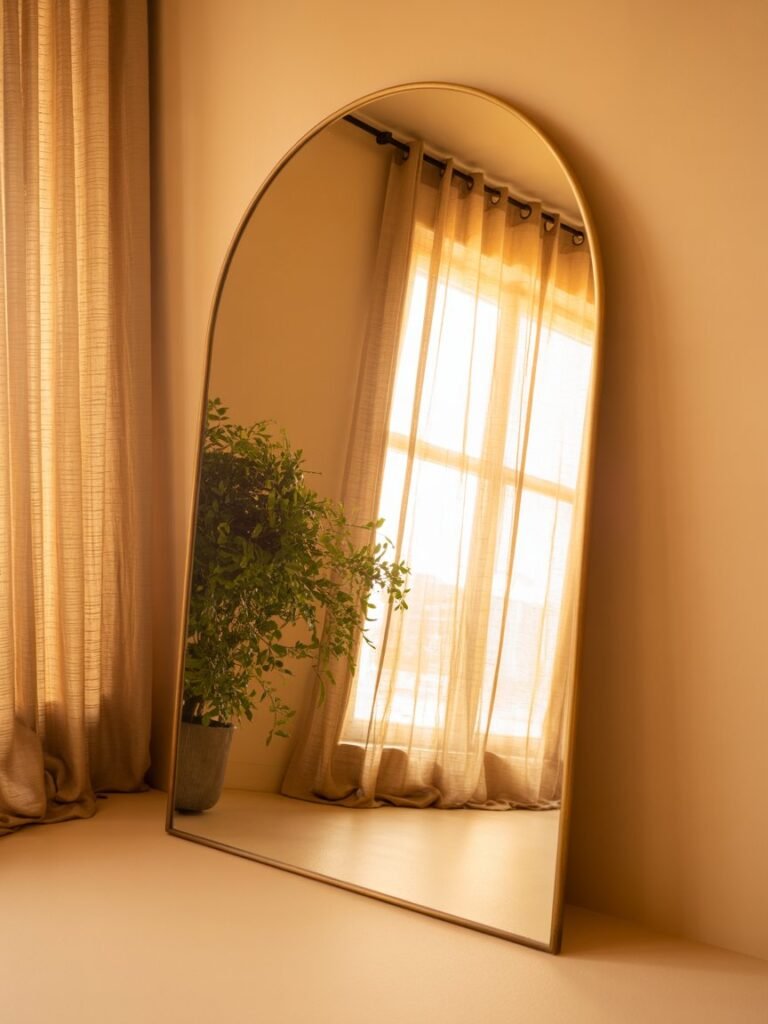
Ask any interior designer what their single most reliable tool is for transforming a living room, and mirrors will be somewhere near the top of every list. A well-placed mirror does three extraordinary things simultaneously: it reflects light and makes a room feel brighter, it creates the illusion of depth and makes a space feel larger, and — when chosen wisely — it functions as a stunning piece of art in its own right.
An arched mirror leaning against the wall has been having a moment in interior design circles for several years now, and it’s not hard to understand why. The soft curve softens a room full of straight lines and hard edges, adding an organic, almost architectural quality. A sunburst mirror brings warmth and a vintage bohemian spirit. A large rectangular mirror in a simple metal frame reads as clean and modern.
“A mirror doesn’t just reflect your room — it expands it, lights it, and quietly makes it more beautiful.”
The placement of a mirror matters as much as the mirror itself. Hang it where it will catch natural light, or position it to reflect a beautiful view — a window, a plant, a lamp with a warm glow. What the mirror reflects becomes part of the composition, so choose thoughtfully.
—
6. Woven Wall Art and Textiles: Bringing Warmth and Texture to Bare Walls

There’s a reason woven wall hangings, macramé pieces, and textile art have never truly left the interior design conversation. They bring something to a wall that no framed print can replicate: texture. In a world of hard surfaces — painted walls, wooden floors, glass tables — a piece of soft, woven art introduces a tactile warmth that makes a room feel genuinely livable.
A large macramé wall hanging in a natural cotton tone works beautifully in bohemian, coastal, and Scandinavian-inspired spaces. A woven tapestry with geometric patterns adds color and folk-art character. Even a simple piece of loose-weave linen stretched over a wooden frame can serve as an understated, textural backdrop.
The best part about textile wall art is its accessibility — a thriving community of independent artisans creates these pieces, and supporting them means your wall art will be truly one-of-a-kind. No two handwoven pieces are ever exactly alike, which gives your living room a sense of authenticity that mass-produced décor simply cannot replicate.
—
7. Architectural Elements: Adding Dimension When Flat Art Isn’t Enough

Sometimes a wall needs more than a picture — it needs structure. Architectural wall treatments like board and batten paneling, shiplap, decorative molding, or even a DIY geometric wood accent wall can completely redefine the character of a room without a single piece of art ever being involved.
Picture rail molding painted the same color as the wall creates a subtle, sophisticated effect — a hint of architectural history that adds richness without loudness. A board and batten treatment on the lower half of a wall grounds the room with a sense of craft and permanence. A series of rectangular frames made from thin wood trim and painted in a contrasting or matching tone creates a paneled effect that looks custom-built but costs very little.
These treatments work especially well in older homes that lack original architectural character, or in newer builds where the walls feel flat and featureless. They’re also a painter’s dream — a beautifully paneled wall in a deep, saturated color becomes an extraordinary focal point.
—
8. Plants as Living Wall Art: Bringing the Outside In

There is something profoundly grounding about the presence of plants in a living room — a reminder that life is growing, breathing, and quietly thriving even in the middle of a busy week. When you use plants as part of your empty wall solution, you create something no static artwork can: a living, changing, breathing display that evolves over time.
A large monstera, fiddle-leaf fig, or olive tree placed in front of an empty wall functions almost like a living sculpture. The wall behind it becomes a backdrop, and the interplay between the plant’s organic shapes and the flat surface behind it creates a composition that’s endlessly interesting to look at.
For a more intentional wall treatment, consider a vertical garden installation, a series of hanging planters at varying heights, or a row of trailing plants — like pothos or string of pearls — mounted on small wall hooks. The trailing greenery softens the hard edge of the wall and brings a gentle, organic energy to the room.
“A plant in front of an empty wall doesn’t just fill space — it fills the room with life.”
—
9. Wallpaper and Wall Murals: The Commitment Worth Making

For those willing to make a slightly bolder commitment, wallpaper and wall murals remain one of the most transformative things you can do to a living room wall. The fear of wallpaper — that it’s permanent, that you’ll tire of it, that it’s difficult to apply and remove — has softened considerably with the rise of peel-and-stick options that go up in an afternoon and come off cleanly.
A botanical mural, a moody landscape, a hand-drawn abstract, or a classic toile print — the range of wallpaper designs available today is genuinely staggering. The key is to resist the temptation to wallpaper every wall. Instead, treat one wall as an accent: your fireplace wall, the wall behind the sofa, or the wall that faces you as you enter the room. One wallpapered wall in a room full of painted walls has an outsized visual impact that feels considered rather than overwhelming.
—
10. Ledges and Leaning Art: The Relaxed, Effortlessly Cool Alternative

Not everyone wants to commit to putting holes in their walls — and honestly, there’s a case to be made for the picture ledge as one of the smartest, most flexible wall solutions available. Picture ledges (also called art ledges or rail shelves) are narrow shelves that allow you to lean artwork, prints, and frames rather than hanging them. This means you can change the display whenever the mood strikes, without any new hardware.
The layered look of leaned frames — some overlapping, some taller, some shorter — creates a casualness that feels current and lived-in. It’s the aesthetic of a well-curated artist’s studio: unpretentious, personal, and full of character. Style the ledge with a mix of framed art, a small vase, a candle, or a plant, and you have a display that changes with the seasons and your evolving taste.
—
11. Clocks, Sconces, and Objects: The Unexpected Wall Décor That Gets Noticed

Not everything that goes on a wall needs to be art or a shelf. Some of the most striking living room walls are decorated with objects that have a function — and that dual purpose makes them feel even more intentional. A large, architectural wall clock turns a bare wall into a focal point while serving a practical purpose. A pair of wall sconces flanking a mirror or piece of art adds drama through light and shadow.
Antique or vintage plates arranged in a loose cluster bring a collected, well-traveled quality to a wall. Architectural salvage pieces — old window frames, carved wooden panels, vintage signs — add history and texture. Even a collection of woven baskets hung in an asymmetrical grouping creates a warm, globally-inspired wall display that feels rich with meaning.
The underlying principle here is that a wall doesn’t need to be filled with traditional “art” to feel beautiful. Objects with stories, history, and personal meaning will always outperform a perfectly coordinated set of prints from a big-box store.
—
12. The Magic of Doing Less: When a Nearly Empty Wall Is the Right Answer

Here’s the thought that might surprise you most: sometimes the most sophisticated answer to an empty wall is to keep it mostly empty. In the age of maximalism and styled shelfies, the quiet restraint of a single, thoughtfully chosen object on an otherwise bare wall carries extraordinary visual power.
One beautiful ceramic wall sculpture. One perfect piece of driftwood. One small, richly detailed oil painting hung at eye level with nothing around it. The space surrounding the object becomes part of the composition — what designers call “negative space” — and it allows the eye to rest, to breathe, and to truly see what’s there.
This approach requires confidence. It goes against the impulse to fill, to cover, to add more. But a room that knows when to stop is a room that feels truly curated. It communicates taste, restraint, and an understanding that beauty doesn’t always require more — it sometimes requires less.
—
🌿 How to Take Care of Your Living Room Wall Display
Once you’ve found your approach to that empty wall, here’s how to keep it looking its best over time. Think of it as tending to something you genuinely love.
Dust art and shelves regularly but gently — a soft microfiber cloth is kinder to frames and surfaces than anything spray-based. Rotate your wall displays seasonally, even if just by swapping one or two pieces or adding a fresh plant. This keeps the room feeling alive rather than static. For hanging plants or trailing greenery, check moisture levels weekly and wipe down leaves with a damp cloth to keep them looking their healthiest. Revisit your gallery wall or shelf arrangement every few months — what felt right in winter may feel heavy in summer, and adjusting your display is free and takes minutes. Finally, trust your instincts: if something stops making you happy every time you walk past it, it’s simply time for a change.
—
❓ FAQ
Q: What is the best way to fill a large empty wall in a small living room? A: In a small living room, the most effective approach is to go big rather than using many small pieces, which can fragment the space and make it feel cluttered. A single large mirror or an oversized piece of art creates visual impact without making the room feel busy. Floating shelves styled with just a few carefully chosen objects also work beautifully in small spaces.
Q: How do I hang a gallery wall without making it look messy? A: The key to a clean, intentional gallery wall is planning everything on the floor first before a single nail goes up. Use a consistent mat color or frame finish as your unifying element, keep spacing even (approximately 2-3 inches between frames), and aim for a roughly rectangular or symmetrical outer boundary to the overall arrangement. A cohesive color palette in the artwork itself will tie everything together.
Q: Can I decorate an empty wall on a tight budget? A: Absolutely — some of the most beautiful living room walls cost very little. DIY architectural treatments like board and batten or painted molding use inexpensive materials and transform a wall dramatically. Peel-and-stick wallpaper is affordable and commitment-free. Printing your own photography or artwork at a local print shop and framing it with inexpensive frames from thrift stores is another budget-friendly approach that results in something deeply personal.
—
💭 Final Thought

An empty wall is one of those rare things in home design that belongs entirely to you — it hasn’t been decided yet, hasn’t been locked in, hasn’t been committed to any one identity. There’s something quietly wonderful about that, if you’re willing to sit with the uncertainty long enough to find what truly resonates. The most beautiful living rooms aren’t the ones that followed every trend — they’re the ones that reflect the people who actually live in them.
So tell me: if your empty wall could say one thing about who you are, what would you want it to say?