
The Log Burner Living Room: How One Glowing Fire Can Transform the Heart of Your Home
There’s a moment — usually sometime in October, when the light shifts and the air carries that first real bite of cold — when you look at your living room and suddenly understand what it’s been missing. A log burner doesn’t just heat a room. It changes the entire soul of it.
—
1. Why a Log Burner Feels Like the Design Decision You’ve Been Waiting For
Before we talk about tiles and hearth surrounds and where to stack your firewood, let’s talk about feeling — because that’s really what this is about. A log burner living room isn’t a style trend. It’s a lifestyle choice. It’s the decision to build a home around warmth, around slowness, around the kind of evenings where nobody reaches for their phone because the fire is more interesting.
Interior designers have long understood that every room needs what they call a “focal point” — something your eye travels to naturally, something that anchors the space and gives it meaning. Historically, that was the fireplace. Then the television usurped that role, and something was quietly lost. A log burner reclaims that focal point, and in doing so, it reclaims the whole emotional register of the room.
“A room with a fire at its center doesn’t just look better — it feels fundamentally different to be inside.”
Think about the last time you sat in a room with a working fire. Your shoulders dropped a little. The conversation slowed to something more honest. The light on everyone’s faces softened. That’s not nostalgia — that’s biology. Humans are hardwired to find flickering flames calming, a response rooted deep in our evolutionary history. When you install a log burner, you’re not just adding a design feature. You’re restoring something ancient to the center of your home.
—
2. Choosing the Right Size Log Burner Without Getting It Wrong
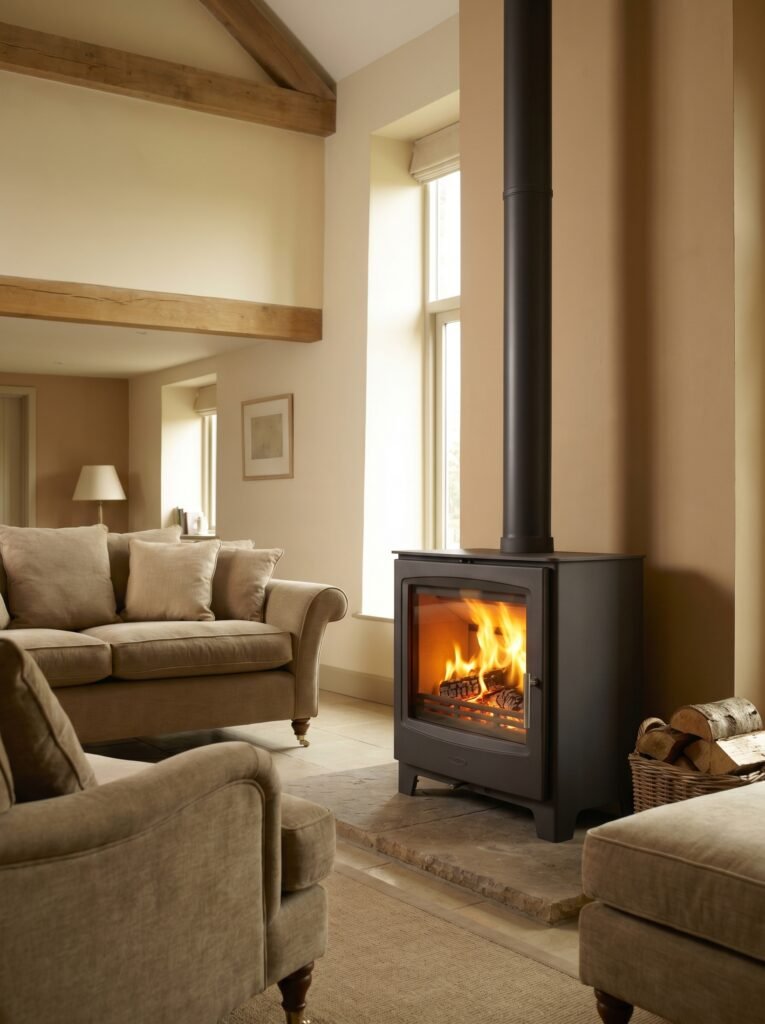
One of the most common mistakes people make — and it’s a costly one — is choosing a log burner based on how it looks in the showroom rather than how it’ll perform in their actual room. A stove that’s too small will work constantly and still leave your room cold. A stove that’s too large will overheat the space and leave you with windows cracked in January, which defeats the entire point.
The general rule of thumb is to calculate your room’s volume in cubic meters (length × width × height) and divide by 14. The result gives you a rough kilowatt output requirement. A typical medium-sized living room of around 25–30 cubic meters will need a stove outputting roughly 4–6kW — which is, reassuringly, the sweet spot for most of the beautifully proportioned stoves you’ll see on Pinterest.
Beyond the numbers, think about how you use the room. Do you want slow background warmth for long winter evenings? Or fierce, fast heat after coming in from a cold walk? Different stoves have different burn characteristics, and a good stove retailer will help you match the two.
—
3. The Hearth: Where Function Meets the Most Photographed Part of Your Room
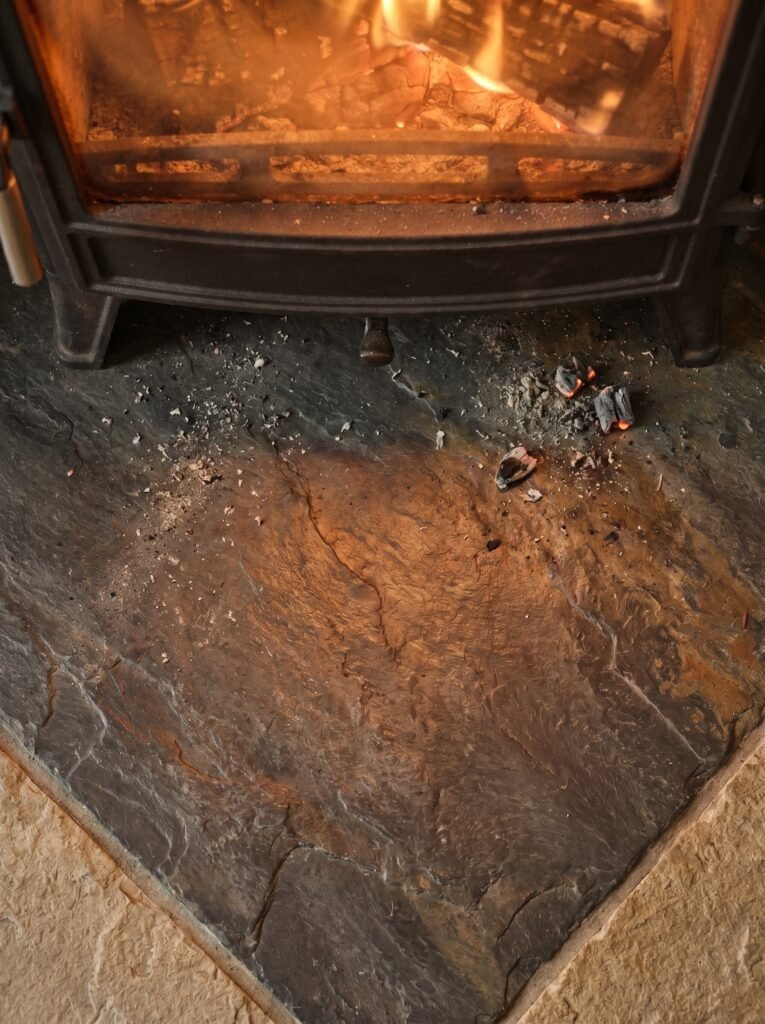
If you’ve spent any time on Pinterest looking at log burner living rooms, you’ll have noticed one thing: the hearth absolutely makes or breaks the look. A beautiful stove sitting on the wrong hearth looks like a great piece of furniture in the wrong house. The hearth is the stage — and it matters.
Natural stone is the perennial favourite, and for good reason. Slate hearths carry an earthy, grounded quality that suits both rustic farmhouse interiors and clean Scandinavian-inspired spaces. Limestone brings warmth and a slightly softer, more romantic character. Granite is extraordinarily hardwearing and comes in dramatic dark tones that make a black cast-iron stove look incredibly deliberate and architectural.
For those working with tighter budgets, porcelain tiles that convincingly mimic stone have come a long way — and can look genuinely stunning in photographs. If you’re going for a more modern, minimal feel, a smooth concrete hearth is quietly extraordinary: understated, tactile, and impossibly cool.
—
4. The Surround That Changes Everything
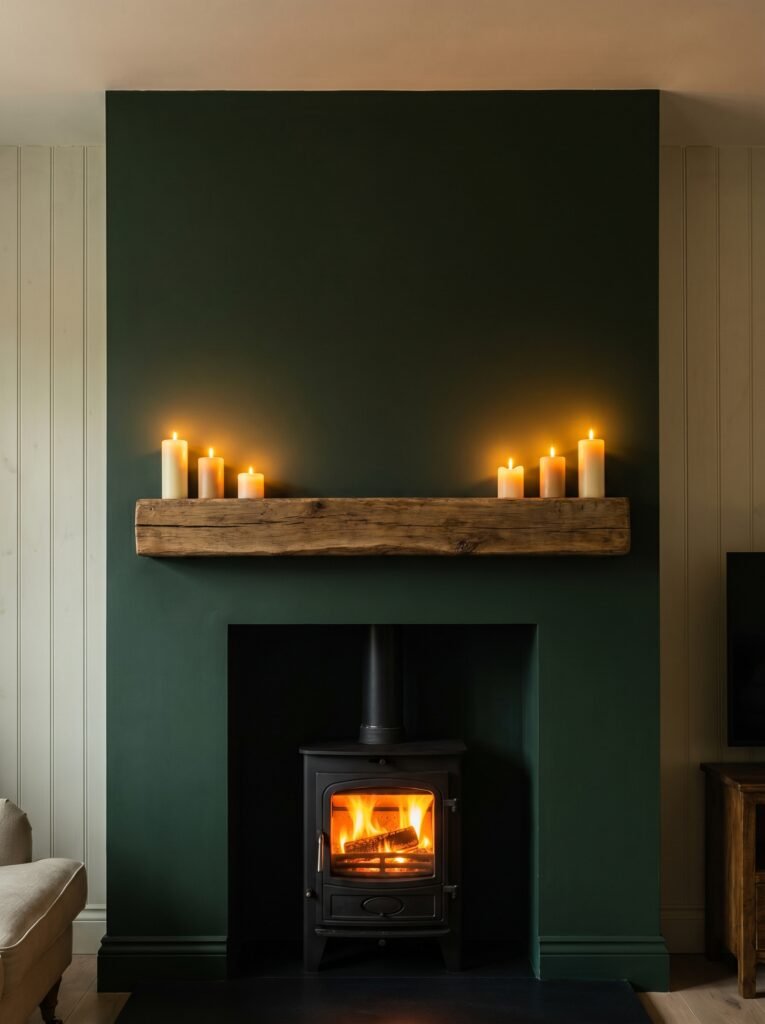
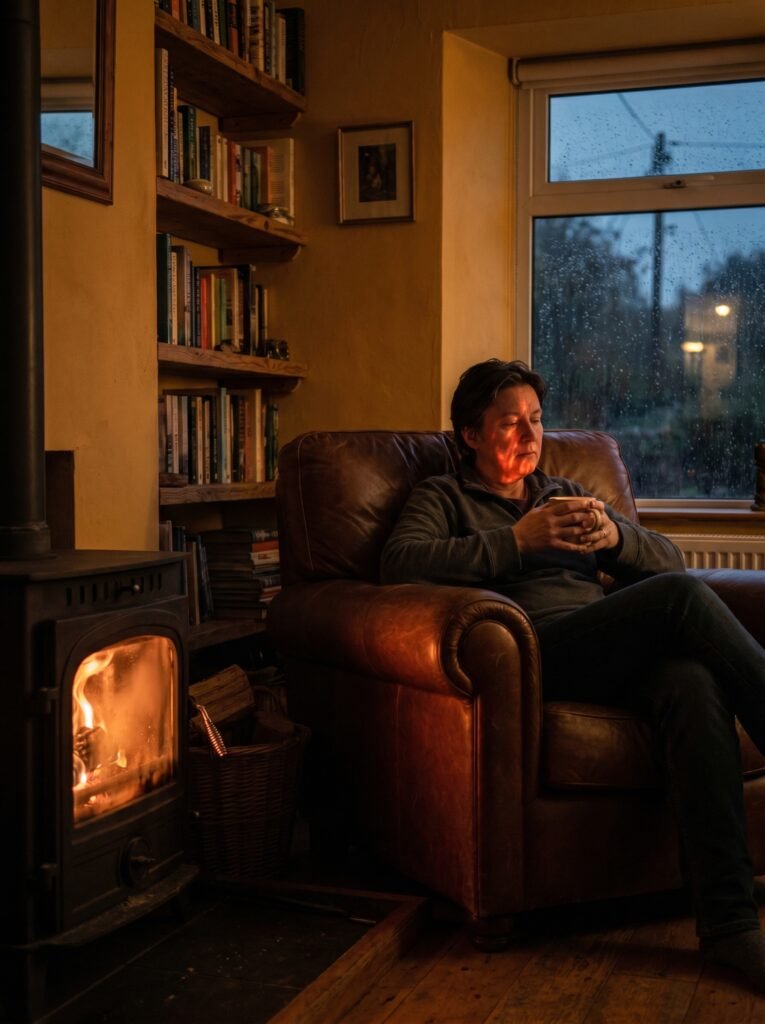
Imagine walking into your living room on a Sunday morning, fire already glowing, mug of something hot in your hand — what does the wall around your log burner look like? Because that wall, that surround, is the entire visual story of the space.
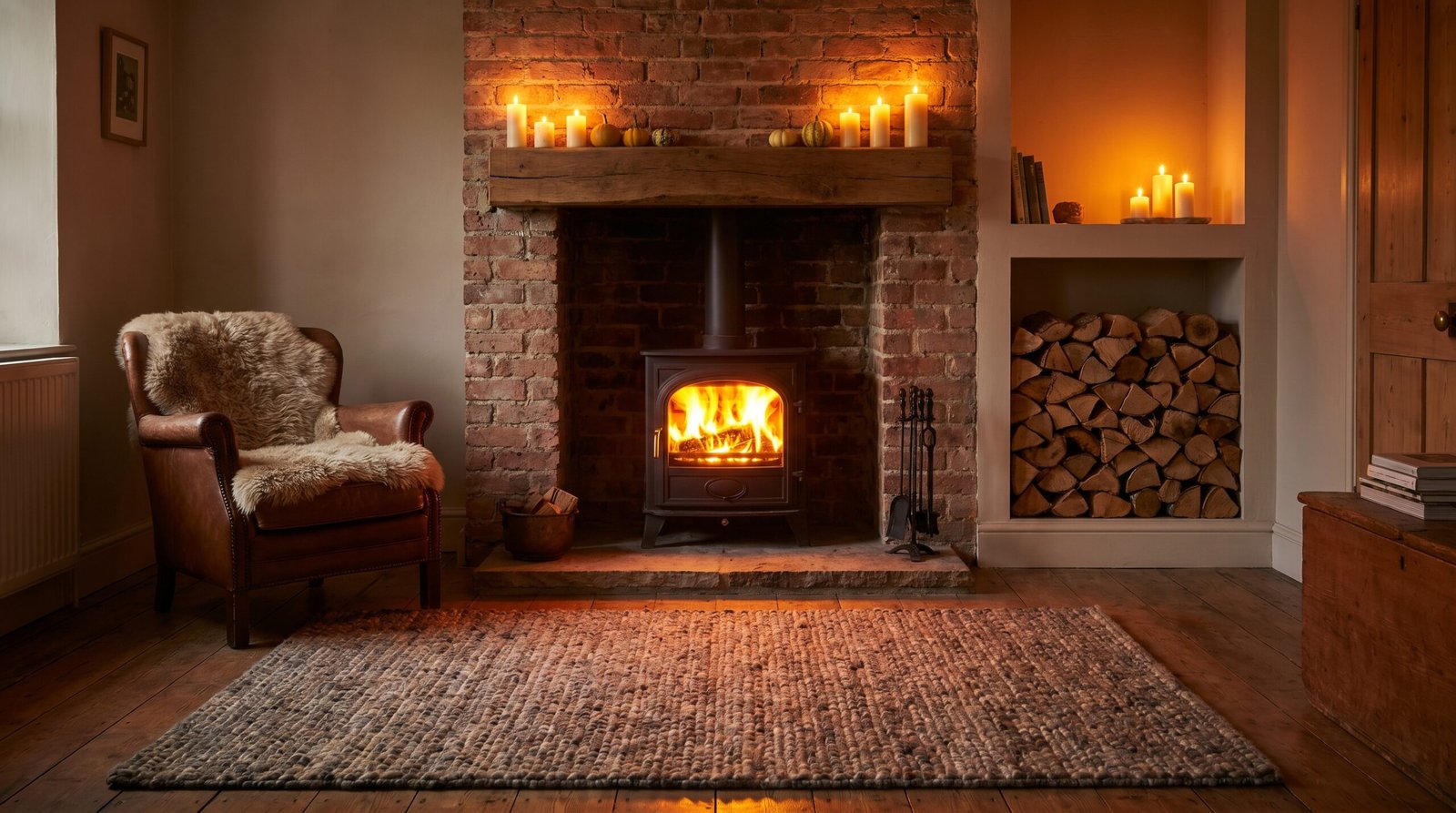
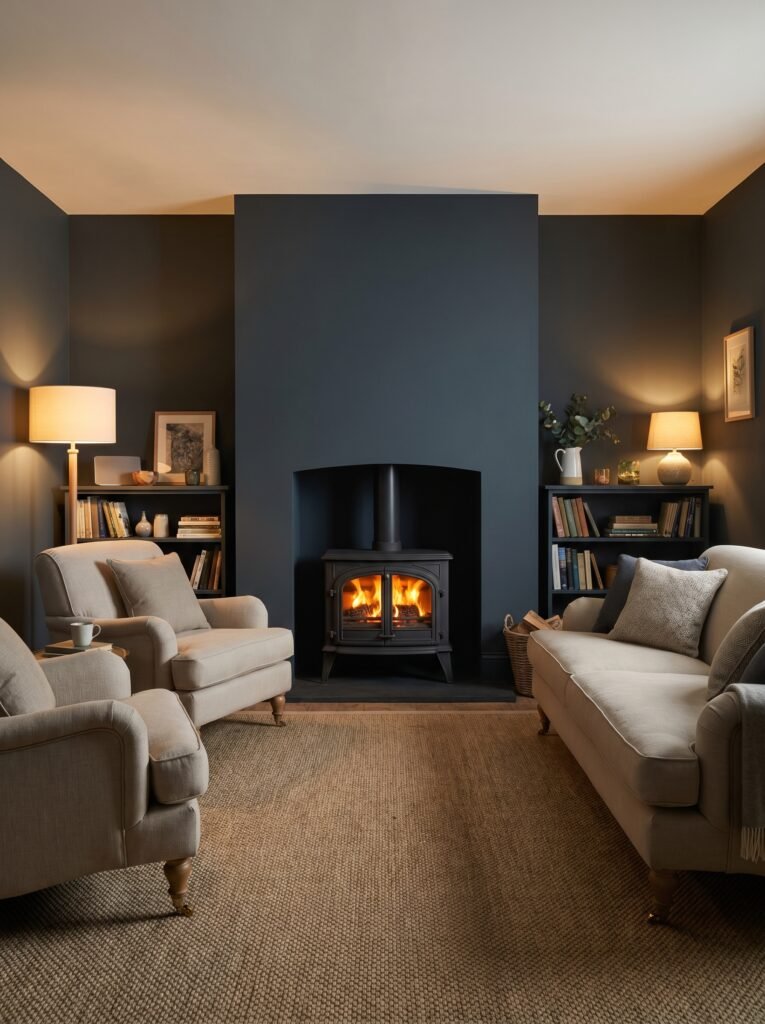
A raw brick chimney breast behind a simple steel log burner is one of the most enduring combinations in interior design. It’s honest, warm, and entirely timeless. If you don’t have exposed brick, a plastered chimney breast painted in a deep, moody colour — Farrow & Ball’s Mole’s Breath, or Railings, or a deep forest green — creates an extraordinary backdrop that makes the fire feel jewel-like by contrast.
Wooden beam mantels add an organic, tactile quality that photographs beautifully and feels wonderful to touch. Pair one with a lime-washed wall or tongue-and-groove panelling and you have a room that looks like it belongs in a countryside inn — in the best possible way.
—
5. Log Storage That’s as Beautiful as It Is Practical
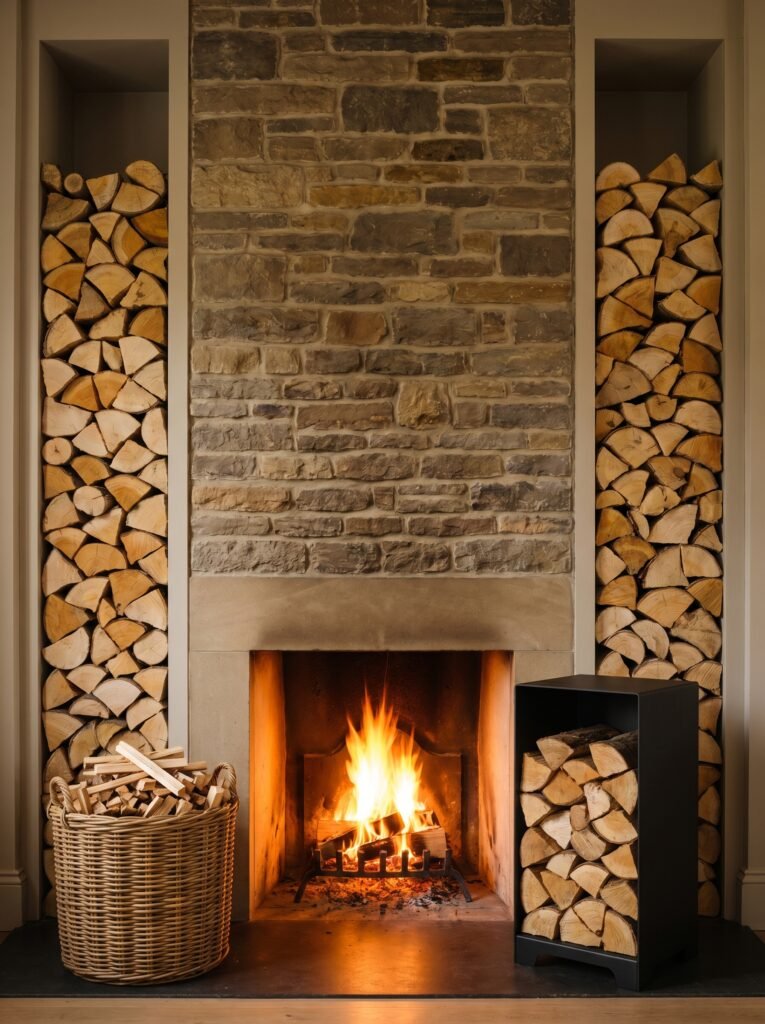
Here’s something the best log burner living rooms have in common: their firewood is part of the design. Not hidden away, not piled haphazardly, but deliberately displayed as a natural, textural element within the room.
A built-in log alcove on either side of a chimney breast is perhaps the most satisfying solution — it’s symmetrical, architectural, and fills those awkward chimney recesses that are otherwise difficult to use well. Fill them with neatly stacked seasoned logs and you have something that looks like it belongs on the pages of a design magazine.
Freestanding log stores made from powder-coated steel or wrought iron add an industrial edge that works beautifully against warm brick or pale stone. A wicker log basket beside the stove brings texture and softness — it’s the kind of thing that makes a room feel lived in rather than decorated.
“The way you store your firewood says more about your interior design philosophy than almost anything else in the room.”
Even a simple copper log bucket beside the hearth transforms the daily ritual of loading the stove into something that feels considered and intentional. Don’t underestimate the decorative power of the practical.
—
6. The Furniture Arrangement That Makes a Log Burner Live Up to Its Potential
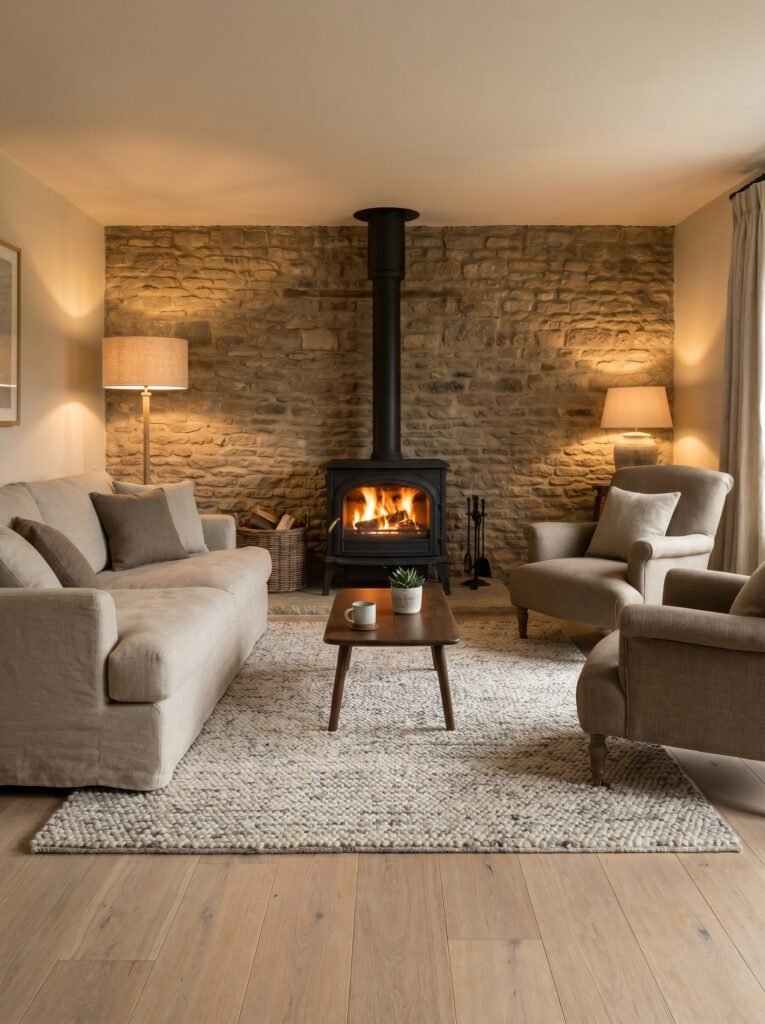
A log burner with the furniture arranged incorrectly is like a beautiful landscape painting hung where nobody can see it. The stove needs to be the destination — the place the room leads you toward.
The classic arrangement is a sofa and armchairs in a loose horseshoe facing the fire, close enough to feel the warmth but far enough to leave circulation space. Interior designers typically recommend keeping seating no more than 3–4 meters from the stove for the heat to feel genuinely intimate rather than abstract.
If your room has an awkward layout — a television on one wall and a log burner on another — resist the temptation to point all your furniture at the screen. Angle your seating toward the fire and accept that the television is secondary. That shift in priority changes the whole character of the room, and you’ll wonder why you ever did it differently.
—
7. Lighting That Complements the Flame
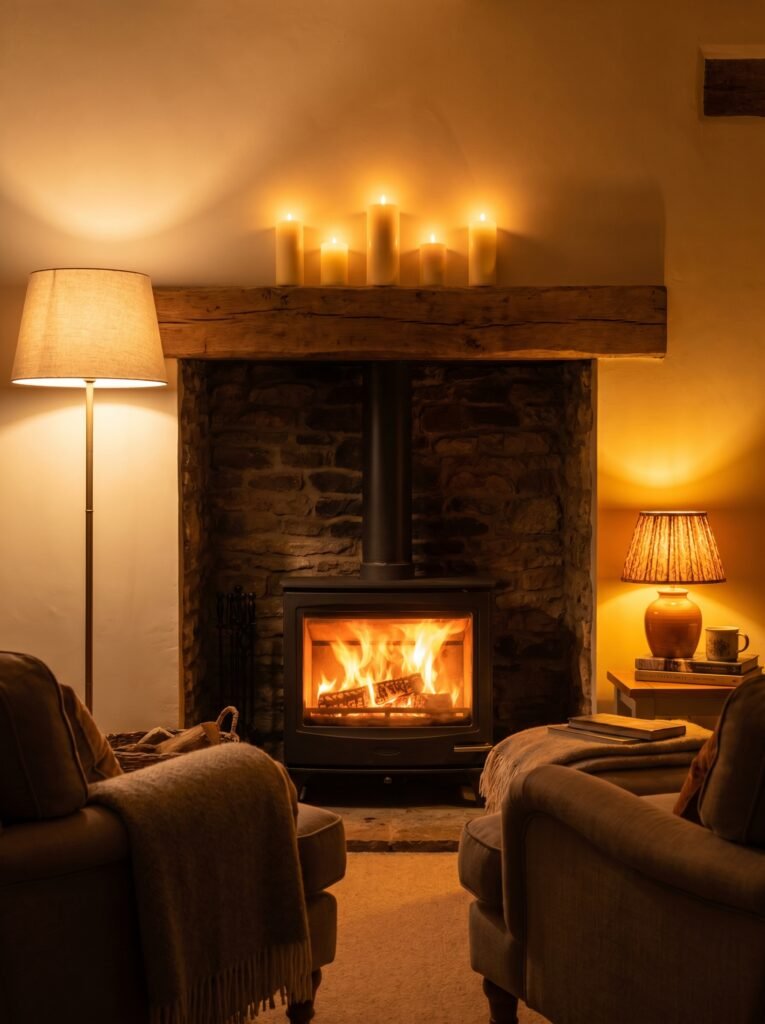
One of the most overlooked elements of a log burner living room is the lighting scheme — and getting it wrong can completely undermine the atmosphere you’ve worked so hard to create. The goal is to never compete with the fire. The fire should always win.
Overhead spotlights are the enemy of firelight. They’re harsh, flat, and drain the drama from the room. Instead, think in layers: table lamps with warm-toned bulbs (2700K is the magic number), floor lamps tucked into corners, and perhaps some discreet wall lights on a dimmer. Candles on the mantelpiece extend the flickering, organic light source of the stove itself and create a continuity that feels effortless and intentional.
When the fire is burning and the only other light in the room comes from low lamps and a handful of candles, you’ll understand exactly what people mean when they describe a room as “glowing.”
—
8. Colour Palettes That Honour the Warmth of a Log Burner
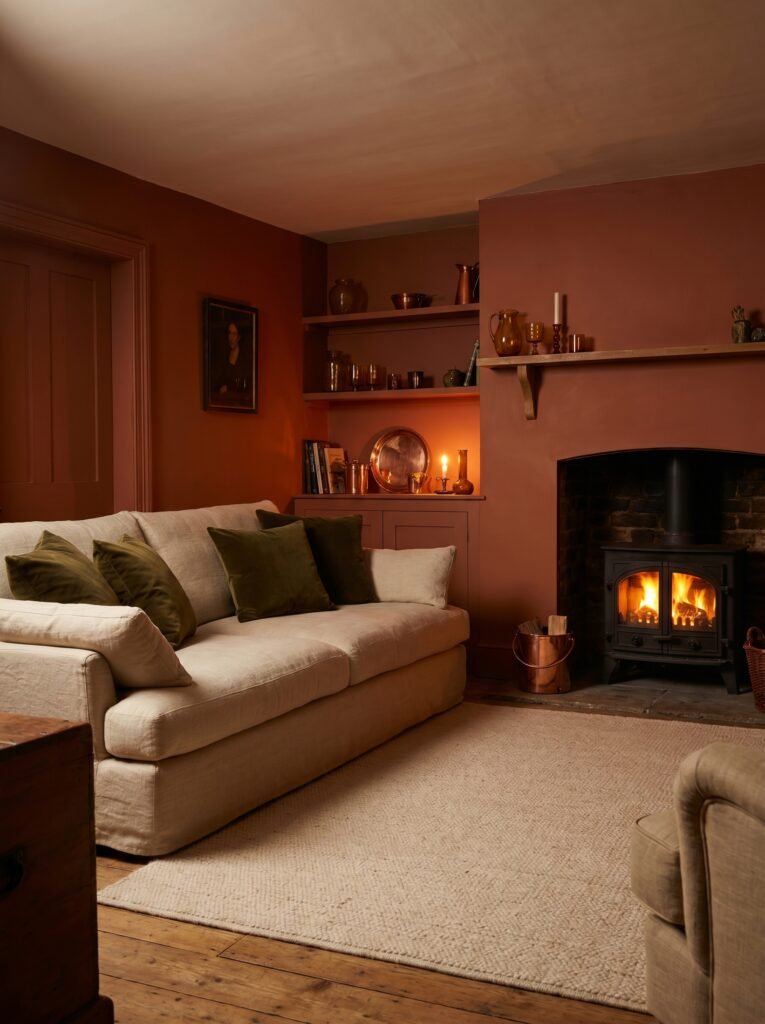
Choosing a colour palette for a log burner living room is one of the most pleasurable decisions in the whole process — because the fire gives you permission to go deep and rich and brave with colour in a way that a standard living room might not.
Warm terracotta and rust tones are extraordinary companions to firelight, picking up the amber and copper in the flames and bouncing it back into the room. Deep olive greens create an intensely cosy, enveloping quality — think the colour of moss, of deep forests, of things that feel permanently sheltered. Warm cream and oatmeal tones work beautifully for those who prefer a lighter room that still feels soft and inviting rather than stark.
The one colour family to be cautious with is cool grey — a palette that dominated interiors for years but can work against firelight, giving a room a faintly clinical quality that sits oddly against the organic warmth of burning wood.
—
9. Styling the Mantelpiece Through the Seasons
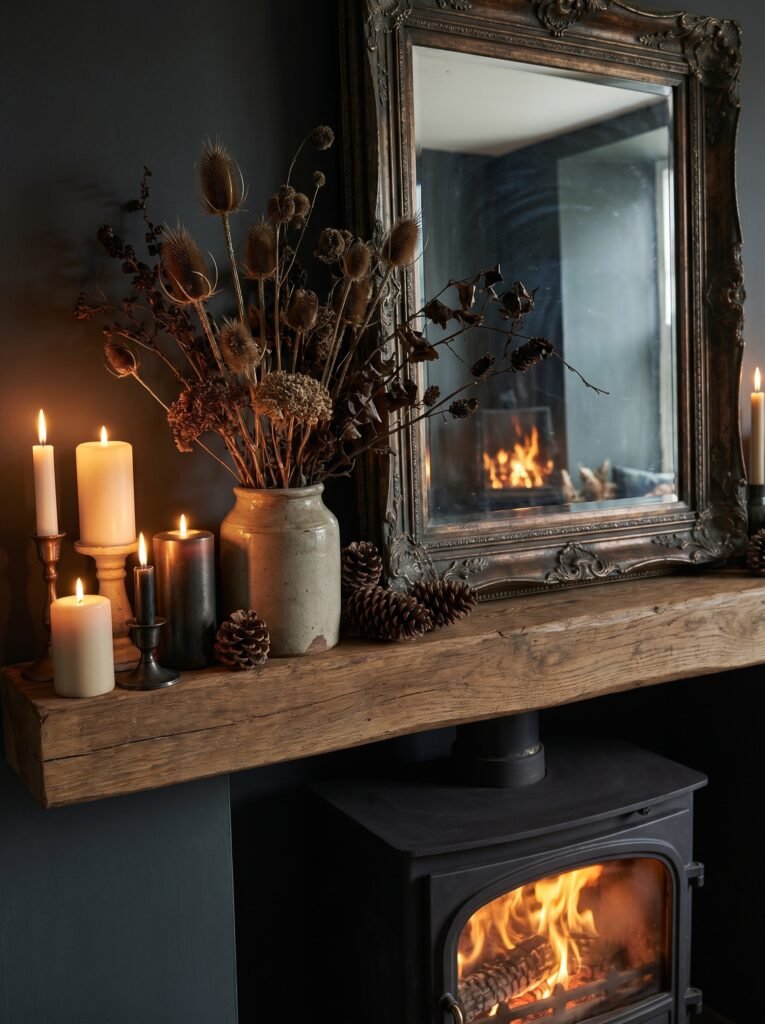
A mantelpiece is never just a shelf. In a log burner living room, it’s a small curated gallery — a place that should evolve and shift through the year in a way that marks the passage of seasons and makes the room feel genuinely alive.
In autumn and winter, lean into the drama: dark botanicals, clusters of pillar candles in varying heights, a large piece of natural art or an oversized mirror that reflects the firelight. Pine cones, dried seedheads, a single striking branch — nature provides extraordinary material for winter mantels.
Come spring, lighten the composition entirely. Fresh greenery, ceramic vases in earthy glazes, something that hints at the outside coming back to life. Summer mantels can be pared back to almost nothing — perhaps just one beautiful object and a small arrangement of dried grasses — because in the warmer months, the stove itself is resting, and the mantel quietly steps back.
“A mantelpiece that changes with the seasons makes a home feel like it’s breathing.”
—
10. The Role of Texture in Making a Log Burner Room Feel Complete
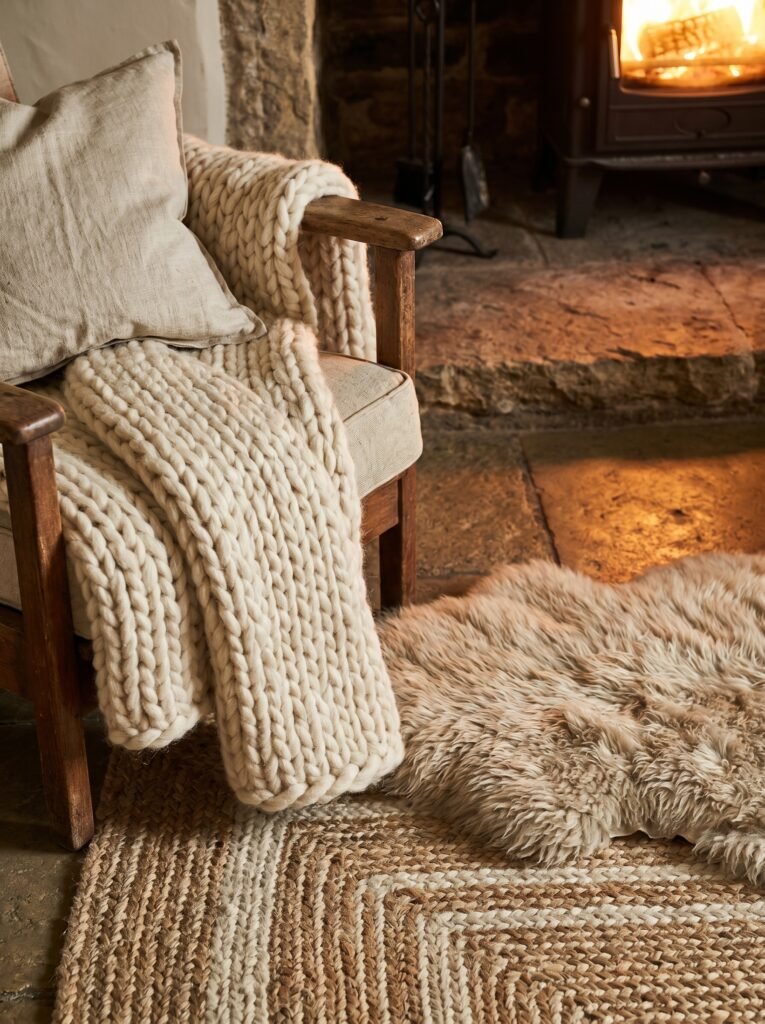
Warmth in a room isn’t only thermal. It’s tactile. The materials you choose to layer around a log burner — their texture, their weight, their visual softness — contribute as much to the feeling of the space as the heat output of the stove itself.
Sheepskin throws draped over an armchair near the fire. A thick woven wool rug defining the seating area on wooden or stone floors. Linen curtains in a warm, undyed natural tone that pool slightly at the floor. A knitted cushion in chunky yarn. Each of these elements adds to a cumulative sensory richness that transforms a decorated room into a genuinely comforting one.
The floor matters enormously here. If you have hard flooring — which is both practical and beautiful alongside a log burner — invest in a generously sized rug. It grounds the seating area, softens the acoustics, and adds an enormous amount of visual warmth. Don’t undersize it. One of the most common decorating mistakes is choosing a rug that’s too small, making the furniture feel as though it’s floating rather than anchored.
—
11. The Practical Realities Nobody Talks About Enough
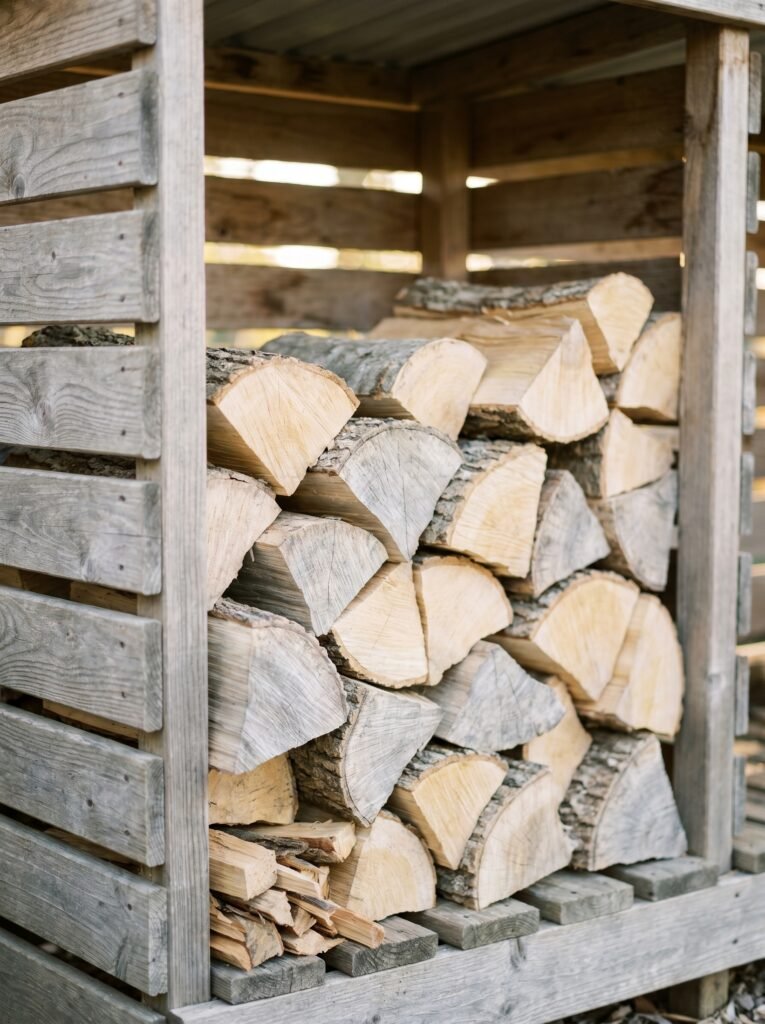
The Pinterest images are glorious — perfectly stacked logs, gleaming stove glass, a room that looks like it’s never been cleaned. The reality is a little more nuanced, and it’s worth knowing what you’re committing to before you fall completely in love with the idea.
A log burner requires good quality, seasoned wood. Burning wet or unseasoned wood is not only inefficient — it produces excessive creosote buildup in your flue, which is a genuine fire hazard. Seasoned hardwoods like oak, ash, and beech are the gold standard: they burn slowly, produce excellent heat, and are kinder to your flue. The Woodsure Ready to Burn certification in the UK is a reliable indicator of properly dried firewood.
Your chimney or flue liner will need sweeping at least once a year, ideally before the burning season begins. This isn’t optional — it’s a safety necessity. A registered HETAS engineer is your best resource for installation, maintenance, and annual safety checks. The administrative side of owning a log burner is modest, but it exists, and it’s part of the honest picture.
—
12. Creating the Full Log Burner Living Room Experience
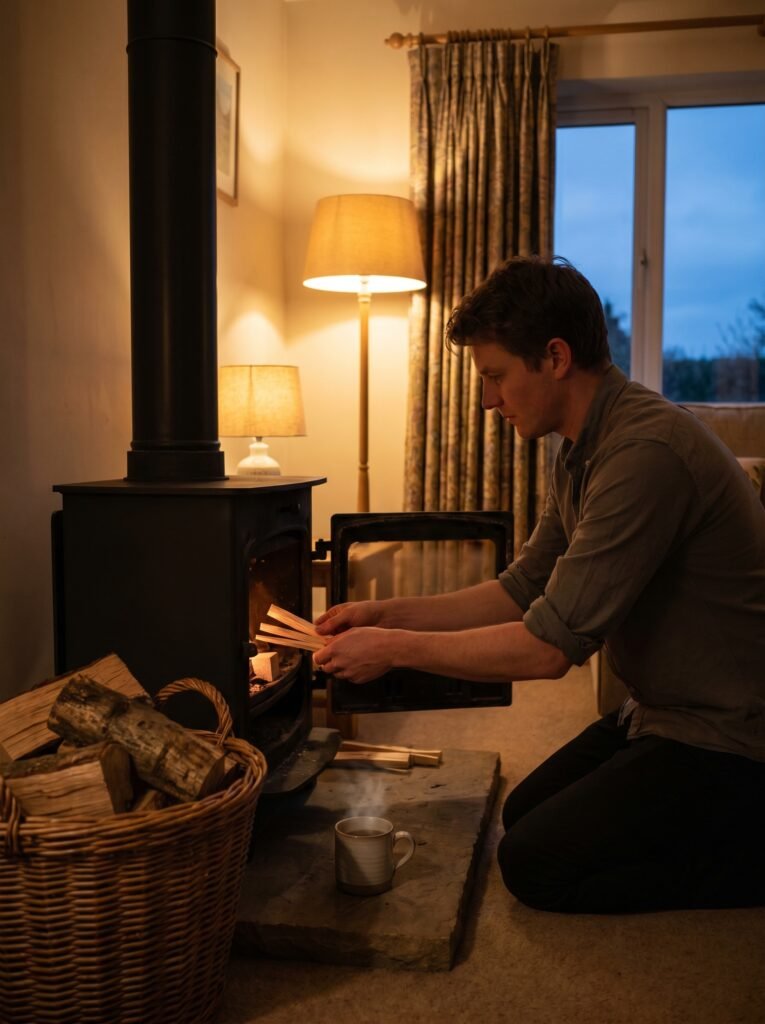
A log burner living room isn’t finished when the stove is installed and the hearth is laid. It’s finished — and it keeps being finished — in the small rituals you build around it. The way you lay the fire each evening. The particular satisfaction of a well-split log. The habit of leaving a candle burning on the mantel long after the fire has settled to embers.
These small rituals are what transform a design decision into a way of living. And that, ultimately, is the real promise of a log burner living room — not that it will look beautiful in photographs (though it will), but that it will make your everyday life feel more intentional, more present, more connected to the simple, ancient pleasure of fire and warmth and a room that holds you.
Build the room you want to come home to. Build it around the fire.
—
🌿 How to Take Care of Your Log Burner Living Room
Caring for a log burner living room is part practical maintenance and part ongoing ritual — and honestly, most of it is deeply satisfying.
Clean the stove glass regularly using a damp cloth and specialist glass cleaner, or even a slightly dampened newspaper dipped in the cool ash from the firebox. It sounds old-fashioned, but it works remarkably well and keeps that all-important view of the flame crystal clear.
Empty the ash pan before it overflows, but leave a shallow bed of ash at the base of the firebox — about an inch deep — as this actually helps the fire burn more efficiently and protects the fire bricks below.
Source your wood early. Good seasoned firewood is best ordered in late spring or summer, giving you the whole warm season to let it dry further under cover before the burning season begins. A quality log store with good airflow will keep your wood in perfect condition.
Have your chimney swept annually by a registered professional, keep a carbon monoxide alarm in the room — positioned at head height — and ensure your air vents are never blocked. These are non-negotiable habits that keep a log burner both safe and performing beautifully.
—
❓ FAQ
Q: Can I have a log burner in a room without a chimney? A: Yes — this is one of the most exciting developments in wood-burning stove technology. Twin-wall flue systems can be installed in rooms without an existing chimney, running either through an external wall or up through the ceiling and roof. The installation requires a HETAS-registered engineer and appropriate building regulations approval, but it opens up log burner living rooms to properties that would previously have been excluded.
Q: What’s the difference between a log burner and a wood-burning stove? A: In practice, the terms are used interchangeably in most conversations and on most design platforms — they refer to the same appliance. Technically, a multi-fuel stove is designed to burn both wood and solid fuels like coal or smokeless fuel, while a dedicated wood-burning stove is optimised for wood only. For most people decorating a living room around a stove, the design considerations are identical.
Q: Are log burners expensive to run compared to central heating? A: The running cost depends heavily on where you source your wood and how efficiently your stove operates. A modern DEFRA-approved log burner running on well-seasoned hardwood can be a very cost-effective heat source, particularly for supplementing rather than replacing central heating in the main living space. The initial installation cost is significant, but many homeowners find the combination of lower running costs and the reduced use of central heating in their main room makes the investment worthwhile over several winters.
—
💭 Final Thought
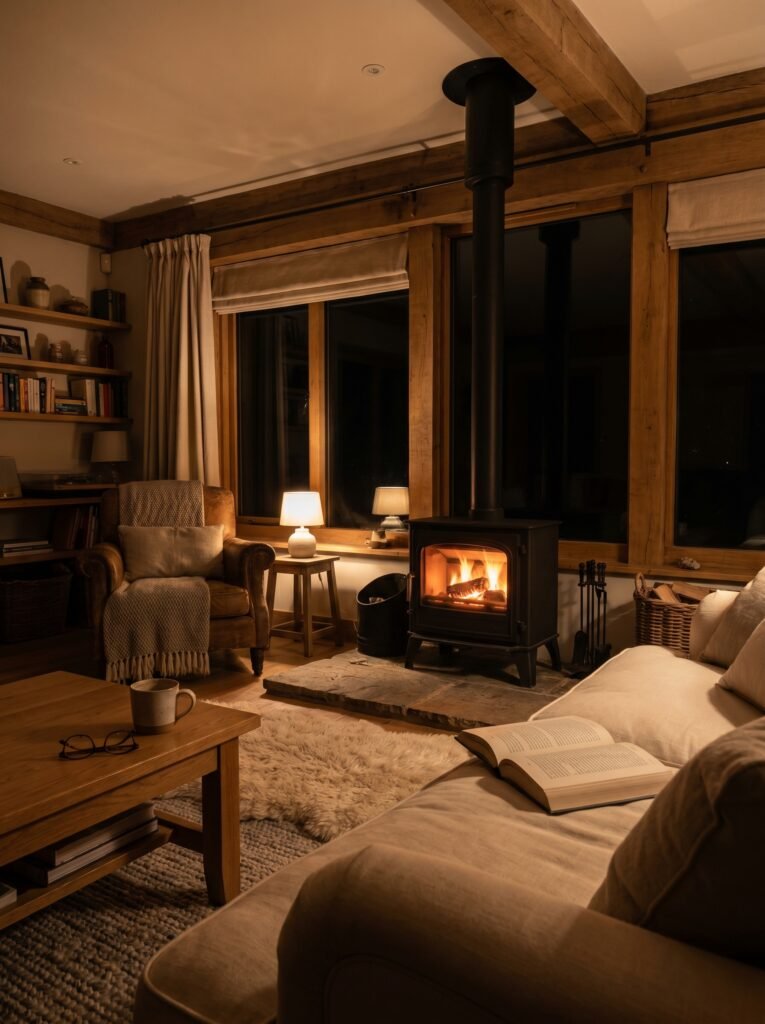
A log burner living room is one of those rare design choices that pays you back every single day — not just on the evenings when you have company, but on the quiet Tuesday nights when it’s just you, the fire, and the particular stillness of a warm room in a cold world. It changes how you feel inside your own home, and that is perhaps the most valuable thing any design decision can do.
So as you sit with these ideas — the hearths, the colours, the carefully stacked logs — ask yourself this: what would it feel like to build a room that genuinely makes you want to be in it?