
Basement Living Room Ideas That Will Make You Fall in Love With the Space You Almost Forgot You Had
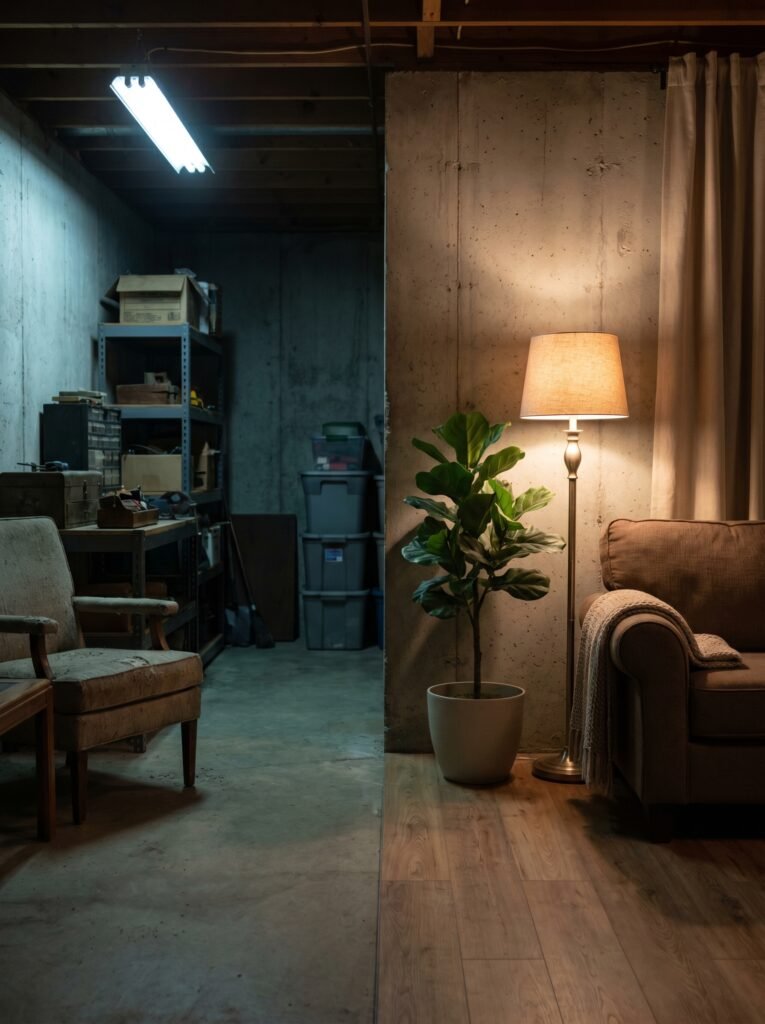
There’s something quietly heartbreaking about a basement that never reaches its potential — a room full of mismatched furniture, forgotten storage boxes, and flickering fluorescent lights that nobody actually wants to spend time in. But here’s what seasoned interior designers know that most homeowners don’t: the basement is often the most transformative space in an entire house, and the right ideas can turn it into the room everyone fights over.
—
1. Why Basements Deserve More Credit Than We Give Them
Think about it for a moment. Your basement has something the rest of your home doesn’t — complete privacy, natural sound insulation, and a blank-slate quality that above-ground rooms simply can’t replicate. There are no awkward window placements dictated by street-facing aesthetics. No neighbors glancing in. No sun glare on your television screen at two in the afternoon.
Yet most of us treat the basement like a junk drawer. We pile things in, close the door, and quietly agree as a household to pretend it doesn’t exist.
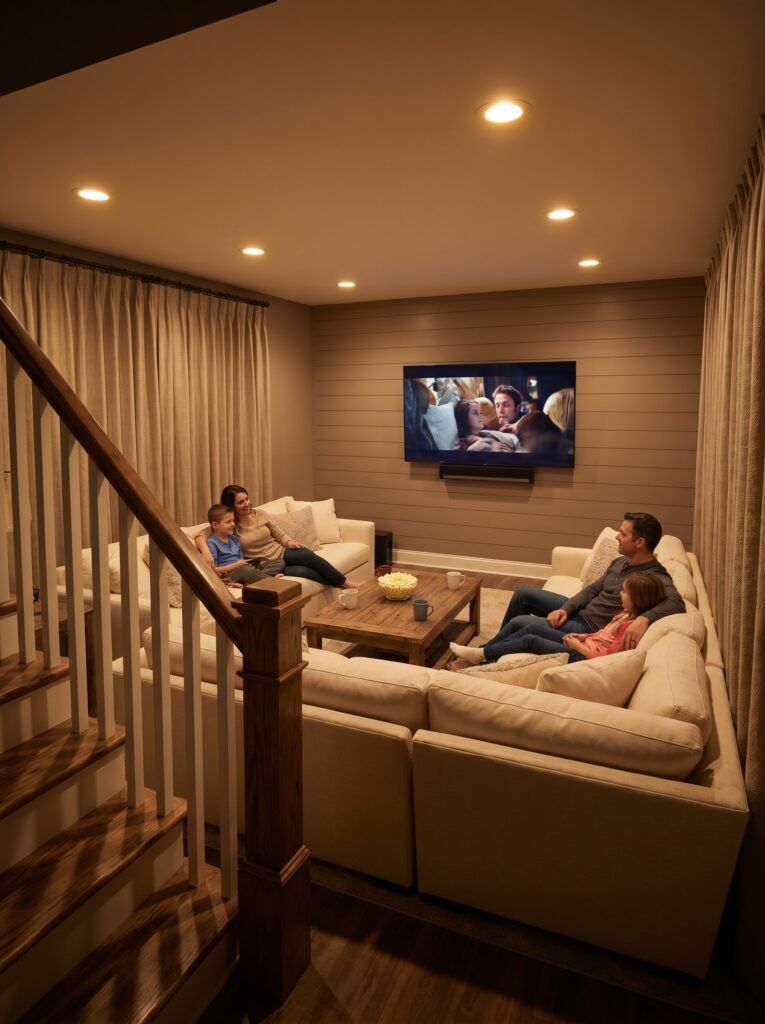
The shift begins when you stop seeing your basement as a problem and start seeing it as a possibility. A thoughtfully designed basement living room can become your family’s most-used space — the cozy movie den, the game night headquarters, the Sunday afternoon retreat where the outside world simply cannot find you.
“The basement isn’t the worst room in your home. It’s just the most misunderstood one.”
Interior designers who specialize in lower-level spaces consistently say the same thing: once you commit to treating your basement with the same intentionality you’d bring to any other living space, the transformation is nothing short of remarkable.
—
2. The Golden Rule of Basement Design: Fight the Cave Effect
Every basement has one natural enemy — darkness. Low ceilings, limited natural light, and cool temperatures combine to create what designers call the “cave effect,” and it’s the single biggest reason basement living rooms feel uninviting.
The good news is that this is entirely fixable, and you don’t need to spend a fortune doing it.
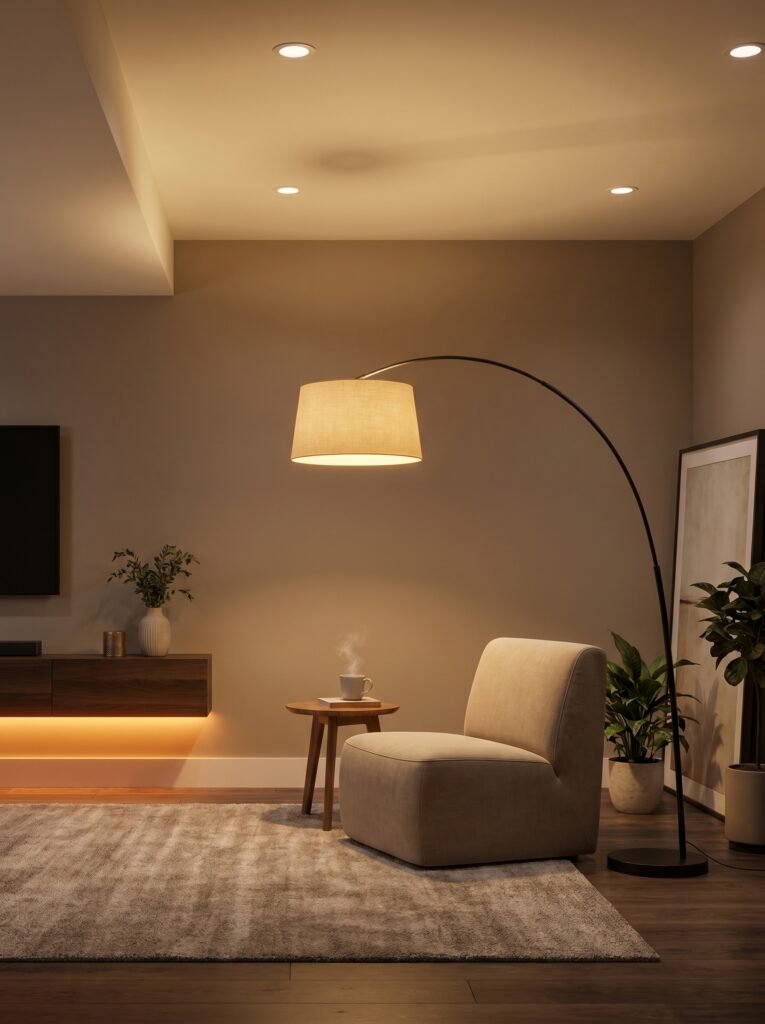
Start with your lighting strategy before you touch a single piece of furniture. Layer your light sources — recessed ceiling lights for overall brightness, floor lamps positioned in corners to eliminate shadow pockets, and warm-toned LED strips tucked under shelving units or along staircases to add depth without harshness. The goal is to mimic the quality of natural light, not simply to add more of the artificial kind.
Color temperature matters enormously here. Bulbs with a color temperature between 2700K and 3000K emit a warm, golden glow that feels organic and welcoming — the opposite of the cold, institutional brightness that makes basements feel like waiting rooms.
—
3. Paint Colors That Literally Change the Feeling of the Room

Color psychology in basement spaces works differently than it does upstairs. Because you’re working against limited light, you have two valid — and beautifully different — design paths to choose from.
The first approach embraces warmth. Creamy whites like Benjamin Moore’s “White Dove,” soft greiges, warm taupes, and butter yellows reflect whatever light exists in the room and push the walls back visually. These shades are the interior designer’s go-to for low-light spaces because they trick the eye into perceiving a room as brighter and larger than it actually is.
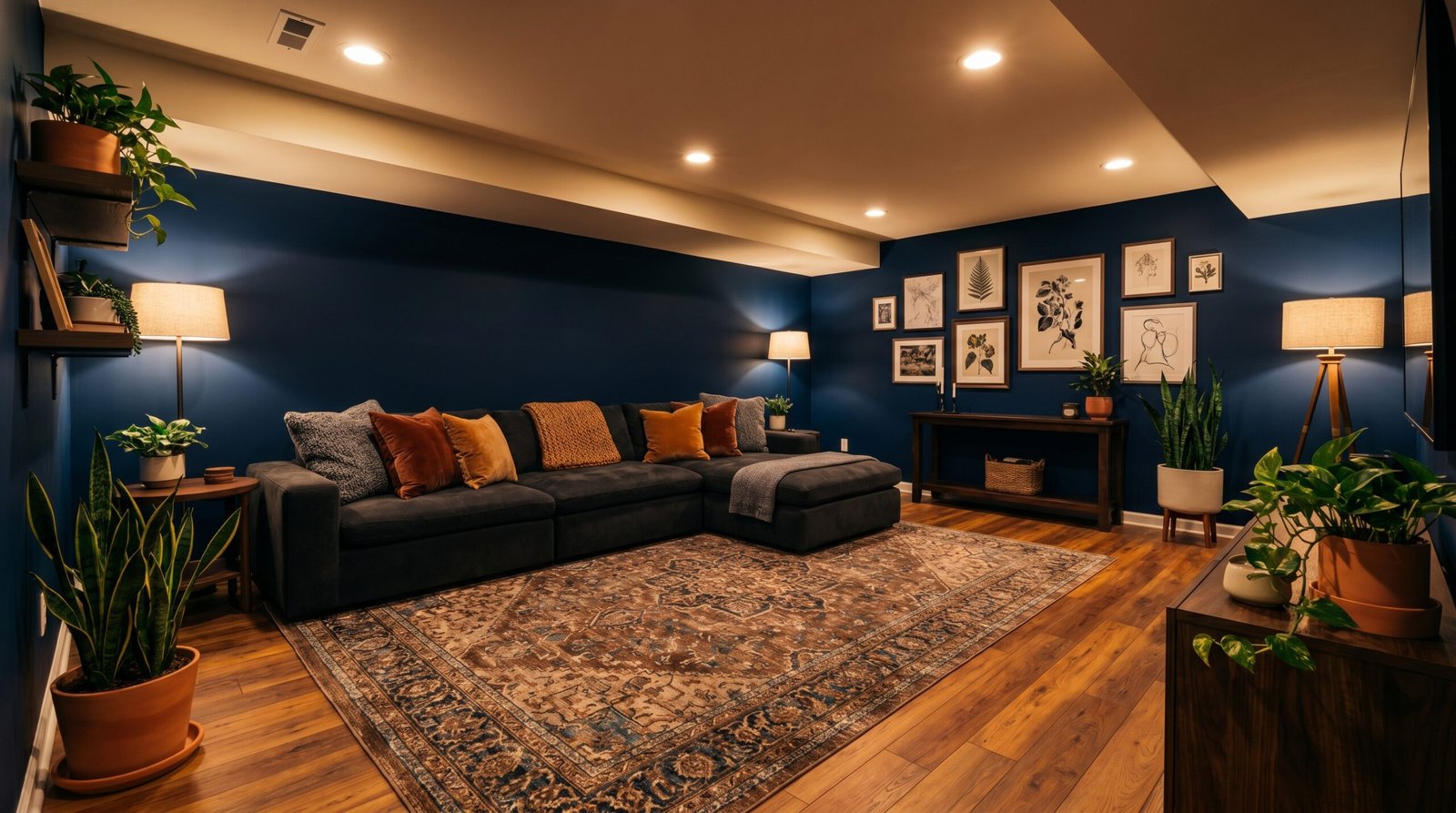
The second approach leans into the intimacy. Deep navy, forest green, moody charcoal, and rich terracotta — these colors acknowledge the basement’s natural coziness and amplify it deliberately. Rather than fighting the darkness, they embrace it, creating an atmosphere that feels like a high-end boutique hotel lounge. This works especially well for entertainment-focused basement living rooms where controlled lighting is already part of the design plan.
Whichever path you choose, always sample paint on the actual wall and observe it over 24 hours before committing. Basement light changes dramatically from morning to evening, and a color that looks perfect at noon might look completely different by lamplight.
—
4. Ceiling Strategies That Make Low Spaces Feel Surprisingly Tall
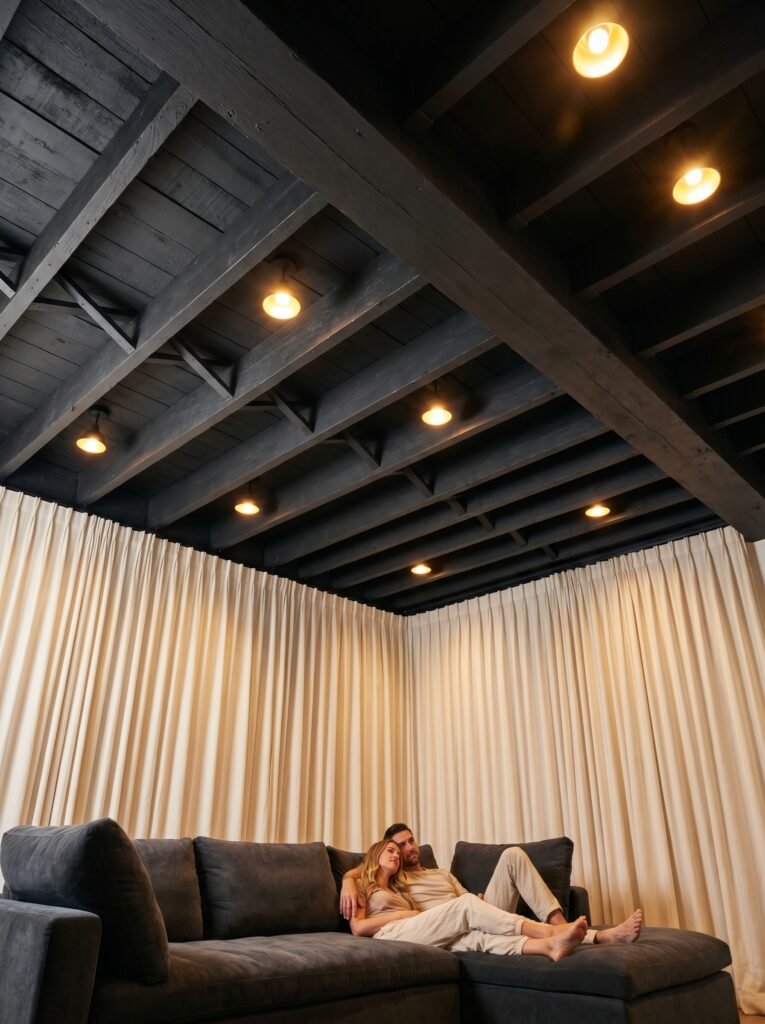
The ceiling is where most basement renovations quietly fail — not because of bad decisions, but because of no decisions at all. A plain, unfinished, or drop-tile ceiling is the fastest way to keep your basement looking like a temporary solution rather than an intentional living space.
If your ceiling height allows, painting exposed beams or joists in a dark matte color — think deep charcoal or black — is one of the most striking and cost-effective transformations you can make. Counterintuitively, dark ceilings draw the eye upward and create visual drama rather than making a space feel smaller. It’s a trick borrowed from upscale restaurant design, and it works beautifully in residential basement living rooms.
For finished ceilings with standard drywall, keep the color consistent with your walls or just a shade lighter to create a seamless envelope effect. Avoiding a stark white ceiling in a low-height basement is important — that high-contrast look only emphasizes how close the ceiling is to your head.
Adding ceiling-mounted curtain rods along the perimeter, with floor-to-ceiling fabric panels, can simulate the height of windows even where none exist. This technique is genuinely underused and dramatically changes how spacious a basement feels.
—
5. Furniture Layout: The Basement Has Its Own Rules
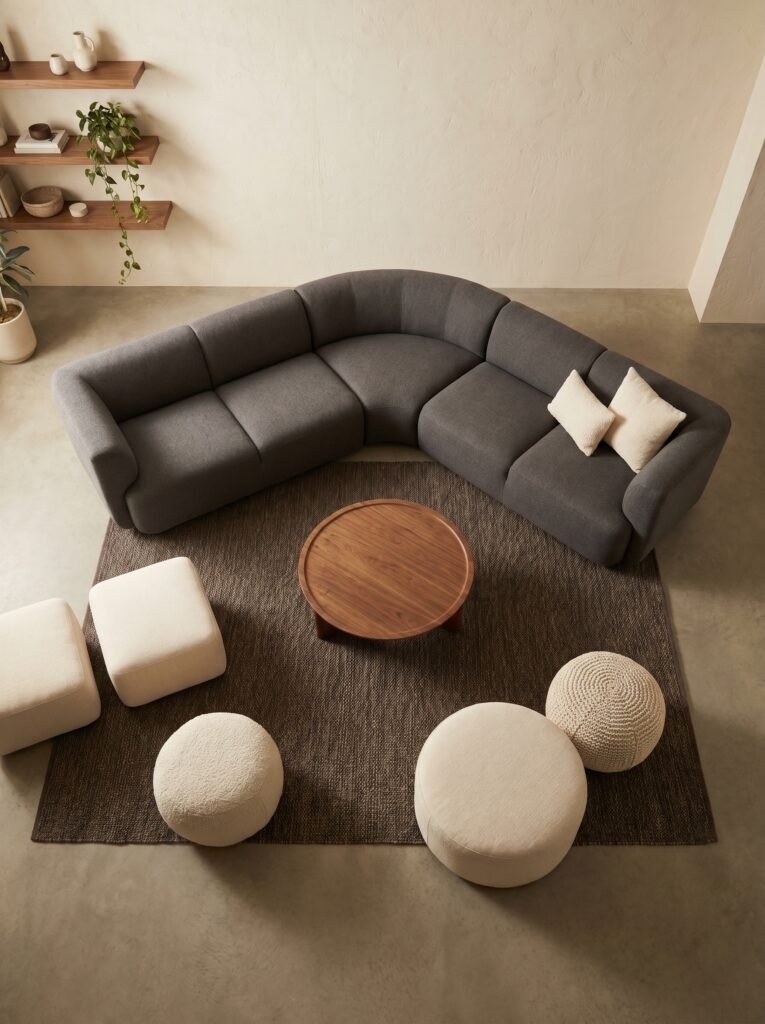
Furniture arrangement in a basement living room follows a fundamentally different logic than it does in an above-ground space. Without natural focal points like large windows or a fireplace, you have to create your own — and every piece of furniture needs to support that central intention.
Start by identifying what the room is for. A family movie room calls for seating arranged in a shallow arc facing the screen, with ottomans and poufs for flexibility. A multi-purpose social space benefits from furniture groupings that can pivot between conversation and entertainment — L-shaped sectionals with movable accent chairs are ideal for this.
Scale is also critical. In a space with lower ceilings, furniture with lower profiles creates visual harmony rather than conflict. Deep, cushioned sofas with low arms and backs; coffee tables that sit closer to the floor; wall-mounted shelving instead of tall bookcases — these choices breathe air into the room rather than competing with its architecture.
“In a basement, every furniture choice is either working with the space or fighting it — there is no in between.”
Avoid cluttering the floor plan. Basements with too much furniture start to feel claustrophobic fast. Leave generous pathways, keep at least 18 inches of clearance around key pieces, and resist the urge to fill every corner just because space exists.
—
6. How to Add Natural Light (Even When There Are No Windows)
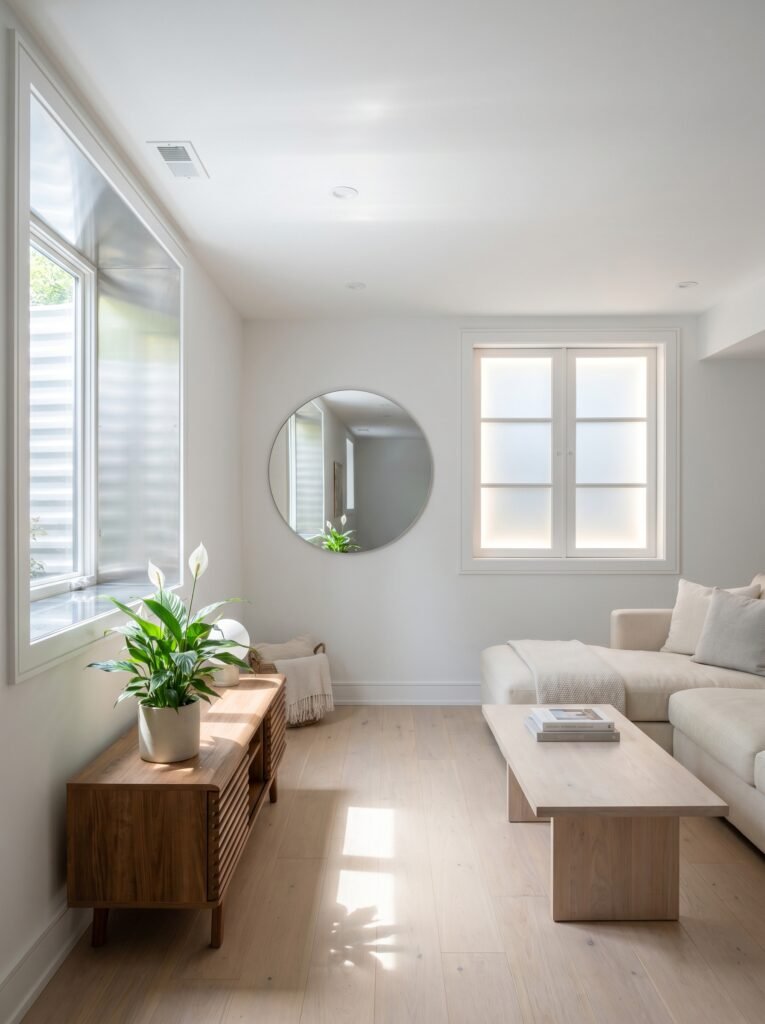
Natural light in a basement is rare, but it’s never entirely impossible — and even the illusion of it can transform the energy of the room.
Egress windows are the most impactful physical change you can make. These larger, code-compliant windows cut into the foundation allow genuine daylight to enter and are increasingly common in basement renovations. They also improve ventilation and — importantly for resale value — allow the space to be legally classified as a finished living area.
Window wells with reflective liners or mirrored surfaces amplify what little natural light enters, bouncing it deeper into the room. It’s a simple addition with a surprisingly noticeable effect.
For spaces where real windows simply aren’t an option, daylight-spectrum LED panels that mimic the color temperature of natural light are advancing rapidly in quality. Positioned thoughtfully — behind frosted panels in a faux window frame, for example — they create a convincing simulation of natural light that genuinely improves how the space feels over long periods of time.
Mirrors are your other best friend. A large, well-placed mirror across from a light source doubles the perceived brightness of the room. This isn’t just a design trick — it’s basic physics, and it works every single time.
—
7. Flooring Choices That Set the Tone for Everything Else
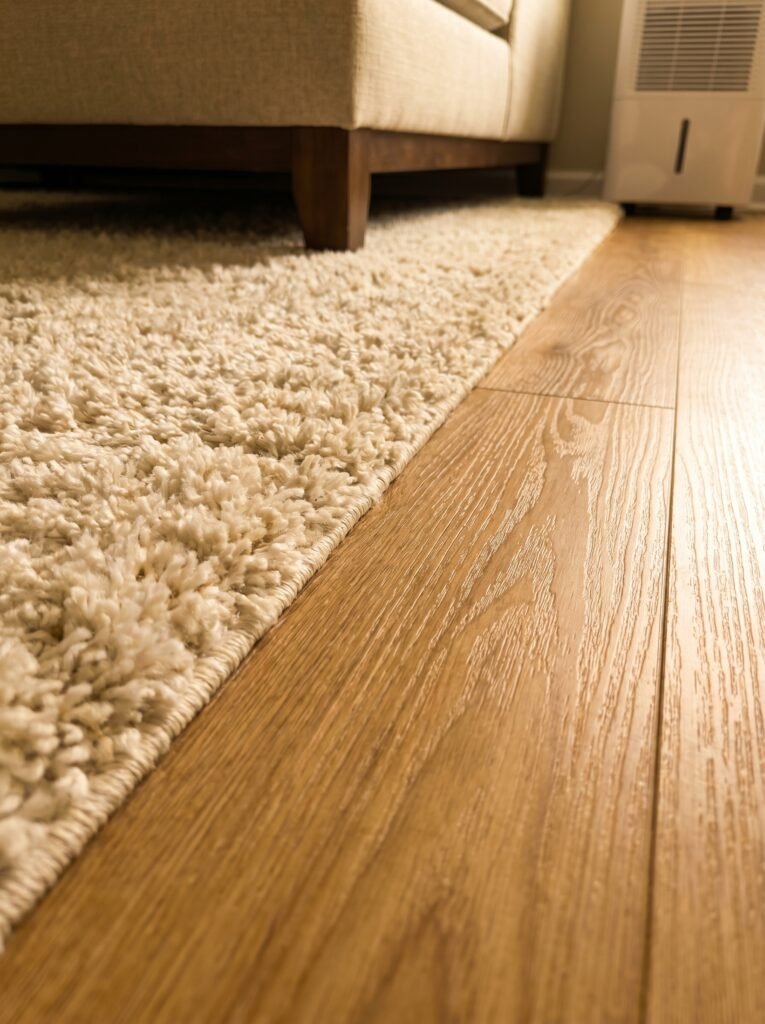
The floor is the foundation of your basement living room’s personality — both literally and aesthetically. And because basements sit on concrete slabs, moisture management is the first conversation any flooring decision needs to address.
Luxury vinyl plank flooring has become the gold standard for basement spaces, and with good reason. It’s 100% waterproof, dimensionally stable in fluctuating temperatures, comfortable underfoot, and available in a range of wood-look and stone-look finishes that are nearly indistinguishable from the real thing. It also installs over minor imperfections in the concrete without requiring an extensive subfloor.
Engineered hardwood is another excellent option for basements with controlled humidity, offering the warmth and authenticity of real wood with better moisture resistance than solid hardwood. However, it requires careful humidity management — ideally keeping the basement between 35% and 55% relative humidity.
Layering large area rugs over your primary flooring is one of the most powerful finishing touches in any basement living room. A generously sized rug — ideally large enough that all key furniture pieces rest at least partially on it — visually anchors the seating area, adds warmth underfoot, reduces echo, and introduces color or texture in a way that’s completely reversible.
—
8. Creating Zones: How to Make One Basement Feel Like Multiple Rooms
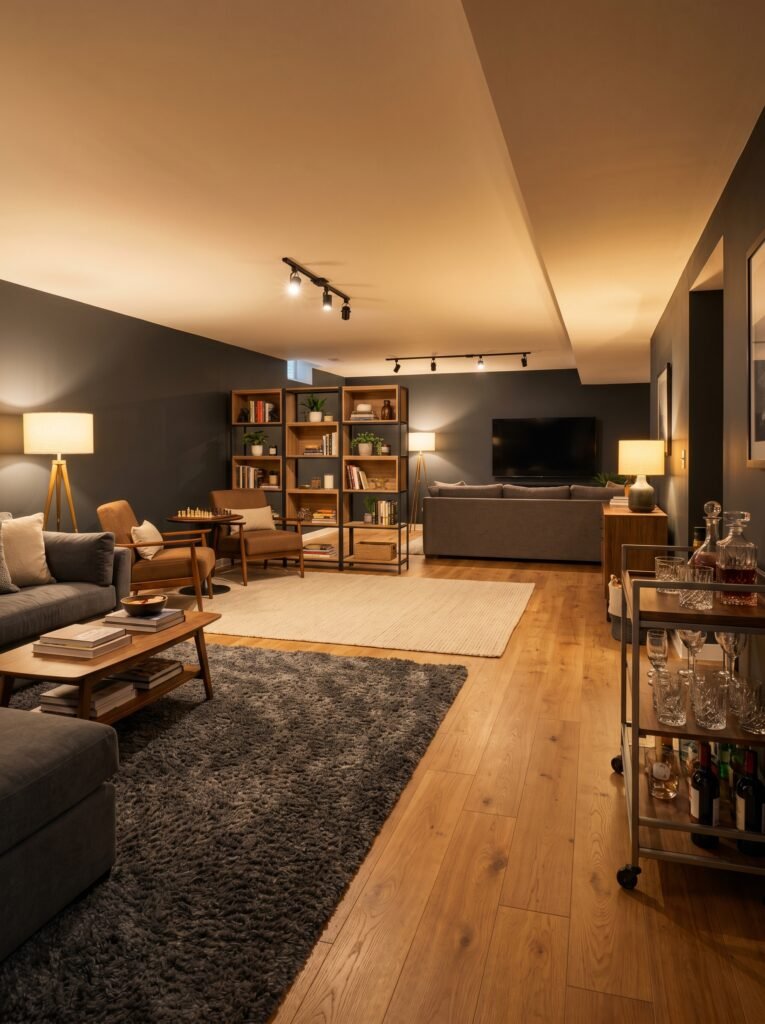
One of the greatest gifts a finished basement gives you is open floor space — and one of the greatest mistakes you can make is not using it intentionally. The key is zoning: creating distinct areas within the larger space that each have their own identity and function.
Use rugs to define separate zones visually without needing physical walls. A plush, dark-toned rug under the main seating area creates the living room. A lighter, flatweave rug under a small table and chairs defines a reading nook or game area. The transition between rugs signals a change in purpose, and it works remarkably well even in open-plan basements.
Shelving units positioned perpendicular to the wall create soft room dividers that maintain visual openness while providing organizational storage and a sense of separation. Built-in shelving flanking a media wall takes this even further — turning a functional storage necessity into an architectural feature.
Consider incorporating a bar cart or a small wet bar area at the perimeter if the space is primarily used for adult entertainment. Even a simple console table styled with a few bottles, glassware, and a small ice bucket creates a dedicated “bar zone” that makes the room feel intentional and curated.
—
9. The Cozy Factor: Textiles and Layers That Make People Stay
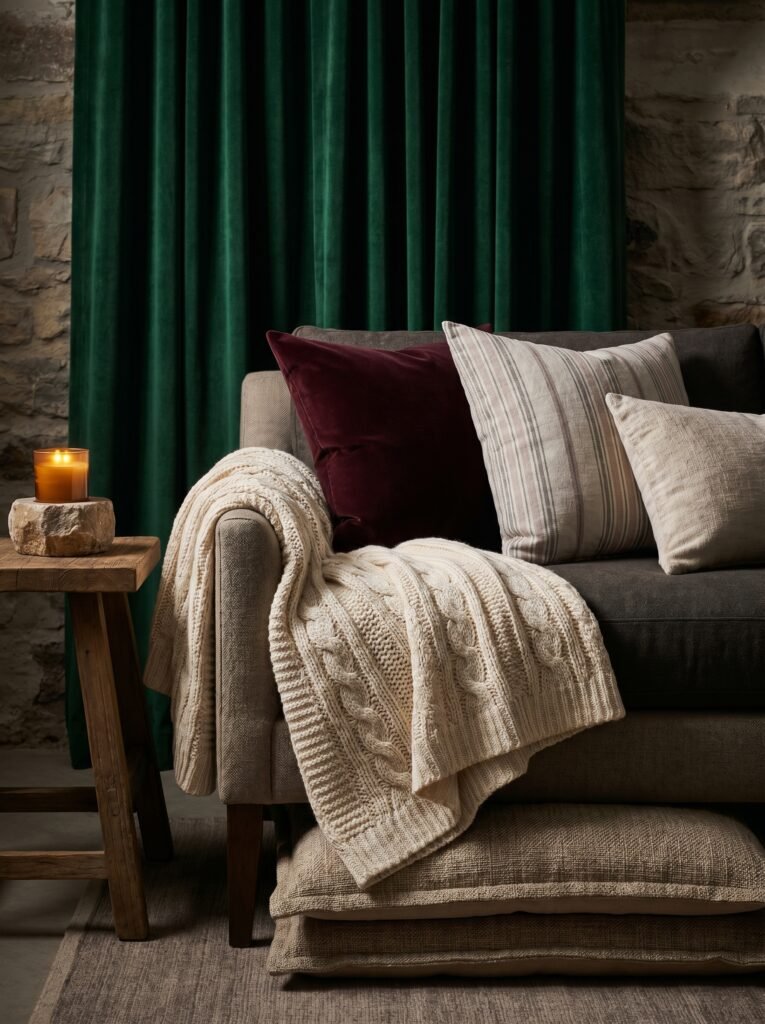
Here is where the emotional design of a basement living room really comes to life. Because basements naturally run cooler than the rest of the house, they have a built-in excuse to lean into layered, textural coziness in a way that other rooms simply can’t justify.
Think weighted throw blankets folded over the arm of a sectional. Think stacked throw pillows in complementary textures — a chunky knit alongside a velvet, alongside a linen stripe. Think floor cushions stacked in a corner for overflow seating that also reads as intentional design.
“A basement doesn’t feel finished until it feels warm — and warmth is always made of layers, never just temperature.”
Curtains are another textile element that’s frequently underused in basements. Even when there are no windows to cover, hanging full-length curtains on one wall adds softness, height, and a sense of theatrical finishing that bare drywall simply cannot achieve. Choose heavy fabrics — velvet, linen, or blackout-weight materials — for the most visual impact.
—
10. Smart Storage That Keeps the Room From Feeling Cluttered
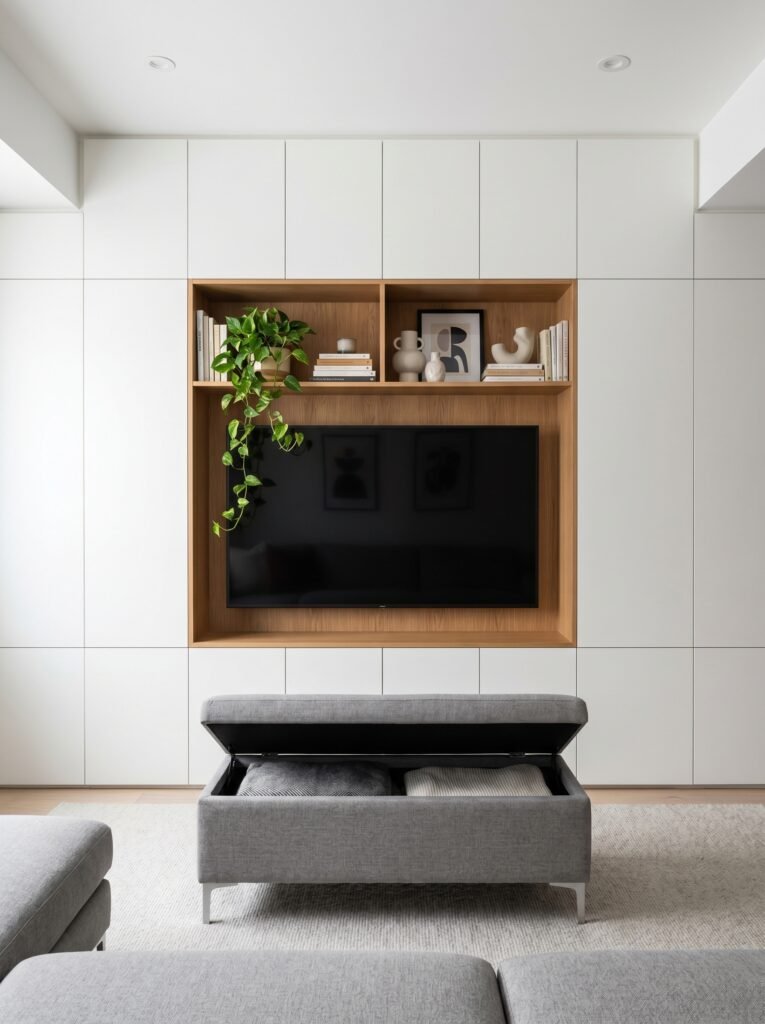
A basement living room that doubles as storage is only successful if the storage is genuinely invisible. Open shelving showcasing books, plants, and curated objects is design. Visible bins of sports equipment and seasonal décor is chaos.
Built-in cabinetry with closed doors along one wall is the most elegant solution, hiding everything that doesn’t need to be seen while creating a streamlined, intentional backdrop for the room. This is a bigger investment, but the transformation it delivers is proportionally significant.
For more budget-conscious approaches, furniture with hidden storage is doing double duty without sacrificing aesthetics. Ottomans with lift-top storage, platform beds with built-in drawers if the basement includes a bedroom component, coffee tables with lower shelves — every piece can and should be working harder than just looking good.
Labeling and organizing what’s inside closed storage keeps the system functional long-term. A basement living room that feels beautiful when guests arrive but descends into disorganization within a week hasn’t actually solved the problem — it’s just hidden it temporarily.
—
11. Bringing Life Into the Basement: Plants and Natural Elements
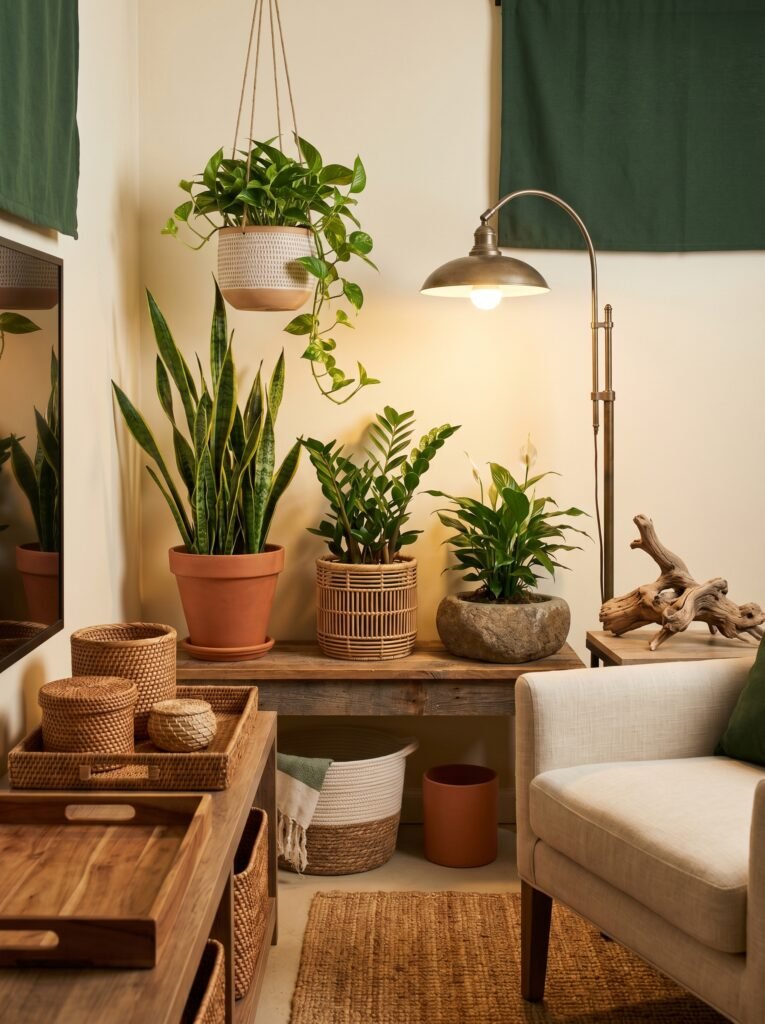
One of the most common objections to basement living rooms is that they feel disconnected from the natural world — and that objection is completely valid. A room with no sunlight, no breeze, and no view can start to feel isolating if you spend significant time in it.
Plants are the most direct answer to this, but they do require thoughtful selection. Low-light champions like pothos, ZZ plants, cast iron plants, snake plants, and peace lilies genuinely thrive in basement conditions with minimal supplemental grow lighting. Grouping several plants together creates a lush, living focal point that softens the room and introduces oxygen, movement, and organic color.
Beyond plants, natural materials woven throughout the design — rattan baskets, wooden trays, linen upholstery, stone candle holders, driftwood accents — create a sensory connection to the outside world that purely synthetic interiors cannot replicate. These elements don’t need to be expensive or numerous; even a single beautiful wooden bowl on the coffee table adds a quality of warmth that manufactured materials rarely achieve.
—
12. Finishing Touches That Separate a Good Basement From a Great One
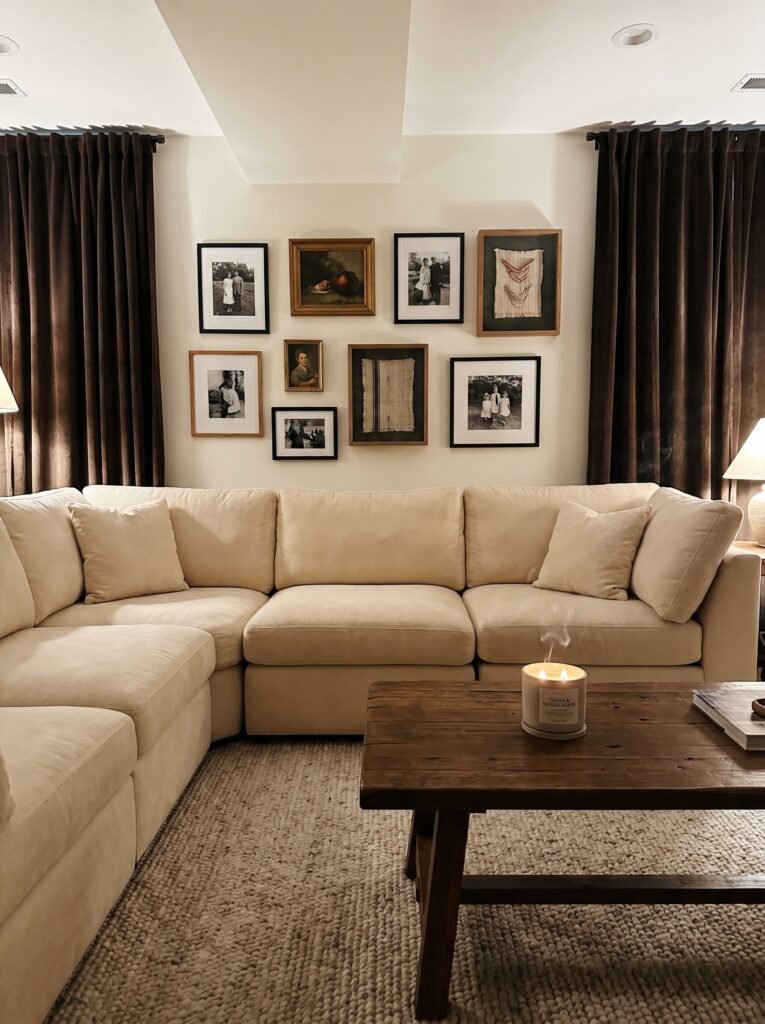
The difference between a basement living room that feels professionally designed and one that feels like a nice attempt is almost always in the finishing details — the things that don’t register consciously but that you feel the absence of immediately.
Scent is one of them. Basements can carry a musty quality that undermines even the most beautiful design. A high-quality candle, a subtle essential oil diffuser, or even a plug-in fragrance near the entrance signals to your senses that this is a curated, cared-for space before your eyes have fully registered the room. Cedar and sandalwood work particularly well in lower-level spaces, as they carry an earthy warmth that feels intentionally suited to the environment.
Gallery walls personalize a basement in a way that no amount of furniture can replicate. A collection of framed photographs, original artwork, vintage posters, or even beautifully matted fabric swatches creates visual narrative — it tells people who lives in this home and what they love. In a basement, where the walls are often the primary design canvas, this investment pays dividends in warmth and personality.
Finally — and this is the detail that separates the genuinely thoughtful designs from the generic ones — consider the acoustics. Basements echo. Hard floors, concrete walls, and limited soft surfaces create a hollow quality that makes everything from conversation to television feel slightly off. Rugs, curtains, upholstered furniture, and even acoustic panels disguised as art all dampen this effect. A basement that sounds good — that feels acoustically intimate rather than hollow — is a basement people will actually want to spend time in.
—
🌿 How to Make Your Basement Living Room Feel Warm and Livable
Start with the light, not the furniture. Before you move a single sofa downstairs, address your lighting plan. Add layered light sources, choose warm-toned bulbs, and if possible, maximize or add window access. Everything else builds from how light the room feels.
Treat the basement like a real room — because it is one. Give it real art, real plants, real textiles. Resist the urge to populate it with the furniture and décor that didn’t earn a place upstairs. A basement furnished with intention will feel like a retreat; one furnished with castoffs will always feel like an afterthought.
Manage moisture before you invest in décor. A dehumidifier is not optional in most basements — it’s foundational. Keeping humidity levels controlled protects your flooring, your furniture, your walls, and the air quality of the entire space.
Zone the space deliberately. Even if your basement is primarily used for one purpose, creating distinct functional areas gives the room depth and versatility. It signals intentional design rather than a single piece of furniture dropped into an empty room.
Come back to it seasonally. Basements respond beautifully to seasonal styling — heavier textiles in winter, lighter linens and plants in summer. Revisiting the space with fresh eyes a few times a year keeps it feeling curated rather than static.
—
❓ FAQ
Q: What is the most important thing to do before designing a basement living room? A: Address moisture first. Before choosing paint, furniture, or flooring, ensure your basement has proper drainage, a functioning sump pump if needed, and a dehumidifier. Designing over a moisture problem only delays a larger, costlier fix — and it puts every beautiful thing you add at risk.
Q: Can a basement living room actually feel cozy and not cave-like? A: Absolutely, and it’s more achievable than most people expect. The combination of warm-toned lighting, layered textiles, low-profile furniture, plants, and intentional color choices can make a basement feel warmer and more inviting than many above-ground living rooms. The “cave feeling” is a lighting and texture problem, and both are entirely solvable.
Q: What flooring is best for a basement living room? A: Luxury vinyl plank is the most practical and versatile choice for most basement living rooms. It’s waterproof, durable, comfortable underfoot, and available in beautiful wood and stone finishes. Pair it with a large, high-quality area rug to add warmth and acoustic softness to the space.
—
💭 Final Thought
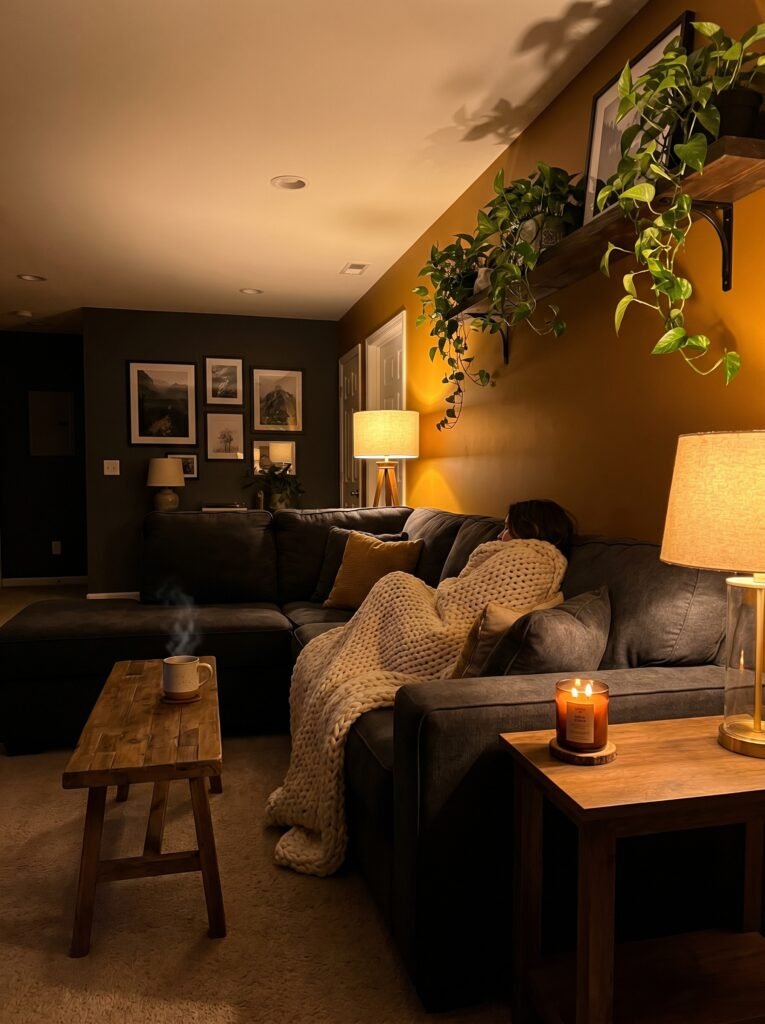
A basement living room, done well, becomes the room that surprises everyone — including you. It’s the space that holds the late-night conversations and the weekend movie marathons and the quiet Sunday afternoons when you just needed somewhere soft and warm to land. It doesn’t happen by accident, but it doesn’t require magic either — just intention, patience, and the willingness to see potential where others only see concrete and darkness.
What would your basement living room feel like if you treated it like the most important room in the house?