
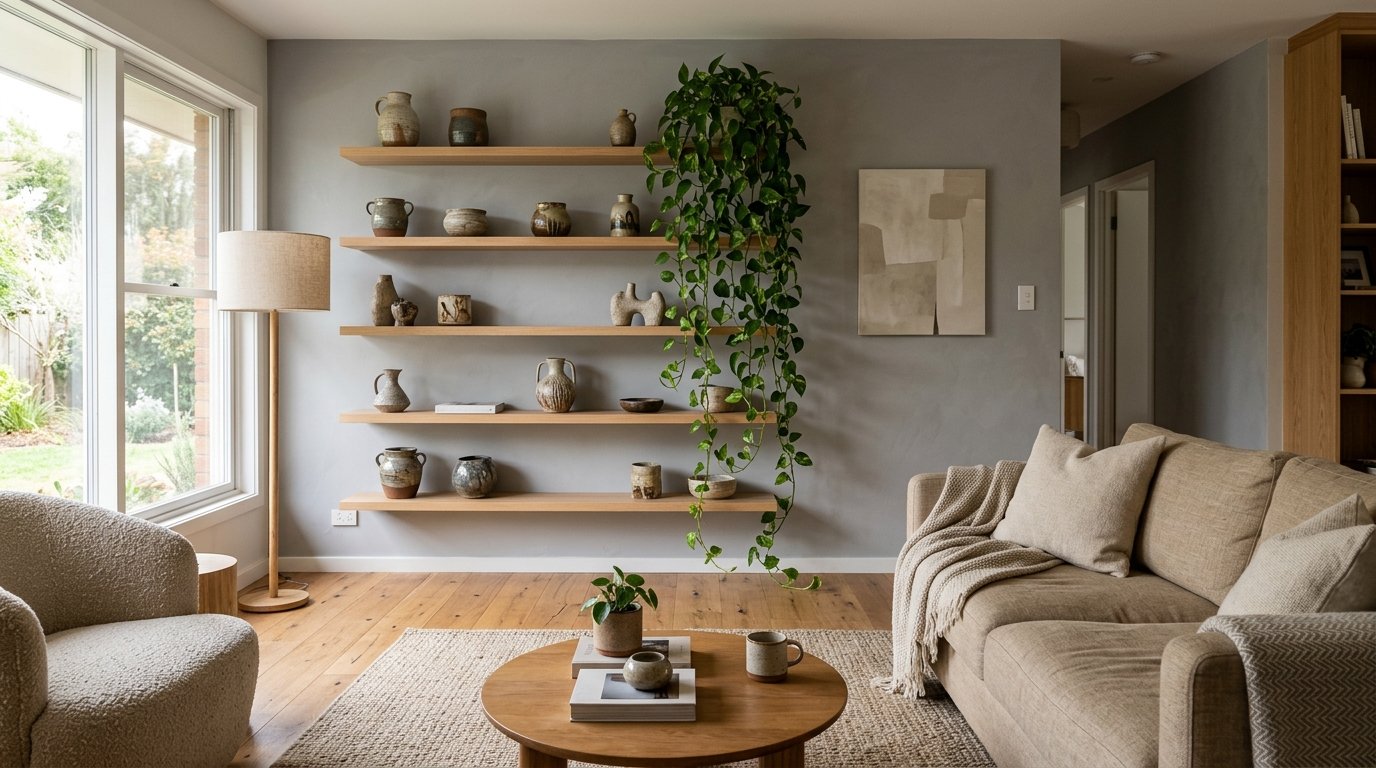
Gray Walls, Open Shelves, and the Living Room That Finally Feels Like Yours
My friend called her living room “the gray void” for about six months before she figured out what was missing. The walls were the right shade. The furniture was minimal, clean, intentional. But every time she walked in, it felt like a waiting room.
Turns out, it wasn’t the gray. It was the shelves.
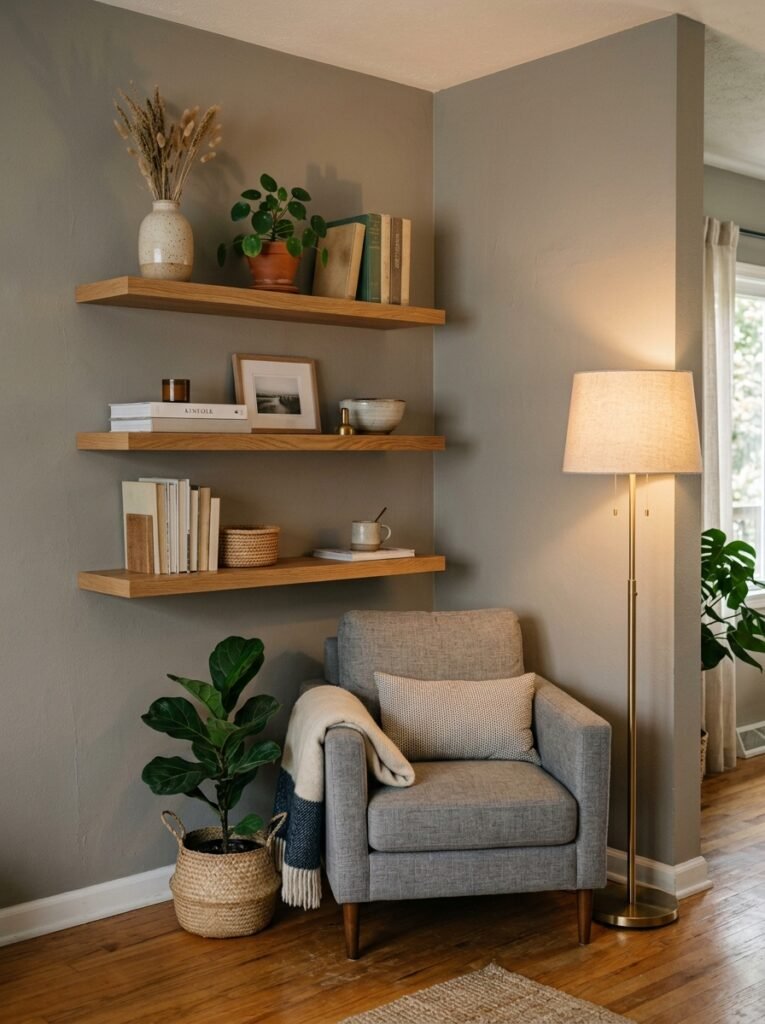
—
1. Why Gray Rooms Feel Cold — and the One Thing That Fixes It
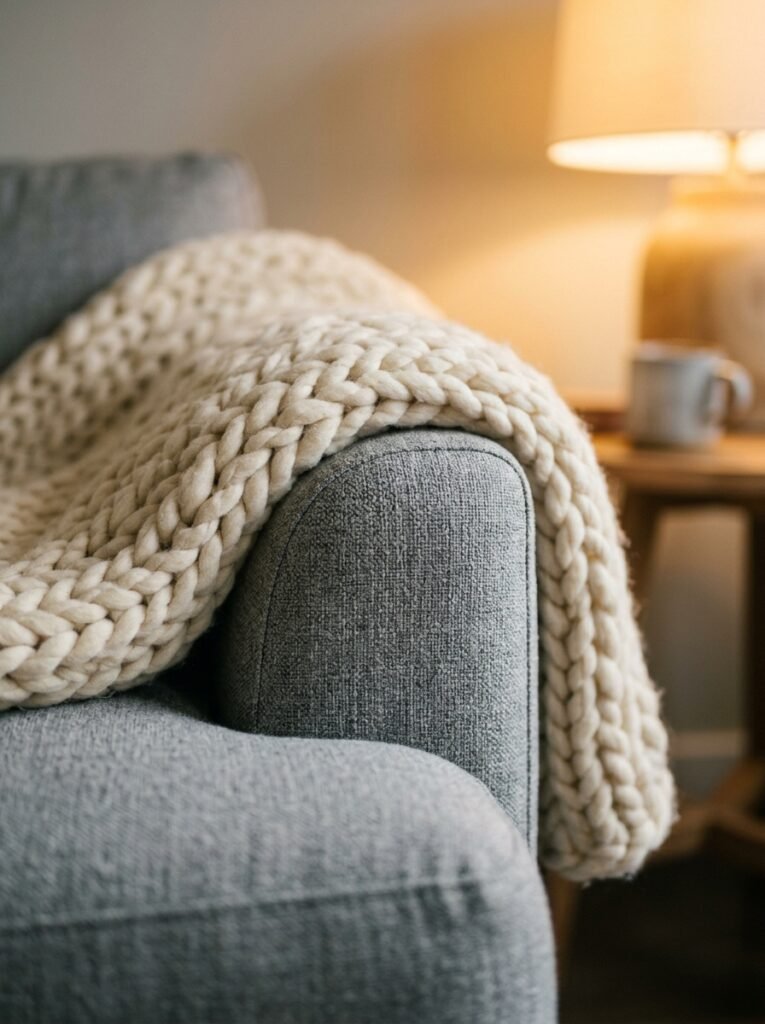
Here’s the thing about gray. It doesn’t misbehave. It doesn’t argue with your sofa or pick fights with your curtains. But it also doesn’t give you anything. It just sits there, quiet and a little noncommittal, waiting for you to do the work.
And that’s actually great news, because it means YOU get to decide what this room becomes.
Wall shelves are how you do that. Not a gallery wall, not a throw pillow refresh — open shelves. Because they’re the one element that adds dimension, depth, and something to actually look at, without cluttering the floor space that makes minimalism feel like minimalism in the first place.
The problem most people run into is they either overload them (every shelf looks like a car boot sale) or they underload them (three items floating on a plank with no connection to each other). Neither works. But there’s a middle path, and it’s not complicated once you see it.
—
2. The Shade of Gray That Actually Pairs Well With Shelves
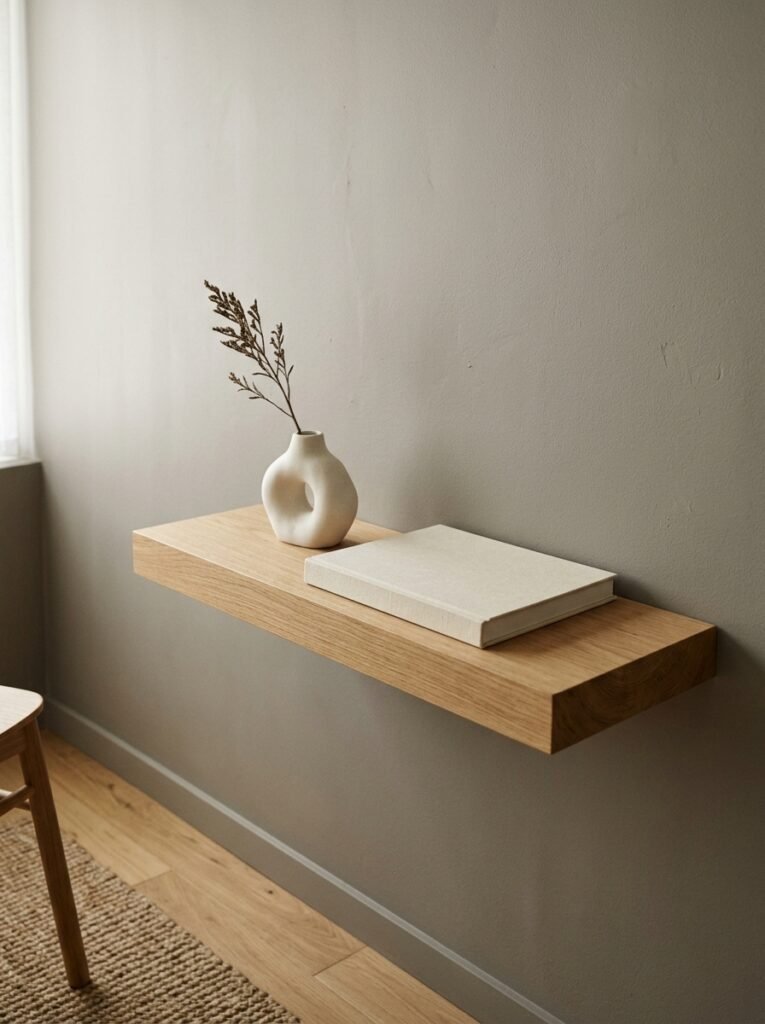
Not all grays behave the same way against open shelving. This is where people get caught out.
Cool, blue-toned grays — think slate, steel, anything with that almost-lavender undertone — look incredible with light wood shelves. Natural oak, ash, pine with a matte finish. The warmth of the wood cuts through the cool and stops the room from feeling like a hospital corridor.
Warm grays are trickier. They’ve got that greige quality, that whisper of beige underneath, and they can actually clash with shelves that are TOO warm — think very orange pine or honey-toned wood. With warm gray walls, go darker. Walnut. Dark oak. Or skip wood entirely and go black metal brackets with white shelves. THAT combination is having a real moment right now, and it earns it.
Side note — if you’re in the UK and your walls are that classic Farrow & Ball-style “greige” (you know the one), white-painted shelves with matte black fittings are almost criminally good. Just leaving that there.
—
3. The Wall You Keep Ignoring Is Probably Your Best Feature
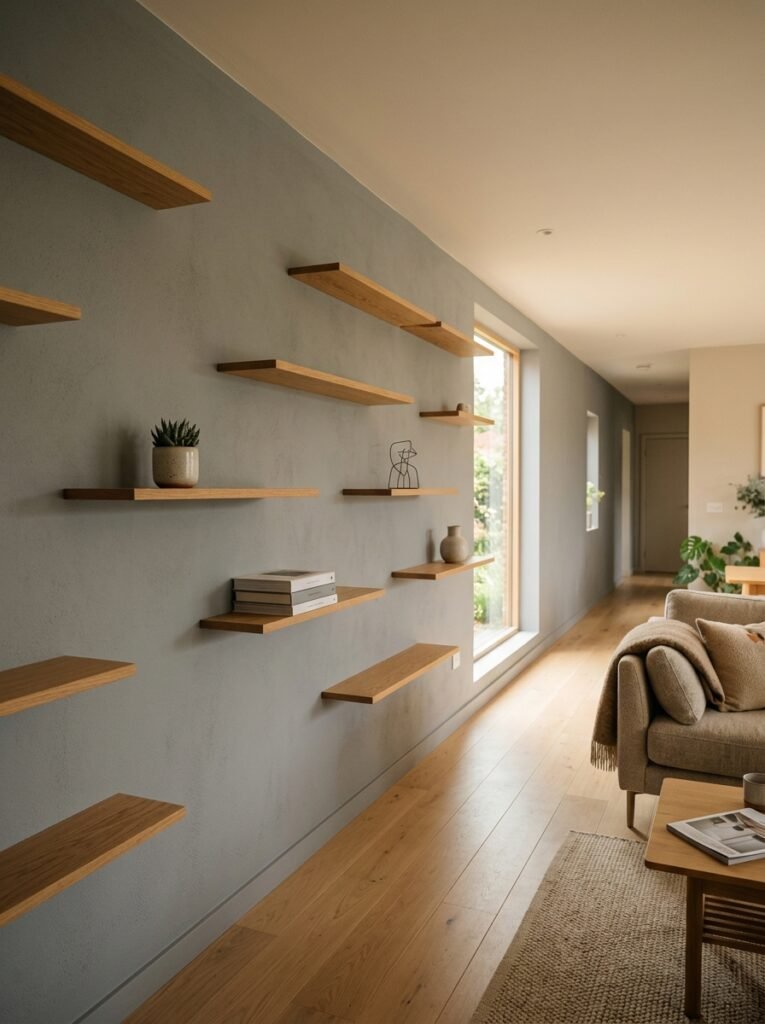
Every room has one. A wall that’s just… there. Not the feature wall, not the one with the window, not the TV wall — the overlooked wall. In most living rooms it’s either to the left or right of the main seating area, and it’s basically holding a painting that hasn’t been looked at in three years.
That wall? That’s your shelf wall.
“The wall you keep overlooking is exactly where the room wants to breathe.”
Floor-to-ceiling open shelving on that wall turns it from background noise into an actual moment. It doesn’t need to be built-in, either. Long floating shelves at three different heights — staggered, not perfectly symmetrical — can do the same thing for a fraction of the cost.
The asymmetry is important. When shelves are too even, too perfectly spaced, they start to look like retail display fixtures. Go slightly uneven. One shelf lower. One shelf longer. It looks intentional even when it happens by accident.
—
4. What to Actually Put on Gray-Room Shelves (Without Making It Look Like a Staged Show Home)
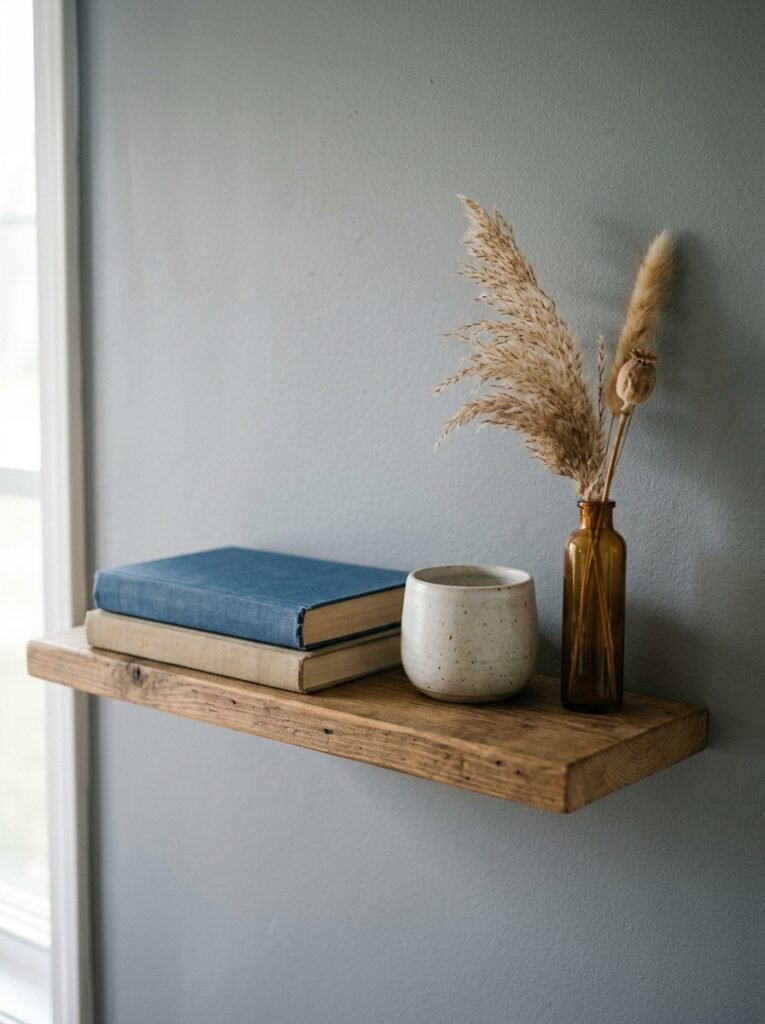
Okay, real talk. The worst shelf styling is the kind where everything looks like it was chosen from a mood board and nothing looks touched. You know those shelves where there’s literally ONE thing on each shelf, spaced exactly in the center, with a tiny eucalyptus sprig? Those are the shelves of someone who’s scared.
Don’t be scared.
In a gray minimalist room, the shelves should do two things: add warmth and tell you something. About the person who lives there. About what they actually care about.
So here’s what actually works:
- Books. REAL ones, spines out, not turned backward (that trend needs to stop, honestly)
- Something with height — a tall vase, a simple ceramic lamp, sculptural dried stems
- One item that’s genuinely personal. A weird vintage find. A thing your kid made. Something imperfect.
- A trailing plant. Pothos, string of pearls, anything that drapes slightly over the edge and breaks the horizontal line of the shelf itself
That’s it. Four categories. You don’t need more.
The gray walls do the heavy lifting. The shelves just need to show up and be real.
—
5. The Bracket Conversation Nobody Wants to Have (But Should)
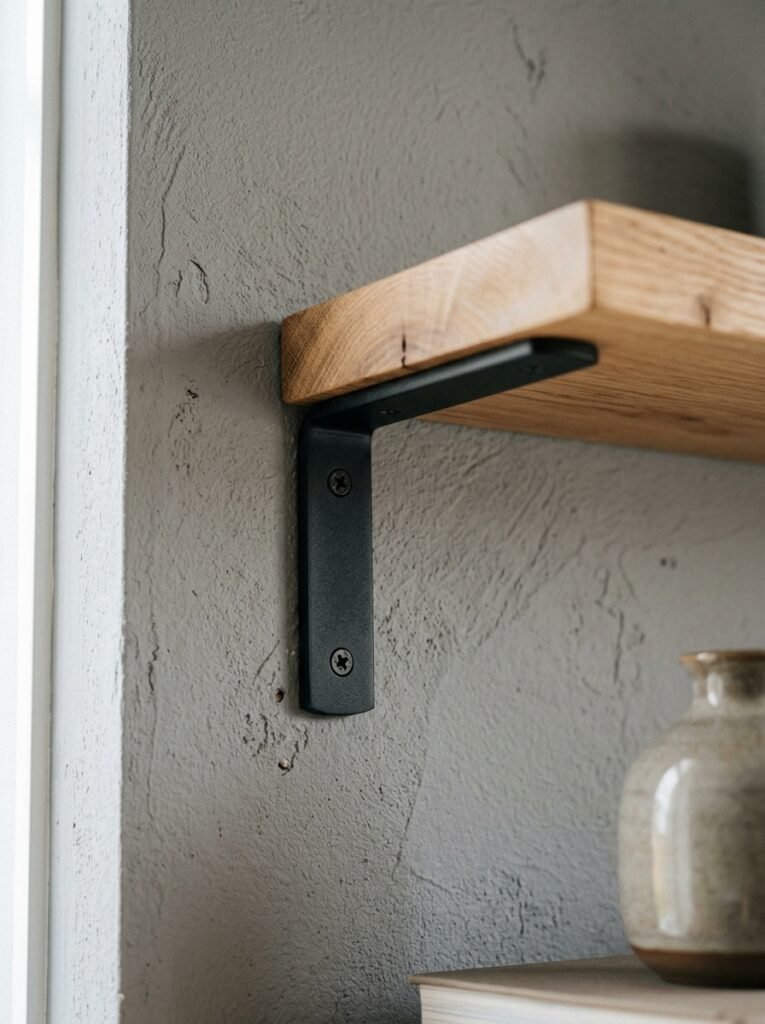
Most people treat shelf brackets as an afterthought. They pick the shelf, then scramble for any bracket that’ll fit, usually ending up with something thin and forgettable or something so chunky it overwhelms the shelf itself.
In a gray room, brackets are visible. They’re part of the look.
Matte black metal brackets are the obvious choice, and they’re obvious because they work. Clean lines, strong visual contrast against the gray, doesn’t compete with anything on the shelf. They let the objects and the wall color be the main event.
But if you want something softer — especially if your gray leans warm — raw brass brackets are quietly beautiful. Not shiny brass, not polished gold. RAW. That slightly muted, almost antique-looking finish. Against warm gray walls with a linen sofa nearby, it’s honestly one of the best combinations in minimalist decorating right now.
White brackets against white shelves against a gray wall essentially disappears the bracket, which works brilliantly if you want the objects to float. Good choice for gallery-style shelf arrangements.
—
6. How to Layer Shelves Without Losing the Minimalist Feel
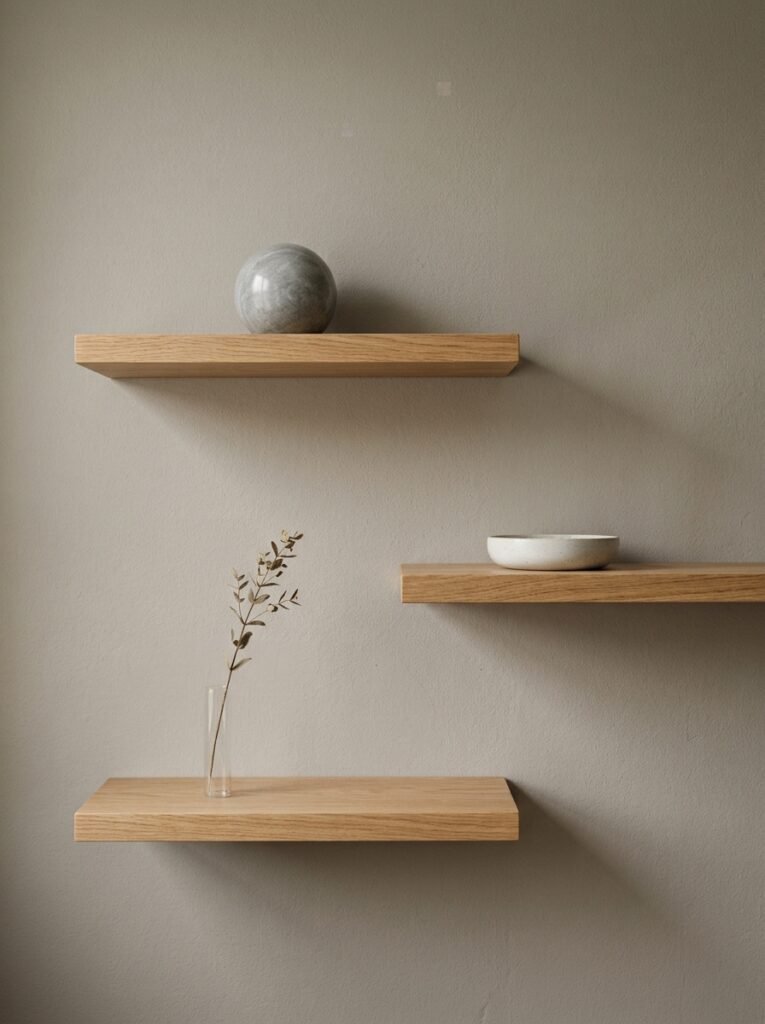
The fear is real. “If I add more shelves, it stops being minimal.” But that’s not how it works.
Minimalism isn’t about having less. Or, well — it’s not ONLY about that. It’s about having nothing unnecessary. And several shelves, styled well, can feel lighter and more intentional than one overstuffed shelf trying to hold everything.
“Three shelves with breathing room will always look more considered than one shelf that’s doing too much.”
The stagger is your friend here. Imagine your wall divided into thirds horizontally. Put one shelf on the left third, high up. One shelf in the center, mid-height. One shelf on the right, lower. They don’t align perfectly, they don’t match perfectly, and somehow that makes the whole arrangement look considered rather than random.
Add a fourth shelf? Go back to one of those thirds and add it close to an existing one — maybe eight inches below, maybe ten above. The slight clustering makes it feel deliberate.
This is the kind of thing that’s hard to describe but you KNOW it when you see it in person.
—
7. The Gray Living Room Style That’s Actually Different in the US vs. the UK
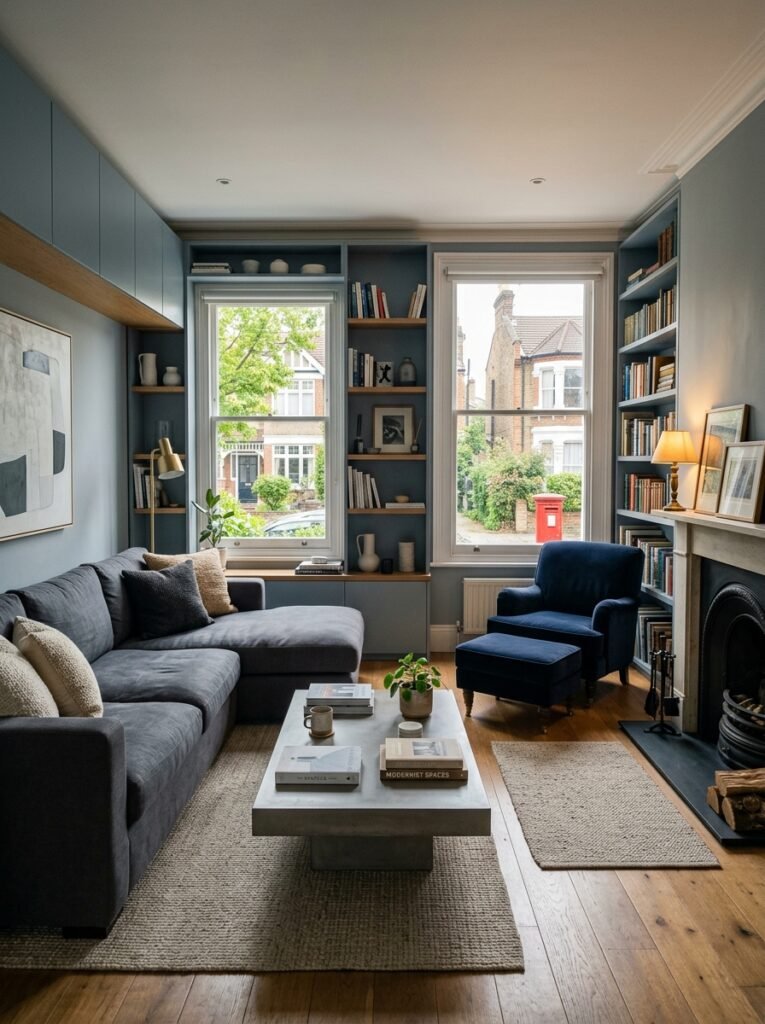
Not gonna lie, I think about this more than most people do.
American minimalist gray living rooms tend to go big and open. Higher ceilings, wider shelves, bolder shelf arrangements. There’s more of an industrial influence — exposed hardware, oversize concrete-look decorative objects, that slightly raw edge even in polished homes.
British gray rooms are more restrained. Older houses, lower ceilings, smaller rooms. The minimalism tends toward softness rather than starkness — more linen, more plaster-finish accessories, a gentle layering that doesn’t shout. Shelf styling in a British gray room often includes more books, more quiet ceramics, fewer statement pieces.
Both are beautiful. Both work. But if you’re pulling inspo from American pins for a British semi-detached with nine-foot ceilings and a bay window — scale everything down and soften the edges, or it’ll feel like you’re trying too hard.
—
8. The Plant You Put on a Shelf Changes Everything
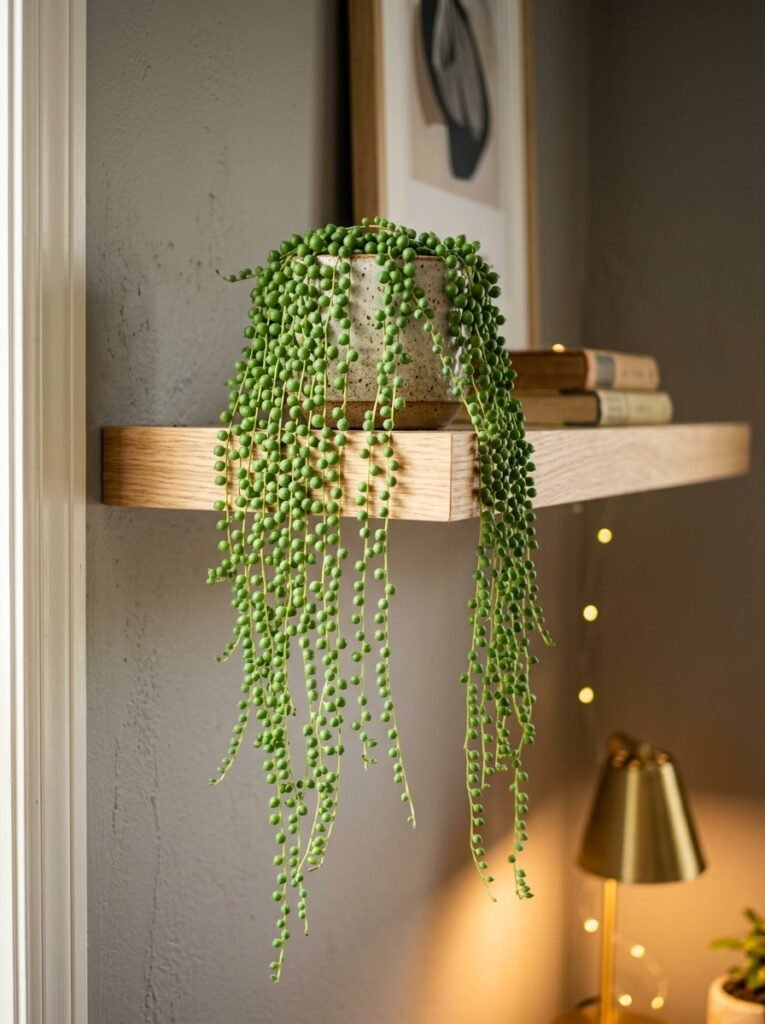
Not the biggest topic. Not glamorous. But I keep coming back to it because it’s so consistently overlooked.
Plants on shelves in gray rooms do something almost chemical to the space. The contrast between cool-to-neutral gray and living green is visually jarring in the best way. Your brain registers it immediately. The room wakes up.
Trailing plants are the obvious shelf choice, and they deserve their reputation. A pothos that’s been there long enough to drape over the shelf edge looks exactly right against gray walls — effortless, a little wild, doing its own thing. String of pearls gives a more delicate, romantic look.
But don’t sleep on upright plants for shelves either. A small sculptural cactus. A single stem in a narrow-necked vase. A compact snake plant on a lower shelf. Upright plants ADD height to the shelf arrangement, which changes the visual rhythm entirely.
One rule: don’t crowd plants on every shelf. One shelf with two plants, the rest without. Otherwise it starts to feel like a garden centre and you lose the minimal quality the gray walls are working so hard to create.
—
9. The Color That Keeps Showing Up in Beautiful Gray Living Rooms Right Now
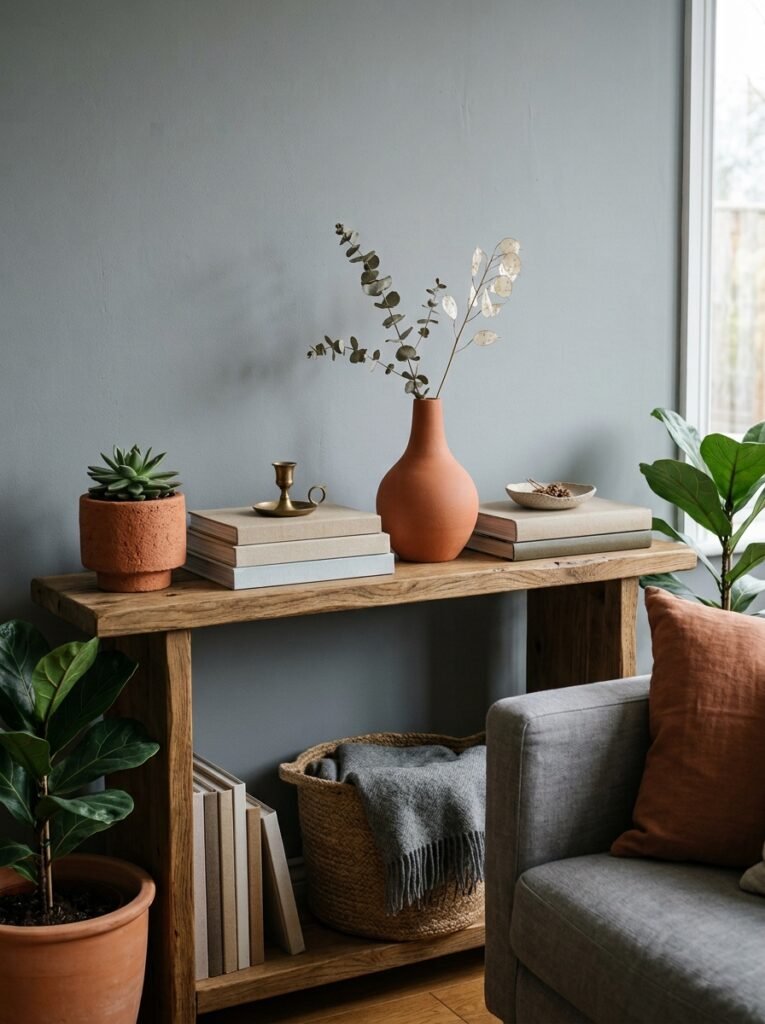
Terracotta.
I know. You’ve heard it. It’s been “trending” for so long that some people are already over it. But here’s why it keeps showing up in gray rooms specifically: it’s the warmth that gray desperately wants.
A single terracotta pot on an otherwise neutral gray shelf is worth more than ten carefully styled white ceramics. It’s not subtle. It doesn’t blend in. It says here I am against the gray and it means it.
In a more muted way, dusty rose and rust tones do the same job. So does aged amber — think honey-colored glass, warm-toned candles, anything in that deep yellow-orange range.
The trick is to not go overboard. One anchor color. Two, maybe three objects in that tone, spread across the shelving arrangement. Everything else neutral. The gray walls will make those warm tones look even richer, like the room turned on a lamp.
—
10. When to Break the Shelf Rules Completely
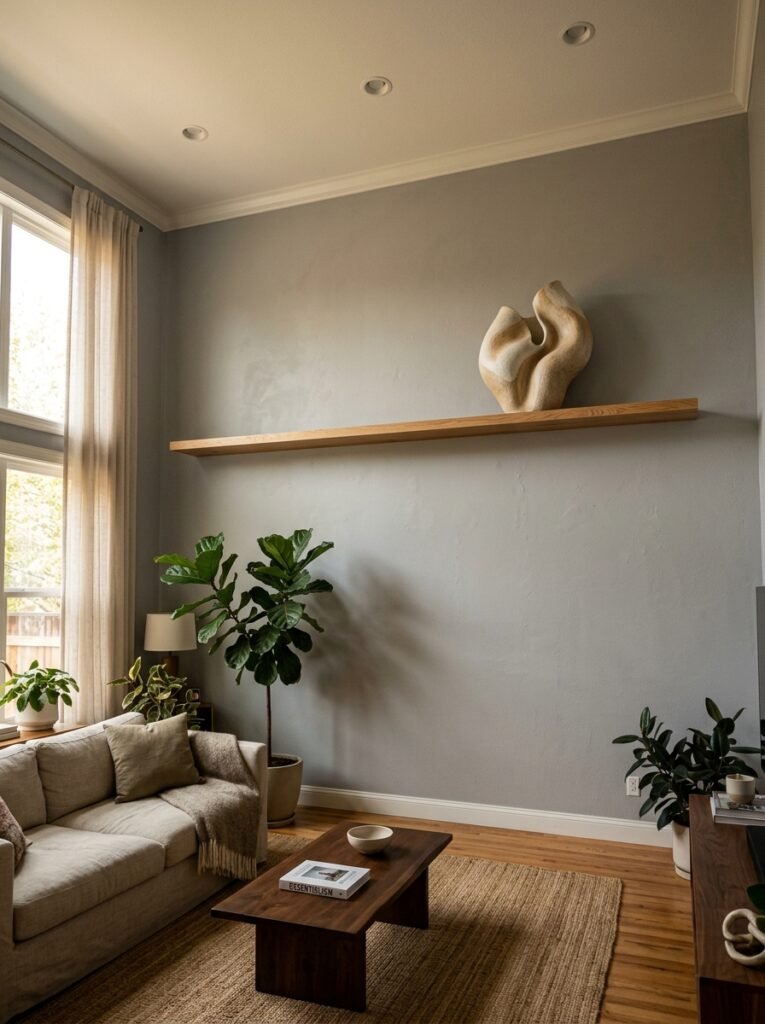
Sometimes rules exist to be ignored. Or, okay, not ignored exactly — adapted.
If your living room is very small (looking at you, British Victorian terrace homeowners), a single long floating shelf at picture-rail height running the entire length of one wall can make the room feel BIGGER. Not smaller. The eye follows the horizontal line all the way across and your brain registers more width. Style it lightly — books, one or two taller objects, a trailing plant at one end.
If your room has an awkward alcove (again — Victorian terrace, you know who you are), built-in or closely fitted shelves inside the alcove with the back wall painted in a darker shade of your gray can turn that awkward nothing-space into the best thing in the room.
“The awkward alcove you’ve been ignoring could be the most interesting thing in your living room — it just needs to commit to something.”
And if you’re renting and can’t put holes in walls — ledge shelves. Narrow rail shelves that lean against the skirting board. Cube storage stacked asymmetrically. There are ways around the restriction that still look deliberate, I promise.
—
11. Lighting the Shelves Without Making It Look Like a Shop Display
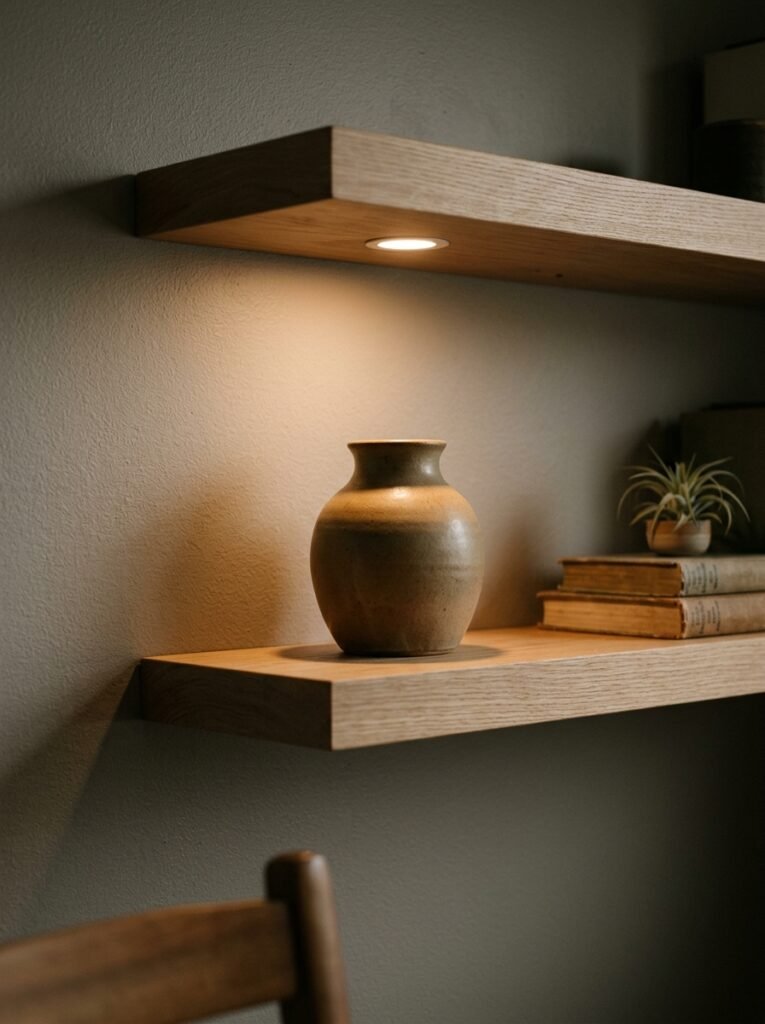
Shelf lighting gets it wrong more often than it gets it right.
The problem is usually direction. Lighting pointed down from the top of a shelf — in a very focused, intense way — creates that retail display effect. It’s too clean. Too performative. Your home isn’t a boutique.
Instead: warm-toned LED strip lighting tucked behind objects, not spotlighting them. Or a small plug-in wall light positioned near the shelf arrangement so it casts an ambient glow over the whole area, not a direct beam at specific items.
The amber glow of a small Edison bulb at 7pm, reflected off gray walls and glancing across the spines of books on a shelf — that’s what shelf lighting should feel like. Accidental. Like it just happened to be perfect.
Battery-powered puck lights tucked on the back edge of shelves work well in rentals or rooms where wiring isn’t possible. They’re small enough to disappear and warm enough to not look harsh.
—
12. The One Shelf That Actually Completes the Gray Living Room
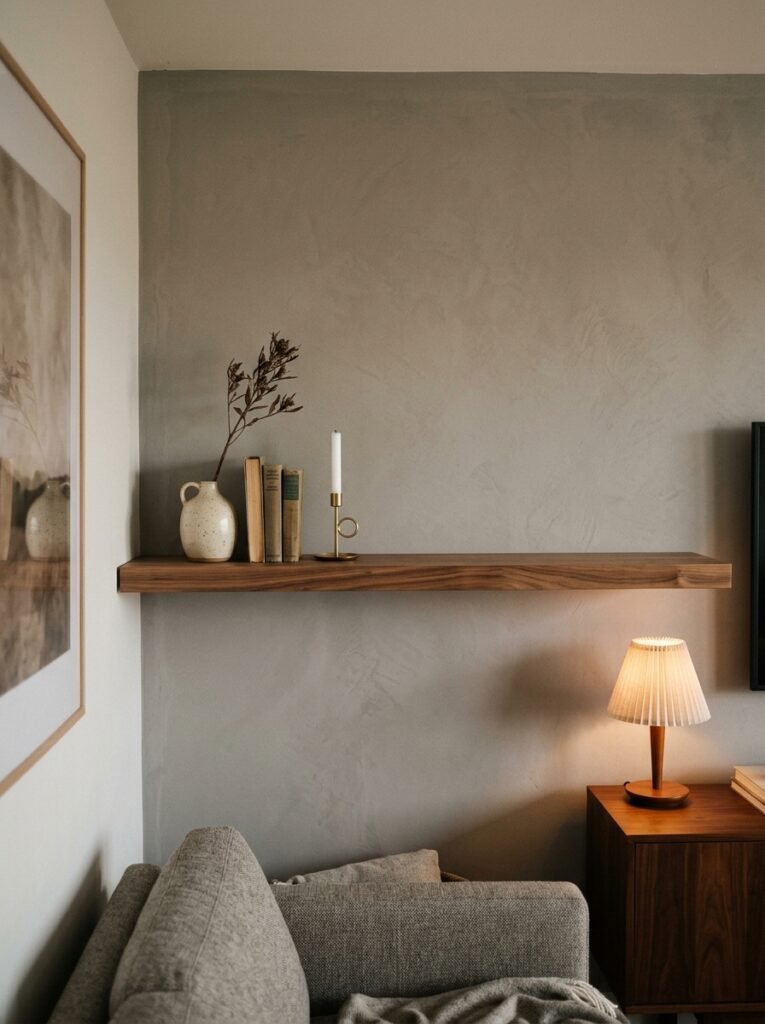
There’s always one shelf that does it. The one that when you stand back and look at the room, your eye goes to that shelf first and thinks: yes. THAT’S the room.
It’s usually not the biggest shelf. It’s not the highest one or the one with the most stuff. It’s the one with the most honesty — the shelf that has the book you’re actually reading right now, the small object you brought back from somewhere, the plant you’ve had since before you moved here.
That shelf earns the whole room.
The gray walls are doing everything right. The brackets are considered. The stagger is good. But without one shelf that feels genuinely yours — not styled, not staged, just real — the room stays in that “waiting room” quality my friend was so frustrated by.
Fill the other shelves deliberately. Fill that one shelf truthfully. Gray loves honesty. It shows everything.
—
❓ FAQ
Q: What’s the best shade of gray for a living room with open shelving? A: It really depends on your light and your shelf material. Cool, blue-toned grays pair beautifully with warm-wood shelves because the contrast is what makes both elements pop. Warm grays work better with darker shelves or matte black hardware. Always test a large paint swatch on your actual wall before committing — gray shifts dramatically depending on the time of day and the natural light in the room.
Q: How do I style minimalist shelves without them looking too bare or too cluttered? A: Think in groups of items rather than single items spread evenly. A cluster of two or three objects with breathing room on either side looks more intentional than lone items parked in the center of each shelf. Vary heights within each grouping — something tall, something low, something that trails over the edge — and you’ll almost always land somewhere that feels balanced without looking staged.
Q: Can I do wall shelves in a rented flat or apartment? A: Yes, though you’ve got more limitations. Ledge shelves that sit on the floor along the skirting board are a genuinely good option for renters — they can look excellent and leave no holes. There are also tension-pole shelf systems designed for renters that fit floor-to-ceiling without wall fixings. If you’re allowed picture hooks but not larger fixings, consider lighter-weight floating shelves with adhesive-backed brackets rated for lighter loads — styled simply, they can look just as good.
—
💭 Final Thoughts
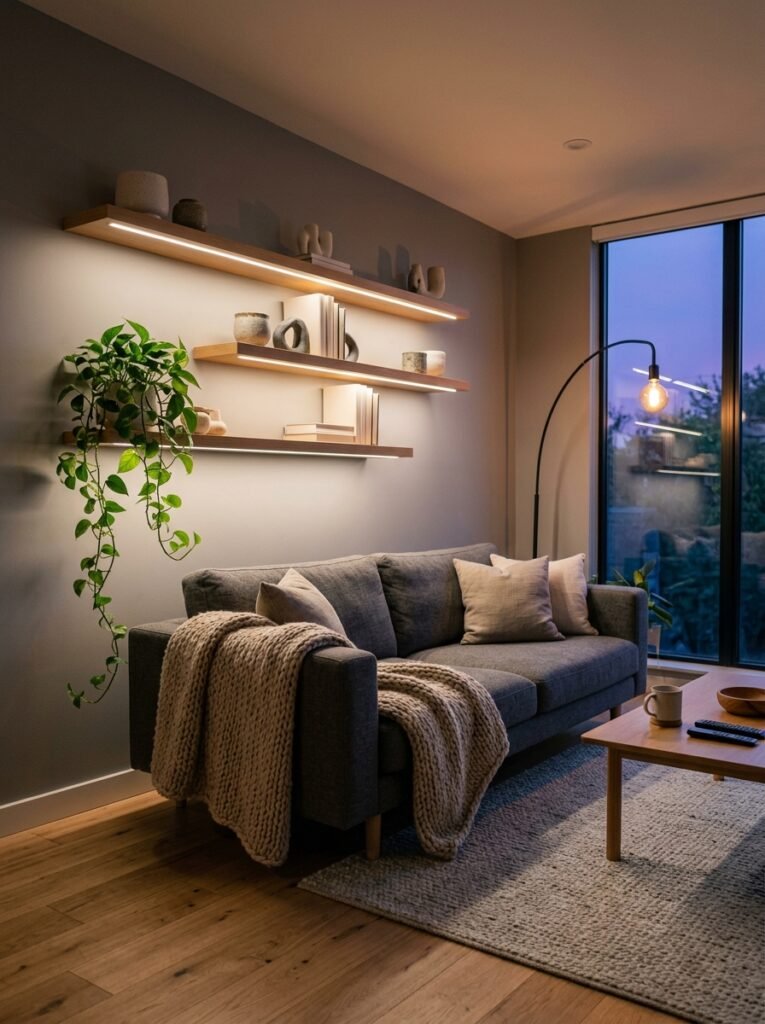
Gray living rooms reward patience. They’re the quiet ones — the rooms that don’t show off immediately but get better the longer you live in them, the more you add and remove and rearrange until it finally clicks.
The shelves are how you hear what the room is asking for. Put something up. Step back. Live with it for a week. The gray will tell you what’s missing.
What’s on your shelves right now — and does any of it actually feel like yours?