Grey Sofa? Good. Now Let’s Make That Living Room Actually Feel Like Something.
You bought the grey sofa because it went with everything. And now it kind of goes with nothing. That’s the trap — and honestly, almost everyone falls into it.

—
1. Why Grey Sofas Feel Flat (And the One Thing That Fixes It Immediately)
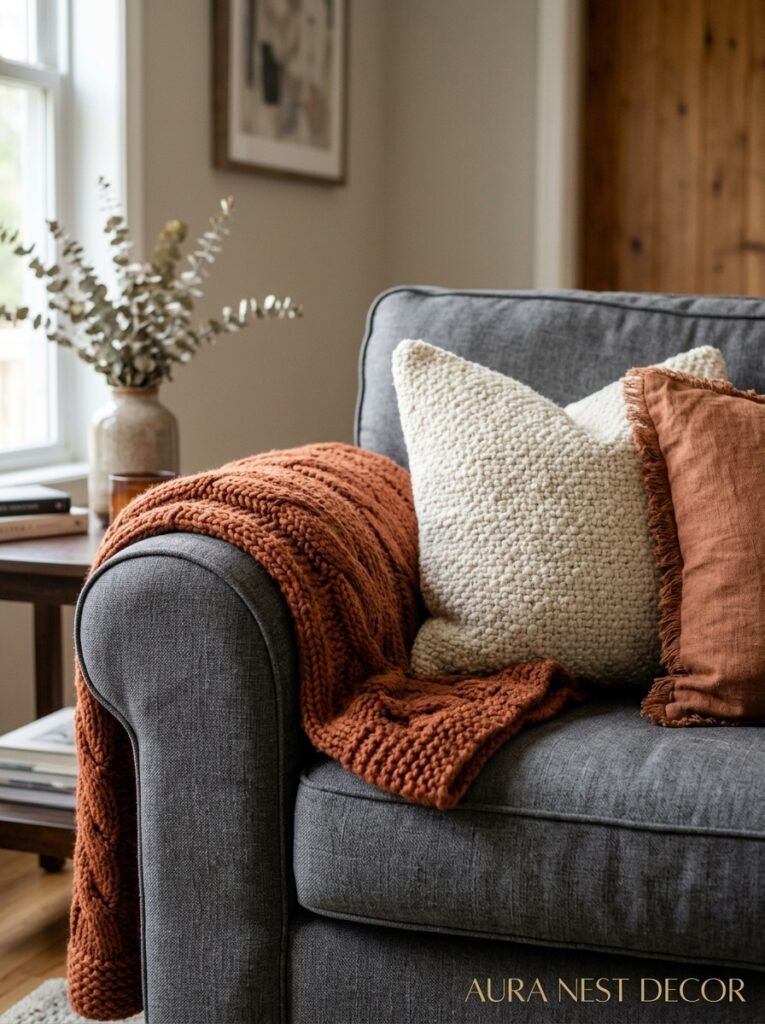
Here’s the honest truth about grey sofas: they don’t have a problem with color. They have a problem with contrast. A grey sofa sitting in a room full of beige and white and light wood doesn’t look sophisticated — it disappears. It becomes the furniture equivalent of a shrug.
The fix isn’t expensive. It’s not even complicated. You need ONE thing in the room that’s darker than the sofa. Not dramatically darker, just… decisively darker. A charcoal throw. A near-black side table. A deep olive plant pot on the floor next to it. That contrast gives the grey something to push against, and suddenly it registers as intentional instead of accidental.
I know that sounds too simple and I don’t care, because it works every single time.
The reason this happens is that grey has no inherent warmth — it borrows warmth from its surroundings. Put it next to cold beige and cold white and you’ve built a room that looks like a hotel that hasn’t been checked into yet. Give it contrast, and the grey starts reading as calm and considered. Completely different feeling.
So before you do anything else on this list — before you pick pillows or rugs or paint colors — go darker somewhere in the room. Anywhere. Just pick one thing.
“Grey doesn’t need more grey. It needs something to stand next to.”
—
2. The Pillow Combination That Looks Like You Hired Someone
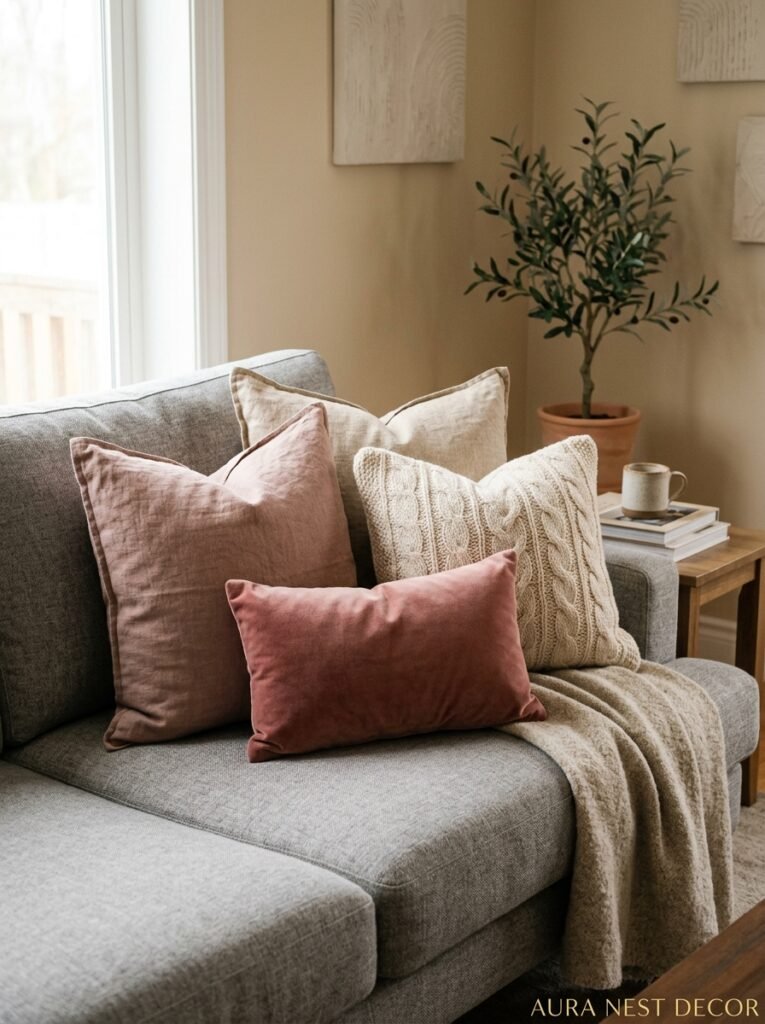
Stop buying matching pillow sets. Please. The four-cushions-in-a-matching-set thing is exactly what makes a living room look like a furniture catalogue instead of a home. What you want is a combination that looks like it came together over time, because that’s what actually looks good.
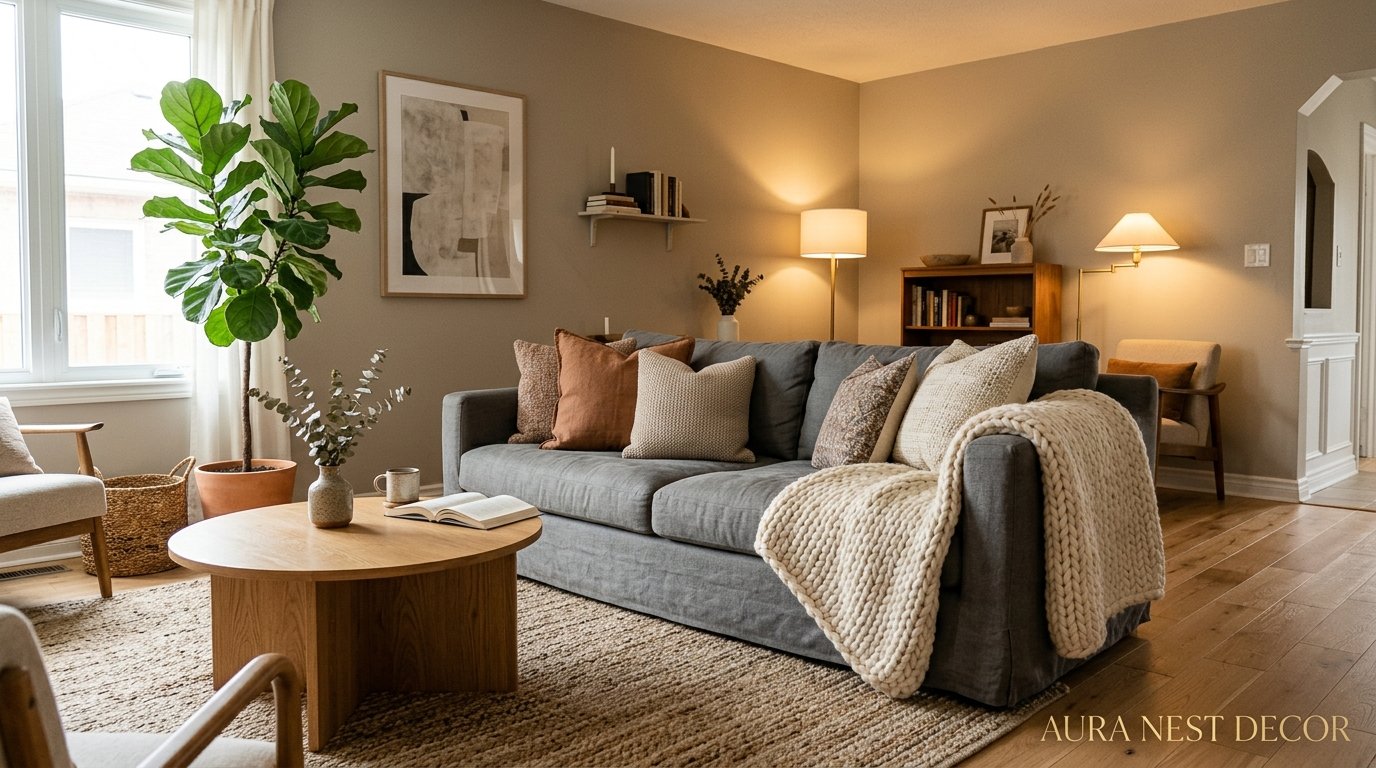
Here’s the combination that works on almost every grey sofa I’ve ever seen: one linen pillow in a warm terracotta or rust tone, one slightly larger pillow in a muted pattern (something with cream and a second accent color), and one textured solid pillow — bouclé, velvet, something with some grip to it — in a color that picks up a note from the pattern pillow.
That’s it. Three pillows on a two-seater, or add a fourth in a complementary solid on a larger sofa.
The pattern pillow is the key player. It does all the connective work, linking the solid colors together so it doesn’t look random. And the texture pillow is what makes people reach out and touch it, which is honestly the goal — you want the room to feel so real and layered that people can’t help themselves.
Rust and cream look incredible on cool grey. Sage green and off-white on warmer grey. Don’t overthink it, but do ditch the matching set.
—
3. The Rug Rule Nobody Talks About (But Every Good Room Follows)
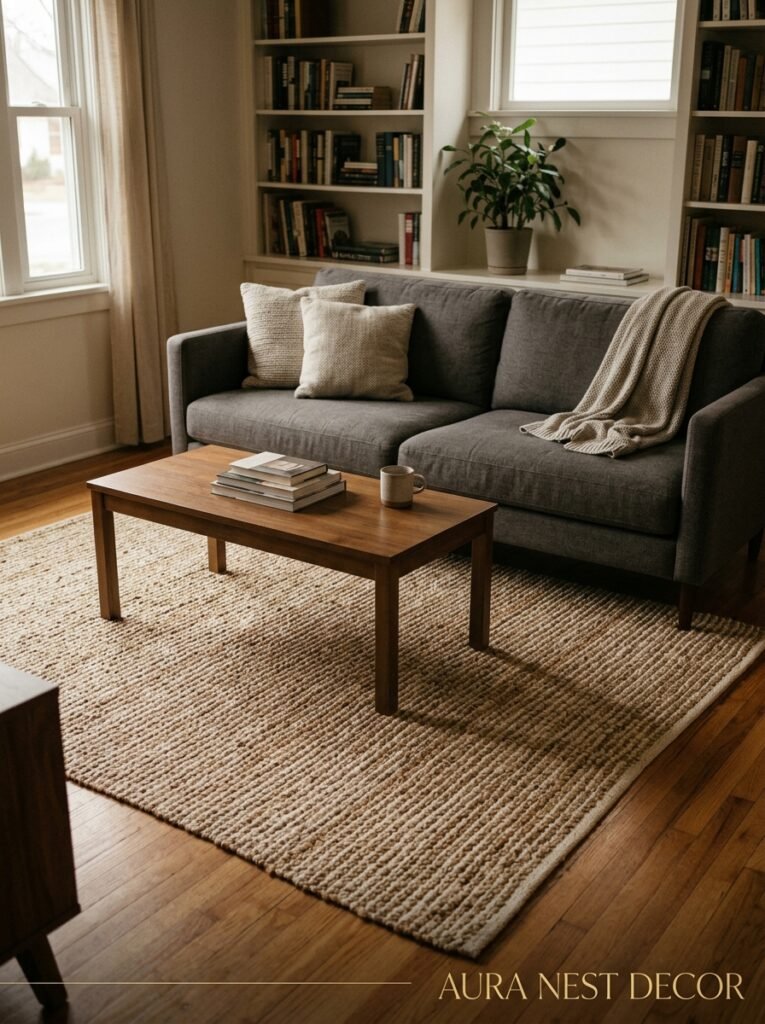
The rug needs to be bigger than you think. That’s the rule. Not slightly bigger — genuinely, probably-makes-you-wince bigger when you see the price tag. A small rug next to a grey sofa makes the whole room look unfinished, like the sofa is floating in the middle of the floor trying to find its footing.
For most living rooms in US and UK homes, you want at least a 8×10 if not larger. All the front legs of the sofa should sit on the rug. ALL of them. Not half. Not hovering just off the edge. On it.
And the color? Go warm. A grey sofa already handles the cool tones in the room, so the rug can and should bring in some warmth — cream, oatmeal, a warm sand, maybe a pattern with terracotta or mustard woven through. Jute rugs work brilliantly here because they’re naturally warm in tone and texture.
Side note — if you have a cool-toned light grey sofa and you put a cool grey rug underneath it, you have created a visual void. The room will feel dim regardless of how much light it gets. Warm rug, cool sofa. That tension is what gives a room life.
—
4. Paint Colors That Make a Grey Sofa Look Expensive
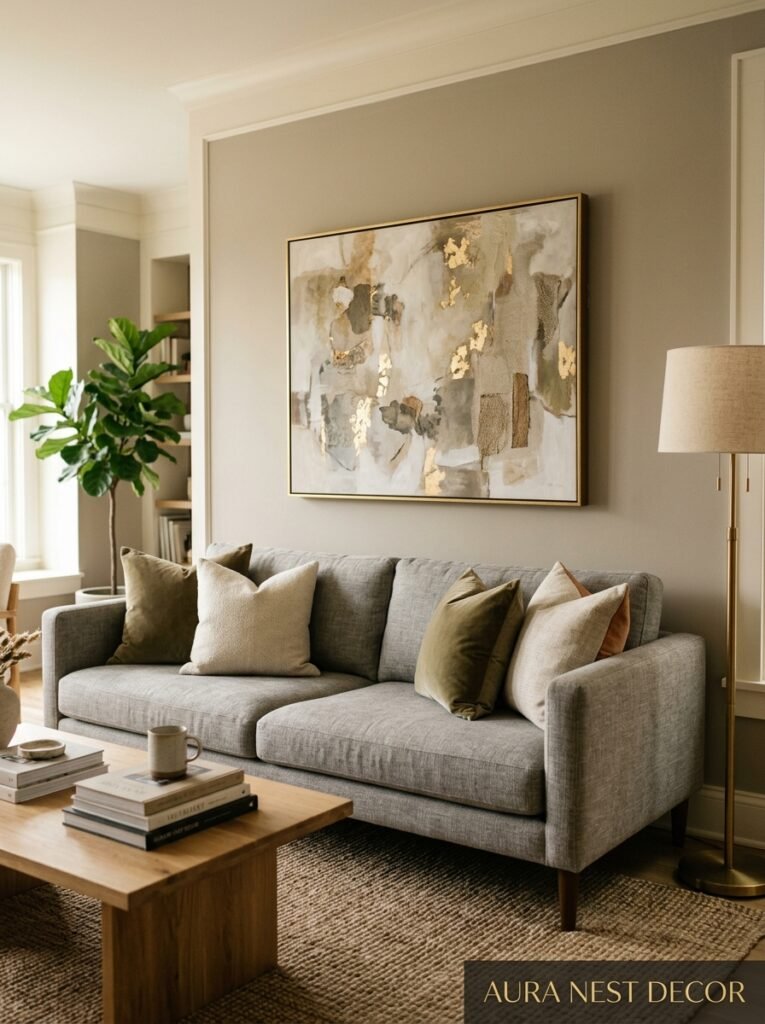
Most people paint their walls white because they think it’s safe. And it can be — but it has to be the RIGHT white. Cool stark whites (anything with a blue or purple undertone) will make your grey sofa disappear into the wall and the room will feel clinical. Think dentist’s office. Not the vibe.
What actually works: warm whites like Farrow & Ball’s “All White” or Benjamin Moore’s “White Dove.” Creamy whites, essentially. The slight warmth in the wall creates contrast with the grey and suddenly the sofa pops without you having changed a thing about it.
But honestly? The rooms that really stop you in your tracks on Pinterest tend to have something bolder going on. Warm terracotta walls with a grey sofa is a combination I can’t stop thinking about. It shouldn’t work on paper and it absolutely DOES in real life. The grey cools down what could be an overwhelming terracotta, and the terracotta gives the grey a reason to exist.
Sage green walls also. Deep sage, not the watery kind — something with some grey in it already, so it bridges the gap. Very British, very Pinterest, very good.
Even a warm mid-tone greige (grey-beige, you know the one) beats a cold stark white for this particular sofa situation.
“The wall color isn’t the backdrop. It’s the other half of the conversation.”
—
5. What to Put on the Coffee Table So It Doesn’t Look Like a Showroom
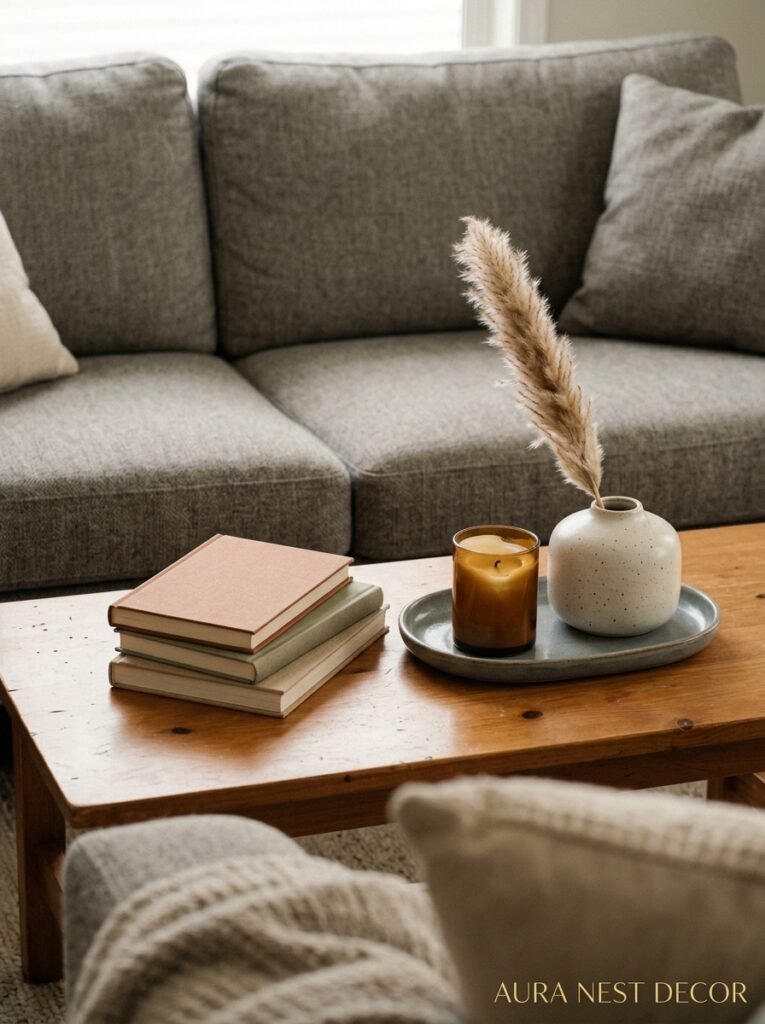
Coffee table styling is where people either get it very right or very wrong, and the wrong version is always the same: three matching decorative objects arranged in a perfectly symmetrical triangle. Please, no.
The coffee table in front of a grey sofa needs to feel lived-in and a little bit personal. Stack two or three books (spines facing different directions, none of that artful-the-same-way arrangement). Put a candle on top of the stack or next to it — preferably one that’s already been burned at least once, because an untouched candle looks like a prop. Add something organic. A small plant, a bowl of stones, some dried stems in a low vessel.
The height variation matters. You want something low and flat (the books), something medium (the candle or a small sculptural object), and something with a little vertical presence (the plant or the dried stems). Don’t match the metals — mix brass with matte black or an aged bronze, it looks more collected and less curated.
And leave some space. The table doesn’t need to be FULL. A bit of the table surface showing is not a failure of styling.
—
6. The Lighting Situation Most People Get Completely Wrong
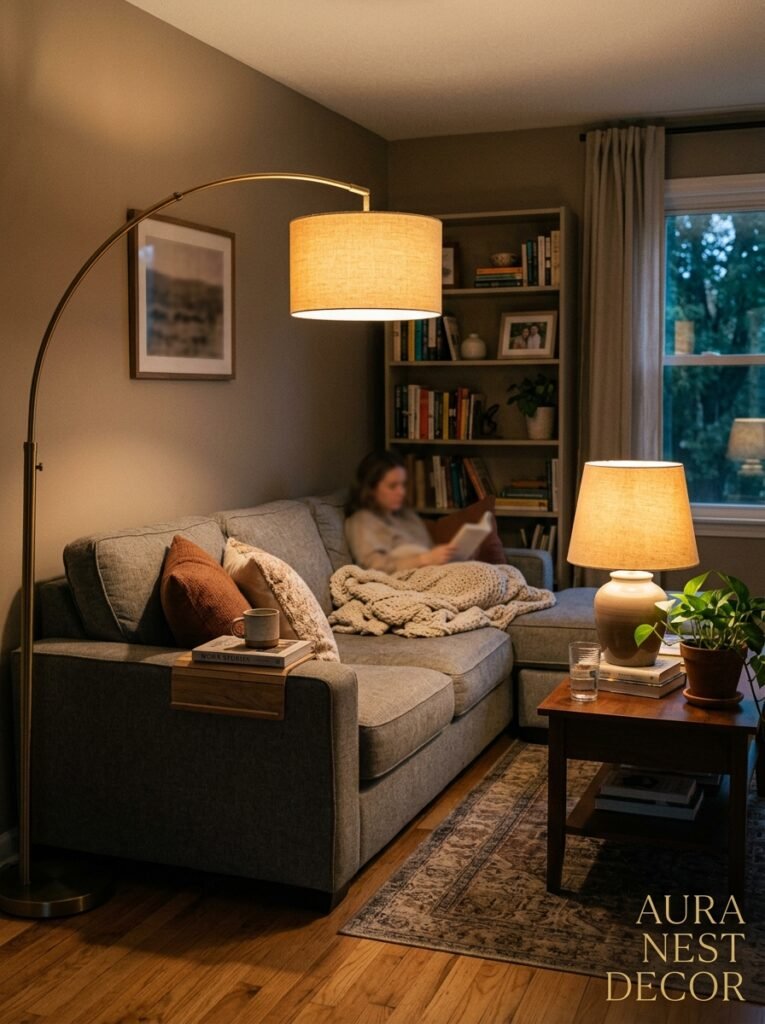
Overhead lighting in a living room is almost always wrong. It points down, it’s harsh, and it makes every grey sofa look like it’s sitting in an interrogation room. Turn off the overhead light and replace it — not with one lamp, but with multiple light sources at different heights.
The amber glow of a floor lamp at 7pm next to a grey sofa is a completely different world than the same room with the ceiling light on. It’s not just softer — it’s warmer in actual color temperature, which means it pours warm light onto the grey and suddenly the whole room feels inhabited.
You want: a floor lamp (ideally with a warm-toned shade, not white), a table lamp on any surface nearby, and potentially some kind of lower light like a candle or a small table lamp on a lower shelf or side table. Three sources. Different heights. All warm-toned bulbs — 2700K is the sweet spot. Not the daylight blue ones. Never those.
The grey sofa genuinely looks different under warm low lighting. Less utilitarian, more like a place someone actually chose to sink into.
—
7. The Unexpected Accent Colors That Actually Work (Especially the One People Are Scared Of)
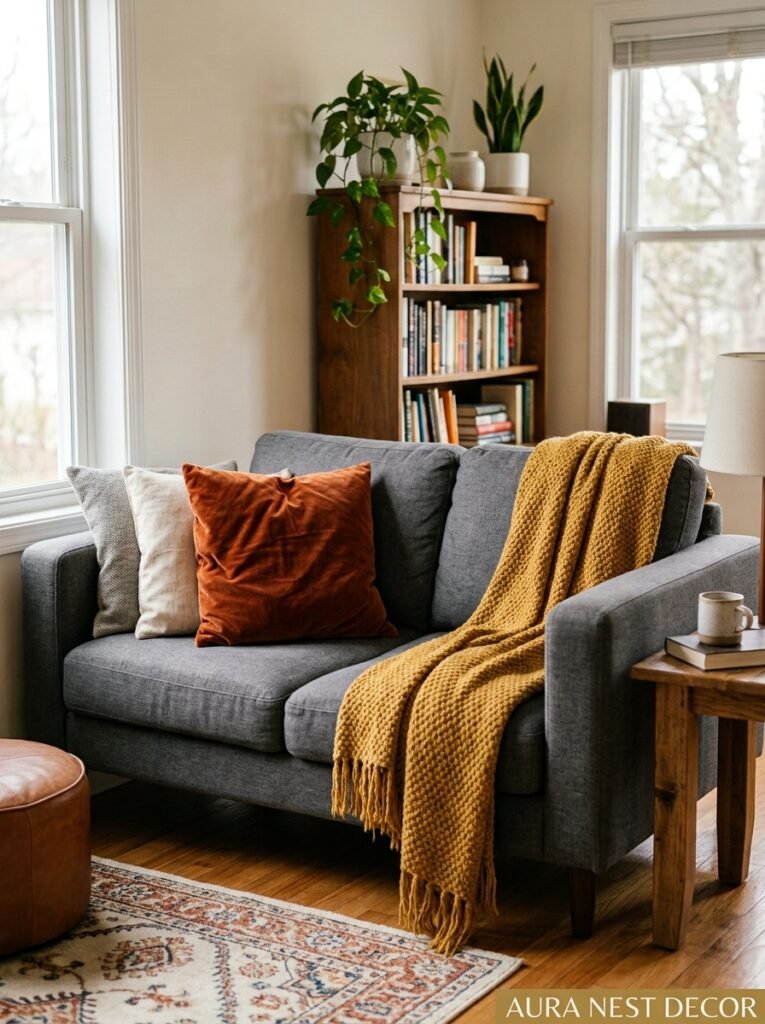
Okay so the obvious ones: rust, terracotta, mustard, sage green. You’ve seen those. They work, and I’ve already mentioned them, but they’re not surprising anyone.
What people don’t talk about enough: blush pink with grey. Not the millennial pink of 2016 — a proper dusty, muted blush, almost a pale terracotta-leaning pink. It sounds very “Instagram 2017” and I promise it doesn’t look that way in real life if you use it right. A dusty blush velvet pillow on a grey sofa looks quietly luxurious. Add a brass lamp and a jute rug and it’s done.
Burnt orange. The deeper, more complex version of orange — not traffic cone, but the color of the inside of a butternut squash in October. One throw in this color draped over one arm of the grey sofa and the whole room looks like it was styled with intention.
And the one people are scared of: forest green. Deep, moody, proper green. A single forest green velvet cushion on a light grey sofa is one of the most satisfying color combinations I’ve ever seen. It gives the room weight and character and it doesn’t match anything technically and somehow that’s exactly why it works.
“The color that scares you a little is usually the one that makes the room.”
—
8. How to Style Around a Grey Sofa When Your Room Is Small
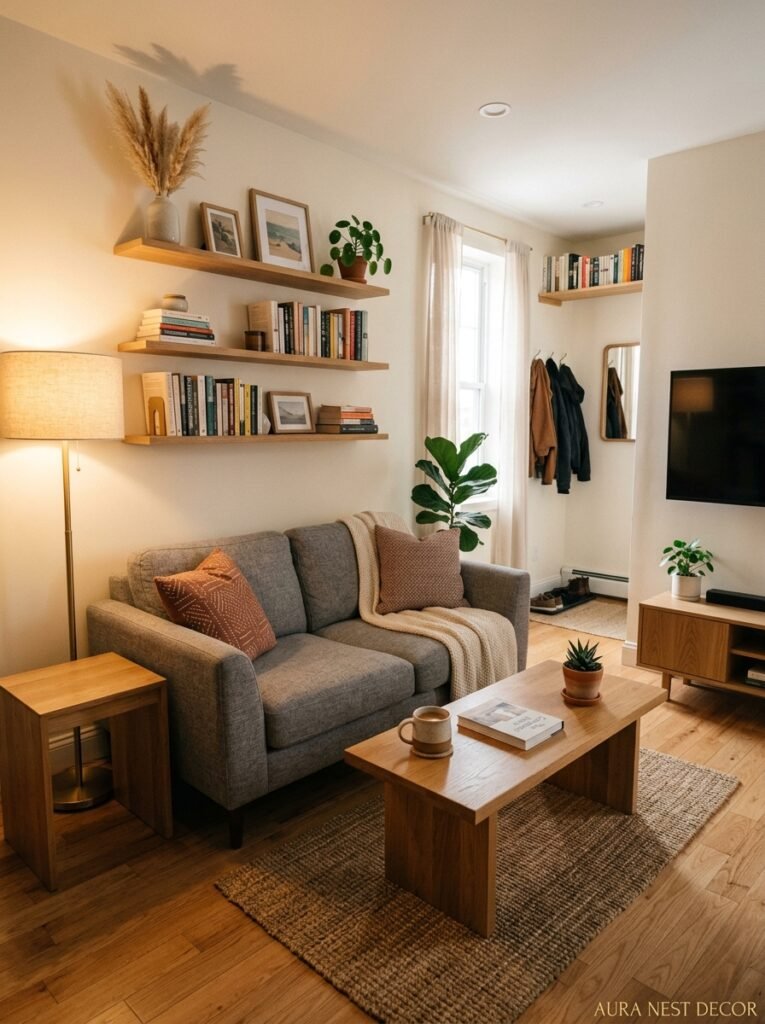
Small room, grey sofa — the instinct is to keep everything light and airy. White walls, pale rug, glass coffee table. And that can work, but it often just makes everything look washed out and vague.
A better approach: commit to the cozy. Lean INTO the smallness. Dark paint on one wall (the one behind the sofa, ideally) makes the room feel more intimate and makes the sofa look like it belongs there rather than trying to float in too much pale space. It’s a counterintuitive move and it’s genuinely good.
A round coffee table instead of rectangular opens up the circulation in a small room dramatically. You don’t need to squeeze past corners. It sounds practical and boring but it changes the feel of the whole space.
Mirrors, but not in a cliché way — don’t hang a big mirror directly opposite the sofa just to “make it look bigger.” That reads dated now. Instead, lean a mirror at an angle, or hang a smaller one off to the side where it catches the window light. The light bounce is what you’re after.
—
9. The Curtain Length That’s Making Your Room Look Shorter Than It Is
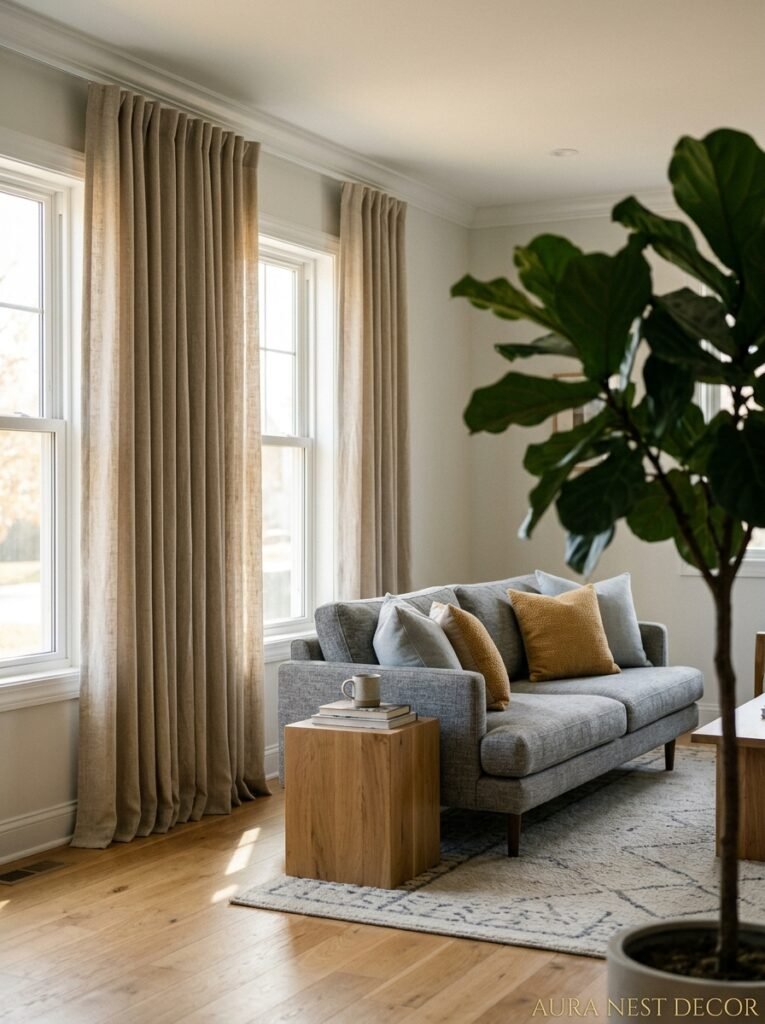
This one is about the grey sofa indirectly, but stay with me. If your curtains don’t hit the floor, they’re cutting the room in half visually and making everything — including the sofa — look squat and stuck. The curtains should skim or pool on the floor. That’s just the rule.
But specifically for grey sofa rooms: don’t go with grey curtains. It feels like a logical choice and it creates a grey-on-grey situation that just… removes all interest from the room. Go with a warm linen in natural or oatmeal, or a proper deep color like navy, forest green, or even a warm rust if you’re going bold.
Hang the curtain rod as close to the ceiling as possible, not just above the window frame. This makes the ceiling feel taller, the windows feel taller, and the room feel like a completely different — better — space. It costs nothing to move the bracket up. It makes an enormous difference.
—
10. The Wood Tone That Pairs Best With Grey (People Get This Wrong All the Time)
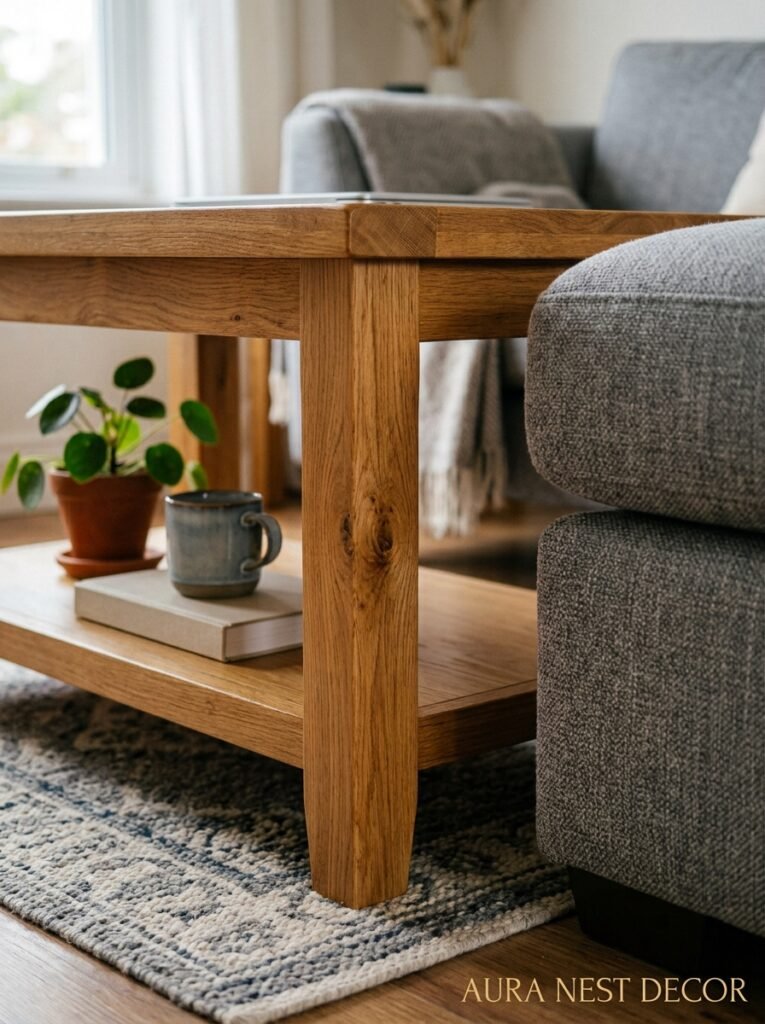
Cool grey sofa plus cool grey undertone furniture wood — again, visual void. The wood in the room needs to be warm to balance the grey, and ideally it should have some actual character to it rather than being a flat, uniform tone.
Walnut is brilliant with grey. The warm reddish-brown of walnut against a cool grey sofa creates exactly the right kind of tension. Rattan and wicker work brilliantly too — they bring warmth AND texture, which is doing double duty.
What doesn’t work as well: light Scandinavian-style blonde wood. It’s lovely on its own, but against grey it tends to read as two different kinds of cold neutrals sitting next to each other without much to say. If you already have blonde wood in the room, lean into warm accessories (rugs, pillows, throws) to compensate.
Painted furniture in dark tones — navy, deep green, even a warm matte black — also works beautifully. It’s less about the wood specifically and more about ensuring something in the room carries real warmth or real depth.
—
11. The Plant That Changes Everything in a Grey Living Room
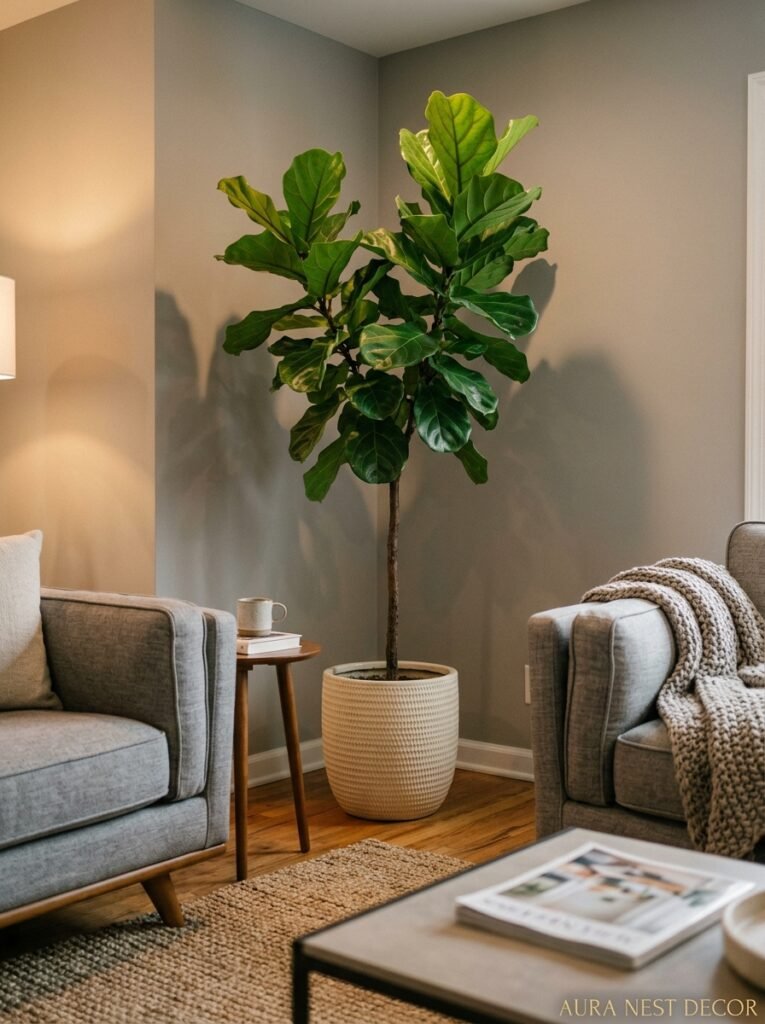
Not all plants do the same thing in a room — I know that sounds weird but it’s true. A small succulents collection on a windowsill is fine and does basically nothing for the room’s overall atmosphere. What a grey sofa living room needs is something with PRESENCE.
A fiddle leaf fig in a tall pot. A monstera that’s had time to get genuinely large. A snake plant in a dark ceramic pot on the floor next to the sofa. These are plants that you look AT, not around, and that’s what changes the energy of the room.
The pot matters as much as the plant, honestly. A gorgeous plant in a plastic nursery pot is a missed opportunity. Get a pot in a warm terracotta, a matte sage ceramic, or a natural rattan basket. That’s the thing that bridges the plant to the room and makes it look like it was placed, not just put somewhere.
The green of the leaves against grey is something that doesn’t need any explanation. It just works. It always has.
—
12. The Final Layer: How to Make a Grey Sofa Living Room Feel Like It Has a Soul
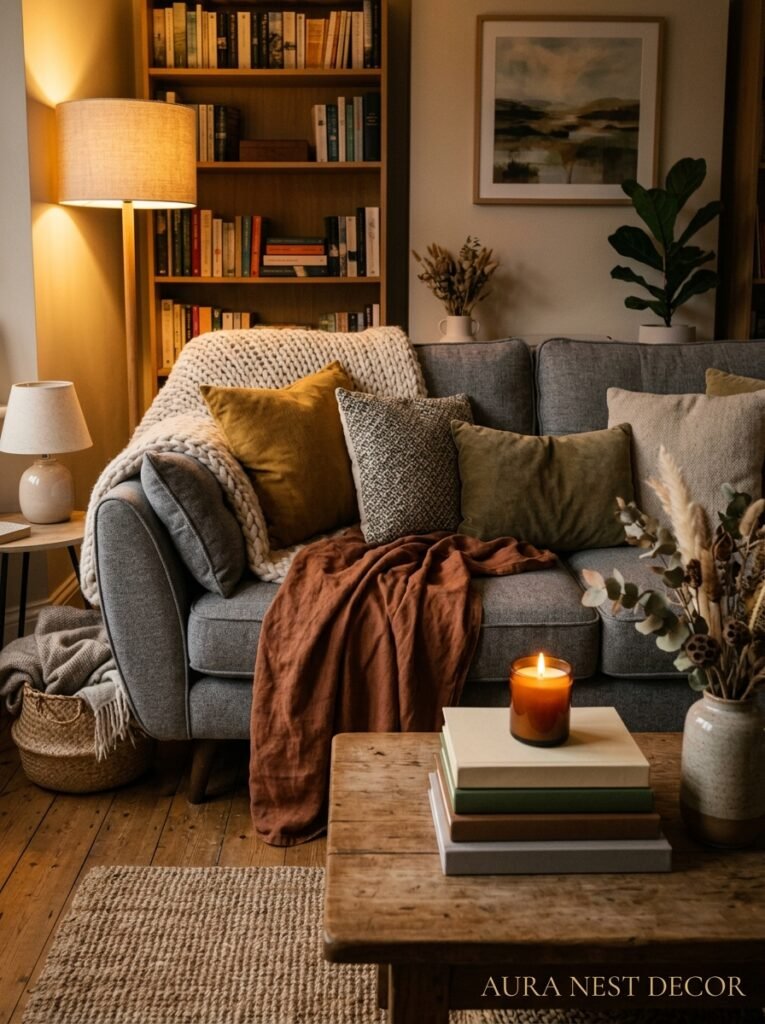
Here’s the thing about grey sofa rooms that are beautiful versus ones that are just… fine. The beautiful ones have something personal in them. A piece of art that has a story. A lamp you found at a car boot sale or a thrift store and repainted. Books that are actually yours and not just stacked for aesthetics. A throw that came from somewhere.
Grey, being neutral, actually requires personality MORE than a bolder sofa choice would. Because the sofa isn’t doing the visual work, the rest of the room has to. And the way rooms get personality is not through expensive things — it’s through specific things. Things that only you would have put there.
So: the textiles, the lighting, the plants, the colors, the art. Make sure at least one element in the room is something that couldn’t have been chosen by an algorithm. Something that makes a guest say “oh, where did you get that?” That question, that moment of genuine curiosity — that’s when you know you’ve done it right.
The grey sofa is just the foundation. Everything good happens on top of it.
—
❓ FAQ
Q: What color walls go best with a grey sofa? A: Warm whites (like Benjamin Moore “White Dove” or Farrow & Ball “All White”), warm terracotta tones, and deep sage green all work brilliantly. Avoid cool stark whites — they make the grey disappear into the wall and the room can feel cold and clinical.
Q: Can you put a grey rug with a grey sofa? A: Technically yes, but it’s risky — grey-on-grey tends to create a flat, low-contrast room that feels dim regardless of how much light you have. If you want a neutral rug, go for a warm oatmeal, cream, or natural jute tone instead, which creates warmth and contrast without competing with the sofa.
Q: What color cushions/pillows look good on a grey sofa? A: Rust, terracotta, dusty blush, mustard, sage green, and forest green velvet all look excellent. The key is to mix at least one textured solid, one patterned pillow that links your colors together, and one accent color that feels a little unexpected. Avoid buying matching cushion sets — they tend to look too curated.
—
💭 Final Thoughts
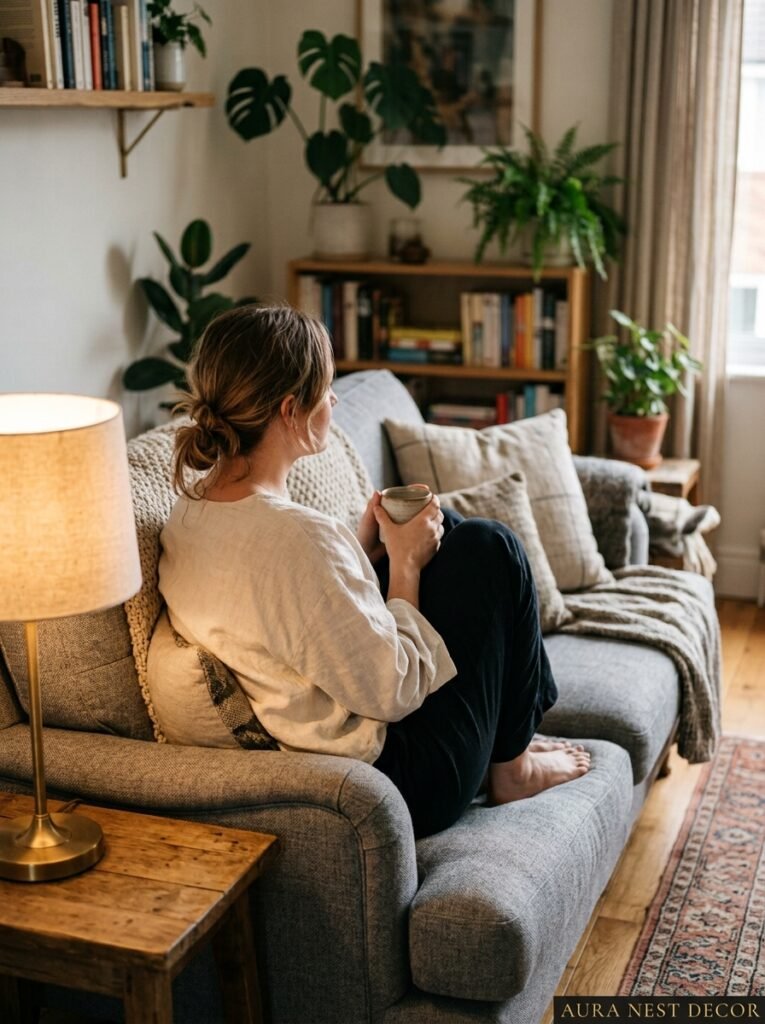
A grey sofa isn’t a mistake — it’s actually a generous starting point, because it genuinely works with almost every direction you want to take. The rooms that get it wrong aren’t missing expensive things. They’re just missing conviction. Pick a direction, commit to it, and add warmth wherever the room feels cold.
What’s the one thing in your living room right now that has a real story behind it?