
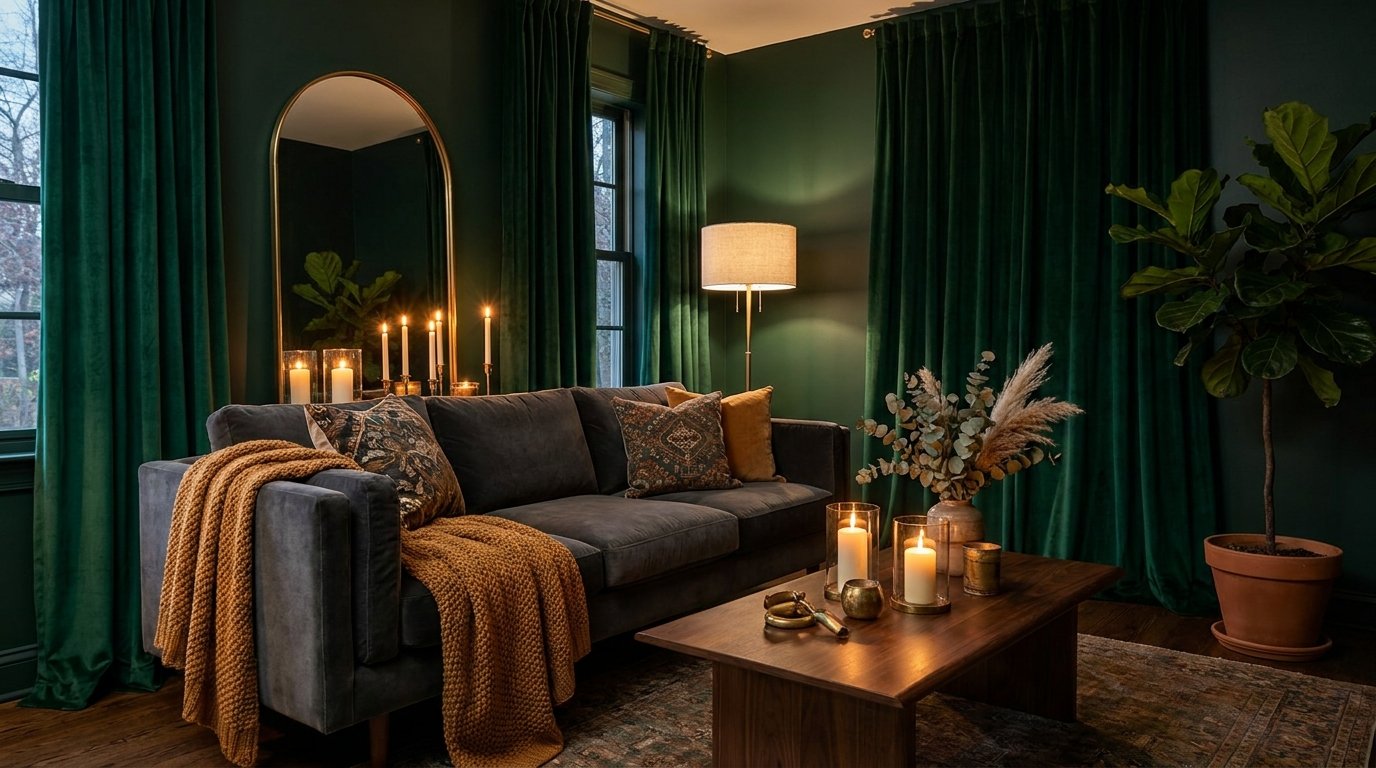
Moody Living Room Ideas That Make You Never Want to Leave Home
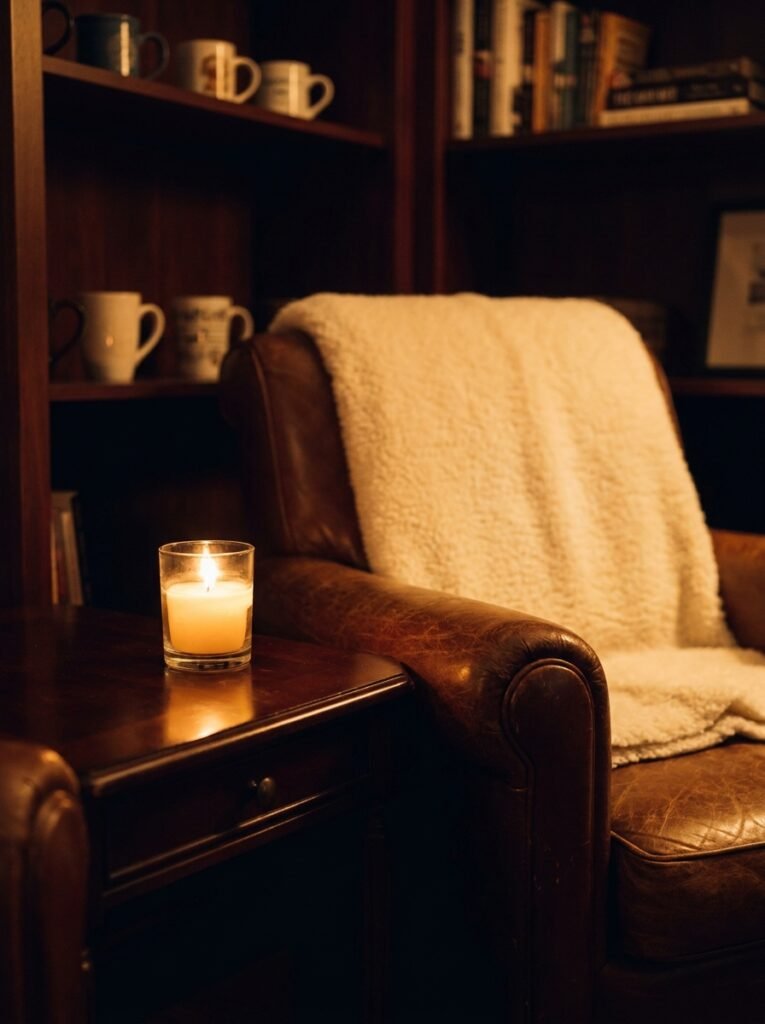
There’s a particular kind of magic that happens in a room that feels like a secret — dimly lit, rich with texture, wrapped in colors that make the outside world feel very far away. If you’ve ever curled up in a corner of a café that felt like it was built just for you, all dark wood and candlelight and the smell of something warm nearby, you already understand what a moody living room can do to the soul.
—
1. What “Moody” Actually Means (And Why It’s Not What You Think)
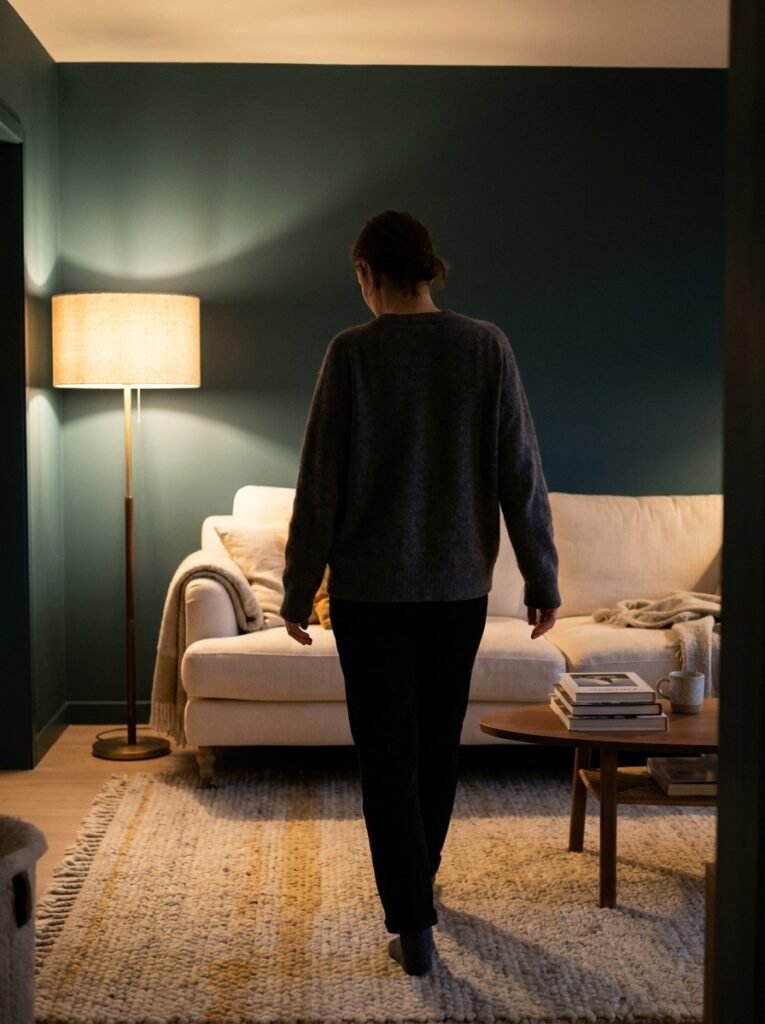
The word “moody” gets misunderstood constantly. People hear it and picture something cold, unwelcoming, or aggressively dark — a room that swallows light and spits out sadness. But that couldn’t be further from the truth. A moody living room is, at its heart, a cozy living room. It’s a room designed with intention, one that creates atmosphere the way a good novelist builds tension — slowly, deliberately, until you’re completely absorbed.
Moody design is about depth. It’s about choosing colors that have weight, layering textures that invite touch, and controlling light in a way that says you are safe here, you can slow down, this space belongs to you. Think of it less as a design style and more as a design feeling. You walk in, your shoulders drop two inches, and you exhale.
“A moody room doesn’t darken your mood — it deepens it. There’s a difference.”
Interior designers often describe moody spaces as having “visual quietness” — a quality where nothing is shouting for attention. Every element is deliberate. Every corner has been considered. And that restraint, paradoxically, creates the most welcoming rooms imaginable.
—
2. The Color Palette That Changes Everything
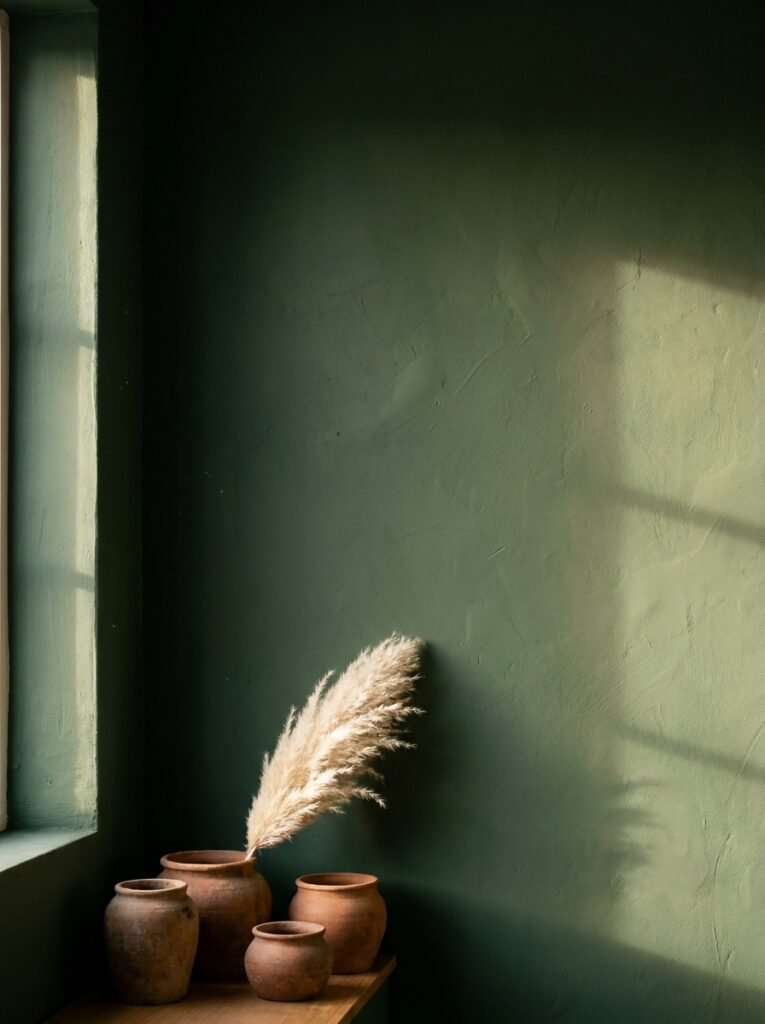
Color is the single most powerful tool in creating a moody living room, and choosing the right one feels a little like choosing a perfume — deeply personal, surprisingly emotional. The most beloved moody palettes lean into deep, saturated tones that carry warmth even in their darkness.
Forest green, in particular, has had a remarkable moment in interior design — and for good reason. It reads as grounded, organic, and surprisingly versatile. It works with gold, with terracotta, with ivory, with rust. Midnight navy carries a similar energy, evoking the feeling of a sky just before stars appear. Charcoal and deep plum are equally powerful, adding richness without the coldness of stark black.
What unifies all of these choices is that they’re not simply “dark” colors — they’re colors with story. When light catches a wall painted in deep sage or shadowed teal, it shifts throughout the day, making the room feel alive. The paint you choose in a moody living room isn’t just a backdrop. It’s a participant.
—
3. The Art of Layering Texture (This Is Where the Magic Lives)
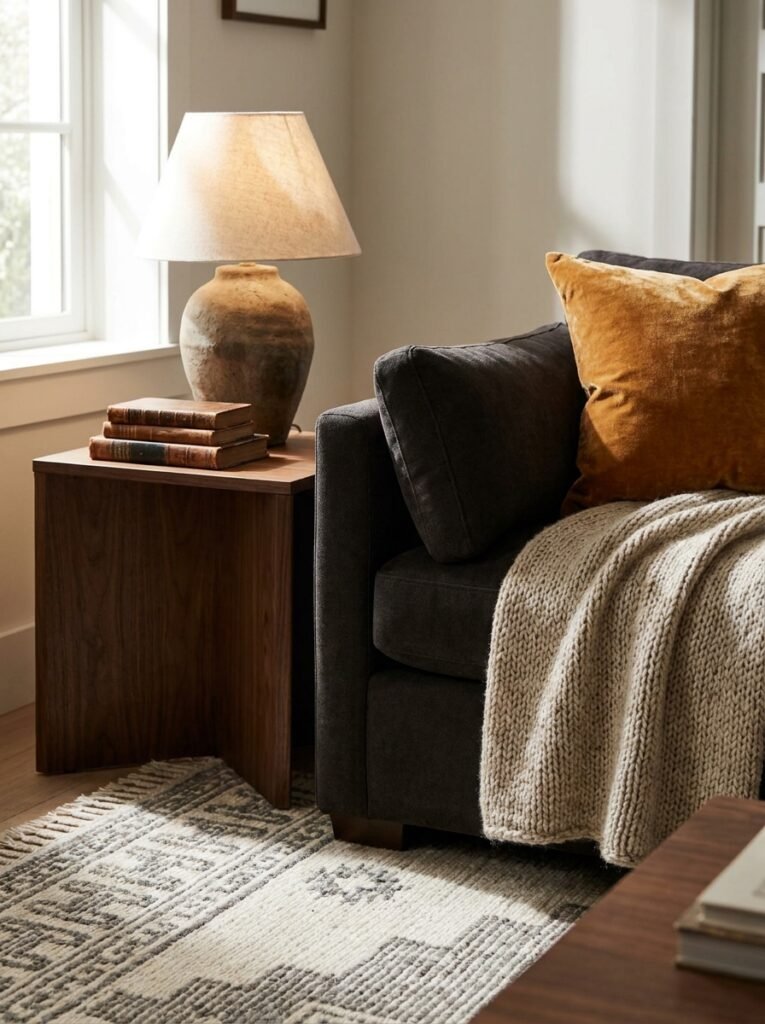
Here’s something designers rarely say loudly enough: in a dark room, texture becomes your light source. When you reduce brightness, the eye instinctively searches for variation — and texture provides it in the most beautiful, tactile way possible.
Imagine a deep charcoal sofa dressed in a chunky knit throw, sitting beside a velvet accent pillow in warm amber, on a floor covered in a low-pile wool rug with geometric patterning. Every single surface in that picture has a different quality. Your eye moves across the room the way it would across a landscape, finding interest at every turn.
This is what separates a moody room that feels rich from one that feels simply dark. Linen curtains that pool slightly on the floor, leather-bound books stacked on a side table, a ceramic lamp with an organic imperfect shape — these details cost almost nothing in terms of budget but add immeasurable warmth. Texture is what makes you want to reach out and touch the room.
—
4. Lighting: The Invisible Architecture of a Moody Room
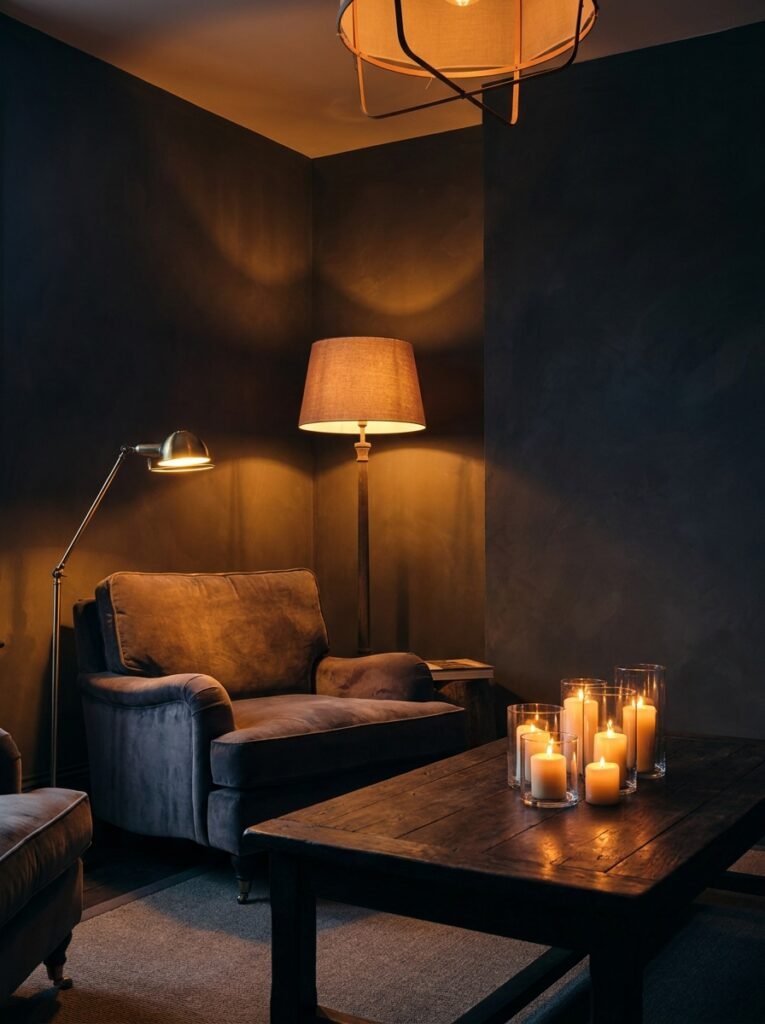
No element shapes a moody living room more fundamentally than lighting — and yet it’s the element most people address last. The mistake is thinking of lighting as a utility rather than a design choice. In a moody space, lighting isn’t about brightness. It’s about placement, warmth, and layers.
The formula that professional designers return to again and again is three-layer lighting: ambient (the general room light), task (focused light for reading or working), and accent (the magical stuff — the warm glow behind a bookshelf, the candlelight on the coffee table, the string lights tucked into a corner). Each layer serves a different emotional purpose.
For moody living rooms specifically, aim for warm bulb temperatures — 2700K or lower. Cool white light is the enemy of atmosphere. Swap overhead fixtures for floor lamps with fabric shades that diffuse light softly. Add a cluster of candles to your coffee table arrangement. Consider a dimmer switch on every light source you can manage — it’s one of the most affordable yet transformative upgrades a room can receive.
—
5. Furniture Choices That Anchor the Mood
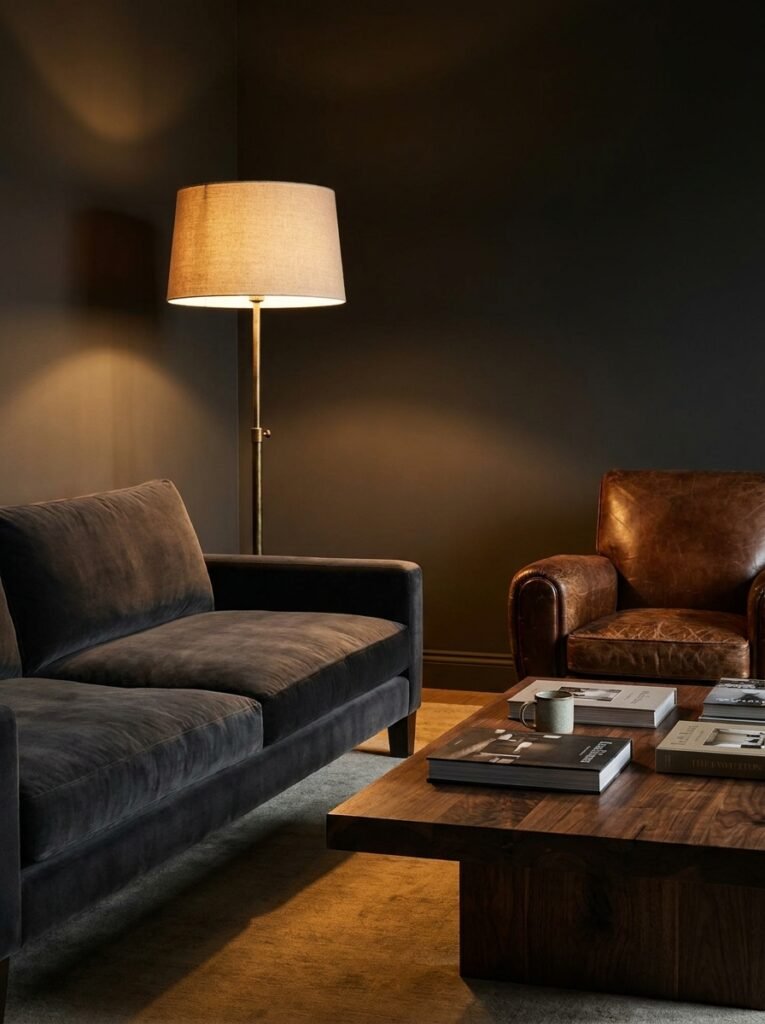
The furniture you choose either deepens the atmosphere or fights against it, and in a moody living room, you want everything pulling in the same direction. Low-profile furniture tends to work beautifully — sofas that sit close to the floor create a sense of groundedness, of being held by the room rather than perched inside it.
“Choose furniture that invites people to stay, not just to sit.”
Materials matter enormously here. Dark wood — walnut, ebony-stained oak, reclaimed timber — adds the kind of warmth that polished chrome simply cannot replicate. Velvet upholstery absorbs light in a way that creates visual depth. Leather, especially aged or distressed leather, brings in that irreplaceable quality of things that have lived.
Consider scale as well. One large, commanding piece — a deep, oversized sofa, or a massive upholstered armchair positioned beside a floor lamp — anchors the room and gives it a sense of drama. Moody rooms aren’t minimalist, but they are selective. Every piece of furniture should feel essential.
—
6. Bringing Nature Indoors: Plants, Wood, and Stone
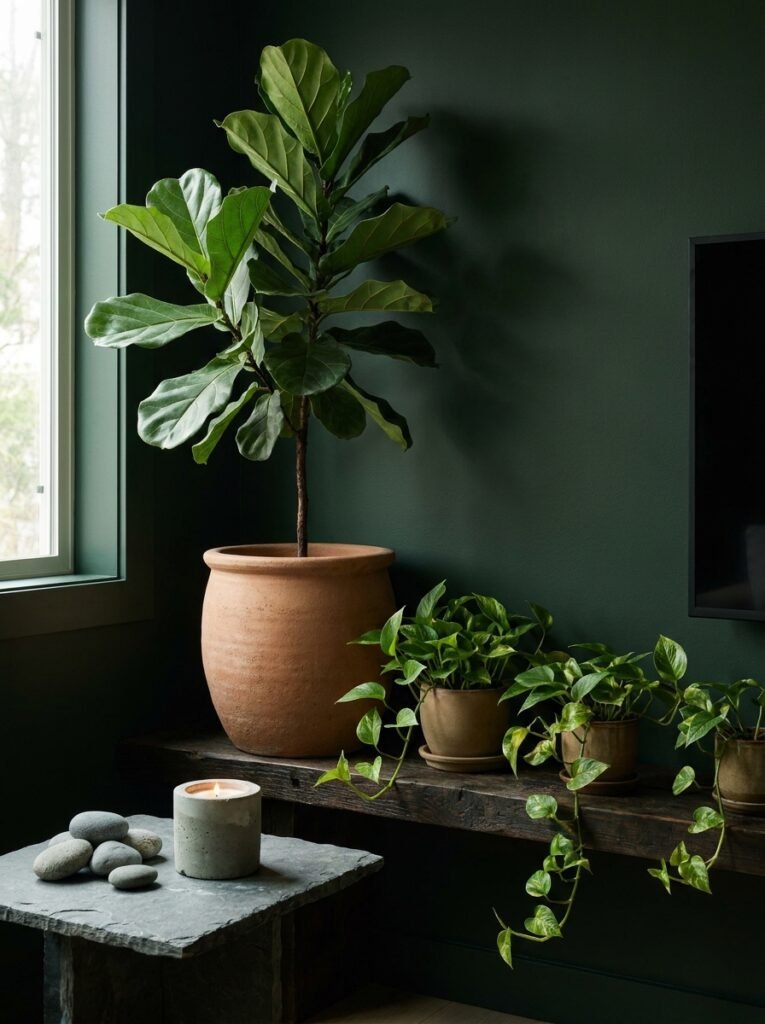
Nature has always been the great equalizer in dark interiors. There’s a reason that every breathtaking moody living room you’ve saved on Pinterest has a plant tucked into the corner, or a wooden coffee table worn smooth with use, or a cluster of stones gathered on a window ledge. These organic elements create contrast that feels alive rather than designed.
Dark walls love the company of lush green plants — the contrast is visually striking but emotionally warm. A fiddle-leaf fig in a terracotta pot against a deep green wall, for instance, creates the same layered quality as a painting. Smaller plants clustered on a windowsill or shelf add rhythm. Trailing plants like pothos or string of pearls soften architectural edges.
Raw stone elements — a slate side table, concrete candle holders, a fireplace surround left in its natural state — add a grounded, elemental quality. These materials remind you, on some wordless level, that the room is connected to something larger than itself.
—
7. The Bookshelf as a Design Element, Not an Afterthought
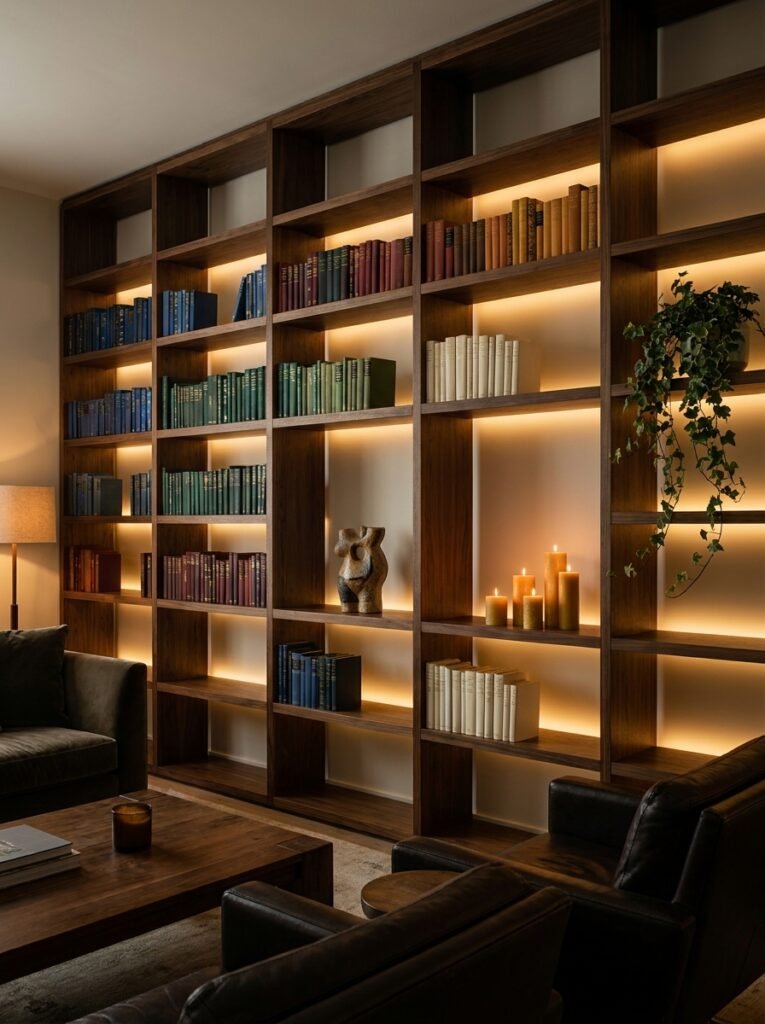
A bookshelf in a moody living room is not just storage — it’s one of the most powerful atmospheric tools at your disposal. Styled thoughtfully, a bookshelf can add color, texture, personality, and depth all at once. It tells the story of who lives in this room without requiring a single word.
The key to moody bookshelf styling is restraint combined with intention. Mix books with objects — a small piece of sculpture, a cluster of candles, a framed photograph, a trailing plant. Group books by color where possible, allowing the spines to create a color story of their own. Leave some space; negative space on a shelf is as important as what fills it.
In darker rooms, a backlit bookshelf — LED strip lighting tucked behind the shelves to create a warm glow — becomes an architectural feature. It draws the eye, adds warmth, and creates the feeling that the room has been thought about deeply, which is precisely the feeling a moody interior should convey.
—
8. Art and Wall Decor That Speaks Without Shouting
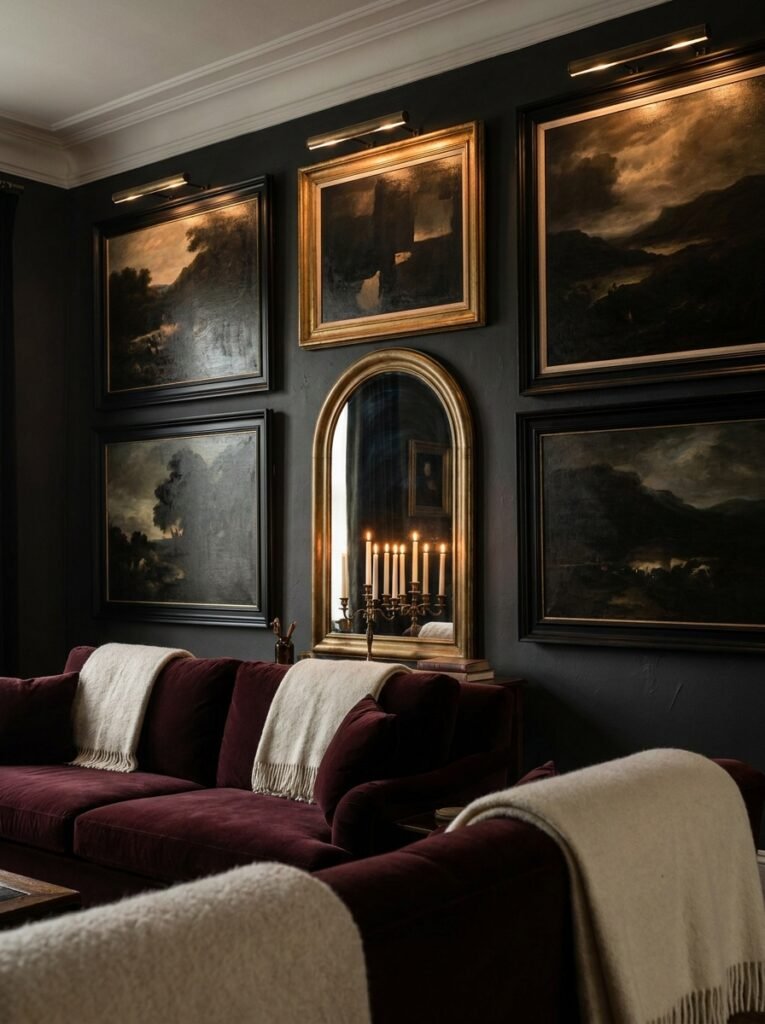
In a moody living room, art should feel discovered rather than displayed. The distinction is subtle but important — when you walk into a room and something on the wall seems to emerge from the darkness, catching your eye gently rather than announcing itself loudly, that’s art working in harmony with its environment.
Large-scale, dark-toned artwork — landscapes, abstract oil paintings, botanical prints in deep frames — tends to work best. A gallery wall in a moody room benefits from cohesion: consistent frame tones (black, dark wood, aged gold), a shared color palette across the prints, and thoughtful spacing that allows each piece room to breathe.
Mirrors deserve special mention here. In a room that embraces darkness, a well-placed mirror doesn’t brighten the space as much as it multiplies it — reflecting candlelight, adding depth, making the room feel larger and more layered simultaneously. An arched mirror in aged brass or a vintage-style carved frame adds exactly the kind of character a moody room thrives on.
—
9. The Coffee Table Arrangement That Sets the Tone
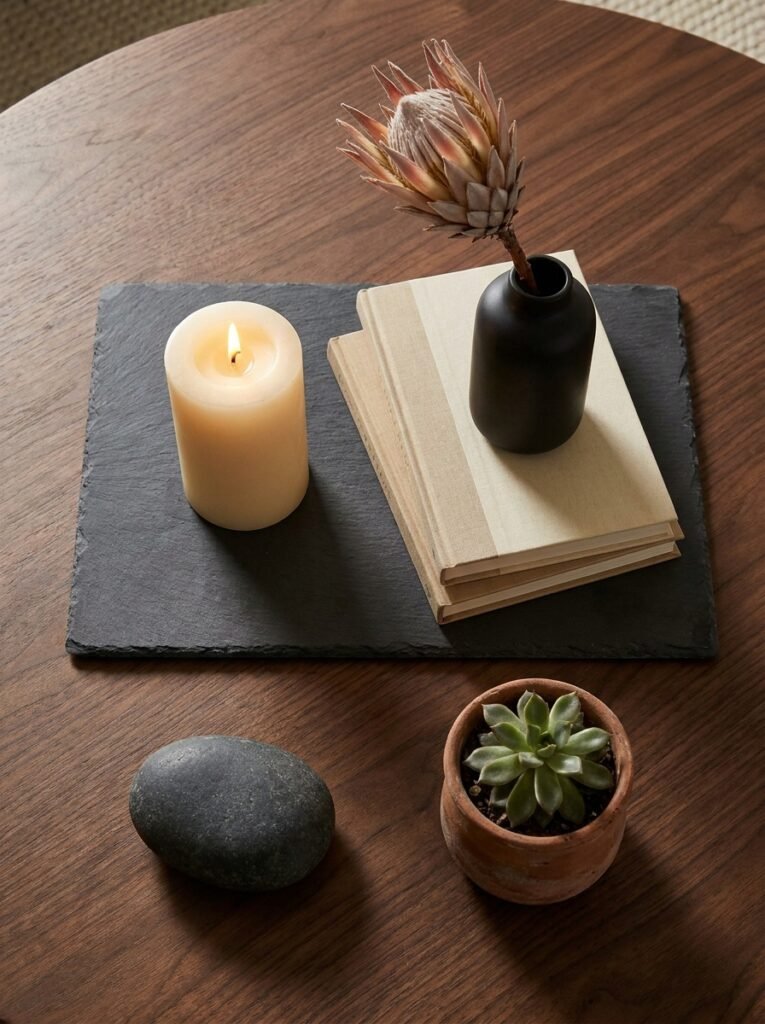
Your coffee table is the room’s gathering point — the place where life actually happens. In a moody living room, the coffee table arrangement should feel curated but lived-in, like something assembled over time rather than styled in a single afternoon.
“The best coffee table arrangements tell a story about the person who lives there.”
Start with a tray in a dark or warm tone — slate, dark wood, brushed brass — to anchor the arrangement and give it structure. Within the tray, layer objects at varying heights: a thick pillar candle, a small stack of art books, a single dried botanical stem in a narrow vase. Outside the tray, allow a few objects to exist freely — a ceramic bowl, a river stone, a small plant.
The goal is controlled imperfection. Everything has been chosen, but nothing looks untouchable. A good coffee table arrangement says people live here, and they love this room.
—
10. Window Treatments That Frame the World Outside
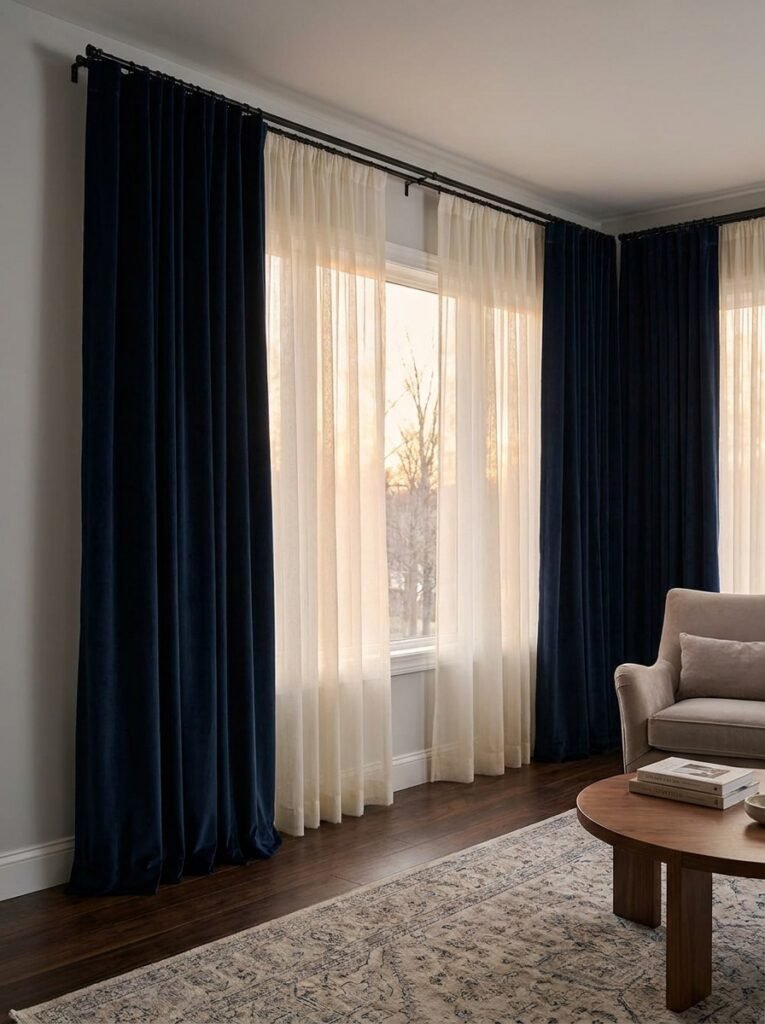
Windows in a moody living room are an opportunity to control light in a way that becomes genuinely theatrical. The right window treatments don’t just block light — they transform it. And in a room built around atmosphere, this distinction is everything.
Floor-length curtains in heavy fabrics — velvet, brocade, thick linen, layered sheers beneath blackout panels — add a sense of grandeur that shorter curtains simply cannot replicate. Hang them high: as close to the ceiling as structurally possible. This single decision makes ceilings feel taller, windows feel larger, and the room feel more intentional overall.
For color, deep curtains that coordinate with the wall color create a cocoon-like effect — a room that feels wrapped. Contrasting curtains in warm cream or ivory provide relief and allow the window to act as a natural focal point. Either approach is valid; what matters is that the choice was made deliberately.
—
11. Scent and Sound: The Often-Forgotten Dimensions of a Moody Room
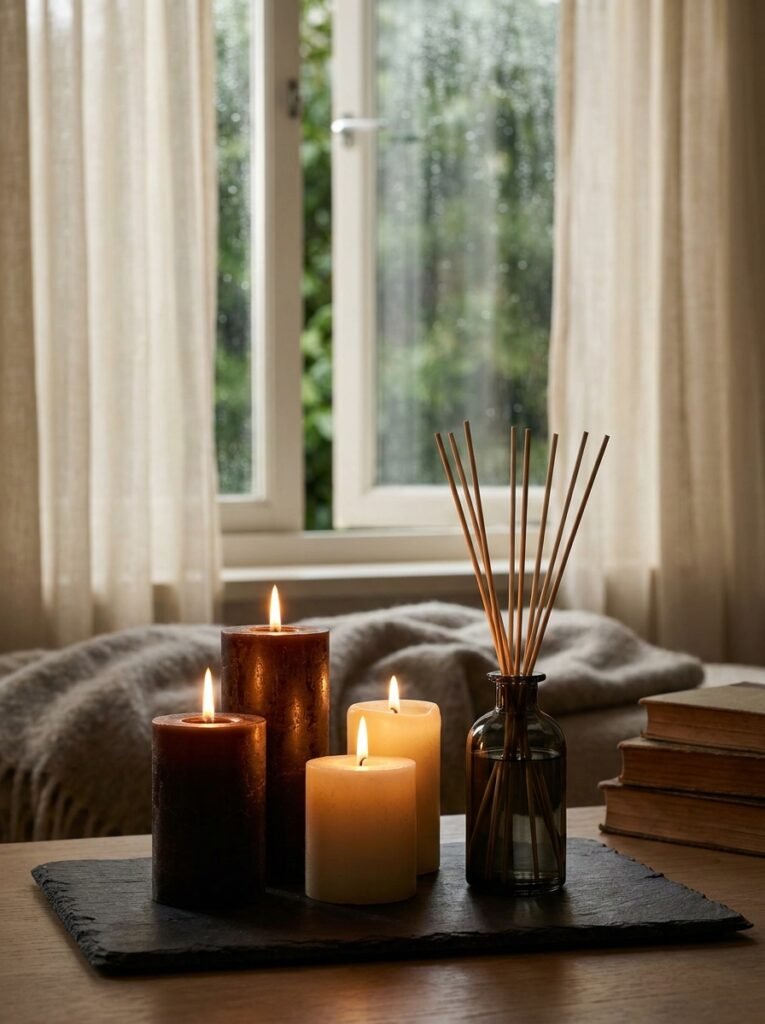
Truly exceptional interior design engages all five senses, not just sight — and the best moody living rooms understand this completely. The atmosphere that makes a room feel like a retreat isn’t achieved by furniture and paint alone. It’s built in layers that include scent, sound, and tactile experience.
Scent, in particular, is staggeringly powerful. The smell of sandalwood, tobacco, black amber, or woodsmoke triggers a specific emotional response — comfort, warmth, a sense of being sheltered. A few carefully chosen candles or a reed diffuser in a complex, warm fragrance can make a room feel profoundly moody even before you’ve registered the decor.
Sound follows naturally. The rooms that feel most atmospheric tend to be quiet — but not empty. Soft background music, the sound of rain through a slightly open window, the low hiss of a fire — these create sonic texture that reinforces the visual mood. Think of your living room as a whole sensory environment, and design accordingly.
—
12. Making a Moody Living Room Work in Small Spaces
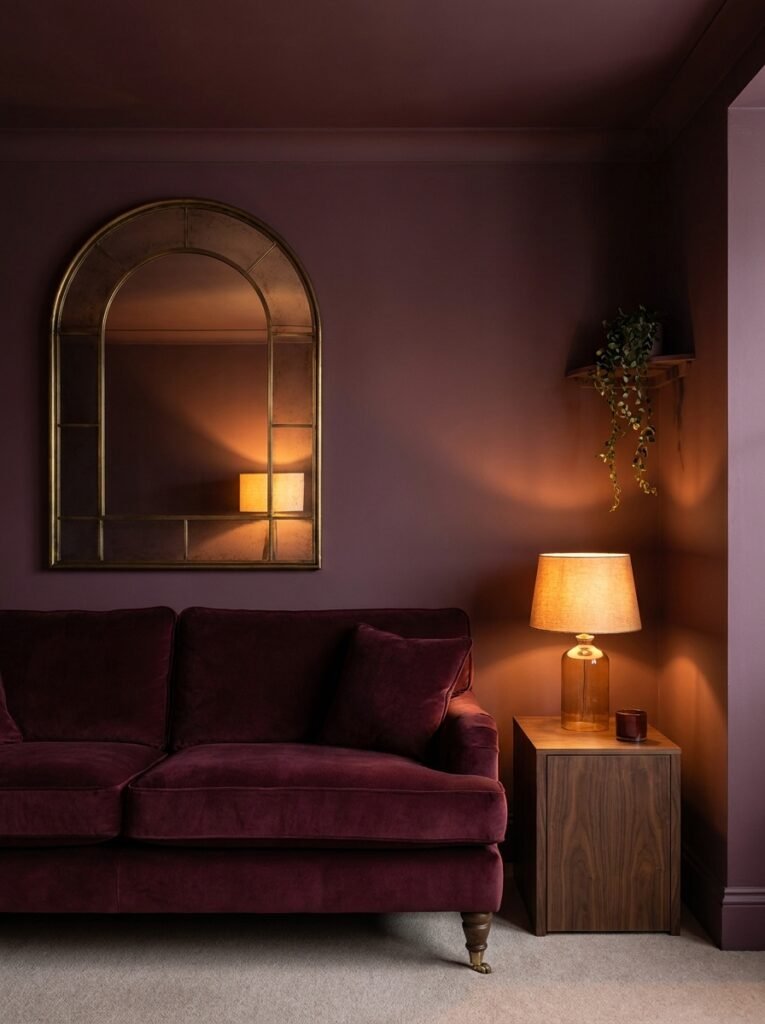
The most common objection to moody design is the fear that dark colors will make a small room feel like a closet. It’s one of the most persistent myths in interior design, and it’s worth addressing directly: a small room decorated with intention, in deep and rich tones, can feel infinitely more luxurious than a small white room that simply feels empty and bright.
The key is scale and cohesion. In a small space, choose one dominant dark tone and keep it consistent across walls — and even ceiling, which creates the beloved “enveloping” effect that moody spaces are built on. Keep furniture scaled appropriately: one or two substantial pieces rather than several small, competing ones. Use mirrors strategically to add perceived depth. Let light sources be warm and soft.
Small moody living rooms often end up feeling like the most beloved spaces in a home — intimate, intentional, impossible to leave. They prove something that designers have always known: it’s not the size of a room that determines how it feels. It’s the care that went into creating it.
—
🌿 How to Build Your Moody Living Room Without Starting Over
You don’t need to gut your entire living room to shift it toward a moodier, more atmospheric feel. Start with your walls — a single deep-toned accent wall behind the sofa can transform the room’s entire character. Then layer in texture with new throw pillows and a warm-toned rug. Replace cool overhead lighting with a floor lamp using a 2700K bulb, and add candles to your coffee table arrangement.
Over time, introduce darker wood elements and replace any stark white accessories with pieces in warm amber, forest green, or aged brass. If you have plants, move them closer to windows and allow them to anchor corners of the room. Let the room evolve gradually — moody design rewards patience and accumulation rather than overnight transformation.
The goal is never a perfect showroom. The goal is a room that, when you walk in at the end of a long day, makes you feel immediately and unmistakably at home.
—
❓ FAQ
Q: Will dark paint colors make my living room feel smaller? A: Not necessarily — and often, the opposite is true. Dark colors can make a room feel more defined and intimate rather than smaller. When paired with good lighting and cohesive decor, a deeply painted room frequently feels more spacious and curated than a white room filled with random elements.
Q: What is the best dark paint color for a moody living room? A: It depends on the natural light in your space and your personal warmth preference. Forest green and deep teal work beautifully in rooms with warm light. Charcoal and midnight navy suit rooms with cooler light or larger windows. Dark plum and burgundy add drama and warmth simultaneously and are ideal for smaller spaces that need richness without feeling cold.
Q: How do I make a moody living room feel cozy rather than oppressive? A: Layered warm lighting is your most important tool — avoid overhead fluorescent light at all costs. Add texture through soft furnishings, include organic elements like plants and wood, and make sure the room has a clear sense of comfort: a throw blanket on the sofa, a side table positioned for a drink beside every seat, and personal objects that make the space feel genuinely inhabited.
—
💭 Final Thought
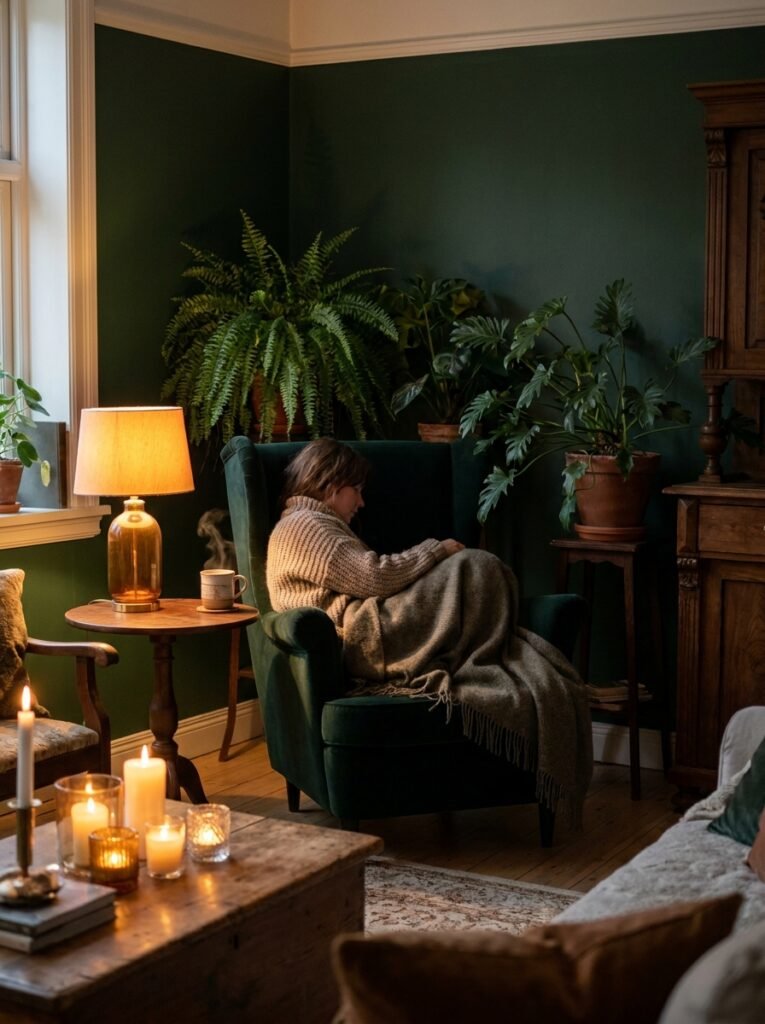
A moody living room is, at its deepest level, an act of self-care — a decision to create a space that holds you rather than merely houses you. It says something quiet but powerful: this space was made for living in, for slowing down, for being fully present. There’s nothing trend-dependent about that impulse. It’s ancient, human, and completely worth pursuing.
So here’s the question worth sitting with: if your living room could make you feel one thing every single time you walked into it, what would you want that feeling to be?