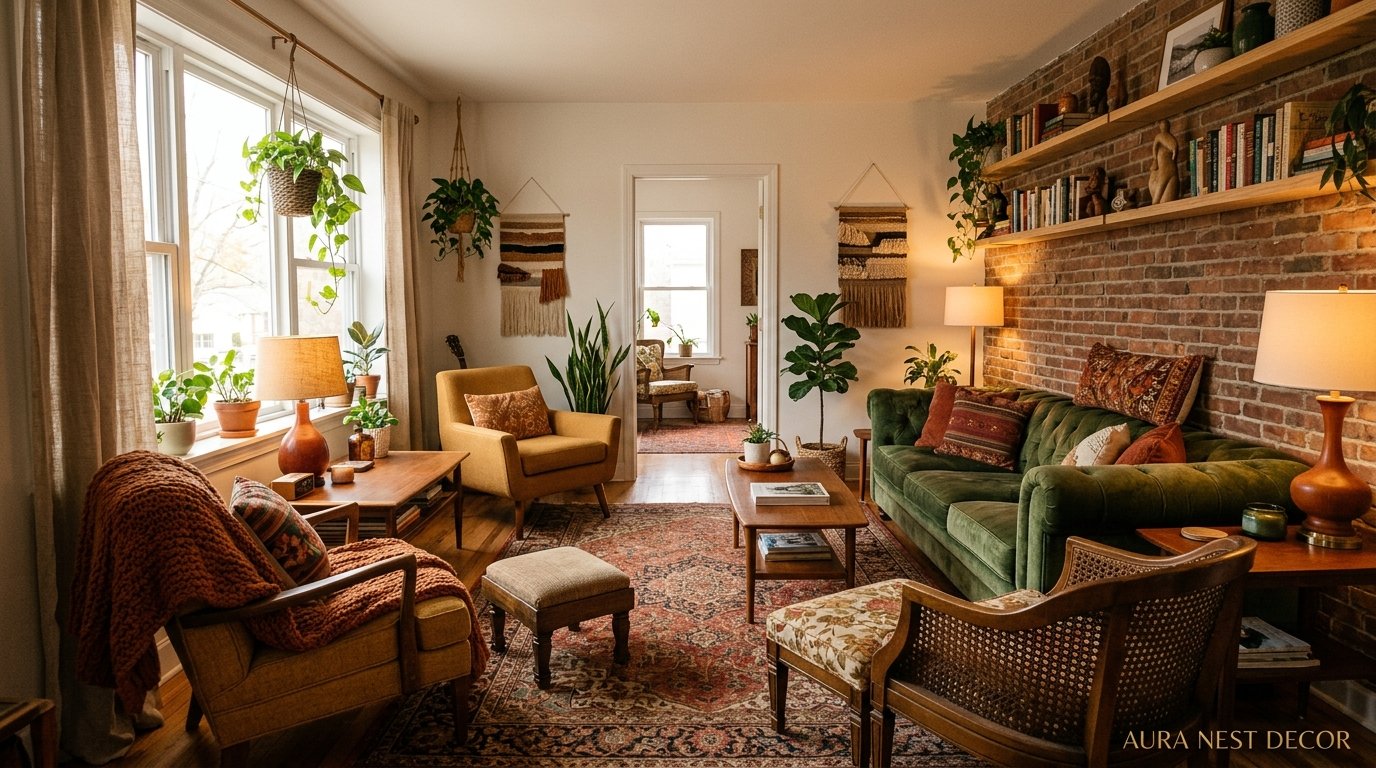
The Cozy Eclectic Living Room I Fell Into Accidentally (And Now Can’t Stop Thinking About)
You know that moment when you walk into a room and your whole body just… exhales? Not a magazine showroom. Not a perfectly styled grid. Something lived-in, layered, a little unexpected — and somehow completely right.
That’s the eclectic living room. And honestly, I think it’s the most misunderstood style in home decor.
—
1. Why “Eclectic” Doesn’t Mean “Stuff You Found at a Car Boot Sale”
Let’s clear this up fast, because I see this mistake everywhere. Eclectic doesn’t mean random. It doesn’t mean you bought twelve things you loved with no plan and hoped for the best — or, well, maybe it does a little, but there’s a crucial difference between chaos and collected.
The eclectic living rooms that stop you mid-scroll on Pinterest? They have a secret. Every single one of them has at least one through-line. Could be color. Could be a material — worn leather, aged brass, raw linen. Could just be a vibe that’s hard to name but impossible to miss. That’s the thing doing the work quietly in the background, tying the Japanese lamp to the Victorian side table to the mid-century sofa.
I think the reason people are scared of this style is that it asks you to have taste and then trust it, which is kind of terrifying when you’re standing in a homeware shop holding a terracotta vase going “is this too much?” Spoiler: it’s probably not too much. It’s probably perfect. But you need a framework before you start layering, and that framework doesn’t have to be complicated. It just has to be yours.
“Eclectic isn’t a free-for-all. It’s a very specific kind of intentional that just looks effortless from across the room.”
—
2. The Sofa Problem Nobody Talks About (And the Weird Fix)
Okay so here’s where I’ll probably lose some people, but stay with me. In a cozy eclectic room, your sofa should NOT be your statement piece.
I know. I know!
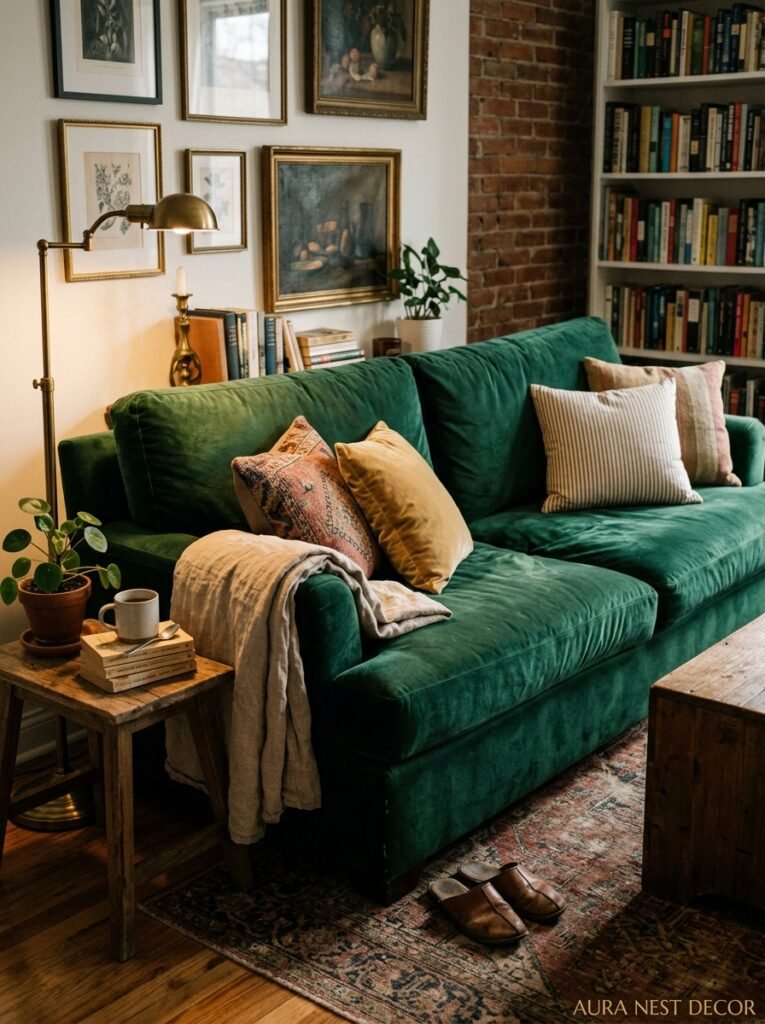
But hear me out. The sofa is usually the biggest, most expensive thing in the room and the temptation is to go bold there first. Resist it. In an eclectic space, the sofa is the base note — the thing everything else gets to bounce off. A deep, worn-looking velvet in forest green or dusty plum. A neutral linen that’s soft enough to sink into. A classic Chesterfield in aged leather that could’ve belonged to a professor in 1974.
What you don’t want is a sofa that’s TRYING too hard, because then every other interesting thing you bring in has to compete with it instead of complement it. The sofa’s job is to be comfortable and grounding. Let the lamp be weird. Let the rug do something unexpected. Let a random side table from a charity shop be the thing guests ask about.
The magic of eclectic layering is that the room reveals itself slowly, and if your sofa is already shouting, nothing else gets a chance to speak.
—
3. The Color Rule That Actually Works for People Who Hate Color Rules
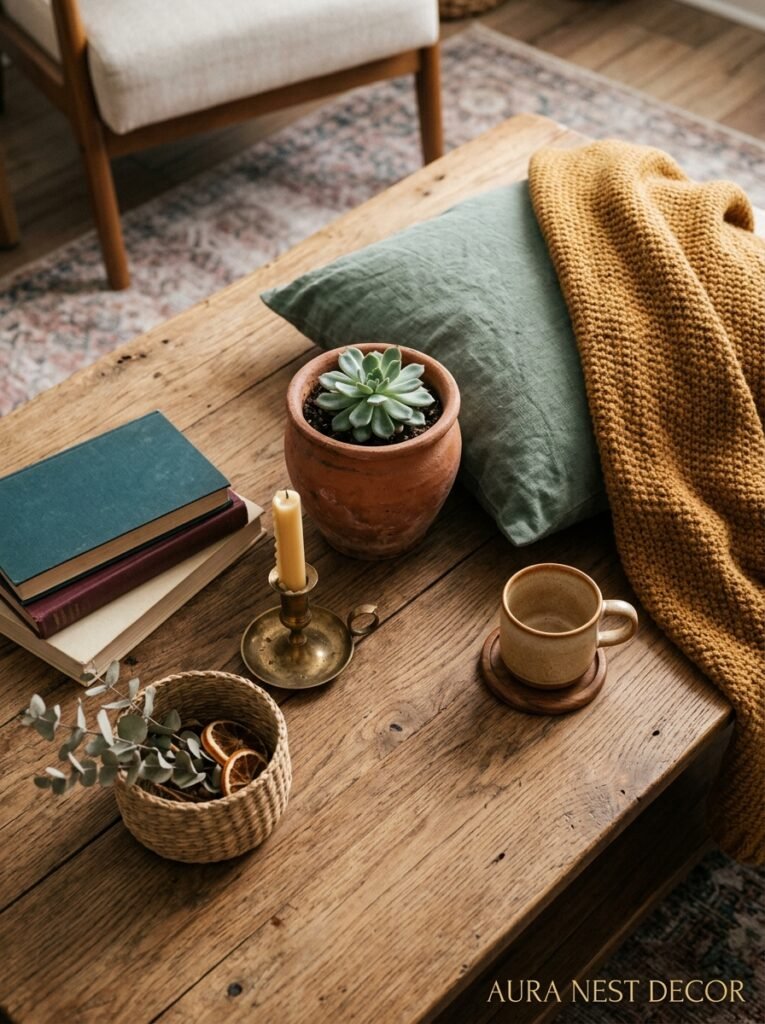
Most color advice is either so vague it’s useless (“stick to three colors!”) or so prescriptive it sucks the soul out of a room. But there’s one principle I keep coming back to for eclectic spaces and it’s this: pick a warm undertone and just don’t fight it.
Terracotta, amber, tobacco brown, aged ivory, dusty rose — warm tones. They’re not a palette, they’re a temperature. And when most of your pieces, even very different pieces, lean warm, the room coheres in a way that feels almost subconscious. You walk in and you don’t know why it feels right, it just does.
That’s not to say you can’t have cool tones. A slate blue throw, a sage green plant pot, an antique mirror with a silvered patina — all of that works. But they’re supporting cast, not leads. The warmth is what creates that cozy, gathered-over-time feeling that’s so hard to manufacture when you buy everything new from the same shop on the same afternoon, you know?
Side note: if you’re UK-based and working with the kind of light we have here — grey skies, north-facing rooms, the sun deciding to knock off early in November — warm tones do even more heavy lifting. Don’t fight your climate. Lean in.
—
4. Lighting That Earns Its Keep in Every Single Corner
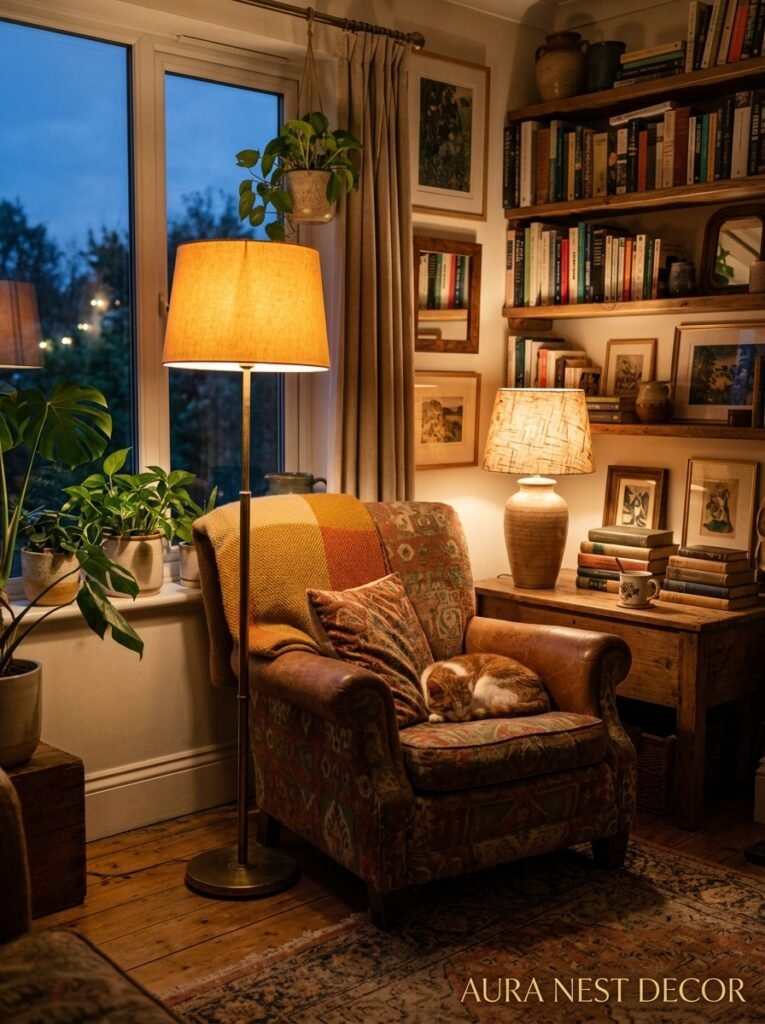
This might be the most important section in this whole piece. I’m not being dramatic.
The difference between an eclectic room that feels cozy and one that just feels cluttered? Lighting. Almost every time.
Overhead lighting is the enemy here. That flat, even brightness flattens everything — all your beautiful layers, your textures, your thoughtfully mismatched pieces. They all look the same under a bright ceiling light. Dull. Kind of sad. You don’t want that.
What you want instead is pools of light. The amber glow of an Edison bulb at 7pm from a floor lamp tucked behind the sofa. A table lamp on a stack of books that casts a small circle of warm light just where you sit to read. A string of small lights wound around a plant or along a bookshelf — not in a dorm room way, in a thoughtful, intentional way. There is a difference and it’s mostly about how many you use and where.
And candles. Real ones if you can, but honestly even the good battery-powered ones work now. The flicker matters. Something about it signals safety and warmth to some very old part of your brain and you don’t question it, you just feel it.
“You’re not decorating. You’re setting the conditions for people to exhale when they walk through the door.”
—
5. The Rug Situation and Why Bigger Is Almost Always Braver
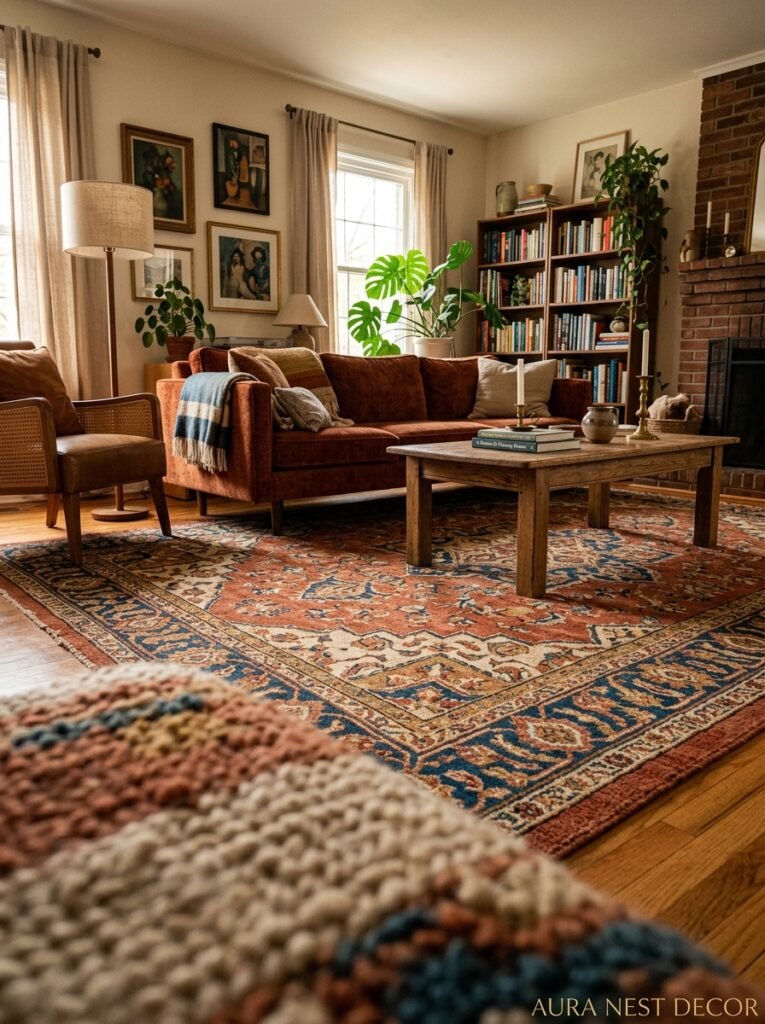
Rugs. We need to talk about rugs.
The single most common mistake in living rooms — eclectic or otherwise — is a rug that’s too small. A sad little rug floating in the middle of the room like it got lost. It makes everything look worse, I promise. Too small a rug doesn’t anchor your furniture, it just emphasizes how much empty floor there is around it.
In a cozy eclectic room, your rug is doing enormous structural work. It’s defining the seating area, pulling colors from across the room, and adding texture underfoot. It needs to be big enough that at least the front legs of every sofa and chair sit ON it. Ideally all legs. Always a bit bigger than you think you need, is the rule.
For the eclectic aesthetic specifically: vintage or antique-style rugs are extraordinary. A worn Persian or Turkish-style rug in faded reds and golds, a Moroccan-inspired beni ourain in cream and charcoal, a faded botanical print — all of them bring that layered, gathered-over-time quality that you genuinely cannot fake with a brand new flat-weave from a big box store. Jute rugs are great as a base layer. But they’re cold on bare feet in winter, so if you’re going for true coziness, you want something with pile.
—
6. The Part Where I Argue for Keeping Things That Don’t “Go”
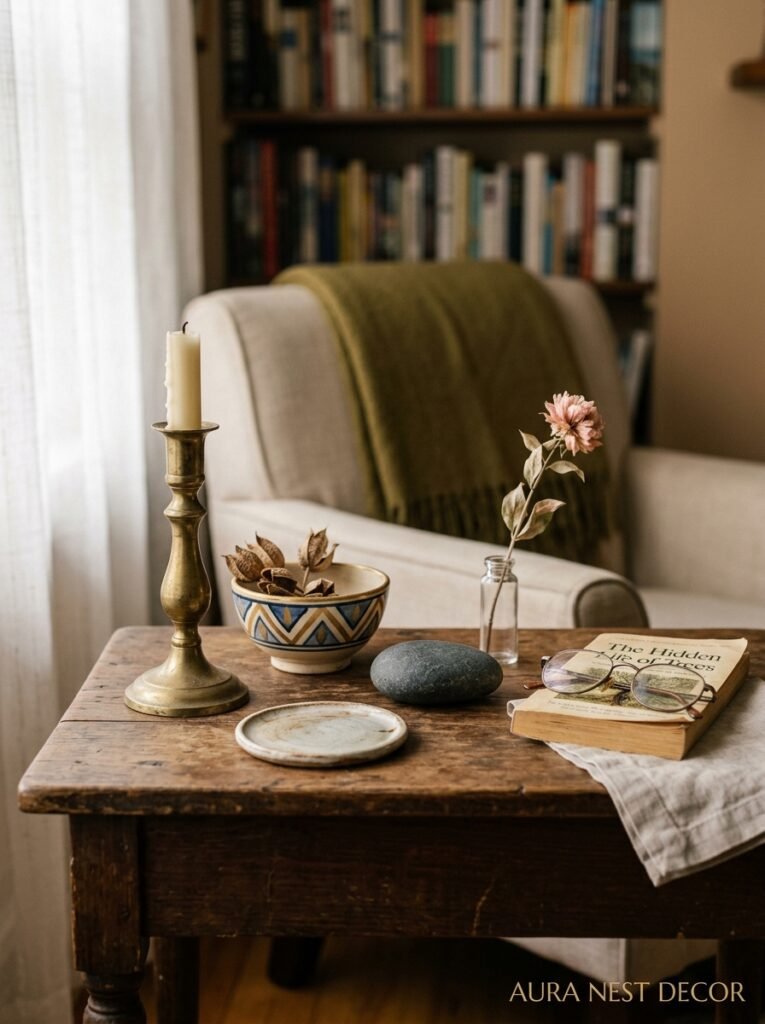
Here’s an opinion: that thing you love but convinced yourself doesn’t fit? Bring it in. Put it in the room. Live with it.
I had this little carved wooden elephant — brought back from a trip years ago — that I kept moving to the bedroom, the hallway, a box in the cupboard, because it didn’t fit any of the “looks” I was trying to create. And then one day I just put it on my bookshelf in the living room, next to a stack of paperbacks and a small brass candlestick, and it looked exactly right.
The thing about an eclectic room is that it’s supposed to look like it’s accumulated around a person’s actual life. Which means it should include things that have history and meaning, not just things that photograph well. The deliberate eclecticism of a room that tells a real story is categorically different from the performed eclecticism of one that’s been curated to just look lived-in.
People can feel the difference. They can’t always say why, but they feel it when they sit down.
So if you’ve got grandma’s side table, a vintage poster from a holiday, a lamp you found at an estate sale — stop second-guessing yourself. That stuff is the POINT.
—
7. Books as Decor — But Not the Hollow, Backwards-Facing Kind
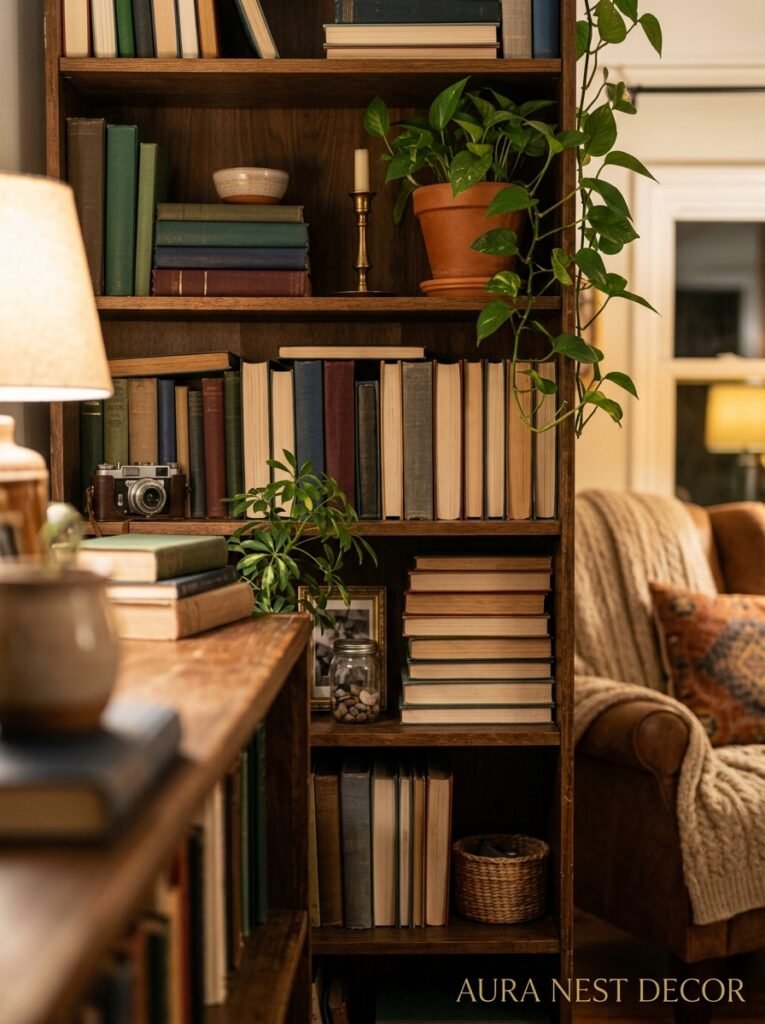
Okay this is a tiny hill I’m willing to die on.
Books — real ones, spines facing outward — are one of the most powerful decorating tools in a cozy eclectic room. And I don’t mean a perfectly color-coordinated shelf of stripped-spine neutrals arranged by height. That’s fine, it’s pretty, it’s not the thing I’m talking about.
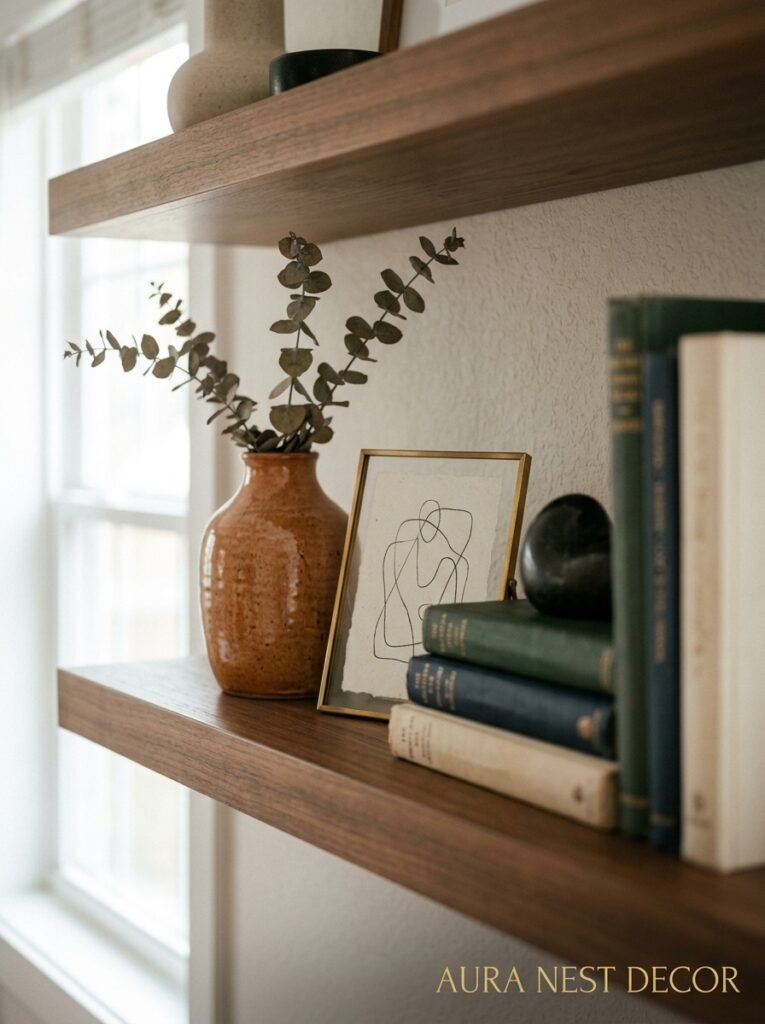
I’m talking about books stacked horizontally with small objects balanced on top. Books doubling as side tables. Piles on the floor next to the sofa that signal someone actually reads here. A shelf where the books are slightly chaotic — some facing out, some leaning, a framed photo tucked in sideways, a small plant with trailing leaves in front.
Books bring warmth AND texture AND story AND scale AND personal history all at once. They’re basically magic. And if someone in your life has ever told you to put them away because they’re cluttering the room — that person is wrong.
“A room without books is a room that’s still figuring out who it belongs to.”
—
8. Textiles Are Where the Cozy Actually Lives
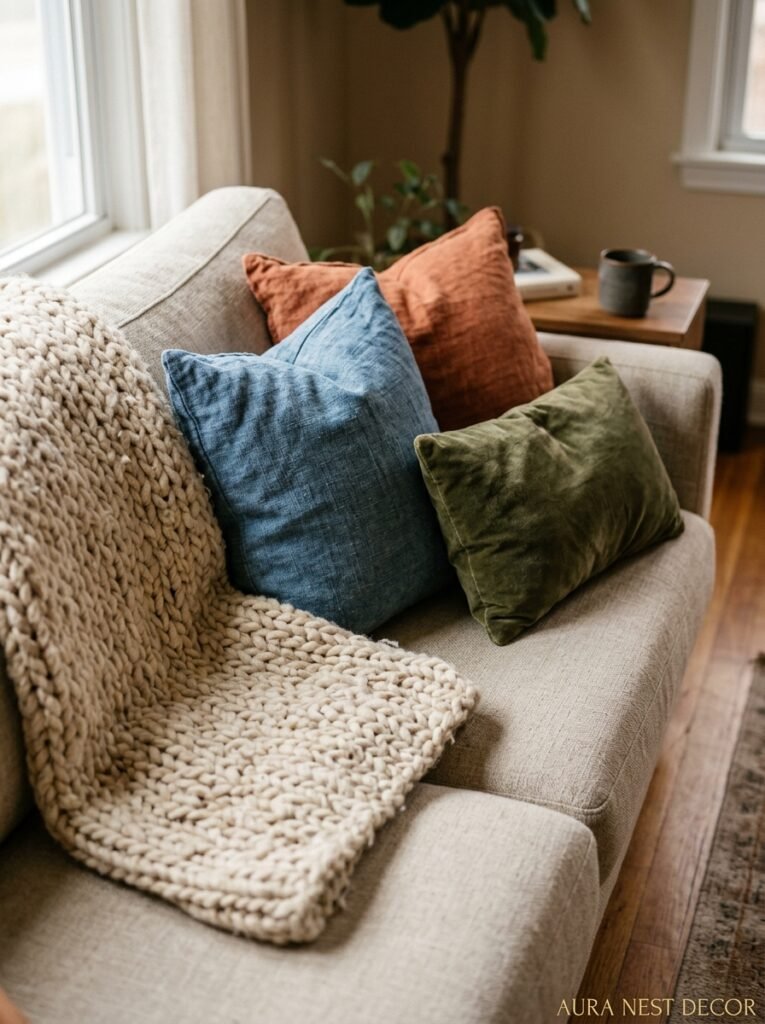
You can have everything else right and if your textiles are wrong, the room will still feel cold. Textiles are where the cozy LIVES.
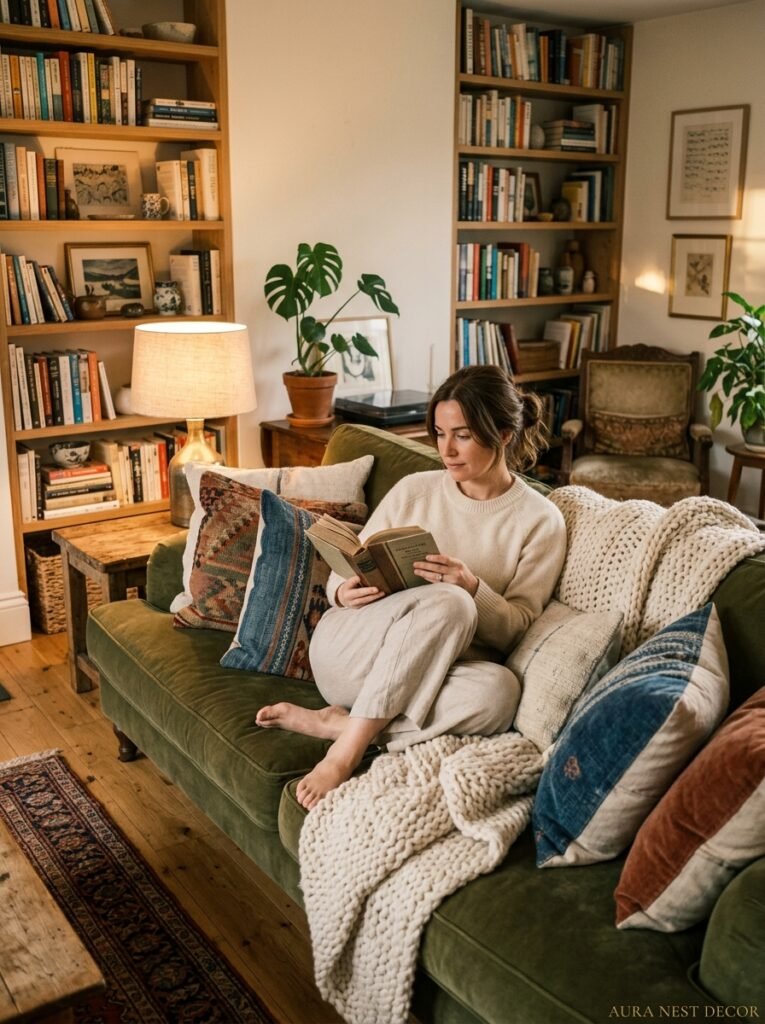
What does that mean in practice? It means you’re not just choosing a throw for color, you’re choosing it for weight and drape. A chunky knit throw tumbling off the arm of a sofa, not folded neatly — that’s cozy. A thin, slippery throw folded in a basket? That’s decor pretending to be comfort.
Cushions in different fabrics on the same sofa — velvet, needlepoint, a worn linen — at slightly different sizes. Not matchy-matchy. Not completely chaos either. Three to five usually works, depending on your sofa size, but honestly don’t count them, just add until it looks right and then pull one out.
Curtains matter more than most people realize. Heavy, floor-length curtains hung high and wide make any room feel more settled and significant. They add scale. And in an eclectic room, curtains in a subtle print — small florals, faded stripes, a traditional Ikat — add enormous warmth without competing with everything else going on.
—
9. The Gallery Wall That Doesn’t Look Like Everyone Else’s Gallery Wall
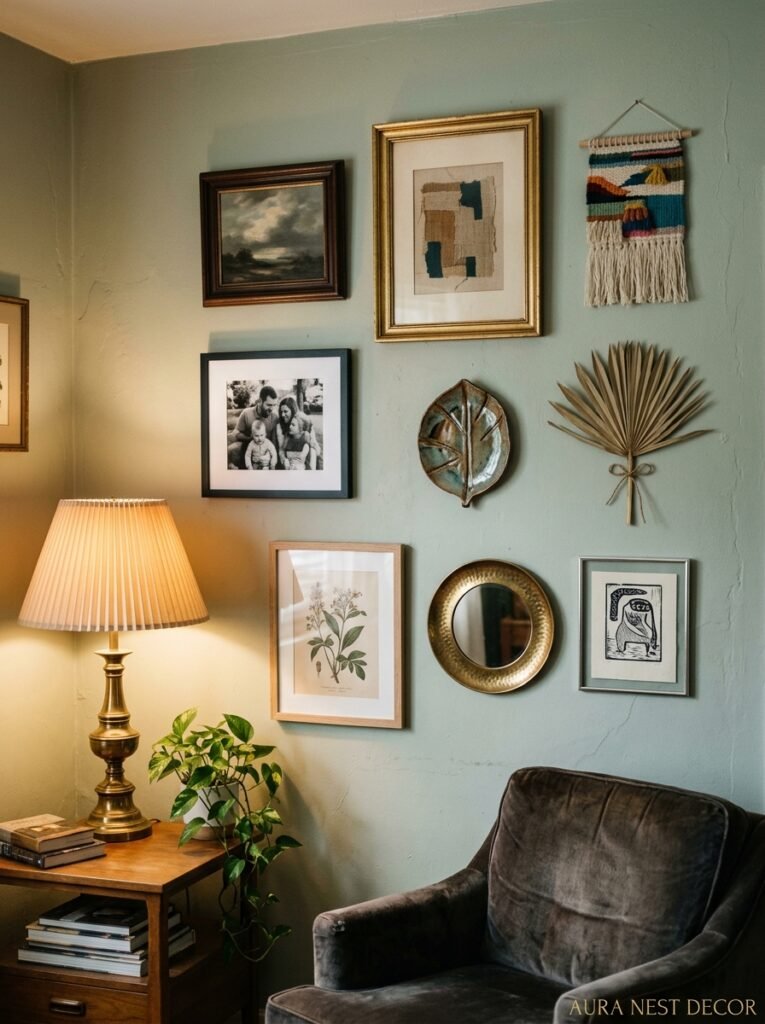
Right, gallery walls. Everyone’s doing them. Most of them look… fine. Uniform frames in black or gold, evenly spaced, everything the same height — it reads a bit Pinterest circa 2016 at this point.
The eclectic version is different and, I think, better. Mix your frame sizes, yes, but also mix your frame styles. An ornate gilded frame next to a simple clip frame next to an unframed canvas. Mix what’s inside them too — a family photo, a piece of art you love, a framed vintage map, a pressed botanical, a postcard from somewhere.
Don’t plan it too carefully. The ones that look best are usually laid out on the floor first, moved around until the spacing feels right intuitively, then put up in one go without too much measuring. A bit of asymmetry is not a problem. It’s actually the goal.
And leave some wall space elsewhere in the room. A gallery wall only looks curated when the walls around it have room to breathe.
—
10. Plants — Which Ones Actually Work and Which Ones Are Just Pretty in Photos
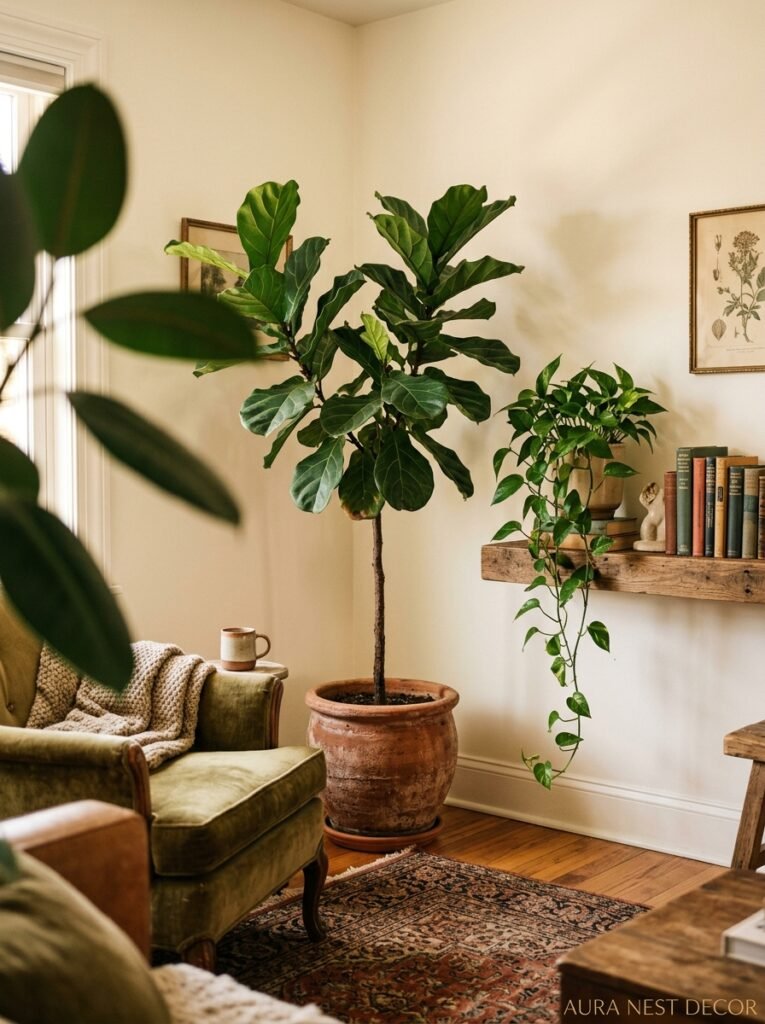
A cozy eclectic room almost always has plants. But not a uniform collection of perfectly pruned succulents in matching white pots. That’s not eclectic, that’s a Scandi minimalist room wearing a costume.
What works: trailing plants, because movement is cozy. A pothos or philodendron trailing off a high shelf. A monstera that’s gotten slightly bigger than you planned (they always do) in a corner. A big olive tree or fiddle-leaf if you’ve got good light and the patience for the temperamental ones. Herbs on a windowsill if you’re near the kitchen.
And the pots matter. Terracotta — always, honestly. Aged or textured ceramic. Woven baskets as pot covers. A mix of heights and scales. Nothing too matchy, nothing that looks like a set.
One plant that’s slightly struggling is more honest than twelve perfectly healthy identical succulents. Not gonna lie.
—
11. The One Thing That Pulls an Eclectic Room Together When You Think Nothing Is Working
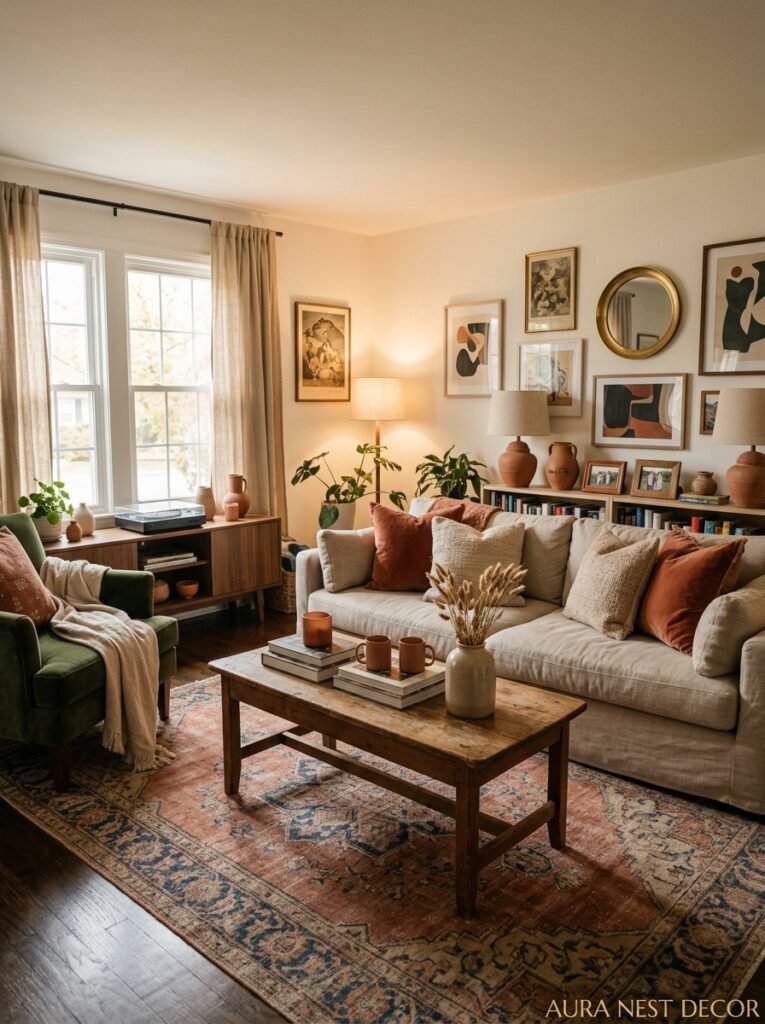
When a room feels chaotic instead of cozy — too busy, too loud, something’s off but you can’t name it — there’s usually one fix that works better than anything else.
A unifying material, used in small amounts, everywhere.
Aged brass, for example. A brass lamp, a brass candle holder, brass drawer pulls on a side table, a small brass-framed mirror. None of it matching exactly, all of it the same family. Your eye moves around the room and finds these little notes of the same material and the room feels stitched together. Like someone thought about it, even if they actually just gradually acquired things they liked.
Warm wood tones do the same thing. Raw terracotta. Aged leather. You don’t need a lot of any of it — you just need it to show up more than once.
This is the trick that makes an eclectic room feel curated rather than accidental. It’s subtle, it costs nothing if you’re thoughtful about what you already own, and it works almost every single time.
—
12. The Cozy Part Isn’t Actually About the Objects at All
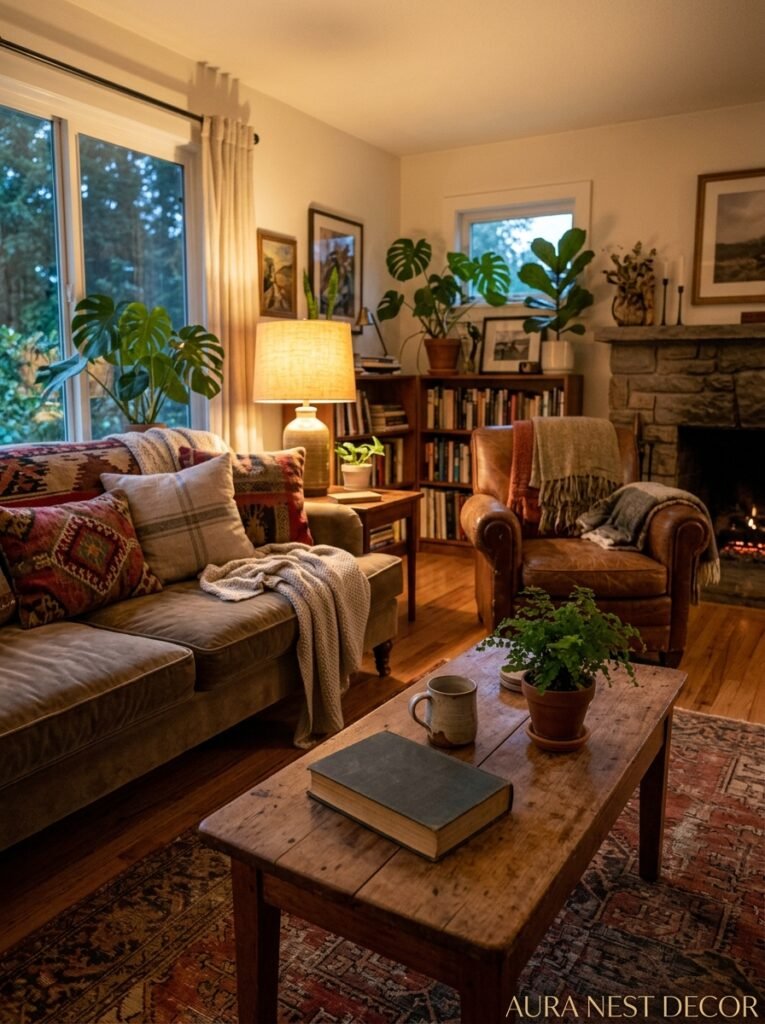
Here’s the thing I want to leave you with. All of this — the rugs, the lighting, the textiles, the gallery walls — none of it is really the point.
The point is how the room makes people feel when they’re in it.
A cozy eclectic living room should feel like being welcomed. Like the person who lives there thought about what you’d need when you sat down — the lamp at the right angle, the cushion that actually supports you, the throw within reach. Rooms that feel truly cozy tend to have a person behind them who genuinely cares about being comfortable, not just about looking good in photos.
That’s why the “collected over time” quality is so important. Because it signals that someone has lived and loved and made choices in this room. It’s not a set. It’s not a staging. It’s someone’s actual life, and you’re in it for a bit, and that’s a privilege.
So buy the thing you love, not the thing that fits the mood board. Keep the objects with meaning. Let the room be a little imperfect. Imperfection, in this style, is the whole secret.
—
❓ FAQ
Q: How do I make an eclectic room look intentional and not just messy? A: Pick one through-line — a color temperature, a material like aged brass or warm wood, or a mood — and make sure most of your pieces nod to it. The room can have wildly different styles as long as there’s that one thread running through it. Even two or three pieces in the same material can do the trick.
Q: What’s the best starting point if I’m decorating an eclectic living room from scratch? A: Start with the sofa and the rug. Get those right — comfortable, grounding, with a warm undertone — and then layer everything else in gradually. Buying everything at once is what makes eclectic rooms feel hollow; the style genuinely rewards patience and slow accumulation.
Q: Can eclectic style work in a small living room? A: Absolutely, and it can actually look better in a smaller space because the layers feel intentional rather than overwhelming. Keep your largest piece — usually the sofa — relatively simple, go big on the rug, and use vertical space with tall plants and stacked books. The cozy factor in a small eclectic room can be seriously off the charts.
—
💭 Final Thoughts
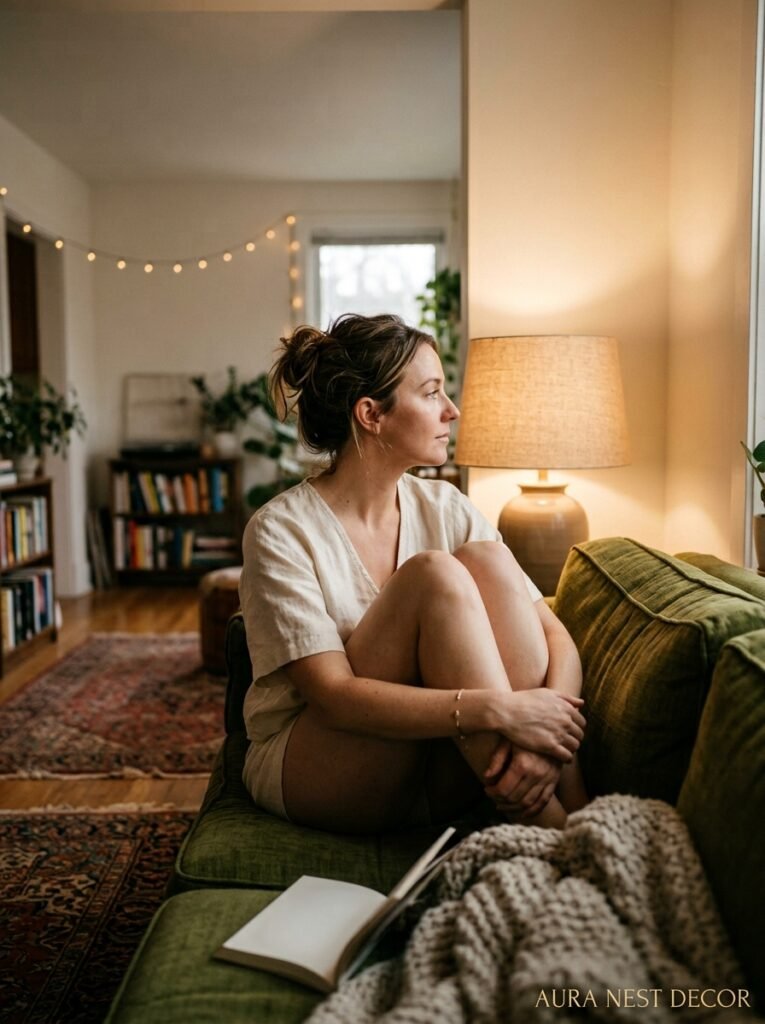
The best rooms I’ve ever been in weren’t designed — they grew. Slowly, over time, with a lot of “I wonder if this works here” and a willingness to be wrong and try again. That’s the spirit of the eclectic living room, really. It’s about being a person with a life and letting your home show it.
So stop waiting until you’ve figured it all out. Put the thing on the shelf. See what happens.
What’s the one piece sitting in a box right now that you’ve been waiting to find a home for?