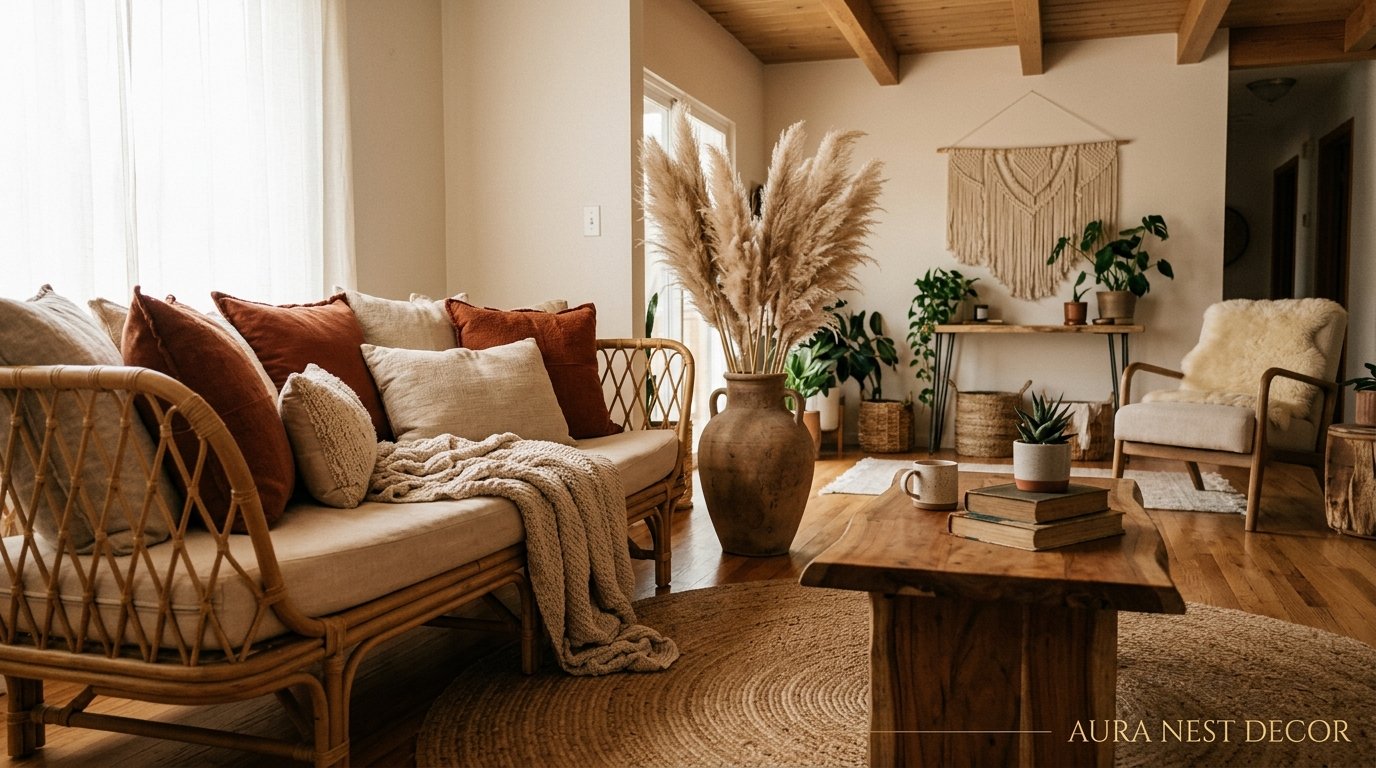
The Earthy Boho Living Room That Feels Like a Deep Breath
You walk in, kick off your shoes, and the room just holds you. No harsh edges. No cold surfaces screaming for attention. Just warm, layered, slightly imperfect beauty that took years to look like nobody tried.
That’s the earthy boho living room. And once you understand how it actually works, you’ll never look at a beige sectional the same way again.
—
1. The Wall Color That Makes Everything Else Look More Expensive

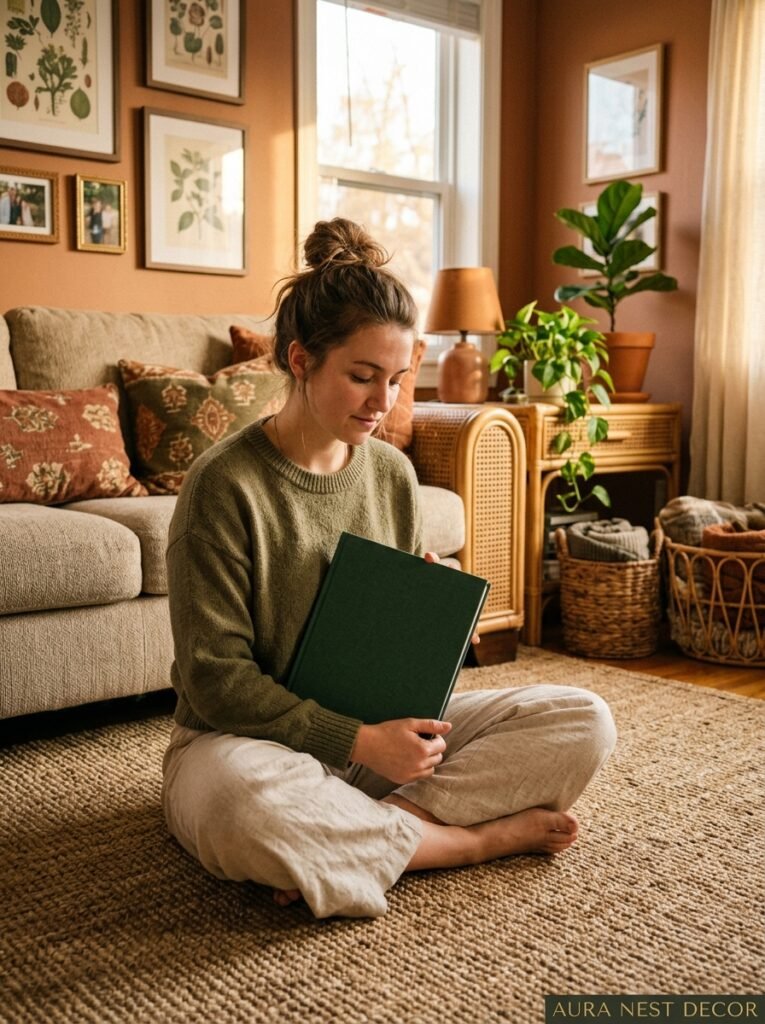
Here’s the thing nobody tells you about earthy boho spaces — the wall color is doing EVERYTHING. Not the throw pillows. Not the macramé. The walls.
And right now the color that keeps showing up in every living room that stops me mid-scroll is a warm terracotta-adjacent clay. Not orange, not red, not salmon — something right in between all three. Like the inside of an old Spanish villa that’s been sun-bleached just enough. Brands call it things like “Raw Umber” or “Adobe Dust” and I’ve seen it work in tiny London flats and sprawling Nashville farmhouses alike.
If that feels too bold — and honestly fair enough, walls are a commitment — go one shade lighter and warmer than you think you need. Most people choose colors that are too cool or too pale and then wonder why the room feels weirdly flat. The answer is almost always that the wall needs more warmth.
A raw, slightly chalky finish matters too. Eggshell over matte. Matte over anything shiny. Boho rooms hate shine on walls. They want texture, depth, something that looks different at 10am than it does at 7pm under a lamp.
“The right wall color in a boho space doesn’t just set the mood — it becomes the mood.”
2. Why Your Sofa Doesn’t Have to Be the Statement (And Shouldn’t Be)
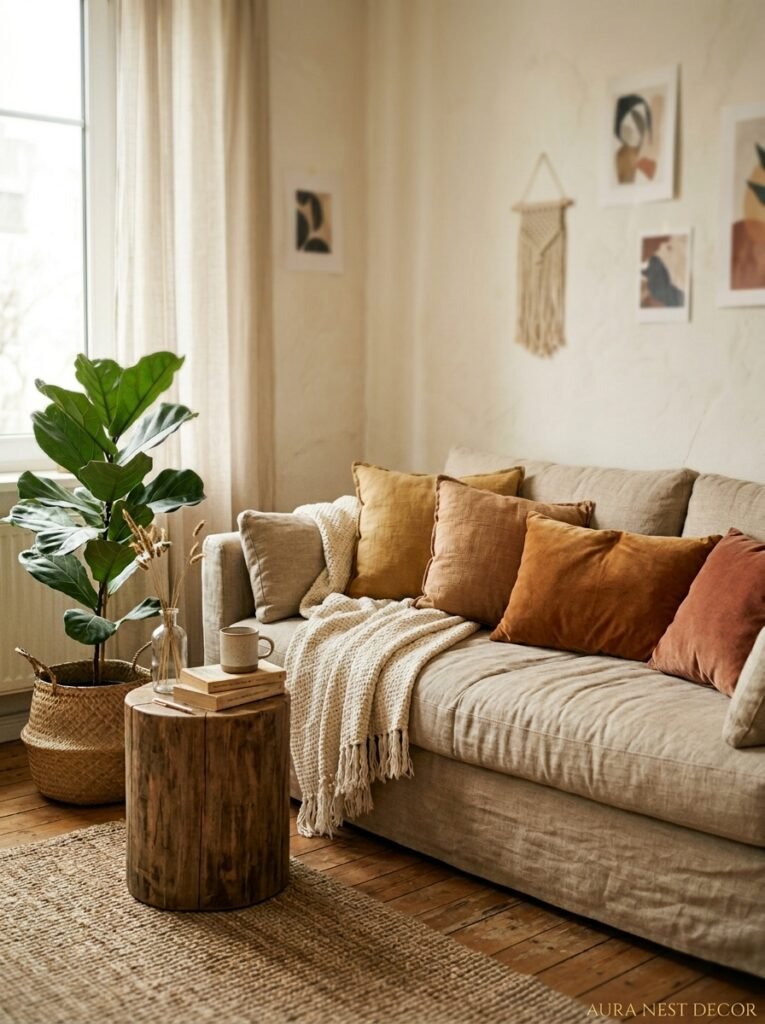
I know. You’ve been told your sofa is the “anchor” of the room. Maybe it should be linen, maybe leather, maybe something neutral so you can “switch up the look” with accessories. And look, that’s not wrong exactly, but in an earthy boho space the sofa kind of… recedes into the room. On purpose.
A worn cognac leather sofa? Beautiful. A low-profile overstuffed linen couch in warm cream? Perfect. An old velvet sofa in dusty sage that looks like it came from a 1970s professor’s study? Honestly, ideal. The point is comfort over perfection. Age over newness. The sofa shouldn’t look like it was delivered last Tuesday.
And this is where US and UK readers sometimes diverge a bit, because in the UK there’s this brilliant tradition of the “lived-in front room” that Americans are sort of rediscovering through Pinterest. Mismatched cushions. A throw that’s actually been used. A visible book spine or two tucked into the back cushions because someone was reading there earlier. That’s not mess, that’s character.
Don’t reupholster something perfect. Buy something that already has a story or let yours get one.
3. The Rug Situation Is More Complicated Than It Looks
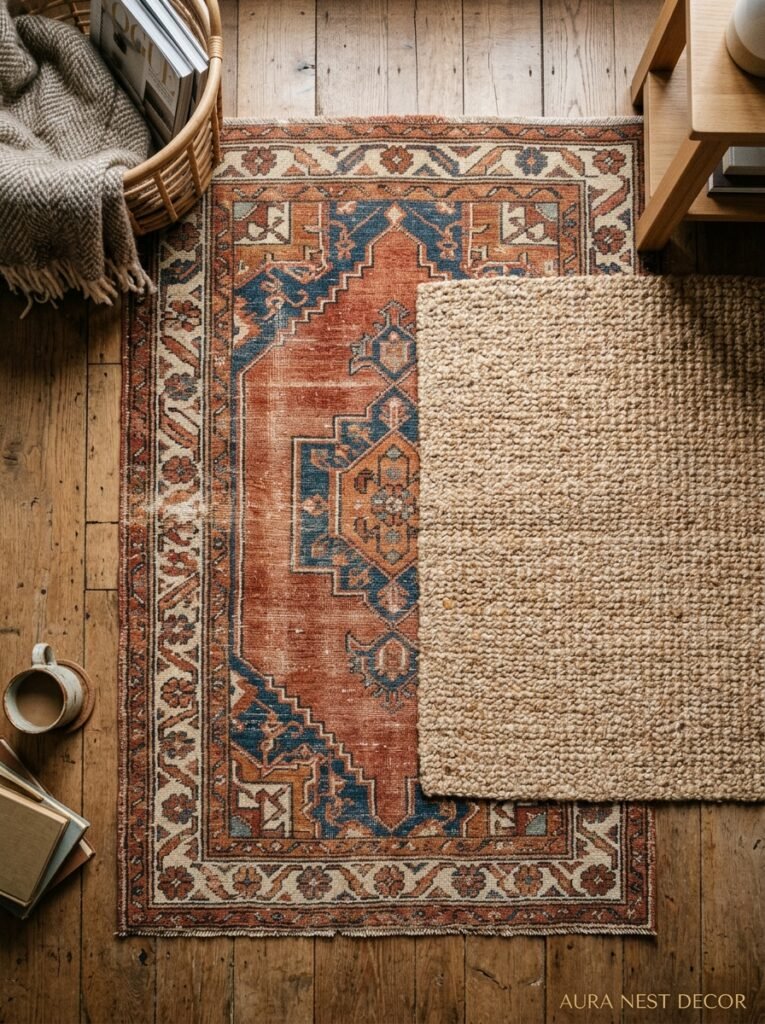
Every earthy boho room has a rug. Usually more than one. And getting this right is — I’m not gonna lie — kind of the hardest part.
The base rug needs to be big. BIGGER than you think. A common mistake is buying a rug that fits under the coffee table and nothing else. In a proper boho space, the front legs of every piece of seating should hit the rug. At minimum. The rug is basically the floor of a room inside the room and if it’s too small everything floats and the whole thing looks like a furniture showroom instead of a home.
Texture over pattern here. Or, if pattern — then subtle. A jute rug, a Moroccan boucherouite, a faded Turkish kilim. The colors should lean warm and muted — terracotta, rust, sand, ochre. Deep burgundy works too if you pull that color into one or two other elements in the room.
Layering rugs is a real thing and it genuinely works, but it’s easy to get wrong. The rule I keep coming back to: layer a flat-weave pattern over a chunky solid, not two patterns on top of each other. One is interesting. Two is chaos. Side note — a sheepskin or cowhide thrown over the corner of a larger jute rug is maybe the easiest boho move in existence.
4. Plants That Actually Belong in This Room (Not Just Any Old Monstera)
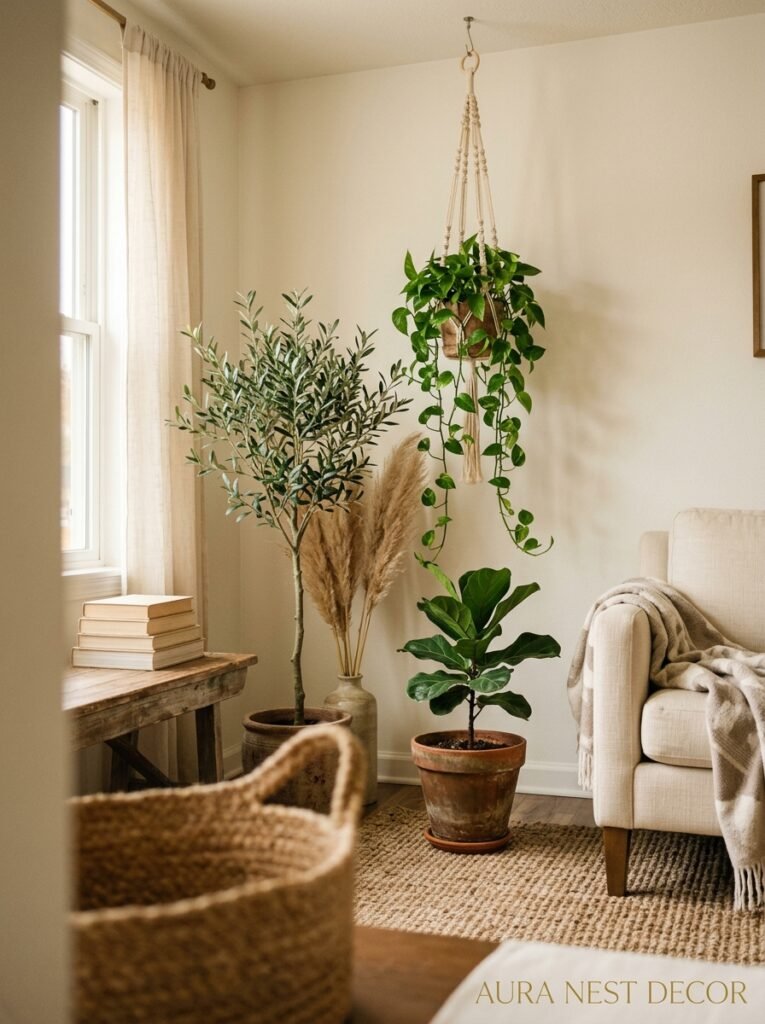
Okay I’m going to say something slightly controversial. The giant monstera trend? Running its course. Or maybe it’s the opposite, honestly — maybe the monstera is so ubiquitous now that it reads as generic rather than interesting. What I’m seeing in the earthy boho spaces that actually feel special right now is a mix of UNEXPECTED plants.
Olive trees. Especially indoors, in a terracotta pot with that dusty silvery foliage — nothing else has that particular old-world, Mediterranean calm. Trailing pothos in macramé hangers, but specifically golden pothos rather than all-green because the yellow-green variegation adds warmth. Dried grasses in an earthenware vase — pampas, yes, but also dried bunny tail grass, dried wheat, even dried wildflowers in faded blush and cream.
And let’s talk pots because the pot is often as important as the plant. No plastic nursery pots, obviously. But also no perfectly glazed ceramics that look like they came from a designer boutique. You want handmade-looking, slightly uneven, clearly thrown on a wheel. Terracotta aged with a little calcium buildup is peak earthy boho. If yours are too new, a tiny bit of diluted white paint dry-brushed on the outside and wiped back fast ages them perfectly.
Plants in this room are never just decoration. They’re structural.
5. The Lighting Setup Nobody Talks About But Everyone Notices
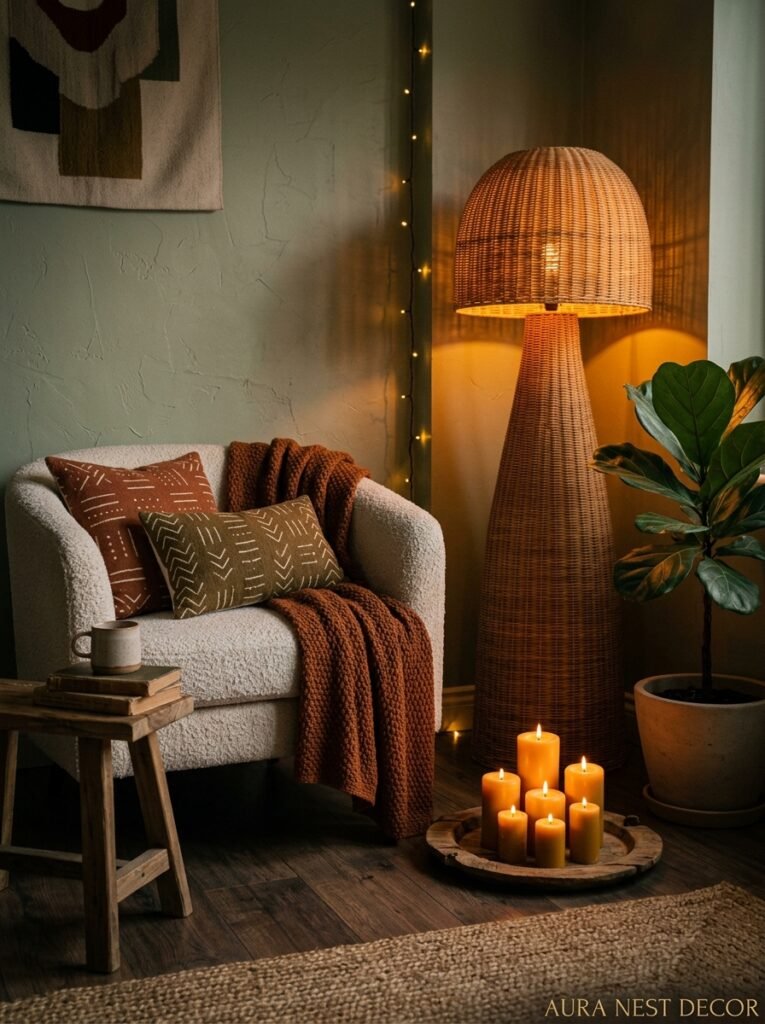
The ceiling light is probably wrong. In almost every living room I’ve ever been in, the ceiling light is the problem. It’s too bright, too cold, too central, too much. In an earthy boho space you want to forget the overhead entirely — or at least supplement it so aggressively that it barely matters.
Floor lamps in the corners. Table lamps at different heights. String lights not in a kitschy way but tucked behind a bookshelf or woven through a trailing plant for that barely-there amber glow. Candles — real ones — in clusters of mismatched holders. The actual goal is for the room to look like it’s lit from WITHIN, from multiple low points, rather than from one source above that flattens everything.
Warm bulbs only. 2700K or below. The amber glow of an Edison bulb at 7pm over a worn leather sofa and a pile of handwoven cushions is the image that launched a thousand Pinterest boards and it’s popular because it genuinely works. It makes the textures in the room — and there should be a lot of them — look even better.
Dimmer switches are underrated and not expensive. Worth every penny.
“In a boho room, lighting isn’t a feature. It’s an atmosphere you can turn up or down.”
6. Texture Layering Without Making It Look Like a Market Stall
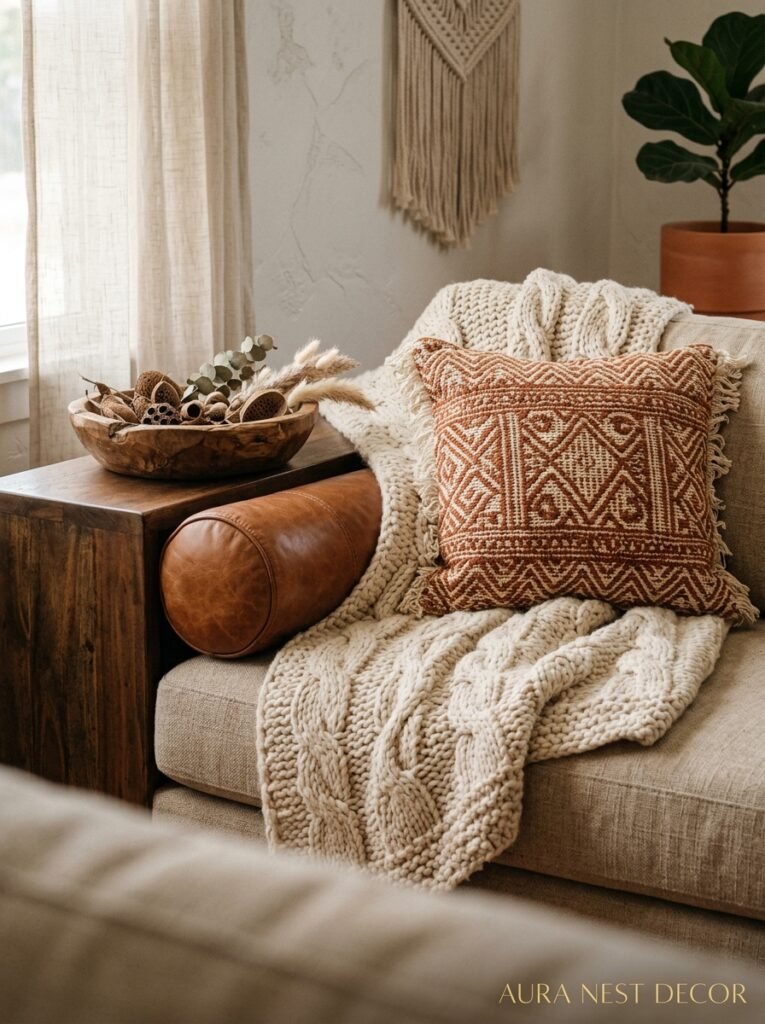
Okay, so the whole earthy boho thing runs on texture. Woven, rough, soft, nubby, smooth, carved. But there’s a version of this that tips into overwhelming and a version that feels rich and intentional and the difference is actually pretty simple.
Vary your textures, but keep your tones. This is the rule. If everything in the room sits within roughly the same warm earthy palette — think ochre, rust, cream, brown, warm grey, dusty sage — then you can mix as many textures as you want without it feeling chaotic. A chunky boucle cushion next to a hammered brass tray next to a rough jute basket next to a smooth mango wood bowl? Works completely because they’re all in the same color family.
Where people go wrong is introducing a texture in a color that’s too far outside the palette. A bright teal velvet cushion, for instance. It might be a beautiful cushion. But it pulls the eye so hard it breaks the whole spell.
Throw blankets draped over one corner of the sofa — not folded neatly but kind of casually half-pulled. A stack of books with beautiful covers. Baskets of various sizes (always odd numbers, for some reason it always looks better). A hand-thrown ceramic bowl holding absolutely nothing except some pebbles and maybe a candle stub.
The layers should look like they happened over time. Not overnight.
7. The Specific Furniture Pieces That Tie It Together (And Some to Avoid)
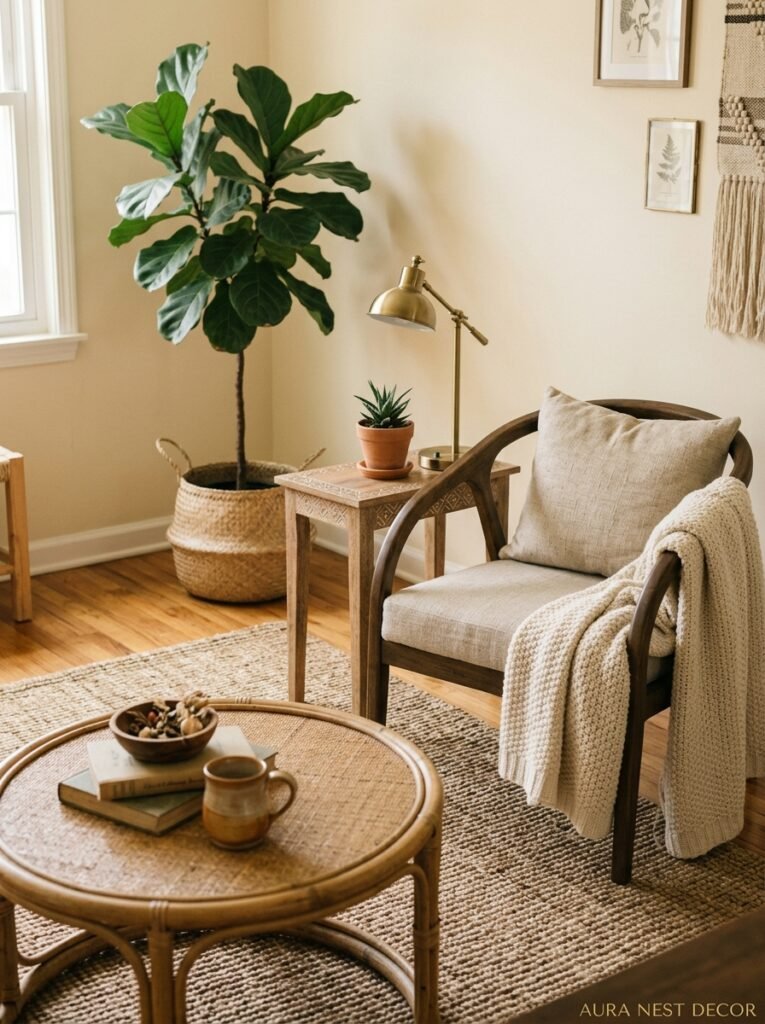
Low is better than high. Wide is better than narrow. Aged is better than new.
That’s genuinely most of the earthy boho furniture philosophy. Low-profile coffee tables — ideally carved wood, hammered metal, or a raw slab of walnut on hairpin legs. Bookshelves that aren’t perfectly organized but lean toward interesting rather than curated. A rattan or wicker chair in the corner that nobody actually uses all the time but looks incredible. A vintage trunk as a side table.
What to avoid is maybe more useful. Glass coffee tables — too cold, too formal. Matching sets. If your sofa, loveseat, and armchairs all match, the room will never feel boho no matter what you hang on the walls. Anything very shiny or very new-looking. Square, hard-edged furniture that has no warmth or curve to it.
Brass hardware and legs good. Chrome, silver or stainless steel? Not great.
“Earthy boho doesn’t do matchy-matchy. It does collected-over-time, found-at-different-markets, loved-by-different-people.”
8. What Actually Goes on the Walls (The Macramé Question)
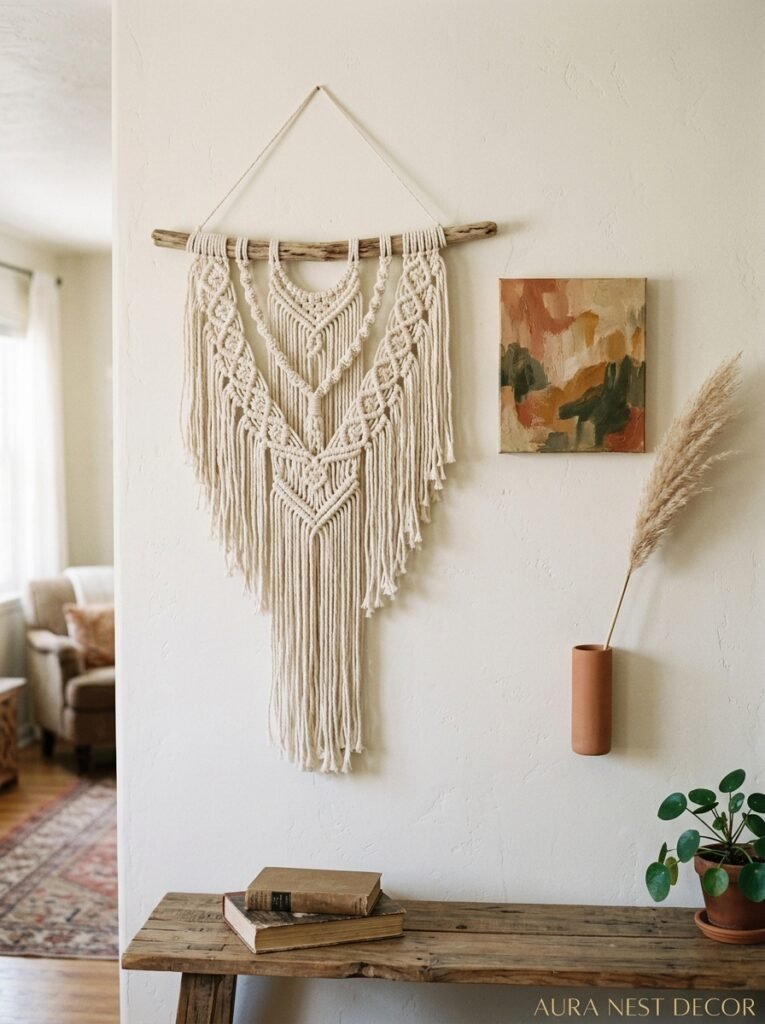
Let’s address it. Macramé. Still good, still works, but only if it’s not doing ALL the work on your walls by itself. A single large macramé wall hanging on an otherwise empty wall looks dated now. A macramé piece as one layer within a gallery wall, or hung alongside woven baskets and a botanical print and a small oil painting? Different thing entirely.
Gallery walls in boho spaces work best when they’re slightly asymmetric and mix different media. Oil paintings or prints, vintage mirrors in ornate frames, woven textiles, maybe a sculptural ceramic piece mounted flush to the wall, a pressed botanical framed in a simple dark wood frame. The frames don’t have to match. They really don’t. What ties the wall together is the color palette within the pieces themselves.
Black and white photography doesn’t really belong here — too stark. Go for warm-toned prints, vintage illustrations, abstract art in earthy colors. Portraits and faces are underrated in boho spaces, particularly vintage ones, because they add a very human, storied energy to the room.
Leave some wall space. Not everything needs to be covered.
9. The Shelf Styling Approach That Looks Effortless But Isn’t
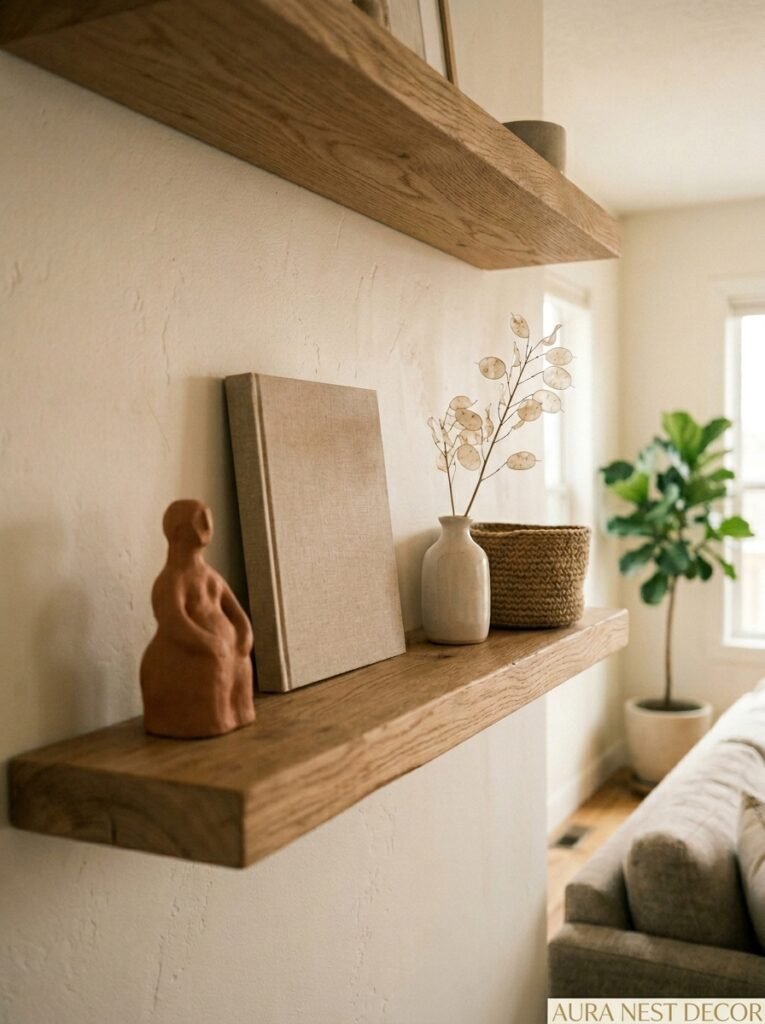
Here’s the thing about boho shelf styling — it looks random and it isn’t. At all. There’s a whole quiet logic running underneath it.
Group objects by rough height, then break the pattern. Put a tall dried grass arrangement next to a short stack of books next to a medium-height candle, then add one trailing plant that falls over the edge of the shelf entirely. The trailing element is what makes it look alive instead of arranged.
Leave gaps. A shelf with everything pushed to the back wall looks like a display. A shelf where some things are pulled forward and some are behind and there’s actual negative space in between looks like someone actually lives here and uses these things.
Vary your materials within a similar color family — again, this is the key. A terracotta pot, an ochre book spine, a sand-colored woven basket, and a burnished brass figurine. All different textures, all basically the same family of warm earthy tones.
Don’t put anything you don’t actually like on the shelf just to fill a gap. A gap is fine. A thing you don’t care about is not.
10. The Scent Layer Most People Forget About Completely
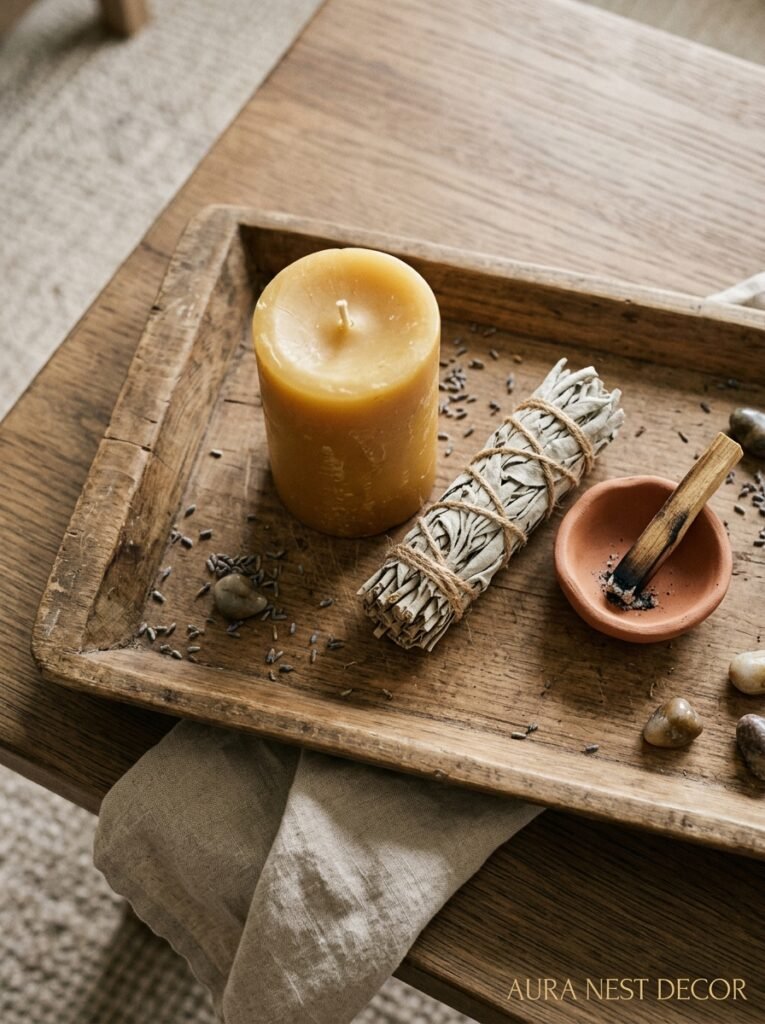
This might sound strange in an article about visual design. But the earthy boho living room has a SMELL, and getting this right does something to the room that no amount of styling can replicate.
Palo santo. Beeswax candles rather than paraffin — they smell cleaner and warmer. A diffuser running something woodsy and slightly resinous, like sandalwood or cedarwood or a really good bergamot blend. Fresh eucalyptus bunches are easy to source in both the US and UK and they release the most beautiful, light green scent over several weeks before drying.
And the natural materials themselves contribute. Real jute rugs, raw wood furniture, real beeswax candles, dried botanicals — they all release a faint, warm, earthy scent that synthetic materials never do. This is one of those things you can’t fully replicate with air freshener and it’s part of why rooms full of natural materials feel so instinctively good.
When someone walks into a beautifully styled earthy boho room and says “it just feels NICE in here” they’re often partly responding to how it smells and they don’t even know it.
11. The Budget Version That Doesn’t Look Budget
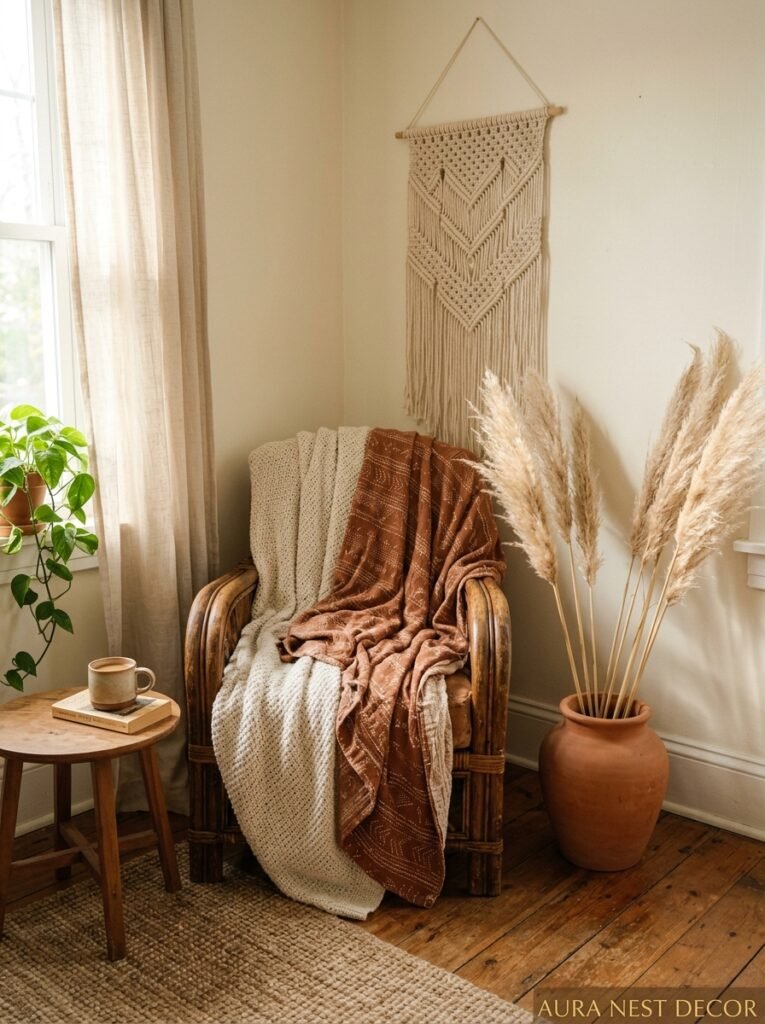
Real talk — earthy boho is actually one of the more achievable interior aesthetics for people who aren’t spending thousands. And I mean that genuinely, not in a patronizing “just add some plants!” way.
Charity shops and secondhand markets in both the US (thrift stores, estate sales) and UK (car boot sales, charity shops, eBay) are practically DESIGNED to source for this aesthetic. Worn leather? Thrift store. Vintage ceramic pots? Car boot sale. Old kilim rug? eBay, constantly. Carved wooden bowls, brass trays, rattan baskets — all of these turn up secondhand regularly and often for almost nothing.
The things worth spending money on: a good quality large rug (the base layer, not the accent), and perhaps one or two larger plants if you want instant impact. Everything else can be sourced slowly over time. In fact the slow sourcing is kind of the point. Rooms that look collected feel collected because they were.
String lights are cheap and they’re doing more atmospheric work than most expensive light fixtures. A bag of good quality beeswax tealights costs about what a coffee does. Dried pampas grass lasts years.
12. The One Thing That Makes a Boho Room Feel Complete Vs. Just Busy
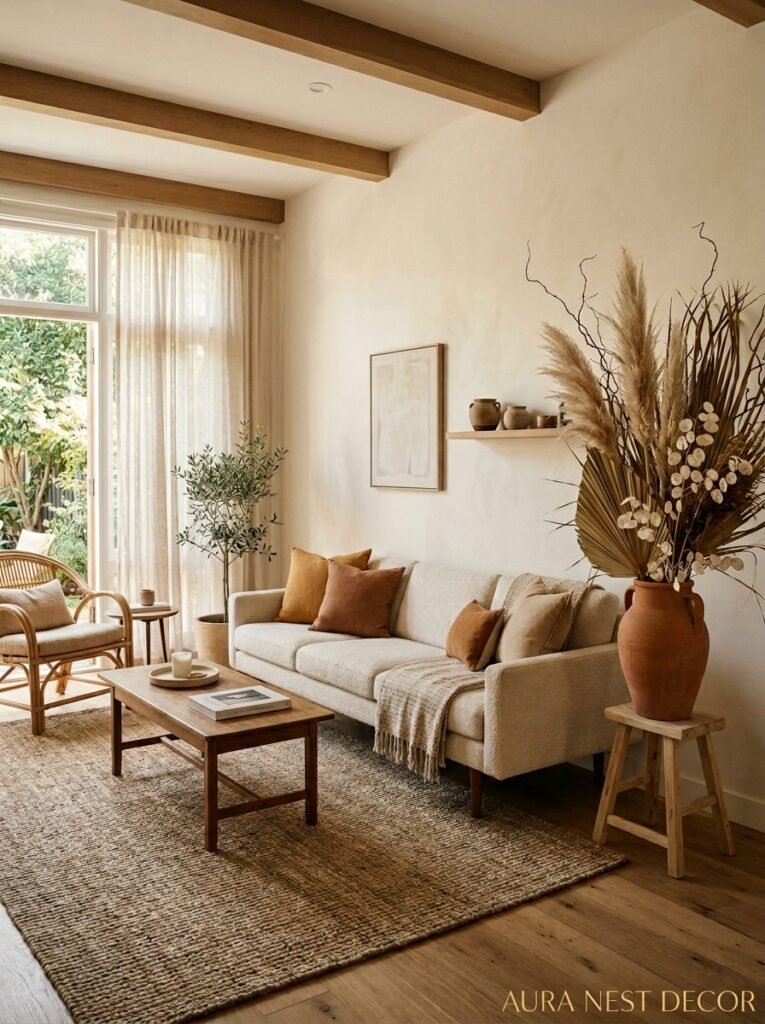
After everything — the rugs, the layers, the plants, the lighting, the shelf styling — there’s one thing that separates the earthy boho rooms that make you want to stay from the ones that just look like a lot of effort.
Somewhere to actually BE.
The most beautiful boho rooms have an obvious, irresistible place to land. A deep corner of the sofa with the best cushions and the closest lamp and a side table exactly the right height for a cup of tea. A reading chair angled toward a window with a basket of books beside it and a throw draped over the arm. A floor cushion situation in front of the fireplace that invites you to sit lower than usual and just settle.
The room needs to make an argument for itself as a place to spend time. Not just to look at. When the styling serves the living — when it’s beautiful AND it’s where you actually want to be — that’s when you’ve nailed it.
That moment when you walk in, kick off your shoes, and the room holds you. That’s what we’re building toward.
—
❓ FAQ
Q: What’s the difference between earthy boho and just regular bohemian decor? A: Regular bohemian decor tends to lean colorful and globally eclectic — lots of saturated color, mixed patterns from different cultures, a maximalist energy. Earthy boho is more restrained in its palette, grounded in warm neutrals and natural materials, with texture doing the work that color would in a classic boho space. It feels calmer, but no less interesting.
Q: Can you do earthy boho in a modern apartment or does it only work in older homes? A: It actually works really well in modern apartments — possibly better, because the clean architectural lines create a nice contrast with all the warmth and texture you’re layering in. The key is not fighting the modernity of the space but softening it. Warm rugs over hard floors, plants near windows, warm bulbs replacing cold overhead lights. The bones of the apartment don’t need to be old. Just the feeling.
Q: How do I stop it looking messy instead of intentionally layered? A: Palette discipline. If every object in the room — no matter how different in shape or texture — sits within the same warm earthy color family, the room reads as intentional rather than chaotic. The moment you introduce a color that doesn’t belong, the “collected” look tips into “cluttered.” When in doubt, edit. A room with a few really good things almost always looks better than one stuffed with many mediocre ones.
—
💭 Final Thoughts
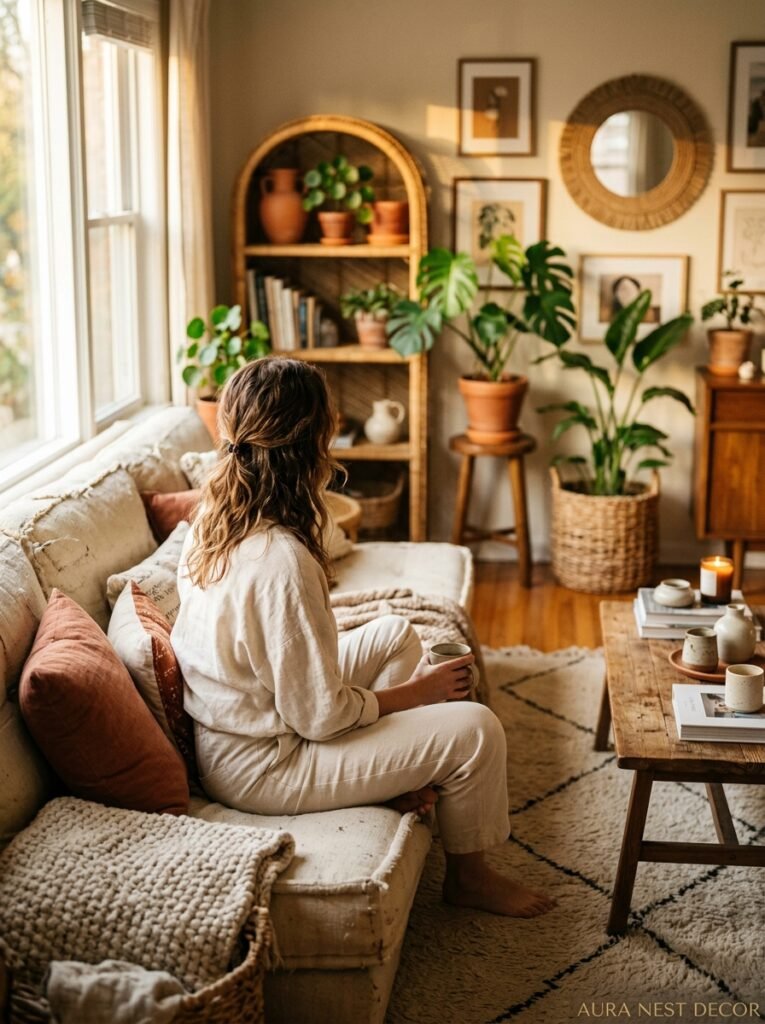
The earthy boho living room isn’t a trend you’re chasing. It’s more like a feeling you’re trying to build a room around — warmth, depth, the particular comfort of a space that looks like it knows you. You don’t have to do it all at once, and honestly you shouldn’t. The best versions of this look got there slowly, one vintage find and one dried grass arrangement and one perfect lamp at a time.
Start with the walls and the rug, and let the rest come. What’s the one piece in your living room right now that already feels like it belongs in the room you’re imagining?