The Garage Storage Glow-Up Nobody Talks About (But Everyone Needs)
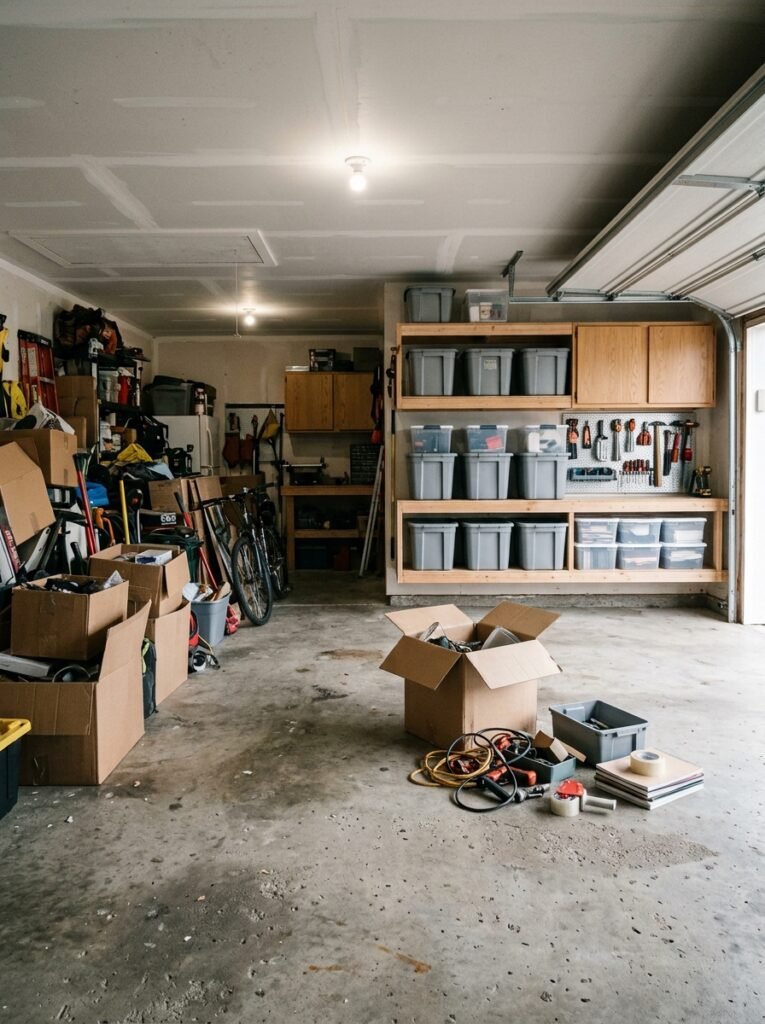
My husband opened the garage door in front of our neighbors last summer and I genuinely considered moving house. Not joking. There was a rake balanced against a box of Christmas decorations, a deflated paddling pool draped over what I think was a lawnmower, and somewhere underneath all of it, theoretically, a workbench.
We fixed it. And I’m going to tell you exactly how.
—
1. The First 20 Minutes That Determine Everything
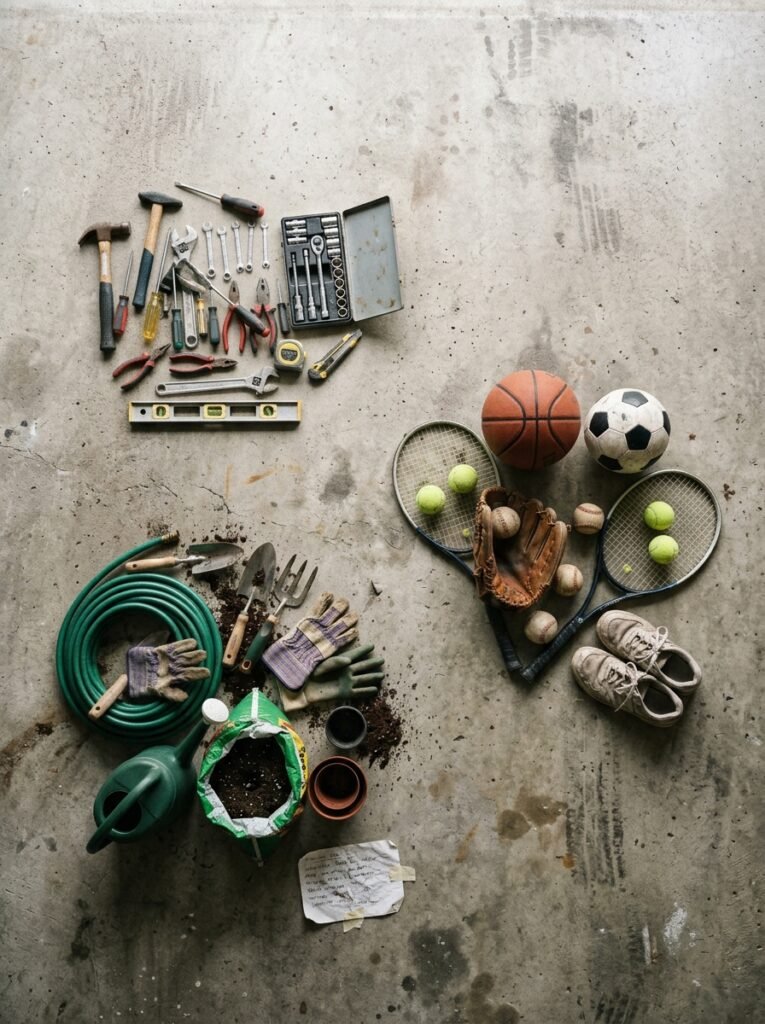
Don’t skip this part. I know you want to, I know it feels like admin before the fun, but the first thing you need to do is pull EVERYTHING out of the garage. Onto the driveway. All of it.
This is the moment people avoid and it’s also the moment that changes everything.
Because when you can actually SEE what you own, two things happen. First, you realize you have four half-empty bags of the same potting compost. Second, you realize you’ve been storing a broken folding chair for three years “just in case.” Just in case of what? Nobody knows.
Sort it into four piles: keep, donate, bin, and the deeply shameful “I’ll deal with that later” pile that you need to keep as small as possible. This stage isn’t glamorous. But doing it properly means everything else clicks into place faster. And honestly, the feeling of driving away a carload of stuff you don’t need anymore is one of the most satisfying experiences available to homeowners. I’m not exaggerating.
—
2. Why Your Floor Is the Most Wasted Space in the Room
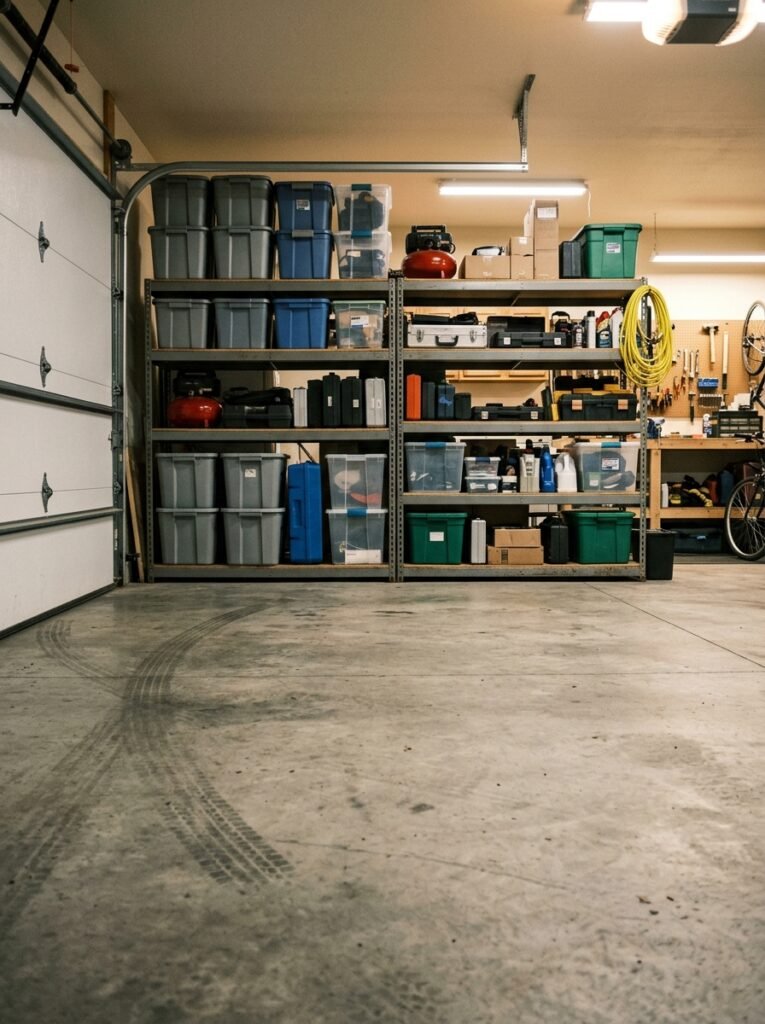
Here’s the thing about garages — everyone fills the floor and ignores the walls. And I get it, that’s the instinct, but it’s completely backwards.
Floor storage is the enemy of a functional garage. Stuff on the floor gets kicked, gets wet, becomes a tripping hazard, and — most importantly — it makes the entire space feel chaotic even when everything technically has a place.
“The goal isn’t a tidy garage. The goal is a garage where you can find anything in under a minute.”
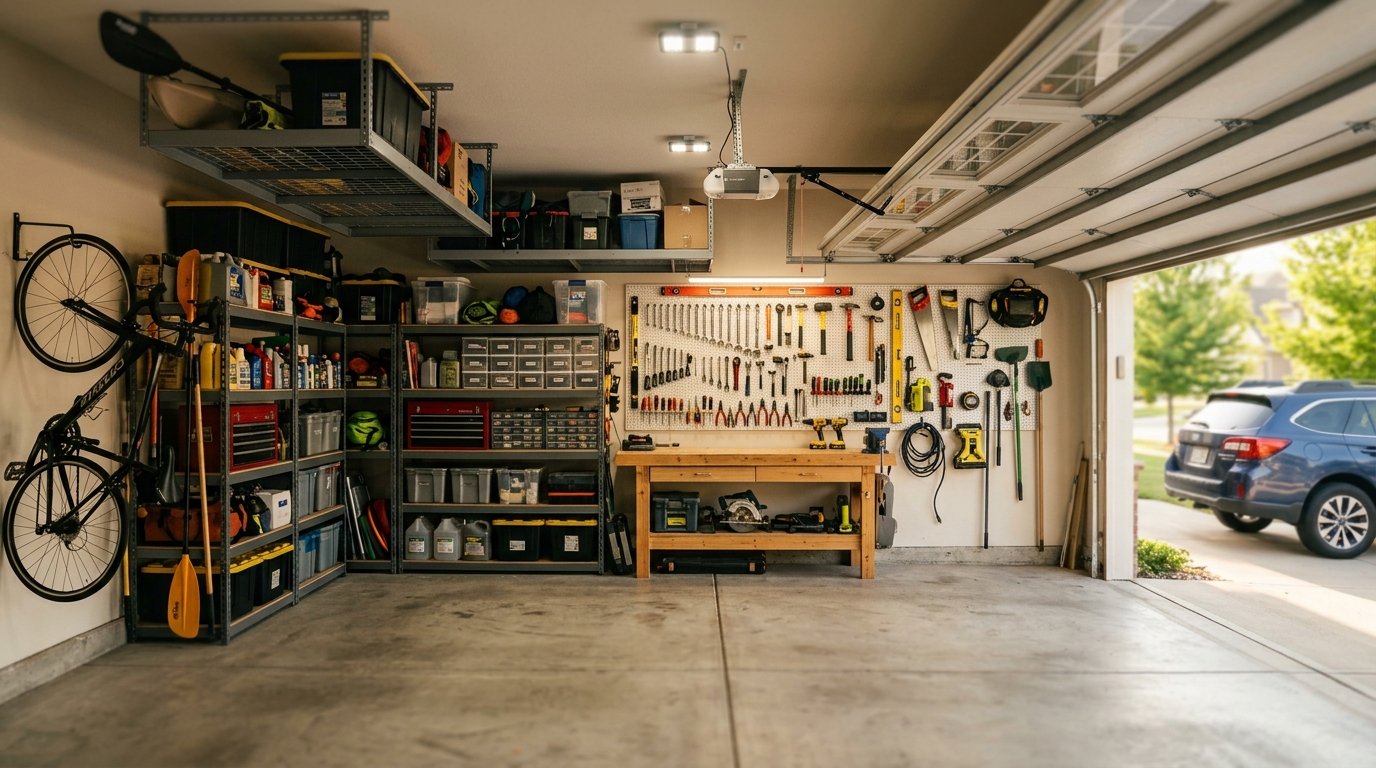
Go vertical. This is the single biggest mental shift required. Your walls are enormous, largely unused real estate. Heavy-duty wall-mounted shelving systems can hold significantly more than you think — we’re talking decades of seasonal gear, sports equipment, and tool storage, all up off the floor.
The floor should be kept clear enough that you could sweep it. That’s the bar. Not always spotless, but clear enough to sweep. It changes how the whole space feels.
—
3. The Ceiling Storage Idea That Sounds Weird Until You Try It
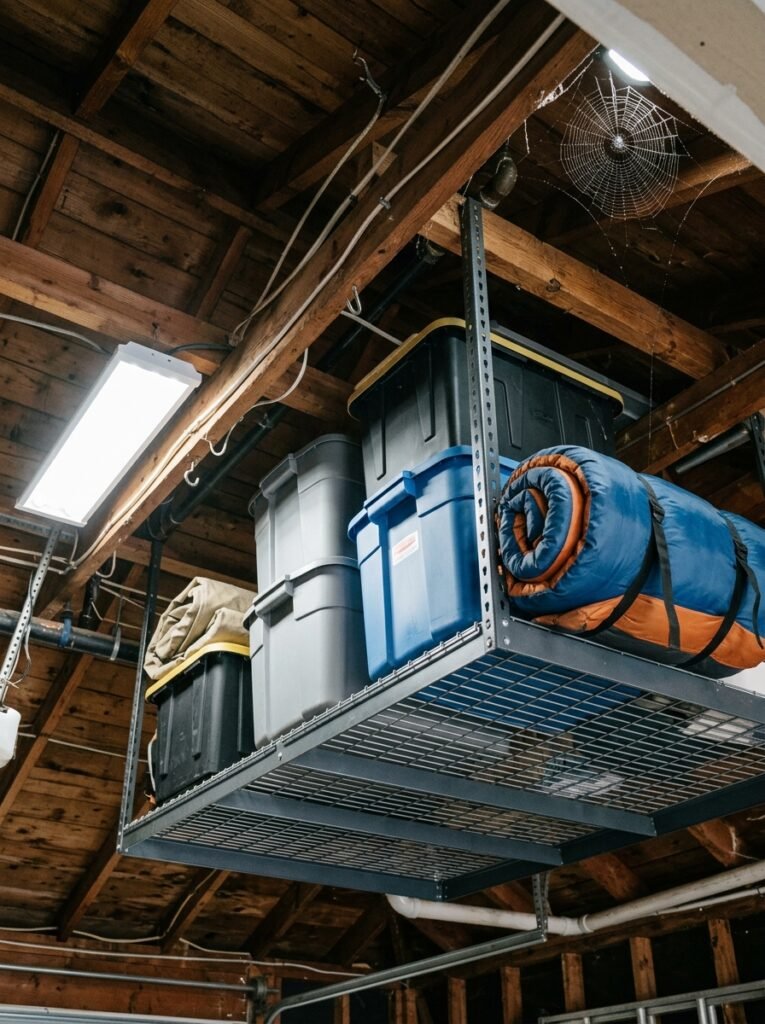
Okay so this one I resisted for a long time because it felt a bit extreme. Overhead ceiling storage — basically a platform or pulley system that hoists things up to sit suspended from the ceiling — seemed like something only very serious garage people did.
Reader, I was wrong.
Seasonal items are PERFECT for ceiling storage. Holiday decorations, camping gear you use twice a year, inflatable things, spare sports equipment for the sport your child has now quit. These things don’t need to be accessible regularly, they just need to be somewhere. And “somewhere” can be your ceiling.
Most ceiling storage platforms bolt into the joists and can hold anywhere from 250 to 600 pounds depending on the system. They sit flat overhead and you essentially forget they’re there until you need them in November when the Christmas boxes come down.
Side note — if you’ve got a tall garage, this is even more useful. The higher the ceiling, the more overhead real estate you’re wasting by not using it.
—
4. The Pegboard Comeback Nobody Predicted
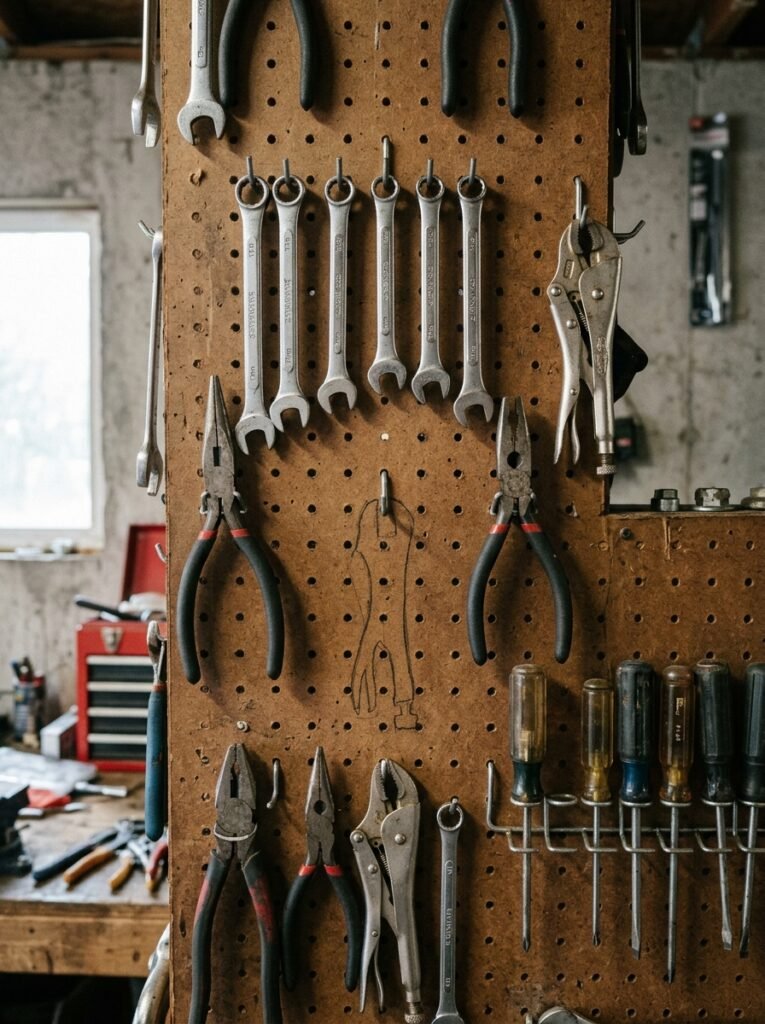
I’ll be honest, pegboard felt very 1987 to me for a long time. Beige, utilitarian, a bit sad. And then I saw someone paint theirs a deep forest green and hang their tools on it in an almost deliberately aesthetic arrangement and I completely changed my mind.
Pegboard is genuinely one of the most flexible storage solutions available. You can rearrange it whenever your needs change, which is significant — garages evolve. What you store changes year to year. Pegboard accommodates that without requiring you to re-drill anything.
Cover one full wall in it. Seriously, go big. A half-measure pegboard patch feels amateur. A full wall of it feels intentional and almost impressive. Add hooks, bins, shelves, magnetic strips for smaller metal items. Keep related things together — all the gardening tools in one section, all the power tool accessories in another.
Paint it first. This is non-negotiable for me. A painted pegboard in a color you actually like makes the whole garage feel like a room rather than a storage unit.
—
5. The Labeled Clear Bin System That Actually Gets Used
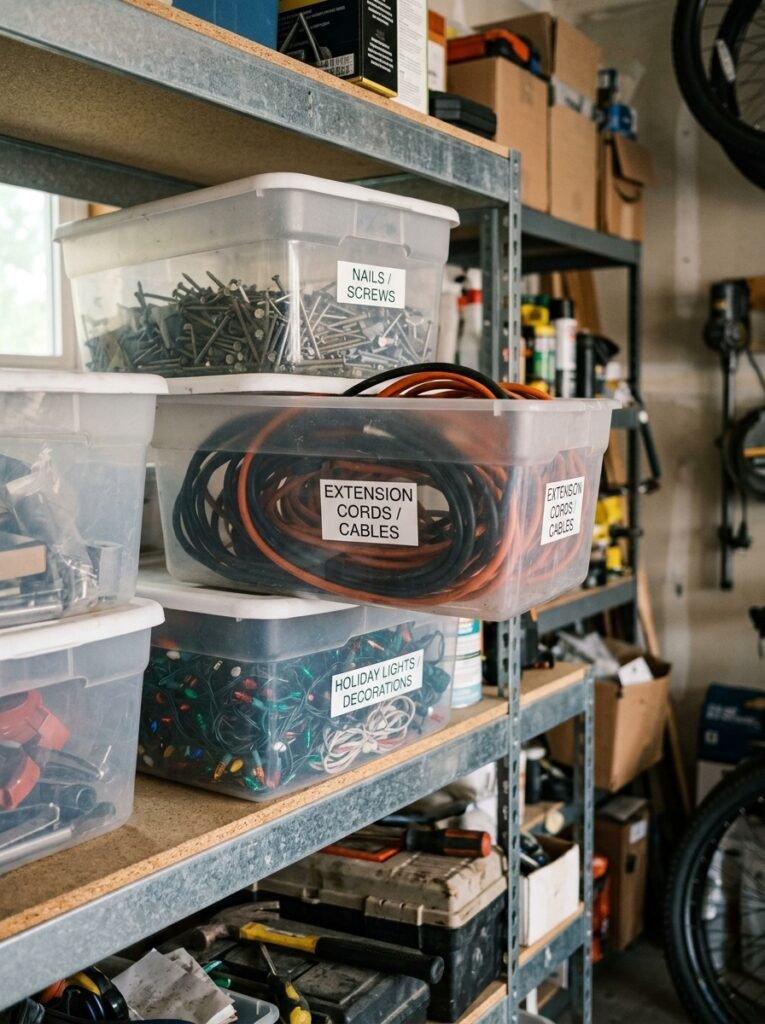
Not gonna lie, I’ve tried a lot of bin systems over the years. Opaque colored bins that look pretty but mean you can never find anything. Unlabeled clear bins that start organized and descend into mystery within six months. The elaborate color-coded label printer situation that lasted exactly two weeks before I gave up.
Here’s what actually works: clear bins, consistently sized, labeled on the SHORT end so you can see the label when they’re stored on a shelf.
That last part. People label the front face and then push bins to the back of a shelf and can’t see anything. Label the short side. Stack them. Done.
“Clear bins aren’t exciting. But you know what’s less exciting? Buying a new set of Allen keys because you can’t find the ones you definitely own.”
Group by actual use rather than by category. “Car stuff” is more useful than separating it into “car cleaning,” “car maintenance,” and “car emergency.” Your brain searches by situation, not taxonomy.
—
6. How to Store Sports Equipment Without Losing Your Mind
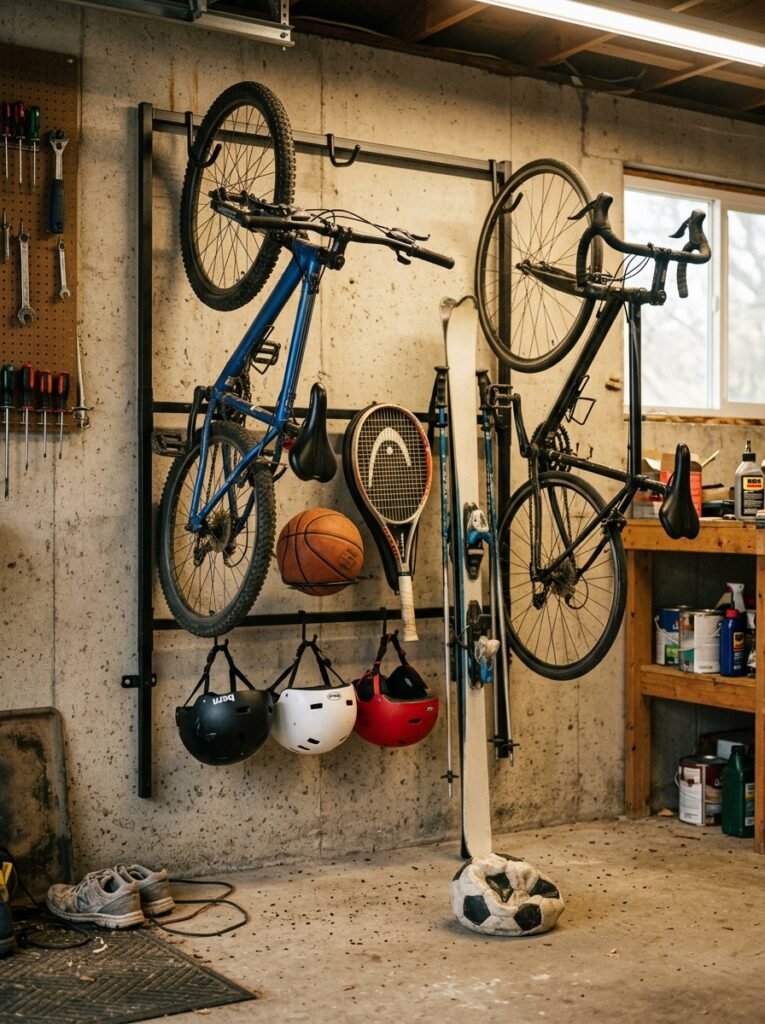
Bikes. Scooters. Footballs that roll under everything. Helmets. Knee pads your kids have outgrown but you’re saving for the theoretical future younger sibling. Tennis rackets, cricket bats, golf clubs for the phase that lasted eight months.
This category is the source of more garage chaos than almost anything else and the reason is that sports equipment is awkward-shaped, large, and frequently used by people who are bad at putting things away (children, but also, honestly, adults).
Bikes go on wall-mounted hooks or a freestanding bike stand — off the floor either way. A floor-level bike just becomes an obstacle course. For balls specifically, a simple mesh bag or a tall open-top bin works better than any fancy ball storage contraption I’ve ever seen. Balls are round. They don’t stack. A bin contains them. Problem solved.
For the helmet/pad/glove situation — one hook or bin per person. Named if you’ve got kids. No shared bin for protective gear, because shared bins become a jumbled argument.
—
7. The Humble Workbench and Why You Probably Need One More Than You Think

Even if you don’t consider yourself a DIY person. Even if “tools” to you means a hammer and a screwdriver set you received as a housewarming gift. A proper workbench changes how you use your garage.
A solid, waist-height work surface with storage underneath gives you somewhere to actually do things — wrapping presents, repotting plants, fixing things, cutting things. Without one, you end up doing all of these tasks hunched over the floor or balancing precariously on whatever flat surface you can find.
The storage underneath the bench is the real prize. Deep drawers for power tools, cabinets for chemicals and paints (kept locked if you have children — genuinely important), shallow drawers for small fixings and screws.
Build in a power outlet strip if you can. Or if hardwiring feels like too much of a project, a heavy-duty extension cord run from the wall and mounted to the bench surface with a clip. You’ll use it more than you expect.
—
8. The Corner That Every Garage Has and Nobody Ever Solves
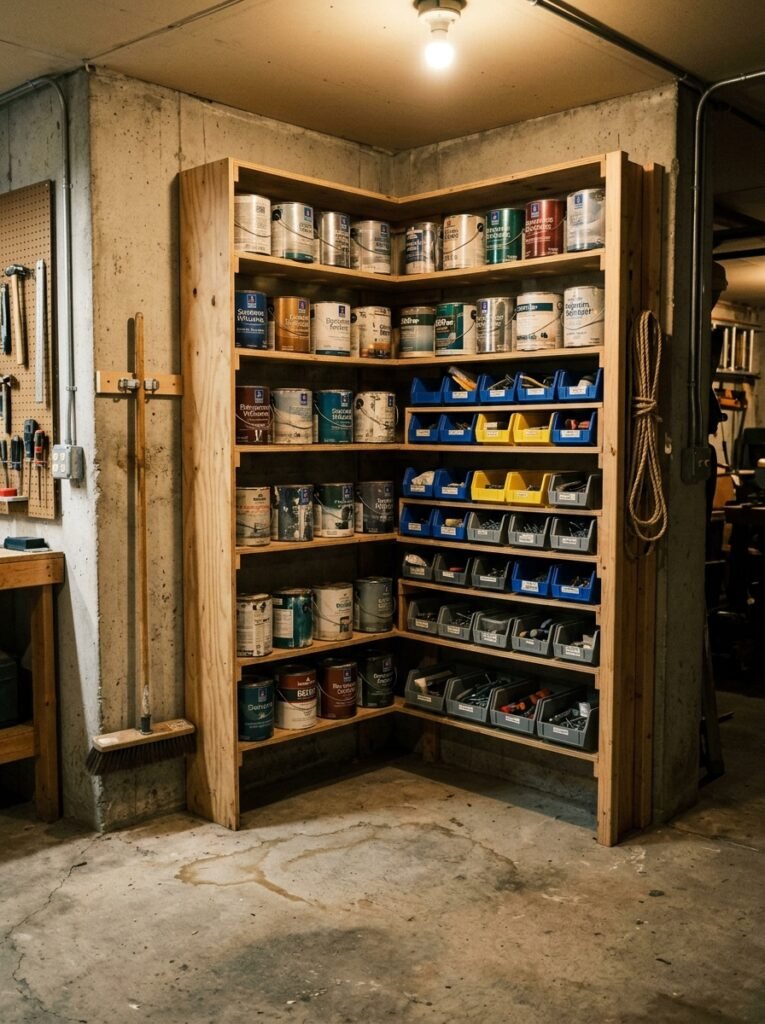
You know the corner I mean. The dead zone. The triangular wasteland where the broom goes to lean awkwardly and nothing ever really fits and you sort of just… avoid it.
Corner shelving units exist specifically for this. Tall, triangular or angled units that nestle into the corner and give you actual usable shelves instead of just angular regret.
Alternatively — and this is the more budget-friendly option — a simple tension rod across the corner at different heights, combined with a few S-hooks, creates hanging storage for lightweight items. Broom, mop, long-handled garden tools. Everything that tends to lean and fall and drive you slowly mad.
The point is: do something with the corner. Anything. It doesn’t take much to transform it from dead space to functional space, it just requires actually deciding what goes there instead of letting random things migrate in.
—
9. Seasonal Rotation: The System That Makes the Rest of It Work
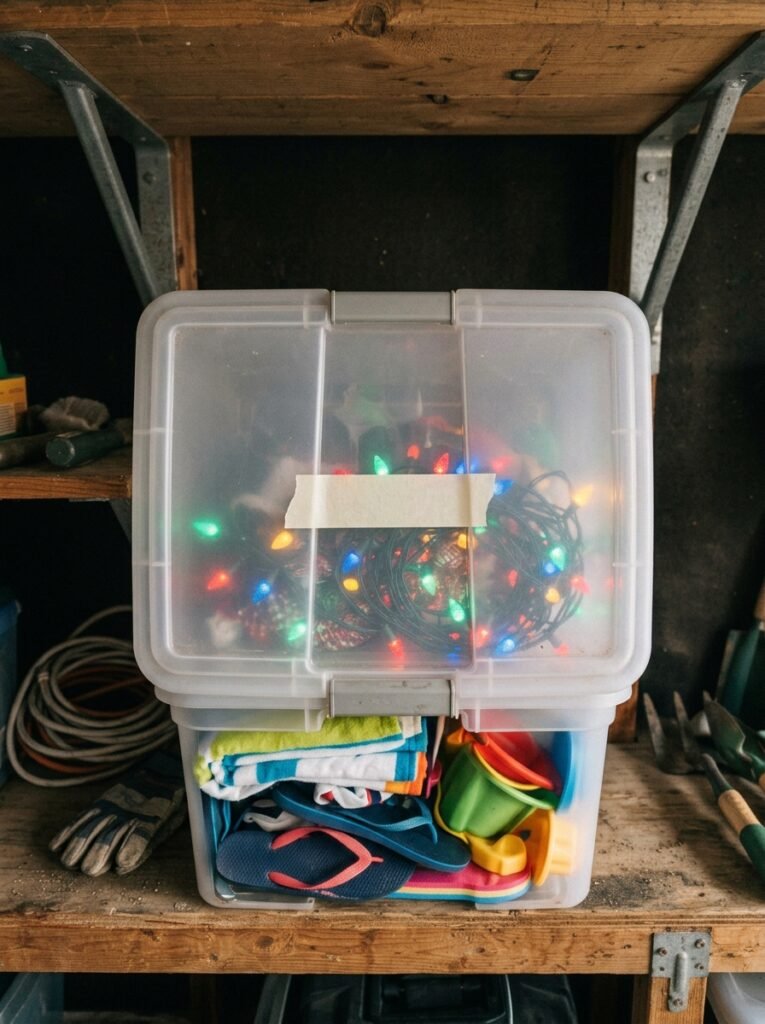
Here’s the thing people miss. They organize the garage ONCE and then wonder why it’s chaos again by February. The reason is that garages are seasonal spaces and a static storage system can’t accommodate that.
What you need is a rotation plan. Basically: twice a year (spring and autumn work well), you swap out what’s accessible and what’s in deep storage.
Summer: garden tools, outdoor furniture cushions, sports gear, car-washing supplies front and center. Winter decorations, snow gear if you’re somewhere that gets it, and off-season garden equipment pushed to the back or up to the ceiling.
Winter: the reverse. De-icer, shovels, and winter kit become the accessible layer. Summer gear goes into the overhead or back-shelf storage.
It sounds like effort. It’s actually about an hour, twice a year, and it means your accessible storage always matches what you actually need right now. Which makes the whole thing feel manageable rather than overwhelming.
“An organized garage isn’t a destination. It’s a rotation.”
—
10. Lighting: The Overlooked Detail That Makes Everything Work Better
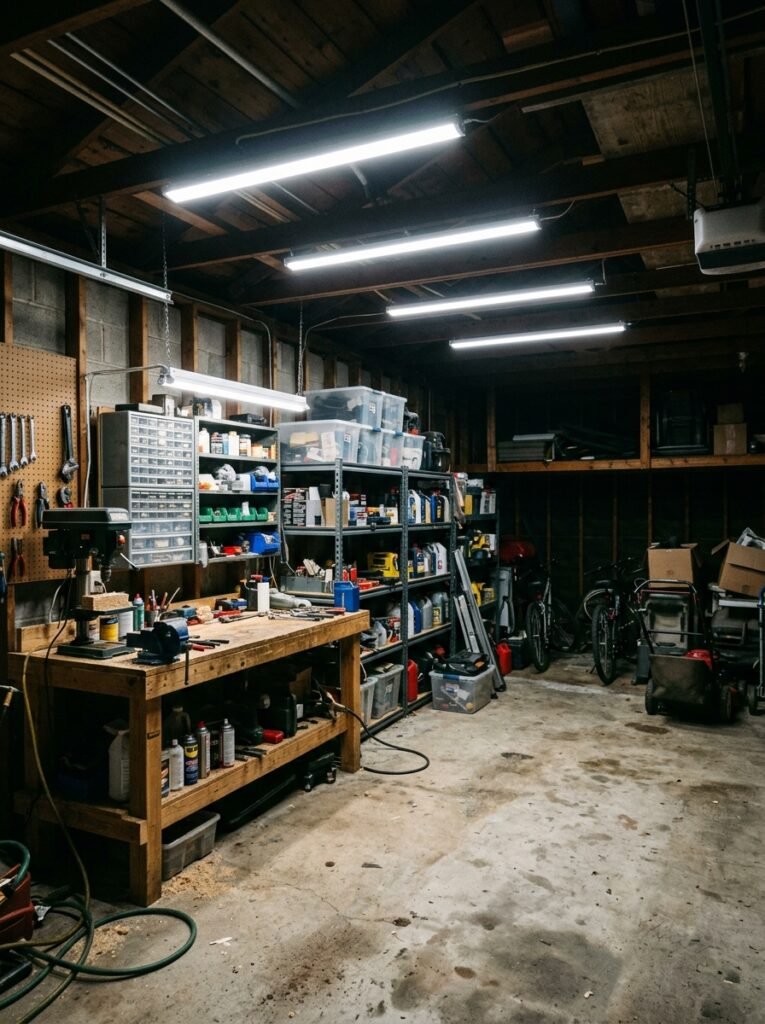
Most garages have one or two fluorescent tubes overhead. They’re functional but they cast weird shadows and they make the space feel institutional and grim, which makes you want to be in the garage for as little time as possible, which means you never properly maintain it.
Better lighting is not an indulgence. It’s practical.
A bright LED strip light running along the underside of your wall shelving means you can actually see what’s in the bins without having to pull everything out. A good overhead shop light — the hanging kind that you can position where you need it — makes the whole space more usable.
If you’ve got a workbench, a mounted arm light directed at the surface is the specific upgrade that makes the most difference. You’ll use the space more when it’s properly lit. That’s just the truth.
—
11. The Chemicals and Hazardous Stuff Problem (That Most Storage Articles Skip)
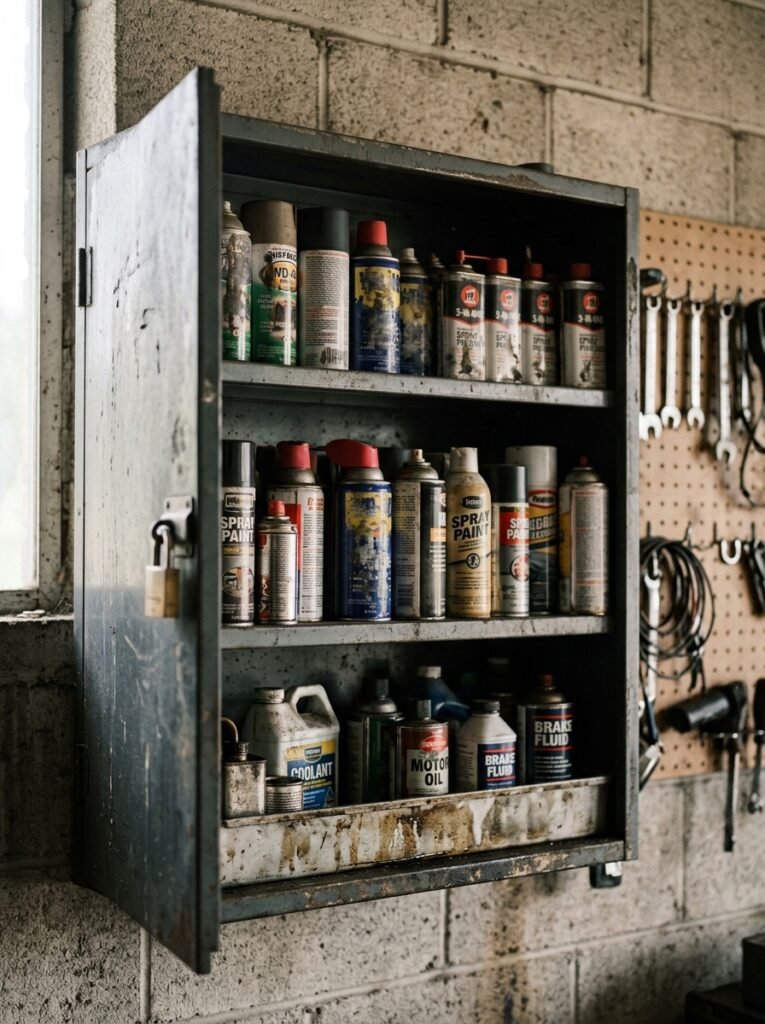
This one matters and it doesn’t get talked about enough. Garages tend to accumulate genuinely hazardous materials — paints, solvents, weed killers, pesticides, motor oil, antifreeze. And they tend to accumulate them kind of randomly, on whatever shelf had space.
These things need their own dedicated, ventilated, lockable storage. A metal cabinet designed for this is the right call — not because it’s stylish but because it protects your kids, your pets, and honestly your whole household.
Old paint tins especially. Half-used, dried out, taking up enormous amounts of space for no reason. Most local councils in the UK offer hazardous waste collection days. Most US counties have similar programs. Use them. Get rid of the paint tins that are clearly never getting used. You’ll reclaim more space than you expect.
—
12. The Small Detail That Makes a Tidy Garage Feel Cared For
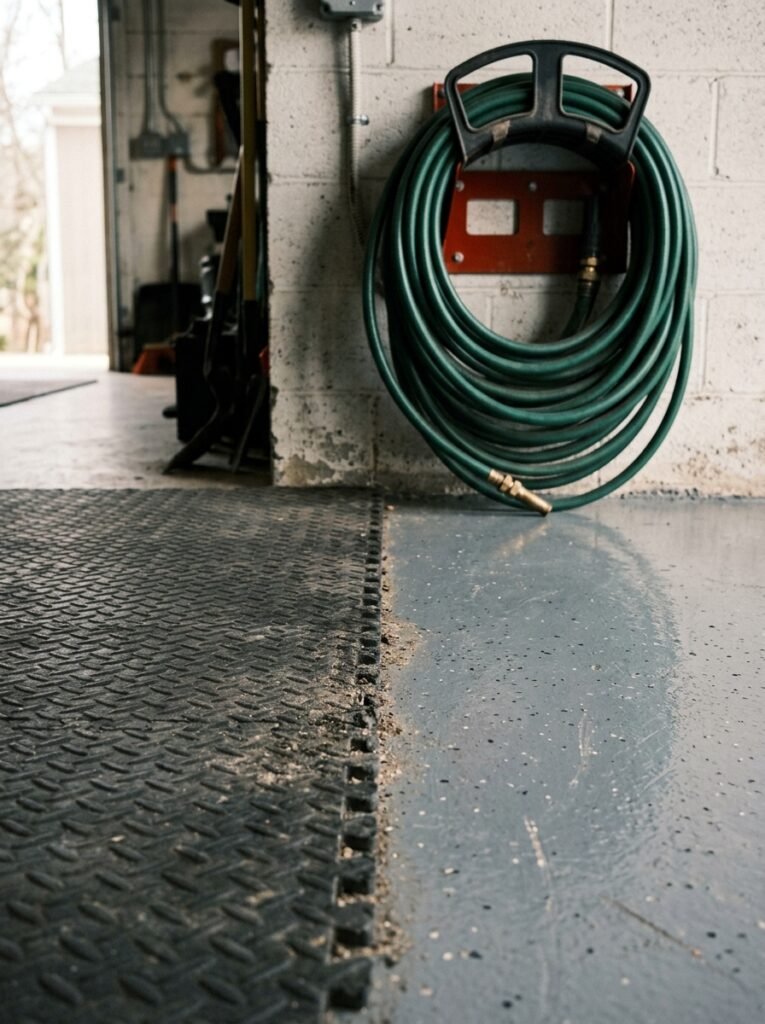
The thing that separates a stored garage from a kept garage is usually something tiny. A mat at the internal door. A clock on the wall (genuinely useful when you’re in the middle of a project). A hook inside the door specifically for the garage keys so they’re never not where they should be.
A chalkboard or small whiteboard on the wall for the shopping list of things you’ve run out of — masking tape, WD-40, spare batteries — so you actually remember to buy them instead of discovering mid-project that you’re out.
None of this is expensive. Or complicated. But it signals that this is a space someone actually takes care of, rather than a space someone simply tolerates. And that feeling — that the garage is part of your home, not just attached to it — is what makes you want to keep it this way.
—
❓ FAQ
Q: How do I stop my garage getting disorganized again after I’ve sorted it? A: The honest answer is: maintenance. A 10-minute reset every few weeks stops things from building back up. The bigger fix is making sure everything has a specific, logical home so putting it away is as easy as leaving it out.
Q: What’s the best way to store paint tins in a garage? A: Cool, dry, and off the floor. Temperature extremes degrade paint fast. If tins are old or dried out, check your local council or county for hazardous waste collection events rather than putting them in regular bins.
Q: Can I actually make a UK or US single-car garage feel organized, or is there just not enough space? A: You genuinely can, but it requires committing to vertical storage rather than floor storage. Single-car garages that go full wall-shelving and pegboard frequently end up with significantly more usable space than double garages that don’t. The square footage matters less than how high you’re willing to go.
—
💭 Final Thoughts
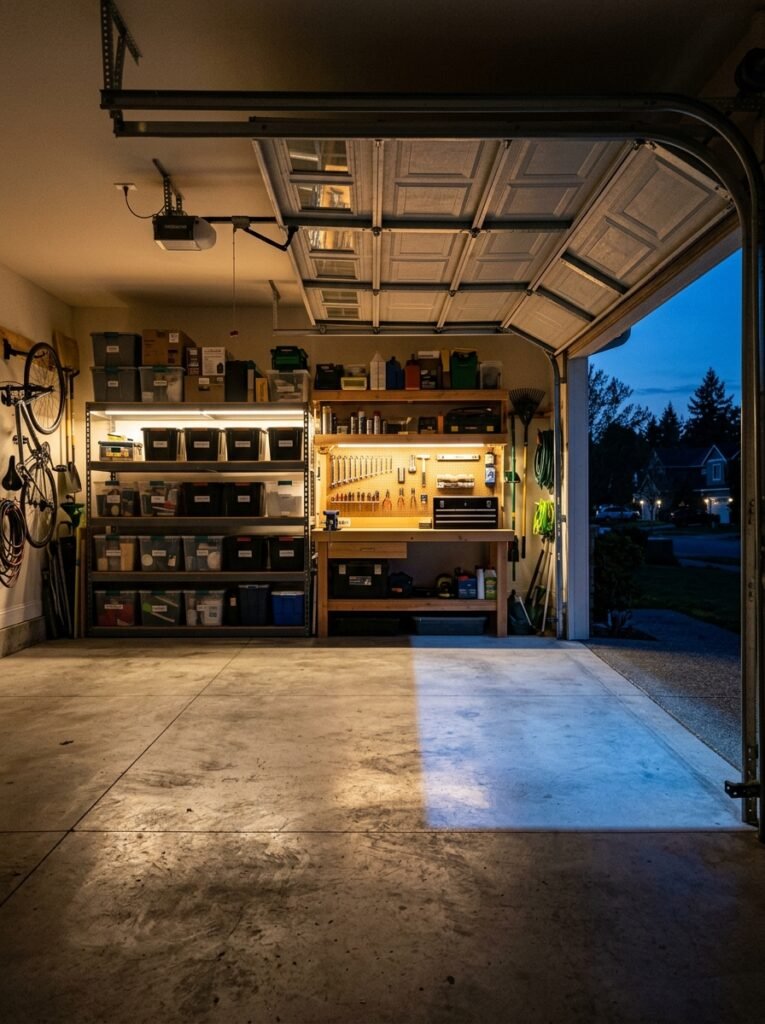
The garage doesn’t have to be the space you’re embarrassed about. It can be — I know this sounds dramatic, but stay with me — genuinely satisfying. A place you actually want to go into. A place that works for you instead of against you.
It just takes one full afternoon, a commitment to going vertical, and the willingness to throw away the broken folding chair.
What’s the one thing in your garage right now that you know, deep down, you should have gotten rid of years ago?