The Living Room Playroom That Doesn’t Look Like a Toy Store Exploded
My neighbor walked into my living room last spring and said, “Wait — you have kids?” She’d been standing in there for ten minutes before she noticed the basket of Duplo bricks tucked under the coffee table.
That was the moment I knew I’d figured something out.
—
1. Why “Just Move the Toys to the Playroom” Is Advice That Doesn’t Work for Most of Us
Here’s the thing nobody says out loud: most homes don’t HAVE a separate playroom. And even the ones that do — the kids don’t actually play in it. They follow you. Into the kitchen, the living room, wherever you are. Kids want to be where the people are, which means your living room is the playroom whether you like it or not.
So you have two choices. You can fight it every single day and lose. Or you can design around it on purpose, which honestly ends up looking better than a room nobody uses anyway.
I chose the second option after one too many evenings spent shoving Barbies under the sofa cushions before guests arrived. There’s a smarter way to do this, and it doesn’t involve buying a matching storage cube set in grey from IKEA and calling it a day. Not that there’s anything wrong with IKEA, but we can do better.
—
2. The One Design Principle That Actually Makes This Work
Everything — and I mean everything — comes down to containment that looks intentional.
Not hidden. Not disguised. Intentional.
There’s a massive difference between a room that’s trying to hide the fact that children exist in it and a room that’s been designed by an adult who also happens to have children. The first one always looks slightly frantic. The second one looks curated.
“A room that embraces children’s things — but decides where they live — always looks better than one that apologizes for them.”
The trick is deciding in advance exactly where toys are allowed to exist. One corner. One basket. One low shelf. When you give things a home, the room doesn’t feel chaotic even when it’s full of stuff. When everything is everywhere, even a beautiful room looks like a mess.
—
3. The Corner Method and Why It Actually Holds Up in Real Life
Pick a corner. Just one. And make it look GOOD.
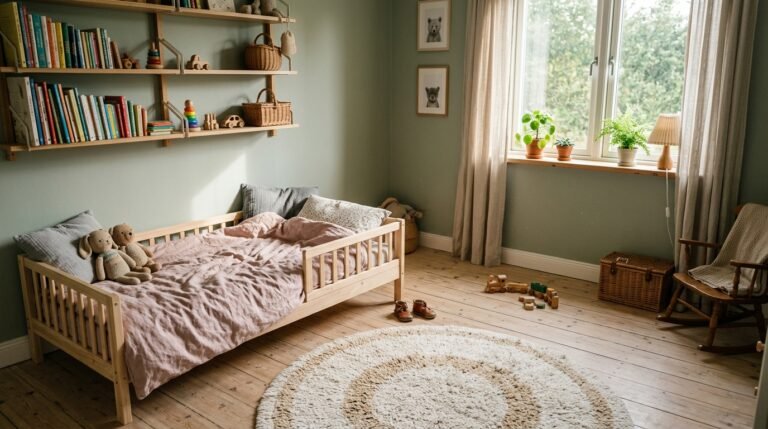
This sounds simple and it sort of is, but the execution matters a lot. Your kids’ corner shouldn’t look like an afterthought — it should look like a considered part of the room. A small bookcase painted in a warm terracotta or a deep forest green. A round rattan basket (not a plastic tub) for soft toys. A little wooden toy kitchen if your kids are in that phase, positioned at an angle so it reads as a furniture piece rather than equipment.
British readers will know what I mean when I say it should look like something from a small independent shop in Margate, not a clearance shelf.
American readers: think the kind of setup that makes other parents ask where you got it, not wince slightly.
The corner works because it gives kids ownership of a real physical space in the family room. They know where their stuff lives. You know where their stuff lives. And the rest of the room can breathe.
—
4. The Furniture That Does Double Duty Without Looking Desperate About It
An ottoman with internal storage is genuinely one of the best things you can own. I know that’s not a controversial take, but it bears repeating because so many people buy one and then don’t USE it for its actual purpose. Stuffed animals in there. Dress-up clothes. Puzzles. Books that are too big for the shelf.
A bench at the end of a sofa — or along a wall — with lift-up storage underneath works the same way. In a UK terrace house where you’re working with a smaller footprint, this kind of furniture earns its square footage.
Side note: don’t sleep on vintage pieces for this. An old blanket box, a wooden chest with a flat lid — they hold SO much, they look interesting, and they won’t make your living room look like a nursery. I found one at a car boot sale for £12. It holds every single toy car my son owns. You’d never know.
—
5. The Color Conversation Nobody Wants to Have (But Should)
Okay, here’s my slightly controversial opinion: the rooms that handle the living-playroom situation best are NOT the white, beige, neutral ones.
I know. I know.
But hear me out. When your walls and furniture are all varying shades of cream and oat, a single piece of bright plastic absolutely destroys the aesthetic. One red fire truck and suddenly the whole room looks like a mistake.
Rooms with a bit of warmth, pattern, or depth? They absorb toys SO much more gracefully. A room with mustard yellow cushions doesn’t blink at a yellow Lego brick on the floor. A sofa in a deep teal or a warm rust can sit next to a colorful toy and not look ridiculous. It’s not that the color hides anything — it just contextualizes it.
I’m not saying paint your living room lime green. I’m saying don’t be afraid of color if you have kids, because actually, color is your friend here.
—
6. The Low Shelf Rule That Interior Designers Use for Kids’ Rooms (It Works Here Too)
Keep everything kids need to access at their height. This sounds obvious but it changes EVERYTHING about how a room functions.
When toys are in reach, kids get them out themselves and — more importantly — they can put them away themselves. That’s not just convenient, it’s the whole system. Low open shelving, accessible baskets, hooks at their height. The mess your kids make is directly proportional to how hard it is for them to reach their own things. When they have to ask you to get something down or dig through a high storage unit, things come out and don’t go back.
“The easiest room to tidy is the one that was designed to be tidied by the people who make the mess.”
A low wooden Kallax unit (or any open cube shelving) works brilliantly for this. You can style the top with plants, books, candles — all the adult things — and dedicate the bottom cubes to kids. It reads as a proper piece of furniture. Nobody walks in and thinks “oh, a kids’ shelf.” They think “oh, nice shelving.”
—
7. Rugs: The Underrated Trick for Defining Space Without Building a Wall
A rug does something genuinely magical in a dual-purpose room. It creates a zone without any physical separation. The kids’ corner has its own rug — something durable, maybe patterned — and the adult seating area has its own rug, or bare floor if that’s your thing. Two areas. One room. No partition wall required.
In practical terms: go for a flat-weave or low-pile rug in the kids’ zone. Easier to clean, less likely to trap Lego pieces, and they vacuum better anyway. If you’re in the UK, a washable cotton dhurrie is honestly one of the most useful things you can own. They look great and they go in the machine.
The rugs don’t need to match. In fact, it’s better if they don’t — it reinforces the sense that these are two distinct zones sharing a space, not one chaotic all-ages room with no clear purpose.
—
8. What to Do With the Artwork Situation
Children’s artwork is genuinely a whole problem and I want to talk about it.
Here’s what I’ve landed on after years of experimenting: a dedicated gallery wall where you swap pieces in and out. Just a small section of wall — maybe five or six frames in matching black or natural wood — and you change what’s inside regularly. The best stuff gets framed and displayed. Everything else gets photographed and recycled. This sounds harsh and it absolutely is not, because your kid doesn’t care about last month’s scribble on a Post-it — they care about right now.
When their art is framed and hung alongside things you’ve actually chosen to display, it gets treated with dignity. Which, honestly, it deserves. A child’s drawing in a black frame on a white wall looks like something you’d find in a cool East London gallery, and that is not an exaggeration.
For the American readers whose school sends home an actual avalanche of work — same principle applies. Frame the standouts, let the rest go. Your refrigerator is not a gallery wall, no matter what it’s been told.
—
9. The Storage That Looks Better When It’s Slightly Visible
Not everything needs to be hidden. Some things look good out.
Wooden puzzles stacked on a shelf look nice. A collection of board books in a small basket looks nice. A few wooden toys on a low shelf — especially natural wood, unpainted — look genuinely lovely in a room. The problem isn’t toys being visible, it’s plastic being visible in large quantities. Which brings me to something I’ve been quietly opinionated about for a while.
The open-basket system is your best friend. A large wicker or seagrass basket with handles can hold an absurd amount of soft toys, dress-up bits, and stuffed animals and still look like a considered decor choice. Get two or three of the same basket and suddenly your storage looks intentional. A collection always looks more deliberate than a single item, even if the single item is identical to what’s in the collection. Weird but true.
—
10. The Screen and Book Zone That Works for Both Generations
If your living room has a TV — and let’s be honest, most do — think carefully about what happens in that same visual field. A small, curated bookshelf near the TV creates a kind of “media corner” that works for kids AND adults. Kids’ books on the lower shelves, adult books on top. A small pair of headphones on a hook. A blanket draped over the arm of the nearest chair.
This area actually benefits from being a bit cozy and a bit dim. The amber glow of a lamp at 7pm, a soft blanket, a small side table with a cup of tea (or a sippy cup, depending on who’s sitting there) — it’s the same spot for everyone. That shared quality is the whole point.
“The most peaceful living rooms I’ve ever been in were the ones where adults and kids clearly used the same spaces — just at different hours.”
When kids and adults share furniture and space rather than being segregated into different zones of the house, you get a room that doesn’t feel like it’s owned by anyone in particular. Which means it feels like a home.
—
11. The Part People Always Ask About: Making It Look Good for Photos (and Guests)
Real talk: there are three things you can do in about four minutes that make a living playroom look pulled together.
Put the baskets back where they go. Stack the books. Move one plant.
That’s genuinely it. Because when the bones of the room are good — when the storage is considered, the furniture is intentional, the colors are working together — a tidy version of it takes no time at all. The rooms that take 45 minutes to pull together before guests arrive are the ones where nothing has a proper home. Give everything a home and the “before guests” routine practically disappears.
For Pinterest photos specifically: take them in the morning with the toys put away, or in the late afternoon with the natural light coming through. Both look beautiful in a room that’s been designed rather than just accumulated. A room you love the bones of will photograph well at almost any hour.
—
12. The Version That Works in a Smaller British Home (Or Any Compact Space)
If you’re working with a UK front room — and I say this with all the love in the world — you know that square footage is not on your side. Here’s what I’d do with a smaller space.
Forget the dedicated corner. Instead, think about dedicated furniture. One beautiful piece of storage that does the kids’ job: a window seat with built-in boxes, a low sideboard with baskets inside, a bench. You want one single piece that “owns” the toy situation so the rest of the room doesn’t have to.
In a compact space, visible clutter is exponentially more overwhelming. So the containment rule matters even more. One basket. Always. Maximum two if you have two kids. And choose toys that are visually quiet when they’re out — wooden, natural-coloured, small.
A smaller room done right can look SO intentional and lovely. It can also look absolutely deranged if the toy situation isn’t handled. The margin for error is smaller, but the reward is real.
—
❓ FAQ
Q: How do I stop toys from creeping back into every corner of the room? A: The short answer is that it won’t stop on its own — you need a reset habit, not a different storage system. A quick five-minute tidy at the end of the day, every day, keeps things from getting to the point where it feels overwhelming. When there’s a clear home for everything, the reset is fast enough that it doesn’t feel like a chore.
Q: What’s the best flooring for a living room that’s also a play area? A: Engineered hardwood or luxury vinyl tile holds up incredibly well and cleans easily. If you’re renting (in the US or UK), or you just don’t want to deal with hard floors yet, a flat-weave or washable rug over whatever you have is genuinely fine — just make sure it’s low-pile enough that it won’t trip kids or trap things underneath.
Q: Can you make a living playroom work with a white sofa? A: You can, but you’ll need a good slipcover situation or very specific ground rules about snacks. A sofa in a slightly textured fabric — linen, boucle, or a durable weave — is much more forgiving than flat white cotton. Some people manage white sofas with kids and genuinely love them. Those people have a different relationship with spot-cleaning than I do, and I respect it enormously.
—
💭 Final Thoughts
The living room playroom doesn’t have to be a compromise. It can be the room where you actually enjoy being — because your kids are in there with you, not shut away somewhere else while you feel guilty about it.
Get the storage right, give the toys a home that looks good, and don’t fight the fact that your family lives in the living room. That’s what living rooms are for.
What does your current setup look like — is it working, or does it feel like the toys are winning?