
The MCM Living Room That Makes You Feel Something the Moment You Walk In
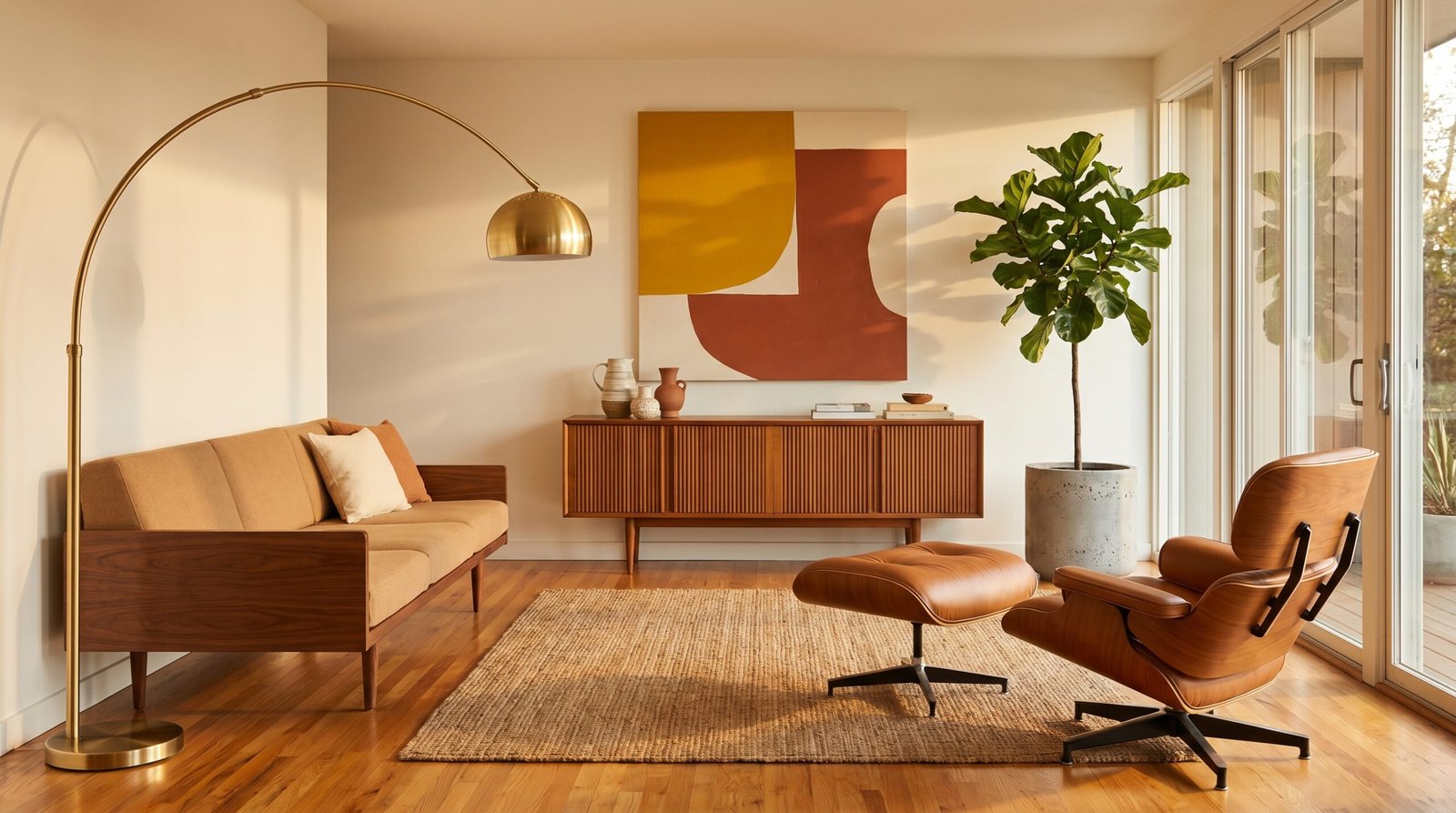
There’s a particular kind of stillness that settles over a Mid-Century Modern living room — clean lines, warm wood tones, a single arc lamp casting golden light across a low-slung sofa. It doesn’t shout for attention. It simply exists, confidently, like it has always known exactly what it is.
—
1. What “Mid-Century Modern” Actually Means (And Why It Still Matters Today)
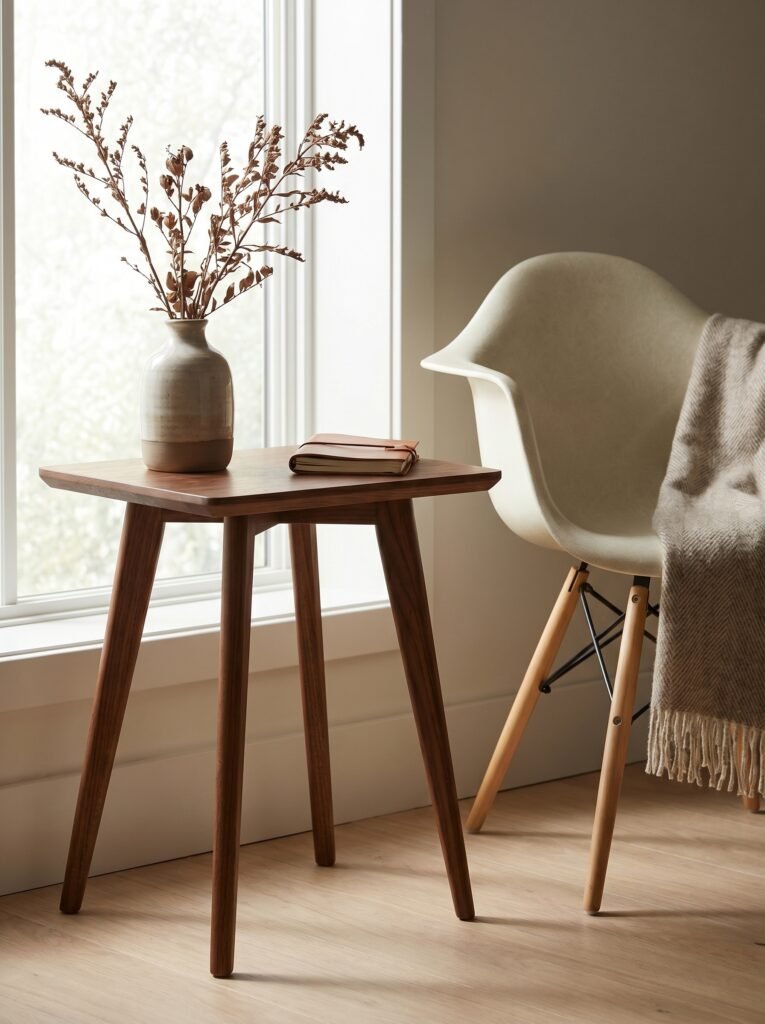
The term gets thrown around so casually on Pinterest that it’s easy to forget it refers to a genuinely distinct design movement — one rooted in a specific moment in history. Mid-Century Modern design flourished roughly between 1945 and 1969, born from a post-war optimism that believed good design could genuinely improve everyday life. Architects and designers like Eames, Saarinen, and Knoll weren’t just making furniture. They were making a philosophy tangible.
What made it revolutionary then — and what makes it timeless now — is its commitment to the idea that form and function should never compete. A chair should be beautiful and comfortable. A room should feel open and lived-in. Every object should justify its presence, not through ornamentation, but through honest, purposeful design.
In a living room context, this translates to spaces that feel both sophisticated and deeply human. There’s no stuffiness here, no gilded excess. Just warmth, intention, and a quietly confident aesthetic that has somehow outlasted every trend that tried to replace it.
“Good design doesn’t age — it simply becomes more honest with time.”
—
2. The Furniture That Defines an MCM Living Room
Imagine running your hand along the curved wooden leg of a walnut credenza, the grain smooth and warm beneath your fingers. That tactile honesty is the heartbeat of MCM furniture — and it’s where any well-designed Mid-Century living room must begin.
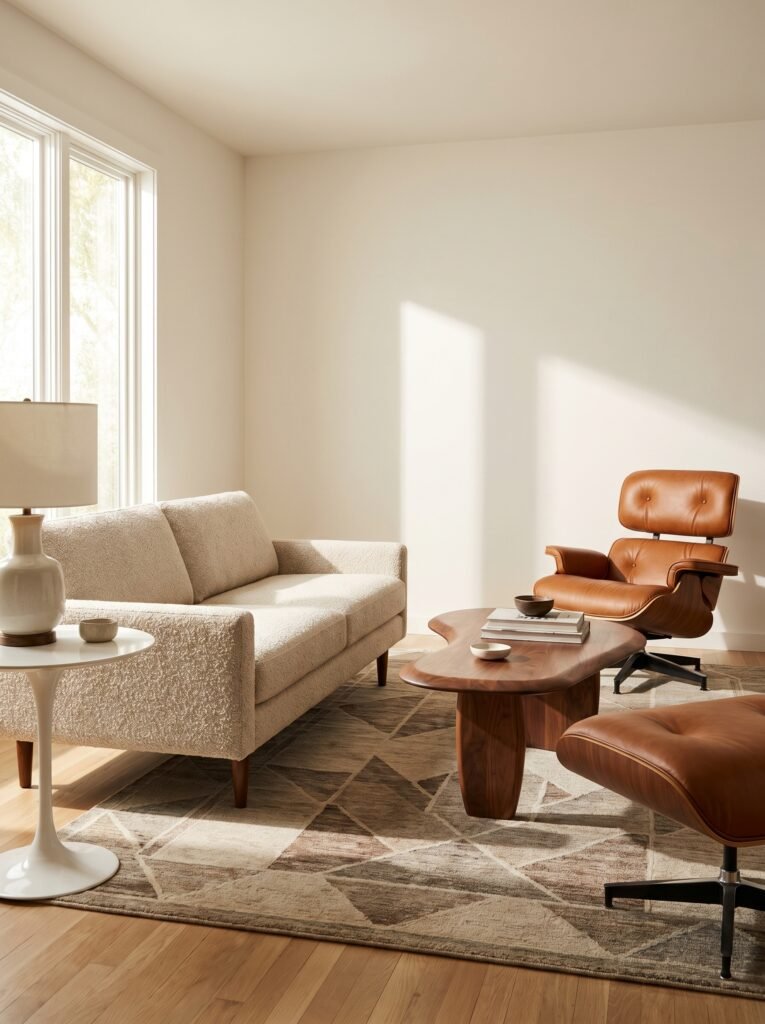
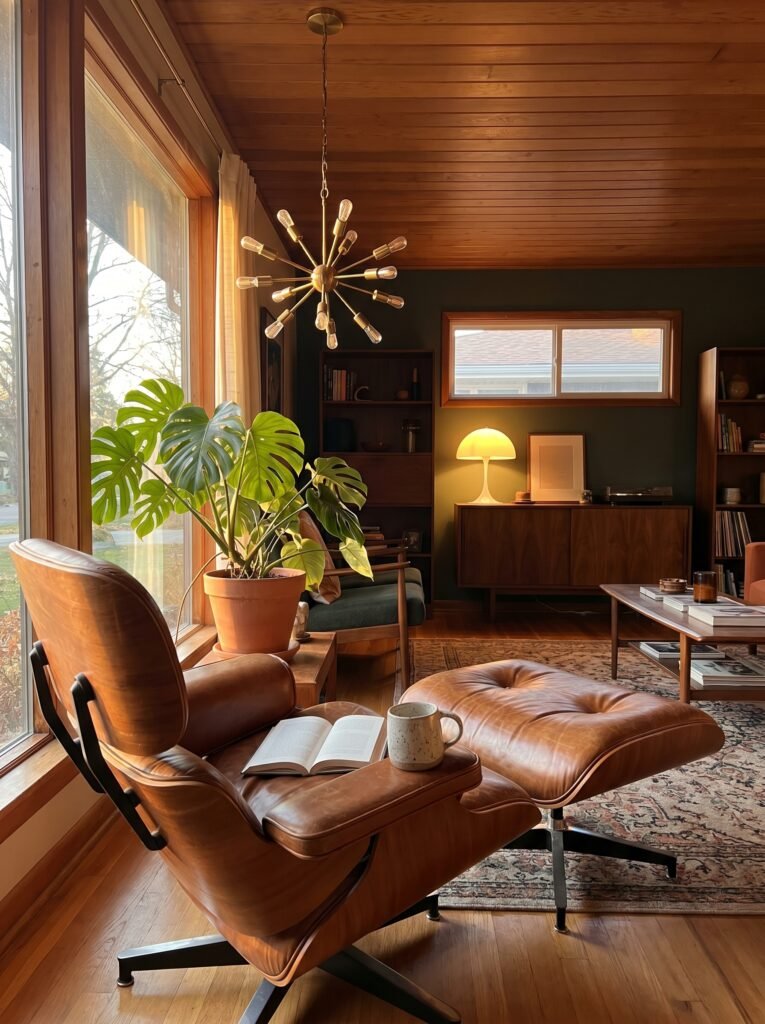
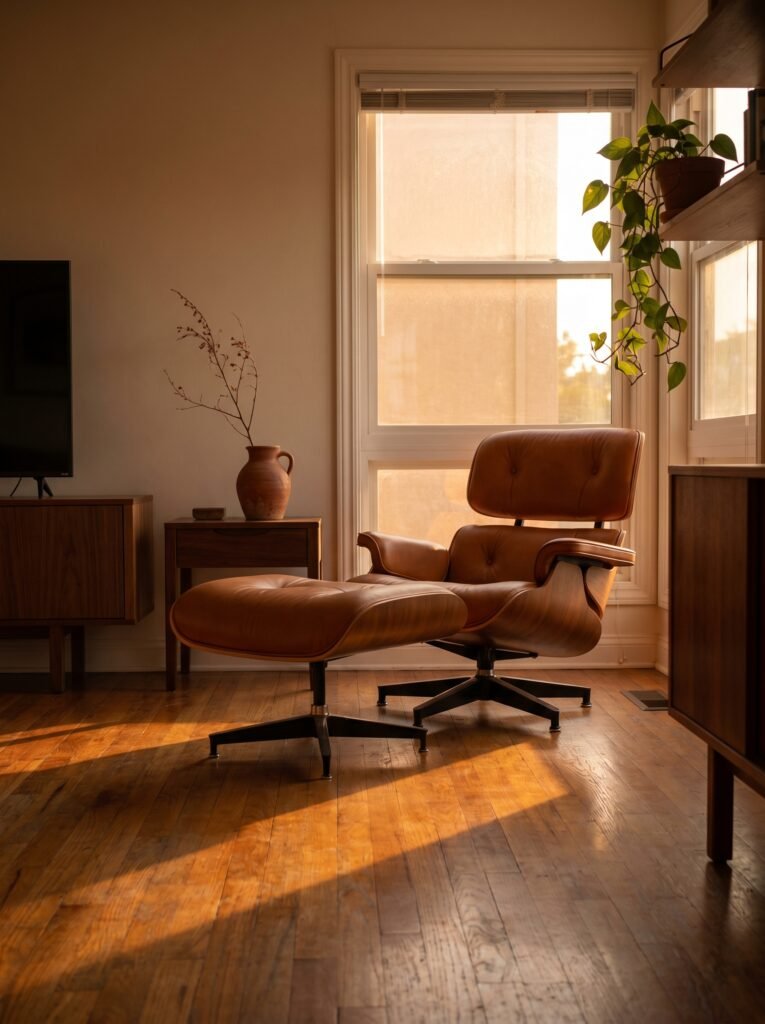
The classic MCM living room centers around a low-profile sofa with clean, angular lines and tapered legs — often in walnut, teak, or beech. The sofa doesn’t sit on the floor; it floats above it, creating visual lightness that makes even a modest room feel more spacious. Pair it with an Eames-style lounge chair, or a tulip side table, and you’re already speaking the language fluently.
What separates MCM furniture from imitations is the honesty of materials. Wood is wood — it shows its grain, its knots, its natural warmth. Upholstery comes in muted, earthy tones or occasionally bold accent colors, but never fussy patterns. Legs are almost always tapered and angled slightly outward, giving every piece an almost athletic elegance, as if the furniture itself is poised to move.
Look for these key furniture pieces when building your MCM living room: a low-slung sofa with wooden legs, a molded plastic or fiberglass accent chair, a floating media console or credenza, a sculptural coffee table in organic shapes, and a floor lamp with an arc or tripod base. These aren’t just pieces of furniture — they’re visual anchors that tell the whole story.
—
3. The Color Palette That Feels Like a Sunday Afternoon
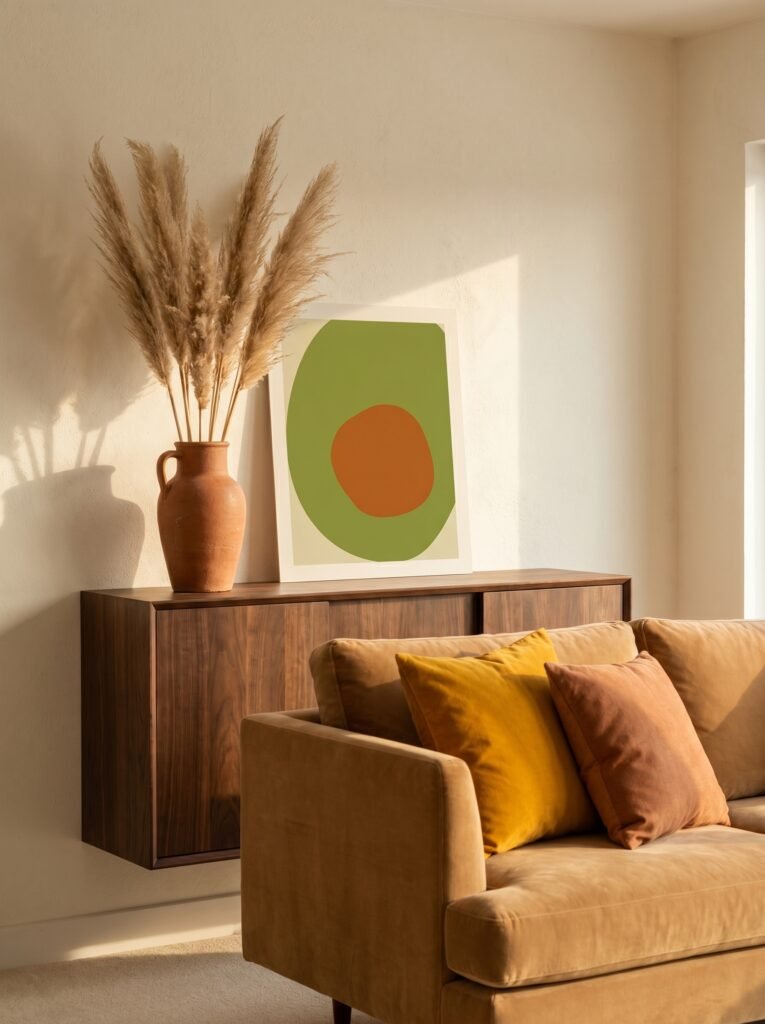
Color in a Mid-Century Modern living room works the way light works in a good photograph — it shapes mood without calling attention to itself. The foundation is almost always neutral: warm whites, creamy off-whites, or soft greige on the walls, allowing natural materials to do the heavy lifting.
From that neutral base, MCM color layers in with deliberate restraint. Warm teak and walnut tones bring richness. Mustard yellow adds a sun-warmed glow. Burnt orange reminds you of autumn light through a kitchen window. Avocado green, terracotta, and rust recall the earthiness of the desert landscapes that inspired so many MCM architects working in Palm Springs and the American Southwest.
What you won’t find in an authentic MCM palette: cold grays, stark whites, or anything that feels clinical. The whole point of this aesthetic — even at its most minimalist — is warmth. Every color choice should feel like it belongs to the natural world, not to a factory floor.
One approach that works beautifully: use a warm white on walls, bring in a walnut-toned credenza and tapered-leg sofa in oatmeal or camel, then add one or two intentional pops of color through throw pillows, a piece of abstract art, or a statement ceramic lamp. The room breathes. It feels curated but never rigid.
—
4. Flooring and Rugs That Ground the Whole Room
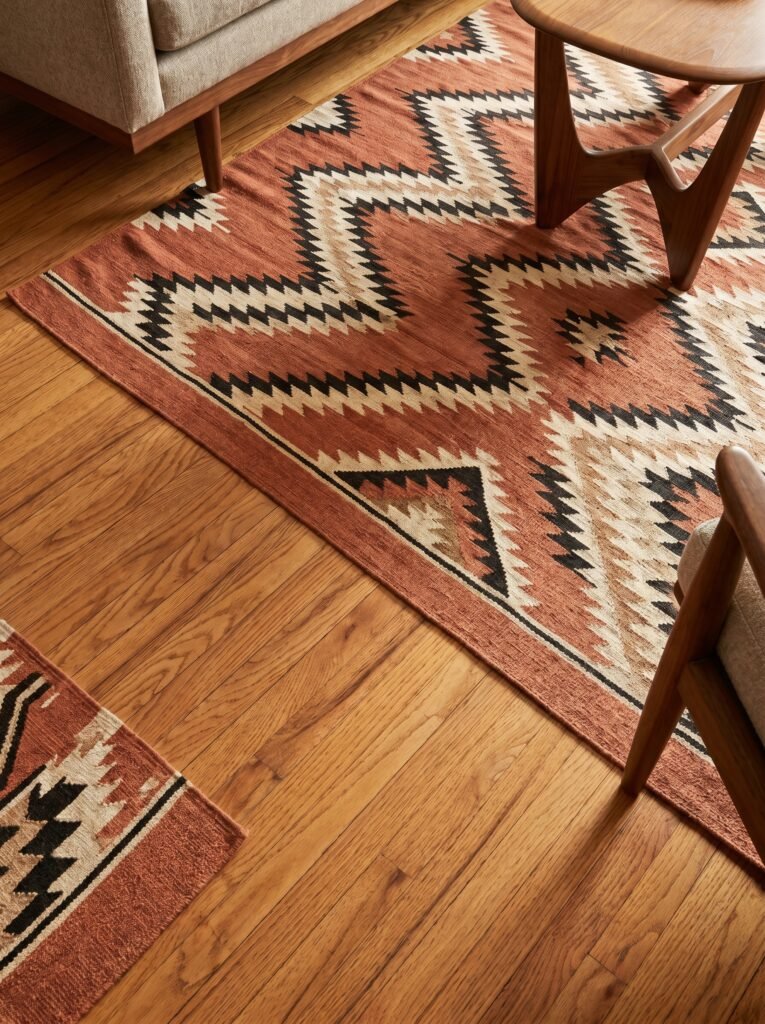
MCM living rooms traditionally feature hardwood floors — and for very good reason. The contrast between warm, natural wood underfoot and the clean angles of the furniture above creates the kind of visual harmony that feels effortless but is actually deeply considered.
If your space has carpet, don’t despair. A well-chosen area rug can do the same work. Look for flat-weave or low-pile rugs in geometric patterns — chevrons, abstract shapes, or simple linear designs in warm tones. The rug should feel grounded and intentional, defining the seating area without competing with the furniture for attention.
Hardwood in warm honey tones, rich walnut, or even painted concrete all work beautifully under an MCM interior. What you want to avoid is anything too ornate — no Persian florals, no shaggy high-pile, nothing that introduces visual noise where the design calls for calm.
“The floor is not just what you stand on — it’s the quiet foundation that holds the whole room together.”
—
5. Lighting That Changes Everything
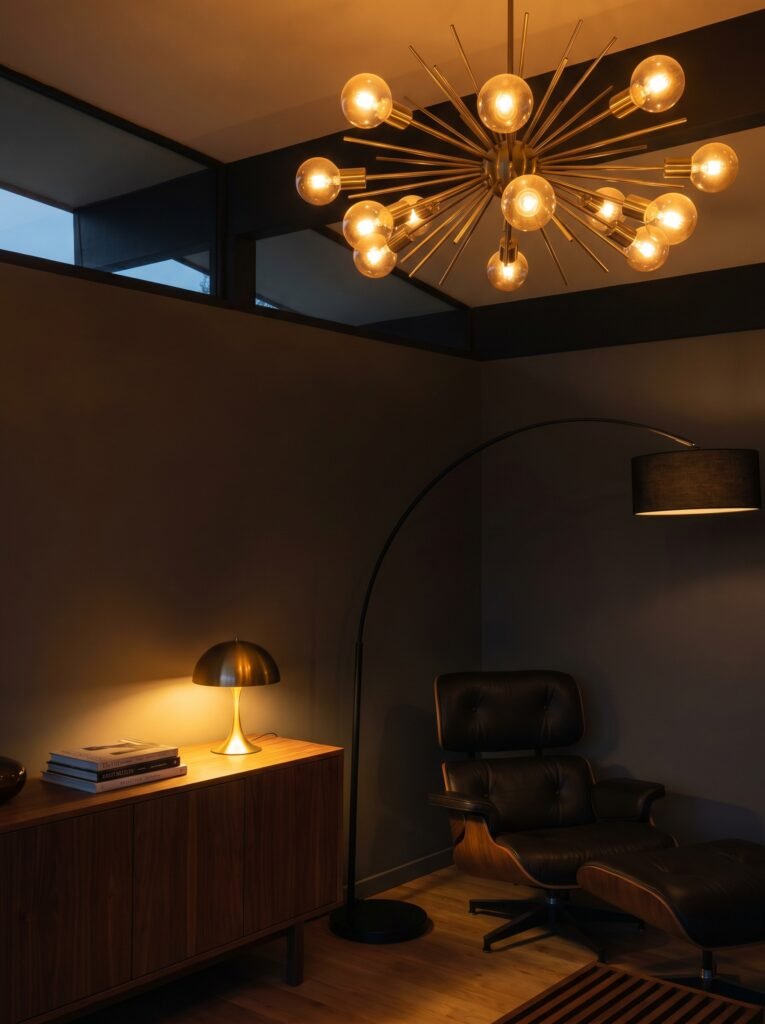
If there is a single element that can transform an MCM living room from merely stylish to genuinely soul-nourishing, it is the lighting. And this is where so many people underestimate the power of this design era.
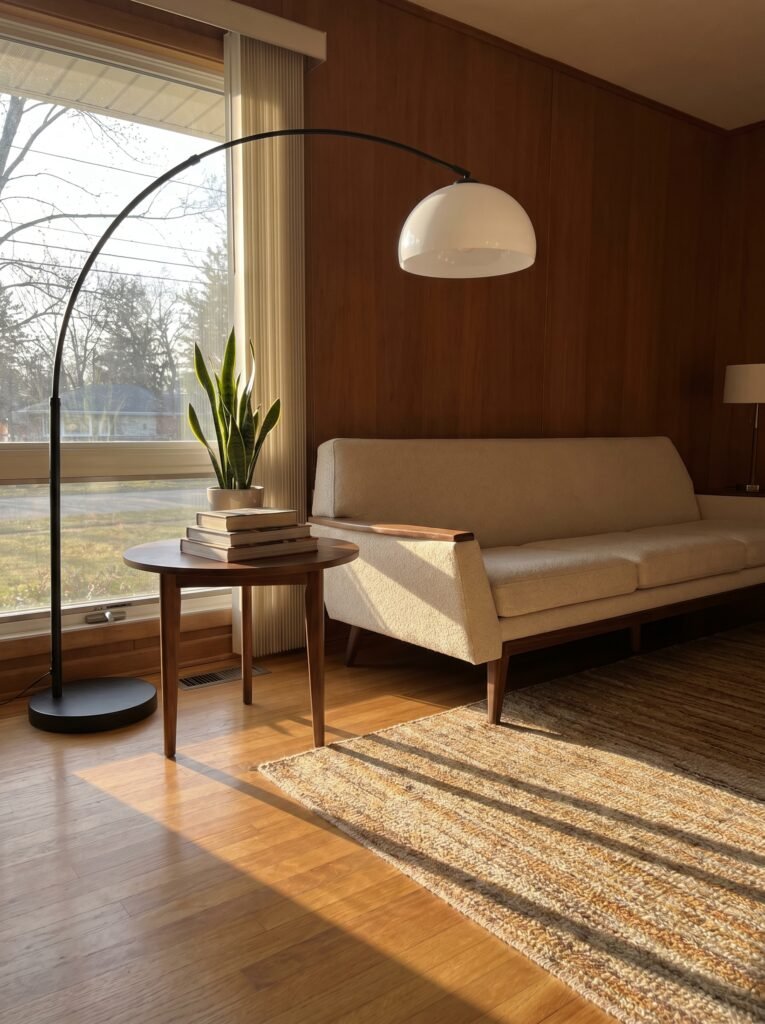
Mid-Century Modern designers were obsessed with light — both natural and artificial. They designed homes with enormous windows specifically to dissolve the barrier between interior and exterior. They created lamps that were themselves sculptures: the arc floor lamp with its dramatic sweep, the Sputnik chandelier with its starburst rays, the organic mushroom table lamp that pools warm light onto a reading surface like a small sun.
In your MCM living room, layer your lighting intentionally. Start with ambient light — recessed lighting with warm-toned bulbs works well, or a statement pendant. Add task lighting through a sculptural floor lamp beside the reading chair. Then introduce accent lighting: small table lamps on the credenza, a backlit piece of wall art, or even a simple candle arrangement on the coffee table that recalls the era’s love of organic, intimate spaces.
Avoid harsh overhead fluorescents or cold LED tones. MCM lighting should always feel warm — 2700K to 3000K on the color temperature scale is your friend here. The goal is a room that glows, not a room that illuminates.
—
6. Walls That Say Everything Without Saying Too Much
The walls of a Mid-Century Modern living room are not a blank afterthought — they are a carefully considered backdrop. And the most important thing to understand about MCM wall design is the principle of restraint.
This doesn’t mean bare walls. It means intentional walls. A single large-format abstract canvas — think bold geometric shapes, or expressive brushwork in mustard, terracotta, and black — can anchor an entire room. A gallery wall of black-and-white photography feels equally at home. Architectural details like a brick accent wall, wood paneling in teak or walnut tones, or even a simple shiplap feature in warm white all align beautifully with the MCM aesthetic.
What to avoid: gallery walls that feel cluttered, decorative signs with phrases, excessive small frames competing for attention. Less is always more here. One meaningful piece, placed with confidence, speaks louder than ten pieces placed without intention.
—
7. The Art of the MCM Accessory (Without the Clutter)
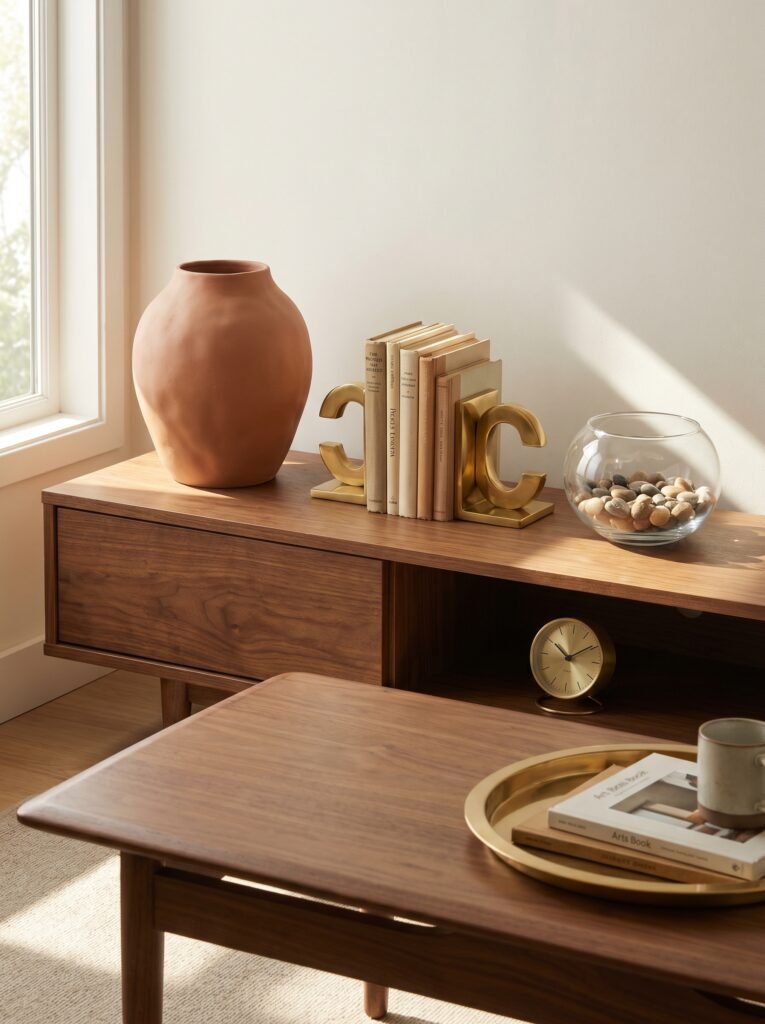
Here’s the quiet secret of every MCM living room that photographs beautifully and feels genuinely comfortable to live in: the accessories are edited ruthlessly. Every object earns its place.
Think ceramic vessels in organic shapes — not rows of small knick-knacks, but one or two statement pieces placed with breathing room between them. Sculptural bookends flanking a curated row of spines. A single trailing plant in a textured pot. A vintage brass clock on the credenza. A glass bowl catching afternoon light on the coffee table.
The MCM approach to accessories is almost curatorial — each object is given enough space to be seen, enough silence around it to be appreciated. When you walk into a room styled this way, you don’t feel the visual exhaustion of too much to look at. You feel, instead, a kind of restful attention. Your eye moves through the space slowly, finding pleasure in each individual element.
—
8. Plants and Nature — The Living Ingredient
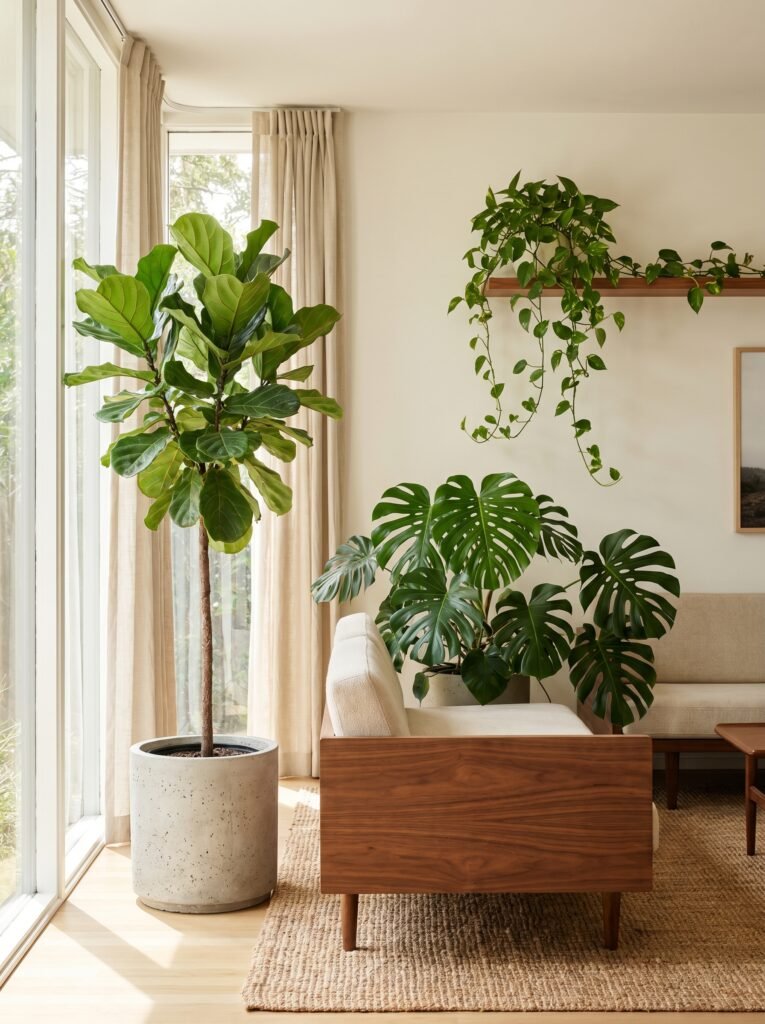
Mid-Century Modern design was, at its philosophical core, a design movement in conversation with nature. The large windows, the organic curves, the natural materials — all of it was an attempt to bring the outside world in, to remind the person sitting in that Eames chair that they are not separate from the natural world.
Plants are the most direct expression of this philosophy in a living room. And the plants that work best in MCM spaces are those with bold, sculptural forms — the rubber plant with its deep green glossy leaves, the fiddle-leaf fig standing tall in the corner, the monstera with its dramatic cut leaves, the snake plant rising with architectural precision from a simple ceramic pot.
“A living room without a plant is like a sentence without a pause — technically complete, but missing something vital.”
Place your plants with the same intentionality you would a piece of furniture. A tall floor plant in a corner brings a vertical element that balances the room’s horizontal lines. A trailing pothos on a floating shelf adds softness. A single succulent on a side table brings a quiet, undemanding presence.
—
9. The MCM Home Office Nook Within the Living Room
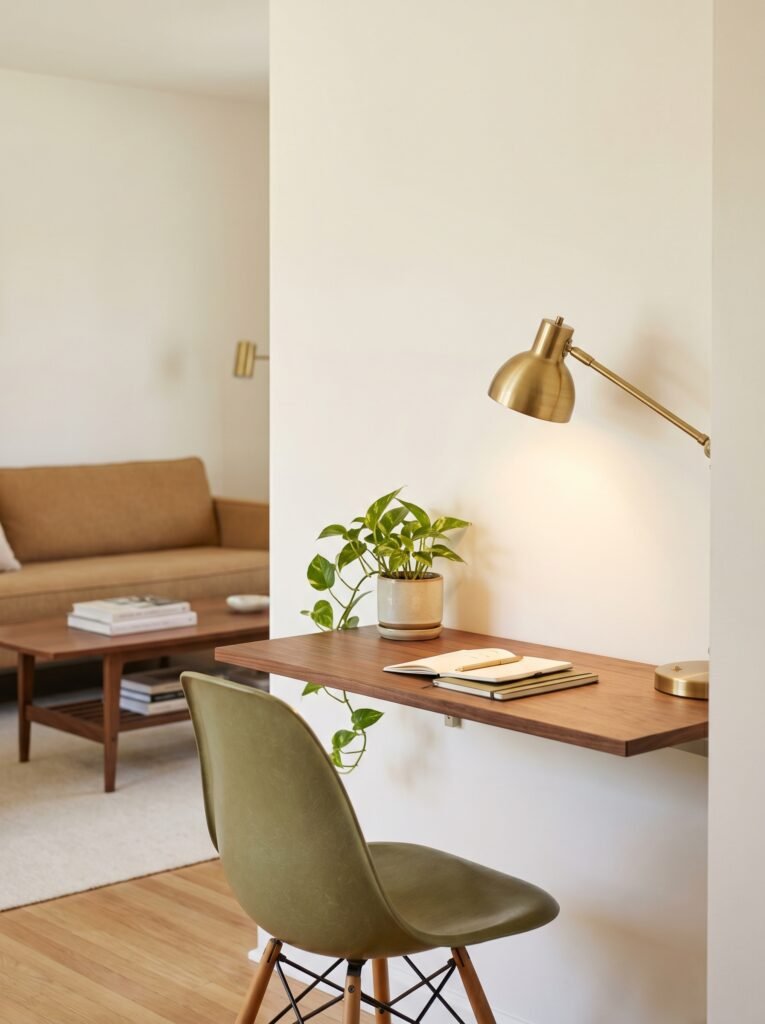
One of the most practical gifts the Mid-Century Modern aesthetic offers to modern living is its natural adaptability to multifunctional spaces. Many of us now need our living rooms to function as workspaces, reading rooms, or creative corners — and the MCM aesthetic handles this gracefully.
A floating walnut desk tucked against one wall, paired with a simple molded chair and a single task lamp, can exist within an MCM living room without disrupting the design logic. The floating credenza becomes a media console and storage unit simultaneously. The bookshelf becomes both library and display space.
The key is that the workspace should feel continuous with the living space, sharing the same materials, color palette, and restraint. When the laptop closes and the day ends, the desk should recede quietly back into the room’s visual calm.
—
10. Small MCM Living Rooms: Making Less Feel Like More
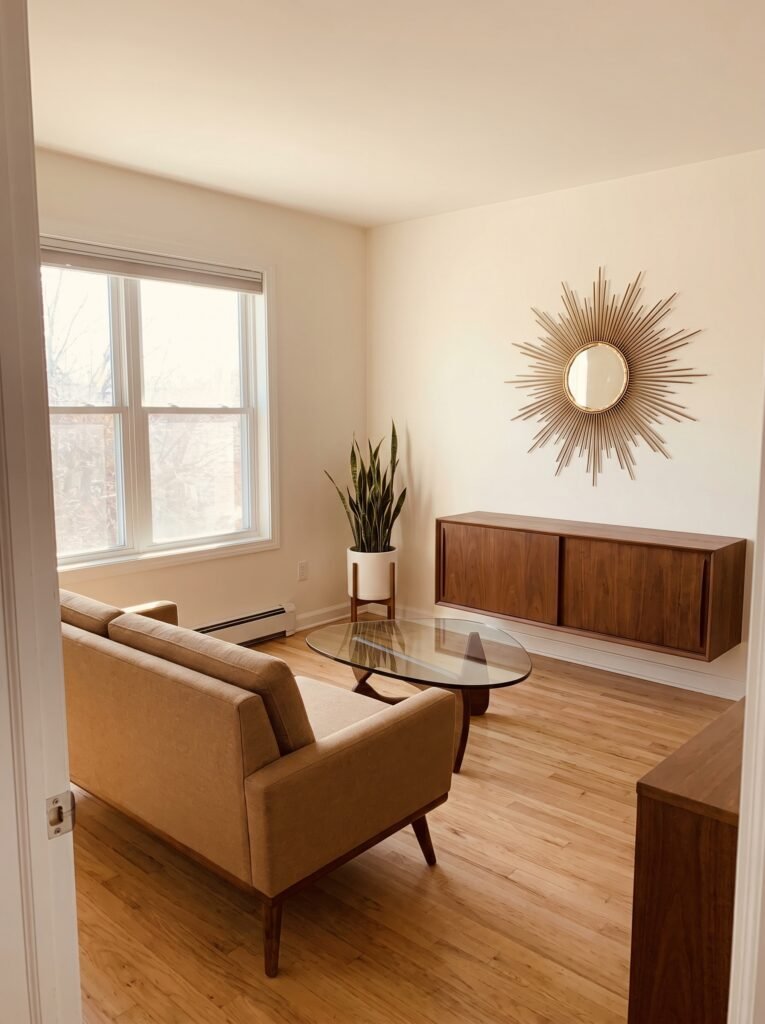
One of the most persistent myths about Mid-Century Modern design is that it requires space — high ceilings, open-plan layouts, sweeping mid-century ranch house proportions. In reality, the MCM aesthetic was designed with efficiency in mind, and it translates beautifully to small living rooms.
The key is the furniture scale. A low-profile sofa doesn’t eat the room visually. A round coffee table allows easier movement. A floating credenza keeps the floor clear underneath, making the room feel more open. Mirrors in atomic or starburst frames reflect light and create the illusion of depth without adding visual weight.
In a small MCM living room, every piece must work harder. Choose multipurpose furniture — an ottoman that doubles as a coffee table, a credenza that serves as media storage and display surface, a nesting table set that can expand for guests and tuck away when not needed. The result is a space that feels intentional, not cramped — curated, not compromised.
—
11. Mixing MCM With Other Styles (The Right Way)
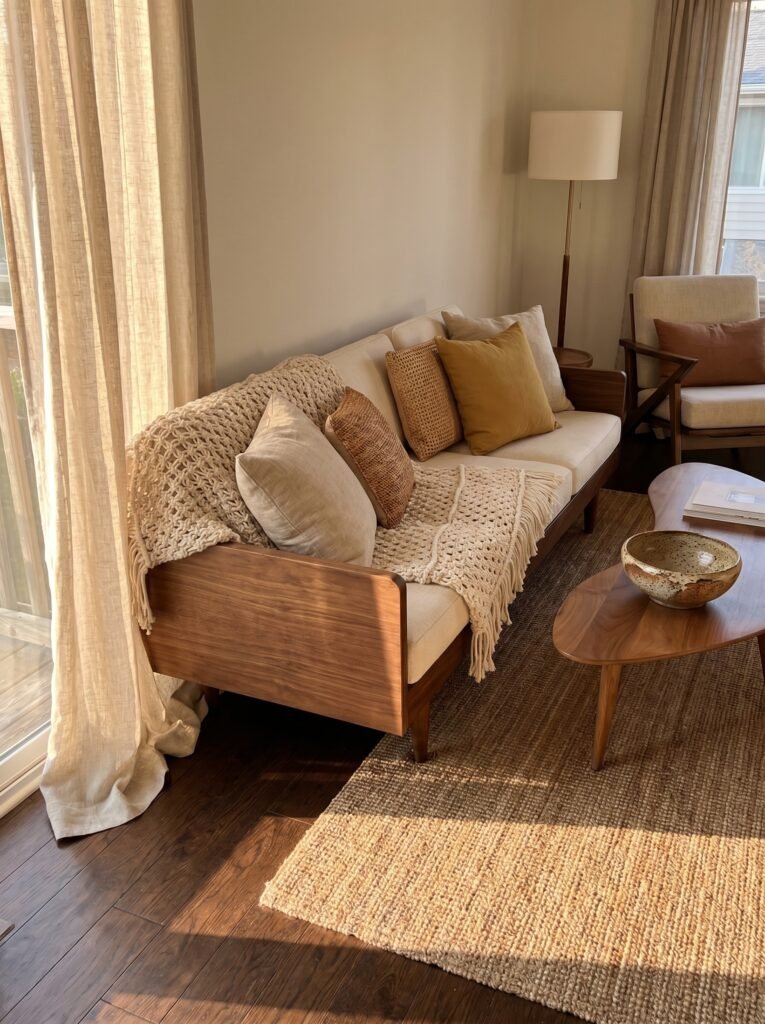
Pure MCM revival can sometimes tip into a kind of design museum feeling — beautiful to look at, but not quite comfortable to live in. The rooms that feel the most magnetic on Pinterest today are the ones that blend MCM with warm, personal touches from other aesthetics.
Bohemian textiles — a macramé throw, a woven cushion cover — add texture and human warmth to an otherwise clean MCM palette. Japandi elements (wabi-sabi ceramics, natural linen, negative space) align almost perfectly with MCM’s own philosophy of restraint and material honesty. Even a few modern contemporary pieces can coexist with MCM, provided they share the commitment to clean lines and quality materials.
What doesn’t mix well: maximalist patterns, heavily ornate traditional pieces, anything that introduces visual chaos into the room’s carefully constructed calm. The conversation between styles should feel like a quiet dialogue, not an argument.
—
12. Why the MCM Living Room Keeps Coming Back
Every few years, design publications announce the “return” of Mid-Century Modern as if it ever truly left. The truth is that this aesthetic has never stopped speaking to us because it addresses something deeper than trend — it addresses how we actually want to feel in our homes.
We want spaces that feel calm without feeling cold. Stylish without feeling precious. Warm without feeling cluttered. In a world that moves faster every year, the MCM living room offers something increasingly rare: a room that slows time, that makes you want to set your phone down and simply be present within it.
That’s not just good design. That’s design as a form of care.
—
🌿 How to Bring MCM to Life in Your Own Living Room
Starting an MCM living room transformation doesn’t require a complete overhaul — it requires intention. Begin with one anchor piece, typically a sofa or a credenza in walnut-toned wood, and let the rest of the room build from there. Let each addition earn its place before you bring in the next. Edit freely and often — MCM rewards restraint more than any other design style. Invest in quality materials where you can, even if it means buying less: one genuine walnut piece will age beautifully for decades, while cheap imitations lose their charm quickly. Finally, bring in a plant or two, let natural light in whenever possible, and resist the urge to fill every surface. The empty spaces in an MCM room are not voids — they’re part of the design.
—
❓ FAQ
Q: What colors work best in a Mid-Century Modern living room? A: Warm neutrals form the foundation — creamy whites, warm beige, soft greige. Layer in earthy accent tones like mustard yellow, burnt orange, avocado green, and terracotta. The palette should always feel warm and connected to the natural world rather than cool or clinical.
Q: Can I create an MCM living room on a budget? A: Absolutely. Thrift stores, estate sales, and vintage markets are treasure troves for authentic MCM pieces. Focus on a few key elements — tapered-leg furniture, a statement lamp, and a clean neutral palette — and build slowly. Even affordable MCM-inspired pieces from mainstream retailers can work beautifully when styled with intention.
Q: What plants suit a Mid-Century Modern living room best? A: Bold, sculptural plants work best — rubber plants, fiddle-leaf figs, monsteras, and snake plants all complement the aesthetic beautifully. Choose simple, textured ceramic or concrete pots in earthy tones rather than ornate planters, and give each plant enough space to be appreciated individually.
—
💭 Final Thought
A Mid-Century Modern living room is not just a design choice — it’s a quiet declaration that you believe your home should feel good, not just look good. It is a space built on the idea that beauty and function are not opposites, that warmth and sophistication can share a sofa, that the objects around you should bring you genuine pleasure each time you look at them.
So as you think about your own living room — wherever it is, whatever its size, whatever your budget — ask yourself this: what would it feel like to walk into a space that was designed, from the very first chair leg to the last ceramic vase, entirely for your comfort and joy?