
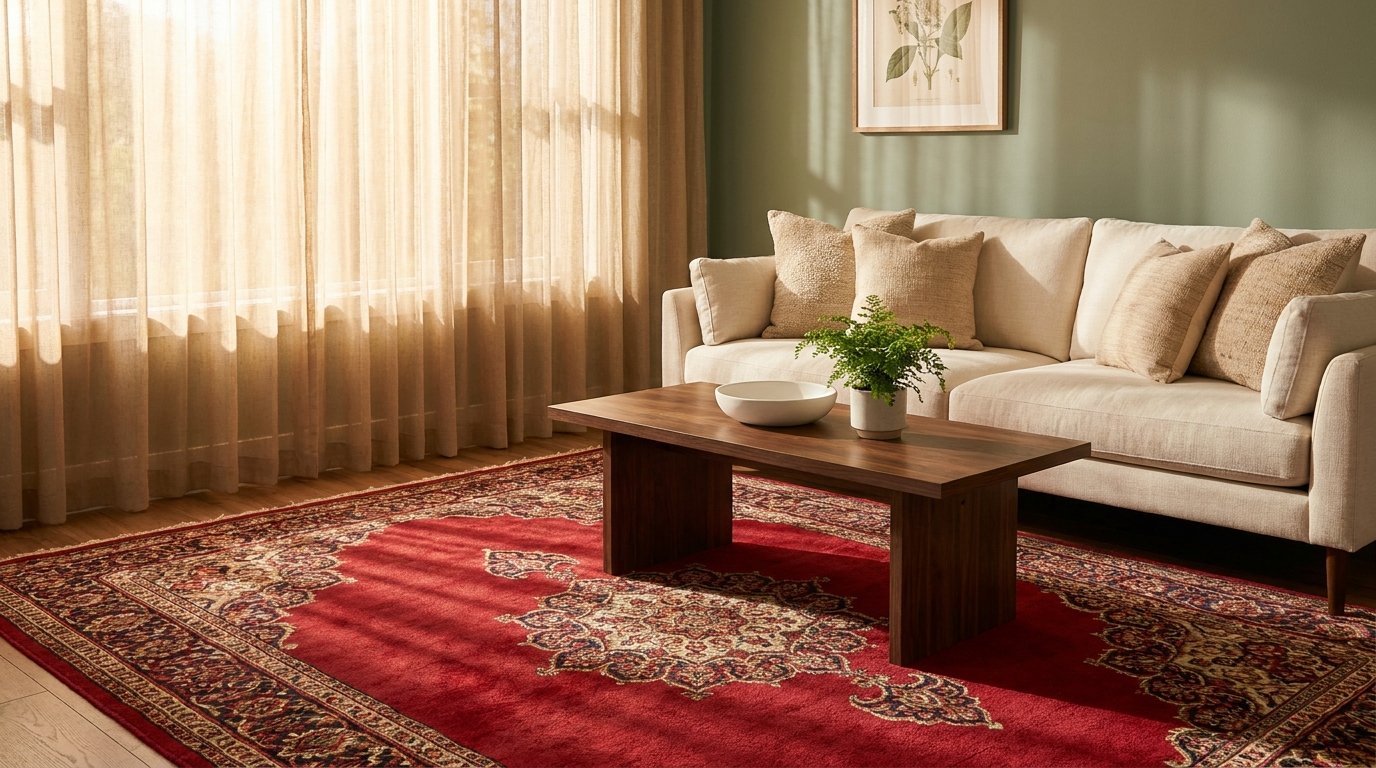
The Red Rug Living Room: How One Bold Choice Can Transform Your Entire Home
There’s a moment — maybe you’ve felt it — when you walk into someone’s living room and everything just stops you. Not because it’s fancy or expensive, but because it feels alive. More often than not, there’s a red rug anchoring it all, pulsing with warmth from the center of the room like a hearth that never goes cold.
—
1. Why a Red Rug Is the Most Emotionally Powerful Design Choice You Can Make
Interior designers have known for decades what psychologists are only now catching up to: color is not decoration. Color is communication. And red, above all other colors, speaks loudest.
A red rug in a living room does something that no piece of furniture, no gallery wall, no statement lamp can quite replicate — it grounds the entire space in warmth. It tells every person who walks through the door: this is a home where people gather, where conversation flows, where you are welcome to stay a little longer.
Red sits at the far end of the visible light spectrum, and our brains are wired to respond to it. It raises our pulse just slightly, makes us feel more present, more engaged, more alive. When that energy is translated into a soft, textured rug beneath your feet, it becomes something genuinely magical — stimulating enough to excite, but cushioned enough to feel safe.
“A red rug doesn’t just fill a room — it gives a room a reason to exist.”
The best part? You don’t need a decorator’s eye or a designer’s budget to make it work. You need intention, a little knowledge, and the courage to stop playing it safe with beige.
—
2. The Hidden History of Red Rugs — and Why They Never Go Out of Style

Long before Pinterest boards and interior design blogs, red rugs were symbols of status, hospitality, and craft. Persian weavers spent months — sometimes years — hand-knotting rugs in rich crimson and scarlet, using natural dyes from madder root and pomegranate rinds. These weren’t floor coverings. They were heirlooms.
In Moroccan homes, deep red wool rugs called Beni Ourain variants were laid out for honored guests. In colonial American parlors, a red woven rug near the fireplace was a sign that the family valued warmth and welcome above all else. In Victorian drawing rooms, jewel-toned Turkish rugs in burgundy and ruby anchored heavy wooden furniture with a sense of grandeur.
What’s remarkable is that despite centuries of shifting design trends — from Baroque to mid-century modern to Scandinavian minimalism — the red rug has survived every single wave. It adapts. It evolves. It belongs everywhere from a rustic farmhouse to a sleek contemporary apartment because it taps into something ancient in us: our love of fire, warmth, and gathering.
—
3. Choosing the Right Shade of Red for Your Living Room Personality
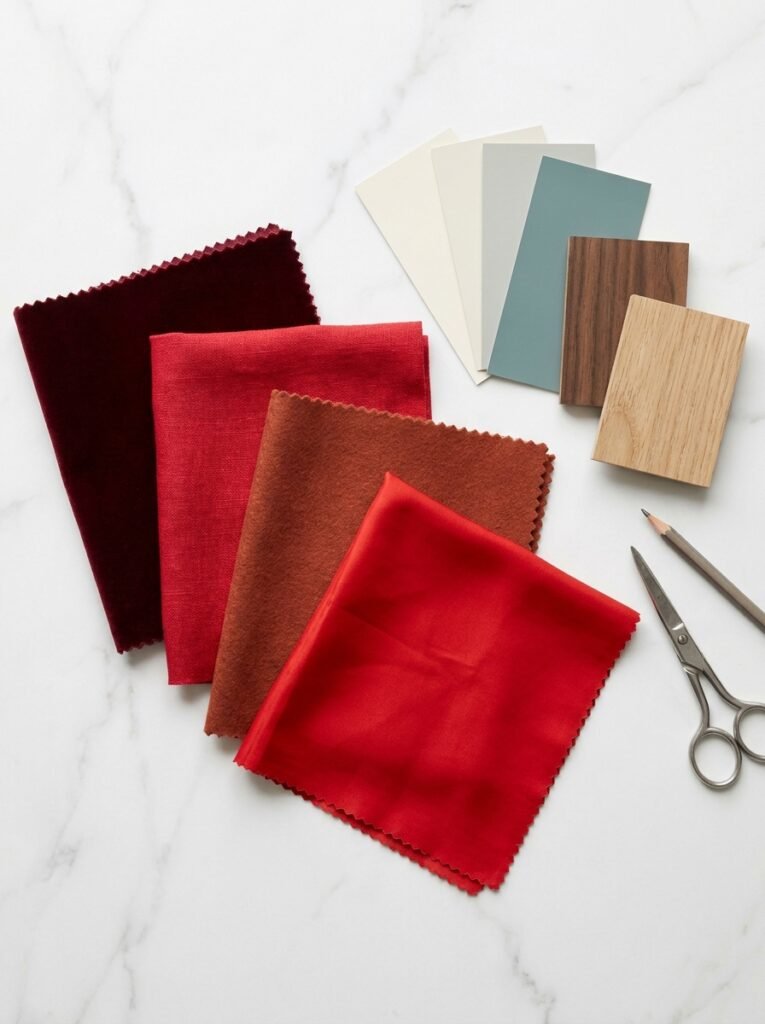
Here’s something that trips up almost everyone who attempts a red rug living room: not all reds are the same. The shade you choose will tell a completely different story, and choosing the wrong one for your space can make the room feel chaotic instead of cohesive.
Burgundy and wine tones are rich, moody, and sophisticated. They pair beautifully with dark walnut furniture, forest green accents, and cream-colored walls. If your living room has low light or north-facing windows, burgundy adds depth without overwhelming — it whispers rather than shouts.
True red — cherry or fire engine red — is confident and contemporary. It loves bright white walls, natural wood, and the clean lines of modern furniture. This is the red that energizes a room, that makes a small apartment feel like a deliberate design statement rather than an afterthought.
Rust and terracotta reds have had their moment in recent years and show no signs of stepping back. They feel earthy, grounding, and endlessly cozy. Rust rugs work with boho-layered interiors, natural rattan, linen sofas, and dried pampas grass — the whole aesthetic practically builds itself around them.
Crimson and scarlet lean theatrical. They pair best with bold, maximalist interiors — gold accents, velvet sofas, dramatic curtains. If you want your living room to feel like a luxurious European salon, this is your red.
Take a paint chip. Hold different fabric swatches near your walls, your sofa, your existing wood tones. The right red will make everything around it look richer, not competed with.
—
4. The Living Room Layouts That Make a Red Rug Look Intentional — Not Accidental
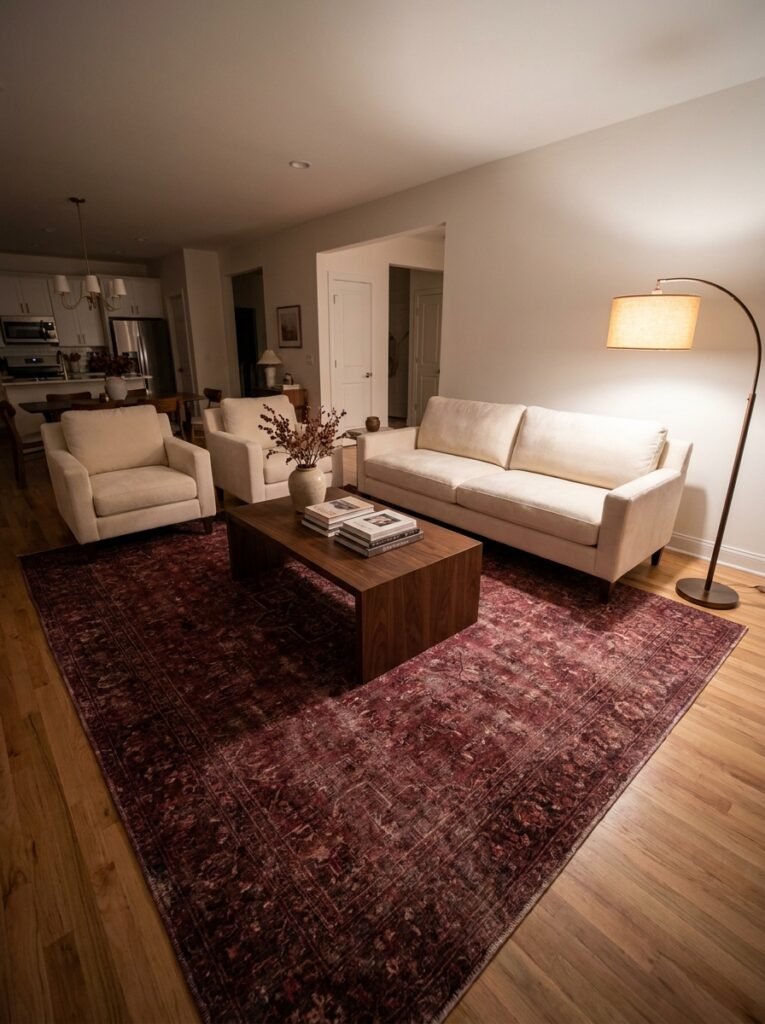
Placement matters more than people realize. A beautiful rug in the wrong position can make a room feel disjointed; the same rug, moved six inches in any direction, can pull everything together with satisfying precision.
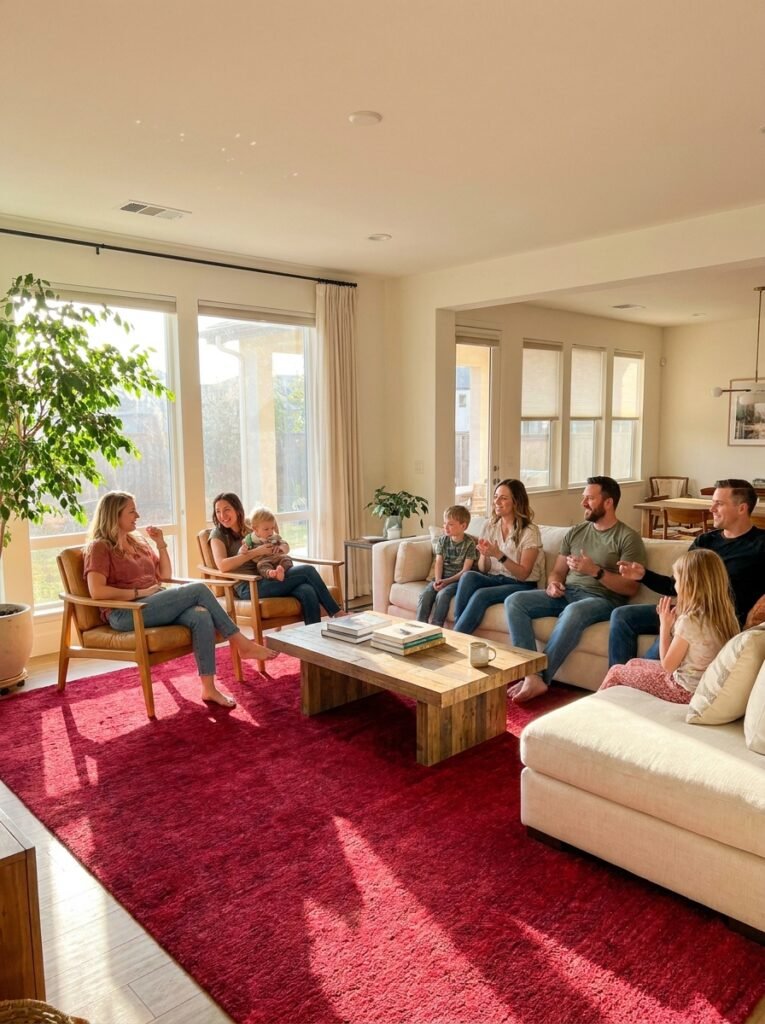
The most common — and most effective — approach is the two legs on, two legs off rule. Place the front two legs of your sofa and chairs on the rug, leaving the back legs off. This creates visual connection between your seating area and the rug without requiring an enormous piece.
For open-plan living rooms, a red rug serves a structural function: it defines the “living” zone. In spaces without walls to anchor furniture, the rug does that work — it says, clearly and quietly, this is where we gather. Keep your coffee table fully on the rug, and arrange your seating around its perimeter.
“The rug isn’t just decor — it’s the blueprint your furniture follows.”
If your living room is small, resist the urge to go tiny with your rug. A small rug in a small room makes the space look even smaller, like furniture floating on islands of bare floor. Go larger than you think you need. A generous red rug in a compact room creates the illusion of expansion while adding enormous warmth.
—
5. What Wall Colors Actually Work with a Red Rug (And What to Avoid)

This is the question that sends most people straight to Pinterest in a panic — and rightfully so. The wall color you choose either becomes a red rug’s best friend or its worst enemy.
White and off-white walls are the safest and most versatile backdrop. Crisp white makes red pop with energy and confidence. Soft off-white or warm ivory lets the red breathe without competing, which works especially well with rust and burgundy tones.
Sage green and olive are extraordinary companions to red rugs — they’re color wheel opposites, which means they don’t clash; they harmonize. The earthiness of sage with the warmth of red creates a living room that feels like it grew organically, like it was always meant to look exactly this way.
Navy and deep blue walls with a red rug is a combination that sounds daring but delivers stunning results. Think classic Americana, nautical richness, or European library vibes — the contrast is sophisticated and deeply satisfying.
Gray can work with true red, but be careful. Cool gray walls and warm red rugs can create visual dissonance. If you love gray, lean toward a warm greige (gray-beige hybrid) rather than a blue-toned silver.
Avoid pairing red rugs with orange-heavy walls, as the tones compete rather than complement. And steer clear of purple-adjacent walls unless you’re intentionally going for a bold, maximalist statement — even then, proceed carefully.
—
6. The Furniture Colors That Complement a Red Rug Beautifully
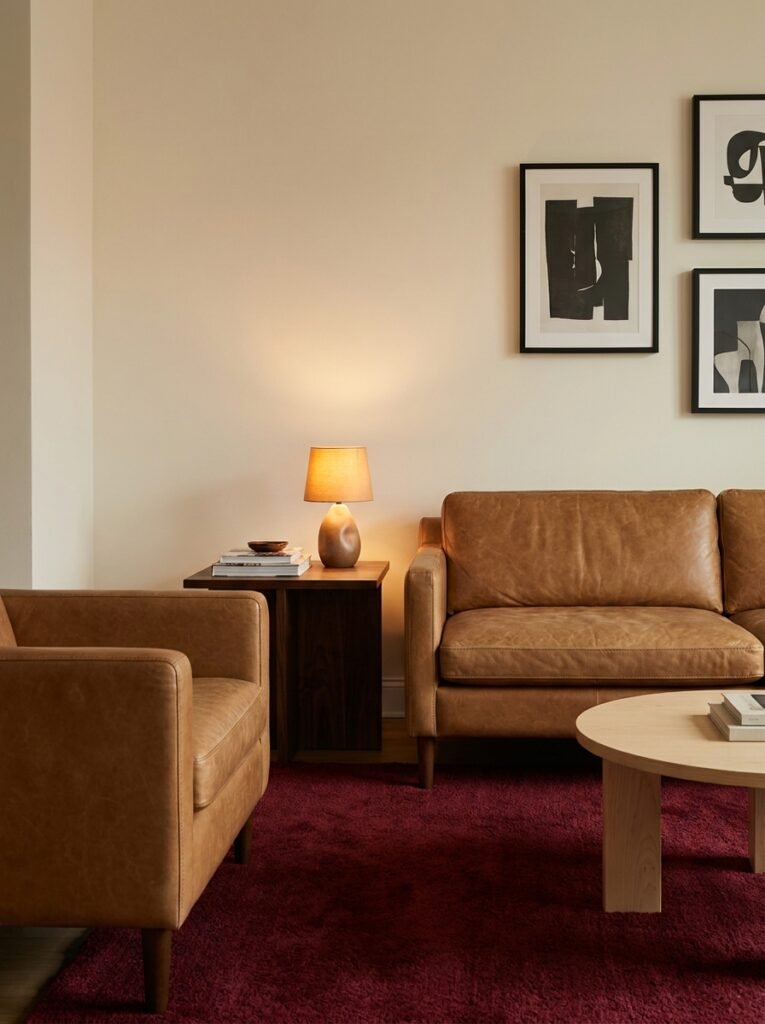
A red rug is strong — which means your furniture doesn’t need to fight for attention. In fact, the rooms that look best tend to let the rug lead and dress the furniture as supporting cast.
Neutral sofas — cream, oatmeal, warm gray, or camel leather — work effortlessly with red rugs. The contrast is clean and purposeful. A cream linen sofa over a burgundy rug has an almost editorial quality, like something from a design magazine that you’d save immediately.
Dark wood furniture in walnut, espresso, or mahogany deepens the richness of a red rug, creating a warmth that feels ancestral and layered. If you love antique or vintage furniture with dark finishes, a red rug is practically made for you.
Natural wood in lighter tones — pine, oak, birch — creates a Scandinavian-inspired balance. The lightness of the wood keeps the red from feeling heavy, while the red brings life to what might otherwise feel too cool and minimal.
Black furniture and accents against a red rug is bold and graphic — great for modern or art deco interiors. A black console table, black-framed art, and a red rug create a visual rhythm that feels composed and deliberate.
—
7. Textures and Patterns: How to Layer Without Overwhelming
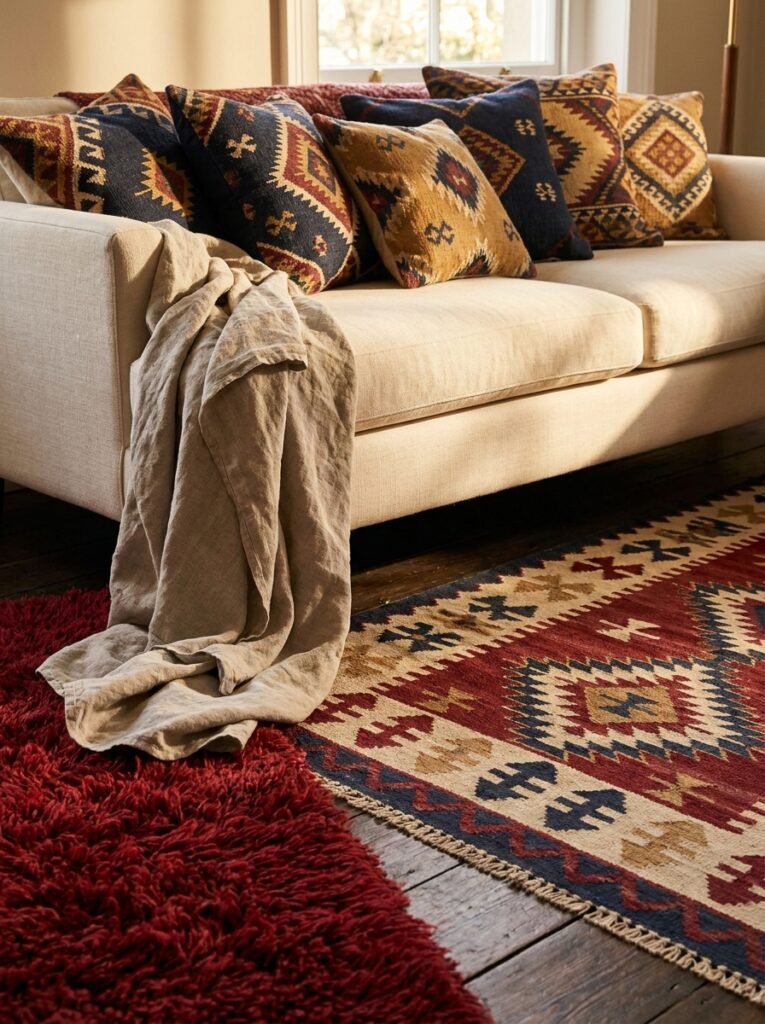
The texture of your red rug matters almost as much as the color itself. A flat-weave kilim in red geometric patterns reads completely differently than a plush shag rug in deep crimson — and both have their place.
Kilim and flatweave rugs with traditional patterns in red, cream, and navy bring heritage and storytelling to a living room. They’re visually busy in the most beautiful way — every corner holds a pattern you haven’t fully explored yet. These work especially well in boho and globally-inspired interiors.
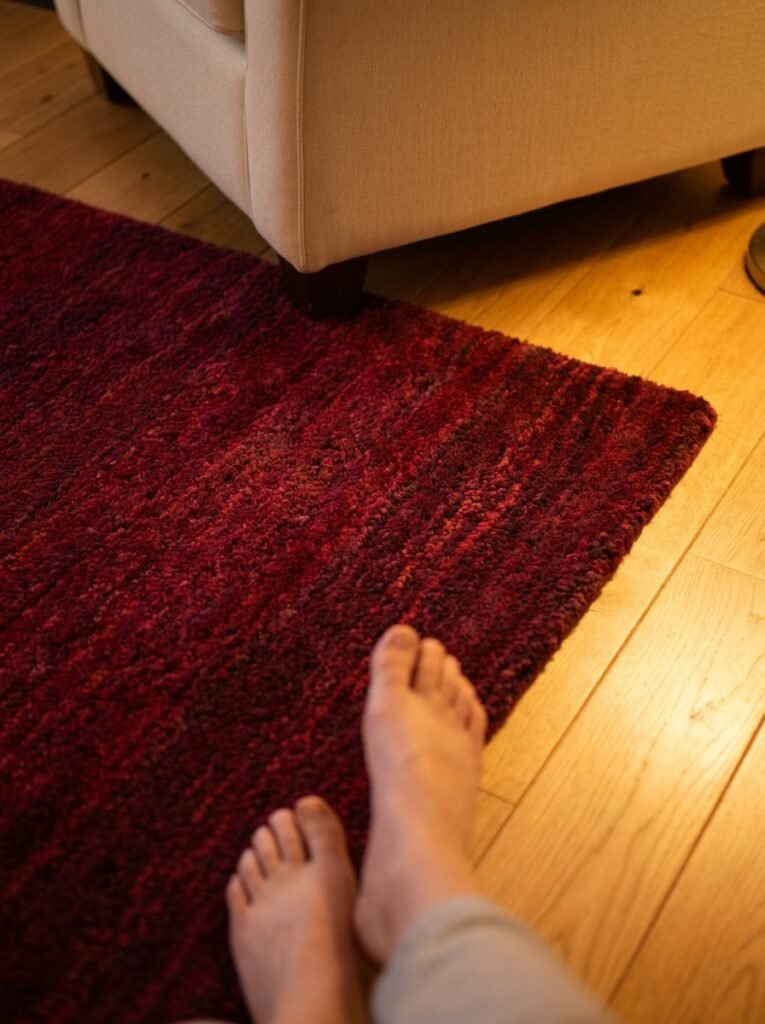
High-pile and shag rugs in red are pure tactile indulgence. They invite you to kick off your shoes, to sit on the floor with a book, to let children build blanket forts on top of them. The texture softens the boldness of the red and adds a dimension of coziness that flat rugs simply can’t match.
Persian and Oriental-style rugs in red are the classics — the ones that inspired every other red rug that came after. Their intricate medallion patterns and botanical motifs bring an irreplaceable sense of history and artistry to a room.
“Texture is the secret language of cozy — and a red rug speaks it fluently.”
When layering other textiles in a red rug living room, reach for neutral throws, patterned cushions in complementary tones, and curtains that echo one of the rug’s secondary colors. The goal is layered richness, not visual noise.
—
8. Lighting Secrets That Make Your Red Rug Glow
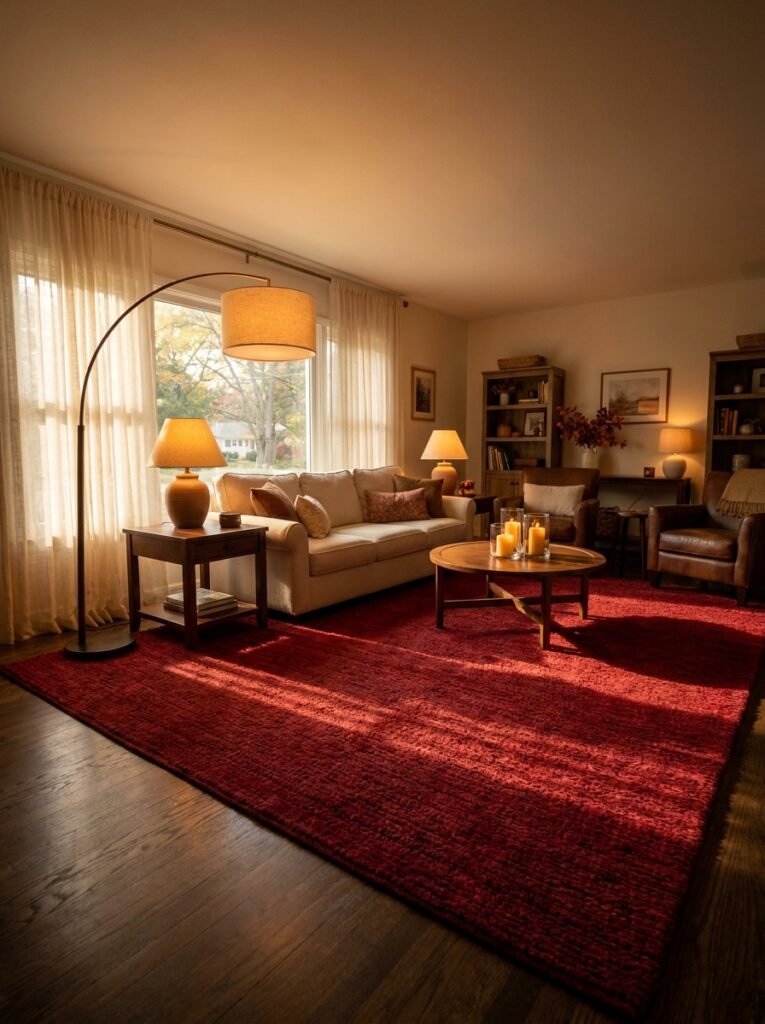
Lighting changes everything — and nowhere is that more true than in a red rug living room. The wrong light can make your rug look muddy, faded, or aggressively harsh. The right light makes it look like a painting you’d never want to leave the room.
Natural daylight is a red rug’s best companion during the day. If your living room has good natural light, position your rug where sunlight touches it in the morning or late afternoon — the way light moves across red fabric in those golden hours is genuinely breathtaking.
For artificial lighting, warm-toned bulbs (2700K–3000K) enhance red beautifully, deepening burgundy tones and giving true red a rich, luminous quality. Avoid cool daylight bulbs — they flatten red into something almost unpleasant.
Floor lamps placed near the edges of the rug create pools of warmth that draw the eye down, highlighting the rug’s texture and color. Table lamps on side tables just off the rug’s perimeter extend the warmth outward without flooding the space with harsh overhead light.
Candles — real or high-quality flickering LED — placed on the coffee table above a red rug create an atmosphere that no lighting fixture can fully replicate. There’s something primal about firelight above a red rug that taps into that ancient love of warmth and gathering.
—
9. Red Rugs in Small Living Rooms: Why Less Space Actually Helps
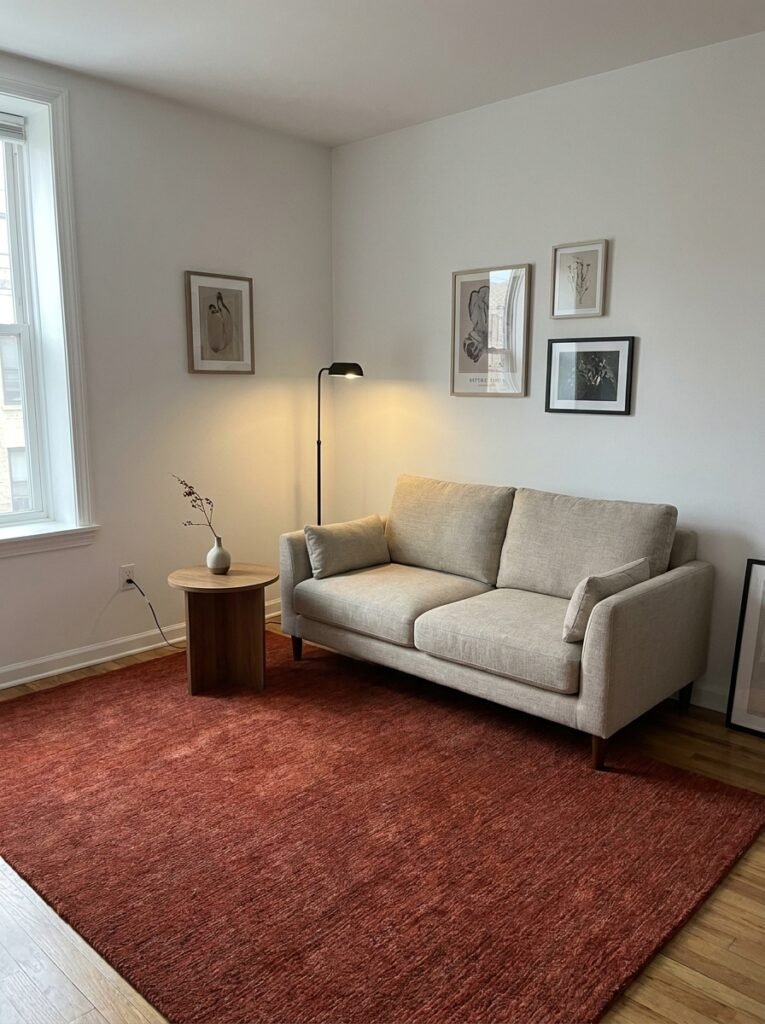
Many people with small living rooms hesitate over a red rug, worried it will make the space feel smaller or more chaotic. The opposite is often true — and here’s why.
In a small living room, you have fewer elements competing for attention. A red rug in a compact space becomes the anchor, the focal point, the entire design story. Everything else — the small sofa, the minimal side table, the single floor lamp — becomes a supporting character. The rug gives the room a reason to exist.
The key is keeping everything else simple. If the rug is bold, the walls should be calm. If the rug carries pattern and history, keep your textiles solid. Let the rug be the one voice speaking clearly, and let the rest of the room listen.
In small apartments especially, a red rug signals intention. It says: I thought about this space. I made choices here. This may be small, but it is designed. That quality — intentionality — is what separates a room that looks put-together from one that simply looks full.
—
10. Styling the Coffee Table Over a Red Rug: The Art of Restraint
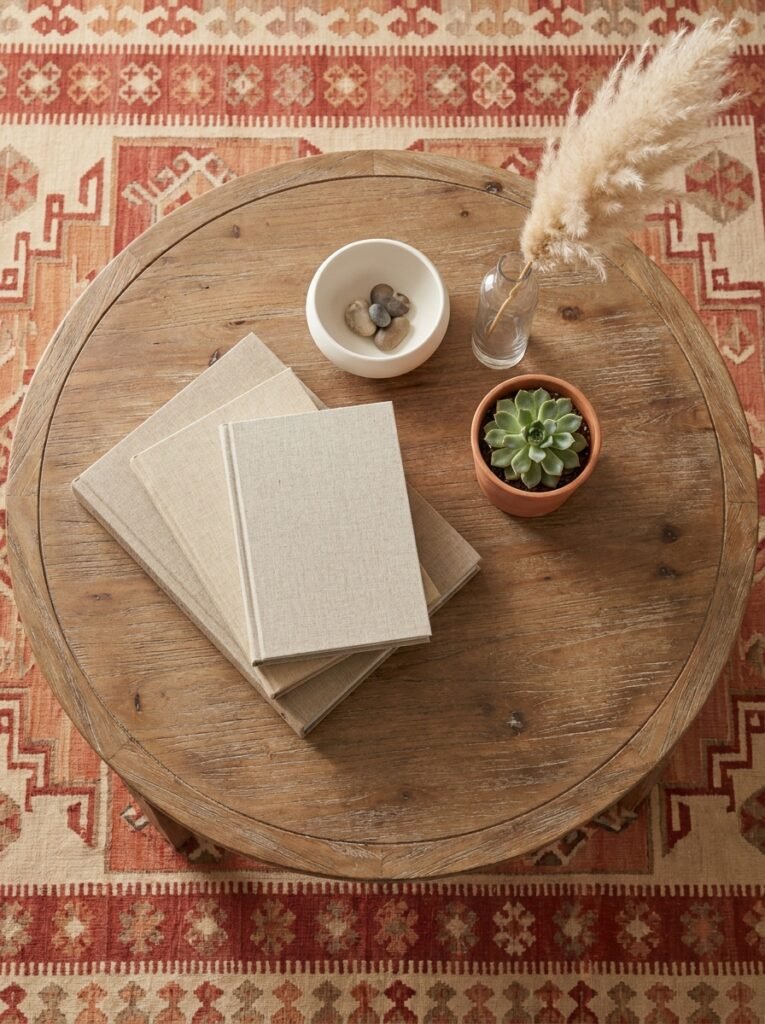
The coffee table that sits above your red rug is prime visual real estate — and what you place on it can either elevate the rug or compete with it unnecessarily.
Think in terms of height variation, natural materials, and calm colors. A stack of coffee table books in neutral covers, a small ceramic bowl, a single stem in a thin glass vase — these elements breathe alongside a red rug rather than talking over it.
Avoid overly colorful or pattern-heavy coffee table decor when your rug is already patterned. Red geometric kilim beneath a chaotic styling arrangement creates visual anxiety rather than visual joy. Choose objects with clean lines and natural textures — wood, stone, ceramic, linen.
Greenery is one of the most powerful tools you can use in a red rug living room. A small potted plant on the coffee table — even a single succulent — brings a living quality to the space and creates a natural color contrast with the red that feels effortless and organic.
—
11. How to Make a Red Rug Work in a Modern Farmhouse or Minimalist Home
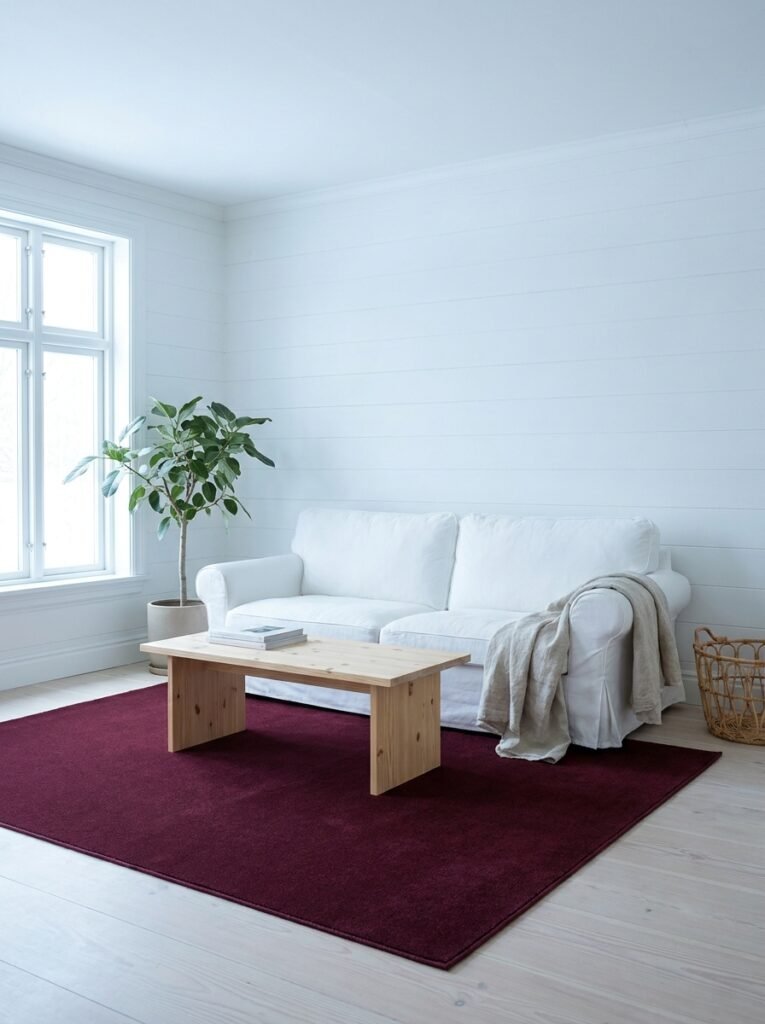
Here’s the design conversation nobody is having enough: red rugs are not just for traditional or maximalist interiors. With the right approach, a red rug can feel perfectly at home in a Scandinavian minimalist space, a clean modern farmhouse, or a pared-back contemporary apartment.
In a modern farmhouse, a flat-weave red rug with simple stripe patterns works beautifully beneath a shiplap-adjacent aesthetic. Keep your furniture in white or light natural wood, add a single woven basket and a linen throw, and the red rug brings warmth without disrupting the simplicity.
In a minimalist interior, a solid deep red or burgundy rug with no pattern becomes almost sculptural — a bold decision in a quiet room. Against white walls and furniture in natural materials, the rug acts as a color punctuation mark: everything else is a sentence, and the rug is the period.
The secret is editing ruthlessly. In a minimal space, the rug gets to be the one emotional element. Honor it by keeping the rest of the room intentionally restrained.
“In a quiet room, a red rug doesn’t shout — it sings.”
—
12. The Long-Term Investment: Why a Quality Red Rug Pays for Itself
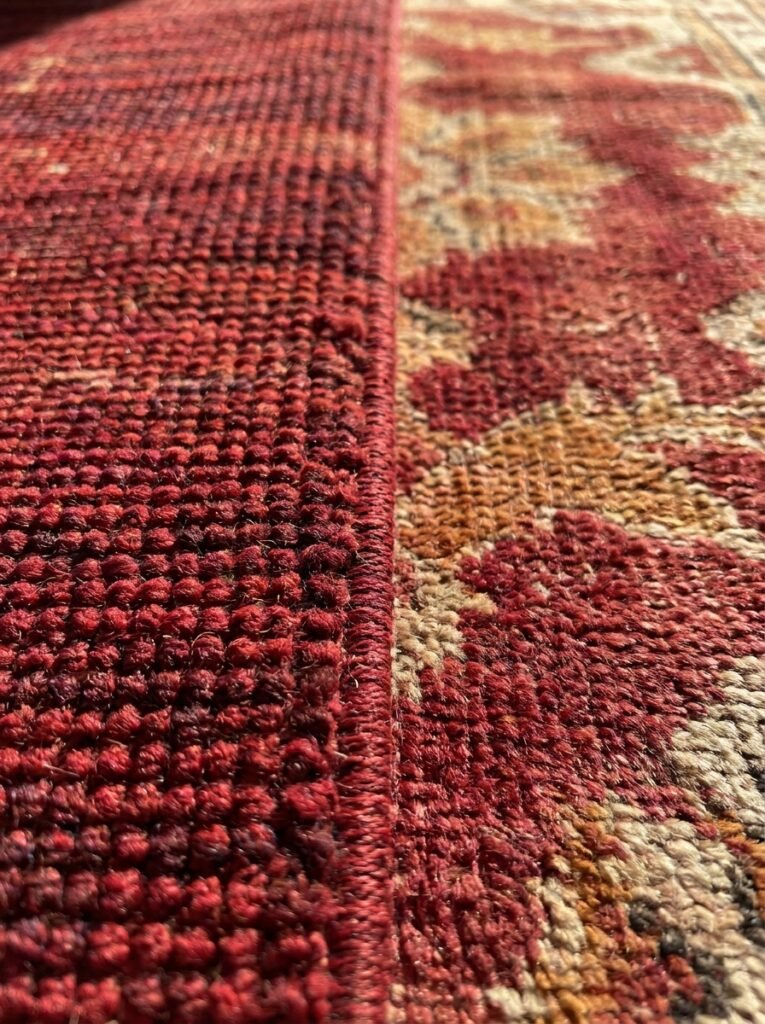
A quality rug — one made with genuine craftsmanship, whether hand-knotted wool, hand-tufted, or high-quality flatweave — is not a purchase. It’s an investment in the atmosphere of your home for years, even decades, to come.
Wool rugs are naturally resilient, easy to clean, and grow more beautiful with age — the colors soften and deepen rather than fading into dullness. A well-made wool red rug that you pay more for today will outlast three or four cheaper synthetic alternatives, and it will look better at year five than it did at purchase.
Red, perhaps counterintuitively, is one of the most forgiving rug colors in terms of showing stains and daily wear. Its depth and richness conceal what lighter rugs expose, which makes it particularly practical for families, for homes with pets, and for anyone who actually lives in their living room rather than simply decorating it.
Buy the best quality you can afford. Look for hand-knotted construction when possible. Consider antique or vintage Persian rugs — they’re often available at surprisingly accessible price points at estate sales, auctions, and marketplaces, and they bring decades of character that no new rug can replicate.
—
🌿 How to Take Care of Your Red Rug Living Room
Owning a red rug is a little like tending a garden — the investment of small, consistent care returns something far larger in beauty and longevity.
Rotate your rug every six months. Traffic patterns and sunlight exposure wear rugs unevenly. Rotating distributes that wear across the whole surface and prevents one section from fading more than the rest.
Vacuum gently and regularly. For wool and high-pile rugs, use a vacuum without a beater bar or set it to the gentlest setting. Aggressive vacuuming can pull fibers and damage the pile over time. Once or twice a week is sufficient for most households.
Address spills immediately and calmly. Blot — never rub — with a clean white cloth. Rubbing spreads the stain and damages fibers. For most spills, cool water and a mild dish soap solution is sufficient. For wool rugs especially, avoid harsh chemical cleaners.
Lay a quality rug pad underneath. This is non-negotiable. A good rug pad prevents slipping, adds cushioning, protects both the rug and your floor, and extends the life of your rug by reducing the friction and tension that comes from being walked on daily.
Have it professionally cleaned every one to two years. Even with perfect home care, deep cleaning by a professional rug cleaner removes embedded grit and dust that vacuuming simply can’t reach — and it restores the richness of the color in ways that will genuinely surprise you.
—
❓ FAQ
Q: Will a red rug make my living room feel smaller? A: Not if you choose the right size. A rug that’s too small for your seating area is what makes rooms feel cramped and disconnected. Size up — a generous red rug in an appropriately proportioned size will actually make your living room feel more grounded and expansive, because it gives the eye a clear focal point rather than floating furniture on bare floor.
Q: Can a red rug work in a rental apartment where I can’t paint the walls? A: Absolutely — and this is actually one of the best use cases for a bold red rug. When your walls are a landlord’s white or off-white, a red rug immediately brings personality, warmth, and identity to a space that would otherwise feel generic. It’s the single most impactful change you can make to a rental without touching anything permanent.
Q: How do I keep a red rug from fading in a sunny living room? A: UV exposure is the main culprit in rug fading. Use sheer curtains or UV-filtering window film to diffuse direct sunlight. Rotate your rug every six months to ensure even, minimal fading across the whole surface. Natural wool rugs are generally more fade-resistant than synthetic alternatives, and vegetable-dyed rugs age gracefully into softer, more antique-looking tones rather than fading harshly.
—
💭 Final Thought
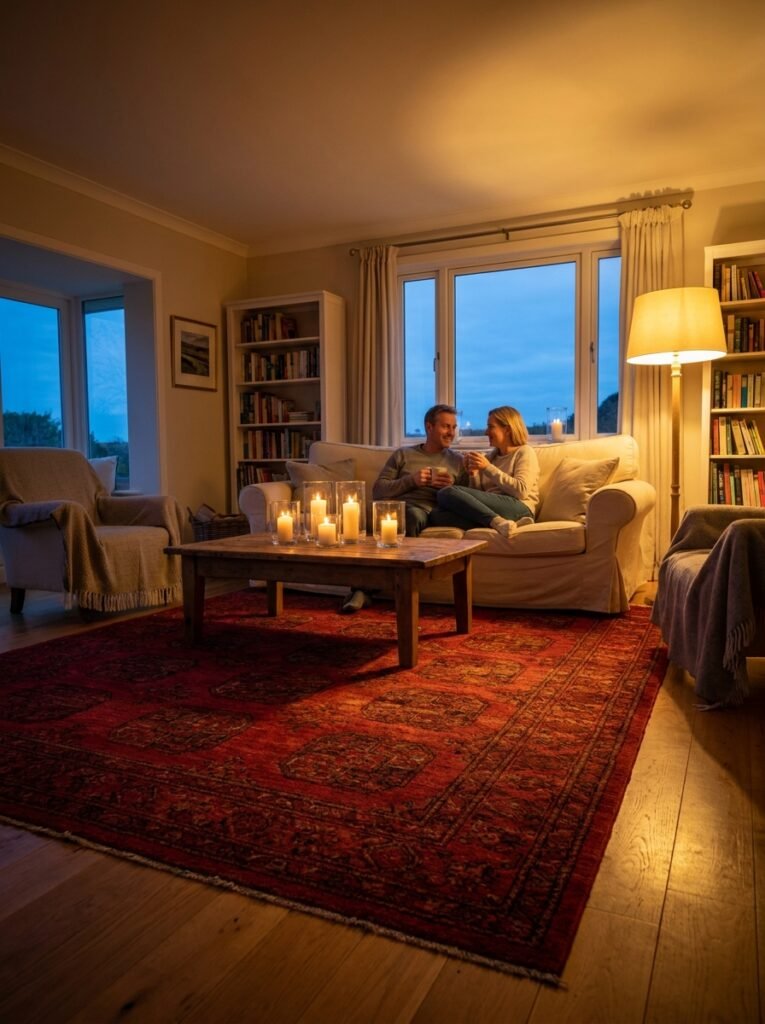
A red rug living room is not a trend to chase or a risk to take. It is, at its heart, an act of choosing warmth — choosing to create a space where people feel welcomed, where conversation lingers a little longer, where the ordinary Tuesday evening somehow feels like something worth remembering. Every home deserves a room that feels this alive.
So here’s the question worth sitting with: what would it feel like to walk into your own living room every single day and feel genuinely moved by it?